Bài giảng Cultural patterns and communication | Trường Đại học Khoa học Xã hội và Nhân văn, Đại học Quốc gia Thành phố Hồ Chí Minh
Bài giảng Cultural patterns and communication | Trường Đại học Khoa học Xã hội và Nhân văn, Đại học Quốc gia Thành phố Hồ Chí Minh. Tài liệu được sưu tầm giúp bạn tham khảo, ôn tập và đạt kết quả cao. Mời bạn đọc đón xem.
Môn: Giao tiếp liên văn hóa 7 tài liệu
Trường: Trường Đại học Khoa học Xã hội và Nhân văn, Đại học Quốc gia Thành phố Hồ Chí Minh 1.2 K tài liệu
Tác giả:



















Preview text:
CULTURAL PATTERNS and COMMUNICATION
• Cultural patterns = unseen but shared expectations about what people say and do
• Cultural patterns are primarily in people’s mind but the
consequences of cultural patterns can be seen in
people’s communication behaviors.
→ Cultural patterns are invisible differences that characterize cultures
• Cultural patterns are the basis for interpreting the symbols used in communication
• Understand differences in cultural patterns
→ Develop competence in intercultural communication
Six fundamental patterns of cultural differences
• Different communication styles
• Different attitudes towards conflict
• Different approaches to completing tasks
• Different decision-making styles
• Different attitudes towards disclosure
• Different approaches to knowing Cultural Taxonomies
• Cultural Taxonomy = a description of cultural patterns,
an approach to understanding the range of cultural differences
• There are some useful approaches to understanding culture.
Each approach takes the whole of cultural patterns (beliefs,
values, norms, social practices) and divides them in different ways
• Individual members of a culture may vary greatly from the
pattern that is typical of that culture.
A specific person may or may not be a typical representative of that culture
Hall’s Cultural Taxonomy
• Edward T. Hall – an American anthropologist and
cross-cultural researcher - made early discoveries of key cultural factors
• He suggested the setting or context of the
communication as one dimension by which we can understand cultures
• His framework answers the question, “Where does meaning lie?” Context
• Hall suggested that to understand communication one
should look at meaning and context together with the
code (i.e., the words themselves)
• Context = the information that surrounds an event; it is
inextricably bound up with the meaning of that event.
• Context = the situation, background, or environment
connected to an event, a situation, or an individual.
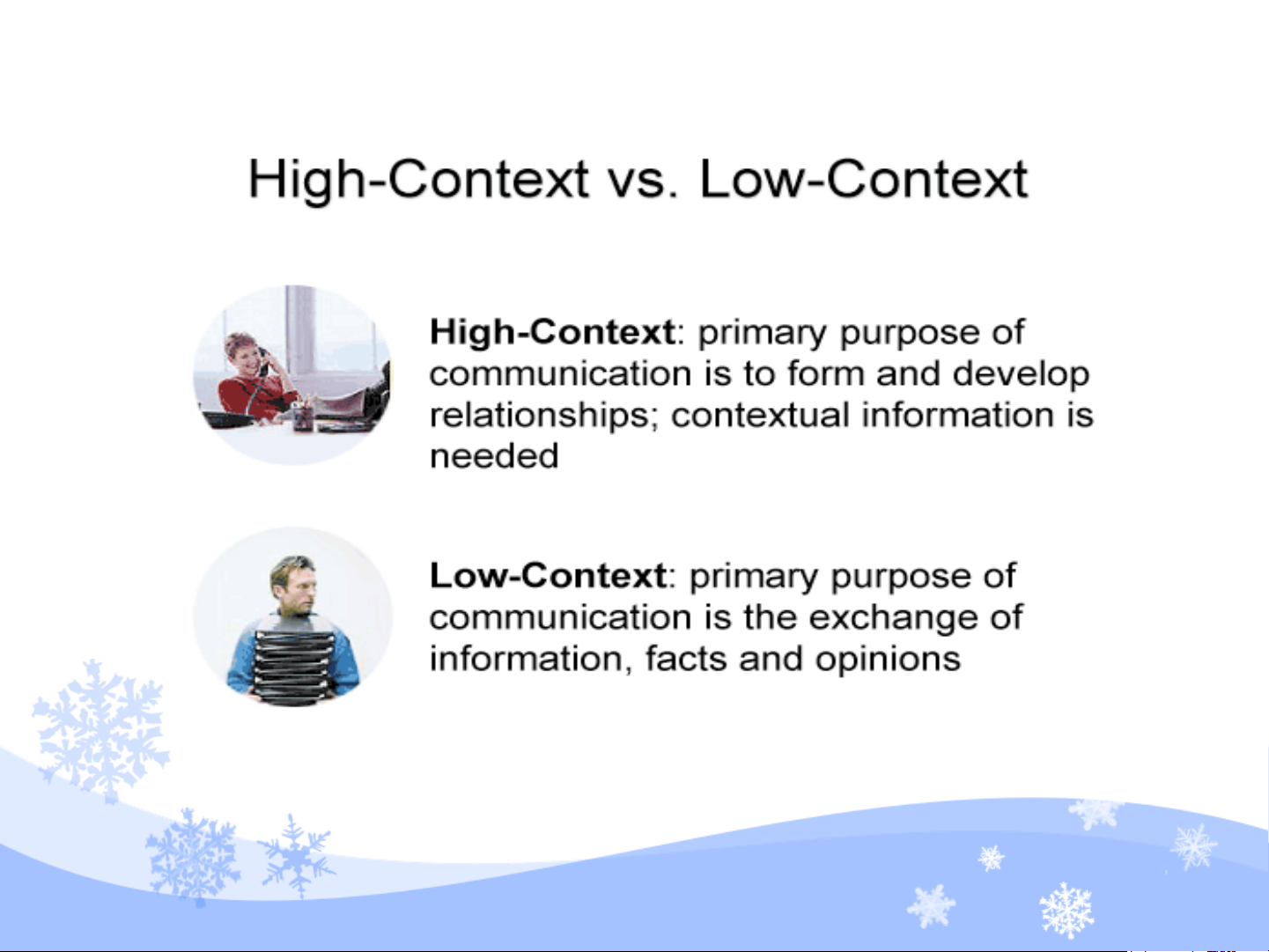
• High-context and low-context communication refer to
how much speakers rely on things other than words to convey meaning
• In a high context message, meaning is in the situation and
the background, roles, and relationships of the speakers
The higher the context, the more meaning wil be hidden in
shades of word meaning and nonverbal behavior
• In a low-context message, meaning is in the actual words
The lower the context, the more direct the message is
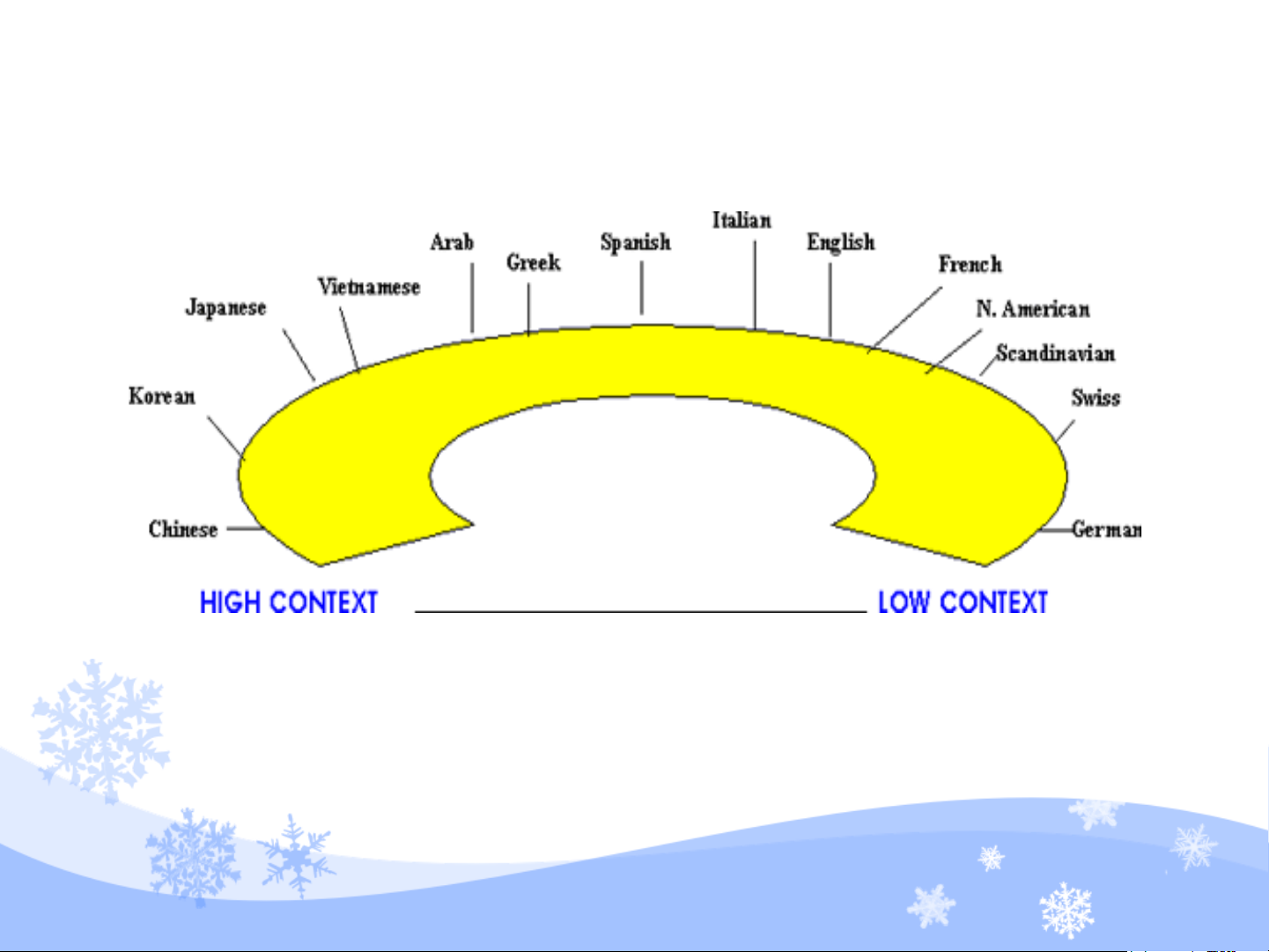
Cultures differ on a continuum that ranges from high to low context
“The cultures of the world can be compared on a scale from high to low context” (Hall, 1990:6)
• Some cultures value a high-context communication style
while others value a low context style
• High context cultures are more common in - eastern nations
- countries with low racial diversity • High context cultures
- have a strong sense of tradition & history - change little over time
1. Overtness of Messages Low-context cultures High-context cultures
• Many overt and explicit
• Many covert and implicit messages messages
• Prefer clear descriptions,
• Use of metaphor and reading
unambiguous communication between the lines
and are highly specific
• More focus on verbal • Much nonverbal
communication than body
communication. What’s not
language. Rely on the spoken
said is often more important or written words than what is said
2. Cohesion and separation of groups High context cultures Low context cultures • One distinguishes between • Many people can be inside people inside and people one's circle; circle's outside one's circle. boundary is not clear.
• One's identity is rooted in
• One's identity is rooted in groups (family, culture, oneself and one's work). accomplishments
• Loyalties to families and to • The extent of involvement
one’s social & work groups and commitment to long- are long-lasting and term relationships is lower unchanging
People bonds (Relationships) Low context cultures High context cultures
• Relationships begin and end
• Relationships depend on trust, quickly. build up slowly, are stable.
• The bonds between people are • The commitment between very fragile . Group people is very strong and deep memberships change rapidly
• Things get done by following
• How things get done depends procedures and paying on relationships with people attention to the goal. People
and attention to group process. do not rely or trust relationships in business communication 3. Orientation to Time
• Chronemics = the study of human tempo in
communication (how we use time to communicate)
• Time can be seen as a structural framework for life
(e.g. “Time is money”), or as a natural course of life
(e.g. “There is a time for everything”)
• Hall clarified the level of difference in chronemics,
referring to a spectrum ranging between Monochronic
(M-time) and Polychronic (P-time)
Typical outward expressions in
Monochronic and Polychronic time settings Monochronic (M-time) Polychronic (P-time) Time is money Time is the servant of people
Time is a commodity and can be
Time is not a commodity; there is gained or lost always more time
Structure and order are central
Relationships and people are central Strict schedules and plans Flexible schedules and plans
One task at a time, linear order, no
Multi-tasking, cyclical order, priority interruptions adjustable Emphasis on punctuality, task- Emphasis on a harmonious orientation relationship High context cultures Low context cultures • High context people • Low context people tend to be polychronic tend to be monochronic (flexible with time) (strict with time) • E.g. Latin America, the • E.g. the U.S., Israel, Middle East, and Africa, Germany, and Aboriginal and Native Switzerland Americans So what?
• When working across cultures, pay attention to high and low
context cultures through the actions of others.
When you understand the personal, national or
organizational culture, then you can seek to align with them
and hence gain greater influence
• No cultures or people are exclusively monochronic or
polychronic. All of us need both to survive Remember!
• Few cultures, and the people in them, are totally at one end
of the spectrum or the other. They usually fall somewhere in
between and may have a combination of high and low context characteristics.
• All cultures have high- and low-context situations, though
there may be cultural preferences toward one mode or the other
• Co-cultures, organizations, or families may differ in the
general level of context people rely on
• Every individual uses both high-context and low context
communication. Often, the types of relationships we have
with others and our circumstances will dictate the extent to
which we rely more on literal or implied meanings.
HOFSTEDE’S CULTURAL TAXONOMY
• Geert Hofstede, a researcher in the fields of organizational
culture, surveyed the employees at the multinational company IBM
in more than 70 countries and identified 5 dimensions or
characteristics of national culture that affect communication: - Power distance - Uncertainty avoidance
- Individualism vs. Collectivism - Masculinity vs. Femininity
- Long-term vs. Short-term orientation to time
• These dimensions represent the basic concerns of all cultures
• Each country receives a score on each dimension (Hofstede’s index)
Tài liệu liên quan:
-
Tiểu luận cuối kì | Giao tiếp liên văn hóa | Đại học Khoa học Xã hội và Nhân văn, Đại học Quốc gia Thành phố HCM
3.2 K 1.6 K -
Giới thiệu chung | Giao tiếp liên văn hóa | Đại học Khoa học Xã hội và Nhân văn, Đại học Quốc gia Thành phố HCM
395 198 -

Uncertainty Avoidance through Xenophobia in South Africa | Giao tiếp liên văn hóa | Đại học Khoa học Xã hội và Nhân văn, Đại học Quốc gia Thành phố HCM
379 190 -
IC - Final - Cultural Dimensions in Communication Hofstede's Framework | Giao tiếp liên văn hóa | Đại học Khoa học Xã hội và Nhân văn, Đại học Quốc gia Thành phố HCM
360 180