Journal
of
Food Protection, Vol. 46,
No.2,
Pages /35-141 (February 1983)
Copyright". International Association
01
Milk, Food, and Environmental Sannarians
135
Influence of Water Activity on Growth, Metabolic
Activities and Survival of Yeasts and Molds
LARRY
R.
BEUCHAT
Department
of
Food Science, University
of
Georgia Agricultural Experiment Station.
Experiment. Georgia
30212
(Received for publication June 24. 1982)
ABSTRACT
The behavior
of
yeasts and molds as influenced by water activ-
ity (a
w
)
is reviewed. Fungal spoilage
of
foods occurs more often
than bacterial spoilage at a
w
0.61-0.85 not because fungi grow
faster at reduced a
w
but rather because the competitive effects
of
the vast majority
of
bacteria are absent. Higher a
w
is
generally re-
quired for spore formation than for spore germination. The range
of
a
w
permitting germination
of
spores
is
greatest at
an
optimum
temperature, but optimum availability
of
nutrients tends
to
broaden the range
of
a
w
and temperature at which germination
and growth will occur. The minimum
a
w
levels for growth
of
fungi arc lower than those required for mycotoxin production.
It
is imperative that diluents and enumeration media with reduced
a
w
be used
to
detect xerotolerant fungi
in
foods. Otherwise, veg-
etative cells and spores may be killed by osmotic shock or remain
dormant when cxposed to high a
w
associated with diluents and
media routinely used for mycological analyses.
It
is
customary to refer to yeasts able to grow at low
water activity (a
w
)
as "osmophilic" (high osmotic pres-
sure-loving) and molds as
"xerophilic" (dry-loving), but
neither description
is
very accurate because
all
yeasts and
molds grow better at
aw
levels considerably higher than
their minimum for growth (18). Accordingly, I shall adopt
the terminology advanced by Corry in which "xerotoler-
ant"
will be used to describe both yeasts and molds that
are dry-tolerant.
It
is
my intention in this paper to review briefly the rela-
tions
of
a
w
and fungi. In particular, I will focus on the be-
havior
of
fungi at a
w
levels approaching and below those
required for growth. No attempt will be made
to
present a
comprehensive review but rather to summarize those fac-
tors influencing the behavior of fungi as affected by a
w
,
ADAPTATION
TO
REDUCED a
w
Fungal spoilage
of
foods occurs more often than bacte-
rial spoilage at a
w
levels
<0.85.
This
is
not because fungi
cannot grow at a
w
>0.85,
but rather because bacteria are
highly competitive at higher a
w
levels, and thus become
the predominant type
of
spoilage microflora at a
w
0.85-
1.00. Fungi are the predominant spoilage flora
of
stored
seeds and intermediate moisture foods, and
in
foods con-
taining high levels
of
sugar such
as
honey, syrups, jams,
confections and sugared fruits (33,35,41,44,61).
The minimum a
w
at which growth
of
fungi has been ob-
served is about
0.61. Contrary to general statements in the
literature concerning tolerance
of
fungi to low a
w
,
certain
species
of
yeasts
as
well
as
molds will grow, albeit slowly,
at a
w
0.62-0.70. von Schelhorn (71) reported a doubling
time of about two months for Saccharomyces rouxii
at
a
w
0.62 and Tilbury (68) reported visible fermentation by
yeasts at a
w
0.70. Tolerance to low a
w
can be gained or
lost in the presence or absence
of
high levels
of
solute;
however, tolerance of cells to high levels
of
given solute.
e.g.,
sucrose, does not necessarily correlate with a similar
degree
of
tolerance to another solute, Hydrogen ion con-
centration affects the ability
of
fungi
to
adapt
to
low a
w
levels (28,64), as does the presence
of
other ions, avail-
ability
of
nutrients and temperature.
The lower a
w
limit for growth of fungi depends in part
upon the characteristics
of
solutes accumulated within cells
when exposed to external environments with reduced
a
w
Brown (10) referred to solutes capable
of
replacing cellular
water without impairing normal functioning
of
the cell
as
"compatible."
Intracellular accumulation
of
such solutes
counteracts the osmotic imbalance across the cell mem-
brane at low
a
w
Compatible compounds include amino
acids such
as
proline, -y-aminobutyric acid and glutamic
acid
in
bacteria (24,39), and polyaIcohols (polyols) in
fungi
(10-12, 34). Intracellular accumulation of glycerol,
arabitol or mannitol may function in preventing
dehydra-
tion
of
aerial mycelia of molds and as reserves to store re-
ducing power, since they are more reduced than their cor-
responding sugars (18). The limit
of
tolerance
of
various
yeasts to a
w
stress may be due not only to the ability
of
cells to accumulate solutes but also to the amount
of
metabolic activity diverted to production
of
compatible sol-
utes (21). These researchers reported that while
Sac-
charomyces cerevisiae accumulates as much glycerol
as
does
S.
rouxii when exposed to reduced a
w
,
it
cannot toler-
ate a
w
values
as
low
as
can
S.
rouxii. The difference
in
to-
JOURNAL
OF
FOOD PROTECTION, VOL. 46, FEBRUARY 1983
Downloaded from http://meridian.allenpress.com/jfp/article-pdf/46/2/135/1655005/0362-028x-46_2_135.pdf by guest on 13 January 2023
136
BEUCHAT
lerance
of
the two species was attributed in part to different
methods by which glycerol accumulation
is
achieved. In S.
rouxii, the mechanism
is
primarily a conservative biophys-
ical (permeation/transport) one, whereas
in
S. cerevisiae it
is metabolic and thus requires a greater energy input.
Pitt (56) hypothesized that compatible solutes exist not
as the evolutionary cause of growth at low a
w
,
but
as
the
evolutionary consequence
of
the need for high internal sol-
ute concentrations if growth at low
aw
is
to be possible. He
stated that the fact that so few fungi are xerophilic can be
taken as a measure
of
the evolutionary difficulty of ac-
cumulating a highly soluble compound to balance the a
w
of
the external environment, of constructing enzyme systems
capable
of
functioning in this solute and of divising means
of excluding undersirable environmental solutes.
Studies to determine effects of reduced
aw
on the appear-
ance and volume
of
cells
of
yeasts have been conducted.
Measurements
of
cell volume can be obtained from photo-
micrographs or by monitoring absorbancy
of
suspending
media. In general, cells
of
both xerotolerant and non-
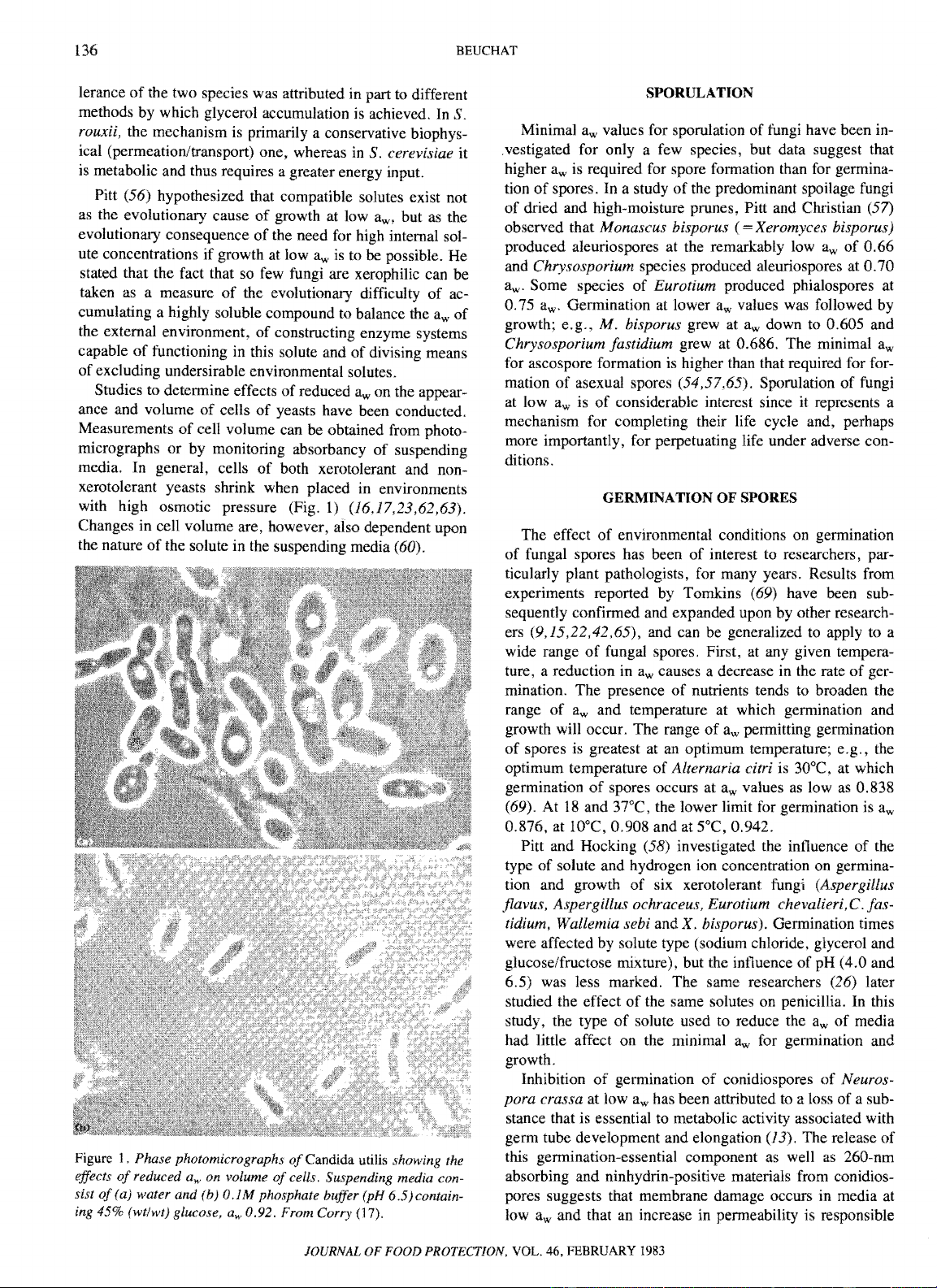
xerotolerant yeasts shrink when placed in environments
with high osmotic pressure (Fig.
1)
(16,17,23,62,63).
Changes in cell volume are, however, also dependent upon
the nature
of
the solute in the suspending media (60).
Figure 1. Phase photomicrographs
of
Candida
utilis showing the
effects
of
reduced a
w
on volume
of
cells. Suspending media con-
sist
of
(a) water and (b)
O.lM
phosphate buffer (pH 6.5) contain-
ing
45% (wtlwt) glucose, a
w
0.92. From Corry (17).
SPORULATION
Minimal a
w
values for sporulation of fungi have been in-
vestigated for only a few species, but data suggest that
higher a
w
is required for spore formation than for germina-
tion
of
spores. In a study
of
the predominant spoilage fungi
of
dried and high-moisture prunes, Pitt and Christian (57)
observed that Monascus bisporus (=Xeromyces bisporus)
produced aleuriospores at the remarkably low a
w
of 0.66
and Chrysosporium species produced aleuriospores at 0.70
a
w
.
Some species of Eurotium produced phialospores at
0.75 a
w
.
Germination at lower a
w
values was followed by
growth;
e.g.,
M. bisporus grew at a
w
down to 0.605 and
Chrysosporium fastidium grew at 0.686. The minimal a
w
for ascospore formation
is
higher than that required for for-
mation
of
asexual spores (54,57,65). Sporulation of fungi
at low a
w
is
of
considerable interest since it represents a
mechanism for completing their life cycle and, perhaps
more importantly, for perpetuating life under adverse con-
ditions.
GERMINATION OF SPORES
The effect
of
environmental conditions on germination
of fungal spores has been
of
interest to researchers, par-
ticularly plant pathologists, for many years. Results from
experiments reported by Tomkins
(69) have been sub-
sequently confirmed and expanded upon by other research-
ers
(9,15,22,42,65), and can be generalized
to
apply to a
wide range
of
fungal spores. First, at any given tempera-
ture, a reduction in a
w
causes a decrease in the rate
of
ger-
mination. The presence
of
nutrients tends
to
broaden the
range
of
a
w
and temperature at which germination and
growth will occur. The range
of
a
w
permitting germination
of
spores
is
greatest at
an
optimum temperature; e.g., the
optimum temperature
of
Alternaria citri
is
30°C, at which
germination
of
spores occurs at a
w
values
as
low as 0.838
(69). At
18
and 37°C, the lower limit for germination
is
a
w
0.876, at
lOoC,
0.908 and at 5°C, 0.942.
Pitt
and Hocking (58) investigated the influence of the
type of solute and hydrogen ion concentration on germina-
tion and growth
of
six xerotolerant fungi (Aspergillus
jlavus, Aspergillus ochraceus, Eurotium chevalieri,C.fas-
tidium, Wallemia sebi
and X. bisporus). Germination times
were affected by solute type (sodium chloride, glycerol and
glucose/fructose mixture), but the influence of pH
(4.0 and
6.5) was less marked. The same researchers
(26) later
studied the effect
of
the same solutes on penicillia. In this
study, the type
of
solute used to reduce the a
w
of
media
had little affect on the minimal a
w
for germination and
growth.
Inhibition
of
germination
of
conidiospores
of
Neuros-
pora crassa
at low a
w
has been attributed
to
a loss of a sub-
stance that
is
essential to metabolic activity associated with
germ tube development and elongation
(13). The release
of
this germination-essential component as well
as
260-nm
absorbing and ninhydrin-positive materials from conidios-
pores suggests that membrane damage occurs in media at
low a
w
and that an increase in permeability is responsible
JOURNAL
OF
FOOD PROTECTION, VOL. 46, FEBRUARY 1983
Downloaded from http://meridian.allenpress.com/jfp/article-pdf/46/2/135/1655005/0362-028x-46_2_135.pdf by guest on 13 January 2023
WATER RELATIONS
OF
YEASTS AND MOLDS
137
for the release
of
cellular components
(l4).
Conidiospores
damaged at low aware able
to
recover when transferred
to
a nutrient solution at elevated a
w
Germination
of
fungal spores may not always be fol-
lowed by growth. Pitt (56) reported that aleuriospores
of
C. fastidium germinated but that growth did not occur in a
medium adjusted with sodium chloride
to
a
w
0.SO-0.96.
Conidiospores
of
A. flavus germinated but did not grow,
and eventually lost their viability at
0.75 a
w
,
while
at
lower
a
w
they remain dormant (67).
EFFECTS
OF
8
w
ON SURVIVAL
The retention
of
viability
of
various propagules
of
fungi
during storage, as measured by their ability
to
germinate
andlor grow when subsequently exposed to suitable en-
vironmental conditions,
is
greatly affected by a
w
and tem-
perature.
Spores
of
Aspergillus oryzae have been demon-
strated to retain viability for
22
years when stored under
favorable conditions (38). At any given a
w
,
an increase in
temperature generally decreases the viability
of
fungal
spores, while lower temperatures (above freezing) favor
longevity (67). The relationship between a
w
and viability
does not appear to be
as
simple. While lower a
w
generally
favors retention
of
viability
of
fungal spores, exceptions do
exist. Endoconidia
of
Endoconidioplwra fagacearum sur-
vive longest under dry conditions; however, ascospores
of
the same fungus retain viability longer at 0.95 than at 0.75
a
w
(40). Conidia
of
A.
flavus and Aspergillus terreus lose
viability more rapidly at
0.75 a
w
compared
to
0.32 or 0.S5
a
w
(67).
The survival
of
fungi in foods at low a
w
depends partly
on non-water constituents. Beuchat (4) studied the survival
of
conidiospores
of
A. flavus over a 4S-week period at
21°C in lemon flavored gelatin, flaked coconut, potato
flakes, cocoa, peanut flour, wheat flour, com flour and
cake mix adjusted
to
aw
values ranging from 0.32-0.7S.
The extent
of
survival
of
conidiospores varied greatly
among foods, the rate
of
death being enhanced by increas-
ing a
w
and, in general, by decreasing pH. Rayman
et
al.
(59) studied the death kinetics
of
several microorganisms
during storage
of
dried (12% moisture) pasta at room tem-
perature. D values for vegetative cells of S.
cerevisiae and
conidiospores
of
Penicillium expansum ranged from 40 to
54 and
130 to 160 d, respectively, at room temperature.
Conidiospores
of
Aspergillus repens were considerably
more sensitive to low a
w
stress, decreasing from 2.7 x
10
5
to
4.0
x
10
2
per gram during the first
10
d of storage.
In general, vegetative cells and spores of fungi are more
tolerant to heat as a
w
of
the suspending medium
is
reduced
by addition
of
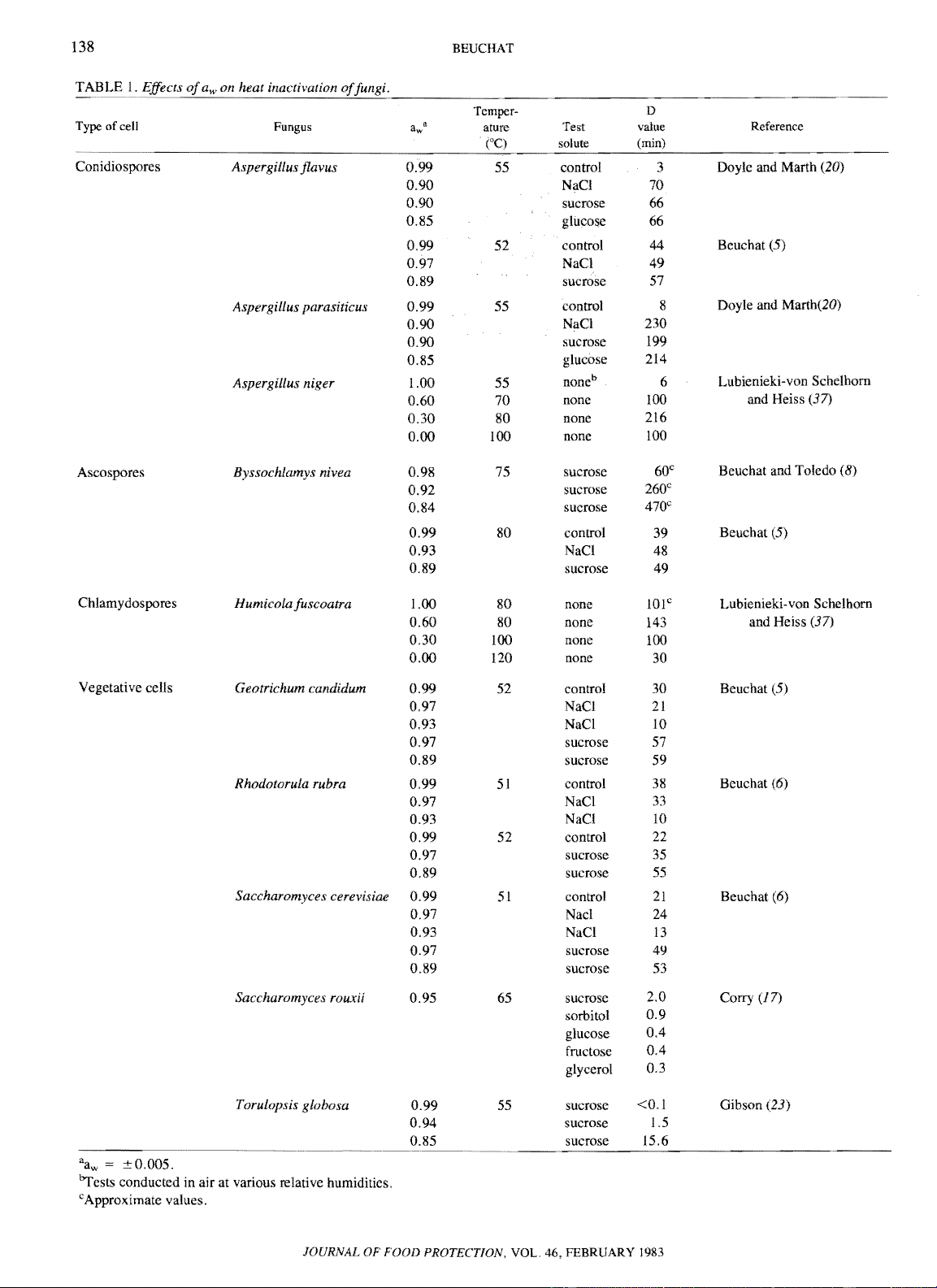
solutes (Table
1).
Doyle and Marth (20) re-
ported that an increase in the amount
of
sodium chloride,
sucrose or glucose in heating media was accompanied by
a decrease in the rate at which conidiospores
of
A.
flavus
and Aspergillus parasiticus were inactivated. Similar ef-
fects
of
sodium chloride and sucrose on heat inactivation
of
another strain
of
A. flavus were noted by Beuchat (5).
The effects
of
various atmospheric relative humidities on
thermal tolerance
of
molds were investigated by
Lubienieki-von
Schelhom and Heiss (37). A reduction
of
relative humidity (and presumably a corresponding reduc-
tion
of
aw
in
test cells) from 100% to 60 or 30% resulted
in
an
increase
in
heat resistance
of
ascospores
of
Bys-
sochlamys nivea
and chlamydospores
of
Humicola fus-
coatra.
Further reduction
in
relative humidity to 0% caused
an increase in sensitivity to heat, indicating that the protec-
tive effects
of
free water are maximum at a critical level
which may be lower than that required for germination and
growth but not approaching zero.
Solutes also have a protective effect against heat inacti-
vation
of
vegetative cells
of
fungi. However, at similar re-
duced a
w
values, effects of various solutes may be of dif-
ferent magnitude. At high concentrations, small molecular
weight solutes such as sodium chloride and glycerol may
actually have a deliterious effect on survival
of
vegetative
cells
of
yeasts and yeast-like fungi exposed to heat (see
Table 1). This may be due to the relative ease of entry
of
Na + ,
Cl-
and glycerol into cells compared
to
that
of
larger
molecular weight solutes such
as
sucrose. The latter solute
is
generally highly protective against heat inactivation,
even at levels approaching saturation. It has been stated
that diffusion
of
glycerol into cells should not be much
greater at
50
to
60°C than at 25°C since the diffusion rate
increase
is
a function
of
the square root
of
temperature
in
OK
(29). However, this would be true only
if
the physical
properties and permeability control mechanisms
of
cells
are unchanged as the temperature
is
increased. Cell vol-
ume, surface area and permeability characteristics are al-
tered by external osmotic pressure and temperature. Thus
the influence
of
various types
of
solutes on heat inactiva-
tion at different a
w
values depends upon the nature of the
solute
as
well as the physical and metabolic state of the
cells.
The effects
of
solutes on survival
of
yeasts and molds
when exposed
to
elevated temperatures depend
in
part
upon the presence in the heating medium of minor compo-
nents which may not be contributing
to
the depression
of
a
w
Citric acid, for example, has been shown
to
enhance
survival
of
Candida lambica heated
in
a model system
simulating orange juice concentrate (32). An increase in
hydrogen ion concentration generally retards the protective
effect
of
solutes against heat inactivation
of
fungi
(4
,5).
Data pertaining
to
survival
of
fungi in foods, as influ-
enced by the combined effects
of
a
w
and refrigeration or
freezing temperatures, are scant.
Sucrose was observed to
have a protective effect against death
of
ascospores
of
B.
nivea
in eight fruit juices and nectars stored at
-7
and -30°C
(8). Murdock and Hatcher (45) conducted a study to deter-
mine the effect
of
cold-temperature storage on survival
of
S.
rouxii and Hanseniaspora melligeri in
45°
and
65°
Brix
orange concentrate. Yeasts died faster in 45° Brix concen-
trate at -17.
SoC
than at -9.4 or -1. 1°C, while in 65
0
Brix
concentrate survival was greater at lower temperatures.
The effect
of
moisture content
of
conidiospores
of
As-
pergillus niger
and Penicillium thomii on susceptibility
to
the lethal action by propylene oxide was investigated by
JOURNAL
OF
FOOD PROTECTION. VOL. 46, FEBRUARY 1983
Downloaded from http://meridian.allenpress.com/jfp/article-pdf/46/2/135/1655005/0362-028x-46_2_135.pdf by guest on 13 January 2023
138
BEUCHAT
TABLE
l.
on heat inactivation
Tcmper-
D
Type
of
cell
Fungus
a
w
ature
Test value
Reference
solute
Conidiospores
Aspergillus flavus
0.99
55
control 3
Doyle and Marth (20)
0.90
NaCI 70
0.90
sucrose 66
0.85 glucose
66
0.99
52
control 44
Beuchat (5)
0.97 NaCI 49
0.89 sucrose
57
Aspergillus parasiticu;.;
0.99
55
control
8
Doyle and Marth(20)
0.90
NaCl
230
0.90
sucrose
199
0.85
glucose
214
Aspergillus niger
1.00 55
none
b
6
Lubienieki-von Schelhorn
0.60
70
none
100
and Heiss (37)
0.30
80
none
216
0.00
100
none
100
Ascospores Byssochlamys nivea
0.98
75
sucrose
60
c
Beuchat and Toledo (8)
0.92
sucrose
260
c
0.84
sucrose
470
c
0.99
80
control
39
Beuchat (5)
0.93 NaCl
48
0.89 sucrose 49
Chlamydospores
Humicola juscoatra
1.00
80
none
10JC
Lubienieki-von Schelhorn
0.60
80
none
143
and Heiss (37)
0.30
100
none
100
0.00
120
none
30
Vegetative cells
Geotrichum candidum
0.99
52
control
30
Beuchat (5)
0.97 NaCI
21
0.93 NaCl
10
0.97 sucrose
57
0.89
sucrose 59
Rhodolorula rubra
0.99
51
control
38
Beuchat (6)
0.97
NaCl
33
0.93
NaCI
10
0.99
52 control
22
0.97 sucrose
35
0.89
sucrose
55
Saccharomyces cerevisiae
0.99
51
control
21
Beuchat (6)
0.97
Nacl
24
0.93 NaCl
13
0.97 sucrose
49
0.89 sucrose
53
Saccharomyces rouxii
0.95 65 sucrose
2.0 Corry (17)
sorbitol
0.9
glucose
0.4
fructose
0.4
glycerol
0.3
Torulopsis globosa
0.99
55
sucrose
<0.1 Gibson (23)
0.94
sucrose 1.5
0.85
sucrose 15.6
aa
w
±0.005.
l>yests
conducted in air at various relative humidities.
C Approximate values.
JOURNAL OF FOOD PROTECTlON,
VOL
46, FEBRUARY
1983
Downloaded from http://meridian.allenpress.com/jfp/article-pdf/46/2/135/1655005/0362-028x-46_2_135.pdf by guest on 13 January 2023
----
WATER
RELATIONS
OF
YEASTS
AND
MOLDS
139
TABLE 2. Minimal
mold.
Minimal
Mycotoxin
Mold
Reference
Growth
Toxin
Aflatoxin
Aspergillus flavus
0.78
Ayerst (2)
0.84
Diener and Davis (19)
0.80 0.83 -
0.87
Northolt
et
aI.
(49)
Aspergillus parasificus
0.82
0.87
Northolt
et
aI.
(48)
0.82
Lotzsch and Trapper (36)
Citrinin
Penicillium citrinum
0.80
Galloway (22)
Penicillium viridicatum 0.81 Mislivec and Tuite (43)
Ochratoxin
Aspergillus ochraceus
0.85 Bacon
et
al. (3)
0.83 0.83 - 0.87
Northolt et al. (51)
0.77
Pitt
and Christian (57)
Penicillium cyclopium
0.81
0.87 - 0.90
Northolt
et
al. (51)
0.82
Ayerst (2)
0.83
Snow (65)
0.85 Pelhate (55)
Penicillium viridicatum
0.83 0.83 - 0.86
Northolt et al. (51)
Penicillic acid
Aspergillus ochraceus
0.81
0.88
Northolt
et
al. (52)
0.80
Bacon
et
al. (3)
0.76
0.81
Troller (70)
Penicillium cyclopium
0.87
0.97
Northolt
et
aI. (52)
0.82
Ayerst (2)
Penicillium martensi!
0.83 0.99
Northolt et al. (52)
0.79
Ayerst (2)
Penicillium islandicum
0.83
Ayerst (2)
Patulin
Penicillium patulum
0.83 - 0.85 0.95
Northolt et
aI.
(50)
0.81
Orth
(53)
0.83
Mislevic and Tuite (43)
0.85
Troller (70)
Penicillium expansum
0.83 0.85
0.99
Northolt et
aI.
(50)
0.83
0.83
Aspergillus clavatus
0.85
Byssochlamys nivea
Stachybotryn
Stachybotrys atra
Trichothecin
Trichothecium
roseum
Tawaratani and Shibasaki (66). Lethal activity increased
with increasing moisture content
of
spores and relative
humidity in the exposure atmosphere. For example, the de-
cimal reduction time (hours) for
A.
niger was reduced from
6.0 to 2.15 by increasing the atmospheric relative humidity
from 33 to 93%; the D values for
P. thomii were 16.0 and
2.8 at relative humidities of 33 and 93%, respectively.
0.84
0.94
0.90
0.90
Ayerst (2)
Mislevic and Tuite (43)
0.99
Northolt
et
aI.
(50)
Orth (53)
0.94
Jarvis (30)
Pelhate (55)
Snow
INFLUENCE
OF
8
w
ON MYCOTOXIN PRODUCTION
Mold growth on intermediate moisture foods has taken
on new significance since the discovery of various mycoto-
xins over the past two decades. The most extensive srudies
concerning the relations
of
a
w
and temperature on mycoto-
xin production have been carried out by Northolt et
a1.
(47-
JOURNAL OF FOOD PROTECTION.
VOL.
46,
FEBRUARY
1983
Downloaded from http://meridian.allenpress.com/jfp/article-pdf/46/2/135/1655005/0362-028x-46_2_135.pdf by guest on 13 January 2023
140
BEUCHAT
52)
in
The Netherlands. Minimal a
w
values for production
of
aflatoxin, patulin, penicillic acid and ochratoxin
as
af-
fected
by
a wide range in temperatures were determined.
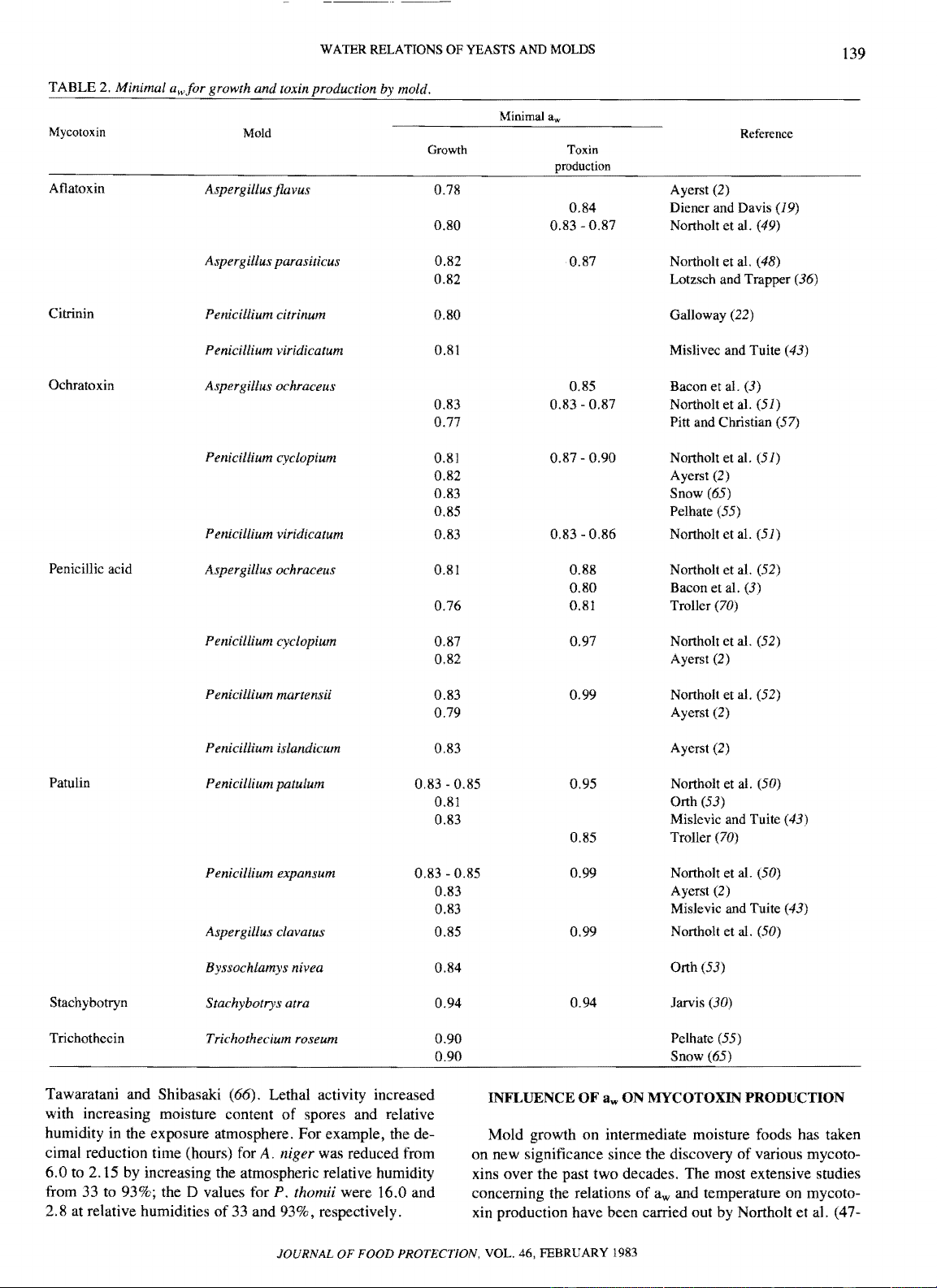
Without exception, the minimum a
w
values for growth
of
II
test molds were lower than those required for produc-
tion
of
respective mycotoxins. The maximum temperatures
for production
of
patulin and penicillic acid were lower
than the maximum temperatures for growth. While
A.
flavus and
A.
parasiticus behaved similarly with regard
to
conditions
of
a
w
and temperature required for growth and
aflatoxin
B1
production, other molds examined for their
ability to produce a given mycotoxin varied considerably.
For example,
A.
ochraceus produced penicillic acid at a
w
as
low
as
0.88, whereas the minimum
aw
for penicillic acid
production by
Penicillium cyclopium was 0.97 (52). On the
other hand, the minimum a
w
values for ochratoxin A pro-
duction by
A.
ochraceus and P. cyclopium were 0.83-0.87
and 0.87-0.90, respectively (5]), indicating that a given
species
of
mold may have different minimum
aw
values for
producing mycotoxins.
The ability
of
molds to produce mycotoxins under condi-
tions
of
a
w
stress
is
also dependent upon the strain, nutrient
availability, oxygen tension, and pH. Some
of
the apparent
discrepancies
in
minimum a
w
values for growth and
mycotoxin production listed in Table 2 are due
to
such fac-
tors. Unfortunately, many
of
these investigations were
made using laboratory media
as
culture substrates. There
is
a real need for expanded research activity to determine the
behavior
of
mycotoxin-producing molds
in
a variety
of
in-
termediate-moisture foods.
The stability of mycotoxins
as
affected
by
a
w
has not
been fully defined. Most studies concerning stability have
dealt with effects
of
temperature, pH and chemicals on
rates
of
inactivation. A report
by
Harwig et al. (25) was
addressed to the effects
of
a
w
on rates
of
disappearance of
patulin and citrinin from grains.
At
a
w
0.70, estimates
of
half-lives for patulin
in
barley, corn and wheat were 12.7,
4.4
and 4.4 d, respectively; at an a
w
of
0.90, they were
6.8, 2.4 and 1.9
d.
For citrinin, these values were 7.8,
15.5 and 11.9 d at
0.70 a
w
,
and 1.8, lOA and
3.0
d at
0.90 a
w
. The differences
in
disappearance rates were attri-
buted
to
variation in composition of the grains; however,
differences were not solely due to pH, since there was no
apparent correlation between half-lives and
pH
of
grains.
ENUMERATION
OF
FUNGI
Diluents and media with reduced
aware
required for
isolating some xerotolerant fungi. Several types
of
media
have been reported in the literature, but none
is
satisfactory
for all species, since various species differ
in
degree of to-
lerance to salts and sugars (3] ,56). Solutes commonly used
to
reduce a
w
in enumeration media include sodium
chloride, glucose, sucrose and glycerol. Hocking and
Pitt
(27) recently reported on the favorable characteristics
of
a
dichloran-glycerol medium for enumeration
of
xerophilic
fungi from low-moisture foods.
While some fungi require low a
w
for growth
in
isolation
media, others will not grow at low a
w
and may actually be
less tolerant to a
w
stress if pretreatment in adverse environ-
mental conditions injured or damaged them. For example,
heat-injured conidiospores
of
A.
flavus have decreased to-
lerance to sodium chloride (1,7). Thus it is important to
select enumeration media based on knowledge
of
the a
w
and composition
of
the food
to
be
analyzed
as
well
as
its
immediate past history with regard
to
exposure to environ-
mental stress.
CONCLUSIONS
Fungal spoilage
of
foods occurs more often than bacte-
rial spoilage at a
w
0.61-0.85 not because fungi grow faster
at reduced a
w
but rather because the competitive effects of
the vast majority
of
bacteria are absent. Within limits, fun-
gal cells can adapt to reduced a
w
as
a mechanism to main-
tain viability.
Higher a
w
is generally required for spore formation than
for spore germination. The range
of
a
w
permitting germina-
tion
of
spores is greatest at an optimum temperature, but
optimum availability
of
nutrients tends to broaden the
range
of
a
w
and temperature at which germination and
growth will occur. The protective effects
of
free water on
long-term viability of spores are maximal at a critical level,
which may be lower than that required for germination but
does not approach zero.
The minimum a
w
levels for growth are lower than those
required for mycotoxin production. The ability of molds
to
produce mycotoxins under conditions
of
a
w
stress
is
also
dependent upon the strain
as
well
as
temperature, nutrient
availability, oxygen tension and pH.
It
is
imperative that diluents and agar media with re-
duced a
w
be used to isolate and enumerate xerotolerant
fungi from foods.
Otherwise, vegetative cells and spores
may be killed by osmotic shock or remain dormant when
exposed
to
high a
w
levels associated with diluents and agar
media routinely used for mycological analyses.
REFERENCES
1.
Adams. G.
IL,
and Z.
J.
Ordal. 1976. Effects of thermal stress and
reduced water activity on conidia of
Aspergillus parasiticus.
J.
Food
Sci.
41
:547-550.
2.
Ayerst, G. 1969. The effects
of
moisture and tempemture
on
growth
and spore germination
in
some fungi. J. Stored Prod. Res. 5:127-
141.
3. Bacon, C.
W.,
V.
G.
Sweeney,
J.
D.
Robbins, and
D.
Burdick.
1973. Production
of
penicillic acid and ochratoxin A on poultry feed
by
Aspergillus ochraceus: temperature and moisture requirements.
Appl. Microbiol.
26:155-160.
4. Beuchat, L.
R.
1979. Survival
of
conidia
of
Aspergillus fIavus in
dried foods.
1.
Stored Prod. Res. 15:25-31.
5. Beuchat, L. R. 1981. Combined effects of solutes and food preserva-
tives on rates of inactivation
of
and colony formation by heated
spores and vegetative cells
of
molds. Appl. Environ. Microbiol.
41:472-477.
6. Beuchat, L. R. 1981. Effects of potassium sorbate and sodium ben-
zoate on inactivating yeasts heated
in
broths containing sodium
chloride and sucrose.
J.
Food Prot. 44:765-769.
7. Beuchat, L. R., and W. K. Jones. 1978. Effects
of
food preserva-
tives and antioxidants on colony formation
by
heated conidia
of
As-
pergillus/lavus. Acta Aliment. Acad. Sci. Hung. 7:373-384.
JOURNAL
OF
FOOD PROTECTION, VOL. 46, FEBRUARY
1983
Downloaded from http://meridian.allenpress.com/jfp/article-pdf/46/2/135/1655005/0362-028x-46_2_135.pdf by guest on 13 January 2023
WATER RELATIONS
OF
YEASTS AND MOLDS
141
8. Beuchat,
L.
R.,
and R. T. Toledo. 1977. Behaviour
of
Bys-
sochlamys nivea ascospores in fruit syrups. Trans. Brit. Myco\. Soc.
68:65-71.
9. Bonner,
J. T. 1948. A study
of
the temperature requirements
of
As-
pergillus niger. Mycologia 40:728-738.
10. Brown, A. D. 1974. Microbial water relations: Features
of
the intra-
cellular composition
of
sugar-tolerant yeasts. J. Bacterio\. 118:769-
777.
II.
Brown, A.
D.
1977. Compatible solutes and extreme water stress in
eUkaryotic microorganisms. Adv. Microbial Physio\. 17:181-242.
12. Brown, A.
D.,
and J. R. Simpson. 1972. Water relations
of
sugar-to-
lerant yeasts: the role
of
intracellular polyols. J. Gen. MicrobioL
72:589-591.
13. Charlang, G.
W.,
and N. H. Horowitz. 1971. Germination and
growth
of
Neurospora at low water activities. Proc. Nat!. Acad. Sci.
68:260-262.
14. Charlang, G.
W.,
and N.
H.
Horowitz. 1974. Membrane permeabil-
ity and the loss
of
germination factor from Neurospora crassa at low
water activities.
1.
BacterioL 117:261-264.
15. Clayton, C. N. 1942. The germination
of
fungus spores in relation to
controlled humidity.
Phytopathology 32:921-943.
16. Corry,
1.
E.
L.
1976. Sugar and polyol permeability
of
Salmonella
and osmophilic yeast cell membranes measured by turbidity, and its
relation to heat resistance. J. App\. Bacteriol. 40:277-284.
17. Corry, J. E.
L. 1976. The effect
of
sugars and polyols on the heat
resistance and morphology
of
osmophilic yeasts.
1.
AppL BacterioL
40:269-276.
18. Corry, J. E.
L.
1978. Relationships
of
water activity to fungal
growth. p. 45-82.
In L. R. Beuchat (ed.), Food and beverage mycol-
ogy. AVI Pub\.
Co.,
Westport, CT.
19. Diener, U.
L.,
and
N.
D. Davis. 1970. Limiting temperature and rel-
ative humidity for aflatoxin production by Aspergillus flavus in stored
peanuts.
J. Am. Oil Chern. Soc. 47:347-351.
20. Doyle,
M.
P.,
and E.
II.
Marth. 1975. Thermal inactivation
of
con-
idia from Aspergillus flavus and Aspergillus parasiticus.
n.
Effects
of
pH
and buffers, glucose, sucrose and sodium chloride. J. Milk
food Technol. 38:750-758.
21. Edgley,
M.,
and A. D. Brown. 1978. Response
of
xerotolerant and
non-tolerant yeasts to water stress.
1.
Gen. Microbio!' 104:343-345.
22. Galloway,
L.
D. 1935. The moisture requirements
of
mold fungi
with special reference to mildew in textiles. J. Textile Inst.
26:Tl23-
129.
23. Gibson,
B.
1973. The effect
of
high sugar concentrations on the heat
resistance
of
vegetative microorganisms. 1. Appl. Bacteriol. 36:365-
376.
24. Gould, G.
W.,
and J.
C.
Measures. 1977. Water relations in single
cells.
Phil. Trans. Royal Soc. London 278:151.
25. Harwig,
J.,
B.
J. Blanchfield, and G. Jarvis. 1977. Effect
of
water
activity on disappearance
of
patulin and citrinin from grains. J. Food
Sci. 42:1225-1228.
26. Hocking, A.
D.,
and J. I. Pitt. 1979. Water relations
of
some
Penicillium species
at
25°C. Trans. Brit. Mycol. Soc. 73:141-145.
27. Hocking, A.
D.,
and J. I. Pitt. 1980. Dichloran-glycerol medium for
enumeration
of
xerophilic fungi from low-moisture foods. Appl. En-
viron. Microbio!. 39:488-492.
28.
Homer,
K. J., and G.
D.
Anagnostopoulos. 1973. Combined effects
of
water activity,
pH
and temperature on the growth and spoilage po-
tential
of
fungi.
1.
AppL Bactcrio!' 36:427-436.
29. Hsieh,
F.-H.,
K. Acot!, and T. P. Labuza. 1975. Prediction
of
microbial death during drying
of
a macaroni product. J. Milk Food
Techno!. 39:619-623.
30. Jarvis, B. 1971. Factors affecting the production
of
mycotoxins. J.
Appl. Bacteriol. 34:199-213.
31. Jarvis,
B.
1978. Methods for detecting fungi in foods and beverages.
p. 471-504. In
L.
R. Beuchat (ed.), Food and beverage mycology.
AVI Publishing
Co.,
Westport, CT.
32. Juven,
B.
J., J. Kanner, and
H.
Weisslowicz. 1978. Influence
of
orange juice composition on the thermal resistance
of
spoilage yeasts.
J. Food Sci. 43:1074-1076,1080.
33. Kushner,
L.,
W.
D.
Rosenweig, and G. Stotzky. 1979. Effects
of
I
saits, sugars, and salt-sugar combinations
on
growth and sporulation
of
an isolate
of
Eurotium rubrum from pancake syrup. J. Food Prot.
41:706-711.
34. Lewis,
D.
H.,
and
D.
C.
Smith. 1967. Sugar alcohols (polyols) in
fungi and green plants.
New
Phytol. 66:143-184.
35. Lloyd, A. C. 1975. Osmophilic yeasts in preserved ginger products.
J. Food Techno!. 10:575-581.
36. Lotzsch,
R.,
and
D.
Trapper. 1978. Aflatoxin and patulin production
as a function
of
water activity (aw-values). Die Fleischwertshaft.
58:2001-2007.
37. Lubieniecki,von Schelhom,
M.,
and R. Heiss. 1975. The influence
of
relative humidity on the thermal resistance
of
mould spores. p.
339-346. In R. B. Duckworth (ed.), Water relations.
of
foods.
Academic Press,
NY.
38. McCrea, A. 1923. Longevity
of
spores
of
Aspergillus oryzae and
Rhizopus nigricans. Science 48:426.
39. Measures,
J. C. 1975. Role
of
amino acids in osmoregulation
of
non-
halophilic bacteria. Nature (London) 257:398-400.
40. Merek, E.
L.,
and
C.
L.
Fergus. 1954. The effect
of
temperature and
relative humidity on the longevity
of
spores
of
oak wilt fungus.
Phytopathology 44:61-64.
41. Miller, M.
W.,
and H. Tanaka. 1963. Microbial spoilage
of
dried
prunes. III. Relation
of
equilibrium relative humidity
to
potential
spoilage. Hilgardia 34:183-190.
42. Mislivec,
P.
B.,
C. T. Dieter, and V. R. Bruce. 1975.
Effectoftem-
perature and relative humidity on spore germination and mycotoxic
species
of
Aspergillus and Penicillium. Mycologia 67: 1187 -1189.
43. Mislivec,
P.
B.,
and J. Tuite. 1970. Temperature and relative humid-
ity requirements
of
species of Penicillium isolated from yellow dent
com
kernels. Mycologia 62:75-88.
44. Munitis, M.
T.,
E. Cabrera, and A. Rodriquez-Navarro. 1976.
An
obligate osmophilic yeast from honey. Appl. Environ. Microbiol.
32:320-323.
45. Murdock, D.
L,
and W.
S.
Hatcher, Jr. 1978. Effect
of
temperature
on survival
of
yeast in 45° and 65° Brix orange concentrate. J. Food
Prot. 41 :689-691 .
46. Northolt, M. D. 1979. The effect
of
water activity and temperature
on the production
of
some mycotoxins. Ph.D. Dissertation.
Rijksinstituut voor de Volksgezondheid, Bilthoven, The Netherlands.
47. Northolt, M.
D.,
and L. B. Bullerman. 1982. Prevention
of
mold
growth and toxin production through control
of
environmental condi-
tions. J. Food Prot. 45:519-526.
48. Northolt, M.
D.,
C.
A. H. Verhulsdonk, P. S. S. Soentoro, and
W.
E. Paulsch. 1976. Effect
of
water activity and temperature on aflato-
xin production by Aspergillus parasiticus. J. Milk Food Techno!.
39:170-174.
49. Northolt, M.
D.,
II.
P. Van Egmond, and W.
E.
Paulsch, 1977. Dif-
ferences betwecn Aspergillus flavus strains in growth and aflatoxin
B
j
production in relation to water activity and temperature.
J.
Food
Prot. 40:778-781.
50. Northolt, M.
D.,
H. P. Van Egmond, and W. E. Paulsch. 1978.
Patulin production by some fungal species in relation to water activ-
ity and temperature. J. Food Prot.
41
:885-890.
51. Northolt, M.
D.,
II.
P. Van Egmond, and W.
E.
Paulsch. 1979. Oc-
hratoxin A production by some fungal species in relation to water ac-
tivity and temperature. J. Food Prot. 42:485-490.
52. Northolt, M. D
..
H. P. Van Egmond, and W. E. Paulsch. 1979.
Penicillic acid production by some fungal species
of
relation to water
activity and temperature. J. Food Prot. 42:476-484.
53.
Orth, R. 1976. The influence
of
water activity on the spore germina-
tion
of
aflatoxin-, sterigmatocystin- and patulin-producing molds.
Lebens. Wiss. Technol.
9:
156-159.
54. Panasenko, V. T. 1967. Ecology
of
microfungi. Bot. Rev. 33:189-
215.
55.
Pelhate,
J.
1968. A study
of
water requirements in some storage
fungi. Mycopathol. Mycol. AppL 36:117-128.
56.
Pitt,
J.
I. 1975. Xerophilic fungi and the spoilage
of
foods
of
plant
origin.
p.
273-307. In R. B. Duckworth (cd.), Water relations
of
foods. Academic Press, London.
57.
Pitt, J., and
H.
Christian. 1968. Water relations in xerophilic fungi
con't. p. 150
JOURNAL OF FOOD PROTECTION, VOL. 46, FEBRUARY 1983
Downloaded from http://meridian.allenpress.com/jfp/article-pdf/46/2/135/1655005/0362-028x-46_2_135.pdf by guest on 13 January 2023

Preview text:

Downloaded from http://meridian.allenpress.com/jfp/article-pdf/46/2/135/1655005/0362-028x-46_2_135.pdf by guest on 13 January 2023