Bài giảng về Information Theory and Linear Regression | Trường Đại học Công nghệ, Đại học Quốc gia Hà Nội
Bài giảng về Information Theory and Linear Regression | Trường Đại học Công nghệ, Đại học Quốc gia Hà Nội. Tài liệu được sưu tầm giúp bạn tham khảo, ôn tập và đạt kết quả cao. Mời bạn đọc đón xem.
Môn: Học máy 10 tài liệu
Trường: Trường Đại học Công nghệ, Đại học Quốc gia Hà Nội 824 tài liệu
Tác giả:









Preview text:
Information Theory and Linear Regression Information Theory
How do we choose between splits when constructing decision trees?
• Measure how much information we can gain from a given split.
• This quantity is called Information Gain!
• It is an information theoretic concept that quantifies for a r.v. how much
uncertainty is removed if we know its value.
Let’s review some information theory basics and definitions. MLA_Tut3 Page 01 Uncertainty and Entropy
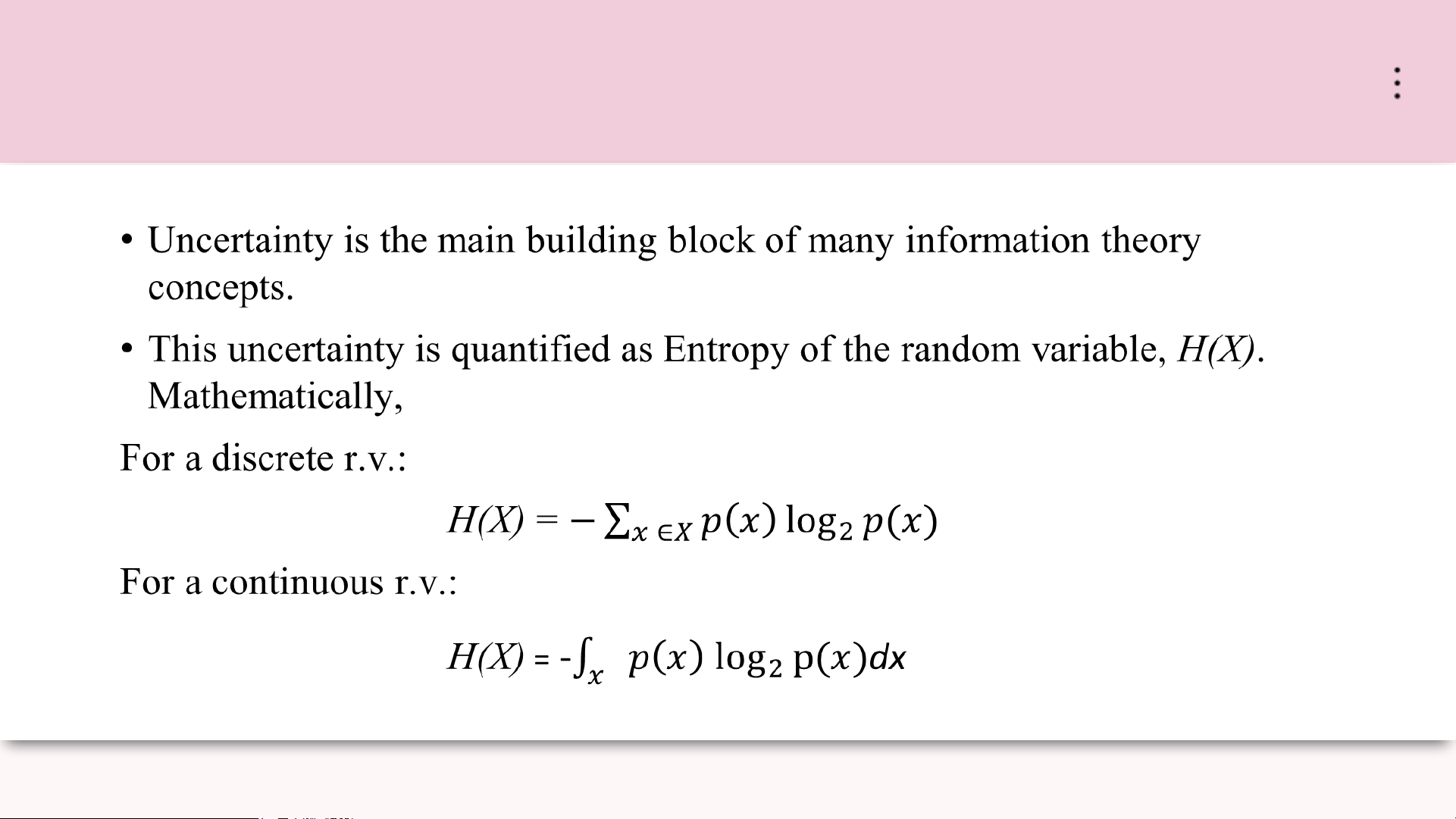
Uncertainty is the main building block of many information theory concepts.
• We don’t always have all the information about all the variables we care about.
• We use probabilities about events to make informed guesses.
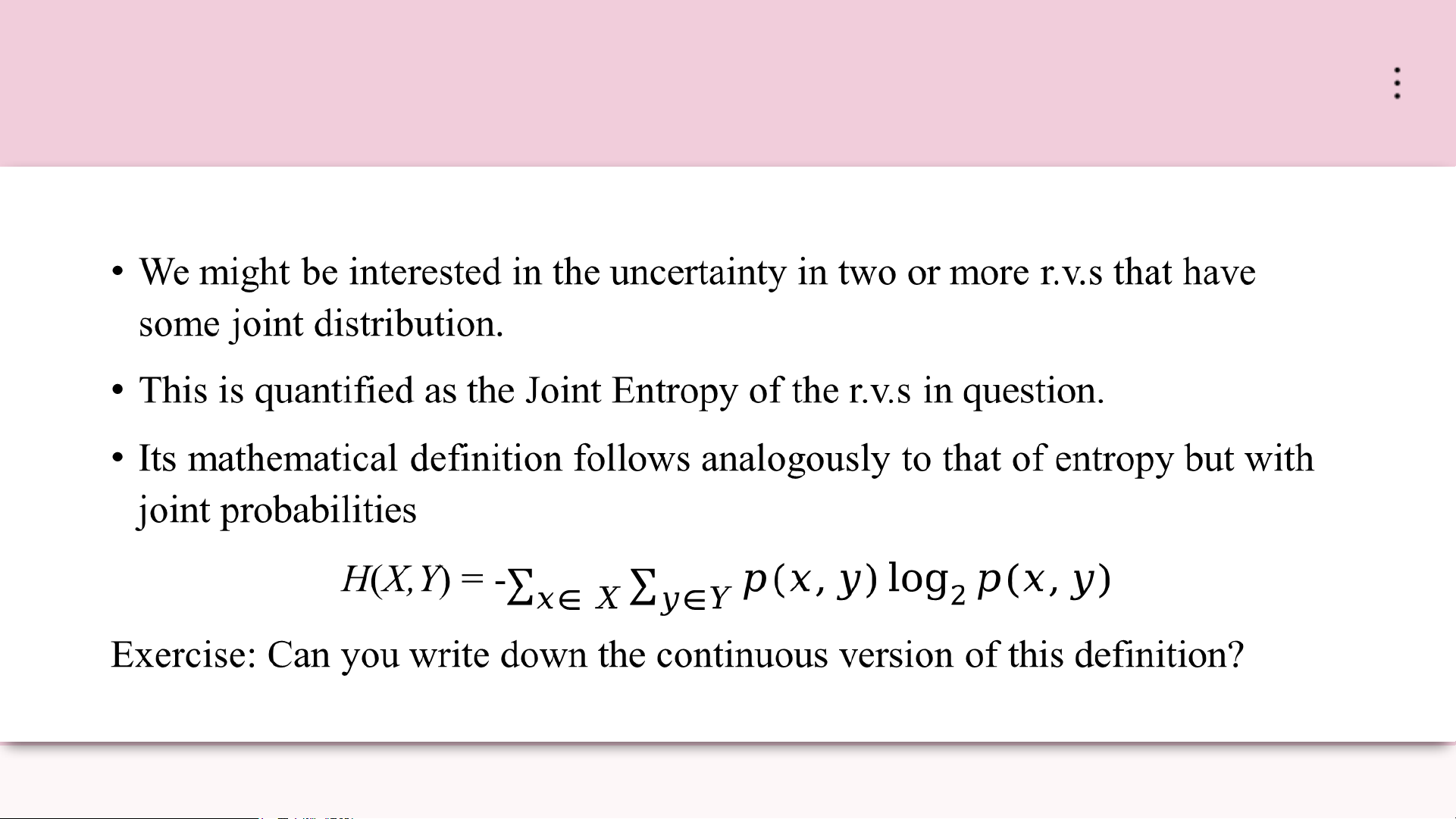
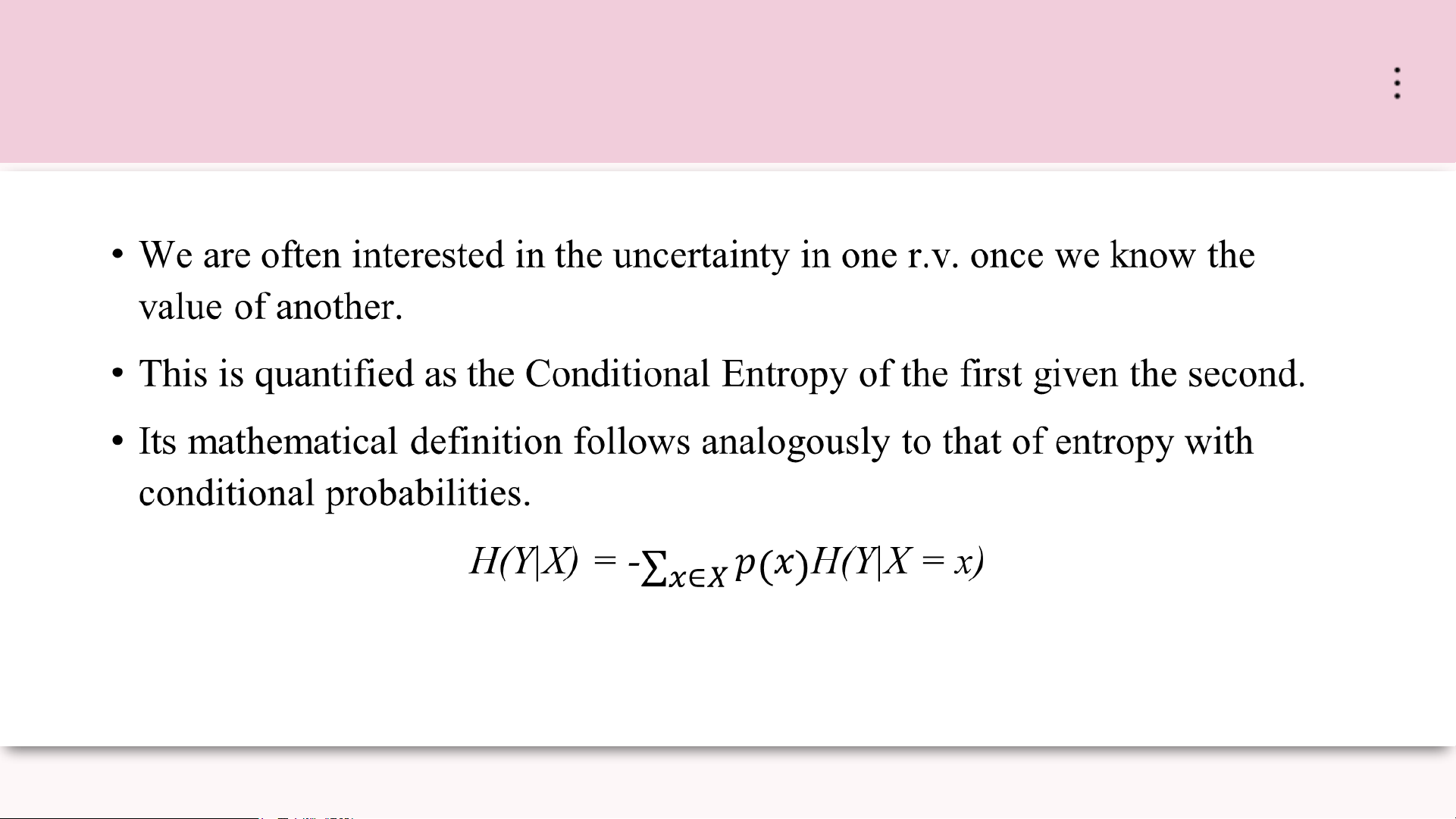
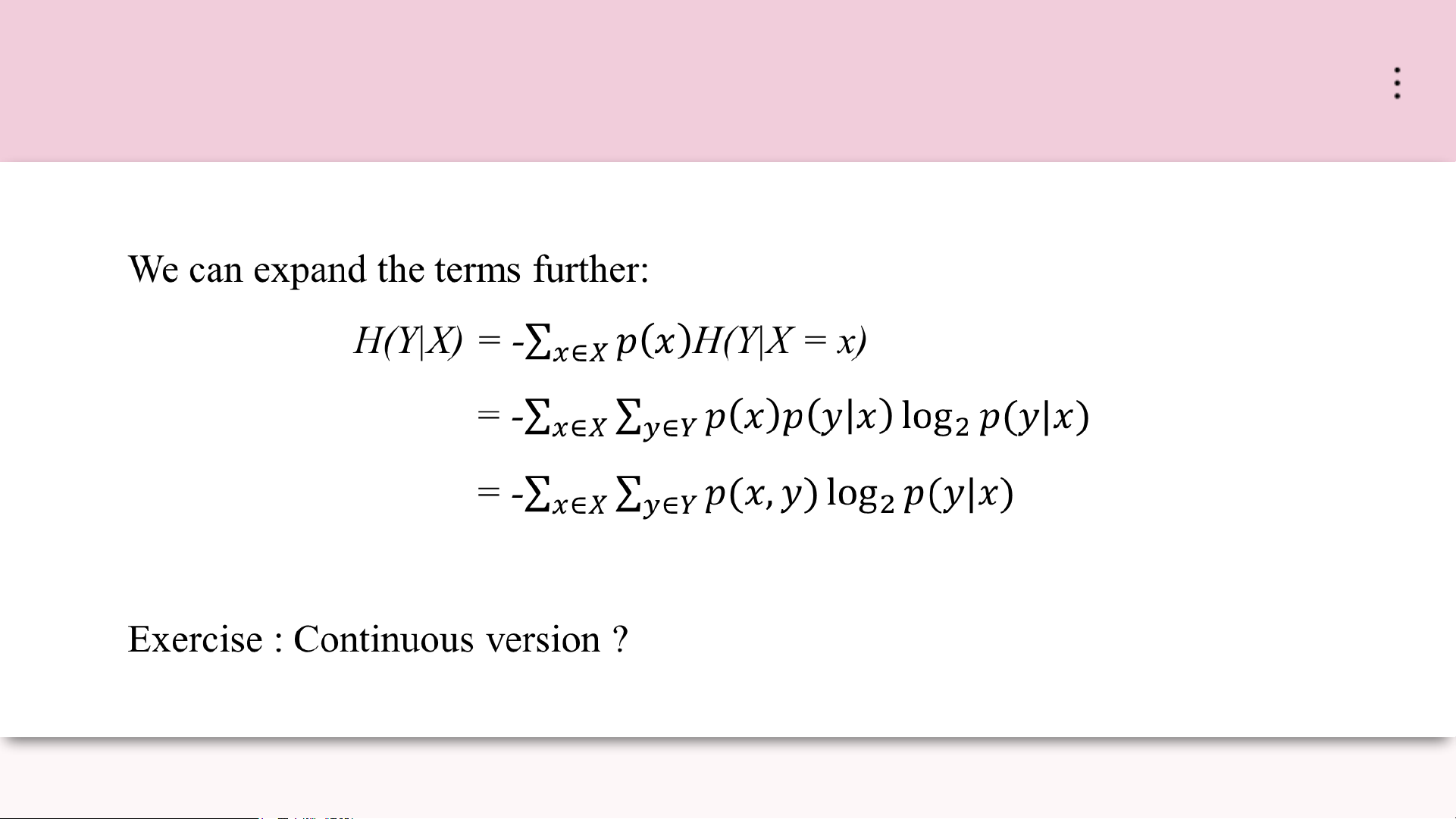
• As we learn more information, we can increase confidence, or decrease uncertainty, in our guess MLA_Tut3 Page 02 Uncertainty and Entropy MLA_Tut3 Page 03 Joint Entropy MLA_Tut3 Page 04 Conditional Entropy MLA_Tut3 Page 05 Conditional Entropy MLA_Tut3 Page 06
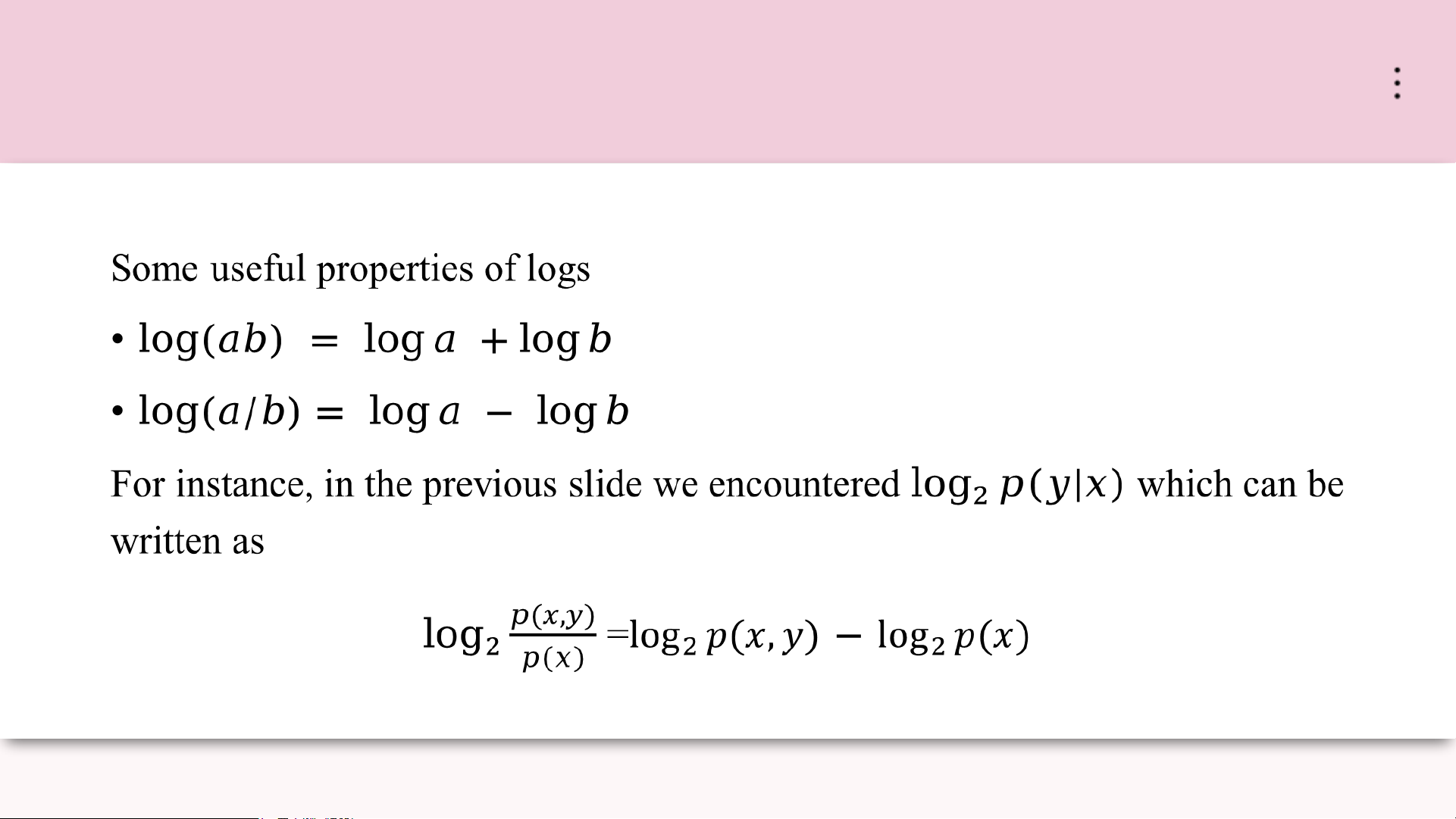
Aside: Logarithm Properties MLA_Tut3 Page 07 Information Gain
Finally, we can now quantify a notion of Information Gain, aka Mutual Information between r.v.s X and Y .
• This quantifies how much more certain (or less uncertain) we are about Y if we know the value of X.
• In other words, how much uncertainty (or entropy) is reduced in Y once we are given X?
• Definition: take the entropy of Y and subtract the conditional entropy of Y given X IG(Y|X) = H(Y) - H(Y|X) MLA_Tut3 Page 08
Exercises: Information Theory
We now practice computing some of these quantities and prove some standard
equalities and inequalities of information theory, which appear in many
contexts in machine learning and elsewhere. MLA_Tut3 Page 09 Exercise 1
Let p(x, y) be given by 0 1 0 1/3 1/3 1 0 1/3 Compute • H(X), H(Y) • H(X|Y), H(Y|X) • H(X|Y) • IG(Y|X) MLA_Tut3 Page 10 Exercise 2 Page 11 MLA_Tut3 Exercise 3
Prove the Chain Rule for entropy, i.e
H(X,Y) = H(X|Y) + H(Y) = H(Y|X) + H(X) MLA_Tut3 Page 12 Exercise 4
Prove that H(X, Y ) ≥ H(X).
Hint: you can use results of the first two exercises. MLA_Tut3 Page 13
Linear Regression Review MLA_Tut3 Page 14
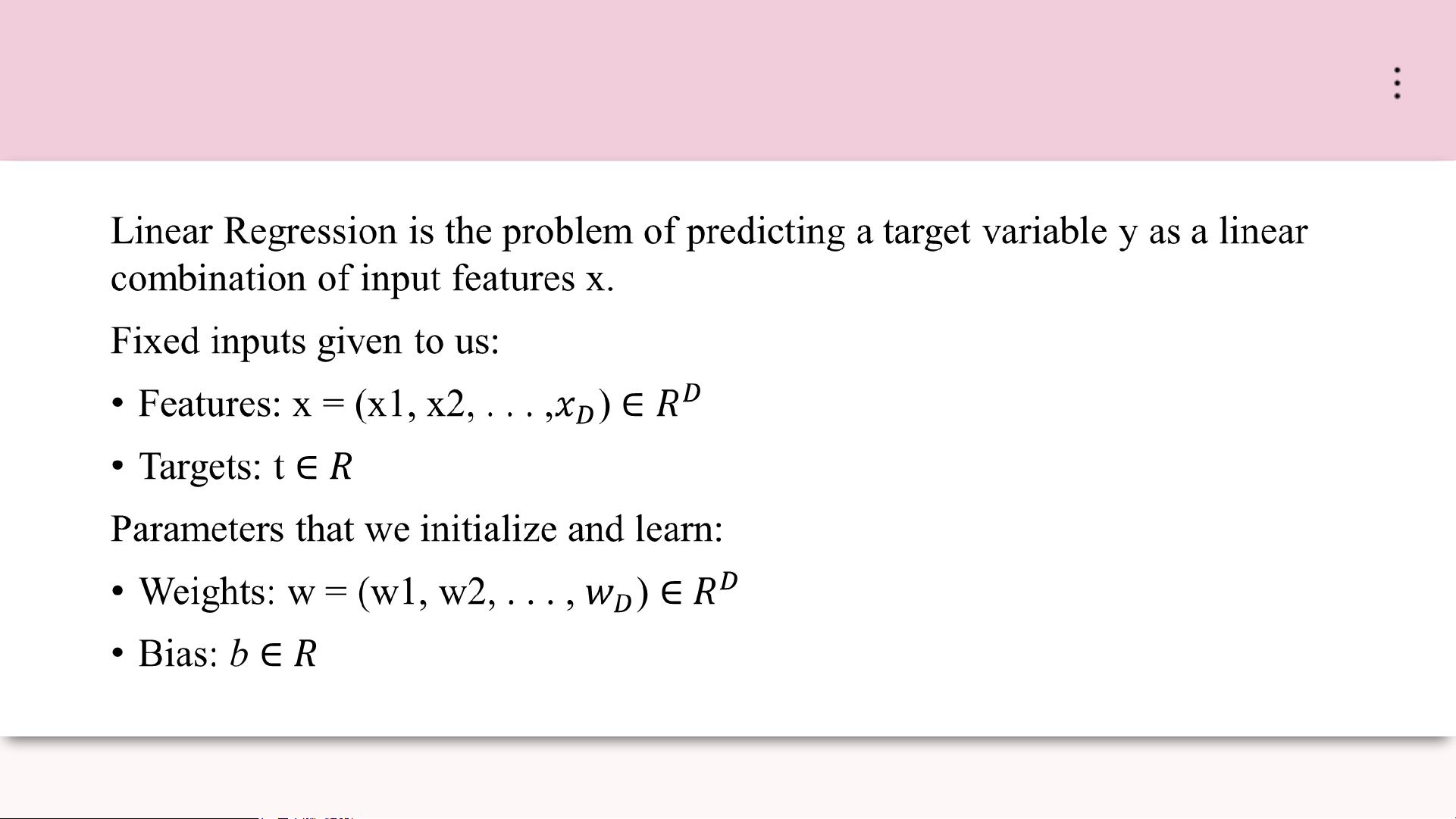
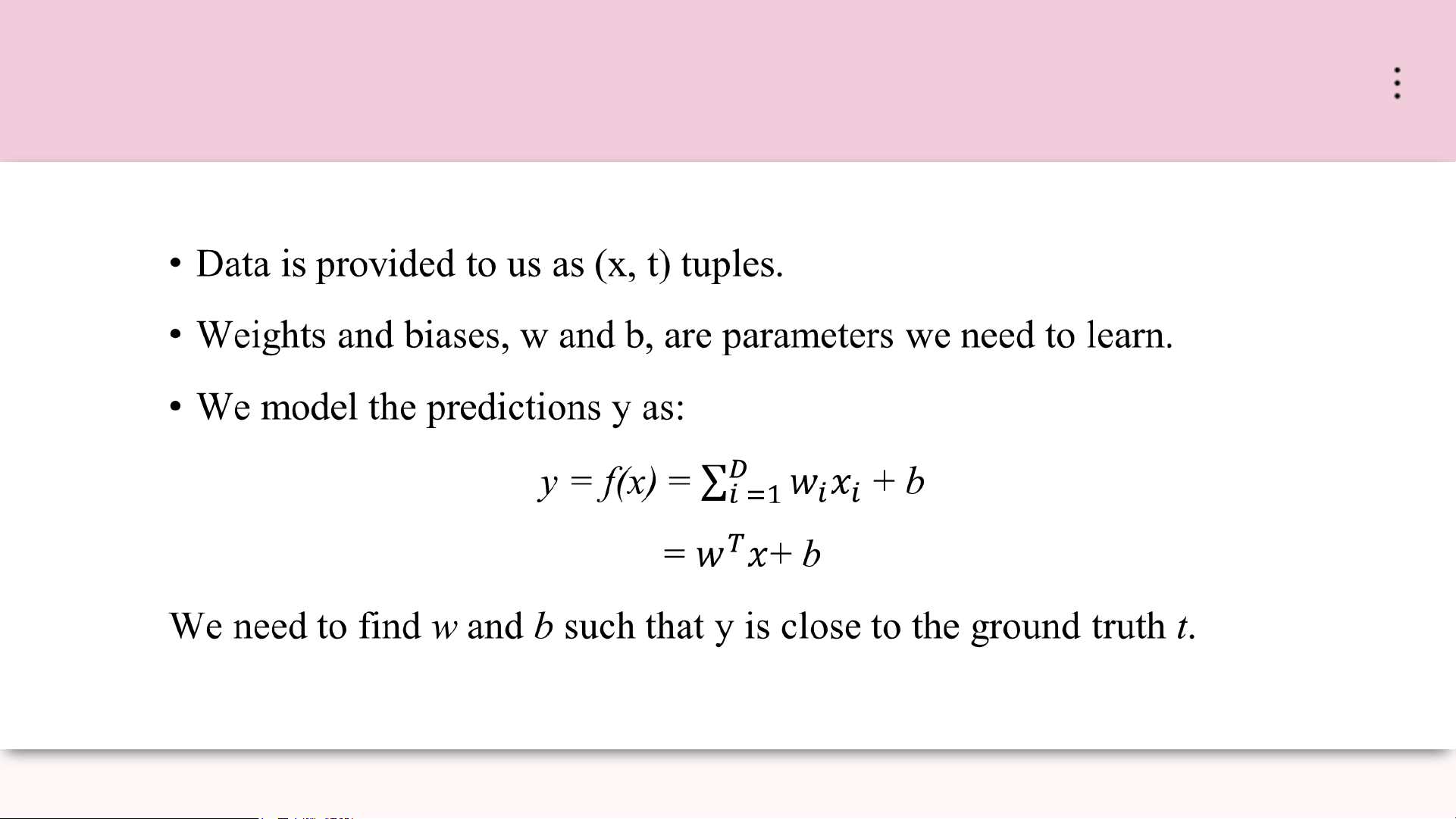
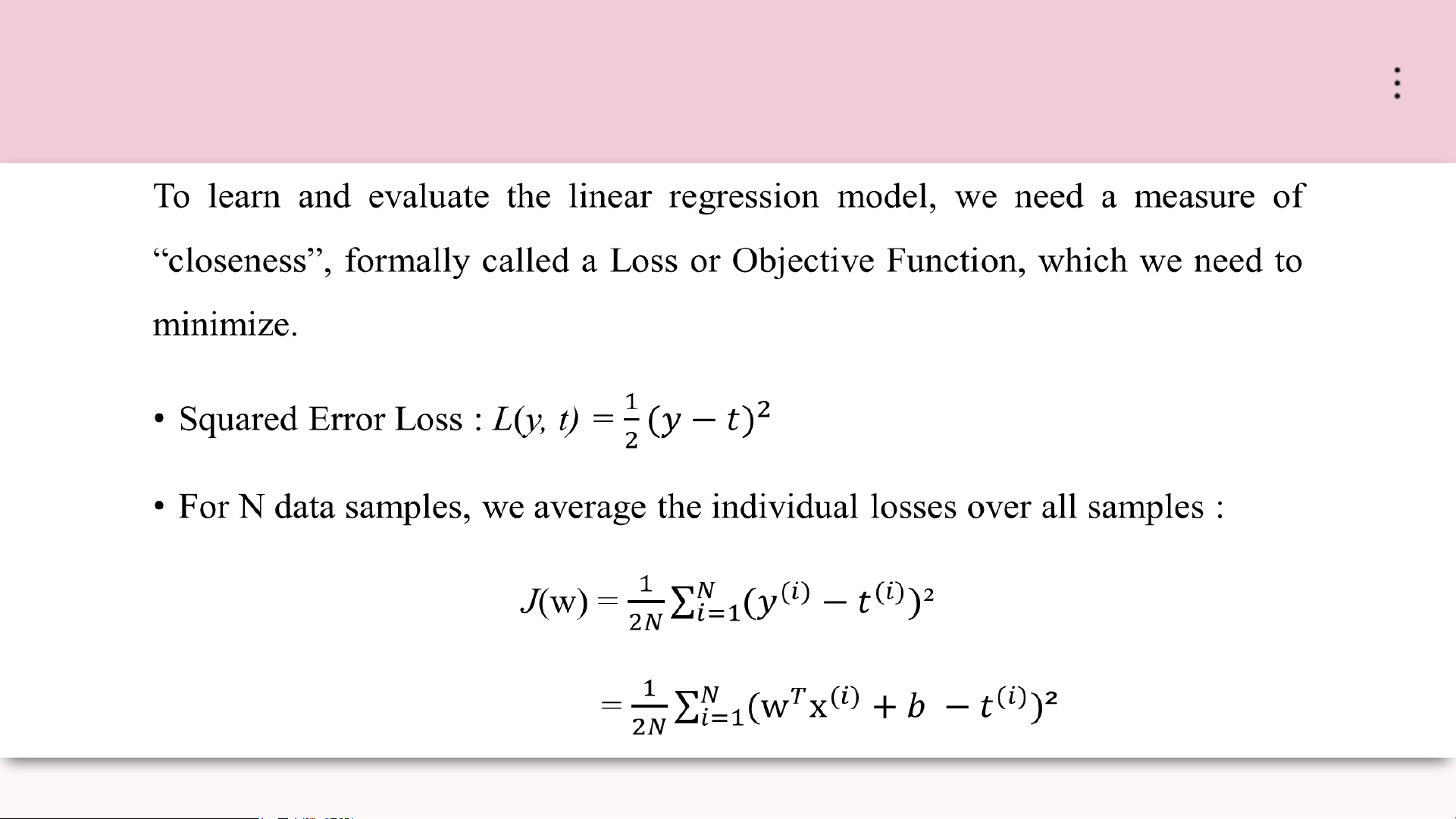
Data, Parameters and the Model MLA_Tut3 Page 15 Objective Function MLA_Tut3 Page 16
Exercise: Linear Regression Bias-Variance MLA_Tut3 Page 17
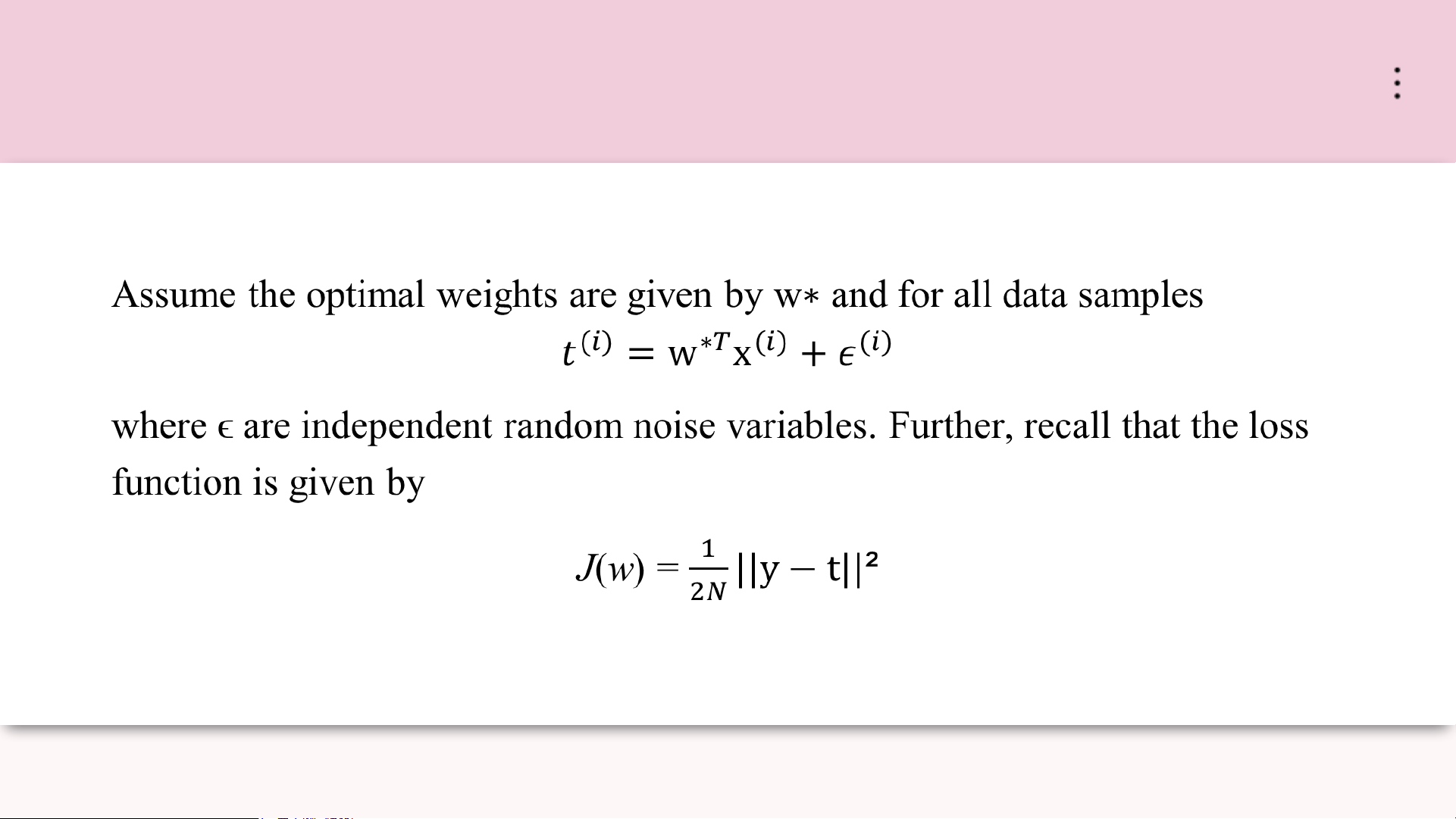
Exercise: Linear Regression Bias-Variance
Using the above, derive the bias-variance decomposition for the linear regression problem. MLA_Tut3 Page 18
Tài liệu liên quan:
-
Bài giảng về Decision Trees and Bias-Variance môn Học máy | Trường Đại học Công nghệ, Đại học Quốc gia Hà Nội
29 15 -

Tài liệu học thuật về Deep Learning môn Học máy | Trường Đại học Công nghệ, Đại học Quốc gia Hà Nội
35 18 -
Ôn tập cuối kỳ: Regularized cost and gradient môn Học máy | Trường Đại học Công nghệ, Đại học Quốc gia Hà Nội
69 35 -
Ôn tập cuối kỳ: Logistic Regression môn Học máy | Trường Đại học Công nghệ, Đại học Quốc gia Hà Nội
65 33