







!"##$%&'()( *()(
Ha Noi - 2025
+
,- .%&/.#- .%&/.#/"0&- ##12/0&/.
9 23D131010 Nguyễn Thị Hồng Duyên Part (a+b) Question 3
19 23D131021 Nguyễn Nhật Lệ - Part (a) Sentence 2
- Translate into English part
1 + sentence 1
29 23D131032 Quản Trọng Quốc Nam - Part (b) Sentence 2
- Translate into English
sentence 2 + sentence 3
39 23D131043 Nguyễn Thị Phương Thảo -1.1.1+1.1.2+1.1.3+ Part
(a) Question 1
- Redo the content of the
plan (Question 3 Part a,b)
- Word summary
49 23D131053 Nguyễn Thị Thảo Vân - 1.2.1+1.2.2+ Part (b)
Question 1
- Edit the content of
Question 2
- Translate the case,
summarize reference
documents
INDEX



 !"#$%&'
()""*$&"+
 )",$%-"""&,%"&,#*%-$%&$".
 *%-$%/$0-112"3.
  ,*%-$%/$&0'112"&"3.
45!647
6487
9 : !5 ! ;< =4 > ?  ! 4 
!4>:<@;7
,A#"*%-$%/$7
$%-$%/$$'*$7
 %-$%/$&$"'-%#2
(,%&''$$''$,%*#
%-$%%$%B,$*$C"
:!>>@>!444>@@
444<4<5!<44>@
 &$,"$&$"$%"&"-%#
(,%$'$%,"$"$"$*%'&%'*&$"$%
"&"-%#"$*#$*%-$%%#"&"'&$#
(&'"'"$$"-,$*%-$%%#
( !%&"-""""'$%,"&&%#,$
((!%&"*&$%$4''$
(!%&*-"""""&"A"$&-$&$(
64 8
 < ! 4  ! 444   444
04><!@!44344><!=4
:4  ! 4!?! 4 4 4> = >@ ! 4 
@4@>44>!4!444
!'$*,""""$4,/,
5,$$,'$*,"D
 @$"$",'$*,"%$"$4,/,
 $-$-"$4,/,+
 ,&%$-$-"+
  @$"$"%$-$-"$4,/,+
($""%$*,$%%$"$4,/,+
<!444=@>@5;! 24!?!
 4 4> E >4 09  4!3  
>4>!4:!4<5)4
<<.
,$%-$"".
+,$%#$$$%#"",$%%$"$4,/,F
+4&G&%$%E%*$%$","$F
+ %$%$","$7
64(8:8444>)44!9=
444!44!@<)4=
! 2
44>@=@4)4@4<4@=!
=4  4< >49 44 !  44 
=@@@@4 2
(&"'&'")"'*"#"' 2
('&*%$-"$$"'* 2
( '&*'$%''''*
((%$"*,,$%'*$"&&%$"0%$-$'3
44>49@49?44>
E544@;@4=<=>
<44=444>=4=@4
 (
( "$%/*&%#$*$/$$%" (
( $*&*$'"$&"$%$&$#%&' (
(  B$%,$*$$%$%"&"-%#$$-%#
( (%$%""#"A&&%$'$A*$"
>4
(
,
(,(,3&31&45$$1
(,(,(,$$11/.%$.1/
The House of Gucci, or simply known as Gucci, is a fashion icon owned by Italy
and France, a famous leather goods brand. Gucci was founded in 1921 by Guccio
Gucci in Florence, Tuscany. Under the direction of Aldo Gucci (son of Guccio),
Gucci became a world-famous brand, a symbol of Italian Dolce Vita.
According to BusinessWeek magazine, Gucci currently has 425 stores worldwide
with plans to expand globally to 487 stores by 2030, creating jobs for 17,157
employees and expected revenue of about 9.628 billion euros.
(,(,',1#.6"/%%&3&!0&/.5$$1
7&8&21//1/29( '(( *#:
·1921: Gucci was founded by Guccio Gucci in Florence, Italy. Initially, Guccio
Gucci opened a store specializing in selling high-end leather goods inspired by his
work at the Savoy Hotel in London.
7&1#&5.7&8"/%9( *#( #:
·1930s: Gucci began to develop other products such as handbags, shoes, and
accessories. The brand was noticed by high-end customers.
·1950s: After Guccio Gucci's death in 1953, his sons Aldo, Vasco and Rodolfo
Gucci continued to develop the brand, expand globally. The first Gucci store was in
New York. This was the period when the "GG" (Guccio Gucci) logo was born,
become one of the most recognizable fashion icons in the world.
!%&/"2&9( ;#( <#:
·1960s: Gucci became a symbol of luxury and was favored by many Hollywood
stars and celebrities.
·1969s - 1970s: Gucci operated 10 stores in the United States, 84,000 Gucci leather
shoes were sold in the United States. Led to global growth in Asia (Tokyo opened
in 1972, Hong Kong in 1974) and the Middle East.
1#1#"/%5"01!6%1#.&#9( =#:
·1980s: This was a period of crisis for Gucci due to family disputes between
members of the Gucci family, which led to a decline and loss of brand value due to
mass production and lack of quality control.
·1983: Rodolfo Gucci died, his son, Maurizio Gucci, took control. However, poor
management and bad decisions pushed Gucci into financial difficulties.
&81.79( #:
·1995: Tragedy struck when Maurizio Gucci was murdered by his ex-wife. This
event shocked and greatly affected the brand's image.
·1990s: Under the leadership of Domenico De Sole and Tom Ford - the chief
creative designer, Gucci began a strong revival. Tom Ford reshaped Gucci with a
bold, sexy, and seductive fashion style, attracting global attention and bringing the
brand back to its golden age.
!8"!&>"/#1/"/%#$$&##9'#&#&/.:
·2004: Gucci became a part of the Kering Group (formerly PPR), one of the world’s
largest luxury fashion groups.
·2000s - 2010s: Gucci focused on aggressive expansion in strategic markets such as
China, South Korea, Singapore, Brazil, Australia, Dubai and Russia. Flagship stores
were built in major cities.
·2015: Alessandro Michele was appointed as creative director to help Gucci expand
into emerging markets, especially Gucci had an official store in 2015 in Ho Chi
Minh City (Vietnam). Gucci had 505 stores worldwide and 4,000 products online.
This period saw an explosion in revenue: from about €3.9 billion in 2015 to more
than €10.5 billion in 2022.
·2020s: Gucci, with a strong presence on digital platforms and social networks, was
a symbol of creativity and innovation in the fashion industry.
$$1.%"6''
·Gucci today is a global brand, maintaining its leading position in the luxury fashion
industry with a strategy that combines tradition and innovation.
(,(,*,$$1?##12/".&%$.#
$$15"#71/9&"%6.4&": The brand's core product line, including ready-to-
wear for men, women and children.
$$1!&".7&2%#97127&/%!&".7&2%#: The leather product line is the
foundation of Gucci's history, including handbags, wallets, shoes, belts, suitcases
and other leather accessories.
$$1#7&#95.4&": Includes sneakers, high heels, loafers, sandals, combining
luxurious design with youthful fashion elements, especially popular among young
people and celebrities.
+
$$1"$$&##1&#9"$$&##1&#: Includes eyewear, scarves, hats, watches and
jewelry. These products often have identifying marks such as the GG monogram,
web stripes or creative floral prints.
$$18&".69$#0&.1$#"/%5"2"/$&#: Launched in 2018, Gucci beauty offers
perfumes, lipsticks, eyeshadows, foundations, and other makeup products.
$$170&95/1.&"/%%&$".1/: This is a product line for living spaces,
including furniture, decorations, and homewares, combining Gucci's signature
classic and eclectic designs.
$$1@1%#9$71!%&/:$$101/198"86: a product line for children, with
designs inspired by adult fashion, using safe materials, vibrant colors, and delicate
details.
(,',$$1?#&.71$"!8#1/&##71!#761/2!8"!&".1/#
Ethical standards in business have always been a very important factor for fashion
brands around the world, especially big fashion brands such as Louis Vuitton,
Chanel, Dior, Prada,... Gucci is one of those prominent fashion brands. Gucci
always affirms that ethical fashion business is not only a trend but also a mandatory
direction for brands.
(,',(,&5&2!8"!1A".1/98&5&( #:
Before globalization, Gucci focused on the quality of traditional Florence leather
craftsmanship with core philosophies such as respecting the value of manual labor,
durable, sophisticated products, using the best materials. Gucci produced products
with quality as the top priority, not mass production to meet sales quotas. In the
early days, Gucci was just a family store and its ethical values were expressed
through transparency about quality, origin, not making poor quality products to
lower prices for personal profit. They built their brand based on trust rather than
advertising activities. Although it was just a family store, Gucci initially served the
aristocracy and wealthy tourists when they came to their country. The brand's
ethical business philosophy is demonstrated through respect for customers,
professional service, creating luxurious, classy yet sophisticated experiences. Before
expanding to the global market, Gucci built a development foundation based on the
brand's core ethical business philosophies. These values have become an important
foundation for the brand to adapt, expand and maintain its own identity in the global
context later.
(,',',7&2!8"!1A".1/&1%950( #.&#&/.:
When entering the globalization period, Gucci developed into an international
fashion group (later belonging to Kering). This has oriented the brand's business
ethics in a new direction, a more modern and systematic direction. Over the past
two decades, Gucci and its parent company Kering have made significant efforts to
affirm their leading position in ethical business practices, sustainability and
.
corporate social responsibility. Central to the effort is a comprehensive code of
ethics, which was launched in 2005, and a number of environmental and social
initiatives. Gucci’s commitment to ethical operations is evident in its code of ethics
and supplier standards. The code is evidenced in its commitment to environmental
sustainability. The brand has set ambitious targets, including a 50% reduction in
CO2 emissions across its entire supply chain by 2025 and a commitment to use
cellulose fibers from sustainably managed forests. In 2018, Gucci became even
more famous when it declared “fur-free” by removing all animal fur materials from
its products. The code is demonstrated through transparency and responsibility in
the supply chain. In 2020, Gucci conducted 1,066 supply chain audits with 825
suppliers to ensure there was no child labor and forced labor. According to The
2023 Gucci Equilibrium Impact Report, Gucci announced a 99% traceability for its
key raw materials. In addition, to ensure compliance with these principles, Gucci
operates a formal monitoring system. Suppliers are trained according to Gucci
standards and are subject to regular audits by Kering’s audit team and independent
agencies. If violations are detected, the brand applies environmental accounting
methods to measure and disclose cost impacts and make improvements. Gucci is not
only famous for fashion but also leads in business ethics with core principles such
as sustainable development, transparency, equality, respect for culture,... These
principles turn ethical philosophy into consistent living values, shaping the way
luxury brands operate in the era of globalization.
F
,BC
C(
DEB+F
E
+,
(,(,7&@&6%13&#52!8"!1A".1/
The key drivers of globalization are the core factors that promote increased
economic, trade, investment, technological and cultural linkages between countries.
These are powerful forces that make the world more deeply integrated and change
the way businesses operate internationally.
In international business, these dynamics explain how goods, capital, information,
ideas, and labor can move rapidly between countries, opening up opportunities for
global growth but also creating new challenges for multinational enterprises.
The main drivers of globalization include:
· Trade liberalization and economic integration
· Globalization of production and resource mobility
· The development of information and communication technology
· Cross-border cultural exchange and diffusion.
(,(,(,"%&!18&"!1A".1/"/%&$/01$1/.&2".1/
./1.1&#
The dynamics of trade liberalization and international economic integration have
had profound impacts on Gucci. The removal of trade barriers, accession to the
WTO and signing of free trade agreements by countries have made it easier for
Gucci to penetrate and expand the global market. Thanks to that, the brand has
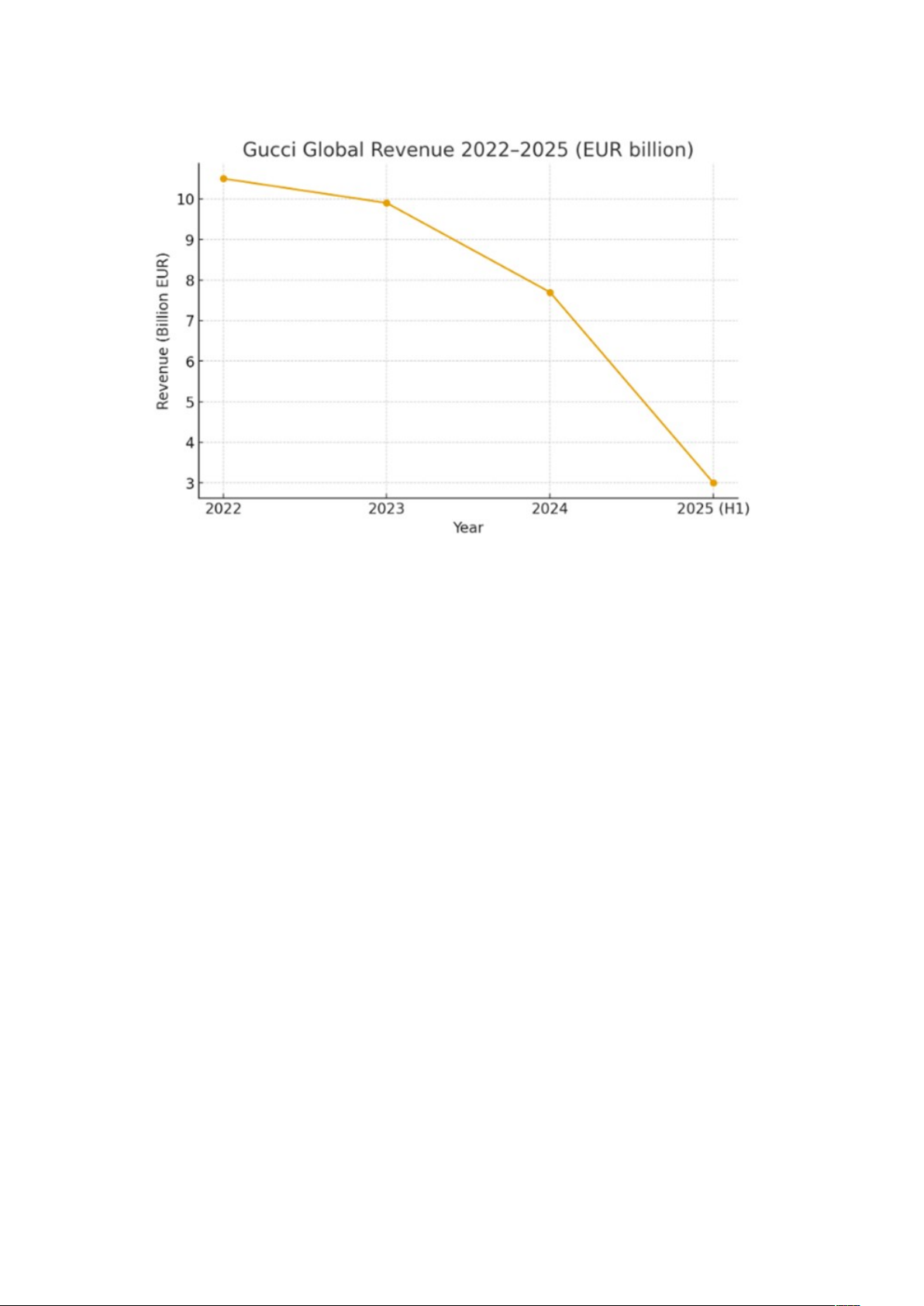
quickly built a widespread retail network in the US, Japan, Korea, and China,
markets that contribute to a revenue of about 10.5 billion euros in 2022, about 9.9
billion euros in 2023, of which more than 75% came from outside Europe.
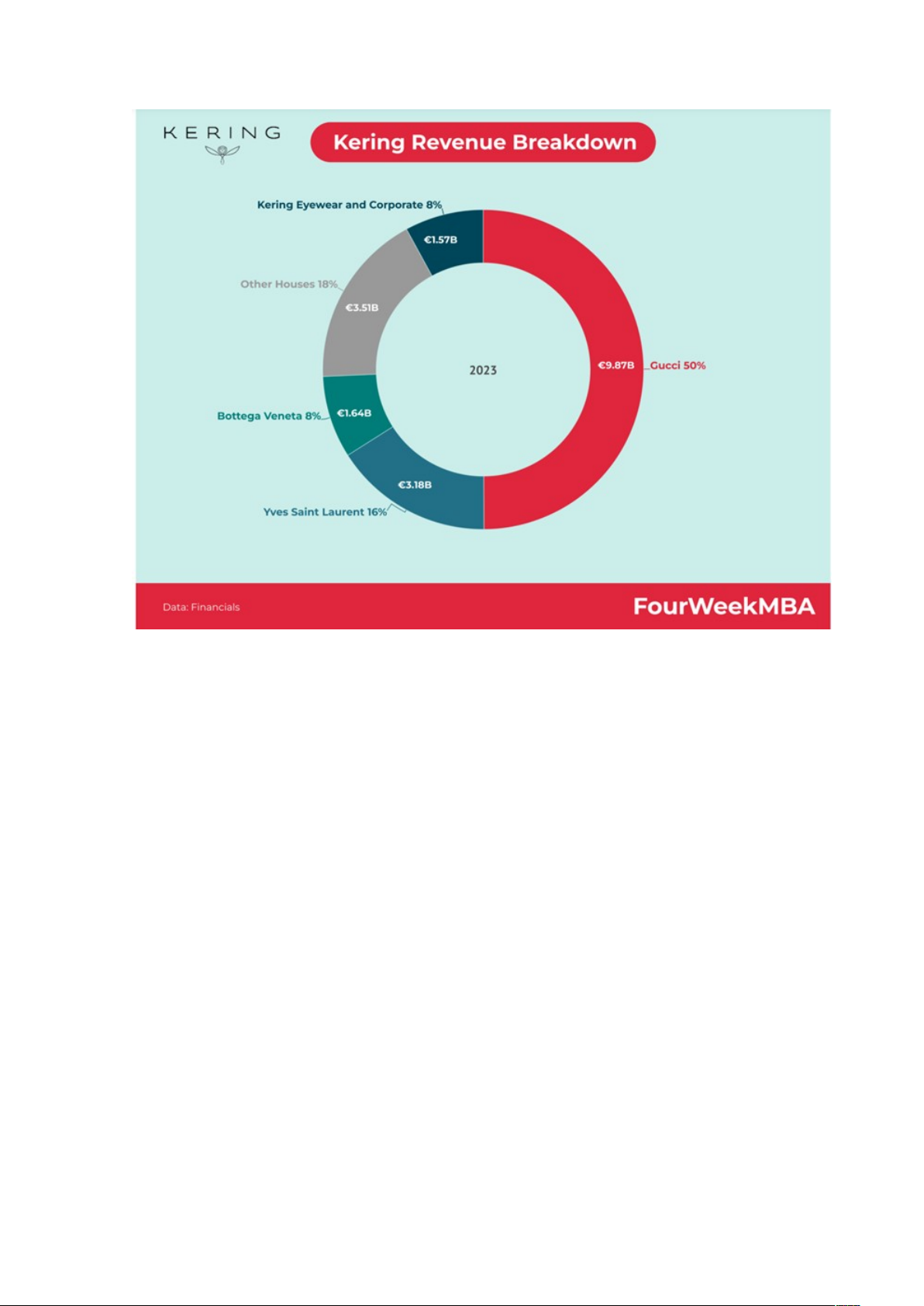
Gucci is not only successful on its own, but also contributes significantly to Kering,
the group that owns Gucci. In 2023, Gucci's revenue accounted for more than 50%
of Kering's total revenue. This contribution proved that Gucci's ability to globalize
and its international brand brings great benefits to both the group's profits and
reputation, helping Kering become a giant in the global luxury goods industry.
7
7"!!&/2&#
Operating in multiple markets forces Gucci to comply with different legal
regulations related to tax, labor, environment and consumer culture, increasing
compliance costs, and complicating management. In addition, increasingly fierce
competition from leading luxury brands such as Louis Vuitton, Chanel, Dior,
forcing Gucci to constantly innovate to maintain its competitive position. The
decline in sales after 2023 as tastes change and demand decreases forces Gucci to
restructure.
1
(,(,',!8"!1A".1/5%$.1/"/%&#$&081!1.6
./1.1&#
Globalization of production and resource mobility are drivers that directly impact
Gucci’s supply chain and operational efficiency, providing cost optimization
advantages. Gucci leverages the high-end craftsmanship in Italy, where 95% of its
products are manufactured, to strengthen quality and maintain its brand identity.
In addition, the company allocates its supply and distribution activities to many
countries to take advantage of raw materials, logistics and labor, helping products
reach the market faster. This brings great opportunities in terms of efficiency and
speed of response to global demand.
7"!!&/2&#
Operating a supply chain that spans multiple countries makes it difficult for Gucci
to fully control working conditions at its manufacturing sites and stores. The 2011
incident in Shenzhen where employees were forced to work more than 14 hours a
day, controlled by magnetic cards and working under a non-transparent “labor
dispatch” model is a clear example of the ethical risks arising from the globalization
of production.
In 2024, Gucci faced a class action lawsuit in the US alleging that the brand misled
customers by promoting products using unethical exotic animal skins, with an
investigation by animal rights groups (e.g. PETA) revealing that snakes and
crocodiles were being severely mistreated for their skins. This caused serious
2
damage to the brand’s reputation and forced Gucci to review its supply chain
monitoring system.
(,(,*,7&%&3&!0&/.51/50".1/"/%$00/1$".1/.&$7/!26
./1.1&#
Technology and social networks are the driving force that helps Gucci reach global
customers effectively, deploy creative marketing campaigns and strengthen its
brand image in the digital age. Platforms such as Instagram, TikTok and Weibo
have become important tools for Gucci to attract young customers and shape
fashion trends.
The use of Big Data and shopping behavior analysis also helps Gucci forecast
trends, adjust production and optimize inventory, increasing efficiency throughout
the value chain.
7"!!&/2&#
In the digital media environment, just one mistake in design or marketing campaign
can cause a global media crisis in a very short time. The 2019 “blackface sweater”
incident, about a sweater with a racist image that caused outrage, spread widely on
social media and forced Gucci to publicly apologize, withdraw the product from the
market and suffer a huge loss of reputation.
(,(,G,!8"!$!."!&>$7"/2&"/%%155#1/
./1.1&#
Cross-border cultural exchange and diffusion are the driving force that both brings
rich design inspiration and creates strict requirements for cultural sensitivity for
Gucci. Cultural globalization helps the brand easily access new aesthetic trends,
integrate international artistic elements into the collection and attract diverse
customers from many different cultures. This contributes to making Gucci a brand
with global appeal.
7"!!&/2&#
Without a deep understanding of the social, political, and religious context, Gucci
could inadvertently violate local cultural norms. Scandals in 2019, including a
$780-$800 Sikh turban that was deemed demeaning to their faith because they
consider the turban a sacred religious symbol.
And a $890 balaclava that was deemed suggestive of “blackface,” demonstrate how
a failure to properly assess cultural sensitivities has led to a backlash from the
international community. These incidents not only damage the brand’s reputation
but also impact sales in important markets like the US.

,E

B
,
(,',/$&.5"$%&5&.71$#"/%$".&#$1"!&#/#181!1.6
A corporate code of ethics is a set of principles designed to help a business guide its
decision-making and distinguish between right and wrong. These principles outline
the mission and values of the business, ensuring that all activities are transparent,
honest, and in accordance with the law
Corporate social responsibility (CSR) is a commitment of businesses to contribute
to sustainable economic development, through compliance with standards on
environmental protection, gender equality, labor safety, labor rights, fair wages,
employee training and development, community development, etc. In a way that
benefits both the business and the overall development of society.
(,*,7&!&5"50"!$%&5&.71$#"#"#.".&21$.!510!&0&/.1/2
$".&#$1"!&#/#181!1.6#.".&261/"2!8"!!6%1#&#&%$0"/6,
(,*,(,&01#&5/150#."/%"%#58&7"312!8"!!6
The code of conduct is used as a strategic tool to define uniform standards for all
suppliers and employees, regardless of geographical location or cultural
environment. This helps reduce legal risks, maintain brand image and synchronize
social responsibility. Proven by the code prohibiting corruption, child labor,
discrimination and other forms of harassment of the GUCCI brand. 100% of
suppliers must sign the Supplier code of conduct, to ensure that standards are
applied consistently throughout the supply chain
(,*,',&!#8#1/&##&#0/1."/%$/.!.7&1#!6$7"1/
The code of ethics is a tool to help businesses better manage risks, helping the
company monitor the entire supply chain to detect violations in a timely manner and
improve social responsibility practices continuously. Gucci has done this
completely through regular audits with suppliers and training suppliers according to
Gucci standards. At the same time, Gucci uses the EP&L environmental accounting
method to measure environmental impact, thereby making improvements and
ensuring compliance with global CSR. In the Gucci Equilibrium 2020 report, it was
recorded that 825 suppliers were audited at least once and a total of 1,066 audits
were conducted. This allows Gucci to control the uniformity of ethical standards
even though they have factories, workshops, and suppliers in many different
countries.
(,*,*,&!#21%&$".&$!.&"/%$00/1$".1/
The code of ethics is a strategic tool to build corporate culture, integrate CSR into
business strategy, enhance transparency and trust among customers, investors, and
the community. According to KPMG (2024), 79% of global businesses have
published sustainability reports, showing that transparency has become the norm in
modern governance. The GRI report (2023) noted that 78% of G250 corporations
apply GRI standards, reflecting the need to standardize social and environmental
data. At the same time, the Edelman Trust Barometer (2024) pointed out that 62%
of consumers expect businesses to address social issues, showing that a code of
ethics associated with CSR is a direct factor in building trust.
A typical example is Gucci, which launched the Gucci Equilibrium digital platform
to increase transparency in its social and environmental activities. It reported a 59%
reduction in its overall environmental impact between 2015 and 2022. In addition,
the company appointed a global director of DEI to ensure that ethical values and
social responsibility are integrated into all activities from design to marketing. This
is in line with McKinsey’s (2023) finding that companies with a clear CSR strategy
have a 10-15% profit margin over the industry average.
(,*,G,&!1/28#1/&##&#&#/%.1#@#"/%.&$.8"/%&.".1/
The code is a strategic tool to reduce risks and protect global reputation. A Deloitte
report found that 87% of businesses see ethical risks as the biggest threat to their
reputation, while PwC found that 69% of organizations have faced a reputation
crisis in the past five years. This shows that businesses need a clear system of
standards to respond when incidents occur. Mc Kinset (2023) pointed out that
companies with a clear ethical governance framework reduced the probability of a
reputation crisis by 40%, while Edelman (2024) warned that 70% of consumers will
stop buying if a brand mishandles an ethical crisis.
When ethical or cultural incidents occur, the code provides behavioral guidelines
and feedback mechanisms, helping to maintain customer and brand credibility. The
code helped Gucci preserve its reputation through the 2011 Shenzhen store incident
with inhumane labor conditions, cultural controversies,… Thanks to the code, Gucci
replaced its management team, recalled products, and publicly apologized,
demonstrating a strategic commitment to global ethical standards.
(
C'
,
9
:
EF,

,
',(,0"/127.#1##&#".$$17&/A7&/
',(,(,B7"."&70"/127.#H
“Human rights are a concept that, to date, has not been fully unified. According to
the United Nations, human rights are rights inherent to all human beings, regardless
of race, sex, nationality, ethnicity, language, religion, or any other status. Human
rights include the right to life and liberty, freedom from slavery and torture,
freedom of opinion and expression, the right to work and education, and many
more.” (International Business Textbook, 2021, p.308)
In international business, respecting human rights is considered one of the core
ethical standards that multinational corporations (MNCs) must adhere to.
Corporations have an obligation to protect human rights for all workers in their
value chain, whether operating directly or indirectly through subcontractors. This is
the foundation for businesses to develop sustainably and maintain their image and
reputation in the global market.
',(,',"/15&#.".1/#570"/127.#31!".1/#".$$17&/A7&/
At the Gucci Shenzhen store, many exposed behaviors indicate serious violations of
human rights. First, employees were placed under overly strict and excessively
controlling regulations. They had to comply with over 100 rules regarding personal
conduct, ranging from asking for permission every time they wanted to drink water
to being limited in the number of times they could use the restroom per day.
Restricting basic physiological needs such as eating, drinking, and sanitation is
considered a direct violation of the right to humane treatment and the right to
minimum health care.
Furthermore, the right to health protection was also seriously violated. Employees
were forced to stand for 12–14 hours a day, sometimes working overtime until 2 or
3 AM without proper rest, leading to severe health consequences. For instance, a
female employee suffered a miscarriage, and many others suffered from stomach
and urinary tract diseases due to prolonged overwork. The company’s disregard for
health signals and forcing employees to work in such hazardous conditions is a
direct violation of the right to health protection and a safe working environment -
one of the fundamental rights guaranteed by international human rights standards.

Although working far beyond standard labor hours, employees at the Gucci
Shenzhen store did not receive financial compensation as prescribed by regulations,
depriving them of legitimate economic rights. This shows that unfair treatment
became part of the management mechanism, eroding the rights and welfare that
workers should have been guaranteed.
More notably, the company required employees to personally compensate for lost
goods, even though these items were covered by insurance, demonstrating a
violation of basic labor rights. When a business transfers financial risk to workers -
even causing some employees to have tens of thousands of yuan deducted - this
reflects serious inequality in labor relations. Workers are forced to shoulder
responsibilities that do not belong to them, leading to severe infringement of their
economic interests.
',',"8"8#&".$$17&/A7&/
',',(,7&$/$&.5!"8"8#&
Labor abuse can be understood as the act of excessively exploiting human labor
through forced overtime, mental or physical action, paying disproportionate wages,
or placing workers in hazardous working environments. International ethical
responsibilities require MNCs to ensure labor rights throughout the entire supply
chain. Any form of forced labor or exploitation is considered a serious violation of
business ethics.
',',',"/15&#.".1/#5!"8"8#&".$$17&/A7&/
In the Shenzhen case, store employees had to work shifts lasting 12 to 14 hours a
day. Furthermore, they frequently had to work overtime without receiving overtime
pay according to labor regulations. This is a clear manifestation of labor
exploitation, as under Chinese labor law and ILO international standards, workers
have the right to receive higher wages for working beyond standard hours. Refusing
to pay legal overtime wages means the business has misappropriated the surplus
labor value created by employees, turning this excess effort into its own economic
benefit.
Additionally, Gucci’s use of the "labor dispatch" model also created loopholes in
protecting workers' rights, preventing them from enjoying benefits equivalent to
formal employees. In many cases, rights regarding social insurance, welfare
benefits, or bargaining power and bonuses were not fully guaranteed. This increased
the level of inequality and made workers vulnerable to abusive behaviors from
management.
',*,"#&#!&"%1/2.&.71$"!31!".1/#".$$17&/A7&/
The acts of human rights violations and labor abuse at the Gucci Shenzhen store did
not appear randomly but had deep roots in the governance structure, labor usage
model, and operational culture in the Chinese market.
+
First, Gucci's application of the labor dispatch model was a major contributing
factor to labor abuse. Most employees at the store did not sign contracts directly
with Gucci but through an intermediary company. This created a "responsibility
gap," where Gucci, the actual employer - was not subject to legal constraints
equivalent to a formal employer. Workers became invisible in the corporate HR
system and were easily overlooked when conflicts of interest arose. This is a
structural cause that made abusive behaviors easy to commit and hard to detect.
Second, the store's management system operated under a draconian management
culture, including over 100 detailed regulations and many unreasonable
requirements such as limiting restroom breaks or controlling employees' personal
behavior. Gucci lacked effective oversight mechanisms for this management level,
leading to prolonged abuse of power without checks. This reflects a weakness in
Gucci's governance system in the Chinese market, where local management power
exceeded control from headquarters and regional HR.
Third, the cause stemmed from a culture of achievement and revenue pressure.
Gucci Shenzhen was a key store, always under pressure to meet high sales targets,
especially during peak tourism and consumption periods. Consequently,
management chose to sacrifice employee rights to maximize service time and
revenue, leading to unpaid overtime and forced excessive working hours. When
business goals are placed above worker welfare without ethical control mechanisms,
violations become tangible and more severe.
Finally, a critical cause of Gucci's ethical violations in Shenzhen was the lack of
transparency and weak internal reporting mechanisms. Employees had no official
channel for complaints, or whistleblower protection mechanisms were ineffective.
When some employees tried to report abuse, they were ignored or even threatened
by management. This created an environment where abuse was systematically
maintained.
,
B+'((F ,
9,,D:
E
B? 
,
',G,7&&.1$"!8"#1#
In international business, enterprises always face the core problem of deciding on
markets for input factors and markets for output distribution to optimize business
efficiency and ensure sustainable development goals. Internationalizing input
factors allows businesses to utilize resources from different countries, creating a
globalization of production; parallel to this is the internationalization of output
markets, creating market globalization. Both processes are strongly impacted by
fundamental factors such as competitive pressure, the degree of trade liberalization,
.
and especially cost advantages between nations. Under intense competitive
pressure, international businesses are forced to organize production and allocate
resources in different markets in the most optimal way to minimize goods costs. At
the same time, differences in costs and trade liberalization levels between markets
create different access conditions, forcing businesses to carefully consider where to
source products or use resources to yield the greatest benefit. It is this competitive
pressure and desire for cost optimization that drives the linkage and
interdependence between businesses in the global value chain.
In Gucci's case in Shenzhen, this theory clearly explains the motive behind the
luxury fashion house applying the labor dispatch regime. Despite being a global
brand with high ethical standards, Gucci could not escape the pressure of operating
costs. To maintain high profit margins amidst rising personnel costs, the business
chose labor "resources" in China through intermediary companies (FESCO/CIIC)
instead of direct recruitment. This is a specific manifestation of the business
choosing a production organization method based on cost advantages and loopholes
in the local market to minimize input costs, despite going against initial ethical
commitments.
Besides corporate motivation, the process of international economic integration is
also deeply governed by the integration views and guidelines of each nation. Each
country, based on its economic position and strength as well as the competitiveness
of domestic enterprises, will build a specific integration roadmap suitable for socio-
economic conditions. This creates a specific legal framework and business
environment to which MNCs must adapt. Changes in state management views, such
as China enacting the new Labor Contract Law in 2008 to strengthen worker
protection, are the concretization of the nation's harmonious social development
guidelines. However, when corporate interests (cost minimization) clash with
national management views (social welfare protection), conflicts arise. The Gucci
Shenzhen incident is proof of the conflict between the global corporation's profit
optimization strategy and the host country's changing institutional framework,
where the business deliberately circumvented macro- policy orientations to serve
short-term economic goals.
',,7&&"!1.6"/%"/"!6#1#5&.71$"!31!".1/#".$$17&/A7&/
',,(,&$151$!1.1$"!!&2"!5"$.#1/.7&#1.".1/
Regarding the political - legal aspect, the disconnect stemmed from Gucci fully
utilizing the "gray area" of the Chinese legal system, specifically the labor dispatch
regime, to neutralize commitments in its own code of ethics. In 2008, China enacted
a new labor contract law to strengthen worker protection, but this inadvertently
increased personnel costs and reduced flexibility for businesses. To cope, Gucci
Shenzhen did not sign contracts directly with employees but through intermediaries
like FESCO or CIIC. In this structure, the intermediary company was the legal
employer responsible for wages and insurance, while Gucci was merely the utilizing
unit. This arrangement created a perfect "legal shield." When employees were fired
illegally or not paid overtime, Gucci could claim they were not the entity
F
responsible in court, thereby avoiding direct lawsuits. This explains why the global
policy on labor law compliance and full overtime payment became meaningless in
Shenzhen, where employees worked 12 - 14 hours per day and stayed for inventory
until 2 - 3AM without a single penny of overtime pay, because on paper, they were
not part of Gucci's official staff to enjoy those protections. However, precisely
because of this method of circumventing the law, Gucci simultaneously lost control
over employees, quality, and accompanying policies for workers.
',,',!."!5"$.#5/%1/.7&#1.".1/
Regarding the cultural aspect, the factor of high power distance in Chinese society
was radicalized by local managers, turning the work environment into a place of
harsh bodily control, completely contrary to the western culture of respecting
human rights. While Global Gucci committed to respecting dignity, at the Shenzhen
store, the manager's power was absolute and imposed. The specific and most
shocking manifestation of this disconnect was the rule controlling basic
physiological needs: employees had to ask for permission to drink water or use the
toilet, and restroom time was strictly limited to a maximum of 5 minutes. This
imposition of power was even crueler toward pregnant women. Although global
policy strictly forbids discrimination, the local culture of obedience forced pregnant
female employees to stand continuously and work night shifts, leading to the tragic
consequence of at least one miscarriage. Here, the local patriarchal management
culture completely crushed the humane standards that the Italian headquarters
mistakenly thought were being applied.
Cultural conflict continued to escalate through the lens of collectivism and the
handling of financial responsibility. In Gucci's western management thinking, the
risk of goods loss is a business risk covered by insurance. However, in Shenzhen,
managers applied the mindset of collective responsibility in a distorted way. When
an item was lost, the fault was not attributed to a specific individual or security
process, but the entire group of employees on the shift had to share the penalty. It
was recorded that employees were deducted a total of up to 70,000 RMB for stolen
goods, even though those goods were insured. This action shows a serious
disconnect. Gucci's global policy aimed for professionalism and fairness, but local
reality operated based on crowd punishment and transferring financial risk to
vulnerable workers, exploiting a culture of fear and peer pressure to manage.
"8!&',(0"1#/5$$1#2!8"!!1$63#&"!1.61/7&/A7&/
Category Global policy Reality in Shenzhen
Working hours Compliance with labor
laws, full overtime pay.
12 - 14 hours per day, staying
for inventory until 2-3 AM
without overtime pay.
7
Basic human
rights
Respect for dignity,
ensuring health and
safety.
Must ask permission to use the
toilet or drink water. Toilet
time limited to 5 minutes.
Maternity
protection
Discrimination strictly
prohibited, protection of
pregnant women.
Pregnant staff forced to work
night shifts, stand
continuously; miscarriage
reported.
Financial
responsibility
Company bears the risk
for goods.
Employees must compensate
for stolen goods.
Code of
conduct
Professional, fair. Imposition of more than 100
harsh rules, micromanagement
of employee behavior.
Finally, the combination of political and cultural factors explains the employees'
explosive method of resistance. Because the political system in Shenzhen did not
encourage independent unions and dispatched employees had no voice in the
organization, internal complaint channels were neutralized. When pushed too far,
employees used the strongest cultural weapon in east Asia: attacking the "face"
(reputation) of the business. The publication of an open letter on the internet titled
"To Gucci's Senior Management" was not just a cry for help but a tactic of public
criticism. In a context where Chinese culture is increasingly sensitive to nationalism
and boycotting "sweatshop" images, this action caused an immediate media crisis,
forcing Gucci to face the naked reality they had deliberately ignored through
beautiful financial reports.
1