Bài tập nhiệt động lực học | Trường Đại học Bách khoa - Đại học Quốc gia Thành phố Hồ Chí Minh
Bài tập nhiệt động lực học | Trường Đại học Bách khoa - Đại học Quốc gia Thành phố Hồ Chí Minh. Tài liệu giúp bạn tham khảo, ôn tập và đạt kết quả cao. Mời đọc đón xem!
Môn: Nhiệt động lực học - Truyền nhiệt 7 tài liệu
Trường: Trường Đại học Bách khoa - Đại học Quốc gia Thành phố Hồ Chí Minh 717 tài liệu
Tác giả:














Preview text:
20
THE SECOND LAW OF THERMODYNAMICS W 20.1.
IDENTIFY: For a heat engine, W = | H Q | − | C Q |. e = . H Q > 0, C Q < 0. H Q
SET UP: W = 2200 J. | C Q | = 4300 J. EXECUTE: (a) H Q = W + | C Q | = 6500 J. 2200 J (b) e = = 0 3 . 4 = 34%. 6500 J
EVALUATE: Since the engine operates on a cycle, the net Q equal the net W. But to calculate the
efficiency we use the heat energy input, H Q . W 20.2.
IDENTIFY: For a heat engine, W = | H Q | − | C Q |. e = . H Q > 0, C Q < 0. H Q SET UP: | H Q | = 9000 J. | C Q | = 6400 J.
EXECUTE: (a) W = 9000 J − 6400 J = 2600 J. W 2600 J (b) e = = = 0.29 = 29%. H Q 9000 J
EVALUATE: Since the engine operates on a cycle, the net Q equal the net W. But to calculate the
efficiency we use the heat energy input, H Q . 20.3.
IDENTIFY and SET UP: The problem deals with a heat engine. W = +3700 W and H Q = 16 + ,100 J. Use
Eq. (20.4) to calculate the efficiency e and Eq. (20.2) to calculate | C Q |. Power = / W t. work output W 3700 J EXECUTE: (a) e = = = = 0 2 . 3 = 23 . , heat energy input H Q 16,100 J
(b) W = Q = | H Q | − | C Q | Heat discarded is | C Q | = | H
Q | −W =16,100 J − 3700 J =12,400 J. (c) H
Q is supplied by burning fuel; H Q = m c L where c
L is the heat of combustion. H Q 16,100 J m = = = 0.350 g. 4 c L 4.60×10 J/g
(d) W = 3700 J per cycle In 1 t = 0 . 0
s the engine goes through 60.0 cycles. P = /
W t = 60.0(3700 J)/1.00 s = 222 kW 5 P = (2 22
. ×10 W)(1 hp/746 W) = 298 hp EVALUATE: C
Q = −12,400 J. In one cycle to Q t = C Q + H
Q = 3700 J. This equals tot W for one cycle. W 20.4.
IDENTIFY: W = | H Q | − | C Q |. e = . H Q > 0, C Q < 0. H Q SET UP: For 1.00 s, 3 W = 180×10 J.
© Copyright 2012 Pearson Education, Inc. All rights reserved. This material is protected under all copyright laws as they currently exist.
No portion of this material may be reproduced, in any form or by any means, without permission in writing from the publisher. 20-1 20-2 Chapter 20 3 W 180 ×10 J EXECUTE: (a) 5 H Q = = = 6.43×10 J. e 0 2 . 80 (b) 5 5 5 | C Q | = | H Q | −W = 6 4 . 3×10 J −1 80 . ×10 J = 4 63 . ×10 J. EVALUATE: Of the 5
6.43 × 10 J of heat energy supplied to the engine each second, 5 1 8 . 0×10 J is
converted to mechanical work and the remaining 5
4.63 × 10 J is discarded into the low temperature reservoir.
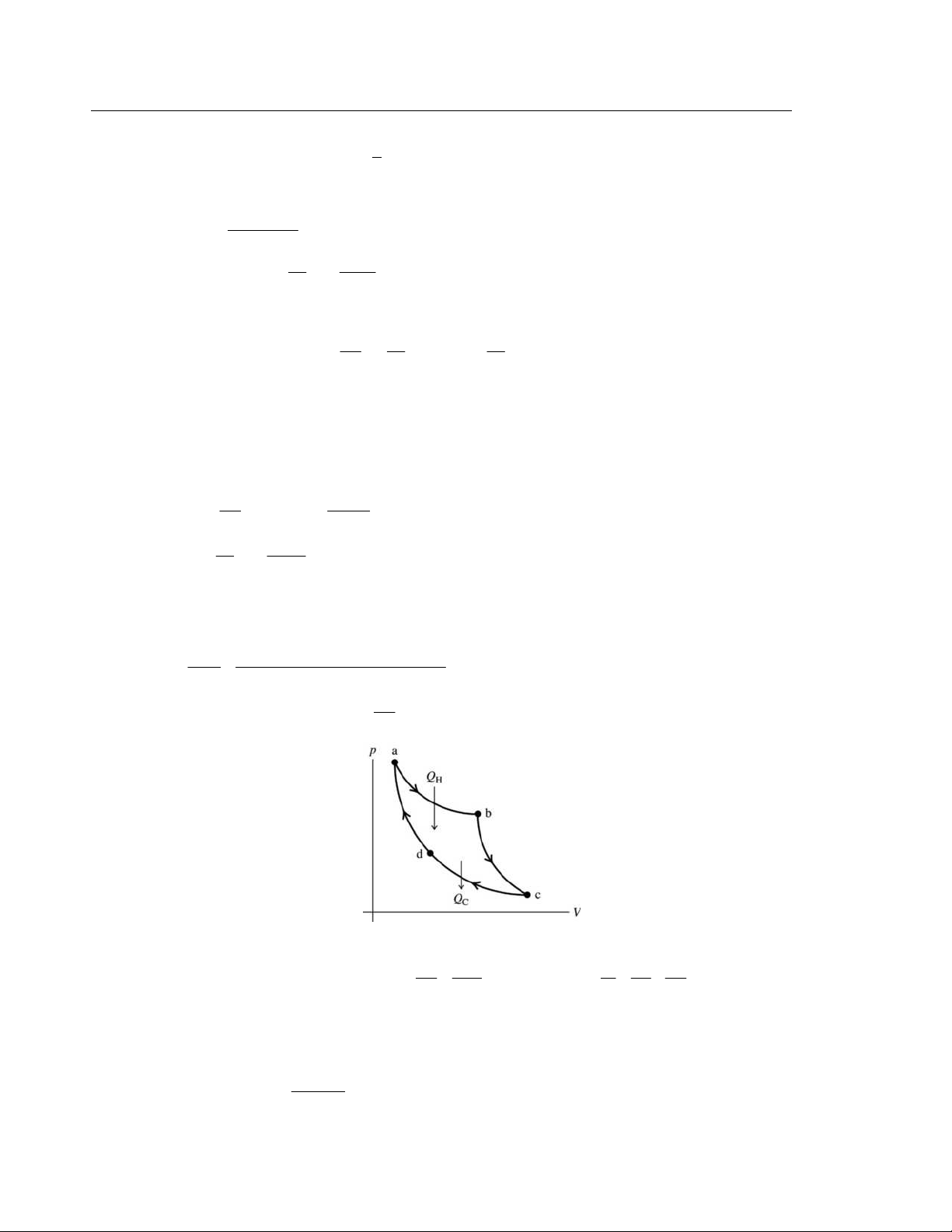
20.5. IDENTIFY: This cycle involves adiabatic (ab), isobaric (bc), and isochoric (ca) processes.
SET UP: ca is at constant volume, ab has Q = 0, and bc is at constant pressure. For a constant pressure p V Δ ⎛ C ⎞
process W = pΔV and Q = nC T Δ . p p
pV = nRT gives nΔT = , so Q = ⎜
⎟ pΔV. If γ = 1.40 the R R ⎝ ⎠ gas is diatomic and 7 C = . p
R For a constant volume process W = 0 and Q = nC T
Δ . pV = nRT gives 2 V V p Δ ⎛ ⎞ nΔT = , so V C Q = V ⎜ ⎟ Δ .
p For a diatomic ideal gas 5 = . 5 1 atm = 1.013 × 10 Pa. R ⎝ R ⎠ V C R 2 EXECUTE: (a) 3 3 9.0 10 m , b V − = × 1.5 b p = atm and 3 3 2.0 10 m . a V − = × For an adiabatic process γ 1.4 3 − 3 γ γ ⎛ V ⎞ ⎛ 9.0 ×10 m ⎞ b a p a V = p V . b = ⎜ ⎟ = ⎜ ⎟ = b a p b p (1.5 atm) 12.3 atm. ⎜ 3 − 3 ⎟ ⎝ a V ⎠ 2.0 ⎝ ×10 m ⎠
(b) Heat enters the gas in process ca, since T increases. ⎛ ⎞ ⎛ 5 V C ⎞ 3 − 3 5 Q = V p ⎜ ⎟ Δ = (2.0 ⎜ ⎟
×10 m )(12.3 atm −1.5 atm)(1.013×10 Pa/atm) = 5470 J. Q = ⎝ R ⎠ ⎝ 2 ⎠ H 5470 J.
(c) Heat leaves the gas in process bc, since T increases. ⎛ Cp ⎞ ⎛ 7 ⎞ 5 3 − 3 Q = ⎜ ⎟ p V Δ = (1.5 atm)(1.013 ⎜ ⎟ ×10 Pa/atm)( 7 − .0×10 m ) = 3 − 723 J. Q = − R C 3723 J. ⎝ ⎠ ⎝ 2 ⎠ (d) W = H Q + C Q = 5
+ 470 J + (−3723 J) =1747 J. W 1747 J (e) e = = = 0.319 = 31.9%. H Q 5470 J
EVALUATE: We did not use the number of moles of the gas. 1 |Q | 20.6.
IDENTIFY: Apply e =1− . C e = 1− . 1 rγ − | H Q | SET UP: In part (b), H
Q =10,000 J. The heat discarded is | C Q |. 1
EXECUTE: (a) e = 1− = 0 5 . 94 = 59 4 . %. 0.40 9 5 . 0 (b) | C Q | = | H
Q |(1− e) = (10,000 J)(1− 0 5 . 94) = 4060 J.
EVALUATE: The work output of the engine is W = | H Q | − | C
Q | = 10,000 J − 4060 J = 5940 J. 20.7. I − DENTIFY: 1 e = 1− r γ
SET UP: r is the compression ratio. E 2 . XECUTE: (a) 0 40 e = 1− (8.8) = 0.581, which rounds to 58%. (b) 0 2 4 . 0 e =1 − (9.6) = 0 5 . 95 an increase of 1.4%.
EVALUATE: An increase in r gives an increase in e.
20.8. IDENTIFY: Convert coefficient of performance (K) to energy efficiency rating (EER). H H SET UP: watts K = and Btu/h EER = . wa P tts wat P ts
© Copyright 2012 Pearson Education, Inc. All rights reserved. This material is protected under all copyright laws as they currently exist.
No portion of this material may be reproduced, in any form or by any means, without permission in writing from the publisher.
The Second Law of Thermodynamics 20-3 H
EXECUTE: 1 Btu/h = 0.293 W so Hwatts = HBtu/h(0.293). Btu/h K = 0.293 = (0.293)EER and w P atts
EER = 3.41K. For K = 3.0, EER = (3.41)(3.0) = 10.2.
EVALUATE: The EER is larger than K, but this does not mean that the air conditioner is suddenly better at cooling! 20.9.
IDENTIFY and SET UP: For the refrigerator K = 2.10 and 4 C Q = 3
+ .4×10 J. Use Eq. (20.9) to calculate
|W| and then Eq. (20.2) to calculate H Q .
(a) EXECUTE: Performance coefficient K = C
Q /|W| (Eq. 20.9) 4 4 |W| = C
Q /K = 3.40×10 J/2.10 =1.62×10 J
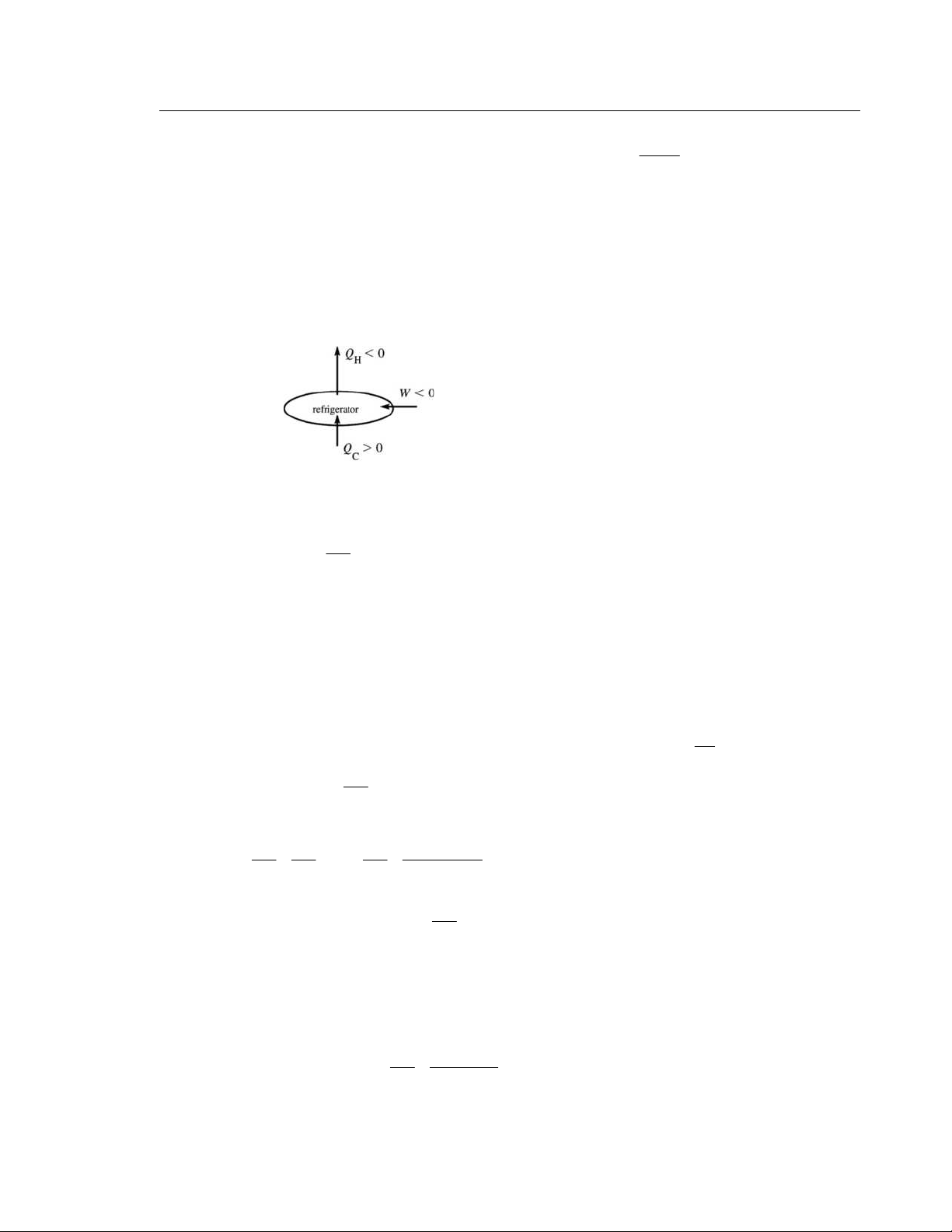
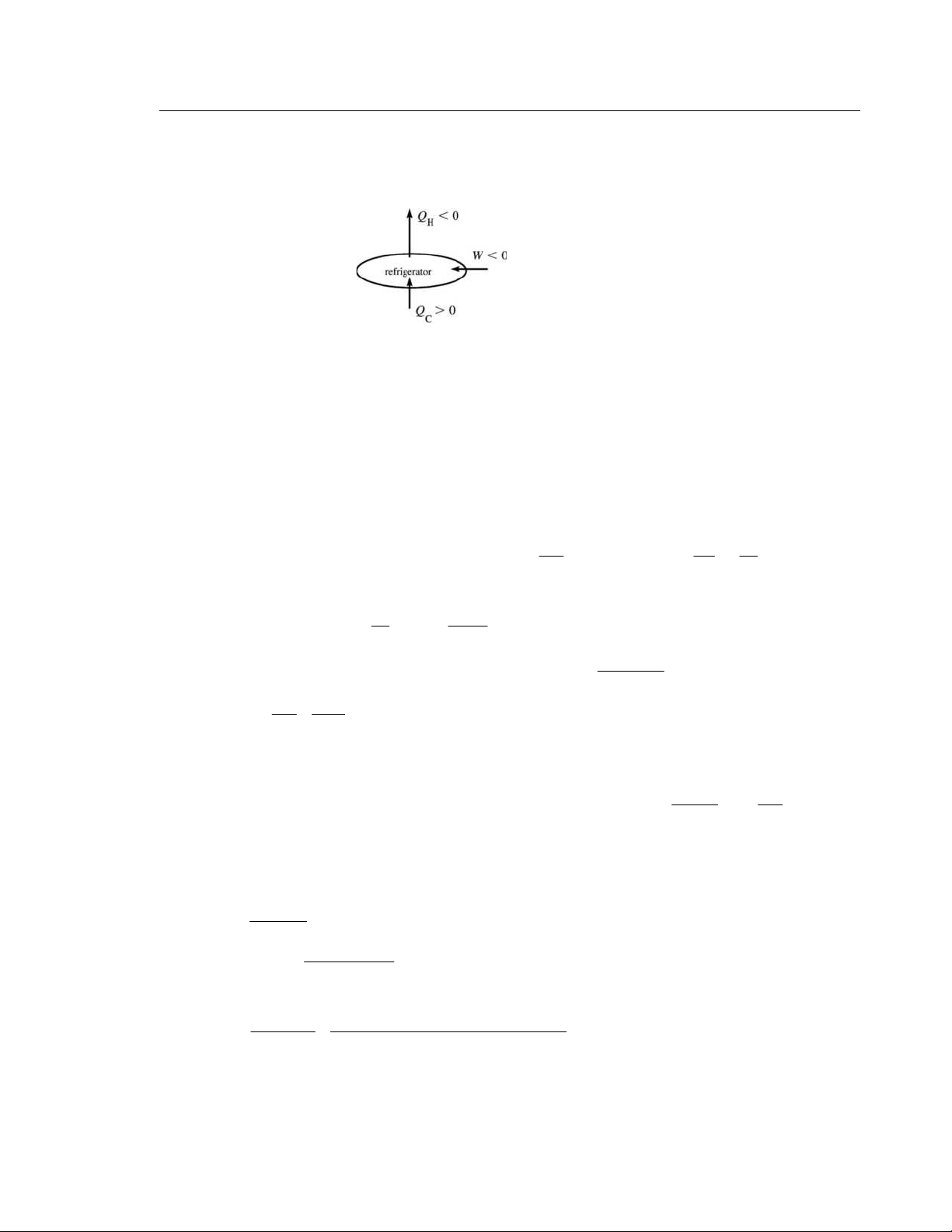
(b) SET UP: The operation of the device is illustrated in Figure 20.9. EXECUTE: W = C Q + H Q H Q = W − C Q 4 4 4 H Q = 1
− .62×10 J − 3.40×10 J = 5 − 02 . ×10 J
(negative because heat goes out of the system) Figure 20.9 EVALUATE: | H Q | = |W| + | C Q |. The heat | H
Q | delivered to the high temperature reservoir is greater than
the heat taken in from the low temperature reservoir. | | 20.10. IDENTIFY: C = Q K
and |Q | = |Q | + |W|. |W| H C
SET UP: The heat removed from the room is | C
Q | and the heat delivered to the hot outside is | H Q |. 4
|W| = (850 J/s)(60.0 s) = 5.10×10 J. EXECUTE: (a) 4 5 | C
Q | = K|W| = (2.9)(5.10×10 J) =1.48×10 J (b) 5 4 5 | H Q | = | C
Q | + |W| =1.48×10 J + 5.10×10 J =1.99×10 J. EVALUATE: (c) | H Q | = | C
Q | + |W|, so | H Q | > | C Q |. 20.11.
IDENTIFY: The heat Q = mc T
Δ that comes out of the water to cool it to 5.0°C is C
Q for the refrigerator. | |
SET UP: For water 1.0 L has a mass of 1.0 kg and 3
c = 4.19×10 J/kg ⋅ C°. = W P . The coefficient of t | | performance is C = Q K . |W| EXECUTE: 3 6 Q = mc T
Δ = (12.0 kg)(4.19×10 J/kg ⋅ C°)(5.0 C ° − 31 C ° ) = −1.31×10 J. 6 | C Q | =1.31×10 J. | 6 C Q | | C Q | |Q | 1.31×10 J K = = so C t = = = 6129 s =102 min =1.7 h. |W| Pt PK (95 W)(2.25)
EVALUATE: 1.7 h seems like a reasonable time to cool down the dozen bottles. |Q | 20.12. IDENTIFY: | H Q | = | C Q | + |W|. C K = . W SET UP: For water, w
c = 4190 J/kg ⋅ K and 5 f
L = 3.34×10 J/kg. For ice, ic c e = 2010 J/kg ⋅ K.
EXECUTE: (a) Q = m ic c eΔ ic T e − f mL + w mc Δ w T . 5 5 Q = (1 80 . kg)([2010 J/kg ⋅ K][ 5 − .0 C ]
° − 3.34×10 J/kg +[4190 J/kg ⋅ K][ 2 − 5 0 . C ] ° ) = 8 − 08 . ×10 J 5 Q = 8.08 −
×10 J. Q is negative for the water since heat is removed from it. 5 |Q | 8.08×10 J (b) 5 | C 5 C
Q | = 8.08×10 J. W = = = 3.37 ×10 J. K 2.40 (c) 5 5 6 | H
Q | = 8.08×10 J + 3.37 ×10 J =1.14 ×10 J.
© Copyright 2012 Pearson Education, Inc. All rights reserved. This material is protected under all copyright laws as they currently exist.
No portion of this material may be reproduced, in any form or by any means, without permission in writing from the publisher. 20-4 Chapter 20
EVALUATE: For this device, C Q > 0 and H
Q < 0. More heat is rejected to the room than is removed from the water. 20.13.
IDENTIFY: Use Eq. (20.2) to calculate |W |. Since it is a Carnot device we can use Eq. (20.13) to relate the
heat flows out of the reservoirs. The reservoir temperatures can be used in Eq. (20.14) to calculate e.
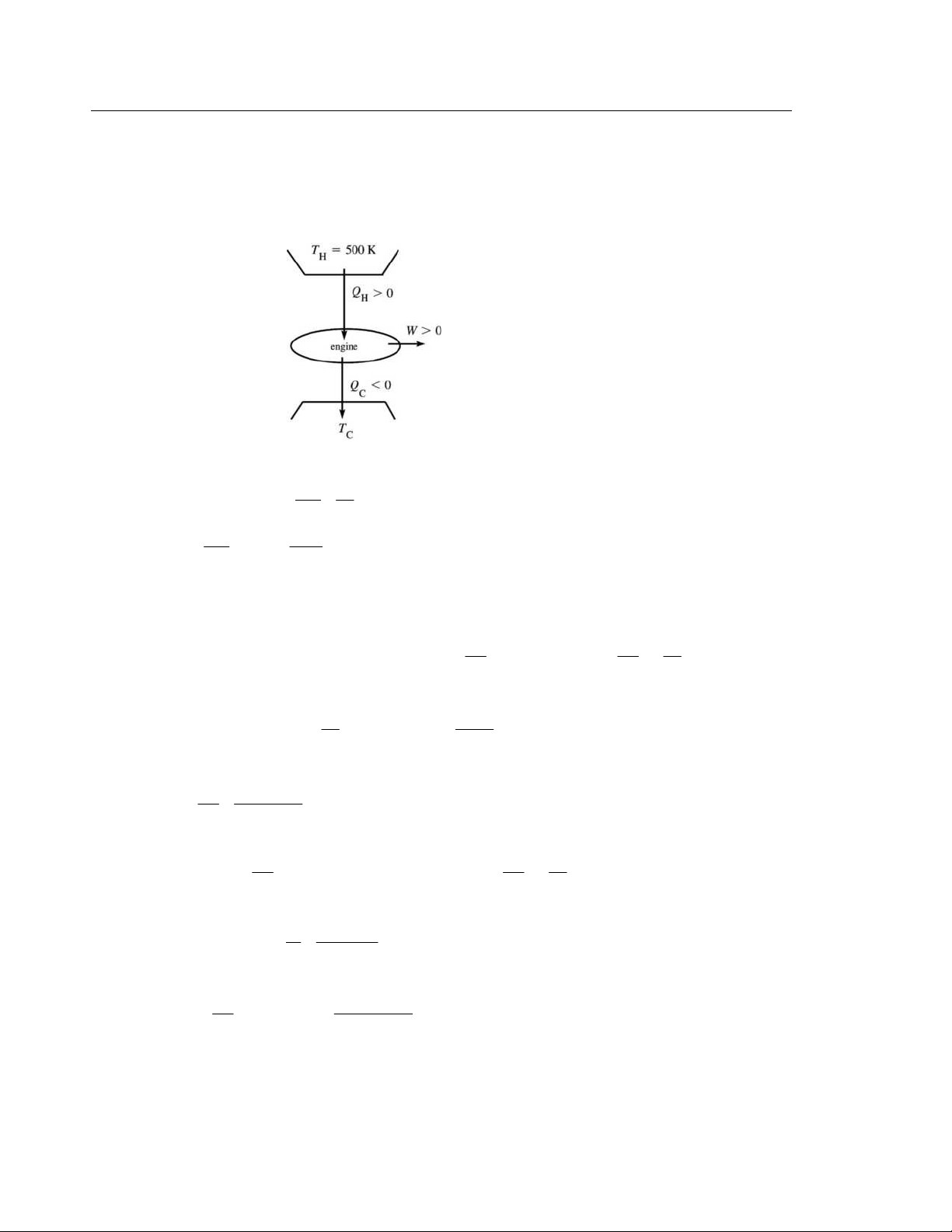
(a) SET UP: The operation of the device is sketched in Figure 20.13. EXECUTE: W = C Q + H Q
W = −335 J + 550 J = 215 J Figure 20.13 |Q | T
(b) For a Carnot cycle, C C = (Eq. 20.13) | H Q | H T | ⎛ ⎞ C Q | 335 J C T = H T = 620 K⎜ ⎟ = 378 K | H Q | ⎝ 550 J ⎠
(c) e(Carnot) =1− C T / H
T = 1− 378 K/620 K = 0.390 = 39.0,
EVALUATE: We could use the underlying definition of e (Eq. 20.4): e = / W H
Q = (215 J)/(550 J) = 39%, which checks. W Q T 20.14.
IDENTIFY: |W| = | H Q | − | C Q |. C Q < 0, H Q > 0. e = . For a Carnot cycle, C C = − . H Q H Q H T SET UP: C T = 300 K, H T = 520 K. 3 | H Q | = 6.45×10 J. ⎛ T ⎞ ⎛ 300 K ⎞ EXECUTE: (a) C 3 3 C Q = − H Q ⎜ ⎟ = −(6.45×10 J)⎜ ⎟ = 3 − .72×10 J. ⎝ H T ⎠ ⎝ 520 K ⎠ (b) 3 3 3 |W| = | H Q | − | C
Q | = 6.45×10 J − 3.72×10 J = 2.73×10 J 3 W 2.73×10 J (c) e = = = 0.423 = 42.3 . , 3 H Q 6.45×10 J
EVALUATE: We can verify that e = 1− C T / H
T also gives e = 42.3 . , W Q T 20.15. IDENTIFY: e =
for any engine. For the Carnot cycle, C C = − . H Q H Q H T SET UP: C T = 20.0 C ° + 273.15 K = 293.15 K 4 W 2.5×10 J EXECUTE: (a) 4 H Q = = = 4.24×10 J e 0.59 (b) W = H Q + C Q so 4 4 4 C Q = W − H
Q = 2.5×10 J − 4.24×10 J = −1.74×10 J. 4 ⎛ . × ⎞ H Q 4 24 10 J H T = − C T = −(293 15 . K)⎜ ⎟ = 714 K = 441 C ° . ⎜ 4 ⎟ C Q 1 ⎝ − 7 . 4×10 J ⎠
EVALUATE: For a heat engine, W > 0, H Q > 0 and C Q < 0.
© Copyright 2012 Pearson Education, Inc. All rights reserved. This material is protected under all copyright laws as they currently exist.
No portion of this material may be reproduced, in any form or by any means, without permission in writing from the publisher.
The Second Law of Thermodynamics 20-5 20.16.
IDENTIFY and SET UP: The device is a Carnot refrigerator.
We can use Eqs. (20.2) and (20.13).
(a) The operation of the device is sketched in Figure 20.16. H T = 24 0 . C ° = 297 K C T = 0 0 . C ° = 273 K Figure 20.16
The amount of heat taken out of the water to make the liquid → solid phase change is 3 7 Q = −m f L = −(85 0
. kg)(334×10 J/kg) = −2.84×10 J. This amount of heat must go into the working
substance of the refrigerator, so 7 C Q = 2.84 + ×10 J. For Carnot cycle | C Q |/| H Q | = C T / H T . EXECUTE: 7 7 | H Q | = | C Q |( H T / C T ) = 2 8
. 4×10 J(297 K/273 K) = 3.09×10 J (b) 7 7 6 W = C Q + H Q = 2.84 + ×10 J − 3.09×10 J = 2 − .5×10 J
EVALUATE: W is negative because this much energy must be supplied to the refrigerator rather than
obtained from it. Note that in Eq. (20.13) we must use Kelvin temperatures. |Q | Q T 20.17. IDENTIFY: | H Q | = |W| + | C Q |. H Q < 0, C Q > 0. C K = . For a Carnot cycle, C C = − . |W| H Q H T SET UP: C T = 270 K, H T = 320 K. | C Q | = 415 J. ⎛ T ⎞ ⎛ 320 K ⎞ EXECUTE: (a) H H Q = −⎜ ⎟ C Q = − (415 J) ⎜ ⎟ = 492 − J. ⎝ C T ⎠ ⎝ 270 K ⎠ (165)(77 J)
(b) For one cycle, |W| = | H Q | − | C
Q | = 492 J − 415 J = 77 J. P = = 212 W. 60 s |Q | 415 J (c) C K = = = 5.4. |W | 77 J
EVALUATE: The amount of heat energy | H
Q | delivered to the high-temperature reservoir is greater than the amount of heat energy | C
Q | removed from the low-temperature reservoir. T |Q | 20.18.
IDENTIFY: The theoretical maximum performance coefficient is C KCarnot = . C K = . | C Q | is the H T − C T |W|
heat removed from the water to convert it to ice. For the water, | | Q = m w c T Δ + m f L . SET UP: C T = 5.0 − C ° = 268 K. H T = 20.0 C ° = 293 K. w
c = 4190 J/kg ⋅ K and 3 f L = 334×10 J/kg.
EXECUTE: (a) In one year the freezer operates (5 h/day)(365 days) = 1825 h. 730 kWh P = = 0.400 kW = 400 W. 1825 h 268 K (b) KCarnot = =10.7 293 K − 268 K (c) 6
|W| = Pt = (400 W)(3600 s) = 1.44×10 J. 7 | C
Q | = K|W| =1.54×10 J. | | Q = m w c T Δ + m f L gives 7 | C Q | 1.54×10 J m = = = 36 9 . kg. 3 w c T Δ + f L
(4190 J/kg ⋅ K)(20.0 K) + 334×10 J/kg
EVALUATE: For any actual device, K < KCarnot, | C
Q | is less than we calculated and the freezer makes
less ice in one hour than the mass we calculated in part (c).
© Copyright 2012 Pearson Education, Inc. All rights reserved. This material is protected under all copyright laws as they currently exist.
No portion of this material may be reproduced, in any form or by any means, without permission in writing from the publisher. 20-6 Chapter 20 W Q Q T T 20.19. IDENTIFY: C e = =1− . For a Carnot cycle, C C = − and C e =1− . H Q H Q H Q H T H T SET UP: H T = 800 K. C Q = 300 − 0 J.
EXECUTE: For a heat engine, H Q = − C
Q /(1− e) = −( 3000 − J)/(1− 0 6 . 00) = 7500 J, and then W = e H
Q = (0.600)(7500 J) = 4500 J.
EVALUATE: This does not make use of the given value of H T . If H T is used, then C T = H
T (1− e) = (800 K)(1− 0.600) = 320 K a H Q = − C Q H nd / T C
T , which gives the same result. Q T 20.20. IDENTIFY: W = C Q + H
Q . For a Carnot cycle, C C = −
. For the ice to liquid water phase transition, H Q H T Q = m f L . SET UP: For water, 3 f L = 334×10 J/kg. Q T EXECUTE: 3 4 C Q = −m f
L = −(0.0400 kg)(334×10 J/kg) = 1 − 3 . 36×10 J. C C = − gives H Q H T 4 Q = −(T T / )Q = −( 1
− .336×10 J)[(373.15 K)/(273.15 K)] 4 H H C C = 1.8 + 25×10 J. 3 W = C Q + H Q = 4.89×10 J.
EVALUATE: For a heat engine, C Q is negative and H
Q is positive. The heat that comes out of the engine
(Q < 0) goes into the ice (Q > 0). W T W 20.21.
IDENTIFY: The power output is P =
. The theoretical maximum efficiency is C e =1− . e = . t Carnot H T H Q SET UP: 4 H Q =1.50×10 J. C T = 350 K. H
T = 650 K. 1 hp = 746 W. T 350 K EXECUTE: C Carnot e =1− =1− = 0.4615. 4 3 W = e H
Q = (0.4615)(1.50×10 J) = 6.923×10 J; this is H T 650 K 3 W (240)(6.923×10 J) the work output in one cycle. 4 P = = = 2 7 . 7×10 W = 37.1 hp. t 60 0 . s Q T
EVALUATE: We could also use C C = − to calculate H Q H T ⎛ ⎞ ⎛ ⎞ C T 350 K 4 3 C Q = −⎜ ⎟ H Q = −⎜ ⎟(1.50×10 J) = 8 − .08×10 J. Then 3 W = C Q + H
Q = 6.92×10 J, the same as ⎝ H T ⎠ ⎝ 650 K ⎠ previously calculated. 20.22.
IDENTIFY: The immense ocean does not change temperature, but it does lose some entropy because it
gives up heat to melt the ice. The ice does not change temperature as it melts, but it gains entropy by
absorbing heat from the ocean. Q
SET UP: For a reversible isothermal process ΔS =
, where T is the Kelvin temperature at which the T
heat flow occurs. The heat flows in this problem are irreversible, but since S Δ is path-independent, the
entropy change is the same as for a reversible heat flow. The heat flow when the ice melts is Q = m f L , with 3 f
L = 334×10 J/kg. Heat flows out of the ocean (Q < 0) and into the ice (Q > 0). The heat flow for
the ice occurs at T = 0 C
° = 273.15 K. The heat flow for the ocean occurs at T = 3.50°C = 276.65 K. EXECUTE: 3 6 Q = m f
L = (4.50 kg)(334×10 J/kg) =1.50×10 J. For the ice, 6 Q 1.50 + ×10 J 6 3 Q 1.50 − ×10 J S Δ = =
= 5.49×10 J/K. For the ocean, 3 S Δ = = = 5.42 − ×10 J/K. The net T 273.15 K T 276.65 K entropy change is 3 3 5.49 ×10 J/K + ( 5.42 − ×10 J/K) = 70
+ J/K. The entropy of the world increases by 70 J/K.
EVALUATE: Since this process is irreversible, we expect the entropy of the world to increase, as we have found.
© Copyright 2012 Pearson Education, Inc. All rights reserved. This material is protected under all copyright laws as they currently exist.
No portion of this material may be reproduced, in any form or by any means, without permission in writing from the publisher.
The Second Law of Thermodynamics 20-7 Q 20.23. IDENTIFY: S Δ =
for each object, where T must be in kelvins. The temperature of each object remains constant. T SET UP: For water, 5 f L = 3.34×10 J/kg.
EXECUTE: (a) The heat flow into the ice is 5 5 Q = m f
L = (0.350 kg)(3.34×10 J/kg) = 1.17 ×10 J. The heat 5 Q 1.17 ×10 J
flow occurs at T = 273 K, so S Δ = =
= 429 J/K. Q is positive and S Δ is positive. T 273 K 5 Q 1.17 − ×10 J (b) 5 Q = 1.17 −
×10 J flows out of the heat source, at T = 298 K. S Δ = = = 393 − J/K. T 298 K
Q is negative and S Δ is negative. (c) S Δ tot = 429 J/K + ( 393 − J/K) = 36 + J/K.
EVALUATE: For the total isolated system, S
Δ > 0 and the process is irreversible. 20.24. IDENTIFY: Apply sy
Q stem = 0 to calculate the final temperature. Q = mc T Δ . Example 20.6 shows that S Δ = mcln( 2 T / 1
T ) when an object undergoes a temperature change.
SET UP: For water c = 4190 J/kg ⋅ K. Boiling water has T =100.0 C ° = 373 K.
EXECUTE: (a) The heat transfer between 100 C ° water and 30 C
° water occurs over a finite temperature
difference and the process is irreversible. (b) (270 kg)c( 2 T − 30.0 C ° ) + (5.00 kg)c( 2 T −100 C ° ) = 0. 2 T = 31.27 C ° = 304.42 K. ⎛ 304.42 K ⎞ ⎛ 304 42 . K ⎞ (c) S
Δ = (270 kg)(4190 J/kg ⋅ K)ln⎜ ⎟ + (5 00 . kg)(4190 J/kg ⋅ K)ln . ⎜ ⎟ ⎝ 303.15 K ⎠ ⎝ 373 15 . K ⎠ S
Δ = 4730 J/K + (−4265 J/K) = +470 J/K. EVALUATE: S
Δ system > 0, as it should for an irreversible process. Q 20.25.
IDENTIFY: Both the ice and the room are at a constant temperature, so S Δ = . For the melting phase T
transition, Q = m f
L . Conservation of energy requires that the quantity of heat that goes into the ice is the
amount of heat that comes out of the room. SET UP: For ice, 3 f
L = 334×10 J/kg. When heat flows into an object, Q > 0, and when heat flows out of an object, Q < 0.
EXECUTE: (a) Irreversible because heat will not spontaneously flow out of 15 kg of water into a warm room to freeze the water. 3 3 mL m 2 L
(15.0 kg)(334×10 J/kg) −(15 0 . kg)(334×10 J/kg) (b) f f S Δ = S Δ ice + S Δ room = + = + . ic T e r T oom 273 K 293 K S Δ = 12 + 50 J/K.
EVALUATE: This result is consistent with the answer in (a) because S
Δ > 0 for irreversible processes. 20.26.
IDENTIFY: Q = mc T
Δ for the water. Example 20.6 shows that S Δ = mcln( 2 T / 1 T ) when an object
undergoes a temperature change. S Δ = /
Q T for an isothermal process.
SET UP: For water, c = 4190 J/kg ⋅ K. 85 0 . C ° = 358.2 K. 20 0 . C ° = 293.2 K. ⎛ T ⎞ ⎛ 293.2 K ⎞ EXECUTE: (a) 2 S
Δ = mcln⎜ ⎟ = (0.250 kg)(4190 J/kg ⋅ K)ln⎜
⎟ = −210 J/K. Heat comes out of ⎝ 1 T ⎠ ⎝ 358 2 . K ⎠
the water and its entropy decreases. (b) 4 Q = mc T
Δ = (0.250)(4190 J/kg ⋅ K)( 6
− 5.0 K) = −6.81×10 J. The amount of heat that goes into the air 4 Q 6 + 8 . 1×10 J is 4 6 + 8
. 1×10 J. For the air, S Δ = = = 232 + J/K. T 293 1 . K S Δ system = 21 − 0 J/K + 232 J/K = 2 + 2 J/K. EVALUATE: S
Δ system > 0 and the process is irreversible.
© Copyright 2012 Pearson Education, Inc. All rights reserved. This material is protected under all copyright laws as they currently exist.
No portion of this material may be reproduced, in any form or by any means, without permission in writing from the publisher. 20-8 Chapter 20 Q 20.27.
IDENTIFY: The process is at constant temperature, so S
Δ = . ΔU = Q −W. T
SET UP: For an isothermal process of an ideal gas, U
Δ = 0 and Q = W. For a compression, V
Δ < 0 and W < 0. −1850 J
EXECUTE: Q = W = 1850 − J. ΔS = = −6 3 . 1 J/K. 293 K
EVALUATE: The entropy change of the gas is negative. Heat must be removed from the gas during the
compression to keep its temperature constant and therefore the gas is not an isolated system. 20.28.
IDENTIFY and SET UP: The initial and final states are at the same temperature, at the normal boiling point
of 4.216 K. Calculate the entropy change for the irreversible process by considering a reversible isothermal
process that connects the same two states, since S
Δ is path independent and depends only on the initial
and final states. For the reversible isothermal process we can use Eq. (20.18).
The heat flow for the helium is Q = m 2 v
L , negative since in condensation heat flows out of the helium. The heat of vaporization v
L is given in Table 17.4 and is 3 v L = 20 9 . ×10 J/kg. EXECUTE: 3 Q = −m v
L = −(0.130 kg)(20.9×10 J/kg) = 2717 − J S Δ = / Q T = 2 − 717 J/4.216 K = 6 − 44 J/K.
EVALUATE: The system we considered is the 0.130 kg of helium; S
Δ is the entropy change of the helium.
This is not an isolated system since heat must flow out of it into some other material. Our result that S Δ < 0
doesn’t violate the 2nd law since it is not an isolated system. The material that receives the heat that flows out
of the helium would have a positive entropy change and the total entropy change would be positive. Q 20.29.
IDENTIFY: Each phase transition occurs at constant temperature and S Δ = . Q = mL . T v
SET UP: For vaporization of water, 3 v L = 2256×10 J/kg. 3 Q mLv (1 00 . kg)(2256 ×10 J/kg) EXECUTE: (a) 3 S Δ = = = = 6.05×10 J/K. T T (373 15 . Note that this is the change K)
of entropy of the water as it changes to steam.
(b) The magnitude of the entropy change is roughly five times the value found in Example 20.5.
EVALUATE: Water is less ordered (more random) than ice, but water is far less random than steam; a
consideration of the density changes indicates why this should be so. Q 20.30.
IDENTIFY: The phase transition occurs at constant temperature and S
Δ = . Q = mL . The mass of one T v
mole is the molecular mass M. SET UP: For water, 3 2 v
L = 2256×10 J/kg. For N2, 3 M = 28 0
. ×10 kg/mol, the boiling point is 77.34 K and 3 2 v
L = 201×10 J/kg. For silver (Ag), 3
M =107.9×10 kg/mol, the boiling point is 2466 K and 3 2 v
L = 2336×10 J/kg. For mercury (Hg), 3
M = 200.6×10 kg/mol, the boiling point is 630 K and 3 v L = 272×10 J/kg. 3 − 3 Q mL . × × EXECUTE: (a) v (18 0 10 kg)(2256 10 J/kg) S Δ = = = =109 J/K. T T (373.15 K) −3 3 (28.0×10 kg)(201×10 J/ kg) 3 − 3 (107 9 . ×10 kg)(2336×10 J/kg) (b) N2: = 72 8 . J /K. Ag: 102 = 2 . J/K. (77 3 . 4 K) (2466 K) −3 3 (200.6×10 kg)(272×10 J/kg) Hg: 86 = .6 J/K (630 K)
(c) The results are the same order or magnitude, all around 100 J/K.
EVALUATE: The entropy change is a measure of the increase in randomness when a certain number
(one mole) goes from the liquid to the vapor state. The entropy per particle for any substance in a vapor
state is expected to be roughly the same, and since the randomness is much higher in the vapor state
(see Exercise 20.29), the entropy change per molecule is roughly the same for these substances.
© Copyright 2012 Pearson Education, Inc. All rights reserved. This material is protected under all copyright laws as they currently exist.
No portion of this material may be reproduced, in any form or by any means, without permission in writing from the publisher.
The Second Law of Thermodynamics 20-9 20.31.
IDENTIFY: No heat is transferred, but the entropy of the He increases because it occupies a larger volume
and hence is more disordered. To calculate the entropy change, we need to find a reversible process that
connects the same initial and final states.
SET UP: The reversible process that connects the same initial and final states is an isothermal expansion at T = 293 K, from 1 V = 10.0 L to 2
V = 35.0 L. For an isothermal expansion of an ideal gas U Δ = 0 and
Q = W = nRT ln( 2 V / 1 V ). EXECUTE: Q 9767 J
(a) Q = (3.20 mol)(8.315 J/mol ⋅ K)(293 K)ln(35.0 L/10.0 L) = 9767 J. S Δ = = = 33.3 J/K. + T 293 K
(b) The isolated system has ΔS > 0 so the process is irreversible.
EVALUATE: The reverse process, where all the gas in 35.0 L goes through the hole and into the tank does not ever occur. 20.32.
IDENTIFY: Apply Eq. (20.23) and follow the procedure used in Example 20.11.
SET UP: After the partition is punctured each molecule has equal probability of being on each side of the
box. The probability of two independent events occurring simultaneously is the product of the probabilities of each separate event.
EXECUTE: (a) On the average, each half of the box will contain half of each type of molecule, 250 of nitrogen and 50 of oxygen.
(b) See Example 20.11. The total change in entropy is −23 −21 S Δ = k 1
N ln(2) + kN2ln(2) = ( 1
N + N2)k ln(2) = (600)(1.381×10 J/K) ln(2) = 5.74×10 J/K. (c) The probability is 500 100 600 1 − 81 (1/2) × (1/2) = (1/2) = 2 4 . ×10
, and is not likely to happen. The numerical
result for part (c) above may not be obtained directly on some standard calculators. For such calculators,
the result may be found by taking the log base ten of 0.5 and multiplying by 600, then adding 181 and then
finding 10 to the power of the sum. The result is then −181 0 8 . 7 −181 10 ×10 = 2.4×10 .
EVALUATE: The contents of the box constitutes an isolated system. S
Δ > 0 and the process is irreversible. 20.33.
(a) IDENTIFY and SET UP: The velocity distribution of Eq. (18.32) depends only on T, so in an isothermal process it does not change.
(b) EXECUTE: Calculate the change in the number of available microscopic states and apply Eq. (20.23).
Following the reasoning of Example 20.11, the number of possible positions available to each molecule is
altered by a factor of 3 (becomes larger). Hence the number of microscopic states the gas occupies at volume 3V is N 2 w = (3) 1
w , where N is the number of molecules and 1
w is the number of possible
microscopic states at the start of the process, where the volume is V. Then, by Eq. (20.23), Δ = ln( N S k 2 w / 1
w ) = k ln(3) = Nk ln(3) = nNAk ln(3) = nRln(3) S Δ = (2 00 . mol)(8 3 . 145 J/mol ⋅ K)ln(3) = 18 + 3 J/ . K
(c) IDENTIFY and SET UP: For an isothermal reversible process ΔS = / Q T.
EXECUTE: Calculate W and then use the first law to calculate Q. T
Δ = 0 implies ΔU = 0, since system is an ideal gas.
Then by ΔU = Q −W , Q = W . V V For an isothermal process, 2 2 W = p dV =
(nRT/V ) dV = nRT ln( ∫ ∫ 2 V / 1 V ) 1 V 1 V
Thus Q = nRT ln( 2 V / 1 V ) and ΔS = / Q T = nRln( 2 V / 1 V )
ΔS = (2.00 mol)(8.3145 J/mol⋅ K)ln(3 1 V / 1 V ) = 1 + 8.3 J/K
EVALUATE: This is the same result as obtained in part (b). 20.34.
IDENTIFY: Example 20.8 shows that for a free expansion, ΔS = nRln( 2 V / 1 V ). S − ET UP: 3 3 1 V = 2 4 . 0 L = 2 40 . ×10 m 3 ⎛ 425 m ⎞
EXECUTE: ΔS = (0 1
. 00 mol)(8.314 J/mol ⋅ K)ln⎜ ⎟ =10.0 J/K ⎜ 3 2 3 2 40 10 m ⎟ ⎝ . × ⎠
EVALUATE: ΔSsystem > 0 and the free expansion is irreversible.
© Copyright 2012 Pearson Education, Inc. All rights reserved. This material is protected under all copyright laws as they currently exist.
No portion of this material may be reproduced, in any form or by any means, without permission in writing from the publisher. 20-10 Chapter 20 20.35.
IDENTIFY: The total work that must be done is tot W = mg y Δ . |W| = | H Q | − | C Q |. H
Q > 0, W > 0 and Q T C
Q < 0. For a Carnot cycle, C C = − , H Q H T SET UP: C T = 373 K, H T = 773 K. | H Q |= 2 50 J. ⎛ T ⎞ ⎛ 373 K ⎞ EXECUTE: (a) C C Q = − H Q ⎜ ⎟ = −(250 J)⎜ ⎟ = 12 − 1 J. ⎝ H T ⎠ ⎝ 773 K ⎠
(b) |W| = 250 J −121 J =129 J. This is the work done in one cycle. 2 5 tot W
= (500 kg)(9.80 m/s )(100 m) = 4.90 ×10 J. The number of cycles required is 5 to W t 4.90×10 J 3 = = 3 8 . 0×10 cycles. |W | 129 J/cycle Q T EVALUATE: In C C = −
, the temperatures must be in kelvins. H Q H T Q T 20.36. IDENTIFY: W = C Q + H
Q . Since it is a Carnot cycle, C C = −
. The heat required to melt the ice is H Q H T Q = m f L . SET UP: For water, 3 f L = 334×10 J/kg. H Q > 0, C Q < 0. C Q = −m f L . H T = 527 C ° = 800.15 K. EXECUTE: (a) H Q = 40 + 0 J, W = +300 J. C Q = W − H Q = −100 J. C T = − H T ( C Q / H
Q ) = −(800.15 K)[(−100 J)/(400 J)] = +200 K = −73 C ° (b) The total C Q required is 3 6 − f
mL = −(10.0 kg)(334×10 J /kg) = −3 3 . 4×10 J. C
Q for one cycle is −100 J, 6 3 − .34×10 J
so the number of cycles required is 4 = 3.34×10 cycles. −100 J /cycle
EVALUATE: The results depend only on the maximum temperature of the gas, not on the number of moles or the maximum pressure. 20.37.
IDENTIFY: We know the efficiency of this Carnot engine, the heat it absorbs at the hot reservoir and the
temperature of the hot reservoir. W Q T
SET UP: For a heat engine e = and H Q + C
Q = W. For a Carnot cycle, C C = − . C
Q < 0, W > 0, H Q H Q H T and H Q > 0. H T = 135 C ° = 408 K. In each cycle, H
Q leaves the hot reservoir and C Q enters the cold
reservoir. The work done on the water equals its increase in gravitational potential energy, mgh. W EXECUTE: (a) e = so W = e H
Q = (0.22)(150 J) = 33 J. H Q (b) C Q = W − H Q = 33 J −150 J = 11 − 7 J. Q T ⎛ Q ⎞ ⎛ 117 − J ⎞ (c) C C = − so C C T = − H T ⎜ ⎟ = −(408 K)⎜ ⎟ = 318 K = 45 C ° . H Q H T ⎝ H Q ⎠ ⎝ 150 J ⎠ − Q Q 15 − 0 J 117 J (d) H C ΔS = + = +
= 0. The Carnot cycle is reversible and ΔS = 0. H T C T 408 K 318 K W 33 J
(e) W = mgh so m = = = 0.0962 kg = 96.2 g. 2 gh (9.80 m/s )(35.0 m)
EVALUATE: The Carnot cycle is reversible so ΔS = 0 for the world. However some parts of the world
gain entropy while other parts lose it, making the sum equal to zero. 20.38.
IDENTIFY: The same amount of heat that enters the person’s body also leaves the body, but these transfers
of heat occur at different temperatures, so the person’s entropy changes.
© Copyright 2012 Pearson Education, Inc. All rights reserved. This material is protected under all copyright laws as they currently exist.
No portion of this material may be reproduced, in any form or by any means, without permission in writing from the publisher.
The Second Law of Thermodynamics 20-11
SET UP: We are asked to find the entropy change of the person. The person is not an isolated system.
In 1.0 s, 0.80(80 J) = 64 J of heat enters the person’s body at 37 C
° = 310 K. This amount of heat leaves Q
the person at a temperature of 30 C ° = 303 K. ΔS = . T 64 + J 6 − 4 J E −
XECUTE: For the person, 3 ΔS = + = −4.8 ×10 J/K. 310 K 303 K
EVALUATE: The entropy of the person can decrease without violating the second law of thermodynamics
because the person isn’t an isolated system. 20.39.
IDENTIFY: The same amount of heat that enters the person’s body also leaves the body, but these transfers
of heat occur at different temperatures, so the person’s entropy changes.
SET UP: 1 food-calorie = 1000 cal = 4186 J. The heat enters the person’s body at 37°C = 310 K and Q
leaves at a temperature of 30°C = 303 K. ΔS = . T ⎛ 4186 J ⎞ EXECUTE: 4
Q = (0.80)(2.50 g)(9.3 food-calorie/g)⎜ ⎟ = 7.79×10 J. ⎝1 food-calorie ⎠ 4 4 7.79 + ×10 J 7 − .79 ×10 J ΔS = + = 5.
− 8 J/K. Your body’s entropy decreases. 310 K 303 K
EVALUATE: The entropy of your body can decrease without violating the second law of thermodynamics
because you are not an isolated system. 20.40.
IDENTIFY: Use the ideal gas law to calculate p and V for each state. Use the first law and specific expressions
for Q, W and ΔU for each process. Use Eq. (20.4) to calculate e. H
Q is the net heat flow into the gas. SET UP: γ = 1.40
= /( −1) = 20.79 J/mol ⋅ K; V C R γ
C = C + R = 29 10 . J/mol⋅ K p V
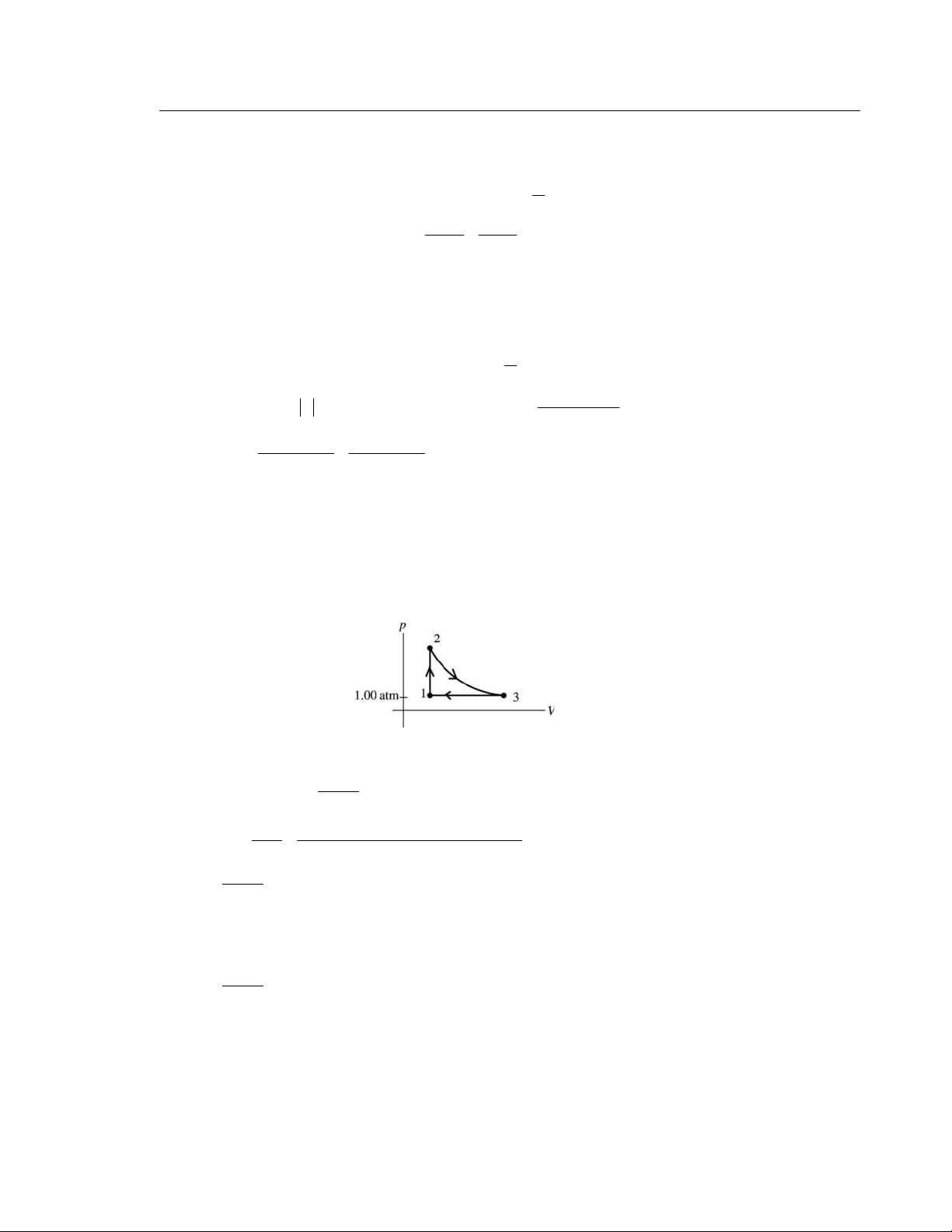
. The cycle is sketched in Figure 20.40. 1 T = 300 K 2 T = 600 K 3 T = 492 K Figure 20.40 EXECUTE: (a) point 1 5 1
p =1.00 atm =1.013×10 Pa (given); pV = nRT; 1 nRT (0 350 . mol)(8 31 . 45 J/mol⋅ K)(300 K) 3 2 3 1 V = = = 8 6 . 2×10 m 5 1 p 1.013×10 Pa point 2
process 1 → 2 at constant volume so 3 2 3 2 V = 1 V = 8 6 . 2×10 m
pV = nRT and n, R, V constant implies 1 p / 1 T = 2 p / 2 T 5 2 p = 1 p ( 2 T / 1
T ) = (1.00 atm)(600 K/300 K) = 2 0 . 0 atm = 2 0 . 3×10 Pa point 3
Consider the process 3 →1, since it is simpler than 2 → 3.
Process 3 →1 is at constant pressure so 5 3 p = 1 p =1.00 atm = 1 0 . 13×10 Pa
pV = nRT and n, R, p constant implies 1 V / 1 T = 3 V / 3 T −3 3 3 − 3 3 V = 1 V ( 3 T / 1 T ) = (8 6 . 2×10 m )(492 K/300 K) =14 1 . ×10 m
© Copyright 2012 Pearson Education, Inc. All rights reserved. This material is protected under all copyright laws as they currently exist.
No portion of this material may be reproduced, in any form or by any means, without permission in writing from the publisher. 20-12 Chapter 20 (b) process 1 → 2 constant volume ( V Δ = 0) Q = n V C ΔT = (0 35
. 0 mol)(20.79 J/mol ⋅ K)(600 K − 300 K) = 2180 J
ΔV = 0 and W = 0. Then ΔU = Q −W = 2180 J process 2 → 3 Adiabatic means Q = 0. ΔU = n V
C ΔT (any process), so ΔU = (0.350 mol)(20 7
. 9 J/mol⋅ K)(492 K − 600 K) = −780 J
Then ΔU = Q −W gives W = Q − U Δ = 780 1
J. (It is correct for W to be positive since V Δ is positive.) process 3 →1 For constant pressure 5 3 2 3 3 2 3 W = p V
Δ = (1.013 ×10 Pa)(8.62 ×10 m −14 1 . ×10 m ) = −560 J
or W = nRΔT = (0 35
. 0 mol)(8.3145 J/mol ⋅ K)(300 K − 492 K) = 560 −
J, which checks. (It is correct for W to be negative, since V
Δ is negative for this process.)
Q = nCpΔT = (0.350 mol)(29.10 J/mol⋅ K)(300 K − 492 K) = −1960 J
ΔU = Q −W = −1960 J − ( 560 − K) = −1400 J
or ΔU = n V
C ΔT = (0.350 mol)(20.79 J/mol ⋅ K)(300 K − 492 K) = −1400 J, which checks (c) ne W t = 1 W 2 + 2 W 3 + 3 W → → 1 = 0 + 780 J − 560 J = 220 1 J → (d) ne Q t = 1 Q 2 + 2 Q 3 + 3 Q → → 1 = 2180 J + 0 − 1960 J = 2 + 20 J → work output W 220 J (e) e = = = = 0 1 . 01 = 10.1 . , heat energy input H Q 2180 J e(Carnot) =1− C T / H
T = 1− 300 K/600 K = 0 5 . 00.
EVALUATE: For a cycle ΔU = 0, so by ΔU = Q −W it must be that ne Q t = n
W et for a cycle. We can also
check that ΔUnet = 0: ΔUnet = Δ 1 U 2 + U Δ 2 3 + ΔU → →
3 1 = 2180 J − 1050 J − 1130 J = 0 →
e < e(Carnot), as it must. 20.41.
IDENTIFY: pV = nRT , so pV is constant when T is constant. Use the appropriate expression to calculate W
Q and W for each process in the cycle. e = . H Q
SET UP: For an ideal diatomic gas, 5 V C = R and 7 C = R. 2 p 2 EXECUTE: (a) 3 p V = 2 0 . ×10 J a a . 3 p V = 2.0×10 J b b
. pV = nRT so a p a V = b p b V says a T = b T .
(b) For an isothermal process, Q = W = nRT ln( 2 V / 1
V ). ab is a compression, with b V < V ,
a so Q < 0 and C
heat is rejected. bc is at constant pressure, so p Q = nCp T Δ = p V Δ . V
Δ is positive, so Q > 0 and heat is R C
absorbed. ca is at constant volume, so V Q = n V C T Δ = V p
Δ . Δp is negative, so Q < 0 and heat is R rejected. 3 p V 2 0 a a . ×10 J p V (c) b b a T = = = 241 K. T = = T = 241 K. nR (1.00)(8.314 J/mol ⋅ K) b a nR 3 p V 4 0 c c . ×10 J c T = = = 481 K. nR (1.00)(8.314 J/mol ⋅ K) 3 ⎛ V ⎞ ⎛ 0 b .0050 m ⎞ (d) 3 ab Q = nRT ln⎜
⎟ = (1.00 mol)(8.314 J/mol ⋅ K)(241 K)ln⎜ ⎟ = 1 − .39×10 J. ⎜ 3 ⎝ a V ⎠ 0 010 m ⎟ ⎝ . ⎠
© Copyright 2012 Pearson Education, Inc. All rights reserved. This material is protected under all copyright laws as they currently exist.
No portion of this material may be reproduced, in any form or by any means, without permission in writing from the publisher.
The Second Law of Thermodynamics 20-13 ⎛ 7 ⎞ 3
Q = nC ΔT = (1 00) . (8
⎜ ⎟ .314 J/mol⋅ K)(241 K) = 7 0 . 1×10 J bc p . ⎝ 2 ⎠ ⎛ 5 ⎞ 3 Q = nC T Δ = (1.00) (8 ⎜ ⎟ .314 J/mol ⋅ K)( 241 − K) = 5 − .01×10 J ca V
. Q = Q + Q + Q = . ⎝ 2 ⎠ net 610 J ab bc ca ne W t = n Q et = 610 J. W 610 J (e) e = = = 0.087 = 8.7% 3 H Q 7.01×10 J
EVALUATE: We can calculate W for each process in the cycle. 3 W = Q = 1 2 3 . 9×10 J ab ab . 5 3 3
= Δ = (4.0 ×10 Pa)(0.0050 m ) = 2.00 ×10 J bc W p V . 0 ca W = . ne
W t =W +W +W = 610 J, ab bc ca which does equal net Q . 20.42.
(a) IDENTIFY and SET UP: Combine Eqs. (20.13) and (20.2) to eliminate C
Q and obtain an expression for H
Q in terms of W, C T and H T . W = 1 0 . 0 J, C T = 268.15 K, H T = 290.15 K For the heat pump C Q > 0 and H Q < 0 Q T EXECUTE: W = C Q + H
Q ; combining this with C C =2 gives H Q H T W 1.00 J H Q = = =13 2 . J 1− C T / H T 1− (268 15 . /290.15)
(b) Electrical energy is converted directly into heat, so an electrical energy input of 13.2 J would be required. W
(c) EVALUATE: From part (a), H Q = . 1− H Q decreases as C
T decreases. The heat pump is less C T / H T
efficient as the temperature difference through which the heat has to be “pumped” increases. In an engine, heat flows from H T to C
T and work is extracted. The engine is more efficient the larger the temperature
difference through which the heat flows. 20.43. IDENTIFY: b T = c
T and is equal to the maximum temperature. Use the ideal gas law to calculate a T . Apply W
the appropriate expression to calculate Q for each process. e = . U
Δ = 0 for a complete cycle and for H Q
an isothermal process of an ideal gas. SET UP: For helium, = 3 /2 V C R and 5 C = R/2 p
. The maximum efficiency is for a Carnot cycle, and Car e not =1− C T / H T . EXECUTE: (a) in Q = ab Q + bc Q . ou Q t = ca Q . max T = T = T = 327 C ° = 600 K b c . p V p V p 1 a a b b a = → T = T = (600 K) = 200 K a b . T T p 3 a b b nRT
(2 moles)(8.31 J/mol ⋅ K)(600 K) b 3 p V = nRT →V = = = 0.0332 m b b b b . 5 b p 3 0 . ×10 Pa b p b V c p c V b p 3 ⎛ 3⎞ 3 = → V = V = (0 0 . 332 m )⎜ ⎟ = 0.0997 m c b = V . T T p ⎝ 1 a ⎠ b c c ⎛ 3⎞ 3
Q = nC ΔT = (2 mol) (8
⎜ ⎟ .31 J/mol⋅ K)(400 K) = 9 9 . 7 ×10 J ab V ab ⎝ 2⎠ c c b nRT V Q = W = pdV = dV = nRT ln c = nRT ln 3 bc bc b b . ∫ ∫ b b V b V 4 bc
Q = (2.00 mol)(8.31 J/mol ⋅ K)(600 K)ln 3 =1.10×10 J. 4 in
Q = Q + Q = 2 1 . 0×10 J ab bc .
© Copyright 2012 Pearson Education, Inc. All rights reserved. This material is protected under all copyright laws as they currently exist.
No portion of this material may be reproduced, in any form or by any means, without permission in writing from the publisher. 20-14 Chapter 20 ⎛ 5 ⎞ 4 ou Q t = ca
Q = nCpΔ ca T = (2.00 mol) (8
⎜ ⎟ .31 J/mol ⋅ K)(400 K) =1.66×10 J. ⎝ 2 ⎠ (b) 4 4 3 Q = U
Δ +W = 0 +W →W = in Q − ou
Q t = 2.10×10 J −1.66×10 J = 4 4 . ×10 J. 3 4.4×10 J e = / W in Q = = 0 2 . 1 = 21%. 4 2.10×10 J T 200 k (c) C m e ax = C e arnot =1− =1− = 0.67 = 67% H T 600 k
EVALUATE: The thermal efficiency of this cycle is about one-third of the efficiency of a Carnot cycle that
operates between the same two temperatures. Q T T 20.44.
IDENTIFY: For a Carnot engine, C C C =2 . e =1−
. |W| = |Q | − |Q |. Q >
Q < . pV = nRT. Carnot H C H 0, C 0 H Q H T H T
SET UP: The work done by the engine each cycle is mg y
Δ , with m =15.0 kg and Δy = 2 0 . 0 m. H T = 773 K. H Q = 500 J.
EXECUTE: (a) The pV diagram is sketched in Figure 20.44. (b) 2 W = mg y Δ = (15.0 kg)(9 8 . 0 m/s )(2 00 . m) = 294 J. | C Q | = | H
Q | − |W| = 500 J − 294 J = 206 J, and C Q = 206 2 J. ⎛ ⎞ C Q ⎛ −206 J ⎞ C T = − H T ⎜ ⎟ = −(773 K)⎜ ⎟ = 318 K = 45 C ° . ⎝ H Q ⎠ ⎝ 500 J ⎠ T 318 K (c) C e = 1− =1− = 0.589 = 58.9 . , H T 773 K (d) | C Q | = 206 J.
(e) The maximum pressure is for state a. This is also where the volume is a minimum, so 3 3 5 00 L 5 00 10 m a V − = . = . × . = H = 773 K a T T . nRT (2.00 mol)(8 31 . 5 J/mol⋅ K)(773 K) a 6 p = = = 2 5 . 7×10 Pa a . 3 − 3 a V 5.00×10 m W
EVALUATE: We can verify that e =
gives the same value for e as calculated in part (c). H Q Figure 20.44 W / W t W Q Q 20.45. IDENTIFY: max e = C e arnot =1− C T / H T . e = = . W = H Q + C Q so C H = + . For a H Q H Q /t t t t
temperature change Q = mc T Δ . SET UP: H T = 300.15 K, C
T = 279.15 K. For water, 3
ρ =1000 kg/m , so a mass of 1 kg has a volume of
1 L. For water, c = 4190 J/kg ⋅ K. 279.15K
EXECUTE: (a) e = 1− = 7.0%. 300.15K
© Copyright 2012 Pearson Education, Inc. All rights reserved. This material is protected under all copyright laws as they currently exist.
No portion of this material may be reproduced, in any form or by any means, without permission in writing from the publisher.
The Second Law of Thermodynamics 20-15 Q P Q Q W (b) H out 210 kW = = = 3.0 MW. C H = − = 3 0 . MW − 210 kW = 2 8 . MW. t e 0.070 t t t 6 m |Q |/t (2.8×10 W)(360 0 s/h) (c) C 5 5 = = = 6×10 kg/h = 6×10 L/h . t cΔT (4190 J/kg ⋅ K)(4 K)
EVALUATE: The efficiency is small since C T and H
T don’t differ greatly. 20.46.
IDENTIFY: Use Eq. (20.4) to calculate e.
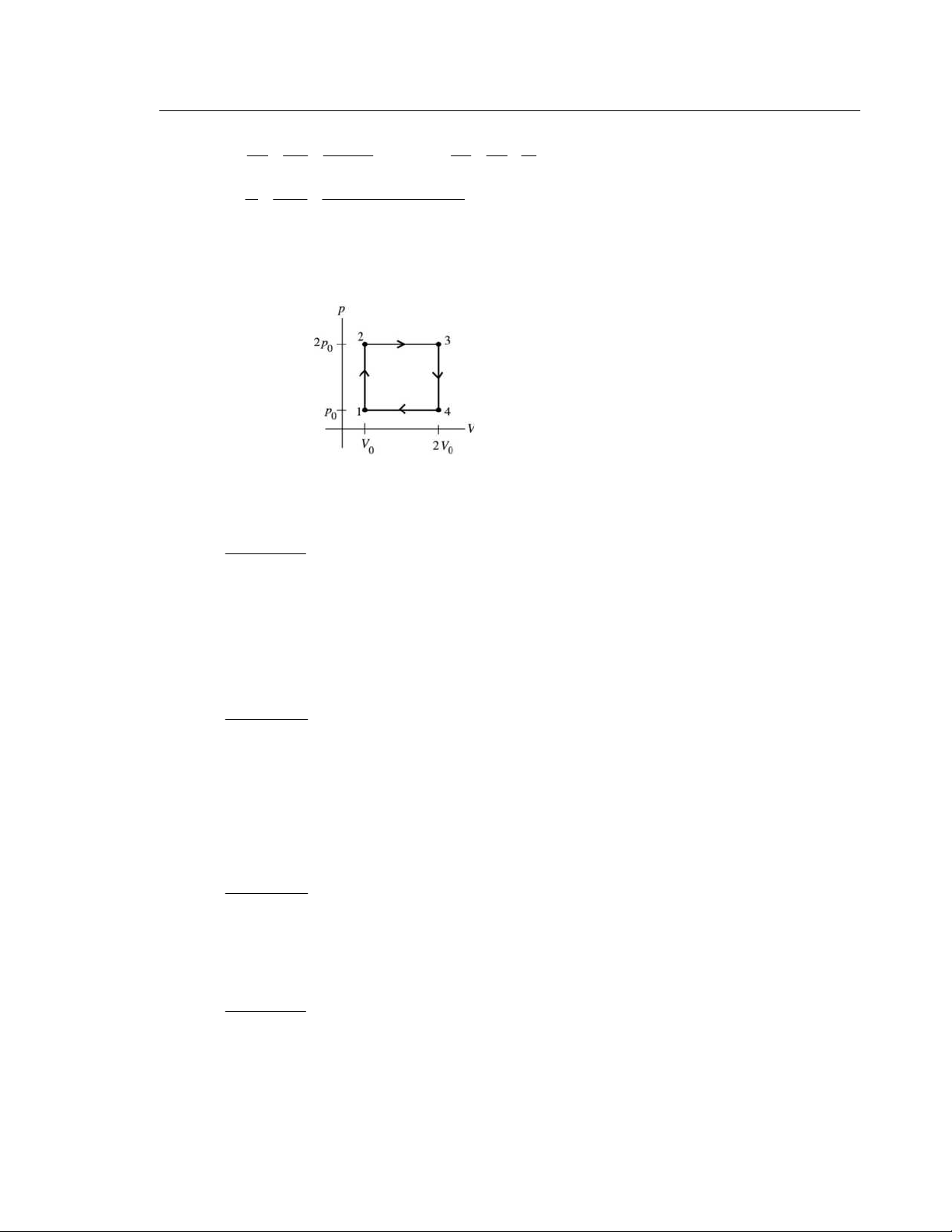
SET UP: The cycle is sketched in Figure 20.46. V C = 5 / R 2
for an ideal gas C = C + R = 7 / R 2 p V Figure 20.46
SET UP: Calculate Q and W for each process. process 1 → 2
ΔV = 0 implies W = 0
ΔV = 0 implies Q = nC T Δ = nC ( 2 T − 1 T ) V V
But pV = nRT and V constant says 1 p V = nR 1 T and 2 p V = nR 2 T . Thus ( 2 p − 1
p )V = nR( 2 T − 1 T ); V p
Δ = nRΔT (true when V is constant).
Then Q = nC ΔT = nC (V Δ /
p nR) = (C /R)V p Δ = (C /R) 0 V (2 0 p − 0
p ) = (C /R) V V V V V 0 p 0
V . Q > 0; heat is absorbed by the gas.) process 2 → 3 p
Δ = 0 so W = pΔV = p( 3 V − 2 V ) = 2 0 p (2 0 V − 0 V ) = 2 0 p 0
V (W is positive since V increases.) p
Δ = 0 implies Q = nC ΔT = nC ( 2 T − 1 T ) p p
But pV = nRT and p constant says p 1 V = nR 1 T and p 2 V = nR 2 T . Thus p( 2 V − 1 V ) = nR( 2 T − 1
T ); pΔV = nRΔT (true when p is constant). Then Q = nC T Δ = nC ( pΔ /
V nR) = (C /R) p V Δ = (C /R)2 0 p (2 0 V − 0
V ) = (C /R)2 p p p p p 0 p 0
V . (Q > 0; heat is absorbed by the gas.) process 3 → 4
ΔV = 0 implies W = 0 ΔV = 0 so
Q = nC ΔT = nC (V Δ /
p nR) = (C /R)(2 0 V )( 0 p − 2 0
p ) = −2(C /R) V V V V 0 p 0 V
(Q < 0 so heat is rejected by the gas.) process 4 →1 p
Δ = 0 so W = p V Δ = p( 1 V − 4 V ) = 0 p ( 0 V − 2 0 V ) = − 0 p 0
V (W is negative since V decreases) p
Δ = 0 so Q = nC T Δ = nC ( pΔ /
V nR) = (C /R) p V Δ = (C /R) 0 p ( 0 V − 2 0
V ) = −(C /R) p p p p p 0 p 0 V (Q < 0 so heat is rejected by the gas.)
© Copyright 2012 Pearson Education, Inc. All rights reserved. This material is protected under all copyright laws as they currently exist.
No portion of this material may be reproduced, in any form or by any means, without permission in writing from the publisher. 20-16 Chapter 20
total work performed by the gas during the cycle: t W ot = 1 W 2 + 2 W 3 + 3 W 4 + 4 W 1 = 0 + 2 0 p 0 V + 0 − 0 p 0 V = 0 p 0 V → → → → (Note that tot
W equals the area enclosed by the cycle in the pV-diagram.)
total heat absorbed by the gas during the cycle ( H Q ):
Heat is absorbed in processes 1 → 2 and 2 → 3. C C ⎛ C + 2C ⎞ V H Q = 1 Q →2 + 2 Q →3 = 0 p 0 V + 2 p V p 0 p 0 V = ⎜ ⎟ 0 p 0 V R R R ⎝ ⎠
C + 2(C + R) ⎛ 3C + 2R ⎞ But C V V V p = V C + R so H Q = 0 p 0 V = ⎜ ⎟ 0 p 0 V . R ⎝ R ⎠
total heat rejected by the gas during the cycle ( C Q ):
Heat is rejected in processes 3 → 4 and 4 →1. C C ⎛ 2C + C ⎞ V C Q = 3 Q →4 + 4 Q 1 = −2 p V p → 0 p 0 V − 0 p 0 V = −⎜ ⎟ 0 p 0 V R R R ⎝ ⎠
2C + (C + R) ⎛ 3C + R ⎞ But C V V V p = V C + R so C Q = 2 0 p 0 V =2⎜ ⎟ 0 p 0 V . R ⎝ R ⎠ efficiency W 0 p 0 V R R 2 e = = = = = . H Q
([3C + 2R]/R)( 0 p 0 V ) 3C + 2R 3(5 / R 2) + 2R 19 V V e = 0 1 . 05 =10.5,
EVALUATE: As a check on the calculations note that ⎛ 3C + R ⎞ ⎛ 3C + 2 V V R ⎞ C Q + H Q = ⎜ 2 ⎟ 0 p 0 V + ⎜ ⎟ 0 p 0 V = 0 p 0
V = W , as it should. ⎝ R ⎠ ⎝ R ⎠ 20.47.
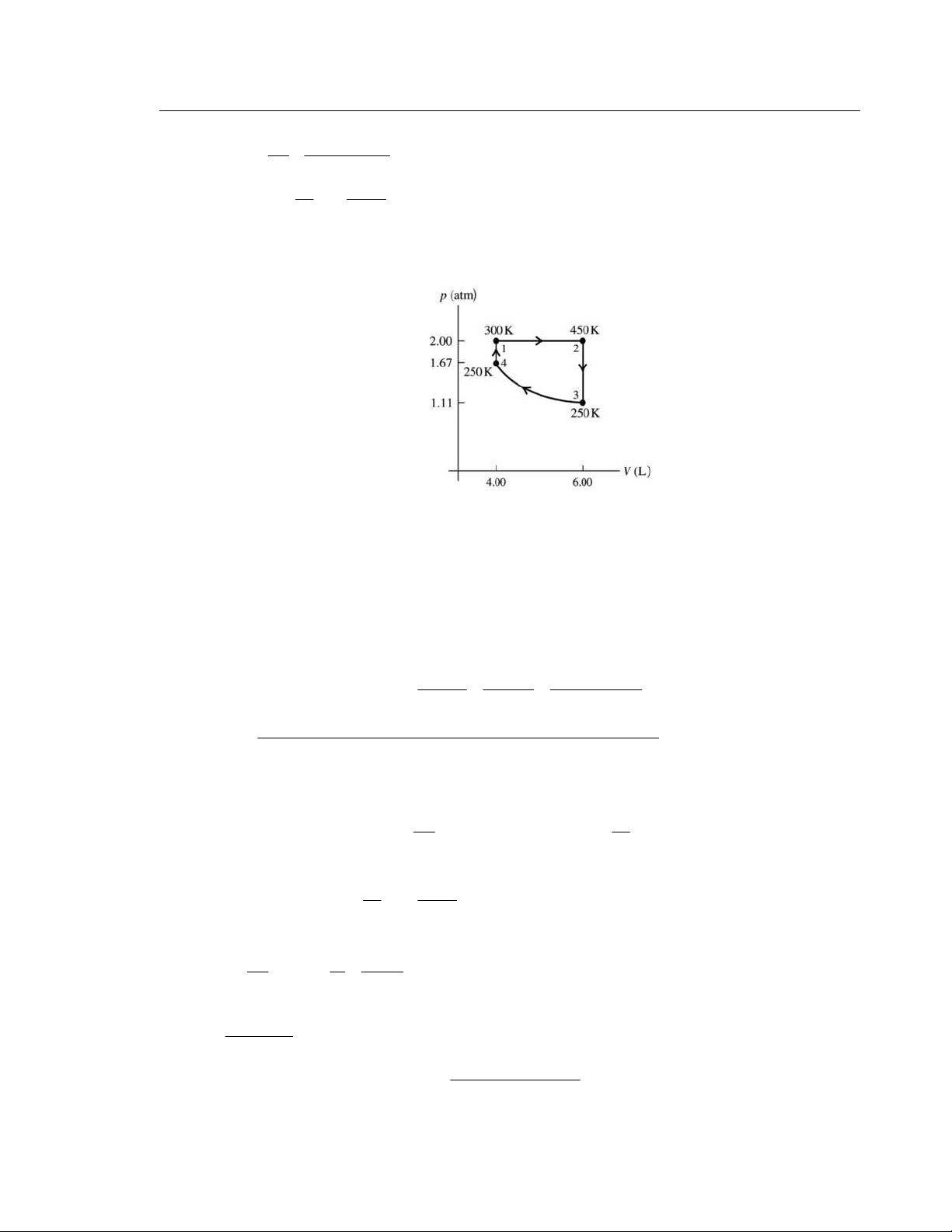
IDENTIFY: Use pV = nRT. Apply the expressions for Q and W that apply to each type of process. W e = . H Q SET UP: For O2, 20 85 J/mol K V C = .
⋅ and C = 29.17 J/mol⋅ K p . EXECUTE: (a) 1 p = 2.00 atm, 1 V = 4 0 . 0 L, 1 T = 300 K. V V ⎛ T ⎞ ⎛ 450 K ⎞ 2 p = 2 0 . 0 atm. 1 2 = . 2 2 V = ⎜ ⎟ 1 V = (4 ⎜ ⎟ .00 L) = 6 0 . 0 L. 1 T 2 T ⎝ 1 T ⎠ ⎝ 300 K ⎠ p p ⎛ T ⎞ ⎛ 250 K ⎞ 3 V = 6.00 L. 2 3 = . 3 3 p = ⎜ ⎟ 2 p = (2 ⎜ ⎟ .00 atm) =1 1 . 1 atm 2 T 3 T ⎝ 2 T ⎠ ⎝ 450 K ⎠ ⎛ ⎞ 3 V ⎛ 6 0 . 0 L ⎞ 4 V = 4.00 L. 3 p 3 V = 4 p 4 V . 4 p = 3 p ⎜ ⎟ = (1.11 atm)⎜ ⎟ =1 6 . 7 atm. ⎝ 4 V ⎠ ⎝ 4 0 . 0 L ⎠
These processes are shown in Figure 20.47. p V (2.00 atm)(4 0 . 0 L) (b) 1 1 n = = = 0.325 mol 1 RT (0 082 . 06 L ⋅ atm/mol ⋅ K)(300 K)
process 1 → 2: W = pΔV = nR T
Δ = (0.325 mol)(8.315 J/mol⋅ K)(150 K) = 405 J. Q = nC T
Δ = (0.325 mol)(29.17 J/mol ⋅ K)(150 K) =1422 J p .
process 2 → 3: W = 0. Q = nC ΔT = (0.325 mol)(20.85 J/mol ⋅ K)( 200 − K) = 13 − 55 J V .
process 3 → 4: ΔU = 0 and ⎛ ⎞ 4 V ⎛ 4.00 L ⎞
Q = W = nR 3 T ln⎜ ⎟ = (0.325 mol)(8 31 . 5 J/mol⋅ K)(250 K)ln⎜ ⎟ = 274 2 J. ⎝ 3 V ⎠ ⎝ 6.00 L ⎠
process 4 →1: W = 0. Q = nC ΔT = (0.325 mol)(20.85 J/mol ⋅ K)(50 K) = 339 J V .
(c) W = 405 J − 274 J =131 J
© Copyright 2012 Pearson Education, Inc. All rights reserved. This material is protected under all copyright laws as they currently exist.
No portion of this material may be reproduced, in any form or by any means, without permission in writing from the publisher.
The Second Law of Thermodynamics 20-17 W 131 J (d) e = = = 0.0744 = 7 4 . 4 . , H Q 1422 J + 339 J C T 250 K Carnot e =1− =1− = 0.444 = 44.4 ; , Carnot e is much larger. H T 450 K EVALUATE: to Q t = 142 1 2 J + ( 135 −
5 J) + (−274 J) + 339 J = 132 J. This is equal to to W t, apart from a
slight difference due to rounding. For a cycle, to W t = t
Q ot, since ΔU = 0. Figure 20.47 20.48.
IDENTIFY: The air in the room receives heat radiated from the person at 30.0°C but radiates part of it back
to the person at 20.0°C, so it undergoes an entropy change.
SET UP: A person with surface area A and surface temperature T = 303 K radiates at a rate 4
H = AeσT .
The person absorbs heat from the room at a rate 4 Hs = Aeσ s T , where s
T = 293 K is the temperature of the
room. In t = 1.0 s, heat 4
AeσtT flows into the room and heat 4 Aeσ s
tT flows out of the room. The heat
flows into and out of the room occur at a temperature of s T . 4 4 4 4 AeσtT AeσtT
Aeσt(T − T ) EXECUTE: For the room, s s ΔS = − =
. Putting in the numbers gives s T s T s T 2 8 − 2 4 4 4
(1.85 m )(1.00)(5.67 ×10 W/m ⋅ K )(1.0 s)([303 K] −[293 K] ) ΔS = = 0.379 J/K. 293 K
EVALUATE: The room gains entropy because its disorder increases. 20.49.
IDENTIFY: Since there is temperature difference between the inside and outside of your body, you can use it as a heat engine. W T
SET UP: For a heat engine e = . For a Carnot engine C e = 1 −
. Gravitational potential energy is H Q H T Ugrav = mg .
h 1 food-calorie = 1000 cal = 4186 J. T 303 K EXECUTE: (a) C e = 1 − = 1 −
= 0.0226 = 2.26%. This engine has a very low thermal efficiency. H T 310 K (b) 2
Ugrav = mgh = (2.50 kg)(9.80 m/s )(1.20 m) = 29.4 J. This equals the work output of the engine. W W 29.4 J e = so 3 H Q = = = 1.30 ×10 J. H Q e 0.0226
(C) Since 80% of food energy goes into heat, you must eat food with a food energy of 3 1.30 × 10 J 3
= 1.63 ×10 J. Each candy bar gives 6
(350 food-calorie)(4186 J/food-calorie) = 1.47 × 10 J. 0.80 3 1.63 × 10 J
The number of candy bars required is 3 = 1.11×10− candy bars. 6 1.47 × 10 J/candy bar
© Copyright 2012 Pearson Education, Inc. All rights reserved. This material is protected under all copyright laws as they currently exist.
No portion of this material may be reproduced, in any form or by any means, without permission in writing from the publisher. 20-18 Chapter 20
EVALUATE: A large amount of mechanical work must be done to use up the energy from one candy bar. 20.50.
IDENTIFY: The sun radiates energy into the universe and therefore increases its entropy.
SET UP: The sun radiates heat energy at a rate 4
H = AeσT . The rate at which the sun absorbs heat from
the surrounding space is negligible, since space is so much colder. This heat flows out of the sun at 5800 K
and into the surrounding space at 3 K. From Appendix F, the radius of the sun is 8 6.96 × 10 m. The surface
area of a sphere with radius R is 2 A = 4π R .
EXECUTE: (a) In 1 s the quantity of heat radiated by the sun is 4 2 4
Q = AeσtT = 4π R eσtT . Putting in the numbers gives 8 2 8 − 2 4 4 26
Q = 4π (6.96×10 m) (1.0)(5.67× 10 W/m ⋅K )(1.0 s)(5800 K) = 3.91×10 J. 26 26 −3.91×10 J 3 + .91×10 J 26 ΔS = + = +1.30×10 J/K. 5800 K 3 K
(b) The process of radiation is irreversible; this heat flows from the hot object (sun) to the cold object
(space) and not in the reverse direction. This is consistent with the answer to part (a). We found
ΔSuniverse > 0 and this is the case for an irreversible process.
EVALUATE: The entropy of the sun decreases because there is a net heat flow out of it. The entropy of
space increases because there is a net heat flow into it. But the heat flow into space occurs at a lower
temperature than the heat flow out of the sun and the net entropy change of the universe is positive. 20.51.
IDENTIFY: Use ΔU = Q −W and the appropriate expressions for Q, W and ΔU for each type of process.
pV = nRT relates ΔT to p and V values. = W e , where H
Q is the heat that enters the gas during the H Q cycle.
SET UP: For a monatomic ideal gas, 5 3 C = R and C p = R. 2 V 2
(a) ab: The temperature changes by the same factor as the volume, and so Cp 5 3 5 Q = nC T Δ =
p (V −V ) = (2 5 . )(3.00×10 Pa)(0 3 . 00 m ) = 2 2 . 5×10 J p a a b . R The work p V
Δ is the same except for the factor of 5 5 , so W = 0 9 . 0×10 J. 2 5
ΔU = Q −W =1.35×10 J.
bc: The temperature now changes in proportion to the pressure change, and 3 5 3 5
Q = ( p − p )V = (1.5)(−2 0
. 0×10 Pa)(0.800 m ) = −2.40×10 J , and the work is zero 2 c b b 5 ( V Δ = 0 ). U Δ = Q −W = 2 2 .40 ×10 J.
ca: The easiest way to do this is to find the work done first; W will be the negative of area in the p-V plane
bounded by the line representing the process ca and the verticals from points a and c. The area of this trapezoid is 1 5 5 3 3 4
(3.00×10 Pa +1.00×10 Pa)(0.800 m − 0.500 m ) = 6.00×10 J and so the work is 2 5
−0.60×10 J. ΔU must be 5 1 0 . 5×10 J (since U
Δ = 0 for the cycle, anticipating part (b)), and so Q must be 5
ΔU +W = 0.45×10 J. (b) See above; 5
Q = W = 0.30×10 J, ΔU = 0.
(c) The heat added, during process ab and ca, is 5 5 5 2.25×10 J + 0 4 . 5×10 J = 2 70 . ×10 J and the efficiency 5 W 0 3 . 0 ×10 is e = = = 0 1 . 11 =11.1 . , 5 H Q 2 7 . 0 ×10
EVALUATE: For any cycle, U Δ = 0 and Q = . W 20.52.
IDENTIFY: Use the appropriate expressions for Q, W and ΔU for each process. e = / W H Q and Car e not =1− C T / H T .
SET UP: For this cycle, H T = 2 T and C T = 1 T .
© Copyright 2012 Pearson Education, Inc. All rights reserved. This material is protected under all copyright laws as they currently exist.
No portion of this material may be reproduced, in any form or by any means, without permission in writing from the publisher.
The Second Law of Thermodynamics 20-19
EXECUTE: (a) ab: For the isothermal process, ΔT = 0 and ΔU = 0. W = n 1
RT ln(V /V ) = 1
nRT ln(1/r) = − 1 nRT ln(r) b a
and Q = W = n 2 R 1 T ln(r).
bc: For the isochoric process, ΔV = 0 and W = 0. Q = U Δ = nC T Δ = nC ( 2 T − 1 T ) V V .
cd: As in the process ab, ΔU = 0 and W = Q = nR 2 T ln(r).
da: As in process bc, 0 ΔV = and
W = 0; ΔU = Q = nC ( 1 T − 2 T ) V .
(b) The values of Q for the processes are the negatives of each other.
(c) The net work for one cycle is net W = nR( 2 T − 1
T )ln(r), and the heat added is cd Q = nR 2
T ln(r), and the W efficiency is net e = =1− ( 1 T / 2
T ). This is the same as the efficiency of a Carnot-cycle engine operating cd Q between the two temperatures.
EVALUATE: For a Carnot cycle two steps in the cycle are isothermal and two are adiabatic and all the heat
flow occurs in the isothermal processes. For the Stirling cycle all the heat flow is also in the isothermal
steps, since the net heat flow in the two constant volume steps is zero. + 20.53.
IDENTIFY: The efficiency of the composite engine is 1 2 12 = W W e , where H1
Q is the heat input to the H1 Q first engine and 1 W and 2
W are the work outputs of the two engines. For any heat engine, W = C Q + H Q , Q T and for a Carnot engine, low low =2 , where lo Q w and hi
Q gh are the heat flows at the two reservoirs hig Q h hi T gh that have temperatures lo T w and hi T gh. SET UP: hig Q h,2 =2 l Q ow,1. lo
T w,1 = T ,′ hi T gh,1 = H T , lo T w,2 = C T and hig T h,2 = T′. W +W Q + Q + Q + Q EXECUTE: 1 2 high,1 low,1 high,2 low,2 12 e = = . Since hi Q gh,2 =2 l
Q ow,1, this reduces to H1 Q h Q igh,1 ⎛ ⎞ lo Q w,2 T T T ⎛ ′ ⎞ C C T T C T 12 e =1+ . low,2 low,1 l Q ow,2 =2 h Q igh,2 = l Q ow,1 =2 hi Q gh,1⎜ ⎟ =2 h Q igh,1⎜ ⎟ . ⎜ ⎟ This gives hi Q gh,1 hi T gh,2 T′ ⎝ h T igh,1 T′ ⎠ ⎝ H T T ⎠ ′ C T 12 e =1−
. The efficiency of the composite system is the same as that of the original engine. H T
EVALUATE: The overall efficiency is independent of the value of the intermediate temperature T′. W 20.54. IDENTIFY: e = . 4
1 day = 8.64×10 s. For the river water, Q = mcΔT , where the heat that goes into H Q the water is the heat C
Q rejected by the engine. The density of water is 3 1000 kg/m . When an object
undergoes a temperature change, ΔS = mcln( 2 T / 1 T ). SET UP: 18 0 . C ° = 291.1 K. 18.5 C ° = 291 6 . K. W P 1000 MW EXECUTE: (a) W H Q = so 3 P = = = 2.50×10 MW. e H e 0.40
(b) The heat input in one day is 9 4 14 (2.50×10 W)(8 64
. ×10 s) = 2.16×10 J. The mass of coal used per day 14 2.16×10 J is 6 = 8.15×10 kg. 7 2 6 . 5×10 J/kg (c) | H Q | = |W| + | C Q |. | C Q | = | H Q | − |W|. 3 3 C P = H P − W
P = 2.50×10 MW −1000 MW =1 5 . 0×10 MW.
(d) The heat input to the river is 9 1 5
. 0×10 J/s. Q = mc T Δ and 0 ΔT = 5 . C° gives 9 Q 1 5 . 0×10 J 5 m m = = = 7.16×10 kg. 3 V =
= 716 m . The river flow rate must be 3 716 m s / . cΔT (4190 J/kg ⋅ K)(0 5 . K) ρ
© Copyright 2012 Pearson Education, Inc. All rights reserved. This material is protected under all copyright laws as they currently exist.
No portion of this material may be reproduced, in any form or by any means, without permission in writing from the publisher. 20-20 Chapter 20 (e) In one second, 5 7 1
. 6×10 kg of water goes from 291.1 K to 291.6 K. ⎛ ⎞ 2 T 5 ⎛ 291.6 K ⎞ 6
ΔS = mcln⎜ ⎟ = (7.16×10 kg)(4190 J/kg ⋅ K)ln⎜ ⎟ = 5.1×10 J/K. ⎝ 1 T ⎠ ⎝ 291 1 . K ⎠
EVALUATE: The entropy of the river increases because heat flows into it. The mass of coal used per second is huge. 20.55.
(a) IDENTIFY and SET UP: Calculate e from Eq. (20.6), C
Q from Eq. (20.4) and then W from Eq. (20.2). E . XECUTE: 1 0 4
e = 1−1/(rγ − ) =1−1/(10 6 . ) = 0.6111 e = ( H Q + C Q )/ H Q and we are given H Q = 200 J; calculate C Q . C Q = (e −1) H
Q = (0.6111−1)(200 J) = −78 J (Negative, since corresponds to heat leaving.) Then W = C Q + H Q = 78
− J + 200 J =122 J. (Positive, in agreement with Figure 20.6.) EVALUATE: H
Q , W > 0, and C
Q < 0 for an engine cycle.
(b) IDENTIFY and SET UP: The stoke times the bore equals the change in volume. The initial volume is the
final volume V times the compression ratio r. Combining these two expressions gives an equation for V. For each cylinder of area 2
A = π (d/2) the piston moves 0.864 m and the volume changes from rV to V, as shown in Figure 20.55a. 1 l A = rV 2 l A = V and 3 − 1 l − 2l = 86 4 . ×10 m Figure 20.55a
EXECUTE: 1lA − 2lA = rV −V and ( 1l − 2l)A = (r −1)V 3 2 3 − 2
( 1l − 2l)A (86.4×1 0 m)π (41 2 . 5× 10 m) 5 2 3 V = = = 4.811×10 m r −1 10 6 . −1
At point a the volume is 5 2 3 4 2 3 rV = 10 6( . 4 8 . 11×10 m ) = 5.10×10 m .
(c) IDENTIFY and SET UP: The processes in the Otto cycle are either constant volume or adiabatic. Use the H
Q that is given to calculate ΔT for process bc. Use Eq. (19.22) and pV = nRT to relate p, V and T
for the adiabatic processes ab and cd.
EXECUTE: point a: 300 K, a T = 4 8 50 10 Pa a p = . × and 4 3 5 10 10 m a V = . × 2 point b: 5 2 3
V = V /r = 4 8 . 1×10 m γ − γ − b a
. Process a → b is adiabatic, so 1 1 T V = T V . a a b b γ 1 − γ 1 T (rV ) − a = b T V 1 0.4
T = T rγ − = 300 K(10.6) = 771 K b a pV = nRT so /
pV T = nR = constant, so p V /T = p V / a a a b b b T 4 6
p = p (V /V )(T /T ) = (8.50×10 Pa)(rV/V )(771 K/300 K) = 2.32×10 Pa b a a b b a
point c: Process b → c is at constant volume, so 5 2 3
V = V = 4.81×10 m c b H Q = nC T
Δ = nC (T −T ) V V c
b . The problem specifies H
Q = 200 J; use to calculate c
T . First use the p, V, T
values at point a to calculate the number of moles n. 4 4 2 3 pV (8 5 . 0×10 Pa)(5.10×10 m ) n = = = 0 0 . 1738 mol RT (8 3 . 145 J/mol ⋅ K)(300 K)
© Copyright 2012 Pearson Education, Inc. All rights reserved. This material is protected under all copyright laws as they currently exist.
No portion of this material may be reproduced, in any form or by any means, without permission in writing from the publisher.
Tài liệu liên quan:
-

Bài giảng Sự hấp thụ nhiệt môn Nhiệt động lực học | Trường Đại học Bách khoa - Đại học Quốc gia Thành phố Hồ Chí Minh
31 16 -
Lý thuyết Nhiệt động học và vật lý phân tử môn Nhiệt động lực học - Truyền nhiệt | Trường Đại học Bách khoa - Đại học Quốc gia Thành phố Hồ Chí Minh
99 50 -
Tính chất nhiệt của vật chất | Bài tập nhiệt động lực học
101 51 -
Định luật thứ nhất của nhiệt động lực | Bài tập nhiệt động lực
88 44