Behaviour of Lithium-lon Batteries in Electric vehicles - Sách tham khảo môn Kỹ thuật điện công nghiệp | Trường Đại học Cần Thơ
Behaviour of Lithium-lon Batteries in Electric vehicles - Sách tham khảo môn Kỹ thuật điện công nghiệp | Trường Đại học Cần Thơ. Tài liệu được sưu tầm giúp bạn tham khảo, ôn tập và đạt kết quả cao. Mời bạn đọc đón xem.
Môn: Kỹ thuật điện công nghiệp 13 tài liệu
Trường: Trường Đại học Cần Thơ 823 tài liệu
Tác giả:


















Preview text:
Green Energy and Technology
More information about this series at http://www.springer.com/series/8059 Editors
Gianfranco Pistoia and Boryann Liaw
Behaviour of Lithium-Ion Batteries in Electric Vehicles
Battery Health, Performance, Safety, and Cost Editors Gianfranco Pistoia
National Research Council, Rome, Italy Boryann Liaw
Department of Energy Storage and Advanced Vehicles, Idaho National
Laboratory, Idaho Falls, ID, USA ISSN 1865-3529 e-ISSN 1865-3537 Green Energy and Technology ISBN 978-3-319-69949-3 e-ISBN 978-3-319-69950-9
https://doi.org/10.1007/978-3-319-69950-9
Library of Congress Control Number: 2017964589
© Springer International Publishing AG 2018
This work is subject to copyright. All rights are reserved by the Publisher,
whether the whole or part of the material is concerned, specifically the rights of
translation, reprinting, reuse of illustrations, recitation, broadcasting,
reproduction on microfilms or in any other physical way, and transmission or
information storage and retrieval, electronic adaptation, computer software, or
by similar or dissimilar methodology now known or hereafter developed.
The use of general descriptive names, registered names, trademarks, service
marks, etc. in this publication does not imply, even in the absence of a specific
statement, that such names are exempt from the relevant protective laws and
regulations and therefore free for general use.
The publisher, the authors and the editors are safe to assume that the advice and
information in this book are believed to be true and accurate at the date of
publication. Neither the publisher nor the authors or the editors give a warranty,
express or implied, with respect to the material contained herein or for any errors
or omissions that may have been made. The publisher remains neutral with
regard to jurisdictional claims in published maps and institutional affiliations. Printed on acid-free paper
This Springer imprint is published by the registered company Springer
International Publishing AG part of Springer Nature
The registered company address is: Gewerbestrasse 11, 6330 Cham, Switzerland Contents
Lithium-Ion Battery Design for Transportation Alvaro Masias
The Future of Lithium Availability for Electric Vehicle Batteries
Jamie Speirs and Marcello Contestabile
The Issue of Metal Resources in Li-Ion Batteries for Electric Vehicles
Marcel Weil, Saskia Ziemann and Jens Peters
Will Current Electric Vehicle Policy Lead to Cost-Effective Electrification
of Passenger Car Transport?
Marcello Contestabile and Mohammed Alajaji
Conventional, Battery-Powered, and Other Alternative Fuel Vehicles: Sustainability Assessment
Lambros K. Mitropoulos and Panos D. Prevedouros
Increasing the Fuel Economy of Connected and Autonomous Lithium-Ion Electrified Vehicles
Zachary D. Asher, David A. Trinko and Thomas H. Bradley
Electric Commercial Vehicles in Mid-Haul Logistics Networks
Maximilian Schiffer, Sebastian Stütz and Grit Walther
Mechanical Design and Packaging of Battery Packs for Electric Vehicles Shashank Arora and Ajay Kapoor
Advanced Battery-Assisted Quick Charger for Electric Vehicles Muhammad Aziz and Takuya Oda
Charging Optimization Methods for Lithium-Ion Batteries Jiuchun Jiang
State of Charge and State of Health Estimation Over the Battery Lifespan
Abbas Fotouhi, Karsten Propp, Daniel J. Auger and Stefano Longo
Recycling of Batteries from Electric Vehicles
Tobias Elwert, Felix Römer, Kirstin Schneider, Qingsong Hua and Matthias Buchert
Business Models for Repurposing a Second-Life for Retired Electric Vehicle Batteries Na Jiao and Steve Evans
© Springer International Publishing AG 2018
Gianfranco Pistoia and Boryann Liaw (eds.), Behaviour of Lithium-Ion Batteries in Electric Vehicles,
Green Energy and Technology, https://doi.org/10.1007/978-3-319-69950-9_1 Lithium-Ion Battery Design for Transportation Alvaro Masias1
(1) Ford Motor Company, 2101 Village Road, Dearborn, MI 48121, USA Alvaro Masias Email: amasias@ford.com Abstract
This chapter will discuss the technical requirements and status of applying
lithium-ion batteries to electrified vehicles. It will begin by introducing the
principles of vehicle propulsion, electrified features, powertrain design, and the
resulting battery chemistry applicability. An understanding of vehicle needs will
enable a discussion on lithium-ion battery pack design. Once the basic layout of
pack design is understood, it is necessary to appropriately size a pack to meet its
intended vehicle function relative to various drive cycles and other requirements.
A review of current lithium-ion technology and applicability for automotive
applications will then follow. This chapter will describe existing cell energy and
power performance in the context of international performance targets. The
various features of cell design for automotive will also be discussed along with a
review of current safety testing standards and regulations. Finally, an
examination of existing commercialized products will show how the vehicle,
pack and cell design principles described are implemented in actual production vehicles.
Keywords Electrified vehicles – Cell design – Battery pack design – Pack performance targets – Safety 1 Introduction
Lithium-ion batteries are enabling a new generation of electrified vehicles to be
commercialized by global automakers. A variety of governments including the
USA, European Union, China, and Japan have announced increasingly strict fuel
economy regulations for their respective markets. The modern fossil fuel
powered automobile has been the subject of continuous engineering
improvement for over one hundred years [1]. Comparatively, modern electrified
automobiles are a relatively new technology, yet their potential for petroleum
displacement makes them a key component of virtually all automakers’ current and future product portfolios.
The status of applying lithium-ion batteries to vehicles and the technical
requirements involved will be discussed. As background, the concepts of vehicle
propulsion, electrified features, powertrain design, and the resulting battery
chemistry applicability will be introduced. A discussion on battery pack design
will be enabled by this understanding of the vehicle needs. After the pack
design, layout basics are understood, it will be possible to suitably size a pack to
meet the designed vehicle features relative to different cycles.
A discussion of the suitability of lithium-ion technology for automotive
applications will then follow. While considering various global performance
targets, the current performance of cell energy and power will be reviewed. Next
will be a survey of current safety testing standards and regulation considering the
various features of cell design for automotive applications. How the identified
vehicle, pack and cell design principles are implemented in vehicle production
will be examined by reviewing existing commercialized electrified vehicles. 2 Vehicles 2.1 Vehicle Propulsion
In a conventional automobile, the propulsion power is provided solely by the
engine, whereas in an electric vehicle the battery/motor delivers all traction
power. In a hybrid electric vehicle, the traction force is provided by a mixture of
the engine and motor/battery which must be efficiently managed by the vehicle
[2, 3]. The traction power required to propel a vehicle must exceed that which is
simply required by kinematics to accelerate the vehicle mass due to the
additional forces for rolling resistance, aerodynamic drag, and elevation change: where m mass of vehicle a acceleration of vehicle g
acceleration of free fall due to gravity
C RR coefficient of rolling resistance between tires and road surface ρ density of ambient air
C D coefficient of draft of the vehicle A
cross-sectional area of vehicle v
speed in the direction of travel θ angle of road grade
The power required to propel the vehicle depends on this force and the vehicle velocity according to:
Note this power has terms with linear and cubic relations to velocity. In a
uniform acceleration, the power demand increases nearly linearly with time
peaking at the end of the acceleration period. It is also notable that power varies
as the cube of velocity, helping to account for the significantly increased power
levels observed at highway speeds when compared to city driving patterns.
Empirically, it can be determined that most vehicles have strongly correlated
acceleration 0–100 kph times (seconds), peak power (kW), and weights (kg).
Vehicle properties such as aerodynamic drag, mechanical grip, and engine/motor
performance can result in a complicated correlation. However, as a first-order
approximation, it can be empirically estimated that: where: T Time (s) A W Curb Weight (Kg) P Power (kW)
Using the fourth-generation Toyota Prius (US Model Year 2009–2015) as an
example yields W = 1380 kg, P = 100 kW, resulting in an estimated 0–100 kph
time of 9.5 s, which was confirmed by Motor Trend Magazine in 2012 [4].
During braking, retarding force is provided through a combination of
electrical (driving the traction motor backwards to establish a generator) and
mechanical (friction disks or drums creating waste heat) loads. In this case, the
braking force required is less than the force needed to decelerate the vehicle
mass since the rolling resistance and aerodynamic drag forces also act to slow the vehicle:
Likewise, the power required to brake the vehicle is the product of this force and the vehicle velocity:
Taking into account again the approximate proportionality of power to
velocity, the braking power required declines approximately linearly with time in
a uniform deceleration. Thus, for braking, the peak power regenerative braking
power requirement occurs at the beginning of the braking event. Braking is
partially assisted by the aerodynamic drag and rolling resistance forces.
However, as a practical matter, during braking the power expended typically
far exceeds that experienced while accelerating and delivered by the
combination of an engine and/or electric motor. Modern automobiles are
expected to brake from speed in a fraction of the time and distance that they took
to achieve the same speed. As a result, a simple kinematic study of these two
vehicle events shows that the powers involved must vary significantly, with the
excess power available to brake serving as a safety feature in the case of any
engine or throttle malfunction.
2.2 Electrified Vehicle Features
There is a variety of electrified vehicle types with no universally accepted
definition. We will use various performance features which the continuum of
increasing electrification confers onto a vehicle as a means to classify the
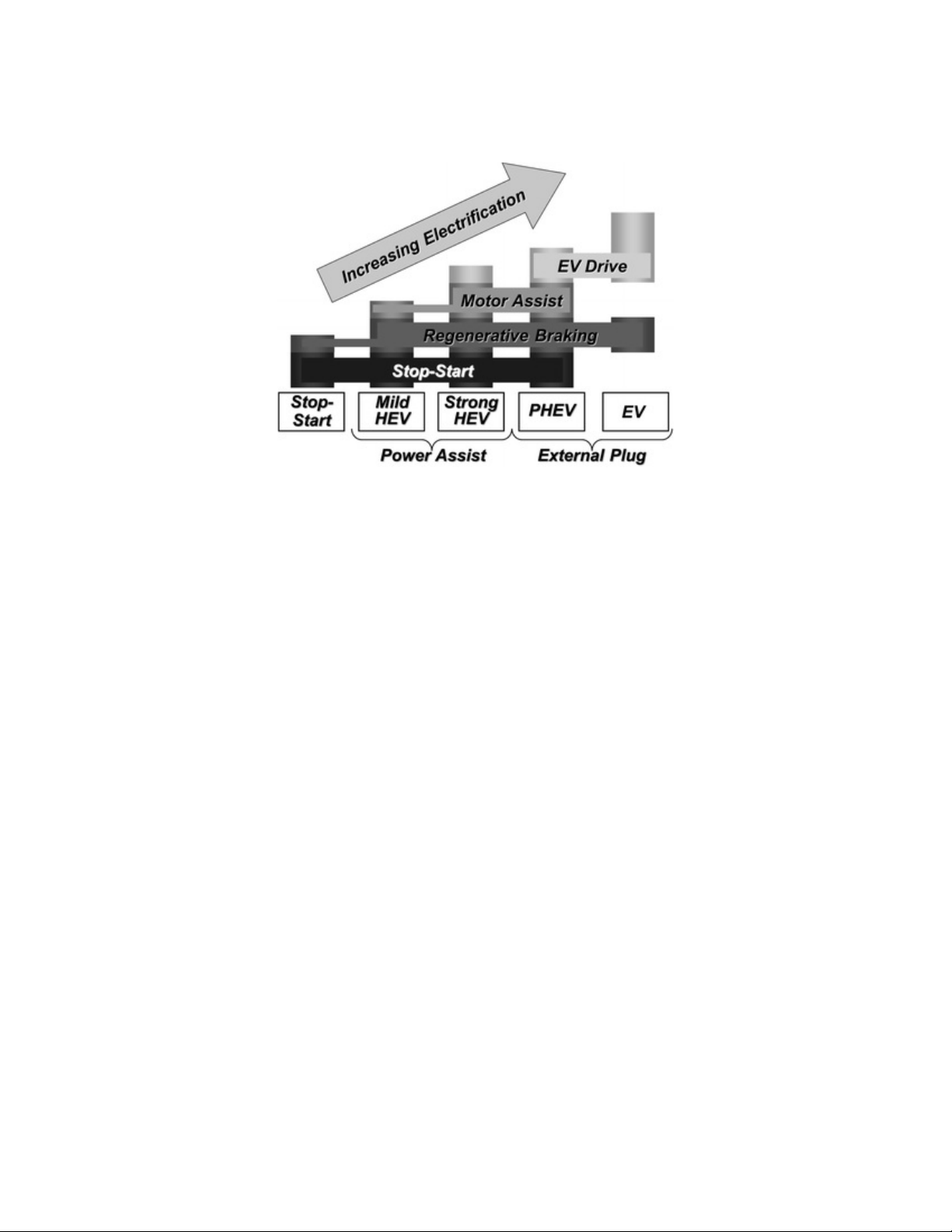
various vehicle types (see Fig. 1) [5].
Fig. 1 Various types of electrified vehicles and defining features [5]
The electrified vehicles which support external plugs to transfer electrical
energy on board are the plug-in hybrid electric vehicle (PHEV) and the electric
vehicle (EV). Although PHEVs and EVs have been around as concepts for some
time, it is only through the recent performance revolution of lithium-ion batteries
that they are becoming viable as vehicle technologies. The families of vehicles
which do not support external plugs are known as stop-start hybrids (S/S) and
hybrid electric vehicle (HEV). The contribution of lithium-ion batteries to these
vehicles (S/S and HEVs) can be described as evolutionary when compared to existing battery types.
A variety of automotive vehicle functions lend themselves well to
electrification. As described in Fig. 1, increasing levels of electrification
(quantity of electrical energy and power on board) enable different features.
Stop–Start: During engine idle times, such as when stopped at a traffic light
or coasting, a traditional internal combustion engine vehicle can consume
significant fuel to maintain power to auxiliary (non-traction) vehicle loads such
as heating/cooling, infotainment, and illumination. By powering these features
from the electrical system on board, a vehicle is able to turn off the engine
completely, thereby leading to fuel savings. This feature typically denotes the
first level of electrification given the limited power (≤10 kW) and energy
(≤100 Wh) needs to be involved.
Regenerative Braking: Traditional automobiles will convert a vehicles
kinetic energy into waste friction and heat under braking to decelerate.
Incorporating an electrical system on board that can harness some or all of this
electrical power allows for a significant efficiency boost by recuperating the
energy used to accelerate the vehicle. Typical braking events are of a short
duration (≤5 s), leading to relatively high power demands for the energies
involved. As a result, it is common to size a battery system to capture only a
portion (approximately 80–90%) of the braking power electrically and have a
mechanical friction system work in concert to absorb the very high initial power pulse.
Motor Assist: Internal combustion engine fuel consumption will vary as a
function of the engine speed and torque. A traditional automobile engine will
have its operating point of engine speed and torque primarily determined by the
driver throttle demand. However, a vehicle with electrified motor assist can
divide the driver torque demands of the vehicle between the engine and battery-
driven electric motor, thereby allowing the engine controller to shift the engine
operating point to a more efficient region of the speed/torque engine map. The
majority of strong hybrids have battery/motor electrical power sized around 30–
40 kW and 300–400 Wh (useable) to achieve this motor assist function for
significant portions of the various driving cycles used around the world.
EV Drive: During EV drive, the entire vehicle traction and auxiliary power
demands are supported by the electrified systems on board. As a result, this
function can require significantly increased electrical power and energy to
achieve. EV drive energy consumption can range widely with typical sedan
values from 95 to 240 Wh/km depending on the particular vehicle (weight,
aerodynamics, road load, etc.) and driving cycle characteristics (rates of
acceleration and deceleration, speed, idle time, etc.) [6].
The electrified power demands of EV drive can also vary widely based on
the same vehicle characteristics as energy, ranging from ~15 kW (low-speed
urban) to >100 kW (aggressive highway). Due to these increased electrical loads,
most HEVs can only achieve limited EV drive range under moderate (urban or
highway coasting) driving scenarios. PHEVs are most often differentiated from
HEVs by the increased electrical range (energy) and power on board. 2.3 Electrified Powertrains
The vehicle performance features which have been electrified can be used to
classify electrified vehicle types (see Fig. 1). Likewise, the vehicle powertrain
(engine, motor, and transmission) is also used to further sort electrified vehicle
types. The four different traditional electrified powertrain types are shown schematically in (see Fig. 2).
Fig. 2 Electrified vehicle type powertrain a Series EV, b Series (P)HEV, c Parallel (P)HEV, d Series/Parallel (P)HEV
Series EV: The series EV is the simplest electrified vehicle powertrain in
terms of quantity of hardware and control strategy required. This powertrain type
has all traction power delivered from a single electric power source. Figure 2a
shows the electrical power flowing from a DC battery to be converted to AC
power before driving the electric motor. The series EV motor can run backwards
to become a generator during regenerative braking. The motor/generator
converts between electrical and mechanical power in interacting with the vehicle
transmission and ultimately wheels. Recently, commercialized vehicles using
this powertrain type are the Nissan Leaf, Tesla Model S, and Ford Focus EV.
Series (P)HEV: A series PHEV or HEV powertrain have the same basic
layout type as shown in Fig. 2b. Both architectures have the mechanical
(engine/generator) and electrical (battery) power sources feed into a common
electrical inverter/converter. Once the electrical power has been combined in the
inverter/converter, this powertrain behaves similarly to a series EV in having one
power/torque flow path to and from the single motor/generator, transmission,
and wheels. The series design allows for the efficient distribution of vehicle
power demands across the two power sources, particularly advantageous during
fluctuating vehicle speed scenarios. A series PHEV would typically be
distinguished from a series HEV in having a more powerful battery, engine, and
inverter but a less powerful engine. Diesel-electric locomotives and the
Chevrolet Volt are commercially available examples of series HEV and series
PHEV powertrains, respectively.
Parallel (P)HEV: Parallel PHEV and HEV vehicles require complicated
electronic controls and transmission setups to manage two different torque
sources (Fig. 2c). By electronically separating the two torque sources, this
vehicle transfers the task of managing overall vehicle efficiency to a primarily
mechanical operation. By maintaining a mechanical linkage between the engine
and transmission, this type is most efficient in steady state velocity conditions.
However, also due to the mechanical setup, it is not possible to completely turn
off the engine while maintaining vehicle functions in a parallel hybrid. This
architecture has experienced limited commercially popularity, having been
primarily manufactured by Honda (Civic, Insight, Accord) during the 2000s.
Series/Parallel (P)HEV: The series/parallel (P)HEV is the layout which
combines the strengths and complexities of the separate series and parallel
arrangements. Although series/parallel controls and components (particularly
transmissions and quantity of motor/generators) are the most complicated and
costly, they enable the greatest flexibility to achieve fuel economy savings. The
mechanical and electrical power sources can each separately and in unison
provide torque to drive the wheels and meet the driver throttle demand (Fig. 2d).
The series/parallel powertrain has been implemented into many vehicles,
including Toyota Prius and Ford Fusion.
2.4 Battery Chemistry Applicability
Battery engineers can design packs to meet the range of energy and power
requirements that each vehicle feature requires using any battery chemistry.
Various battery chemistries (lead–acid, nickel–metal hydride, and lithium-ion)
have lent themselves to being commercialized in specific electrified vehicles
types based on cost, energy, power, weight, and volume requirements (see
Table 1). As a result, various trends for the application of lithium-ion technology have emerged.
Table 1 Commercialized electrified vehicle type by battery chemistry
Vehicle type Historical Recent (2010–2018) Future (2018) S/S PbA PbA PbA & LIB HEV NiMH LIB & NiMH LIB & NiMH (Toyota) PHEV N/A LIB EV PbA & LIB LIB
Lithium-ion has helped to commercialize the PHEV type as a vehicle class,
as the weight of older chemistries (such as nickel–metal hydride or lead–acid)
required to get any appreciable electric range along with an engine was
impractical. The improved energy gravimetric and volumetric density of lithium-
ion has allowed it to completely replace other chemistries for EV applications.
Lithium-ion provides several times greater specific energy than either nickel–
metal hydride or lead–acid chemistries, without which modern EVs would be unworkable.
The lower energy and power needs of the S/S and HEV types have led to
lithium-ion competing with lead–acid and nickel–metal hydride chemistries in
the near term. In the future, it is expected that all HEVs will shift to lithium-ion
chemistry batteries with the notable exception of Toyota which is expected to
amortize its significant investment in nickel–metal hydride production. While
S/S applications will still primarily utilize lead–acid chemistries due to their low
cost, it is expected that lithium-ion will begin to gain a foothold in this market as well. 3 Packs 3.1 Battery Pack Design
Electrified vehicle battery packs are required to meet a variety of automotive
technical requirements, in addition to meeting the vehicle electrical power and
energy demand. The assembly of cells into modules and subsequently packs is
what makes the hardware relevant to an automotive designer and user.
Mechanically, battery packs are required to be integrated into the existing
vehicle crash structure. Packs are also required to manage the electronic control
interface with the rest of the vehicle control modules and to maintain their cells
within predetermined operating parameters for life and safety. Additionally,
battery packs typically have dedicated or vehicle-derived thermal control
components, also for performance and safety considerations. The sensitivity of
lithium-ion chemistries to mechanical, electrical, and thermal excursions outside
design specifications places additional importance on robust battery pack design.
Modules/Packs: In automotive applications, we need to consider not only
cell-level figures of merit, but also at the module (a mechanical assembly of
cells, often containing electrical/thermal sensing and interfaces) and battery pack
level (a mechanical assembly of modules, often containing electrical and thermal
control hardware and software). Although module and pack designs can vary
substantially, they all add additional weight and volume which effectively de-
rates the cell-level performance values.
Individual cell voltages are insufficient to provide kilowatts of power
required for electrified vehicles since practical considerations with electric
motors, cabling, and power electronics limit current flow to <500 A. A single
series string or a series-parallel arrangement of cells is used to electrically and
mechanically form a subassembly building block known as a battery module.
Battery modules typically contain cell arrangements such that voltage is ≤50 V
and weight ≤22 kg for ease of handling and safety.
Battery modules are combined electrically (most often in series) to provide
the full power and energy need for electric vehicles. Depending on the vehicle
type and design, the electrochemical cells may account for between 50 and 75%
of the pack cost, weight, and volume. Thus, the specific performance of the
battery pack system is always less than that of the modules and the modules less
than that of the cells. Electrified vehicle battery performance targets are
therefore typically set at the pack level to be most relevant to automotive designers.
Mechanical: Battery packs must also be contained physically within the
vehicle in such a way as to be safe in the event of crashes and during normal
vehicle use and vibrations. A typical vehicle passenger zone is defined as the
area between the wheel axles and inside the rocker panels on either side. Placing
a battery pack outside this zone is possible, but typically requires significant
structural reinforcement to be added to ensure crash integrity, adding significant
cost, weight, and volume burdens to the pack. Due to the restrictive nature of
volume limitations on the battery pack, the engineering of the battery packaging
envelope is always a critical feature in the design of an electric vehicle.
Mechanical packaging location also influences the level of robustness
against water and dust intrusion which is required, with pack surfaces external to
the vehicle structure requiring the greatest control. Additionally, packing
location and battery chemistry type will influence whether a gas vent routing
system to the vehicle exterior is necessary in the event of a cell vent during a
malfunction (given that lithium-ion cells are sealed unlike nickel–metal hydride types).
Electrical: The electronic controls assist the battery pack in providing the
required propulsion power while maintaining the battery pack within the normal
operating conditions. A traditional 12 V lead–acid battery is commonly used to
power electrified vehicle auxiliary loads (lights, alarm systems, radio, etc.)
during engine off conditions to prevent the accidental overdischarge of the high-
voltage battery. Upon receiving an engine on signal, the 12 V supply will close
several system contactors to electronically connect the high-voltage battery to
the vehicle. Packs typically also contain manual service disconnects (MSDs) to
electronically disable a pack in the event of a malfunction (i.e., welded
contactors) or during maintenance. Low voltage (≤50 V) battery packs are
typically grounded to the vehicle chassis, whereas high-voltage (≥50 V) systems
are required to be electronically isolated. For additional safety, packs often
contain high voltage interlock (HVIL) circuits that when broken will alert the
vehicle to a possible isolation leak.
The pack/module/cell voltages and currents are measured and controlled by
the packs battery management system (BMS). The BMS will often reference
lookup tables and/or predefined algorithms to set cell voltage/current as well as
pack energy/power limits for the battery based on factors such as state of charge
(SOC), age, and temperature. The BMS is also responsible for communicating
with the vehicle controllers the status of the pack contactors, HVIL, MSD, and
temperature information, in addition to moderating the overall pack electrical
output and input. For vehicles which are externally chargeable (PHEV and EVs),
the BMS is also required to supervise and control the onboard charger and
external plug interface. Over time individual cells will have their SOC drift from
a common or average value due to imperfections in their assembly, capacity,
power, and thermal history. Periodically, the BMS can attempt to perform either
passive (i.e., discharge to a resistor) or active (i.e., redistribution of energy
among high and low SOC cells) cell balancing events to return the pack subunits
to a tighter SOC window to avoid overdischarge or overcharge.
Thermal: Electrified vehicle battery packs commonly employ a thermal
management system designed to maintain the cell temperatures within a normal
operating range. Lithium-ion battery cell design parameters such as electrolyte
composition will strongly influence the preferred operating temperature range.
As a practical matter, most chemistries are able to achieve a desirable balance of
available energy and power in the range of 10–40 °C. Fortunately for air-cooled
systems, this temperature window is similar to that which the vehicle operator
will naturally prefer for the cabin with which the pack shares airflow. This
results in a small temperature delta between the customer set thermal
environment and the battery pack. Unfortunately, for liquid cooling systems, this
temperature range is dissimilar from the existing engine/transmission (~100 °C)
and power electronics (~80 °C) coolant. This difference in temperature windows
means that it is not currently possible to commonize existing coolant loops to
leverage existing vehicle cooling hardware.
Hybrid electrified vehicles typically have large amounts of waste heat energy
from the thermal inefficiencies of the engine to perform heating functions. Since
electric vehicles do not have an engine to supply excess heat, they typically
employ positive thermal coefficient (PTC) heaters to warm the passenger cabin
and potentially the battery pack. These heat sources, the exothermic nature of
lithium-ion battery discharge/charge and the joule heating of pack components
(on the order of 10% of the pack delivered power) means that most temperature
control systems focus on cooling the pack rather than heating.
Cooling systems can vary in complexity and design but typically fall into
three categories: passive air, active air, or liquid temperature control. A few
vehicles (Nissan Leaf) depend on natural convection; however, most designs
incorporate one or multiple fans to provide sufficient heat transfer. A passive air
approach receives air from the passenger cabin and relies on the vehicle operator
to determine the conditioning strategy (i.e., cooling in summer and heating in
winter). This approach has the advantage of simplicity and, as a result, is used in
most commercial electrified air-cooled vehicles (Toyota Prius). The active air
approach would directly link conditioned air from the vehicles air conditioning
system to the battery pack (First-Generation Ford Escape Hybrid, US Model
Year 2004–2006) or add a second, dedicated air conditioning system solely for
the battery (Lexus LS 600 h, US Model Year 2006–2012). In this way, the active
air approach would bypass the operator and cabin temperature preference in
favor of the optimum inlet temperature for the battery. Due to the additional air
channels involved and/or second cooling system and the resulting associated
weight, volume, and cost, the active air approach is much less common than the passive approach.
Liquid cooling typically allows for a greater degree of thermal control than
air cooling given the need to use a dedicated heat exchanger and coolant loop.
Additionally, liquid cooling is much more volumetrically efficient than air
cooling due to much greater specific heat capacity of its cooling medium
(typically water/ethylene glycol 50/50% mix) and channels (pipes vs. plenums).
Unfortunately, liquid cooling does increase the weight, cost, parts count, and
manufacturing complexity when compared to passive air cooling. As a result,
only vehicles that require the greater degree of thermal control from liquid
cooling (typically large EV or PHEV batteries) implement this solution (Ford
Focus EV, Chevrolet Volt PHEV).
The goal of all thermal management systems is to keep the average battery
temperatures within the normal operating range and provide for uniform
temperatures across the entire battery pack. Uniform battery cell temperatures
are needed to minimize operating cell voltage variations caused by differences in
resistance, which can have significant temperature dependence. It is equally
important to avoid cell-to-cell temperature variations to maintain a uniform state
of charge since self-discharge is also significantly temperature dependent. 3.2 Battery Sizing
Determining the appropriate battery energy and power to put on board an
electrified vehicle requires balancing a variety of competing requirements. Each
vehicle class has different needs based on its electrified features. Ultimately, the
goal of electrification is to improve the vehicle fuel economy, so an
understanding of drive cycles is necessary. After considering the vehicle driving
demand, it is possible to size a vehicle’s energy and power. After the overall
energy and power of the pack is determined, it is necessary to determine the
quantity and arrangement of cells to meet these targets. A variety of business
factors can determine the ultimate cell selection; we will focus on the technical
requirements of pack voltage and capacity.
Drive Cycles: Regulatory fuel economy is confirmed by each government by
requiring a vehicle to follow prescribed drive cycles, traces of speed and time.
Typically, the ultimate label fuel economy is a convolution of multiple low
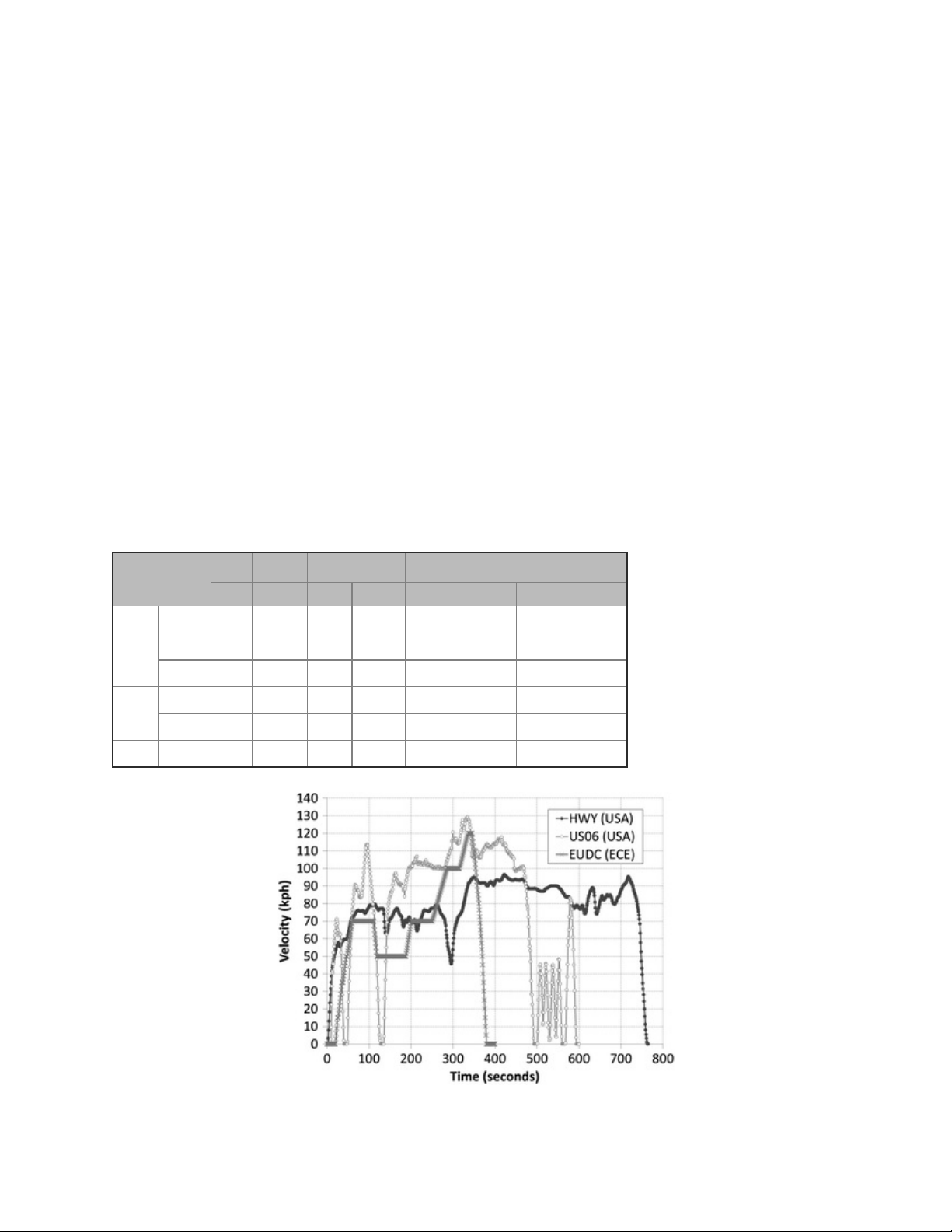
(urban) and high speed (highway) cycle results. Table 2 and Figs. 3 and 4
illustrate representative drive cycles of the US, Economic Commission for
Europe (ECE), and Japan for the purposes of comparison [7]. A visual review of
the traces enables a qualitative comparison among the cycles. Among the high-
speed cycles, the US06 pattern has the greatest number of speed changes,
whereas the EUDC cycle has several periods of zero acceleration. The low-speed
traces show that the UDDS pattern has the largest speed maximum and greatest
frequency of speed changes, thereby likely the largest power demand.
Table 2 International drive cycle summary [7] Name
Time Length Speed (kph) Absolute acceleration (m/sec2) (sec) (km) Avg Max Avg Max USA UDDS 1369 11.99 31.51 91.25 0.40 1.48 HWY 765 16.51 77.58 96.40 0.17 1.48 US06 596 12.89 77.86 129.23 0.61 3.76 EU EUC 195 0.99 18.26 50 0.27 1.06 EUDC 400 62.44 62.44 120 0.19 1.39 Japan 10–15 892 25.58 25.58 70 0.27 0.83
Tài liệu liên quan:
-

Giáo Trình Thực Tập Kỹ Thuật Điện và Những Nghiên Cứu Liên Quan | Môn Kỹ thuật điện công nghiệp - Đại học Cần Thơ
127 64 -

Bài Giảng Thực Tập Điện Kỹ Thuật - Cấu Tạo và Ứng Dụng Kỹ Thuật | Môn Kỹ thuật điện công nghiệp - Đại học Cần Thơ
131 66 -
Báo cáo thực hành điện công nghiệp | Môn Kỹ thuật điện công nghiệp - Đại học Cần Thơ
144 72 -

Bài giảng thực tập mạch điện | Môn Kỹ thuật điện công nghiệp - Đại học Cần Thơ
119 60