
















Preview text:
Động từ tường thuật Dịch nghĩa Told, said Nói Asked Yêu cầu/Hỏi Denied Phủ nhận Promised Hứa Suggested Gợi ý, đề nghị Ví dụ:
• She told Maya that she had bought a new bag. (Cô ấy nói với Maya
rằng cô ấy đã mua 1 chiếc túi mới)
• William asked his son which shoes he liked best. (William hỏi con trai
mình thích đôi giày nào nhất)
Lùi thì của động từ Câu trực tiếp Câu gián tiếp Thì hiện tại đơn Thì quá khứ đơn → V1 → V2/V-ed → Learn → Learned
Thì hiện tại tiếp diễn Thì quá khứ tiếp diễn → is/are V_ing → was/were V_ing → is/are learning → was/were learning
Thì hiện tại hoàn thành Thì quá khứ hoàn thành → have/has V2/V-ed → had V3/V-ed Câu trực tiếp Câu gián tiếp → have/has learnt → had leant
Thì hiện tại hoàn thành tiếp diễn
Thì quá khứ hoàn thành tiếp diễn
→ have/has been V_ing → had been V_ing → have/has been learning → had been learning Thì quá khứ đơn Thì quá khứ hoàn thành → V2/V-ed → had V3/V-ed → learned → had learnt Thì quá khứ tiếp diễn
Thì quá khứ hoàn thành tiếp diễn → was/were V_ing → had been V_ing → was/were learning → had been learning Thì quá khứ hoàn thành
Thì quá khứ hoàn thành tiếp diễn → had V3/ V-ed → had V3/V-ed → had learnt → had learnt
Thì quá khứ hoàn thành tiếp diễn
Thì quá khứ hoàn thành tiếp diễn → had been V_ing → had been V_ing → had been learning → had been learning
Can/may/must (have to) Could/might/had to
→ Hana said: “I can’t see them”
→ Hana said she could not see them. Câu trực tiếp Câu gián tiếp
(Hana nói rằng: “Mình không thể thấy họ.”)
(Hana nói rằng cô ấy không thể thấy họ.) Lưu ý cần nắm: Ví dụ Nghĩa Could, should, would, might,
“You should drink some milk,”
Cô ấy nói rằng tôi nên uống ought to she said. một chút sữa → Không lùi thì
→ She said I should drink some milk.
Câu trực tiếp đề cập sự thật hiển
“The sun rises in the east,” he
Anh ấy nói rằng mặt trời mọc nhiên, chân lý said. ở đằng Đông.
→ Giữ nguyên thì của động từ
→ He said that the sun rises in the east.
>>> Tham khảo thêm: Bài tập thì hiện tại hoàn thành (Present Perfect) có đáp án
Đổi các đại từ, tính từ sở hữu, tân ngữ Vị trí Câu trực tiếp Câu gián tiếp Chủ ngữ I He/ She You I/We/They We We/They Tân ngữ Me Him/Her You Me/Us/Them Us Us/Them Vị trí Câu trực tiếp Câu gián tiếp Đại từ sở hữu My His/Her Your My/Our/Their Our Our/Their Đại từ sở hữu Mine His/Hers Yours Mine/Ours/Theirs Ours Ours/Theirs
Đại từ chỉ định This The/That These The/Those
Ví dụ 1: “Are you tired?” Jake asked.
→ Jake asked me if I was tired.
→ Jake hỏi tôi có mệt không.
Ví dụ 2: “My cat has brown fur,” she said.
→ She said that her cat has brown fur.
→ Cô ấy nói rằng mèo nhà cô ấy có bộ lông màu nâu.
Cách chuyển câu trực tiếp sang gián tiếp trong tiếng Anh >>> Xem thêm:
• Đại từ quan hệ (Relative pronouns) – Cách dùng và bài tập
• Câu hỏi đuôi (Tag question): Công thức, cách dùng và bài tập
Đổi lại các trạng từ chỉ thời gian, địa điểm Câu trực tiếp Câu gián tiếp Now Then/ At the time Câu trực tiếp Câu gián tiếp Today That day Yesterday
The day before/ The previous day Tomorrow
The following day/ The day after/ The next day The day before yesterday Two days before The day after tomorrow
Two days after/ In two days’ time Ago Before This week That week Last week
The week before/ The previous week Next week
The following week/ The week after/ The next week This That These Those Here There
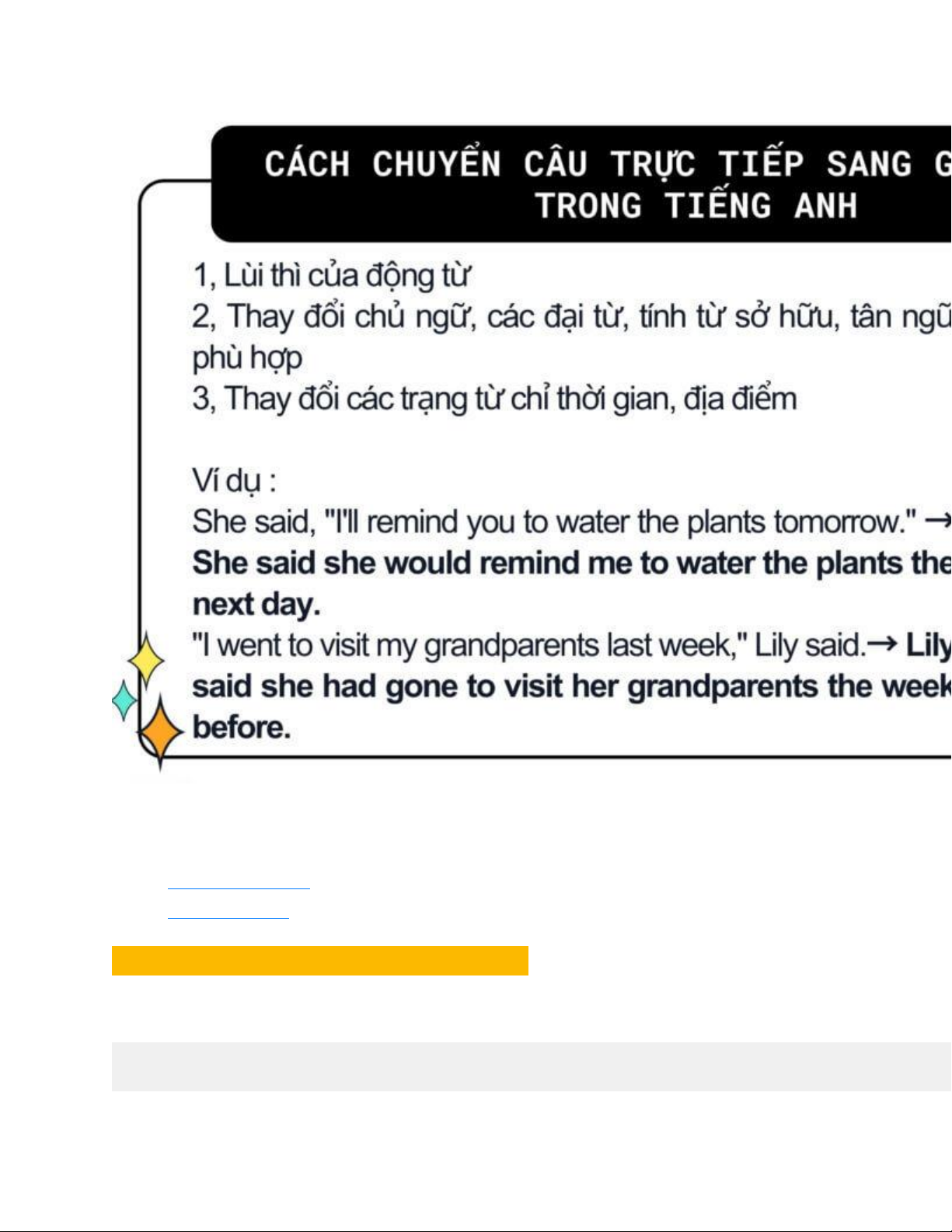
Ví dụ 1: She said, “I’ll remind you to water the plants tomorrow.”
→ She said she would remind me to water the plants the next day.
→ Cô ấy nói rằng cô ấy sẽ nhắc tôi tưới cây vào ngày mai.
Ví dụ 2: “I went to visit my grandparents last week,” Lily said.
→ Lily said she had gone to visit her grandparents the week before.
→ Lily nói rằng cô ấy đã tới thăm ông bà vào tuần trước. >> Xem thêm:
• Câu bị động đặc biệt trong tiếng Anh
• Câu điều kiện: Công thức, cách dùng và bài tập có đáp án
• Bài tập thì hiện tại tiếp diễn từ cơ bản đến nâng cao có đáp án chi tiết
🎯Nắm vững kiến thức cách sử dụng câu trực tiếp và câu gián tiếp ngay hôm nay cùng ELSA Speak👇
Cấu trúc câu gián tiếp (Reported Speech)
• Dạng câu trực tiếp là câu kể thì cấu trúc câu gián tiếp là: S + say(s)/
said/tell/told + that + S + V. Ví dụ:
She said to me: “I’m going to the mall.” → She told me that he was going to the mall.
• Cấu trúc câu gián tiếp chuyển từ dạng câu trực tiếp là câu mệnh
lệnh/yêu cầu: S + asked/ told/ demanded,… + (O) + (not) to V. Ví dụ:
“Don’t smoke here.” my father told Pete. → My father told Pete not to smoke there.
• Cấu trúc câu gián tiếp chuyển từ dạng câu cảm thán tiếng Anh trực
tiếp: S + exclaimed/ said + that + S + V. Ví dụ:
“What a beautiful picture!” said Emma. → Emma exclaimed that the picture was beautiful.
• Cấu trúc câu gián tiếp chuyển từ dạng câu đề nghị trực tiếp: S +
suggested (+ O) + (not) V-ing. Ví dụ:
“Why don’t you send Mai Chi an invitation?” said Tin. → Tin suggested me
sending Mai Chi an invitation.
• Cấu trúc câu gián tiếp chuyển từ dạng câu trực tiếp là câu hỏi Yes
No: S + asked/ wanted to know/wondered + if/whether + S + V. Ví dụ:
“Are you hungry?” my friend asked me. → My friend asked me if I was hungry.
• Cấu trúc câu gián tiếp chuyển từ dạng câu trực tiếp là câu hỏi có từ
để hỏi Wh question: S + asked/wanted to know/wondered + Wh + S + V. Ví dụ:
“What song is Andy listening to?” Jim asked → Jim wanted to know what song Andy was listening to.
• Một số cấu trúc đặc biệt khác khi chuyển câu từ trực tiếp sang gián tiếp:
– Cấu trúc S + V + O + N/V-ing. Ví dụ:
“Sorry I’m late” said Mindy. → Mindy apologized for being late.
She said: “John broke the vase.” → She accused John of breaking the vase. – Cấu trúc S + V + to V.
Ví dụ: “I will call you when I arrive.” Tim said. → Tim promised to call me when he arrived.
– Câu mời, đề nghị lịch sự.
Ví dụ: “Shall I pick you up at the airport?” said my brother. → My brother
offered to pick me up at the airport.
• Một số động từ thường được sử dụng trong câu gián tiếp: say (nói),
tell (kể), ask (hỏi), admit (thừa nhận), deny (phủ nhận), claim (khẳng
định), promise (hứa), accuse (buộc tội), apologize (xin lỗi), suggest (gợi ý), warn (cảnh báo)…
Ôn tập nhanh về thì hiện tại tiếp diễn ở bài viết Thì hiện tại tiếp diễn (present
continuous): Công thức, dấu hiệu nhận biết và bài tập
Cấu trúc câu gián tiếp (Reported Speech)
Mẹo làm bài tập chuyển đổi câu trực tiếp sang câu tường thuật
Bước 1: Xác định loại câu trực tiếp
Câu trực tiếp có thể được chia thành nhiều loại khác nhau, tùy thuộc vào
chức năng của câu. Các loại câu trực tiếp thường gặp bao gồm: • Câu kể:
o Câu trần thuật: S + V + O + …
o Câu nghi vấn: WH + S + V + O + …
o Câu cầu khiến: S + V + O + …
• Câu mệnh lệnh: S + V + O + …
Bước 2: Lựa chọn động từ tường thuật
Có nhiều động từ tường thuật có thể được sử dụng để chuyển đổi câu trực
tiếp sang câu tường thuật, tùy thuộc vào loại câu trực tiếp và ý nghĩa của
câu. Các động từ tường thuật thường gặp bao gồm:
• Câu kể: said, told, asked, inquired, wondered, …
• Câu mệnh lệnh: told, ordered, commanded, …
Bước 3: Thay đổi dấu ngoặc kép thành dấu chấm câu phù hợp
Dấu ngoặc kép trong câu trực tiếp được thay đổi thành dấu chấm câu khi đổi sang câu tường thuật. Ví dụ:
• Câu mệnh lệnh: S + told/ordered/commanded/… + O + to + V + O • Câu kể:
o Câu cầu khiến: S + told/ordered/commanded/… + O + to + V + O
o Câu trần thuật: S + said/told/asked/inquired/wondered that + S + V + O
o Câu nghi vấn: S + asked/inquired/wondered/… if/whether + S + V + O
Bước 4: Thay đổi đại từ nhân xưng, đại từ sở hữu, tân ngữ
Đại từ nhân xưng, đại từ sở hữu, tân ngữ là gì ,… trong câu trực tiếp được
thay đổi cho phù hợp với người nói và người nghe khi chuyển sang câu gián tiếp. Ví dụ:
“I am heading to the center now,” he said. → Câu tường thuật: He said he
was heading to the center then.
Bước 5: Thay đổi thì của động từ
Cách chia động từ trong câu trực tiếp được thay đổi thì cho phù hợp với thời gian nói hoặc viết. Ví dụ:
“I will buy some food tonight,” my mom said. → My mom said she would buy some food that night.
Bài tập câu tường thuật trong tiếng Anh từ cơ bản đến nâng cao
1. Bài tập chuyển câu trực tiếp sang gián tiếp
1. “What are you doing?” she asked me.
She asked me ………………………….
2. “Close the door,” Anne said.
Anne told them ………………………….
3. “Will you come to my party?” Linda said to them.
Linda invited them ………………………….
4. “Are you going by bus?” my teacher asked.
My teacher wanted to ………………………….
5. “I don’t like this pink carpet,” she said.
She told me ………………………….
6. Nhung said: “She can not help you tomorrow.”
Nhung said ………………………….
7. “What would you do if you passed the exam?” The professor asked me.
The professor asked me ………………………….
8. “Do you and your big brother go to the same school?” Maya asked her friend.
Maya asked her friend ………………………….
9. “Give me the red cup,” Selena told him.
Selena asked him ………………………….
10. “Hurry up,” He said to me.
He told me ………………………….
11. “You stole my phone, Alex!” said Lily.
Lily accused Alex ………………………….
12. “I want a blue jacket for my birthday,” she said.
She said that ………………………….
13. “Don’t forget to turn off the light.” He said.
He reminded me ………………………….
14. “I should go home to do my homework”, said Lily.
Lily told me ………………………….
15. “Stand up, Daniel,” he said.
He asked Daniel ………………………….
16. “She works in a station,” He said.
He said that ………………………….
17. “They have not eaten dinner”
He told me ………………………….
18. He said to me: “I haven’t finished my work”
He told me ………………………….
19. “I will visit my grandparents tomorrow.”
He told me that ………………………….
20. Daniel said: “Where are you going on your vacation this week?
Daniel asked me ………………………….
21. “Are you serious?” she asked him.
She asked him ………………………….
22. “Can I meet you at the meeting?” He asked me.
He asked me ………………………….
23. “Dinner will be served after 6 m.m,” said my aunt.
My mother said ………………………….
24. “Are you going to the restaurant?” she asked me.
He wanted to know ………………………….
25. “Did you see the black cat?” she asked me.
She asked me …………………………. >> Xem thêm:
• Trọn bộ bài tập thì hiện tại đơn có đáp án
• Câu điều kiện loại 1: Công thức, cách dùng, bài tập có đáp án
• Cấu trúc The Last Time trong tiếng Anh và bài tập vận dụng chi tiết
2. Dạng bài tập viết lại câu tường thuật
1. “Where is my phone?” he asked.
2. “What are you doing?” he asked.
3. “Has Emily talked to Jessica?” my sister asked me.
4. “Are you going to bed?” she asked me.
5. “Did you lock the door?” she asked me.
6. “I could play the guitar when I was seven,” she said.
7. “I don’t like peanut butter,” he said.
8. “You should go to school early,” Lily said.
9. “Will you help me, please?” Becky asked.
10. ”Don’t play the guitar in this room,” the music teacher said.
11. ”What are they talking about?”
12. “I have just sent a letter to Hoa,” Bella said.
13. “Do you like listening to music?” Alex asked.
14. “Which bike do you like best?” My brother asked me.
15. “Why don’t you help Jack?” Jenny asked her.
16. “Can I pick you up at 8 p.m?” she asked.
17. “Where is the ideal place to go camping?” Nhung asked.
18. “Hank, please don’t tell anyone your salary.” said Tom.
19. “I’ll call you tomorrow.”
20. “When was your daughter born?” said the doctor to Linda.
21. “Did Daniel send the book to you?” He asked.
22. “Can I help you, David?” asked Harry.
23. “Don’t tell her about it.” she said.
24. “Did you buy the red dress?” she asked me.
25. The boy asked, “Who made the noise?”
>> Có thể quan tâm: 150+ bài tập thì quá khứ đơn có đáp án
3. Bài tập câu tường thuật trắc nghiệm
1. Lily said she was leaving for Hanoi _________. A. next week B. the week previous C. following week D. the following week
2. The teacher asked students_________ . A. why did they slept B. why they were sleeping C. why they sleep D. why were they sleeping
3. Daniel said that Tokyo _________ more lively than Seoul. A. is B. be C. was D. were
4. Jack was pessimistic about the exam. I advised him _________. A. no worry B. not worry C. no to worry D. not to worry
5. He wanted to know where they _________. A. had lived B. lived C. was lived D. has lived
6. He asked me if I _________. A. had seen that car B. saw that car C. has seen that car D. see that car
7. Henry told me that he _________ home after the event. A. walked B. had walked C. walking D. was walking 8. Leo asked her _________ .
A. what time does the meeting end B. what time the meeting end
C. what time the meeting ended
D. what time did the meeting end
9. My friend _________ me there’s been an accident on that street. A. asked B. said C. spoke D. told
10. Jenny wonders _________ doing well at school. A. whether her sisters are B. if her sisters were C. her sisters were D. her sisters are if
11. David asked Timmy why _________ the film on television the day before. A. didn’t he watch B. hadn’t he watched C. he doesn’t watch D. he hadn’t watched
12. She asked me if I _________ speak Vietnamese. A. could B. can C. will D. was
13. She wanted to know what they _________. A. doing B. were doing C. did D. had been doing
14. The mother asked her son where _________.