China’s Whole-of-Region Diplomacy inthe Middle East - Opportunities and Challenges môn Quan hệ quốc tế | Học viện Báo chí và Tuyên truyền
China’s Whole-of-Region Diplomacy inthe Middle East - Opportunities and Challenges môn Quan hệ quốc tế | Học viện Báo chí và Tuyên truyền. Tài liệu được sưu tầm giúp bạn tham khảo, ôn tập và đạt kết quả cao. Mời bạn đọc đón xem.
Môn: Quan hệ quốc tế 32 tài liệu
Trường: Học viện Báo chí và Tuyên truyền 2.8 K tài liệu
Tác giả:
















Preview text:
China’s Whole-of- Region Diplomacy in the Middle East Opportunities and Challenges Sun Degang
Abstract: To safeguard its economic and security interests, China has
adopted a whole-of-region diplomacy in the Middle East since the end of
the Cold war. Through a multitude of regional and international organi-
zations, China has been able to maintain constructive interactions with
Middle Eastern countries while deepening its ties with other major powers
like the United States, the European Union, Russia, Japan and India.
China’s diplomatic efforts have paid off in the Middle East and increased
the influence of developing countries as a whole in international politics.
Meanwhile, China’s whole-of-region diplomacy is faced with a number of
challenges given the complexity of ethnic, religious and security land-
scapes in the Middle East. China needs more holistic and well-coordinated
ways of whole-of-region diplomacy to seek closer relationships with
Middle Eastern countries. To this end, it is important for China to
consolidate its network of strategic partnerships on the basis of bilateral
China Q of Int' l Strategic Stud 2019.05:49-64. Downloaded from www.worldscientific.com
Sun Degang is Senior Researcher at the Institute for Middle East Studies, Shanghai
International Studies University (SISU). His mailing address is: Middle East Studies
Institute, Shanghai International Studies University, Shanghai 200083, China. He can
by 173.211.106.246 on 08/20/19. Re-use and distribution is strictly not permitted, except for Open Access articles.
also be reached at sdgsdg@163.com. °
c 2019 World Century Publishing Corporation and Shanghai Institutes for International Studies
China Quarterly of International Strategic Studies, Vol. 5, No. 1, 49–64 DOI: 10.1142/S2377740019500015
This is an Open Access article, copyright owned by the SIIS and WCPC. The article is distributed
under the Creative Commons Attribution 4.0 (CC BY-NC) Licence. Further distribution of this work is
permitted, provided the original work is properly cited and for non-commercial purposes. 49 50
China Quarterly of International Strategic Studies Vol. 5, No. 1
collaboration and multilateral cooperation, further strengthen its discourse
power and agenda-setting capacity, and consider adopting a common but
differentiated strategy toward regional countries according to their dif-
ferent national conditions, political systems and paths of socioeconomic development.
Keywords: Whole-of-region diplomacy; China; Middle East; international organizations.
Ever since the end of the Cold War, regionalization has gained strong mo-
mentum in the developing world where many countries of Asia, Africa, Latin
America as well as Central and Eastern Europe vary in their political systems
and stages of economic development. Quite a few regional, sub-regional and
trans-regional organizations came into existence, including, among others,
the Asia-Pacific Economic Cooperation (APEC), the South Asian Association
for Regional Cooperation (SAARC), the African Union (AU), the Mercado
Cornún del Sur (MERCOSUR), the Caribbean Community and Common
Market (CARICOM), the East Asia Summit (EAS), the Indian Ocean Rim-
Association for Regional Cooperation (IOR-ARC), the Southern African
Development Community (SADC), the Forum on China-Africa Cooperation
(FOCAC), and the China-Arab States Cooperation Forum (CASCF).
For small and middle-sized developing countries, regional organiza-
tions are usually symbols of solidarity and platforms where collective
actions can be taken to succeed in international competition and earn re-
spect from great powers. For developed countries and rising powers, re-
gional organizations are also a key element of diplomacy. For instance, the
United States, France, Japan, Russia, China and India have all forged
China Q of Int' l Strategic Stud 2019.05:49-64. Downloaded from www.worldscientific.com
strategic ties with Africa for various purposes, thus giving the AU a bal-
ancing role in global politics.1 Nowadays, the world’s leading powers on
one side, and small/middle-sized countries on the other, maintain regular
by 173.211.106.246 on 08/20/19. Re-use and distribution is strictly not permitted, except for Open Access articles.
interactions through regional organizations or multilateral institutions.
China, in particular, has developed a whole-of-region diplomacy as an
1Avaneesh Pandey, “India-Africa Summit 2015: India Seeks to Challenge China’s
Dominance Through `Unprecedented’ Conference,” International Business Times, October 27,
2015; and Seifudein Adem, “Emerging Trends in Japan-Africa Relations: An African
Perspective,”African Studies Quarterly, Vol. 5, No. 2 (2001), pp. 61–69.
China’s Whole-of-Region Diplomacy in the Middle East 51
effective approach to strengthen its partnerships with other developing countries.2
Based on some preliminary findings,3 this paper attempts to explore
China’s whole-of-region diplomacy toward Middle Eastern countries. It first
elaborates on the patterns of China’s diplomatic practice in the Middle East, a
geopolitical hot spot for decades. It then examines the features as well as
deficiencies in China’s whole-of-region diplomacy toward Middle Eastern
countries. The third section analyzes the major challenges that China faces
with regard to the complexities of the Middle East. It concludes that more
holistic and well-coordinated ways of whole-of-region diplomacy are nec-
essary for China to build closer relationships with Middle Eastern countries.
China’s Diplomatic Approaches in the Middle East
Due to its abundant energy reserves and geo-strategic importance, the
Middle East has obtained an increasingly prominent position in China’s
diplomacy since the beginning of the 21st century. When Chinese President
Xi Jinping proposed the Belt and Road Initiative (BRI) in late 2013, the
significance of the Middle East was highlighted as it connects Asia with
Europe and Africa along the ancient Silk Road a conduit of frequent
trade and cultural exchanges between the Arab world and China hundreds
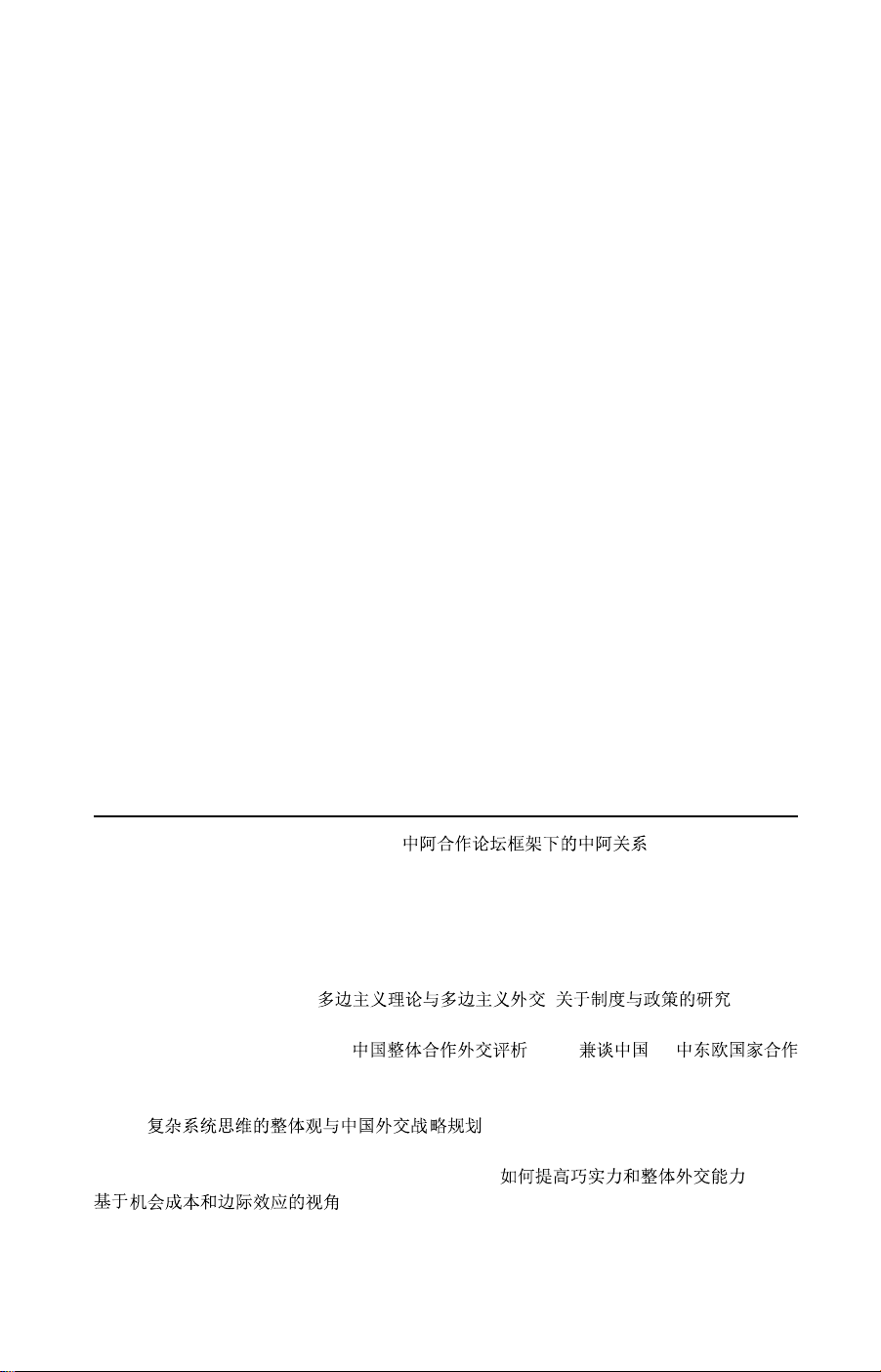
2Liu Zhongmin and Shu Meng, “ [China-Arab Rela-
tions Under the Framework of the China-Arab States Cooperation Forum],” West Asia and Africa, 2014(3), p. 32.
3See, for example, Kristina Kausch, “Competitive Multipolarity in the Middle East,”
The International Spectator: Italian Journal of International Affairs, Vol. 50, No.3 (2015), pp 1–15;
China Q of Int' l Strategic Stud 2019.05:49-64. Downloaded from www.worldscientific.com
Zheng Qirong and Niu Zhongjun, eds., China’s Multilateral Diplomacy (Beijing: World Affairs Press, 2012); Wang Zheng, “ : [Theory
and Diplomacy of Multilateralism: A Study on Institution and Policy],” Theory Horizon,
by 173.211.106.246 on 08/20/19. Re-use and distribution is strictly not permitted, except for Open Access articles.
2015(7), pp. 137–145; Hu Dawei, “
[An Assessment of China’s Diplomacy of Integrated Cooperation With a View into
China-Central and Eastern Europe Cooperation],”International Studies, 2015(5), p. 75; Wang Fan, “
[The Holistic Approach of Complex
Systematic Thinking and Strategic Planning of China’s Diplomacy],” World Economics
and Politics, 2013(9), p. 145; and Zha Xiaogang, “
[How to Increase Smart Power and General Foreign Policy
Capability: A Perspective Based on Opportunity Cost and Marginal Effect],” Theory Horizon, 2014(7), p. 165. 52
China Quarterly of International Strategic Studies Vol. 5, No. 1
of years ago. In 2016, President Xi made a state visit to Saudi Arabia, Egypt
and Iran, which was widely regarded as an extension of the BRI to the
Middle East, making it a key region of economic engagement.
For a long time, China’s diplomacy toward
Middle Eastern countries has centered on de- China has enhanced
veloping favorable economic partnerships and diplomacy toward
avoiding major conflicts. For Middle Eastern the Middle East
countries, China’s comparative economic ad- mainly for economic
vantage means new opportunities for their de-
velopment; for China, cooperation with Middle reasons.
Eastern countries will bring economic benefits
through oil and gas trade as well as investment
in the petrochemical industry and infrastructure construction. Meanwhile,
Middle Eastern countries provide China with both huge markets for manu-
factured products and access to vital sea lines of communication. In short,
Middle Eastern countries are becoming increasingly important for China.
In general, China’s diplomacy in the Middle East follows three pat-
terns. First of all, China has initiated a number of bilateral mechanisms
together with Middle Eastern countries and taken the lead in setting the
agenda of cooperation. This pattern can be described as “1 þ N (China plus
Middle Eastern countries or regional organizations)” approach, exemplified
by the CASCF, the FOCAC and the China-GCC (Gulf Cooperation Council)
Strategic Dialogue. For example, the CASCF was launched in January 2004
between China and the 22-member League of Arab States (LAS). In 2010,
the fourth CASCF Ministerial Meeting issued the “Tianjin Declaration,”
announcing the establishment of the China-Arab strategic relationship for
comprehensive cooperation and common development and unveiling a
China Q of Int' l Strategic Stud 2019.05:49-64. Downloaded from www.worldscientific.com
new stage of China-Arab collective dialogue and cooperation. When
addressing the opening ceremony of the sixth CASCF Ministerial Meeting
by 173.211.106.246 on 08/20/19. Re-use and distribution is strictly not permitted, except for Open Access articles.
on June 5, 2014, President Xi characterized the CASCF as of strategic im-
portance to the long-term development of bilateral relations and substan-
tive cooperation.4 In May 2016, the seventh CASCF Ministerial Meeting was 4“ [Xi Jinping At-
tends Opening Ceremony of the Sixth Ministerial Meeting of the China-Arab States Coop-
eration Forum and Delivers Speech],” Xinhua News, June 5, 2014, www.xinhuanet.com/
politics/2014-06/05/c 1111002498.htm.
China’s Whole-of-Region Diplomacy in the Middle East 53
held in Doha under the theme of “Jointly Building the Belt and Road to
Reinforce Strategic Cooperation.” By July 2018, eight CASCF ministerial
meetings had been held and other mechanisms of cooperation, such as
senior officials’ meetings, entrepreneurs’ conferences, media forums and
seminars on dialogue of civilizations, had also been functioning very well.
In a similar vein, the FOCAC was inaugurated in 2000 as the official
forum between China and African countries, including 10 Arab states from
the Middle East. To date, three summits and seven ministerial meetings of
the FOCAC have been held. Sub-forums themed on agriculture, science and
technology, finance, cultural exchanges, youth, civil society and media have
also been set up.5 During the FOCAC Beijing summit in 2018, President Xi
proposed building a closer China-Africa community with a shared future
and made new financial pledges to promote industrialization and agricul-
tural modernization in Africa. As a driving force for the Middle Eastern
economy, the GCC has been China’s traditional partner in the fields of
energy trade and investment. In 2004, both sides signed the Framework
Agreement for Economic Investment and Technical Cooperation to pave the way
for free trade negotiations. In June 2010, China and the GCC launched their
first strategic dialogue in Beijing, succeeded by the second and third dia-
logues in 2011 and 2014 respectively. In 2013, China-GCC bilateral trade
volume reached US$177 billion and Chinese companies signed $10 billion
new labor deals with GCC countries.6
Undoubtedly, China’s leading role in the agenda-setting of the CASCF,
the FOCAC and the China-GCC Strategic Dialogue is unique. Furthermore,
China’s policy and proposals are usually hailed and embraced by Middle
Eastern countries, for they have yielded favorable results in various political
and economic aspects, including promotion of the Israeli-Palestinian Peace
China Q of Int' l Strategic Stud 2019.05:49-64. Downloaded from www.worldscientific.com
Process and cooperation of industrial capacities along the Belt and Road.
Through this “1 þ N” approach, both China and Middle Eastern countries
by 173.211.106.246 on 08/20/19. Re-use and distribution is strictly not permitted, except for Open Access articles.
can find win-win solutions to issues relevant to their interests.
5See an introduction to the China-Arab States Cooperation Forum at the website of the
Ministry of Foreign Affairs of the People’s Republic of China: http://www.focac.org/chn/itda/ ltjj/t933521.htm. 6Wu Sike, “` ’ [Constructing `One Belt and
One Road’ to Enhance China and GCC Cooperation],” Arab World Studies, 2015(2), p. 8. 54
China Quarterly of International Strategic Studies Vol. 5, No. 1
Second, China has been actively engaged in multilateral platforms
sponsored by Middle Eastern countries and fully respects their agendas.
This pattern can be regarded as an “N þ 1” approach and exemplified by
the Organization of Islamic Cooperation (OIC), the Parliamentary Assem-
bly of Turkic-speaking countries (TurkPA), the Economic Cooperation Or-
ganization (ECO) and the Union of the Arab Maghreb (UAM). For example,
the OIC consists of 57 members and identifies itself as the collective voice of
the Muslim world in regional and international affairs.7 When meeting with
Iyad Madani, Secretary-General of the OIC, during his state visit to Saudi
Arabia in January 2016, President Xi emphasized that China would forever
see Islamic countries as good brothers, friends and partners. With the im-
provement of Algeria-Morocco relations, the UAM has become China’s new
partner of diplomacy in North Africa.
Third, China maintains its collaborative ties with Middle Eastern
countries in a variety of multilateral organizations and mechanisms, whose
agendas are much broader and often go beyond China-Arab relations. This
pattern can be considered as a “1 þ N þ X” approach, because both China
and Middle Eastern countries need to shape policy agendas together with
other states. The Shanghai Cooperation Organization (SCO), the Confer-
ence on Interaction and Confidence-building Measures in Asia (CICA), the
Asia Infrastructure Investment Bank (AIIB), the Indian Ocean Rim Asso-
ciation (IORA), the United Nations Security Council (UNSC), the Interna-
tional Monetary Fund (IMF), the World Bank, the UN climate change
conferences, the Group of Twenty (G20), the P5 þ 1 Talks on Iran nuclear
issues and the Vienna Conference on Syria are all multilateral platforms
where the “1 þ N þ X” approach applies. China has adopted a
At the regional level, the SCO, with
China Q of Int' l Strategic Stud 2019.05:49-64. Downloaded from www.worldscientific.com
China, Russia and Central Asian countries as whole-of-region
its anchors, was founded to address regional diplomacy toward
by 173.211.106.246 on 08/20/19. Re-use and distribution is strictly not permitted, except for Open Access articles.
security challenges; and its membership has the Middle East to
been increasing gradually. Since 2005, Iran has
been an observer state of the SCO. In 2012, foster various
Turkey was also accepted as a dialogue part- partnerships.
ner of the organization. The enlargement of 7“
[Xi Jinping Meets with OIC Secretary-
General Iyad Madani],” People’s Daily, January 20, 2016, p. 2.
China’s Whole-of-Region Diplomacy in the Middle East 55
the SCO has greatly strengthened security cooperation in the Middle East.
As another organization consisting of 26 member states including China,
Turkey, Iran, Qatar, Egypt, Israel, Palestine, Jordan, Iraq, the United Arab
Emirates and Bahrain, the CICA provides China and Middle Eastern
countries with more room to enhance cooperation on promoting peace,
security and stability in Asia. In addition, China is a dialogue partner of the
IORA in which the Middle Eastern countries bordering the Indian Ocean are members.
At the international level, China was open to share its knowledge and
viewpoints with Turkey and Saudi Arabia on how to achieve more effective
global economic governance during its chairmanship of the G20. Besides,
China contributed much to the conclusion of the Iran nuclear deal through
the P5 þ 1 talks. For years, China has been working closely with Middle
Eastern countries under the UN framework to fight against terrorism and de-
escalate crises in Syria, Yemen and Libya. China’s mediation diplomacy in the
Middle East attracted wide attention as the country had a seat at the table
during two rounds of Syria peace talks held in Vienna at the end of 2015.8
The three models of “1 þ N,” “N þ 1” and “1 þ N þ X” mentioned
above are empirical evidence of China’s whole-of-region diplomacy toward
Middle Eastern countries. Through such diplomacy, China has been able to
gain practical experience in exploring solutions to regional security
dilemmas while balancing its economic and security interests along the Belt and Road in the Middle East.
Evaluating China’s Diplomacy in the Middle East
Whole-of-region diplomacy is not new in the history of international poli-
China Q of Int' l Strategic Stud 2019.05:49-64. Downloaded from www.worldscientific.com
tics. During the Cold War era, two military alliances were built up in the
Middle East by the United States and the Soviet Union as regional proxies
by 173.211.106.246 on 08/20/19. Re-use and distribution is strictly not permitted, except for Open Access articles.
of confrontation. Later on, both the United States and the Soviet Union tried
to facilitate dialogues and negotiations between Israel and Arab states
through whole-of-region diplomacy.9 However, these diplomatic efforts 8Wang Huaicheng, “
[Vienna Conference Focuses on Syria],”
Guangming Daily, November 16, 2015, p. 12. 9Huang Wenyong, “
[From Arab-Israel Conflicts to
Peace Talks in Madrid],” Foreign Affairs Review, 1992(1), p. 54. 56
China Quarterly of International Strategic Studies Vol. 5, No. 1
ended in failure after the dissolution of the Soviet Union and the escalation
of Israeli-Palestinian conflicts. In 2002, the Middle East Quartet was foun-
ded by the United States, Russia, the European Union (EU) and the United
Nations to advance the Israeli-Palestinian peace process, which did not
make any breakthrough either. As another attempt of whole-of-region di-
plomacy by the EU, former French President Nicolas Sarkozy once pro-
posed establishing the Union for the Mediterranean (UfM) as an
intergovernmental institution bringing together the EU and some Middle
Eastern countries from the southern and eastern shores of the Mediterra-
nean to promote dialogue and economic cooperation in the Euro-Mediter-
ranean region.10 Unfortunately, the UfM has long been stagnant due to
ensuing political and social crises in the Middle East.
Compared with the United States, the EU and Russia, China is a new
player in the Middle East. But it has made remarkable achievements
thanks to its whole-of-region diplomacy. At the same time, some defi-
ciencies need to be overcome to improve the country’s diplomatic practice in the Middle East.
To begin with, the CASCF has become an inclusive political commu-
nity built upon maximum consensus of cooperation and principles of
equality, non-interference in domestic affairs and compliance with the
norms of international relations.11 At the sixth CASCF Ministerial Meeting
in 2014, China laid out the “1 þ 2 þ 3” framework of cooperation with Arab
states: “one” refers to energy cooperation as the main axis; “two” stands for
the two wings of infrastructure construction as well as trade and invest-
ment; and “three” means that breakthroughs need to be made in the three
high-tech areas of nuclear energy, aerospace satellite and new energy.
During the seventh CASCF Ministerial Meeting in 2016, both sides agreed
China Q of Int' l Strategic Stud 2019.05:49-64. Downloaded from www.worldscientific.com
to strengthen their ties under the BRI with a focus on policy alignment and
industrial capacity cooperation. Despite its success, the CASCF is still
by 173.211.106.246 on 08/20/19. Re-use and distribution is strictly not permitted, except for Open Access articles.
lacking in institutional progress since its creation fifteen years ago. For
instance, in contrast with the FOCAC, no leaders’ summit of the CASCF has
been held so far although each CASCF ministerial meeting issued a joint
10“Nicolas Sarkozy’s New `Club Med,”’ Der Spiegel, July 14, 2008. 11Yang Fuchang, “
[Ten Years of Achievements of the
China-Arab States Cooperation Forum to Be Remembered by History],” Guangming Daily, June 2, 2014, p. 8.
China’s Whole-of-Region Diplomacy in the Middle East 57
declaration and an action plan, these documents are usually non-binding
principles that can hardly be put into practice without follow up measures
mandated from the top leadership.
In addition, China invested enormous resources in and greatly
benefited from official diplomacy; however, the huge potential of people-to-
people exchange has yet to be fully tapped. Over time, China has become
used to a top-down approach in the country’s diplomacy and international
cooperation to manage both domestic and international situations.12 It is
doubtless that China’s official diplomacy has been successful with its
unique advantages. However, contributions from enterprises, non-govern-
mental organizations (NGOs), volunteer groups and even the general
public are also expected, as these actors have become integral components
of diplomacy of a country. In many cases, NGOs, civil societies, religious
groups and philanthropic foundations play a rather active role in the
Middle East diplomacy of the United States and the EU to help project their
influence and soft power. By contrast, Chinese media, companies, univer-
sities, think tanks and social organizations have had very limited
diplomatic participation in the same region. Therefore, the significance of
people-to-people exchange in complementing official diplomacy needs to be further amplified.
Moreover, China’s role in regional se- Security cooperation
curity cooperation has long been marginal- remains a weakest
ized although it has continued consolidation
of economic partnerships with Middle East- dimension of China’s
ern countries. From the Chinese perspective, diplomacy in the
socioeconomic development should be pri- Middle East.
oritized, which can bring about better solu-
China Q of Int' l Strategic Stud 2019.05:49-64. Downloaded from www.worldscientific.com
tions to security problems in the Middle East,
because “development means the greatest
by 173.211.106.246 on 08/20/19. Re-use and distribution is strictly not permitted, except for Open Access articles.
security and the master key to regional security issues.”13 This is why China
concentrates most of its diplomatic efforts on economic cooperation with 12Zhang Qingmin, “
[Understanding China’s Diplomacy
Since the 18th CPC National Congress],” Foreign Affairs Review, 2014(2), p. 20.
13Xi Jinping, “New Approach for Asian Security Cooperation,” in Xi Jinping, The
Governance of China (Beijing: Foreign Languages Press, 2014), p. 393. 58
China Quarterly of International Strategic Studies Vol. 5, No. 1
Arab states, especially under the frameworks of the BRI, the CASCF, the
China-GCC Strategic Dialogue and the AIIB.14 Just as President Xi em-
phasized when addressing his audience at the headquarters of the LAS in
Cairo at the beginning of 2016: rather than searching for a proxy in the
Middle East, China promotes peace talks; rather than seeking any sphere of
influence, China calls on all parties to join the circle of friends for the BRI;
rather than attempting to fill any “power vacuum,” China tries to build a
cooperative partnership network for win-win outcomes.15 But in the long
run, China needs to build up its capacity on overall planning, strategic
design and agenda setting, especially in the fields of security and political
cooperation where principles of pragmatism and utilitarianism are domi- nant for the time being.
In addition, the central government of China can encourage more
participation from the provincial level in the country’s diplomacy in the
Middle East. Since the 18th National Congress of the Communist Party of
China (CPC), the Chinese leadership headed by President Xi has conducted
a series of institutional reforms to better leverage China’s diplomatic
resources. For example, the National Security Commission (NSC) and the
Central Cyberspace Affairs Commission were set up under the CPC Central
Committee. Within the Ministry of Foreign Affairs (MFA), the Department
of International Economic Affairs and the Advisory Council of International
Economic and Financial Affairs were also created. As a key step of reform,
the Chinese government has reshuffled the State Oceanic Administration
(SOA) by integrating fragmented sectors such as maritime surveillance,
fisheries administration, maritime patrol units and the maritime anti-
smuggling police.16 Nevertheless, in comparison with the enhanced coor-
dination at the central level, institutional cooperation from Chinese pro-
China Q of Int' l Strategic Stud 2019.05:49-64. Downloaded from www.worldscientific.com
vinces, municipalities as well as autonomous regions are lagging behind. At
present, only Ningxia Hui Autonomous Region and a few cities in the
by 173.211.106.246 on 08/20/19. Re-use and distribution is strictly not permitted, except for Open Access articles.
14Degang Sun and Yahia Zoubir, “China’s Economic Diplomacy towards the Arab
Countries: Challenges Ahead?,” Journal of Contemporary China, Vol. 23, No. 95 (2015), pp. 18–19.
15Xi Jinping, “Increase Sino-Arab Dialogue and Expand Common Ground,” in Xi
Jinping, The Governance of China II (Beijing: Foreign Languages Press, 2017), p. 503. 16Gao Xiaosheng, “ [Cause and Impact of Chinese
Diplomatic Transition in New Period],” Teaching and Research, 2015(5), p. 47.
China’s Whole-of-Region Diplomacy in the Middle East 59
coastal area like Yiwu, Xiamen and Guangzhou are involved in China’s
trade with Middle Eastern countries; and Ningxia remains a leader in Arab
economic links with China through hosting the China-Arab States Expo.
Measures must be taken to encourage more regions of China to join in the
rapidly growing ties between China and Middle Eastern countries.
Challenges Ahead for China’s Whole-of-Region Diplomacy
The Middle East is known for its complexity of ethnic, religious and se-
curity landscapes, which are challenging for any major power to achieve
positive outcomes from whole-of-region diplomacy. The setbacks in the
diplomatic efforts by the United States and the EU in history seemed to be
unavoidable since the regionalization process in the Middle East is far from being completed.
Today, the Middle East remains quite chaotic because most regional
organizations still languish at a low level of cooperation. Founded in 1945,
the LAS has fallen into lasting political fragmentation where its members
dispute over a number of issues such as the solutions to Yemeni and Syrian
crises and the Israeli-Palestinian peace negotiations. Likewise, the GCC was
at one time regarded as the “Holy Alliance” of six Arab states based on
shared culture, value, ethnicity, religion and political system. Unfortunately,
the objective of creating a single currency and a common market has never
been fulfilled within the territories of GCC countries, let alone the inte-
gration of their military and politics. As for the UAM, barriers to solidarity
are obvious due to the rivalry between two of its members, Morocco and
Algeria. Additionally, no institution has been arranged so far to manage the
relations of Arab states with non-Arab states, in particular Israel, Iran and
China Q of Int' l Strategic Stud 2019.05:49-64. Downloaded from www.worldscientific.com
Turkey. Since the war in 1973, Israel and the Sunni Arab states have been in
hostility for decades. Saudi Arabia has no formal diplomatic relations with
by 173.211.106.246 on 08/20/19. Re-use and distribution is strictly not permitted, except for Open Access articles.
Israel and does not even recognize Israel as a state. Still, recent evidence
shows that ties between the Sunni Arab states and Israel are improving as a
result of their mutual distrust of Iran. Both Saudis and Israelis seem to have
found a common enemy in Iran, which means more complicated relations
among Middle Eastern countries.
For China, similar challenges are waiting ahead as the emerging power
further steps into this geopolitical hot spot to conduct its whole-of-region
diplomacy. The most prominent one comes from the religious landscape. 60
China Quarterly of International Strategic Studies Vol. 5, No. 1
It is well known that the Middle East is home to conflicts among different
religions and various religious sects. Throughout history, the effect of reli-
gion on politics has been of fundamental importance. It can be argued that
the Middle East is probably the sole geographic region that is situated on
the axis of political-religious confrontation. Religion-based conflicts in the
Middle East can be first examined within the context of the interactions
between Muslims and Jews. Notably, Israel is rather unique in the region as
it is the only country within a completely different religion other than Islam.
The Jews in Israel believe that Middle Eastern lands, including those they
are living on now, were given to them by Jehovah and thus need to be
recovered. Meanwhile, the Arabs also have no intention of sharing their
land with the Jews. Countries in the Islamic world like Egypt, Algeria, Iran,
Turkey and Saudi Arabia are all regional powers, while the majority of their
population is either Shia or Sunni Muslims. In Saudi Arabia, Sunni Muslims
are quite dominant in political affairs, whilst Shia Muslims are the majority
in Iran, Iraq and Bahrain. Even in countries like Lebanon, Yemen and Syria,
Shia as an Islamic sect boasts huge political influence. In the Middle East,
both national identity and ethnic identity have been eclipsed by sectarian
identity. The diversification of identities is therefore considered a strong
impediment to regional integration.17
The divergence of political institutions
and developmental approaches among Middle Religion-based
Eastern countries has been another major ob- conflicts in the
stacle to China’s whole-of-region diplomacy. Middle East may
On the one hand, monarchies and republics co- undermine China’s
exist in the region; and rare cases can also be
found such as Israel, a parliamentary democ- diplomatic efforts.
China Q of Int' l Strategic Stud 2019.05:49-64. Downloaded from www.worldscientific.com
racy of western style, and Iran, a country
worshiping Islamic theocracy. On the other
by 173.211.106.246 on 08/20/19. Re-use and distribution is strictly not permitted, except for Open Access articles.
hand, several countries like Qatar and the UAE are highly developed
economies whereas Yemen and a few others are stricken by extreme pov-
erty. In most Middle Eastern countries, governments are reliant on com-
modity exports and tourism as major revenue sources. Without industrial
and agricultural modernization, countries in pursuit of peace and
17Louise Fawcett and Helene Gandois, “Regionalism in Africa and the Middle East:
Implications for EU Studies,” Journal of European Integration, Vol. 32, No. 6 (2010), p. 617.
China’s Whole-of-Region Diplomacy in the Middle East 61
development find it extremely difficult to reach their national goals. From
the perspective of social governance, some countries including Israel, Iran,
Kuwait, Qatar, Oman and the UAE have been successful in securing sta-
bility and progress, while others are still under reform and transformation
with lots of uncertainties about their directions down the road. Further-
more, turbulent states should not be neglected as Syria, Iraq, Libya, Yemen,
Lebanon, Palestine, Somalia, Sudan and South Sudan remain fragile in their
political and socioeconomic development.
In the meantime, the intervention and competition of traditional
powers in the Middle East like the United States, the EU and Russia may
also undermine the whole-of-region diplomacy by emerging countries such
as China and India. Given the legacies left by Western colonial powers as
well as the close trade linkages with the outside world, Middle Eastern
countries tend to maintain a strategic balance among regions and major
powers. For instance, Iran would like to seek balance between Central Asia
and the Middle East, and Turkey tries to keep the same distance with the
East and the West. Furthermore, member countries of the UAM prefer a
middle position between Europe and Africa. Israel and Egypt, as allies of
the United States, often adopt balancing tactics when dealing with other
powers like the EU, Russia and China. The geopolitical games among major
powers in the Middle East like the U.S.-Russia rivalry and particularly the
proxy wars and regime changes promoted by the United States have not
only crippled the governing capacity of Middle Eastern countries, but also
exacerbated ethnic and sectarian conflicts between Sunni and Shia Muslims.
In 2002, the G.W. Bush administration proposed the “Greater Middle
East Initiative” to promote democratic reforms in Iraq and Afghanistan.
From the U.S. perspective, autocracy and dictatorship were culprits of
China Q of Int' l Strategic Stud 2019.05:49-64. Downloaded from www.worldscientific.com
turmoil and sources of terrorism in the Middle East; and lasting peace,
progress and prosperity would never be achieved without democratic
by 173.211.106.246 on 08/20/19. Re-use and distribution is strictly not permitted, except for Open Access articles.
systems.18 However, Iraq failed to be transformed into a role model of
democracy in the region. Instead, the U.S. intervention fueled the spread of
crises in Libya, Yemen and Syria and even reversed the democratization
process in Turkey and Israel as two of U.S. allies. Nearly a decade later, the
18Marina Ottaway and Thomas Carothers, “The Greater Middle East Initiative: Off to a
False Start,” Policy Brief, Carnegie Endowment for International Peace, No. 29 (March 29, 2004), p. 1. 62
China Quarterly of International Strategic Studies Vol. 5, No. 1
Kurdish Spring backed by the United States, the EU, Britain, Australia and
Canada in the aftermath of the Arab Spring has proven to bring further ruin
to the Middle East and aggravate the split of the whole region.19 At the
forefront of anti-terrorism, the United States, Russia and Saudi Arabia have
also set up military or intelligence alliances with their own regional part-
ners, which makes China’s whole-of-region diplomacy even more difficult
in the highly disintegrated region. Conclusion
To safeguard their economic and security interests, Asian powers like
China, India and Japan have adopted whole-of-region diplomacy in the
Middle East, an approach pioneered by the United States, Britain, France,
Germany and Russia. As a result, the region is moving further toward
multi-polarization.20 On the one hand, small and middle-sized states are
trying to defend their autonomy and dignity through joint actions and
gain economic returns from their interdependent relations with major
powers. On the other hand, although multilateral institutions often re-
quire “self-restraints,” major powers can still establish close political
and economic ties with a number of developing states by means of
whole-of-region diplomacy and thus create a sound environment for their development.21
In the post-Cold War era, China has launched its own whole-of-region
diplomacy toward various groups of developing countries through a
multitude of regional and international organizations. Evidently, China’s
diplomatic efforts have paid off in Northeast, South, Southeast and Central
Asia and broken up the Western monopoly on institutions and the supply
China Q of Int' l Strategic Stud 2019.05:49-64. Downloaded from www.worldscientific.com
of regional public goods. Consequently, the entire developing world has
increased its weight in international politics, which has led to more
by 173.211.106.246 on 08/20/19. Re-use and distribution is strictly not permitted, except for Open Access articles.
19David L. Philips, The Kurdish Spring: A New Map of the Middle East (New Brunswick,
New Jersey: Transaction Publishers, 2015).
20See Geoffrey Kemp,The East Moves West: India, China and Asia’s Growing Presence in the
Middle East (Washington D. C.: Brookings Institute Press, 2010). 21Song Wei, “ : [Chinese Neighborhood Foreign
Policy: Multilateralism or Bilateralism],” Journal of SJTU (Philosophy and Social Sciences), 2015(4), p. 7.
China’s Whole-of-Region Diplomacy in the Middle East 63
balanced power distribution, more diversified approaches of development
and more sustained economic growth.22 As the only permanent member of
the United Nations Security Council that is able to maintain friendly
exchanges with all parties in Middle East conflicts, China can be said to
have made the fewest diplomatic mistakes so far. As evidence, China has
won increasing political support from the LAS and its members including
Qatar, Algeria, Lebanon, Yemen and Saudi Arabia in the country’s claims in
the South China Sea, as the Doha Declaration issued during the seventh
Ministerial Meeting of the CASCF in May 2016 acknowledged China’s
national sovereignty as well as maritime rights and interests. Despite great
achievements, China’s whole-of-region diplomacy in the Middle East is still
faced with many challenges. The complexity of ethnic, religious and secu-
rity landscapes of the region makes it even harder for China to benefit from its diplomatic endeavors.
Looking into the future, China needs more holistic and well-coordi-
nated ways of whole-of-region diplomacy to seek and build closer rela-
tionships with Middle Eastern countries. First, China can try to consolidate
its network of strategic partnerships on the basis of bilateral collaboration
and multilateral cooperation. At the bilateral level, China has forged both
comprehensive strategic partnerships with Saudi Arabia, Iran, Egypt and
Algeria and such multilevel strategic partnerships as with Turkey, Sudan,
Iran, Morocco, the UAE, Qatar and Jordan.23 At the multilateral level, China
has been able to maintain constructive interactions with Middle Eastern
countries via a myriad of “1 þ N,” “N þ 1” and “1 þ N þ X” platforms,
which help deepen China’s ties with other powers like the United States, the
EU, Russia, Japan and India.24 In the long run, a balanced network of
strategic partnerships is expected for China to upgrade its cooperation with
China Q of Int' l Strategic Stud 2019.05:49-64. Downloaded from www.worldscientific.com Middle Eastern countries.25
by 173.211.106.246 on 08/20/19. Re-use and distribution is strictly not permitted, except for Open Access articles. 22Wang Cungang, “
[On China’s Core Diplomatic Values],”
World Economics and Politics, 2015(5), p. 19.
23Sun Degang and Wei Jinshen, “ [An Assessment of
China’s Norm Setting Role in International Organizations],” Global Outlook, 2016(4), p. 107.
24Zia Mian et al., “South Asia, Russia, China & the Middle East,” Bulletin of the Atomic
Scientists, Vol. 63, No. 4 (2007), p. 34. 25Li Weijian, “
[Research on China’s Middle East Strategy
Construction],” Arab World Studies, 2016(2), p. 10. 64
China Quarterly of International Strategic Studies Vol. 5, No. 1
In addition, China can further strengthen its discourse power and
agenda-setting capacity by making full use of its diplomatic resources.
Since its foundation in 1949, the People’s Republic of China has been ad-
hering to principles of non-alignment, taking no sides, making no enemies,
seeking no spheres of influence and looking for no proxies, which are
valuable assets and unique advantages of the country’s diplomatic practice.
China deserves a bigger role and a stronger voice in Middle East affairs,
particularly on some key topics including the socioeconomic reconstruction
of war-torn states, the refugee resettlement, the prevention of spread of
small arms and light weapons (SALW), the promotion of Israeli-Palestinian
peace talks and the de-escalation of crises in Syria and Yemen. As a first
step, China can convene international conferences among powers within
and outside of the region to discuss those topics.
Finally, China should consider adopting a common but differentiated
strategy and tailor its foreign policies toward four sub-regions of the Middle
East, namely, the Gulf region, the Red Sea region, the Eastern Mediterra-
nean region and the Maghreb region in North Africa, according to their
different national conditions, political systems and approaches to socio-
economic development. A strategy of sub-regionalization would better fit
into the geographical and political realities in the Middle East and facilitate
the implementation of the BRI on the ground.
China Q of Int' l Strategic Stud 2019.05:49-64. Downloaded from www.worldscientific.com
by 173.211.106.246 on 08/20/19. Re-use and distribution is strictly not permitted, except for Open Access articles.
Document Outline
- China’s Whole-of-Region Diplomacy in the Middle East
- China’s Diplomatic Approaches in the Middle East
- Evaluating China’s Diplomacy in the Middle East
- Challenges Ahead for China’s Whole-of-Region Diplomacy
- Conclusion