Chương 1 Giới thiệu về Quản lý Chuỗi Cung Ứng (SCM) | Môn Quản trị chuỗi cung ứng quốc tế - Đại học Kinh Tế Quốc Dân
Supply chain management (SCM) is the design and management of flows of products, information, and funds throughout the supply chain. It involves the coordination and management of all the activities of a supply chain. As such, SCM may appear deceptively simple. Tài liệu được sưu tầm gồm 11 trang, giúp bạn ôn tập tốt hơn. Mời các bạn đón xem.
Môn: Quản trị chuỗi cung ứng quốc tế 80 tài liệu
Trường: Trường Đại học Kinh Tế Quốc Dân 8.2 K tài liệu
Tác giả:








Preview text:
lOMoAR cPSD| 58950985
WHAT IS SUPPLY CHAIN MANAGEMENT (SCM)?
Supply chain management (SCM) is the design and management of flows of products, information, and
funds throughout the supply chain. It involves the coordination and management of all the activities of a
supply chain. As such, SCM may appear deceptively simple. In fact, it is a complex business concept that
is far reaching in the nature and type of decisions involved. Before we can begin to look at the full
complexity of SCM, it is important to first understand the meaning of the term ‘‘supply chain.’’ A supply
chain is the network of all entities involved in producing and delivering a finished product to the final
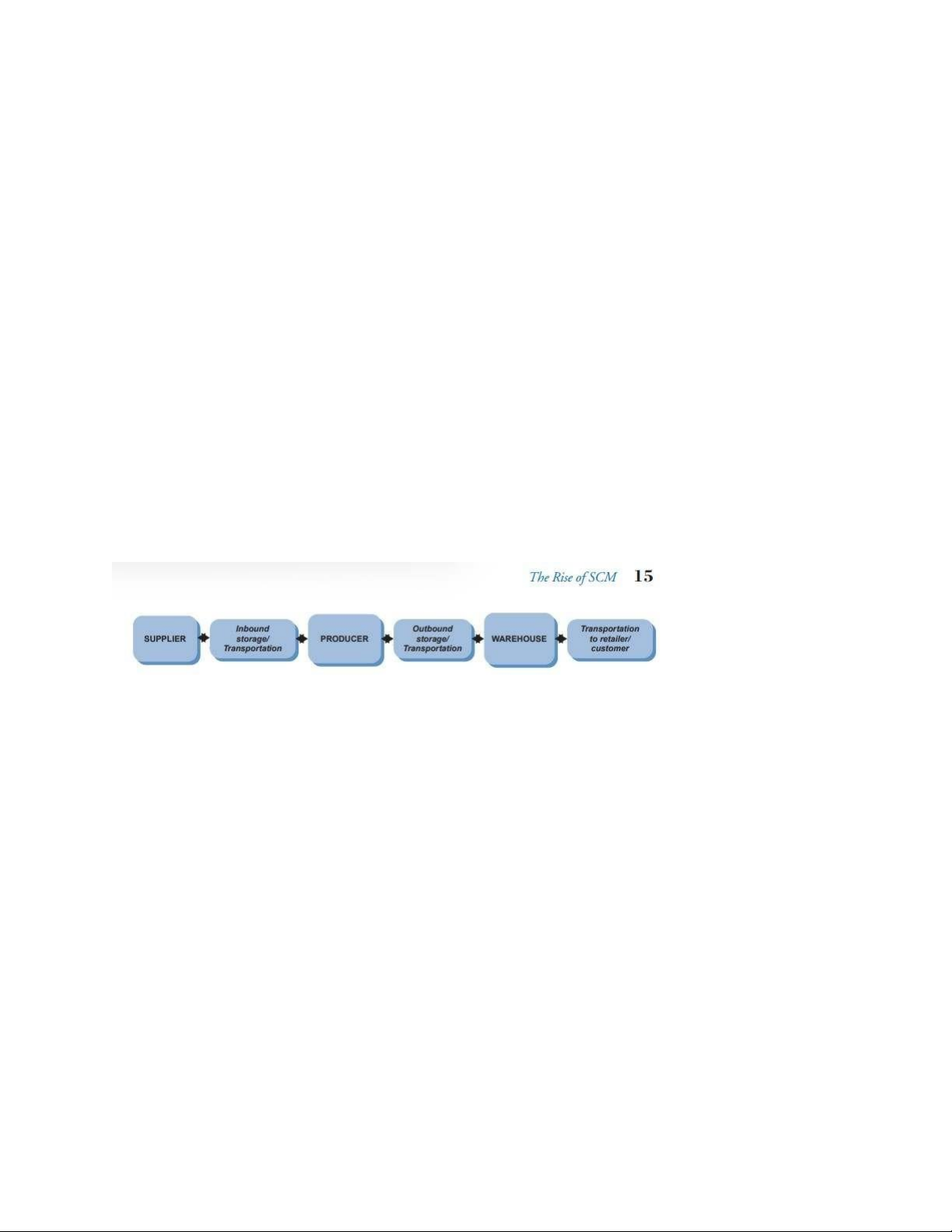
customer. This includes sourcing raw materials and parts, manufacturing, producing, and assembling the
products, storing goods in warehouses, order entry and tracking, distribution, and delivery to the final customer. What is a SUPPLY CHAIN?
A supply chain is the network of all entities involved in producing and delivering a finished product to the
final customer. This includes sourcing raw materials and parts, manufacturing, producing, and assembling
the products, storing goods in warehouses, order entry and tracking, distribution, and delivery to the final customer.
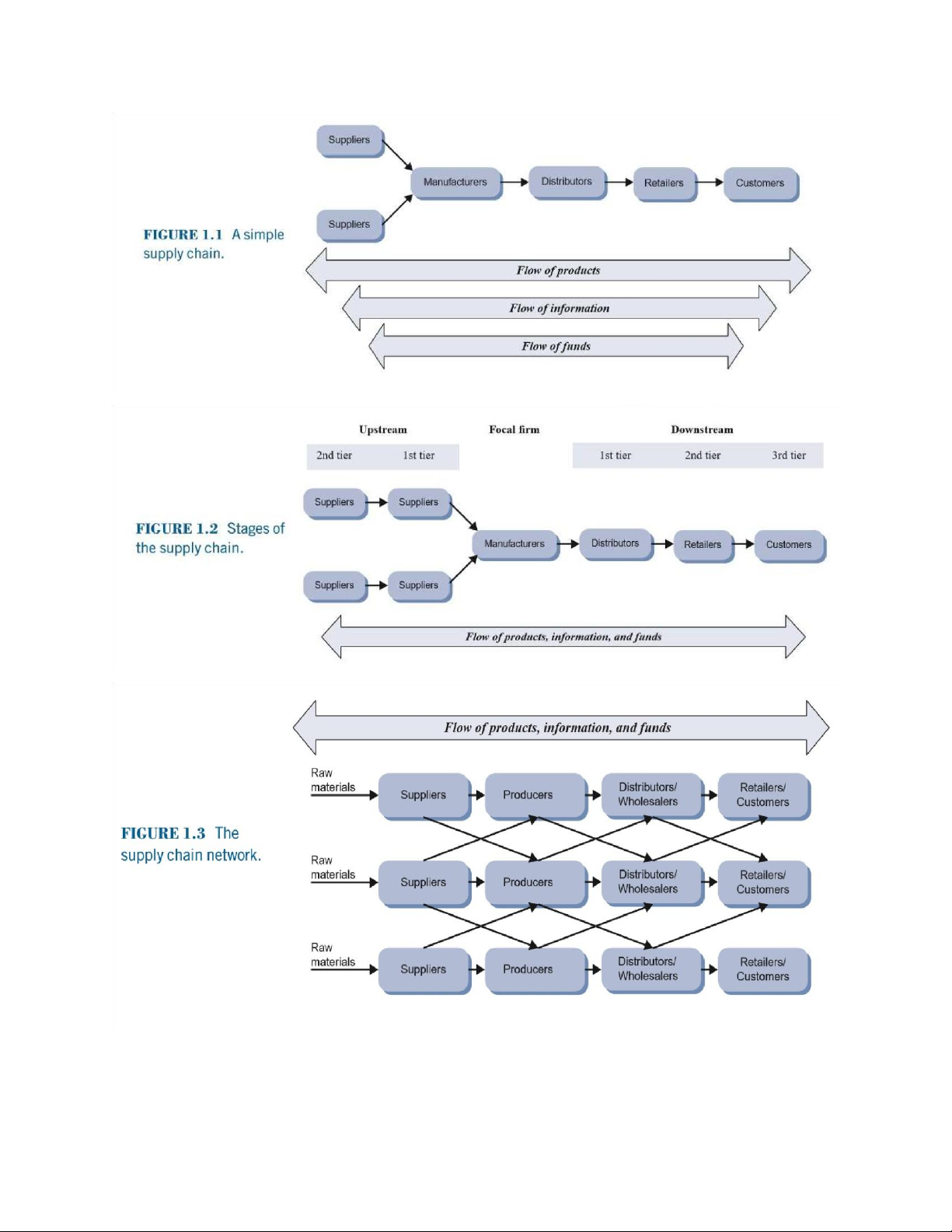
A typical supply chain may involve many different trading partners, called stages. These supply chain stages may include: • Suppliers • Producers
• Wholesalers/Distributors & • Retailers • Customers
Note that every supply chain is different and that these stages are a generic representation of a supply
chain. In fact, each stage may not be present in every supply chain. The number of stages that are part of
a supply chain and its appropriate design will depend on both the customer’s needs, the roles of the stages
involved, and the value each stage provides.
Supply chains are under increasing financial pressure and stages that do not add value to the supply chain
are quickly bypassed or eliminated. For this reason, a supply chain is often called a value chain or a value
network. Today’s concept of the supply chain comes from the concept of a ‘‘value chain’’ that was
introduced by Harvard Business School Professor, Michael Porter, in the l980s. Michael Porter explained
that a company’s competitive advantage cannot be understood by looking at a firm as a whole. Rather, its
competitive advantage comes from the many discrete activities that a firm performs and that each of
these activities contributes to the firm’s total cost position. This concept of each activity contributing to
the total value has now been extended to the entire supply chain. In fact, it has been often said that it is not companies that compete. lOMoAR cPSD| 58950985 lOMoAR cPSD| 58950985 SCM ACTIVITIES:
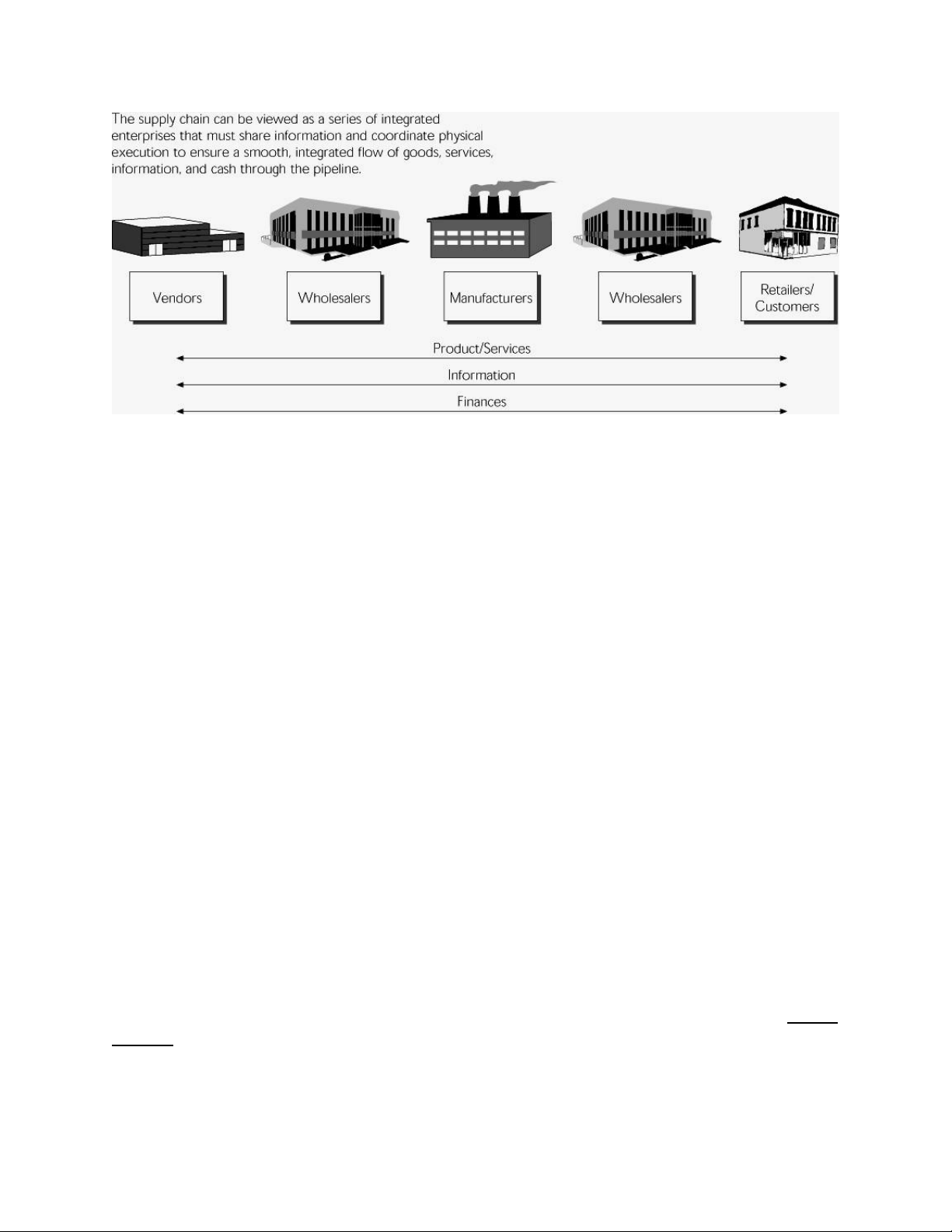
SCM activities include the following:
• Coordination: SCM involves coordinating the movement of goods and services through the supply
chain, from suppliers to manufacturers to distributors to final customers; it also includes
movement of goods back up the supply chain as products may be returned. Coordination also
involves the movement of funds through the supply chain as products are purchased and sold.
This includes various financial arrangements and terms of purchase between buyers and suppliers.
• Information Sharing: SCM requires sharing relevant information among members of the supply
chain. This includes sharing demand and sales forecasts, pointof-sale data, promotional
campaigns planned, and inventory levels. Consider that a manufacturer must know if a retailer is
planning an advertising campaign in order to ensure that enough of the product is being
produced. Otherwise, the retailer may run out of stock. Similarly, the manufacturer’s suppliers
must be aware of increased production plans in order to provide sufÏcient component parts.
Sharing this information enables the entire chain to work in unison.
• Collaboration: SCM requires collaboration between supply chain members so that they jointly
plan, operate, and execute business decisions as one entity. This is important for decisions that
range from product design and process improvement to implementing business initiatives or
following a particular business strategy. For example, this may include collaborating on ways to
cut costs or improve quality standards throughout the entire supply chain. MANAGING
FLOWS THROUGH THE SUPPLY CHAIN
Recall that there are many flows that move through a supply chain network. The first is the flow of
products through the supply chain, from the beginning of the chain through various stages of production,
to the final customer. However, goods also flow back through the chain. This is in the form of returned
products that are unacceptable to customers for a variety of reasons, such as damaged or obsolete goods. lOMoAR cPSD| 58950985
This is an area of SCM called reverse logistics, because the direction of product flow is reversed. The
increased focus on customer accommodation has resulted in an increase in the amount of goods returned from customers.
The second important flow through the supply chain is that of information that is shared between
members of the supply chain. Many simplified supply chains view the product flowing from suppliers to
customers and information flowing in the opposite direction, from point-of-sale back to suppliers. In this
simplified case, the primary information is demand or sales data, which is used to trigger replenishment
and serves as the basis for forecasting. In a more realistic case, sales information is shared on a real-time
basis, which leads to less uncertainty and less safety stock. The sharing of real-time information serves to
compress or shorten the supply chain from a time standpoint. The result of this more timely and accurate
information is a reduction in the amount of inventory carried throughout the supply chain.
The third important flow through the supply chain is that of funds. In a simplified supply chain, financial
flow is often viewed as one-directional, flowing backward in the supply chain as payment for products and
services received. However, as products flow in both directions so does the transfer of funds. A major
impact on fund transfer and the financials of companies has been supply chain compression. A shorter
order cycle time means that customers receive their orders faster. It means that they are billed sooner
and that companies receive payment sooner. This speeding up of the money collection process has had a
huge impact on the profitability of certain firms. Consider Dell Computer Corporation, a company that has
gained much from the compressed supply chain. Dell turns over its inventory 50 times per year, which is
roughly about once per week. Since their orders are filled in seven days, they often receive payment in
seven to 10 days, which is well before Dell pays its suppliers, providing a large financial benefit to Dell. THE BULLWHIP EFFECT:
It has been observed that fluctuation and distortion of information increases as it moves up the supply
chain, from retailers, manufacturers, to suppliers. This is called the bullwhip effect as inaccurate and
distorted information travels up the chain like a bullwhip uncoiling. In response, each stage of the chain
carries progressively more inventory to compensate for the lack of information. The bullwhip effect has
been well documented in many industries and is costly for all supply chain members
One of the best known examples of the bullwhip effectwas observed by Proctor & Gamble (P&G), in the
supply chain of its Pampers diapers. The company discovered that even when demand for diapers was
stable at the retail store level, orders for diapers from P&G fluctuated significantly. Even greater fluctuation
was observed in orders for raw materials from suppliers over time. Although consumption of the final
product was stable, orders for raw materials were highly variable.
The longer the supply chain the greater the opportunity for the bullwhip effect, as manufacturers and
suppliers are further away from final customer demand. If there is no coordination or sharing of
information, these stages do not know final customer demand or when a replenishment order might
arrive. As a result of this higher uncertainty, they stockpile inventory. The way to combat the bullwhip
effect is to share point-of-sale information, available from most cash registers, with all members of the
supply chain. This allows all stages of the supply chain to make replenishment decisions from the same
information source. In addition to information sharing, coordination and collaboration will enable stages
of the supply chain to work toward the same goals. lOMoAR cPSD| 58950985
What is Global supply chain management?
The integration and coordination of the strategic leverage points embedded in the supply chain
functions – logistics, purchasing/sourcing, operations and marketing globally THE
BOUNDARY-SPANNING NATURE OF SCM:
INTRA-ORGANIZATIONAL INTEGRATION
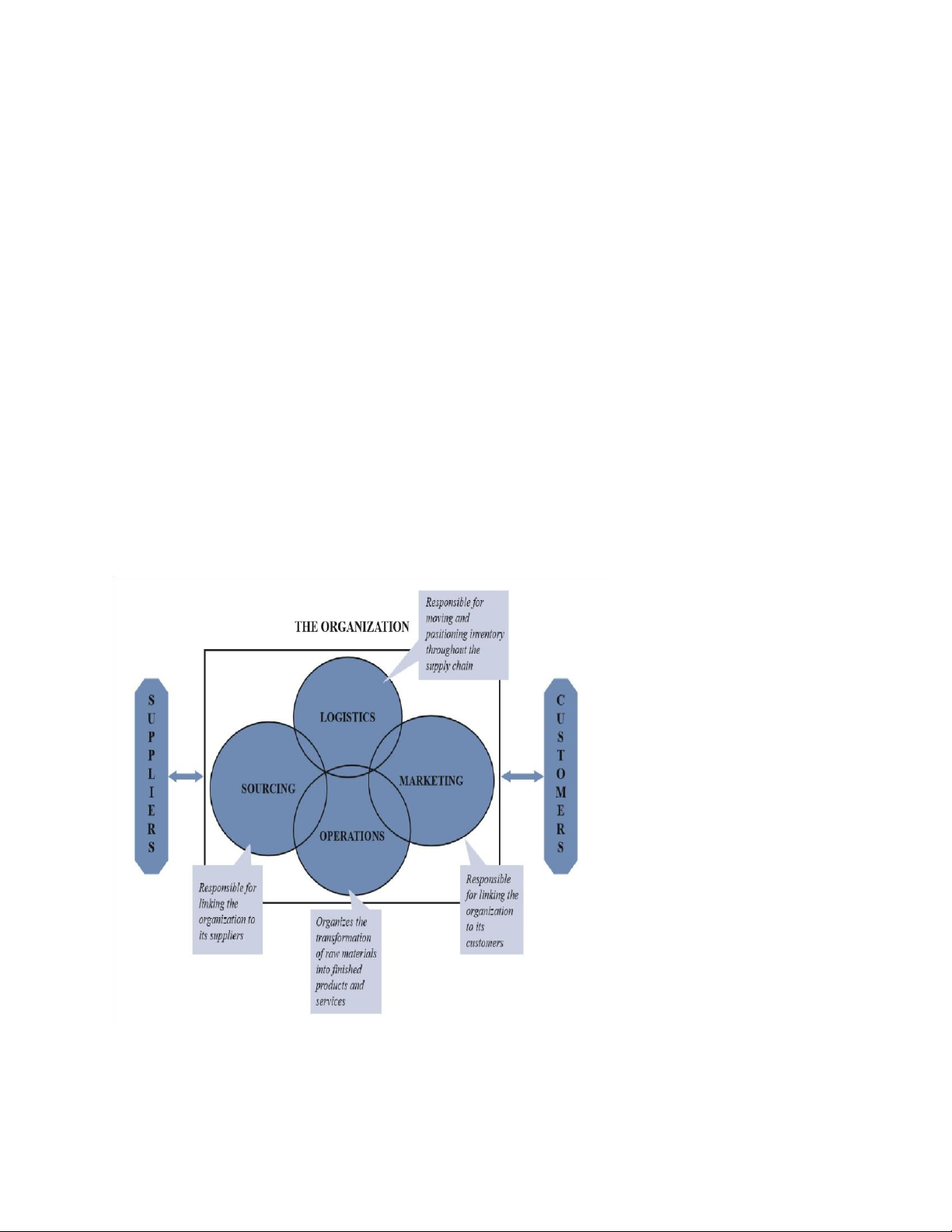
INTRA-ORGANIZATIONAL INTEGRATION SCM requires participation and coordination of activities between
different organizational functions. The relationship between the functions of marketing, operations,
sourcing, and logistics is particularly important. For an organization to be effectively integrated with other
members of its supply chain, it must have internal coordination. This means that the various functions
must share information and conduct coordinated activities.
Marketing is the function responsible for linking the organization to its customers and identifying what
customers want in products and services. It is the function that interfaces with the customer. Operations
ensures that the exact products customers want are produced efÏciently and in a cost-effective manner.
It is the function whose job is to organize the transformation of raw materials into finished products.
Sourcing is the function responsible for linking the organization to its suppliers, and ensuring an efÏcient
supply of materials. Logistics is responsible for moving and positioning inventory throughout the supply
chain, and ensuring that the right products are delivered to the right place at the right time. SCM would
not be possible without the support of these functions. CROSS-ENTERPRISE INTEGRATION:
The management of a supply chain as an extended enterprise involves coordinating two-way flows of
goods and services, information, and funds. The integration across the boundaries of several organizations lOMoAR cPSD| 58950985
means that the supply chain should function like one organization in satisfying the final customer. In fact,
the ultimate goal of a supply chain is to operate as a single entity. Information technology is the key
enabler of this capability, without which cross-enterprise integration would not be possible. This
integration can be difÏcult as real-world supply chains are usually complex and have many supply chain
participants. Achieving integration and coordination of activities in the supply chain is predicated on
relationship management. Concepts such as partnerships and alliances have become a part of the SCM
vocabulary. Traditional adversarial relationships with suppliers have given way to longterm partnering.
However, supply chain relationships need to incorporate more than shared information and a focus on
total supply chain cost. Supply chains need to achieve a level of integration that involves collaboration
among partners in developing strategic plans and joint setÝng of long-term goals. An important factor to
achieving this level of integration is for companies to have an internal, crossfunctional team that engages
in ongoing external efforts with suppliers, transportation carriers, and distributors. Toyota is a good
example of successful supplier collaboration. Toyota engages in collaboration with suppliers from the
earliest stages of product design—a system called ‘‘early supplier involvement.’’ This has led to a
significant cost reduction in producing its cars. In addition to collaborative planning, achieving full cross-
enterprise integration requires the sharing of risks and rewards. Most organizations still function in a way
that minimizes their own risk and maximizes their own rewards. This strategy may mean that outcomes
they achieve are at the expense of other companies. The cooperative and collaborative approach of SCM
is predicated on the win-win outcome. Although adversarial relationships can provide financial gain, the
win-win strategy has shown to be the best strategy over the long run.
CHARACTERISTICS OF A COMPETITIVE SUPPLY CHAIN: RESPONSIVENESS
The ability to respond to customers’ requirements in ever-shorter time frames has become critical. Today
customers want shorter lead times, greater flexibility, and greater product choice. This means that the
supplier and manufacturer have to be able to meet the precise demands of the customer in a shorter
amount of time than ever before. The ability for a supply chain to have this level of responsiveness is often
described as ‘‘agility,’’ which is the ability to move quickly to meet customer demands. In fact, in rapidly
changing environments, agility is more important than long-term strategy as there is no ‘‘long term.’’
Agility will come from short supply chains that are much more demand-driven — responding to what the
customer ‘‘demands’’—rather than forecast-driven. RELIABILITY
Uncertainty is a fact of life for most businesses, such as uncertainty about future demands, uncertainty
about a supplier’s ability to meet deadlines, or uncertainty about the quality of component materials. In
fact, uncertainty is the main reason why companies carry safety stock inventories—to guard against this
uncertainty— which then results in higher costs. The best way to reduce uncertainty is by increasing
reliability through the redesign of processes that impact performance. One factor that greatly improves lOMoAR cPSD| 58950985
reliability in supply chains is improved visibility. Typically, the further one goes up the supply chain, the
more limited the ‘‘visibility’’ of downstream activities. Organizations that are further up the chain have
typically relied on demand from their immediate customer in the chain to forecast demand. This lack of
coordination has resulted in the classic ‘‘bullwhip’’ effect. Supply chain coordination and sharing of
realtime data and information through information technology has permitted visibility to all entities in the
chain. This results in greatly improved visibility and, consequently, supply chain reliability. RELATIONSHIP MANAGEMENT
An important characteristic of competitive supply chains is their focus on relationship building and
collaboration, rather than arms-length adversarial relationships that had been dominant in the past. In
many industries, for example, the practice of ‘‘single-sourcing’’ is widespread. It has been documented
that such practices improve quality, product innovation and design while reducing costs and improving
overall responsiveness. Underlying this idea is that the buyer-supplier relationship should be based upon
a partnership of trust, commitment, and fairness. There are numerous advantages to such relationships
that can be long-term and mutually beneficial. The competitive advantage of companies such as Toyota
and Honda over their competitors in the auto industry comes from the collaborative relationships they
have developed with their suppliers. As we have seen thus far, SCM is primarily about the management
of relationships across complex networks of companies. Successful supply chains will be those that are
governed by a constant search for win-win relationships based upon reciprocity of trust. TRENDS IN SCM: GLOBALIZATION
In the eyes of the economist Thomas Friedman, globalization has replaced the so-called ‘‘cold war’’ of the
post-World War II era as the dominant driving force of world economics. The concept of the ‘‘global
marketplace’’ has changed the meaning of how and where business is conducted, for all enterprises and
for individual customers. Changes in information technology, transportation, and government policies
have made the concept of the global economy a fact of life. A number of countries have aggressively
pursued opening up international trade. This has served to open new markets and sources of supply for
most companies, both large and small. Further, these opportunities have been made possible through
information technology, which has helped break the distance barrier. Companies have benefited from a
larger choice of product sources. Consumers have also benefited due to greater product choice, higher
quality, and lower cost. Managing global supply chains, however, has a number of challenges. The distance
factor can become a significant barrier when shipments move thousands of miles from suppliers to
customers. In an environment of reduced cycle times, expected higher levels of reliability, and emphasis
upon efÏciency, the distance factor presents special challenges to supply chain managers. OUTSOURCING
Outsourcing is hiring a third party to perform a set of tasks for a fee. Companies have historically and
routinely outsourced certain activities, such as janitorial services, records management, or uniform
cleaning. The difference today is that companies are outsourcing almost all activities and on a much larger
scale. Increased competitive pressure has forced companies to recognize that they compete through their
core competencies (sometimes termed ‘‘distinctive competencies’’). This means that an organization
creates superior value for customers by managing their core competencies better than competitors. To be
able to focus on core competencies, many companies outsource other activities to those that can do them lOMoAR cPSD| 58950985
better. Outsourcing can involve hiring out one aspect of the operation, such as shipping, to outsourcing
an entire part of the manufacturing process. The practice has rapidly grown in recent years and has helped
companies be more efÏcient by focusing on what they do best. The convergence of technologies at the
turn of this century has taken the concept of outsourcing to a new level. Massive investments in
technology, such as worldwide broadband connectivity, the increasing availability of lower cost of
computers, and the development of software such as e-mail, search engines, and other software have
allowed individuals to work together in real time from anywhere in the world. The result has been the
outsourcing of virtually any job imaginable. Manufacturers have outsourced software development and
product design to engineers in India, accounting firms have outsourced tax preparation to India, even
some hospitals have outsourced the reading of CAT scans to doctors in India and Australia. TECHNOLOGY
An important driver of supply chain management is technology. Technological advances have enabled
companies to produce products faster, with better quality, at a lower cost, and this trend will continue.
Many processes that were not imaginable only a few years ago have been made possible through the use
of information technology. Advancements in information technology have in particular had the greatest
impact on SCM. In fact, information technology can be viewed as an enabler of SCM as without it
coordination between supply chain members would not be possible. The most popular type of information
technology, and most familiar to all, is the Internet, which has had the greatest impact on the way
companies conduct business. The Internet has linked trading partners—customers, buyers, and
suppliers—and has enabled electronic commerce and the virtual marketplace. This is one of the greatest
forces that has made information sharing along the supply chain possible. Another powerful information
technology is enterprise software, such as enterprise resource planning (ERP). These are large software
programs used for planning and coordinating all resources throughout the entire enterprise. They allow
data sharing and communication within and outside of the firm, enabling collaborative decision making.
Other examples of information technologies that have impacted the supply chain include wireless
communication technologies. We are all familiar with cellular phones and pagers from everyday life.
However, these technologies can also significantly improve business operations. For example, wireless
homing devices and wearable computers are being used in warehouses to quickly guide workers to the
locations of goods. This serves to significantly improve warehouse operations and logistics. Wireless
technologies, enhanced by satellite transmission, can rapidly transmit information from one source to
another. For example, Wal-Mart uses company-owned satellites to automatically transmit point-of-sale
data to computers at its warehouses for replenishment. Global positioning systems (GPS) are another type
of wireless technology that uses satellite transmission to communicate exact locations and have
dramatically improved logistics transportation. GPS has numerous logistics applications such as in
distribution, where trucking companies use GPS technology to identify the exact location of their vehicles.
Radio frequency identification (RFID) is yet another wireless technology that is dramatically changing
supply chain operations. RFID uses memory chips equipped with tiny radio antennas that can be attached
to objects to transmit streams of data about the object. For example, RFID can be used to identify any
product movement, reveal a missing product’s location, or have a shipment of products ‘‘announce’’ their
arrival. Empty store shelves can signal that it is time for replenishment using RFID, or low inventories can
signal the vendor that it is time to order more products. In fact, RFID has the potential to become the
backbone of logistics as it can identify and track billions of individual objects all over the world, in real
time. These information technologies collectively provide access to data never before available. This lOMoAR cPSD| 58950985
information has changed how products are bought and sold, and has changed the modus operandi of the
marketplace. Buyers no longer have to go to the seller’s place of business to view and buy products.
Rather, consumers can complete purchases seven days a week, 24 hours a day. IT has changed how buyers
and sellers interact in the marketplace, both business-tobusiness (B2B) and business-to-consumer (B2C). POSTPONEMENT:
Companies are continually struggling to reach global markets, while providing local customization. Even in
a geographically compact area like Europe there are still significant needs for local customization. For
example, consider differences in preferences for washing machines in different European countries. The
French, for example, prefer top-loading machines while the British prefer front-loaders. The Germans
prefer high-speed spins while the Italians prefer a lower speed. Similar differences occur with other
products, such as soft drinks requiring the Coca-Cola Corporation to offer many different soft-drink flavors
to cater to the unique local tastes. These differences significantly affect SCM. The challenge for a global
company is to achieve the cost advantage of standardization while still catering to local taste. This is
essentially mass customization coupled with rapid delivery. One way a company can achieve this is to seek
standardized parts, components and modules, and then, through flexible manufacturing and logistics,
provide specific product demands at each market. This is sometimes called ‘‘postponement’’ where
completion of the final product is postponed to the last possible moment till local demands are known
with greater certainly. Hewlett-Packard (HP) was known for this in the production and distribution of their
printers in the European market. The company completed the manufacture of the product, storing it in a
central location, then waited to finalize packaging and specific country/language labeling till local demand
was known. Postponement is an important strategy for companies to reach diverse geographic areas while
still providing customization. THE LEAN SUPPLY CHAIN The lean philosophy has been of great importance
in business as it has focused on the elimination of waste and has helped numerous companies become
more competitive. The importance of lean thinking has now been extended to the supply chain. It has
been recognized that while individual firms can become lean by themselves, waste anywhere in the supply
chain is passed on to the customer and ultimately everyone in the supply chain pays for it. For example,
shifting inventories to suppliers is ultimately passed on to the customer in the form of higher cost and
makes the entire supply chain less competitive. The lean supply chain can be defined as the set of all
organizations directly linked by upstream and downstream flows of products, services, finances, and
information that collaboratively work to reduce cost and waste. As such, a lean supply chain requires all
supply chain organizations to work together. It requires a coordinated effort among partners to eliminate
waste across the entire supply chain by analyzing processes and identifying areas for improvement.
MANAGING SUPPLY CHAIN DISRUPTIONS
SCM and global sourcing have lowered purchase prices and expanded market access. This wide reach,
however, has increased the level of supply chain risk. There is an increased risk of product and service flow
disruptions and in the magnitude of these disruptions. Supply chain disruptions are a significant corporate
crisis and can be very costly. Imagine, for example, a producer of an influenza vaccine suddenly not being
able to receive its key ingredients from a supplier during peak flu season. Production may be halted, the
company’s survival may be of serious concern, and the welfare of customers might be jeopardized.
Managing supply chain risks is challenging because disruptions can occur for a wide variety of reasons.
This can include transportation delays, industrial plant fires, work slowdowns or stoppages, natural
disasters, such as earthquakes or hurricanes, and man-made disasters, such as the 9/11 terrorist attacks. lOMoAR cPSD| 58950985
As companies have increasingly focused on lean operations, they no longer have the inventory or excess
capacity to make up for production losses caused by such disruptions. As a result, they are highly
vulnerable to even a short material-flow problem. Companies are continuing to look for ways to guard
their supply chains against disruptions. Some strategies include having access to backup suppliers, building
excess capacity into the system, screening and monitoring suppliers for supply chain risks, requiring
suppliers of critical items to develop detailed disruption plans, and including the expected costs of
disruptions in the total cost of sourcing. SUPPLY CHAIN SECURITY
Related to supply chain disruption is the study of supply chain security and maintaining product integrity
as goods are moved across the globe between borders. Today’s strict security initiatives make supply chain
relationships much more complex, and the study of ways to protect security while maintaining efÏciency
is now a key issue. This is particularly critical when dealing with international freight movement. Tighter
security and inspection at ports can significantly increase transit time and increase costs. Government
regulations aimed at preventing terrorist threats, such as Customs-Trade Partnership Against Terrorism
(CTAT) and the Container Security Initiative (CSI), require companies to engage in high levels of
compliance. Although these measures are necessary, companies are working to find ways to comply while
still engaging in outsourcing, off-shoring, and global sourcing on a cost-efÏcient scale. Other concerns are
theft and product tampering. This is especially true for high valued goods and pharmaceuticals, although
anything that has intrinsic value can potentially be stolen. Supply chain security looks at different ways to
protect the product, from using electronic seals to prevent tampering, to using RFID and GPS technologies to track product location.
SUSTAINABILITY AND THE ‘‘GREEN’’ SUPPLY CHAIN
Environmental concerns, including climate change, energy use, environmental contamination, and
resource depletion, are here to stay. Consider that the economies of India and China are growing at
double-digit rates, and the population of the world continues to grow, creating shortages of many
resources that we used to take for granted. Corporations are increasingly aware that they must design
their supply chains for sustainability. This means designing processes to use environmentally friendly
inputs and create outputs that can be recycled and that do not contaminate the environment. Sources of
supply and movement of goods are huge factors in ensuring sustainability. Consider that Starbuck’s selects
and manages their growers to ensure integrity of their environment. Starbuck’s mandates harvesting
practices of their growers that do not damage rainforests. Other aspects of the supply chain are also
important to sustainability, such as packaging and transportation to reduce environmental impacts.
Changes such as reducing the amount of cardboard or filler by designing ‘‘smart packages’’ can save
companies money. Also, filling trucks as full as possible, rather than moving half-empty trucks, is an
important environmental strategy. For example, Dell has increased its average truck load from 18,000 to
22,000 pounds. It has also worked with United Postal Service (UPS) to optimize delivery strategies that
reduce the carbon footprint. 3M has developed an innovative system to install adjustable decks in trucks,
allowing placement of pallets on two levels, reducing the number of daily truckloads. Companies are also
realizing that these types of measures are not only important to compliance with environmental
regulation and consumer demand, they are also good business practices. Starbuck’s, for example, realized
that by working with growers to protect the environment, they are assured of a consistent and reliable source of supply. lOMoAR cPSD| 58950985 INNOVATION
Innovation is increasingly becoming a critical capability for companies across the globe. This can include
designing new products that satisfy customer demands, designing new cost-cutÝng production processes,
or coming up with more efÏcient product delivery mechanisms. For example, consider a pharmaceutical
company recently involved in developing the flu vaccine for the recent outbreak of H1N1. Innovation
involves identifying the vaccine components and doing clinical trials, as well as production, packaging, and
distribution. This must be done efÏciently ensuring the highest security, all the while doing it as expediently
as possible to reach the market quickly. Companies that compete on innovation realize that their entire
supply chain must be designed to support their efforts, and are designing them accordingly. These chains
are typically shorter to reduce time to market. Also, innovative products need greater protection from
copying and tampering, and security issues become critical. The role of suppliers is especially important
in these supply chains. Suppliers need to be involved early in the product design process to shorten the
design time. Also, suppliers are an excellent source of product ideas and process improvements. As
competitive pressures increase, continuing to find ways to manage supply chains for innovations will
remain an important issue. This means coming up with new ideas and being able to produce and deliver
products faster than competitors. THE FINANCIAL SUPPLY CHAIN
The financial supply chain is intimately tied to SCM and managing the flow of funds is an essential
ingredient for its success. In today’s downturned global economy companies are under greater financial
pressures than ever before to cut costs. The result has been a push to redesign entire supply chains and
search for less costly sources of supply. This includes strategies such as global sourcing and production
outsourcing, trying to achieve labor cost advantages by pushing operations offshore, and outsourcing
noncore activities. As companies send operations offshore, however, there are significant financial
implications. These include masked hidden costs, such as managing more expensive plants and equipment
in emerging countries. Pushing inventory downstream to suppliers often means higher inventory costs as
these suppliers typically have a higher cost of capital. Also, global operations can wreak havoc on the
financial supply chain as the longer chain has a higher amount of tiedup working capital. Another area of
interest for management is the ‘‘cash-to-cash cycle,’’ which is the time it takes to convert an order into
cash. Although management has long recognized the competitive impact of shorter order cycles, it has
recently seen the impact the total order process has on working capital. This is another financial supply
chain issue that companies are trying to closely manage. As the supply chain provides a significant cost-
cutÝng opportunity the trend of managing finances, identifying the risks and challenges of the financial
supply chain will continue to be a significant trend in the future.
Tài liệu liên quan:
-

Tài Liệu Học Tập Quản Trị Chuỗi Cung Ứng - GIÁO TRÌNH GQC1
7 4 -
Bài giảng Nghiên cứu doanh nghiệp Nike trong Phân tích chuỗi cung ứng | Trường Đại học Kinh Tế Quốc Dân
19 10 -
Bài Thuyết Trình Ngành Dệt May Trung Quốc - LOGT26CD
28 14 -
Đề cương ôn tập Quản trị chuỗi cung ứng
33 17 -

Phân tích Mô hình Kinh doanh và Quản lý Chuỗi cung ứng của Samsung | Môn Quản trị chuỗi cung ứng quốc tế - Đại học Kinh Tế Quốc Dân
65 33