











Preview text:
Objective Proficiency Student’s Book with answers Annette Capel Wendy Sharp Second Edition
c a m b r i d g e u n i v e r s i t y p r e s s
Cambridge, New York, Melbourne, Madrid, Cape Town,
Singapore, São Paulo, Delhi, Mexico City Cambridge University Press Th
e Edinburgh Building, Cambridge CB2 8RU, UK www.cambridge.org
Information on this title: www.cambridge.org/9781107646377
© Cambridge University Press 2013 Th
is publication is in copyright. Subject to statutory exception
and to the provisions of relevant collective licensing agreements,
no reproduction of any part may take place without the written
permission of Cambridge University Press. First published 2002 Second edition published 2013 Reprinted 2013
Printed in Italy by L.E.G.O. S.p.A.
A catalogue record for this publication is available from the British Library
ISBN 978-1-107-64637-7 Student’s Book with answers with Downloadable Soft ware
ISBN 978-1-107-61116-0 Student’s Book without answers with Downloadable Soft ware
ISBN 978-1-107-67056-3 Teacher’s Book
ISBN 978-1-107-67634-3 Class Audio CDs (2)
ISBN 978-1-107-61920-3 Workbook with answers with Audio CD
ISBN 978-1-107-62156-5 Workbook without answers with Audio CD
ISBN 978-1-107-63368-1 Student’s Book Pack (Student’s Book with answers with
Downloadable Soft ware and Class Audio CDs (2))
Cambridge University Press has no responsibility for the persistence or
accuracy of URLs for external or third-party internet websites referred to in
this publication, and does not guarantee that any content on such websites is,
or will remain, accurate or appropriate. Information regarding prices, travel
timetables and other factual information given in this work is correct at
the time of fi rst printing but Cambridge University Press does not guarantee
the accuracy of such information thereaft er.
Map of Objective Proficiency Student’s Book TOPIC LESSON FOCUS EXAM SKILLS GRAMMAR VOCABULARY Unit 1 1.1 Listening and Vocabulary
Paper 1 Reading and Use of English: 1 Perfect tenses Introduction to idioms
Ring the changes 8–13 1.2 Grammar
Paper 2 Writing: 1 Summarising ideas Phrasal verbs Talking about change 1.3 Reading into Writing Paper 3 Listening: 4 Word formation – suffi x endings
Exam folder 1 14–15
Paper 1 Reading and Use of English: 3 Word formation Unit 2 2.1 Reading and Vocabulary
Paper 1 Reading and Use of English: 7 Aspects of the Collocations with
Expectation 16–21 2.2 Grammar and Vocabulary Paper 3 Listening: 1 future traveller Expectations 2.3 Listening and Speaking Paper 4 Speaking: 1 Pronunciation: Prepositional phrases homophones Have no + noun Phrases – nouns with related verbs
Writing folder 1 22–23 Paper 2 Writing: 1 Essay Unit 3 3.1 Listening and Vocabulary
Paper 1 Reading and Use of English: 2 Conditional Phrases – fi xed pairs of
Strange behaviour 24–29 3.2 Grammar
Paper 2 Writing: 1 Reformulation clauses words Content to be supplied Human and animal behaviour 3.3 Reading into Writing Modifi ers – quite, rather, fairly Word formation – negative adjectives
Exam folder 2 30–31
Paper 1 Reading and Use of English: 2 and 4 Open cloze Key word transformations Unit 4 4.1 Reading and Vocabulary
Paper 1 Reading and Use of English: 5 Past tenses Collocations
Sweet rituals 32–37 4.2 Grammar and Vocabulary Paper 4 Speaking: 2 Compound adjectives Food and ritual 4.3 Listening and Speaking Adjectives and idioms to do with food
Writing folder 2 38–39 Paper 2 Writing: 2 Review
Revision Units 1–4 40–41 Unit 5 5.1 Listening and Vocabulary
Paper 1 Reading and Use of English: 1 Countable/ Phrasal verbs
The consumer society 42–47 5.2 Grammar and Vocabulary
Paper 2 Writing: 1 Working with two uncountable Phrases with right Advertising, shopping 5.3 Reading into Writing texts nouns Prepositions Paper 3 Listening: 2 Possession Abstract nouns Spelling
Exam folder 3 48–49
Paper 1 Reading and Use of English: 1 Multiple-choice cloze Unit 6 6.1 Reading and Vocabulary
Paper 1 Reading and Use of English: 2, 4 Degrees of Phrases with take
The sound of music 50–55 6.2 Grammar and 6 likelihood Collocations with Music 6.3 Listening and Speaking Paper 3 Listening: 2 Pronunciation: adjectives and adverbs Paper 4 Speaking: 2 contrastive stress Idioms with music words
Writing folder 3 56–57 Paper 2 Writing: 1 Essay Unit 7 7.1 Listening and Vocabulary
Paper 1 Reading and Use of English: 3 Participle clauses Idioms with eye
Before your very eyes 58–63 7.2 Grammar
Paper 2 Writing: 1 Exemplifying your Extended noun phrases Art and sight 7.3 Reading into Writing ideas Adjectives showing Paper 3 Listening: 1 disapproval
Exam folder 4 64–65
Paper 1 Reading and Use of English: 7 Multiple matching
m a p o f o b j e c t i v e p r o f i c i e n c y s t u d e n t ’s b o o k 3 TOPIC LESSON FOCUS EXAM SKILLS GRAMMAR VOCABULARY Unit 8 8.1 Reading and Vocabulary
Paper 1 Reading and Use of English: 4 Inversion Compound adjectives Urban jungle 66–71 8.2 Grammar and Vocabulary and 7 City living 8.3 Listening, Speaking and Paper 4 Speaking: 3 Phrases with place Vocabulary
Writing folder 4 72–73 Paper 2 Writing: 2 Set text question: Film tie-in
Revision Units 5–8 74–75 Unit 9 9.1 Listening and Vocabulary
Paper 1 Reading and Use of English: 2 Gerunds and Phrases with come
Fitting in 76–81 9.2 Grammar and Vocabulary and 4 infinitives Prefixes Attitudes 9.3 Reading into Writing Paper 2 Writing: 1 Linking Linking words and Paper 3 Listening: 4 phrases Personal appearance, personality
Exam folder 5 82–83
Paper 1 Reading and Use of English: 6 Gapped text Unit 10 10.1 Reading and Vocabulary
Paper 1 Reading and Use of English: 1, 3 Reference Expressions with turn Globalisation 84–89 10.2 Grammar and and 4 devices Language and culture Vocabulary Paper 3 Listening: 1 Expressing 10.3 Listening and Speaking Paper 4 Speaking: 2 wishes and preferences Pronunciation: word stress
Writing folder 5 90–91 Paper 2 Writing: 2 Article Unit 11 11.1 Listening and
Paper 1 Reading and Use of English: 2 Gradability Phrasal verbs
For better, for worse 92–97 Vocabulary and 3 Idioms to do with Relationships 11.2 Grammar
Paper 2 Writing: 1 Reformulation 2 relationships 11.3 Reading into Writing Paper 3 Listening: 3
Exam folder 6 98–99 Paper 3 Listening: 4 Multiple matching Unit 12 12.1 Reading and Vocabulary
Paper 1 Reading and Use of English: 1, 4 Passive Idioms with technical
At the cutting edge 100–105 12.2 Grammar and 6 structures words Scientific advances 12.3 Listening and Speaking Paper 4 Speaking: 3 Pronunciation: Phrases with set stress and emphasis
Writing folder 6 106–107 Paper 2 Writing: 2 Report
Revision Units 9–12 108–109 Unit 13 13.1 Listening and
Paper 1 Reading and Use of English: 1 Reported speech Vocabulary – the
Save the planet 110–115 Vocabulary and 2 environment The environment 13.2 Grammar
Paper 2 Writing: 1 Giving opinions Register 13.3 Reading into Writing Paper 3 Listening: 1 Synonyms
Exam folder 7 116–117
Paper 1 Reading and Use of English: 5 Multiple-choice text Unit 14 14.1 Reading and Vocabulary
Paper 1 Reading and Use of English: 4 Articles review Register
Get fit, live longer! 118–123 14.2 Grammar and and 7 Pronunciation: Phrases with live Sport and health Vocabulary Paper 3 Listening: 3 noun/verb/ Phrases with nouns and 14.3 Listening and Speaking Paper 4 Speaking: 2 adjective stress no article Prepositions Word formation
Writing folder 7 124–125 Paper 2 Writing: 2 Letter 4
m a p o f o b j e c t i v e p r o f i c i e n c y s t u d e n t ’s b o o k TOPIC LESSON FOCUS EXAM SKILLS GRAMMAR VOCABULARY Unit 15 15.1 Listening and
Paper 1 Reading and Use of English: 2 Purpose and Topic expressions
The daily grind 126–131 Vocabulary
Paper 2 Writing: 1 Contrasting ideas reason clauses Neologisms The world of work 15.2 Grammar Paper 3 Listening: 3 Gender-specific words 15.3 Reading into Writing
Exam folder 8 132–133 Paper 3 Listening: 2 Sentence completion Unit 16 16.1 Reading and Vocabulary
Paper 1 Reading and Use of English: 3, 4 Concessive Adjectives describing
Hidden nuances 134–139 16.2 Grammar and and 5 clauses character Literature and the printed Vocabulary Paper 4 Speaking: 3 Pronunciation: word 16.3 Listening and Speaking silent consonants
Writing folder 8 140–141 Paper 2 Writing: 2 Set text question: Review
Revision Units 13–16 142–143 Unit 17 17.1 Listening and
Paper 1 Reading and Use of English: 1, 2 Comparison Idioms to do with Defining happiness Vocabulary and 4 emotions 144–149 17.2 Grammar and Paper 2 Writing: 1 Full Task 1 Metaphor Happiness and well-being Vocabulary Paper 3 Listening: 4 Synonyms 17.3 Reading into Writing Idioms to do with hardship Exam folder 9 150–151 Paper 3 Listening: 1 Multiple-choice questions Paper 3 Listening: 3 Multiple-choice questions Unit 18 18.1 Reading and Vocabulary
Paper 1 Reading and Use of English: 1, Review of Synonyms On freedom 152–157 18.2 Grammar and 3, 4 and 6 modals Freedom Vocabulary Paper 4 Speaking: 2 18.3 Listening and Speaking Pronunciation: stress and intonation
Writing folder 9 158–159 Paper 2 Writing: 2 Article Unit 19 19.1 Listening and
Paper 1 Reading and Use of English: 1 Word order and Adjectives describing
The unexplained 160–165 Vocabulary and 2 adverbs personality Strange places and happenings 19.2 Grammar Paper 2 Writing: 1 Full Task 2 Onomatopoeia 19.3 Reading into Writing Paper 3 Listening: 2 Word formation
Exam folder 10 166–167 Paper 4 Speaking Unit 20 20.1 Reading and Vocabulary
Paper 1 Reading and Use of English: 2, 4 Uses of have, get Expressions with go
A sense of humour 168–173 20.2 Grammar and and 5 and go Humour Vocabulary Paper 3 Listening: 3 Pronunciation: 20.3 Listening and Speaking Paper 4 Speaking: 3 loan words
Writing folder 10 174–175 Paper 2 Writing: 2 Articles and letters General advice
Revision Units 17–20 176–177
Grammar folder 178–188
Revision crosswords 189–191
Answers and recording scripts 192
Acknowledgements 278
m a p o f o b j e c t i v e p r o f i c i e n c y s t u d e n t ’s b o o k 5
Content of Cambridge English: Proficiency (CPE)
Cambridge English: Profi ciency, also known as Certifi cate of Profi ciency in English (CPE) consists of four papers. Th
e Reading and Use of English paper carries 40% of the marks while the Writing, Listening and Speaking
papers each carry 20% of the marks. It is not necessary to pass all four papers in order to pass the examination.
If you achieve a grade A, B or C in the examination, you will receive the Cambridge English: Profi ciency
certifi cate at Level C2. If your performance is below Level C2, but falls within Level C1, then you will receive
a Cambridge English certifi cate stating that you have demonstrated ability at C1 level.
As well as being told your grade, you will also be given a Statement of Results – a graphical profi le of your
performance, i.e. it will show whether you have done especially well or badly on some of the papers.
Paper 1 Reading and Use of English 1 hour 30 minutes Th
ere are seven parts to this paper and they are always in the same order. For Parts 1 to 4, the test contains texts
with accompanying grammar and vocabulary tasks, and separate items with a grammar and vocabulary focus.
For Parts 5 to 7, the test contains a range of texts and accompanying reading comprehension tasks. Th e texts are
from books (fi ction and non-fi ction), non-specialist articles from magazines, newspapers and the internet. Part Task Type Number of Task Format Objective Exam Folder Questions 1 Multiple-choice 8
You must choose which word from four answers completes 3 (48–49) cloze each of the gaps in a text. 2 Open cloze 8
You must complete a text with eight gaps using only one 2 (30–31) word in each gap. 3 Word formation 8
You need to use the right form of a given word to fi ll each 1 (14–15) of eight gaps in a text. 4 Key word 6
You must complete a sentence with a given word, so that it 2 (30–31) transformations
means the same as the fi rst sentence. 5 Multiple-choice 6
You must read a text and answer the questions by fi nding 7 (116–117) text
the relevant information in the text. 6 Gapped text 7
You must read a text from which paragraphs have been 5 (82–83)
removed and placed in jumbled order, together with an
additional paragraph, after the text. You need to decide
from where in the text the paragraphs have been removed. 7 Multiple matching 10
You read a text or several short texts, preceded by multiple- 4 (64–65)
matching questions. You must match a prompt to elements in the text. 6
c o n t e n t o f c a m b r i d g e e n g l i s h : p r o f i c i e n c y
Paper 2 Writing 1 hour 30 minutes
There are two parts to this paper. Part 1 is compulsory, you have to answer it. In Part 2 there are five questions
and you must choose one. Each part carries equal marks and you are expected to write 240–280 words for Part 1
and 280–320 words for Part 2. Part Task Type Number of Task Format
Objective Writing Folder or Unit Tasks 1 Question 1 1 You are given two short
WF 1 (22–23); U1 (12–13); U3 (28–29);
An essay with a discursive focus compulsory texts and you must write an
U5 (46–47); U7 (62–63); U9 (80–81); essay summarising and
U11 (96–97); U13 (114–115); evaluating the key ideas
U15 (130–131); U17 (148–149); contained in the texts. U19 (164–165) 2 Questions 2–4 5 You are given a choice of Essay WF 3 (56–57) • an article choose one topics which you have to
Article WF 5, 9 and 10 (90–91; • a letter respond to in the way 158–159; 174–175) • a report specified.
Letter WF 7 and 10 (124–125; 174–175) • a review Question 5 Review WF 2 (38–39)
Choice of two questions – one on Report WF 6 (106–107)
each of the specified set texts:
Set text: Film tie-in WF 4 (72–73)
article, essay, letter, review, report
Set text: Review WF 8 (140–141)
Paper 3 Listening about 40 minutes
There are four parts to this paper. Each part is heard twice. The texts are a variety of types either with one speaker or more than one. Part Task Type Number of Task Format Objective Questions Exam Folder 1 Multiple-choice 6
You hear three short, unrelated extracts, with either one or two 9 (150–151) questions
speakers. You must answer two questions on each extract, choosing from A, B or C. 2 Sentence 9
You must complete spaces in sentences with information given by 8 (132–133) completion one speaker. 3 Multiple-choice 5
You will hear two or more speakers interacting. You must choose 9 (150–151) questions
your answer from A, B, C or D. 4 Multiple matching 10
There are two tasks, each task containing five questions. You must 6 (98–99)
select five correct options from a list of eight.
Paper 4 Speaking about 16 minutes
There are three parts to this paper. There are usually two of you taking the examination and two examiners. This
paper tests your accuracy, vocabulary, pronunciation and ability to communicate and manage the tasks. Part Task Type Time Task Format Objective Exam Folder 1 The interviewer asks each 2 minutes
You will be asked some questions about yourself 10 (166–167) candidate some questions
and asked to express personal opinions. 2 Two-way conversation between 4 minutes
You will be given visual and written prompts which 10 (166–167) candidates
are used in a decision-making task. 3
A long turn for each candidate 10 minutes
You will be given a written question to respond to. 10 (166–167) followed by a discussion on in total
You will then be asked to engage in a discussion on related topics related topics.
c o n t e n t o f c a m b r i d g e e n g l i s h : p r o f i c i e n c y 7 1.1 Ring the changes Listening 2
1 02 You will hear five different people talking
about a key change in their lives. Tick each speaker’s
life-changing moment. There is one extra that you will not need. life-changing moment 1 2 3 4 5 being made redundant gaining media attention Speaking meeting ‘Mr Right’ 1
Everyone goes through changes, whether by choice heading the wrong way
or because of something outside their control. Talk
losing something special
about changes that have happened to you or might stepping in for someone
happen in the future, relating them to these phrases. r a change for the better 3
1 02 Listen again to check your answers. Then
r the earliest change you can remember
choose one of the speakers and describe what r a new location
happened to him or her.
r a change of direction in your life r a change of heart
Which two phrases above are examples of idioms? Vocabulary
Find a third idiom on this page. Phrasal verbs Idiom spot Exam spot
At C2 level, you need to understand and use phrases and
Phrasal verbs are tested in Parts 1, 2 and 4 of Paper 1.
idioms where the meaning is not transparent. You will
Remember that their use is generally informal, so they should
probably know the individual words used, but this may not
be used with care in Paper 2, where the tasks mostly require a
help! Some examples of common idioms are given below.
more neutral or formal register.
Choose the correct option (a or b) to complete each definition.
These idioms are used in the Listening section.
EXAMPLE: If something happens out of the blue, it is
You will already have come across many phrasal
a) unexpected b) creative. Answer a)
1 When things fall into place, events happen to a) change
verbs, but now you need to add to this knowledge.
the order of a list b) produce the situation you want.
If there are gaps in your learning, try to fill them
2 If something goes downhill, it a) gradually becomes worse
in. How many phrasal verbs can you come up with b) picks up speed.
3 If something is on the cards, it is a) likely to fail b) likely to
from the recording in 2? Remember that some happen.
phrasal verbs contain two particles rather than
4 When you are talking about a change in your life and you say
one (an adverb and a preposition), as in the last
the rest is history, you mean that a) it happened a long time
ago b) you are sure that people know what happened next. example. 8 u n it 1
4 Match the verbs to the correct particle(s) to form
6 Read the text below, which is from the introduction to
phrasal verbs that were used by Speakers 1–5. Four
a book on feng shui. Decide which answer (A, B, C or D)
of them are ‘three-part’ phrasal verbs. best fits each gap.
example: break up (3) verbs particles
break catch cheer come around at cut end get hang back down help jump pay run in off
The ancient Chinese philosophers who considered settle take track turn on out up with
feng (wind or air) and shui (water) to be the (1)
of mankind also understood that these 5
Now complete these sentences using a phrasal verb
were not the only supportive elements flowing
from 4 in a suitable tense. Sometimes the passive through the (2) . They perceived a subtler form will be needed. (3)
, calling it chi or ‘cosmic breath’. This
example: The whole family moved to Switzerland
life force is well-known to acupuncturists, who
last month and their two children are have (4)
elaborate maps of the ‘meridians’
settling in well at school there.
or channels it uses to flow through the body. Kung
a Their lives changed completely once the loan
Fu masters believe that chi can be concentrated in as it meant they could treat
the human body, allowing someone to (5)
themselves to meals out and weekends away.
almost supernatural feats, such as the breaking b An old school friend me of concrete blocks (6) by using the edge of
on the Internet and we met up
recently to compare our life stories.
their hand. A real feng shui master is able to
c The company offered Maria a post in the New (7)
the flow of chi in a site, and may advise York branch and she the
changes to the environment to (8) health, chance. wealth and good fortune.
d During the last recession, local businesses recruitment and no graduate trainees as a result.
e Jeff explained that shortly after they bought the
house together, he and his wife and she moved to another town. 1 A sustainers B providers
C keepers D promoters
f People often manage to advance their careers
2 A background B location
C outlook D landscape by the right people and telling 3 A vigour B weight C energy D stimulus them what they want to hear. 4 A shown up B built up C put up D laid up
g Everything fell into place – she was offered the 5 A perform B play C act D conduct
scholarship at Harvard, the flight was booked 6 A barely B merely C hardly D slightly and her missing passport just 7 A suspect B realise C sense D endure in time! 8 A set about
B come about C go about D bring about
h My brother has had a change of heart and is willing to me
with decorating the flat after all. Exam spot
Part 1 of Paper 1 is a short text with eight gaps. Don’t panic if
you find unfamiliar words in options A–D. Try the other words
in the gap first. If you’re sure they don’t fit, choose the word you don’t know.
r i n g t h e c h a n g e s 9 1.2 Grammar clinic 1
Read these short texts about alternative ways of
approaching city life. The highlighted parts illustrate Corpus spot
some of the grammar areas that C2 learners
continue to have problems with. What are they?
Correct the errors in perfect tenses in these sentences, which
were written by exam candidates.
a Three years ago I have been to Germany on a cultural 2
Tick any grammar areas below that you feel you exchange.
need to work on. Add your main grammar problem if
b Tourism is a word that is being used for the it is not listed. last 50 years.
c In England last year, I was able to appreciate things I have Modal verbs never seen in my entire life. Passives
d The noise levels have been measured in our suburb the
other day and are twice the acceptable level. Conditionals
e All these years I’m practising basketball, I’m trying to Perfect tenses become a better player. Relative clauses
f When you will have bought your train tickets, you should
take one each and put it into the machine. Reported speech
g Supposing they would have got married, wouldn’t the day Uncountable nouns
have come when they got bored with each other?
h Nowadays, almost every disease has a cure and people
have been caring more about their health.
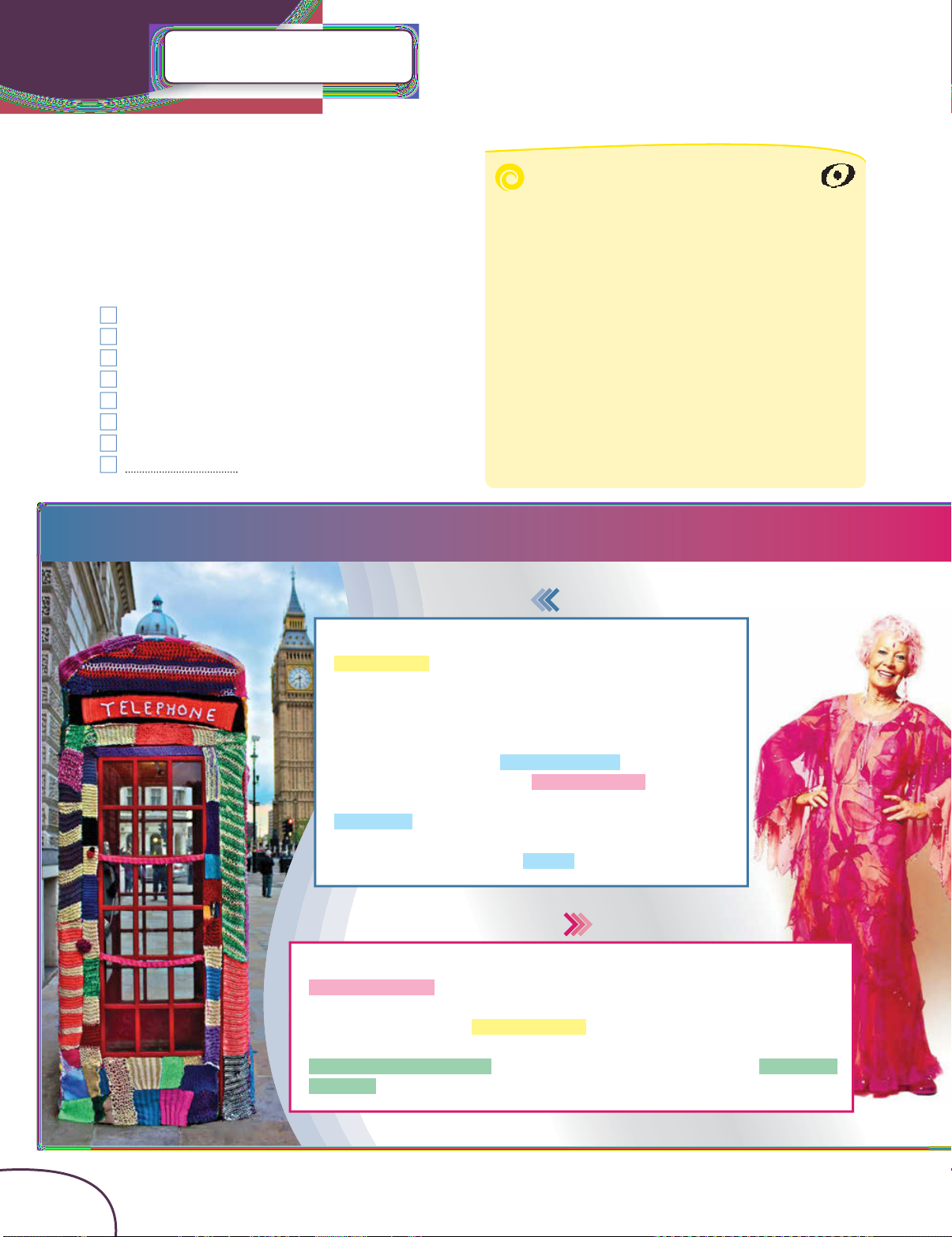
A L I F E L E S S O R D I N A R Y Knit the City
From knitted graffi ti to guerrilla crocheting – needle crafts
have exploded in ways entirely unforeseen by previous
generations. Our grandmothers would no doubt approve
of twenty-somethings knitting something similar to a tea
cosy (which they used to cover their teapots), even when
it is large enough to keep a London phonebox warm! This
original item of knitwear has been made by Knit the City,
a subversive group of knitters who also operate in other
capital cities. In Berlin, for example, a woolly ‘Currywurst’
was created entirely out of yarn recently. For those not in the
know, the Currywurst is a popular fast food item – over 800
million of the sausage treats are sold every year! Pink Lady Flamingo
You may have come across the extravagantly dressed Pink Lady Flamingo,
whose real name is Maryanne Kerr, busking on the underground in London. She
auditioned for an offi cial licence to perform her music, having experimented with
many previous careers. “I’ve been busking since I broke a recording contract with
a major record company,” said Maryanne, “because I refused to be dictated to.”
She added that she became a busker more than forty years ago and announced
that she is in her late seventies now and still busking. 10 u n it 1 3 4
Explain how tense choice alters the meaning in
Answer these questions so that they are true for you,
these sentences. In which two sentences is there no using perfect tenses. change in meaning?
a How long have you been learning English?
a Mirek has gone / went to Gdansk on business.
b What have you never done that you would like
b Our society has been suffering / was suffering to do?
from high unemployment for decades.
c What change has been made to your town or
c We were given / have been given more time to
city recently that you don’t approve of? complete the task.
d Which single change would most improve your
d Top government ministers have been dealing / quality of life at home?
have dealt with the problem.
e What may have changed in your life by this time
e Matt and James have played / have been playing next year? golf all day. G page 178
f I’ve thought / been thinking about what you said.
g Is there anything else we could have done / will have done?
h Come October, we will have lived / will have
been living here for eleven years. 5
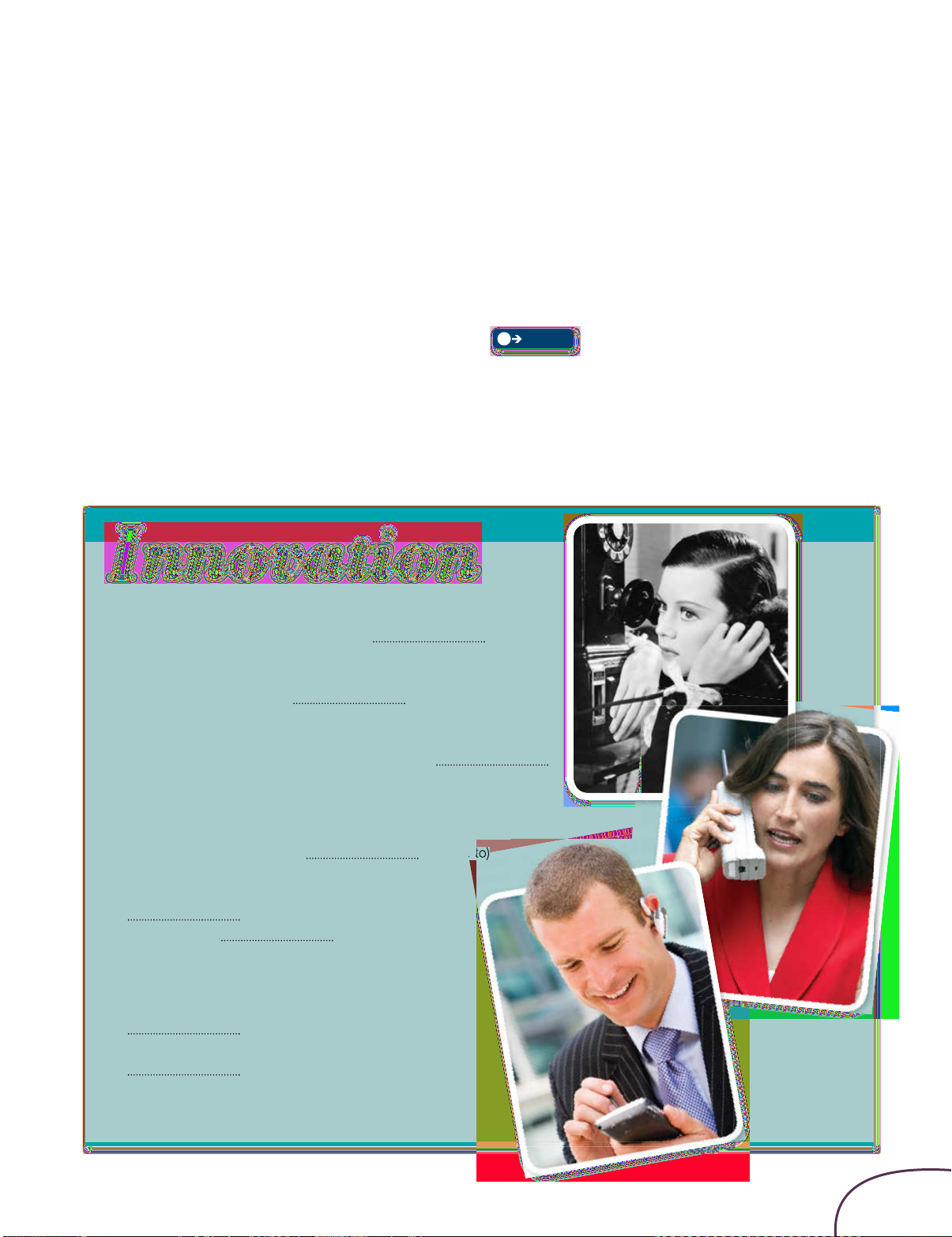
Complete the text below, using the words in brackets in such a way that they fit the space grammatically. Innovation in our lives
Across the centuries, people’s daily lives (1)
(continually transform) by innovation. One of the most obvious
characteristics of the 20th century was the rapid growth of technology,
with individual quality of life (2) (improve) immeasurably
as a result. Basic labour-saving appliances such as washing machines,
refrigerators and freezers were commonplace in the home by the 1960s
and the demand for these and other ‘white goods’ (3)
(further stimulate) by the availability of cheap electricity and noticeable
increases in personal wealth during that decade.
Personal computers first made their appearance in the home in the
1970s, but surely few people (4) (be able to)
imagine then that the home computer could evolve into the
super-fast, super-sleek machines of today. Nor could they (5)
(even think) that handheld mobile gadgets would (6) (use constantly) by
all of us, in our desperation to keep up with everything
from office correspondence to world news.
So what lies ahead of us? By 2025, will we (7)
(embrace) even more sophisticated
technological aids – or will the world’s resources (8)
(deplete) by mankind to such an
extent that there will be insufficient electricity to support
these advances? Only time will tell.
r i n g t h e c h a n g e s 11
1.3 Reading into Writing: Summarising ideas 3
For sentences a–j, replace the words in italics with
a single adjective formed from one of the verbs or
nouns given. What adjectives are formed from the four remaining words?
adventure alternate disaster dispose exhaust experiment flaw hope 1
What changes do you notice in the world around identify mass notice philosophy
you? Identify the changes shown in the pictures and predict speech understand
categorise them, choosing from the adjectives below.
Then suggest other changes that could be classified
example: I’ve been given this very lengthy and
under these categories.
complete list of all the repairs needed in the flat. Exhaustive
commercial environmental physical political social technological
a My boss’s response to my plea for changes to my
job description was exactly what I was expecting.
b If the weather is unfavourable, do you have any
other suggestions to replace our original plans? Vocabulary
c Both sides in the conflict are expressing their Word formation
optimism that the ceasefire will hold.
d Jeremy seems to have calmly accepted the news 2
The adjectives above are formed from nouns. about the break-in.
Generally, the suffix -al is added to the noun, as
e That play I went to see last night was trying
in environmental. Explain the formation rules for
something new in its use of dialect.
commercial and technological.
f I was incapable of any reply when Ella told me she had quit her job. The suffixes
-able and -ive frequently combine
g It’s really easy to see how much fitter Liam has
with verbs to form adjectives, as in favourable and
become since he started swimming regularly.
supportive. Explain the formation rules for creative
h Your last piece of writing was without any
and variable. mistakes whatsoever.
i Many of today’s products are used only once and The suffix
-ous combines with nouns, as in
then thrown away, which is having an impact on
courageous. Give two more examples. the environment.
Other common adjectival suffixes added to nouns
j The updating of the university’s computer
are -ful and -less, as in meaningful and harmless. Give
system has had extremely bad and far-reaching
two more examples of each. consequences. 12 u n it 1
5 Choose from a–f the best summary
sentence for text 2, judging it by Exam spot
the inclusion of information, use of
In the Paper 2, Part 1 compulsory task, you will read two short texts in order
alternative words, choice of register and
to summarise and evaluate them. You will need to reproduce different ideas
concisely, using your own words wherever possible.
conciseness. Say why the remaining
sentences are less successful.
4 In extracts 1 and 2, important information has been underlined.
a Mauve not only radically changed
Do the same in 3 and 4. Then answer questions 1–3 below the
the dye industry but also led to texts.
new discoveries of anything from perfume to aspirin. 1
We pick up on health and social status from facial features,
b By cooking up mauve in his lab,
as shown by a recent research project where people were
Perkin pushed the dye industry
unconsciously attracted to healthy females and wealthy
forward and set the ball rolling in
men, even when they only had a picture of a face (without
other industries too, such as perfume
make-up or jewellery) to judge them by. and photography and aspirin.
c In accidentally discovering mauve, Perkin transformed dyeing and 2
many other areas, notably medicine.
It was in 1856, while working in his tiny laboratory at
d Perkin discovered a special pale
home, that William Perkin produced, quite by chance,
purple colour and this discovery was
the colour mauve, which not only revolutionised the
revolutionary for the dye industry
dye industry but also led to important innovations
and also for the pharmaceutical
in perfume, photography and, most significantly for industry, since it led to the
modern medicine, to the development of aspirin. innovation of aspirin.
e Aspirin owes its development to
Perkin, who found mauve by chance 3 in his laboratory at home.
Rather than burgers and fries being a product of
f Commercially-speaking, Perkin’s
the social changes seen over the last fifty years in chance discovery was very
America, the author suggests that fast food brands
were to a large extent responsible for these changes,
important, as other innovations
as they profoundly affected both lifestyle and diet. followed, for example the development of aspirin. 4
6 Now write summary sentences for texts
Tiny holes found in human teeth estimated to be over
3 and 4, referring to the parts you have
8000 years old are now believed to be the earliest
underlined and using between 12 and
evidence of dentistry, for when these holes wer
20 words for each. Use your own words e
examined with an electron microscope, r wherever possible. esearchers found
their sides were too perfectly rounded to be caused by
bacteria and have therefore proposed that they were
drilled by prehistoric dentists.
1 Which information in text 1 is summarised in the following sentence?
People form opinions of others by looking at their faces. What has been omitted?
2 Which phrase in text 1 could be replaced by the verb assess or evaluate?
3 Which underlined words in text 2 could be replaced by others?
r i n g t h e c h a n g e s 13 Exam folder 1
Paper 1 Part 3 Word formation
In Part 3 of the Reading and Use of English paper, you will be asked to read a text and complete
the eight numbered gaps with a form of the word in capitals at the end of the line. There is an
example at the beginning of the text.
There are three main categories of changes that are tested. These are affixation (suffixes and
prefixes), compound and grammatical changes. Unlike lower level examinations, at Proficiency
level there is no limit to the number of changes which might be required to the root word.
Below are some examples of the changes you might need to make. i The of fast food CONSUME Affixes
is increasing at a frightening rate.
noun to adjective flaw to flawless j
seems to suit Ella DOMESTIC
noun to negative adverb effect to ineffectively
– she’s really happy with her home life.
adjective to negative adverb definite to indefinitely
k The side wall of the house had to
verb to noun act to interaction be . STRONG
verb to plural noun apply to applicants
l I believe she had the FORTUNE
adjective to verb deep to deepened
to have been seriously ill as a child.
m The broken vase turned out to be
1 Do the following for practice. Make sure you check totally . REPLACE the following: n She showed her deep
r do you need to make the word plural? by slamming the APPROVE r is a prefix needed? door in our faces.
r does any prefix need to be negative?
o The police tried to evict the three
from the building. OCCUPY
a There are a number of
activities now CURRICULUM being offered at the school. Compounds
b People have always enjoyed the
Compounds are often tested at this level. effects of sea air. BENEFIT example: c Tony is a really OPINION a The of the meeting COME person. was rather inconclusive. d The animal really KING Answer: outcome fascinates my young daughter.
b His brother had a second-hand car e Stefan was a COMPEL which was barely . ROAD
collector of gadgets throughout his life. Answer: roadworthy
f It was rapidly becoming
that we would have APPEAR to make changes to our plans.
g There have been a number of female in the INNOVATE field of aircraft design.
h There were a number of built into the CONSTRAIN contract. 14 e x am f o l d e r 1
2 Match a word from A with one from B to form a compound noun EXAM ADVICE
or adjective. The words in B can be used more than once.
● Read through the text carefully and A B
decide which form of the given word frame worthy you need to use. up fall
● Be careful as you will need to use a out date
negative prefix or another form of prefix at least once. wind work
● Check to see if a noun needs to be plural. rain break
● All the words must be correctly spelled. credit turn
American spelling is acceptable. down proof
● Write your answers in CAPITAL LETTERS on your answer sheet.
3 Read the Exam advice and then do the task below.
Use the word given in capitals at the end of some of the lines to form a word that fits in the gap in the
same line. There is an example at the beginning (0). Write your answers IN CAPITAL LETTERS. Example: 0 W I L F U L L Y IT’S ONLY SKIN DEEP
We are the only animal that chooses what it will look
like. True, the chameleon changes colour – but not
(0) WILFULLY . Unlike us, it doesn’t get up in the morning WILL
and ask itself, ‘What shall I look like today?’, but we can and do. Indeed, the (1)
of body decoration points to the ANTIQUE
conclusion that it is a key factor in our development as the (2) life-form on our planet. DOMINATE By (3)
their physical appearance our ancestors CUSTOM
distanced themselves from the rest of the animal
kingdom. Within each tribe this helped them to mark out
differences of role, status, and (4) . Our ancestors KIN (5)
developed extraordinary techniques of body APPEAR
decoration for practical reasons. How to show where one
tribe ends and another begins? How to (6) in a LINE
lasting way the significance of an individual becoming an
adult member of society? (7) , without the expressive ARGUE
capabilities of such ‘body language’ we would have been (8) less successful as a species. FINITE
e x a m f o l d e r 1 15 2.1 Expectation The way we Speaking travel now
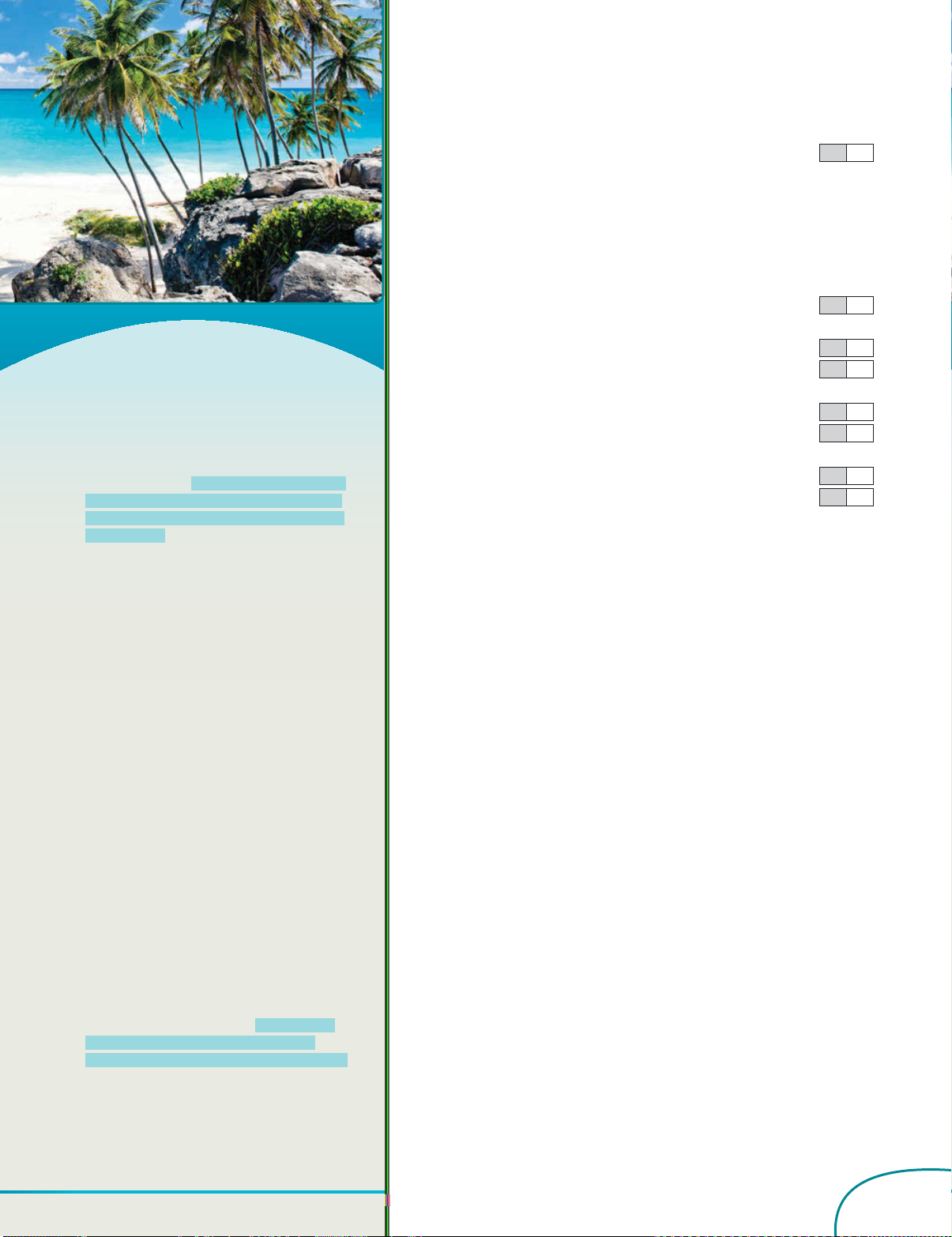
1 Work with a partner. Look at the photos. What
expectations would you have of a holiday in each of the places? A
The prospect of a holiday is liable to persuade even
On which holiday might you
the most downcast that life is worth living. Few events
r get off the beaten track?
are anticipated more eagerly, nor form the subject of r
more complex and enriching daydreams. They offer be able to chill out?
us perhaps our finest chance to achieve happiness –
r possibly have to rough it?
outside of the constraints of work, of our struggle for
r end up spending a fortune?
survival and for status. The way we choose to spend
r get by on a shoestring budget?
them embodies, if only unknowingly, an understanding r
of what life might ideally be about. However,
enjoy being a culture vulture?
holidays almost always go wrong. The tragicomic r get back to nature?
disappointments of travel are a staple of office chat;
r be in the lap of luxury?
the half-built hotel, the sense of disorientation, the
mid-afternoon despair, the dreary fellow travellers, the
If you have had such a holiday, did it live up to your lethargy before ancient ruins.
expectations? Have you ever had a holiday which B
exceeded/didn’t live up to your expectations?
I remember a trip to Barbados a few years ago. I looked
forward to it for months. But on my first morning on
the island, I realised something at once obvious and Exam spot
surprising; that my body proved a temperamental
In Part 7 of Paper 1 there are a number of short texts or
partner. Asked to sit on a deckchair so that the mind
one long text divided into sections. You need to read the
could savour the beach, the trees and the sun, it
sections carefully and then look at the questions. Underline
collapsed into difficulties; the ears complained of
your answer when you have found it. Make sure that your
an enervating wind, the skin of stickiness and the
underlined text fully answers the question.
toes of sand lodged between them. Unfortunately, I
had brought something else that risked clouding my
appreciation of my surroundings; my entire mind – not
only the part that had planned the journey and agreed Reading
to pay for it, but also the part committed to anxiety,
boredom, self-disgust and financial alarm. At home, as
2 You are going to read an article about holidays and
I had pored over the photographs of Barbados, I had
what we expect of them. Read through the article
felt oblivious to anything besides their contents. I had
quickly to get a general idea of what it is about,
simply been in the pictures; alone with their elements.
ignoring the highlights for now. What does the
But melancholy and regrets were my bedfellows on
that Caribbean isle, acting like panes of distorting glass
writer think about holidays? between myself and the world. 16 u n it 2
3 You need to decide in which part of the text you will find the
answer to the questions. Do the following question for practice.
Which section mentions a number of unanticipated problems faced by the writer? 1
You will see that there are problems mentioned in sections A,
B, C and D (highlighted). However, which section mentions
problems which are ‘unanticipated’ and ‘faced by the writer’? Now do questions 2–8. Which section mentions
the possibility of the writer altering a previous 2 pattern of behaviour?
negative emotions being ever present? 3 C
the fact the some conditions must be met for 4
There was a trip to a hotel in France a other aims to be achieved?
friend took with his wife. The setting
was sublime, the room flawless – and yet
the frequency of a certain topic being raised? 5
they managed to have a row which, for
the possibility that an unfulfilled objective may 6
all the good the room and setting did be more desirable?
them, meant that they might as well have
the writer finding it impossible to achieve his goal? 7
stayed at home. The row (it started with
who had forgotten the key in the room
the belief that the selection of a holiday is a 8
and extended to cover the whole of the
product of an unconscious desire?
relationship) was a reminder of the rigid,
unforgiving logic to which human moods
seem subject – and which we ignore at
our peril. Our capacity to draw happiness Vocabulary
from aesthetic or material goods seems
critically dependent on first satisfying
Collocations with traveller
a more important range of emotional
4 The writer in the article talks about ‘dreary fellow travellers’.
or psychological needs, among them
the need for understanding, for love,
Circle the most suitable collocation in these sentences. expression and respect.
a Dr Parr was a frequent / recurrent traveller to Dublin. D
b There has been a rise in the numbers of self-contained /
independent travellers as opposed to those on packages.
It may be necessary to accept that the
anticipation of travel is perhaps the best
c Seasoned / Practised travellers know exactly how to get an
part about it. Our holidays are never as upgrade on their bookings.
satisfying as they are when they exist in
d I’m fed up with reading about all these intrepid / heroic
an as-yet-unrealised form; in the shape
travellers going up the Amazon river in a canoe.
of an airline ticket and a brochure. In
the great 19th-century novel, Against
e The hotel offers fatigued / weary travellers an excellent
Nature, by JK Huysmans, the narrator
opportunity to recharge their batteries.
goes on a few holidays which go wrong
f LuxVac is the resort for judicious / discerning travellers –
and then decides never to leave home
ones who know how to appreciate the good things in life.
again. He has the itineraries of the major
g My father has always been more of a / an armchair / sofa
shipping companies framed and lines his
bedroom with them. He fills an aquarium
traveller, much to my mother’s disgust!
with seaweed, buys a sail, some rigging
h Susie is the kind of inveterate / habitual traveller who will
and a pot of tar and, with these aids is
probably never settle down in one place.
able to experience the most pleasant
i The hotel touts lie in wait for unguarded / unwary travellers
sides of a long sea voyage without the
inconveniences such as sea-sickness,
and then take them to unsuitable lodgings.
storms or uncongenial fellow passengers.
5 Discuss with a partner.
I continue to travel myself but there are
times when I too feel there might be no
r Do you agree with the ideas put forward by the writer?
finer journeys than those provoked in the Why / Why not?
imagination by remaining at home slowly
r Do you think it’s better to travel hopefully than arrive?
turning the pages of an airline timetable. Why / Why not? e x p e c tat i o n 17
2.2 Aspects of the future
1 When we want to talk about the future in English
d Sue is going to get / is getting her visa next week,
we have to use a variety of tenses, modals and if she has time.
expressions, not just will do. The context of the
e It’s a lovely day – I think I’ll go / I’ll be going to
sentence is what tells us which aspect of the future the beach. to use.
f I rang her up to tell her that I won’t go / I’m not
going to the party because I’m already busy that
For example, there are many different variations night.
possible for the verb in brackets here: What you (do)
g I’ll see you on Saturday. What will you do / will tonight? you be doing in the afternoon? Answers
h By the year 2040 a manned space ship will travel
a What are you doing tonight? / will have travelled to Io.
b What will you do tonight? i The hotel
is not to allow / is not allowing guests
c What are you going to do tonight?
to use the car park this week, while building
d What will you be doing tonight? work goes ahead.
e What will you have done tonight? j I
will do / am doing my packing this afternoon,
f What were you going to do tonight? if I can find my suitcase.
Before you can decide which aspect of the future to
k Peter will have been painting / will have painted
use, you need to know the context. With a partner,
that portrait for three weeks by Saturday.
discuss when each of the forms above would be used.
l This time next year we will have finished / will finish our exams. G pages 178–179
m Don’t let him read in the coach – he’ll feel / he’s going to feel sick.
n What will you be doing / will you do if the flight
Note – the present simple is also used to express is delayed tomorrow?
the future when talking about travel arrangements,
o Tomorrow is / will be Tuesday.
e.g. The ship leaves on Saturdays, and also about
p I will have / am having caviar tonight – it’s
facts that can’t be changed, e.g. Tomorrow is already in my fridge! Wednesday.
q I’ll ring you on my mobile when I will arrive / arrive.
2 Choose the best alternative in sentences a–s.
r Stop worrying – the train is arriving / will be
example: I think I will / ’m going to faint – let me arriving soon. get some air!
s Will / Shall I help you?
3 With a partner, decide what you would say in the following situations.
example: Your birthday tomorrow. I’m 22
tomorrow. / I’ll be 22 tomorrow. (fact/ neutral future)
a He never does any work, I’m sure he’s going to get / he’s getting the sack.
b That will be / is going to be the postman – he
usually comes round at this time.
c The plane for Zurich leaves / will leave at 16.00
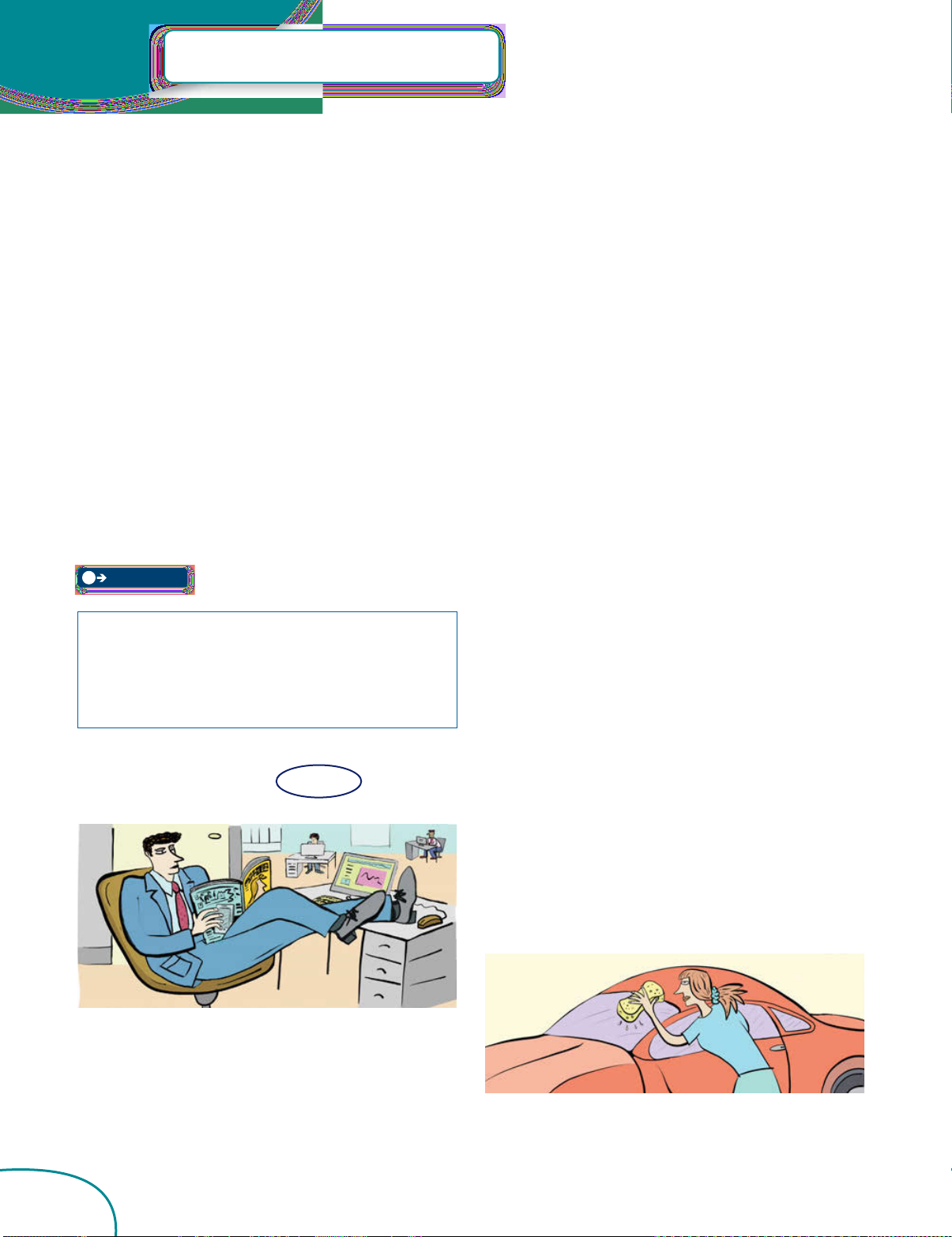
a Your intention to clean your car tomorrow. on Fridays.
b You see dark clouds in the sky.
c The weather next week. 18 u n it 2