Đề cương môn công nghệ phần mềm- Trường Đại học bách khoa - Đại học đà nẵng.
Apolygonisconvexifanylinesegmentjoiningtwopointsontheboundarystays within the polygon.Equivalently, if you walk around the boundary of the polygon in counterclockwise direction you always take left turns.
Đề cương môn công nghệ phần mềm- Trường Đại học bách khoa - Đại học đà nẵng.
Tài liệu gồm 25 trang , giúp bạn tham khảo, ôn tập và đạt kết quả cao.
Môn: Công nghệ phần mềm (CNPM1) 40 tài liệu
Trường: Trường Đại học Bách khoa, Đại học Đà Nẵng 1.7 K tài liệu
Tác giả:





Preview text:
lOMoARcPSD|61022953 Convex hull - toán nâng cao
Công nghệ phần mềm (Trường Đại học Bách Khoa - Đại học Đà Nẵng) Scan to open on Studeersnel
Studocu is not sponsored or endorsed by any college or university
Downloaded by giang le (legiangnamban@gmail.com) lOMoARcPSD|61022953
Chapter A1: Convex Hulls: An Example
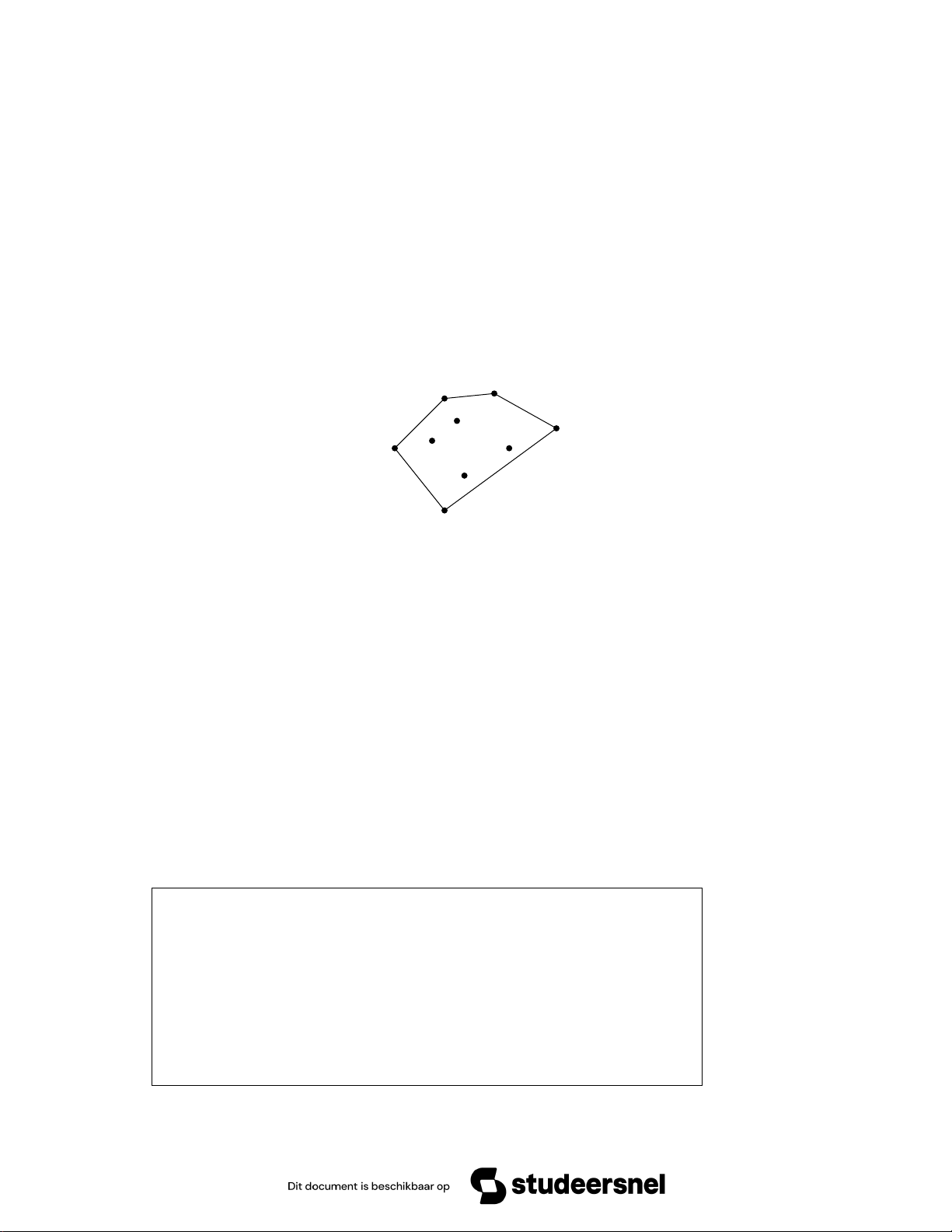
A polygon is convex if any line segment joining two points on the boundary stays
within the polygon. Equivalently, if you walk around the boundary of the polygon in
counterclockwise direction you always take left turns.
The convex hull of a set of points in the plane is the smallest convex polygon for which
each point is either on the boundary or in the interior of the polygon. One might think
of the points as being nails sticking out of a wooden board: then the convex hull is the
shape formed by a tight rubber band that surrounds all the nails. A vertex is a corner
of a polygon. For example, the highest, lowest, leftmost and rightmost points are all
vertices of the convex hull. Some other characterizations are given in the exercises.
We discuss three algorithms for finding a convex hull: Graham Scan, Jarvis March and
Divide & Conquer. We present the algorithms under the assumption that:
• no 3 points are collinear (on a straight line) A1.1 Graham Scan
The idea is to identify one vertex of the convex hull and sort the other points as viewed
from that vertex. Then the points are scanned in order.
Let x0 be the leftmost point (which is guaranteed to be in the convex hull) and number
the remaining points by angle from x0 going counterclockwise: x1, x2, . . . , xn 1. Let −
xn = x0, the chosen point. (We’re assuming no two points have the same angle from x0.)
The algorithm is simple to state with a single stack: Graham Scan
1. Sort points by angle from x0 2. Push x0 and x1. Set i=2 3. While i ≤ n do:
If xi makes left turn w.r.t. top 2 items on stack then { push xi; i++ } else { pop and discard }
Downloaded by giang le (legiangnamban@gmail.com) lOMoARcPSD|61022953
To prove that the algorithm works, it suffices to argue that:
• A discarded point is not in the convex hull.
If xj is discarded, then for some
i < j < k the points xi → xj → xk form a right turn. So, xj is inside the triangle
x0, xi, xk and hence is not on the convex hull. k j i 0
• What remains is convex. This is immediate as every turn is a left turn.
The running time: Each time the while loop is executed, a point is either stacked or
discarded. Since a point is looked at only once, the loop is executed at most 2n times.
There is a constant-time subroutine for checking, given three points in order, whether
the angle is a left or a right turn (Exercise). This gives an O(n) time algorithm, apart
from the initial sort which takes time O(n log n). (Recall that the notation O(f (n)),
pronounced “order f (n)”, means “asymptotically at most a constant times f (n)”.) A1.2 Jarvis March
This is also called the wrapping algorithm. This algorithm finds the points on the
convex hull in the order in which they appear. It is quick if there are only a few points
on the convex hull, but slow if there are many.
Let x0 be the leftmost point. Let x1 be the first point counterclockwise when viewed
from x0. Then x2 is the first point counterclockwise when viewed from x1, and so on. Jarvis March i = 0 while not done do
xi+1 = first point counterclockwise from xi 2
Downloaded by giang le (legiangnamban@gmail.com) lOMoARcPSD|61022953 2 0 1
Finding xi+1 takes linear time. The while loop is executed at most n times. More
specifically, the while loop is executed h times where h is the number of vertices on the
convex hull. So Jarvis March takes time O(nh).
The best case is h = 3. The worst case is h = n, when the points are, for example,
arranged on the circumference of a circle. A1.3 Divide and Conquer
Divide and Conquer is a popular technique for algorithm design. We use it here to find
the convex hull. The first step is a Divide step, the second step is a Conquer step, and
the third step is a Combine step. The idea is to: Divide and conquer
1. Divide the n points into two halves.
2. Find convex hull of each subset.
3. Combine the two hulls into overall convex hull.
Part 2 is simply two recursive calls. Note that, if a point is in the overall convex hull,
then it is in the convex hull of any subset of points that contain it. (Use characterization
in exercise.) So the task is: given two convex hulls, find the convex hull of their union. ♦ Combining two hulls
It helps to work with convex hulls that do not overlap. To ensure this, all the points
are presorted from left to right. So we have a left and right half, and hence a left and right convex hull.
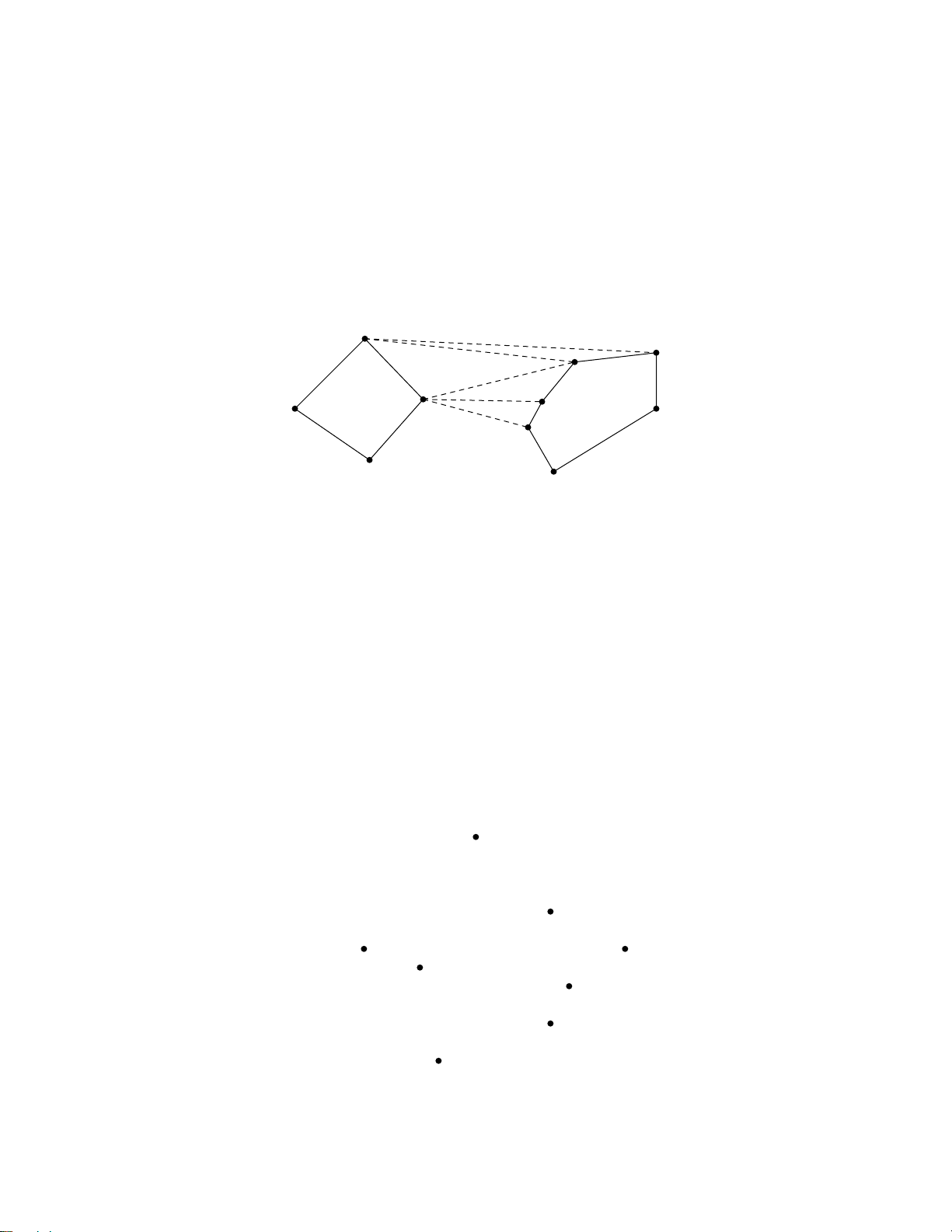
Define a bridge as any line segment joining a vertex on the left and a vertex on the
right that does not cross the side of either polygon. What we need are the upper and
lower bridges. The following produces the upper bridge. 3
Downloaded by giang le (legiangnamban@gmail.com) lOMoARcPSD|61022953
1. Start with any bridge. For example, a bridge is guaranteed if you join the rightmost
vertex on the left to the leftmost vertex on the right.
2. Keeping the left end of the bridge fixed, see if the right end can be raised. That
is, look at the next vertex on the right polygon going clockwise, and see whether
that would be a (better) bridge. Otherwise, see if the left end can be raised while the right end remains fixed.
3. If made no progress in Step 2 (cannot raise either side), then stop else repeat Step 2. 5 4 3 2 1
We need to be sure that one will eventually stop. Is this obvious?
Now, we need to determine the running time of the algorithm. The key is to perform
Step 2 in constant time. For this it is sufficient that each vertex has a pointer to the next
vertex going clockwise and going counterclockwise. Hence the choice of data structure:
we store each hull using a doubly linked circular linked list.
It follows that the total work done in a merge is proportional to the number of vertices.
And as we shall see from a later chapter, this means that the overall algorithm takes time O(n log n). Exercises
1. Find the convex hulls for the following list of points using the three algorithms presented. (30 60) , (50 40) , (0 30) (70 30) , , (15 25) , (55 20) , (50 10) , (20 0) , 4
Downloaded by giang le (legiangnamban@gmail.com) lOMoARcPSD|61022953
2. Give a quick calculation which tells one whether three points make a left or a right turn.
3. Discuss how one might deal with collinear points in the algorithms.
4. Show that a point D is on the convex hull if and only if there do not exist points
A, B, C such that D is inside the triangle formed by A, B, C.
5. Give a good algorithm for the convex layers problem. The convex layers are the
convex hull, the convex hull of what remains, etc. 6. e
○ Assume one has a fast convex hull subroutine that returns the convex hull in
order . Show how to use the subroutine to sort numbers. 5
Downloaded by giang le (legiangnamban@gmail.com)
Tài liệu liên quan:
-
Báo cáo Thực tập nhận thức Tìm hiểu về Công ty Cổ phần cao su Đà Nẵng | Trường Đại học Bách khoa, Đại học Đà Nẵng
29 15 -

CHƯƠNG 1 Tổng quan về Công nghệ phần mềm môn Công nghệ phần mềm | Trường Đại học Bách Khoa, Đại học Đà Nẵng
33 17 -
Đề cương môn công nghệ phần mềm- Trường Đại học bách khoa - Đại học đà nẵng.
69 35 -
.Đề cương môn công nghệ phần mềm- Trường Đại học bách khoa - Đại học đà nẵng
63 32