Đề cương ôn tập môn Cơ sở dữ liệu | Trường Đại học Kinh Tế - Luật, Đại học Quốc gia Thành phố Hồ Chí Minh
Đề cương ôn tập môn Cơ sở dữ liệu | Trường Đại học Kinh Tế - Luật, Đại học Quốc gia Thành phố Hồ Chí Minh. Tài liệu được sưu tầm giúp bạn tham khảo, ôn tập và đạt kết quả cao. Mời bạn đọc đón xem.
Môn: Chuyển đổi số 53 tài liệu
Trường: Trường Đại học Kinh Tế - Luật, Đại học Quốc gia Thành phố Hồ Chí Minh 1.5 K tài liệu
Tác giả:










Preview text:
lOMoARcPSD|30194144 C1 - ôn tập
Cơ sở dữ liệu (Trường Đại học Kinh tế – Luật, Đại học Quốc gia Thành phố Hồ Chí Minh) Scan to open on Studocu
Studocu is not sponsored or endorsed by any college or university
Downloaded by Thi Nguy?n Th? Minh (thintm23408a@st.uel.edu.vn) lOMoARcPSD|30194144 -
Database: An organized collection of logically related data. -
Data: Stored representations of objects and events that have meaning and importance in the user’s environment. Structured Unstructured -
Metadata Data: that describe the properties or characteristics of end-user data and the context of those data.
DISADVANTAGE OF FILE PROCESSING: -
Database application: An application program (or set of related programs) that is used
to perform a series of database activities (create, read, update, and delete) on behalf of database users. -
Duplication of Data: Because applications are often developed independently in
processing systems, unplanned duplicate data files are the rule rather than the exception. -
Limited data sharing: With the traditional file processing approach, each appli has its
own private files, and users have little opportunity to share data outside their own applications. -
Lengthy development times -
Excessive program maintenance DATABASE APPROACH -
Data model: Graphical systems used to capture the nature and relationships among data. -
Entity: A person, a place, an object, an event, or a concept in the user environment
about which the organization wishes to maintain data. The data you are interested in
capturing about the entity (e.g., Customer Name) is called an attribute. -
Relationships: A well-structured database establishes the relationships between
entities that exist in organizational data so that desired information can be retrieved. -
Relational database: A database that represents data as a collection of tables in which
all data relationships are represented by common values in related tables. -
Relational databases establish the relationships between entities by means of common
fields included in a file, called a relation. -
Database management system (DBMS): A software system that is used to create,
maintain, and provide controlled access to user databases. The primary purpose of a
DBMS is to provide a systematic method of creating, updating, storing, and retrieving the data stored in a database.
Downloaded by Thi Nguy?n Th? Minh (thintm23408a@st.uel.edu.vn) lOMoARcPSD|30194144
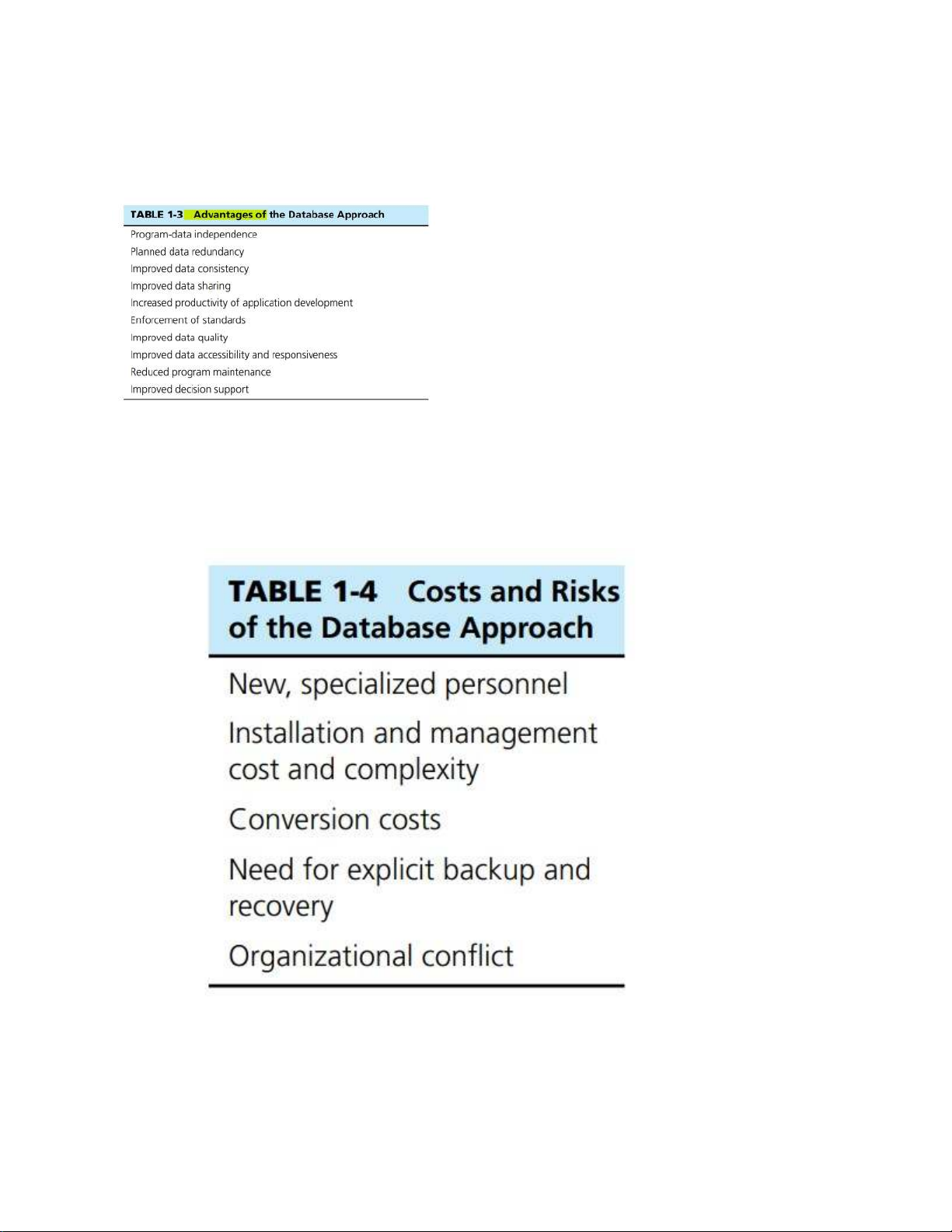
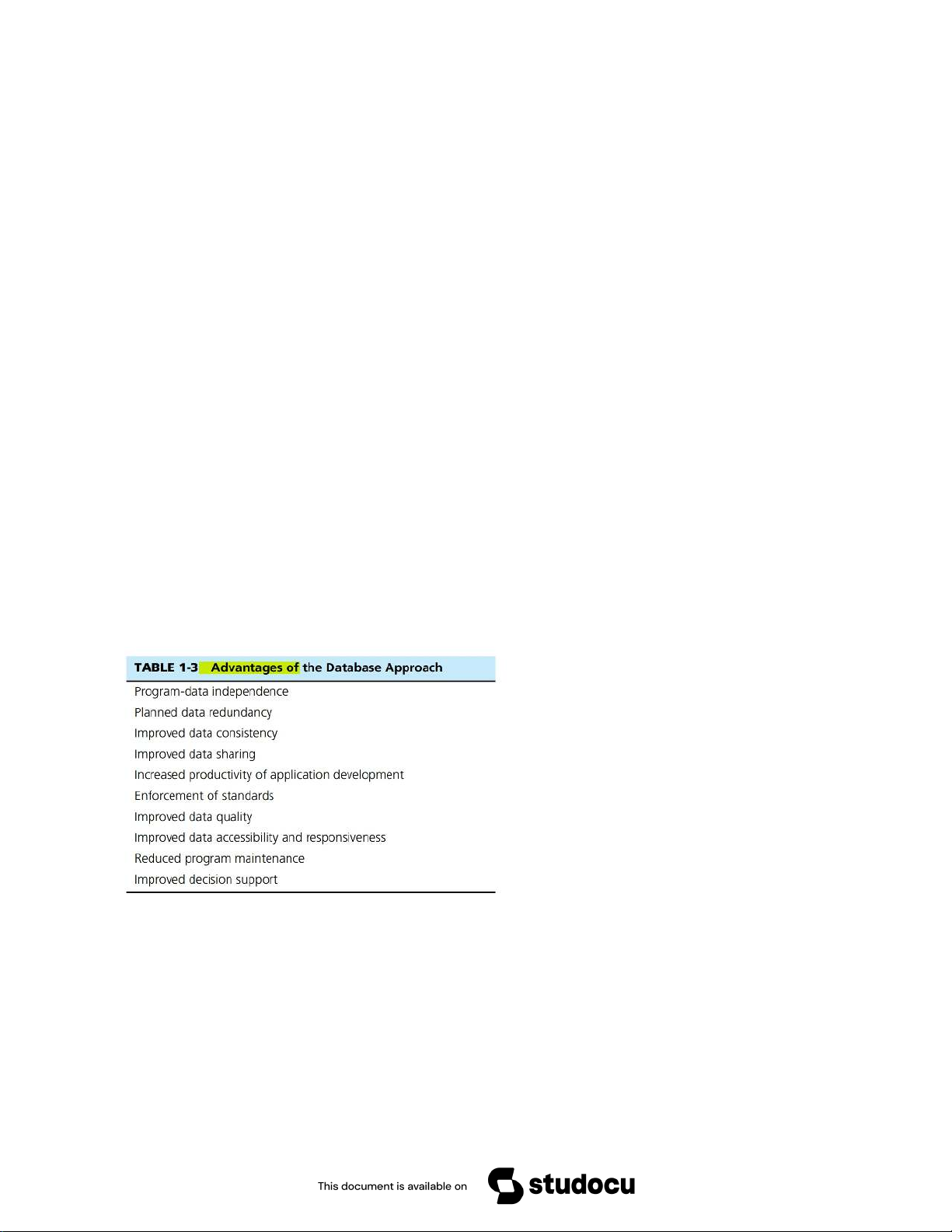
ADVANTAGES OF DATABASE APPROACH -
Data independence: The separation of data descriptions from the application
programs that use the data. A data descriptions are stored in a central location called the repository. -
User view: A logical description of some portion of the database that is required by a
user to perform some task. A user view is often developed by identifying a form or
report that the user needs on a regular basis. -
A constraint: is a rule that cannot be violated by database users.
COSTS AND RISKS OF DATABASE APPROACH
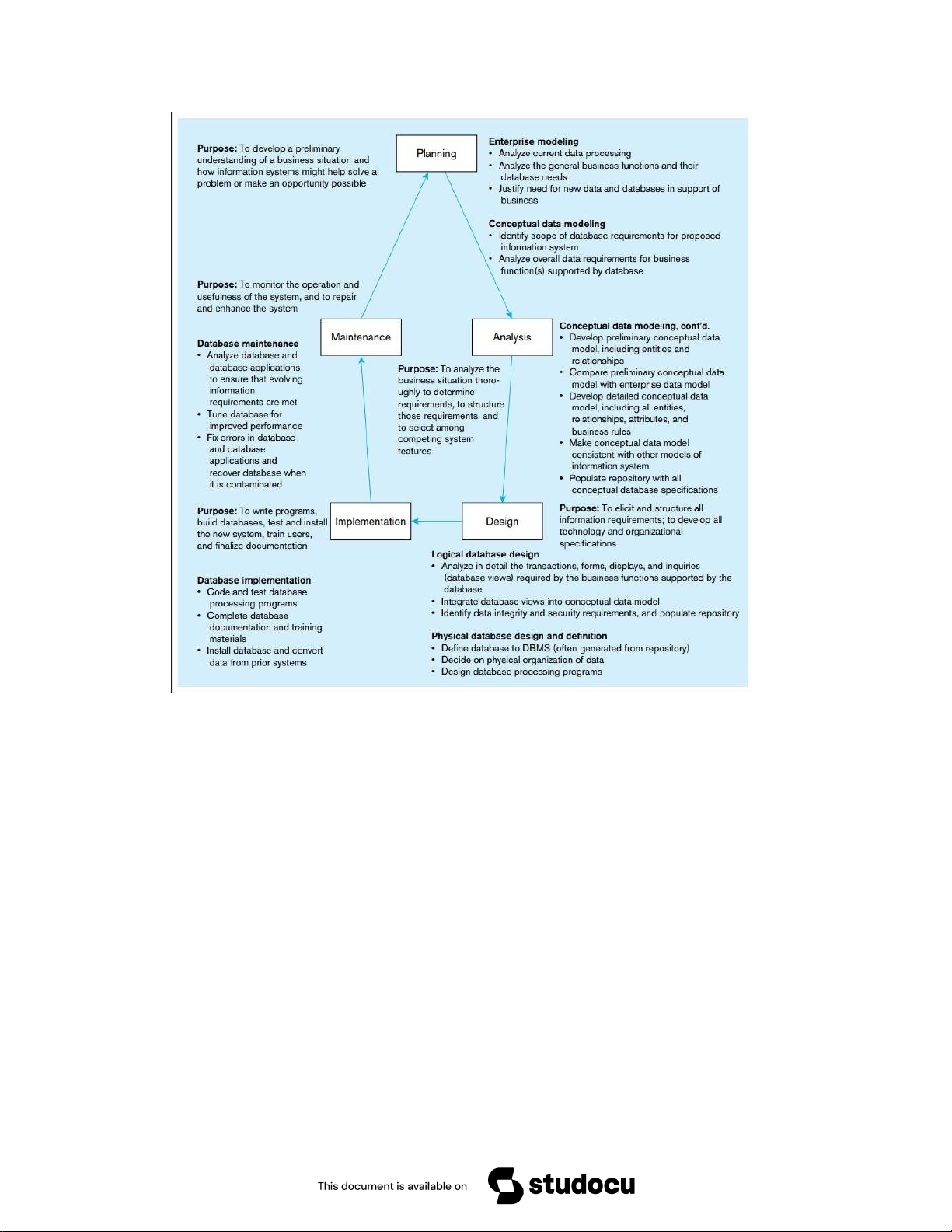
THE DATABASE DEVELOPMENT PROCESS -
Enterprise data modeling: The first step in database development, in which the scope
and general contents of organizational databases are specified. -
Systems development life cycle (SDLC): The traditional methodology used to
develop, maintain, and replace information systems.
Downloaded by Thi Nguy?n Th? Minh (thintm23408a@st.uel.edu.vn) lOMoARcPSD|30194144 -
The three schemas as defined by ANSI (depicted down the center of Figure 1-9) are as follows: o
1. External schema: This is the view (or views) of managers and other
employees who are the database users. As shown in Figure 1-9, the external
schema can be represented as a combination of the enterprise data model (a top-
down view) and a collection of detailed (or bottom-up) user views. o
2. Conceptual schema: This schema combines the different external views into
a single, coherent, and comprehensive definition of the enterprise’s data. The
conceptual schema represents the view of the data architect or data administrator. o
3. Internal schema: an internal schema today really consists of two separate
schemas: a logical schema and a physical schema. o
The logical schema: is the representation of data for a type of data
management technology (e.g., relational). o
The physical schema: describes how data are to be represented and
stored in secondary storage using a particular DBMS (e.g., Oracle). ENTERPRISE APPLICATION -
Enterprise resource planning (ERD): A business management system that integrates
Downloaded by Thi Nguy?n Th? Minh (thintm23408a@st.uel.edu.vn) lOMoARcPSD|30194144
all functions of the enterprise, such as manufacturing, sales, finance, marketing,
inventory, accounting, and human resources. ERP systems are software applications
that provide the data necessary for the enterprise to examine and manage its activities. -
Data warehouse: An integrated decision support database whose content is derived from
the various operational databases
The Database Environment and Development Process
1) A database is an organized collection of _logically_______ related data. A) logically B) physically C) loosely D) badly
We define a database as an organized collection of logically related data.
2) Older systems that often contain data of poor quality are called ___legacy___ systems. A) controlled B) legacy C) database D) mainframe
Enormous amounts of data are trapped in older, “legacy” systems, and the data are often of poor quality.
3) Program-data dependence is caused by:
A) file descriptions being stored in each database application.
B) data descriptions being stored on a server.
C) data descriptions being written into programming code.
D) data cohabiting with programs.
The file descriptions in each program that is affected (up to five programs) would have to be modified.
4) Because applications are often developed independently in file processing systems:
A) the data is always non-redundant.
B) unplanned duplicate data files are the rule rather than the exception.
C) data can always be shared with others.
D) there is a large volume of file I/O.
Duplication of Data Because applications are often developed independently in processing
systems, unplanned duplicate data files are the rule rather than the exception.
5) Relational databases establish the relationships between entities by means of common fields
included in a file called a(n):
Downloaded by Thi Nguy?n Th? Minh (thintm23408a@st.uel.edu.vn) lOMoARcPSD|30194144 A) entity. B) relationship. C) relation. D) association.
Relational databases establish the relationships between entities by means of common fields
included in a file, called a relation
6) A(n) ________ is often developed by identifying a form or report that a user needs on a regular basis. A) enterprise view B) reporting document C) user view D) user snapshot
A user view is a logical description of some portion of the database that is required by a user to
perform some task. A user view is often developed by identifying a form or report that the user needs on a regular basis.
7) A graphical system used to capture the nature and relationships among data is called a(n): A) XML data model. B) hypertext graphic. C) relational database D) data model.
Data model Graphical systems used to capture the nature and relationships among data.
8) Data that describe the properties of other data are: A) relationships. B) logical. C) physical. D) metadata.
Metadata Data that describe the properties or characteristics of end-user data and the context of those data
9) All of the following are properties of metadata EXCEPT: A) data definitions. B) processing logic. C) rules or constraints. D) data structures.
10) A person, place, object, event, or concept about which the organization wishes to maintain data is called a(n):
Downloaded by Thi Nguy?n Th? Minh (thintm23408a@st.uel.edu.vn) lOMoARcPSD|30194144 A) relationship. B) object. C) attribute. D) entity.
Entity A person, a place, an object, an event, or a concept in the user environment about which
the organization wishes to maintain data
11) ________ are established between entities in a well-structured database so that the desired information can be retrieved. A) Entities B) Relationships C) Lines D) Ties
A well-structured database establishes the relationships between entities that exist in organizational
data so that desired information can be retrieved.
12) All of the following are primary purposes of a database management system (DBMS) EXCEPT: A) creating data. B) updating data. C) storing data.
D) providing an integrated development environment.
The primary purpose of a DBMS is to provide a systematic method of creating, updating,
storing, and retrieving the data stored in a database.
13) With the database approach, data descriptions are stored in a central location known as a: A) server. B) mainframe. C) PC. D) repository.
With the database approach, data descriptions are stored in a central location called the repository 14) A user view is:
A) what a user sees when he or she looks out the window. B) a table or set of tables.
C) a logical description of some portion of the database.
D) a procedure stored on the server.
A user view is a logical description of some portion of the database that is required by a user to perform some task.
Downloaded by Thi Nguy?n Th? Minh (thintm23408a@st.uel.edu.vn) lOMoARcPSD|30194144
15) Which organizational function should set database standards? A) Management B) Application development C) Technical services D) Database Administration
The database administration function should be granted single-point authority and responsibility for
establishing and enforcing data standards.
16) ________ is a tool even non-programmers can use to access information from a database. A) ODBC B) Structured query language C) ASP
D) Data manipulation query language
The language used in this query is called Structured Query Language, or SQL. (You will study
this language in detail in Chapters 6 and 7.) Although the queries constructed can be much more
complex, the basic structure of the query is easy for even novice, non-programmers to grasp.
17) Which of the following is NOT an advantage of database systems?
A) Redundant data Planned Data redundancy
B) Program-data independence C) Better data quality D) Reduced program maintenance
18) The most common source of database failures in organizations is: A) lack of planning. B) inadequate budget. C) inadequate hardware.
D) failure to implement a strong database administration function.
the failure to implement a strong database administration function is perhaps the most
Downloaded by Thi Nguy?n Th? Minh (thintm23408a@st.uel.edu.vn) lOMoARcPSD|30194144
common source of database failures in organizations.
19) A rule that CANNOT be violated by database users is called a: A) password. B) constraint. C) program. D) view.
A constraint is a rule that cannot be violated by database users
20) In a file processing environment, descriptions for data and the logic for accessing the data are built into: A) application programs. B) database descriptors. C) fields. D) records.
In a file processing environment, the data descriptions and the logic for accessing data are
built into individual application programs (this is the program-data dependence issue described earlier).
22) Which of the following is NOT an objective that drove the development and evolution of database technology?
A) The need to provide greater independence between programs and data
B) The desire to manage increasing complex data types and structures
C) The desire to require programmers to write all file handling functionality
D) The need to provide ever more powerful platforms for decision support applications
To summarize, some of the following four objectives generally drove the development and
evolution of database technology:
1. The need to provide greater independence between programs and data, thereby reducing maintenance costs
2. The desire to manage increasingly complex data types and structures
3. The desire to provide easier and faster access to data for users who have neither a background
in programming languages nor a detailed understanding of how data are stored in databases
4. The need to provide ever more powerful platforms for decision support applications
24) A relatively small team of people who collaborate on the same project is called a: A) server group. B) workgroup. C) data collaborative.
Downloaded by Thi Nguy?n Th? Minh (thintm23408a@st.uel.edu.vn) lOMoARcPSD|30194144 D) typical arrangement.
25) A workgroup database is stored on a central device called a: A) client. B) server. C) remote PC. D) network.
27) Which of the following is NOT a cost and/or risk of the database approach? A) Specialized personnel B) Cost of conversion C) Improved responsiveness
D) Organizational conflict
Cost and/or risk of the database approach: - New, Specialized personnel -
Installation and Management Cost and Complexity - Cost of conversion -
Need for Explicit Backup and Recovery - Organizational conflict
28) The need for consensus on data definitions is an example of which type of risk in the database environment?
A) Specialized personnel needs B) Organizational conflict C) Conversion costs D) Legacy systems
A shared database requires a consensus on data definitions and ownership, as well as responsibilities for accurate data maintenance.
30) Which of the following is software used to create, maintain, and provide controlled access to databases? A) Network operating system B) User view
C) Database management system (DBMS) D) Attribute
A DBMS is a software system that is used to create, maintain, and provide controlled access to user databases.
33) Database development begins with ________, which establishes the range and general
contents of organizational databases.
Downloaded by Thi Nguy?n Th? Minh (thintm23408a@st.uel.edu.vn) lOMoARcPSD|30194144 A) database design B) cross-functional analysis C) departmental data modeling D) enterprise data modeling
The database development process begins with review of the enterprise modeling components
that were developed during the information systems planning process.
34) The traditional methodology used to develop, maintain and replace information systems is called the: A) Enterprise Resource Model.
B) Systems Development Life Cycle. C) Unified Model.
D) Systems Deployment Life Cycle.
A traditional process for conducting an information systems development project is called the systems
development life cycle (SDLC)
The SDLC is a complete set of steps that team of information systems professionals, including database
designers and programmers, follow in an organization to specify, develop, maintain, and replace information systems.
35) The SDLC phase in which every data attribute is defined, every category of data is listed and
every business relationship between data entities is defined is called the ________ phase. A) planning B) design C) analysis D) implementation
During the Analysis phase of t the analyst produces a detailed data model that identifies all the
organizational data that must be managed for this information system. Every data attribute is
defined, all categories of data are listed, every business relationship between data entities is
represented, and every rule that dictates the integrity of the data is specified.
36) The SDLC phase in which database processing programs are created is the ________ phase. A) planning B) design C) analysis D) implementation
In database implementation, a designer writes, tests, and installs the programs/scripts that access, create database.
38) Organizing the database in computer disk storage is done in the ________ phase.
Downloaded by Thi Nguy?n Th? Minh (thintm23408a@st.uel.edu.vn) lOMoARcPSD|30194144 A) design B) maintenance C) analysis D) implementation
42) ________ do NOT concentrate on determining the requirements for the database
component of an information system. A) Database analysts B) Systems analysts C) Programmers D) End Users
43) The three-schema approach includes which of the following schemas? A) Internal B) Logical C) Cross-functional D) Dissecting Internal-External-Conceptual
45) ________ is the most popular RDMS data model notation. A) ERD B) END C) DRE D) RED
Downloaded by Thi Nguy?n Th? Minh (thintm23408a@st.uel.edu.vn)
Tài liệu liên quan:
-
Bài 1 Chuyển đổi số | Trường Đại học Kinh Tế - Luật, Đại học Quốc gia Thành phố Hồ Chí Minh
44 22 -
Đáp án đợt 3 Cuộc thi trắc nghiệm tìm hiểu về Chuyển đổi số tỉnh Đắk Lắk năm 2025 môn Chuyển đổi số | Trường Đại học Kinh Tế - Luật, Đại học Quốc gia Thành phố Hồ Chí Minh
47 24 -
Công ty Chuyển đổi số | Trường Đại học Kinh tế – Luật, Đại học Quốc gia Thành phố Hồ Chí Minh
251 126 -

Loại khẩu trang Chuyển đổi số | Trường Đại học Kinh tế – Luật, Đại học Quốc gia Thành phố Hồ Chí Minh
228 114