Does work-family conflict lead to abusive supervision in the construction projects?
Does work-family conflict lead to abusive supervision in the construction projects? Tài liệu được sưu tầm giúp bạn tham khảo, ôn tập và đạt kết quả cao. Mời bạn đọc đón xem.
Môn: Tài liệu Tổng hợp 3.5 K tài liệu
Trường: Tài liệu khác 3.8 K tài liệu
Tác giả:












Preview text:
Rafique et al. Future Business Journal 2024, 10(1):38 Future Business Journal
https://doi.org/10.1186/s43093-024-00323-7 RESEARCH Open Access
Does work–family conflict lead to abusive
supervision in the construction projects? The
role of project commitment and psychological resilience
Muhammad Rafique1*, Mastura Jaafar1, Saira Ahmed2 and Muhammad Amjad‑ur‑Rehman3 Abstract
Drawing on conservation of resources theory, the study aimed to investigate the relationship between work–fam‑
ily conflict (time‑based, strain‑based and behavior‑based) and project manager abusive supervision in the presence
of mediating mechanism and boundary condition. Time‑lagged data were collected from 235 respondents working
on construction projects to examine the proposed relationships by utilizing regression analysis. Findings indicated
that the dimensions of work–family conflict had a positive significant relationship with abusive supervision and nega‑
tive relationship with project commitment. Additionally, project commitment mediated the relationships and psy‑
chological resilience were found to alleviate the negative influence of work–family conflict on project commitment.
Surprisingly, the results delineated that strain‑based work–family conflict have more pronounced influence in instigat‑
ing abusive supervision. This study is unique as it broadens the empirical research on work–family conflict and more
particularly negative supervisor behavior in the project context.
Keywords Work–family conflict (WFC), Project commitment, Psychological resilience, Project manager abusive supervision Introduction
WFC [126], which refers to “a form of inter-role conflict
Research on work–family conflict (WFC) has garnered in which the role pressures from the work and family
attention in different organizations and industries world-
domains are mutually incompatible in some respect” [43,
wide [84], and construction industry is of no exception p. 77]. In literature, there are two different forms of con-
[125]. The reason is construction has complex project flict, work–family conflict (WFC) and family–work con-
environment with long working hours than average as flict [4]. However, the research scope is limited to WFC
compared to other industries [115], and professionals because studies found stronger relationship between
are encouraged to work on weekends, evenings and WFC and work-related consequences as compared to
holidays [72]. Such situation instigates project manager family–work conflict [82]. Past research revealed that
WFC significantly influences individual behavior and
outcomes [14, 89, 126, 132]. Though research have linked *Correspondence: Muhammad Rafique
WFC with various outcomes like burnout, project citi- khanfr353t@gmail.com
zenship behavior and project performance, however, its
1 School of Housing, Building and Planning, Universiti Sains Malaysia,
relationship with counterproductive work behavior is George Town, Penang, Malaysia
2 United Nations Industrial Development Organization (UNIDO),
overlooked, despite the fact that WFC impedes to main- Islamabad, Pakistan
tain equilibrium in both work and family role and is
3 Al‑Qadir University, Jhelum, Pakistan
a source of individual stress [107]. The current study is
© The Author(s) 2024. Open Access This article is licensed under a Creative Commons Attribution 4.0 International License, which
permits use, sharing, adaptation, distribution and reproduction in any medium or format, as long as you give appropriate credit to the
original author(s) and the source, provide a link to the Creative Commons licence, and indicate if changes were made. The images or
other third party material in this article are included in the article’s Creative Commons licence, unless indicated otherwise in a credit line
to the material. If material is not included in the article’s Creative Commons licence and your intended use is not permitted by statutory
regulation or exceeds the permitted use, you will need to obtain permission directly from the copyright holder. To view a copy of this
licence, visit http:// creat iveco mmons. org/ licen ses/ by/4. 0/.
Rafique et al. Future Business Journal 2024, 10(1):38 Page 2 of 14
taking WFC as a possible antecedent of project man-
relationship [35, 39]. Cao et al. [21] urged for incorporat-
ager abusive supervision due to several reason. WFC is ing personality traits on examining the outcomes of WFC
a multi-dimensional construct, and each dimension can in the project environment. People tend to be different,
effect the outcomes with different magnitudes; however, their response to specific event is different as well, and it
the linkage of these dimensions are yet to be explored depends on individual personal characteristics. Conser-
in one combined analysis [32, 58]. Additionally, several vation of resources theory (COR) posits that personal
calls have been made to examine the impact of WFC on attributes delineate valuable resources that may ascertain
domain-specific consequences, as it has detrimental con-
individual response to stressors in the work environment
sequences for construction industry professionals [14, 21, and safeguard individuals from its unfavorable influ-
126, 132]. Studies up to great extent focused on project ence [42]. Psychological resilience is important in the
or organizational level outcomes [74, 115] and ignored understanding of how individual respond to stressors in
individual-level outcomes [21].
the project [104], as it allows individual to manage and
Research advocated that the link between WFC and successfully adapt to stressful situation [130]. Resilience
counterproductive work behaviors such as abusive super-
help professionals in managing unfavorable outcomes of
vision needs exploration [107]. Since its inception, stud-
stressors and negative emotions [28, 76]. Although stud-
ies have focused more on linking abusive supervision with ies examined resilience as a protective factor against
negative individual- and organizational-level outcomes different stressors, as far as our understanding, studies
[19, 93, 135]. Despite few studies that examined instigators overlooked its examination from project manager per-
of abusive supervision [35, 64, 65], research on its ante-
spective, despite the fact that resilience is regarded as
cedent and more specifically supervisor-level antecedents critical and important for project professionals and effec-
are still in its nascent stage [131]. Li et al. [70] argued that tive leadership [85].
experiencing stressors has the potential to deplete indi-
Traditionally, project management focused more on
vidual psychological resources; hence, they are more vul-
technical aspect prioritizing iron triangle [86], while
nerable to indulge in abusive supervision. Literature on providing less importance to human or soft side of the
aggression posits that stressors can instigate aggressive and project [114, 122]. Nevertheless, evidence shows that
counterproductive work behaviors [88]. Stressful demands human issues have prominent role in project failure [1,
in project environment may compel project managers to 80]. Therefore, based on COR, the study is bestowing to
engrosse in abusing subordinates [129].
the literature and more specifically to construction litera-
Though it is evident that WFC has the potential to dete-
ture in several ways. First, we intend to investigate WFC
riorate project manager behavior, however, this influence dimension-wise and examine the magnitude of each
may translate through a mechanism and pathway. Studies dimension on the outcome variable. Second, this research
overlooked the mechanisms and accompanying pathways will add to the embryonic literature on causes of abu-
that link WFC with outcomes and need to be explored sive supervision in the project context. It is evident that
in a more rigorous way [13, 127, 132]. Professionals who this phenomenon is present in the project environment;
are unable to establish equilibrium between their work however, investigation is somehow overlooked in the lit-
and family become less engaged and committed in their erature [38, 39]. Additionally, Pradhan et al. [97] contend
job [60]. The reason is individual blame their work envi-
that abusive supervision is a ubiquitous threat and is not
ronment for not fulfilling the duties and responsibilities limited to a particular society, nation or industry. Third,
of their family; hence, their commitment toward project our study will enrich the literature on the mechanism and
goals may decline. We opine that WFC may lead project pathways through which WFC influences the outcome
managers to engage in abusive supervision because such variables, as it is evident that literature lack evidence on
stressors make individuals less committed to the project the specific mechanisms and accompanying pathways.
as well as organization [59]. Prior research showed that Last but not the least, we are incorporating psychologi-
reduced commitment is a prime pathway through which cal resilience to examine that whether resilience provides
stressor influence individual behavior [96]. However, stud-
some sort of help in overcoming the adverse situation
ies have overlooked this as a mediator in relation to the facing in the project environment.
effect of stressors on abusive supervision and more specifi-
cally in project environment. Our theoretical framework Theory and hypothesis development
concedes that the positive influence of WFC on abusive Conservation of resources theory (COR)
supervision may come from reduced project commitment.
COR is the most widely utilized theory for understand-
Between the relationship of causes and abusive ing the link between WFC and its possible outcomes,
supervision, the suggestion is to utilize moderator as a and researchers suggested that WFC research should
boundary condition that helps in waxing or waning the be extended through the lens of COR [17, 42]. The
R afique et al. Future Business Journal 2024, 10(1):38 Page 3 of 14
fundamental tenet is individual attempt to obtain, main-
behavior in another domain. The project environment
tain and protect resources that render valuable work- and is complex and uncertain, which demands emotional
non-work-related conditions, objects, energies and per-
stability and objectivity to achieve the desired project
sonal characteristics [49]. According to theory, resource objectives [133], while the family demands an individ-
loss in one domain may lead to exposure of stress in ual to be warm, composed and emotional to them [33].
another domain. When individuals lose resources, they However, when individual is unable to comply with the
indulge in withdrawal or defensive mode to conserve behavior expected in the family domain resulting in
resources to save further resource loss [46, 51]. Thus, behavior-based WFC [126].
dealing with incompatible demands lessen individual
The relation between WFC and outcomes is described
energy and time on project work, which instigate attitudi-
by either matching or cross-domain. In matching
nal reaction in project domain [31]. Project commitment domain, WFC yield work-related consequences, while in
is one of the crucial attitudinal outcomes in the project cross-domain, WFC is linked with family outcomes [4].
environment. Based on the assumption that strain arisen Past research showed that WFC have strong relationship
from resource loss leads to further unfavorable conse-
with work-related consequences [4, 120]. Hence, con-
quences in the project, we propose that WFC may have sistent with matching domain, the current study expects
direct and indirect relationship with project manager WFC to be related to project manager abusive supervi-
abusive supervision. Particularly, COR propounds that sion, because WFC has the potential to influence work
WFC may be acknowledged as stressful experience that attitudes and behaviors [109]. Studies showed that WFC
drain project manager resources, and therefore are more has a positive relationship with withdrawal behavior [26],
likely lead to decrease project commitment, which in counterproductive work behavior [107], deviant behavior
turn may be reflected in their behavior that subordinates [36], and aggressive behavior [75]. The reason is expe-
perceive as abusive. Moreover, another facet of COR is riencing WFC left individual with fewer resources to
that individual with sufficient resources are exposed less bestow to work, which lead to deleterious behaviors [23,
to the loss of resources and have the potential to gain 82]. Our contention is that project manager experienc-
resources [51]. Individual differences can be regarded ing WFC in the construction project due to long working
as resources that buffer the negative influence of WFC hours, immense pressure, complex tasks and rigid sched-
on individuals [49]. Therefore, based on COR, psycho-
uling [127] may be unable to conserve their resources
logical resilience is a personal resource of an individual result in feeling threatened to achieve the desired pro-
that helps in protecting the depletion of resources, while ject objectives, hence may engross in abusive supervi-
experiencing WFC in the project environment.
sion. Abusive supervisors abuse, disrespect and show
rude behavior toward subordinates. Evidence advocated
Work–family conflict and project manager abusive
that temporary environment is propitious to the prac- supervision
tices of abusive supervision [39, 58]. Although all project
WFC is a multi-dimensional construct and is differ-
processes have competing expectations and demands,
entiated into time, strain and behavior-based conflict project managers are asked to do more with less, mostly
[43]. When time consumed in one domain interferes forcing them to be demanding and aggressive to achieve
with the performance of another domain result in time-
desired targets [5], which puts pressure and exhaust their
based WFC. The nature of project is temporary, and resources. Hence, the incompatibility of energy and time
professionals address various uncertainties to com-
to fulfill the expectation of both domains is perceived
plete the project within specified time [78], because as challenging and stressful that may have the ability to
of which they have inadequate time to complete fam-
behavioral and psychological resource loss that compels
ily demands; thus, time-based conflict arises. Strain project manager to engross in abusive supervision.
stemming from work influences individual propensity
There are multiple reasons to propose the hypoth-
to address the expectations and demands of family esis between WFC and abusive supervision. First, meta-
domain resulting in strain-based WFC. Professionals analysis on WFC revealed that majority of the studies
in construction projects work for long hours [73, 91], have focused on investigating its antecedents, and very
resulting in feeling of being tired to enjoy family life limited studies have concentrated on its consequences.
[33]. Similarly, high uncertainty, irregular resource Additionally, these consequences are limited to work
allocation and overlapping stakeholder demands in and family satisfaction and ignored other critical out-
construction projects put swelling workload and huge comes like counterproductive work behavior [71, 107].
responsibilities on professionals [105, 133] that cause Second, research on antecedent of abusive supervision
strain. Behavior-based conflict arises when the behav-
is limited and more specifically in the project context,
ior of one domain is incompatible with the expected which needs empirical investigation. Third, WFC is a
Rafique et al. Future Business Journal 2024, 10(1):38 Page 4 of 14
multi-dimensional construct; however, it is studied uni-
responsibilities [44]. Provided the intense and dynamic
dimensionally, which limits capturing the magnitude working environment project managers may encounter
of each dimension on outcome variable [58]. Hence, we all three forms of WFC [126]. As a leader, project man- propose that:
ager is supposed to manage multiple stakeholders [78]
and most importantly ensuring to complete the project
Hypothesis (1a) Time-based, (1b) strain-based and [12]. Fulfilling these responsibilities exhausts resources
(1c) behavior-based WFC have a significant positive rela-
and left manager with fewer resources to fulfill family
tionship with project manager abusive supervision.
responsibilities that may reduce his/her commitment
toward the project, because of blaming project for such
Work–family conflict and project commitment
incompatible and incongruent demands. Hence, we
COR posits that WFC is a stressful experience that con- hypothesize that:
sumes individual resources and therefore may more likely
to decrease commitment toward work. Project commit-
Hypothesis (2a) Time-based, (2b) strain-based and
ment refers to the project goals acceptance, the readiness (2c) behavior-based WFC have a significant negative
to bestow substantial effort and the yearning to sustain relationship with project commitment.
membership in project [53]. High level of project com-
mitment compels an individual to involve actively in the Mediating role of project commitment
project [18]. Past research revealed that commitment The study of Singh et al. [110] found that occupational
enhances cohesion and cooperation in team, which is commitment mediate the relationship between conflict
conducive for the establishment of an environment that and outcome variable. Our contention is in line with
fosters knowledge sharing and mutual help (Buvik and COR and attitude–behavior theory [37], which states that
Tvedt 2017), [24]. Additionally, commitment toward the individual experiences in work environment inform their
project encourage individuals to efficiently pursue pro-
attitudes, which in turn navigate their respective behav-
ject goals [119]. Project manager as a leader inculcates iors. Past research is evident on the role of commitment
this sense of commitment in project team members. as a mediator in the link between stressors and behav-
However, if the commitment of project manager is on ioral outcome [96]. Additionally, the study of Xia et al.
stake, it could be detrimental for project goals. Individ-
[126] indicated that project commitment mediates the
ual commitment requires energy and time to carry out relationship between WFC and individual behavior like
their activities [71]. In WFC, both realms are contingent project citizenship behavior. In permanent organization,
for resources on each other [43]. High demand in either it is manifested widely that WFC can negatively influence
domain needs individual resources to fulfill that demand, work attitudes [4]. Thus, it is more likely that working in
which deplete resources from another domain [108]. such a high WFC environment undermines the project
Unavoidably, individual would require to lessen their manager ability to engross in positive behavior, because
involvement and dissipate fewer resources on another the stressful demands of project may compel managers to
domain [83], thereby diminishing their commitment [71].
engross in abusive behaviors [39, 129]. However, little or
The support for the negative link between WFC no research has investigated the pathway or mechanism
and commitment comes from the study of [4], which through which WFC leads to engaging in abusive super-
found that WFC is negatively correlated with organi-
vision, despite an overwhelming focus on WFC problems
zational commitment. Research acknowledged that [115] and abusive supervision in projects [38, 39, 64], we
WFC compromises individual commitment irrespec-
contend that project managers high in WFC would be
tive of organizations whether permanent or temporary unable to maintain normative behavior and the possibility
[126]. Individual’s exposure to high WFC makes them of indulging in abusive supervision is high. However, the
detached from the tasks, which lower their commitment positive influence of WFC on abusive supervision is more
toward the project objectives [40]. More recently, stud-
likely to be promulgated through project commitment.
ies found that individuals having conflicting demands in The reason is prior to delineate any negative behavior
the work environment have lower level of commitment (i.e., indulging in abusive supervision), to reduce resource
toward their responsibilities in project and organiza-
loss because of WFC, their attitude toward project (i.e.,
tion as a whole [90, 133]. Similarly, studies in policing project commitment) may first change [126]. Hence, we
found that occupational stressors like conflict lower the hypothesize that project commitment mediates the rela-
commitment of individuals toward their occupation tionship between WFC and supervisor abuse, such that
[27, 100]. Furthermore, an empirical evidence from pre-
the development of negative attitude toward the project
school teachers showed that work–family conflict dete-
is a key pathway through which WFC compels project
riorates individual’s commitment toward their task and manager to engross in abusive supervision.
R afique et al. Future Business Journal 2024, 10(1):38 Page 5 of 14
Hypothesis Project commitment mediates the rela-
project managers would have more potential of func-
tionship between (3a) time-based (3b), strain-based tioning properly even in the existence of incompatible
(3c) behavior-based WFC andproject manager abusive demands , thereby diminishing the possibility of reduc- supervision.
tion in project commitment and engaging in abusive
supervision. Furthermore, Chen et al. [25] opined three
Moderating role of psychological resilience
important constituents of resilience. First resilient indi-
Consistent with COR [49], individual gain and conserve viduals foresee adverse events before they occur and pre-
resources and stress happens when these resources pare themselves to manage it, second, such individuals
deplete; however, individual replenish the loss of threat-
are flexible and buffer the effect of stressful events with-
ened resources with resource gain from another source. out exposure to significant unfavorable outcomes, and
Hence, COR advocates that resource gain can help to third, these individuals bounce back from such adverse
cope with stress. According to COR, individual reaction circumstances successfully. Hence, in line with COR,
to loss of resources due to stressors is hinged on individ-
psychological resource could help alleviate the negative
ual differences [52]. In the literature of stress, resilience is influence of stressors; thus, we hypothesize that:
a personal resource [7], characterized by the (1) ability to
bounce back from negative emotional experiences and by Hypothesis Psychological resilience moderates the
(2) flexible adaption to the changing demands of stress-
relationship between (4a) time-based (4b), strain-based
ful experiences [113, p. 318]. Resilient individuals have (4c) behavior-based WFC and project commitment such
the potential to effectively manage trauma and stress [16] that the relationship is weaker (stronger) when psycho-
because of their optimism and flexibility in regulating logical resilience is high (low).
their emotions [87]. These individuals anticipate positive
outcomes in adverse circumstances and apprehend work
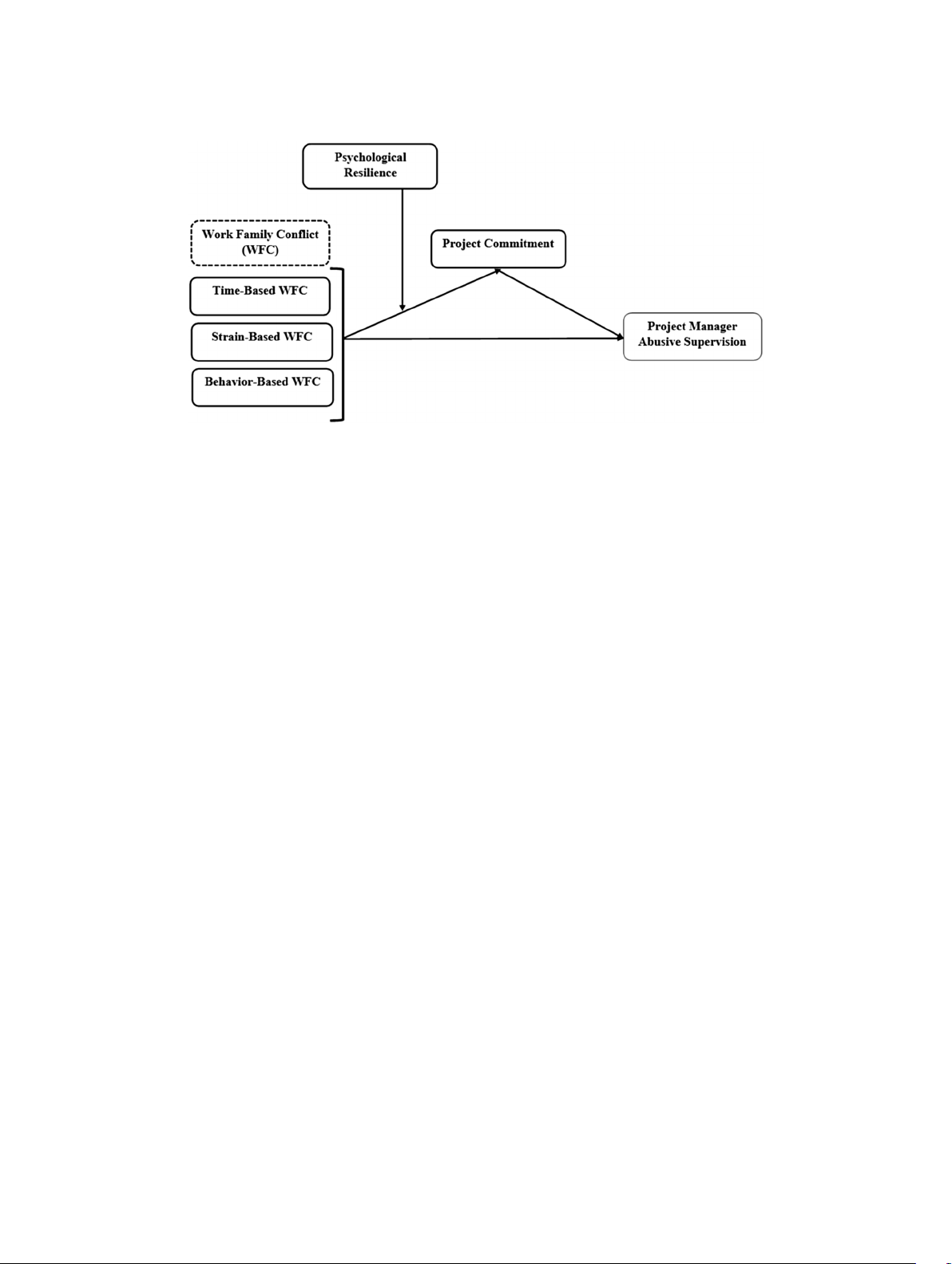
Figure 1 represents impact of work–family conflict on
demands as challenging [15], due to which resilience is of abusive supervision.
utmost significance for project professionals [116].
Psychologically resilient individuals have the propen- Method
sity to manage stressful situations and negative emo-
The population of this study is construction sector of
tions; thus, they are less likely to engross in hostile and Pakistan. There are several reasons to choose construc-
aggressive behaviors because they perceive challenges tion projects. First, construction is regarded as demand-
in a positive way [69]. Studies acknowledged resilience ing and individuals are divulged continuously to inherent
as a protective factor, which diminish the unfavorable stressors like WFC in their project environment [67].
influence of stressors on behavioral outcomes [47, 112], Construction projects have limited resources and set
and provided evidence that personal resources can ham-
deadlines, which act as a source of stressors for con-
per the deleterious effect of workplace stressors [55, 61]. struction professionals [94]. Second, as [38] opined that
Research delineated that resilience buffers the effect of supervisor abuse is rated as a precarious element that can
stressors on outcomes [124]. We argue that highly resil-
influence psychological health of construction employ-
ient project managers while experiencing WFC in the ees, however, empirical investigation is lacking [39].
project may be less likely to reduce their commitment
toward the project. Past studies showed that resilience
diminishes the negative influence of stressful environ- Sample and procedure
ment on individuals and increase commitment [128, Purposive sampling is utilized as it provides adequate
134] as well as engagement in the work 29. Resilience as portrayal of target participants [117]. This technique is
a personal resource plays significant role in actuating the more appropriate to access the subordinates to answer
motivational process and enhance commitment toward those questions relevant to their supervisor behavior [62].
the organization [9]. It also aid individuals to maintain Additionally, the authors selected construction indus-
positive emotions, which helps in developing attachment try purposively due to the prominent presence of WFC
toward the project as well as organization [92].
and abusive supervision in this industry. Previous stud-
Work requirements can deplete individual valuable ies have utilized the same technique for the examina-
resources; however, individuals having adequate per-
tion of abusive supervision [8, 77]. Questionnaire survey
sonal resources can cope efficiently with those require-
were utilized to collect data, because it is widely recog-
ments and avoid burnout [49, 50, 99]. Resilience may nized tool in behavioral research [118]. Before, distribut-
protect professionals from personal resource loss when ing questionnaires, contacts were approached and they
dealing with family issues [10]. Since psychological resil-
referred us to project managers. A brief explanation is
ience aids in maintaining positive balance, highly resilient provided about the study objective and were requested
Rafique et al. Future Business Journal 2024, 10(1):38 Page 6 of 14 Fig. 1 Research model
for the contacts of their immediate subordinates. Two Project commitment were measured on a 5-item scale
separate questionnaires were designed. Project manager developed by [95]. The alpha were 0.844. Psychological
rated work–family conflict, project commitment and psy-
resilience were measured by adopting the short version
chological resilience, while subordinates rated abusive 10-item scale of [20]. The scale reliability were 0.956. For
supervision. A cover letter was attached to each question-
measuring abusive supervision a 10-item scale were used
naire, which asked for the formal consent, and ensure the by [111]. The reliability were 0.980.
anonymity and confidentiality of the responses. Data were
collected in time lags to allow deduction about causality Results
between model variables [34] as well as to avoid issue of Measurement model
common method bias. At Time 1 (T1), project managers Following the recommendation of Anderson and Ger-
responded to demographic variables, WFC and psycho-
bing [6], confirmatory factor analysis were conducted
logical resilience. At (T2), approximately, one month after to validate the measurement model. . To evaluate
(T1), project managers responded to project commit-
model fitness, different fit indices were utilized. The
ment, while subordinates rated abusive supervision. Out threshold for CFI, TLI and IFI is equal or greater than
of 350 distributed questionnaires in (T1), 252 responses 0.95 [54]. Moreover, values less than 0.05 for RMSEA
were received (72%). At (T2), 246 responses were received represent excellent model fitness [66]. The results
from project managers (response rate 70.2%), and 241 revealed that the value of x2/df was 1.351. Additionally,
responses were received from subordinates (response the value for CFI was 0.975, for TLI was 0.974, and
rate 68.8%). Incomplete and mismatch responses were for IFI was 0.976. Similarly, the value of RMSEA was
discarded. Hence, the final matched sample was 235, 0.039. These results represent excellent model fit. Fur-
resulting in response rate of (67.1%). Majority of the par-
thermore, to establish convergent validity, composite
ticipants were male constituted for 73.5% and had an reliabilities (CR) and average variance extracted (AVE)
average age of 40 years. Most of the respondents had a were computed. The results revealed that CR for all
qualification of masters accounted for 59.6%, and on aver-
variables ranged from 0.847 to 0.980 which is greater
age 48.5% respondents had an experience of 10 years.
than the threshold of 0.70, and the values of AVE were
in between 0.525 and 0.838, which is in the acceptable
range, hence establishing convergent validity. Moreo- Measures
ver, to establish discriminant validity, heterotrait–
We distributed the survey in English because it is spo-
monotrait (HTMT) ratio was computed. The results
ken widely in Pakistan [63, 81, 101, 102]. All items were revealed that all values were less than 0.95, hence con-
measured on 5-point Likert scale. firming discriminant validity.
The dimensions of work–family conflict were measured
on a 9-item scale developed by [22]. The reliability for Descriptive statistics
time-based conflict were 0.936, for strain-based conflict Descriptive statistics are provided in table 1 .
were 0.935, and for behavior-based conflict were 0.953.
R afique et al. Future Business Journal 2024, 10(1):38 Page 7 of 14 Hypothesis testing
Table 2 Direct hypothesis
Hypothesis were tested by utilizing Hayes PROCESS Hypothesis B
MACROS, suggested by Hayes [48] and Preacher et al.
[98]. The results of direct hypothesis are presented in Time‑based WFC → abusive supervision .11*
Table 2. Hypothesis 1a to 1c stated that all three dimen-
Strain‑based WFC → abusive supervision .13*
sions of WFC have positive significant relationship with Behavior‑based WFC → abusive supervision .12*
abusive supervision. Results supported this as for time-
Time‑based WFC → project commitment − .19***
based WFC, the regression coefficient was (β = 0.11, Strain‑based WFC → project commitment − .23***
p < 0.05), for strain-based WFC (β = 0.13, p < 0.05) and Behavior‑based WFC → project commitment − .20***
for behavior-based WFC (β = 0.12, p < 0.05). These results *p < ,05, ***p < .001
bestowed support to the proposed hypothesis that time-
based WFC, strain-based WFC and behavior-based WFC
positively influence abusive supervision. Furthermore, is high. Results are presented in Table 4. The regression
hypothesis 2a to 2c stated that dimensions of WFC have coefficient of interaction term (time-based WFC and
negative significant relationship with project commit-
project commitment) was significant (β = 0.122, p < 0.05).
ment. Results supported these hypothesis as for time-
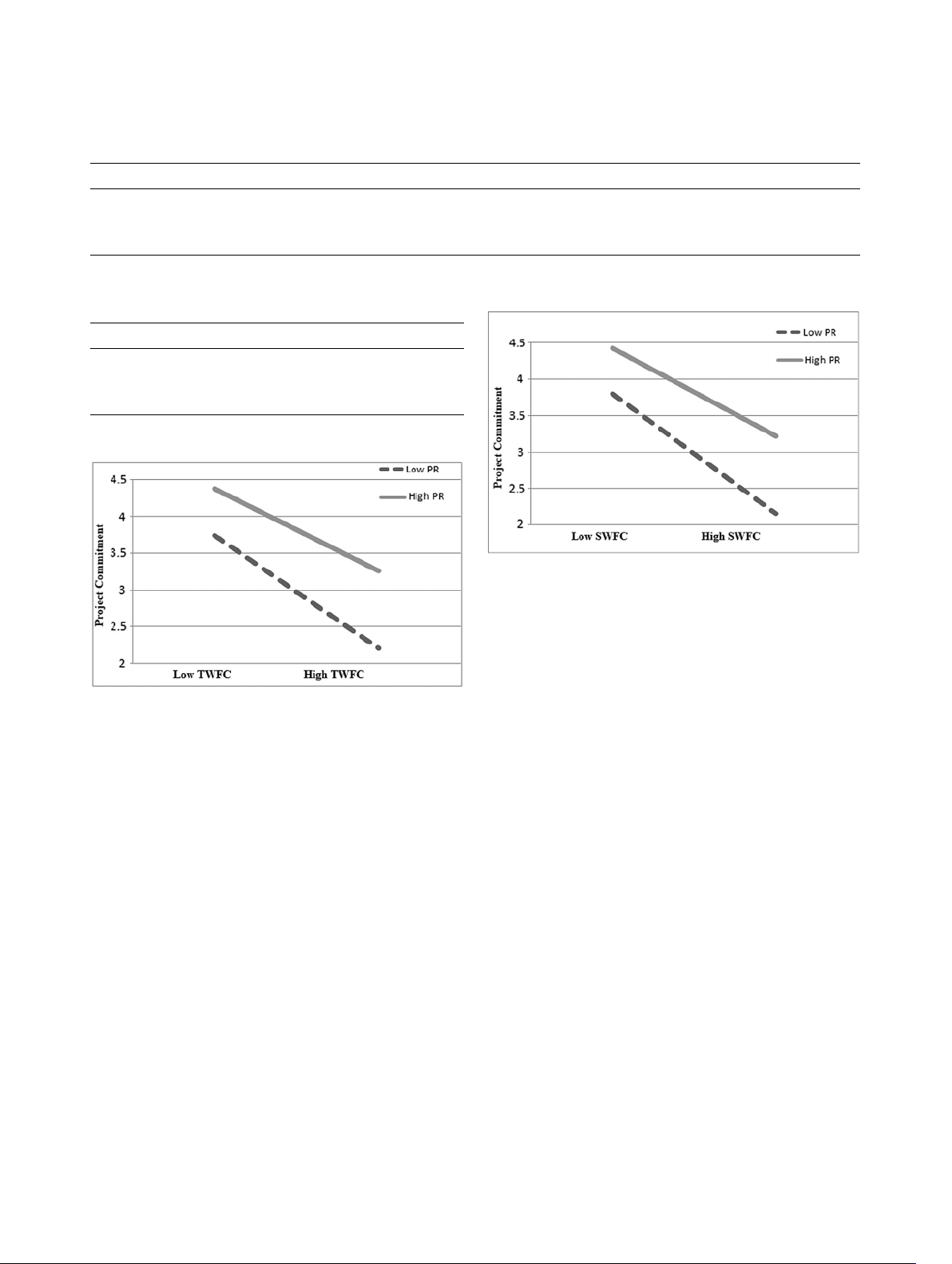
The interaction graph in Fig. 2 depicts that project com-
based WFC, the regression coefficient was (β = − 0.19, mitment was higher in the presence of higher level of
p < 0.05), for strain-based WFC (β = − 0.23, p < 0.05), and psychological resilience irrespective of low- or high-time-
for behavior-based WFC (β = − 0.20, p < 0.05).
based WFC. However, as time-based WFC is increasing
Moreover, for indirect hypothesis, hypothesis 3a to 3c from low to high, the negative influence of time-based
stated that project commitment mediates the relationship WFC on project commitment was low, when psychologi-
between dimensions of WFC and abusive supervision. cal resilience is high. The decrease in negative slope of
Results in Table 3 supported our proposed hypothesis curve shows that psychological resilience aids in lessen-
as shown by the lower-level and upper-level confidence ing the detrimental impact of time-based WFC on pro-
interval of indirect effect. For mediation of project com-
ject commitment. Furthermore, the regression coefficient
mitment between time-based WFC and abusive super-
of interaction term (strain-based WFC and psychological
vision, the ULCI and LLCI were (− 0.0825, − 0.0124), resilience) was significant (β = 0.127, p < 0.05). Addition-
both have same sign, and no zero is present between ally, the interaction graph in Fig. 2 delineated that project
them. Similarly, for mediation of project commitment commitment was higher, when psychological resilience
between strain-based WFC and abusive supervision, the is high. The decrease in negative slope of curve deline-
upper level and lower level have same sign (− 0.0967, ates that psychological resilience helps in decreasing the
− 0.0173). Lastly, project commitment mediates the link negative influence of strain-based WFC on project com-
between behavior-based conflict and abusive supervision mitment. Hence, hypothesis 3b is supported. Moreover,
as shown by (− 0.0773, − 0.0126), as both LLCI and ULCI the interaction effect (behavior-based WFC and psycho-
have no zero in between them. Hence, it is supported.
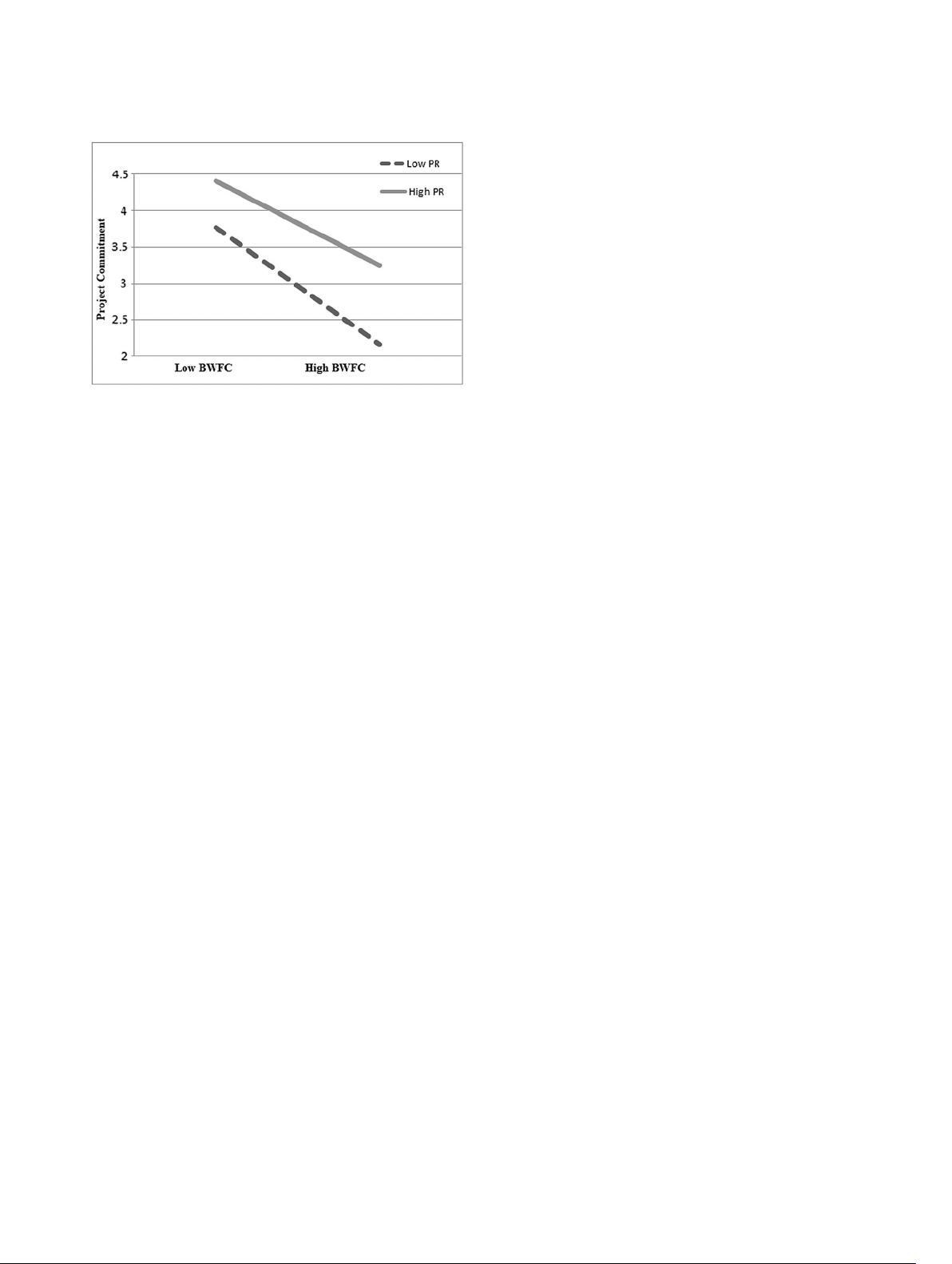
logical resilience) was significant (β = 0.128, p < 0.05). The
Lastly, moderation analysis were conducted to test interaction graph is provided in Fig. 3, which represents
hypothesis 4a to 4c which stated that psychological resil-
that decrease in negative slope of the curve indicates that
ience moderates the relationship between dimensions psychological resilience aids in reducing the negative
of WFC and project commitment, such that the rela-
impact of behavior-based WFC on project commitment.
tionship will be weaken when psychological resilience
Table 1 Descriptive statistics, reliabilities and correlation Variables Mean SD 1 2 3 4 5 6 Time‑based WFC 2.46 1.28 (.936) Strain‑based WFC 2.51 1.26 .92** (.935) Behavior‑based WFC 2.45 1.29 .93** .94** (.953) Project commitment 3.52 .81 − .30** − .34** − .31** (.844) Psychological resilience 3.24 .67 − .12 − .17** − .15** .27** (.956) Abusive supervision 4.17 .97 .12 .10 .11 .11 .27** (.980)
N = 235, **p < .01
Reliabilities are presented in parenthesis
Rafique et al. Future Business Journal 2024, 10(1):38 Page 8 of 14
Table 3 Indirect hypothesis Variables LLCI 95% ULCI 95%
Time‑based WFC → project commitment → abusive supervision − .0825 − .0124
Strain‑based WFC → project commitment → abusive supervision − .0967 − .0173
Strain‑based WFC → project commitment → abusive supervision − .0773 − .0126
Table 4 Moderation hypothesis Variables B LLCI ULCI
Time‑based WFC*psychological resilience .1223 .0175 .2270
Strain‑based WFC*psychological resilience .1269 .0228 .2311
Behavior‑based WFC*psychological resilience .1275 .0217 .2333
Fig. 3 Strain‑based WFC*psychological resilience
behavior-based) predicted abusive supervision. These
findings are in congruence with Selvarajan et al. [107]
that WFC is positively related to counterproductive
Fig. 2 Time‑based WFC*psychological resilience
work behavior. Similarly, Eissa and Lester [34] found
that stressors have the potential to compel professionals
to engross in abusive supervision. Managers in the con-
struction do experience work to family conflict[132]. One
Figure 2 represents the moderation of psychological possible reason might be that individuals in high-power
resilience on the link between time-based WFC and pro-
distance culture like Pakistan prioritizes work over fam- ject commitment.
ily [126], due to lack of employment opportunities, for
Figure 3 represents moderation of psychological resil-
career progression and considering the organization
ience on the link among strain-based WFC and project boss as a father figure. Additionally, the findings revealed commitment.
that strain-based WFC has a greater positive impact on
Figure 4 represents moderation of psychological resil-
abusive supervision as compared to other dimensions of
ience on the link among behavior-based WFC and pro- WFC. ject commitment.
We anticipated that the dimensions of WFC negatively
influence project commitment. The findings revealed Discussion
that all dimensions negatively predicted project commit-
The current study investigated whether and how WFC ment; however, strain-based WFC has stronger negative
influences abusive supervision. Drawing on COR [50, influence. Past studies propounded that individuals expo-
51], we anticipated that in the stressful environment sure to conflicting demands may experience deteriorated
of project [132], WFC consume individual resources commitment toward organization [90]. Project managers
that lower their commitment toward project and finally having abundant responsibilities to complete the project
result indulging in abusive supervision. We contem-
within triple constraints compel to bestow more time and
plate psychological resilience buffers the proposed rela-
resources to project work, which hampers them to fulfill
tionship. The findings revealed that as hypothesized, family responsibilities. This sense of not meeting fam-
the dimensions of WFC (time-based, strain-based and ily demands reduce their commitment toward project,
R afique et al. Future Business Journal 2024, 10(1):38 Page 9 of 14
strain-based conflict has much greater influence on out-
come variables. In line with this, our findings revealed
that WFC is one of the reason in generating detrimental
outcomes for project professionals like poor project com-
mitment and indulging in abusive supervision.
Additionally, our study is contributing by explor-
ing the prevalence of abusive supervision in the project
context. Though studies are evident about its existence
in the project environment [38, 39]. However, empirical
investigation of this phenomenon was somehow miss-
ing in the project literature. Therefore, responding to the
calls for empirical examination of abusive supervision in
the project context, this study examined its antecedents
Fig. 4 Behavior‑based WFC*psychological resilience
to reduce its detrimental consequences [41, 131]. Our
findings discerned that abusive supervision is present
in the project, and due to stressful and dynamic project
because such individuals blame the project work for not environment, project managers are unable to control
fulfilling family responsibilities and duties efficiently.
their urges of venting their negative feelings on immedi-
The indirect results showed project commitment medi-
ate subordinates. Theoretically, our study is unique in a
ated the relationship between WFC and abusive supervi-
sense that our study not only identified the prevalence
sion [46, 50]. The findings are in congruence with past but also empirically examined its antecedents in the pro-
studies on the mediating role of project commitment ject context.
between WFC and behavioral outcomes [126]. The medi-
Moreover, another theoretical contribution of our
ation results advocate that each dimension of WFC invig-
study is the identification of project commitment as a
orates negative response which leads to reduced project mechanism and accompanying pathway through which
commitment, because project managers blame the pro-
WFC leads to abusive supervision. Prior studies con-
ject environment for such incompatible demands, which tended that mechanism is missing that links WFC with
ultimately translates into abusive behavior.
outcome variables [13, 127, 132]. Hence, this study
The moderating results delineated that psychologi-
unveiled this black box and examined project commit-
cal resilience aids in reducing the influence of WFC on ment as a mediating mechanism. Our findings showed
project managers commitment toward the project. Previ-
that WFC has the potential to diminish the project man-
ous studies revealed that resilience as a personal resource ager’s commitment because such individuals considered
aid professionals in adapting to all kind of stressors project environment responsible for not meeting family
to maintain good psychological health irrespective of demands; hence, they engage in counterproductive work
adverse situations [123]. Moreover, consistent with COR, behaviors readily.
highly resilient individuals may be less exposed to loss
Finally, we highlighted the role of psychological resil-
of resources and are more vulnerable to resource gains, ience in aiding project professionals with stressful situ-
because they tend to gather and refine resources with ations and negative outcomes [28, 76]. Psychological
the passage of time [51, 76]. Accordingly, past studies resilience is an individual resource that helps in the
showed that resilience buffers the negative influence of apprehension of how individual react to stressors in
job demands like WFC on different outcomes [3].
the project [104], as it aids in managing and adapting
successfully to stressful circumstances [130]. Previous
Theoretical implications
studies in the context of project concentrated more on
The present study extends WFC and abusive super-
emotional intelligence [56, 106, 132]. However, our study
vision literature in the construction projects from makes particular contribution by investigating the role
COR perspective. Primarily, we intend to deepen of psychological resilience. We showed that psychologi-
WFC research in project context. The study is unique cal resilience buffers the negative relationship of WFC
because we not only respond to the calls for research on and project commitment. This suggests that personal
linking WFC with outcome variables [14, 126, 132], but resources are sensitive for project professionals as it helps
also examined the impact of each dimension on out-
them to cope with WFC in the stressful environment of
come variable, which were ignored in previous studies the project.
[32, 58]. Our findings suggest that out of all dimensions,
Rafique et al. Future Business Journal 2024, 10(1):38 Page 10 of 14 Practical implications
examine its influence on project manager abusive super-
Our study findings suggest several implications that can vision. However, the industry of construction is demand-
help project-based organizations to improve their work ing and possesses stressors [68]. We suggest future
environment to achieve the desired project goals. The studies investigate these stressors with abusive supervi-
direct results suggest that WFC is a serious problem in sion in a single theoretical framework and draw conclu-
the construction projects that can deteriorate project sion. Though we tried to fill the gap on mechanism and
manager’s attitude and behavior toward the project. pathways through which WFC influence work-related
Hence, it is of utmost importance for organizations to outcomes by taking project commitment as a mediator,
plan particular interventions that facilitates reconcilia-
however, project literature is still in its nascent stages on
tion of professionals work responsibilities with that of this aspect. Therefore, we recommend other mediators
other responsibilities [45]. Additionally, project-based like emotional responses such as a frustration, anger in
organizations need to develop family-friendly environ-
the relationship between WFC and outcome variables.
ment by adopting measures like providing on-site child Last, as construction industry is widely acknowledged as
care facility to single parent as well as women profes-
stressful, professional needs personal resources to cope
sionals [10]. Furthermore, caring and supportive top-
with stressors. In the current study, we utilized only psy-
level management could promote education and training chological resilience; however, future studies can exam-
program on how to manage the pressures from work and ine other personal resources like emotional stability and family [10]. psychological hardiness.
We urged project-based organizations to devise a clear
policy with respect to abusive practices in the work envi-
ronment. It is the right of every individual to be treated Conclusion
fairly and with due respect. Mistakes happen but it Drawing on COR theory, we investigated the impact
should not be punished through abuse because it can of WFC on project manager abusive supervision in the
distort the mental health of subordinates. More particu-
presence of mediating and moderating effect.. We found
larly in Pakistani context, subordinates consider boss as that WFC had a positive effect on abusive supervision
a father figure and consider abuse from boss as his/her and negative influence on project commitment. Addi-
discretion; thus, they are more vulnerable to such abuse. tionally, project commitment mediated the relationship
Additionally, lack of employment opportunities compels and psychological resilience buffered the relationship
them to tolerate supervisor’s abuse. Hence, it is organiza-
between WFC and project commitment. The study
tion responsibility to make it part of organizational pol-
enhanced the current project management literature on
icy and [2, 103, 114] educate their project managers on WFC and abusive supervision. We believe this investiga-
how to handle stressors and behave politely.
tion may support further empirical studies on WFC and
Since resilience is a malleable personal resource that its possible project-related outcomes in the literature.
can be nurtured through training [57]. The training could Due to stressful and dynamic nature of construction
be concentrated on enhancing professional ability to take projects, it is crucial to gain an extensive apprehen-
some time for self-reflection [79]. Studies are evident of sion of the elements that instigate supervisor abuse and
particular human resource interventions to improve indi-
how professionals could cope it to achieve the desired
vidual personal resilience like career counselling, educa- objectives.
tion interventions and mentoring programs [11, 30]. Abbreviations WFC Work–family conflict COR
Conservation of resources theory
Limitations and future research directions
There are certain limitations that need the attention of Acknowledgements
researcher. For the current study, data were collected only Not applicable.
from construction industry; therefore, it may hamper the Author contributions
generalizability of study findings. Future studies can col-
‘MR’ and ‘MJ’ performed conceptualization, introduction and writing of the
lect data from multiple organizations like IT and NGO manuscript and were the major contributor; ‘SA’ performed discussion and
conclusion sections. All authors read and approved the final manuscript.
projects to enhance the generalizability. In this study, we
utilized COR theory; however, in future other theories Funding
could be used to explain the proposed relationship such No external funding is received for this research.
as affective event theory [121] and job-demand resource Availability of data and materials
model [39] that may enrich the project management lit-
The data are available from the corresponding author upon reasonable
erature. Moreover, we rely only on WFC as a stressor to request.
R afique et al. Future Business Journal 2024, 10(1):38 Page 11 of 14 Declarations
19. Caesens G, Nguyen N, Stinglhamber F (2019) Abusive supervision and
organizational dehumanization. J Bus Psychol 34(5):709–728
Ethics approval and consent to participate
20. Campbell‑Sills L, Stein MB (2007) Psychometric analysis and refine‑ Not applicable.
ment of the connor–davidson resilience scale (CD‑RISC): validation of
a 10‑item measure of resilience. J Trauma Stress Off Publ Int Soc Traum Consent for publication Stress Stud 20(6):1019–1028 Not applicable.
21. Cao J, Liu C, Wu G, Zhao X, Jiang Z (2020) Work–family conflict and job
outcomes for construction professionals: the mediating role of affective Competing interests
organizational commitment. Int J Environ Res Pub Health 17(4):1443
The authors declare that they have no competing interests.
22. Carlson DS, Kacmar KM, Williams LJ (2000) Construction and initial
validation of a multidimensional measure of work–family conflict. J Vocat Behav 56(2):249–276
Received: 4 October 2023 Accepted: 10 March 2024
23. Carlson DS, Thompson MJ, Kacmar KM (2019) Double crossed: the Published: 5 April 2024
spillover and crossover effects of work demands on work outcomes
through the family. J Appl Psychol 104(2):214–228
24. Chang KC, Yen HW, Chiang CC, Parolia N (2013) Knowledge con‑
tribution in information system development teams: an empiri‑ References
cal research from a social cognitive perspective. Int J Proj Manag
1. Ahmadi A, Golabchi M (2013) Complexity theory in construction pro‑ 31(2):252–263
ject time management. Int Res J Appl Basic Sci 6(5):538–542
25. Chen X, Wang Y, Yan Y (2016) The essential resilience scale: instru‑
2. Alam M, Gale A, Brown M, Khan AI (2010) The importance of human
ment development and prediction of perceived health and behav‑
skills in project management professional development. Int J Manag
iour. Stress Health 32(5):533–542 Proj Bus 3(3):495–516
26. Chen Y, Zhang F, Wang Y, Zheng J (2020) Work–family conflict, emo‑
3. Al‑Hawari MA, Bani‑Melhem S, Quratulain S (2020) Do frontline employ‑
tional responses, workplace deviance, and well‑being among construc‑
ees cope effectively with abusive supervision and customer incivility?
tion professionals: a sequential mediation model. Int J Environ Res Pub
Testing the effect of employee resilience. J Bus Psychol 35(2):223–240 Health 17(18):6883
4. Amstad FT, Meier LL, Fasel U, Elfering A, Semmer NK (2011) A meta‑
27. Choi J, Kruis NE, Yun I (2020) When do police stressors particularly
analysis of work–family conflict and various outcomes with a special
predict organizational commitment? The moderating role of social
emphasis on cross‑domain versus matching‑domain relations. J Occup
resources. Police Q 23(4):527–546 Health Psychol 16(2):151–169
28. Clough BA, Ireland MJ, Leane S, March S (2020) Stressors and protective
5. Anantatmula VS (2016) Project teams: a structured development
factors among regional and metropolitan Australian medical doctors: a
approach. Business Expert Press, New York
mixed methods investigation. J Clin Psychol 76(7):1362–1389
6. Anderson JC, Gerbing DW (1988) Structural equation modeling in
29. Cooke FL, Cooper B, Bartram T, Wang J, Mei H (2019) Mapping the
practice: a review and recommended two‑step approach. Psychol Bull
relationships between high‑performance work systems, employee 103(3):411–423
resilience and engagement: A study of the banking industry in China.
7. Annor F, Amponsah‑Tawiah K (2020) Relationship between workplace
Int J Hum Resour Manag 30(8):1239–1260
bullying and employees’ subjective well‑being: does resilience make a
30. Cooper CL, Liu Y, Tarba SY (2014) Resilience, HRM practices and impact
difference? Empl Responsib Rights J 32(3):123–135
on organizational performance and employee well‑being. Int J Hum
8. Ayub A, Ajmal T, Iqbal S, Ghazanfar S, Anwaar M, Ishaq M (2021) Abusive
Resour Manag 25(17):2466–2471
supervision and knowledge hiding in service organizations: exploring
31. Delp L, Wallace SP, Geiger‑Brown J, Muntaner C (2010) Job stress and
the boundary conditions. Int J Constr Manag 32(5):725–746
job satisfaction: home care workers in a consumer‑directed model of
9. Bakker AB, Demerouti E, De Boer E, Schaufeli WB (2003) Job demands
care. Health Serv Res 45(4):922–940
and job resources as predictors of absence duration and frequency. J
32. Dodanwala TC, San Santoso D, Shrestha P (2022) The mediating role Vocat Behav 62(2):341–356
of work–family conflict on role overload and job stress linkage. Built
10. Bernuzzi C, Setti I, Maffoni M, Sommovigo V (2021) From moral distress
Environ Proj Asset Manag 12(6):924–939
to burnout through work‑family conflict: the protective role of resil‑
33. Dodanwala TC, Shrestha P (2021) Work–family conflict and job satisfac‑
ience and positive refocusing. Ethics Behav 32:578–600
tion among construction professionals: the mediating role of emotional
11. Bimrose J, Hearne L (2012) Resilience and career adaptability: qualita‑
exhaustion. On the Horizon 29(2):62–75
tive studies of adult career counseling. J Vocat Behav 81(3):338–344
34. Eissa G, Lester SW (2017) Supervisor role overload and frustration as
12. Bowen P, Edwards P, Lingard H, Cattell K (2014) Occupational stress and
antecedents of abusive supervision: the moderating role of supervisor
job demand, control and support factors among construction project
personality. J Organ Behav 38(3):307–326
consultants. Int J Proj Manag 32(7):1273–1284
35. Eissa G, Lester SW, Gupta R (2020) Interpersonal deviance and abusive
13. Bowen P, Govender R, Edwards P, Cattell K (2018) Work‑related contact,
supervision: the mediating role of supervisor negative emotions and
work–family conflict, psychological distress and sleep problems experi‑
the moderating role of subordinate organizational citizenship behavior.
enced by construction professionals: an integrated explanatory model. J Bus Ethics 166(3):577–594
Constr Manag Econ 36(3):153–174
36. Ferguson M, Carlson D, Hunter EM, Whitten D (2012) A two‑study
14. Bowen P, Zhang RP (2020) Cross‑boundary contact, work‑family con‑
examination of work–family conflict, production deviance and gender.
flict, antecedents, and consequences: testing an integrated model for J Vocat Behav 81(2):245–258
construction professionals. J Constr Eng Manag 146(3):1–13
37. Fishbein M, Ajzen I (1977) Belief, attitude, intention, and behavior: an
15. Britt TW, Jex SM (2015) Thriving under stress: harnessing demands in
introduction to theory and research. Philos Rhetor 10(2):177–188
the workplace. Oxford University Press, New York
38. Fordjour GA, Chan AP, Tuffour‑Kwarteng L (2021) Exploring construc‑
16. Brown S, Whichello R, Price S (2018) The impact of resiliency on nurse
tion employees’ perspectives on the potential causes of psychological
burnout: an integrative literature review. Medsurg Nurs 27(6):349–378
health conditions in the construction industry: a study in Ghana. Int J
17. Burić I, Šimunović M, Balaž B (2022) Work–family conflicts and teacher
Constr Educ Res 17(4):373–393
commitment during the COVID‑19 pandemic: a moderated media‑
39. Gallagher EC, Mazur AK, Ashkanasy NM (2015) Rallying the troops or
tion analysis of emotional exhaustion and psychological capital. Educ
beating the horses? How project‑related demands can lead to either Psychol 43:472–490
high‑performance or abusive supervision. Proj Manag J 46(3):10–24
18. Buvik MP, Tvedt SD (2017) The influence of project commitment and
40. Gao Y, Shi J, Niu Q, Wang L (2013) Work–family conflict and job satisfac‑
team commitment on the relationship between trust and knowledge
tion: emotional intelligence as a moderator. Stress Health 29(3):222–228
sharing in project teams. Proj Manag J 48(2):5–21
Rafique et al. Future Business Journal 2024, 10(1):38 Page 12 of 14
41. Garcia PRJM, Restubog SLD, Kiewitz C, Scott KL, Tang RL (2014)
65. Khan S, Medica K (2020) Who do we blame for abusive supervision?
Roots run deep: investigating psychological mechanisms between Can J Adm Sci 37(4):435–447
history of family aggression and abusive supervision. J Appl Psychol
66. Kline TJ (2005) Psychological testing: a practical approach to design and 99(5):883–897
evaluation. Sage Publications, London
42. Grandey AA, Cropanzano R (1999) The conservation of resources model
67. Law DMY, Fox PW (2004) Job stress of construction professionals. J
applied to work–family conflict and strain. J Vocat Behav 54(2):350–370 Hong Kong Inst Sur 15:88–92
43. Greenhaus JH, Beutell NJ (1985) Sources of conflict between work and
68. Leung MY, Ng ST, Skitmore M, Cheung SO (2005) Critical stressors
family roles. Acad Manag Rev 10(1):76–88
influencing construction estimators in Hong Kong. Constr Manag Econ
44. Guo Y, Li X (2023) Work‑family conflict, organisational commitment 23(1):33–44
and turnover intention in Chinese preschool teachers: a comparison of
69. Li MH, Eschenauer R, Persaud V (2018) Between avoidance and problem
mediation models. J Educ Teach 49(4):695–710
solving: resilience, self‑efficacy, and social support seeking. J Couns Dev
45. Gupta P, Srivastava S (2020) Work–life conflict and burnout among 96(2):132–143
working women: a mediated moderated model of support and resil‑
70. Li Z, He B, Sun X (2020) Does work stressors lead to abusive supervi‑
ience. Int J Organ Anal 29(3):629–655
sion? A study of differentiated effects of challenge and hindrance
46. Halbesleben JR, Neveu JP, Paustian‑Underdahl SC, Westman M (2014)
stressors. Psychol Res Behav Manag 13:573–588
Getting to the “COR” understanding the role of resources in conserva‑
71. Liao EY, Lau VP, Hui RT, Kong KH (2019) A resource‑based perspec‑
tion of resources theory. J Manag 40(5):1334–1364
tive on work–family conflict: meta‑analytical findings. Career Dev Int
47. Hao S, Hong W, Xu H, Zhou L, Xie Z (2015) Relationship between resil‑ 24(1):37–73
ience, stress and burnout among civil servants in Beijing, China: mediat‑
72. Lingard H, Sublet A (2002) The impact of job and organizational
ing and moderating effect analysis. Personal Individ Differ 83:65–71
demands on marital or relationship satisfaction and conflict among
48. Hayes AF (2013) Introduction to mediation, moderation, and condi‑
Australian civil engineers. Constr Manag Econ 20(6):507–521
tional process analysis: a regression‑based approach. Guilford Press,
73. Lingard H, Francis V (2007) “Negative interference” between Australian New York
construction professionals’ work and family roles: evidence of an asym‑
49. Hobfoll SE (1989) Conservation of resources: a new attempt at concep‑
metrical relationship. Eng Constr Archit Manag 14(1):79–93
tualizing stress. Am Psychol 44(3):513–524
74. Liu JY, Low SP (2011) Work–family conflicts experienced by project
50. Hobfoll SE (2011) Conservation of resource caravans and engaged set‑
managers in the Chinese construction industry. Int J Proj Manag
tings. J Occup Organ Psychol 84(1):116–122 29(2):117–128
51. Hobfoll SE, Halbesleben J, Neveu JP, Westman M (2018) Conservation
75. Liu Y, Wang M, Chang CH, Shi J, Zhou L, Shao R (2015) Work–family con‑
of resources in the organizational context: the reality of resources and
flict, emotional exhaustion, and displaced aggression toward others:
their consequences. Ann Rev Organ Psychol Organ Behav 5:103–128
the moderating roles of workplace interpersonal conflict and perceived
52. Hobfoll SE, Shirom A (2001) Conservation of resources theory: applica‑
managerial family support. J Appl Psychol 100(3):793–808
tions to stress and management in the workplace. In: Golembiewski
76. Maffoni M, Sommovigo V, Giardini A, Paolucci S, Setti I (2020) Dealing
RT (ed) Handbook of organizational behavior, 2nd edn. Taylor & Francis
with ethical issues in rehabilitation medicine: the relationship between Group, New York, pp 57–80
managerial support and emotional exhaustion is mediated by moral
53. Hoegl M, Weinkauf K, Gemuenden HG (2004) Interteam coordination,
distress and enhanced by positive affectivity and resilience. J Nur
project commitment, and teamwork in multiteam R&D projects: a Manag 28(5):1114–1125
longitudinal study. Organ Sci 15(1):38–55
77. Masood H, Karakowsky L, Podolsky M (2021) Exploring job crafting as a
54. Hu LT, Bentler PM (1999) Cutoff criteria for fit indexes in covariance
response to abusive supervision. Career Dev Int 26(2):174–200
structure analysis: conventional criteria versus new alternatives. Struct
78. Mazur AK, Pisarski A (2015) Major project managers’ internal and
Equ Model Multidiscip J 6(1):1–55
external stakeholder relationships: the development and validation of
55. Jahanzeb S, Fatima T, Javed B, Giles JP (2020) Can mindfulness over‑
measurement scales. Int J Proj Manag 33(8):1680–1691
come the effects of workplace ostracism on job performance? J Soc
79. McAllister M, McKinnon J (2009) The importance of teaching and learn‑ Psychol 160(5):589–602
ing resilience in the health disciplines: a critical review of the literature.
56. Jepson JM, Kirytopoulos K, London K (2017) Exploring project man‑
Nurse Educ Today 29(4):371–379
agers’ perception of stress when working in increasingly complex
80. Merrow EW, Nandurdikar N (2018) Leading complex projects: a data‑
construction projects. Constr Econ Buid 17(3):47–67
driven approach to mastering the human side of project management.
57. Joyce S, Shand F, Tighe J, Laurent SJ, Bryant RA, Harvey SB (2018) Road Wiley, London
to resilience: a systematic review and meta‑analysis of resilience train‑
81. Mir A, Rafique M, Mubarak N (2021) Impact of inclusive leadership on
ing programmes and interventions. BMJ Open 8(6):e017858
project success: testing of a model in information technology projects.
58. Ju L, Zhao W, Wu C, Li H, Ning X (2020) Abusive supervisors and
Int J Inf Technol Proj Manag 12(1):63–79
employee work‑to‑family conflict in Chinese construction projects:
82. Morgan WB, Perry SJ, Wang Y (2018) The angry implications of work‑to‑
how does family support help? Constr Manag Econ 38(12):1158–1178
family conflict: examining effects of leadership on an emotion‑based
59. Kaplan S, Bradley JC, Luchman JN, Haynes D (2009) On the role of
model of deviance. J Vocat Behav 108:13–27
positive and negative affectivity in job performance: a meta‑analytic
83. Mowday RT, Porter LW, Steers RM (1982) Employee‑organization
investigation. J Appl Psychol 94(1):162–176
linkages: the psychology of commitment, absenteeism and turnover.
60. Karatepe OM, Karadas G (2016) ‘Service employees’ fit, work‑family Academic Press, New York
conflict, and work engagement. J Serv Mark 30(5):554–566
84. Mukanzi CM, Senaji TA (2017) Work–family conflict and employee com‑
61. Karatepe OM, Kim TT, Lee G (2019) Is political skill really an antidote in
mitment: the moderating effect of perceived managerial support. SAGE
the workplace incivility‑emotional exhaustion and outcome relation‑ Open 7(3):1–12
ship in the hotel industry? J Hosp Tour Manag 40:40–49
85. Naderpajouh N, Matinheikki J, Keeys LA, Aldrich DP, Linkov I (2020)
62. Kashif M, Handoko I, Lamichhane R (2023) Two cooks spoil the broth:
Resilience and projects: an interdisciplinary crossroad. Proj Leadersh
Destructive outcomes of supervisor and customer mistreatment in Soc 1:100001
mediating‑moderating roles of anger and self‑control in an Indonesian
86. Nauman S, Musawir AU, Munir H, Rasheed I (2021) Enhancing the
context. Empl Res Rights J 35(3):369–393
impact of transformational leadership and team‑building on project
63. Khan AK, Moss S, Quratulain S, Hameed I (2018) When and how subor‑
success: the moderating role of empowerment climate. Int J Manag
dinate performance leads to abusive supervision: a social dominance Proj Bus 15(2):423–447
perspective. J Manag 44(7):2801–2826
87. New AS, Fan J, Murrough JW, Liu X, Liebman RE, Guise KG et al (2009) A
64. Khan NA, Khan AN (2021) Exploring the impact of abusive supervision
functional magnetic resonance imaging study of deliberate emotion
on employee’voice behavior in Chinese construction industry: a mod‑
regulation in resilience and posttraumatic stress disorder. Biol Psychiatr
erated mediation analysis. Eng Constr Archit Manag 29(8):3051–3071 66(7):656–664
R afique et al. Future Business Journal 2024, 10(1):38 Page 13 of 14
88. Ng BCS, Zhang X, Chen ZXG (2021) A stress perspective on antecedents
109. Shockley KM, Singla N (2011) Reconsidering work—family interactions
of abusive supervision: blaming the organisation when exhausted
and satisfaction: a meta‑analysis. J Manag 37(3):861–886
supervisors abuse. J Manag Organ 27(2):361–381
110. Singh R, Zhang Y, Wan M, Fouad NA (2018) Why do women engineers
89. Novieto DT, Kportufe GS (2021) Work‑family conflict and project perfor‑
leave the engineering profession? The roles of work–family conflict,
mance of construction professionals in a developing country: testing
occupational commitment, and perceived organizational support. Hum
the mediating–moderating effect of project management self‑efficacy. Resour Manag 57(4):901–914
Eng Constr Archit Manag 29(9):3331–3344
111. Tepper BJ (2000) Consequences of abusive supervision. Acad Manag J
90. Olaniyan OS, Iversen AC, Ortiz‑Barreda G, Hetland H (2022) When your 43(2):178–190
source of livelihood also becomes the source of your discomfort: the
112. Thurston IB, Hardin R, Kamody RC, Herbozo S, Kaufman C (2018) The
perception of work–family conflict among child welfare workers. Eur J
moderating role of resilience on the relationship between perceived Soc Work 25(3):418–429
stress and binge eating symptoms among young adult women. Eat
91. Panojan P, Perera BAKS, Dilakshan R (2022) Work‑life balance of profes‑ Behav 29:114–119
sional quantity surveyors engaged in the construction industry. Int J
113. Tugade MM, Fredrickson BL (2007) Regulation of positive emotions: Constr Manag 22(5):751–768
emotion regulation strategies that promote resilience. J Happiness Stud
92. Paul H, Bamel UK, Garg P (2016) Employee resilience and OCB: medi‑ 8(3):311–333
ating effects of organizational commitment. Vikalpa 41(4):308–324
114. Turner M (2016) Beyond the iron triangle: reflections of an early career
93. Peltokorpi V (2019) Abusive supervision and emotional exhaus‑
academic. Int J Manag Proj Bus 9(4):892–902
tion: the moderating role of power distance orientation and the
115. Turner M, Mariani A (2016) Managing the work‑family interface:
mediating role of interaction avoidance. Asia Pac J Hum Resour
experience of construction project managers. Int J Manag Proj Bus 57(3):251–275 9(2):243–258
94. Pinto JK, Patanakul P, Pinto MB (2016) Project personnel, job
116. Turner M, Scott‑Young C, Holdsworth S (2018) Developing the resilient
demands, and workplace burnout: the differential effects of job title
project professional: examining the student experience. Int J Manag
and project type. IEEE Trans Eng Manag 63(1):91–100 Proj Bus 12(3):716–729
95. Pinto MB, Pinto JK, Prescott JE (1993) Antecedents and conse‑
117. ul Haque A, Aston J, Kozlovski E (2018) The impact of Stressors on
quences of project team cross‑functional cooperation. Manag Sci
organizational commitment of managerial and non‑managerial per‑ 39(10):1281–1297
sonnel in contrasting economies: evidences from Canada and Pakistan.
96. Pooja AA, De Clercq D, Belausteguigoitia I (2016) Job stressors and Int J Bus 23(2):166–182
organizational citizenship behavior: the roles of organizational com‑
118. Wan J, Le Y, Wang G, Xia N, Liu X (2020) Carrot or stick? The impact of
mitment and social interaction. Hum Resour Dev Q 27(3):373–405
paternalistic leadership on the behavioral integration of top manage‑
97. Pradhan S, Srivastava A, Jena LK (2019) Abusive supervision and
ment teams in megaprojects. Int J Manag Proj Bus 13(5):937–960
intention to quit: exploring multi‑mediational approaches. Pers Rev
119. Wang W, Chen X, Ning G, Wang Y, Song S (2022) The relationship 49(6):1269–1286
between anger and learning from failure: the moderating effect of
98. Preacher KJ, Rucker DD, Hayes AF (2007) Addressing moderated
resilience and project commitment. Curr Psychol 42:22726–22737
mediation hypotheses: theory, methods, and prescriptions. Multivar
120. Wayne SJ, Lemmon G, Hoobler JM, Cheung GW, Wilson MS (2017) The Behav Res 42(1):185–227
ripple effect: a spillover model of the detrimental impact of work–fam‑
99. Pu J, Hou H, Ma R, Sang J (2017) The effect of psychological capital
ily conflict on job success. J Organ Behav 38(6):876–894
between work–family conflict and job burnout in Chinese university
121. Weiss HM, Cropanzano R (1996) Affective events theory. Res Organ
teachers: testing for mediation and moderation. J Health Psychol Behav 18(1):1–74 22(14):1799–1807
122. Weiss M, Hoegl M (2016) The psychology and management of project
100. Qureshi H, Lambert EG, Frank J (2019) When domains spill over:
teams. Int J Manag Proj Bus 9(2):466–468
the relationships of work–family conflict with Indian police affec‑
123. Windle G (2011) What is resilience? A review and concept analysis. Rev
tive and continuance commitment. Int J Off Ther Comp Criminol Clin Gerontol 21(2):152–169 63(14):2501–2525
124. Wingo AP, Wrenn G, Pelletier T, Gutman AR, Bradley B, Ressler KJ
101. Rafique M (2022) Supervisor role overload and emotional exhaustion
(2010) Moderating effects of resilience on depression in individuals
as antecedents of supervisor incivility: the role of time conscious‑
with a history of childhood abuse or trauma exposure. J Affect Disord
ness. J Manag Organ 29(3):481–503 126(3):411–414
102. Rafique M, Ahmed S, Ismail M (2021) Impact of safety climate on
125. Wu G, Duan K, Zuo J, Yang J, Wen S (2016) System dynamics model
safety behaviour in construction projects: mediating mechanism and
and simulation of employee work‑family conflict in the construction
interacting effect. J Constr Dev Ctries 26(2):163–181
industry. Int J Environ Res Public Health 13(11):1–17
103. Ramazani J, Jergeas G (2015) Project managers and the journey from
126. Xia N, Zhong R, Wang X, Tiong R (2018) Cross‑domain negative effect of
good to great: the benefits of investment in project management
work‑family conflict on project citizenship behavior: study on Chinese
training and education. Int J Proj Manag 33(1):41–52
project managers. Int J Proj Manag 36(3):512–524
104. Rees CS, Breen LJ, Cusack L, Hegney D (2015) Understanding indi‑
127. Yang F, Li X, Song Z, Li Y, Zhu Y (2018) Job burnout of construction pro‑
vidual resilience in the workplace: the international collaboration of
ject managers: considering the role of organizational justice. J Constr
workforce resilience model. Front Psychol 6:73 Eng Manag 144(11):04018103
105. Rezvani A, Chang A, Wiewiora A, Ashkanasy NM, Jordan PJ, Zolin
128. Youssef‑Morgan CM, Luthans F (2015) Psychological capital and well‑
R (2016) Manager emotional intelligence and project success:
being. Stress Health J Int Soc Investig Stress 31(3):180–188
the mediating role of job satisfaction and trust. Int J Proj Manag
129. Zaman U, Florez‑Perez L, Anjam M, Khwaja MG, Ul‑Huda N (2022) At 34(7):1112–1122
the end of the world, turn left: examining toxic leadership, team silence
106. Rezvani A, Khosravi P (2019) Emotional intelligence: the key to miti‑
and success in mega construction projects. Eng Constr Archit Manag
gating stress and fostering trust among software developers working 30(6):2436–2462
on information system projects. Int J Inf Manag 48:139–150
130. Zanatta F, Maffoni M, Giardini A (2020) Resilience in palliative healthcare
107. Selvarajan TT, Singh B, Cloninger PA, Misra K (2019) Work–family
professionals: a systematic review. Support Care Cancer 28(3):971–978
conflict and counterproductive work behaviors: moderating role
131. Zhang Y, Bednall TC (2016) Antecedents of abusive supervision: a meta‑
of regulatory focus and mediating role of affect. Organ Manag J
analytic review. J Bus Ethics 139(3):455–471 16(1):42–54
132. Zheng J, Gou X, Li H, Xia N, Wu G (2021) Linking work–family conflict
108. Shaffera MA, Harrison DA, Gilley KM, Luk DM (2001) Struggling for
and burnout from the emotional resource perspective for construction
balance amid turbulence on international assignments: work–family
professionals. Int J Manag Proj Bus 14(5):1093–1115
conflict, support and commitment. J Manag 27(1):99–121
Rafique et al. Future Business Journal 2024, 10(1):38 Page 14 of 14
133. Zheng J, Wu G (2018) Work‑family conflict, perceived organizational
135. Zhu J, Zhang B (2019) The double‑edged sword effect of abusive
support and professional commitment: a mediation mechanism for
supervision on subordinates’ innovative behavior. Front Psychol 10:66
Chinese project professionals. Int J Environ Res Public Health 15(2):344
134. Zhou ZK, Liu QQ, Niu GF, Sun XJ, Fan CY (2017) Bullying victimization Publisher’s Note
and depression in Chinese children: A moderated mediation model of
resilience and mindfulness. Personal Individ Differ 104:137–142
Springer Nature remains neutral with regard to jurisdictional claims in pub‑
lished maps and institutional affiliations.
Tài liệu liên quan:
-
Pin fin-PCM composite heat sink solution for thermal management of cylindrical Li-ion battery
7 4 -
Numerical analysis of lithium-ion battery performance with new mini-channel configurations implementing hybrid nanofluid
10 5 -
Kỷ nguyên vươn mình: Tại sao Việt Nam đang tăng tốc?
15 8 -

Báo cáo tổng kết năm 2025 - Hiệp hội Thương mại điện tử Việt Nam (VECOM)
13 7 -
Luật sở hữu trí tuệ của Quốc hội nước Cộng hòa Xã hội Chủ nghĩa Việt Nam số 50/2005/QH11 ngày 29 tháng 11 năm 2005
15 8