E-Business & E-Commerce: Managing eCustomer Relationships | Logistics | Trường Đại học Kinh tế, Đại học Quốc gia Hà Nội
This chapter deals with fundamental aspects of the customer relationship in electronic business. A general movement from product orientation to customer ori- entation is emphasized (Sect. 8.1). Section 8.2 introduces an approach proposed by Blattberg et al. for the computation of customer equity. Section 8.3 deals with analytical customer relationship management and outlines a customer data ware- house used for long-term maintenance of customer relationships. The point of customer relationship. Tài liệu được sưu tầm và soạn thảo dưới dạng file PDF để gửi tới các bạn cùng tham khảo, ôn tập đầy đủ kiến thức, chuẩn bị cho các buổi học thật tốt. Mời bạn đọc đón xem!
Môn: Logistics 61 tài liệu
Trường: Trường Đại học Kinh tế, Đại học Quốc gia Hà Nội 491 tài liệu
Tác giả:




Preview text:
142 8
eCustomer Relationship Management 8.1
From Product Orientation to Customer Orientation What is CRM?
Customer relationship management (CRM) focuses on caring for the customer
relationship. It involves building and managing the relationship between a com- 8 eCustomer Relationship
pany or an organization and its stakeholders. Objective of
CRM requires the formulation of a company-wide business strategy, includ- Management customer
ing all sales and communication channels, for the systematic maintenance of relationship
the customer relationship. The focus is product-oriented, service-oriented and management
customer-oriented, and a high value is attributed to the usefulness of the cus-
tomer. The goal of all CRM activities is to obtain and to increase customer value
(i.e., customer satisfaction and customer loyalty) as well as customer profitability
during the entire duration of the customer relationship (customer lifetime value).
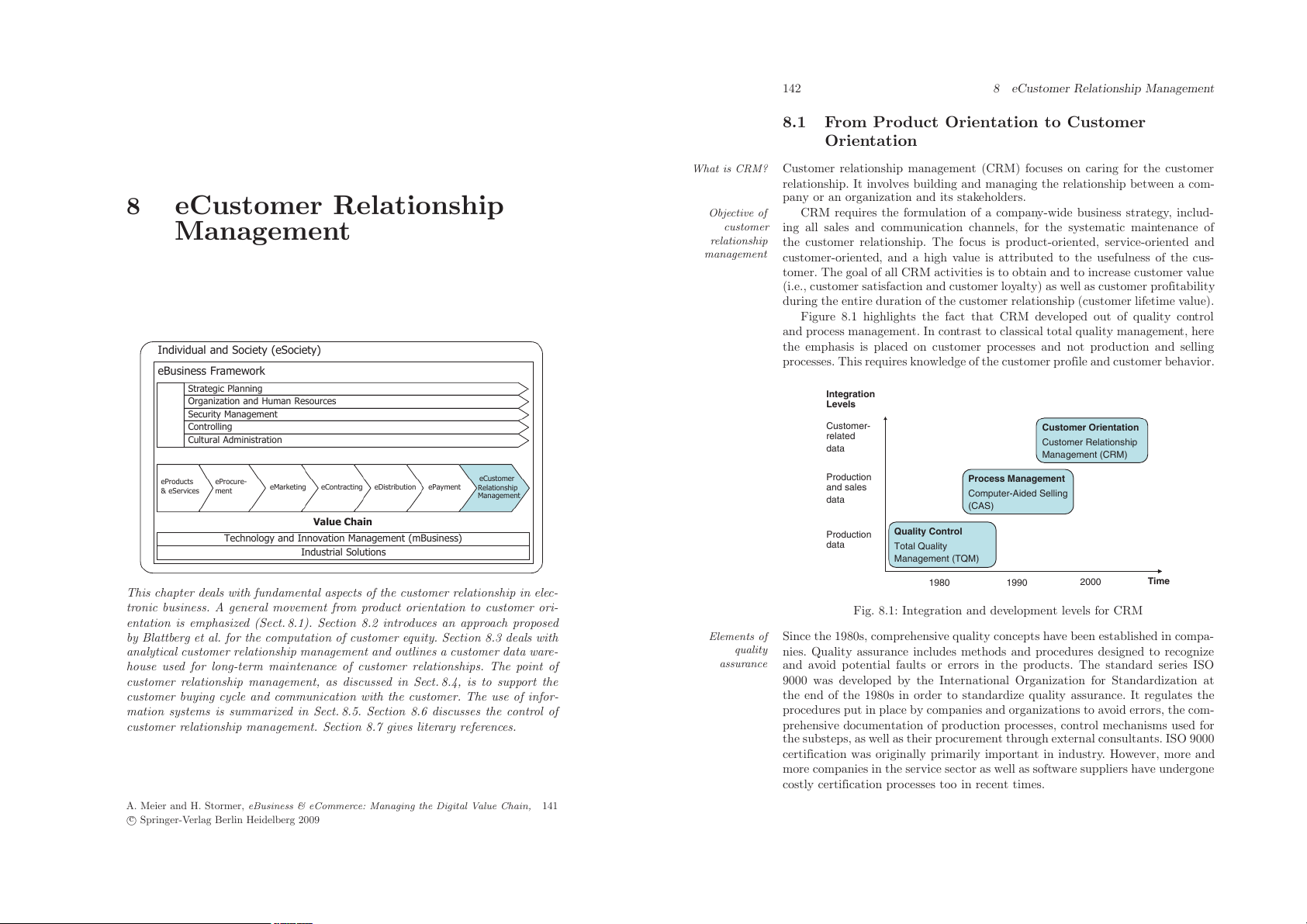
Figure 8.1 highlights the fact that CRM developed out of quality control
and process management. In contrast to classical total quality management, here
Individual and Society (eSociety)
the emphasis is placed on customer processes and not production and selling
processes. This requires knowledge of the customer profile and customer behavior. eBusiness Framework g Strategic Planning s Integration
Organization and Human Resources rtin Levels o sse p ce Security Management p u ro Controlling Customer- Customer Orientation S P Cultural Administration related Customer Relationship data Management (CRM) Production eProducts eProcure- eCustomer Process Management & eServices ment eMarketing eContracting eDistribution ePayment Relationship and sales Management Computer-Aided Selling data (CAS) Value Chain Quality Control
Technology and Innovation Management (mBusiness) Production data Total Quality Industrial Solutions Management (TQM) 1980 1990 2000 Time
This chapter deals with fundamental aspects of the customer relationship in elec-
tronic business. A general movement from product orientation to customer ori-
Fig. 8.1: Integration and development levels for CRM
entation is emphasized (Sect. 8.1). Section 8.2 introduces an approach proposed
by Blattberg et al. for the computation of customer equity. Section 8.3 deals with Elements of
Since the 1980s, comprehensive quality concepts have been established in compa-
analytical customer relationship management and outlines a customer data ware- quality
nies. Quality assurance includes methods and procedures designed to recognize
house used for long-term maintenance of customer relationships. The point of assurance
and avoid potential faults or errors in the products. The standard series ISO
customer relationship management, as discussed in Sect. 8.4, is to support the
9000 was developed by the International Organization for Standardization at
customer buying cycle and communication with the customer. The use of infor-
the end of the 1980s in order to standardize quality assurance. It regulates the
mation systems is summarized in Sect. 8.5. Section 8.6 discusses the control of
procedures put in place by companies and organizations to avoid errors, the com-
customer relationship management. Section 8.7 gives literary references.
prehensive documentation of production processes, control mechanisms used for
the substeps, as well as their procurement through external consultants. ISO 9000
certification was originally primarily important in industry. However, more and
more companies in the service sector as well as software suppliers have undergone
costly certification processes too in recent times.
A. Meier and H. Stormer, eBusiness & eCommerce: Managing the Digital Value Chain, 141 c
Springer-Verlag Berlin Heidelberg 2009 8.1
From Product Orientation to Customer Orientation 143 144 8
eCustomer Relationship Management
At the beginning of the 1990s, the quality-oriented approach achieved through Analysis and 8.2
The Customer Equity Model by Blattberg et al.
the analysis and reorganization of business processes was expanded. A business organization of business
process is a connection of activities which must be processed in a particular order
The term customer value has many interpretations, because the value contributed processes
by different organizational units. Business processes are structured, labor-divided
by the customer in his various roles must be considered. In his decisions, the
activity chains; for example, the settlement of damages through an insurance
customer judges the intrinsic usefulness of continuing a business relationship or
company or the purchase of goods through a commercial company. Originally, ending it.
internal development and processes were up for discussion; now it is the opti- Definition of
The customer lifetime value or the customer capital, known as the customer
mization of the sales and service processes that has moved into the foreground. customer
equity, is the value of a customer or customer base in attempting to achieve equity
Information systems and databases for sales and marketing are used in, for exam-
the monetary and nonmonetary goals of the company. This customer equity is
ple, sales force automation, computer-aided selling, and call centers. Central to
often characterized by three components: value equity, brand equity, and reten-
this is an increase in the efficiency of the sales organization, as well as improved
tion equity. The value equity is established through the value perception of the marketing.
customer. The brand equity involves the subjective appraisal of the brand by
During the course of the liberalization and globalization of the markets over Decreasing
the customer. The retention equity describes the success of customer retention
the last few years, it has been observed that customers are behaving more indi- customer programs. loyalty
vidually and customer loyalty is decreasing. In global markets, the competitive
differentiation of products and services alone is no longer a promising approach. Customer
Companies and organizations are aware of this change in the market situation yield
and are deliberately aligning their value chains toward the customer. The sale
of a product or of a service should represent not only a business transaction but
also the beginning of a long-term customer relationship. Customer management Customer Customer
aims to incorporate individual customer desires and customer behavior in the Acquisition Retention
place of product-related argumentation lists and efforts. Customer life
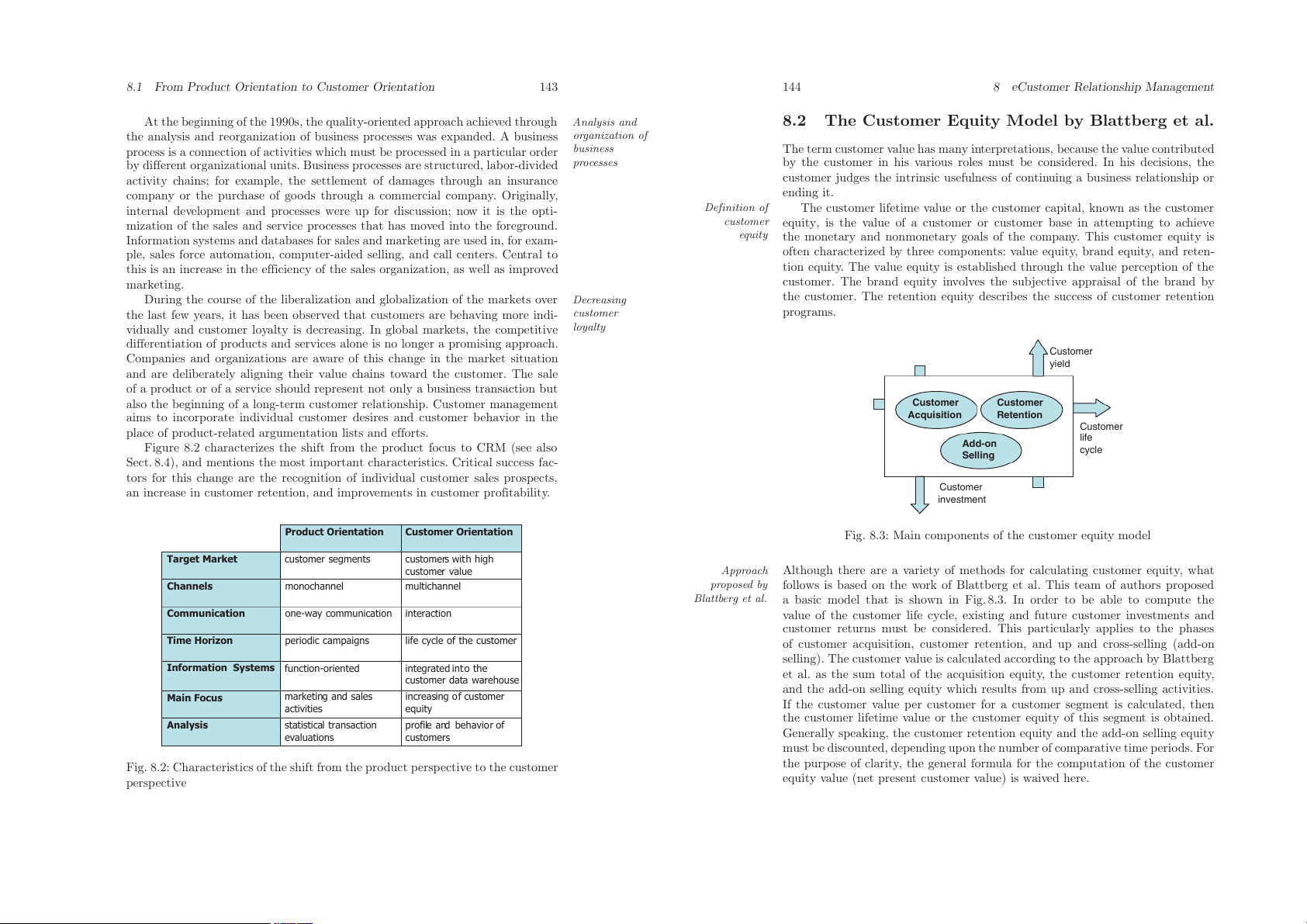
Figure 8.2 characterizes the shift from the product focus to CRM (see also Add-on cycle Selling
Sect. 8.4), and mentions the most important characteristics. Critical success fac-
tors for this change are the recognition of individual customer sales prospects,
an increase in customer retention, and improvements in customer profitability. Customer investment Product Orientation Customer Orientation
Fig. 8.3: Main components of the customer equity model Target Market customer segments customers with high customer value Approach
Although there are a variety of methods for calculating customer equity, what Channels monochannel multichannel proposed by
follows is based on the work of Blattberg et al. This team of authors proposed Blattberg et al.
a basic model that is shown in Fig. 8.3. In order to be able to compute the Communication one-way communication interaction
value of the customer life cycle, existing and future customer investments and
customer returns must be considered. This particularly applies to the phases Time Horizon periodic campaigns life cycle of the customer
of customer acquisition, customer retention, and up and cross-selling (add-on
selling). The customer value is calculated according to the approach by Blattberg Information Systems function-oriented integrated into the
et al. as the sum total of the acquisition equity, the customer retention equity, customer data warehouse
and the add-on selling equity which results from up and cross-selling activities. Main Focus marketing and sales increasing of customer activities equity
If the customer value per customer for a customer segment is calculated, then
the customer lifetime value or the customer equity of this segment is obtained. Analysis statistical transaction profile and behavior of evaluations customers
Generally speaking, the customer retention equity and the add-on selling equity
must be discounted, depending upon the number of comparative time periods. For
Fig. 8.2: Characteristics of the shift from the product perspective to the customer
the purpose of clarity, the general formula for the computation of the customer perspective
equity value (net present customer value) is waived here. 8.2
The Customer Equity Model by Blattberg et al. 145 146 8
eCustomer Relationship Management Acquisition equity =
an airline creates a customer club for frequent fliers. Such a concept is not
implemented simply because a direct measurable increase in yield is expected (rate margin acq × acq) - expenditureacq
with it; it is also implemented because the customer club will undoubtedly gen-
erate recommendations. Above all, if the relationship to the customer in the Customer retention equity =
club intensifies and he receives courteous treatment, then the probability of a Customer equity
recommendation increases. Along with the recommendation potential, the lead
1/(1 -rate ) (margin - expenditure ) per customer ret × ret ret
customer potential will also have an influence on the computation of the customer value. Add-on selling equity = Key : acq Acquisition Customer
A question remains: how are all of the measured values involved in the creation rate ret Retention lifetime value
of the customer equity and the qualitative influencing variables collected over
a-o × 1/(1 –rateret) × (margina-o – expenditurea-o) a-o Add-on selling
time and evaluated? Under normal conditions, the aim is for lifelong customer
retention, with the customer value tracked over several years (customer lifetime
Fig. 8.4: Calculation of customer value (according to Blattberg et al.)
value). Suitable information systems to achieve this must therefore be designed
and constructed. A customer data warehouse—which provides the quantitative
and qualitative measurements of customer development structured within a mul-
From Fig. 8.4, it is apparent that the acquisition equity results from the profit Calculation of
tidimensional database—is considered a promising approach. Such analysis and
margin minus the expenditure transacted for the acquisition. In the process, the the acquisition
maintenance of the customer data warehouse is carried out in analytical CRM.
profit margin must be multiplied by the acquisition rate because not everyone in equity
the target group will be gained as new customers. The acquisition rate expresses
the percentage of those customers who are acquired as new customers, based on 8.3
Analytical Customer Relationship Management
the size of the target group. With the expenditure, however, the total amount is
included in the formula for the acquisition equity; in other words, the expenditure 8.3.1
Rough Architecture of a Customer Data Warehouse
is not multiplied by the acquisition rate.
In the computation of the customer retention equity, the customer retention Formula for Evaluation of
The change from product orientation to customer orientation is facilitated by in-
rate expresses how many customers from the acquired customer base can be customer valuable
formation technologies and communication technologies. These technologies en- customers
retained over the next time period. For example, a customer retention rate of retention equity
able those involved in analytical CRM to become better acquainted with existing
70% means that 30% of the customer base is lost in one year (or over a selected
customers (through the use of a special database) and allow potential customers
time period). If the assumption is made that this rate remains constant over
to be acquired more systematically. The most valuable customers, either existing
time, then the duration of the relationship is calculated from the partial formula
or potential, should be recognized early and captured in a long-term customer 1/(1
relationship. With these customer groups defined, differentiated products can be
− Rateret). In the case of a customer retention rate of 70%, a duration of
3.33 years is obtained (namely 1/(1
fashioned and services for specific needs developed.
− 0.70) = 1/0.3 = 3.33). If this duration is
known, then the total profit of the customer relationship for the core products
To begin with, the valuable customers must first be identified and quanti-
and services of this customer can be computed.
fied with regard to their profitability. This is achieved with the help of a well-
The third measurement, the add-on selling equity, is calculated by taking Add-on selling
structured and multidimensional database, the customer data warehouse. A cus-
into account the margins and expenditures for the customer programs of the up- equity
tomer data warehouse is an integrated database which aids the decision-making
and cross-selling. At the same time, it is assumed that the duration of the effect processes that occur in CRM.
of the up- and cross-selling is the same as that of the customer retention; in Establishing
In order to establish the customer profile, the following questions must be
other words the same partial formula 1/(1 customer answered:
− Rateret ) is used for the relationship profiles
duration as for the customer retention. However, the measurement of the add-on • Who is the customer?
selling equity depends on how strongly the company performs in the activity of
up- and cross-selling. For this reason, the add-on selling rate Ratea-o must be
• What are the needs of the customer?
incorporated into the up-selling.
It is not only quantitative measurements that determine the customer value Qualitative
• How do these requirements relate to the service?
or customer equity, however. There are also qualitative measurements that must measurements
• How does he prefer to communicate with the company?
be considered when assessing the customer value. Suppose the marketing of
• When would he like to be informed about product changes, etc.? 8.3
Analytical Customer Relationship Management 147 148 8
eCustomer Relationship Management
Additional questions related to customer behavior and customer loyalty must be Analysis of
include the operational information systems, such as enterprise resource planning, answered in a second step: customer
call centers, supply systems, help desks, and other things; external sources can behavior
include online databases, business reports and business analyses, or data from
• How loyal is the customer to the company?
information brokers. These data must be converted into uniform formats covering
specified periods (daily, weekly, or monthly) and deposited into the multidimen-
• How often and to what extent does he do business with the company?
sional database. In order to accomplish this data integration step, predefined
• What additional value does the customer bring?
descriptive data (metadata) are attached to both the data and the data formats
used. Each time the database is periodically loaded, the data entered earlier are
• How high is his customer value?
not lost; they are kept in comprehensive archives. In order to be able to analyze
and evaluate the data cube according to different criteria, suitable tools are used
• How will his customer value develop in the future?
for data distribution and data preparation.
If the customers and their behavior are known, then the customers can be divided Segmenting of
into groups. Such a division can be done according to profit potentials, capital customers
outlays and acquisition costs, market risks, or other company-specific success 8.3.2
Evaluation of a Multidimensional Data Cube
factors. For instance, in a specific company, the key customers who have high Online
Operational databases and applications concentrate on a clearly defined function-
requirements and yet generate more than half of the company’s profit may be transaction
oriented performance area. For business transactions, the aim is to make data
evaluated. Another possible group comprises the customers with rising potential processing
available quickly and accurately for the completion of business. This kind of
who have fewer differentiated requirements and only conditionally want to spend
business activity is often referred to as online transaction processing (OLTP).
more money on additional services. If the expectations and the behavior of the Online
Since operational databases are updated daily, important data on which the
top customers are known, it is also possible to draw conclusions about potential analytical
user can base decisions are lost. Moreover, these databases were primarily in-
customers. A differentiated approach to looking at these customer groups enables processing
tended to aid in the completion of business rather than for analysis and eval-
the acquisition of customers with success potential.
uation. This is why, for many years, other databases and applications aside
A customer data warehouse is multidimensional, time-related, and not alter- Definition of a
from transaction-oriented databases have also been developed to help with data
able. Multidimensionality means that indicators such as customer value, turnover customer data
analysis and decision support. This is referred to as online analytical processing
figures, profitability key numbers and other measures can be analyzed according warehouse (OLAP).
to different analytical dimensions, such as customer segments, distribution areas,
The core element of OLAP is a data warehouse with a multidimensional data
product groups, or branch networks. Time-related means that the evaluations
cube in which all facts relevant to the decision-making process, covering arbitrary
relate to the past, the present, and also the future. The data values of a data
evaluation parameter dimensions, are stored. Such a data cube can become quite
warehouse can only be read, not changed; they are pulled periodically from the
extensive, since it contains decision-related variables for various points in time.
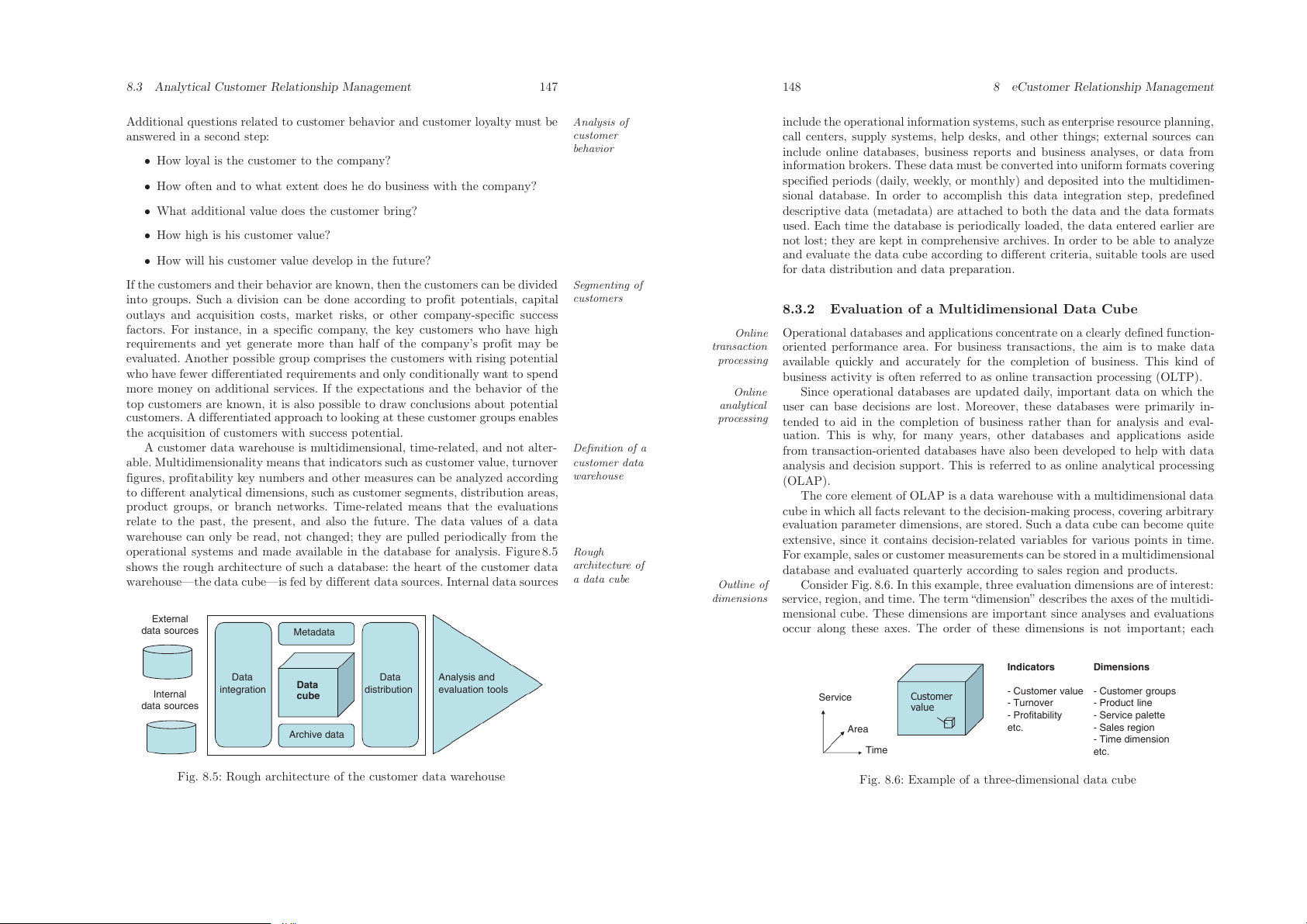
operational systems and made available in the database for analysis. Figure 8.5 Rough
For example, sales or customer measurements can be stored in a multidimensional
shows the rough architecture of such a database: the heart of the customer data architecture of
database and evaluated quarterly according to sales region and products. a data cube
warehouse—the data cube—is fed by different data sources. Internal data sources Outline of
Consider Fig. 8.6. In this example, three evaluation dimensions are of interest: dimensions
service, region, and time. The term “dimension” describes the axes of the multidi-
mensional cube. These dimensions are important since analyses and evaluations External data sources Metadata
occur along these axes. The order of these dimensions is not important; each Indicators Dimensions Data Data Analysis and integration Data distribution Internal evaluation tools cube - Customer value - Customer groups Service Customer data sources - Turnover - Product line value - Profitability - Service palette Area etc. - Sales region Archive data - Time dimension Time etc.
Fig. 8.5: Rough architecture of the customer data warehouse
Fig. 8.6: Example of a three-dimensional data cube 8.3
Analytical Customer Relationship Management 149 150 8
eCustomer Relationship Management
user can and should be able to perform evaluations from various viewpoints. For
and distribution indicators, customer line and customer movement indicators,
example, a customer consultant prioritizes the service dimension, while an area
business process indicators, innovation potential indicators, and staff know-how
representative might want to list customer value measurements according to his
indicators are all important. These indicators, along with the dimensions, form region.
the basis of management decision support, internal and external reporting, as
A customer data warehouse supports the following operations on the data
well as computer-aided performance measurement systems. cube: Determining
The dimensions are the economically relevant formation and evaluation crite- the dimensions
ria, such as customer groups, service and product palettes, sales regions, or sales
Drill down. This command allows a part of the cube to be evaluated in greater From the
channels. As already discussed above, the dimension of time strictly belongs to
depth by increasing the detail presented for a particular dimensional region. For coarse to the
customer data warehouses. The dimensions themselves can be substructured: the
example, the annual perspective can be broken down into months, weeks, or even detailed
customer dimension can contain segments and subgroups; the time dimension
days, or a region may be analyzed in detail according to subregions or branches.
can also cover—aside from yearly data—months, weeks, and days. A dimension
Depending upon the granularity of the data cube, it should be possible to break
thus describes the desired aggregation level used in the evaluation of the multi-
the data down into individual customers, services, or daily perspectives. dimensional cube.
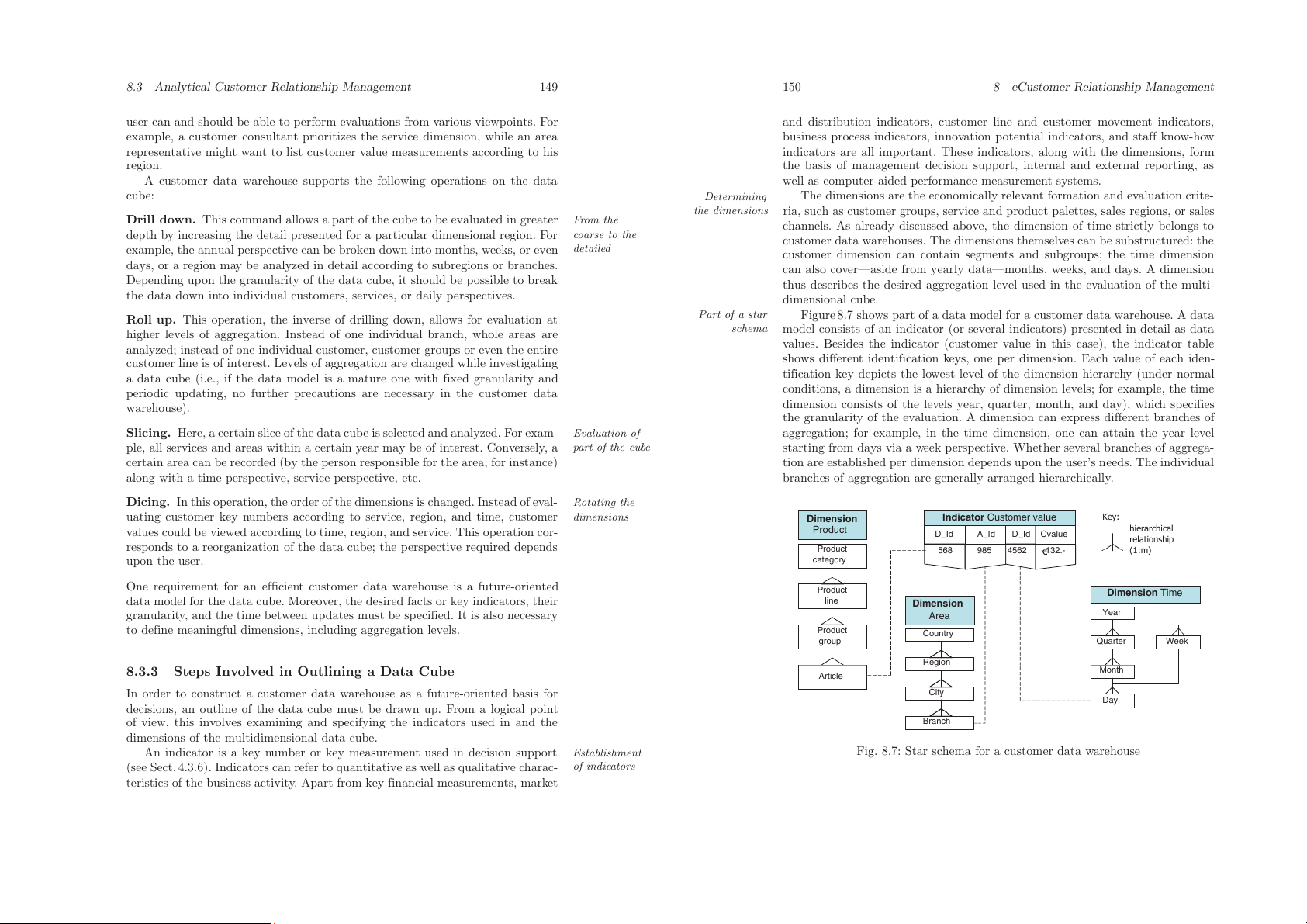
Roll up. This operation, the inverse of drilling down, allows for evaluation at Part of a star
Figure 8.7 shows part of a data model for a customer data warehouse. A data schema
higher levels of aggregation. Instead of one individual branch, whole areas are
model consists of an indicator (or several indicators) presented in detail as data
analyzed; instead of one individual customer, customer groups or even the entire
values. Besides the indicator (customer value in this case), the indicator table
customer line is of interest. Levels of aggregation are changed while investigating
shows different identification keys, one per dimension. Each value of each iden-
a data cube (i.e., if the data model is a mature one with fixed granularity and
tification key depicts the lowest level of the dimension hierarchy (under normal
periodic updating, no further precautions are necessary in the customer data
conditions, a dimension is a hierarchy of dimension levels; for example, the time warehouse).
dimension consists of the levels year, quarter, month, and day), which specifies
the granularity of the evaluation. A dimension can express different branches of
Slicing. Here, a certain slice of the data cube is selected and analyzed. For exam- Evaluation of
aggregation; for example, in the time dimension, one can attain the year level
ple, all services and areas within a certain year may be of interest. Conversely, a part of the cube
starting from days via a week perspective. Whether several branches of aggrega-
certain area can be recorded (by the person responsible for the area, for instance)
tion are established per dimension depends upon the user’s needs. The individual
along with a time perspective, service perspective, etc.
branches of aggregation are generally arranged hierarchically.
Dicing. In this operation, the order of the dimensions is changed. Instead of eval- Rotating the
uating customer key numbers according to service, region, and time, customer dimensions Dimension
Indicator Customer value Key:
values could be viewed according to time, region, and service. This operation cor- Product hierarchical D_Id A_Id D_Id Cvalue relationship
responds to a reorganization of the data cube; the perspective required depends Product 568 985 4562 132.- (1:m) upon the user. category
One requirement for an efficient customer data warehouse is a future-oriented Product Dimension Time
data model for the data cube. Moreover, the desired facts or key indicators, their line Dimension
granularity, and the time between updates must be specified. It is also necessary Area Year
to define meaningful dimensions, including aggregation levels. Product Country group Quarter Week Region 8.3.3
Steps Involved in Outlining a Data Cube Month Article
In order to construct a customer data warehouse as a future-oriented basis for City Day
decisions, an outline of the data cube must be drawn up. From a logical point
of view, this involves examining and specifying the indicators used in and the Branch
dimensions of the multidimensional data cube.
An indicator is a key number or key measurement used in decision support Establishment
Fig. 8.7: Star schema for a customer data warehouse
(see Sect. 4.3.6). Indicators can refer to quantitative as well as qualitative charac- of indicators
teristics of the business activity. Apart from key financial measurements, market 8.3
Analytical Customer Relationship Management 151 152 8
eCustomer Relationship Management 8.3.4 Data Mining Procedure
as close to one another physically as possible or far apart; both variants exhibit
their advantages and disadvantages).
Data mining means exploring a database or digging for valuable information in What is data
it. The term “mining” refers to the mining industry, where large quantities of mining? Generalization
Generalization. When a customer data cube is evaluated, interest often focuses
rock are broken up in order to extract jewels or precious metals. and
on reports about aggregated data rather than detailed data. The abstraction of
More precisely, data mining is the use of algorithms to extract and represent Pattern specialization
objects into object categories is called generalization (e.g., we can generalize the
patterns in data. Specific algorithms are needed for data mining in order to be recognition
behavior of individual customers to the behavior of customer groups). The reverse
able to analyze extensive volumes of data. Possible patterns relate to promis-
direction—the analysis of an individual customer or a subgroup instead of a cus-
ing business constellations (e.g., in terms of customer behavior and customer
tomer group—is called specialization. Generalization functions and specialization relationship maintenance).
functions can therefore be applied to different aggregation levels.
Two different problem areas can be addressed with data-mining procedures, Data-mining
as shown in Fig. 8.8. Starting from company data and market information that procedures
If the customer, his relationship to the company and his behavior are analyzed,
were purposefully collected in a customer data warehouse, analyses such as prog-
then future-oriented reports and prognoses can be drawn up. The following two
noses for relationship maintenance and the optimization of marketing activities
procedures have gained importance:
can be generated. In terms of the analysis of the customer, his sales behavior, Allocation of
and his involvement in the customer relationship, the following procedures are
Classification. The allocation of customers into given categories based on the customers into
characteristics of the customers is called classification. A well-known example is emphasized: categories
risk examination at financial or insurance institutions, in which the customers
are divided into high-risk and low-risk customers. Classification problems can Data Mining for CRM
be solved by decision trees, neural networks, or genetic algorithms: decision trees
segment the volume of data based on certain characteristics; a detailed discussion
of such decision trees is provided in Sect. 8.3.5. A neural networks is a form of Analysis Prognosis
computer-based processing that mimics the way in which nerve cells operate. of the existing customer
of the future relationship with
It consists of a network of simple components arranged in layers, where each relationship and customer the customer and the
component is coupled to components from surrounding layers. As well as pattern behavior development of the behavior
recognition in data mining, neural networks are used for language analysis or for Clustering and Classification
image processing. Genetic algorithms borrow the processing strategy associated deviation analysis
with evolutionary theory in order to find the best possible solution to a problem. Effect prognosis Association
Starting with a (virtual) population, new populations are generated via mutation
and crossbreeding rules, which are evaluated with the aid of a fitness function. Generalization
After repeating heredity processes over a number of generations, it is hoped that
Fig. 8.8: Analysis and prognosis procedures for CRM
a promising solution variant will emerge. Prognosis
Effect prognosis. Characteristic individual developments of the customer can
Clustering and deviation analysis. The goal of clustering is to group to- Similar procedure
be estimated using a prognosis procedure. For example, we may be interested in
gether customers with similar customer profiles and customer behavior. Deviation customer
the order volume of a customer for the next report period, based on his present
analysis aims to recognize changes in developmental and behavioral patterns and profiles
purchase behavior. Statistical procedures (e.g., regression analysis), neural net-
to find “strays” who cannot be assigned to any cluster. Clustering and deviation
works, or genetic algorithms are used for this.
analysis allow the customer line to be evaluated with respect to different criteria
Decision trees obtained from such data-mining procedures and used for customer
and a better understanding of the behavior of customer groups.
classification are described below.
Association. Dependencies between the characteristics of individual customers Shopping cart
are captured into association rules (in the form “if A and B then C”). Also in- analysis 8.3.5
Decision Trees for Customer Classification
cluded are shopping cart analyses, which evaluate products based on an evalu-
ation of purchases (evaluation of sales slips or customer charge cards) that are Purpose of
Decision trees can be used to classify customers. Each decision tree consists of
commonly bought in combination. However, such an analysis says nothing about decision trees
nodes and edges. There is a root node, as many inner nodes as desired, and a
the placement of the products (i.e., whether product combinations are displayed
number of leaves (end nodes without subtrees). An edge always connects exactly 8.3
Analytical Customer Relationship Management 153 154 8
eCustomer Relationship Management
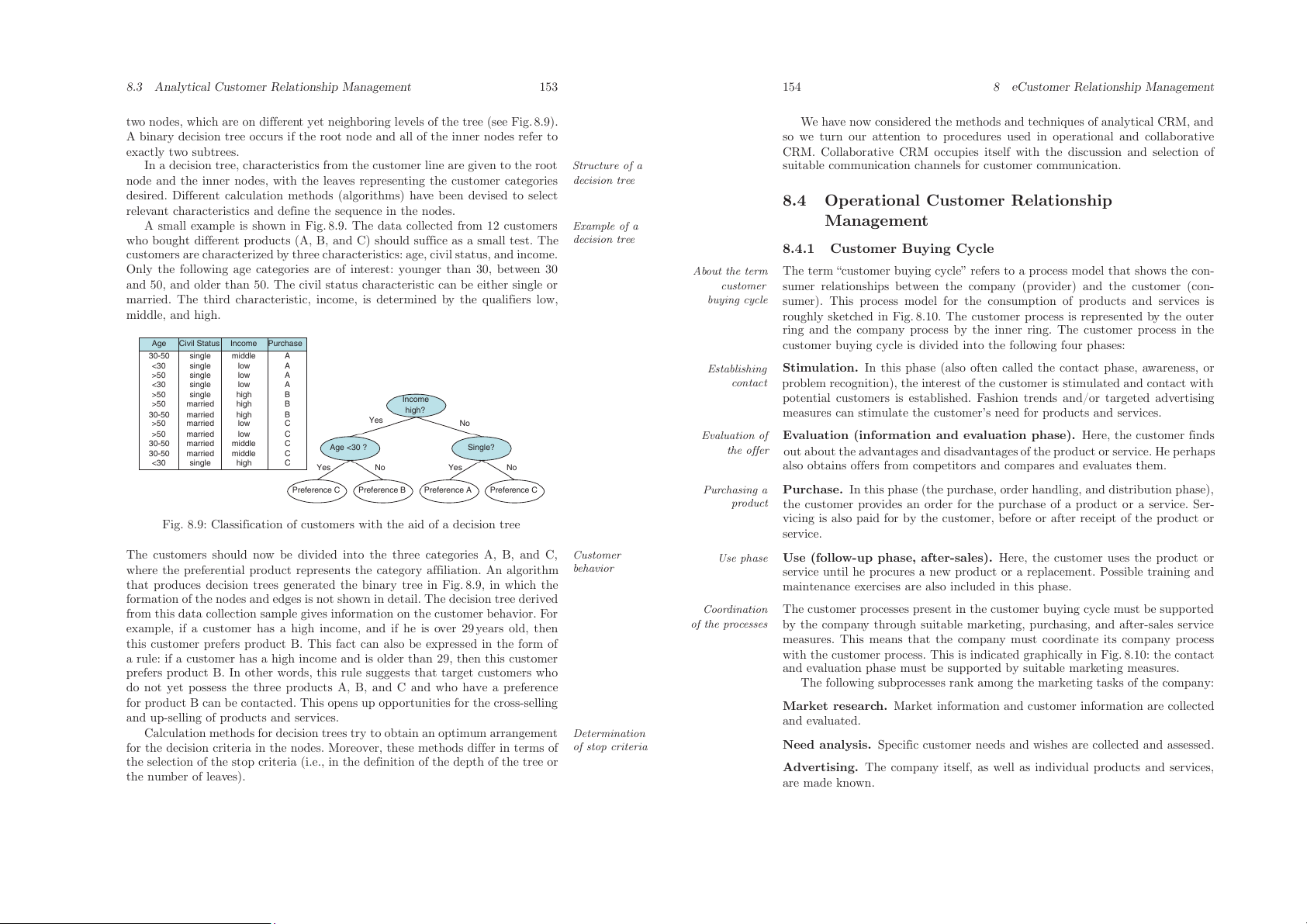
two nodes, which are on different yet neighboring levels of the tree (see Fig. 8.9).
We have now considered the methods and techniques of analytical CRM, and
A binary decision tree occurs if the root node and all of the inner nodes refer to
so we turn our attention to procedures used in operational and collaborative exactly two subtrees.
CRM. Collaborative CRM occupies itself with the discussion and selection of
In a decision tree, characteristics from the customer line are given to the root Structure of a
suitable communication channels for customer communication.
node and the inner nodes, with the leaves representing the customer categories decision tree
desired. Different calculation methods (algorithms) have been devised to select 8.4
Operational Customer Relationship
relevant characteristics and define the sequence in the nodes.
A small example is shown in Fig. 8.9. The data collected from 12 customers Example of a Management
who bought different products (A, B, and C) should suffice as a small test. The decision tree
customers are characterized by three characteristics: age, civil status, and income. 8.4.1 Customer Buying Cycle
Only the following age categories are of interest: younger than 30, between 30 About the term
The term “customer buying cycle” refers to a process model that shows the con-
and 50, and older than 50. The civil status characteristic can be either single or customer
sumer relationships between the company (provider) and the customer (con-
married. The third characteristic, income, is determined by the qualifiers low, buying cycle
sumer). This process model for the consumption of products and services is middle, and high.
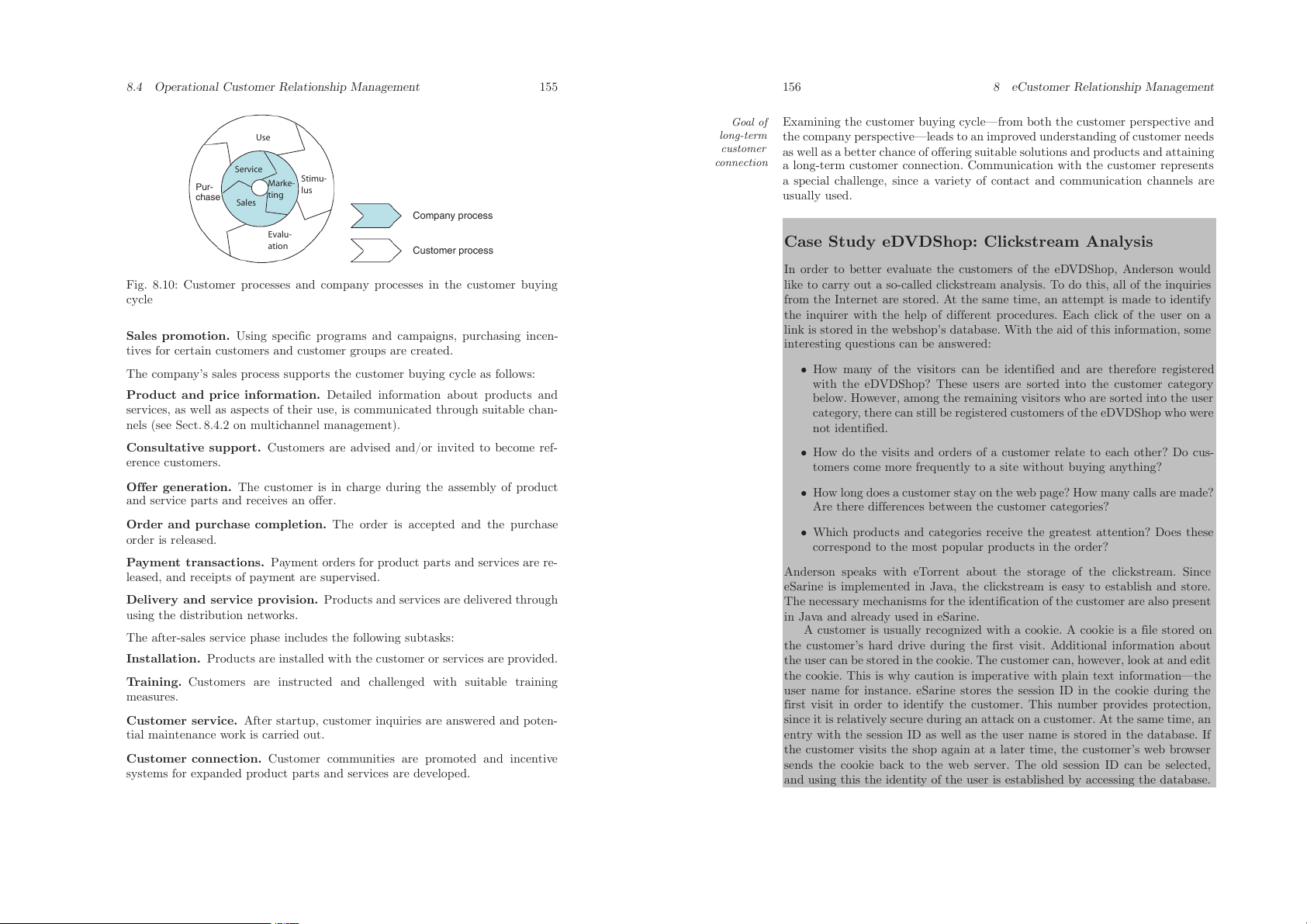
roughly sketched in Fig. 8.10. The customer process is represented by the outer
ring and the company process by the inner ring. The customer process in the Age Civil Status Income Purchase
customer buying cycle is divided into the following four phases: 30-50 single middle A <30 single low A Establishing
Stimulation. In this phase (also often called the contact phase, awareness, or >50 single low A <30 single low A contact
problem recognition), the interest of the customer is stimulated and contact with >50 single high B Income
potential customers is established. Fashion trends and/or targeted advertising >50 married high B high? 30-50 married high B
measures can stimulate the customer’s need for products and services. >50 married low C Yes No >50 married low C Evaluation of
Evaluation (information and evaluation phase). Here, the customer finds 30-50 married middle C Age <30 ? Single? 30-50 married middle C the offer
out about the advantages and disadvantages of the product or service. He perhaps <30 single high C e Y s No e Y s No
also obtains offers from competitors and compares and evaluates them. Preference C Preference B Preference A Preference C Purchasing a
Purchase. In this phase (the purchase, order handling, and distribution phase), product
the customer provides an order for the purchase of a product or a service. Ser-
Fig. 8.9: Classification of customers with the aid of a decision tree
vicing is also paid for by the customer, before or after receipt of the product or service.
The customers should now be divided into the three categories A, B, and C, Customer Use phase
Use (follow-up phase, after-sales). Here, the customer uses the product or
where the preferential product represents the category affiliation. An algorithm behavior
service until he procures a new product or a replacement. Possible training and
that produces decision trees generated the binary tree in Fig. 8.9, in which the
maintenance exercises are also included in this phase.
formation of the nodes and edges is not shown in detail. The decision tree derived
from this data collection sample gives information on the customer behavior. For Coordination
The customer processes present in the customer buying cycle must be supported
example, if a customer has a high income, and if he is over 29 years old, then of the processes
by the company through suitable marketing, purchasing, and after-sales service
this customer prefers product B. This fact can also be expressed in the form of
measures. This means that the company must coordinate its company process
a rule: if a customer has a high income and is older than 29, then this customer
with the customer process. This is indicated graphically in Fig. 8.10: the contact
prefers product B. In other words, this rule suggests that target customers who
and evaluation phase must be supported by suitable marketing measures.
do not yet possess the three products A, B, and C and who have a preference
The following subprocesses rank among the marketing tasks of the company:
for product B can be contacted. This opens up opportunities for the cross-selling
Market research. Market information and customer information are collected
and up-selling of products and services. and evaluated.
Calculation methods for decision trees try to obtain an optimum arrangement Determination
for the decision criteria in the nodes. Moreover, these methods differ in terms of of stop criteria
Need analysis. Specific customer needs and wishes are collected and assessed.
the selection of the stop criteria (i.e., in the definition of the depth of the tree or
Advertising. The company itself, as well as individual products and services, the number of leaves). are made known. 8.4
Operational Customer Relationship Management 155 156 8
eCustomer Relationship Management Goal of
Examining the customer buying cycle—from both the customer perspective and Use long-term
the company perspective—leads to an improved understanding of customer needs customer
as well as a better chance of offering suitable solutions and products and attaining connection Service
a long-term customer connection. Communication with the customer represents Stimu-
a special challenge, since a variety of contact and communication channels are Pur- Marke- lus chase ting usually used. Sales Company process Evalu- ation
Case Study eDVDShop: Clickstream Analysis Customer process
In order to better evaluate the customers of the eDVDShop, Anderson would
Fig. 8.10: Customer processes and company processes in the customer buying
like to carry out a so-called clickstream analysis. To do this, all of the inquiries cycle
from the Internet are stored. At the same time, an attempt is made to identify
the inquirer with the help of different procedures. Each click of the user on a
Sales promotion. Using specific programs and campaigns, purchasing incen-
link is stored in the webshop’s database. With the aid of this information, some
interesting questions can be answered:
tives for certain customers and customer groups are created.
The company’s sales process supports the customer buying cycle as follows:
• How many of the visitors can be identified and are therefore registered
with the eDVDShop? These users are sorted into the customer category
Product and price information. Detailed information about products and
below. However, among the remaining visitors who are sorted into the user
services, as well as aspects of their use, is communicated through suitable chan-
category, there can still be registered customers of the eDVDShop who were
nels (see Sect. 8.4.2 on multichannel management). not identified.
Consultative support. Customers are advised and/or invited to become ref-
• How do the visits and orders of a customer relate to each other? Do cus- erence customers.
tomers come more frequently to a site without buying anything?
Offer generation. The customer is in charge during the assembly of product
and service parts and receives an offer.
• How long does a customer stay on the web page? How many calls are made?
Are there differences between the customer categories?
Order and purchase completion. The order is accepted and the purchase order is released.
• Which products and categories receive the greatest attention? Does these
correspond to the most popular products in the order?
Payment transactions. Payment orders for product parts and services are re-
leased, and receipts of payment are supervised.
Anderson speaks with eTorrent about the storage of the clickstream. Since
eSarine is implemented in Java, the clickstream is easy to establish and store.
Delivery and service provision. Products and services are delivered through
The necessary mechanisms for the identification of the customer are also present
using the distribution networks.
in Java and already used in eSarine.
A customer is usually recognized with a cookie. A cookie is a file stored on
The after-sales service phase includes the following subtasks:
the customer’s hard drive during the first visit. Additional information about
Installation. Products are installed with the customer or services are provided.
the user can be stored in the cookie. The customer can, however, look at and edit
Training. Customers are instructed and challenged with suitable training
the cookie. This is why caution is imperative with plain text information—the measures.
user name for instance. eSarine stores the session ID in the cookie during the
first visit in order to identify the customer. This number provides protection,
Customer service. After startup, customer inquiries are answered and poten-
since it is relatively secure during an attack on a customer. At the same time, an
tial maintenance work is carried out.
entry with the session ID as well as the user name is stored in the database. If
the customer visits the shop again at a later time, the customer’s web browser
Customer connection. Customer communities are promoted and incentive
sends the cookie back to the web server. The old session ID can be selected,
systems for expanded product parts and services are developed.
and using this the identity of the user is established by accessing the database. 8.4
Operational Customer Relationship Management 157 158 8
eCustomer Relationship Management
However cookies are somewhat controversial, since they do limit user anonymity Company Customer
on the Internet. For this reason there are users who do not permit the storage Channel Medium of cookies. Personal Branch
After a few weeks, Anderson compiles a statistics report and is surprised contact Stimulation
by the large number of users who visit his site without registering or buying Marketing Self-service Telephone
anything. They click on an average of 3.2 pages before they leave the eDVDShop. system SMS Evaluation
Anderson considers providing a special offer for new customers in order to induce them to make a purchase. Sales Field service Letter Purchase Contact eMail center Service Use Web portal WWW 8.4.2 Multichannel Management
The term “multichannel management” has not yet become firmly established Unclear term
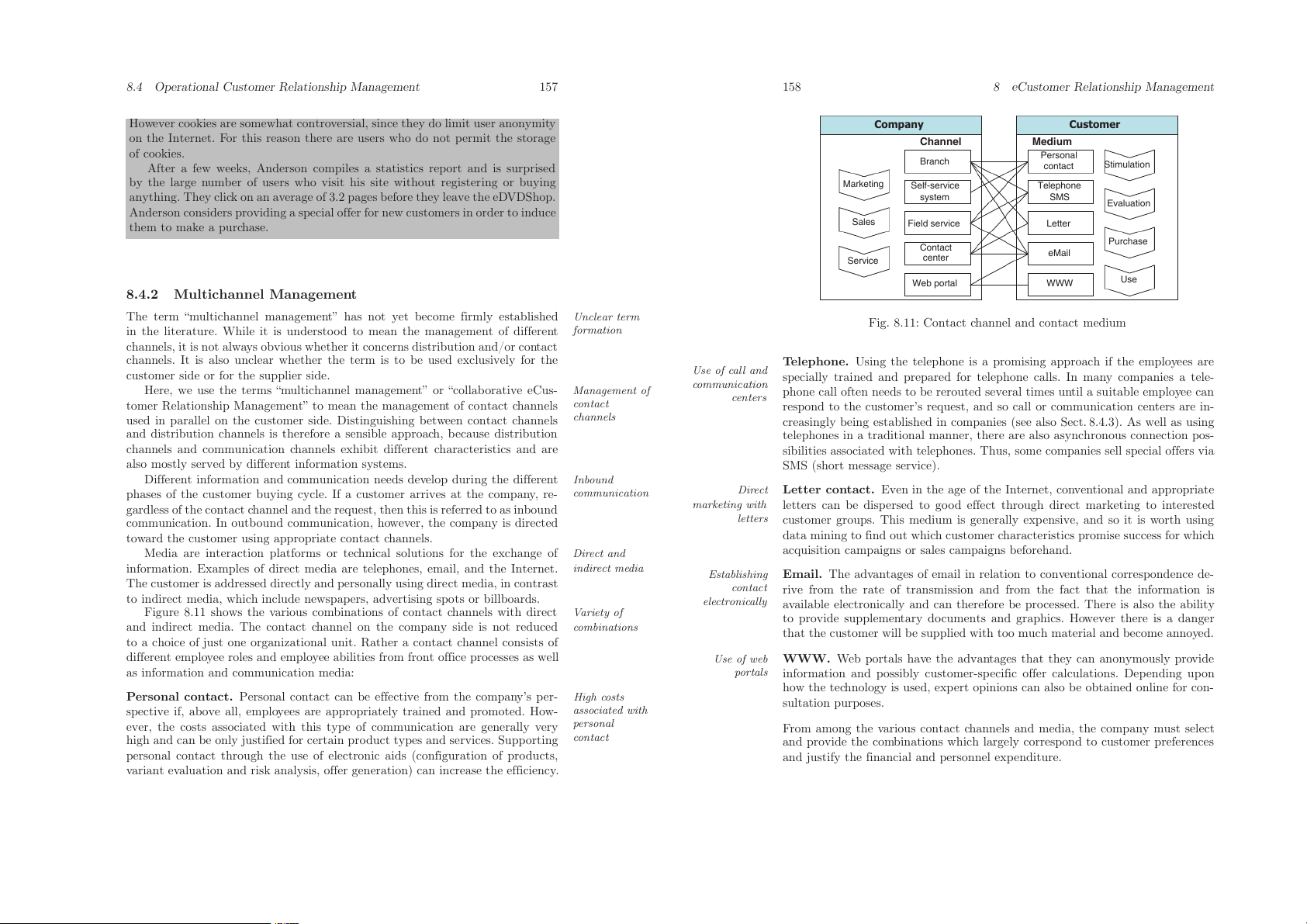
Fig. 8.11: Contact channel and contact medium
in the literature. While it is understood to mean the management of different formation
channels, it is not always obvious whether it concerns distribution and/or contact
channels. It is also unclear whether the term is to be used exclusively for the
Telephone. Using the telephone is a promising approach if the employees are
customer side or for the supplier side. Use of call and
specially trained and prepared for telephone calls. In many companies a tele- communication
Here, we use the terms “multichannel management” or “collaborative eCus- Management of
phone call often needs to be rerouted several times until a suitable employee can centers
tomer Relationship Management” to mean the management of contact channels contact
respond to the customer’s request, and so call or communication centers are in- channels
used in parallel on the customer side. Distinguishing between contact channels
creasingly being established in companies (see also Sect. 8.4.3). As well as using
and distribution channels is therefore a sensible approach, because distribution
telephones in a traditional manner, there are also asynchronous connection pos-
channels and communication channels exhibit different characteristics and are
sibilities associated with telephones. Thus, some companies sell special offers via
also mostly served by different information systems. SMS (short message service).
Different information and communication needs develop during the different Inbound
phases of the customer buying cycle. If a customer arrives at the company, re- communication Direct
Letter contact. Even in the age of the Internet, conventional and appropriate
gardless of the contact channel and the request, then this is referred to as inbound marketing with
letters can be dispersed to good effect through direct marketing to interested
communication. In outbound communication, however, the company is directed letters
customer groups. This medium is generally expensive, and so it is worth using
toward the customer using appropriate contact channels.
data mining to find out which customer characteristics promise success for which
Media are interaction platforms or technical solutions for the exchange of Direct and
acquisition campaigns or sales campaigns beforehand.
information. Examples of direct media are telephones, email, and the Internet. indirect media Establishing
Email. The advantages of email in relation to conventional correspondence de-
The customer is addressed directly and personally using direct media, in contrast contact
rive from the rate of transmission and from the fact that the information is
to indirect media, which include newspapers, advertising spots or billboards. electronically
available electronically and can therefore be processed. There is also the ability
Figure 8.11 shows the various combinations of contact channels with direct Variety of
to provide supplementary documents and graphics. However there is a danger
and indirect media. The contact channel on the company side is not reduced combinations
that the customer will be supplied with too much material and become annoyed.
to a choice of just one organizational unit. Rather a contact channel consists of
different employee roles and employee abilities from front office processes as well Use of web
WWW. Web portals have the advantages that they can anonymously provide
as information and communication media: portals
information and possibly customer-specific offer calculations. Depending upon
how the technology is used, expert opinions can also be obtained online for con-
Personal contact. Personal contact can be effective from the company’s per- High costs sultation purposes.
spective if, above all, employees are appropriately trained and promoted. How- associated with personal
ever, the costs associated with this type of communication are generally very
From among the various contact channels and media, the company must select contact
high and can be only justified for certain product types and services. Supporting
and provide the combinations which largely correspond to customer preferences
personal contact through the use of electronic aids (configuration of products,
and justify the financial and personnel expenditure.
variant evaluation and risk analysis, offer generation) can increase the efficiency. 8.4
Operational Customer Relationship Management 159 160 8
eCustomer Relationship Management 8.4.3
Inbound and Outbound Customer Processes Processing
Classifying and processing the inbound. The inbounds are classified and categories of
forwarded accordingly for processing. The following processing categories can
In inbound communication, the company receives incoming customer inquiries, About inbound inbound thereby be differentiated:
assesses them, and (if necessary) forwards them to other company units for pro- communication communication
cessing. These customer inquiries are often bundled by a contact or interaction • Providing information
center, since these organizational units are trained for customer dialog and are • Requesting an offer
connected to the most important information systems in the company.
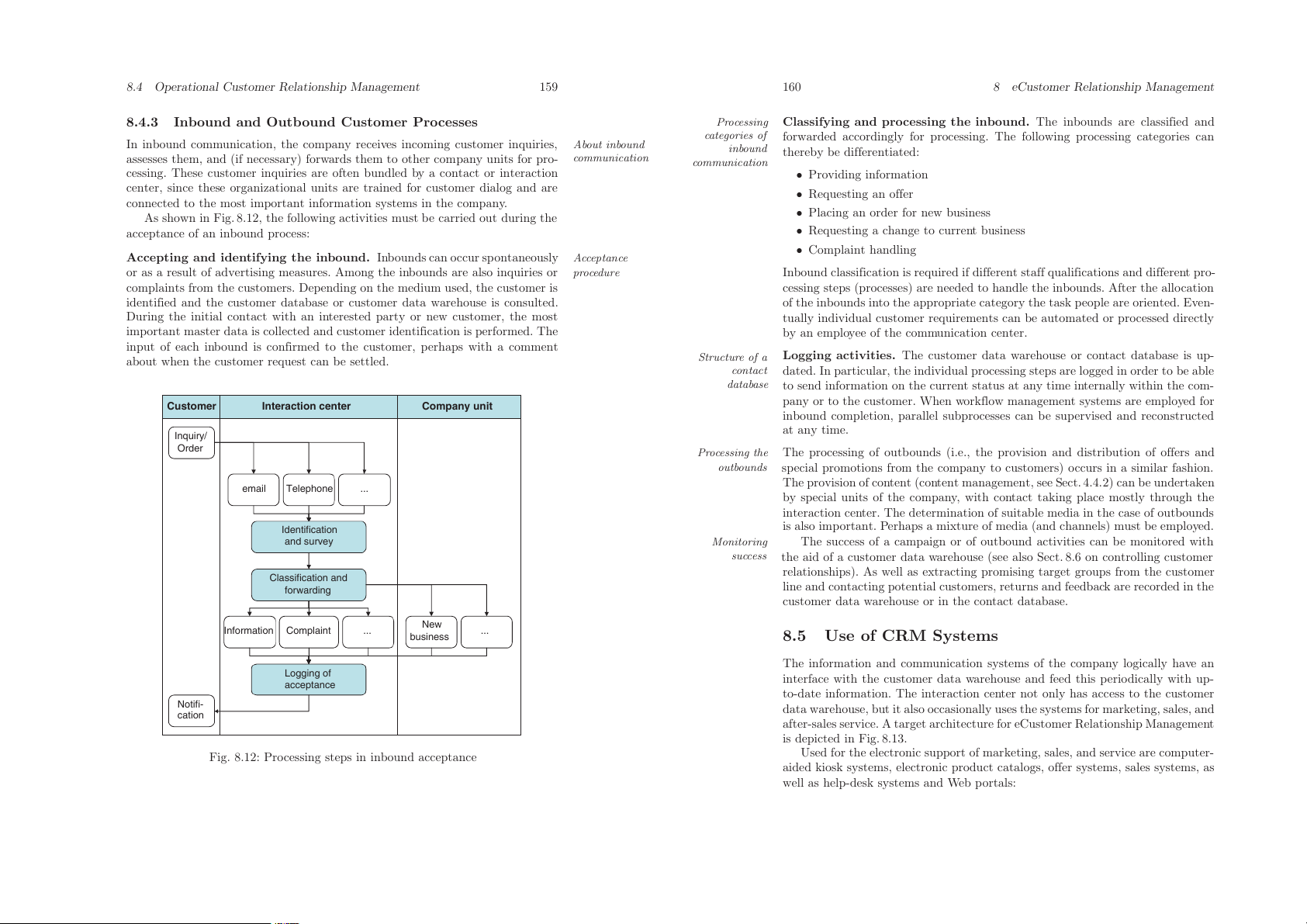
As shown in Fig. 8.12, the following activities must be carried out during the
• Placing an order for new business
acceptance of an inbound process:
• Requesting a change to current business
Accepting and identifying the inbound. Inbounds can occur spontaneously Acceptance • Complaint handling
or as a result of advertising measures. Among the inbounds are also inquiries or procedure
Inbound classification is required if different staff qualifications and different pro-
complaints from the customers. Depending on the medium used, the customer is
cessing steps (processes) are needed to handle the inbounds. After the allocation
identified and the customer database or customer data warehouse is consulted.
of the inbounds into the appropriate category the task people are oriented. Even-
During the initial contact with an interested party or new customer, the most
tually individual customer requirements can be automated or processed directly
important master data is collected and customer identification is performed. The
by an employee of the communication center.
input of each inbound is confirmed to the customer, perhaps with a comment
about when the customer request can be settled. Structure of a
Logging activities. The customer data warehouse or contact database is up- contact
dated. In particular, the individual processing steps are logged in order to be able database
to send information on the current status at any time internally within the com- Customer Interaction center Company unit
pany or to the customer. When workflow management systems are employed for
inbound completion, parallel subprocesses can be supervised and reconstructed at any time. Inquiry/ Order Processing the
The processing of outbounds (i.e., the provision and distribution of offers and outbounds
special promotions from the company to customers) occurs in a similar fashion.
The provision of content (content management, see Sect. 4.4.2) can be undertaken email Telephone ...
by special units of the company, with contact taking place mostly through the
interaction center. The determination of suitable media in the case of outbounds Identification
is also important. Perhaps a mixture of media (and channels) must be employed. and survey Monitoring
The success of a campaign or of outbound activities can be monitored with success
the aid of a customer data warehouse (see also Sect. 8.6 on controlling customer
relationships). As well as extracting promising target groups from the customer Classification and forwarding
line and contacting potential customers, returns and feedback are recorded in the
customer data warehouse or in the contact database. New Information Complaint ... ... business 8.5 Use of CRM Systems
The information and communication systems of the company logically have an Logging of
interface with the customer data warehouse and feed this periodically with up- acceptance
to-date information. The interaction center not only has access to the customer Notifi-
data warehouse, but it also occasionally uses the systems for marketing, sales, and cation
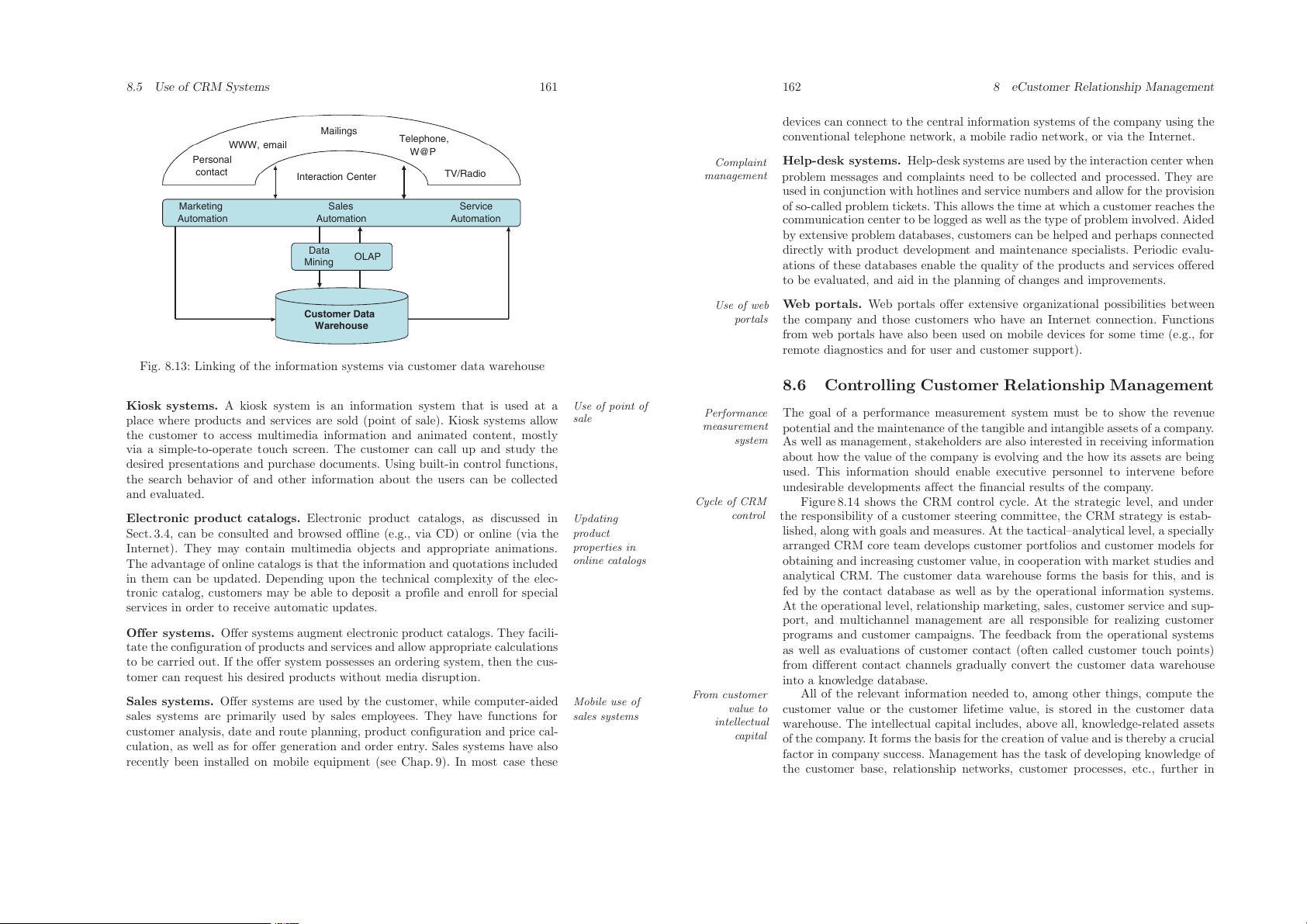
after-sales service. A target architecture for eCustomer Relationship Management is depicted in Fig. 8.13.
Fig. 8.12: Processing steps in inbound acceptance
Used for the electronic support of marketing, sales, and service are computer-
aided kiosk systems, electronic product catalogs, offer systems, sales systems, as
well as help-desk systems and Web portals: 8.5 Use of CRM Systems 161 162 8
eCustomer Relationship Management
devices can connect to the central information systems of the company using the Mailings Telephone,
conventional telephone network, a mobile radio network, or via the Internet. WWW, email W@P Personal Complaint
Help-desk systems. Help-desk systems are used by the interaction center when contact Interaction Center TV/Radio management
problem messages and complaints need to be collected and processed. They are
used in conjunction with hotlines and service numbers and allow for the provision Marketing Sales Service
of so-called problem tickets. This allows the time at which a customer reaches the Automation Automation Automation
communication center to be logged as well as the type of problem involved. Aided
by extensive problem databases, customers can be helped and perhaps connected Data
directly with product development and maintenance specialists. Periodic evalu- OLAP Mining
ations of these databases enable the quality of the products and services offered
to be evaluated, and aid in the planning of changes and improvements. Use of web
Web portals. Web portals offer extensive organizational possibilities between Customer Data portals
the company and those customers who have an Internet connection. Functions Warehouse
from web portals have also been used on mobile devices for some time (e.g., for
remote diagnostics and for user and customer support).
Fig. 8.13: Linking of the information systems via customer data warehouse 8.6
Controlling Customer Relationship Management
Kiosk systems. A kiosk system is an information system that is used at a Use of point of Performance
The goal of a performance measurement system must be to show the revenue
place where products and services are sold (point of sale). Kiosk systems allow sale measurement
potential and the maintenance of the tangible and intangible assets of a company.
the customer to access multimedia information and animated content, mostly system
As well as management, stakeholders are also interested in receiving information
via a simple-to-operate touch screen. The customer can call up and study the
about how the value of the company is evolving and the how its assets are being
desired presentations and purchase documents. Using built-in control functions,
used. This information should enable executive personnel to intervene before
the search behavior of and other information about the users can be collected
undesirable developments affect the financial results of the company. and evaluated. Cycle of CRM
Figure 8.14 shows the CRM control cycle. At the strategic level, and under
Electronic product catalogs. Electronic product catalogs, as discussed in Updating control
the responsibility of a customer steering committee, the CRM strategy is estab-
Sect. 3.4, can be consulted and browsed offline (e.g., via CD) or online (via the product
lished, along with goals and measures. At the tactical–analytical level, a specially
Internet). They may contain multimedia objects and appropriate animations. properties in
arranged CRM core team develops customer portfolios and customer models for online catalogs
The advantage of online catalogs is that the information and quotations included
obtaining and increasing customer value, in cooperation with market studies and
in them can be updated. Depending upon the technical complexity of the elec-
analytical CRM. The customer data warehouse forms the basis for this, and is
tronic catalog, customers may be able to deposit a profile and enroll for special
fed by the contact database as well as by the operational information systems.
services in order to receive automatic updates.
At the operational level, relationship marketing, sales, customer service and sup-
port, and multichannel management are all responsible for realizing customer
Offer systems. Offer systems augment electronic product catalogs. They facili-
programs and customer campaigns. The feedback from the operational systems
tate the configuration of products and services and allow appropriate calculations
as well as evaluations of customer contact (often called customer touch points)
to be carried out. If the offer system possesses an ordering system, then the cus-
from different contact channels gradually convert the customer data warehouse
tomer can request his desired products without media disruption. into a knowledge database. From customer
All of the relevant information needed to, among other things, compute the
Sales systems. Offer systems are used by the customer, while computer-aided Mobile use of value to
customer value or the customer lifetime value, is stored in the customer data
sales systems are primarily used by sales employees. They have functions for sales systems intellectual
warehouse. The intellectual capital includes, above all, knowledge-related assets
customer analysis, date and route planning, product configuration and price cal- capital
of the company. It forms the basis for the creation of value and is thereby a crucial
culation, as well as for offer generation and order entry. Sales systems have also
factor in company success. Management has the task of developing knowledge of
recently been installed on mobile equipment (see Chap. 9). In most case these
the customer base, relationship networks, customer processes, etc., further in 8.7 Literary References 163 164 8
eCustomer Relationship Management Strategic Level
examine aspects of a customer data warehouse or the use of database technologies
in marketing, sales, and customer management. -Process strategy development Standard works
Some standard works on data warehouse systems are available. An early work S
-Customer production and recovery tr on data
with clear concept formation was provided by Inmon [Inm96]. The work by Kim- a -Cross-selling and up-selling te -Customer connection programs warehouses g
ball et al. [Kim96], which describes all of the aspects of planning and operating ic a
a data warehouse system, is one of the more well known. Adamson and Vener- n y d c
Tactical-Analytical Level
able [Ada98] focus on discussing an outline of and the development of a data n o p ie
warehouse. Jarke et al. [Jar00] illustrate the state of research in this field, in e Analysis and r ffic a model building t
addition to general methods and techniques. i f e o Customer n Contact o Literature on
Adriaans and Zantige [Adr96] give an overview of data mining and the KDD a data re l database g u s KDD process
process (Knowledge Discovery in Databases) with illustrative examples. Addi- u Evaluation warehouse a id e
tional standard works on data mining come from Han and Kamber [Han01], Weiss e and prognosis l M in
and Indurkhya [Wei98], as well as from Witten and Frank [Wit99]. Different pro- e s
cedures such as clustering, decision trees, association rules, neural networks, and Mar- Ser-
genetic algorithms are described in these works, including a procedural model for Sales keting vice the KDD process.
The use of data-mining algorithms for sales, distribution, and customer Operational Level Contact channels
support is tackled in the works by Berry and Linoff [Ber97] and Berson and
Smith [Ber99]. Kaushik [Kau07] has written a book about web analytics and
Fig. 8.14: Control cycle for customer relationship management
provides a guide for implementing it step by step. On the
The management of intangible assets is increasingly presenting new challenges
order to enhance the intellectual property of the company as well as to secure it management of
to companies. In this field, the work by Kaplan and Norton [Kap96b] on the intangible
for the long term using the control process outlined above.
balanced scorecard, which improves the steering of the functional chain towards assets
company success, is well known. Edvinsson and Malone [Edv97] show in their
work on intellectual capital the significance of customer capital, organization 8.7 Literary References
capital, and human capital. Küng et al. [KMW01] illustrate the basic principles
of using information systems for performance measurement.
The Internet and electronic business relationships affect customer management to
a considerable degree. Kotler et al. [Kot02] deal with these changes and describe
a holistic marketing concept that can be applied to meet the challenges of elec-
tronic business. In the Harvard Business Review [Har02] on customer relationship
management, a collection of papers describe relationship building strategies. A
book by Buttle [But04] shows the roles played by customer data and information
technology in enabling customer relationships to be implemented.
Approaches that can be used to increase customer orientation and to improve Literature on
CRM have been widely discussed in the last few years in scientific circles and customer
implemented in practice to some degree. Lately, the focus has shifted more and capital
more towards customer value. Some works on this have been published: in En-
glish. Blattberg et al. [Bla01] developed a customer equity model that is oriented
towards the customer life cycle and computing the acquisition equity, the cus-
tomer connection equity, and the add-on equity from increased sales effort. Rust
et al. [Rus00] regard the three components of value equity, brand equity and
retention equity as being influential variables in the customer equity.
An array of textbooks and research work have recently been published that
focus on the topics of data warehousing and data mining. Some of these works
Tài liệu liên quan:
-

Giáo trình logistic về quản trị logistics
6 3 -

Chương 3 Đóng gói và vân chuyển - Mối quan hệ giữa đóng gói và vận chuyển trong logistics môn Logistics | Trường Đại học Kinh tế, Đại học Quốc gia Hà Nội
29 15 -
Yếu Tố: Các Quy Định Mà Tổ Chức Tuân Thủ môn logistics | Trường Đại học Kinh tế, Đại học Quốc gia Hà Nội
26 13 -
Mối liên hệ giữa Logistics và Vận tải đa phương thức môn Logistics | Trường Đại học Kinh tế, Đại học Quốc gia Hà Nội
38 19