European Journal of Soil Biology - Soil enzymes activity
European Journal of Soil Biology - Soil enzymes activity. Tài liệu được sưu tầm giúp bạn tham khảo, ôn tập và đạt kết quả cao. Mời bạn đọc đón xem.
Môn: Tài liệu Tổng hợp 3.6 K tài liệu
Trường: Tài liệu khác 3.9 K tài liệu
Tác giả:








Preview text:
European Journal of Soil Biology 103 (2021) 103292
Contents lists available at ScienceDirect
European Journal of Soil Biology
journal homepage: www.elsevier.com/locate/ejsobi
Soil enzymes activity: Effect of climate smart agriculture on rhizosphere
and bulk soil under cereal based systems of north-west India
H.S. Jat a,b, Ashim Datta a,*, Madhu Choudhary a,**, P.C. Sharma a,***, Bharti Dixit a,c, M.L. Jat b
a ICAR-Central Soil Salinity Research Institute (CSSRI), Karnal, Haryana, India
b International Maize and Wheat Improvement Center (CIMMYT), New Delhi, India
c Choudhary Charan Singh Haryana Agricultural University, Hisar, India A R T I C L E I N F O A B S T R A C T
Handling editorYakov Kuzyakov
In agriculture production system, soil enzymes are important indicators of soil quality. Measurements of soil
quality parameter changes are essential for assessing the impact of soil and crop management practices. Keeping Keywords:
this in view, an experiment was conducted to evaluate the enzyme activities namely dehydrogenase (DHA), Conservation agriculture
β-glucosidase, acid and alkaline phosphatase (AcP & AlP), fluorescein diacetate hydrolases (FDH), cellulase, Climate smart agriculture
urease and aryl sulphatase in rhizosphere and bulk soil after 8 years of different management regimes. Soil Rhizosphere Rice-wheat system
organic carbon (SOC), moisture content and few enzyme indices such as enzymatic pH indicator (AcP/AlP), Maize-wheat system
alteration index three (Al3) and geometric mean (GMea) were also measured. The treatments were conventional Long term managements
rice-wheat system (termed as scenario (Sc1), CT system), partial conservation agriculture (CA)-based rice-wheat-
mungbean system (Sc2, PCA-RW), partial climate smart agriculture (CSA)-based rice-wheat-mungbean system
(Sc3), partial CSA-based maize-wheat-mungbean system (Sc4), full CSA-based rice-wheat-mungbean system
(Sc5), and full CSA-based maize-wheat-mungbean system (Sc6). Soil samples were collected from rhizosphere
and away from roots (bulk soil) at 0–15 cm soil depth before sowing (from rhizosphere of previous crops), at
maximum tillering, flowering, and after harvesting of wheat crop. Results showed that DHA activity was higher
before sowing (59.8%), at maximum tillering (48.4%), flowering (8.6%) and after harvesting (19.1%) in rice
based CSA systems (mean of Sc3 and Sc5) over maize based CSA systems (mean of Sc4 and Sc6) in rhizospheric
soil. On average, β-glucosidase activity was significantly higher in rhizospheric soils of rice based system over
maize based CSA system. Before sowing of wheat, significantly higher (21.4%) acid phosphatase activity was
observed in rhizosphere over bulk soils of maize based CSA system. Significantly higher alkaline phosphatase
activity was observed before sowing of wheat in bulk soils of rice (25.3%) and maize (38.5%) based CSA systems
over rhizospheric soils. Rice based CSA systems showed 27% higher FDH activity than maize based systems.
Significant interaction effect was observed between the managements and enzymes. SOC played an important
role in regulating the enzymes activity both in rhizosphere and bulk soil. Significant variation in AcP/AlP, Al3
and GMea was observed among the managements. Therefore, CSA managements are beneficial in improving
enzyme activities not only in rhizosphere but also in bulk soil where residues are retained thereby may help in improving nutrient cycling. 1. Introduction
enzymes act as necessary catalysts and strongly influence energy
transformation, environmental quality, and agronomic productivity.
Soil enzymes are the key players in biochemical processes of organic
Soil enzymes provide early detection of changes in soil health because
matter recycling in the soil system and their activities are closely related
they respond to soil management changes and environmental factors
to soil organic matter (SOM), soil physical properties, and microbial
much sooner than other soil quality parameters. Qualitative and quan-
activity [1]. During decomposition of SOM and nutrient cycling, soil
titative changes in soil enzymes determine the availability of nutrients
* Corresponding author. ICAR-CSSRI, Karnal.
** Corresponding author. ICAR-CSSRI, Karnal.
*** Corresponding author. ICAR-CSSRI, Karnal.
E-mail addresses: ashimdatta2007@gmail.com (A. Datta), madhucssri@gmail.com (M. Choudhary), pcsharma.knl@gmail.com (P.C. Sharma).
https://doi.org/10.1016/j.ejsobi.2021.103292
Received 25 November 2019; Received in revised form 13 August 2020; Accepted 4 February 2021
Available online 15 February 2021
1164-5563/© 2021 The Author(s).
Published by Elsevier Masson SAS. This is an open access article under the CC BY license
(http://creativecommons.org/licenses/by/4.0/). H.S. Jat et
European Journal of Soil Biology al. 103 (2021) 103292
and crop productivity [2]. Different agricultural practices like tillage,
2. Materials and methods
cropping systems, irrigation and nutrient management influence soil
enzyme activities, thereby influencing yield sustainability [3]. Adverse
2.1. Field experimental design
impacts of mechanical tillage, cropping systems, and residues removal
have been observed in soil enzymatic activities and availability of plant
The experiment was established in 2009 at the research farm of In-
nutrients [4]. Application of organic and inorganic fertilization exerts a
dian Council of Agricultural Research (ICAR) - Central Soil Salinity
strong influence on soil quality. In any agriculture production system,
Research Institute (CSSRI) (29◦70′N, 76◦95′E), Karnal, India. Soil type is
amending with organic matter and application of balanced fertilizers
loam in texture with 34% sand, 46.1% silt and 19.9% clay. It falls under
improve soil organic carbon and biological properties including micro-
Typic Natrustalf category. Climate is extreme hot and dry (April–June) to
bial biomass and enzymatic activities [5,6]. Dehydrogenase enzyme
wet summers (July–September) and cold dry winters (October–March).
activity (DHA) is considered as the indicator of oxidative activity of soil
Average annual temperature is 26 ◦C with maximum and minimum of
microorganisms and increases significantly upon application of
34◦ and 18 ◦C, respectively with annual precipitation of 650 mm. balanced fertilization [6].
Initially, the experiment comprised of four cereal-based scenarios
Climate Smart Agriculture (CSA) practices are based on conservation
varying in cropping system, tillage, crop establishment methods, and
agriculture (CA) principles of zero tillage (ZT), residue management and
residue management practices (Sc1, Sc2, Sc3 and Sc4). Treatments were
sustainable crop rotation along with precision irrigation and N-man-
replicated thrice in 20 m × 100 m plot size in randomized complete
agement using sub-surface drip irrigation (SDI) system. There are
block design. In May 2016, precise water management practice (sub-
number of advantages of CSA practices such as higher soil organic car-
surface drip irrigation; SDI) was included in subdivided plots (20 m ×
bon, improved soil physical properties, nutrient availability, and crop
50 m) of Sc3 and Sc4, respectively. Briefly, six treatments termed as
productivity as reported by researchers all over the world [7–10].
scenarios (Sc) were: i) conventional-till (CT) rice-CT wheat (Sc1;
Several studies have been done on the effect of different agriculture
farmers’ practice; CT); ii) CT rice-Zero tillage (ZT) wheat-ZT mungbean
management practices on soil enzyme activities in cereal based systems
with flood irrigation (Sc2; partial CA); iii) ZT rice-ZT wheat-ZT mung-
[11–13]. While studying the effect of series of CA based managements
bean with flood irrigation (Sc3; rice based partial CSA); iv) ZT maize-ZT
on soil enzymes, Choudhary et al. [14] reported 210% and 49% higher
wheat-ZT mungbean with flood irrigation (Sc4; maize based partial
DHA and alkaline phosphatase activity (AlP), respectively in soils under
CSA); v) ZT rice-ZT wheat-ZT mungbean with SDI (Sc5; rice based full
maize-wheat-mungbean with residue retention and 140% and 42%
CSA); and vi) ZT maize-ZT wheat-ZT mungbean with SDI (Sc6; maize
under rice-wheat-mungbean system with residue retention over con-
based full CSA). Sc3 and Sc4 were based on principles of CA practices
ventional rice-wheat system, respectively in NW India. Bergstrom et al.
where irrigation water and N application were not precisely managed
[12] compared six enzymes namely urease, glutaminase, phosphatase,
and called it partial climate smart agriculture (CSA). However, in Sc5
arylsulfatase, β-glucosidase and dehydrogenase under no tillage along a
and Sc6, irrigation water and N in the form of urea was precisely applied
topographic and soil textural gradient and observed higher β-glucosi-
using subsurface drip irrigation (SDI) and called full CSA. Best crop
dase, glutaminase, phosphatase and aryl sulfatase activity in
management practices were followed in all the treatments except Sc1,
coarse-textured soils at a lower slope than in fine-textured soil at an
where farmer’s traditional practices were followed (Supp. Table 1, Supp.
upper slope. No-tilled soil showed higher dehydrogenase, urease, pro-
Fig. 1). We used four systems for convenience, conventional tillage
tease, phosphatase and β-glucosidase activities over conventional tillage
based rice-wheat system (CT-RW), partial CA based rice-wheat mung-
system in sorghum cultivation under subtropical conditions [15].
bean system (PCA-RW) (Sc2), rice based CSA system (mean of Sc3 and
The rhizosphere zone of the plants acts as hotspot of enzyme activ-
Sc5) and maize based CSA system (mean of Sc4 and Sc6).
ities. Recently, it was stated that the rhizosphere activity should be
extended from mm scale to cm scale due to H2 fertilization effect and
2.2. Soil sampling, processing and analysis
volatile organic compounds released by roots [16]. The quantity and
quality of root exudates depends on plant type and growth stages of
Wheat is common crop among all the scenarios so soil samples were
plants [ 17] which also influence the diversity and activity of microbes,
collected from wheat season in order to explore the effect of manage-
biochemical processes and enzyme activities [17]. ‘Rhizosphere priming
ment practices (CT v/s PCA and/CSA) on different enzyme activities like
effect’ is also an important factor playing an important role in SOM
dehydrogenase (DHA), acid phosphatase (AcP), alkaline phosphatase decomposition [17].
(AlP), beta-glucosidase (β-glu), fluorescein diacetate hydrolases (FDH),
In most of the studies so far, soil samples were collected between
aryl sulphatase (ArS), urease (Ur) and cellulose (CeL) activity and SOC
rows of the crops after harvesting (called bulk soil sample). In conven-
changes. From each plot, soil samples were collected at 0–15 cm soil
tional agricultural practices, tillage mixes the stubbles/roots of previous
depth by an auger from nine locations from each rhizosphere and non-
crop with soil before sowing of next crop and after planking stubbles are
rhizosphere zones (bulk soils) and composite samples were prepared
accumulated and removed from the field. But in CSA practices, stubbles
separately before sowing, maximum tillering, flowering, and after har-
and roots of the crops are undisturbed with zero tillage condition and
vesting in the year 2017–18 (wheat was sown in November 2017 and
loose crop residues are retained over the soil surface instead of burning
harvested in April 2018). For rhizosphere zone samples, wheat plants
or removal as practiced in conventional agriculture. Generally rhizo-
were uprooted and soil adhered to roots was collected. Bulk soil samples
sphere soil is characterized by higher microbial activity due to rhizo-
were collected from the mid-point of the two rows. Row to row distance
deposition, root secretion etc. than bulk soil (away from roots) [17].
in wheat crop was 22.5 cm. Rhizosphere soil before sowing indicates
Therefore, in CSA, we may expect higher enzymes activity in bulk soil
rhizosphere of previous crops. As after harvesting of previous crop (rice
compared to conventional practices due to residue retention and also
and maize), the stubbles remain intact in soil, we collected soil samples
enzymes activity in rhizosphere and bulk soil need to be investigated to
from the rhizosphere of those crop stubbles and designated as rhizo-
capture whether there is any synergistic effect exists. There is hardly any
sphere soil before sowing. Fresh soil samples were immediately stored in
study to unveil this aspect. The objectives of this study are to assess the
a refrigerator at 4 ◦C till analysis of different enzymes. DHA, AcP and AlP
enzyme activities and SOC concentration in rhizosphere and bulk soils
activities were estimated as described by Dick et al. [18]. β-glucosidase
and their interactions after 8 years of continuous smart crop manage-
activity was determined by the method of Eivazi and Tabatabai [19],
ment practices. We hypothesize that soil enzyme activities in bulk soil
urease was by the method of Tabatabai [20] and aryl sulfatase was by
with CSA based management practices will be improved at different
the method of Tabatabai and Bremner [21]. Cellulase activity was
growth stages compared to those of conventional/tillage based man-
measured by the method of Hope and Burns [22] and FDH assay by the agement practices. method of Green et al. [23]. 2 H.S. Jat et
European Journal of Soil Biology al. 103 (2021) 103292
Root mass after harvesting of rice, wheat and maize was measured by
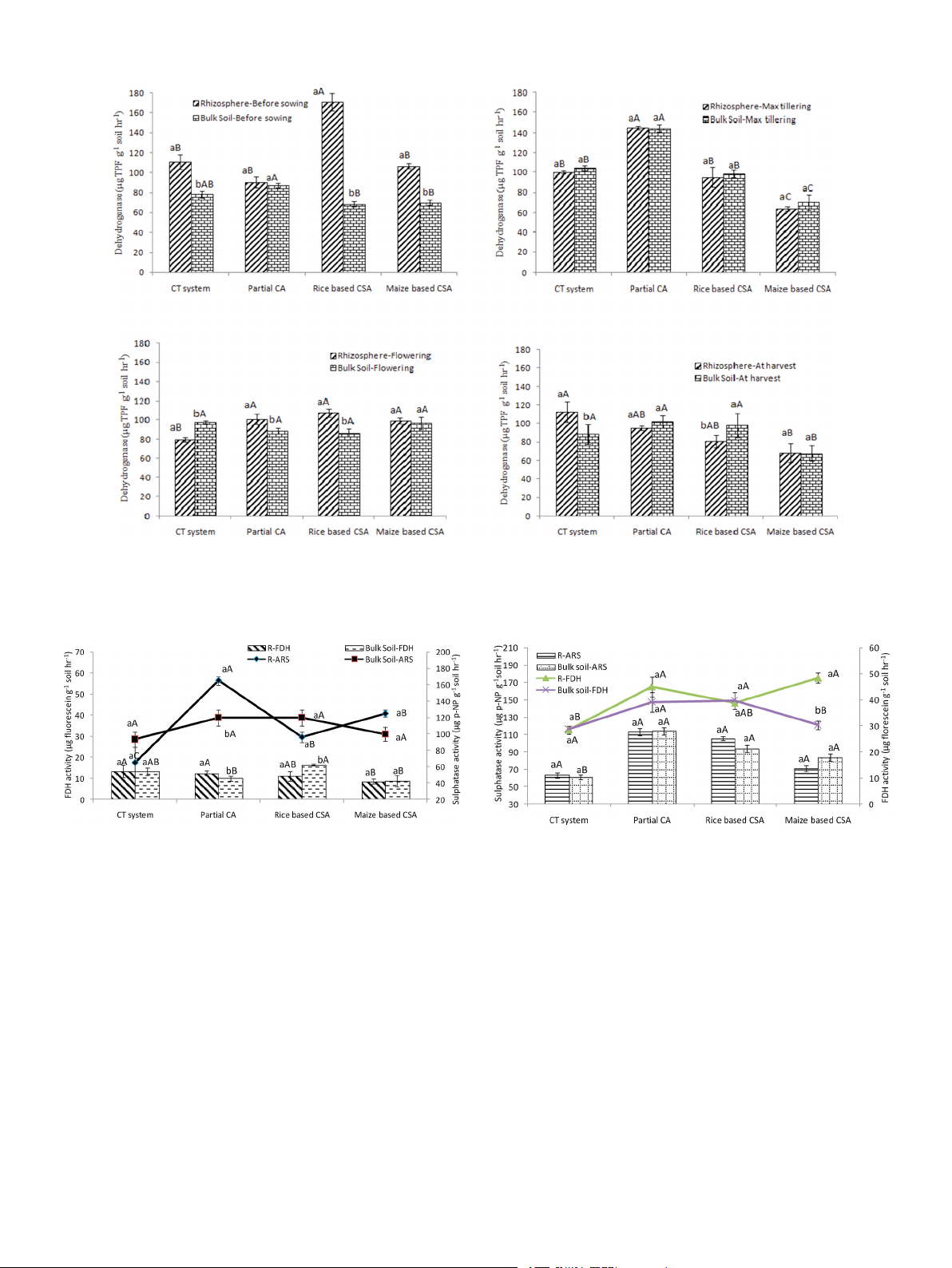
significantly higher before sowing (59.6%) and flowering stage (18.7%)
using standard procedure. Soil blocks up to 40 cm depth with plant roots
in rice based CSA systems (mean of Sc3 and Sc5) over maize based CSA
were taken out from four random places in each scenario. Roots were
systems (mean of Sc4 and Sc6) (Fig. 1a and 1c). Before sowing in maize
washed carefully, detached from the main stem at the first node. Roots
based system, about 35% higher DHA activity was observed at rhizo-
were dried at 65 ± 5 ◦C at oven and dry weight was calculated and then
spheric soil over bulk soil. At maximum tillering stage, DHA activity was converted to t/ha.
significantly higher in partial CA based rice system (PCA-RW, Sc2) (145
Soil moisture content was determined by drying the fresh soil sam-
μg TPF g− 1 soil hr− 1) over others irrespective of sampling location
ples at 105 ◦C for 24 h in a hot air oven until a constant weight and
(Fig. 1b). At flowering, DHA activity was 12% higher in rhizosphere of
calculated by following formula.
PCA-RW (Sc2) over bulk soil (Fig. 1c). After harvesting of the crop,
Moisture content (%) = (Moist soil wt-dry soil wt)/dry soil wt × 100.
significantly higher (21%) DHA activity was observed in bulk soils (98
One part of the fresh samples collected from both rhizosphere and
μg TPF g− 1 soil hr− 1) over rhizospheric soils (81 μg TPF g− 1 soil hr− 1) in
bulk soil was dried in shade, ground and sieved and stored in plastic
rice based CSA system (Fig. 1d). Being the responsible enzyme for car-
container for chemical analysis. Oxidizable organic carbon (SOC) was
bon cycle in soil, on average β-glucosidase activity was significantly (p
determined by following Walkley and Black method [24].
< 0.05) higher in rhizospheric soils of rice based CSA systems (108 μg p-
The enzymatic pH indicator was calculated using the results of
NP g− 1 soil hr− 1) over bulk soil (92 μg p-NP g− 1 soil hr− 1) whereas under
alkaline and acid phosphatase activity [25]:
maize based systems similar values were observed (Suppl. Fig. 2) irre-
spective of crop growth stages. In bulk soil under maize systems
Enzymatic pH indicator = AlP/AcP
significantly higher β-glucosidase activity was observed before sowing
The alteration index three (Al3) was also calculated using the results
(Suppl. Fig. 2a) and at maximum tillering stage (Suppl. Fig. 2b)
of β-glucosidase, phosphatase and urease [26]:
compared to rice based CSA system. Whereas at harvesting stage, rhi-
zospheric soils under maize systems (112 μg p-NP g− 1 soil hr− 1) showed
Alteration index three (Al3) = 7.87 β-glucosidase− 8.22 acid phos-
significantly (p < 0.05) higher β-glucosidase activity over rhizospheric phatase− 0.49 urease
soil under rice based CSA system (94 μg p-NP g− 1 soil hr− 1) (Suppl.
For each scenario, the geometric mean (GMea) was calculated as the
Fig. 2d). At maximum tillering stage, significantly higher β-glucosidase
mean for the assayed enzymes activities [27]. It is a general index to
activity was observed at rhizosphere soil of rice based CSA system (93 μg
consolidate information from variables with different units and range of
p-NP g− 1 soil hr− 1) over bulk soil (72 μg p-NP g− 1 soil hr− 1) and also variation:
maize based system (78 μg p-NP g− 1 soil hr− 1) (Suppl. Fig. 2b). In rice
based CSA system, after harvesting of the crop significantly (p < 0.05)
GMea = (DHA * GLU * AlP *AcP * FDH* Ur*CeL*ArS) 1/8
higher β-glucosidase activity was observed in bulk soils (12.8%) over
rhizospheric soils (Suppl. Fig. 2d). On average β-glucosidase activity was
Where DHA, GLU, AlP, AcP, FDH, Ur, CeL, ArS are dehydrogenase,
20% higher (p < 0.05) in CA based scenarios (Sc2-Sc6) over conven-
β-glucosidase, alkaline phosphatase, acid phosphatase, fluorescein
tional tillage scenario (Sc1) irrespective of crop growth stages and
diacetate hydrolases, urease, cellulase and aryl sulphatase, respectively. sampling location. 2.3. Residue load
3.2. Acid and alkaline phosphatase activity under different managements
Crop residues recycled in each year under different scenarios are
Significant variation in acid and alkaline phosphatase activity was
presented at Supp. Table 2. Significantly higher residues amount (129
observed irrespective of scenarios and sampling location (Supp. Table 3
Mg ha− 1) were recycled in maize based system (mean of Sc4 and Sc6)
and 4). Before sowing of wheat, significantly higher (21.4%) acid
over others, followed by PCA-RW (Sc2) (115.5 Mg ha− 1). About 111 Mg
phosphatase activity was observed in rhizosphere over bulk soils of
ha− 1residues were added in rice based CSA systems (mean of Sc3 and
maize based systems (Supp. Table 3). But at maximum tillering, about Sc5) during the last 8 years.
8.2% higher acid phosphatase activity was observed in bulk soils over
rhizosphere soil of rice based CSA systems. In maize based systems, at
2.4. Statistical analysis
flowering stage 6% higher (p < 0.05) acid phosphatase activity was
recorded at bulk soil over rhizospheric soil. At harvesting, bulk soils
The data were subjected to analysis of variance (ANOVA) and using
recorded significantly higher acid phosphatase activity in both rice
the general linear model procedure of the SPSS window version 17.0
(9.5%) and maize (7.4%) based CSA systems over rhizospheric soils
(SPSS Inc., Chicago, USA). Treatment means were separated by Duncan
(Supp. Table 3). Significantly higher alkaline phosphatase activity was
Multiple Range Test (DMRT) at 5% level of significance (P < 0.05).
observed before sowing of wheat in bulk soils of rice (25.3%) and maize
Correlation study was performed among the enzymes, indices calculated
(38.5%) based CSA systems over rhizospheric soils (Supp. Table 4).
from different enzymes, residue load, SOC and soil moisture content. To
determine the effect of scenarios, rhizosphere/bulk soils and stages
3.3. Fluorescein diacetate hydrolases (FDH) and aryl sulphatase (ArS)
(fixed factors) and their interaction effect on the different enzyme ac-
activity under different managements
tivities (random variable), three-way ANOVA was carried out. Linear
contrasts were used to compare single or multiple treatments against
On average rice based CSA system showed 27% higher FDH activity one another.
than maize based system (Supp. Table 5). In rhizosphere, on average it
was 18% and in bulk soils it was 38% higher in rice based CSA systems 3. Results
than maize based systems. At maximum tillering stage, about 29%
higher FDH activity was observed in bulk soils of rice based CSA system
3.1. Dehydrogenase (DHA) and β-glucosidase activity as influenced by
over rhizosphere soil whereas rhizospheric soils of partial CA based management practices
system recorded 11.5% higher FDH activity over bulk soils (Fig. 2).
Rhizosphere soils under maize based systems showed about 39% higher
Significant variation in DHA was observed both in rhizosphere and
FDH activity over bulk soils at flowering stage (Fig. 3). Similar FDH
bulk soils of different scenarios (Fig. 1). Before sowing of the crop, DHA
activity was observed under partial CA and rice based CSA systems in
activity was significantly higher in rhizospheric soils over bulk soils
rhizosphere and bulk soils (Fig. 3). After harvesting, bulk soils under
irrespective of cropping system. In rhizospheric soil, DHA activity was
maize based CSA and partial CA based systems recorded 29% and 69% 3 H.S. Jat et
European Journal of Soil Biology al. 103 (2021) 103292
Fig. 1. Dehydrogenase activity (μg TPF g− 1 soil hr− 1) in rhizosphere and bulk soils a) before sowing of crop, b) at maximum tillering c) flowering stage of crop and d)
after harvesting of crop under different tillage, residue and crop rotations.
Same upper case letters among the CSA systems and same lower case letters between rhizosphere and bulk soils in each system are not significantly different at P <
0.05 according to Duncan Multiple Range Test (DMRT) for separation of mean.
Fig. 2. Fluorescein diacetate hydrolases (FDH) (μg fluorescein g− 1 soil hr− 1)
Fig. 3. Fluorescein diacetate hydrolases (μg fluorescein g− 1 soil hr− 1) and Aryal
and Aryal sulphatase activity (μg p-NP g− 1 soil hr− 1) in rhizosphere and bulk
Sulphatase activity (μg p-NP g− 1 soil hr− 1) in rhizosphere and bulk soils at
soils at maximum tillering stage of crop under different tillage, residue and crop
flowering stage of crop under different tillage, residue and crop rotations. rotations.
Where, R: rhizosphere; ARS: aryal sulphatase activity; FDH: Fluorescein diac-
Where, R: rhizosphere; ARS: aryal sulphatase activity; FDH: Fluorescein diac- etate hydrolases activity. etate hydrolases activity.
Same upper case letters among the CSA systems and same lower case letters
Same upper case letters among the CSA systems and same lower case letters
between rhizosphere and bulk soils in each system are not significantly different
between rhizosphere and bulk soils in each system are not significantly different
at P < 0.05 according to Duncan Multiple Range Test (DMRT) for separation
at P < 0.05 according to Duncan Multiple Range Test (DMRT) for separation of mean. of mean.
and then increased from tillering to flowering in both soils. At maximum
higher FDH activity over rhizosphere soils (Suppl. Fig. 3). In rhizosphere
tillering stage, about 32% higher aryl sulphatase activity was observed
zone an increase of 14% FDH activity can be seen in CA based systems
in rhizosphere soils of partial CA based system (Sc2) over bulk soil
(mean of Sc2 to Sc6) over CT system (Sc1) but simultaneously 6%
(Fig. 2). Highest activity of ArS was recorded at flowering stage with few
decrease was noticed in CA based systems over CT system in bulk soils
exceptions (Fig. 3). It was noticed that lowest activities of ArS was found (Supp. Table 5).
in conventional till scenario (CT system, Sc1) irrespective of growth
At different growth stages of wheat crop, variation in activities of ArS
stages and sampling location. In both the zones, on average, 28% higher
(17.63–117.58 μg p-NP g− 1soil hr− 1) was recorded for rhizosphere and
ArS activity was recorded in PCA and CSA based scenarios (mean of Sc2
bulk soils (Supp. Table 6). In both rhizosphere and bulk soil, ArS activity
to Sc6) over CT system (Sc1). Overall activities of ArS were found similar
was higher by 12% and 15%, respectively before the sowing of wheat
in all scenarios in both rhizosphere and bulk soils, with a mean value of
than the tillering stage. It was first decreased from sowing to tillering
60 μg p-NP g− 1soil hr− 1 in both the zones. Rice based partial CSA system 4 H.S. Jat et
European Journal of Soil Biology al. 103 (2021) 103292
(Sc3) has more ArS activities than maize based partial CSA (Sc4) except
CSA based rice (36%) and maize (44%) based system over rhizosphere
in rhizosphere soil of maximum tillering stage. In rhizosphere and bulk
soils but about 21.4% lower SOC was observed in bulk soils over
soil, it was 13% and 12% higher in rice based CSA system than maize
rhizosphere soil under PCA-RW system (Fig. 4b). At flowering stage,
based system, respectively (Supp. Table 6).
higher SOC concentration was observed in rhizosphere soils compared
to maximum tillering stage irrespective of scenarios (Fig. 4c). But in bulk
3.4. Urease (ur) and cellulase (CeL) activity under different
soils, significantly lower SOC were observed in rice (11%) and maize managements
(18%) based system whereas PCA-RW system recorded 66% higher SOC
compared to the bulk soil at maximum tillering stage (Fig. 4c). At har-
Higher activity of urease was noticed in maize based full CSA system
vesting stage, higher SOC was observed in all the scenarios irrespective
(Sc6) compared to other scenarios (Supp. Table 7). There was hardly any
of sampling locations except the bulk soil under CT system which
effect of growth stages on Ur in both rhizosphere and bulk soils. Effect of
registered 14% lower SOC compared to the bulk soil under flowering
CSA practices has not been observed on Ur activities as it was found stage (Fig. 4d).
similar in CA based scenarios (mean of Sc2 to Sc6) (319.9 μg urea g− 1
Residue retention exhibited strong influence on soil moisture content
soil hr− 1) and CT system (319.6 μg urea g− 1 soil hr− 1) (Supp. Table 7).
in all the scenarios (Supp. Table 9). At maximum tillering stage, similar
Cellulase activity was found to increase from before sowing to
moisture content was observed irrespective of scenarios. CSA based rice
maximum tillering and flowering stage with some exceptions and
system recorded 34% higher moisture content at rhizosphere soil over
decreased towards harvesting stage (Supp. Table 8). In CA based sce-
bulk soil whereas 51% higher moisture was observed at bulk soils under
narios (mean of Sc2 to Sc6) significantly higher CeL activities (15.54 μg
maize based system over rhizosphere soil at flowering stage. On average
glucose g− 1 soil hr− 1) were noticed over CT system (8.03 μg glucose g− 1
64% higher moisture content was observed at bulk soils under CSA
soil hr− 1). Partial CA system (Sc2) showed 52% increase in CeL activities
based rice and maize based system over rhizosphere soil (Supp. Table 9).
over CT system. Integration of mungbean (mean of Sc3 to Sc6) showed
34% increase in CeL activity over partial CA.
3.7. Enzymatic pH indicator, Al3 and GMea and their relationship with
enzymes, residue load, SOC and soil moisture
3.5. Interactions effect of managements, sampling locations and crop
growth stages on soil enzymes
The enzymatic pH indicator was calculated using the values of the
alkaline and acid phosphatase activities under different managements.
The analysis of variance showed that all the enzymes in rhizosphere
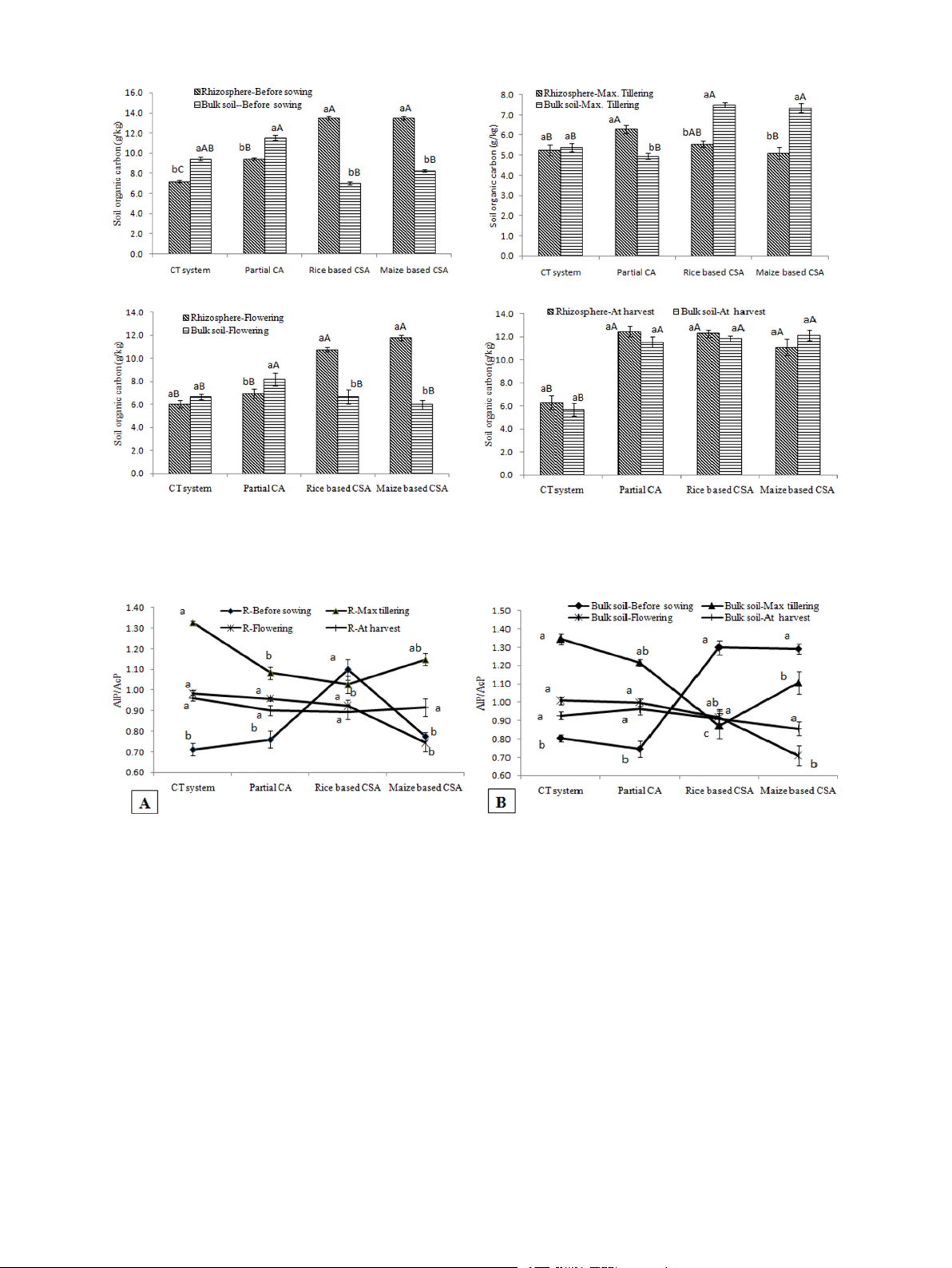
The value of this indicator varied from 0.71 to 1.34 irrespective of
and bulk soils were significantly influenced by scenarios, rhizosphere
sampling location and crop growth stages (Fig. 5). Enzymatic pH indi-
(R)/bulk soil (B), crop growth stages and their interactions i.e. scenario
cator was significantly negatively correlated with β-glucosidase activity
× stage, scenario × R/B, stage × R/B and scenario × stage × R/B except
(r = − 0.95, p < 0.05), Al3 (r = − 0.97, p < 0.05), SOC (r = − 0.79, p <
few instances (Table 1). The interaction effect between rhizosphere ×
0.05) and residue load (r = − 0.82, p < 0.05) irrespective of sampling
bulk soils was not significant for acid and alkaline phosphatase activity
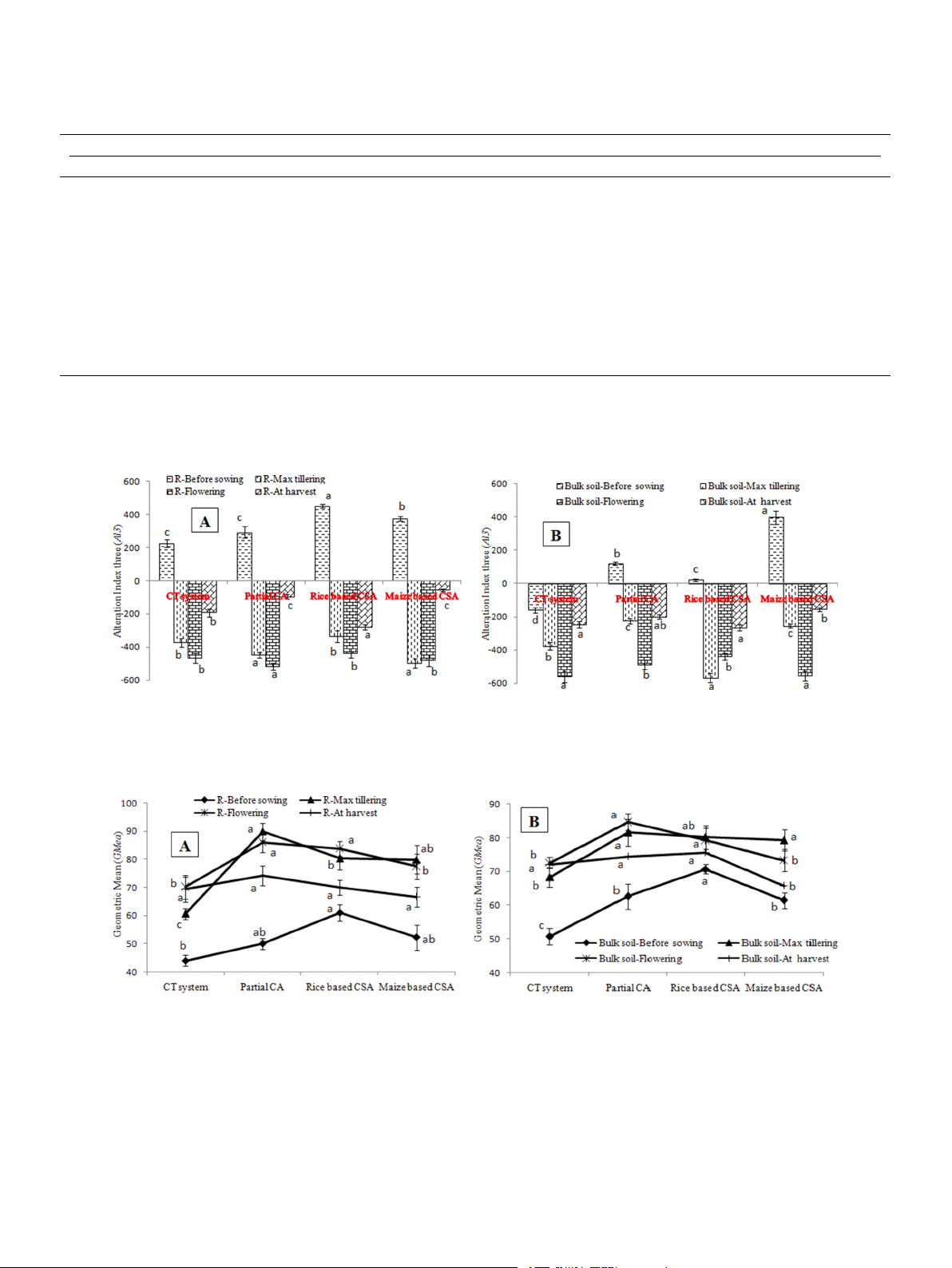
location and crop growth stages (Table 2). Alteration index three varied
whereas crop growth stage × R/B was also not significant for acid
significantly among the crop growth stages and rhizosphere and bulk
phosphatase activity. Contrast analysis showed that there was signifi-
soil under different managements (Fig. 6). Lower values of Al3 indicated
cant difference between rice and maize based cropping systems
better soil quality. In rhizosphere soil, lowest Al3 (− 516) was observed (Table 1).
at flowering stage of partial CA based system whereas in bulk soil rice
based CSA system recorded lowest Al3 (− 567) at maximum tillering
3.6. Soil organic carbon and soil moisture under different managements
stage. Significantly higher Al3 values were recorded before sowing of and crop growth stages
crop irrespective of sampling location (Fig. 6). Significant negative
correlation was observed between Al3 and β-glucosidase (r = − 0.94, p
Significant variation in SOC was observed at different crop growth
< 0.05), and also negatively correlated with residue load (r = − 0.84, p
stages and sampling locations. On average irrespective of crop growth
< 0.05) and SOC (r = − 0.73, p < 0.05) (Table 2). Significant variation in
stages and sampling locations, rice and maize based CSA (45%) and
GMea index values was recorded among the managements and sampling
PCA-RW (37%) recorded significantly higher SOC over conventional
locations. In rhizosphere and bulk soil, highest GMea index was
practices (Fig. 4). Before sowing, rhizosphere soils of CSA based rice and
observed in maximum tillering (90) and flowering stage (85) of partial
maize systems recorded 90% (in rice rhizosphere) and 63% (in maize
CA based system (Fig. 7). Lower values of GMea index was recorded in
rhizosphere) higher SOC over their respective bulk soils. Whereas
conventional system and before sowing of wheat irrespective of sam-
18–24% higher SOC was observed in bulk soils under CT (rice crop) and
pling location. Significant positive correlation was observed between
PCA-RW system (rice crop) over rhizosphere soils (Fig. 4a). At maximum
GMea and β-glucosidase (r = 0.73, p < 0.05), acid phosphatase (r = 0.99,
tillering stage, significantly higher SOC was observed in bulk soils under
p < 0.05), aryl sulphatase (r = 0.95, p < 0.05), SOC (r = 0.93, p < 0.05) Table 1
Interactions among the scenarios, crop growth stages and rhizosphere and bulk soil and contrast effect between rice-wheat and maize - wheat systems.
Statistical significance (P value) Source of variation DHA AcP AlP ArS Ur β-Glu FDH CeL Scenario <0.0001 0.0174 <0.0001 <0.0001 0.0001 <0.0001 0.0105 <0.0001 Stage <0.0243 <0.0001 <0.0001 <0.0001 <0.0003 <0.0001 <0.0001 <0.0001 Scenario*stage <0.0001 <0.0001 0.0201 <0.0001 <0.0001 <0.0001 <0.0001 <0.0001 Rhizosphere/bulk soil <0.0001 0.4524 0.4524 <0.0001 <0.0001 <0.0001 <0.0002 <0.0001 Scenario*R/B <0.0001 0.0324 0.0008 <0.0001 0.0020 <0.0001 0.0112 <0.0004 Stage*R/B <0.0001 0.2097 <0.0001 <0.0001 <0.0001 <0.0001 <0.0001 <0.0001 Scenario*stage*R/B <0.0001 0.0297 <0.0001 <0.0001 <0.0001 <0.0001 <0.0001 <0.0001
Contrast – Rice-wheat: Maize-Wheat 0.001 0.001 0.001 0.001 0.001 0.001 0.001 0.001
Where R: rhizosphere; B: bulk soil.
DHA: Dehydrogenase, AcP: Acid Phosphatase, AlP: Alkaline Phosphatase, ArS: Arylsulfatase.
Ur: Urease, β-Glu: β-glucosidase, FDH: Fluorescein diacetate hydrolases, CeL: Cellulase. 5 H.S. Jat et
European Journal of Soil Biology al. 103 (2021) 103292
Fig. 4. Soil organic carbon (g/kg) in rhizosphere and bulk soils a) before sowing of crop, b) at maximum tillering c) flowering stage of crop and d) after harvesting of
crop under different tillage, residue and crop rotations.
Same upper case letters among the CSA systems and same lower case letters between rhizosphere and bulk soils in each system are not significantly different at P <
0.05 according to Duncan Multiple Range Test (DMRT) for separation of mean.
Fig. 5. Enzymatic pH indicator (AlP/AcP) in A) rhizosphere and B) bulk soils before sowing of crop, maximum tillering, flowering stage and after harvesting of crop
under different tillage, residue and crop rotations.
Same lower case letters among the management system are not significantly different at P < 0.05 according to Duncan Multiple Range Test (DMRT) for separation of mean.
and residue load (r = 0.84, p < 0.05) (Table 2). CA based management
the microorganisms are higher at rhizosphere zone of the crop because it
practices recorded significantly higher soil moisture over conventional
has been found that the proportions of rhizodeposition carbon (C) of
system and significantly positively correlated with acid phosphatase (r
below ground carbon inputs through roots, rhizodeposition etc. aver-
= 0.84, p < 0.05), aryl sulphatase (r = 0.70, p < 0.05), cellulase (r =
aged 54–63% for the cereals [28]. Because of this labile carbon, the
0.86, p < 0.05), GMea (r = 0.88, p < 0.05), residue load (r = 0.84, p <
activity of the microorganisms at rhizosphere is higher compared to bulk
0.05) and SOC (r = 0.80, p < 0.05) irrespective of managements and
soil resulting in higher enzymes activity in rhizosphere. Moreover, zero sampling location (Table 2).
tillage, resource (irrigation water and nutrients) management and suit-
able crop rotation with mungbean integration facilitated congenial 4. Discussion
environment for the microorganisms.
Higher DHA activity in bulk soils after harvest of the rice crop might
Climate smart agriculture management influences soil enzyme ac-
be due to the availability of very labile carbon originated from decom-
tivities at different extents. Significant variations were observed for
position of previous year’s wheat and mungbean residues. Decomposi-
activities of the enzymes studied under partial CA, CSA and CT practices.
tion of earlier surface retained maize residues releases labile carbon
Significant variation among the enzymes in rhizosphere and bulk soils
which was available to microbes and resulted in higher DHA activity in
among the scenarios at different crop growth stages might be due to the
bulk soils under maize based system than rice based CSA system at
crop and soil management practices followed. Generally the activity of
flowering stage. Lower C: N ratio of maize roots (35:1) and stover (57:1) 6 H.S. Jat et
European Journal of Soil Biology al. 103 (2021) 103292 Table 2
Pearson’s bivariate correlations among different enzymes and enzyme indices, SOC, residue load, moisture content irrespective of scenarios, crop growth stages and sampling locations. Correlations β-Glu AcP AlP DHA ArS Ur FDH CeL AL EP GM SOC RL MC β-Glu 1 AcP 0.81* AlP − 0.09 0.47 DHA − 0.19 0.35 0.98* ArS 0.69 0.96* 0.66 0.56 Ur 0.38 − 0.13 − 0.56 − 0.48 − 0.13 FDH − 0.09 0.50 0.97* 0.93* 0.64 − 0.71 Cl 0.77 0.64 − 0.26 − 0.42 0.40 − 0.07 − 0.12 AL ¡0.94* 0.56 − 0.42 − 0.49 0.40 0.61 − 0.43 0.72 EP ¡0.95* − 0.62 0.26 0.31 − 0.52 − 0.65 0.31 − 0.59 ¡0.97* GM 0.73* 0.99* 0.53 0.41 0.95* − 0.27 0.59 0.63 0.45 − 0.51 SOC 0.92* 0.97* 0.27 0.16 0.90* 0.07 0.29 0.71* ¡0.73* ¡0.78* 0.93* RL 0.96* 0.88* 0.06 − 0.13 0.74* 0.11 0.06 0.88* ¡0.84* ¡0.82* 0.84* 0.95* MC 0.66 0.84* 0.26 0.09 0.70* − 0.44 0.40 0.86* 0.44 − 0.38 0.88* 0.80* 0.84* 1
*. Correlation is significant at the 0.05 level (2-tailed).
Where β-Glu: β-glucosidase, AcP: Acid Phosphatase, AlP: Alkaline Phosphatase, DHA: Dehydrogenase, ArS: Arylsulfatase, Ur: Urease, FDH: Fluorescein diacetate
hydrolases, CeL: Cellulase, Al: alteration index three, EP: enzymatic pH indicator, GM: geometric mean, SOC: soil organic carbon, RL: residue load, MC: moisture content.
Fig. 6. Alteration index three (Al3) in A) rhizosphere and B) bulk soils before sowing of crop, maximum tillering, flowering stage and after harvesting of crop under
different tillage, residue and crop rotations.
Same lower case letters among the management system are not significantly different at P < 0.05 according to Duncan Multiple Range Test (DMRT) for separation of mean.
Fig. 7. Geometric mean (GMea) in A) rhizosphere and B) bulk soils before sowing of crop, maximum tillering, flowering stage and after harvesting of crop under
different tillage, residue and crop rotations.
Same lower case letters among the management system are not significantly different at P < 0.05 according to Duncan Multiple Range Test (DMRT) for separation of mean.
over rice (root: 58.8 and straw: 67:1) facilitated faster decomposition of
to maize as well as rice and wheat residues and their mixtures incor-
maize residues. Higher root biomass of maize (3.8 t ha− 1) over rice root
porated and placed at soil surface. Similar or higher activities of en-
mass (2.26 t ha− 1) had resulted higher root carbon input to soil under
zymes in bulk soil over rhizosphere soil was attributed to the production
maize system. Bergstrom et al. [12] reported higher DHA activity under
of volatile organic compounds released by roots which can be carried far
zero tillage conditions. In a lab experiment Datta et al. [29] also showed
away from rhizosphere in dry soil due to higher air filled porosity
faster decomposition of maize residues placed at surface soil in respect
resulting in higher microbial activity [16]. ‘Rhizosphere priming effect’ 7 H.S. Jat et
European Journal of Soil Biology al. 103 (2021) 103292
mediated by microorganisms also plays an important role in increasing
conventional agriculture in varying textured soils were also reported by
and decreasing enzymes activity in rhizosphere and bulk soil [17].
other researchers [12,35,36]. Choudhary et al. [11,14] also reported
Higher β-glucosidase activity in rhizospheric soils over bulk soil under
higher DHA and alkaline phosphatase activity under zero till based
rice based CSA systems might be due to higher carbon input from fibrous
conservation agriculture practices. Residue retention and zero tillage are
root mass of rice in previous year (Suppl. Fig. 2a). But higher β-gluco-
the main reasons behind the higher CeL activity under CSA based sce-
sidase activity in bulk soils under maize based systems at maximum
narios. Residues provide favourable conditions to the microbes and
tillering stage might be due to the higher residue load from maize res-
microbial transformation of crop residue and soil organic matter en-
idue (Suppl. Fig. 2b) leading to more carbon input to soil. This is also
hances enzyme activities under zero tillage systems [8]. Higher enzyme
supported by the higher soil carbon concentration under maize based
activities in CSA based scenarios (both rice and maize based systems) as
systems over rice based CSA systems (Fig. 3) and significant positive
compared to CT and partial CA was mainly due to the integration of
correlations between β-glucosidase activity with residue load and SOC legume [14].
(Table 2). Moreover, during flowering stage the decomposition of the
Higher SOC under CSA and PCA based rice and maize systems was
previous year’s residue were at peak as revealed from temperature rise
due to higher residue load (112–129 Mg ha− 1) (Suppl. Table 2) which
at the end of February which might facilitate higher β-glucosidase ac-
supplies organic carbon to soils in addition to carbon input from plants
tivity at maize based systems. The flowering in wheat starts around
through roots, rhizodepositions, secretions etc. We do not have mea-
mid-February and that time the temperature (22.8 ◦C) and relative hu-
surements on plant and root derived carbons. Generally rhizosphere soil
midity (73%) is conducive for microbial growth compared to January
is characterized by higher amount of very labile carbon and lower
(18.4 ◦C and 79.5%). CA based scenarios received higher carbon input in
contents of mineral nitrogen as well as other nutrients with 19–32 times
the form of residue (Table 2) and zero tillage practice which resulted in
higher number of microorganisms compared to bulk soil [17]. In bulk
the higher activity of β-glucosidase in soil. Pausch and Kuzyakov [30]
soil (away from roots), all the nutrients are mostly available with
reported that the highly dynamic nature of rhizodeposition and rhizo-
limiting easily available carbon for microbial growth [17]. Priming ef-
deposits are rapidly incorporated into microorganisms, soil organic
fect plays an important role in increasing or decreasing soil organic
matter, and decomposed to CO2 which explains the higher β-glucosidase
matter decomposition in rhizosphere as well as bulk soil with crop res-
activity in rhizospheric soil under rice. Before sowing of wheat, higher
idue retention at soil surface under CSA [17,37]. Before sowing of
root biomass of maize (3.8 t ha− 1) in addition of previous years residues
wheat, lower SOC in maize rhizosphere soil compared to rice might be
left in the soil which is decomposing and supplying labile carbon to
due to faster decomposition of maize roots with lower C:N ratio (35:1)
microbes, led to higher acid phosphatase activity. Hirte et al. (2018)
over rice roots (C:N ratio of 58.8:1) thereby facilitating positive priming
[31] showed higher root biomass of maize (186 ± 15 g m− 2) over wheat
effect. Also maize being a C4 plant releases less organic compounds to
root biomass (137 ± 6 g m− 2) after harvesting in long term field trial of
soil through roots due to lesser investment of C in the below ground
DOK (bio-Dynamic, bio-Organic, Conventional site in Switzerland).
processes over C3 rice crop [17]. As the stubbles of rice and wheat were
Higher rhizodeposition in root zone led to the acidity which further
kept and mixed properly with soil during puddling under CT and PCA
accentuates the acid phosphatase activity [30]. Higher acid phosphatase
system resulting higher SOC in bulk soil compared to rhizospheric soil of
activity in bulk soils at maximum tillering stage of rice and flowering
wheat which might have experienced positive priming leading to lower
stage of maize system is attributed to differential residue decomposition
SOC. At maximum tillering stage, lower SOC in rhizosphere soil
leading to varying rates of labile carbon release in these systems. After
compared to bulk soil in CSA based rice and maize systems might be due
harvesting in both the system, the residues placed away from root zone
to higher rhizosphere priming effect caused by root secretions, rhizo-
were completely decomposed whereas the roots just start decaying
deposition with vigorous microbial activity. In bulk soil at flowering
which explains higher acid phosphatase activity in bulk soils. Similar
stage, lower SOC was observed under rice and maize based CSA systems
observations were also reported in alkaline phosphatase activity. Crop
which might be due to higher priming effect mediated by greater activity
rotation particularly inclusion of legume has played an important role in
of microorganisms caused by decomposing residues retained at soil
enzyme activities observed in those CSA based scenarios. In our case,
surface. Whereas at rhizosphere soil, there might be higher rhizodepo-
legume integration in rice-wheat and maize-wheat systems has facili-
sition which results in higher SOC but with limiting mineral nitrogen
tated higher microbial activity leading to release of both acid and
leads to lower decomposition [17]. Significantly higher SOC in bulk soil
alkaline phosphatase activity in soil. Plant roots release a wide range of
at flowering under PCA system might be due to higher humification of
compounds that may differ between plant species [30] which leads to
crop residue carbon to SOC caused by proper mixing of crop residues
the difference between FDH activity in rice and maize based systems.
with soil during previous puddled rice crop. At harvesting stage except
Different crop rotation is also a factor in variation of FDH activities [32].
CT system, higher SOC both at rhizosphere and bulk soil might be due to
Different plant species results distinct microbial communities with
higher carbon released by roots and decomposing surface retained crop
different activity [33]. CSA practices have positive effect on soil enzy-
residues of previous crops with lower mineral nitrogen leading to lower
matic activities [14] and this can be seen in the overall FDH activity in
priming effect. Whereas in CT system, due to availability of mineral
CSA based scenarios and particularly in rhizosphere zone. Sulphatases
nitrogen and other nutrients, microbial activity was higher in bulk soil
are reported to be also found as exoenzymes in the soil and are closely
and thereby facilitating more oxidation of SOM [17].
linked to organic matter [34] applied in the form of heavy load of res-
Higher soil moisture in bulk soils under CSA based systems irre-
idues. Higher SOC in PCA and CSA based scenarios (Sc2 to Sc6) (Fig. 4)
spective of crop growth stages was due to crop residue retentions at soil
resulted in higher activities of ArS as evidenced from significant positive
surface (Suppl. Table 2). Crop residue mulch enhances soil water storage
correlations between SOC and ArS (Table 2). Kotkova et al. [34] re-
by regulating soil temperature, reducing evaporation and increasing
ported that in wheat ArS activity was higher in rhizosphere as compared
infiltration and SOM concentration and thereby increasing water
to bulk soil and vice versa was reported in lupine but in our study such
retention capacity of soil [9]. In bulk soils, SOC derived from crop res-
type of trend was not reported. In this study both the zones have similar
idues interacts with soil matrix and enhances the specific surface area of
activities of ArS. Higher ArS activity in rice over maize based CSA can be
soil which facilitates higher adsorption and retention of water molecules
linked to differences in crop rotation and their residues as rice and maize under CSA based systems [9].
were grown before wheat in those scenarios. Activity of cellulase at
For optimum plant growth and development, soil pH at which the
different growth stages can be regulated by the available moisture
ratio of enzymatic indicator (AlP/AcP) is about 0.5, can be considered as
content due to crop residue mulch and irrigation water given to crops as
optimum [38]. In our experiment, both rhizosphere and bulk soil sam- evidenced from Supp. Table 9.
ples, the AlP/AcP value exceeded 0.5. These results were confirmed by
Higher β-glucosidase and acid phosphatase activity in no till soil over
soil pH measurement in soil:water 1:2 ratio (data not shown). Negative 8 H.S. Jat et
European Journal of Soil Biology al. 103 (2021) 103292
correlations between AlP/AcP and residue load, SOC and few enzymes
support from GCIAR Research Programs on Climate Change, Agriculture
might be due to the decline in soil pH because of release of organic acids
and Food Security (CCAFS). We are grateful to the editor and two
upon decomposition of crop residues retained at soil surface [25]. The
anonymous reviewers for their constructive comments which improved
balance between three soil enzymes β-glucosidase, urease and phos-
the quality of the manuscript a lot.
phatase is quantified by alteration index three (Al3) which is sensitive to
soil characteristics alterations. The low values of Al3 indicated the better
Appendix A. Supplementary data
soil [26]. Higher values before sowing of crop irrespective of scenarios
and sampling locations manifested poor soil quality which improved
Supplementary data to this article can be found online at https://doi.
significantly upon growth of the plants as observed at maximum tillering
org/10.1016/j.ejsobi.2021.103292.
and flowering stages. Importantly at harvest, significantly lower values
of Al3 were observed at bulk soils under CSA based systems which might References
be due to the higher SOC derived from crop residues decomposition.
Higher SOC improves soil quality in CSA based systems and explains
[1] M.C. Moscatelli, L. Secondi, R. Marabottini, R. Papp, S.R. Stazi, E. Mania,
lower Al3 values as evidenced from negative correlations between them
S. Marinari, Assessment of soil microbial functional diversity: land use and soil
properties affect CLPP-MicroResp and enzymes responses, Pedobiologia 66 (2018)
(Table 2) [38]. Soil physico-chemical and biological properties are 36–42.
related to GMea of the studied enzymes and therefore, is used as an index
[2] R.P. Dick, E. Kandeler, Enzymes in soils, in encyclopedia of soils in the
of soil quality. Higher values of GMea designate better soil quality and
environment, Reference Module in Earth Systems and Environmental Sciences
(2005) 448–456, https://doi.org/10.1016/B0-12-348530-4/00146-6.
can describe qualitative changes in soil without considering physico-
[3] C. Srinivasarao, R. Lal, S. Kundu, M.B.B. Prasad Babu, B. Venkateswarlu, A.
chemical properties [38]. Higher SOC in CSA based systems enhanced
K. Singh, Soil carbon sequestration in rainfed production systems in the semiarid
soil enzymes activities and subsequently GMea as evidenced from sig-
tropics of India, Sci. Total Environ. 487 (2014) 587–603.
[4] I. Celika, Z.B. Barut, I. Ortasa, M. Goka, A. Demirbasa, Y. Tuluna, C. Akpinara,
nificant positive correlations between GMea with residue load, SOC and
Impacts of different tillage practiceson some soil microbiological properties and
soil moisture content (Table 2). Lemanowicz et al. [38] also observed
crop yieldunder semi-arid Mediterranean conditions, Int. J. Plant Prod. 5 (3)
significant positive correlations between GMea and SOC while studying (2011) 237–254.
enzyme activities under different tree species in Poland.
[5] S. Pajares, G.F. Gallardo, G. Masciandaro, B. Ceccanti, J.D. Etchevers, Enzyme
activity as an indicator of soil quality in degraded cultivated acrisols in the
Significant interactions among the scenarios, crop growth stages and
Mexican transvolcanic belt, Land Degrad. Dev. 22 (3) (2011) 373–381.
rhizosphere and bulk soils on the soil enzymes might be due to the effect
[6] C. Srinivasa Rao, M. Grover, S. Kundu, S. Desai, Soil Enzymes. Encyclopedia of Soil
of Climate Smart Agriculture practices followed. Residue retention in-
Science, third ed., 2017, https://doi.org/10.1081/E-ESS3-120052906.
[7] H.S. Jat, A. Datta, P.C. Sharma, V. Kumar, A.K. Yadav, M. Choudhary,
creases microbial population [39] by providing a stimulating substrate
V. Choudhary, M.K. Gathala, D.K. Sharma, M.L. Jat, N.P.S. Yaduvanshi, G. Singh,
for their growth resulting in higher enzyme activities. Higher population
A. McDonald, Assessing soil properties and nutrient availability under conservation
counts of total bacteria, fluorescent Pseudomonas, and actinomycetes
agriculture practices in a reclaimed sodic soil in cereal-based systems of North-
West India, Arch. Agron Soil Sci. 64 (2018) 531–545.
were observed under residue retention with ZT over residue removal
[8] S. Mangalassery, S.J. Mooney, D.L. Sparkes, W.T. Fraser, S. Sj¨ogersten, Impacts of
under conventional tillage [40].
zero tillage on soil enzyme activities, microbial characteristics and organic matter
functional chemistry in temperate soils, Eur. J. Soil Biol. 68 (2015) 9–17.
[9] H. Blanco-Canqui, R. Lal, Crop residue removal impacts on soil productivity and 5. Conclusions
environmental quality, Crit. Rev. Plant Sci. 28 (2009) 139–163.
[10] H.S. Jat, P.C. Sharma, A. Datta, M. Choudhary, S.K. Kakraliya, H.S. Sidhu,
The enzyme activities are strongly influenced by tillage and crop
B. Gerard, M.L. Jat, Re-designing irrigated intensive cereal systems through
bundling precision agronomic innovations for transitioning towards agricultural
establishment, crop rotation, and crop residues and water management
sustainability in North-West India, Sci. Rep. 9 (1) (2019) 1–14.
practices. In bulk soil, enzymes activities were higher under CSA prac-
[11] M. Choudhary, A. Datta, H.S. Jat, A.K. Yadav, M.K. Gathala, T.B. Sapkota, A.K. Das,
tices over conventional managements and activities of some of the en-
P.C. Sharma, M.L. Jat, R. Singh, J.K. Ladha, Changes in soil biology under
zymes were similar or comparable to rhizospheric soils. Rice based CSA
conservation agriculture based sustainable intensification of cereal systems in
Indo-Gangetic Plains, Geoderma 313 (2018) 193–204.
systems showed higher enzyme activities over maize based systems. The
[12] D.W. Bergstrom, C.M. Monreal, A.D. Tomlin, J.J. Miller, Interpretation of soil
CSA based systems has shown higher DHA and alkaline phosphatase
enzyme activities in a comparison of tillage practices along a topographic and
activities before sowing rather than at maximum tillering, flowering and
textural gradient, Can. J. Soil Sci. 80 (2000) 71–79.
[13] H.S. Jat, M. Choudhary, A. Datta, A.K. Yadav, M.D. Meena, R. Devi, M.K. Gathala,
after harvesting of wheat. FDH activity in rice based CSA systems was
M.L. Jat, A. McDonald, P.C. Sharma, Temporal changes in soil microbial properties
27% higher than maize based systems. Higher SOC was observed under
and nutrient dynamics under climate smart agriculture practices, Soil Tillage Res.
CSA based systems which also influenced soil moisture availability due 199 (2020) 104595.
[14] M. Choudhary, H.S. Jat, A. Datta, A.K. Yadav, T.B. Sapkota, S. Mondal, R.P. Meena,
to crop residue retention. Crop management practices under a specific
P.C. Sharma, M.L. Jat, Sustainable intensification influences soil quality, biota, and
agro-ecosystem has important implications in nutrient availability to
productivity in cereal-based agroecosystems, Appl. Soil Ecol. 126 (2018) 189–198.
plants because upon decomposition, crop residues release nutrients
[15] A. Roldan, J.R. Salinas-Garcia, M.M. Alguacil, E. Diaz, F. Caravaca, Soil enzyme
activities suggest advantages of conservation tillagepractices in sorghum
which could help in savings of precious nutrients applied externally
cultivation under subtropical conditions, Geoderma 129 (2005) 178–185.
besides improving overall soil quality and carbon enrichment. There-
[16] A. de la Porte, R. Schmidt, ´E. Yergeau, P. Constant, A gaseous milieu: extending the
fore, future studies should consider nutrients availability and priming
boundaries of the rhizosphere, Trends Microbiol. (2020), https://doi.org/10.1016/ j.tim.2020.02.016.
effect at different crop growth stages in rhizosphere and bulk soils under
[17] Y. Kuzyakov, Review: factors affecting rhizosphere priming effects, J. Plant Nutr. CSA based cereal systems.
Soil Sci. 165 (4) (2002) 382–396.
[18] R.P. Dick, D.P. Breakwell, R.F. Turco, Soil enzyme activities and biodiversity
measurements as integrative microbiological indicators, Methods for assessing soil
Declaration of competing interest
quality, sssa special publ (1996) 247–271.
[19] F. Eivazi, M.A. Tabatabai, Glucosidases and galactosidases in soils, Soil Biol.
The authors declare no competing interests. Biochem. 20 (1988) 601–606.
[20] M.A. Tabatabai, Soil Enzymes. Methods Of Soil Analysis: Part 2 Microbiological And
Biochemical Properties vol. 5, 1994, pp. 775–833 [31] Tabatabai, M.A. and Acknowledgements
Bremner, J.M., 1970. Arylsulfatase activity of soils. Soil Sci. Soc. Am. Proc. 34, 225-229.
Collaborations and support from ICAR-Central Soil Salinity Research
[21] M.A. Tabatabai, J.M. Bremner, Arylsulfatase activity of soils, Soil Sci. Soc. Am. Proc. 34 (1970) 225–229.
Institute (CSSRI) and CIMMYT and funding from U.S. Agency for In-
[22] C.F.A. Hope, R.G. Burns, Activity, origins and location of cellulases in a silt loam
ternational Development (USAID) and the Bill and Melinda Gates
soil, Biol. Fertil. Soils 5 (1987) 164, https://doi.org/10.1007/BF00257653.
Foundation (BMGF) through CSISA (Cereal Systems Initiative for South
[23] V.S. Green, D.E. Stott, M. Diack, Assay for fluorescein diacetate hydrolytic activity:
optimization for soil samples, Soil Biol. Biochem. 38 (4) (2006) 693–701.
Asia) project are duly acknowledged. We also acknowledge the technical 9 H.S. Jat et
European Journal of Soil Biology al. 103 (2021) 103292
[24] A. Walkley, I.A. Blackm, An examination of the Degtjareff method for determining
aggregate stability under zero tillage in the Indo-Gangetic Plains, Soil Tillage Res.
soil organic matter, and a proposed modification of the chromic acid titration 184 (2018) 291–300.
method, Soil Sci. 37 (1) (1934) 29–38.
[33] P. Garbeva, J.D. Van Elsas, J.A. Van Veen, Rhizosphere microbial community and
[25] W.A. Dick, L. Cheng, P. Wang, Soil acid and alkaline phosphatase activity as pH
its response to plant species and soil history, Plant Soil 302 (1–2) (2008) 19–32.
adjustment indicators, Soil Biol. Biochem. 32 (2000) 1915–1919.
[34] B. Kotkova, J. Balik, J. Cerny, M. Kulh´anek, M. Bazalova, Crop influence on mobile
[26] E. Puglisi, A.A.M. Del Re, M.A. Rao, L. Gianfreda, Development and validation of
sulphur content and aryl sulphatase activity in the plant rhizosphere, Plant Soil
numerical indexes integrating enzyme activities of soils, Soil Biol. Biochem. 38 (7) Environ. 54 (3) (2008) 100. (2006) 1673–1681.
[35] D.W. Bergstrom, C.M. Monreal, D.J. King, Sensitivity of soil enzyme activities to
[27] M.B. Hinojosa, R. Garcia-Ruiz, B. Vi˜negla, J.A. Carreira, Microbiological rates and
conservation practices, Soil Sci. Soc. Am. J. 62 (1998) 1286–1295.
enzyme activities as indicators of functionality in soils affected by the Aznalc´ollar
[36] W.A. Dick, Influence of long-term tillage and crop rotation combinations on soil
toxic spill, Soil Biol. Biochem. 36 (10) (2004) 1637–1644.
enzyme activities, Soil Sci. Soc. Am. J. 48 (1983) 569–574.
[28] J. Hirte, J. Leifeld, S. Abiven, H.-R. Oberholzer, J. Mayer, Below ground carbon
[37] Y.V. Kuzyakov, J.K. Friedel, K. Stahr, Review of mechanisms and quantification of
inputs to soil via root biomass and rhizodeposition of field-grown maize and wheat
priming effects, Soil Biol. Biochem. 32 (2000) 1485–1498.
at harvest are independent of net primary productivity, Agric. Ecosyst. Environ.
[38] J. Lemanowicz, S.A. Haddad, A. Bartkowiak, R. Lamparski, P. Wojew´odzki, The 265 (2018) 556–566.
role of an urban park’s tree stand in shaping the enzymatic activity, glomalin
[29] A. Datta, H.S. Jat, A.K. Yadav, M. Choudhary, P.C. Sharma, M. Rai, L.K. Singh, S.
content and physicochemical properties of soil, Sci. Total Environ. 741 (2020)
P. Majumder, V. Choudhary, M.L. Jat, Carbon mineralization in soil as influenced 140446.
by crop residue type and placement in an Alfisols of Northwest India, Carbon
[39] B.L. Helgason, F.L. Walley, J.J. Germida, Fungal and bacterial abundance in Manag. 10 (2019) 37–50.
longtermno-till and intensive-till soils of the Northern Great Plains, Soil Sci. Soc.
[30] J. Pausch, Y. Kuzyakov, Carbon input by roots into the soil: quantification of Am. J. 73 (2009) 120–127.
rhizodeposition from root to ecosystem scale, Global Change Biol. 24 (2018) 1–12.
[40] B. Govaerts, M. Mezzalama, K.D. Sayre, J. Crossa, K. Lichter, V. Troch,
[31] J. Hirte, J. Leifeld, S. Abiven, J. Mayer, Maize and wheat root biomass, vertical
K. Vanherck, P.D. Corte, J. Deckers, Long term consequences of tillage, residue
distribution, and size class as affected by fertilization intensity in two long-term
managementand crop rotation on selected microflora group in the subtropical
field trials, Field Crop. Res. 216 (2018) 197–208.
highland, Appl. Soil Ecol. 38 (2008) 197–210.
[32] G. Singh, R. Bhattacharyya, T.K. Das, A.R. Sharma, A. Ghosh, S. Das, P. Jha, Crop
rotation and residue management effects on soil enzyme activities, glomalin and 10
Document Outline
- Soil enzymes activity: Effect of climate smart agriculture on rhizosphere and bulk soil under cereal based systems of north ...
- 1 Introduction
- 2 Materials and methods
- 2.1 Field experimental design
- 2.2 Soil sampling, processing and analysis
- 2.3 Residue load
- 2.4 Statistical analysis
- 3 Results
- 3.1 Dehydrogenase (DHA) and β-glucosidase activity as influenced by management practices
- 3.2 Acid and alkaline phosphatase activity under different managements
- 3.3 Fluorescein diacetate hydrolases (FDH) and aryl sulphatase (ArS) activity under different managements
- 3.4 Urease (ur) and cellulase (CeL) activity under different managements
- 3.5 Interactions effect of managements, sampling locations and crop growth stages on soil enzymes
- 3.6 Soil organic carbon and soil moisture under different managements and crop growth stages
- 3.7 Enzymatic pH indicator, Al3 and GMea and their relationship with enzymes, residue load, SOC and soil moisture
- 4 Discussion
- 5 Conclusions
- Declaration of competing interest
- Acknowledgements
- Appendix A Supplementary data
- References
Tài liệu liên quan:
-

Ung dung game hoa trong cac chien dich MKT
27 14 -

Bao cao Chi so TMDT Viet Nam 2025
30 15 -
Thông tư quy định về việc phân quyền, phân cấp và phân định thẩm quyền quản lý nhà nước về giáo dục cho chính quyền địa phương
32 16 -
Nghị quyết về phát huy các giá trị di sản văn hóa gắn với phát triên du lịch bền vững tỉnh Khánh Hòa đến năm 2025, định hướng đến năm 2030
34 17 -
Quyết định phê duyệt Chiến lược phát triển du lịch Việt Nam đến năm 2030
21 11