FTU2- Note bài giảng Pháp luật đại cương CLC 2025-2026
Tóm tắt các nội dung bài giảng PLDC
Môn: Pháp luật đại cương(PLDC) 100 tài liệu
Trường: Trường Đại học Ngoại Thương 1.1 K tài liệu
Tác giả:














Preview text:
INTRODUCTION TO LAW - 28th Oct I. Definition
Law may be defined as a body of rules, created by the state, binding within its
jurisdiction (ràng buộc trong quyền hạn xét xử) and enforced with the authority of
the state through the use of sanctions (thực thi với các cơ quan nhà nước có quyền
sử dụng các biện pháp trừng phạt) II. Course content
1. State and law ● Objective:
○ Understand the concept of state and its structure,
understand the concept of law and the current structure
of the Vietnamese legal system;
○ Understand fundamental legal concepts and the different
ways in which law can be classified and organized.
2. Civil law in Vietnam (*) ● Objective:
○ Understand the notion of contract, its validity and
formation; build up basic knowledge on legal framework
governing contract; understand what should be included in the content of a contract.
○ Understand different types of remedies in contract law
and characteristics of each type of remedies.
3. Public international law (*) ● Objective:
○ Identify the nature of a conflict of laws issue raised by a
case or legal problem involving a foreign element;
identify the rule of choice of law or jurisdiction relevant
to the problem; and apply that rule to cross-border fact patterns;
4. Private international law ● Objective:
○ Identify the nature of international law and the structure
of the international legal system and explain the basic
elements of public international law. III. Articles
Form of resolution of disputes: giải quyết tranh chấp
● Negotiation: thương lượng ● Mediation: hòa giải
● Arbitration: trọng tài - non-governmental - applied for businesses - private/
confidential service - save time - international transaction (arbitration)
● Negotiation -> Mediation -> Arbitration -> Vietnamese law: it is not
necessary to follow step by step
● Civil law: Luật dân sự ⇒ contract
● Public international law: công pháp quốc tế
● Private international law: tư pháp quốc tế
● Remedy: look for solutions when someone break the contract ⇒ chế tài (biện
pháp khắc phục khi 1 bên vi phạm hợp đồng)
● Constitution: Hiến pháp
● Civil code: Bộ luật Dân sự
● Law on promulgation of legal documents: Luật ban hành văn bản quy phạm pháp ● luật
● International treaties: điều ước quốc tế
● CISG: Convention on Contract for International Sale of Goods 1980: Công ước
quốc tế về hợp đồng mua bán quốc tế Exercise 28/10
Case 1: Mr. A planted pomelo trees on his legally owned land, but the branches
bearing fruit extended to Mr. B's property. Mr. A claims the fruit is his because
the tree belongs to him, while Mr. B argues that he has the right to cut the
branches and pick the fruit since they are on his land. Are you in favor of A or B? Why?
Under the Civil Code of Vietnam (2015), I find Mr. B's argument convincing that he
has the right to trim the branches and harvest the fruit. The code explicitly grants
property owners the right to use and enjoy their property (Article 244) and to remove
any obstacles or nuisances that impede their use or enjoyment (Article 245).
Article 175.2 (Civil Code 2015): “A land user may use the airspace and the sub-surface
according to the vertical dimensions of the boundaries around the land plot in
accordance with law and may not interfere with the land use by other persons”.
A’s branches extending onto B’s land = infringement on B’s rights
In this case, Mr. A's pomelo tree branches are overhanging onto Mr. B's property,
creating a tangible obstacle that affects Mr. B's enjoyment of his own land. Article
249 of the Civil Code specifically permits property owners to cut off branches or
roots that extend from their property to another, providing a clear legal basis for Mr. B's actions.
Furthermore, Article 256 of the Civil Code acknowledges that multiple property
owners may be affected by an obstacle or nuisance, and permits each party to take
measures to rectify the situation without causing harm to others. Given these
provisions, Mr. B has a legitimate claim to prune the branches and pick the fruit, as
it is a reasonable and necessary step to protect his property rights and interests.
Note: Article 177, Mr.B can request Mr.A to cut the tree, but he is not allowed to cut without permission
Case 2: In Sep 2024, Mr. A agreed to buy Mrs. B's apartment in Binh Thanh
District, HCMC, for 100,000 USD, with a 20% deposit of 20,000 USD. After a
sudden increase in property prices, Mrs. B refused to sell. Is Mrs. B obligated to
return double the deposit to Mr. A? Why? (Assume no other agreements were made).
Article 328.2: “Upon a contract being entered into or performed, any performance
bond property shall be returned to the depositor, or deducted from the amount of an
obligation to pay money. If the depositor refuses to enter into or perform the
contract, the performance bond property shall belong to the recipient of the
performance bond; and if the recipient of the performance bond refuses to enter into
or perform the contract, it must return the performance bond property and pay an
amount equivalent to the value of the performance bond property to the depositor, unless otherwise agreed.”
Based on this clause, Mrs B has to pay 40,000 to Mr.A because Mrs B unilaterally cancels the contract.
Case 3: A hotel food and beverage director is presented with a bottle of rare and
expensive wine as a Christmas gift from her linen vendor. Can she legally accept
the gift without threatening her employment status? ● Case 1:
○ The company policy does not allow for receiving gifts.
○ SHE CAN’T : Against the company policy ● Case 2:
○ The company does not have any policy against receiving gifts.
■ 2.1: The act of receiving gifts related to the company work has a
negative impact on the companies ( his company and relevant
organizations) ( Selling personal information, fabricating data,
engaging in the process of initiating an illicit agreement,
possibility of favoritism.) If: The given act is considered as an
act of bribery and corruption(securing a contract or economic
benefit ) —>unfair competition, damaging to other competitors,
or harmful to consumer rights. —> violate the law ( Article 364 -
Crime of Giving Bribes and Article 354 - Crime of
Receiving Bribes of the 2015 Penal Code (amended 2017). => CAN’T
■ 2.2: The act of receiving gifts does not relate nor has any effect on the
companies (his company and relevant organizations) If: The
given act is not considered as an act of bribery and corruption (
have no damage or affect the work). => CAN
Note: No concrete evidence whether the real purpose of the gift is for bribery is true
or false so further investigation between the two people must be done before
jumping into any conclusion. Although we have discussed both theories with the
first being the gift was intended for bribery purpose, the second one being simply a
gift, this is still a point worth noting.- Speaking of culture, it is common in Vietnam
to send gifts occasionally to those that have a special bond with an individual/a group of people]
Case 4: A franchise restaurant owner receives a letter from her franchisor stating
that the "casual Friday" dress code policy recently adopted by the owner is in
violation of the franchise agreement. Must the owner change her policy?
The owner must change her policy due to Section 8, Article 284, point 1 and 2
Vietnam Civil law on commerce. The purchase or sale of goods or provision of
services shall be conducted in accordance with methods of business organization
prescribed by franchisors and associated with the franchisors’ trademarks, trade
names, business know-how, business slogans, business logos and advertisements.
Which means the owner policy or any activities related to the franchise must be supervised by the franchisor.
Or in point 2 of the same article Franchisors shall be entitled to supervise and assist
franchisees in conducting their business activities. To enhance my point, it is
mentioned in Article 286 of the same section that franchisors shall have the right to
conduct periodical or extraordinary inspections of activities of franchisees in order
to ensure the uniformity of the commercial franchise system and the stability of
quality of goods and services.
Or in Article 289, Obligations of franchisees, it is written that the franchisees must
submit to the control, supervision and instruction by franchisors; to comply with all
requirements set forth by franchisors on designing and arrangement of places of sale
of goods or provision of services; ➔ Notes:
- Liên quan tới contract - civil law - Responsibility = remedy
- Mai Hong Quy (introduction to vietnamese law), nguyễn thị mơ intro to law,
kenneth w.clarkson and roger - reading recs
- Arbitration applied for businesses as it keeps the information secret, less time- consuming
- Arguments should be based on laws (legal thinking)
CHAPTER 1: STATE AND LAW I. Law
1) Law is a binding rule, made by the state, 2) sanction: chế tài
a) criminal (imprisonment, fines, debt penalty, life imprisonment): hình sự
b) administrative: hành chính ( fine, c) civil: dân sự (damages,
d) sources of laws: nguồn của pháp luật = find out all the laws, rules
i) legislation văn bản luật - made by national assembly
ii) delegated legislation văn bản dưới luật - made by numerous
parties involved (lower than national assembly) 3) constitution hiến pháp ● Acts, codes
● Constitution (hiến pháp): the law of the law
*a collection of laws and regulations creating a ruling document for a government *promulgated by parliament. first: 1946 by Uncle Ho 1959 1980 1992
Now: 2013- The basis law/ supreme law of the country
- constitution is the supreme law of the country = basic law = fundamental law
sống và làm việc theo hiến pháp và pháp luật - living and working in accordance with the constitution and the law constitution prevails law
unconstitutional = vi phạm hiến pháp, vi hiến
➔ revised amended or abolished
Explain one article, why article interests you, outline main idea, make comparison
between vn and foreign country or with previous competition in vn (3-5 min, group of 3) Good morning everyone,
Today we would like to present the Vietnam Constitution
2013, so I would like to choose Article 13 of the Constitution to present you with
some interesting information. First of all, this is a key section that outlines the
national symbols of Vietnam, encapsulating the essence of the country’s identity and
values. The article mentions 5 main symbols, including flag, emblem, anthem,
national day, and our capital. These are quite basic knowledge, right? So I just made a quick summary of it.
Our flag is rectangular with a red background and a prominent five-pointed gold
star in the center. The red color represents revolution and bloodshed in the fight for
independence, while gold star symbolizes the leadership of the communist party and the unity of the country.
Next is the national emblem. It is circular, featuring a red background and a five
pointed gold star framed by rice ears. Beneath the star are a half cog wheel, and the
inscription reads “Socialist Republic of Vietnam." We can imply that rice ears mean
that Vietnam is an agricultural country, and the cog wheel represents industrial
workforce. This emblem reflects Vietnam’s commitment to socialism, and it is a country of the people.
The third key point is about the national anthem, called “Tien Quan ca.” This is a
powerful piece of music that most Vietnamese know and memorize.
Our national day was also mentioned in this article. We all know that it is on
September 2nd, 1945, and marks the Declaration of Independence from French colonial rule.
And finally, it is our capital, Hanoi.
So after talking about Vietnamese symbols, I have some fun facts about our country
for you. As you have heard, there is no rule about our national flower and national
costume. Although we often consider lotus as Vietnam's national flower and believe
that ao dai is our national costume, it is just our assumption, not the fact. It can be
said that our country doesn’t have national flower or costume
Examples of laws: Đạo luật mua bán hàng hóa: commercial law
law on prevention of money laundry: luật phòng chống rửa tiền
personal income tax, youth law
law that comprises all sources of law: luật ban hành văn bản vi phạm pháp luật prefer to article 4
difference between people’s council and people’s committee
national assembly - people’s council
on the government level and local level
● resolution can be considered as legislation or delegated legislation
● resolution can also be made by the national assembly is considered legislation
but if made by lower bodies is considered delegated legislation
● decree provides detailed guidelines for ordinances, ordinance prevail
● first-instance court (tòa sơ thẩm), in some cases involved international
characters will be enhanced by higher court such as hcmc people court (trung nguyên cases)
● first-instance -> appellate court (tòa phúc thẩm) - cao nhất
● judicial power quyền tư pháp
● difference between prosecution ● criminal prosecution (1)
● control judicial activities (2) ○ police - investigation
○ people procuracy - prosecution
○ people’s court - hearing
only when the case is prosecuted will it be transferred to the court
ở sơ thẩm nếu thấy ko đồng ý có thể appeal/ protest để lên tòa phúc thẩm
● ministry: bộ kế hoạch, bla bla
● circular can only be made by the minister
● head of ministerial- level agencies
○ coi thêm trong bài soạn
● Claimant and respondent
● when you appeal the case, you are called appelant (người kháng cáo)
○ Appellant: The party who files the appeal, challenging the decision of a
lower court. The appellant believes there was an error in the initial trial
and is asking a higher court to review and possibly reverse or modify the lower court's decision.
○ Appellee (or Respondent): The opposing party in an appeal, who argues
that the lower court’s decision should be upheld. The appellee seeks to
show that the original ruling was correct and that the appeal should be denied
homework: what is balance, beyond the burden of… in the table in the slides
● what are the functions of people’s procuracy (Viện Kiểm sát Nhân dân)
● when people commit the crime, they go through 3 stages: investigation (by
police) - prosecution - hearing (conducted by the court) ● plaintiff, defendant ● claimant, respondent
● in vn: less serious crime, serious crime, very serious crime, extremely serious crime (more than 50 years) Discussion 11/11
Injury -> tort (60%)/ criminal (1 death, 7,65%) Islamic -
the loan content (credit content - hợp đồng tín dụng)
if parents buy life insurance for themselves, when they pass away, the offspring come
into this money - not beneficial for the third person, just a condition
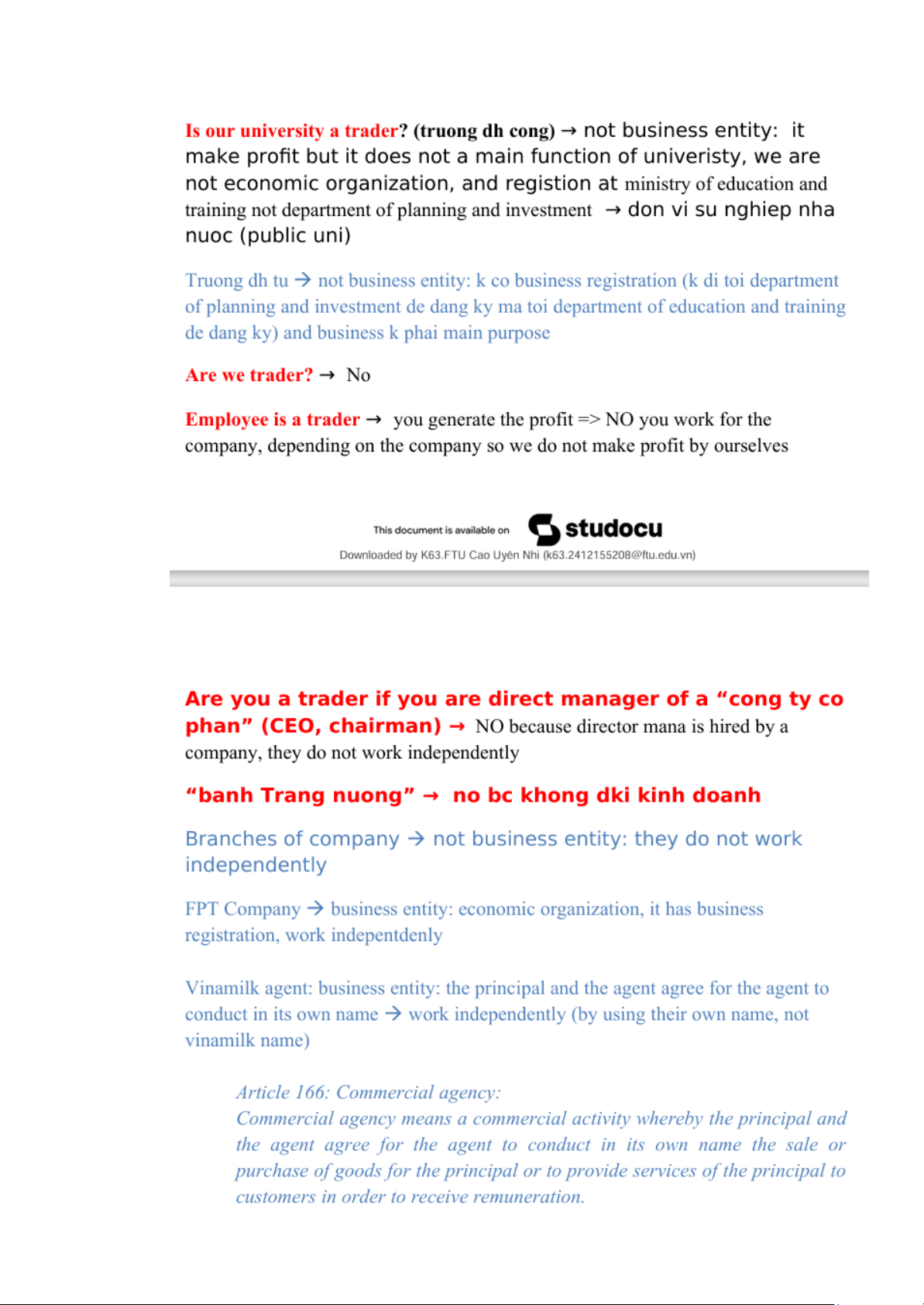
II. commercial contract
● parties: business entities/ traders (thương nhân)
● buy breakfast - not a trade, you don’t make any profit
● business household(s): hộ kinh doanh cá thể < enterprises, companies
○ go to people's committee (ủy ban nhân dân) for business registration
● enterprises, companies -> LLC (most) , JSC, sole proprietorship, partnership (doanh nghiệp hợp doanh)
○ business registration office (văn phòng đki kinh doanh) under the
control the department of planning and investment
○ if u have a department for rent on holiday for 3 months, u are not a
trader because it’s not regular and no company registration
● business trader: economic organisation so FTU university is not trader (don
vi nghe nghiep nha nuoc) under the control of administrator of education;
● ceo, chairman are not traders but just owner of the company as the business
registration if for the company not the boss
● van phong dai dien cong ty is also not business trader
definition article 166 commercial law
do business independently - not trader object: goods, service art 3.2 - law on commerce goods include:
- all types of movables, including those to be formed in the future, - things attached to land
*Land is not a commodity because it's the property of people and it’s not private
ownership, is controlled by the state
● we are selling and using land use right (quyen su dung dat) not the land
● if u buy a department which is built in the next 2 years, is it movable? - no
because the department cant move
● if u buy a car, it is not delivered - it is movable
● u buy a drink at the vending machine, it is a contract established by specific acts, verbal form
● art 3 law 15: Forms of validity to documents include telegraph, telex,
facsimile, data, message and other forms
● if im a director of a company, i'm not a trader because the business has the
registration - the owner is just on behalf of the company, legal representative ● a written contract
● civil code is not applicable to sale contract - false (specific - law on commerce - civil code (relevant law)
● Governing law: art 4-law on commerce
● 1. It means that commercial law would be first of the liable
● 2. Particular law/ specialised law (luật chuyên ngành)
● Ex: land law, tax law, the law of enterprise (luật doanh nghiệp), insurance
● law, law of real estate, investment law…
● Law in VN considered as specialised law is also commercial activities
● Specialised law commercial law civil code: three steps to apply the
● law for conducting commercial activities in vietnam
● art 5 clause 2 - foreign element (article 663.2)
● among 3 element, satisfy 1 condition - legal entity/ legal person (pháp nhân), main point is the nationality
● if not satisfy condition A, cannot continue with condition b (civil code 663)
● subject matter (đối tượng hợp đồng): if the contract involve foreign element,
can choose any law. but if no, stick to vn law only
● export contract can be governed by foreign law - YES
● Art 663.2 (Civil Code): Civil relation involving a foreign element means a civil
relation in any of the following cases:
○ (a) At least one of the participating parties is a foreign individual or legal entity (pháp nhân);
○ (b) The participating parties are Vietnamese citizens or legal entities
but the establishment, modification, implementation, or termination of
such relation happened in a foreign country; e.g. 2 Vietnamese
companies sign a contract in Australia.
○ (c) The participating parties are Vietnamese citizens or legal entities
but the subject matter (đối tượng của hợp đồng) of such civil relation is
located in a foreign country. e.g. The contract is signed between 2
Vietnamese companies and the goods are located in Thailand.
e.g. Two Vietnamese companies sign a contract, but the two directors
are Chinese. Can we apply Chinese Law? => stil applies Vietnamese law,
b/c the one who signs the contract is the sel er and buyer (the company, not the
directors) -> the directors are just representative => stil Vietnamese company => no foreign elements OFFER AND ACCEPTANCE
Offer: đặt hàng, đặt giao kết hợp đồng (offer from the seller: -> send service for the
buyer to purchase) => Purchasing order (đơn chào hàng)
Acceptance: chờ hàng, nhận giao kết hợp đồng Forms:
Offer + Acceptance = Contract
Offer signed by both the seller and buyer = Contract
● contract is an agreement between parties, at the time you accept, it is binding
○ offer to buy sth = order = đề nghị giao kết hợp đồng
○ PO = purchase order = chào mua hàng
○ offeror = người chào hàng, offeree: người mua hàng
○ priority in art 4: commercial law -> civil code
● Is the price tag on a book considered an offer, but it is a display? - not an offer
● invitation to treat -> negotiate
● if u buy a good and it says on the poster that u will get a gift, but the cashier
says it is out of stock, no gift -> still an offer because sometimes the poster
may have the disclaimer that the gift is limited, up to their stock
● 3 terms: commodity, quantity and price- have to satisfy 3 conditions
○ but vn is not clear about this
● the seller has the right to revoke if they have, this offer is irreplaceable, cannot be revoked
review: the difference between withdrawal in vn and CISG: vn has 2 situations to
withdraw, while CISG has 1 situation
● situation a in civil code art 389 is similar to art 15 of CISG
● but the situation b in the civil code is not mentioned in the CISG
○ ex: the seller has the right to withdraw the offer if the market price is
10% higher than the original price
● in vn law, you have to mention the right to revoke besides the time limit,
otherwise you cannot revoke - while CISG just need the time limit
● minor or major change, based on vn law, we have to make new offer
Tài liệu liên quan:
-
Đề thi cuối kì môn Pháp luật đại cương | Trường Đại học Ngoại Thương
77 39 -
Đề thi môn Pháp luật đại cương | Trường Đại học Ngoại Thương
72 36 -
Bồi Thường Thiệt Hại Ngoài Hợp Đồng Trong Vụ Án Quý - Hạnh môn Pháp luật đại cương| Trường Đại học Ngoại Thương
47 24 -
Phân Tích Tội Cưỡng Đoạt Tài Sản và Giả Mạo Chức Vụ môn Pháp luật đại cương| Trường Đại học Ngoại Thương
38 19