UNIT 7: TRAFFIC Lesson 1: Getting started – Meeting in the schoolyard | Giáo án môn Tiếng Anh lớp 7
UNIT 7: TRAFFIC Lesson 1: Getting started – Meeting in the schoolyard | Giáo án môn Tiếng Anh lớp 7 . Tài liệu giúp bạn tham khảo, ôn tập và đạt kết quả cao. Mời đọc đón xem!
Chủ đề: Unit 7: Traffic (GS) 31 tài liệu
Môn: Tiếng Anh 7 1.5 K tài liệu
Tác giả:













Preview text:
Date of planning : 25 - 31/12/2023
Date of teaching : 15- 20/01/2024 WEEK 19 – Period 55 UNIT 7: TRAFFIC
Lesson 1: Getting started – Meeting in the schoolyard I. OBJECTIVES
By the end of this lesson, Ss will be able to gain: 1. Knowledge
- An overview about the topic Traffic
- Vocabulary to talk about means of transport 2. Core competence
- Develop communication skills and cultural awareness
- Be collaborative and supportive in pair work and teamwork
- Actively join in class activities 3. Personal qualities
- Develop awareness of travelling in town/ city
- Be concerned to the local traffic II. MATERIALS
- Grade 7 textbook, Unit 7, Getting started
- Computer connected to the Internet
- Projector/ TV/ pictures and cards - sachmem.vn III. PROCEDURES Notes:
In each activity, each step will be represented as following: * Deliver the task ** Implement the task *** Discuss
**** Give comments or feedback Stage Stage aim Procedure WARM-UP - To activate MIMING GAME students’ * Teacher gives instructions. knowledge on the topic of the unit
** Get one student to the board. Teacher secretly shows 1 picture of a means of
transport to that student. He/ She has to mime the picture and the other students - To enhance
have to guess. Have students take turns going to the board until the last picture. students’ skills of cooperating with
**** Teacher checks and corrects if Ss pronounce the words incorrectly. teammates PRESENTATION To help students VOCABULARY use key language
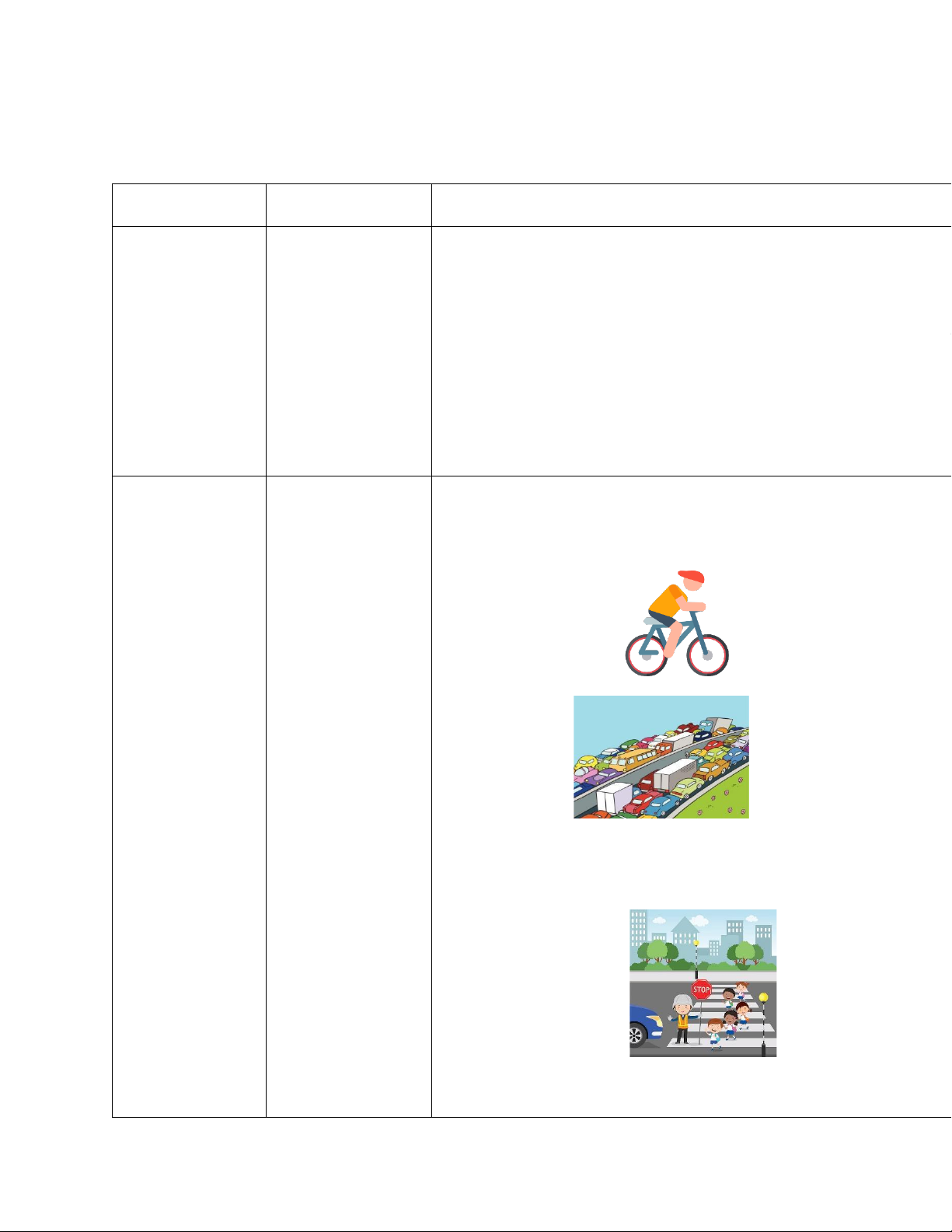
* T asks Ss to look at the photos and answer the questions: more appropriately 1. What is he doing? before they read and listen 2. What is this? 3. What are they doing?
4. Which time of the day do traffic jams usually happen? ** Ss say the words.
**** T shows and says the words aloud and asks Ss to repeat them.
* T asks Ss to translate the words into Vietnamese. Concept check: Slap the board - To get students
TASK 1: LISTEN AND READ. interested in the
* Teacher asks Ss to look at the picture (p.72, 73), then answer the question: topic Where are they? - To set the context
* Teacher plays the recording, asks students to pay attention to the new words.
(Teacher may check the meaning of some words if necessary.)
- Teacher can play the recording more than once. - Students listen and read.
** Teacher can invite some pairs of students to read aloud.
*** Teacher refers to the questions previously asked.
**** Then, teacher confirms the correct answer. PRACTICE - To help Ss
TASK 2: READ THE CONVERSATION AGAIN AND CHOOSE THE understand the
CORRECT ANSWER. (Ex 2, p. 74) main idea of the
* T asks Ss to quickly read the conversation again. text
** Ss discuss and answer questions in pairs.
*** Ss share their answers as a whole class.
**** T asks them to read and listen to the conversation to check their answers. T
encourages students to explain where they have found the answers in the conversation. Answer key: 1. A 2. B 3. C
TASK 3: WRITE ONE WORD FROM THE CONVERSATION TO
COMPLETE EACH SENTENCE. (Ex 3, p. 74)
* Teacher asks Ss to work individually to read the conversation and find the
words and phrases and then share their answers with their partners who sit next to them. (peer check) - To practise
** Ss do exercise individually.
reading for specific *** Ss share and discuss with their partners to write all words down on the information notebooks. - To practise
**** Teacher corrects their answers as a class. scanning - To develop Ss' knowledge of Answer key: vocabulary 1. cycled 2. should 3. jams 4. How 5. crowded - To revise and
TASK 4: LOOK AT THE PICTURES AND WRITE A WORD UNDER develop the EACH. vocabulary about (Ex 4, p. 74) means of transport
* Teacher asks students to work individually to complete the task.
** Have students fill in the blanks with the most suitable words/ phrases.
*** Teacher nominates Ss to read the words aloud.
**** Teacher checks and gives the correct answers.
Suggested answers:
1. bicycle/ bike 2. car 3. bus 4. motorbike
5. plane 6. train 7. boat 8. ship PRODUCTION - To help Ss
TASK 5: FIND SOMEONE WHO … WRITE YOUR FRIENDS’ NAMES practise talking
IN THE BLANKS. THEN REPORT TO THE CLASS. (Ex 5, p. 74) about how they go
* Teacher gives Ss clear instructions in order to make sure Ss can do the survey to school effectively. - To practise team
- Ask students to look at the survey and think of the needed structures to ask working their friends. - To give students
- Students go around the class and ask at least 20 classmates (Do you usually authentic practice
walk to school? Have you ever gone to school by bus?…) in using target language
- Observe Ss while they are role playing, note their language errors. ** Ss do as instructed.
**** Teacher gives Ss feedback.
- Choose some useful or excellent words/ phrases/ expressions/ word choices Ss
have used to suggest for other students.
- Choose some typical mistakes and correct as a whole class without nominating the students’ names. CONSOLIDATIO To help Ss
Teacher asks students to talk about what they have learnt in the lesson: N
memorise the target - Vocabulary of traffic and means of transport language and skills that they have
- Reading for specific information and details learned - Scanning HOMEWORK To prepare for the
- Do exercises in the workbook. next lessons.
- Prepare the vocabulary for the next lesson: A closer look 1. - Project preparation
+ Teacher informs student of the final project of the Unit’s project
+ Explain the requirements of the project: Find four traffic signs in your
neighbourhood, then choose to make one of them out of a cardboard or other
materials. Students will show their work and present in Lesson 7 – Looking back and Project.
+ Teacher explains to students how they can get the information
+ Put students into groups and ask them to discuss to assign tasks for each
member. Help them set a deadline for each task.
(Teacher should check the progress of students’ preparation after each lesson.) *EXPERIENCE:
- An overview about the topic Traffic
- Vocabulary to talk about means of transport
--------------------------------------------------
Date of planning : 25 - 31/12/2023
Date of teaching : 15- 20/01/2024 WEEK 19 – Period 56 UNIT 7: TRAFFIC
Lesson 2: A closer look 1 I. OBJECTIVES
By the end of this lesson, Ss will be able to gain: 1. Knowledge
- Verbs to use with means of transport
- Vocabulary to read the road signs
- Pronunciation: /aɪ/ and /eɪ/ 2. Core competence
- Be collaborative and supportive in pair work and teamwork
- Actively join in class activities 3. Personal qualities
- Develop awareness of understanding the road signs and obeying the traffic rules II. MATERIALS
- Grade 7 textbook, Unit 7, A closer look 1
- Computer connected to the Internet
- Projector/ TV/ small boards, markers - sachmem.vn III. PROCEDURES Notes:
In each activity, each step will be represented as following: * Deliver the task ** Implement the task *** Discuss
**** Give comments or feedback Stage Stage aim Procedure WARM-UP - To activate JUMBLED WORDS
students’ knowledge * Teacher gives instructions. on the topic of the unit
** In groups of 5, Ss will be given a small white board and a marker. - To enhance
- Teacher shows the jumbled words on the screen one by one. students’ skills of cooperating with
- Students work in groups to make the correct words and write down onto the teammates
small boards. When they finish, they hold the boards up to show their answers to teacher.
- Have students take turns to write until the last word.
**** Teacher checks and corrects if Ss write the words incorrectly. Answer key: 1- otba -> boat 2- itanr -> train 3- npeilara -> airplane 4- rsotrpca -> sport car 5- otmiroekb -> motorbike
VOCABULARY To help students use VOCABULARY key language more
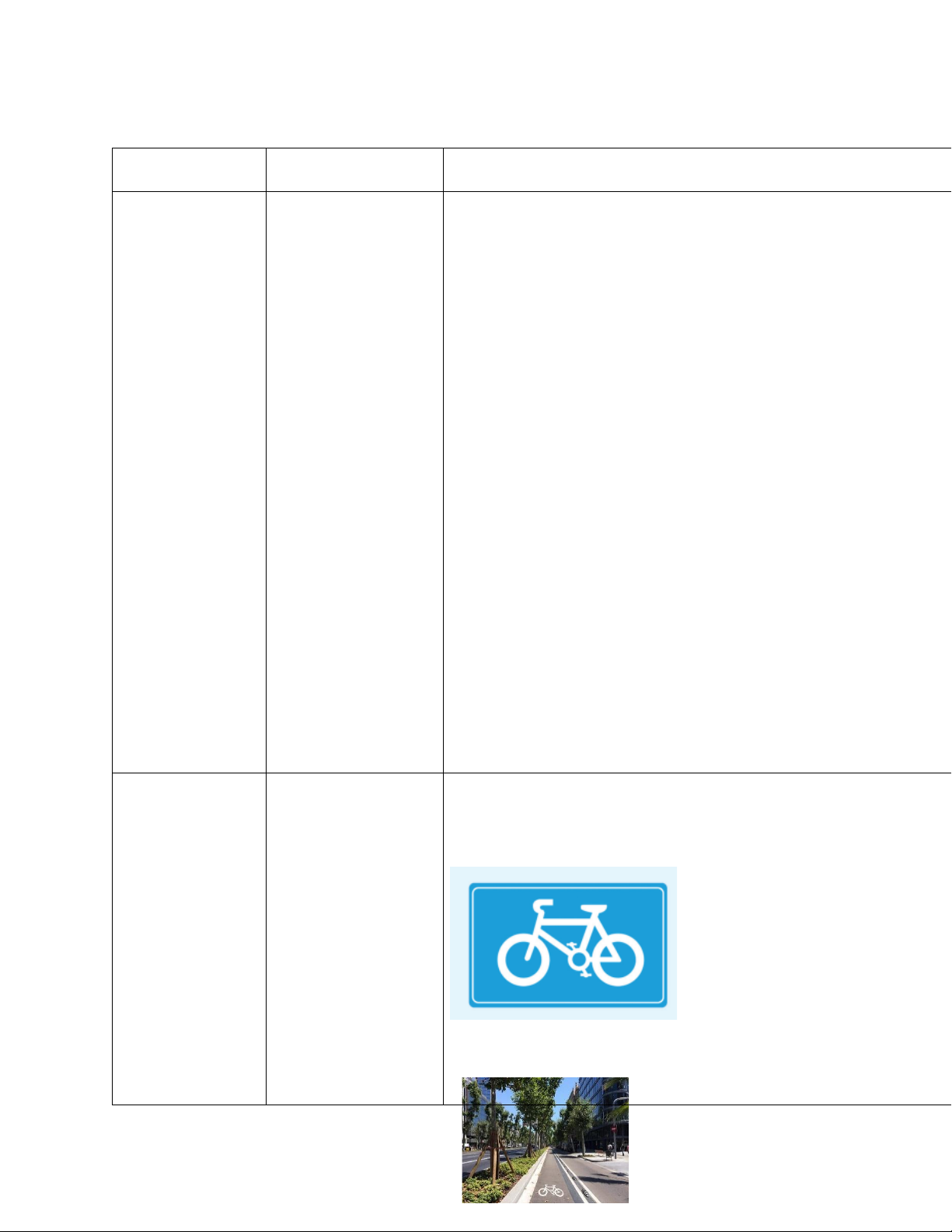
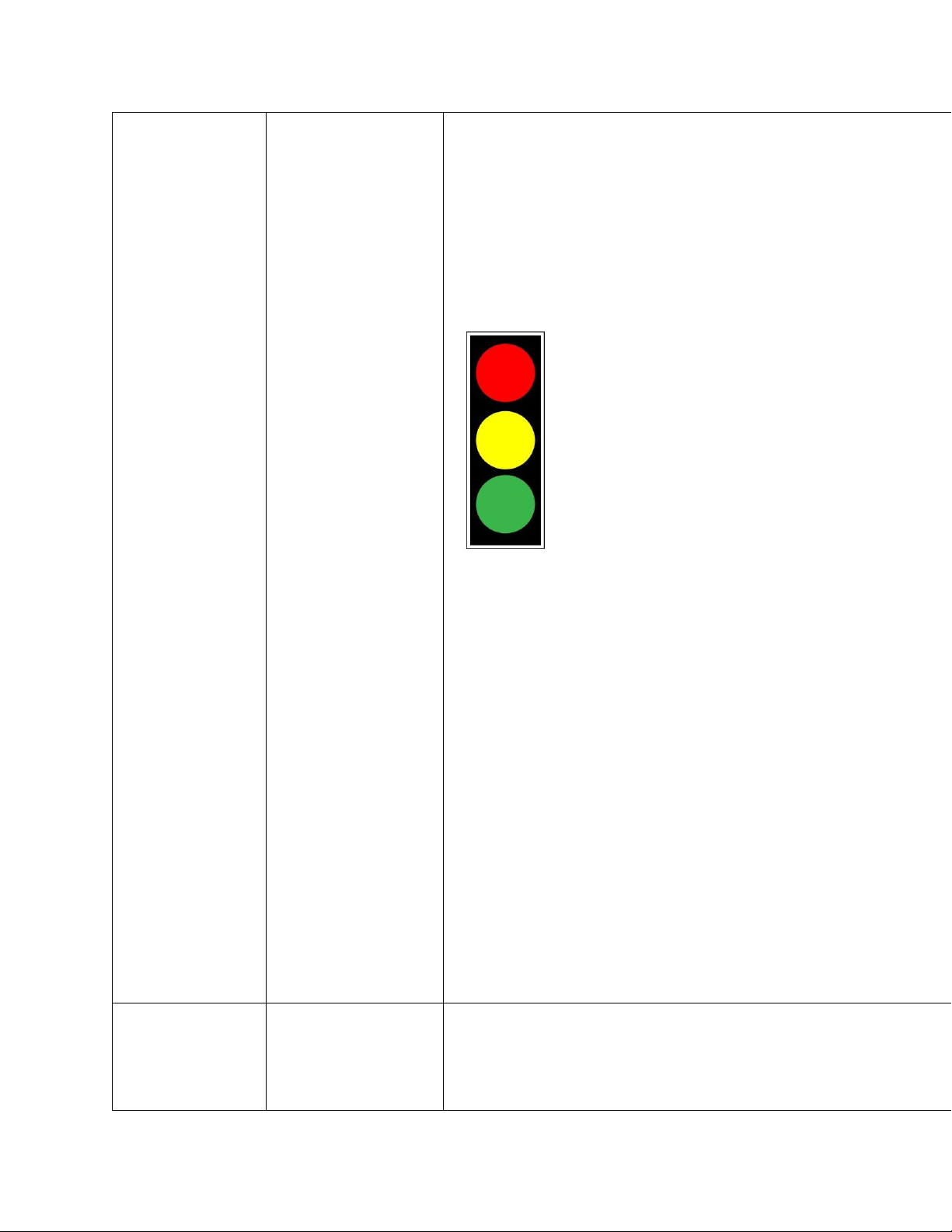
* T asks Ss to look at the photos and answer the question . appropriately 1. What is this? (road sign) 2. What is this? (cycle lane)
3. What is this? (traffic light) ** Ss say the words.
*** Other Ss correct if the previous answers are incorrect.
**** Teacher shows and says the words aloud and asks Ss to repeat them.
* Teacher asks Ss to translate the word into Vietnamese. ** Ss says the word. VOCABULARY - To revise/ teach
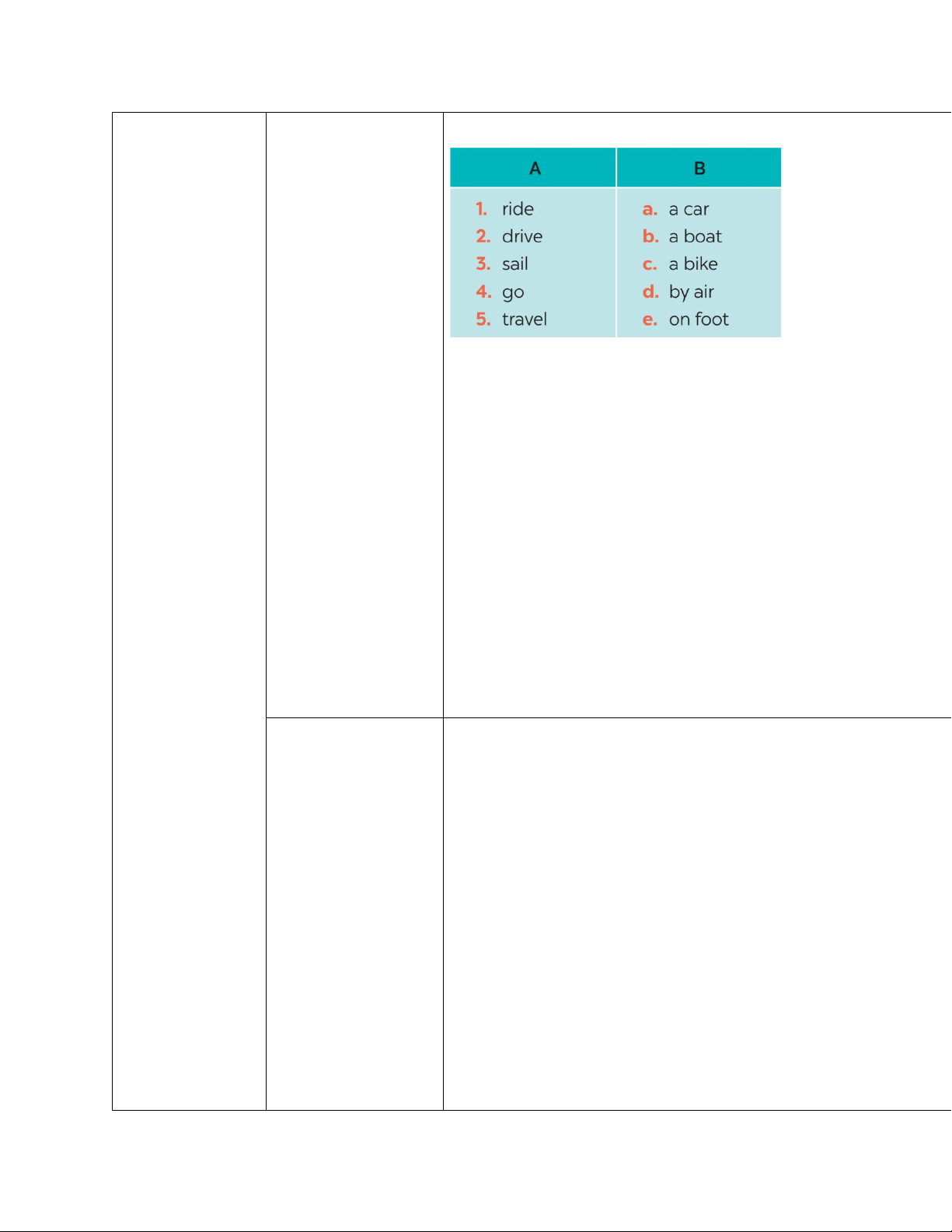
TASK 1: MATCH THE WORDS IN A WITH THE PHRASES IN B. (Ex
some collocations of 1, p. 74) a verb and a phrase
* Teacher asks Ss to look at the table (p.74), identify the form (verbs and related to different means of transport
nouns – means of transport): Answer key: 1. c 2. a 3. b 4. e 5. d
** Ss work out and answer questions in pairs.
*** Ss share their answers as a whole class.
**** T asks them to check their answers.
* Teacher asks students to make their own sentences with these phrases. Then
tell them to share their sentences with a partner and correct them.
TASK 2: LOOK AT THESE ROAD SIGNS. THEN WRITE THE
CORRECT PHRASES UNDER THE SIGNS. (Ex 2, p.74)
* Teacher asks Ss to look at the road signs and guess their meanings. Then
work and share their answers with their partners who sit next to them. (peer - To practise check) identifying the meanings of road ** Ss do Task 2 in pairs. signs
*** Ss share and discuss with their partners to write all words/ phrases down - To develop Ss' on the notebooks. knowledge of
**** Teacher corrects their answers as a class. vocabulary Answer key:
1. Traffic lights 2. Hospital ahead 3. No right turn
4. Cycle lane 5. School ahead 6. No cycling - To help Ss deeply
TASK 3: WORK IN PAIRS. TAKE TURNS TO SAY WHICH OF THE understand how to
SIGNS IN 2 YOU SEE ON THE WAY TO SCHOOL. (Ex 3, p. 74)
read the road signs * Teacher gives suggestions and asks students to share their sentences. - To practise the
*** Teacher nominates Ss to say the sentences aloud targeted language in life context.
**** Teacher checks and gives the corrections if they have mistakes.
PRONUNCIATIO - To help Ss identify
TASK 4: LISTEN AND REPEAT. PAY ATTENTION TO THE SOUNDS N
the and classify the /aɪ/ AND /eɪ/. (Ex 4, p. 74) sounds
* Teacher has students listen to the recording once first.
** Students listen to the recording and read out the words.
*** Teacher plays the recording for them to listen and repeat each word as a class, then as individuals.
**** Teacher check students’ pronunciation if needed. - To help students
TASK 5: UNDERLINE THE WORDS WITH THE SOUND /aɪ/ AND pronounce the
CIRCLE THE WORDS WITH THE SOUND /eɪ/. THEN LISTEN,
sounds correctly in CHECK AND REPEAT. (Ex 5, p. 74) context
* Teacher plays the recording again and asks students to underline and circle - To help students the appropriate sounds. differentiate the ** Ss do as instructed sounds /aɪ/ and /eɪ/
**** Teacher gives Ss feedback.
- Choose some common mispronounced words that contain the sounds and
suggest students practise using them.
- Choose some typical errors and correct as a whole class. WRAP-UP To consolidate what
- Teacher asks students to summarise what they have learnt in the lesson. students have learnt in the lesson. HOMEWORK To revise what they Do exercises in the workbook. have learnt. *EXPERIENCE:
- Students have learned Verbs used with means of transportation
- Students have learned vocabulary for reading road signs
- Students have learned how to pronounce: /aɪ/ and /eɪ/
-------------------------------------------------------------
Date of planning : 25 - 31/12/2023
Date of teaching : 15- 20/01/2024 WEEK 19 – Period 57 UNIT 7: TRAFFIC
Lesson 3: A closer look 2 I. OBJECTIVES
By the end of this lesson, Ss will be able to gain: 1. Knowledge Know how to use:
- It to indicate distance
- should and shouldn’t Structure Examples
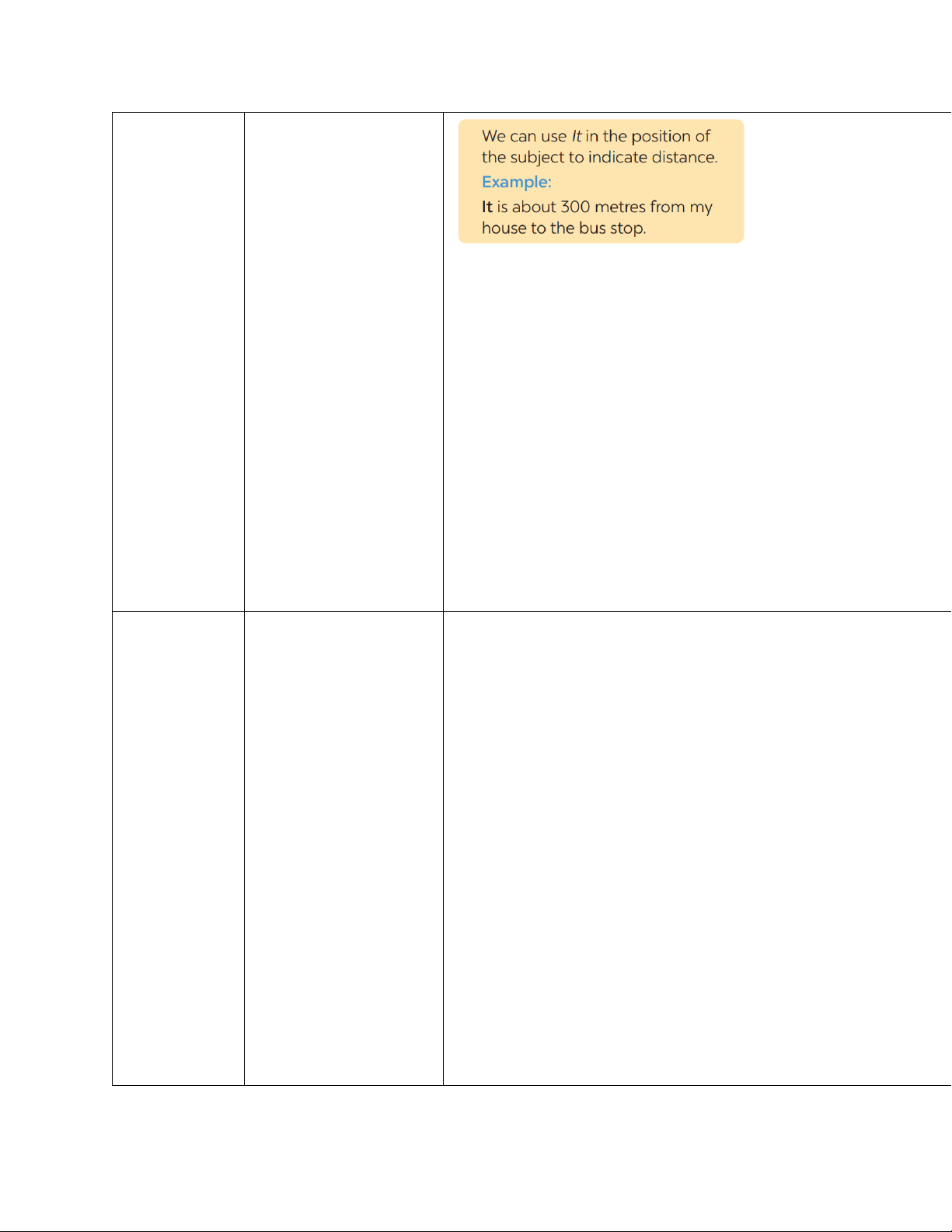
1. It to indicate distance
It is 4 kilometers from my house to school. 2. should
We should eat more vegetables and fruits. 3. shouldn’t
You shouldn’t stay up late everyday. 2. Core competence
- Be collaborative and supportive in pair work and teamwork
- Actively join in class activities 3. Personal qualities
- Develop awareness of understanding the road signs and obeying the traffic rules. II. MATERIALS
- Grade 7 textbook, Unit 7, A closer look 2
- Computer connected to the Internet - Projector/ TV/ pictures. - sachmem.vn III. PROCEDURES Notes:
In each activity, each step will be represented as following: * Deliver the task ** Implement the task *** Discuss
**** Give comments or feedback Stage Stage aim Procedure WARM-UP - To activate students’ SLAP THE BOARD
knowledge on the topic * Teacher gives instructions and sticks some road signs pictures onto the of the unit board. - To enhance students’
** In 2 groups, Ss will choose 1 student in each group to go to the board. skills of cooperating with teammates
- Teacher says a road sign message.
- Students quickly run and slap onto the correct road signs.
- Students take turns until they finish all of the signs.
Suggested answers: 1. Cycle lane 2. School ahead 3. No cycling 4. No right turn 5. Schools ahead
**** Teacher checks and corrects if Ss pronounce the signs incorrectly. PRESENTATI To introduce students
IT INDICATING DISTANCE ON the form of the key
- Teacher says: “This lesson today is going to tell you about “it indicating grammar and how to distance” use them appropriately
* Teacher draws students’ attention to the grammar point and the example * Teacher asks Ss:
- What does the sentence tell us about?
Answer: Distance from his/her house to the bus stop.
- What is the structure used in the sentence?
Answer: It be (about) + distance from A to B.
** Ss read the grammar explicitly and study the example.
*** Ss may discuss within groups/pairs before answering.
**** Teacher shows and says the sentences aloud and asks Ss to make similar sentences. PRACTICE
To help student practise TASK 1: WRITE SENTENCES WITH IT. USE THESE CUES. (Ex 1, p.
using It to write correct 75) sentences
* Teacher asks Ss to look at the example and the task.
** Ss work out and answer questions individually.
*** Ss share their answers in pairs.
**** T asks them to check their answers.
* Then tell them to share their sentences as a whole in class and correct for them. Answer key:
1. It is about 700 metres from my flat to the Youth Club.
2. It is about 5 kilometres from my village to the nearest town.
3. It is about 120 km from Ho Chi Minh City to Vung Tau.
4. It is about 384,400 km from the Earth to the Moon.
5. It is not very far from Ha Noi centre to Noi Bai airport. To practise asking and
TASK 2: WORK IN PAIRS. ASK AND ANSWER QUESTIONS ABOUT answering about
DISTANCES IN YOUR NEIGHBOURHOOD. (Ex 2, p. 75) distance
* Teacher asks Ss to look at the example and identify the structure of the
question: How far is it from … to …?
Then work with their partners who sit next to them to make similar conversations. ** Ss do exercise 2 in pairs.
*** Ss write all conversations down on the notebooks.
**** Teacher corrects their answers as a class. To review the first use
TASK 3: CHOOSE THE CORRECT OPTION IN BRACKETS. (Ex 3, p.
of should and shouldn’t 75)
* Teacher draws students' attention to the Remember box. Teacher asks them
to study the examples and identify the structure:
S + should/ shouldn’t + V-inf
* Teacher gives suggestions and asks students to make some similar sentences using the structures.
*** Teacher nominates Ss to read aloud the sentences.
**** Teacher checks and gives the corrections if they have mistakes. Answer key: 1. should 2. should 3. shouldn’t 4. should 5. shouldn’t
To practise using should TASK 4: COMPLETE EACH SENTENCE, USING SHOULD /
and shouldn’t
SHOULDN’T. (Ex 4, p.75)
* Teacher gives Ss time to do the exercise individually and peer check with their partner.
*** Teacher nominates Ss to read aloud the sentences.
**** Teacher checks and gives the corrections if they have mistakes. Answer key: 1. shouldn’t 2. should 3. shouldn’t 4. should 5. should 6. shouldn’t PRODUCTIO
To help students apply TASK 5: LOOK AT THE PICTURES. MAKE SENTENCES, USING N
SHOULD/ SHOULDN’T AND THE CUES. (Ex 5, p.76)
should and shouldn’t in real context
* Teacher asks students to do the exercise individually. ** Ss do as instructed.
**** Teacher gives Ss feedback.
- Choose some common mistakes and suggest students how to avoid them
- Choose some typical errors and correct as a whole class Answer key:
1. He shouldn’t waste water.
2. They should wear their helmets.
3. She should be more careful.
4. They shouldn’t play football on the pavement.
5. They shouldn’t ride their bikes dangerously. WRAP-UP To consolidate what
Teacher asks students to summarise what they have learnt in the lesson. students have learnt in the lesson. HOMEWORK To revise what they Do exercises in the workbook. have learnt. * EXPERIENCE: Known how to use:
- It to indicate distance
- should and shouldn’t