UNIT 7: TRAFFIC Lesson 4: Communication | Giáo án môn Tiếng Anh lớp 7
UNIT 7: TRAFFIC Lesson 4: Communication | Giáo án môn Tiếng Anh lớp 7 . Tài liệu giúp bạn tham khảo, ôn tập và đạt kết quả cao. Mời đọc đón xem!
Chủ đề: Unit 7: Traffic (GS) 31 tài liệu
Môn: Tiếng Anh 7 1.5 K tài liệu
Tác giả:


















Preview text:
Date of planning : 01 - 05/01/2024
Date of teaching : 22- 27/01/2024 WEEK 20 – Period 58 UNIT 7: TRAFFIC
Lesson 4: Communication I. OBJECTIVES
By the end of this lesson, students will be able to: 1. Knowledge
- Learn how to ask and answer about means of transport and some strange traffic rules.
- Practise using some grammar points and vocabulary related to the topic. 2. Core competence
- Develop communication skills
- Be collaborative and supportive in pair work and team work
- Actively join in class activities 3. Personal qualities
- Be benevolent and responsible II. MATERIALS
- Grade 7 textbook, Unit 7, Communication
- Computer connected to the internet - TV/ Pictures/ Projector - sachmem.vn III. PROCEDURES Notes:
In each activity, each step will be represented as following: * Deliver the task ** Implement the task *** Discuss
**** Give comments or feedback Stage Stage aim Procedure WARM-UP
To introduce the lesson Game: BRAINSTORMING HOW DO YOU GO TO SCHOOL?
* Teacher divides the class into 2 teams and asks them to think of “MEANS
OF TRANSPORT” (even the strangest ones).
** Ss have 1 min to think of the words related to the topic or they can discuss with their partners.
*** Members from each team will take turns to run to the board and write one word.
**** Teacher corrects their answers.
- The team which has more correct words will be the winner
Suggested answers:
motorbike, bicycle, train, bus, plane, helicopter,… LEAD-IN To lead in the lesson
Teacher leads students into the lesson by telling them what they are going to
learn: “We are going to learn how to ask and answer about means of transport
and some strange traffic rules”. EVERYDAY To let students know
TASK 1: LISTEN AND READ THE CONVERSATION, PAYING ENGLISH
the structure to ask and ATTENTION TO THE HIGHLIGHTED PARTS. (Ex 1, p. 76) answer about means of
* Teacher plays the record for Ss to listen and read the conversation about transport means of transport.
** Ss listen and practise saying with their partners.
*** Teacher calls some pairs to read aloud.
**** Teacher corrects pronunciation if needed.
* Teacher asks Ss to pay attention to the highlighted parts and asks them some
questions to elicit the new structure:
- Which tense do we use to ask and answer?
- Which question word do we use? - …
** Ss answer teacher’s questions to find out the new structure to ask and answer
about means of transport to travel to places.
*** Some students give the new structure to the teacher.
**** Teacher corrects and writes on the board: ⮚ Structure: to ask:
- How do/ does + S + go to …? to answer: - S + go/goes by … - S + V PRACTICE To help students
TASK 2: WORK IN PAIRS. TAKE TURNS TO ASK AND ANSWER practise on how to ask
ABOUT THE MEANS OF TRANSPORT YOUR FAMILY MEMBERS and answer about
USE EVERY DAY. (Ex 2, p. 76) means of transport.
* Teacher has SS look at the situation in Ex 1 to make similar dialogue:
** Ss work in pairs to make similar dialogue.
*** Teacher calls some pairs to present it in front of the class.
**** Teacher gives feedback and some comments.
Suggested answers:
A: How does your father go to school?
B: He usually drives his car but sometimes he goes by bus. How about your father?
A: He walks because we live near his office. STRANGE To provide students
TASK 3: WHICH COUNTRIES BELOW KEEP TO THE LEFT? TICK TRAFFIC with more knowledge
THE CORRECT ANSWERS. (Ex 3, p.76) RULES about strange traffic
* Teacher asks Ss to discuss in pairs and tick. rules ** Ss do the task in pairs.
*** Teachers discuss with students about their answers. Answer key:
- Task 3: The United Kingdom, Australia, Thailand To help students
TASK 4: LISTEN AND CHECK YOUR ANSWERS IN 3. THEN LISTEN practise listening for
AGAIN AND COMPLETE THE SENTENCE WITH NO MORE THAN details
THREE WORDS. (Ex 4, p. 77)
* Teacher plays the recording twice (if necessary).
*** Teacher calls some Ss to give their answers and explain them.
**** Teacher lets Ss listen and confirms the correct answers. Answer key:
- Task 4: the same system
To help students know TASK 5: READ, DISCUSS WHICH ONE IS THE STRANGEST RULE?
more about traffic rules (Ex 5, p. 77) around the world
* Teacher has students work in groups to discuss which one they find strangest. ** Ss work in groups.
*** 2-3 groups share their ideas.
**** Teacher encourages students to add more if they know. WRAP-UP To consolidate what
Teacher asks students to talk about what they have learnt in the lesson. students have learnt in the lesson HOMEWORK
To prepare for the next - Do exercises in the workbook. lesson: Skills 1
- Prepare for the next lesson. *EXPERIENCE:
- Students learned how to ask and answer about means of transport and some strange traffic rules.
-Students have practiced using some grammar points and vocabulary related to the topic.
--------------------------------------------------
Date of planning : 01 - 05/01/2024
Date of teaching : 22- 27/01/2024 WEEK 20 – Period 59 UNIT 7: TRAFFIC Lesson 5: Skills 1 I. OBJECTIVES
By the end of this lesson, students will be able to gain: 1. Knowledge
- Reading: read for specific information about some rules about road safety
- Speaking: talk about how to avoid traffic accidents 2. Core competence
- Develop communication skills
- Be collaborative and supportive in pair work and teamwork
- Actively join in class activities 3. Personal qualities Be benevolent and responsible II. MATERIALS
- Grade 7 textbook, Unit 7, Skills 1
- Computer connected to the Internet - TV/ Pictures, cards - sachmem.vn III. PROCEDURES Notes:
In each activity, each step will be represented as following: * Deliver the task ** Implement the task *** Discuss
**** Give comments or feedback Stage Stage aim Procedure WARM-UP To introduce the topic of GAME: HANGMAN reading D A N G E R O U S
* Teacher divides the class into 2 teams and asks them to think of a word
which has 9 letters in it related to the topic “ON THE ROAD”.
** Ss have 1 min to think of the words related to the topic or they can discuss with their partners.
*** Each member from each team guesses the letter in the secret word in turn.
**** Teacher corrects their answers.
- The team which can find or guess the secret first will be the winner. LEAD-IN To lead in the lesson
Teacher leads students into the lesson by telling what they are going to learn: about Skills 1
“We are going to read a passage about some rules about road safety.” READING To provide students with VOCABULARY
some lexical items before - Teacher introduces the vocabulary by: reading the text
+ Providing the synonyms or antonyms of the words.
+ Providing the pictures of the words.
+ Providing the definitions of the words.
- pedestrian (n): người đi bộ - passenger (n): hành khách - (to) obey : tuân thủ - seatbelt (n): dây an toàn
Concept check: Rub out and Remember To introduce words
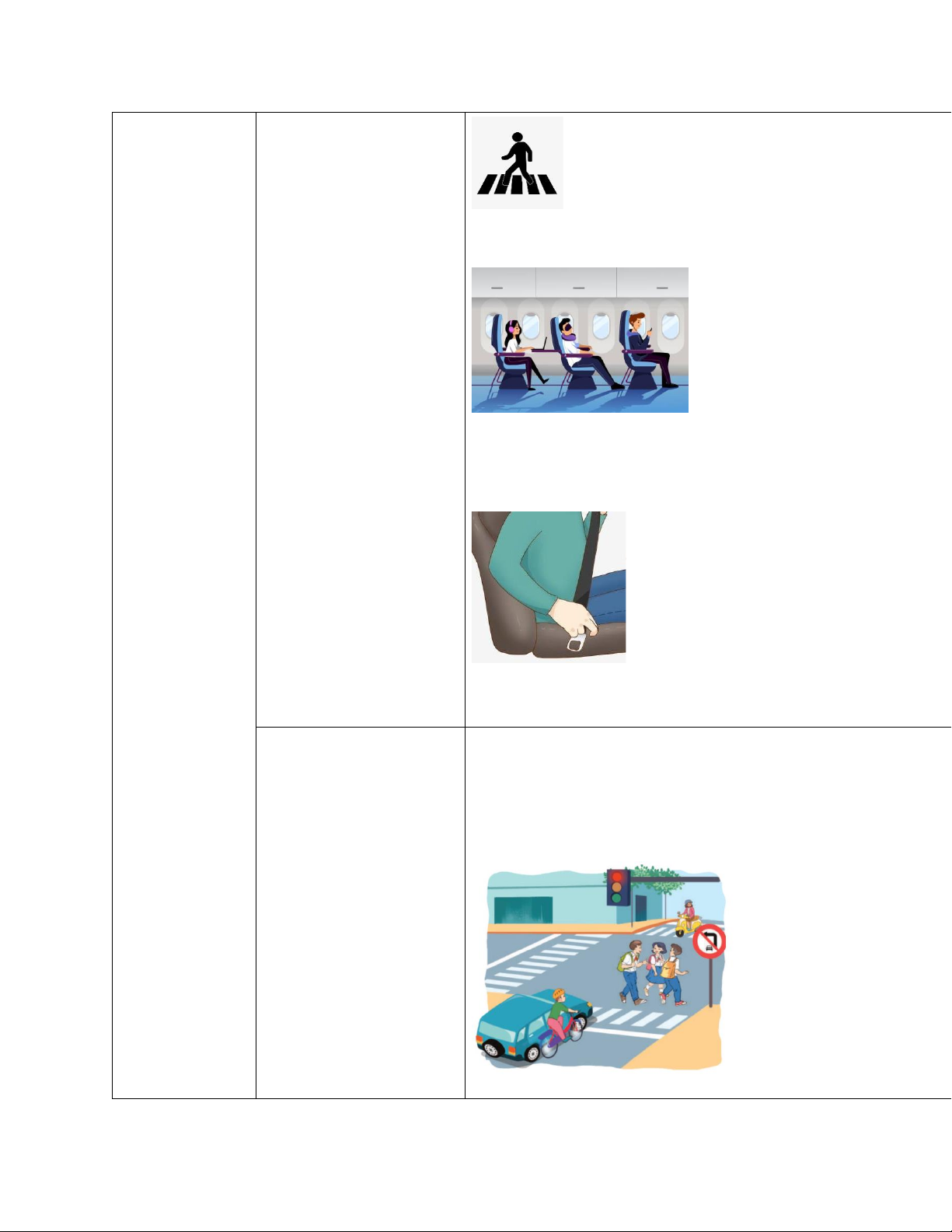
TASK 1: LOOK AT THE PICTURE. CAN YOU SEE ANYTHING related to skin conditions
THAT IS DANGEROUS? (Ex 1, p. 78) to Ss and help Ss have a
* Teacher asks Ss to work in pairs to look at the Picture in Ex 1 and discuss
general idea of what they what they see that is dangerous? are going to read ** Ss work in pairs.
*** Teacher calls some Ss to check what they have discussed. **** Teacher corrects.
Suggested answers:
The students are crossing the road. But they do not walk in the right place and they are not careful. To help Ss develop their
TASK 2: READ THE FOLLOWING TEXT AND CHOOSE THE reading skills for main
CORRECT ANSWER. (Ex 2, p. 78) ideas and specific This text is about ______. information (scanning) and help them focus on A. rules for pedestrians the road safety rules B. traffic lights C. traffic rules
* Teacher has Ss read the first sentence of the text in detail to do the exercise
and asks them how to do this kind of exercise.
** Ss do the task independently.
*** Teacher tells Ss to compare their answers in pairs before calling some of them to check.
**** Teacher confirms the correct answer and explains if needed. Answer key: C To help Ss further
TASK 3: READ THE TEXT AGAIN AND ANSWER THE QUESTIONS. develop their reading (Ex 3, p. 78) skills for specific
* Teacher asks Ss: reading each question, locating where the information information (scanning)
appears in the text, reading that part carefully and circling the correct answer.
** Ss do the task independently.
*** Teacher has Ss compare their answers in pairs and call some Ss to give their ideas.
**** Teacher checks and confirms the correct answers. Answer key:
1. They shoud cross the street at the zebra crossing.
2. We should use the cycle lane.
3. We should give a signal (before we turn while riding a bike).
4. We must wait for buses to fully stop when you get on or off a bus.
5. We mustn’t stick any body parts out of the window (when you are in a moving vehicle). SPEAKING
To help Ss talk about how TASK 4: WORK IN GROUPS. ASK AND ANSWER THE FOLLOWING
they apply the rules in the QUESTION (Ex 4, p.78) reading themselves
“When you are a road user, what should you NOT do?”
MAKE A LIST IN GROUPS. COMPARE YOUR LIST WITH OTHER GROUPS’.
* Teacher asks Ss to work in groups and tells them to focus on the rules for
road users in the text to talk about which one they have to obey every day.
** Ss work in groups. Teacher goes around and listens and gives help if needed.
*** Teacher calls on some Ss to share their answers with the class.
**** Teacher listens and gives comments.
TASK 5: READ THE FOLLOWING SENTENCES ABOUT THESE
PEOPLE. THEN WORK IN GROUPS. DISCUSS WHO IS BEING
SAFE, AND WHO ISN’T. (Ex 5, p.78)
* Teacher has Ss work in groups and asks them to take turns to discuss the situations.
** Ss work in groups to do the task. Teacher goes around, listens and gives help if needed.
*** Teacher calls on some groups to share their answers with the class. **** Teacher comments. - To provide Ss an
TASK 6: GIVE ADVICE ON DANGEROUS SITUATIONS ON THE opportunity to practise ROAD. giving advice on
Structure: S + should/shouldn’t + V-inf dangerous situations on the road
* Teacher has students give advice on how to avoid dangerous situations on the road.
** Students do the task in groups.
*** Teacher calls on some groups to share their answers with the class.
**** Teacher comments and corrects if needed. WRAP-UP To consolidate what
Teacher asks students to talk about what they have learnt in the lesson. students have learnt in the lesson HOMEWORK To prepare for the next
- Do exercises in the workbook. lesson: Skills 2
- Prepare for the next lesson. *EXPERIENCE:
- Students read to find specific information about some traffic safety regulations.
- Students talked about how to avoid traffic accidents.
---------------------------------------------------------
Date of planning : 01 - 05/01/2024
Date of teaching : 22- 27/01/2024 WEEK 20 – Period 60 UNIT 7: TRAFFIC Lesson 6: Skills 2 I. OBJECTIVES
By the end of this lesson, students will be able to: 1. Knowledge - Listening
+ use the lexical items related to the topic Traffic
+ listen for main ideas and specific information about traffic problems in Mumbai.
- Writing: write about traffic problems in your area. 2. Core competence
- Develop communication skills
- Be collaborative and supportive in pair work and teamwork
- Actively join in class activities 3. Personal qualities Be benevolent and responsible II. MATERIALS
- Grade 7 textbook, Unit 7, Skills 2
- Computer connected to the Internet - Pictures - sachmem.vn III. PROCEDURES Notes:
In each activity, each step will be represented as following: * Deliver the task ** Implement the task *** Discuss
**** Give comments or feedback Stage Stage aim Procedure WARM-UP To activate students’ BRAINSTORMING prior knowledge and
* Teacher writes on the board the word “Traffic problems” and asks Ss
vocabulary related to the some questions: lesson
+ What does this word mean?
+ What do we have to suffer from these problems?
+ Can you name some traffic problems?
** Ss think of these questions and discuss with their partners if needed.
*** Teacher calls some students to give their answers.
**** Teacher listens and gives comments. LEAD-IN To introduce the new
Teacher introduces students the content of the lesson: “In the lesson today, lesson
we are going to listen to a person talking about traffic problems in his city - Mumbai.”
PRE-LISTENING To help Ss brainstorm
TASK 1: WHAT CAN YOU SEE IN THIS PICTURE? WHAT IS the topic and prepare for
SPECIAL ABOUT IT? (Ex 1, p. 79) the listening text
* Teacher asks Ss to work in pairs to the problems they can find in the picture on page 79.
** Ss work with their partner to do the task.
*** Teacher calls on some Ss to answer.
**** Teacher gives comments and leads Ss to task 2.
Suggested answers: traffic jams, vehicle overload, people’s awareness about traffic rules… WHILE- To help Ss develop their
TASK 2: LISTEN TO THE RECORDING AND CHOOSE THE LISTENING skills of listening for
CORRECT ANSWER A, B, OR C. (Ex 2, p. 79) main idea
* Teacher asks Ss to read and underline the key words.
** Ss work independently to guess then listen to the recording once to check their guess.
*** Teacher calls on some students to give the answers they have listened. **** Teacher gives feedback. Answer key: C
To help students develop TASK 3: LISTEN AGAIN AND WRITE ONE WORD OR NUMBER their skills of listening
IN EACH GAP. (Ex 3, p. 79) for specific information
* Teacher asks Ss to read and underline the key words.
** Ss work independently then listen to the recording again
**** Teacher confirms the correct answers for their predictions. Answer key: 1. jams 2. problem / jams 3. 20 / twenty 4. roads 5. obey POST-
To help Ss use what they TASK 4: DISCUSSION: COMPARE TRAFFIC PROBLEMS IN LISTENING have listened to life
MUMBAI WITH TRAFFIC PROBLEMS IN HA NOI. context
* Teacher tells Ss to work in groups to discuss and compare traffic problems
in Mumbai with traffic problems in Ha Noi. Write down in the notebooks in full sentences.
** Ss work in groups. Teacher moves around and offers help if needed.
*** Teacher invites some Ss to share their answers.
**** Teacher corrects if needed.
E.g. The traffic jams in Ha Noi are as serious and frequent as they are in Mumbai. PRE-WRITING To help Ss prepare ideas
TASK 5: TICK THE TRAFFIC PROBLEMS IN BIG CITIES IN VIET to write a passage
NAM. (Ex 4, p. 79)
* Teacher writes on the board “Your City’s Traffic Problems” and asks Ss
to tick the traffic problems in big cities in Viet Nam and asks them to give
out more problems that they see in their city.
** Ss think of it and can discuss it with their partners.
*** Teacher calls on some Ss to raise their ideas.
**** Teacher listens and confirms.
Suggested answers: Too many vehicles Narrow roads People’s awareness … WHILE- To help Ss write a
TASK 6: WRITE A PARAGRAPH OF ABOUT 70 WORDS ABOUT WRITING passage about 70 words
THE TRAFFIC PROBLEMS IN YOUR TOWN / CITY. (Ex 5. p.79) about the traffic
* Teacher tells Ss that they are going to write a passage about the traffic problems in their town / problems in their town/city. city
** Teacher reminds Ss of the structure of a passage and steps to make an outline for the passage.
** Ss work independently to do the task and try to use the notes from the previous tasks.
Teacher goes around and helps if necessary.
POST-WRITING To peer check, cross
PEER CHECK AND CROSS CHECK check and final check students’ writing
*** Teacher asks Ss to share their writing with their partners. Then, call on
some Ss to show their writing in front of the class.
**** Teacher checks ideas, grammar, vocabulary and gives comments.
Suggested answers:
The most serious traffic problem in our city – Ha Noi is the traffic jam.
Although the public transport system in Ha Noi is quite modern and
convenient, many people prefer using their own motorbikes. The reason for
that is because most roads and streets in Ha Noi are quite small and include
many tiny lanes. Therefore, using private vehicles allows them to get to their
destinations without walking long distances. The situation usually gets worse
at rush hours when people all go to work or return home from work and
schools. In conclusion, people should try to use public transport more often
to reduce the traffic jams and exhaust. WRAP-UP To consolidate what
Teacher asks students to talk about what they have learnt in the lesson. students have learnt in the lesson HOMEWORK To allow students to
- Prepare for the next lesson: Looking back & Project. finalize their passage
- Rewrite the passage on the notebook. after being checked by friends and teacher
- Do exercise in the workbook. *EXPERIENCE: - Listen:
+ Students used vocabulary items related to the topic of Transportation
+ Students heard the main ideas and specific information about traffic problems in Mumbai.
- Writing: Students wrote about traffic problems in the area where they live.