Date of planning:…………..
Date of teaching: ………..…
WEEK:
Period ..... : UNIT 4: MUSIC AND ARTS
Lesson 1: GETTING STARTED
A talk at the school gate
I. OBJECTIVES: * By the end of this lesson, Ss will be able to gain:
- use the words related to the topic
Music and Arts;
- pronounce the sounds /ʃ/ and /ʒ/ correctly;
- use like, different from, (not) as... as to compare people and things;
- express preferences;
- read for specific information about a traditional art form;
- talk about a musical performance at their school;
- listen for specific information about street painting;
- write an informal letter of invitation
1. Knowledge:
- To introduce the topic “
Music and arts
”. To practice listening and reading.
- Have an overview about the topic
Music and arts.
- Use the vocabulary to talk about
Music and arts.
+ Vocabulary: + use the lexical items related to the topic
Music and arts;
concert hall (n), actress (n), artist (n), composer (n), puppet (n), portrait (n),
photography , perform
- pronounce and recognize the sounds /ʃ/ and /ʒ/.
+ Grammar: -
Comparisons:
like, different from, (not) as … as .
2. Competence: Students will be able to practice listening and reading the
conversation between Trang and Nick.
(They are talking about music and arts,
what they often do in their free time, and then they agree on what to do next
weekend.)
- Develop communication skills.
- Be cooperative and supportive in pair work and teamwork.
- Actively join in class activities.
3. Qualities: - To educate the love of music and art.
- Be ready to know the words about music and arts.
- Develop self-study skills.
II. TEACHING AIDS:
- Teacher: Grade 7 text book, laptop, projector / TV/ pictures and cards.....
- Students : Text books, studying equipment….
- Computer connected to the Internet.
- Sach mem.vn
III. PROCEDURE:
Notes: In each activity, each step will be represented as following:
* Deliver the task.
* Implement the task.
* Discuss.
* Give comments or feedback.
1. WARM UP & INTRODUCTION ( 3’- 5’)
Aims:
- To create an active atmosphere in the class before the lesson;
- To lead into the new unit
* Content: To have some warm-up activities to create a friendly and relaxed atmosphere
to inspire Ss to warm up to the subject and new lesson.
* Outcome: Having a chance to speak English.
* Organisation : Teacher’s instructions …
Teacher’s Student’s activities Content
+ Greeting
+ Guessing game: Kinds of music
* Teacher divides students into 2 groups
and has them listen to some songs to guess
what kinds of music they are.
* Students work in 2 groups, try to listen,
and guess.
* The member in each group which has the
answer can raise hand. If student has the
correct answer, he/ she will get 1 point for
his/ her group.
* Teacher confirms the winner.
* Teacher leads students into the lesson by
telling them that In today lesson, we are
going to learn more words to talk about
Music and arts
and two sounds /ʃ/ and /ʒ/.”
- Ask Ss to guess what they are going to
learn about in this unit. Then write Music
and Arts and ask Ss to give any words or
phrases they know related to these
activities.
- Ask Ss to open their book and introduce
what they are going to study….
+ Greeting
+ Guessing game: Kinds of music
- T_Ss.
+ Students (Ss) listen and learn how to do
the tasks.
Suggested answers:
1. Classical music:
https://www.youtube.com/watch?
v=zHvBPwNUBS8&ab_channel=JervyHo
u
2. Rock:
https://www.youtube.com/watch?
v=AW8AFTBbetI&ab_channel=Infraction
-NoCopyrightMusic
3. Jazz:
https://www.youtube.com/watch?
v=jUCxIbI9cak&ab_channel=bojunc
5. Pop:
https://www.youtube.com/watch?
v=8xg3vE8Ie_E&ab_channel=TaylorSwift
VEVO
6. Country music:
https://www.youtube.com/watch?
v=rCIXjYo9qs4&ab_channel=MusicTrave
lLove
2. PRESENTATION/ NEW LESSON ( 12’- 15’)
ACTIVITY 1:
Aims: To set the context for the introductory conversation;
- To introduce the topic of the unit.
* Content: Learn some new words . Read the conversation and find out new words.
* Outcome: Knowing more new words. Understanding the conversation; topic of the
lesson, grammar points…
* Organisation : Teacher’s instructions..
Teacher’s Student’s activities Content
1. Listen and read:
(Ex 1, p. 40)
*Teach vocabulary:
+ Teacher uses different techniques to
teach vocab (situation, realia, translation.)
+ Teacher introduces the vocabulary by:
- providing the pictures
- eliciting the definition of the words
+ Teacher do the “Rub out and remember”
checking technique.
+ Teacher checks students’ pronunciation
and gives feedback. Teacher reveals that
these words will appear in the reading text
and asks students to open their textbook to
discover further.
- Call on some groups of Ss to read the
conversation aloud.
** Set the context for the listening and
reading. Introduce Trang and Nick: they are
friends.
- Have Ss look at the title and the picture
and guess what the conversation between
Chau and Nick might be about. Have Ss
answer some questions.
- Encourage Ss to answer, but do not
confirm whether their answers are right or
wrong.
- Play the recording twice for Ss to listen
and read along. (They may read silently or
aloud.)
1. Listen and read: - T_Ss
* Vocabulary
1. classical (adj): cổ điển
2. spare time (n): thời gian rảnh rỗi
3. musical instruments (n): nhạc cụ
4. landscape (n): cảnh quan
5. art gallery (n): phòng trưng bày nghệ
thuật
...
- Listen carefully and read aloud.
** ... Ask Ss what exactly Trang and Nick
are talking about. Now confirm the correct
answer. (They are talking about music and
arts, what they often do in their free time,
and then they agree on what to do next
weekend.)
- Have Ss say the words in the text that
they think are related to the topic of the
unit. Have them pronounce the words
containing the sounds /ʃ/ and /ʒ/ . Quickly
- Have some pairs of Ss read the
conversation aloud.....
write the words on the board.
3. PRACTICE ( 15’)
ACTIVITY 2:
Aim: To help Ss understand the main idea of the text.
* Content: Listen and read the conversation. Answer the question.
* Outcome: Understanding more the content of the conversation.
* Organisation :
Teacher’s Student’s activities Content
2. What are Trang and Nick talking
about?
- First, ask Ss to give the answers without
reading the conversation again.
- Then have Ss underline the words /
phrases in the conversation that are related
to the topic Music and Arts and check their
answers. Confirm the correct answers.
- Check the answers as a class.
2. What are Trang and Nick talking
about?
- T_Ss
- Work individually.
- Give the answers
* Key: C
ACTIVITY 3:
Aims:
- To help Ss further understand the text;
- To acquaint Ss with the grammar points and new vocabulary of the unit.
* Content: Complete the sentences with suitable word or phrases.
* Outcome: Ss know more the use of words and phrases in context.
* Organisation :
3. Complete the phrases under the
pictures with the verbs below.
- Ask Ss to work independently to fill each
blank with a word / phrase from the box.
- T may instruct them how to do the
exercise: (1) read the sentences and identify
the kind of information needed to fill the
blanks, (2) read the conversation again and
locate the place to find the words / phrases
to fill the blanks.
- Allow Ss to share answers before
discussing as a class.
- Write the correct answers on the board.
3. Complete the phrases under the
pictures with the verbs below.
- T_ Ss
- Listen to the instructions clearly
- Ss to work independently
- Copy them
Key:
1. art gallery 2. photos
3. different from 4. like
5. musical instruments
- If there's time, call on some Ss to read the
sentences.
- Check the answers as a class.
ACTIVITY 4:
Aim: To develop Ss' knowledge of the vocabulary about music and arts.
* Content: Write the correct word od phrases under each picture.
* Outcome: Ss know more some words about music and arts
* Organisation :
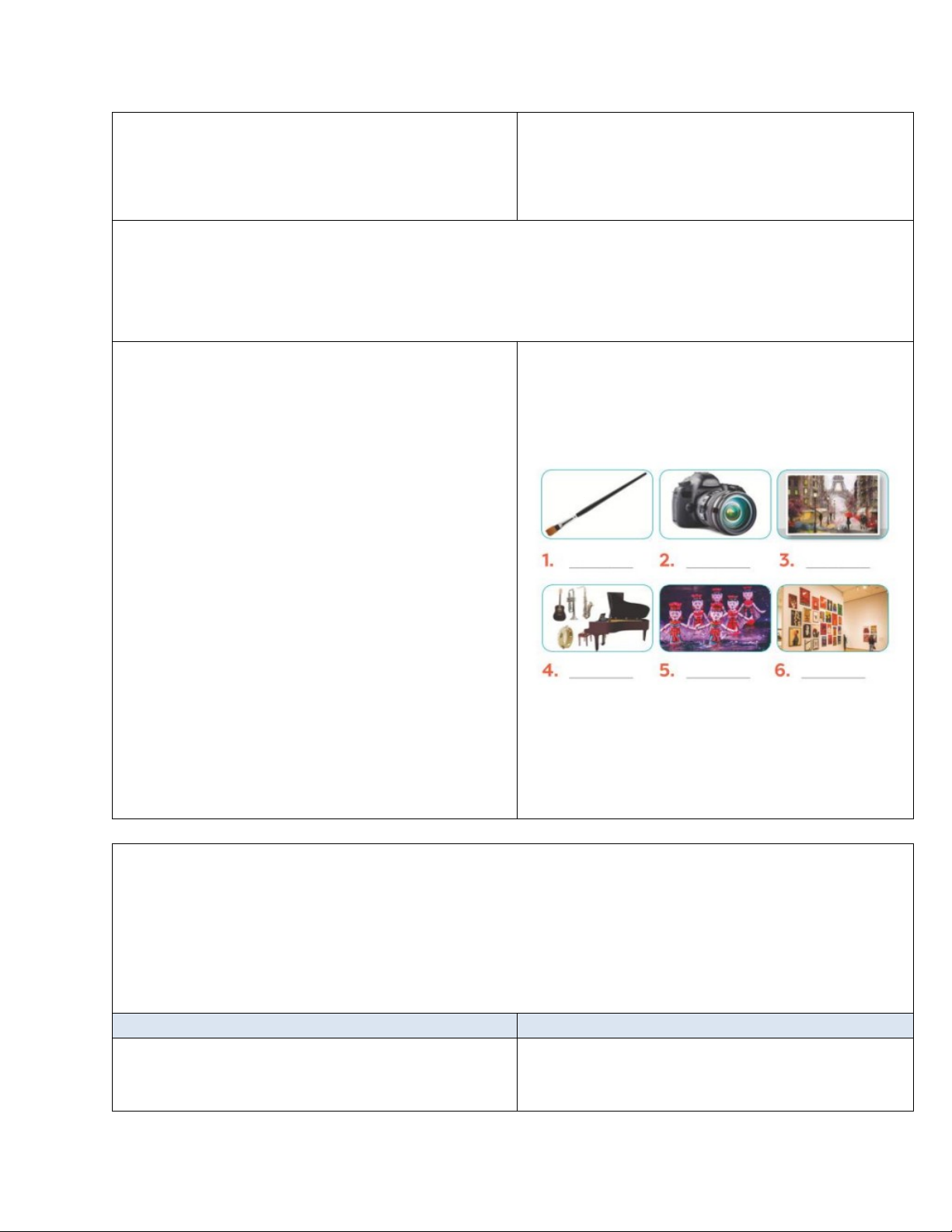
4. Write the correct word or phrase
under each picture. Then listen and
repeat.
- Ask Ss to work in pairs or in groups to do
the task. Tell them that some words /
phrases appear in the text and some do not.
- Play the recording for Ss to check and
repeat. - Check and correct their
pronunciation.
- Give them the meaning of the words /
phrases if necessary.
- Check the answers as a class.
4. Write the correct word or phrase
under each picture. Then listen and
repeat.
- T_ Ss. Work in pairs
- Ss do it.
* Key:
1. paintbrush 2. Camera
3. painting 4. musical
instruments
5. water puppet show 6. art gallery
4. PRODUCTION/ FURTHER PRACTICE ( 8’)
ACTIVITY 5:
Aim: To help Ss revise some vocabulary related to the field of music and arts and to
evaluate how artistic they are.
* Content: Doing the Quiz
* Outcome: Ss can remember the words. Revise and learn more new words.
* Organisation :
Teacher’s Student’s activities Content
5. QUIZ : How artistic are you?
- Have Ss work individually. Tell them to
write down their answers to all the
5. QUIZ : How artistic are you?
+ Listen to the instructions carefully and
questions.
- Let them add up their points and report to
their group how artistic they are.
Example:
A: I think I'm very artistic. I have 4 As out
of 5.
B: I'm not artistic at all. I've got only 1 A
and 4 Bs.
(If a student's answer is 4 or 5 As, he / she is
very artistic, if his / her answer is 3 As, he /
she is somewhat artistic, if his / her answer
is 0 / 1 / 2 As, he / she is not artistic (at
all).)
- T may call on some Ss to report to the
whole class.
do the tasks.
5. WRAP-UP & HOME WORK (2’)
1. Ask one or two Ss to tell the class what they have learnt. Ask Ss to say aloud some
words/ phrases they remember from the lesson. If there is a projector in the classroom,
show the conversation, highlight the key words related to the topic. It would be helpful if
T also highlights in the conversation the words with the sounds /ʃ/ and /ʒ/. the structures
with like, (not) as... as, different from.
- Tell Ss that they will learn these language points in the following lessons.
- Bring to class some posters / pictures, or show on the screen some images of musical
instruments, places or things related to the topic Music and Arts, or some famous actors
and actresses.
- Ask Ss to name them.
2. Teacher informs student of the final project of the Unit’s project.
+ Explain the requirements of the project: Imagine that you are going to organise a music
show and then design an invitation for that show. Students will show their posters and
present their ideas in Lesson 7 – Looking back and Project.
+ Teacher explains to students how they can get the information.
+ Put students into groups and ask them to discuss to assign tasks for each member. Help
them set a deadline for each task.
(Teacher should check the progress of students’ preparation after each lesson.)
* HOME WORK
- Read again the conversation on page 40
- Do more exercises in workbook.
- Prepare new lesson: Lesson 2: A CLOSER LOOK _1
=========================
Date of planning:……/…/ 2022
Date of teaching: ………..…
WEEK:
Period .....: UNIT 4: MUSIC AND ARTS
Lesson 2 : A CLOSER LOOK - 1
Vocabulary
- Music and arts
Pronunciation:
- Sounds: /ʃ/ and /ʒ/
Grammar
- Comparisons: like, dierent from,
(not) as … as
Skills
- Reading about a traditional art form
- Talking about a musical performance at
one’s school
- Listening to a talk about street painting
- Writing an informal letter of invitation
Everyday English
- Expressing preference.
I. OBJECTIVE: By the end of this lesson, students will be able to gain the
following things :
1. Knowledge:
- To introduce the topic “
Music and arts
”. To teach some new words
+ Use the lexical items related to the topic
Music and arts;
+ Pronounce and recognize the sounds /ʃ/ and /ʒ/.
+ Vocabulary: + use the lexical items related to the topic
Music and arts;
concert hall (n), actress (n), artist (n), composer (n), puppet (n), portrait (n),
photography , perform
- pronounce and recognize the sounds /ʃ/ and /ʒ/.
+ Grammar: -
Comparisons:
like, different from, (not) as … as .
2. Competence: Students will be able to know more new words related to the field
of music and arts.
- Develop communication skills.
- Be cooperative and supportive in pair work and teamwork.
- Actively join in class activities.
3. Qualities: - To educate the love of music and art.
- Be ready to know the words about music and arts.
- Develop self-study skills.
II. TEACHING AIDS:
- Teacher: Grade 7 text book, laptop, projector / TV/ pictures and cards.....
- Students : Text books, studying equipment….
- Computer connected to the Internet.
- Sach mem.vn
III. PROCEDURE:
Notes: In each activity, each step will be represented as following:
* Deliver the task.
* Implement the task.
* Discuss.
* Give comments or feedback.
1. WARM UP & INTRODUCTION (5’)
Vocabulary
Aim: - To create an active atmosphere in the class before the lesson;
- To lead into the new unit
- Bring to class some posters / pictures, or show on the screen some images of musical
instruments, places or things related to the topic
Music and Arts
, or some famous actors
and actresses.
- Ask Ss to name them.
- Brainstorming: Have Ss find all the words / phrases they know related to music and arts.
- Encourage them to say out as many words / phrases as possible.
* Content: To have some warm-up activities to create a friendly and relaxed atmosphere
to inspire Ss to warm up to the subject and new lesson.
* Outcome: Having a chance to speak English.
* Organisation : Teacher’s instructions …
Teacher’s & Student’s activities Content
+ Greeting
+ Revision .
- Ask Ss to guess what they are going to
learn about in this unit. Then write Music
and Arts and ask Ss to give any words or
phrases they know related to these
activities.
- Ask Ss to open their book and introduce
what they are going to study….
+ Greeting
+ Revision
- T_ Ss
- Students (Ss) listen and learn how to do.
- Open their book and write .
2. PRESENTATION/ NEW LESSON (12’)
ACTIVITY 1:
Aim: To revise / teach nouns indicating people and places related to the field of
music and arts.
* Content: Teach some new words . Listen and repeat. Write them in the correct
columns.
* Outcome: Ss know more new words. Learn how to use them . Do the tasks correctly.
* Organisation :
Teacher’s & Student’s activities Content
1. Listen and repeat these words and
phrases
*) Pre- teach vocabulary:
- Teacher uses different techniques to teach
vocabulary (situation, realia, translation .....)
+ Teacher may introduce the vocabulary
by:
- providing explanations of the words;
- showing picture illustrating the
word.
+ Follow the steps to teach vocabulary
- Repeat in chorus and individually
+ Check vocabulary.
- Play the recording and let Ss listen. Play it
again with pause for them to repeat each
word / phrase.
- Correct their pronunciation.
- Explain the meaning of these words /
phrases if necessary.
- Have Ss work in pairs and put these words
/ phrases in the correct columns
1. Listen and repeat the words and
phrases
- T_ Ss
+ Students (Ss) listen to the instructions
carefully and learn how to do the tasks.
* Vocabulary:
I. Vocabulary
1. concert hall (n) phòng hòa nhạc
2. actress (n) nữ diễn viên
3. artist (n) nghệ sĩ
4. composer (n) nhà soạn nhạc
5. puppet (n) con rối
6. portrait (n) chân dung
7. photography (n) nhiếp ảnh
8. perform (v) thực hiện/ trình diễn
.......
* Audio script - Track 24:
art gallery composer
concert hall musician
actress artist
painter puppet theatre
3. PRACTICE (15’)
ACTIVITY 2:
Aim: To teach Ss how to combine a verb and a noun to form a collocation about
music and arts.
* Content: Do the matching.
* Outcome: Ss can match a word in A with a word or phrase in B correctly.
* Organisation :
Teacher’s Student’s activities Content
2. Match a word in A with a word or
phrase in B.
- Explain to Ss that in English some verbs
and nouns go together, and some don't.
2. Match a word in A with a word or
phrase in B.
- Listen carefully and learn how to do.
- Have Ss work in pairs. Tell them to match
the verbs in column A with nouns in column
B to form collocations. Then check their
answers as a class. Explain to them which
noun goes with each verb.
- T may allow Ss some time to extend their
vocabulary by adding more words to
combine with each verb.
Example: perform a play, magic...
- Check the answers as a class.
- Correct Ss' pronunciation if necessary.
- Give the answer
* Key:
1.e 2.d 3.a 4.c/e 5. b
ACTIVITY 3:
Aim: To give Ss practice in how to use words / phrases related to music and arts in
context.
* Content: Complete the sentences.
* Outcome: Ss can complete sentences correctly.
* Organisation :
3. Underline the correct word to complete
each sentence.
- Have them read the sentences carefully
and look for clues so that they can choose
the correct words to complete the sentences.
- Have one student write the words on the
board. Confirm the correct answers.
- T may call on some Ss to read the
sentences.
3. Underline the correct word to
complete each sentence.
- Ss to work individually.
* Key:
1. drawing 2. composer
3. museum 4. concert
5. photography
II. PRONUNCIATION: (10’)
Sounds /ʃ/ and /ʒ/.
ACTIVITY 4
Aim: To teach Ss how to pronounce the sounds /ʃ/ and /ʒ/ and practise pronouncing
these sounds in words correctly.
* Content: Listen and repeat the word to pay attention to the sounds: /ʃ/ and /ʒ/
* Outcome: Ss can learn how to pronounce the sounds: /ʃ/ and /ʒ/
* Organisation :
Teacher’s Student’s activities Content
4. Listen and repeat. Pay attention to the
sounds /ʃ/ and /ʒ/
- Let Ss practise the sounds /ʃ/ and /ʒ/
together. - Ask Ss to observe T's mouth
4. Listen and repeat. Pay attention to the
sounds /ʃ/ and /ʒ/
- Listen carefully
- Listen and repeat
when pronouncing the two sounds.
- Play the recording and ask Ss to listen to
these words and repeat.
- Correct their pronunciation. Play the
recording as many times as necessary.
- Call on some Ss to read the words aloud.
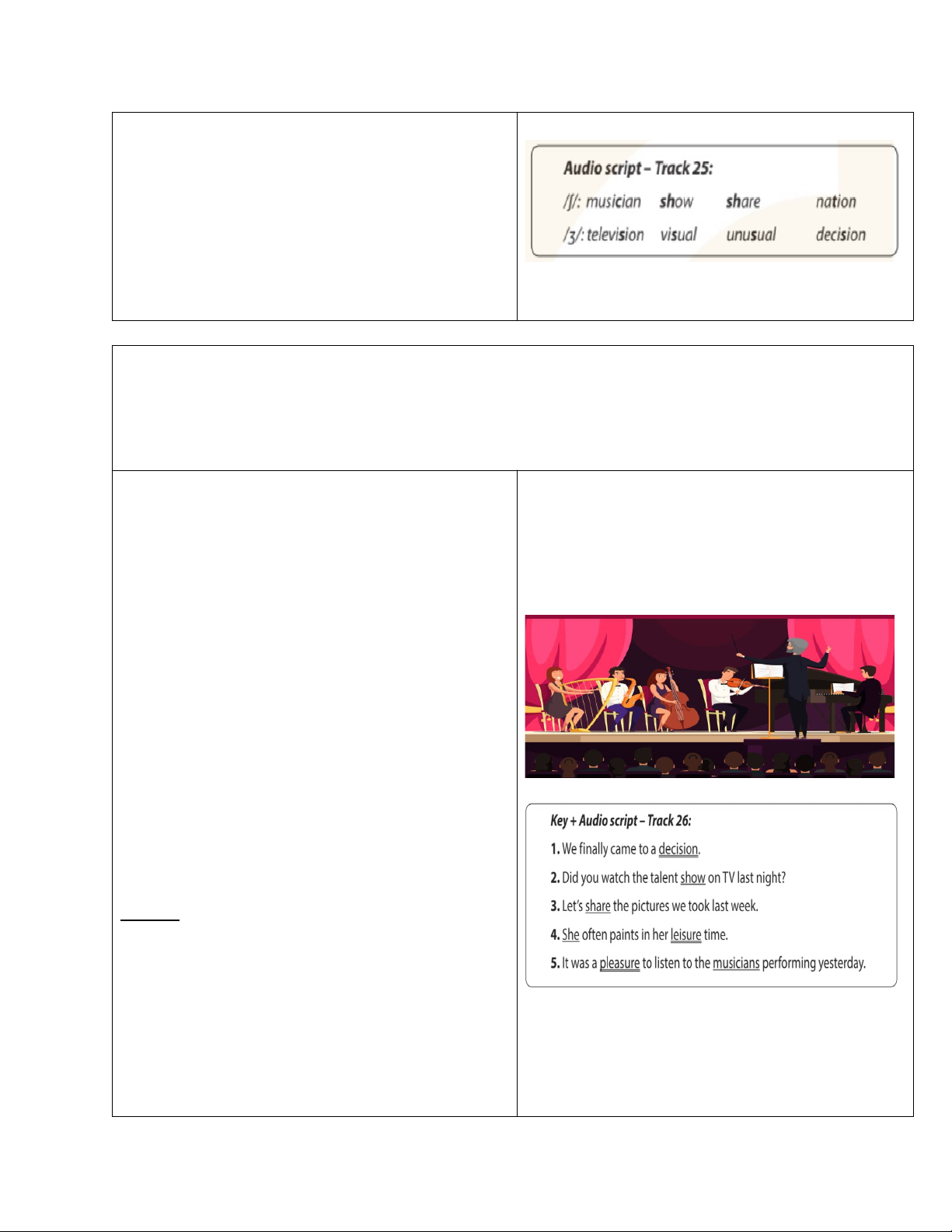
* Audio script- track 25:
4. FURTHER PRACTICE (8’)
ACTIVITY 5:
Aim: To help Ss practise pronouncing the sounds /t/, /id/, and /id/ in sentences.
* Content: Listen and pay attention to the underlined parts
* Outcome: Ss will be able to pronounce the sounds correctly.
* Organisation :
5. Listen and repeat. Listen again and
single-underline the words with the
sound /ʃ/ and double-underline the words
with the sound /ʒ/
- Have Ss quickly read the sentences and
single-underline the words with the sound
/ʃ/ and double underline the words with the
sound /ʒ/ . Then play the recording for Ss to
listen and check the words that they have
underlined.
- Have them work in pairs to compare their
answers. Check Ss' answers.
- Play the recording again. Let Ss listen and
repeat sentence by sentence, paying
attention to the underlined words.
- Comment on their pronunciation .
Notes:
For more able Ss,T may refer to the
following:
Sound /ʃ/ can be represented by sh (she,
wash,...)
by ch (machine,...)
by t (station, initial...)
by s (sugar, sure ...)
5. Listen and repeat. Listen again and
single-underline the words with the
sound /ʃ/ and double-underline the
words with the sound /ʒ/
- T_ Ss
- S do the tasks
* Audio script-Track 26
or by c (special, physician ...)
Sound /ʒ/ can be represented by s
(television, usually ...)
5. WRAP-UP & HOME WORK (2’)
- Ask Ss to summarise what they have learnt in this lesson. Ask some Ss to recall some
vocabulary and collocations.
* HOME WORK
- remember some verbs in the past simple
- Do more exercises in workbook.
- Prepare new lesson. A CLOSER LOOK_ 2
=======================================
Date of planning:………….
Date of teaching: ………..…
WEEK:
Period .....: UNIT 4: MUSIC AND ARTS
Lesson 3 : A CLOSER LOOK - 2
I. OBJECTIVE: By the end of this lesson, students will be able to gain the
following things :
1. Knowledge:
- Know how to recognize and write comparisons with
like, different from, (not) as
… as
:
- To introduce the topic “
Music and arts
”. To teach some new words
+ Use the lexical items related to the topic
Music and arts;
Types of
comparisons
How to use Examples
1. like to show that sth is
similar to sth else.
This picture is like the one I
saw at the art museum.
2. different from to show that two or
more things are not
similar.
Painting portraits is different
from painting landscapes.
3. as + adj + as to show that two
things are similar.
My brother is as tall as my
father.
4. not as + adj + as to show that sth is
“more” or “less” than
Classical music is not as
exciting as rock.
sth else.
+ Vocabulary: + use the lexical items related to the topic
Music and arts;
concert hall (n), actress (n), artist (n), composer (n), puppet (n), portrait (n),
photography , perform
- pronounce and recognize the sounds /ʃ/ and /ʒ/.
+ Grammar: -
Comparisons:
like, different from, (not) as … as .
2. Competence: Students will be able to know how to recognize and write
comparisons with
like, different from, (not) as … as
:
- Develop communication skills.
- Be cooperative and supportive in pair work and teamwork.
- Actively join in class activities.
3. Qualities: - To educate the love of music and art.
- Be ready to know the words about music and arts.
- Develop self-study skills.
II. TEACHING AIDS:
- Teacher: Grade 7 text book, laptop, projector / TV/ pictures and cards.....
- Students : Text books, studying equipment….
- Computer connected to the Internet.
- Sach mem.vn
III. PROCEDURE:
Notes: In each activity, each step will be represented as following:
* Deliver the task.
* Implement the task.
* Discuss.
* Give comments or feedback.
1. WARM UP & INTRODUCTION (5’)
Aims:
- To create an active atmosphere in the class before the lesson;
- To lead into the new lesson.
Comparisons: like, different from, (not) as ... as
- Different types of comparisons and the vocabulary related to them were already studied
in Tieng Anh 5 and Tieng Anh 6, so T may ask Ss to recall them and give examples.
Focus Ss' attention on the Remember! box. Explain the uses of the three structures to
them and give some examples. (Always remember that examples should be directed to
the topic of the unit.)
T may also bring to class some pictures of different musical instruments (or show on the
screen) and ask Ss to make comparison.
* Content: Review the previous lesson or have some warm-up activities to create a
friendly and relaxed atmosphere to inspire Ss to warm up to the new lesson.
* Outcome: Having a chance to speak English and focus on the topic of the lesson..
* Organisation :Teacher’s instructions…
Teacher’s & Student’s activities Content
+ Greeting
GAME: BRAINSTORMING
* Teacher asks students to work in 2 teams to
think of as many adjectives to describe as
possible.
- Students work in 2 teams.
- In 1 minute, students from each team, turn by
turn, run to the board and write down one
adjective.
- Teacher comments and counts how many
correct answers for each team.
- The team which has more correct answers
will be the winner.
- Teacher shows the picture and asks students
to use one adjective they have found to make
comparisons.
- Teacher confirms the answers and gives
feedback.
- Teacher gives feedback, then lead to the new
lesson.
- Ask Ss to open their book and introduce
what they are going to study….
+ Greeting
GAME: BRAINSTORMING
- T_Ss
- Students play games
- Team work
* Suggested answers:
big, small, heavy, light, cheap,
expensive, boring, interesting, special,
fun, thin, fat, tall, short, handsome, ugly,
etc.
Eg:
a) Tom is taller than Mary.
Mary isn’t as tall as Tom
2. PRESENTATION/ NEW LESSON (12’)
ACTIVITY 1:
Aim: To help Ss identify the correct comparison, using like, (not) as... as, different
from.
* Content: Complete the sentences using like, as, different from..
* Outcome: Ss can learn how to use the comparison.
* Organisation : Teacher’s instructions…
Grammar: Comparisons: like, different from, (not) as … as.
Remember!
We use:
like to show that something is similar to something else.
Example: This picture is like the one I saw at the art museum.
Adjecves
different from to show that two or more things are not similar.
Example: Painting portraits is different from painting landscapes.
as + adjective + as to show that two things are similar.
not as + adjective + as to show that something is “more” or “less” than something else.
Example: Classical music is not as exciting as rock.
Teacher’s & Student’s activities Content
1. Write like, as, or different in the blanks.
- Ask Ss to do the exercise individually and
then compare their answers with a partner.
Check the answers as a class. Confirm the
correct answers.
- Teacher confirms the answers and gives
feedback.
- Students find out the form and the usage of
comparisons using like, different from, (not)
as … as”
* Concept checking:
+ Form:
1. (not) as + adj + as
2. as + adj + as
3. to be different from
4. like
+ Use: ask students to read “Remember box”,
then teacher asks students some questions to
check understanding.
1. Write like, as, or different in the
blanks.
- T_ Ss
+ Students (Ss) listen to the instructions
carefully and learn how to do the tasks.
* Key:
1. as 2. like 3. different
4. as 5. different
3. PRACTICE (18’)
ACTIVITY 2:
Aim: To help Ss use the correct comparison, using like, (not) as... as, different from
in situations.
* Content: Complete the sentences by using like , as.... as, or different from
* Outcome: Ss understand more using comparison. Complete the sentences correctly.
* Organisation :
Teacher’s Student’s activities Content
2. Finish the second sentence in each pair ,
using like, as.... as, or different from.
Tell Ss to do the task independently first. Tell
them to write in their notebooks, then check
their answers as a class.
T may call on some Ss to call out their
2. Finish the second sentence in each
pair , using like, as.... as, or different
from.
- T_ Ss
- Listen carefully and learn how to do.
- Ss work individually
answers and / or write their answers on the
board. Explain if necessary.
- Check the answers as a class
Notes:
Hoàng Long & Phạm Tuyên: famous
composers from Viet Nam. They have
composed a lot of good songs for children.
The Vatican Museum: art museum in the
Vatican City.
The Louvre Museum (or the Louvre): the
world's largest art museum in Paris, France.
- Give the answers
* Key:
Key:
1. different from 2. like
3. as... as 4. different from
5. as... as
ACTIVITY 3:
Aim: To help Ss practise using like, (not) as... as, different from in context.
* Content: Compare The two museums using like , as ....as , different from.
* Outcome: Ss can compare the two museums correctly.
* Organisation :
3. Work in pair. Compare the two
museums: History and Science, using like,
as.... as, or different from.
- Have Ss work in pairs. Help them interpret
the table first.
- Give them instructions how to do the task.
{Note: A museum is "friendly" when its staff
are friendly.)
- This is a speaking activity so encourage Ss to
talk as much as possible.
Example: History is not as modern as
Science.
- While Ss do their task, T goes round to
monitor the whole class.
- Check the answers as a class.
- Comment on their performance.
3. Work in pair. Compare the two
museums: History and Science, using
like, as.... as, or different from.
- Ss to work in pairs
- Ss do themselves.
- Speaking tasks
Key:
Example: History is not as modern as
Science.
1. The History Museum is not as modern
as the Science Museum.
2. The staff in History Museum is as
friendly as ones in Science Museum.
3. Things in History Museum are more
interesting than things in Science
Museum.
4. The price in History Museum is like
in Science Museum.
ACTIVITY 4:
Aim: To help Ss revise like, (not) as... as, different from in sentence writing.
* Content: Write complete sentences using the words given at the beginning.
* Outcome: Ss can write complete sentences from the words given correctly.
* Organisation :
Teacher’s Student’s activities Content
4. Rewrite sentences, using the words given
at the beginning.
- Have Ss do the exercise individually and
then exchange their answers with a classmate.
Ask them to write down the sentences in their
notebooks.
- Call on some Ss to write their answers on the
board. Other Ss comment.
Confirm the correct answers. Some Ss read the
sentences aloud.
- Check the answers as a class.
4. Rewrite sentences, using the words
given at the beginning.
- T_ Ss
- Do the tasks and share the answers.
Key:
1. I think comedies are not as
interesting as action films.
2. Our history homework is not as
difficult as our maths homework.
3. This year's music contest is not like
last year's.
4. The characters in the film are different
from the ones in the play.
5. That picture is not as bright as this
one.
4. FURTHER PRACTICE ( 8’)
ACTIVITY 5:
Aim: To help Ss practise speaking, using comparison with like, (not) as... as,
different from through pictures.
* Content: Ask and answer about Tom’s project in 2016 and 2018.
* Outcome: Further practice using past simple tense. Answer the questions.
* Organisation :

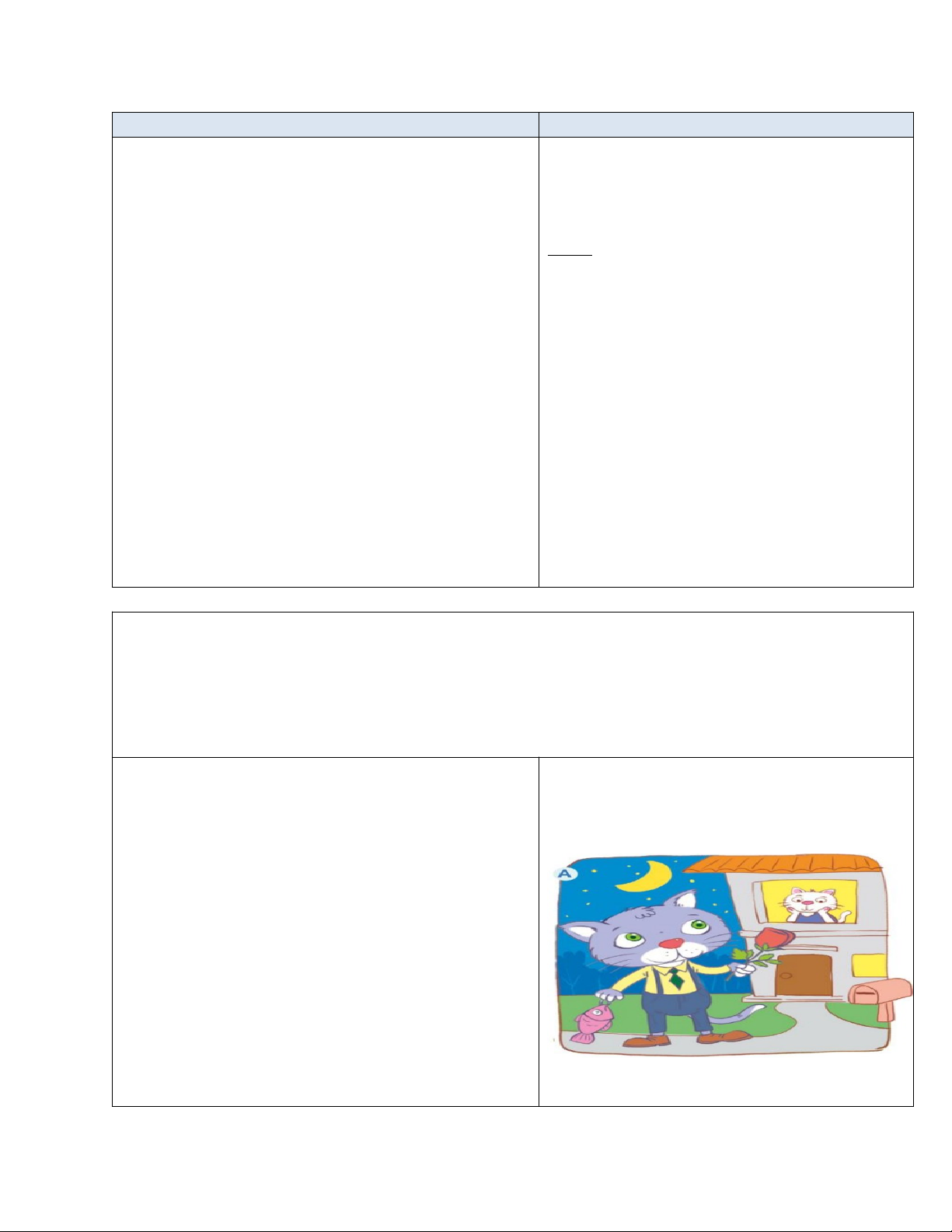
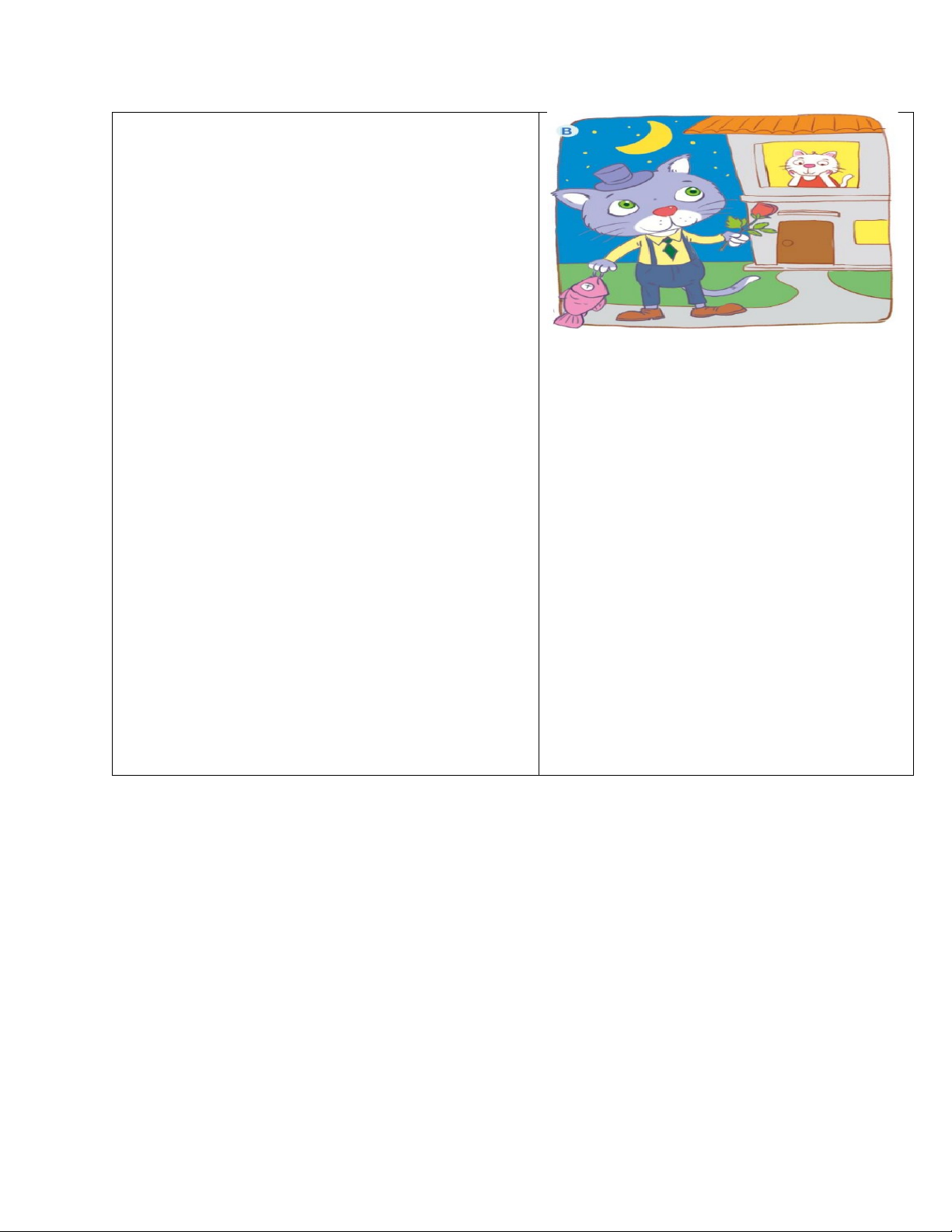
5. Work in groups. Look at the two pictures
below. Compare them , using like, as ....as,
or different from.
- Have Ss work in groups. Tell them to look at
the two pictures and compare them, using like,
(not) as ... as, or different from.
- Elicit the similarities and differences
between the two pictures and the things in
them.
Examples:
Picture A is not as big as Picture B.
The cat in Picture A is different from the cat in
Picture B.
5. Work in groups. Look at the two
pictures below. Compare them , using
like, as ....as, or different from.
- T_ Ss
.................
- Encourage Ss to give as many sentences as
possible. Don't stop Ss while they are speaking
in order to correct their errors. Correct only
common errors after Ss finish speaking.
Suggested answers:
- Picture A is not as big as picture B.
- The cat in picture A is different from the cat
in picture B.
- The cat in the house in picture A is like the
cat in the house in picture B.
- The fish in picture A is not as big as the fish
in picture B.
- The flower in picture A is not as small as the
flower in picture B.
* Further practice:
- If time allows, T may ask some Ss to make
comparisons between their classmates, or
things in the classroom.
Examples:
- Trung is as tall as Nam.
- Nam's backpack is quite different from
Duy's.
.......
* Suggested answers:
- Picture A is not as big as picture B.
- The cat in picture A is different from
the cat in picture B.
- The cat in the house in picture A is like
the cat in the house in picture B.
- The fish in picture A is not as big as
the fish in picture B.
- The flower in picture A is not as small
as the flower in picture B.
5. WRAP-UP & HOME WORK (2’)
- Ask Ss to summarise what they have learnt in the lesson.
- Reactivate the knowledge that students have gained
- Have them say out loud the past forms of the verbs they learnt in the lesson.
*HOME WORK
- Remember the form and use the past simple tense.
- Do more exercises in workbook.
- Prepare new lesson: COMMUNICATION.
=======================
Date of planning:………….
Date of teaching: ………..…
WEEK:
Period .....: UNIT 4: MUSIC AND ARTS
Lesson 4 : COMMUNICATION
I. OBJECTIVE: By the end of this lesson, students will be able to gain the
following things :
1. Knowledge:
- To introduce the topic “
Music and arts
”. To practice speaking
- Learn how to deal with some ways of expressing preferences
- Practise using some grammar points and vocabulary related to the topic
+ Vocabulary: + use the lexical items related to the topic
Music and arts;
- pronounce and recognize the sounds /ʃ/ and /ʒ/.
+ Grammar: -
Comparisons:
like, different from, (not) as … as .
2. Competence:
- Be cooperative and supportive in pair work and teamwork.
- Actively join in class activities.
3. Qualities: - To educate the love of music and art.
- Be ready to know the words about music and arts.
- Develop self-study skills.
II. TEACHING AIDS:
- Teacher: Grade 7 text book, laptop, projector / TV/ pictures and cards.....
- Students : Text books, studying equipment….
- Computer connected to the Internet.
- Sach mem.vn
III. PROCEDURE:
Notes: In each activity, each step will be represented as following:
* Deliver the task.
* Implement the task.
* Discuss.
* Give comments or feedback.
1. WARM UP & INTRODUCTION (3’-5’)
Everyday English Expressing preference
Aims: To provide Ss with the way of giving compliments
* Content: Review the previous lesson or have some warm-up activities to create a
friendly and relaxed atmosphere to inspire Ss to warm up to the new lesson.
* Outcome: Having a chance to speak English and focus on the topic of the lesson.
* Organisation: Follow teacher’s instructions.
Teacher’s & Student’s activities Content
+ Greeting
+ Revision
- Teacher (T) asks Ss some questions about
them and class.
- Ask Ss what they did lastnight?
- Ask Ss to open their book and introduce
what they are going to study….
+ Greeting
+ Revision
- T_ Ss
- Students (Ss) listen and learn how to do.
+ Answer the questions.
- Open their book and write .
2. PRESENTATION/ NEW LESSON (12’)
ACTIVITY 1+ 2:
Aims:
- To introduce two ways of expressing preferences;
- To help Ss practise expressing their preferences.
* Structure: to express preferences
- prefer sth.
- like sth better.
* Content: To introduce the way of expressing preference. Listen and read the dialogue.
* Outcome: Ss learn some new word and how to express preference.
* Organisation : Teacher’s instructions…
Teacher’s & Student’s activities Content
1. Listen and read the dialogue, paying
attention to the highlighted parts
- Allow Ss to listen to and read the
conversation.
- Tell them to pay attention to the highlighted
parts.
- Elicit from Ss structures used for expressing
preferences:
+ prefer sth
+ like sth better
- Ask Ss to work in pairs and practise the
conversation.
- Give feedback n their dialogues.
2. Work in pairs. Ask and answer questions
about your preferences for:
- painting and taking photos.
- singing and dancing.
- Have Ss work in pairs and make similar
1. Listen and read the dialogue, paying
attention to the highlighted parts
- T_ Ss
+ Students (Ss) listen to the instructions
carefully and learn how to do the tasks.
* Audio script - Track 27:
Nick: Which do you prefer, pop or folk
music?
Nam: I prefer folk music. It has a better
beat.
Nick: And which do you like better,
modern art or folk art?
Nam: I like modern art better.