Date of planning:…………..
Date of teaching: ………..…
WEEK:
Period ..... : UNIT 5: FOOD AND DRINK
Lesson 1: GETTING STARTED
At a Vietnamese restaurant
I. OBJECTIVES: * By the end of this lesson, Ss will be able to gain:
- use the words related to the topic
Food and Drink;
- pronounce the sounds [ɔ] and [ɔ:] correctly;
- use some, a lot of, and lots of to talk about quantity;
- ask and answer about prices;
- read for specific information about a typical traditional food;
- talk about a popular food or drink;
- listen for specific information about eating habits;
- write a paragraph describing eating habits.
1. Knowledge:
- To introduce the topic “
Food and Drink
”. To practice listening and reading.
- An overview about the topic
Food and Drink
- Vocabulary to talk about food and drink
+ Vocabulary: Use the words related to the topic
Food and Drink:
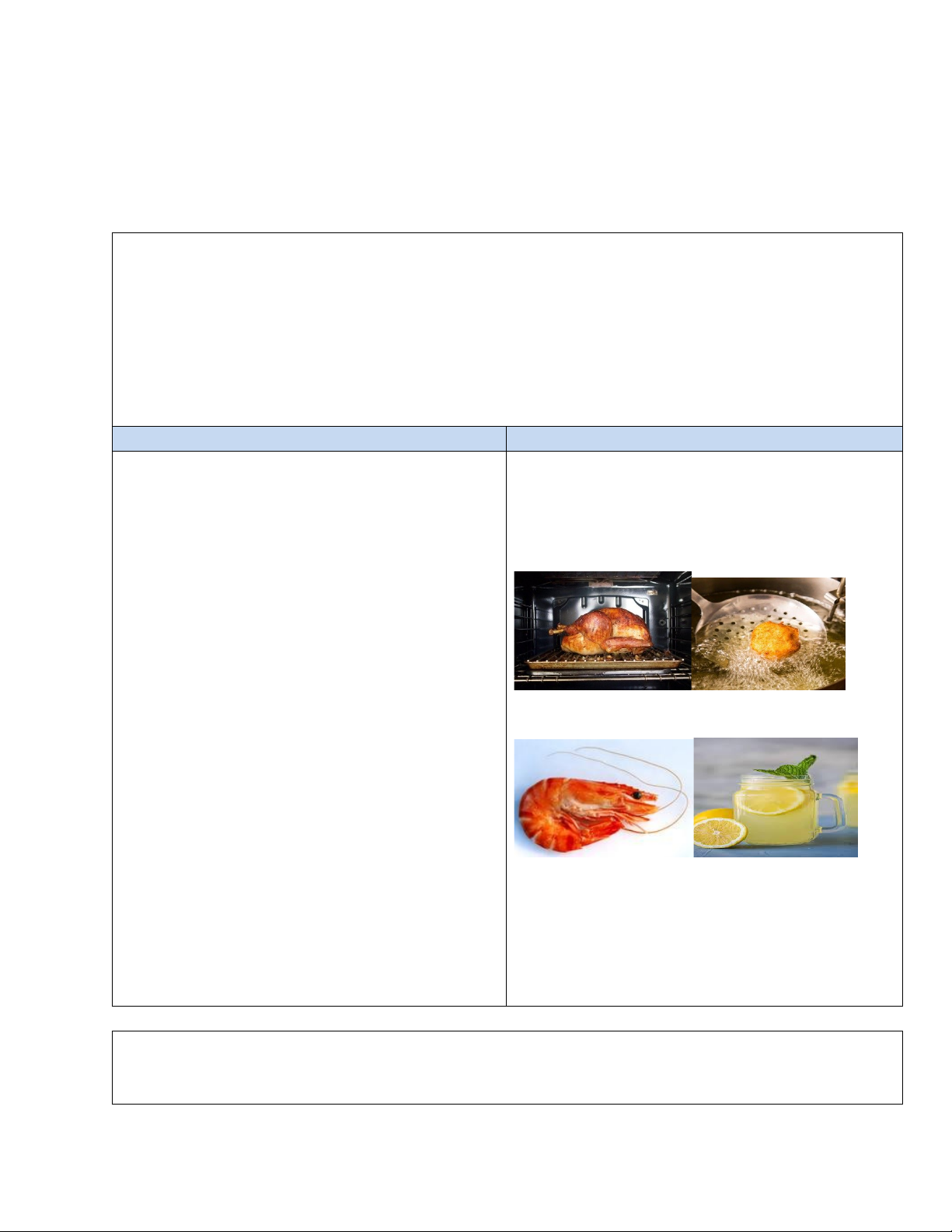
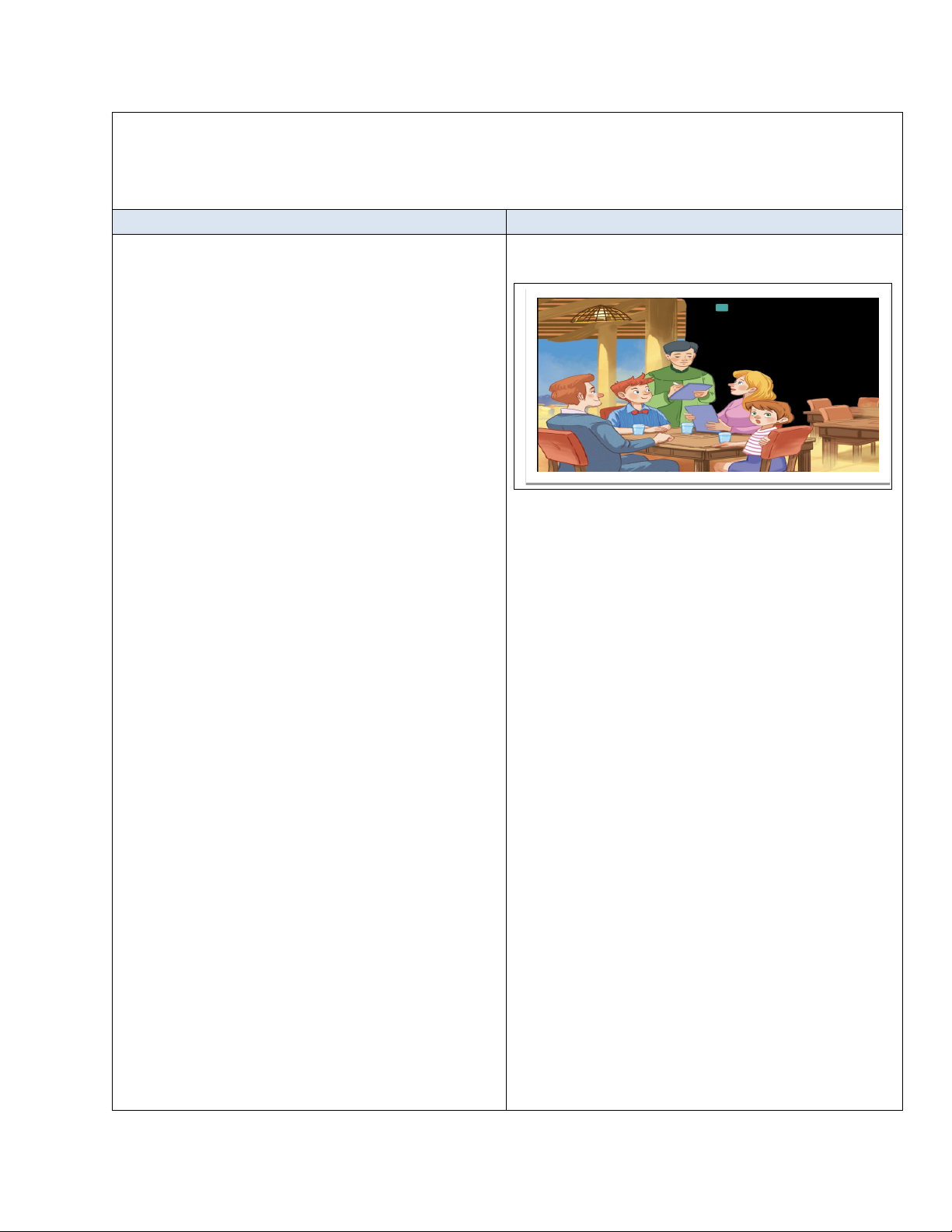
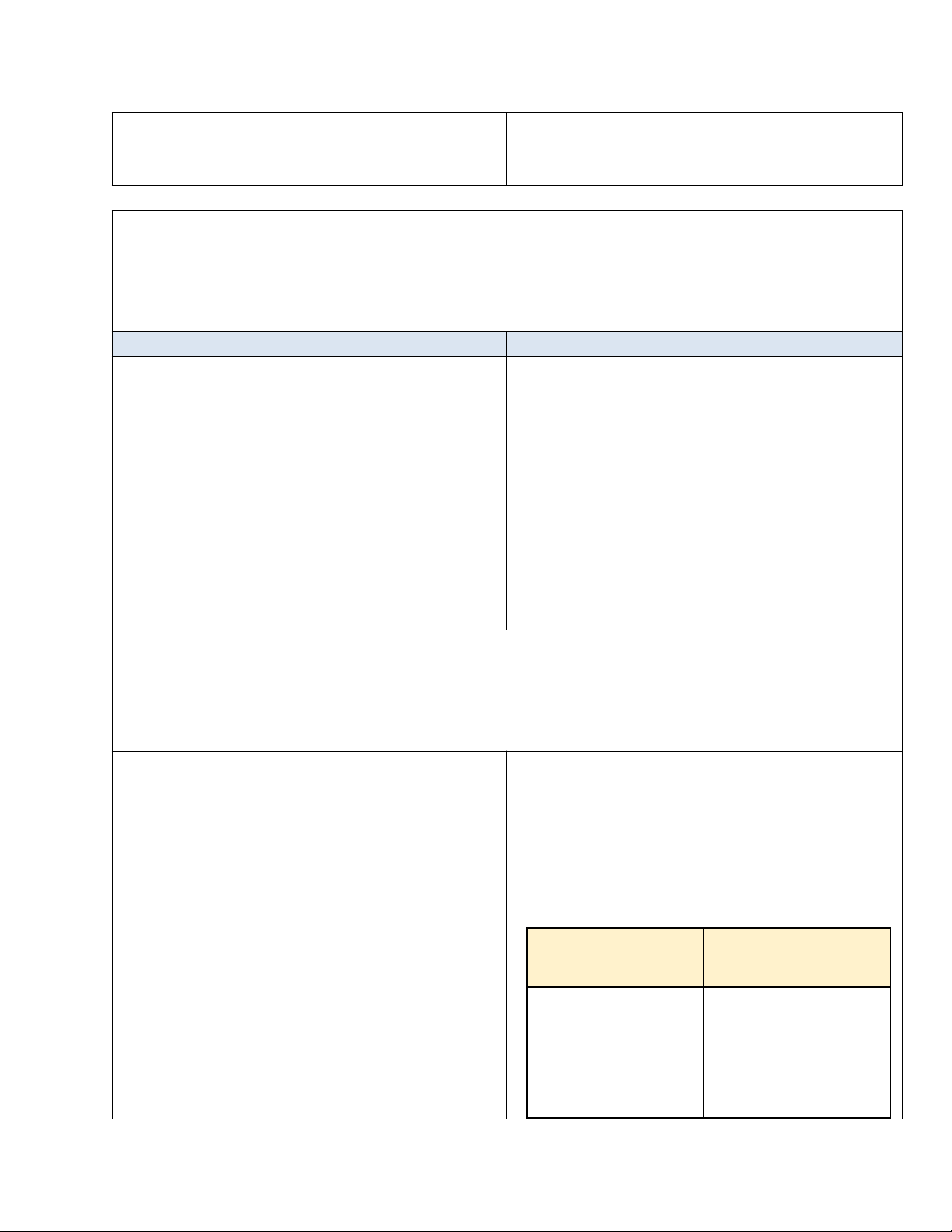
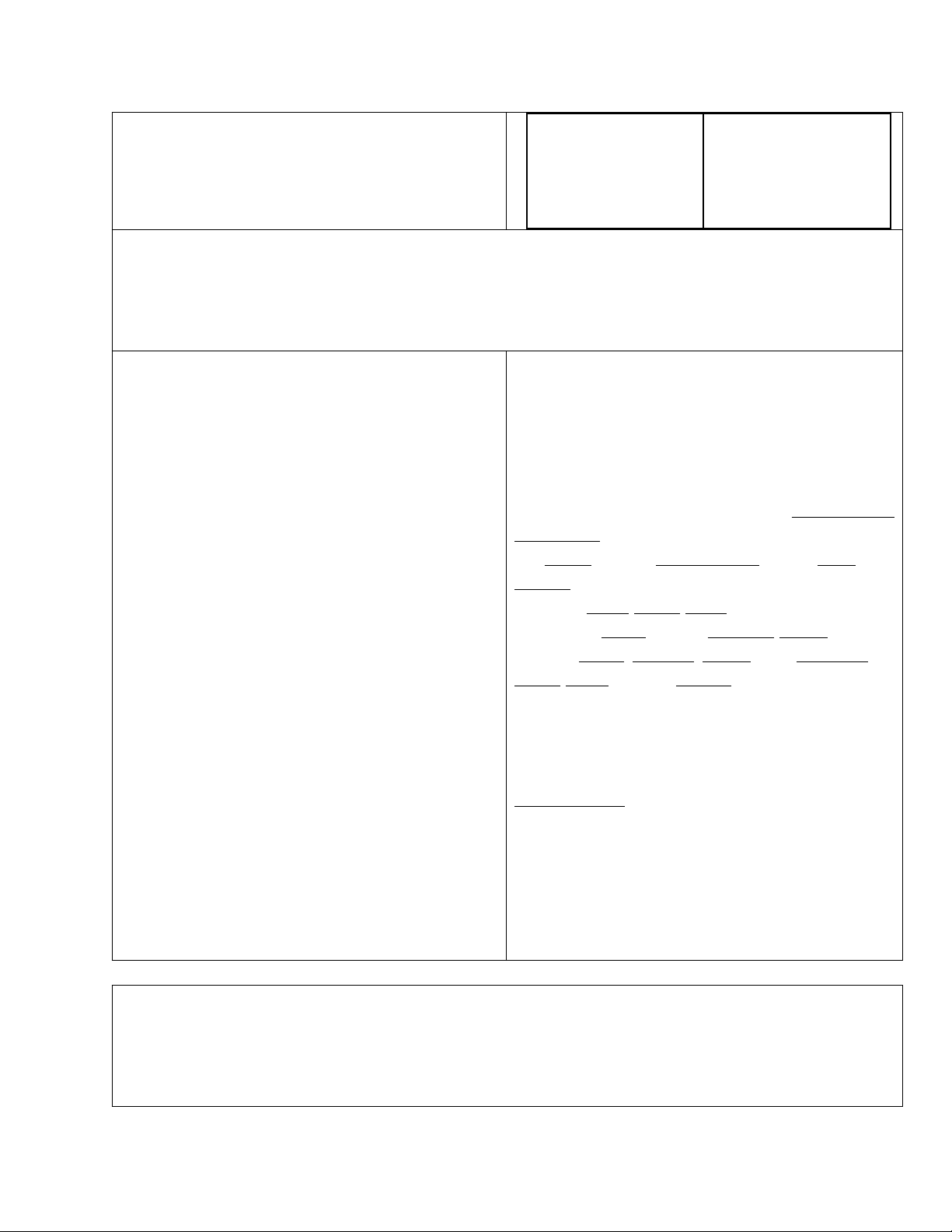
- roast (v) , fry (v) , shrimp (n) , lemonade (n) , mineral (adj)
- Ask and answer about prices;
+ Grammar: - Use some, a lot of, and lots of to talk about quantity;
2. Competence: Students will be able to practice listening and reading skills .
- Develop communication skills and cultural awareness.
- Be cooperative and supportive in pair work and teamwork.
- Actively join in class activities.
3. Qualities:
- Develop healthy eating habits and awareness of balanced diets.
- Be proud of the homeland
- Develop self-study skills.
II. TEACHING AIDS:
- Teacher: Grade 7 text book, laptop, projector / TV/ pictures and cards.....
- Students : Text books, studying equipment….
- Computer connected to the Internet.
- Sach mem.vn
III. PROCEDURE:
Notes: In each activity, each step will be represented as following:
* Deliver the task.

* Implement the task.
* Discuss.
* Give comments or feedback.
1. WARM UP & INTRODUCTION ( 3’- 5’)
Aims:
- To create an active atmosphere in the class before the lesson;
- To lead into the new unit.
* Content: To have some warm-up activities to create a friendly and relaxed
atmosphere to inspire Ss to warm up to the subject and new lesson.
* Outcome: Having a chance to speak English.
* Organisation : Teacher’s instructions …
Teacher’s Student’s activities Content
+ Greeting
+ Asking questions
- Review the previous unit before Ss open
their books. T may organise a short
vocabulary game
, e.g. Pass the Ball or Slap
the Board, etc
. to revise the words Ss have
learnt in Unit 4.
- Lead to the new unit.
- Write the unit title
Food and Drink
on the
board. Elicit any information Ss know
about food and drink by asking what they
know about different types of food and
drink.
- After Ss answer, ask them to open their
books to page 50. Draw their attention to
the THIS UNIT INCLUDES box and
introduce what they are going to learn in
Unit 5.
- Ask Ss to open their book to page 50 - 51
and introduce what they are going to
study….
+ Greeting
+ Asking questions.
- T_Ss.
+ Students (Ss) listen and learn how to do
the tasks.
- Open the book and write the tittle of the
lesson.
2. PRESENTATION/ NEW LESSON ( 12’- 15’)
ACTIVITY 1:
Aims: To set the context for the introductory conversation;
- To introduce the topic of the unit.

* Content: Learn some new words . Read the conversation and find out new words.
* Outcome: Knowing more new words. Understanding the conversation; topic of the
lesson, grammar points…
* Organisation : Teacher’s instructions..
Teacher’s Student’s activities Content
1. Listen and read:
(Ex 1, p. 50)
*Teach vocabulary:
+ Teacher uses different techniques to
teach vocab (situation, realia, translation.)
+ Teacher introduces the vocabulary by:
- providing the pictures
- eliciting the definition of the words
+ Teacher do the “Rub out and remember”
checking technique.
+ Teacher checks students’ pronunciation
and gives feedback.
- Teacher reveals that these words will
appear in the reading text and asks
students to open their textbook to discover
further.
* Teacher asks Ss to look at the picture
(p.50-51) and answer the questions:
* Set the context for the listening and
reading text. Have Ss look at the picture
and answer some questions, e.g.
Where is
Mark's family? What are they doing? Who
are they to?
- T can also ask Ss to share any recent ex-
periences of eating at a restaurant:
Have
you ever been to a restaurant? Where and
when? What food and drink did you have
there?
- Encourage Ss to answer, but do not
confirm whether their answers are right or
wrong. Ask them to talk a bit about types
of food and drink they know.
- Play the recording twice for Ss to listen
and read along. Have Ss underline the
words that are related to the topic of the
unit while they are listening and reading.
1. Listen and read:
- T_Ss
*Vocabulary
1. roast (v) /rəʊst/: quay, nướng (thịt…)
2. fry (v) /fraɪ/: rán
3. shrimp (n) /ʃrɪmp/: con tôm
4. lemonade (n) /ˌleməˈneɪd/: nước chanh
5. mineral (adj) /ˈmɪnərəl/: khoáng chất
* What is Mark's family doing?
A. Ordering food for dinner.
B. Preparing for their dinner.
C. Talking about their favourite food.

- T asks them to read and listen to the
conversation and check their answers.
3. PRACTICE ( 15’)
ACTIVITY 2:
Aim: To help Ss understand the main idea of the text.
* Content: Listen and read the conversation. Answer the question.
* Outcome: Understanding more the content of the conversation.
* Organisation :
Teacher’s Student’s activities Content
2. What is Mark’s family doing?
- First, ask Ss to give the answers without
reading the conversation again.
- Then have Ss underline the words /
phrases in the conversation that are related
to the topic and check their answers.
+ Ask Ss what exactly Jack's family is
doing. Now confirm the correct answer.
(They are ordering food for dinner).
- Check the answers as a class.
2. What is Mark’s family doing?
- T_Ss
- Work individually.
- Give the answers
* Key: A
ACTIVITY 3:
Aim: To develop Ss' knowledge of the vocabulary for food and drink.
* Content: Complete the sentences with suitable word or phrases.
* Outcome: Ss know more the use of words and phrases in context.
* Organisation :
3. Find the words and phrases about
food and drink in the conversation and
write them in the correct columns.
- Have Ss quickly write the words they
think are about food and drink in the two
columns Food and Drink individually
without looking at the book. Then ask Ss
to open their books and check their
answers with their partners.
- Ask some Ss to read out their answers or
write them on the board. With a weaker
class, ask for translations of the words /
phrases to make sure they understand
3. Find the words and phrases about
food and drink in the conversation and
write them in the correct columns.
- T_ Ss
- Listen to the instructions clearly
- Ss to work individually.
* Key:
Food Drink
rice, pork, fish
sauce, roast
chicken, fried
vegetables, fried
juice, lemonade,
green tea, mineral
water, winter
melon juice,

them.
- Check the answers as a class.
tofu, spring rolls,
canh (soup),
shrimp, fish,
ACTIVITY 4:
Aim: To help Ss deeply understand the text.
* Content: Read the conversation again and tick T/F.
* Outcome: Ss understand more the content of the conversation.
* Organisation :
4. Read the conversation again and tick
(✓) T (True) or F (False).
- Have Ss look at the statements in this
activity.
- Ask them how to do it. Give them some
strategies to do the exercise. (E.g. reading
the statements, underlining the key words,
reading the text while paying attention to
the key words, deciding if each sentence is
true or false).
- Set a time limit for Ss to do the activities.
When the time is up, have Ss share their
answers in pairs.
- Invite some pairs to answer and confirm
the correct ones. For strong classes, ask Ss
to correct the false sentences.
- Check the answers as a class.
4. Read the conversation again and tick
(✓) T (True) or F (False).
- T_ Ss. Work individually.
- Ss do the tasks
* Key:
* Suggested keywords in the statements:
1. Mark's family is at a Vietnamese
restaurant.
2. Mark wants fried tofu and beef for
dinner.
3. They don't order canh.
4. Mark's mum wants mineral water.
5. His mum doesn't allow her children to
drink juice during dinner.
- Scan the conversation to locate the
underlined key words
- Read intensively to tick True or False
* Key: 1. T 2. F 3. F 4. T 5. F
Answer key:
1. T 2. F
(Mark wants some fried tofu
and spring rolls.)
3. F
(Mark's dad thinks they will try some
canh)
4. T
5. F
(Mineral water for me, green tea for
my husband, and juice for my children)
4. PRODUCTION/ FURTHER PRACTICE ( 8’)
ACTIVITY 5:
Aim: To help Ss practise talking about their favourite food and drink.
* Content: Further practice. Think about their own food and drink.
* Outcome: Ss can remember the words. Ask and answer about their favourite Food
and drink.

* Organisation :
Teacher’s Student’s activities Content
5. Work in pairs. Think about your
favourite food and drink. Then ask your
partner about his or her favourite food
and drink.
- Ask each student to think of the questions
he / she may use to ask about his / her
partner's favourite food and drink.
- Demonstrate the activity to the class first.
- Ask a strong student to help you. Then
ask Ss to work in pairs.
- T goes round to help weaker Ss.
- Call on some pairs to perform in front of
the class.
5. Work in pairs. Think about your
favourite food and drink. Then ask your
partner about his or her favourite food
and drink.
+ Listen to the instructions carefully and
do the tasks.
Example:
A: What’s your favourite food?
B: It’s pho bo – beef noodle soup.
A: When do you usually have it?
B: In the morning
..........
5. WRAP-UP & HOME WORK (2’)
- Ask one or two Ss to tell the class what they have learnt. Ask Ss to say aloud some
words / phrases they remember from the lesson. If there is a projector in the classroom,
show the conversation, highlight the key words related to the topic.
* HOME WORK
- Talk about your favourite food (for a minute)
- Project preparation:
+ Teacher informs student of the final project of the Unit’s project
+ Explain the requirements of the project: Design a poster about eating habits in an area
or a foreign country you know, including names of main meals and mealtimes; names of
common food/ drink for each meal; picture/ photo to illustrate the meals. Students will
show their posters and present their ideas in Lesson 7 – Looking back and Project.
Explain students
+ Teacher explains to students how they can get the information
+ Put students into groups and ask them to discuss to assign tasks for each member.
Help them set a deadline for each task.
(Teacher should check the progress of students’ preparation after each lesson.)
- Do more exercises in workbook.
- Prepare new lesson: Lesson 2: A CLOSER LOOK _1
=========================

Date of planning:……/…/ 2022
Date of teaching: ………..…
WEEK:
Period .....: UNIT 5: FOOD AND DRINK
Lesson 2 : A CLOSER LOOK - 1
THIS UNIT INCLUDES:
Vocabulary
- Food and drink
Pronunciation:
- Sounds: [ɔ] and [ɔ:]
Grammar
- some, a lot of, lots of
Skills
- Reading about a typical traditional food
- Talking about a popular food or drink
- Listening about eating habits
- Writing a paragraph describing eating
habits
- Everyday English
- Asking and answering about prices
I. OBJECTIVE: By the end of this lesson, students will be able to gain the
following things :
1. Knowledge:
- To introduce the topic “
Food and Drink
”. To revise and teach some
measurement words
...
- Know how to use the measurement words and phrases often used with food and
drink
- Pronounce the sounds /ɒ/ and /ɔ:/ correctly
+ Vocabulary: - Use the lexical items related to the topic
Food and Drink;
measurement words
...
- kilo (kg), teaspoon, litter, tablespoon, gram, millimeter
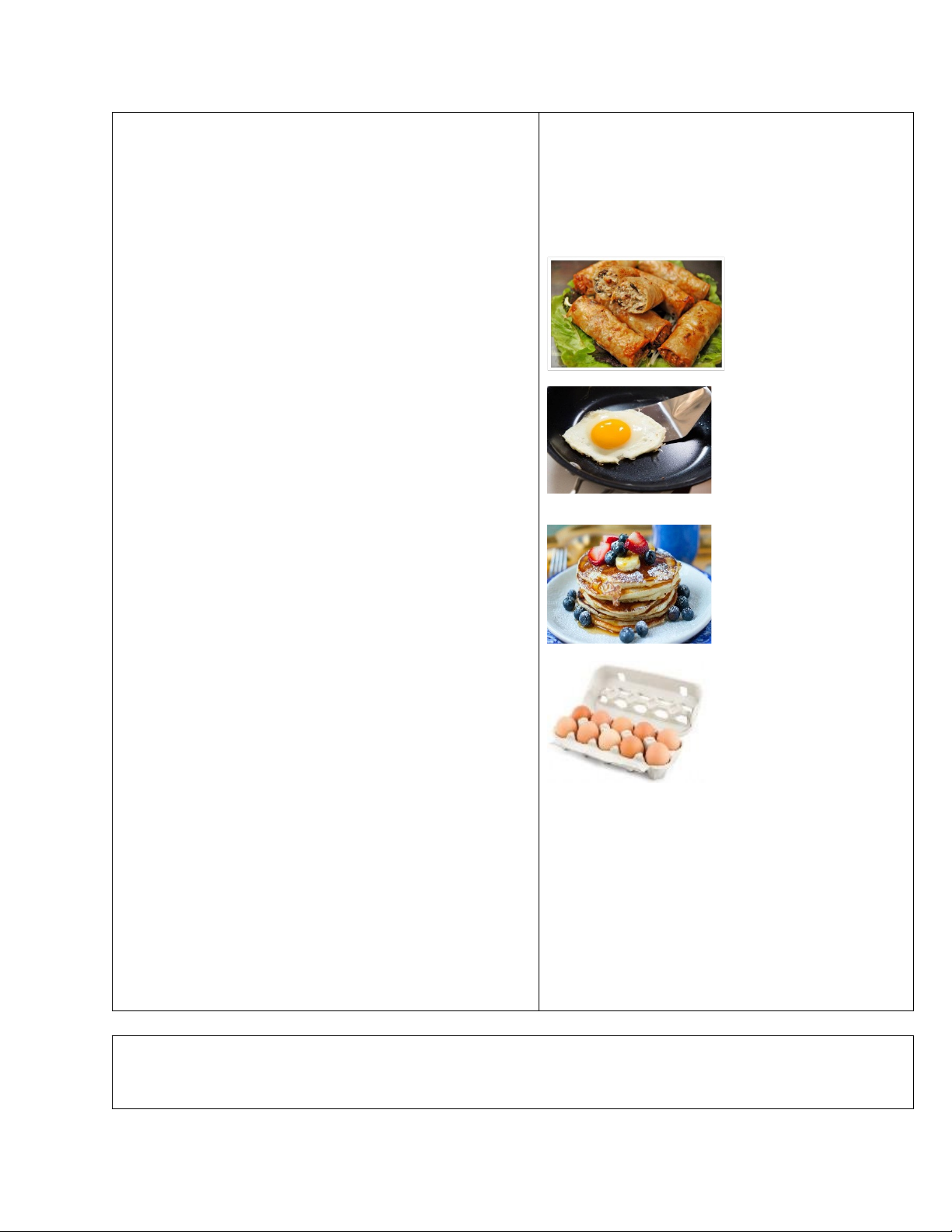
- omelette, pancake, spring rolls, onion, pepper, butter
- Ask and answer about prices;
+ Grammar: - Use some, a lot of, and lots of to talk about quantity;
2. Competence:
- Access and consolidate information from a variety of sources.
- Be cooperative and supportive in pair work and teamwork.
- Actively join in class activities.
3. Qualities:
- Promote pride in the values of Vietnamese culture.
- Develop love for family
- Develop self-study skills.
II. TEACHING AIDS:
- Teacher: Grade 7 text book, laptop, projector / TV/ pictures and cards.....

- Students : Text books, studying equipment….
- Computer connected to the Internet.
- Sach mem.vn
III. PROCEDURE:
Notes: In each activity, each step will be represented as following:
* Deliver the task.
* Implement the task.
* Discuss.
* Give comments or feedback.
1. WARM UP & INTRODUCTION (5’)
Vocabulary
Aim: - To create an active atmosphere in the class before the lesson;
- To lead into the new unit
* Content: To have some warm-up activities to create a friendly and relaxed atmosphere
to inspire Ss to warm up to the subject and new lesson.
* Outcome: Having a chance to speak English.
* Organisation : Teacher’s instructions …
Teacher’s & Student’s activities Content
+ Greeting
+ Game: Odd one out
Put Ss in small groups.
Explain that you are going to dictate three
sets of four words / phrases, such as pea,
orange, potato, onion.
Ss listen and write the set. Then they choose
the odd one out and circle it. Give Ss some
time to choose an odd-one-out of each set.
More than one answer is possible.
Each group explains their choices, e.g. A
pea, because it's a green small seed that is
cooked and eaten as vegetable../An orange,
because because it is the only fruit which
we can make a drink from.
* T may create his / her own lists or choose
any three from the list below:
1. lemon, grapefruit, grape, lime
2. fridge, cooker, microwave, toaster
3. cows, chicken, sheep, fish
+ Greeting
+ Game: Odd one out
- T_ Ss
- Group work
- Students (Ss) listen and learn how to do.
1. lemon, grapefruit, grape, lime
2. fridge, cooker, microwave, toaster
3. cows, chicken, sheep, fish

4. bacon, eggs, tomatoes, toast
5. rice, wheat, potatoes, pasta
6. bread, cake, pie, pizza
- Ask Ss to open their book and introduce
what they are going to study….
4. bacon, eggs, tomatoes, toast
5. rice, wheat, potatoes, pasta
6. bread, cake, pie, pizza
- Open their book and write .
2. PRESENTATION/ NEW LESSON (12’)
ACTIVITY 1:
Aim: To revise and teach the measurement words / phrases often used with food and
drink.
* Content: Teach some new words . Do the matching . Repeat the words.
* Outcome: Ss know more new words. Learn how to use them .
* Organisation :
Teacher’s & Student’s activities Content
1. Match the phrases with the pictures.
Then listen, check, and repeat the
phrases.
*) Pre- teach vocabulary:
- Teacher uses dif
ferent techniques to teach vocabulary
(situation, realia, translation .....)
+ Teacher may introduce the vocabulary
by:
- providing explanations of the words;
- showing picture illustrating the
word.
+ Follow the steps to teach vocabulary
- Repeat in chorus and individually
+ Check vocabulary.
+ Have Ss quickly match the phrases with
the pictures individually. Then ask Ss to
check their answers with their partners.
- Play the recording for Ss to check their
answers. Pause the recording after each
phrase and ask them to repeat chorally and
individually.
- Correct their pronunciation. With weaker
classes, ask for translations to check
understanding.
1. Match the phrases with the pictures.
Then listen, check, and repeat the
phrases.
- T_ Ss
+ Students (Ss) listen to the instructions
carefully and learn how to do the tasks.
* Vocabulary:
1. kilo (kg) /ˈkiːləʊ/: kí lô
2. teaspoon /ˈtiːspuːn/: thìa cà phê
3. litre /ˈliːtə/: lít
4. tablespoon /ˈteɪbəlspuːn/: thìa canh
5. gram /ɡræm/: gờ-ram
6. millimetre /ˈmɪlɪmiːtə(r)/: mi-li-mét
7. omelette /ˈɒmlət/: trứng ốp lết
8. pancake /ˈpænkeɪk/: bánh kếp
9. spring rolls /sprɪŋ rəʊlz/: nem rán
10. onion /ˈʌnjən/: hành tây
11. pepper /ˈpepə/: hạt tiêu
12. butter /ˈbʌtə/: bơ
* Key: 1. b 2.f 3. a 4.c 5.d 6.e
* Audio script - Track 31:
1. a teaspoon (tsp) of salt


2.400 millilitres (ml) of milk
3. a kilo (kg) of beef
4. a litre (I) of water
5. a tablespoon (tbsp) of sugar
6.200 grams (g) of flour
3. PRACTICE (15’)
ACTIVITY 2:
Aim: To teach Ss new words / phrases of dishes and ingredients.
* Content: Write the words / phrases in the correct column.
* Outcome: Ss can choose a word or phrase and write in the correct column correctly.
* Organisation :
Teacher’s Student’s activities Content
2. Write the following words and phrases
in the correct columns. Add any other
dishes and ingredients you know.
- First, check Ss' understanding of the
meanings of the words/ phrases given in the
box. With the nouns that Ss do not know, T
may explain their meanings by using
pictures, examples, or even translations.
- Then, have Ss sort the words into the
correct columns.
- Ask Ss to check their answers and share
the words for other dishes and ingredients
they know with their partners before T
checks their answers with the whole class.
2. Write the following words and
phrases in the correct columns. Add any
other dishes and ingredients you know.
- Listen carefully and learn how to do.
- Give the answer
* Key:
Dishes Ingredients
spring rolls butter
omelette onions
pancake pepper
ACTIVITY 3:
Aim: To help Ss practise asking and answering about the ingredients for a dish
using measurement words and phrases they have learnt.
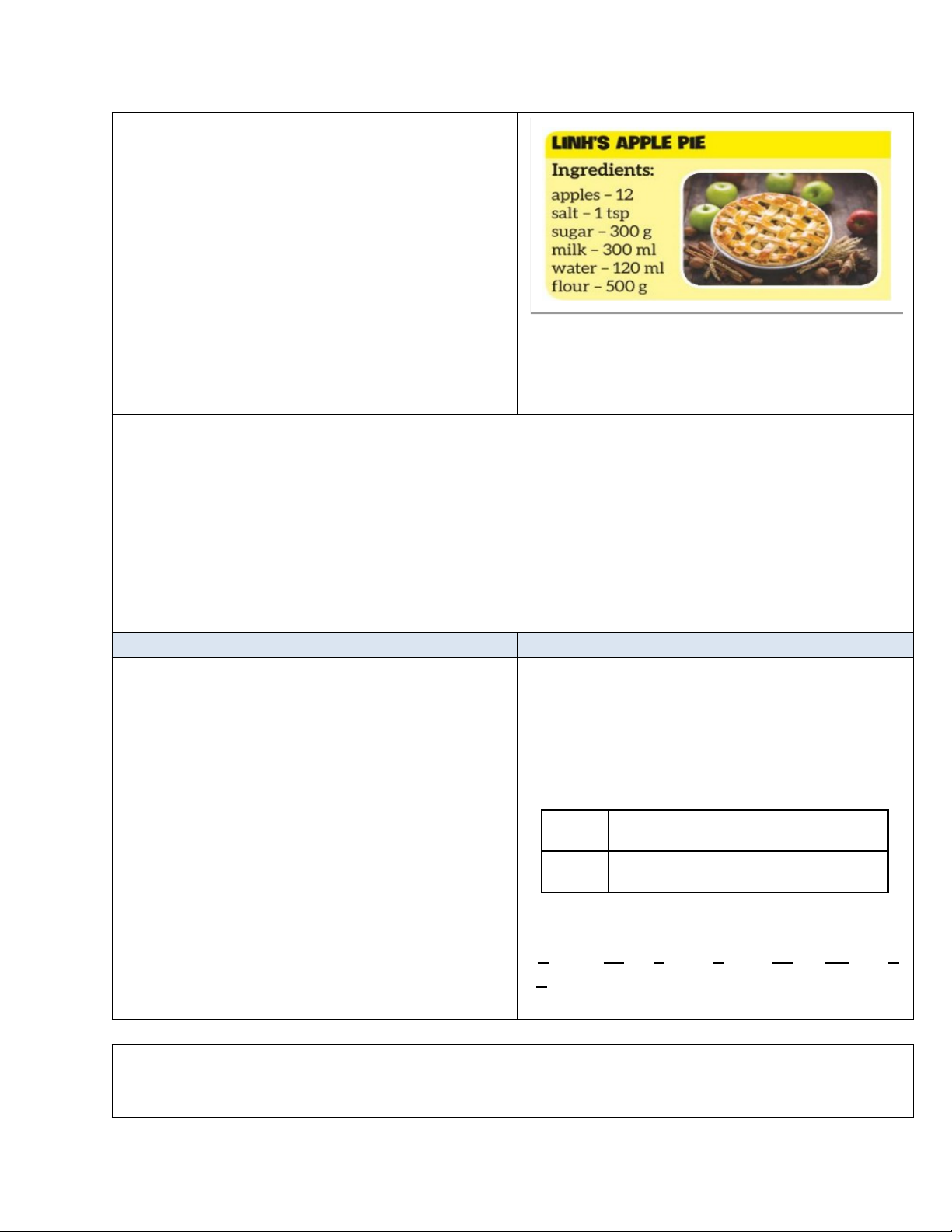
* Content: Ask and answer about ingredient for Linh’s apple pie.
* Outcome: Ss can answer the questions correctly.
* Organisation :
3. Work in pairs. Ask and answer about
the ingredients for Linh’s apple pie, using
the quantities in the recipe.
- Model this activity with a strong student.
-Remind Ss that they only use the
information from the table to ask and
3. Work in pairs. Ask and answer about
the ingredients for Linh’s apple pie,
using the quantities in the recipe.
- Listen to the teacher ‘s instruction
carefully.
- Ss to work in pairs.

answer about the quantity of ingredients for
an apple pie.
- Ask Ss to work in pairs. Then, call on
some pairs to practise in front of the class.
- T may call on some Ss to read the
sentences.
Example:
A. How many apples do we need?
B. We need 12
II. PRONUNCIATION: (10’)
Sounds /ɒ/ and /ɔ:/
ACTIVITY 4
Aim: Aim: To teach Ss how to pronounce the sound /ɒ/ and /ɔ:/ and practise
pronouncing these sounds correctly in words
* Content: Listen and repeat the word to pay attention to the sounds: /ɒ/ and /ɔ:/
* Outcome: Ss can learn how to pronounce the sounds:/ɒ/ and /ɔ:/.
* Organisation :
Teacher’s Student’s activities Content
4. Listen and repeat. Pay attention to the
sounds /ɒ/ and /ɔ:/
- Model the sounds /ɒ/ and /ɔ:/ first and let
Ss see how the sounds are formed. Ask Ss
to practise the sounds /ɒ/ and /ɔ:/ together.
- Pays the recording and ask Ss to listen and
repeat. Play the recording as many times as
necessary. Ask Ss to put the words in the
correct column while they listen.
- Ss compare their answers in pairs before T
checks their answers with the whole class.
- Correct their pronunciation. Play the
recording as many times as necessary.
- Call on some Ss to read the words aloud.
4. Listen and repeat. Pay attention to the
sounds /ɒ/ and /ɔ:/
- Listen carefully
- Listen and repeat
* Audio script- track 32:
/ɒ/ fond, lot, not
/ɔ:/ short, call, water, pork, sauce
* Audio script – Track 32:
Fond short call wate pork sauce lot
not
4. FURTHER PRACTICE (8’)
ACTIVITY 5:
Aim : To help Ss practice pronouncing the sound /ɒ/ and /ɔ:/ correctly in context
* Content: Listen and pay attention to the underlined parts

* Outcome: Ss will be able to pronounce the sounds correctly.
* Organisation :
5. Listen and repeat, paying attention to
the underlined words. Tick (✓) the
sentences with the /ɒ/ sound.
- Ask Ss to listen and repeat whileT plays
the recording.Then play the recording again
and ask
-Ss to tick (✓) the sentences with the /0/
sound.
- Ask Ss to check their answers. Provide
further practice if needed.
5. Listen and repeat, paying attention to
the underlined words. Tick (✓) the
sentences with the /ɒ/ sound.
- T_ Ss
- S do the tasks
* Key: ✓: 1,2,4
* Audio script - Track 33:
1. hate hot dogs.
2. It's a very big pot.
3. Put the forks here.
4. This soup is very hot.
5. like pork cooked with vegetables.
5. WRAP-UP & HOME WORK (2’)
- Ask Ss to summarise what they have learnt in the lesson.
- Ask Ss to make sentences about quantity of ingredients for a dish using the words and
phrases they have learnt in the lesson.
* HOME WORK
- Remember some
- Do more exercises in workbook.
- Prepare new lesson. A CLOSER LOOK_ 2
=======================================
Date of planning:………….
Date of teaching: ………..…
WEEK:
Period .....: UNIT 5: FOOD AND DRINK
Lesson 3 : A CLOSER LOOK - 2
I. OBJECTIVE: By the end of this lesson, students will be able to gain the
following things :
1. Knowledge:
- To introduce the topic “
Food and Drink
”. To revise and teach some
measurement words
...
- Know how to use the measurement words and phrases such as
some
and
a lot of /

lots of
with countable and uncountable nouns.
- Understand and use the
How many/ How much
to ask and answer about
quantities
+ Vocabulary: - Use the lexical items related to the topic
Food and Drink;
measurement words
...
- Pronounce the sounds /ɒ/ and /ɔ:/ correctly
- Ask and answer about prices;
+ Grammar: - Use some, a lot of, and lots of to talk about quantity;
2. Competence:
- Access and consolidate information from a variety of sources.
- Be cooperative and supportive in pair work and teamwork.
- Actively join in class activities.
3. Qualities:
- Promote pride in the values of Vietnamese culture.
- Develop love for family
- Develop self-study skills.
II. TEACHING AIDS:
- Teacher: Grade 7 text book, laptop, projector / TV/ pictures and cards.....
- Students : Text books, studying equipment….
- Computer connected to the Internet.
- Sach mem.vn
III. PROCEDURE:
Notes: In each activity, each step will be represented as following:
* Deliver the task.
* Implement the task.
* Discuss.
* Give comments or feedback.
1. WARM UP & INTRODUCTION (5’)
Aims:
- To create an active atmosphere in the class before the lesson;
- To lead into the new lesson.
* Content: Review the previous lesson or have some warm-up activities to create a
friendly and relaxed atmosphere to inspire Ss to warm up to the new lesson.
* Outcome: Having a chance to speak English and focus on the topic of the lesson..
* Organisation :Teacher’s instructions…
Teacher’s & Student’s activities Content

+ Greeting
+ Mini game: Are these countable and
uncountable?
* Teacher put Ss into 2 big teams (named
Mango & Orange)
and gives instruction.
- When teacher say the words (
apple, carrot,
chicken, salt, meal, sugar, star, cucumber,
pepper, meat…)
aloud:
- Ss of
Mango
team stand up and shout out if
the word is countable.
- Ss of
Orange
team stand up and shout out if
the word is uncountable.
- Teacher checks and tells Ss the noun is
countable or uncountable when they have
already reacted. - Teacher confirms the
answers and gives feedback.
- Teacher gives feedback, then lead to the new
lesson.
- Ask Ss to open their book and introduce
what they are going to study….
+ Greeting
+ Mini game: Are these countable and
uncountable?
- T_Ss
- Students play games
- Team work
* Vocabulary
1. đếm được: countable /ˈkaʊntəbəl/
2. số lượng: quantity /ˈkwɒntəti/
3. miêu tả: describe /dɪˈskraɪb/
4. nhiều người biết đến: popular
/ˈpɒpjələr/
5. hoạt hình: cartoon /kɑːˈtuːn/
2. PRESENTATION/ NEW LESSON (12’)
ACTIVITY 1:
Aim: To help Ss practise using some and a lot of/lots of in sentences and in context.
* Content: Complete the sentences by circling the correct words.

* Outcome: Ss can learn how to use the words to talk about quantity.
* Organisation : Teacher’s instructions…
Grammar: some, a lot of / lots of
Ask some Ss to give some examples of countable nouns and uncountable nouns. Then
ask them to tell the difference between countable nouns and uncountable nouns. Remind
Ss that they should use a good dictionary to check if a noun is countable or uncountable.
- Have Ss look at the Remember! box about the use of some, a lot of/lots of. Draw Ss'
attention to the use of some, a lot of/lots of by analysing the instructions and the
examples in the Remember! box.
Briefly explain to them that some, a lot of/lots of are all used with both countable
nouns and uncountable nouns to talk about quantities. Explain that we use some with
plural countable nouns or uncountable nouns to talk about a number or amount of
something / somebody when the exact number or amount is not given; we use lot of/lots
of with plural countable nouns or uncountable nouns to talk about a large number or
amount of something / people.
Teacher’s & Student’s activities Content
1. Circle the correct words or phrases to
complete the following sentences.
- Ask Ss to read the instruction. Tell Ss what
they should do. (With a weaker class, do the
first sentence as an example)
- Ask Ss to do the exercise individually and
then compare their answers with a classmate's.
Check the answers as a class. Confirm the
correct answers.
1. Circle the correct words or phrases
to complete the following sentences.
- T_ Ss
+ Students (Ss) listen to the instructions
carefully and learn how to do the tasks.
* Key: 1. a lot of 2. lots of 3. some
4. a lot of 5. some
3. PRACTICE (18’)
ACTIVITY 2:
Aim: To give Ss further practice on using some and a lot of/lots of in sentences and
in context and help Ss revise the use of any.
* Content: Complete the sentences by using some, any, a lot of , lots of ...
* Outcome: Ss understand more using the words to describe the quantity.
* Organisation :
Teacher’s Student’s activities Content
2. Look at the picture and complete each
sentence. Write some, any or a lot of / lots of
in the blanks.
- Ask Ss to do the exercise individually and
then compare their answers with a classmate's.
- Check the answers as a class.
2. Look at the picture and complete
each sentence. Write some, any or a
lot of / lots of in the blanks.
- T_ Ss
- Listen carefully and learn how to do.
- Ss work individually

- Confirm the correct answers.
* Key:
1. a lot / lots of 2. any
3. some 4. a lot / lots of
5. a lot / lots of.
ACTIVITY 3:
Aim: To help Ss revise the use of How many and How much to ask about quantities.
* Content: Do the filling. Answer the questions, using pictures.
* Outcome: Ss can fill in each blank with How many/ How much correctly. Answer
questions..
* Organisation :
3. Fill in each blank with How many or
How much. Answer the questions, using the
pictures.
- Have Ss do this exercise individually.
- Call on two Ss to write their answers on the
board.
- Draw all Ss' attention to the board and check
the answers together.
- Check the answers as a class.
3. Fill in each blank with How many
or How much. Answer the questions,
using the pictures
- Ss to work in pairs
- Speaking tasks
Key:
1. How much 2. How many
3. How many 4. How many
5. How many
ACTIVITY 4:
Aim: To help Ss practise using How many and How much to ask and answer about
quantities.
* Content: Ask and answer the questions in 3
* Outcome: Ss can ask answer the questions in 3 correctly.
* Organisation :
Teacher’s Student’s activities Content

4. Work in pairs. Ask and answer, using the
questions in 3.
- First ask Ss to read the instructions. Use the
example to make clear to Ss what they are
supposed to do (with a weaker class do the
first sentence).
- Then have Ss work in pairs: one asks the
questions he / she has made from 3 and the
other gives the answers.
- T may go round to help weaker Ss.
- Check the answers as a class.
4. Work in pairs. Ask and answer,
using the questions in 3.
- T_ Ss
- Do the tasks and share the answers.
Key:
A. How much water do you drink
everyday?
B. Two liter
4. FURTHER PRACTICE ( 8’)
ACTIVITY 5:
Aim: To give Ss further practice using measurement words and phrases, words of
dishes and ingredients, How many and How much in context.
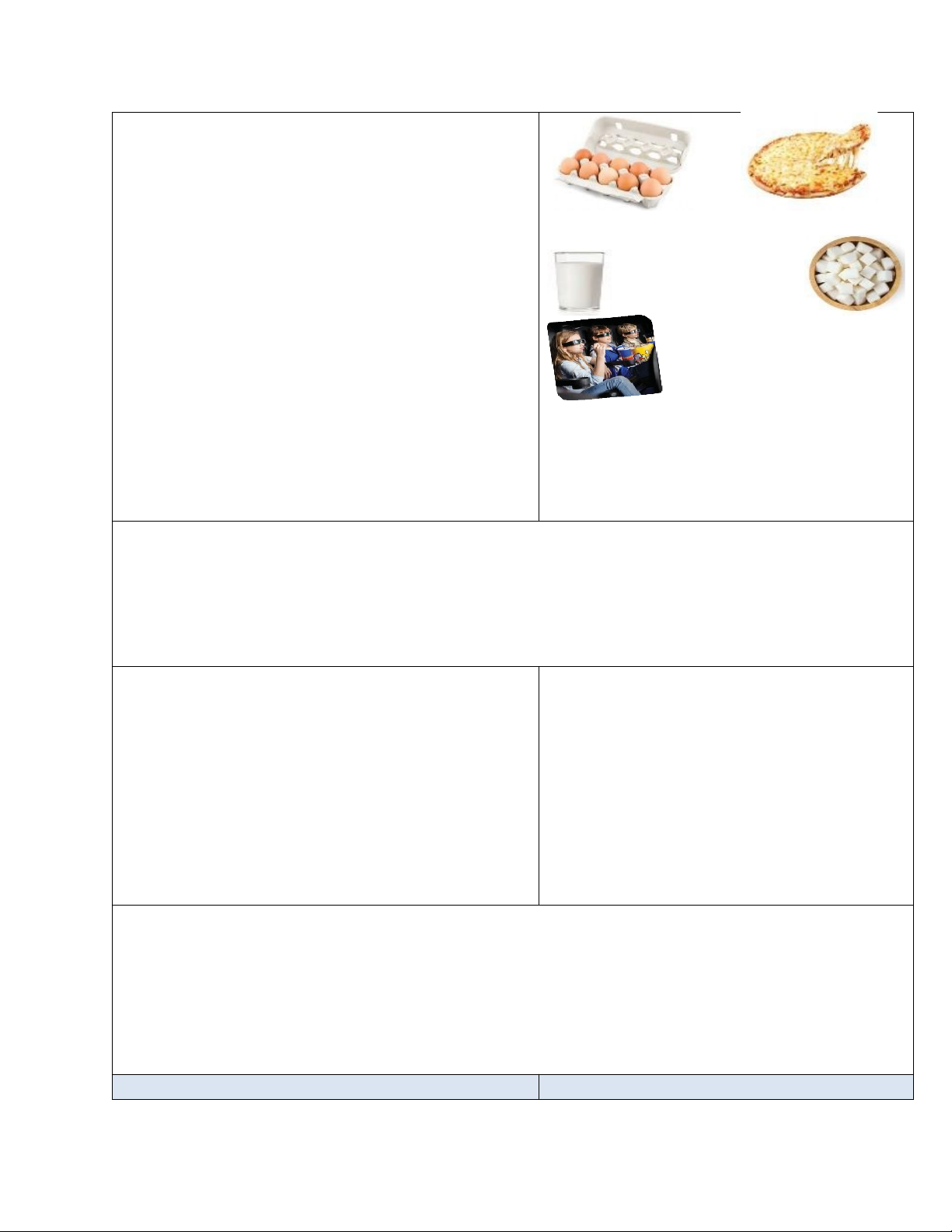
* Content: Ask and answer about the recipes to make pancakes or an omelette.
* Outcome: Ss can ask and answer about the recipes to make pancake or an omelette.
* Organisation :
5. Work in pairs. Take turn to ask and
answer about the recipes.
- Model this activity with a strong student.
Remind Ss to only use the information from
the table to ask and answer about the recipes.
- Ask Ss to work in pairs while T goes round
to provide help. Then, call on some pairs to
practise in front of the class.
5. Work in pairs. Take turn to ask
and answer about the recipes.
- T_ Ss
* Example:
A. What do we need to make pancakes?
B. We need eggs, sugar, flour, milk and
butter.
A. How many eggs do we need?
B. Two.
5. WRAP-UP & HOME WORK (2’)
* Summarise the main points of the lesson.
- Ask Ss to make questions and sentences about quantities, using some, a lot of/lots of,
any, How much and How many.
*HOME WORK
- Remember the form and use the past simple tense.
- Do more exercises in workbook.
- Prepare new lesson: COMMUNICATION.
=======================
Date of planning:…………. Period .....: UNIT 5 : FOOD AND DRINK

Date of teaching: ………..…
WEEK:
Lesson 4 : COMMUNICATION
I. OBJECTIVE: By the end of this lesson, students will be able to gain the
following things :
1. Knowledge:
- Use lexical items related to the favourite food and drink in everyday life
- Understand and use ways to ask and answer about prices and favourite food and
drink in English
+ Vocabulary: - Use the lexical items related to the topic
Food and Drink;
measurement words
...
- Pronounce the sounds /ɒ/ and /ɔ:/ correctly
- Ask and answer about prices;
+ New words: eel, foreign, favourite, interview, try
+ Grammar: - Use some, a lot of, and lots of to talk about quantity;
2. Competence:
- Access and consolidate information from a variety of sources.
- Be cooperative and supportive in pair work and teamwork.
- Actively join in class activities.
3. Qualities:
- Promote pride in the values of Vietnamese culture.
- Develop love for family
- Develop self-study skills.
II. TEACHING AIDS:
- Teacher: Grade 7 text book, laptop, projector / TV/ pictures and cards.....
- Students : Text books, studying equipment….
- Computer connected to the Internet.
- Sach mem.vn
III. PROCEDURE:
Notes: In each activity, each step will be represented as following:
* Deliver the task.
* Implement the task.
* Discuss.
* Give comments or feedback.
1. WARM UP & INTRODUCTION (3’-5’)
Everyday English Asking and answering about prices.
Aims: To provide Ss with the way of giving compliments

* Content: Review the previous lesson or have some warm-up activities to create a
friendly and relaxed atmosphere to inspire Ss to warm up to the new lesson.
* Outcome: Having a chance to speak English and focus on the topic of the lesson.
* Organisation: Follow teacher’s instructions.
Teacher’s & Student’s activities Content
+ Greeting
+ Game: Going out for a meal
- Put Ss in small groups.
- Ask Ss to imagine they are all going out for a
meal.
- Have them agree on which kind of restaurant
to go to.
- Ss write up their discussion and perform it as
a role play.
- Encourage them to give reasons for their
choices in the discussion.
+ Tell Ss that they are going to learn how to
ask and answer about prices. Ask Ss if they
know any ways to ask and answer about
prices.
- Ask Ss to open their book and introduce
what they are going to study….
+ Greeting
+ Game: Going out for a meal
- T_ Ss
- Students (Ss) listen and learn how to do.
+ Answer the questions.
- Open their book and write .
2. PRESENTATION/ NEW LESSON (12’)
ACTIVITY 1
Aim: To introduce ways to ask and answer about prices in English.
* Content: To introduce the way of expressing preference. Listen and read the dialogue.
* Outcome: Ss learn some new word and how to express preference.
* Organisation : Teacher’s instructions…
Teacher’s & Student’s activities Content
1. Listen and read the conversation. Pay
attention to the questions and answers.
+ To introduce some new words.
- Play the recording for Ss to listen to and read
the conversation between Mark and Mi.
- Ask Ss to pay attention to the questions and
the answers.
- Elicit the structures to ask and answer about
prices from Ss. Have Ss practise the
1. Listen and read the conversation.
Pay attention to the questions and
answers.
- T_ Ss
+ Students (Ss) listen to the instructions
carefully and learn how to do the tasks.
I. Vocabulary
1. eel /iːl/: con lươn
2. foreign /ˈfɒrən/: ngoại quốc
3. favourite /ˈfeɪvərɪt/: ưa thích

conversation in pairs.
- Call on some pairs to practise the
conversation in front of the class.
- Give feedback n their dialogues.
4. interview /ˈɪntəvjuː/: cuộc phỏng vấn
5. try /traɪ/: thử làm gì đó
* Audio script - Track 34:
Mark: How much is a bottle of mineral
water?
Mi: It's 5,000 dong.
Mark: And how much are two kilos of
apples?
Mi: They're 50,000 dong.
ACTIVITY 2:
Aim: To help Ss practice asking and answering about prices.
* Content: To introduce the way of asking and answering about prices.
* Outcome: Ss learn how to ask and answer about prices of the food and drink on the
menu.
* Organisation : Teacher’s instructions…
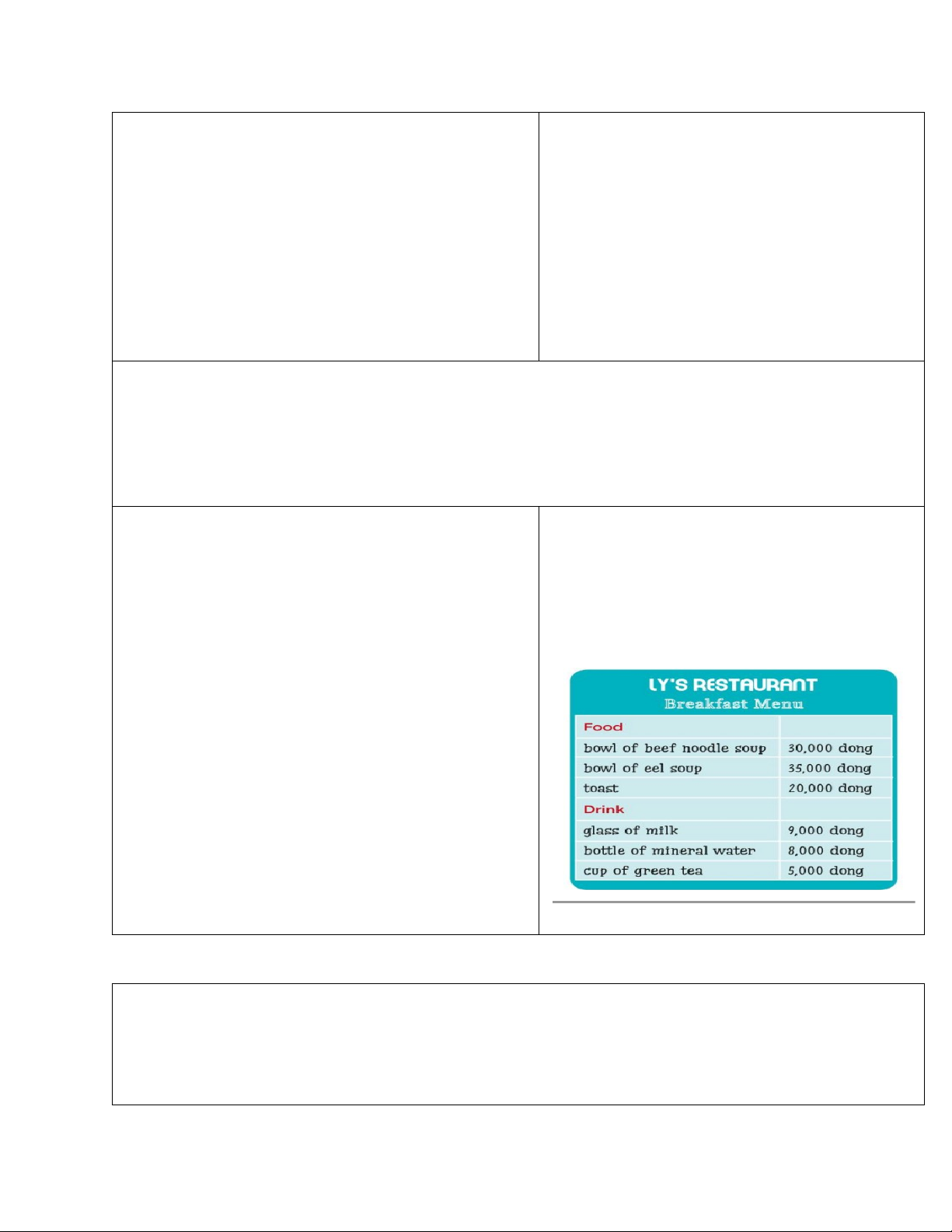
2. Work in pairs. Take turns to ask and
answer about the prices of the food and
drink on the menu
- Ask Ss to work in pairs to make similar
conversation, using the structures for asking
and answering about prices.
- Move around to observe and provide help.
Call on some pairs to practise in front of the
class.
- Comment on their performance.
2. Work in pairs. Take turns to ask and
answer about the prices of the food and
drink on the menu
- Do the tasks
A: How much is a glass of milk?
B: It’s 9,000 dong.
3. PRACTICE (18’)
ACTIVITY 3:
Aims:
- To teach Ss the questions they can ask to interview someone about their favourite
food and drink;
- To help Ss revise the vocabulary related to the topic.
Bấm Tải xuống để xem toàn bộ.