Giáo trình Tài chính doanh nghiệp | Trường Đại học Kinh Tế Quốc Dân
Giáo trình Tài chính doanh nghiệp | Trường Đại học Kinh Tế Quốc Dân. Tài liệu được sưu tầm giúp bạn tham khảo, ôn tập và đạt kết quả cao. Mời bạn đọc đón xem.
Môn: Quản trị tài chính doanh nghiệp 283 tài liệu
Trường: Trường Đại học Kinh Tế Quốc Dân 8.6 K tài liệu
Tác giả:




















Preview text:
Fundamentals of CORPORATE FINANCE ros18955_fm_i-xlvi.indd 1 07/02/18 4:01 pm
The McGraw-Hill Education Series in Finance, Insurance, and Real Estate Financial Management
Ross, Westerfield, and Jordan Saunders and Cornett
Block, Hirt, and Danielsen
Essentials of Corporate Finance
Financial Markets and Institutions
Foundations of Financial Management Ninth Edition Seventh Edition Sixteenth Edition
Ross, Westerfield, and Jordan
Brealey, Myers, and Allen
Fundamentals of Corporate Finance International Finance
Principles of Corporate Finance Twelfth Edition Eun and Resnick Twelfth Edition Shefrin
International Financial Management
Brealey, Myers, and Allen
Behavioral Corporate Finance: Eighth Edition
Principles of Corporate Finance, Concise
Decisions that Create Value Second Edition Second Edition Real Estate
Brealey, Myers, and Marcus Brueggeman and Fisher
Fundamentals of Corporate Finance Investments
Real Estate Finance and Investments Ninth Edition Bodie, Kane, and Marcus Sixteenth Edition Brooks
Essentials of Investments Ling and Archer FinGame Online 5.0 Tenth Edition
Real Estate Principles: A Value Approach
Bruner, Eades, and Schill Bodie, Kane, and Marcus Fifth Edition
Case Studies in Finance: Managing for Investments
Corporate Value Creation Eleventh Edition
Financial Planning and Insurance Eighth Edition Hirt and Block
Allen, Melone, Rosenbloom, and Mahoney
Cornett, Adair, and Nofsinger
Fundamentals of Investment Management
Retirement Plans: 401(k)s, IRAs, and Other
Finance: Applications and Theory Tenth Edition
Deferred Compensation Approaches Fourth Edition
Jordan, Miller, and Dolvin Twelfth Edition
Cornett, Adair, and Nofsinger
Fundamentals of Investments: Altfest M: Finance
Valuation and Management
Personal Financial Planning Fourth Edition Eighth Edition Second Edition DeMello
Stewart, Piros, and Heisler Harrington and Niehaus Cases in Finance
Running Money: Professional
Risk Management and Insurance Third Edition Portfolio Management Second Edition First Edition Grinblatt (editor)
Kapoor, Dlabay, Hughes, and Hart
Stephen A. Ross, Mentor: Influence through Sundaram and Das
Focus on Personal Finance: An Active Generations
Derivatives: Principles and Practice
Approach to Help You Achieve Second Edition Grinblatt and Titman Financial Literacy
Financial Markets and Corporate Strategy Sixth Edition Second Edition
Financial Institutions and Markets
Kapoor, Dlabay, Hughes, and Hart Higgins Rose and Hudgins Personal Finance
Analysis for Financial Management
Bank Management and Financial Services Twelfth Edition Twelfth Edition Ninth Edition Walker and Walker
Ross, Westerfield, Jaffe, and Jordan Rose and Marquis
Personal Finance: Building Your Future Corporate Finance
Financial Institutions and Markets Second Edition Eleventh Edition Eleventh Edition
Ross, Westerfield, Jaffe, and Jordan Saunders and Cornett
Corporate Finance: Core Principles
Financial Institutions Management: and Applications
A Risk Management Approach Fifth Edition Ninth Edition ros18955_fm_i-xlvi.indd 2 07/02/18 4:01 pm Fundamentals of CORPORATE FINANCE Twelfth Edition Stephen A. Ross Randolph W. Westerfield
University of Southern California, Emeritus Bradford D. Jordan University of Kentucky ros18955_fm_i-xlvi.indd 3 07/02/18 4:01 pm
FUNDAMENTALS OF CORPORATE FINANCE, TWELFTH EDITION
Published by McGraw-Hill Education, 2 Penn Plaza, New York, NY 10121. Copyright © 2019 by McGraw-Hill
Education. All rights reserved. Printed in the United States of America. Previous editions © 2016, 2013, and
2010. No part of this publication may be reproduced or distributed in any form or by any means, or stored in a
database or retrieval system, without the prior written consent of McGraw-Hill Education, including, but not
limited to, in any network or other electronic storage or transmission, or broadcast for distance learning.
Some ancillaries, including electronic and print components, may not be available to customers outside the United States.
This book is printed on acid-free paper.
1 2 3 4 5 6 7 8 9 LWI 21 20 19 18 ISBN 978-1-259-91895-7 MHID 1-259-91895-5
Director, Finance: Chuck Synovec
Product Developers: Michele Janicek, Jennifer Upton
Senior Marketing Manager: Trina Maurer
Content Project Managers: Daryl Horrocks, Jill Eccher, Karen Jocefowicz
Buyer: Susan K. Culbertson Design: Matt Diamond
Content Licensing Specialist: Beth Thole
Cover Image: ©Jose A. Bernat Bacete/Getty Images Compositor: MPS Limited
All credits appearing on page or at the end of the book are considered to be an extension of the copyright page.
Library of Congress Cataloging-in-Publication Data
Ross, Stephen A., author. | Westerfield, Randolph W., author. | Jordan, Bradford D., author.
Fundamentals of corporate finance/Stephen A. Ross, Massachusetts Institute of Technology,
Randolph W. Westerfield, University of Southern California, Emeritus, Bradford D. Jordan, University of Kentucky.
Twelfth edition. | New York, NY : McGraw-Hill Education, [2019]
| Series: The McGraw-Hill Education series in finance, insurance, and real estate
LCCN 2017031339 | ISBN 9781259918957 (alk. paper) LCSH: Corporations—Finance.
LCC HG4026 .R677 2019 | DDC 658.15—dc23 LC record available
at https://lccn.loc.gov/2017031339
The Internet addresses listed in the text were accurate at the time of publication. The inclusion of a website does
not indicate an endorsement by the authors or McGraw-Hill Education, and McGraw-Hill Education does not
guarantee the accuracy of the information presented at these sites. mheducation.com/highered ros18955_fm_i-xlvi.indd 4 07/02/18 4:01 pm To Stephen A. Ross and family
Our great friend, colleague, and coauthor Steve Ross passed away on
March 3, 2017, while we were working on this edition of Fundamentals
of Corporate Finance. Steve’s influence on our textbook is seminal,
deep, and enduring, and we will miss him greatly. We are confident
that on the foundation of Steve’s lasting and invaluable contributions,
our textbook will continue to reach the highest level of excellence that we all aspire to. R.W.W. B.D.J. ros18955_fm_i-xlvi.indd 5 07/02/18 4:01 pm STEPHEN A. ROSS rs
Stephen A. Ross was the Franco Modigliani Professor of Finance and
Economics at the Sloan School of Management, Massachusetts Institute ho
of Technology. One of the most widely published authors in finance and
economics, Professor Ross was widely recognized for his work in devel-
oping the Arbitrage Pricing Theory and his substantial contributions to the
discipline through his research in signaling, agency theory, option pricing,
and the theory of the term structure of interest rates, among other topics.
A past president of the American Finance Association, he also served as
an associate editor of several academic and practitioner journals. He was he Aut
a trustee of CalTech. He died suddenly in March of 2017. ut t RANDOLPH W. WESTERFIELD
Marshall School of Business, University of Southern California
Randolph W. Westerfield is Dean Emeritus and the Charles B. Thornton
Professor in Finance Emeritus of the University of Southern California’s Abo
Marshall School of Business. Professor Westerfield came to USC from
the Wharton School, University of Pennsylvania, where he was the chair-
man of the finance department and a member of the finance faculty for
20 years. He is a member of the board of trustees of Oaktree Capital
mutual funds. His areas of expertise include corporate financial policy,
investment management, and stock market price behavior. BRADFORD D. JORDAN
Gatton College of Business and Economics, University of Kentucky
Bradford D. Jordan is Professor of Finance and holder of the duPont
Endowed Chair in Banking and Financial Services at the University of
Kentucky. He has a long-standing interest in both applied and theoretical
issues in corporate finance and has extensive experience teaching all
levels of corporate finance and financial management policy. Professor
Jordan has published numerous articles on issues such as cost of
capital, capital structure, and the behavior of security prices. He is a past
president of the Southern Finance Association, and he is coauthor of
Fundamentals of Investments: Valuation and Management, 8e, a lead-
ing investments text, also published by McGraw-Hill. vi ros18955_fm_i-xlvi.indd 6 07/02/18 4:01 pm
Preface from the Authors
When the three of us decided to write a book, we were united by one strongly held principle: Corporate
finance should be developed in terms of a few integrated, powerful ideas. We believed that the subject
was all too often presented as a collection of loosely related topics, unified primarily by virtue of being
bound together in one book, and we thought there must be a better way.
One thing we knew for certain was that we didn’t want to write a “me-too” book. So, with a lot of help,
we took a hard look at what was truly important and useful. In doing so, we were led to eliminate topics of
dubious relevance, downplay purely theoretical issues, and minimize the use of extensive and elaborate
calculations to illustrate points that are either intuitively obvious or of limited practical use.
As a result of this process, three basic themes became our central focus in writing Fundamentals of Corporate Finance: AN EMPHASIS ON INTUITION
We always try to separate and explain the principles at work on a commonsense, intuitive level before
launching into any specifics. The underlying ideas are discussed first in very general terms and then
by way of examples that illustrate in more concrete terms how a financial manager might proceed in a given situation.
A UNIFIED VALUATION APPROACH
We treat net present value (NPV) as the basic concept underlying corporate finance. Many texts stop
well short of consistently integrating this important principle. The most basic and important notion,
that NPV represents the excess of market value over cost, often is lost in an overly mechanical ap-
proach that emphasizes computation at the expense of comprehension. In contrast, every subject we
cover is firmly rooted in valuation, and care is taken throughout to explain how particular decisions have valuation effects. A MANAGERIAL FOCUS
Students shouldn’t lose sight of the fact that financial management concerns management. We em-
phasize the role of the financial manager as decision maker, and we stress the need for managerial
input and judgment. We consciously avoid “black box” approaches to finance, and, where appro-
priate, the approximate, pragmatic nature of financial analysis is made explicit, possible pitfalls are
described, and limitations are discussed.
In retrospect, looking back to our 1991 first edition IPO, we had the same hopes and fears as any en-
trepreneurs. How would we be received in the market? At the time, we had no idea that 26 years later,
we would be working on a twelfth edition. We certainly never dreamed that in those years we would
work with friends and colleagues from around the world to create country-specific Australian, Canadian,
and South African editions, an International edition, Chinese, French, Polish, Portuguese, Thai, Russian,
Korean, and Spanish language editions, and an entirely separate book, Essentials of Corporate Finance, now in its ninth edition.
Today, as we prepare to once more enter the market, our goal is to stick with the basic principles that
have brought us this far. However, based on the enormous amount of feedback we have received from
you and your colleagues, we have made this edition and its package even more flexible than previous
editions. We offer flexibility in coverage, as customized editions of this text can be crafted in any com-
bination through McGraw-Hill’s CREATE system, and flexibility in pedagogy, by providing a wide variety vii ros18955_fm_i-xlvi.indd 7 07/02/18 4:01 pm viii
PREFACE FROM THE AUTHORS
of features in the book to help students to learn about corporate finance. We also provide
flexibility in package options by offering the most extensive collection of teaching, learning,
and technology aids of any corporate finance text. Whether you use only the textbook, or the
book in conjunction with our other products, we believe you will find a combination with this
edition that will meet your current as well as your changing course needs. Stephen A. Ross
Randolph W. Westerfield Bradford D. Jordan
THE TAX CUTS AND JOBS ACT (TCJA) IS INCORPORATED THROUGHOUT
ROSS FUNDAMENTALS OF CORPORATE FINANCE, 12E.
There are six primary areas of change and will be reflected in the 12th edition:
1. Corporate tax. The new, flat-rate 21 percent corporate rate is discussed and compared
to the old progressive system. The new rate is used throughout the text in examples and
problems. Entities other than C corporations still face progressive taxation, so the discus-
sion of marginal versus average tax rates remains relevant and is retained.
2. Bonus depreciation. For a limited time, businesses can take a 100 percent depreciation
charge the first year for most non-real estate, MACRS-qualified investments. This “bonus
depreciation” ends in a few years and MACRS returns, so the MACRS material remains rel-
evant and is retained. The impact of bonus depreciation is illustrated in various problems.
3. Limitations on interest deductions. The amount of interest that may be deducted for tax
purposes is limited. Interest that cannot be deducted can be carried forward to future tax
years (but not carried back; see next).
4. Carrybacks. Net operating loss (NOL) carrybacks have been eliminated and NOL carryfor-
ward deductions are limited in any one tax year.
5. Dividends received tax break. The tax break on dividends received by a corporation has
been reduced, meaning that the portion subject to taxation has increased.
6. Repatriation. The distinction between U.S. and non-U.S. profits has been essentially elimi-
nated. All “overseas” assets, both liquid and illiquid, are subject to a one-time “deemed” tax.
With the 12e we’ve also included coverage of:
• Clawbacks and deferred compensation • Inversions • Negative interest rates • NYSE market operations
• Direct Listings and Cryptocurrency Initial Coin Offerings (ICOs) • Regulation CF • Brexit • Repatriation
• Changes in lease accounting ros18955_fm_i-xlvi.indd 8 07/02/18 4:01 pm Coverage
This book was designed and developed explicitly for a first course in business or corporate finance, for
both finance majors and non-majors alike. In terms of background or prerequisites, the book is nearly
self-contained, assuming some familiarity with basic algebra and accounting concepts, while still review-
ing important accounting principles very early on. The organization of this text has been developed to
give instructors the flexibility they need.
The following grid presents, for each chapter, some of the most significant features as well as a few
selected chapter highlights of the 12th edition of Fundamentals. Of course, in every chapter, opening vi-
gnettes, boxed features, in-chapter illustrated examples using real companies, and end-of-chapter material
have been thoroughly updated as well. Chapters
Selected Topics of Interest Benefits to You
PART 1 Overview of Corporate Finance CHAPTER 1
Goal of the firm and agency problems.
Stresses value creation as the most fundamental Introduction to
aspect of management and describes agency Corporate Finance issues that can arise.
Ethics, financial management, and
Brings in real-world issues concerning conflicts executive compensation.
of interest and current controversies surrounding
ethical conduct and management pay. Sarbanes-Oxley.
Up-to-date discussion of Sarbanes-Oxley and its implications and impact. New: Clawbacks and deferred
Discusses new rules on bonus clawbacks and compensation. deferred compensation.
Minicase: The McGee Cake Company.
Examines the choice of organization form for a small business. CHAPTER 2 Cash flow vs. earnings.
Clearly defines cash flow and spells out the Financial Statements,
differences between cash flow and earnings. Taxes, and Cash Flow Market values vs. book values.
Emphasizes the relevance of market values over book values. Brief discussion of average
Highlights the variation in corporate tax rates corporate tax rates. across industries in practice. New: Inversions.
Discusses the controversial issue of mergers that are also tax inversions.
Minicase: Cash Flows and Financial.
Reinforces key cash flow concepts in a small business setting.
Statements at Sunset Boards, Inc. ix ros18955_fm_i-xlvi.indd 9 07/02/18 4:01 pm x COVERAGE Chapters
Selected Topics of Interest Benefits to You
PART 2 Financial Statements and Long-Term Financial Planning CHAPTER 3 Expanded DuPont analysis.
Expands the basic DuPont equation to better Working with Financial
explore the interrelationships between operating Statements and financial performance.
DuPont analysis for real companies using Analysis shows students how to get and use real-
data from S&P Market Insight.
world data, thereby applying key chapter ideas.
Ratio and financial statement analysis
Uses firm data from RMA to show students how using smaller firm data.
to actually get and evaluate financial statement benchmarks.
Understanding financial statements.
Thorough coverage of standardized financial statements and key ratios.
The enterprise value-EBITDA ratio.
Defines enterprise value (EV) and discusses the widely used EV-EBITDA ratio.
Minicase: Ratio Analysis at S&S Air, Inc.
Illustrates the use of ratios and some pitfalls in a small business context. CHAPTER 4
Expanded discussion of sustainable
Illustrates the importance of financial planning in a Long-Term Financial Planning growth calculations. small firm. and Growth
Explanation of alternative formulas for
Explanation of growth rate formulas clears up a
sustainable and internal growth rates.
common misunderstanding about these formulas
and the circumstances under which alternative formulas are correct.
Thorough coverage of sustainable
Provides a vehicle for examining the interrelationships growth as a planning tool.
between operations, financing, and growth. Long-range financial planning.
Covers the percentage of sales approach to creating pro forma statements.
Minicase: Planning for Growth at
Discusses the importance of a financial plan and S&S Air.
capacity utilization for a small business.
PART 3 Valuation of Future Cash Flows CHAPTER 5
First of two chapters on time value of
Relatively short chapter introduces just the basic Introduction to Valuation: money.
ideas on time value of money to get students The Time Value of Money
started on this traditionally difficult topic. CHAPTER 6
Growing annuities and perpetuities.
Covers more advanced time value topics with Discounted Cash Flow
numerous examples, calculator tips, and Excel Valuation
spreadsheet exhibits. Contains many real-world examples.
Second of two chapters on time value
Explores the financial pros and cons of pursuing of money. an MBA degree. Minicase: The MBA Decision. ros18955_fm_i-xlvi.indd 10 07/02/18 4:01 pm COVERAGE xi Chapters
Selected Topics of Interest Benefits to You CHAPTER 7 New: Negative interest rates.
New chapter opener explores the recent phenomenon of Interest Rates and Bond
negative interest on government bonds. Valuation Bond valuation.
Complete coverage of bond valuation and bond features. Interest rates.
Discusses real versus nominal rates and the
determinants of the term structure.
“Clean” vs. “dirty” bond prices and
Clears up the pricing of bonds between coupon payment accrued interest.
dates and also bond market quoting conventions.
TRACE system and transparency in the
Up-to-date discussion of new developments in corporate bond market.
fixed income with regard to price, volume, and transactions reporting.
“Make-whole” call provisions.
Up-to-date discussion of a relatively new type of call
provision that has become very common. Islamic finance.
Provides basics of some important concepts in Islamic finance.
Minicase: Financing S&S Air’s Expansion
Discusses the issues that come up in selling bonds Plans with a Bond Issue. to the public. CHAPTER 8 Stock valuation.
Thorough coverage of constant and non-constant Stock Valuation growth models. New: NYSE market operations.
Up-to-date description of major stock market operations. Valuation using multiples.
Illustrates using PE and price/sales ratios for equity valuation.
Minicase: Stock Valuation at Ragan, Inc.
Illustrates the difficulties and issues surrounding small business valuation. PART 4 Capital Budgeting CHAPTER 9
First of three chapters on capital
Relatively short chapter introduces key ideas on an Net Present Value and budgeting.
intuitive level to help students with this traditionally Other Investment Criteria difficult topic.
NPV, IRR, payback, discounted payback,
Consistent, balanced examination of advantages and
MIRR, and accounting rate of return.
disadvantages of various criteria. Minicase: Bullock Gold Mining.
Explores different capital budgeting techniques with nonstandard cash flows. CHAPTER 10 Project cash flow.
Thorough coverage of project cash flows and the Making Capital Investment
relevant numbers for a project analysis. Decisions
Alternative cash flow definitions.
Emphasizes the equivalence of various formulas,
thereby removing common misunderstandings. Special cases of DCF analysis.
Considers important applications of chapter tools.
Minicase: Conch Republic Electronics, Part 1.
Analyzes capital budgeting issues and complexities. CHAPTER 11 Sources of value.
Stresses the need to understand the economic basis
Project Analysis and Evaluation
for value creation in a project.
Scenario and sensitivity “what-if”
Illustrates how to actually apply and interpret these analyses. tools in a project analysis. Break-even analysis.
Covers cash, accounting, and financial break-even levels.
Minicase: Conch Republic Electronics,
Illustrates the use of sensitivity analysis in capital Part 2. budgeting. ros18955_fm_i-xlvi.indd 11 07/02/18 4:01 pm xii COVERAGE Chapters
Selected Topics of Interest Benefits to You PART 5 Risk and Return CHAPTER 12
Expanded discussion of geometric vs.
Discusses calculation and interpretation Some Lessons from Capital arithmetic returns.
of geometric returns. Clarifies common Market History
misconceptions regarding appropriate use of
arithmetic vs. geometric average returns. Capital market history.
Extensive coverage of historical returns, volatilities, and risk premiums. Market efficiency.
Efficient markets hypothesis discussed along with common misconceptions. The equity risk premium.
Section discusses the equity premium puzzle and latest international evidence. The 2008 experience.
Section on the stock market turmoil of 2008.
Minicase: A Job at S&S Air.
Discusses selection of investments for a 401(k) plan. CHAPTER 13
Diversification and systematic and
Illustrates basics of risk and return in a
Return, Risk, and the Security unsystematic risk. straightforward fashion. Market Line
Beta and the security market line.
Develops the security market line with an intuitive
approach that bypasses much of the usual portfolio theory and statistics. Minicase: The Beta for
Detailed discussion of beta estimation. Colgate-Palmolive.
PART 6 Cost of Capital and Long-Term Financial Policy CHAPTER 14 Cost of capital estimation.
Contains a complete, web-based illustration of Cost of Capital
cost of capital for a real company.
Geometric vs. arithmetic growth rates.
Both approaches are used in practice. Clears up
issues surrounding growth rate estimates. Firm valuation.
Develops the free cash flow approach to firm valuation.
Minicase: Cost of Capital for Swan
Covers pure play approach to cost of capital Motors. estimation. CHAPTER 15 Dutch auction IPOs.
Explains uniform price auctions. Raising Capital New: Regulation CF.
Explains the new Regulation CF for crowdfunding and provides some examples. IPO “quiet periods.”
Explains the SEC’s quiet period rules. Rights vs. warrants.
Clarifies the optionlike nature of rights prior to their expiration dates. IPO valuation.
Extensive, up-to-date discussion of IPOs, including the 1999–2000 period.
Minicase: S&S Air Goes Public.
Covers the key parts of the IPO process for a small firm. CHAPTER 16 Basics of financial leverage.
Illustrates effect of leverage on risk and return.
Financial Leverage and Capital Optimal capital structure.
Describes the basic trade-offs leading to an Structure Policy optimal capital structure.
Financial distress and bankruptcy.
Briefly surveys the bankruptcy process.
Minicase: Stephenson Real Estate
Discusses optimal capital structure for a medium- Recapitalization. sized firm. ros18955_fm_i-xlvi.indd 12 07/02/18 4:01 pm COVERAGE xiii Chapters
Selected Topics of Interest Benefits to You CHAPTER 17
Very recent survey evidence on
New survey results show the most important (and Dividends and Payout Policy dividend policy.
least important) factors considered by financial
managers in setting dividend policy. Effect of new tax laws.
Discusses implications of new, lower dividend and capital gains rates.
Dividends and dividend policy.
Describes dividend payments and the factors
favoring higher and lower payout policies. Optimal payout policy.
Extensive discussion of the latest research and
survey evidence on dividend policy, including life- cycle theory. Stock repurchases.
Thorough coverage of buybacks as an alternative to cash dividends.
Minicase: Electronic Timing, Inc.
Describes the dividend/share repurchase issue for a small company.
PART 7 Short-Term Financial Planning and Management CHAPTER 18 Operating and cash cycles.
Stresses the importance of cash flow timing. Short-Term Finance
Short-term financial planning.
Illustrates creation of cash budgets and potential and Planning need for financing. Purchase order financing.
Brief discussion of PO financing, which is popular
with small and medium-sized firms.
Minicase: Piepkorn Manufacturing
Illustrates the construction of a cash budget and Working Capital Management.
short-term financial plan for a small company. CHAPTER 19 Float management.
Thorough coverage of float management and Cash and Liquidity Management potential ethical issues.
Cash collection and disbursement.
Examination of systems used by firms to handle cash inflows and outflows.
Minicase: Cash Management at Webb
Evaluates alternative cash concentration systems Corporation. for a small firm. CHAPTER 20 Credit management.
Analysis of credit policy and implementation. Credit and Inventory Inventory management.
Brief overview of important inventory concepts. Management
Minicase: Credit Policy at Howlett
Evaluates working capital issues for a small Industries. firm.
PART 8 Topics in Corporate Finance CHAPTER 21 Foreign exchange.
Covers essentials of exchange rates and their
International Corporate Finance determination.
International capital budgeting.
Shows how to adapt basic DCF approach to handle exchange rates.
Exchange rate and political risk.
Discusses hedging and issues surrounding sovereign risk. New: Brexit.
Uses “Brexit” as an illustration of political risk. New: Repatriation.
New opener and in-chapter discussion of
the immense overseas cash holdings by U.S. corporations.
Minicase: S&S Air Goes International.
Discusses factors in an international expansion for a small firm. ros18955_fm_i-xlvi.indd 13 07/02/18 4:01 pm xiv COVERAGE Chapters
Selected Topics of Interest Benefits to You CHAPTER 22 Behavioral finance.
Unique and innovative coverage of the effects of
Behavioral Finance: Implications
biases and heuristics on financial management for Financial Management
decisions. “In Their Own Words” box by Hersh Shefrin.
Case against efficient markets.
Presents the behavioral case for market
inefficiency and related evidence pro and con.
Minicase: Your 401(k) Account at
Illustrates the considerations to be taken when S&S Air. selecting investment options. CHAPTER 23 Volatility and risk.
Illustrates need to manage risk and some of the Enterprise Risk Management most important types of risk.
Hedging with forwards, options, and
Shows how many risks can be managed with swaps. financial derivatives.
Minicase: Chatman Mortgage, Inc.
Analyzes hedging of interest rate risk. CHAPTER 24
Stock options, employee stock options,
Discusses the basics of these important option Options and Corporate Finance and real options. types. Option-embedded securities.
Describes the different types of options found in corporate securities.
Minicase: S&S Air’s Convertible Bond.
Examines security issuance issues for a small firm. CHAPTER 25
Put-call parity and Black-Scholes.
Develops modern option valuation and factors Option Valuation influencing option values.
Options and corporate finance.
Applies option valuation to a variety of corporate
issues, including mergers and capital budgeting.
Minicase: Exotic Cuisines Employee
Illustrates complexities that arise in valuing Stock Options. employee stock options. CHAPTER 26 Alternatives to mergers and
Covers strategic alliances and joint ventures and Mergers and Acquisitions acquisitions.
why they are important alternatives. Defensive tactics.
Expanded discussion of antitakeover provisions.
Divestitures and restructurings.
Examines important actions such as equity carve-
outs, spins-offs, and split-ups. Mergers and acquisitions.
Develops essentials of M&A analysis, including
financial, tax, and accounting issues.
Minicase: The Birdie Golf–Hybrid Golf
Covers small business valuation for acquisition Merger. purposes. CHAPTER 27
New: Changes in lease accounting.
Discusses upcoming changes in lease accounting Leasing
rules and the curtailment of “off-balance-sheet” financing. Leases and lease valuation.
Examines essentials of leasing, good and bad
reasons for leasing, and NPV of leasing.
Minicase: The Decision to Lease or Buy
Covers lease-or-buy and related issues for a small at Warf Computers. business. ros18955_fm_i-xlvi.indd 14 07/02/18 4:01 pm In-Text Study Features
To meet the varied needs of its intended audience, Fundamentals of Corporate Finance is rich in valu-
able learning tools and support. CHAPTER-OPENING VIGNETTES
Vignettes drawn from real-world events introduce students to the chapter concepts. CHAPTER LEARNING OBJECTIVES
This feature maps out the topics and learning Part 5 Risk and Return
goals in every chapter. Each end-of-chapter
problem and test bank question is linked to a
learning objective, to help you organize your Some Lessons from
assessment of knowledge and comprehension. Chapter Capital Market History 12
WITH THE S&P 500 UP about 12 percent and the NASDAQ index up about 9 percent in 2016, stock market
performance overall was mixed for the year. The S&P 500 return was about average, while the NASDAQ return was
below average. However, investors in AK Steel had to be thrilled with the 359 percent gain in that stock, and investors in
United States Steel had to feel pleased with its 332 percent gain. Of course, not all stocks increased during the year. Stock
in pharmaceutical company Endo International fell 73 percent during the year, and stock in First Solar fell 51 percent.
These examples show that there were tremendous potential profits to be made during 2016, but there was
also the risk of losing money—lots of it. So what should you, as a stock market investor, expect when you invest
your own money? In this chapter, we study almost nine decades of market history to find out. Learning Objectives
After studying this chapter, you should be able to:
LO1 Calculate the return on an investment. LO3 Discuss the historical risks on various
LO2 Discuss the historical returns
important types of investments. tockPhotoGettyImages on various important types of
LO4 Explain the implications of market investments. efficiency. ©by_adri/iS
For updates on the latest happenings in finance, visit fundamentalsofcorporatefinance.blogspot.com.
Thus far, we haven’t had much to say about what determines the required return on an in
vestment. In one sense, the answer is simple: The required return depends on the risk of the
investment. The greater the risk, the greater is the required return.
Having said this, we are left with a somewhat more difficult problem. How can we mea
sure the amount of risk present in an investment? Put anot282
her way, what does it mean to say P A R T 4 Capital Budgeting
that one investment is riskier than another? Obviously, we need to define what we mean by PEDAGOGICAL USE OF COL
risk if we are going to OR
answer these questions. This is our task in this chapter and the next.
From the last several chapters, we know that one of t FIGURE he r 9.3
esponsibilities of the financial
manager is to assess the value of proposed real asset investments. In doing this, it is impor
This learning tool continues to be an important
tant that we first look at what financial inves tments have tFuture V
o offer. A alue of Project t a minimum, the return
we require from a proposed nonfinancial investment must be greater than what we can get feature of Cash Flows 700 Fundamentals of Corporate by buying financial asse ts of similar risk. $642
Finance. In almost every chapter Our goal in this
us about risk and r , color plays chapter is to provide eturn. The most impor
a perspective on what capital market history can tell 600
tant thing to get out of this chapter is a feel for the
an extensive, nonschematic, and largely self-
numbers. What is a high return? What is a low return? More generally, what returns should $541
we expect from financial assets, and what are the risks of such investments? This perspective 500
evident role. A guide to the functional use of
is essential for understanding how to anal yze and value risky investment projects. $481
FV of initial investment 382
color is on pages xlv–xlvi of this front matter. 400 300 Future value ($)
FV of projected cash flow 200 100 0 1 2 3 4 5 Year Future Value at 12.5% $100 Annuity $300 Lump Sum Year (Projected Cash Flow) (Projected Investment) 0 $ 0 $300 1 100 338 2 213 380 3 339 427 4 481 481 5 642 541
Table 9.3 is $356. The cost of the project was $300, so the NPV is obviously $56. This $56
is the value of the cash flow that occurs after the discounted payback (see the last xv line in
Table 9.3). In general, if we use a discounted payback rule, we won’t accidentally take any
projects with a negative estimated NPV.
Based on our example, the discounted payback would seem to have much to recommend
it. You may be surprised to find out that it is rarely used in practice. Why? Probably be-
cause it really isn’t any simpler to use than NPV. To calculate a discounted payback, you
have to discount cash flows, add them up, and compare them to the cost, just as you do
with NPV. So, unlike an ordinary payback, the discounted payback is not especially simple to calculate.
A discounted payback period rule has a couple of other significant drawbacks. The ros18955_fm_i-xlvi.indd 15
biggest one is that the cutoff still has to be arbitrarily set, and cash flows beyond that point 07/02/18 4:01 pm
are ignored.3 As a result, a project with a positive NPV may be found unacceptable because
the cutoff is too short. Also, just because one project has a shorter discounted payback than
another does not mean it has a larger NPV.
All things considered, the discounted payback is a compromise between a regular pay-
back and NPV that lacks the simplicity of the first and the conceptual rigor of the second.
Nonetheless, if we need to assess the time it will take to recover the investment required
by a project, then the discounted payback is better than the ordinary payback because it
3If the cutoff were forever, then the discounted payback rule would be the same as the NPV rule. It would also
be the same as the profitability index rule considered in a later section. xvi IN-TEXT STUDY FEATURES IN THEIR OWN
Chapter 4 Long-Term Financial Planning and Growth 111 IN THEIR OWN WORDS ... WORDS BOXES
Robert C. Higgins on Sustainable Growth This series of boxes features popular articles on key
Most financial officers know intuitively that it takes money to make money. Rapid sales growth requires
increased assets in the form of accounts receivable, inventory, and fixed plant, which, in turn, require money to pay topics in the text written by
for assets. They also know that if their company does not have the money when needed, it can literally “grow broke.” distinguished scholars and
The sustainable growth equation states these intuitive truths explicitly.
Sustainable growth is often used by bankers and other external analysts to assess a company’s creditworthiness. practitioners. Boxes include
They are aided in this exercise by several sophisticated computer software packages that provide detailed analyses essays by Merton Miller on
of the company’s past financial performance, including its annual sustainable growth rate.
Bankers use this information in several ways. Quick comparison of a company’s actual growth rate to its sustainable capital structure, Fischer
rate tells the banker what issues will be at the top of management’s financial agenda. If actual growth consistently exceeds Black on dividends, and
sustainable growth, management’s problem will be where to get the cash to finance growth. The banker thus can anticipate
interest in loan products. Conversely, if sustainable growth consistently exceeds actual, the banker had best be prepared to talk Roger Ibbotson on capital
about investment products, because management’s problem will be what to do with all the cash that keeps piling up in the till. market history. A complete
Bankers also find the sustainable growth equation useful for explaining to financially inexperienced small business
owners and overly optimistic entrepreneurs that, for the long-run viability of their business, it is necessary to keep
list of “In Their Own Words”
growth and profitability in proper balance. boxes appears on page xliv.
Finally, comparison of actual to sustainable growth rates helps a banker understand why a loan applicant needs
money and for how long the need might continue. In one instance, a loan applicant requested $100,000 to pay off
several insistent suppliers and promised to repay in a few months when he collected some accounts receivable that
were coming due. A sustainable growth analysis revealed that the firm had been growing at four to six times its
sustainable growth rate and that this pattern was likely to continue in the foreseeable future. This alerted the banker to
the fact that impatient suppliers were only a symptom of the much more fundamental disease of overly rapid growth,
and that a $100,000 loan would likely prove to be only the down payment on a much larger, multiyear commitment.
Robert C. Higgins is the Marguerite Reimers Professor of Finance, Emeritus, at the Foster School of Business at the University of Washington.
He pioneered the use of sustainable growth as a tool for financial analysis.
A NOTE ABOUT SUSTAINABLE GROWTH RATE CALCULATIONS
Very commonly, the sustainable growth rate is calculated using just the numerator in our
expression, ROE × b. This causes some confusion, which we can clear up here. The issue
has to do with how ROE is computed. Recall that ROE is calculated as net income divided
by total equity. If total equity is taken from an ending balance sheet (as we have done con-
sistently, and is commonly done in practice), then our formula is the right one. However, if
total equity is from the beginning of the period, then the simpler formula is the correct one.
In principle, you’ll get exactly the same sustainable growth rate regardless of which way
you calculate it (as long as you match up the ROE calculation with the right formula). In
reality, you may see some differences because of accounting-related complications. By the way, Chapter 3 if you
W use the average of beginning
orking with Financial Statements and ending equity (as some 79 advocate), yet another
formula is needed. Also, all of our comments here apply to the internal growth rate as well.
A simple example is useful to illustrate these points. Suppose a firm has a net income WORK THE WEB
of $20 and a retention ratio of .60. Beginning assets are $100. The debt-equity ratio W is .25, ORK THE WEB BOXES so beginning equity is $80.
As we discussed in this chapter, ratios are an If w important e use beginning numbers, w
tool for examining a company’ e g s et the following: performance. These boxes show students
Gathering the necessary financial statements to calculate ratios can be tedious and time-consuming. how to research financial
Fortunately, many sites on the web provide this ROE = $20/80 = .25 = 25%
information for free. One of the best is www.reuters.com.
We went there, entered the ticker symbol “HD” (for Sus Home tainable g Depot), and rowt
then h = .60 × .25 = .15 = 15%
went to the “Financials” page. issues using the web
Here is an abbreviated look at the results:
For the same firm, ending equity is $80 + .60 × $20 = $92. So, we can calculate this: and then how to use the ROE = $20/92 = .2174 = 21.74% information they find to
Sustainable growth = .60 × .2174/(1 − .60 × .2174) = .15 = 15% make business decisions.
These growth rates are exactly the same (after accounting for a small rounding er Wror in the ork the Web boxes also
second calculation). See if you don’t agree that the internal growth rate is 12 percent. include interactive follow-up questions and exercises.
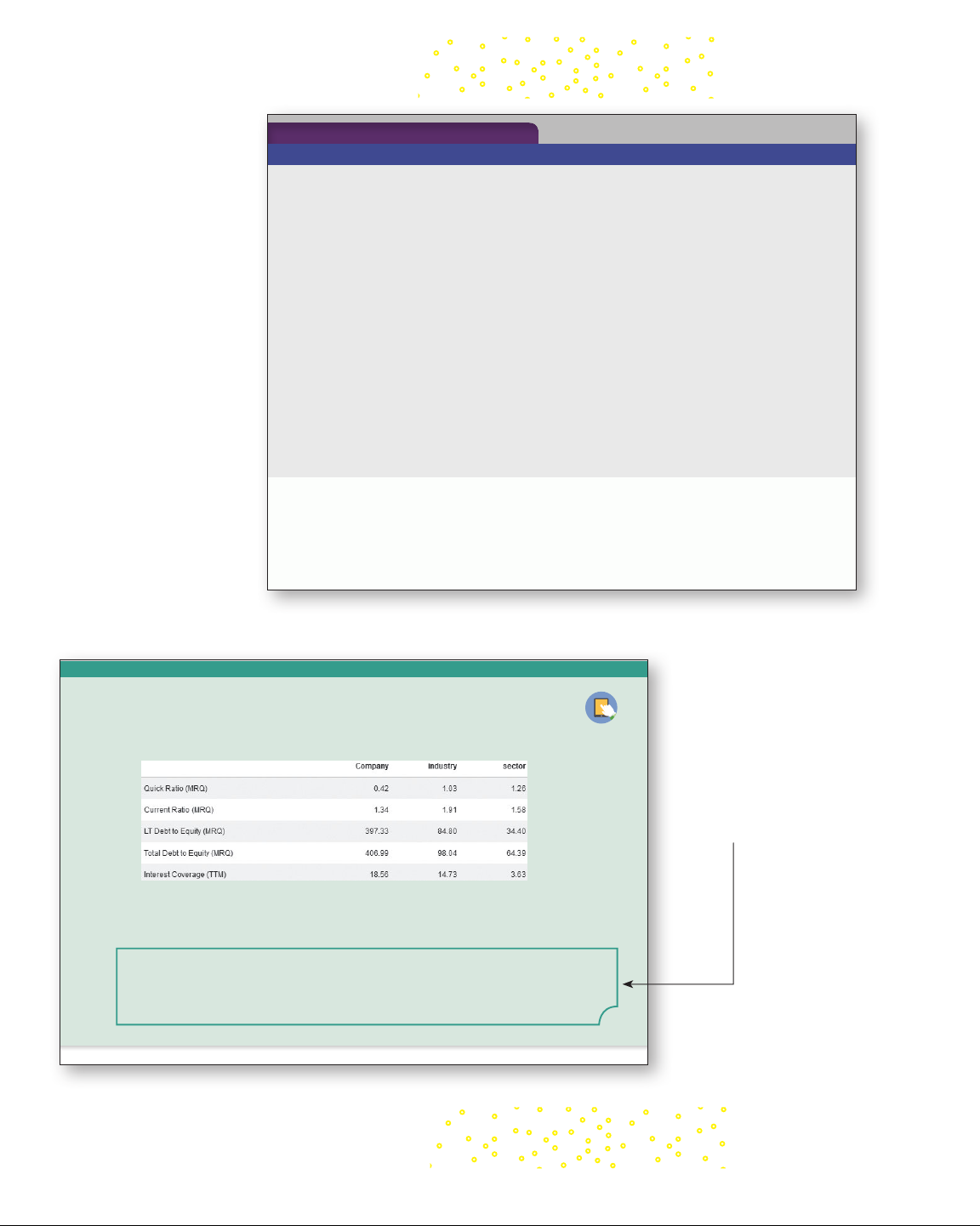
The website reports the company, industry, and sector ratios. As you can see, Home Depot has
lower quick and current ratios than the industry. Questions
1. Go to www.reuters.com and find the major ratio categories listed on this website. How do the categories differ
from the categories listed in this textbook?
2. Go to www.reuters.com and find all the ratios for Home Depot. How does the company compare to the indus-
try for the ratios presented on this website?
principles (GAAP). The existence of different standards and procedures makes it difficult
to compare financial statements across national borders.
Even companies that are clearly in the same line of business may not be comparable.
For example, electric utilities engaged primarily in power generation are all classified in
the same group (SIC 4911). This group is often thought to be relatively homogeneous.
However, most utilities operate as regulated monopolies, so they don’t compete much with
each other, at least not historically. Many have stockholders, and many are organized as
cooperatives with no stockholders. There are several different ways of generating power,
ranging from hydroelectric to nuclear, so the operating activities of these utilities can differ
quite a bit. Finally, profitability is strongly affected by the regulatory environment, so util-
ities in different locations can be similar but show different profits.
Several other general problems frequently crop up. First, different firms use different
accounting procedures—for inventory, for example. This makes it difficult to compare
statements. Second, different firms end their fiscal years at different times. For firms in
seasonal businesses (such as a retailer with a large Christmas season), this can lead to dif-
ficulties in comparing balance sheets because of fluctuations in accounts during the year. ros18955_fm_i-xlvi.indd 16 07/02/18 4:01 pm
Finally, for any particular firm, unusual or transient events, such as a one-time profit from
an asset sale, may affect financial performance. In comparing firms, such events can give misleading signals. IN-TEXT STUDY FEATURES xvii REAL-WORLD EXAMPLES
Actual events are integrated throughout the text, tying chapter concepts to real life
through illustration and reinforcing the relevance of the material. Some examples
tie into the chapter-opening vignette for added reinforcement. 156
P A R T 3 Valuation of Future Cash Flows SPREADSHEET STRATEGIES SPREADSHEET
How to Calculate Present Values with Multiple STRATEGIES
Future Cash Flows Using a Spreadsheet This feature introduces
Just as we did in our previous chapter, we can set up a basic spreadsheet to calculate the present values of
the individual cash flows as follows. Notice that we have calculated the present values one at a time and added students to Excel and them up: shows them how to set up spreadsheets in order to analyze common financial
problems—a vital part of every
Chapter 6 Discounted Cash Flow Valuation
business student’s education. 155 The present value must be: $16,710.50/1.116 = $8,934.12
Let’s check this. Taking them one at a time, the PVs of the cash flows are:
$5,000 × 1/1.116 = $5,000/1.8704 = $2,673.20
$5,000 × 1/1.115 = $5,000/1.6851 = 2,967.26
+$5,000 × 1/1.114 = $5,000/1.5181 = 3,293.65 Source: Microsoft Excel
Total present value = $8,934.12 This is as A NOTE we ABOUT previously CASH FLOW calculated. The TIMING
point we want to make is that we can calculate pres- ent and In wor future king present values in and any future value order pr and oblems, cash convert flow timing between is cr them itically im using portant. In whatever way seems most almost all convenient. such The calculations, answers it is will implicitl always y assumed be the that the same cash as flow long s occur as we at the end stick with the same
of each period. In fact, all the formulas we have discussed, all the numbers in a standard
discount rate and are careful to keep track of the right number of periods.
present value or future value table, and (very important) all the preset (or default) settings
on a financial calculator assume that cash flows occur at the end of each period. Unless you
CALCULATOR HINTSare explicitly told otherwise, you should always assume that this is what is meant.
As a quick illustration of this point, suppose you are told that a threeyear investment
Brief calculator tutorials appear in selected chapters to
has a firstyear cash flow of $100, a secondyear cash flow of $200, and a thirdyear cash
flow of $300. You are asked to draw a time line.
help students learn or brush up on their financial calculatorW
ithout further information, you should
always assume that the time line look
skills. These complement the Spreadsheet S s like t trategies. his: 0 1 2 3 CALCULATOR HINTS $100 $200 $300
On our time line, notice how the first cash flow occurs at the end of the first period, the
second at the end of the second per
How to Calculate Present Viod, and the third at the end of the third period.
alues with Multiple Future
We will close this section by answering the question we posed at the beginning of the
Cash Flows Using a Financial Calculator
chapter concerning quarterback Andrew Luck’s contract. Recall that the contract called for a To $6.4 calculate million the signing present bonus value of and $12 million multiple in cash salary flows in 2016. with a The remaining financial $120.725 calculator, mil
we will discount the individual cash flows lion w one as at to a be paid time as using $19.4 the million same in 2017, $24.4 technique we million used in in 2018, our $27.525 previous million
chapter, so this is not really new.
However, we can show you a shortcut. We will use the numbers in Example 6.3 to illustrate.
To begin, of course, we first remember to clear out the calculator! Next, from Example 6.3, the first cash flow
is $200 to be received in one year and the discount rate is 12 percent, so we do the following: Enter 1 12 200 N I/Y PMT PV FV Solve for –178.57
Now, you can write down this answer to save it, but that’s inefficient. All calculators have a memory where you
can store numbers. Why not just save it there? Doing so cuts down on mistakes because you don’t have to write
down and/or rekey numbers, and it’s much faster.
Next, we value the second cash flow. We need to change N to 2 and FV to 400. As long as we haven’t
changed anything else, we don’t have to reenter I/Y or clear out the calculator, so we have: Enter 2 400 N I/Y PMT PV FV Solve for –318.88
You save this number by adding it to the one you saved in your first calculation, and so on for the remaining two calculations.
As we will see in a later chapter, some financial calculators will let you enter all of the future cash flows at
once, but we’ll discuss that subject when we get to it. ros18955_fm_i-xlvi.indd 17 07/02/18 4:01 pm xviii IN-TEXT STUDY FEATURES CONCEPT BUILDING
Chapter sections are intentionally kept short to promote a step-by-step, building block approach to learning. Each
section is then followed by a series of short concept questions that highlight the key ideas just presented. Students
use these questions to make sure they can identify and understand the most important concepts as they read.
Chapter 3 Working with Financial Statements 69
Chapter 6 Discounted Cash Flow Valuation 165 TABLE 6.2 I. Symbols: Concept Questions PV Summary of Annuity
= Present value, what future cash flows are worth today and Perpetuity
FV = Future value, what cash flows are worth in the future t
3.3a What are the five groups of ratios Calculations
? Give two or three examples of each kind.
r = Interest rate, rate of return, or discount rate per period—typically, but not always, one year
3.3b Given the total debt ratio, what other two ratios can be computed? Explain
t = Number of periods—typically, but not always, the number of years how. C = Cash amount
3.3c Turnover ratios all have one of two figures as the numerator. What are these II.
Future Value of C per Period for t Periods at r Percent per Period: FV =
two figures? What do these ratios measure? How do you interpret the results? C × {[(1 + r)t − 1]/r} t
A series of identical cash flows is called an 3.3d
annuity, and the term [(1 + r)t − 1]/r is called the
Profitability ratios all have the same figure in the numerator. What is it? What do annuity future value factor.
these ratios measure? How do you interpret the results? III.
Present Value of C per Period for t Periods at r Percent per Period:
PV = C × {1 − [1/(1 + r)t ]}/r
The term {1 − [1/(1 + r)t ]}/r is called the annuity present value factor. IV.
Present Value of a Perpetuity of C per Period: The DuPont Identity 3.4 PV = C/r
A perpetuity has the same cash flow every year forever.
As we mentioned in discussing ROA and ROE, the difference between these two profitabil-
ity measures is a reflection of the use of debt financing, or financial leverage. We illustrate Excel Master It! accommodating text PERPETUITIES
the relationship between these measures in this section by investigating a famous way of goes here text goes We’ve seen decom that a series posing R of level OE int cash flows o its com can be valued ponent par by
ts. treating those cash flows as an here text goes here SUMMAR annuity. An Y T importABLES
ant special case of an annuity arises when the level stream of cash flows continues A forever. Suc CLOSER h an asse LOOKt is Acalled T a perpetuity ROE
because the cash flows are perpetual. perpetuity
These tables succinctly restate k
Perpetuities are also called consols, ey principles, results, and equations. They appear whenever it is useful to
particularly in Canada and the United Kingdom. See An annuity in which the cash
To begin, let’s recall the definition of ROE: flows continue forever.
emphasize and summarize a group of related concepts. For an example
Example 6.7 for an important example of a perpetuity. , see Chapter 3, page 68.
Because a perpetuity has an infinite number of cash flows, we obviously can’t compute Return on equity = Net income __________ consol
its value by discounting each one. T F ot ortunatel al eq y,
uity valuing a perpetuity turns out to be the eas A type of perpetuity.
iest possible case. The present value of a perpetuity is:
If we were so inclined, we could multiply this ratio by Assets/Assets without changing LABELED EXAMPLES
PV for a perpetuity = C/r 6.4 anything:
For example, an investment offers a perpetual cash flow of $500 every year. The return you Separate numbered and titled require Ron e suc tur h an inves n on eq tment is uity = Net income 8 percent. What is __________ t
he value of this investment? The value examples are extensively Total equity = Net income __________ Total equity × Assets ______ Assets of this perpetuity is: integrated into the chapters.
Perpetuity PV = C/r = $500/.08 = $6,250
These examples provide detailed = Net income __________ Assets × Assets __________ Total equity
applications and illustrations of
For future reference, Table 6.2 contains a summary of the annuity and perpetuity basic calculations Notice t we ha hat v w e e descr hav ibed e e in xpr this section. essed the By R now OE , you as t pr he obabl pr y think oduct t of hat twyou o ’ll ot just her ratios—ROA and the
the text material in a step-by- use online eq calculators to
uity multiplier: handle annuity problems. Before you do, see our nearby Work the step format. Each example is Web box! completely self-contained so
ROE = ROA × Equity multiplier = ROA × (1 + Debt-equity ratio)
students don’t have to search
Looking back at Prufrock, for example, we see that the debt-equity ratio was .38 and ROA for additional information. Preferred Stock
was 10.12 percent. Our work here implies that Prufrock’s ROE, as we EXAMPLE previously 6.7 calcu-
Based on our classroom testing, these examples are among Preferred stock lated, is t (or
his: preference stock) is an important example of a perpetuity. When a corpo-
ration sells preferred stock, the buyer is promised a fixed cash dividend every period (usually the most useful learning aids every quarter) R
forever. This dividend must be paid
OE = 10.12% × 1.38 = 14.01% before any dividend can be paid to regular because they provide both
stockholders—hence the term preferred. detail and explanation. Suppose The the diffFellini er Co ence . wants betw to sell een R preferred OE and stock RO at A $100 can per be share subst. A similar antial, issue par of ticularly for certain busi-
preferred stock already outstanding has a price of $40 per share and offers a dividend of
nesses. For example, in 2016, American Express had an ROA of 3.40 percent, which is
$1 every quarter. What dividend will Fellini have to offer if the preferred stock is going to sell?
fairly typical for financial institutions. However, financial institutions tend to borrow a lot
of money and, as a result, have relatively large equity multipliers. For American Express,
ROE was about 26.38 percent, implying an equity multiplier of 7.75 times.
We can further decompose ROE by multiplying the top and bottom by total sales: ROE = Sales _____ Sales × Net income __________ Assets × Assets __________ Total equity
If we rearrange things a bit, ROE looks like this: ROE = Net income __________ Sales × Sales ______ Assets × Assets __________ Total equity 3.26 Return on assets
= Profit margin × Total asset turnover × Equity multiplier ros18955_fm_i-xlvi.indd 18 07/02/18 4:01 pm 562
P A R T 6 Cost of Capital and Long-Term Financial Policy
Because different industries have different operating characteristics in terms of, for ex-
ample, EBIT volatility and asset types, there does appear to be some connection between
these characteristics and capital structure. Our story involving tax savings, financial distress
costs, and potential pecking orders undoubtedly supplies part of the reason; but, to date,
there is no fully satisfactory theory that explains these regularities in capital structures. Concept Questions
16.9a Do U.S. corporations rely heavily on debt financing?
16.9b What regularities do we observe in capital structures?
16.10 A Quick Look at the Bankruptcy Process
As we have discussed, one consequence of using debt is the possibility of financial distress,
which can be defined in several ways:
1. Business failure: This term is usually used to refer to a situation in which a business
has terminated with a loss to creditors; but even an all-equity firm can fail.
2. Legal bankruptcy: Firms or creditors bring petitions to a federal court for bankruptcy. bankruptcy
Bankruptcy is a legal proceeding for liquidating or reorganizing a business. A legal proceeding for
3. Technical insolvency: Technical insolvency occurs when a firm is unable to meet its liquidating or reorganizing financial obligations. a business.
4. Accounting insolvency: Firms with negative net worth are insolvent on the books. This
happens when the total book liabilities exceed the book value of the total asse IN-TEXT STUDY FEA ts. TURES xix
We now very briefly discuss some of the terms and more relevant issues associated with KEY TERMS
bankruptcy and financial distress.
Key Terms are printed in bold type and defined within the text the first time they appear
LIQUIDATION AND REORGANIZATION . They also
appear in the margins with definitions for easy location and identification by the student.
Firms that cannot or choose not to make contractually required payments to creditors have liquidation
two basic options: Liquidation or reorganization. Liquidation means termination of the Termination of the firm as a
firm as a going concern, and it involves selling off the assets of the firm. The proceeds, net going concern. EXPLANATORY WEB LINKS
of selling costs, are distributed to creditors in order of established priority. Reorganization
is the option of keeping the firm a going concern; it often involves issuing new securities to reorganization
These web links are provided in the margins of the text. They are specifically Financial restructuring of
replace old securities. Liquidation or reorganization is the result of a bankruptcy proceed-
selected to accompany text material and provide students and instructors with a failing firm to attempt to
ing. Which occurs depends on whether the firm is wort h more “dead or alive.” continue operations as a
a quick way to check for additional information using the Internet. going concern.
Bankruptcy Liquidation Chapter 7 of the Federal Bankruptcy Reform Act of 1978
deals with “straight” liquidation. The following sequence of events is typical:
1. A petition is filed in a federal court. Corporations may file a voluntary petition, or in-
voluntary petitions may be filed against the corporation by several of its creditors.
2. A trustee-in-bankruptcy is elected by the creditors to take over the assets of the debtor
corporation. The trustee will attempt to liquidate the assets. The SEC has a good overview
3. When the assets are liquidated, after payment of the bankruptcy administration costs, of the bankruptcy process
the proceeds are distributed among the creditors.
in its “Online Publications” section at www.sec.gov.
4. If any proceeds remain, after expenses and payments to creditors, they are distributed to the shareholders. KEY EQUATIONS
Called out in the text, key equations are identified by an equation number. The list in Appendix B
shows the key equations by chapter, providing students with a convenient reference.
Chapter 7 Interest Rates and Bond Valuation 199
Chapter 12 Some Lessons from Capital Market History 393
Based on our examples, we can now write the general expression for the value of a bond.
If a bond has (1) a face value of F paid at maturity, (2) a coupon of C paid per period, (3) t Concept Questions
periods to maturity, and (4) a yield of r per period, its value is:
12.2a With 20/20 hindsight, what do you say was the best investment for the period
Bond value = C × [1 − 1/(1 + r)t]/r + F/(1 + r)t from 1926 through 1935?
Bond value = Present value
12.2b Why doesn’t everyone just buy small stocks as investments 7.1 ? of the coupons + Present value
12.2c What was the smallest return observed over the 91 years for each of the face amount of these
investments? Approximately when did it occur?
12.2d About how many times did large-company stocks return more than 30
percent? How many times did they return less than −20 percent?
12.2e What was the longest “winning streak” (years without a negative return) for Semiannual Coupons
large-company stocks? For long-term government bonds EXAMPLE 7. ? 1 HIGHLIGHTED CONCEPT
In practice, bonds issued in the S
12.2f How often did the T-bill portfolio have a negative return?
United States usually make coupon payments twice a year.
Throughout the text, important ideas
So, if an ordinary bond has a coupon
rate of 14 percent, then the owner will get a total of
are pulled out and presented in a
$140 per year, but this $140 will come in two payments of $70 each. Suppose we are exam-
ining such a bond. The yield to maturity is quoted at 16 percent. highlighted bo Bond x—signaling to students
yields are quoted like APRs; the
Average Returns: The First Lesson
quoted rate is equal to the actual rate per period 12.3
that this material is particularly relevant
multiplied by the number of periods. In this case, with As a y 16 ou’ve probabl percent y begun quoted to yield notice, and the his
semian- tory of capital market returns is too complicated Excel Master It!
and critical for their understanding. For
nual payments, the true yield is 8 percent per six to be months. of muc The h use bond in its undig matures in ested seven form. W
years. e need to begin summarizing all these numbers. Excel Master
What is the bond’s price? What is the effective annual yield on this bond? examples, Chapter 10 Based on our , page 313; discussion, we know
Accordingly, we discuss how to go about condensing the detailed data. We start out by coverage online the bond will calculating a sell at a ver discount age returns. because it has a coupon Chapter 13, page 434.
rate of 7 percent every six months when the market requires 8 percent every six months. So, if our answer exceeds $1,000 CALCULA
, we know we have made a mistake.TING AVERAGE RETURNS EXCEL MA To get $1,000 paid S the TER
exact price, we first calculate the The present obvious value w of ay t the o calculate bond’s the face averag value e r
of eturns on the different investments in Table 12.1
in seven years. This seven-year period is to has add 14 up the periods year of ly six returns and months divide
each. At by 91. The result is the historical average of the
Icons in the margin identify concepts
8 percent per period, the value is: individual values.
and skills covered in our unique
Present value = $1,000/1.0814 = , RW $1, J-
For example, if you add up the returns for the largecompany stocks in Figure 12.5 for 000/2.9372 = $340.46
the 91 years, you will get about 10.88. The average annual return is 10.88/91 = .120, or created Ex The cel Master program. For coupons can be viewed as a 14-period annuity 12.0%. of $70 You per interpre period. t A this t 12.0 an 8 percent percent jus
dis-t like any other average. If you were to pick a year more training in Ex count rate cel functions for
, the present value of such an annuity is:
at random from the 91year history and you had to guess what the return in that year was, finance, and for more practice
Annuity present value = $70 × , log on (1 − 1/1.
the best guess would be 12.0 percent. 0814)/.08
to McGraw-Hill’s Connect Finance = $70 × (1 − for .3405)/.08
AVERAGE RETURNS: THE HISTORICAL RECORD
Fundamentals of Corporate Finance = $70 × 8.2442
Table 12.2 shows the average returns for the investments we have discussed. As shown, in a
to access the Excel Master files. This = $577.10
typical year, the smallcompany stocks increased in value by 16.6 percent. Notice also how
pedagogically superior tool will help get
much larger the returns are for stocks, compared to the returns on bonds.
The total present value gives us what the bond should sell for:
your students the practice they need to
These averages are, of course, nominal because we haven’t worried about inflation.
Total present value = $340.46 + 577.10 = $917.56 Notice that the average inflation rate was 3.0 percent per year over this 91year span. The
succeed—and to exceed expectations.
nominal return on U.S. Treasury bills was 3.4 percent per year. The average real return on
To calculate the effective yield on this bond, note that 8 percent every six months is equiv- alent to:
Effective annual rate = (1 + .08)2 − 1 = 16.64% TABLE 12.2 Investment Average Return Large-company stocks 12.0% Average Annual
The effective yield is 16.64 percent. Returns: 1926–2016 Small-company stocks 16.6 Long-term corporate bonds 6.3 Long-term government bonds 6.0 U.S. Treasury bills 3.4 Inflation 3.0
As we have illustrated in this section, bond prices and interest rates always move in op-
Source: Morningstar, 2017, author calculations. posite ros18955_fm_i-xlvi.indd 19
directions. When interest rates rise, a bond’s value, like any other present value, will 07/02/18 4:01 pm
decline. Similarly, when interest rates fall, bond values rise. Even if we are considering a
bond that is riskless in the sense that the borrower is certain to make all the payments, there Visit investorguide.com to
is still risk in owning a bond. We discuss this next. learn more about bonds.