Incomplete
Left
Bundle-Branch
Block
A
Definite
Electrocardiographic
Entity
By
S.
SERGE
BAROLD,
M.B.,
M.R.A.C.P.,
JOSEPH
W.
LINHART,
M.D.,
FRANK
J.
HInDNER,
M.D.,
ONKAR
S.
NARULA,
M.D.,
AND
PILIP
SAMET,
M.D.
SUMMARY
Rate-dependent
intermittent
incomplete
and
complete
left
bundle-branch
block
(LBBB)
is
described
in
a
patient
without
other
evidence
of
heart
disease.
Continuous
electrocardiographic
tracings
revealed
QRS
complexes
intermediate
in
configuration
between
normal
conduction
and
complete
LBBB
during
the
transitional
phase
from
normal
to
abnormal
conduction.
This
provided
an
opportunity
to
study
the
various
grades
of
incomplete
LBBB
in
man.
During
the
incomplete
LBBB
phase,
the
mor-
phology
of
the
QRS
complexes
bore
a
close
resemblance
to
the
QRS
form
in
the
Wolff-Parkinson-White
syndrome
(type
B).
The
differences
between
these
two
en-
tities
are
emphasized.
Additional
Indexing
Words:
Critical
rate
phenomenon
Intrinsicoid
deflection
Septa
I
NCOMPLETE
left
bundle-branch
block
(LBBB)
has
been
produced
and
studied
in
experimental
animals,'
but
its
occurrence
in
man
has
been
conclusively
established
only
recently.
Prior
to
1964,
when
Schamroth
and
Bradlow2
described
a
patient
with
intermit-
tent
incomplete
LBBB
of
gradual
onset
and
disappearance,
this
abnormality
received
little
documentation.24
Schamroth
and
Bradlow's
report
provided
for
the
first
time
convincing
evidence
of
the
existence
of
incomplete
LBBB.
The
purpose
of
the
present
communication
is
to
report
the
same
phenomenon
in
an
addi-
tional
patient
who
exhibited
various
grades
of
incomplete
LBBB,
thus
presenting
further
evidence
of
the
existence
of
such
an
entity
in
man.
Report
of
Case
A
41-year-old
woman
was
referred
to
Mount
From
the
Division
of
Cardiology,
Department
of
Medicine,
Mount
Sinai
Hospital,
Miami
Beach,
Florida,
and
the
Department
of
Medicine,
University
of
Miami
School
of
Medicine,
Coral
Cables,
Florida.
Work
was
supported
in
part
by
U.
S.
Public
Health
Service
Grant
HE-09782-03.
702
Wolff-Parkinson-White
syndrome
al
activation
Delta
wave
Sinai
Hospital
for
investigation
of
short-lived
episodes
of
paroxysmal
tachyeardia
in
the
last
2
years.
She
had
no
other
symptoms
referable
to
the
cardiovascular
system.
On
physical
exam-
ination
she
was
normotensive,
and
there
was
a
very
soft
ejection
systolic
murmur
(grade
I/IV
in
intensity)
along
the
left
sternal
border.
The
rest
of
the
examination
was
unremarkable.
Chest
x-rays
were
normal.
The
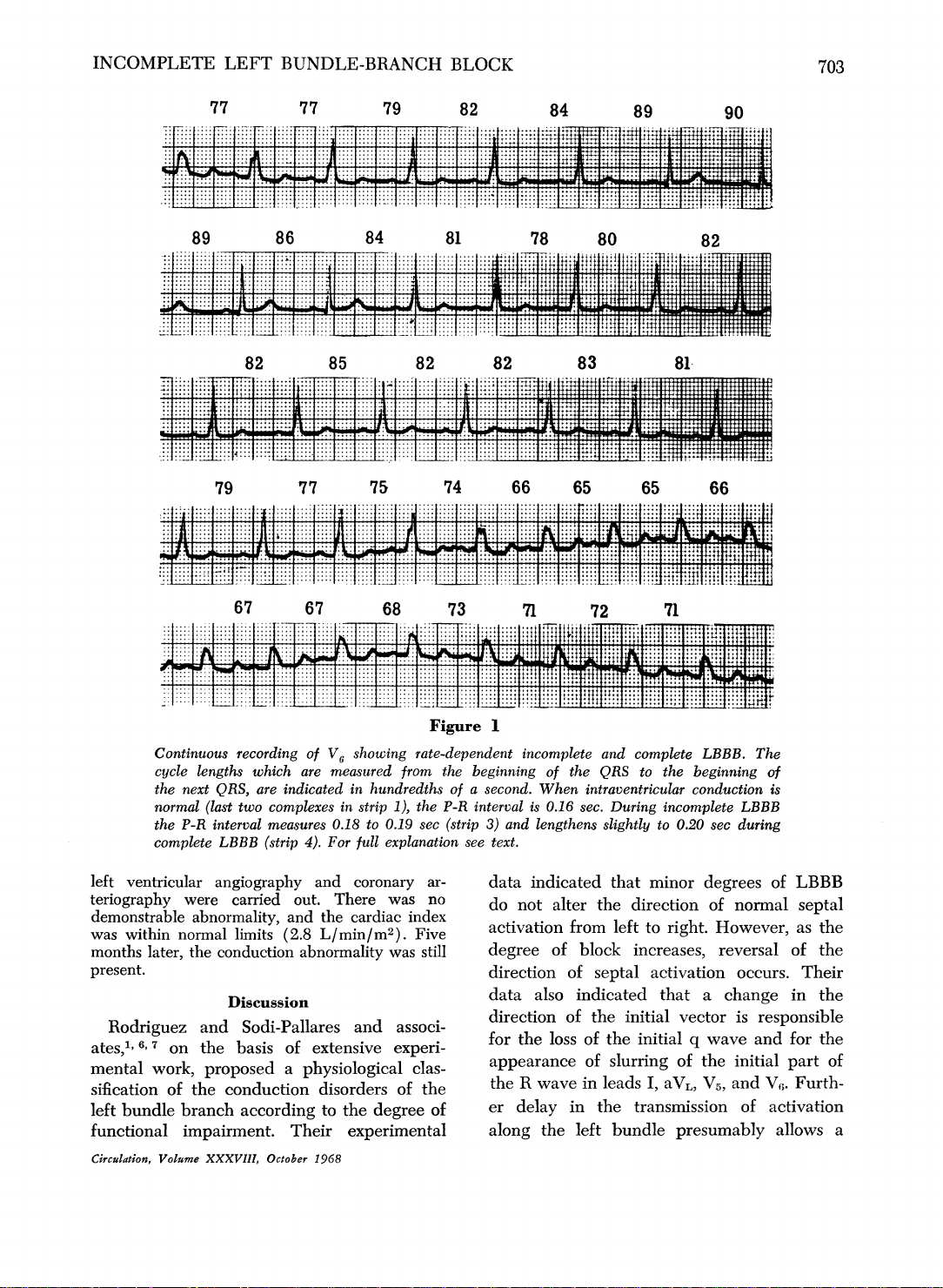
electrocardiograms,
which
disclosed
intermittent
incomplete
and
com-
plete
LBBB,
are
illustrated
in
figures
1
to
4.
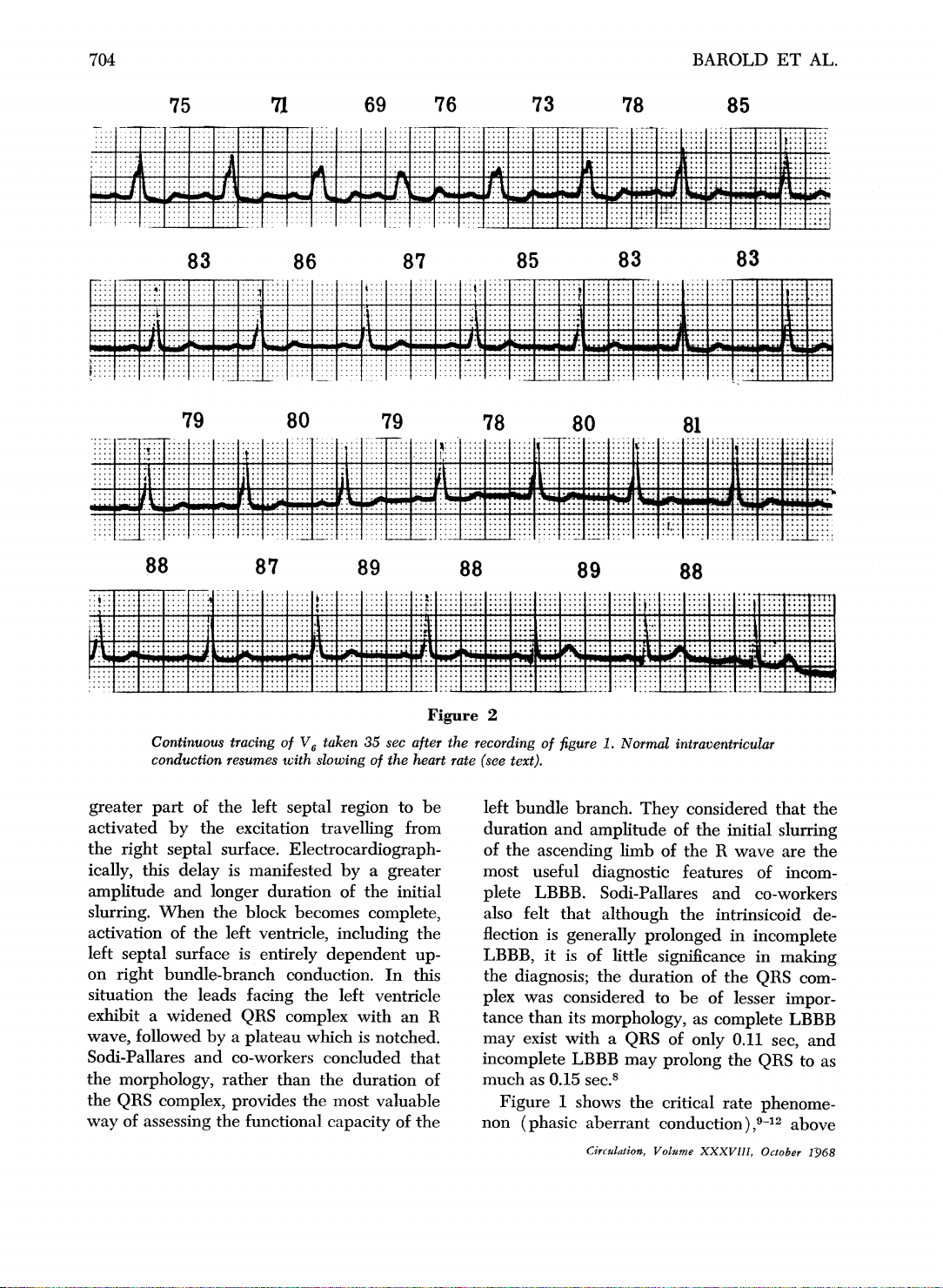
The
conduction
disturbance
was
clearly
rate-depen-
dent
appearing
with
an
increase
in
heart
rate
and
disappearing
with
a
decrease
in
heart
rate
(figs.
1
and
2).
The
full
progression
from
nor-
mal
conduction
to
complete
LBBB
became
evi-
dent
when
sinus
tachycardia
was
induced
by
ex-
ercise,
excitement,
and
the
inhalation
of
amyl
nitrite.
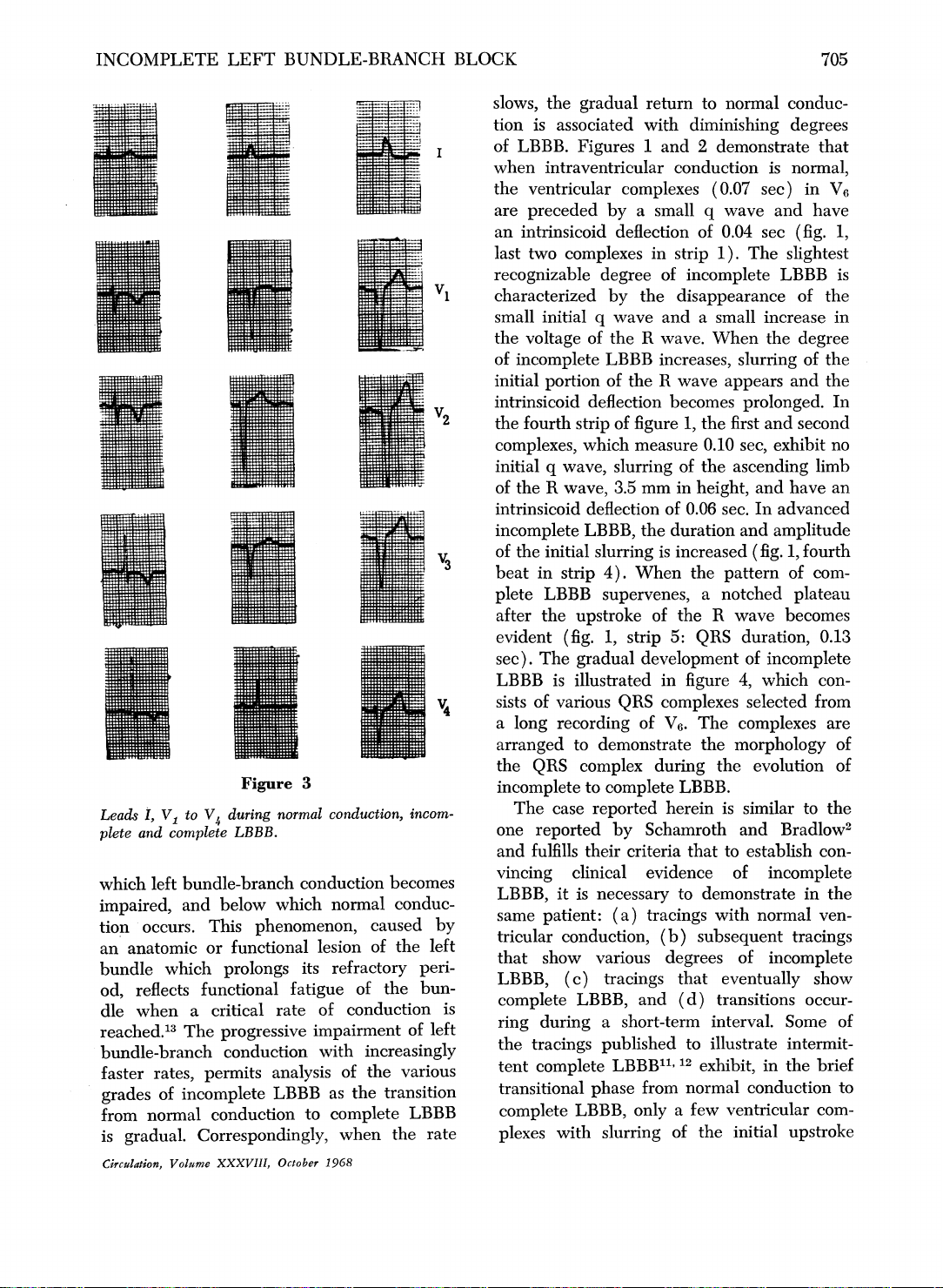
The
configuration
of
the
ventricular
com-
plexes
in
leads
I
and
V1
to
V4,
during
normal
intraventricular
conduction,
and
during
intermit-
tent
and
complete
LBBB,
is
displayed
in
figure
3.
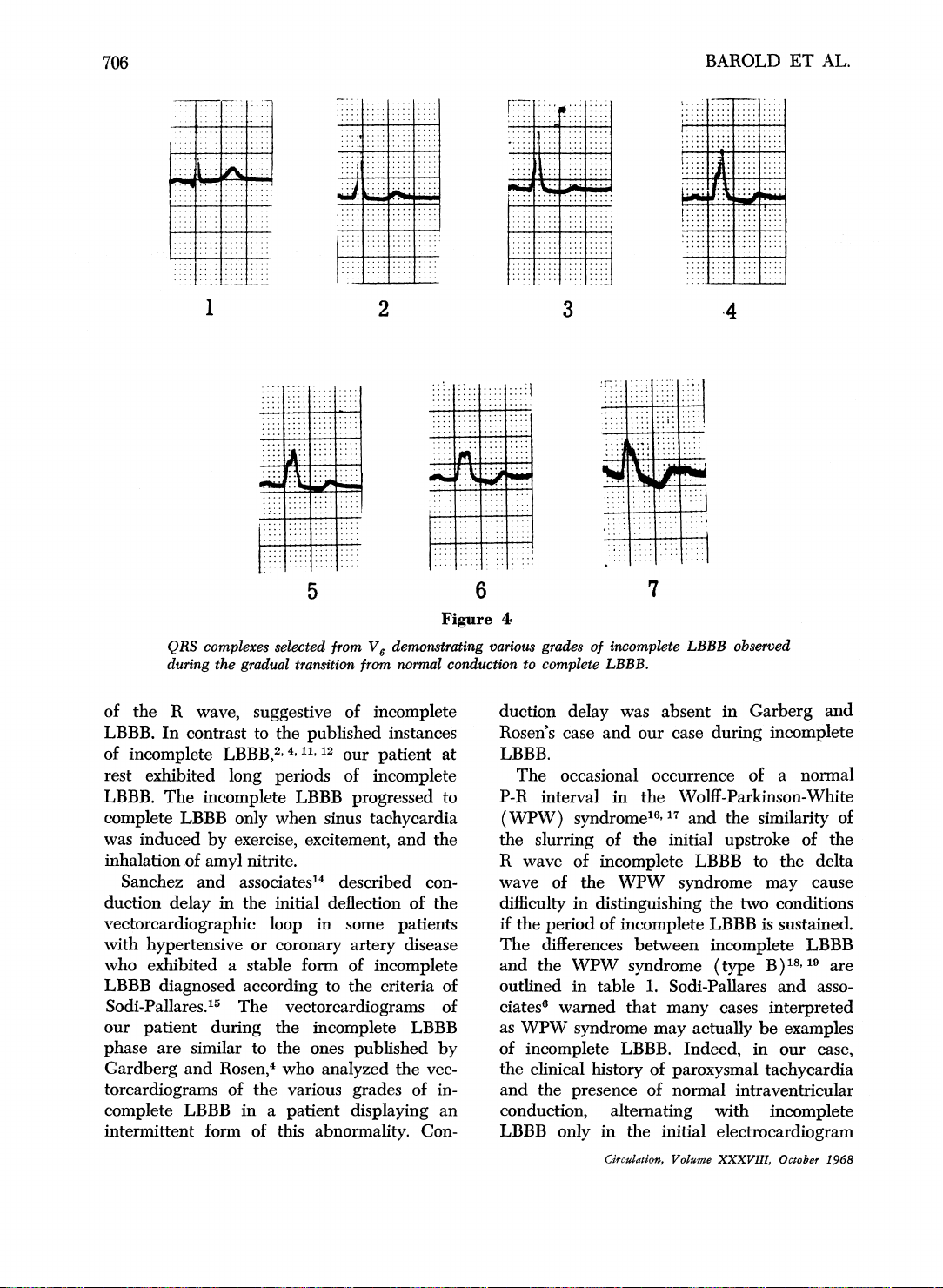
Figure
4
demonstrates
the
various
patterns
observed
during
the
progression
from
normal
conduction
to
complete
LBBB.
During
normal
conduction
there
was
T-wave
inversion
from
V1
to
V4
(fig.
3).
The
vectorcardiograms
re-
corded
by
the
Frank
system5
are
illustrated
and
described
in
figures
5
and
6.
Right
and
retro-
grade
left
heart
catheterization,
together
with
Circulation,
Volume
XXXVIII,
October
1968
Downloaded from http://ahajournals.org by on May 20, 2025

INCOMPLETE
LEFT
BUNDLE-BRANCH
BLOCK
77
77
79
82
84
89
90
I
:T,~~~~~~2
..
....
.... ....
.,~~~~~~~~~~~~~~~~..
.....
.
.
88
..
....
....
....
~...
....
.
.
..
.
.
..
.
.
..
.
.
..
.
.
..
...
.
..
..
..
..
.4
....
..
..
.w
..
.4
..S...
*
t+
O o
89
8
6
84
81
78
80
82
-
.I,
l
&
l
ri
l
.l.
O.l
l
#l,
al
|
t
~~~~~~~~N,
13"'lii
l
M
,
4.44
,i
~~~~~~~~~~~~.
L .
.
82
85
82
82
83
81
79
77
75
74
66
65
65
66
67
67
68
73
71
72
71
.7;
igur
1
;.,I
noma
(ls.
wocmlee.n.ti
1),
the'
P-
nevl
s01
e.uigicopeeLB
Continuous-l-------
reorin
of---
V
6
showin
-a-te-dependet
incomle--t
--
Le
rand
tcomple*te
LBBB
l*
The
the
P-R
interval
measures
0.18
to
0.19
sec
(strip
3)
and
lengthens
slightly
to
0.20
sec
during
complete
LBBB
(strip
4).
For
full
explanation
see
text.
left
ventricular
angiography
and
coronary
ar-
teriography
were
carried
out.
There
was
no
demonstrable
abnormality,
and
the
cardiac
index
was
within
normal
limits
(2.8
L/min/m2).
Five
months
later,
the
conduction
abnormality
was
still
present.
Discussion
Rodriguez
and
Sodi-Pallares
and
associ-
ates,'
61
67
on
the
basis
of
extensive
experi-
mental
work,
proposed
a
physiological
clas-
sification
of
the
conduction
disorders
of
the
left
bundle
branch
according
to
the
degree
of
functional
impairment.
Their
experimental
Circulation,
Volume
XXXVIII,
October
1968
data
indicated
that
minor
degrees
of
LBBB
do
not
alter
the
direction
of
normal
septal
activation
from
left
to
right.
However,
as
the
degree
of
block
increases,
reversal
of
the
direction
of
septal
activation
occurs.
Their
data
also
indicated
that
a
change
in
the
direction
of
the
initial
vector
is
responsible
for
the
loss
of
the
initial
q
wave
and
for
the
appearance
of
slurring
of
the
initial
part
of
the
R
wave
in
leads
I,
aVL,
V5,
and
Vc,.
Furth-
er
delay
in
the
transmission
of
activation
along
the
left
bundle
presumably
allows
a
44411
....
....
703
Downloaded from http://ahajournals.org by on May 20, 2025

704
~~~~~~~~~~~~BAROLD
ET
AL.
71
69
76
73
78
85
J
.-
....
...
...
.....
....
.....
....
I.
.
. .
.
. .
JA
Al
t
Iiiw
J
....
..
....
..
...
....
....
....
...
..
.........
..
83
86
87
85
83
83
77
...
....
....
.....
....
...
....
..
....
......
..
...
....
....
.......
...
....
....
....
.
I
....
....
....
:i
79
80
79
78
80
81
-
-77..
..
I::,.
ji;.:
..
..
...
....
...
.
.
.
GW"
....
....
....
....
....
87
89
88
89
88
....
.....
....
.
.
.taken
..o
. . .
greater
part
of
the
left
septal
region
to
be
activated
by
the
excitation
travelling
from
the
right
septal
surface.
Electrocardiograph-
ically,
this
delay
is
manifested
by
a
greater
amplitude
and
longer
duration
of
the
initial
slurring.
When
the
block
becomes
complete,
activation
of
the
left
ventricle,
including
the
left
septal
surface
is
entirely
dependent
up-
on
right
bundle-branch
conduction.
In
this
situation
the
leads
facing
the
left
ventricle
exhibit
a
widened
QRS
complex
with
an
R
wave,
followed
by
a
plateau
which
is
notched.
Sodi-Pallares
and
co-workers
concluded
that
the
morphology,
rather
than
the
duration
of
the
QRS
complex,
provides
the
most
valuable
way
of
assessing
the
functional
capacity
of
the
left
bundle
branch.
They
considered
that
the
duration
and
amplitude
of
the
initial
slurring
of
the
ascending
limb
of
the
R
wave
are
the
most
useful
diagnostic
features
of
incom-
plete
LBBB.
Sodi-Pallares
and
co-workers
also
felt
that
although
the
intrinsicoid
de-
flection
is
generally
prolonged
in
incomplete
LBBB,I
it
is
of
little
significance
in
making.
the
diagnosis;
the
duration
of
the
QRS
com-
plex
was
considered
to
be
of
lesser
impor-
tance
than
its
morphology,
as
complete
LBBB
may
exist
with
a
QRS
of
only
0.11
sec,
and
incomplete
LBBB
may
prolong
the
QRS
to
as
much
as
0.15
sec.8
Figure
shows
the
critical
rate
phenome-
non
(phasic
aberrant
conduction
),9
12
above
Circulation,
Volume
XXX
VIII,
October
1-968
75
88
704
Downloaded from http://ahajournals.org by on May 20, 2025

INCOMPLETE
LEFT
BUNDLE-BRANCH
BLOCK
I
gr
,,
tiT
!^
.
,
a
x
r
I+g--
m
Y
1
. . .
.
W ii]
i . .
i...l
11.
_
_
i..
.'
's<T
.,
.,,,,.
,.saar
._-
_
_TT
_
llixillllw
r .
. *
i
"
1l
lX
I
d
.
d
-
=
i
V2
ll'*iiiii
T
t
_ 4; _
_
'iitilullR
g
=
EE
:
:
:t:
1T
1l
,.s7Z'
_
sil
l,..,,.,,
'_.
- I .
>_
._
&|xIz;
_
(j
rl
jl,,*.T_.|ll;
'11.111!,ilD11t
CL
t1 s ws | i I . 1'1 '
.1
aTr-.
TiITlEii+4ii,iii!
v
kTi5>§
TT
lT
-,
wq
11IHTlliT
.............
} <
<
.
T
X X '
s . s
rwTa
r_ro
iF
T+I
rl
ITT$,
"1111m11111111|s
11:111.
Iil
wIr
. i
,
{...
'.i.
l.azi....-s
if TT T X T
I I Tr a
7TTTS
rTT
r
7
X
lilF
-lllilll,51111id!]]12
i i, ..
111,
X .
T n
,,,, w w
w w ^
BTrTr.
rTTTfT5TTA
*arr-w
rTT
TTt
,,,, , . ,,,.,
..
rl.
I I r X WT6T
I T T . '
r.
IllUllllStllllll4TI
il
-l
rl
.
1
,1111H111H1i11"'
:1
r
.,
_
_
_-r7
1I
TT
.1
IrTlrFR
7
Tl
I
-
..
3
..
.
s
..
..
. . . . . -i * . E
s a ] a . x , -
E.TilVT
11+till
sllIvXI
iii
__
.
_c
_
llTBr
m3T=
m7mm
_
=,
.-_
I]*iil:4#llll-illj'
_
.X.
,
T
S:TIT
_TTT
r-
[, i B X,
5 1 5 @ X
_I
r-
=
_
ST;1T
IlllUllllllllllilii
rl I 1 1 1 1 | I
I I . | I X W
..ir
.rrTrrJllw
-
___
_
mmE
E..s.r.
rT.l
T
-
m_
m
IT_
_TElT
m
;
:XL
11111181114S"X
rllr ... Ii
' . ' .. .
lii _'
i ,
TT
1--1X
Fa
wrlrarll
_
_
T
XTA
T
T .
_
_
n
T
XTTTT
T
[
eIlTrnllllllllllllirl
il;+5
,ralilfflllilliHili
11
11
1
*..,
...]]
*.
tTI.
5,
Ir
r
_TU_
IDn
1 r r
T
1
I
l l Ir] r rars
T 1 l r l
ZTSM
I
rTT
x
T
T
T
T
T
,
TT
r.
l...rl
I.iTTr
TlE*l
IllUliFl4TITl4I+ll
nTnnll
1
lLK
.lilElilr
.wirr
111r11
s
} . E P L . . s |
| | I . 1 [ E i m
Orm
IJ
!'lldSllllllllli§i!
;1;iil
!l4§lili
.
'] t | 1s1 itrrrrTl
Tl | }
LL
1_
L
_L
_Z
e_
r
1
r r
n
r r
rxl
1
x rT
X;
r+lm
nl
I, rl
1
ITFilITllllllllFT
n,i.,,..1nTrr.,,a
I.
m_
nnlrTr
I-ITrTEt.l*l
,B
ITrTTr;
liizillllinillll
111111111111111
l
l
.......
... _
...........
. l,, .
1rX ....
t. .. r
....,,
X,,,,,,
., iii
|
;
;
,,,,,,,
TTT
T
T
x
.
r
TT
T
TT
T
.
rT rTIrrT l
I T T x I
ne
iTIIT
-
==
2 B i i
ir * |
-
tililHlilil
:G
...................
...............
,, .,,
.
,i
.
r
T
T
x
.
nloillllllilllllli
ITT"Tlllllle
i
.
[....
w v
Figure
a
Leads
i,
V1
to
V4
during
normal
conduction,
incom-
plete
and
complete
LBBB.
which
left
bundle-branch
conduction
becomes
impaired,
and
below
which
normal
conduc-
tion
occurs.
This
phenomenon,
caused
by
an
anatomic
or
functional
lesion
of
the
left
bundle
which
prolongs
its
refractory
peri-
od,
reflects
functional
fatigue
of
the
bun-
dle
when
a
critical
rate
of
conduction
is
reached.13
The
progressive
impairment
of
left
bundle-branch
conduction
with
increasingly
faster
rates,
permits
analysis
of
the
various
grades
of
incomplete
LBBB
as
the
transition
from
normal
conduction
to
complete
LBBB
is
gradual.
Correspondingly,
when
the
rate
Circulation,
Volume
XXXVIII,
October
1968
slows,
the
gradual
return
to
normal
conduc-
tion
is
associated
with
diminishing
degrees
of
LBBB.
Figures
1
and
2
demonstrate
that
when
intraventricular
conduction
is
normal,
the
ventricular
complexes
(0.07
sec)
in
V0
are
preceded
by
a
small
q
wave
and
have
an
intrinsicoid
deflection
of
0.04
sec
(fig.
1,
last
two
complexes
in
strip
1).
The
slightest
recognizable
degree
of
incomplete
LBBB
is
characterized
by
the
disappearance
of
the
small
initial
q
wave
and
a
small
increase
in
the
voltage
of
the
R
wave.
When
the
degree
of
incomplete
LBBB
increases,
slurring
of
the
initial
portion
of
the
R
wave
appears
and
the
intrinsicoid
deflection
becomes
prolonged.
In
the
fourth
strip
of
figure
1,
the
first
and
second
complexes,
which
measure
0.10
sec,
exhibit
no
initial
q
wave,
slurring
of
the
ascending
limb
of
the
R
wave,
3.5
mm
in
height,
and
have
an
intrinsicoid
deflection
of
0.06
sec.
In
advanced
incomplete
LBBB,
the
duration
and
amplitude
of
the
initial
slurring
is
increased
(fig.
1,
fourth
beat
in
strip
4).
When
the
pattern
of
com-
plete
LBBB
supervenes,
a
notched
plateau
after
the
upstroke
of
the
R
wave
becomes
evident
(fig.
1,
strip
5:
QRS
duration,
0.13
sec).
The
gradual
development
of
incomplete
LBBB
is
illustrated
in
figure
4,
which
con-
sists
of
various
QRS
complexes
selected
from
a
long
recording
of
V6.
The
complexes
are
arranged
to
demonstrate
the
morphology
of
the
QRS
complex
during
the
evolution
of
incomplete
to
complete
LBBB.
The
case
reported
herein
is
similar
to
the
one
reported
by
Schamroth
and
Bradlow2
and
fulfills
their
criteria
that
to
establish
con-
vincing
clinical
evidence
of
incomplete
LBBB,
it
is
necessary
to
demonstrate
in
the
same
patient:
(a)
tracings
with
normal
ven-
tricular
conduction,
(b)
subsequent
tracings
that
show
various
degrees
of
incomplete
LBBB,
(c)
tracings
that
eventually
show
complete
LBBB,
and
(d)
transitions
occur-
ring
during
a
short-term
interval.
Some
of
the
tracings
published
to
illustrate
intermit-
tent
complete
LBBB"'I
12
exhibit,
in
the
brief
transitional
phase
from
normal
conduction
to
complete
LBBB,
only
a
few
ventricular
com-
plexes
with
slurring
of
the
initial
upstroke
705
Q--
-t
.-
44--
I±i±im-Wmm.
......
....
Downloaded from http://ahajournals.org by on May 20, 2025

BAROLD
ET
AL.
1
r~--
2
5
.......:
i...
....
."
.
.
.
..
....
.
...
..
3..
..
....
.... ....
....
.... .... ....
.... .... ....
.... .... ....
.... .... ....
.... .... ....
.... .... ....
_
..
.... .... ....
.... .... ....
_
6
_
t
_
L
s;
t
. . .
.... ....
r
_
_
_
...,
...
....
..... .. ... .
....
..... .. ... .
....
....
.... ....
_
....
.... ....
....
.... ....
....
.... ....
....
....
...
.... ....
...
.... ....
...
.... ....
...
....
....
6
....
.....
....
....
.4
7
Figure
4
QRS
complexes
selected
from
V6
demonstrating
various
grades
of
incomplete
LBBB
observed
during
the
gradual
transition
from
normal
conduction
to
complete
LBBB.
of
the
R
wave,
suggestive
of
incomplete
LBBB.
In
contrast
to
the
published
instances
of
incomplete
LBBB,2
4
12
our
patient
at
rest
exhibited
long
periods
of
incomplete
LBBB.
The
incomplete
LBBB
progressed
to
complete
LBBB
only
when
sinus
tachyeardia
was
induced
by
exercise,
excitement,
and
the
inhalation
of
amyl
nitrite.
Sanchez
and
associates14
described
con-
duction
delay
in
the
initial
deflection
of
the
vectorcardiographic
loop
in
some
patients
with
hypertensive
or
coronary
artery
disease
who
exhibited
a
stable
form
of
incomplete
LBBB
diagnosed
according
to
the
criteria
of
Sodi-Pallares.15
The
vectorcardiograms
of
our
patient
during
the
incomplete
LBBB
phase
are
similar
to
the
ones
published
by
Gardberg
and
Rosen,4
who
analyzed
the
vec-
torcardiograms
of
the
various
grades
of
in-
complete
LBBB
in
a
patient
displaying
an
intermittent
form
of
this
abnormality.
Con-
duction
delay
was
absent
in
Garberg
and
Rosen's
case
and
our
case
during
incomplete
LBBB.
The
occasional
occurrence
of
a
normal
P-R
interval
in
the
Wolff-Parkinson-White
(WPW)
syndrome'6'
17
and
the
similarity
of
the
slurring
of
the
initial
upstroke
of
the
R
wave
of
incomplete
LBBB
to
the
delta
wave
of
the
WPW
syndrome
may
cause
difficulty
in
distinguishing
the
two
conditions
if
the
period
of
incomplete
LBBB
is
sustained.
The
differences
between
incomplete
LBBB
and
the
WPW
syndrome
(type
B
)18,
19
are
outlined
in
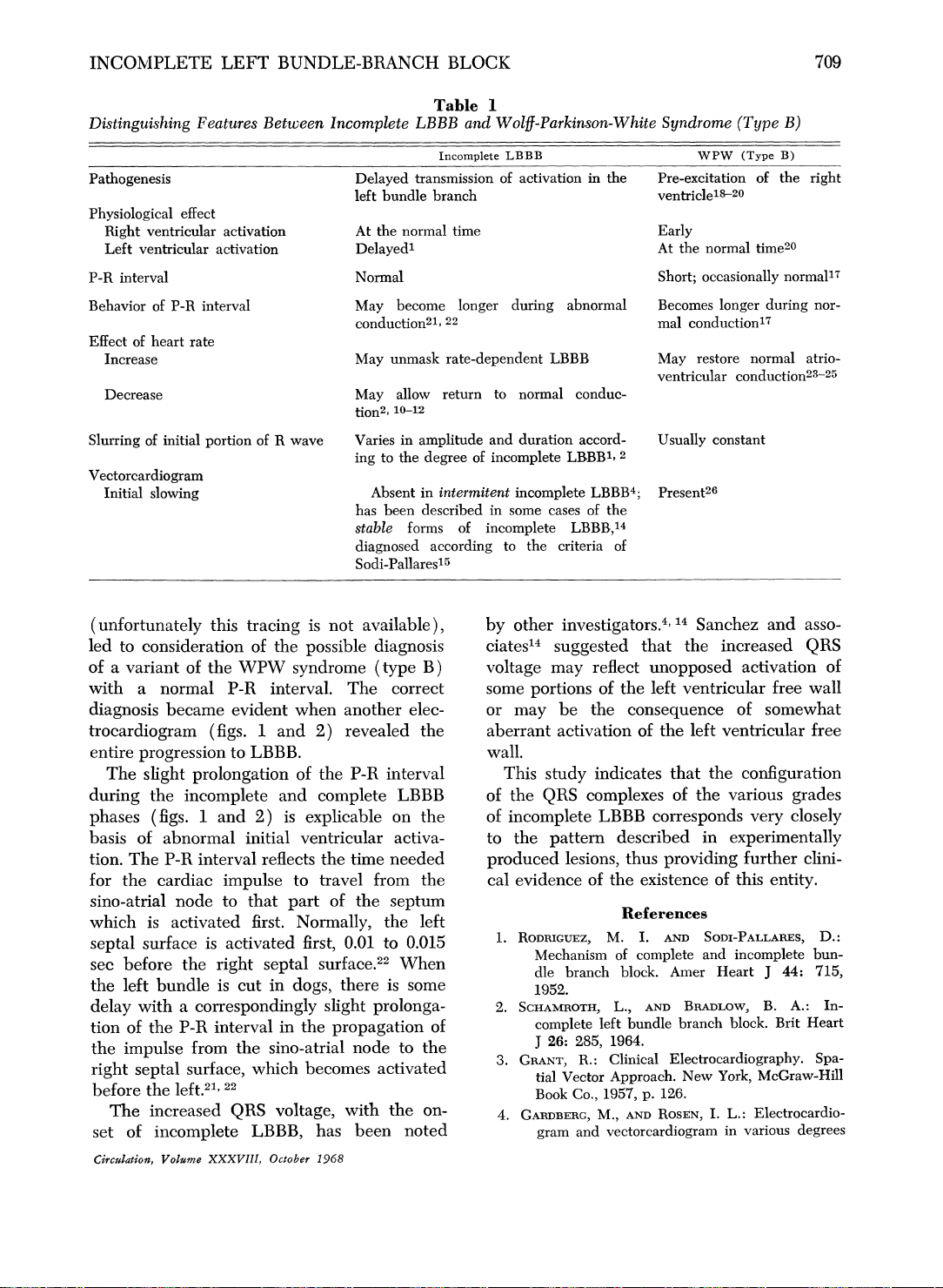
table
1.
Sodi-Pallares
and
asso-
ciates6
warned
that
many
cases
interpreted
as
WPW
syndrome
may
actually
be
examples
of
incomplete
LBBB.
Indeed,
in
our
case,
the
clinical
history
of
paroxysmal
tachyeardia
and
the
presence
of
normal
intraventricular
conduction,
alternating
with
incomplete
LBBB
only
in
the
initial
electrocardiogram
Circultaion,
Volume
XXXVIII,
October
1968
706
Downloaded from http://ahajournals.org by on May 20, 2025

INCOMPLETE
LEFT
BUNDLE-BRANCH
BLOCK
A
B1
B2
C
E
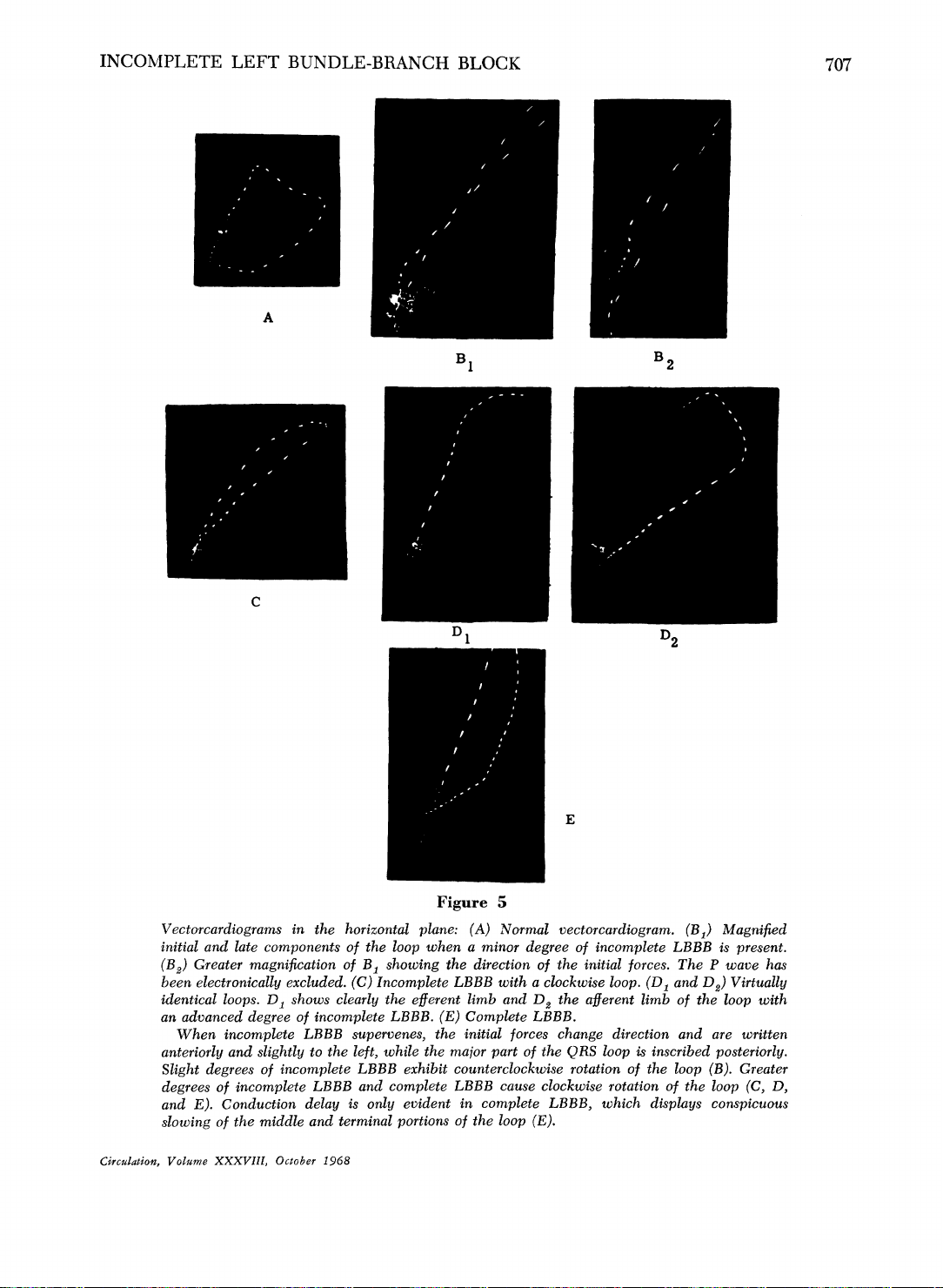
Figure
5
Vectorcardiograms
in
the
horizontal
plane:
(A)
Normal
vectorcardiogram.
(B1)
Magnified
initial
and
late
components
of
the
loop
when
a
minor
degree
of
incomplete
LBBB
is
present.
(B2)
Greater
magnification
of
B1
showing
the
direction
of
the
initial
forces.
The
P
wave
has
been
electronically
excluded.
(C)
Incomplete
LBBB
with
a
clockwise
loop.
(D1
and
D)
Virtually
identical
loops.
Di
shows
clearly
the
efferent
limb
and
D2
the
afferent
limb
of
the
loop
with
an
advanced
degree
of
incomplete
LBBB.
(E)
Complete
LBBB.
When
incomplete
LBBB
supervenes,
the
initial
forces
change
direction
and
are
written
anteriorly
and
slightly
to
the
left,
while
the
major
part
of
the
QRS
loop
is
inscribed
posteriorly.
Slight
degrees
of
incomplete
LBBB
exhibit
counterclockwise
rotation
of
the
loop
(B).
Greater
degrees
of
incomplete
LBBB
and
complete
LBBB
cause
clockwise
rotation
of
the
loop
(C,
D,
and
E).
Conduction
delay
is
only
evident
in
complete
LBBB,
which
displays
conspicuous
slowing
of
the
middle
and
terminal
portions
of
the
loop
(E).
Circulation,
Volume
XXXVIII,
October
1968
707
Downloaded from http://ahajournals.org by on May 20, 2025

BAROLD
ET
AL.
Frontal
Right
Sagittal
Normal
Conduction
Normal
Conduction
Incomplete
LBIBBInopeeLB
-
-
Incomplete
LBBB
Incomplete
LBBB
Figure
6
Vectorcardiogranis
in
the
frontal
(left)
and
Tight
sagittal
(right)
planes
during
normal
intra-
ventricular
conduction
and
incomplete
LBBB.
The
initial
forces
change
direction
from
right
to
left,
and
most
of
the
loop
is
inscribed
posteriorly
when
-incomplete
LBBB
is
present.
The
middle
vectorcardiograms
were
recorded
at
half
sensitivity.
Cifculation,
Volume
XXXVIII,
October
1968
708
Downloaded from http://ahajournals.org by on May 20, 2025

INCOMPLETE
LEFT
BUNDLE-BRANCH
BLOCK
Table
1
Distinguishing
Features
Between
Incomplete
LBBB
and
Wolff-Parkinson-White
Syndrome
(Type
B)
Pathogenesis
Physiological
effect
Right
ventricular
activation
Left
ventricular
activation
P-R
interval
Behavior
of
P-R
interval
Effect
of
heart
rate
Increase
Decrease
Slurring
of
initial
portion
of
R
wave
Vectorcardiogram
Initial
slowing
Incomplete
LBBB
Delayed
transmission
of
activation
in
the
left
bundle
branch
At
the
normal
time
Delayedl
Normal
May
become
longer
during
abnormal
conduction21,
22
May
unmask
rate-dependent
LBBB
May
allow
return
to
normal
conduc-
tion2,
10-12
Varies
in
amplitude
and
duration
accord-
ing
to
the
degree
of
incomplete
LBBBI,
2
Absent
in
intermitent
incomplete
LBBB4;
has
been
described
in
some
cases
of
the
stable
forms
of
incomplete
LBBB,14
diagnosed
according
to
the
criteria
of
Sodi-Pallares15
WPW
(Type
B)
Pre-excitation
of
the
right
ventriclel82O
Early
At
the
normal
time20
Short;
occasionally
normal'7
Becomes
longer
during
nor-
mal
conduction17
May
restore
normal
atrio-
ventricular
conduction23-25
Usually
constant
Present26
(unfortunately
this
tracing
is
not
available),
led
to
consideration
of
the
possible
diagnosis
of
a
variant
of
the
WPW
syndrome
(type
B)
with
a
normal
P-R
interval.
The
correct
diagnosis
became
evident
when
another
elec-
trocardiogram
(figs.
1
and
2)
revealed
the
entire
progression
to
LBBB.
The
slight
prolongation
of
the
P-R
interval
during
the
incomplete
and
complete
LBBB
phases
(figs.
1
and
2)
is
explicable
on
the
basis
of
abnormal
initial
ventricular
activa-
tion.
The
P-R
interval
reflects
the
time
needed
for
the cardiac
impulse
to
travel
from
the
sino-atrial
node
to
that
part
of
the
septum
which
is
activated
first.
Normally,
the
left
septal
surface
is
activated
first,
0.01
to
0.015
sec
before
the
right
septal
surface.22
When
the
left
bundle
is
cut
in
dogs,
there
is
some
delay
with
a
correspondingly
slight
prolonga-
tion
of
the
P-R
interval
in
the
propagation
of
the
impulse
from
the
sino-atrial
node
to
the
right
septal
surface,
which
becomes
activated
before
the
left.21
22
The
increased
QRS
voltage,
with
the
on-
set
of
incomplete
LBBB,
has
been
noted
Circulation,
Volume
XXXVIII,
October
1968
by
other
investigators.4
14
Sanchez
and
asso-
ciates14
suggested
that
the
increased
QRS
voltage
may
reflect
unopposed
activation
of
some
portions
of
the
left
ventricular
free
wall
or
may
be
the
consequence
of
somewhat
aberrant
activation
of
the
left
ventricular
free
wall.
This
study
indicates
that
the
configuration
of
the
QRS
complexes
of
the
various
grades
of
incomplete
LBBB
corresponds
very
closely
to
the
pattern
described
in
experimentally
produced
lesions,
thus
providing
further
clini-
cal
evidence
of
the
existence
of
this
entity.
References
1.
RODRIGUEZ,
M.
I.
AND
SODI-PALLAREs,
D.:
Mechanism
of
complete
and
incomplete
bun-
dle
branch
block.
Amer
Heart
J
44:
715,
1952.
2.
SCHAMROTH,
L.,
AND
BRADLOW,
B.
A.:
In-
complete
left
bundle
branch
block.
Brit
Heart
J
26:
285,
1964.
3.
GRANT,
R.:
Clinical
Electrocardiography.
Spa-
tial
Vector
Approach.
New
York,
McGraw-Hill
Book
Co.,
1957,
p.
126.
4.
GARDBERG,
M.,
AND
ROSEN,
I.
L.:
Electrocardio-
gram
and
vectorcardiogram
in
various
degrees
709
Downloaded from http://ahajournals.org by on May 20, 2025

BAROLD
ET
AL.
of
left
bundle
branch
block.
Amer
J
Cardiol
1:
592,
1958.
5.
FRANK,
E.:
Accurate
clinically
practical
system
for
spatial
vectorcardiography.
Circulation
13:
736,
1956.
6.
SODI-PALLARES,
D.,
ESTANDIA,
A.,
SOBERON,
J.,
AND
RODRIGUEZ,
M.
I.:
Left
intraventricular
potential
of
the
human
heart:
II.
Criteria
for
diagnosis
of
incomplete
bundle
branch
block.
Amer
Heart
J
40:
655,
1950.
7.
SODI-PALLARES,
D.:
New
Bases
of
Electrocardi-
ography.
St.
Louis,
C.
V.
Mosby
Co.,
1956.
p.
290.
8.
SODI-PALLARES,
D.:
New
Bases
of
Electrocardi-
ography.
St.
Louis,
C.
V.
Mosby
Co.,
1956.
p.
293.
9.
DANIELOPOLU,
D.,
AND
DANULESCO:
Lesions
la-
tentes
des
branches
du
faisceau
auriculo-ven-
triculaire:
Moyens
de
les
deceler.
Arch
Mal
Coeur
14:
529,
1921.
10.
VESSEL,
H.:
Critical
rates
in
ventricular
con-
duction:
Unstable
bundle
branch
block.
Amer
J
Med
Sci
202:
198,
1941.
11.
SHEARN,
M.
A.,
AND
RYTLAND,
D.
A.:
Inter-
mittent
bundle-branch
block:
Observations
with
special
reference
to
critical
rate.
Arch
Intern
Med
91:
448,
1953.
12.
BAUER,
G.
E.:
Bundle
branch
block
under
volun-
tary
control.
Brit
Heart
J
26:
167,
1964.
13.
BASCHMAKOFF,
W.
I.:
Die
Bedingungen
eines
vollstandigen
funktionellen
Herzblocks.
Pflii-
eger
Arch
Ges
Physiol
224:
167,
1930.
14.
SANCHEZ,
C.,
WALSH,
T.
J.,
AND
MASSIE,
E.:
Vectorcardiogram
in
incomplete
left
bundle
branch
block.
Amer
J
Cardiol
7:
629,
1961.
15.
SoDi-POLLARES,
D.:
New
Bases
of
Electrocardi-
ography.
St.
Louis,
C.
V.
Mosby
Co.,
1956,
p.
289.
16.
WOLFF,
L.,
PARKINSON,
J.,
AND
WHITE,
P.
D.:
Bundle
branch
block
with
short
PR
interval
in
healthy
young
people
prone
to
paroxysmal
tachycardia.
Amer
Heart
J
5:
685,
1930.
17.
SCHERF,
D.,
AND
COHEN,
J.:
Atrioventricular
Node
and
Selected
Cardiac
Arrhythmias.
New
York,
Grune
and
Stratton,
1964,
p.
385.
18.
ROSENBAUM,
F.
F.,
HEcHr,
H.
H.,
WILSON,
F.
N.,
AND
JOHNSTON,
F.
D.:
Potential
varia-
tions
of
thorax
and
esophagus
in
anomalous
atrio-ventricular
excitation
(Wolff-Parkinson-
White
syndrome).
Amer
Heart
J
29:
281,
1945.
19.
HECHT,
H.
H.,
et
al.:
Anomalous
atrioventricular
excitation,
Panel
discussion.
Ann
N
Y
Acad
Sci
65:
826,
1956.
20.
BANDIERA,
G.,
AND
ANTOGRETTI,
P.
F.:
Ven-
tricular
precontracting
area
in
Wolff-Parkin-
son-White
Syndrome:
Demonstration
in
man.
Circulation
17:
225,
1958.
21.
BULRCHELL,
H.
B.,
ESSEX,
H.
E.,
AND
PRUITT,
R.
D.:
Studies
on
spread
of
excitation
through
ventricular
myocardium:
II.
Ventricular
sep-
tum.
Circulation
6:
161,
1952.
22.
SODI-PALLARES,
D.,
RODIGUEZ,
M.
I.,
CHMT,
L.
O.,
AND
ZUCKERMANN,
R.:
Activation
of
interventricular
septum.
Amer
Heart
J
41:
569,
1951.
23.
SANDBERG,
L.:
Effect
of
exercise
on
electro-
cardiogram
of
pre-excitation.
Acta
Med
Scand
Suppl
365,
1961.
24.
BELLET,
S.:
Clinical
disorders
of
the
heart
beat.
Philadelphia,
Lea
and
Febiger,
1963,
p.
460.
25.
FRIEDBERG,
C.
K.:
Diseases
of
the
Heart.
Phil-
adelphia,
W.
B.
Saunders
Co.
1966,
p
630.
26.
CHUNG,
J.
Y.,
WALSH,
T.
J.,
AND
MASSIE,
E.:
Wolff-Parkinson-White
syndrome.
Amer
Heart
J
69:
116,
1965.
Circulation,
Volume
XXXVIII,
October
1968
710
Downloaded from http://ahajournals.org by on May 20, 2025
Bấm Tải xuống để xem toàn bộ.
Preview text:
Downloaded from http://ahajournals.org by on May 20, 2025