IoT Research Challenges and Future Applications | Iot và ứng dụng | Học viện Công nghệ Bưu chính Viễn thông
Abstract—With the Internet of Things (IoT) gradually evolving as the subsequent phase of the evolution of the Internet, it becomes crucial to recognize the various potential domains for application of IoT, and the research challenges that are associated with these applications. Ranging from smart cities, to health care, smart agriculture, logistics and retail, to even smart living and smart environments IoT is expected to infiltrate into virtually all aspects of daily life. Tài liệu được sưu tầm và soạn thảo dưới dạng file PDF để gửi tới các bạn cùng tham khảo, ôn tập đầy đủ kiến thức, chuẩn bị cho các buổi học thật tốt. Mời bạn đọc đón xem!
Môn: IoT và ứng dụng 143 tài liệu
Trường: Học viện Công Nghệ Bưu Chính Viễn Thông 1.8 K tài liệu
Tác giả:

Preview text:
(IJACSA) International Journal of Advanced Computer Science and Applications, Vol. 10, No. 6, 2019
Internet of Things (IOT): Research Challenges and Future Applications AbdelRahman H. Hussein
Department of Networks and Information Security
Faculty of Information Technology / Al-Ahliyya Amman University
Abstract—With the Internet of Things (IoT) gradually
functions, these devices can accomplish smart reorganizations,
evolving as the subsequent phase of the evolution of the Internet,
tracing, positioning, control, real-time monitoring and process
it becomes crucial to recognize the various potential domains for
control. In the past years, there has been an important
application of IoT, and the research challenges that are associated
propagation of Internet capable devices. Even though its most
with these applications. Ranging from smart cities, to health care,
significant commercial effect has been observed in the
smart agriculture, logistics and retail, to even smart living and
consumer electronics field; i.e. particularly the revolution of
smart environments IoT is expected to infiltrate into virtually all
smartphones and the interest in wearable devices (watches,
aspects of daily life. Even though the current IoT enabling
technologies have greatly improved in the recent years, there are
headsets, etc.), connecting people has become merely a
still numerous problems that require attention. Since the IoT
fragment of a bigger movement towards the association of the
concept ensues from heterogeneous technologies, many research digital and physical worlds.
challenges are bound to arise. The fact that IoT is so expansive
With all this in mind, the Internet of Things (IoT) is
and affects practically all areas of our lives, makes it a significant
expected to continue expanding its reach as pertains the
research topic for studies in various related fields such as
number of devices and functions, which it can run. This is
information technology and computer science. Thus, IoT is
paving the way for new dimensions of research to be carried out.
evident from the ambiguity in the expression of “Things”
which makes it difficult to outline the ever-growing limits of
This paper presents the recent development of IoT technologies
and discusses future applications and research challenges.
the IoT [4]. While commercial success continues to
materialize, the IoT constantly offers a virtually limitless Keywords
supply of opportunities, not just in businesses but also in
—Internet of Things; IoT applications; IoT
challenges; future technologies; smart cities; smart environment;
research. Accordingly, the understudy addresses the various
smart agriculture; smart living
potential areas for application of IoT domains and the research
chal enges that are associated with these applications. I. INTRODUCTION
The Internet can be described as the communication
network that connects individuals to information while The
Internet of Things (IoT) is an interconnected system of
distinctively address able physical items with various degrees
of processing, sensing, and actuation capabilities that share the
capability to interoperate and communicate through the
Internet as their joint platform [1]. Thus, the main objective of
the Internet of Things is to make it possible for objects to be
connected with other objects, individuals, at any time or
anywhere using any network, path or service. The Internet of
Things (IoT) is gradually being regarded as the subsequent
phase in the Internet evolution. IoT will make it possible for
ordinary devices to be linked to the internet in order to achieve
countless disparate goals. Currently, an estimated number of
only 0.6% of devices that can be part of IoT has been
connected so far [2]. However, by the year 2020, it is likely
that over 50 billion devices will have an internet connection.
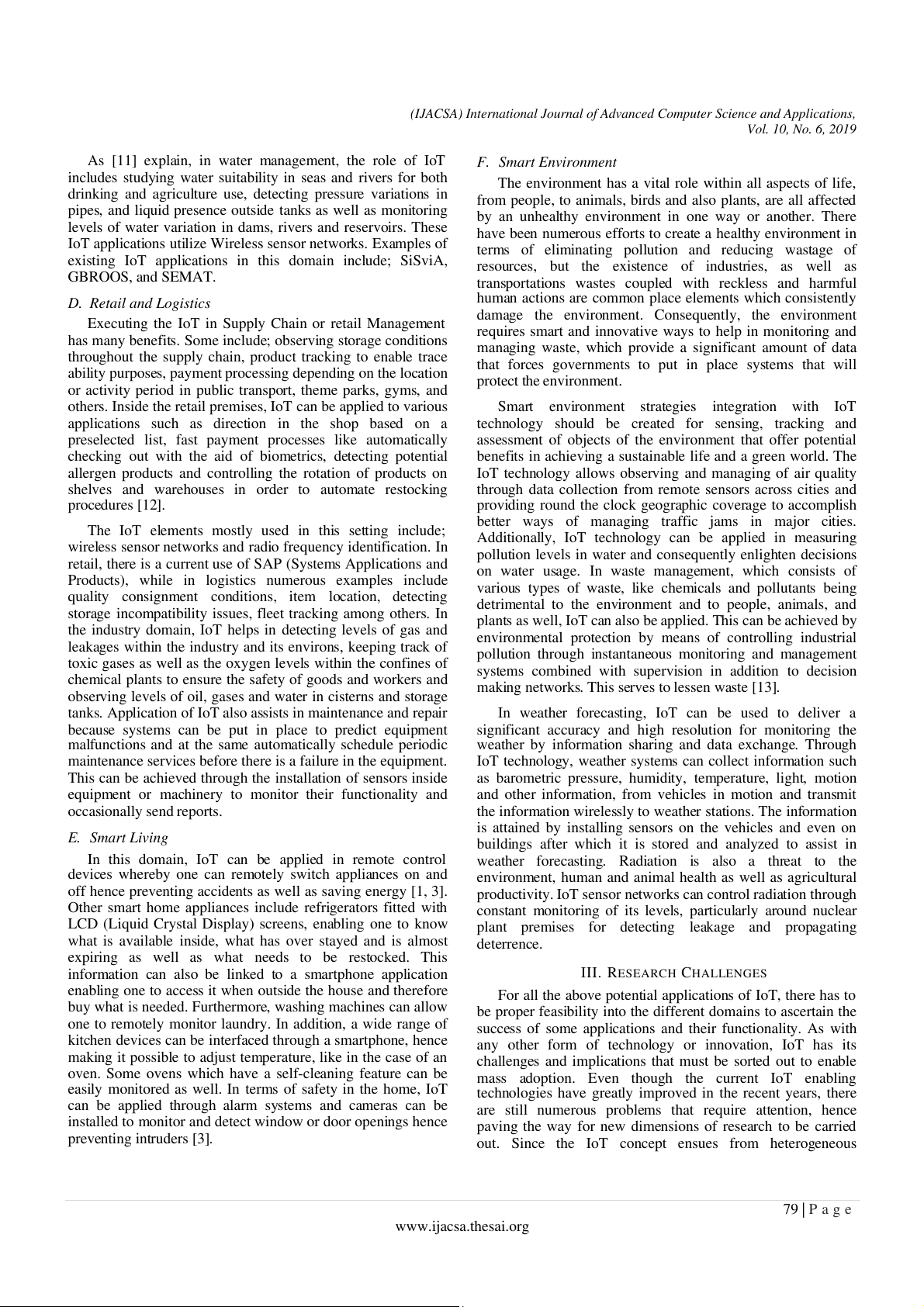
Fig. 1. IoT can be viewed as a Network of Networks [3].
As the internet continues to evolve, it has become more
II. POTENTIAL APPLICATION DOMAINS OF IOT
than a simple network of computers, but rather a network of
Potential applications of the internet of Things are not only
various devices, while IoT serves as a network of various
numerous but also quite diverse as they permeate into virtually
“connected” devices a network of networks [3], as shown in
all aspects of daily life of individuals, institutions, and society.
Fig. 1. Nowadays, devices like smartphones, vehicles,
According to [5], the applications of IoT cover broad areas
industrial systems, cameras, toys, buildings, home appliances,
including manufacturing or the industrial sector, health sector,
industrial systems and countless others can all share
agriculture, smart cities, security and emergencies among many
information over the Internet. Regardless of their sizes and others. 77 | P a g e www.ijacsa.thesai.org
(IJACSA) International Journal of Advanced Computer Science and Applications, Vol. 10, No. 6, 2019 A. Smart Cities
can be applied to outpatient and inpatient patients, dental
According to [6], the IoT plays a crucial role in improving
Bluetooth devices and toothbrushes that can give information
the smartness of cities and enhancing general infrastructure.
after they are used and patient’s surveillance. Other elements of
Some of IoT application areas in creating smart cities include;
IoT in this capacity include; RFID, Bluetooth, and Wi-Fi
intelligent transportation systems [7], smart building, traffic
among others. These wil greatly enhance measurement and
congestion [7, 8] waste management [9], smart lighting, smart
monitoring techniques of critical functions like blood pressure,
parking, and urban maps. This may include different
temperature, heart rate, blood glucose, cholesterol levels, and
functionalities such as; monitoring available parking spaces many others.
within the city, monitoring vibrations as wel as material
The applications of Internet of Things (IoT) and Internet of
conditions of bridges and buildings, putting in place sound
Everything (IoE) are further being extended through the
monitoring devices in sensitive parts of cities, as well as
materialization of the Internet of Nano-things (IoNT) [3]. The
monitoring the levels of pedestrians and vehicles. Artificial
notion of IoNT, as the name implies, is being engineered by
Intel igence (AI) enabled IoT can be utilized to monitor,
integrating Nano-sensors in diverse objects (things) using Nano
control and reduce traffic congestions in Smart Cities [6].
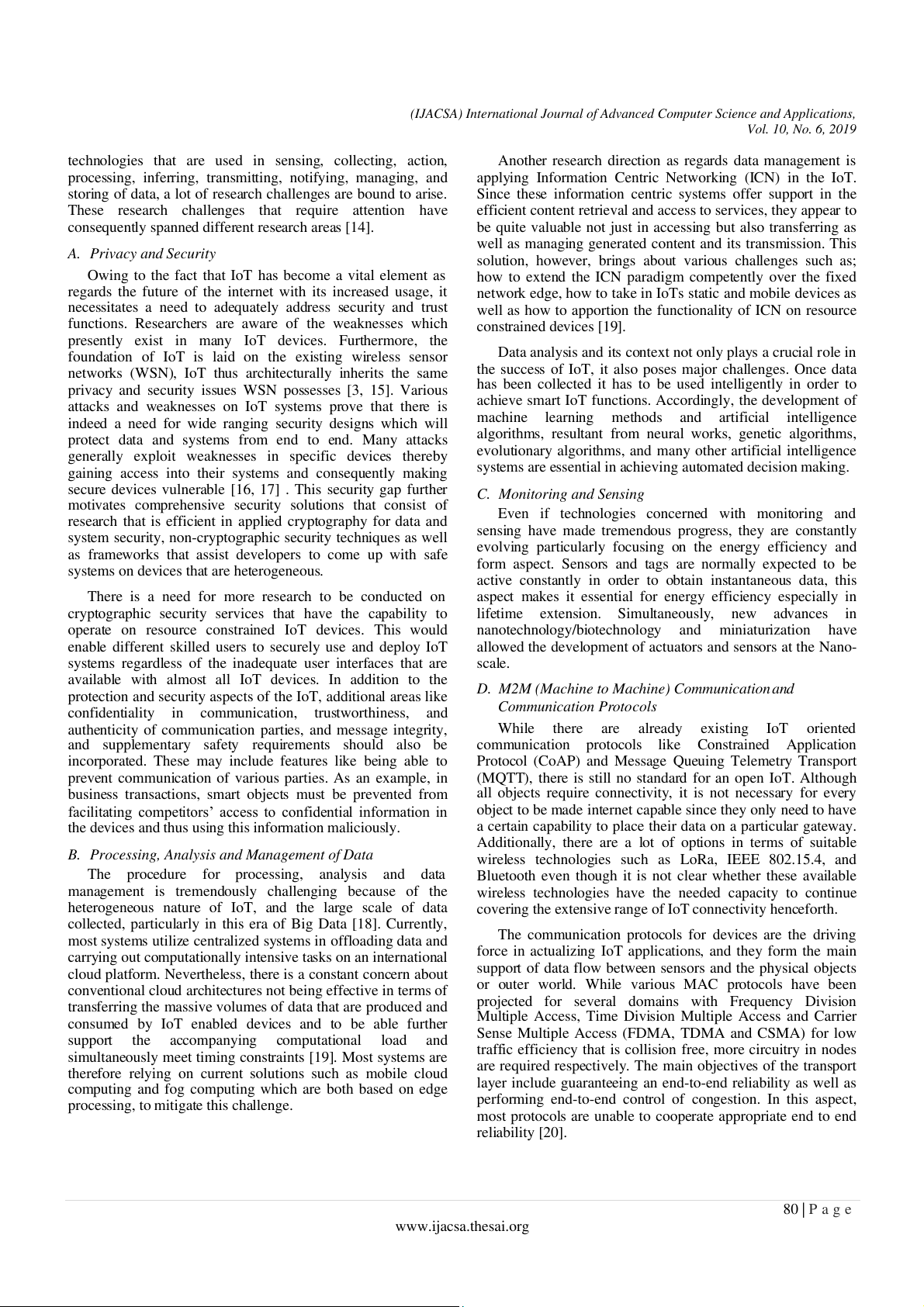
networks. Medical application, as shown in Fig. 2, is one of the
Moreover, IoT allows installation of intelligent and weather
major focuses of IoNT implementations. Application of IoNT
adaptive street lighting and detection waste and waste
in human body, for treatment purposes, facilitates access to
containers by keeping tabs of trash collection schedules.
data from in situ parts of the body which were hitherto in
Intel igent highways can provide warning messages and
accessible to sense from or by using those medical instruments
important information, such as access to diversions depending
incorporated with bulky sensor size. Thus, IoNT will enable
on the climatic conditions or unexpected occurrences like
new medical data to be collected, leading to new discoveries traffic jams and accidents. and better diagnostics.
Application of IoT to achieve smart cities would require
C. Smart Agriculture and Water Management
using radio frequency identification and sensors. Some of the
already developed applications in this area are the Aware home
According to [11], the IoT has the capacity to strengthen
and the Smart Santander functionalities. In the United States,
and enhance the agriculture sector through examining soil
some major cities like Boston have plans on how to implement
moisture and in the case of vineyards, monitoring the trunk
the Internet of Things in most of their systems ranging from
diameter. IoT would allow to control and preserve the quantity
their parking meters, streetlights, sprinkler systems, and
of vitamins found in agricultural products, and regulate
sewage grates are all scheduled to be interlinked and connected
microclimate conditions in order to make the most of the
to the internet. Such applications will offer significant break
production of vegetables and fruits and their quality.
throughs in terms of saving money and energy.
Furthermore, studying weather conditions allows forecasting of
ice information, drought, wind changes, rain or snow, thus B. Healthcare
controlling temperature and humidity levels to prevent fungus
Most healthcare systems in many countries are inefficient,
as well as other microbial contaminants.
slow and inevitably prone to error. This can easily be changed
When it comes to cattle, IoT can assist in identifying
since the healthcare sector relies on numerous activities and
animals that graze in open locations, detecting detrimental
devices that can be automated and enhanced through
gases from animal excrements in farms, as well as controlling
technology. Additional technology that can facilitate various
growth conditions in offspring to enhance chances of health
operations like report sharing to multiple individuals and
and survival and so on. Moreover, through IoT application in
locations, record keeping and dispensing medications would go
agriculture, a lot of wastage and spoilage can be avoided
a long way in changing the healthcare sector [10].
through proper monitoring techniques and management of the
A lot of benefits that IoT application offers in the health-
entire agriculture field. It also leads to better electricity and
care sector is most categorized into tracking of patients, staff, water control.
and objects, identifying, as wel as authenticating, individuals,
and the automatic gathering of data and sensing. Hospital
workflow can be significantly improved once patients flow is
tracked. Additionally, authentication and identification reduce
incidents that may be harmful to patients, record maintenance
and fewer cases of mismatching infants. In addition, automatic
data collection and transmission is vital in process automation,
reduction of form processing timelines, automated procedure
auditing as well as medical inventory management. Sensor
devices allow functions centered on patients, particularly, in
diagnosing conditions and availing real-time information about
patients’ health indicators [6].
Application domains in this sector include; being able to
monitor a patient’s compliance with prescriptions, telemedicine
solutions, and alerts for patients’ well-being. Thereby, sensors
Fig. 2. The Internet of Nano-Things [3]. 78 | P a g e www.ijacsa.thesai.org
(IJACSA) International Journal of Advanced Computer Science and Applications, Vol. 10, No. 6, 2019
As [11] explain, in water management, the role of IoT F. Smart Environment
includes studying water suitability in seas and rivers for both
The environment has a vital role within all aspects of life,
drinking and agriculture use, detecting pressure variations in
from people, to animals, birds and also plants, are all affected
pipes, and liquid presence outside tanks as well as monitoring
by an unhealthy environment in one way or another. There
levels of water variation in dams, rivers and reservoirs. These
have been numerous efforts to create a healthy environment in
IoT applications utilize Wireless sensor networks. Examples of
terms of eliminating pollution and reducing wastage of
existing IoT applications in this domain include; SiSviA,
resources, but the existence of industries, as well as GBROOS, and SEMAT.
transportations wastes coupled with reckless and harmful
D. Retail and Logistics
human actions are common place elements which consistently
Executing the IoT in Supply Chain or retail Management
damage the environment. Consequently, the environment
has many benefits. Some include; observing storage conditions
requires smart and innovative ways to help in monitoring and
throughout the supply chain, product tracking to enable trace
managing waste, which provide a significant amount of data
ability purposes, payment processing depending on the location
that forces governments to put in place systems that will
or activity period in public transport, theme parks, gyms, and protect the environment.
others. Inside the retail premises, IoT can be applied to various
Smart environment strategies integration with IoT
applications such as direction in the shop based on a
technology should be created for sensing, tracking and
preselected list, fast payment processes like automatically
assessment of objects of the environment that offer potential
checking out with the aid of biometrics, detecting potential
benefits in achieving a sustainable life and a green world. The
allergen products and controlling the rotation of products on
IoT technology allows observing and managing of air quality
shelves and warehouses in order to automate restocking
through data collection from remote sensors across cities and procedures [12].
providing round the clock geographic coverage to accomplish
The IoT elements mostly used in this set ing include;
better ways of managing traffic jams in major cities.
wireless sensor networks and radio frequency identification. In
Additional y, IoT technology can be applied in measuring
retail, there is a current use of SAP (Systems Applications and
pollution levels in water and consequently enlighten decisions
Products), while in logistics numerous examples include
on water usage. In waste management, which consists of
quality consignment conditions, item location, detecting
various types of waste, like chemicals and pollutants being
storage incompatibility issues, fleet tracking among others. In
detrimental to the environment and to people, animals, and
the industry domain, IoT helps in detecting levels of gas and
plants as well, IoT can also be applied. This can be achieved by
leakages within the industry and its environs, keeping track of
environmental protection by means of control ing industrial
toxic gases as well as the oxygen levels within the confines of
pollution through instantaneous monitoring and management
chemical plants to ensure the safety of goods and workers and
systems combined with supervision in addition to decision
observing levels of oil, gases and water in cisterns and storage
making networks. This serves to lessen waste [13].
tanks. Application of IoT also assists in maintenance and repair
In weather forecasting, IoT can be used to deliver a
because systems can be put in place to predict equipment
significant accuracy and high resolution for monitoring the
malfunctions and at the same automatically schedule periodic
weather by information sharing and data exchange. Through
maintenance services before there is a failure in the equipment.
IoT technology, weather systems can collect information such
This can be achieved through the installation of sensors inside
as barometric pressure, humidity, temperature, light, motion
equipment or machinery to monitor their functionality and
and other information, from vehicles in motion and transmit occasionally send reports.
the information wirelessly to weather stations. The information
is attained by installing sensors on the vehicles and even on E. Smart Living
buildings after which it is stored and analyzed to assist in
In this domain, IoT can be applied in remote control
weather forecasting. Radiation is also a threat to the
devices whereby one can remotely switch appliances on and
environment, human and animal health as well as agricultural
off hence preventing accidents as well as saving energy [1, 3].
productivity. IoT sensor networks can control radiation through
Other smart home appliances include refrigerators fitted with
constant monitoring of its levels, particularly around nuclear
LCD (Liquid Crystal Display) screens, enabling one to know
plant premises for detecting leakage and propagating
what is available inside, what has over stayed and is almost deterrence.
expiring as well as what needs to be restocked. This
information can also be linked to a smartphone application III. RESEARCH CHALLENGES
enabling one to access it when outside the house and therefore
For all the above potential applications of IoT, there has to
buy what is needed. Furthermore, washing machines can allow
be proper feasibility into the different domains to ascertain the
one to remotely monitor laundry. In addition, a wide range of
success of some applications and their functionality. As with
kitchen devices can be interfaced through a smartphone, hence
any other form of technology or innovation, IoT has its
making it possible to adjust temperature, like in the case of an
chal enges and implications that must be sorted out to enable
oven. Some ovens which have a self-cleaning feature can be
mass adoption. Even though the current IoT enabling
easily monitored as well. In terms of safety in the home, IoT
technologies have greatly improved in the recent years, there
can be applied through alarm systems and cameras can be
are still numerous problems that require attention, hence
installed to monitor and detect window or door openings hence
paving the way for new dimensions of research to be carried preventing intruders [3].
out. Since the IoT concept ensues from heterogeneous 79 | P a g e www.ijacsa.thesai.org
(IJACSA) International Journal of Advanced Computer Science and Applications, Vol. 10, No. 6, 2019
technologies that are used in sensing, collecting, action,
Another research direction as regards data management is
processing, inferring, transmit ing, notifying, managing, and
applying Information Centric Networking (ICN) in the IoT.
storing of data, a lot of research challenges are bound to arise.
Since these information centric systems offer support in the
These research challenges that require attention have
efficient content retrieval and access to services, they appear to
consequently spanned different research areas [14].
be quite valuable not just in accessing but also transferring as
well as managing generated content and its transmission. This
A. Privacy and Security
solution, however, brings about various chal enges such as;
Owing to the fact that IoT has become a vital element as
how to extend the ICN paradigm competently over the fixed
regards the future of the internet with its increased usage, it
network edge, how to take in IoTs static and mobile devices as
necessitates a need to adequately address security and trust
well as how to apportion the functionality of ICN on resource
functions. Researchers are aware of the weaknesses which constrained devices [19].
presently exist in many IoT devices. Furthermore, the
foundation of IoT is laid on the existing wireless sensor
Data analysis and its context not only plays a crucial role in
networks (WSN), IoT thus architecturally inherits the same
the success of IoT, it also poses major chal enges. Once data
privacy and security issues WSN possesses [3, 15]. Various
has been collected it has to be used intelligently in order to
attacks and weaknesses on IoT systems prove that there is
achieve smart IoT functions. Accordingly, the development of
indeed a need for wide ranging security designs which will
machine learning methods and artificial intelligence
protect data and systems from end to end. Many attacks
algorithms, resultant from neural works, genetic algorithms,
generally exploit weaknesses in specific devices thereby
evolutionary algorithms, and many other artificial intelligence
gaining access into their systems and consequently making
systems are essential in achieving automated decision making.
secure devices vulnerable [16, 17] . This security gap further
C. Monitoring and Sensing
motivates comprehensive security solutions that consist of
research that is efficient in applied cryptography for data and
Even if technologies concerned with monitoring and
system security, non-cryptographic security techniques as well
sensing have made tremendous progress, they are constantly
as frameworks that assist developers to come up with safe
evolving particularly focusing on the energy efficiency and
systems on devices that are heterogeneous.
form aspect. Sensors and tags are normally expected to be
active constantly in order to obtain instantaneous data, this
There is a need for more research to be conducted on
aspect makes it essential for energy efficiency especially in
cryptographic security services that have the capability to
lifetime extension. Simultaneously, new advances in
operate on resource constrained IoT devices. This would
nanotechnology/biotechnology and miniaturization have
enable different skil ed users to securely use and deploy IoT
allowed the development of actuators and sensors at the Nano-
systems regardless of the inadequate user interfaces that are scale.
available with almost all IoT devices. In addition to the
protection and security aspects of the IoT, additional areas like
D. M2M (Machine to Machine) Communication and
confidentiality in communication, trustworthiness, and
Communication Protocols
authenticity of communication parties, and message integrity,
While there are already existing IoT oriented
and supplementary safety requirements should also be
communication protocols like Constrained Application
incorporated. These may include features like being able to
Protocol (CoAP) and Message Queuing Telemetry Transport
prevent communication of various parties. As an example, in
(MQTT), there is stil no standard for an open IoT. Although
business transactions, smart objects must be prevented from
all objects require connectivity, it is not necessary for every
facilitating competitors’ access to confidential information in
object to be made internet capable since they only need to have
the devices and thus using this information maliciously.
a certain capability to place their data on a particular gateway.
Additional y, there are a lot of options in terms of suitable
B. Processing, Analysis and Management of Data
wireless technologies such as LoRa, IEEE 802.15.4, and
The procedure for processing, analysis and data
Bluetooth even though it is not clear whether these available
management is tremendously challenging because of the
wireless technologies have the needed capacity to continue
heterogeneous nature of IoT, and the large scale of data
covering the extensive range of IoT connectivity henceforth.
collected, particularly in this era of Big Data [18]. Currently,
most systems utilize centralized systems in offloading data and
The communication protocols for devices are the driving
carrying out computationally intensive tasks on an international
force in actualizing IoT applications, and they form the main
cloud platform. Nevertheless, there is a constant concern about
support of data flow between sensors and the physical objects
conventional cloud architectures not being effective in terms of
or outer world. While various MAC protocols have been
transferring the massive volumes of data that are produced and
projected for several domains with Frequency Division
consumed by IoT enabled devices and to be able further
Multiple Access, Time Division Multiple Access and Carrier
support the accompanying computational load and
Sense Multiple Access (FDMA, TDMA and CSMA) for low
simultaneously meet timing constraints [19]. Most systems are
traffic efficiency that is collision free, more circuitry in nodes
therefore relying on current solutions such as mobile cloud
are required respectively. The main objectives of the transport
computing and fog computing which are both based on edge
layer include guaranteeing an end-to-end reliability as well as
processing, to mitigate this challenge.
performing end-to-end control of congestion. In this aspect,
most protocols are unable to cooperate appropriate end to end reliability [20]. 80 | P a g e www.ijacsa.thesai.org
(IJACSA) International Journal of Advanced Computer Science and Applications, Vol. 10, No. 6, 2019
E. Blockchain of Things (BCoT): Fusion of Blockchain and
Countless research groups have been, and continue to be, Internet of Things
initiated from different parts of the world, and their main
Similar to IoT, blockchain technologies have also gained
objective is to follow through IoT related researches. As more
tremendous popularity since its introduction in 2018. Even
and more research studies are conducted, new dimensions to
though blockchain was first implemented as an underlying
the IoT processes, technologies involved and the objects that
technology of Bitcoin cryptocurrency, it is now being used in
can be connected, continue to emerge, further paving way for
multifaceted nonmonetary applications [21]. Miraz argues that
much more application functionalities of IoT. The fact that IoT
both IoT and Blockchain can strengthen each other, in a
is so expansive and affects practically all areas of our lives,
reciprocal manner, by eliminating their respective inherent
makes it a significant research topic for studies in various
architectural limitations [22]. The underlying technology of
related fields such as information technology and computer
IoT is WSN. Therefore, analogous to WSN, IoT also suffers
science. The paper highlights various potential application
from security and privacy issues. On the contrary, the primary
domains of the internet of things and the related research chal enges.
reasons for blockchain’s implementation trend in non-
monetary applications is due to its inbuilt security, REFERENCES
immutability, trust and transparency. These attributes are
[1] M. H. Miraz, M. Ali, P. S. Excell, and R. Picking, “A Review on
powered by blockchain’s consensus approach and utilization of
Internet of Things (IoT), Internet of Everything (IoE) and Internet of
Distributed Ledger Technologies (DLTs) which require
Nano Things (IoNT)”, in 2015 Internet Technologies and Applications
extensive dependency on participating nodes. Therefore, the
(ITA), pp. 219– 224, Sep. 2015, DOI: 10.1109/ITechA.2015.7317398.
fusion of these two technologies Blockchain and Internet of
[2] P. J. Ryan and R. B. Watson, “Research Challenges for the Internet of
Things (IoT) conceives a new notion i.e. the Blockchain of
Things: What Role Can OR Play?,” Systems, vol. 5, no. 1, pp. 1–34, 2017.
Things (BCoT) where blockchain strengthens IoT by providing
[3] M. Miraz, M. Ali, P. Excell, and R. Picking, “Internet of Nano-Things,
extra layer of security while the “things” of IoT can serve as
Things and Everything: Future Growth Trends”, Future Internet, vol. 10,
participating nodes for blockchain ecosystems [22]. Thus,
no. 8, p. 68, 2018, DOI: 10.3390/fi10080068.
blockchain enabled IoT ecosystems will provide enhanced
[4] E. Borgia, D. G. Gomes, B. Lagesse, R. Lea, and D. Puccinelli, “Special
overal security [23] as well as benefit from each other.
issue on" Internet of Things: Research challenges and Solutions".,”
Computer Communications, vol. 89, no. 90, pp. 1–4, 2016. F. Interoperability
[5] K. K. Patel, S. M. Patel, et al., “Internet of things IOT: definition,
Traditionally as regards the internet, interoperability has
characteristics, architecture, enabling technologies, application future
always been and continues to be a basic fundamental value
challenges,” International journal of engineering science and computing, vol. 6, no. 5, pp. 6122
because the initial prerequisite in Internet connectivity –6131, 2016.
[6] S. V. Zanjal and G. R. Talmale, “Medicine reminder and monitoring
necessitates that “connected” systems have the ability to
system for secure health using IOT,” Procedia Computer Science, vol.
“speak a similar language” in terms of encodings and 78, pp. 471–476, 2016.
protocols. Currently, various industries use a variety of
[7] R. Jain, “A Congestion Control System Based on VANET for Small
standards in supporting their applications. Due to the large
Length Roads”, Annals of Emerging Technologies in Computing
quantities and types of data, as well as heterogeneous devices, (AETiC), vol. 2, no. 1, pp. 17–21, 2018, DOI:
using standard interfaces in such diverse entities is very 10.33166/AETiC.2018.01.003.
important and even more significant for applications which
[8] S. Soomro, M. H. Miraz, A. Prasanth, M. Abdullah, “Artificial
support cross organizational, in addition to a wide range of
Intelligence Enabled IoT: Traffic Congestion Reduction in Smart C
system limitations. Therefore, the IoT systems are meant
ities,” IET 2018 Smart Cities Symposium, pp. 81–86, 2018, DOI: 10.1049/cp.2018.1381.
towards being designed to handle even higher degrees of
[9] Mahmud, S. H., Assan, L. and Islam, R. 2018. “Potentials of Internet of interoperability [24].
Things (IoT) in Malaysian Construction Industry”, Annals of Emerging
Technologies in Computing (AETiC), Print ISSN: 2516-0281, Online IV. CONCLUSION
ISSN: 2516-029X, pp. 44-52, Vol. 2, No. 1, International Association of Educators and Researchers (IAER), DOI:
The IoT can best be described as a CAS (Complex 10.33166/AETiC.2018.04.004.
Adaptive System) that will continue to evolve hence requiring
[10] Mano, Y., Faical B. S., Nakamura L., Gomes, P. G. Libralon, R.
new and innovative forms of software engineering, systems
Meneguete, G. Filho, G. Giancristofaro, G. Pessin, B. Krishnamachari,
engineering, project management, as well as numerous other
and Jo Ueyama. 2015. Exploiting IoT technologies for enhancing Health
disciplines to develop it further and manage it the coming
Smart Homes through patient identification and emotion recognition.
years. The application areas of IoT are quite diverse to enable it Computer Communications, 89.90, (178-190). DOI: 10.1016/j.comcom.2016.03.010.
to serve different users, who in turn have different needs. The [11]
technology serves three categories of users, individuals, the
V. Sundareswaran and M. S. null, “Survey on Smart Agriculture Using
IoT,” International Journal of Innovative Research in Engineering &
society or communities and institutions. As discussed in the
Management (IJIREM), vol. 5, no. 2, pp. 62–66, 2018.
application section of this research paper, the IoT has without a
[12] P. Tadejko, “Application of Internet of Things in logistics-current chal-
doubt a massive capability to be a tremendously transformative
lenges,” Ekonomia i Zarz{a˛}dzanie, vol. 7, no. 4, pp. 54–64, 2015.
force, which will, and to some extent does already, positively
[13] S. Rajguru, S. Kinhekar, and S. Pati, “Analysis of internet of things in a
impact millions of lives worldwide. According to [25], this has
smart environment,” International Journal of Enhanced Research in
become even more evident, as different governments around
Man-agement and Computer Applications,vol. 4, no. 4, pp. 40–43, 2015.
the world have shown an interest in the IoT concept by
[14] H. U. Rehman, M. Asif, and M. Ahmad, “Future applications and
providing more funding in the field that is meant to facilitate
research challenges of IOT,” in 2017 International Conference on
Informa-tion and Communication Technologies (ICICT), pp. 68–74,
further research. A good example is the Chinese Government. Dec 2017. 81 | P a g e www.ijacsa.thesai.org
(IJACSA) International Journal of Advanced Computer Science and Applications, Vol. 10, No. 6, 2019
[15] Z. Alansari, N. B. Anuar, A. Kamsin, M. R. Belgaum, J. Alshaer, S.
[21] M. H. Miraz and M. Ali, “Applications of Blockchain Technology
Soomro, and M. H. Miraz, “Internet of Things: Infrastructure,
beyond Cryptocurrency”, Annals of Emerging Technologies in
Architecture, Security and Privacy”, in 2018 International Conference
Computing (AETiC), vol. 2, no. 1, pp. 1–6, 2018, DOI:
on Com- puting, Electronics Communications Engineering (iCCECE), 10.33166/AETiC.2018.01.001.
pp. 150– 155, Aug 2018, DOI: 10.1109/iCCECOME.2018.8658516.
[22] Miraz, M.H., “Blockchain of Things (BCoT): The Fusion of Blockchain
[16] J. A. Chaudhry, K. Saleem, P. S. Haskell-Dowland, and M. H. Miraz,
and IoT Technologies”, Advanced Applications of Blockchain
“A Survey of Distributed Certificate Authorities in MANETs,” Annals
Technology, Studies in Big Data 60, 2019, DOI: 10.1007/978-981-13-
of Emerging Technologies in Computing (AETiC), vol. 2, no. 3, pp. 11–
8775-3_7, https://doi.org/10.1007/978-981-13-8775-3_7.
18, 2018, DOI: 10.33166/AETiC.2018.03.002.
[23] Miraz, M. H. and Ali, M., 2018. Blockchain Enabled Enhanced IoT
[17] A. S. A. Daia, R. A. Ramadan, and M. B. Fayek, “Sensor Networks
Ecosystem Security, Proceedings of the International Conference on
Attacks Classifications and Mitigation”, Annals of Emerging
Emerging Technologies in Computing 2018, London Metropolitan
Technologies in Computing (AETiC), vol. 2, no. 4, pp. 28–43, 2018,
University, UK, Part of the Lecture Notes of the Institute for Computer
DOI: 10.33166/AETiC.2018.04.003.
Sciences, Social Informatics and Telecommunications Engineering
[18] Z. Alansari, N. B. Anuar, A. Kamsin, S. Soomro, M. R. Belgaum, M. H.
(LNICST), vol. 200, pp. 38-46, Online ISBN: 978-3-319-95450-9, Print
ISBN: 978-3-319-95449-3, Series Print ISSN: 1867-8211, Series Online
Miraz, and J. Alshaer, “Challenges of Internet of Things and Big Data Integration
ISSN: 1867-822X, DOI: 10.1007/978-3-319-95450-9_3, Springer-
”, in Emerging Technologies in Computing (M. H. Miraz, P.
Ex- cell, A. Ware, S. Soomro, and M. Ali, eds.), (Cham), pp. 47
Verlag, https://link.springer.com/chapter/10.1007/978-3-319-95450-9_3. –55,
Springer International Publishing, 2018, DOI: 10.1007/978-3-319-
[24] A. Mazayev, J. A. Martins, and N. Correia, “Interoperability in IoT 95450-9_4.
Through the Semantic Profiling of Objects,” IEEE Access, vol. 6, [19] J. Cooper and A. pp. 19379–19385, 2018.
James, “Challenges for database management in the
internet of things”IETE Technical Review,vol.26,no.5,pp.320–329,2009.
[25] R. Porkodi and V. Bhuvaneswari, “The Internet of Things (IoT) [20] D. B. Ansari, A.-
Applications and Communication Enabling Technology Standards: An
U. Rehman, and R. Ali, “Internet of Things (IoT)
Proto- cols: A Brief Exploration of MQTT and CoAP,” International
Overview,” in 2014 International Conference on Intelligent Computing
Journal of Computer Applications, vol. 179, pp. 9
Applications, pp. 324–329, March 2014. –14, 03 2018. 82 | P a g e www.ijacsa.thesai.org
Tài liệu liên quan:
-
Tóm tắt lý thuyết môn IoT và ứng dụng | Học viện Công Nghệ Bưu Chính Viễn Thông
23 12 -

Accelerated Corner-Detector Algorithms: GPU Implementations and Results | Iot và ứng dụng | Học viện Công nghệ Bưu chính Viễn thông
46 23 -
Đề xuất Dự án IoT: Thiết bị phát hiện chạm cho xe máy | Iot và ứng dụng | Học viện Công nghệ Bưu chính Viễn thông
35 18 -
Phân Tích và Giải Pháp FastAPI | Iot và ứng dụng | Học viện Công nghệ Bưu chính Viễn thông
30 15 -
Tăng cường pháp chế xã hội chủ nghĩa trong quản lý nhà nước | Iot và ứng dụng | Học viện Công nghệ Bưu chính Viễn thông
25 13