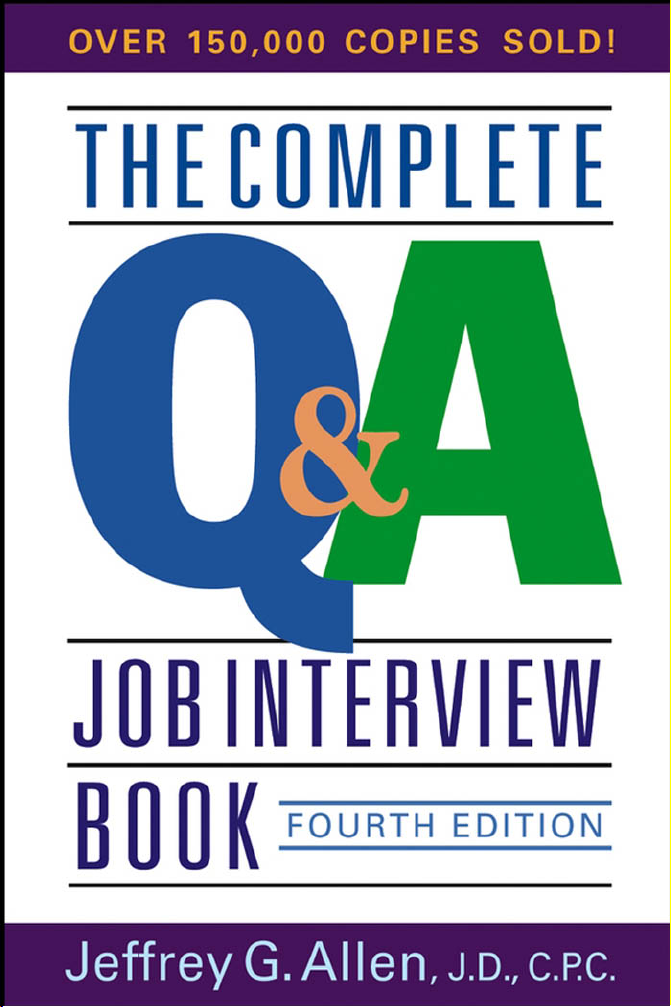
Jeffrey G Allen - The Complete QA Job Interview Book-Wiley (2004)
Jeffrey G Allen - The Complete QA Job Interview Book-Wiley (2004). Tài liệu được sưu tầm giúp bạn tham khảo, ôn tập và đạt kết quả cao. Mời bạn đọc đón xem.
Môn: Tài liệu Tổng hợp 3.6 K tài liệu
Trường: Tài liệu khác 3.9 K tài liệu
Tác giả:




















Preview text:
TeAM Digitally signed by TeAM YYePG DN: cn=TeAM YYePG, c=US, o=TeAM YYePG, ou=TeAM YYePG, email=yyepg@msn.com
YYePG Reason: I attest to the accuracy and integrity of this document
Date: 2005.02.06 15:12:39 +08'00'
ffirs.qxd 1/21/04 10:22 AM Page iii The Complete Q&A Job Interview Book Fourth Edition Jeffrey G. Allen
John Wiley & Sons, Inc.
ffirs.qxd 1/21/04 10:22 AM Page i The Complete Q&A Job Interview Book Fourth Edition
ffirs.qxd 1/21/04 10:22 AM Page ii
Other books by Jeffrey G. Allen, J.D., C.P.C.
HOW TO TURN AN INTERVIEW INTO A JOB
(also available on audiocassette) THE RESUME MAKEOVER
ffirs.qxd 1/21/04 10:22 AM Page iii The Complete Q&A Job Interview Book Fourth Edition Jeffrey G. Allen
John Wiley & Sons, Inc.
ffirs.qxd 1/21/04 10:22 AM Page iv
Copyright © 2000, 2004 by Jeffrey G. Allen. All rights reserved.
Published by John Wiley & Sons, Inc., Hoboken, New Jersey.
Published simultaneously in Canada.
No part of this publication may be reproduced, stored in a retrieval system, or
transmitted in any form or by any means, electronic, mechanical, photocopying,
recording, scanning, or otherwise, except as permitted under Section 107 or 108 of the
1976 United States Copyright Act, without either the prior written permission of the
Publisher, or authorization through payment of the appropriate per-copy fee to the
Copyright Clearance Center, Inc., 222 Rosewood Drive, Danvers, MA 01923, (978)
750-8400, fax (978) 750-4470, or on the Web at www.copyright.com. Requests to the
Publisher for permission should be addressed to the Permissions Department, John
Wiley & Sons, Inc., 111 River Street, Hoboken, NJ 07030, (201) 748-6011, fax (201)
748-6008, e-mail: permcoordinator@wiley.com.
Limit of Liability/Disclaimer of Warranty: While the publisher and author have used
their best efforts in preparing this book, they make no representations or warranties
with respect to the accuracy or completeness of the contents of this book and
specifically disclaim any implied warranties of merchantability or fitness for a
particular purpose. No warranty may be created or extended by sales representatives
or written sales materials. The advice and strategies contained herein may not be
suitable for your situation. The publisher is not engaged in rendering professional
services, and you should consult with a professional where appropriate. Neither the
publisher nor author shall be liable for any loss of profit or other commercial
damages, including but not limited to special, incidental, consequential, or other damages.
For general information on our other products and services please contact our
Customer Care Department within the United States at (800) 762-2974, outside the
United States at (317) 572-3993 or fax (317) 572-4002.
Wiley also publishes its books in a variety of electronic formats. Some content that
appears in print may not be available in electronic books. For more information about
Wiley products, visit our web site at www.Wiley.com.
Library of Congress Cataloging-in-Publication Data:
Allen, Jeffrey G., 1943–
The complete Q & A job interview book / Jeffrey G. Allen.—4th ed. p. cm. Includes index. ISBN 0-471-65125-7 (pbk.)
1. Employment interviewing. I. Title: Complete Q and A job interview book.
II. Title: Complete question and answer job interview book. III. Title. HF5549.5.I6 A43 2004 650.14'4—dc22 2003063489
Printed in the United States of America. 10 9 8 7 6 5 4 3 2 1
ffirs.qxd 1/21/04 10:22 AM Page v To my wife Bev; to our daughter Angela;
to our son (in-law) Rudy;
to our grandchildren Jonathan and Gabby;
and to Janice Borzendowski
for her capable assistance in the research
and preparation of the script manuscript.
ffirs.qxd 1/21/04 10:22 AM Page vi
ftoc.qxd 1/21/04 10:22 AM Page vii Contents Introduction 1 Chapter 1 Personal and Family Data 15 Chapter 2 Educational Background 31 Chapter 3 Character Traits 45 Chapter 4 Initiative and Creativity 79 Chapter 5 Management Ability 89 Chapter 6 Career Objectives 103 Chapter 7 Suitability for Target Job 113 Chapter 8 Salary Negotiations 139 Chapter 9 Experience and Training 151
Chapter 10 Technology Know-How 199
Chapter 11 Interrogation Questions 211
Chapter 12 Outside Interests 227
Chapter 13 Questions to Ask the Interviewer 237 Index 243 About the Author 248 vii
ftoc.qxd 1/21/04 10:22 AM Page viii
ccc_allen_intro_1-14.qxd 1/14/04 3:33 PM Page 1 Introduction
ccc_allen_intro_1-14.qxd 1/14/04 3:33 PM Page 2 INTRODUCTION
A job interview is a screen test, an act. Getting hired depends
almost completely on the actor factor. If you know your lines,
perfect your delivery, and dress for the part, you’ll get hired. If
you don’t, you won’t. No retakes. No bit parts.
For almost a decade, I was behind a personnel director’s
desk, interviewing applicants of every age, stage, and wage,
every day (and night—in my sleep). I’ve probably read every
book on how to interview. I’ve taken courses on it. I’ve even
trained supervisors on how to do it.
I rapped nonstop about interviewing techniques: directive
or nondirective, specific or general, closed-ended or open-
ended, structured or unstructured, restricted or unrestricted,
window, choice, hypothetical, theoretical, interpretive, lead-
ing, loaded, stress, interrogation, machine-gun, multiple, double, curiosity, and so on.
Interviewing is a welcome break for supervisors and
keeps a lot of personnellers off the unemployment line. But
studying interviewing techniques is a total waste of time for
a serious job seeker. At best, studying them will get you tired
long before you’re hired. At worst, it will intimidate you. In-
terviewing hasn’t changed since Laurel hired Hardy. It’s just
as comical as it has always been.
Now you can memorize the script in advance. There are
only so many questions that can be asked and only so many
ways to ask them. Oh, there might be minor variations—like
the accent of the interviewer, his or her tone of voice, or a
pause here and there. Experienced jobgetters appreciate them.
Otherwise, they’d undoubtedly start snoring before the offers were extended.
Because interviews are so predictable, they’re control-
lable. Only the places and faces change—not the words. And 2
ccc_allen_intro_1-14.qxd 1/14/04 3:33 PM Page 3 INTRODUCTION
you can have them all embedded in your subconscious, ready
for instant replay at the drop of an interesting job lead.
I know—you think background, qualifications, or experi-
ence have something to do with getting hired. You’re right—not
about the job, though. About interviewing! The director only
knows what you show. That’s why the actor factor is so critical.
Twenty-five years ago, I developed the only measure that
counts: the interview-to-offer ratio. If you ask enough people,
you’ll find the ratio averages twelve to one: It takes twelve in-
terviews for the average person to get one job offer. That
means for every person who intuitively knows how to get
hired every time (or uses our techniques), some walking
wounded is limping into his or her twenty-fourth interview.
For every two people who know, there’s someone being car-
ried into his or her forty-eighth, showing battle scars and
telling war stories. Destroyed, not employed.
After a while, these folks live with a self-fulfilling
prophecy: rejection. They might as well just call the inter-
viewer and say, “I’m canceling the interview. Your time is too
valuable to waste with me.” They’re destined to flub their
lines from the time the first board claps.
Tragic. Even more tragic when that interview-to-offer ra-
tio will tumble down for anyone who’ll just follow the pro-
grammed interview system automatically. It’s nothing more
than preparing that amazing computer between your ears to
signal your mouth and limbs to move in the right way at the right time.
Unlike your conscious mind, which understands, judges,
and controls (thinks), your subconscious mind stores infor-
mation. If you give it the right input (images and cues), the
output (words and actions) will be right, too. 3
ccc_allen_intro_1-14.qxd 1/14/04 3:33 PM Page 4 INTRODUCTION
The input about interviewing that is now stored back
there in your subconscious is probably based on a few random
encounters when you were looking for a job. You were ner-
vous, unprepared, and probably don’t even consciously re-
member how you reflexively responded. In fact, applicants
forget 90 percent of the dialogue within hours after leaving an
interviewer’s office! Some are lucky if they even remember
their own names when they leave.
This is no way to learn how to respond to something so
predictable as an interview. There’s no positive reinforce-
ment—no disciplined practice, either. How unfortunate when
your livelihood and personhood are on the line.
At first most people are afraid they’ll be like a bionic
with a broken brain and will just talk or move out of context.
Not a chance. The subconscious just stores. Words and ac-
tions will happen naturally when the time is right. You’ll
adapt the delivery to your own vocabulary and mannerisms
like any accomplished actor. That’s why interviewers will
never know you’re using the system. They won’t care, either.
They want that job requisition off their desks and out of
their lives for as long as possible. They’ll even coach you if you know your lines.
Oh, maybe you have some moral problems with using the
actor factor to your advantage and not being yourself. If so, I
suggest you ask a past interviewer for the rating forms he or
she used on you. It won’t get you hired, but it will open your
eyes wide to the games interviewers play and to how biased,
unfair, and incorrect their snap judgments really are. Now
you can work this to your advantage.
People who interview well are better employees, too.
That’s because they’ve learned how to interact on the job—to 4
ccc_allen_intro_1-14.qxd 1/14/04 3:33 PM Page 5 INTRODUCTION
sell themselves and their ideas to others. They aren’t en-
slaved because they know they can always find another job.
They’re working because they want to. They’re the ones who
succeed in their careers: Positive interaction gets people
hired, promoted, and recruited for better opportunities. They
develop a loyal fan club, which follows them to the top.
All you’re doing is taking the most random selection
process imaginable and controlling it. That’s right, you’re in
control! No, I don’t recommend that you try to switch seats
with the interviewer. You’ll never have that much control.
It’s his or her office and decision (almost). After all, he or she can always yell, “Cut!”
So don’t fight it. Just do it. Let it work for you. Then you
won’t want to fight it, anyway. You’ll feel great about your-
self when you know you can knock any interview cold. You
should. You have lifetime unemployment insurance and a su- percharged career.
Here’s how to use the programmed interview technique to fast-forward your future:
1. Read the questions and answers to yourself once.
2. Customize the questions where necessary to apply to
your background and target job.
3. Customize the answers where necessary to your vocabu-
lary, background, and target job. (Just don’t change them
radically; each answer is carefully designed and tested to
score the most points. The further you deviate from it, the more you risk.)
4. Prepare a cassette for yourself containing the most difficult
questions for you to answer, leaving spaces on the tape to 5
ccc_allen_intro_1-14.qxd 1/14/04 3:33 PM Page 6 INTRODUCTION
read your answers aloud. (You can stop the tape occasion-
ally to rehearse a particular response, but it is important to
simulate an interview where the dialogue continues.)
5. Then, play the cassette at least three times a week for the
next two weeks, sitting in front of a full-length mirror.
Try to simulate an interview as closely as possible by us-
ing a table for a desk and adding other props. Don’t stop
the tape. Pay attention to your facial expressions, hand
movements, and body language. Smile. Look the inter-
viewer (you) in the eye. Try not to speak with your hands. Lean forward to make a point.
6. Use your driving, riding, or walking time to listen to the
cassette and answer the questions. (You can just think the
answers, but talking aloud to your imaginary friend will
rivet your attention. Engaging your mouth when your
brain is in gear is good practice.) PREPARATION
If you want to come out of a job interview with an offer on
the table, then for you the interview should begin as far in ad-
vance of the date and time of your appointment as possible.
For starters you’ll want to find out as much as you can prior
to the big day about the company and the position you’re ap-
plying for. And you’ll need to find out what’s considered ap-
propriate dress and deportment at the company. These issues
are not as clear-cut as they once were. Traditionally, stan-
dards had been set, which no one questioned. Both men and
women were expected to dress conservatively (suits and ties 6
ccc_allen_intro_1-14.qxd 1/14/04 3:33 PM Page 7 INTRODUCTION
for men and business suits or dresses for women). As to per-
sonal conduct, the standard advice was to be reserved and re-
spectful and let the interviewer control the interview.
Today abiding by these standards certainly will stand you
in good stead in many situations and professions; when you’re
in doubt, they can and should be considered your fallback po-
sition. But since the early 1980s, there is no single response to
how to dress and behave in a job interview. In particular since
the Internet has come into widespread use, with the concomi-
tant explosion of e-commerce, job applicants may find them-
selves face to face with break-all-the-rules entrepreneurs as
well as traditional business people—sometimes in the same
day—who want and expect different things from job candi-
dates. More than ever applicants must prepare themselves by
researching the firms and people with positions to fill. Let’s
begin by discussing the importance of learning all you can
about the company you’ll be interviewing with. It’s What You Know
Unless you know someone at the company where you’ll be in-
terviewing, someone who can and is willing to share with you
insider information, you have to reverse the adage “It’s not
what you know, it’s who you know.” To be confident going into
an interview (which is a primary ingredient in making a good
impression), you need to find out as much as you can about the
company—and ideally the person or people—you’ll be inter-
viewing with. Fortunately, this has never been easier. Thanks
to the Internet, and more specifically the World Wide Web, you
can find out valuable information about most companies 7
ccc_allen_intro_1-14.qxd 1/14/04 3:33 PM Page 8 INTRODUCTION
worldwide. No longer do you have to make difficult, some-
times embarrassing phone calls to receptionists or assistants
and try to eke out any piece of information that might give you
a leg up on the interview. No longer do you have to go to the li-
brary and track down articles in periodicals or newspapers in
search of recent news on a company or person. Just log on to the
Internet, and the business world is at your fingertips—literally.
Note If you don’t have Internet access from your home,
most libraries and schools now provide free service to the public. It’s How You Look
Since the 1980s, dress in the workplace has become almost
universally more casual (with a few exceptions, such as the
legal and investment brokerage professions); even doctors
wear jeans or chinos under their lab coats (which aren’t even
always white anymore). What started as casual Fridays have
become casual all days in many organizations. Perhaps
prompted by the rapid and widespread emergence of high-
tech companies, many of whose founding entrepreneurs con-
sidered themselves to be rebels against the tight-laced,
suit-and-tie corporate world, the old rules of suits for men
and dresses for women have, by and large, fallen by the way-
side. Today most companies, large and small, have loosened
their dress codes. To the job candidate, this raises difficult
questions about how to dress for an interview. Do you dress
the old-fashioned way, meant to show respect and to impress, 8
ccc_allen_intro_1-14.qxd 1/14/04 3:33 PM Page 9 INTRODUCTION
or do you show your willingness to fit in by dressing as others
in the company do? The answer is: It depends.
The following are some guideline questions to ask—and
get answered—in advance of your scheduled interview.
How do the employees in your target
company dress? Does there seem to be a standard, a dress code?
If you don’t know the answer to this, you might just
want to conduct some on-site casual research (assuming
you are not traveling out of town to the interview). Hang
out during rush hour or lunch hour at the company head-
quarters, for example, to see how people are dressed. A
more direct and surefire approach is to call the human re-
sources department at the company and ask someone
there what the dress code is. Do not be embarrassed to
ask this question. It is the job of human resources person-
nel to act as the go-betweens for the employer and em-
ployee candidates. They want to ensure they’re not
wasting the time of the interviewers by setting them up
with inappropriate candidates, and they’ll respect your desire to dress correctly.
And don’t forget the Web; most companies now have
web sites, and a good number of those sites include job op-
portunities sections or pages, where you might be able to
get the information you need. In particular, if you’re inter-
viewing with a large corporation, you’ll probably discover
its web site goes into some detail about its recruitment
procedures. Companies don’t want to waste their time or 9
ccc_allen_intro_1-14.qxd 1/14/04 3:33 PM Page 10 INTRODUCTION
yours, so they make this information readily available.
Take advantage of all the sources available to you.
What if the company is so small it has no
human resources department or no web site?
Today, it’s highly unlikely that a company won’t have
one of these sources of information available, but if this is
the case, chances are you’ll have a preliminary screening
interview, often by phone, either with the person you’ll be
meeting with at a later date or with his or her assistant.
During that conversation, you may be able to ask about the
company’s dress code. If you feel it’s inappropriate or un-
comfortable to do so, err on the side of caution: Dress con-
servatively, in traditional business attire—suits for men
and business suits or dresses for women.
What if I’m told it’s okay to wear jeans?
Unless you’re absolutely sure this is acceptable,
don’t do it. It’s still safer to dress “up”; in general no in-
terviewer is going to penalize you for being too neatly or
conservatively dressed. I say “in general” because today
this, too, can be tricky. Some companies today, whose
owners and executives prize creativeness and the entre-
preneurial spirit, may be put off by someone who appears
too traditional. Others are returning from casual to tradi-
tional. Again, preparedness is key: Know the industry,
know the company. Probably a safe level of dress for this 10
Tài liệu liên quan:
-

Ung dung game hoa trong cac chien dich MKT
28 14 -

Bao cao Chi so TMDT Viet Nam 2025
30 15 -
Thông tư quy định về việc phân quyền, phân cấp và phân định thẩm quyền quản lý nhà nước về giáo dục cho chính quyền địa phương
32 16 -
Nghị quyết về phát huy các giá trị di sản văn hóa gắn với phát triên du lịch bền vững tỉnh Khánh Hòa đến năm 2025, định hướng đến năm 2030
34 17 -
Quyết định phê duyệt Chiến lược phát triển du lịch Việt Nam đến năm 2030
21 11