Kinh nghiệm thành lập công ty và quỹ tài sản công thương mại | Quản lý tài chính công | Trường Đại Học Lâm Nghiệp
Dag Detter is the co-founder and partner of Whetstone Solutions, advising investors in Europe and Asia, specialized in identifying underperforming high potential assets and advising in the acquisition/disposal process for private and public institutions. Dag has served as Non-Executive Director on a range of boards of private and public companies. As President of Stattum, the Swedish government holding company, and a Director at the Ministry of Industry. Tài liệu được sưu tầm và soạn thảo dưới dạng file PDF để gửi tới các bạn cùng tham khảo, ôn tập đầy đủ kiến thức, chuẩn bị cho các buổi học thật tốt. Mời bạn đọc đón xem!
Môn: Quản lý tài chính công 77 tài liệu
Trường: Trường Đại học Lâm nghiệp 286 tài liệu
Tác giả:





Preview text:
Click Here to Add FP Graphic THE PUBLIC WEALTH OF NATIONS
Unlocking the value of global public assets
Citi GPS: Global Perspectives & Solutions June 2015 Dag Detter Stefan Folster Willem Buiter
Citi is one of the world’s largest financial institutions, operating in all major established and emerging markets. Across these world markets, our employees
conduct an ongoing multi-disciplinary global conversation – accessing information, analyzing data, developing insights, and formulating advice for our clients.
As our premier thought-leadership product, Citi GPS is designed to help our clients navigate the global economy’s most demanding challenges, identify future
themes and trends, and help our clients profit in a fast-changing and interconnected world. Citi GPS accesses the best elements of our global conversation
and harvests the thought leadership of a wide range of senior professionals across our firm. This is not a research report and does not constitute advice on
investments or a solicitation to buy or sell any financial instrument. For more information on Citi GPS, please visit www.citi.com/citigps.
Citi GPS: Global Perspectives & Solutions June 2015
Dag Detter is the co-founder and partner of Whetstone Solutions, advising investors in Europe and Asia,
specialized in identifying underperforming high potential assets and advising in the acquisition/disposal
process for private and public institutions. Dag has served as Non-Executive Director on a range of boards of
private and public companies. As President of Stattum, the Swedish government holding company, and a
Director at the Ministry of Industry, he led the first deep-rooted transformation of state commercial assets. He
has worked extensively as an investment banker and advisor within the corporate, real estate and financial sector in China and Europe.
Stefan Fölster is Director of the Reform Institute and associate Professor of economics at the Royal Institute
of Technology, in Stockholm. He has previously been Chief Economist at the Swedish Confederation of
Enterprise, and is an author of numerous books and academic articles in industrial organization and public
economics. He also on the board of several companies.
Willem Buiter joined Citi in January 2010 as Chief Economist. One of the world’s most distinguished
macroeconomists, Willem previously was Professor of Political Economy at the London School of Economics
and is a widely published author on economic affairs in books, professional journals and the press. Between
2005 and 2010, he was an advisor to Goldman Sachs advising clients on a global basis. Prior to this, Willem
was Chief Economist for the European Bank for Reconstruction & Development between 2000 and 2005,
and from 1997 and 2000 a founder external member of the Monetary Policy Committee of the Bank of
England. He has been a consultant to the IMF, the World Bank, the Inter-American Development Bank and
the Asian Development Bank, the European Commission and an advisor to many central banks and finance
ministries. Willem has held a number of other leading academic positions, including Cassel Professor of
Money & Banking at the LSE between 1982 and 1984, Professorships in Economics at Yale University in the
US between 1985 and 1994, and Professor of International Macroeconomics at Cambridge University in the
UK between 1994 and 2000. Willem has a BA degree in Economics from Cambridge University and a PhD
degree in Economics from Yale University. He has been a member of the British Academy since 1998 and
was awarded the CBE in 2000 for services to economics.
+1-212-816-2363 | willem.buiter@citi.com Contributors Michael Bilerman Roger Elliott Andrew Howell Edward L Morse Anthony Pettinari Harvinder Sian June 2015
Citi GPS: Global Perspectives & Solutions 3 THE PUBLIC WEALTH OF NATIONS
Unlocking the value of global public assets
In his foreword to the book The Public Wealth of Nations, Adrian Wooldridge,
Management Editor of The Economist, suggests that Dag Detter and Stefan Fölster
have proposed a new idea in the public policy arena which not only identifies a
problem that few people had realized existed, but suggests a relatively pain-free
way to tackle it while at the same time boosting the size of the global economy.
The idea rests on the observation that governments around the world have an
estimated $75 trillion of dollars of public assets, ranging from corporations to
forests, which are often badly managed and frequently not even accounted for on
their balance sheets. Over recent decades, policy makers have focused almost
solely on managing debt while largely ignoring the question of public wealth. Given
that in most countries public wealth is larger than public debt, just managing it better
could help to solve the debt problem while also providing the material for future
economic growth. A higher return of just 1% on global public assets would add
some $750 billion to public revenues. Poor management not only throws money
down the drain, but also forecloses opportunities. As an example, the fracking
revolution, which is making the US self-sufficient in oil, has taken place almost entirely on private land.
In this Citi GPS report and as a preview to their upcoming book, Dag Detter and
Stefan Fölster present their thesis that the governance of public wealth is one of the
crucial institutional building blocks that divides well-run countries from failed states.
They argue that the polarized debate between privatizers and nationalizers has
missed the point — what really matters is the quality of asset management, and the
focus when it comes to public wealth should be on yield rather than ownership.
They calculate that improvements in public wealth management could yield returns
greater than the world’s combined investment in infrastructure such as transport,
power, water and communications. They also note that improvements in public
wealth management could help to win the war against corruption as assets are
moved at an arm’s length from politicians. They thus address at a single stroke two
of the great problems of our age: the shortage of infrastructure investment thanks to
the overhang of the public debt and the halt in the advance of democracy thanks to
the prevalence of poor government.
Improving the quality of asset management starts with transparency. Back in 1983,
Chief Economist Willem Buiter argued that governments needed to have a clearer
picture of their total balance sheet and should construct a “comprehensive balance
sheet” including all assets and liabilities of the state, including commercial and non-
commercial assets as well as central bank assets. He notes that even partial
success — and the recognition of what information is still missing and preventing
the completion of the comprehensive balance sheet — can inform policy debate and
improve the accountability of the state and its agents.
Finally, the authors argue that the best way to foster good management and
democracy is to consolidate public assets under a single institution — a national
wealth fund — which is removed from direct government influence. This structure
maximizes economic value consistent with the principles of corporate governance. It
can also be a vehicle for improving access or the cost of borr w o ing on the
international capital markets for financing infrastructure projects or other commercial ventures or assets. © 2015 Citigroup
Citi GPS: Global Perspectives & Solutions June 2015 Save for 2-page spread © 2015 Citigroup June 2015
Citi GPS: Global Perspectives & Solutions 5 Save for 2-page spread © 2015 Citigroup
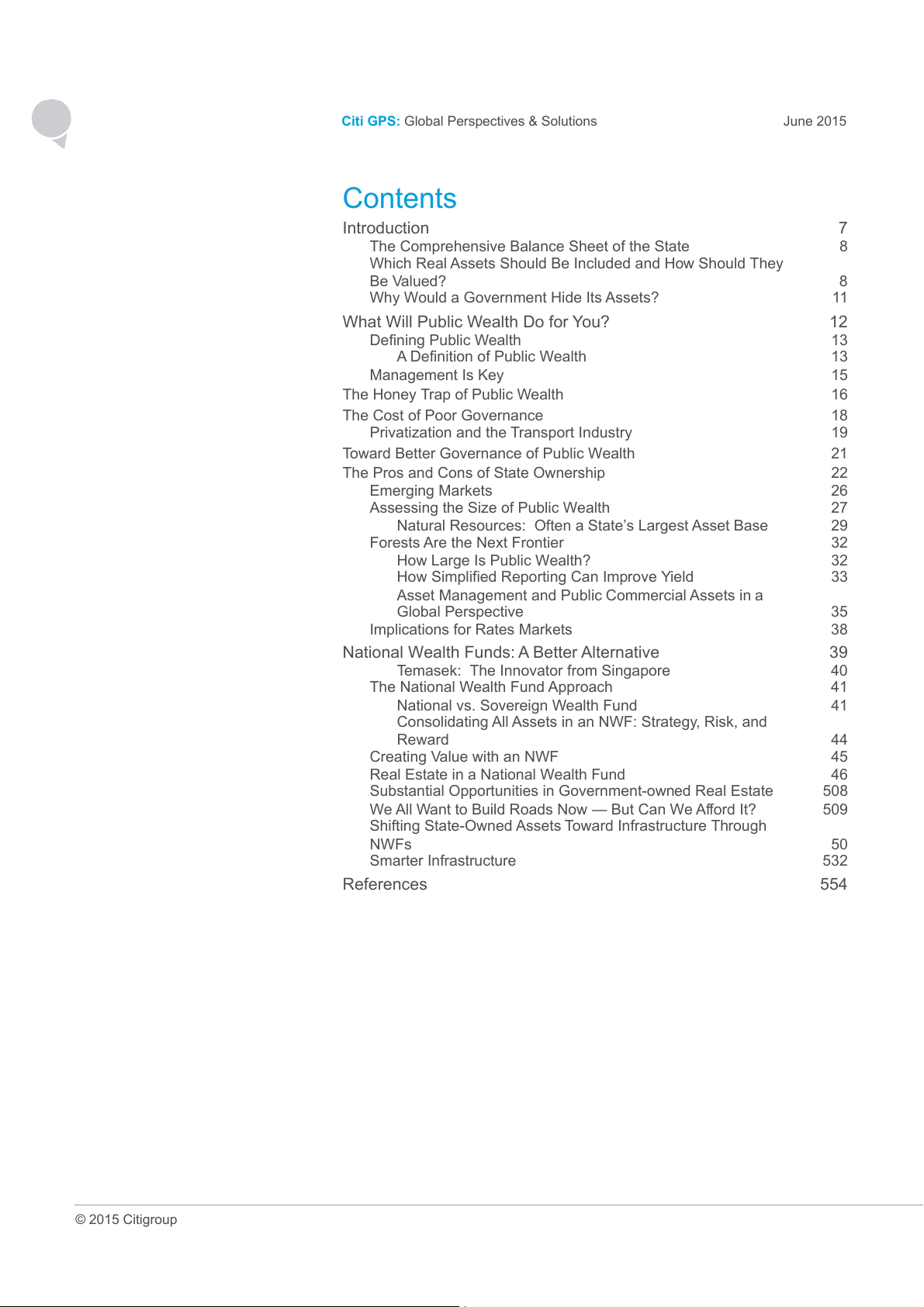
Citi GPS: Global Perspectives & Solutions June 2015 Contents Introduction 7
The Comprehensive Balance Sheet of the State 8
Which Real Assets Should Be Included and How Should They Be Valued? 8
Why Would a Government Hide Its Assets? 11
What Will Public Wealth Do for You? 12 Defining Public Wealth 13 A Definition of Public Wealth 13 Management Is Key 15
The Honey Trap of Public Wealth 16 The Cost of Poor Governance 18
Privatization and the Transport Industry 19
Toward Better Governance of Public Wealth 21
The Pros and Cons of State Ownership 22 Emerging Markets 26
Assessing the Size of Public Wealth 27
Natural Resources: Often a State’s Largest Asset Base 29 Forests Are the Next Frontier 32 How Large Is Public Wealth? 32
How Simplified Reporting Can Improve Yield 33
Asset Management and Public Commercial Assets in a Global Perspective 35
Implications for Rates Markets 38
National Wealth Funds: A Better Alternative 39
Temasek: The Innovator from Singapore 40
The National Wealth Fund Approach 41
National vs. Sovereign Wealth Fund 41
Consolidating All Assets in an NWF: Strategy, Risk, and Reward 44 Creating Value with an NWF 45
Real Estate in a National Wealth Fund 46
Substantial Opportunities in Government-owned Real Estate 508
We All Want to Build Roads Now — But Can We Afford It? 509
Shifting State-Owned Assets Toward Infrastructure Through NWFs 50 Smarter Infrastructure 532 References 554 © 2015 Citigroup June 2015
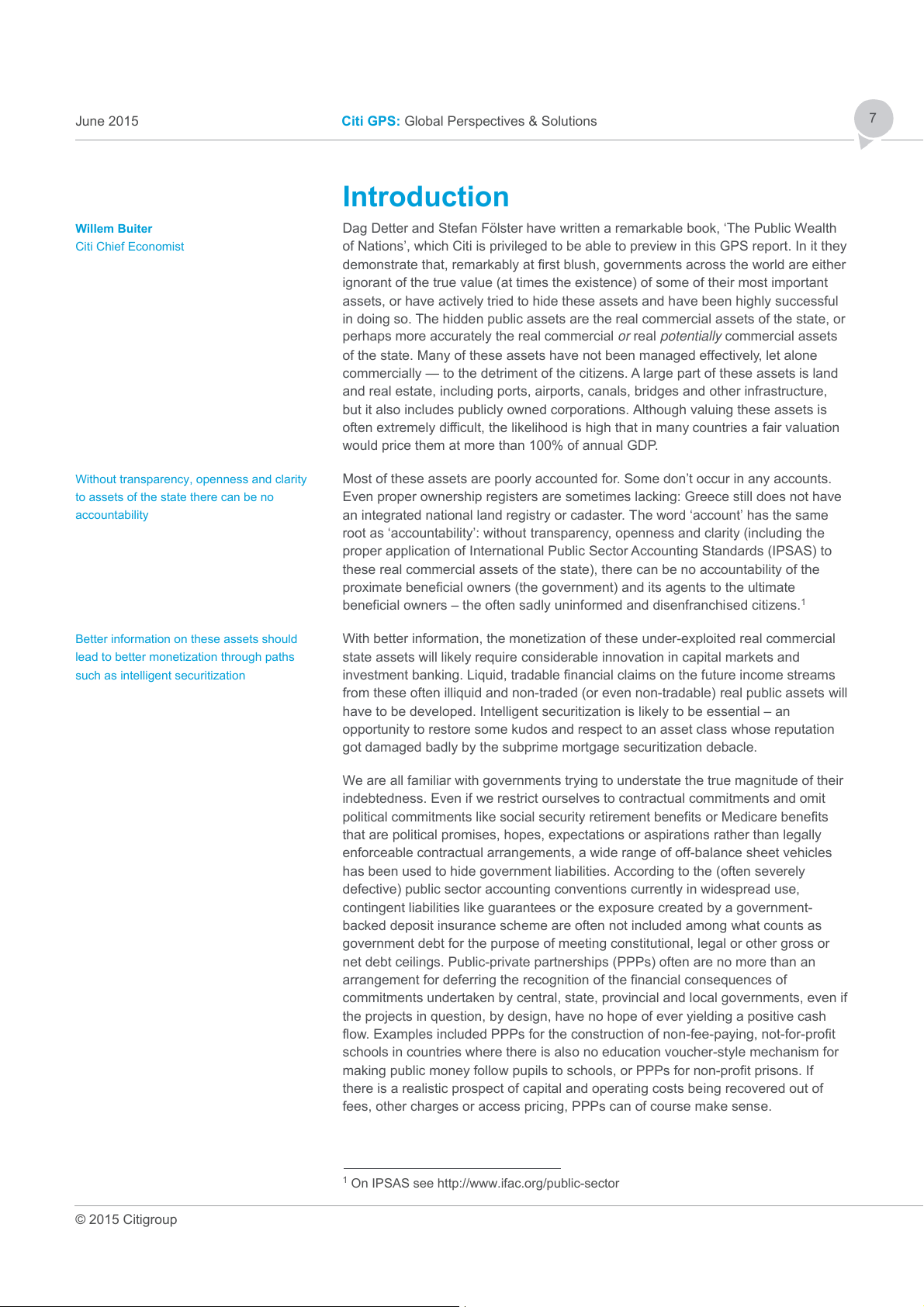
Citi GPS: Global Perspectives & Solutions 7 Introduction Willem Buiter
Dag Detter and Stefan Fölster have written a remarkable book, ‘The Public Wealth Citi Chief Economist
of Nations’, which Citi is privileged to be able to preview in this GPS report. In it they
demonstrate that, remarkably at first blush, governments across the world are either
ignorant of the true value (at times the existence) of some of their most important
assets, or have actively tried to hide these assets and have been highly successful
in doing so. The hidden public assets are the real commercial assets of the state, or
perhaps more accurately the real commercial or real potential y commercial assets
of the state. Many of these assets have not been managed effectively, let alone
commercially — to the detriment of the citizens. A large part of these assets is land
and real estate, including ports, airports, canals, bridges and other infrastructure,
but it also includes publicly owned corporations. Although valuing these assets is
often extremely difficult, the likelihood is high that in many countries a fair valuation
would price them at more than 100% of annual GDP.
Without transparency, openness and clarity
Most of these assets are poorly accounted for. Some don’t occur in any accounts.
to assets of the state there can be no
Even proper ownership registers are sometimes lacking: Greece still does not have accountability
an integrated national land registry or cadaster. The word ‘account’ has the same
root as ‘accountability’: without transparency, openness and clarity (including the
proper application of International Public Sector Accounting Standards (IPSAS) to
these real commercial assets of the state), there can be no accountability of the
proximate beneficial owners (the government) and its agents to the ultimate
beneficial owners – the often sadly uninformed and disenfranchised citizens.1
Better information on these assets should
With better information, the monetization of these under-exploited real commercial
lead to better monetization through paths
state assets will likely require considerable innovation in capital markets and
such as intelligent securitization
investment banking. Liquid, tradable financial claims on the future income streams
from these often illiquid and non-traded (or even non-tradable) real public assets will
have to be developed. Intelligent securitization is likely to be essential – an
opportunity to restore some kudos and respect to an asset class whose reputation
got damaged badly by the subprime mortgage securitization debacle.
We are all familiar with governments trying to understate the true magnitude of their
indebtedness. Even if we restrict ourselves to contractual commitments and omit
political commitments like social security retirement benefits or Medicare benefits
that are political promises, hopes, expectations or aspirations rather than legally
enforceable contractual arrangements, a wide range of off-balance sheet vehicles
has been used to hide government liabilities. According to the (often severely
defective) public sector accounting conventions currently in widespread use,
contingent liabilities like guarantees or the exposure created by a government-
backed deposit insurance scheme are often not included among what counts as
government debt for the purpose of meeting constitutional, legal or other gross or
net debt ceilings. Public-private partnerships (PPPs) often are no more than an
arrangement for deferring the recognition of the financial consequences of
commitments undertaken by central, state, provincial and local g overnments, even if
the projects in question, by design, have no hope of ever yielding a positive cash
flow. Examples included PPPs for the construction of non-fee-paying, not-for-profit
schools in countries where there is also no education voucher-style mechanism for
making public money follow pupils to schools, or PPPs for non-profit prisons. If
there is a realistic prospect of capital and operating costs being recovered out of
fees, other charges or access pricing, PPPs can of course make sense.
1 On IPSAS see http://www.ifac.org/public-sector © 2015 Citigroup
Citi GPS: Global Perspectives & Solutions June 2015
The Comprehensive Balance Sheet of the State
A “comprehensive balance sheet” should be
To obtain a truly informative picture of the fiscal/financial health of the state, all
compiled including all assets and liabilities of
present and anticipated or contingent future cash flows of the state must be allowed the state
for, including non-contractual commitments to future payments by the state, such as
Social Security or Medicare benefits. Before we can determine what decisions
about public spending and taxation are desirable or optimal, we have to determine
what is feasible. What is feasible — the present and future fiscal space — can only
be determined by constructing the most comprehensive set of accounts of the state
– what in 1983 I called the “comprehensive balance sheet” - which includes all
assets and (contingent) liabilities of the state, valued as th e present discounted
value (NPV) of their uncertain future cash flows.2 The assets and liabilities of the
two (US federal) government-sponsored enterprises (GSEs), Fannie Mae (Federal
National Mortgage Association) and Freddie Mac (Federal Home Loan Mortgage
Corporation), are definitely part of the federal government’s comprehensive balance
sheet (and of the comprehensive balance sheet of the general government – the
consolidated federal, state and local government sector). Although the practical
implementation of such a comprehensive balance sheet (or inter-temporal budget
constraint) of the government can be a bit of a nightmare – as i s gning probabilities to
highly uncertain future cash flows and applying the appropriate (stochastic) discount
factors to these uncertain future cash flows is a rather daunting task — countries
like New Zealand have had a serious go at it for decades.3 Even partial success —
and the recognition of what information is still missing and preventing the
completion of the comprehensive balance sheet — can inform policy debate and
improve the accountability of the state and its agents.
Which Real Assets Should Be Included and How Should They Be Valued?
All real assets for which the state either is
Strictly speaking, to construct the comprehensive balance sheet of the state, all real
the beneficial owner or has fiduciary
assets for which the state (central/federal, state/regional/provincial or
responsibility should be included, and both
local/municipal) either is the beneficial owner (has a claim on the residual income or
commercial and non-commercial assets
profits) or has fiduciary responsibility should be included. The distinction between
should be considered in continuum
commercial assets (e.g. forests or other land that can be exploited and developed
commercially without restrictions other than those that apply to privately owned
forests or land) and non-commercial assets (e.g. national or state parks) where
commercial exploitation is restricted or impossible is not a binary but a continuous
one. A national park in the US is likely to present the US federal government with a
negative cash flow — the costs of managing, policing, protecting and maintaining
the national park. The value (the financial value, given by the discounted future
cash flows) of the national park is therefore most likely negative. This negative
value as a commercial asset can, of course, be justified by the social returns yielded
by the national park, now and in the future. Now consider the case where there is a
chance that, at some future date, there could be some commercial exploitation of
the national park (drilling for gas and oil or fracking might, for instance, be
permitted, or the construction of residential or commercial re l estate). In that case, a
the commercial value of the national park would be boosted by the NPV of the
future cash revenues from these commercial activities. These uncertain future cash
flows would be discounted at the appropriate stochastic discount rates that reflect
both the likelihood of commercial exploitation occurring at various future dates and
the likely revenues that would be appropriated by the federal government should
commercial exploitation take place. Of course, a higher valuation of the national
park as a commercial asset would likely be at the cost of a reduction in its non- 2 Buiter (1983) 3 New Zealand Treasury (2014 © 2015 Citigroup June 2015
Citi GPS: Global Perspectives & Solutions 9
pecuniary social value as an amenity for rest and recreation and as a reservoir of
environmental treasures. We are not advocating strip mining Yellowstone National
Park, only outlining the way in which the federal government’s guardianship of
Yellowstone National Park ought to be reflected in the federal government’s
comprehensive balance sheet. Only that way can a well-informed cost-benefit
analysis be conducted to determine the socially optimal use of this public asset.
Calculating or estimating the pecuniary value of a government real asset by
discounting its uncertain future cash flows, positive and/or negative, is therefore not
a sneaky way to open the door to turning the Acropolis into a bowling alley, casino
or parking lot. But even a real public asset that is a jewel in the crown of the nation
or all of humanity and whose non-pecuniary value is immeasurably vast will have a
financial footprint that will have to be recognized, estimated and entered into the
comprehensive public sector balance sheet if informed social choices are to be made.
Central banks are an additional
Again going beyond the scope of the ‘commercial’ government assets of the state
asset that should be added to the
that are the focus of Detter and Fölster analysis, I would like to draw attention here comprehensive balance sheet
to another state asset that tends to be left out of the government’s accounts. The
Treasury or Ministry of Finance of the central or federal government is the beneficial
owner of the central bank. Some countries make this very clear. In the UK, for
instance, the Bank of England is formally a joint stock company all of whose stock is
owned (since 1946) by HM Treasury. In other countries this fundamental beneficial
ownership structure under which the Treasury/Ministry of Finance is the claimant to
the residual income of the central bank is obscured by legacy pseudo-private
ownership structures (Italy, Japan and the regional Reserve Banks in the US, for
instance) or by hiding the beneficial ownership structure in a vague independent
government agency construction, as with the Board of Governors of the Federal
Reserve System. In recent years, the Federal Reserve System has contributed
around $80 billion annually to the US Treasury. With the massive increase in the
size of the Federal Reserve System’s balance sheet since the beginning of the
Great Financial Crisis in 2007 (from 6% of GDP to 24% of GDP), seigniorage profits
are likely to remain massive for the foreseeable future, especially if interest rates
return to less abjectly low levels and normal spreads between interest rates on the
Fed’s liabilities (even its interest-bearing ones, like excess reserves) and on its assets are restored.
Not only should the conventional balance sheet of the Federal Reserve System be
consolidated with that of the general government (which for reasons unknown
excludes the central bank), the invisible, off-balance sheet asset of the central bank
(the NPV of its future net interest income) has to be entered into the comprehensive
balance sheet of the state. We are talking trillions of US dol a l rs in the case of the Fed (see Buiter (2013)). © 2015 Citigroup
Citi GPS: Global Perspectives & Solutions June 2015
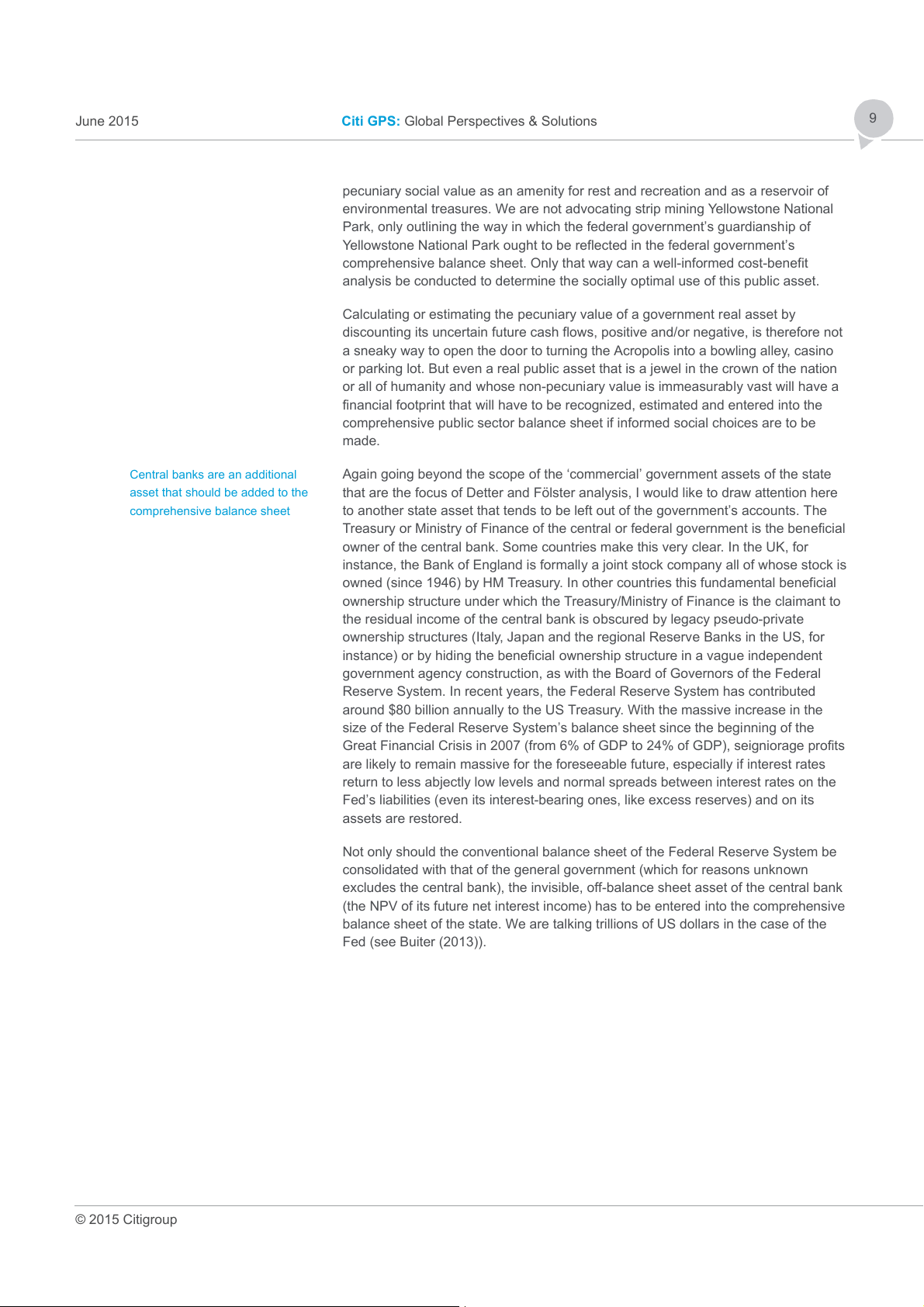
A stylized version of the comprehensive balance sheet of the consolidated general
government and central bank (taken from Buiter (2014)) is shown in Figure 1 below.
Figure 1. Comprehensive Balance Sheet of the State (consolidated General Government and Central Bank) Assets Liabilities K
Valueofrealassets,equityinpublic M Basemoney
enterprisesandotherfinancialassets V ({T})
NPVoftaxes,leviesandsocialsecurity N
Non‐monetaryliabilitiesofcentralbank contributions V ({I })
NPVoffutureinterestsavedthroughthe B
issuanceofbasemoney a ndothernet
Statedebtheldbythepublic interestincome V (M )
NPVoftheterminal(long‐run)stockof NPVofstateprimarycurrent V ({ } G ) basemoney expenditure W
Statecomprehensivenetworth Source: Buiter (2014)
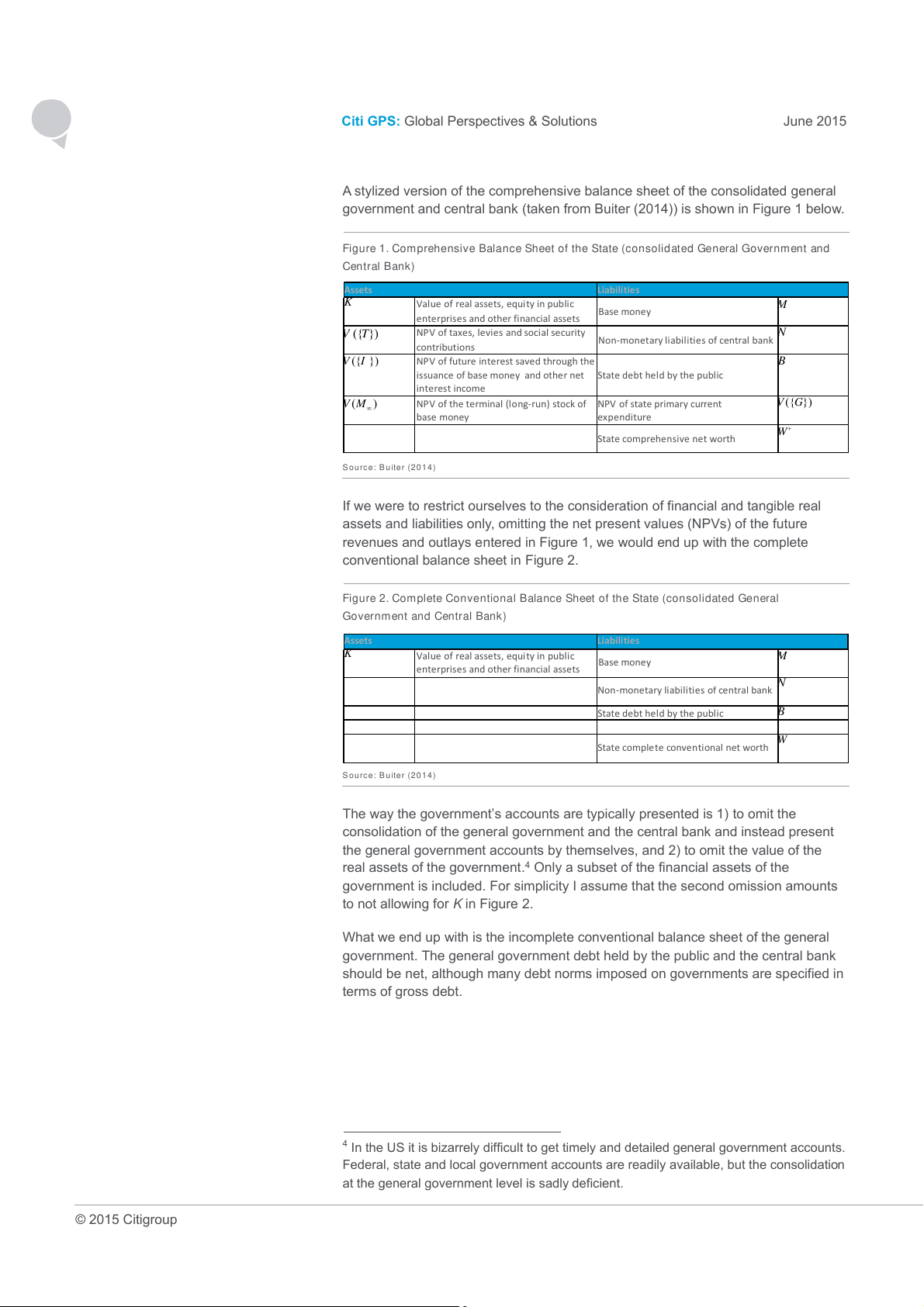
If we were to restrict ourselves to the consideration of financial and tangible real
assets and liabilities only, omitting the net present values (NPVs) of the future
revenues and outlays entered in Figure 1, we would end up with the complete
conventional balance sheet in Figure 2.
Figure 2. Complete Conventional Balance Sheet of the State (consolidated General
Government and Central Bank) Assets Liabilities K
Valueofrealassets,equityinpublic M Basemoney
enterprisesandotherfinancialassets N
Non‐monetaryliabilitiesofcentralbank
Statedebtheldbythepublic B W
Statecompleteconventionalnetworth Source: Buiter (2014)
The way the government’s accounts are typically presented is 1) to omit the
consolidation of the general government and the central bank and instead present
the general government accounts by themselves, and 2) to omit the value of the
real assets of the government.4 Only a subset of the financial assets of the
government is included. For simplicity I assume that the secon d omission amounts
to not allowing for K in Figure 2.
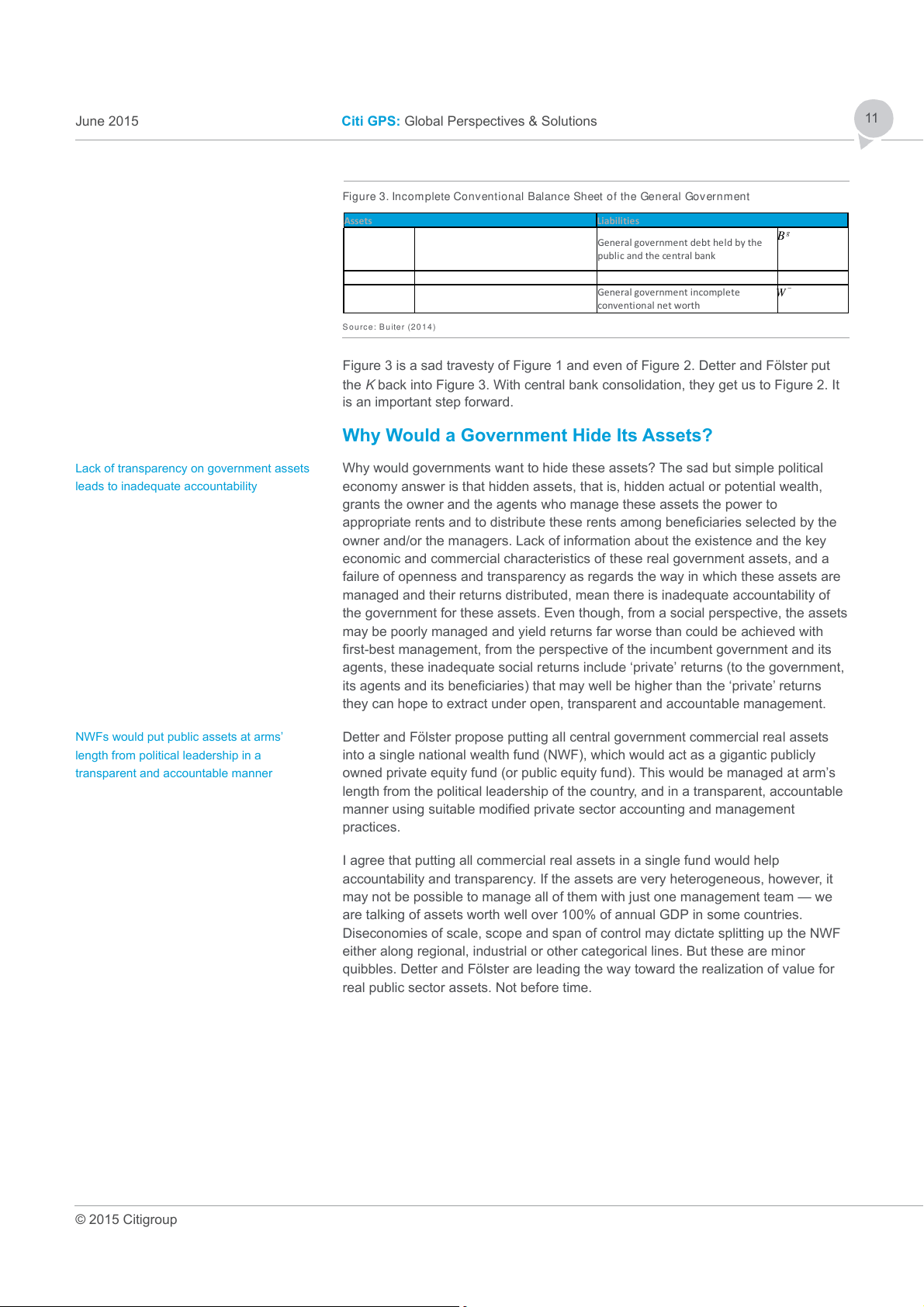
What we end up with is the incomplete conventional balance sheet of the general
government. The general government debt held by the public and the central bank
should be net, although many debt norms imposed on governments are specified in terms of gross debt.
4 In the US it is bizarrely difficult to get timely and detailed general government accounts.
Federal, state and local government accounts are readily available, but the consolidation
at the general government level is sadly deficient. © 2015 Citigroup June 2015
Citi GPS: Global Perspectives & Solutions 11
Figure 3. Incomplete Conventional Balance Sheet of the General Government Assets Liabilities g B
Generalgovernmentdebtheldbythe
publicandthecentralbank
Generalgovernmentincomplete W conventionalnetworth Source: Buiter (2014)
Figure 3 is a sad travesty of Figure 1 and even of Figure 2. D t e ter and Fölster put
the K back into Figure 3. With central bank consolidation, they get us to Figure 2. It is an important step forward.
Why Would a Government Hide Its Assets?
Lack of transparency on government assets
Why would governments want to hide these assets? The sad but simple political
leads to inadequate accountability
economy answer is that hidden assets, that is, hidden actual or potential wealth,
grants the owner and the agents who manage these assets the power to
appropriate rents and to distribute these rents among beneficiaries selected by the
owner and/or the managers. Lack of information about the existence and the key
economic and commercial characteristics of these real government assets, and a
failure of openness and transparency as regards the way in which these assets are
managed and their returns distributed, mean there is inadequate accountability of
the government for these assets. Even though, from a social perspective, the assets
may be poorly managed and yield returns far worse than could be achieved with
first-best management, from the perspective of the incumbent government and its
agents, these inadequate social returns include ‘private’ returns (to the government,
its agents and its beneficiaries) that may well be higher than the ‘private’ returns
they can hope to extract under open, transparent and accountable management.
NWFs would put public assets at arms’
Detter and Fölster propose putting all central government commercial real assets
length from political leadership in a
into a single national wealth fund (NWF), which would act as a gigantic publicly
transparent and accountable manner
owned private equity fund (or public equity fund). This would be managed at arm’s
length from the political leadership of the country, and in a transparent, accountable
manner using suitable modified private sector accounting and management practices.
I agree that putting all commercial real assets in a single fund would help
accountability and transparency. If the assets are very heterogeneous, however, it
may not be possible to manage all of them with just one management team — we
are talking of assets worth well over 100% of annual GDP in some countries.
Diseconomies of scale, scope and span of control may dictate splitting up the NWF
either along regional, industrial or other categorical lines. But these are minor
quibbles. Detter and Fölster are leading the way toward the realization of value for
real public sector assets. Not before time. © 2015 Citigroup
Tài liệu liên quan:
-
Đề cương luận văn thạc sĩ: Tăng cường thu hút nguồn nhân lực của Công ty TNHH MTV 790 môn Quản lý tài chính công | Trường Đại học Lâm Nghiệp
44 22 -

Quy định lập kế hoạch tài chính 5 năm | Quản lý tài chính công | Trường Đại Học Lâm Nghiệp
46 23 -

Luật Ngân sách Nhà nước 2015 – Những Quy định Cơ bản và Chi tiết | Quản lý tài chính công | Trường Đại Học Lâm Nghiệp
41 21 -

Phân Cấp Quản Lý Thu Ngân Sách Nhà Nước: Chi Tiết và Ý Nghĩa | Quản lý tài chính công | Trường Đại Học Lâm Nghiệp
29 15 -

Quản Lý Vốn Doanh Nghiệp: Tầm Quan Trọng và Phương Pháp Hiệu Quả | Quản lý tài chính công | Trường Đại Học Lâm Nghiệp
35 18