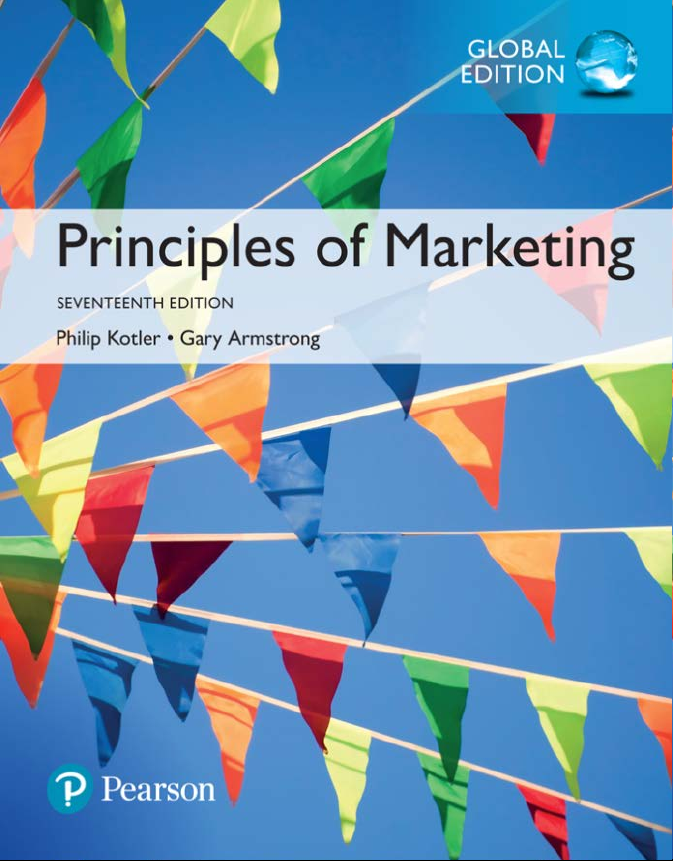
Kotler and Armstrong Principles of Marketing17th Textbook
Kotler and Armstrong Principles of Marketing17th Textbook
Môn: Tài liệu Tổng hợp 3.6 K tài liệu
Trường: Tài liệu khác 3.9 K tài liệu
Tác giả:




















Preview text:
Principles of Marketing
This page intentionally left blank Principles of Marketing 17e gLOBaL eDitiOn Philip Kotler Northwestern University Gary Armstrong
University of North Carolina with Marc Oliver Opresnik
St. Gallen Management Institute
Harlow, England • London • New York • Boston • San Francisco • Toronto • Sydney • Dubai • Singapore • Hong Kong
Tokyo • Seoul • Taipei • New Delhi • Cape Town • Sao Paulo • Mexico City • Madrid • Amsterdam • Munich • Paris • Milan
Vice President, Business Publishing: Donna Battista
Product Marketing Assistant: Jessica Quazza
Director of Portfolio Management: Stephanie Wall
Vice President, Production and Digital Studio, Arts and Business:
Portfolio Manager: Daniel Tylman Etain O’Dea
Editorial Coordinator: Linda Albelli
Director of Production, Business: Jeff Holcomb
Managing Editor, Global Edition: Steven Jackson
Managing Producer, Business: Ashley Santora
Associate Acquisitions Editor, Global Edition: Ishita Sinha
Operations Specialist: Carol Melville
Senior Project Editor, Global Edition: Daniel Luiz
Creative Director: Blair Brown
Project Manager, Global Edition: Nikhil Rakshit
Manager, Learning Tools: Brian Surette
Manager, Media Production, Global Edition: M. Vikram Kumar
Content Developer, Learning Tools: Sarah Peterson
Senior Manufacturing Controller, Production, Global Edition:
Managing Producer, Digital Studio, Arts and Business: Trudy Kimber Diane Lombardo
Vice President, Product Marketing: Roxanne McCarley
Digital Studio Producer: Darren Cormier
Director of Strategic Marketing: Brad Parkins
Digital Studio Producer: Alana Coles
Strategic Marketing Manager: Deborah Strickland
Full-Service Project Management, Design, and Composition: Integra
Product Marketer: Becky Brown Software Services
Field Marketing Manager: Lenny Ann Kucenski
Cover Art: MSSA/Shutterstock.com Pearson Education Limited KAO Two KAO Park Harlow CM17 9NA United Kingdom
and Associated Companies throughout the world
Visit us on the World Wide Web at: www.pearsonglobaleditions.com
© Pearson Education Limited 2018
The rights of Philip Kotler and Gary Armstrong to be identified as the authors of this work have been asserted by them in
accordance with the Copyright, Designs and Patents Act 1988.
Authorized adaptation from the United States edition, entitled Principles of Marketing, 17th edition, ISBN 978-0-13-449251-3, by
Philip Kotler and Gary Armstrong, published by Pearson Education © 2018.
All rights reserved. No part of this publication may be reproduced, stored in a retrieval system, or transmitted in any form
or by any means, electronic, mechanical, photocopying, recording or otherwise, without either the prior written permis-
sion of the publisher or a license permitting restricted copying in the United Kingdom issued by the Copyright Licensing
Agency Ltd, Saffron House, 6–10 Kirby Street, London EC1N 8TS.
All trademarks used herein are the property of their respective owners. The use of any trademark in this text does not vest
in the author or publisher any trademark ownership rights in such trademarks, nor does the use of such trademarks imply
any affiliation with or endorsement of this book by such owners. ISBN 10: 1-292-22017-1
ISBN 13: 978-1-292-22017-8
British Library Cataloguing-in-Publication Data
A catalogue record for this book is available from the British Library. 10 9 8 7 6 5 4 3 2 1 14 13 12 11 10
Typeset in Times LT Pro-Roman by Integra Software Services.
Printed and bound by Lego, Italy. Dedication
To Kathy, Betty, Mandy, Matt, KC, Keri, Delaney, Molly, Macy, and Ben;
and Nancy, Amy, Melissa, and Jessica
This page intentionally left blank about the authors
As a team, Philip Kotler and Gary Armstrong provide a blend of skills uniquely suited
to writing an introductory marketing text. Professor Kotler is one of the world’s leading
authorities on marketing. Professor Armstrong is an award-winning teacher of under-
graduate business students. Together, they make the complex world of marketing prac-
tical, approachable, and enjoyable.
Philip Kotler is S.C. Johnson & Son Distinguished Professor
worked with many companies on marketing research, sales
of International Marketing at the Kellogg School of Manage-
management, and marketing strategy.
ment, Northwestern University. He received his master’s
But Professor Armstrong’s first love has always been teach-
degree at the University of Chicago and his Ph.D. at M.I.T., both
ing. His long-held Blackwell Distinguished Professorship is
in economics. Dr. Kotler is the author of Marketing Management
the only permanent endowed professorship for distinguished
(Pearson), now in its fifteenth edition and the most widely used
undergraduate teaching at the University of North Carolina at
marketing textbook in graduate schools of business worldwide.
Chapel Hill. He has been very active in the teaching and ad-
He has authored more than 50 other successful books and has
ministration of Kenan-Flagler’s undergraduate program. His
published more than 150 articles in leading journals. He is the
administrative posts have included Chair of Marketing, Associ-
only three-time winner of the coveted Alpha Kappa Psi award
ate Director of the Undergraduate Business Program, Director
for the best annual article in the Journal of Marketing.
of the Business Honors Program, and many others. Through the
Professor Kotler was named the first recipient of four
years, he has worked closely with business student groups and
major awards: the Distinguished Marketing Educator of the Year
has received several UNC campuswide and Business School
Award and the William L. Wilkie “Marketing for a Better World”
teaching awards. He is the only repeat recipient of the school’s
Award, both given by the American Marketing Association;
highly regarded Award for Excellence in Undergraduate Teach-
the Philip Kotler Award for Excellence in Health Care Marketing
ing, which he received three times. Most recently, Professor
presented by the Academy for Health Care Services Market-
Armstrong received the UNC Board of Governors Award for
ing; and the Sheth Foundation Medal for Exceptional Contribution
Excellence in Teaching, the highest teaching honor bestowed by
to Marketing Scholarship and Practice. He is a charter member
the sixteen-campus University of North Carolina system.
of the Marketing Hall of Fame, was voted the first Leader in
Marc Oliver Opresnik is Professor of Marketing and Man-
Marketing Thought by the American Marketing Association,
agement and Member of the Board of Directors at SGMI St.
and was named the Founder of Modern Marketing Manage-
Gallen Management Institute, a leading international business
ment in the Handbook of Management Thinking. His numerous
school. In addition, he is Professor of Business Administration
other major honors include the Sales and Marketing Executives
at Luebeck University of Applied Sciences as well as a visiting
International Marketing Educator of the Year Award; the European
professor to international universities such as the European
Association of Marketing Consultants and Trainers Marketing
Business School in London and East China University of Sci-
Excellence Award; the Charles Coolidge Parlin Marketing Research
ence and Technology in Shanghai. He has 10 years of experi-
Award; and the Paul D. Converse Award, given by the American
ence working in senior management and marketing positions
Marketing Association to honor “outstanding contributions to
for Shell International Petroleum Co. Ltd. and is the author of
science in marketing.” A recent Forbes survey ranks Professor
numerous articles and books. Along with Kevin Keller and Phil
Kotler in the top 10 of the world’s most influential business
Kotler, he is co-author of the German edition of Marketing Man-
thinkers. And in a recent Financial Times poll of 1,000 senior ex-
agement. In addition, he is a co-editor and member of the edito-
ecutives across the world, Professor Kotler was ranked as the
rial board of several international journals such as Transnational
fourth “most influential business writer/guru” of the twenty-
Marketing, Journal of World Marketing Summit Group, and Interna- first century.
tional Journal of New Technologies in Science and Engineering. He
Dr. Kotler has served as chairman of the College on Mar-
was also appointed Chief Research Officer at Kotler Impact Inc.,
keting of the Institute of Management Sciences, a director of the
Philip Kotler’s international company. His responsibilities in-
American Marketing Association, and a trustee of the Marketing
clude the global development, planning, implementation, and
Science Institute. He has consulted with many major U.S. and
management of university courses and executive training as
international companies in the areas of marketing strategy and
well as global research initiatives and cooperations.
planning, marketing organization, and international marketing.
As president of his consulting firm Opresnik Management
He has traveled and lectured extensively throughout
Consulting, Professor Opresnik works as a coach, keynote
Europe, Asia, and South America, advising companies and gov-
speaker, and consultant for numerous institutions, govern-
ernments about global marketing practices and opportunities.
ments, and international corporations, including Google,
Gary Armstrong is Crist W. Blackwell Distinguished
Coca-Cola, McDonald’s, Dräger, RWE, SAP, Porsche, Audi,
Professor Emeritus of Undergraduate Education in the Kenan-
Volkswagen, Shell International Petroleum Co. Ltd., Procter
Flagler Business School at the University of North Carolina at
& Gamble, Unilever, L’Oréal, Bayer, BASF, and Adidas. More
Chapel Hill. He holds undergraduate and master’s degrees in
than 100,000 people have benefited professionally and person-
business from Wayne State University in Detroit, and he re-
ally from his work as a coach in seminars on marketing, sales,
ceived his Ph.D. in marketing from Northwestern University.
and negotiation and as a speaker at conferences all over the
Dr. Armstrong has contributed numerous articles to lead-
world, including locations like St. Gallen, Davos, St. Moritz,
ing business journals. As a consultant and researcher, he has
Berlin, Houston, Moscow, London, Paris, Dubai, and Tokyo. 7
This page intentionally left blank Brief Contents Preface 17 Acknowledgments 23 Part 1
Defining Marketing and the Marketing Process 26 1
Marketing: Creating Customer Value and Engagement 26 2
Company and Marketing Strategy: Partnering to Build Customer Engagement, Value, and Relationships 62 Part 2
Understanding the Marketplace and Consumer Value 90 3
Analyzing the Marketing Environment 90 4
Managing Marketing Information to Gain Customer Insights 122 5
Consumer Markets and Buyer Behavior 156 6
Business Markets and Business Buyer Behavior 186 Part 3
Designing a Customer Value–Driven Strategy and Mix 210 7
Customer Value–Driven Marketing Strategy: Creating Value for Target Customers 210 8
Products, Services, and Brands: Building Customer Value 242 9
Developing New Products and Managing the Product Life Cycle 278 10
Pricing: Understanding and Capturing Customer Value 306 11
Pricing Strategies: Additional Considerations 330 12
Marketing Channels: Delivering Customer Value 356 13 Retailing and Wholesaling 390 14
Engaging Consumers and Communicating Customer Value: Integrated Marketing Communication Strategy 422 15
Advertising and Public Relations 450 16
Personal Selling and Sales Promotion 478 17
Direct, Online, Social Media, and Mobile Marketing 510 Part 4 Extending Marketing 540 18
Creating Competitive Advantage 540 19 The Global Marketplace 566 20
Sustainable Marketing: Social Responsibility and Ethics 596 Appendix 1 Marketing Plan 627 Appendix 2 Marketing by the Numbers 637 Appendix 3 Careers in Marketing 655 Glossary 667 References 675 Index 705 9
This page intentionally left blank Contents Preface 17 Acknowledgments 23 2 Chapter
Company and Marketing Strategy:
partnering to Build Customer engagement, Value, and relationships 62
Part 1: Defining Marketing and the Marketing Process 26
Company-Wide Strategic Planning: Defining Marketing’s Role 64
Defining a Market-Oriented Mission 64 | Setting Company 1 Objectives and Goals 66 Chapter
Marketing: Creating Customer Value and
Designing the Business Portfolio 66 engagement 26
Analyzing the Current Business Portfolio 67 | The Boston
Consulting Group Approach 67 | Developing Strategies for What Is Marketing? 28 Growth and Downsizing 70
Marketing Defined 29 | The Marketing Process 29
Planning Marketing: Partnering to Build Customer
Understanding the Marketplace and Customer Relationships 72 Needs 30
Partnering with Other Company Departments 72 | Partnering
Customer Needs, Wants, and Demands 30 | Market
with Others in the Marketing System 73
Offerings—Products, Services, and Experiences 31 |
Marketing Strategy and the Marketing Mix 74
Customer Value and Satisfaction 31 | Exchanges and
Customer Value–Driven Marketing Strategy 74 | Developing an Relationships 33 | Markets 33 Integrated Marketing Mix 77
Designing a Customer Value–Driven Marketing Strategy
Managing the Marketing Effort and Marketing Return on and Plan 34 Investment 79
Customer Value–Driven Marketing Strategy 34 | Preparing an
Managing the Marketing Effort 79 | Measuring and Managing
Integrated Marketing Plan and Program 38
Marketing Return on Investment 83
Managing Customer Relationships and Capturing Customer
REVIEWING AND ExTENDING THE CONCEPTS 84 | OBjECTIVES Value 38
REVIEW AND KEY TERMS 84 | Objectives Review 84 | Key
Engaging Customers and Managing Customer
Terms 85 | DISCuSSION AND CRITICAL THINKING 86 | Discussion
Relationships 38 | Capturing Value from Customers 44
Questions 86 | Critical Thinking Exercises 86 | APPLICATIONS AND
The Changing Marketing Landscape 46
CASES 86 | Online, Mobile, and Social Media Marketing: Google’s
The Digital Age: Online, Mobile, and Social Media
(Alphabet’s) Mission 86 | Marketing Ethics: Predicting the
Marketing 46 | The Changing Economic Environment 50 |
Future 87 | Marketing by the Numbers: Apple vs. Microsoft 87 |
The Growth of Not-for-Profit Marketing 51 | Rapid
Video Case: Konica 87 | Company Case: Facebook: Making the
Globalization 52 | Sustainable Marketing—The Call for More
World More Open and Connected 88
Environmental and Social Responsibility 53 | So, What Is
Marketing? Pulling It All Together 53
Part 2: Understanding the Marketplace and Consumer
REVIEWING AND ExTENDING THE CONCEPTS 55 | Value 90
OBjECTIVES REVIEW AND KEY TERMS 55 | Objectives
Review 55 | Key Terms 56 | DISCuSSION AND CRITICAL
THINKING 57 | Discussion Questions 57 | Critical Thinking 3 Chapter
analyzing the Marketing environment 90
Exercises 57 | APPLICATIONS AND CASES 57 | Online,
Mobile, and Social Media Marketing: The ALS Ice
The Microenvironment and Macroenvironment 92
Bucket Challenge 57 | Marketing Ethics: Exaggeration and High
The Microenvironment 92 | The Macroenvironment 96
Pressure 58 | Marketing by the Numbers: Be on the
The Demographic and Economic Environments 96
First Page 58 | Video Case: Eskimo joe’s 58 | Company Case:
The Demographic Environment 96 | The Economic Environment 103
Argos: Creating Customer Value amid Change and
The Natural and Technological Environments 104 Turbulence 59
The Natural Environment 104 | The Technological Environment 106 11 12 Contents
The Political–Social and Cultural Environments 108
Buying Decision Behavior and the Buyer Decision
The Political and Social Environment 108 | The Cultural Process 174 Environment 111
Types of Buying Decision Behavior 174 | The Buyer Decision
Responding to the Marketing Environment 114 Process 175
REVIEWING AND ExTENDING THE CONCEPTS 117 | OBjECTIVES
The Buyer Decision Process for New Products 178
Stages in the Adoption Process 178 | Individual Differences in
REVIEW AND KEY TERMS 117 | Objectives Review 117 | Key
Innovativeness 179 | Influence of Product Characteristics on
Terms 117 | DISCuSSION AND CRITICAL THINKING 118 | Rate of Adoption 179
Discussion Questions 118 | Critical Thinking Exercises 118 |
APPLICATIONS AND CASES 118 | Online, Mobile, and Social
REVIEWING AND ExTENDING THE CONCEPTS 180 |
Media Marketing: Sharing Economy 118 | Marketing Ethics: Your
OBjECTIVES REVIEW AND KEY TERMS 180 | Objectives
Insurance Renewal Notice Could Be a Trap 118 | Marketing by the
Review 180 | Key Terms 181 | DISCuSSION AND CRITICAL
Numbers: Demographic Trends 119 | Video Case: Burger King 119 |
THINKING 182 | Discussion Questions 182 | Critical
Company Case: Fitbit: Riding the Fitness Wave to Glory 119
Thinking Exercises 182 | APPLICATIONS AND CASES 182 |
Online, Mobile, and Social Media Marketing: Blogvertorials 182 |
Marketing Ethics: Make Yourself Feel Good 183 | Marketing 4 Chapter
Managing Marketing Information to Gain
by the Numbers: Evaluating Alternatives 183 | Video Case: Customer Insights 122
IMG Worldwide 183 | Company Case: GoldieBlox: Swimming
upstream against Consumer Perceptions 184
Marketing Information and Customer Insights 124
Marketing Information and Today’s “Big Data” 125 | Managing Marketing Information 125
Assessing Information Needs and Developing Data 126 6 Chapter
Business Markets and Business Buyer
Assessing Marketing Information Needs 126 | Developing Behavior 186 Marketing Information 126 Marketing Research 130 Business Markets 188
Defining the Problem and Research Objectives 130 | Developing
Market Structure and Demand 189 | Nature of the Buying
the Research Plan 131 | Gathering Secondary Data 132 |
unit 189 | Types of Decisions and the Decision
Primary Data Collection 133 | Implementing the Research Process 189
Plan 140 | Interpreting and Reporting the Findings 140 Business Buyer Behavior 190
Analyzing and Using Marketing Information 140
Major Types of Buying Situations 191 | Participants in the
Customer Relationship Management (CRM) 141 | Big
Business Buying Process 192 | Major Influences on Business
Data and Marketing Analytics 141 | Distributing and using Buyers 192 Marketing Information 144
The Business Buyer Decision Process 195
Other Marketing Information Considerations 144
Problem Recognition 195 | General Need Description 196 |
Marketing Research in Small Businesses and Nonprofit
Product Specification 196 | Supplier Search 196 | Proposal
Organizations 144 | International Marketing Research 145 |
Solicitation 196 | Supplier Selection 197 | Order-Routine
Public Policy and Ethics in Marketing Research 147
Specification 197 | Performance Review 197
REVIEWING AND ExTENDING THE CONCEPTS 149 |
Engaging Business Buyers with Digital and Social
OBjECTIVES REVIEW AND KEY TERMS 149 | Objectives Marketing 197
Review 149 | Key Terms 150 | DISCuSSION AND CRITICAL
E-procurement and Online Purchasing 197 | Business-
THINKING 150 | Discussion Questions 150 | Critical Thinking
to-Business Digital and Social Media Marketing 198
Exercises 151 | APPLICATIONS AND CASES 151 | Online, Mobile,
Institutional and Government Markets 199
and Social Media Marketing: Online Snooping 151 | Marketing
Institutional Markets 199 | Government Markets 201
Ethics: Metadata 151 | Marketing by the Numbers: What’s
REVIEWING AND ExTENDING THE CONCEPTS 203 |
Your Sample? 151 | Video Case: Nielsen 152 | Company Case:
OBjECTIVES REVIEW AND KEY TERMS 203 | Objectives
Campbell Soup Company: Watching What You Eat 152
Review 203 | Key Terms 204 | DISCuSSION AND CRITICAL
THINKING 204 | Discussion Questions 204 | Critical Thinking 5 Chapter
Consumer Markets and Buyer
Exercises 205 | APPLICATIONS AND CASES 205 | Online, Behavior 156
Mobile, and Social Media Marketing: E-procurement and
Mobile Procurement 205 | Marketing Ethics: Innocent: Proven Model of Consumer Behavior 158
Guilty? 205 | Marketing by the Numbers: NAICS 206 | Video
Characteristics Affecting Consumer Behavior 159
Case: Eaton 206 | Company Case: Procter & Gamble: Treating
Cultural Factors 159 | Social Factors 162 | Personal
Business Customers as Strategic Partners 206
Factors 167 | Psychological Factors 169 Contents 13
Video Case: Plymouth Rock Assurance 275 | Company Case:
Part 3: Designing a Customer Value–Driven Strategy
Airbnb: Making Hospitality Authentic 275 and Mix 210 7 Chapter
Customer Value–Driven Marketing
Strategy: Creating Value for target Customers 210 9 Chapter
Developing New products and Managing the product Life Cycle 278 Marketing Strategy 212
New Product Development Strategy 280 Market Segmentation 213
The New Product Development Process 281
Segmenting Consumer Markets 213 | Segmenting Business
Idea Generation 281 | Idea Screening 283 | Concept
Markets 219 | Segmenting International Markets 220 |
Development and Testing 283 | Marketing Strategy
Requirements for Effective Segmentation 221
Development 284 | Business Analysis 285 | Market Targeting 221
Product Development 286 | Test Marketing 286 |
Evaluating Market Segments 221 | Selecting Target Market
Commercialization 287 | Managing New Product Segments 222 Development 287
Differentiation and Positioning 228
Product Life-Cycle Strategies 289
Positioning Maps 229 | Choosing a Differentiation and
Introduction Stage 294 | Growth Stage 294 | Maturity
Positioning Strategy 230 | Communicating and Delivering the Stage 295 | Decline Stage 296 Chosen Position 235
Additional Product and Service Considerations 297
REVIEWING AND ExTENDING THE CONCEPTS 236 |
Product Decisions and Social Responsibility 297 |
OBjECTIVES REVIEW AND KEY TERMS 236 | Objectives
International Product and Services Marketing 298
Review 236 | Key Terms 237 | DISCuSSION AND CRITICAL
REVIEWING AND ExTENDING THE CONCEPTS 299 |
THINKING 237 | Discussion Questions 237 | Critical Thinking
OBjECTIVES REVIEW AND KEY TERMS 299 | Objectives
Exercises 238 | APPLICATIONS AND CASES 238 | Online,
Review 299 | Key Terms 300 | DISCuSSION AND CRITICAL
Mobile, and Social Media Marketing: Get Your Groupon 238 |
THINKING 300 | Discussion Questions 300 | Critical Thinking
Marketing Ethics: Targeting Teens 238 | Marketing by the
Exercises 301 | APPLICATIONS AND CASES 301 | Online,
Numbers: uSAA 238 | Video Case: Sprout 239 | Company Case:
Mobile, and Social Media Marketing: Telemedicine 301 |
Virgin America: Flight Service for the Tech Savvy 239
Marketing Ethics: The Sustainable Tourist? 301 | Marketing by
the Numbers: Dental House Calls 302 | Video Case: Day2Night
Convertible Heels 302 | Company Case: Bose: Better Products 8 Chapter
products, Services, and Brands: Building through Research 302 Customer Value 242 What Is a Product? 244
Products, Services, and Experiences 244 | Levels of Product 10 Chapter
pricing: Understanding and Capturing
and Services 245 | Product and Service Classifications 246 Customer Value 306
Product and Service Decisions 249
Individual Product and Service Decisions 249 | Product Line What Is a Price? 308
Decisions 256 | Product Mix Decisions 256 Major Pricing Strategies 309 Services Marketing 258
Customer Value–Based Pricing 309 | Cost-Based
The Nature and Characteristics of a Service 258 | Marketing
Pricing 313 | Competition-Based Pricing 317
Strategies for Service Firms 259 | The Service Profit Chain 259
Other Internal and External Considerations Affecting Price
Branding Strategy: Building Strong Brands 264 Decisions 317
Brand Equity and Brand Value 264 | Building Strong
Overall Marketing Strategy, Objectives, and Mix 318 |
Brands 265 | Managing Brands 272
Organizational Considerations 321 | The Market and
Demand 321 | The Economy 323 | Other External
REVIEWING AND ExTENDING THE CONCEPTS 272 | Factors 323
OBjECTIVES REVIEW AND KEY TERMS 272 | Objectives
Review 272 | Key Terms 273 | DISCuSSION AND CRITICAL
REVIEWING AND ExTENDING THE CONCEPTS 324 |
THINKING 274 | Discussion Questions 274 | Critical Thinking
OBjECTIVES REVIEW AND KEY TERMS 324 | Objectives
Exercises 274 | APPLICATIONS AND CASES 274 | Online,
Review 324 | Key Terms 325 | DISCuSSION AND CRITICAL
Mobile, and Social Media Marketing: Feeding Pets from Your
THINKING 325 | Discussion Questions 325 | Critical Thinking
Smartphone 274 | Marketing Ethics: Cutthroat Prices 274 |
Exercises 325 | APPLICATIONS AND CASES 325 | Online,
Marketing by the Numbers: Pop-Tarts Gone Nutty! 275 |
Mobile, and Social Media Marketing: Sold Out 325 | 14 Contents
Marketing Ethics: The Cost of a Life 326 | Marketing
Channel Management Decisions 372
by the Numbers: Pricey Sheets 326 | Video Case:
Selecting Channel Members 372 | Managing and
Fast-Food Discount Wars 327 | Company Case: MSC
Motivating Channel Members 373 | Evaluating Channel
Cruises: From One Second-Hand Ship to a Major World
Members 375 | Public Policy and Distribution Player 327 Decisions 375
Marketing Logistics and Supply Chain Management 376
Nature and Importance of Marketing Logistics 376 | 11 Chapter
pricing Strategies: additional
Sustainable Supply Chains 377 | Goals of the Logistics Considerations 330
System 378 | Major Logistics Functions 378 | Integrated Logistics Management 381
New Product Pricing Strategies 332
REVIEWING AND ExTENDING THE CONCEPTS 383 |
Market-Skimming Pricing 332 | Market-Penetration
OBjECTIVES REVIEW AND KEY TERMS 383 | Objectives Pricing 333
Review 383 | Key Terms 384 | DISCuSSION AND
Product Mix Pricing Strategies 333
CRITICAL THINKING 385 | Discussion Questions 385 |
Product Line Pricing 334 | Optional-Product Pricing 334 |
Critical Thinking Exercises 385 | APPLICATIONS AND
Captive-Product Pricing 334 | By-Product Pricing 335 |
CASES 385 | Online, Mobile, and Social Media Marketing: Product Bundle Pricing 335
Fabletics Changing Channels 385 | Marketing Ethics: Ethical
Price Adjustment Strategies 335
Sourcing 386 | Marketing by the Numbers: Tyson
Discount and Allowance Pricing 335 | Segmented Pricing 336 |
Expanding Distribution 386 | Video Case: Progressive 386 |
Psychological Pricing 337 | Promotional Pricing 338 |
Company Case: Apple Pay: Taking Mobile Payments
Geographical Pricing 339 | Dynamic and Online Pricing 340 | Mainstream 387 International Pricing 342 Price Changes 344
Initiating Price Changes 344 | Responding to Price Changes 345 13 Chapter
retailing and Wholesaling 390 Public Policy and Pricing 346
Pricing within Channel Levels 349 | Pricing across Channel Retailing 392
Retailing: Connecting Brands with Consumers 392 | Types of Levels 349 Retailers 393
REVIEWING AND ExTENDING THE CONCEPTS 350 |
Retailer Marketing Decisions 400
OBjECTIVES REVIEW AND KEY TERMS 350 | Objectives
Segmentation, Targeting, Differentiation, and Positioning
Review 350 | Key Terms 351 | DISCuSSION AND CRITICAL
Decisions 400 | Product Assortment and Services
THINKING 351 | Discussion Questions 351 | Critical Thinking
Decision 401 | Price Decision 403 | Promotion Decision 403 |
Exercises 352 | APPLICATIONS AND CASES 352 | Online, Place Decision 404
Mobile, and Social Media Marketing: Krazy Coupon Lady 352 |
Retailing Trends and Developments 405
Marketing Ethics: Less Bang for Your Buck 352 | Marketing by
Tighter Consumer Spending 405 | New Retail Forms,
the Numbers: Louis Vuitton Price Increase 352 | Video Case:
Shortening Retail Life Cycles, and Retail Convergence 406 |
Hammerpress 353 | Company Case: Lululemon: Indulging
The Rise of Megaretailers 406 | Growth of Direct, Online,
Customers at a Premium Price 353
Mobile, and Social Media Retailing 407 | The Need for
Omni-Channel Retailing 407 | Growing Importance of Retail 12 Chapter
Marketing Channels: Delivering Customer
Technology 409 | Green Retailing 410 | Global Expansion of Major Retailers 411 Value 356 Wholesaling 411
Supply Chains and the Value Delivery Network 358
Types of Wholesalers 412 | Trends in Wholesaling 416
The Nature and Importance of Marketing Channels 359
REVIEWING AND ExTENDING THE CONCEPTS 417 |
Channel Behavior and Organization 362
OBjECTIVES REVIEW AND KEY TERMS 417 | Objectives
Channel Behavior 362 | Vertical Marketing Systems 363 |
Review 417 | Key Terms 418 | DISCuSSION AND CRITICAL
Horizontal Marketing Systems 365 | Multichannel Distribution
THINKING 418 | Discussion Questions 418 | Critical Thinking
Systems 365 | Changing Channel Organization 366
Exercises 418 | APPLICATIONS AND CASES 418 | Online, Channel Design Decisions 368
Mobile, and Social Media Marketing: Skipping the Checkout
Analyzing Consumer Needs 369 | Setting Channel
Line 418 | Marketing Ethics: Footloose and Tax-Free 419 |
Objectives 369 | Identifying Major Alternatives 370 |
Marketing by the Numbers: Inventory Management 419 | Video
Evaluating the Major Alternatives 371 | Designing International
Case: Kmart 419 | Company Case: Bass Pro Shops: Creating Distribution Channels 371
Nature’s Theme Park for People Who Hate to Shop 420 Contents 15 Managing the Sales Force 482 14 Chapter
engaging Consumers and Communicating
Designing the Sales Force Strategy and Structure 482 |
Customer Value: Integrated Marketing
Recruiting and Selecting Salespeople 485 | Training
Salespeople 486 | Compensating Salespeople 487 |
Communication Strategy 422
Supervising and Motivating Salespeople 488 | Evaluating
Salespeople and Sales Force Performance 489 | Social The Promotion Mix 424
Selling: Online, Mobile, and Social Media Tools 490
Integrated Marketing Communications 425
The New Marketing Communications Model 425 | The Need
The Personal Selling Process 493
Steps in the Selling Process 493 | Personal Selling and
for Integrated Marketing Communications 427
Managing Customer Relationships 495
Developing Effective Marketing Communication 430
A View of the Communication Process 430 | Steps in Sales Promotion 496
The Rapid Growth of Sales Promotion 496 | Sales Promotion
Developing Effective Marketing Communication 432
Objectives 497 | Major Sales Promotion Tools 498 |
Setting the Total Promotion Budget and Mix 437
Developing the Sales Promotion Program 502
Setting the Total Promotion Budget 437 | Shaping the Overall
Promotion Mix 439 | Integrating the Promotion Mix 441 |
REVIEWING AND ExTENDING THE CONCEPTS 503 |
Socially Responsible Marketing Communication 441
OBjECTIVES REVIEW AND KEY TERMS 503 | Objectives
Review 503 | Key Terms 504 | DISCuSSION AND CRITICAL
REVIEWING AND ExTENDING THE CONCEPTS 444 |
THINKING 505 | Discussion Questions 505 | Critical Thinking
OBjECTIVES REVIEW AND KEY TERMS 444 | Objectives
Exercises 505 | APPLICATIONS AND CASES 505 | Online,
Review 444 | Key Terms 445 | DISCuSSION AND CRITICAL
Mobile, and Social Media Marketing: Snap It and Redeem It! 505 |
THINKING 446 | Discussion Questions 446 | Critical Thinking
Marketing Ethics: Walking the Customer 506 | Marketing by
Exercises 446 | APPLICATIONS AND CASES 446 | Online,
the Numbers: Sales Force Analysis 506 | Video Case: First
Mobile, and Social Media Marketing: Spot the Difference 446 |
Flavor 506 | Company Case: SunGard: Building Sustained
Marketing Ethics: Western Stereotypes 447 | Marketing by
Growth by Selling the SunGard Way 506
the Numbers: Advertising-to-Sales Ratios 447 | Video Case:
OxO 447 | Company Case: Volvo Trucks: Integrated Marketing
Communications of Epic Proportions 447 17 Chapter
Direct, Online, Social Media, and Mobile 15 Chapter
advertising and public relations 450 Marketing 510 Advertising 452
Direct and Digital Marketing 512
Major Advertising Decisions 453
The New Direct Marketing Model 512 | Rapid Growth of Direct
Setting Advertising Objectives 453 | Setting the Advertising
and Digital Marketing 513 | Benefits of Direct and Digital
Budget 456 | Evaluating Advertising Effectiveness and the
Marketing to Buyers and Sellers 514
Return on Advertising Investment 468 | Other Advertising
Forms of Direct and Digital Marketing 514 Considerations 468
Marketing, the Internet, and the Digital Age 515 Public Relations 470 Online Marketing 516 The Role and Impact of PR 471
Social Media and Mobile Marketing 521
Major Public Relations Tools 472
Social Media Marketing 521 | Mobile Marketing 525
REVIEWING AND ExTENDING THE CONCEPTS 473 | OBjECTIVES
Traditional Direct Marketing Forms 528
REVIEW AND KEY TERMS 473 | Objectives Review 473 | Key
Direct-Mail Marketing 528 | Catalog Marketing 529 |
Terms 473 | DISCuSSION AND CRITICAL THINKING 474 |
Telemarketing 529 | Direct-Response Television
Discussion Questions 474 | Critical Thinking Exercises 474 |
Marketing 530 | Kiosk Marketing 531 | Public Policy Issues in
APPLICATIONS AND CASES 474 | Online, Mobile, and Social Media
Direct and Digital Marketing 531
Marketing: Facebook Audience Network 474 | Marketing Ethics:
REVIEWING AND ExTENDING THE CONCEPTS 534 |
Lie to Me 474 | Marketing by the Numbers: Dubai City Guide 475 |
OBjECTIVES REVIEW AND KEY TERMS 534 | Objectives
Video Case: Kmart 475 | Company Case: Allstate: Bringing Mayhem
Review 534 | Key Terms 536 | DISCuSSION AND CRITICAL
to the Auto Insurance Advertising Wars 475
THINKING 536 | Discussion Questions 536 | Critical Thinking
Exercises 536 | APPLICATIONS AND CASES 536 | Online, 16 Chapter
personal Selling and Sales promotion 478
Mobile, and Social Media Marketing: On the Move 536 |
Marketing Ethics: #Fail 537 | Marketing by the Numbers: Field Personal Selling 480
Sales versus Telemarketing 537 | Video Case: Nutrisystem 537 |
The Nature of Personal Selling 480 | The Role of the Sales
Company Case: Alibaba: The World’s Largest E-tailer Is Not Force 481 Amazon 538 16 Contents
Key Terms 591 | DISCuSSION AND CRITICAL THINKING 592 |
Part 4: Extending Marketing 540
Discussion Questions 592 | Critical Thinking Exercises 592 |
APPLICATIONS AND CASES 592 | Online, Mobile, and Social Media 18 Chapter
Creating Competitive advantage 540
Marketing: China’s Great Firewall 592 | Marketing Ethics: Cleaning up
the Chinese Pharmaceutical Market 593 | Marketing by the Numbers: Competitor Analysis 542
Attracting Alternative Markets 593 | Video Case: Monster 593 |
Identifying Competitors 542 | Assessing Competitors 545 |
Company Case: L’Oréal: The united Nations of Beauty 593
Selecting Competitors to Attack and Avoid 547 | Designing a
Competitive Intelligence System 549 Competitive Strategies 549 20 Chapter
Sustainable Marketing: Social
Approaches to Marketing Strategy 549 | Basic Competitive
responsibility and ethics 596
Strategies 550 | Competitive Positions 553 | Market Leader
Strategies 554 | Market Challenger Strategies 557 | Market Sustainable Marketing 598
Follower Strategies 558 | Market Nicher Strategies 558
Social Criticisms of Marketing 600
Balancing Customer and Competitor Orientations 559
Marketing’s Impact on Individual Consumers 600 |
Marketing’s Impact on Society as a Whole 604 | Marketing’s
REVIEWING AND ExTENDING THE CONCEPTS 560 | Impact on Other Businesses 606
OBjECTIVES REVIEW AND KEY TERMS 560 | Objectives
Review 560 | Key Terms 561 | DISCuSSION AND CRITICAL
Consumer Actions to Promote Sustainable Marketing 607
Consumerism 607 | Environmentalism 608 | Public Actions to
THINKING 561 | Discussion Questions 561 | Critical Thinking Regulate Marketing 612
Exercises 562 | APPLICATIONS AND CASES 562 | Online,
Mobile, and Social Media Marketing: I’ll Eat My Hat 562 |
Business Actions Toward Sustainable Marketing 613
Sustainable Marketing Principles 613
Marketing Ethics: Creating Competitive Advantage…to What
End? 562 | Marketing by the Numbers: Market Share 562 | Video
Marketing Ethics and the Sustainable Company 617
Marketing Ethics 617 | The Sustainable Company 620
Case: umpqua Bank 563 | Company Case: YouTube: Google’s Quest for Video Dominance 563
REVIEWING AND ExTENDING THE CONCEPTS 620 |
OBjECTIVES REVIEW AND KEY TERMS 620 | Objectives
Review 620 | Key Terms 621 | DISCuSSION AND CRITICAL
THINKING 621 | Discussion Questions 621 | Critical 19 Chapter
the Global Marketplace 566
Thinking Exercises 622 | APPLICATIONS AND CASES 622 |
Online, Mobile, and Social Media Marketing: Teens and Global Marketing Today 568
Social Media 622 | Marketing Ethics: Milking the International
Elements of the Global Marketing Environment 570 | Deciding
Market 622 | Marketing by the Numbers: The Cost of
Whether to Go Global 578 | Deciding Which Markets to
Sustainability 622 | Video Case: Honest Tea 623 | Company Enter 578
Case: adidas: Athletic Apparel with Purpose 623
Deciding How to Enter the Market 580
Exporting 580 | joint Venturing 581 | Direct Investment 582 Appendix 1: Marketing Plan 627
Deciding on the Global Marketing Program 583
Appendix 2: Marketing by the Numbers 637
Product 585 | Promotion 586 | Price 588 | Distribution
Appendix 3: Careers in Marketing 655 Channels 589
Deciding on the Global Marketing Organization 590 Glossary 667
REVIEWING AND ExTENDING THE CONCEPTS 591 | OBjECTIVES References 675
REVIEW AND KEY TERMS 591 | Objectives Review 591 | Index 705 Preface
The Seventeenth Edition of Kotler/Armstrong’s
Principles of Marketing! Setting the World Standard in Marketing Education
These are exciting times in marketing. Recent surges in digital technologies have created a
new, more engaging, more connected marketing world. Beyond traditional tried-and-true
marketing concepts and practices, today’s marketers have added a host of new-age tools
for engaging consumers, building brands, and creating customer value and relationships.
In these digital times, sweeping advances in “the Internet of Things”—from social and mo-
bile media, connected digital devices, and the new consumer empowerment to “big data”
and new marketing analytics—have profoundly affected both marketers and the consum- ers they serve.
All around the world—across five continents, more than 40 countries, and 24
languages—students, professors, and business professionals have long relied on Kotler/
Armstrong’s Principles of Marketing as the most-trusted source for teaching and learning
about the latest developments in basic marketing concepts and practices. More than ever,
the seventeenth edition introduces new marketing students to the fascinating world of
modern marketing in a complete and authoritative yet fresh, practical, and engaging way.
Once again, we’ve added substantial new content and poured over every page, table,
figure, fact, and example in order to make this the best text from which to learn about and
teach marketing. Enhanced by MyMarketingLab, our online homework and personalized
study tool, the seventeenth edition of Principles of Marketing remains the world standard in
introductory marketing education.
Marketing: Creating Customer Value and Engagement
in the Digital and Social Age
Top marketers share a common goal: putting the consumer at the heart of marketing. To-
day’s marketing is all about creating customer value and engagement in a fast-changing,
increasingly digital and social marketplace.
Marketing starts with understanding consumer needs and wants, determining which
target markets the organization can serve best, and developing a compelling value proposi-
tion by which the organization can attract and grow valued consumers. Then, more than
just making a sale, today’s marketers want to engage customers and build deep customer
relationships that make their brands a meaningful part of consumers’ conversations and lives.
In this digital age, to go along with their tried-and-true traditional marketing methods,
marketers have a dazzling set of new online, mobile, and social media tools for engaging
customers anytime, anyplace to jointly shape brand conversations, experiences, and commu-
nity. If marketers do these things well, they will reap the rewards in terms of market share,
profits, and customer equity. In the seventeenth edition of Principles of Marketing, you’ll learn
how customer value and customer engagement drive every good marketing strategy.
What’s New in the Seventeenth Edition?
We’ve thoroughly revised the seventeenth edition of Principles of Marketing to reflect the
major trends and forces that affect marketing in this digital age of customer value, engage-
ment, and relationships. Here are just some of the major and continuing changes you’ll find in this edition. 17 18 Preface
• The seventeenth edition adds fresh coverage in both traditional marketing areas and
on fast-changing and trending topics such as customer engagement marketing, mobile
and social media, big data and the new marketing analytics, the Internet of Things,
omni-channel marketing and retailing, customer co-creation and empowerment, real-
time customer listening and marketing, building brand community, marketing content
creation and native advertising, B-to-B social media and social selling, monetizing
social media, tiered and dynamic pricing, consumer privacy, sustainability, global marketing, and much more.
• This new edition continues to build on its customer engagement framework—creating
direct and continuous customer involvement in shaping brands, brand conversations,
brand experiences, and brand community. New coverage and fresh examples through-
out the text address the latest customer engagement tools, practices, and develop-
ments. See especially Chapter 1 (refreshed sections on Customer Engagement and Today’s
Digital and Social Media and Consumer-Generated Marketing); Chapter 4 (big data and
real-time research to gain deeper customer insights); Chapter 5 (creating social influ-
ence and customer community through digital and social media marketing); Chapter
9 (customer co-creation and customer-driven new-product development); Chapter 13
(omni-channel retailing); Chapters 14 and 15 (marketing content curation and native
advertising); Chapter 16 (sales force social selling); and Chapter 17 (direct digital, on-
line, social media, and mobile marketing).
• No area of marketing is changing faster than online, mobile, social media, and other
digital marketing technologies. Keeping up with digital concepts, technologies, and
practices has become a top priority and major challenge for today’s marketers. The
seventeenth edition of Principles of Marketing provides thoroughly refreshed, up-to-
date coverage of these explosive developments in every chapter—from online, mobile,
and social media engagement technologies discussed in Chapters 1, 5, 14, 15, and 17
to “real-time listening” and “big data” research tools in Chapter 4, real-time dynamic
pricing in Chapter 11, omni-channel retailing in Chapter 13, and social selling in
Chapter 16. A Chapter 1 section on The Digital Age: Online, Mobile, and Social Media
Marketing introduces the exciting new developments in digital and social media mar-
keting. Then a Chapter 17 section on Direct, Online, Social Media, and Mobile Marketing
digs more deeply into digital marketing tools such as online sites, social media, mobile
ads and apps, online video, email, blogs, and other digital platforms that engage con-
sumers anywhere, anytime via their computers, smartphones, tablets, internet-ready
TVs, and other digital devices.
• The seventeenth edition continues to track fast-changing developments in marketing
communications and the creation of marketing content. Marketers are no longer sim-
ply creating integrated marketing communications programs; they are joining with
customers and media to curate customer-driven marketing content in paid, owned,
earned, and shared media. You won’t find fresher coverage of these important topics in any other marketing text.
• The seventeenth edition of Principles of Marketing continues to improve on its innova-
tive learning design. The text’s active and integrative presentation includes learning
enhancements such as annotated chapter-opening stories, a chapter-opening objective
outline, explanatory author comments on major chapter sections and figures, and Real
Marketing highlights that provide in-depth examples of marketing concepts and prac-
tices at work. The chapter-opening layout helps to preview and position the chapter
and its key concepts. Figures annotated with author comments help students to sim-
plify and organize chapter material. New and substantially revised end-of-chapter fea-
tures help to summarize important chapter concepts and highlight important themes,
such as marketing ethics, financial marketing analysis, and online, mobile, and social
media marketing. This innovative learning design facilitates student understanding and eases learning.
• The seventeenth edition provides 18 new end-of-chapter company cases by which stu-
dents can apply what they learn to actual company situations. It also features 16 new
video cases, with brief end-of-chapter summaries and discussion questions. Finally, all
of the chapter-opening stories, Real Marketing highlights, and end-of-chapter features
in the seventeenth edition are either new or revised.
• New material throughout the seventeenth edition highlights the increasing importance
of sustainable marketing. The discussion begins in Chapter 1 and ends in Chapter 20, Preface 19
which pulls marketing together under a sustainable marketing framework. In be-
tween, frequent discussions and examples show how sustainable marketing calls for
socially and environmentally responsible actions that meet both the immediate and
the future needs of customers, companies, and society as a whole.
• The seventeenth edition provides new discussions and examples of the growth in
global marketing. As the world becomes a smaller, more competitive place, marketers
face new global marketing challenges and opportunities, especially in fast-growing
emerging markets such as China, India, Brazil, Africa, and others. You’ll find much
new coverage of global marketing throughout the text, starting in Chapter 1 and dis- cussed fully in Chapter 19.
Five Major Customer Value and Engagement Themes
The seventeenth edition of Principles of Marketing builds on five major customer value and engagement themes:
1. Creating value for customers in order to capture value from customers in return.
Today’s marketers must be good at creating customer value, engaging customers, and manag-
ing customer relationships. Outstanding marketing companies understand the marketplace
and customer needs, design value-creating marketing strategies, develop integrated
marketing programs that engage customers and deliver value and satisfaction, and build
strong customer relationships and brand community. In return, they capture value from
customers in the form of sales, profits, and customer equity.
This innovative customer-value and engagement framework is introduced at the
start of Chapter 1 in a five-step marketing process model, which details how mar-
keting creates customer value and captures value in return. The framework is care-
fully developed in the first two chapters and then fully integrated throughout the remainder of the text.
2. Customer Engagement and Today’s Digital and Social Media. New digital and so-
cial media have taken today’s marketing by storm, dramatically changing how com-
panies and brands engage consumers and how consumers connect and influence
each other’s brand behaviors. The seventeenth edition introduces and thoroughly
explores the contemporary concept of customer engagement marketing and the excit-
ing new digital and social media technologies that help brands to engage customers
more deeply and interactively. It starts with two major Chapter 1 sections: Customer
Engagement and Today’s Digital and Social Media and The Digital Age: Online, Mobile,
and Social Media. A refreshed Chapter 17 on Direct, Online, Social Media, and Mobile
Marketing summarizes the latest developments in digital engagement and relation-
ship-building tools. Everywhere in between, you’ll find revised and expanded cov-
erage of the exploding use of digital and social tools to create customer engagement and build brand community.
3. Building and managing strong, value-creating brands. Well-positioned brands with
strong brand equity provide the basis upon which to build customer value and profit-
able customer relationships. Today’s marketers must position their brands powerfully
and manage them well to create valued brand experiences. The seventeenth edition
provides a deep focus on brands, anchored by a Chapter 8 section on Branding Strategy: Building Strong Brands.
4. Measuring and managing return on marketing. Especially in uneven economic
times, marketing managers must ensure that their marketing dollars are being well
spent. In the past, many marketers spent freely on big, expensive marketing pro-
grams, often without thinking carefully about the financial returns on their spend-
ing. But all that has changed rapidly. “Marketing accountability”—measuring and
managing marketing return on investment—has now become an important part of
strategic marketing decision making. This emphasis on marketing accountability is
addressed in Chapter 2, in Appendix 2 (Marketing by the Numbers), and throughout the seventeenth edition.
5. Sustainable marketing around the globe. As technological developments make the
world an increasingly smaller and more fragile place, marketers must be good at mar-
keting their brands globally and in sustainable ways. New material throughout the
Tài liệu liên quan:
-

Ung dung game hoa trong cac chien dich MKT
23 12 -
Bao cao Chi so TMDT Viet Nam 2025
26 13 -
Thông tư quy định về việc phân quyền, phân cấp và phân định thẩm quyền quản lý nhà nước về giáo dục cho chính quyền địa phương
30 15 -
Nghị quyết về phát huy các giá trị di sản văn hóa gắn với phát triên du lịch bền vững tỉnh Khánh Hòa đến năm 2025, định hướng đến năm 2030
26 13 -

Quyết định phê duyệt Chiến lược phát triển du lịch Việt Nam đến năm 2030
16 8