Bài giảng Microeconomics
Bài giảng Microeconomics
Môn: Tài liệu Tổng hợp 3.6 K tài liệu
Trường: Tài liệu khác 3.9 K tài liệu
Tác giả:
















Preview text:
Firm Behavior and the organization oF industry 13 The Costs of Production
The theory of the firm sheds light on the decisions that lie
14 Firms in Competitive Markets
behind supply in competitive markets. 15 Monopoly 16 Monopolistic Competition
Firms with market power can cause market outcomes to be inefficient. 17 Oligopoly
the economics oF LaBor markets
18 The Markets for the Factors of Production 19 Earnings and Discrimination
These chapters examine the special features of labor markets,
in which most people earn most of their income.
20 Income Inequality and Poverty
topics For Further study
21 The Theory of Consumer Choice
Additional topics in microeconomics include household decision
making, asymmetric information, political economy, and 22 Frontiers of Microeconomics behavioral economics.
Copyright 2011 Cengage Learning. All Rights Reserved. May not be copied, scanned, or duplicated, in whole or in part. Due to electronic rights, some third party content may be suppressed from the eBook and/or eChapter(s).
Editorial review has deemed that any suppressed content does not materially affect the overall learning experience. Cengage Learning reserves the right to remove additional content at any time if subsequent rights restrictions require it.
Copyright 2011 Cengage Learning. All Rights Reserved. May not be copied, scanned, or duplicated, in whole or in part. Due to electronic rights, some third party content may be suppressed from the eBook and/or eChapter(s).
Editorial review has deemed that any suppressed content does not materially affect the overall learning experience. Cengage Learning reserves the right to remove additional content at any time if subsequent rights restrictions require it.
This is an electronic version of the print textbook. Due to electronic rights restrictions,
some third party content may be suppressed. Editorial review has deemed that any suppressed
content does not materially affect the overall learning experience. The publisher reserves the right
to remove content from this title at any time if subsequent rights restrictions require it. For
valuable information on pricing, previous editions, changes to current editions, and alternate
formats, please visit www.cengage.com/highered to search by ISBN#, author, title, or keyword for
materials in your areas of interest.
Copyright 2011 Cengage Learning. All Rights Reserved. May not be copied, scanned, or duplicated, in whole or in part. Due to electronic rights, some third party content may be suppressed from the eBook and/or eChapter(s).
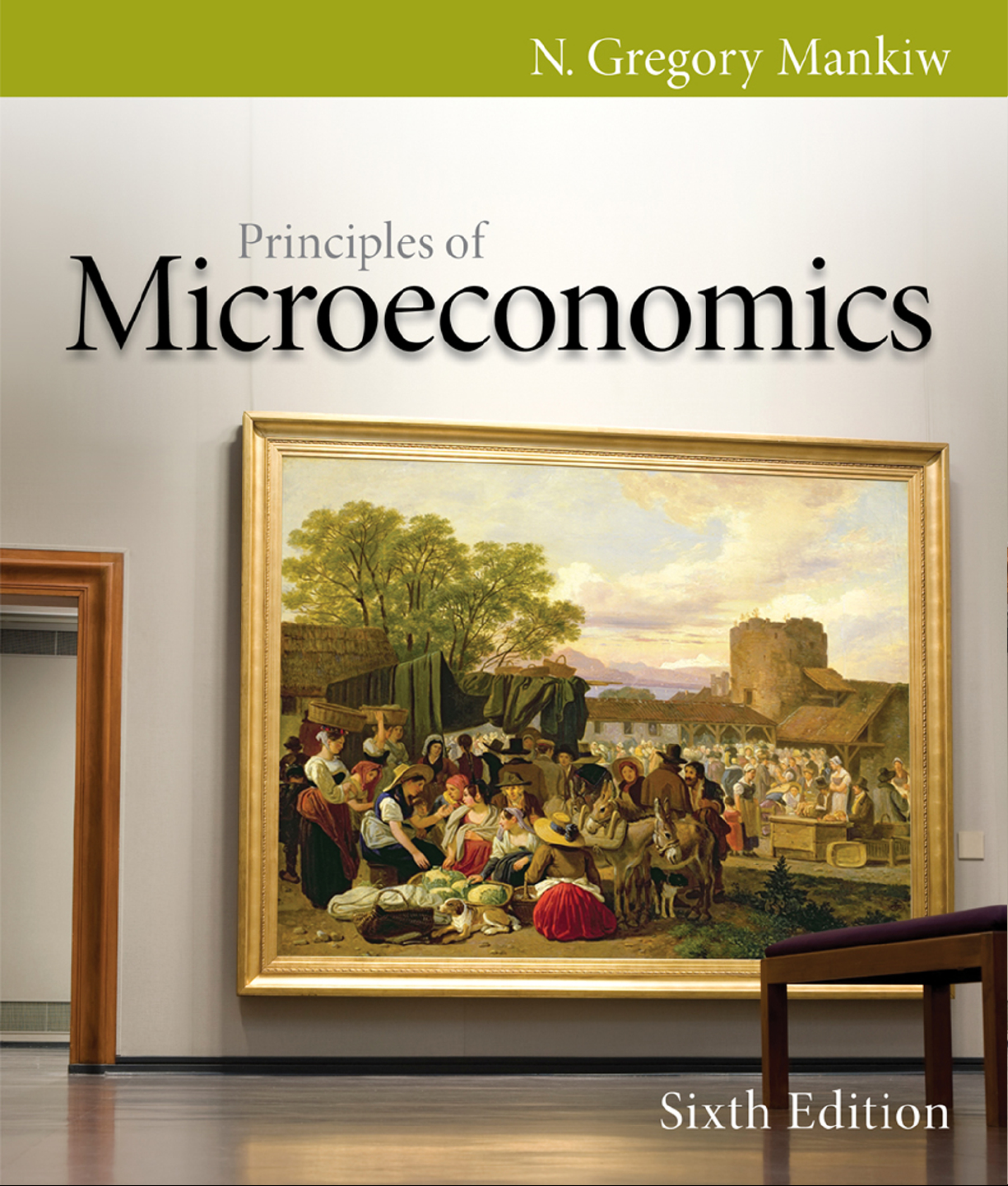
Editorial review has deemed that any suppressed content does not materially affect the overall learning experience. Cengage Learning reserves the right to remove additional content at any time if subsequent rights restrictions require it. Principles of Microeconomics Sixth Edition N. Gregory Mankiw HARVARD UNIVERSITY
Copyright 2011 Cengage Learning. All Rights Reserved. May not be copied, scanned, or duplicated, in whole or in part. Due to electronic rights, some third party content may be suppressed from the eBook and/or eChapter(s).
Editorial review has deemed that any suppressed content does not materially affect the overall learning experience. Cengage Learning reserves the right to remove additional content at any time if subsequent rights restrictions require it.
Principles of Microeconomics, 6E
© 2012, 2009 South-Western, Cengage Learning N. Gregory Mankiw
ALL RIGHTS RESERVED. No part of this work covered by the copyright
Vice President of Editorial, Business:
herein may be reproduced, transmitted, stored, or used in any form Jack W. Calhoun
or by any means graphic, electronic, or mechanical, including but not
Editor-in-Chief: Joseph Sabatino
limited to photocopying, recording, scanning, digitizing, taping, web
distribution, information networks, or information storage and retrieval Executive Editor: Mike Worls
systems, except as permitted under Section 107 or 108 of the 1976
Developmental Editor: Jane Tufts
United States Copyright Act, without the prior written permission
Contributing Editors: Jennifer E. Thomas of the publisher. and Katie Trotta
Editorial Assistant: Allyn Bissmeyer
For product information and technology assistance, contact us at
Senior Marketing Manager: John Carey
Cengage Learning Customer & Sales Support, 1-800-354-9706
Associate Marketing Manager: Betty Jung
For permission to use material from this text or product,
submit all requests online at www.cengage.com/permissions
Senior Content Project Manager:
Further permissions questions can be emailed to Colleen A. Farmer
permissionrequest@cengage.com Media Editor: Sharon Morgan
Senior Frontlist Buyer, Manufacturing:
ExamView® is a registered trademark of eInstruction Corp. Windows Kevin Kluck
is a registered trademark of the Microsoft Corporation used herein
Senior Marketing Communications Manager:
under license. Macintosh and Power Macintosh are registered Sarah Greber
trademarks of Apple Computer, Inc. used herein under license.
© 2008 Cengage Learning. All Rights Reserved. Production Service: Cadmus
Senior Art Director: Michelle Kunkler
Library of Congress Control Number: 2010941870
Cover and Internal Designer: Ke Design
Cengage Learning WebTutorTM is a trademark of Cengage Learning.
Internal Illustrations: Larry Moore
Cover Image: © Chalmers Bequest, Hackney ISBN 13: 978-0-538-45304-2
Art Gallery, UK / Bridgeman Art Library ISBN 10: 0-538-45304-4
International; © marc fischer / iStockphoto
Rights Acquisitions Specialist, Photos: John Hill
South-Western Cengage Learning 5191 Natorp Boulevard Mason, OH 45040 USA
Cengage Learning products are represented in Canada by Nelson Education, Ltd.
For your course and learning solutions, visit www.cengage.com
Purchase any of our products at your local college store or at our
preferred online store www.cengageBrain.com
Printed in the United States of America 1 2 3 4 5 6 7 14 13 12 11
Copyright 2011 Cengage Learning. All Rights Reserved. May not be copied, scanned, or duplicated, in whole or in part. Due to electronic rights, some third party content may be suppressed from the eBook and/or eChapter(s).
Editorial review has deemed that any suppressed content does not materially affect the overall learning experience. Cengage Learning reserves the right to remove additional content at any time if subsequent rights restrictions require it.
To Catherine, Nicholas, and Peter,
my other contributions to the next generation
Copyright 2011 Cengage Learning. All Rights Reserved. May not be copied, scanned, or duplicated, in whole or in part. Due to electronic rights, some third party content may be suppressed from the eBook and/or eChapter(s).
Editorial review has deemed that any suppressed content does not materially affect the overall learning experience. Cengage Learning reserves the right to remove additional content at any time if subsequent rights restrictions require it. abou au t the thor
N. Gregory Mankiw is professor of economics at
Harvard University. As a student, he studied eco-
nomics at Princeton University and MIT. As a teach-
er, he has taught macroeconomics, microeconomics,
statistics, and principles of economics. He even
spent one summer long ago as a sailing instructor on Long Beach Island.
Professor Mankiw is a prolific writer and a regu-
lar participant in academic and policy debates. His
work has been published in scholarly journals, such
as the American Economic Review, Journal of Political
Economy, and Quarterly Journal of Economics, and in
more popular forums, such as The New York Times
and The Wall Street Journal. He is also author of
the best-selling intermediate-level textbook Macroeconomics (Worth Publishers).
In addition to his teaching, research, and writing, Professor Mankiw has been a
research associate of the National Bureau of Economic Research, an adviser to the
Congressional Budget Office and the Federal Reserve Banks of Boston and New
York, and a member of the ETS test development committee for the Advanced
Placement exam in economics. From 2003 to 2005, he served as chairman of the
President’s Council of Economic Advisers.
Professor Mankiw lives in Wellesley, Massachusetts, with his wife, Deborah,
three children, Catherine, Nicholas, and Peter, and their border terrier, Tobin. vi
Copyright 2011 Cengage Learning. All Rights Reserved. May not be copied, scanned, or duplicated, in whole or in part. Due to electronic rights, some third party content may be suppressed from the eBook and/or eChapter(s).
Editorial review has deemed that any suppressed content does not materially affect the overall learning experience. Cengage Learning reserves the right to remove additional content at any time if subsequent rights restrictions require it. brief contents Part I Introduction 1
Part V Firm Behavior and the Organization of Industry 257
1 Ten Principles of Economics 3
13 The Costs of Production 259
2 Thinking Like an Economist 21
14 Firms in Competitive Markets 279
3 Interdependence and the Gains from Trade 49 15 Monopoly 299
16 Monopolistic Competition 329 17 Oligopoly 349 Part II How Markets Work 63
4 The Market Forces of Supply and Demand 65
5 Elasticity and Its Application 89
Part VI The Economics of Labor Markets 373
6 Supply, Demand, and Government Policies 111
18 The Markets for the Factors of Production 375
19 Earnings and Discrimination 397
20 Income Inequality and Poverty 415
Part III Markets and Welfare 133
7 Consumers, Producers, and the Efficiency of Markets 135
8 Application: The Costs of Taxation 155
Part VII Topics for Further Study 437
9 Application: International Trade 171
21 The Theory of Consumer Choice 439
22 Frontiers of Microeconomics 467
Part IV The Economics of the Public Sector 193 10 Externalities 195
11 Public Goods and Common Resources 217
12 The Design of the Tax System 233 vii
Copyright 2011 Cengage Learning. All Rights Reserved. May not be copied, scanned, or duplicated, in whole or in part. Due to electronic rights, some third party content may be suppressed from the eBook and/or eChapter(s).
Editorial review has deemed that any suppressed content does not materially affect the overall learning experience. Cengage Learning reserves the right to remove additional content at any time if subsequent rights restrictions require it.
Copyright 2011 Cengage Learning. All Rights Reserved. May not be copied, scanned, or duplicated, in whole or in part. Due to electronic rights, some third party content may be suppressed from the eBook and/or eChapter(s).
Editorial review has deemed that any suppressed content does not materially affect the overall learning experience. Cengage Learning reserves the right to remove additional content at any time if subsequent rights restrictions require it. preface to the student
E“conomics is a study of mankind in the ordinary business of life.” So
wrote Alfred Marshall, the great 19th-century economist, in his textbook,
Principles of Economics. Although we have learned much about the economy
since Marshall’s time, this definition of economics is as true today as it
was in 1890, when the first edition of his text was published.
Why should you, as a student at the beginning of the 21st century, embark on
the study of economics? There are three reasons.
The first reason to study economics is that it will help you understand the
world in which you live. There are many questions about the economy that might
spark your curiosity. Why are apartments so hard to find in New York City? Why
do airlines charge less for a round-trip ticket if the traveler stays over a Saturday
night? Why is Johnny Depp paid so much to star in movies? Why are living stan-
dards so meager in many African countries? Why do some countries have high
rates of inflation while others have stable prices? Why are jobs easy to find in
some years and hard to find in others? These are just a few of the questions that a
course in economics will help you answer.
The second reason to study economics is that it will make you a more astute
participant in the economy. As you go about your life, you make many economic
decisions. While you are a student, you decide how many years to stay in school.
Once you take a job, you decide how much of your income to spend, how much
to save, and how to invest your savings. Someday you may find yourself running
a small business or a large corporation, and you will decide what prices to charge
for your products. The insights developed in the coming chapters will give you
a new perspective on how best to make these decisions. Studying economics will
not by itself make you rich, but it will give you some tools that may help in that endeavor.
The third reason to study economics is that it will give you a better understand-
ing of both the potential and the limits of economic policy. Economic questions
are always on the minds of policymakers in mayors’ offices, governors’ mansions,
and the White House. What are the burdens associated with alternative forms of
taxation? What are the effects of free trade with other countries? What is the best
way to protect the environment? How does a government budget deficit affect
the economy? As a voter, you help choose the policies that guide the allocation of
society’s resources. An understanding of economics will help you carry out that
responsibility. And who knows: Perhaps someday you will end up as one of those policymakers yourself.
Thus, the principles of economics can be applied in many of life’s situations.
Whether the future finds you reading the newspaper, running a business, or sit-
ting in the Oval Office, you will be glad that you studied economics. N. Gregory Mankiw December 2010 ix
Copyright 2011 Cengage Learning. All Rights Reserved. May not be copied, scanned, or duplicated, in whole or in part. Due to electronic rights, some third party content may be suppressed from the eBook and/or eChapter(s).
Editorial review has deemed that any suppressed content does not materially affect the overall learning experience. Cengage Learning reserves the right to remove additional content at any time if subsequent rights restrictions require it. Experience Mankiw
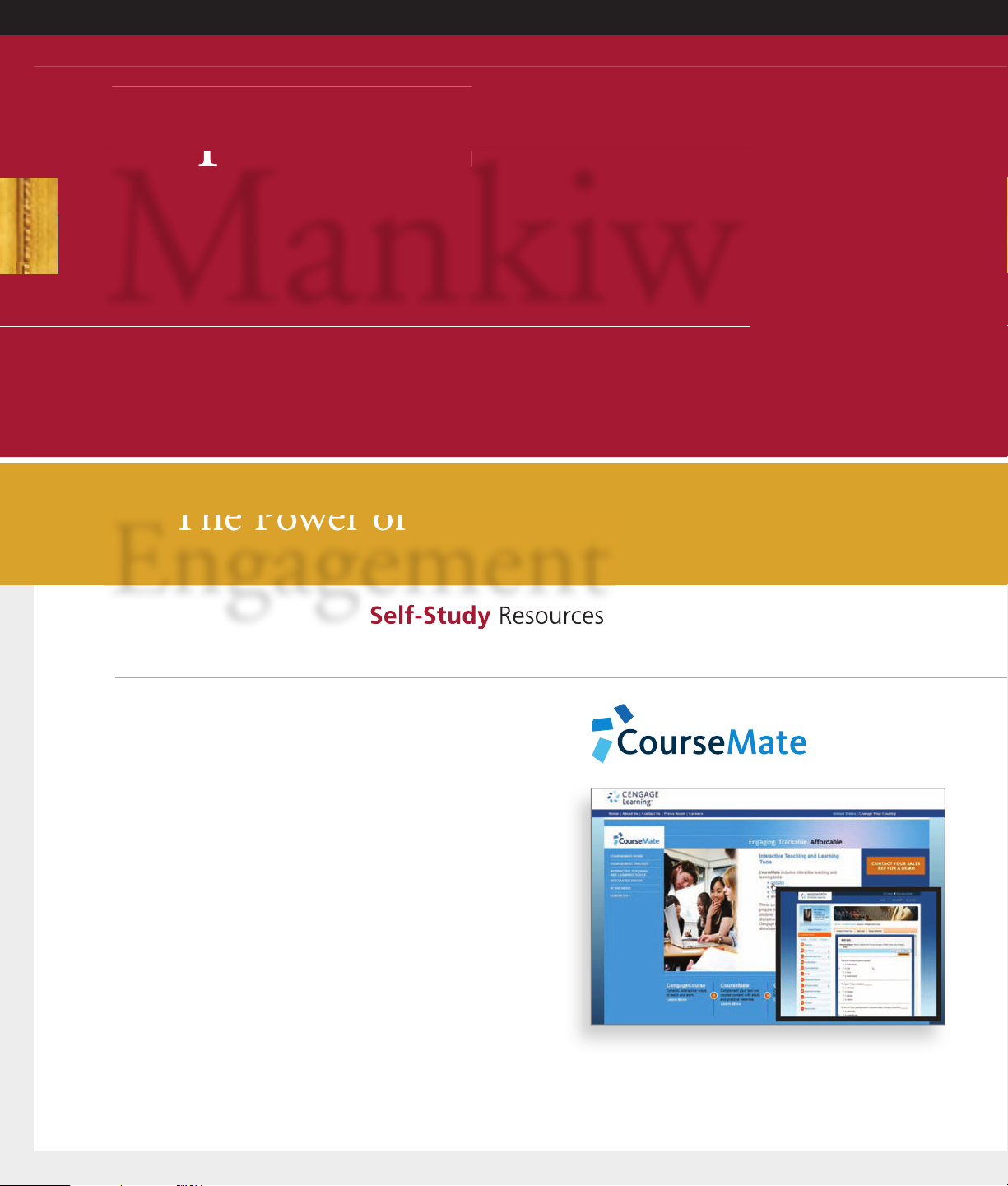
The Art of Instruction, The Power of Engagement, The Spark of Discovery The Power of Engagement Self-Study Resources
I n t e r a c t I v e Q u I z z I n g , v I d e o s a n d M o r e !
Economics CourseMate: Engaging, Trackable, Affordable
Economics CourseMate brings course concepts to life with interactive
learning and study tools that support the printed textbook. Economics
CourseMate goes beyond the book to deliver what you need! InteractIve LearnIng tooLs:
Economics CourseMate includes interactive learning tools including: • Quizzes • Flashcards • Videos • Graphing Tutorials • News, Debates, and Data InteractIve eBook:
In addition to interactive learning tools, Economics CourseMate
includes an interactive eBook. You can take notes, highlight, search
and interact with embedded media specific to your book. Use it as
a supplement to the printed text, or as a substitute—the choice is up to you with CourseMate.
To purchase access to CourseMate and these interactive tools, visit www.cengagebrain.com.
Copyright 2011 Cengage Learning. All Rights Reserved. May not be copied, scanned, or duplicated, in whole or in part. Due to electronic rights, some third party content may be suppressed from the eBook and/or eChapter(s).
Editorial review has deemed that any suppressed content does not materially affect the overall learning experience. Cengage Learning reserves the right to remove additional content at any time if subsequent rights restrictions require it.
Maximize your efforts — and results — when you
Experience Mankiw’s engaging learning tools. With
Economics CourseMate, you’ll quickly reinforce
chapter concepts and sharpen your skills with
interactive, hands-on applications online.
If a printed Study Guide better suits your needs
and study habits, the Mankiw 6e Study Guide
is unsurpassed in its careful attention to accuracy,
concise language, and practice that enhances your study time. Mankiw 6e Study Guide
Completely revised for the Sixth Edition, this Study Guide covers chapter material comprehensively — and accurately. Very
hands-on, each chapter thoroughly covers the material in the corresponding chapter of Mankiw. Every key word and con-
cept is addressed within the Study Guide chapter — meaning you’ll feel confident that if you can do the study guide, you
will understand all of the material in that chapter of Mankiw.
The “types” of questions used in the Study Guide reflect what you find most useful when studying. Our student surveys
show that students like you felt that fill-in-the-blank questions, matching questions, and questions without specific single
answers were an inefficient use of their time — and the Mankiw Study Guide avoids these kinds of questions.
To purchase a study guide, visit www.cengagebrain.com. xi
Copyright 2011 Cengage Learning. All Rights Reserved. May not be copied, scanned, or duplicated, in whole or in part. Due to electronic rights, some third party content may be suppressed from the eBook and/or eChapter(s).
Editorial review has deemed that any suppressed content does not materially affect the overall learning experience. Cengage Learning reserves the right to remove additional content at any time if subsequent rights restrictions require it. acknowledgments
In writing this book, I benefited from the input of many talented people. Indeed, the
list of people who have contributed to this project is so long, and their contributions
so valuable, that it seems an injustice that only a single name appears on the cover.
Let me begin with my colleagues in the economics profession. The six editions
of this text and its supplemental materials have benefited enormously from their
input. In reviews and surveys, they have offered suggestions, identified challeng-
es, and shared ideas from their own classroom experience. I am indebted to them
for the perspectives they have brought to the text. Unfortunately, the list has be-
come too long to thank those who contributed to previous editions, even though
students reading the current edition are still benefiting from their insights.
Most important in this process have been Ron Cronovich (Carthage College)
and David Hakes (University of Northern Iowa). Ron and David, both dedicated
teachers, have served as reliable sounding boards for ideas and hardworking part-
ners with me in putting together the superb package of supplements.
For this new edition, the following diary reviewers recorded their day-to-day
experience over the course of a semester, offering detailed suggestions about how to improve the text.
Mark Abajian, San Diego Mesa College
Rita Callahan, Keiser University
Jennifer Bailly, Long Beach City College
Tina Collins, San Joaquin Valley College
J. Ulyses Balderas, Sam Houston State
Bob Holland, Purdue University University
Tom Holmes, University of Minnesota
Antonio Bos, Tusculum College
Simran Kahai, John Carroll University
Greg Brock, Georgia Southern
Miles Kimball, University of Michigan University
Jason C. Rudbeck, University of Georgia
Donna Bueckman, University of
Kent Zirlott, University of Alabama Tennessee Knoxville Tuscaloosa
The following reviewers of the fifth edition provided suggestions for refining
the content, organization, and approach in the sixth.
Mark Abajian, San Diego Mesa College
Daren Conrad, Bowie State University
Hamid Bastin, Shippensburg University
Diane de Freitas, Fresno City College
Laura Jean Bhadra, Northern Virginia
Veronika Dolar, Cleveland State Community College University
Benjamin Blair, Mississippi State
Justin Dubas, Texas Lutheran University University
Lane Boyte, Troy University
Robert L Holland, Purdue University
Greg Brock, Georgia Southern University
Andres Jauregui, Columbus State
Andrew Cassey, Washington State University University
Miles Kimball, University of Michigan
Joni Charles, Texas State University -
Andrew Kohen, James Madison San Marcos University xii
Copyright 2011 Cengage Learning. All Rights Reserved. May not be copied, scanned, or duplicated, in whole or in part. Due to electronic rights, some third party content may be suppressed from the eBook and/or eChapter(s).
Editorial review has deemed that any suppressed content does not materially affect the overall learning experience. Cengage Learning reserves the right to remove additional content at any time if subsequent rights restrictions require it. ACKNOWLEDGMENTS xiii
Daniel Lee, Shippensburg University
Jeff Rubin, Rutgers University, New
David Lindauer, Wellesley College Brunswick
Joshua Long, Ivy Tech Community College
Lynda Rush, California State
James Makokha, Collin College
Polytechnic University Pomona
Jim McAndrew, Luzerne County
Naveen Sarna, Northern Virginia Community College Community College
William Mertens, University of Colorado
Jesse Schwartz, Kennesaw State
Cindy Munson, Western Technical University College
Mark Showalter, Brigham Young
David Mushinski, Colorado State University University
Michael Tasto, Southern New
Fola Odebunmi, Cypress College Hampshire University
I received detailed feedback on specific elements in the text, including all end-
of-chapter problems and applications, from the following instructors.
Mark Abajian, San Diego Mesa College
Christian Beer, Cape Fear Community
Afolabi Adebayo, University of New College Hampshire
Gary Bennett, State University of New
Mehdi Afiat, College of Southern York Fredonia Nevada
Bettina Berch, Borough of Manhattan
Douglas Agbetsiafa, Indiana University Community College South Bend
Thomas M. Beveridge, Durham
Richard Agnello, University of
Technical Community College Delaware
Abhijeet Bhattacharya, Illinois Valley
Henry Akian, Gibbs College Community College
Constantine Alexandrakis, Hofstra
Prasad Bidarkota, Florida International University University
Michelle Amaral, University of the
Jekab Bikis, Dallas Baptist University Pacific
Michael Bognanno, Temple University
Shahina Amin, University of Northern
Cecil Bohanon, Ball State University Iowa
Natalia Boliari, Manhattan College
Larry Angel, South Seattle Community
Melanie Boyte, Troy University College
Charles Braymen, Kansas State
Kathleen Arano, Fort Hays State
William Brennan, Minnesota State University University at Mankato
J. J. Arias, Georgia College & State
Greg Brock, Georgia Southern University University
Nestor Azcona, Babson College
Ken Brown, University of Northern
Steve Balassi, St. Mary’s College/Napa Iowa Valley College
Laura Bucila, Texas Christian
Juventino Ulyses Balderas, Sam University
Houston State University
Stan Buck, Huntington University
Tannista Banerjee, Purdue University
Donna Bueckman, University of
Jason Barr, Rutgers University, Newark Tennessee Knoxville
Alan Barreca, Tulane University
Joe Bunting, St. Andrews Presbyterian
Hamid Bastin, Shippensburg University College
Tammy Batson, Northern Illinois
Rita Callahan, Keiser University
University / Rock Valley College
Michael G. Carew, Baruch College
Carl Bauer, Oakton Community College
John Carter, Modesto Junior College
Klaus Becker, Texas Tech University
Kalyan Chakraborty, Emporia State
Robert Beekman, University of Tampa University
Copyright 2011 Cengage Learning. All Rights Reserved. May not be copied, scanned, or duplicated, in whole or in part. Due to electronic rights, some third party content may be suppressed from the eBook and/or eChapter(s).
Editorial review has deemed that any suppressed content does not materially affect the overall learning experience. Cengage Learning reserves the right to remove additional content at any time if subsequent rights restrictions require it. xiv ACKNOWLEDGMENTS
Henry Check, Penn State University
David Furst, University of South Florida
Xudong Chen, Baldwin-Wallace College
Monica Galizzi, University of
Clifton M. Chow, Mass Bay Massachusetts Lowell Community College
Jean-Philippe Gervais, North Carolina
Tina Collins, San Joaquin Valley College State University
Valerie Collins, Sheridan College
Dipak Ghosh, Emporia State University
Sarah Cosgrove, University of
Bill Goffe, State University of New York Massachusetts Dartmouth Oswego
Dana Costea, Indiana University South
Ryan Gorka, University of Nebraska Bend Lincoln
Maria DaCosta, University of Wisconsin
Marshall Gramm, Rhodes College Eau Claire
Elias C. Grivoyannis, Yeshiva
Mian Dai, Drexel University University
Joel Dalafave, Bucks County
Eleanor Gubins, Rosemont College Community College
Darrin Gulla, University of Kentucky
Maylene Damoense, Monash
Karen Gulliver, Argosy University University South Africa
Ranganai Gwati, University of
Lorie Darche, Southwest Florida College Washington Seattle
Diane de Freitas, Fresno City College
Mike Haupert, University of Wisconsin
Ejigou Demissie, University of La Crosse Maryland Eastern Shore
L Jay Helms, University of California
Richard DePolt, Guilford Technical Davis Community College
Dr. David Hennessy, University of
Aaron Dighton, University of Dubuque Minnesota
Curry Hilton, Guilford Technical
Veronika Dolar, Cleveland State Community College University
George Hoffer, Virginia Commonwealth
Fisher Donna, Georgia Southern University University
Mark Holmes, University of Waikato
Harold Elder, University of Alabama
Carl Hooker, Community College of
Jamie Emerson, Salisbury University Vermont
Elena Ermolenko, Oakton Community
Daniel Horton, Cleveland State University College
Scott Houser, Colorado School of the
Pat Euzent, University of Central Mines Florida
Fanchang Huang, Washington
Yan Feng, Hunter College, Queens University in St Louis College, CUNY
Gregory Hunter, California State
Donna K. Fisher, Georgia Southern
Polytechnic University Pomona University
Christopher Hyer, University of New
Paul Fisher, Henry Ford Community Mexico College
Leke Ijiyode, St. Mary’s University of
Fred Foldvary, Santa Clara University Minnesota
Nikki Follis, Chadron State College
Chris Inama, Golden Gate University
Kent Ford, State University of New York /
Sarbaum Jeff, University of North
Onondaga Community College Carolina Greensboro
Ryan Ford, Pasadena City College
Chad Jennings, Tennessee Temple
Timothy Ford, California State University University Sacramento
Philipp Jonas, Kalamazoo Valley
Johanna Francis, Fordham University Community College
Robert Francis, Shoreline Community
Robert Jones, Rensselaer Polytechnic College Institute
Mark Frascatore, Clarkson University
Prathibha Joshi, Gordon College
Copyright 2011 Cengage Learning. All Rights Reserved. May not be copied, scanned, or duplicated, in whole or in part. Due to electronic rights, some third party content may be suppressed from the eBook and/or eChapter(s).
Editorial review has deemed that any suppressed content does not materially affect the overall learning experience. Cengage Learning reserves the right to remove additional content at any time if subsequent rights restrictions require it. ACKNOWLEDGMENTS xv
James Jozefowicz, Indiana University of
Frances Mc Donald, Northern Virginia Pennsylvania Community College
Mahbubul Kabir, Lyon College
Edward McGrath, Holyoke Community
Simran Kahai, John Carroll University College
David Kalist, Shippensburg University
Shirley Ann Merchant, George
Camilla Kazimi, St. Mary’s College Washington University
Chris Kelton, Naval Postgraduate School
William Mertens, University of
Brian Kench, University of Tampa Colorado
Hyeongwoo Kim, Auburn University
Mitch Mitchell, Bladen Community College
Miles Kimball, University of Michigan
Mitch Mitchell, North Carolina Wesleyan
Alfreda L. King, Lawson State
Mike Mogavero, University of Notre Community College Dame
Elizabeth Knowles, –Univeristy of
Prof Ramesh Mohan, Bryant University Wisconsin La Crosse
Daniel Monchuk, University of
Fred Kolb, University of Wisconsin Eau Southern Mississippi Claire
Vasudeva Murthy, Creighton University
Risa Kumazawa, Duquesne University
David Mushinsk, Colorado State
Sumner La Croix, University of Hawaii University
Christopher Laincz, Drexel University
Paula Nas, University of Michigan Flint
Ghislaine Lang, San Jose State
Russ Neal, Collin County Community University College
Carolyn Langston, South Arkansas
Megumi Nishimura, University of Community College Colorado
Richard Le, Cosumnes River College
Peter Olson, Indiana University
Daniel Lee, Shippensburg University
Esen Onur, California State University
Tom Lehman, Indiana Wesleyan Sacramento University
Stephen Onyeiwu, Allegheny College
Megan Leonard, Hendrix College
Margaret Oppenheimer, DePaul
Larry Lichtenstein, Canisius College University
Tad Lincoln, Middlesex Community
Glenda Orosco, Oklahoma State College
University Institute of Technology
David Linthicum, Cecil College North
David Ortmeyer, Bentley University East
Thomas Owen, College of the Redwoods
Sam Liu, West Valley College
Jan Palmer, Ohio University
Melody Lo, University of Texas at San
Amar Parai, State University of New Antonio York at Fredonia
Volodymyr Logovskyy, Georgia
Nitin Paranjpe, Wayne State and Institute of Technology Oakland University
Min Lu, Robert Morris University
Carl Parker, Fort Hays State University
Gennady Lyakir, Champlain College
Michael Petrack, Oakland Community
Bruce Madariaga, Montgomery College Community College
Gyan Pradhan, Eastern Kentucky
Brinda Mahalingam, University of University California Riverside
Michael Pries, University of Notre Dame
Rubana Mahjabeen, Truman State
Joe Quinn, Boston College University
Mahesh Ramachandran, Clark
Bahman Maneshni, Paradise Valley University Community College
Ratha Ramoo, Diablo Valley College
Denton Marks, University of Wisconsin-
Surekha Rao, Indiana University Whitewater Northwest
Timothy Mathews, Kennesaw State
Ryan Ratcliff, University of San Diego University
Scott Redenius, Brandeis University
Copyright 2011 Cengage Learning. All Rights Reserved. May not be copied, scanned, or duplicated, in whole or in part. Due to electronic rights, some third party content may be suppressed from the eBook and/or eChapter(s).
Editorial review has deemed that any suppressed content does not materially affect the overall learning experience. Cengage Learning reserves the right to remove additional content at any time if subsequent rights restrictions require it. xvi ACKNOWLEDGMENTS
Susan Reilly, Florida State College at
Dosse Toulaboe, Fort Hays State Jacksonville University
Imke Reimers, University of Minnesota
Richard Trainer, State University of
Christopher Richardson, Merrillville New York at Nassau High School
Ngoc Bich Tran, San Jacinto College
Art Riegal, State University of New
Sandra Trejos, Clarion University of York Sullivan Pennsylvania
Richard Risinit, Middlesex Community
Julie Trivitt, Arkansas Tech University College
Arja Turunen-Red, University of New
Michael Rogers, Albany State Orleans University
Diane Tyndall, Craven Community
Paul Roscelli, Canada College College
Larry Ross, University of Alaska
Kay Unger, University of Montana Anchorage
Lee J. Van Scyoc, University of
Jeff Rubin, Rutgers University Wisconsin Oshkosh
Allen Sanderson, University of Chicago
Lisa Verissimo-Bates, Foothill College
Jeff Sarbaum, University of North
Priti Verma, Texas A&M University, Carolina Greensboro Kingsville
Dennis Shannon, Southwestern Illinois
Patrick Walsh, St. Michael’s College College
Jing Wang, Northeastern University
Xuguang Sheng, State University of
Donald Waters, Brayant and Stratton New York at Fredonia
College, Virginia Beach, Virgina
Mark Showalter, Brigham Young Campus University
Patrick Welle, Bemidji State University
Johnny Shull, Central Carolina
Elizabeth Wheaton, Southern Methodist Community College University
Suann Shumaker, Las Positas
Luther White, Central Carolina Community College Community College
Jonathan Silberman, Oakland University
Oxana Wieland, University of
Steven Skinner, Western Connecticut Minnesota Crookston State University
John Winters, Auburn University at
Catherine Skura, Sandhills Community Montgomery College
Suzanne Wisniewski, University of
Gary Smith, D’Youville College St. Thomas
Warren Smith, Keiser University
Patricia Wiswell, Columbia-Greene
William Snyder, Peru State College Community College
Ken Somppi, Southern Union State
Mark Witte, College of Charleston Community College
Louis A. Woods, University of North
Dale Steinreich, Drury University Florida
Liliana Stern, Auburn University
Guy Yamashiro, California State
Derek Stimel, Menlo College University Long Beach
Carolyn Fabian Stumph, Indiana
Benhua Yang, Stetson University
University Purdue University Fort Wayne
Leslie Young, Kilian Community
Bryce Sutton, University of Alabama at College Birmingham
Karen Zempel, Bryant and Stratton
Justin Tapp, Southwest Baptist University College
Copyright 2011 Cengage Learning. All Rights Reserved. May not be copied, scanned, or duplicated, in whole or in part. Due to electronic rights, some third party content may be suppressed from the eBook and/or eChapter(s).
Editorial review has deemed that any suppressed content does not materially affect the overall learning experience. Cengage Learning reserves the right to remove additional content at any time if subsequent rights restrictions require it. ACKNOWLEDGMENTS xvii
The team of editors who worked on this book improved it tremendously. Jane
Tufts, developmental editor, provided truly spectacular editing—as she always
does. Mike Worls, economics executive editor, did a splendid job of overseeing the
many people involved in such a large project. Jennifer Thomas (supervising devel-
opmental editor) and Katie Yanos (supervising developmental editor) were crucial
in assembling an extensive and thoughtful group of reviewers to give me feed-
back on the previous edition, while putting together an excellent team to revise the
supplements. Colleen Farmer, senior content project manager, and Malvine Litten,
project manager, had the patience and dedication necessary to turn my manu-
script into this book. Michelle Kunkler, senior art director, gave this book its clean,
friendly look. Larry Moore, the illustrator, helped make the book more visually
appealing and the economics in it less abstract. Sheryl Nelson, copyeditor, refined
my prose, and Cindy Kerr, indexer, prepared a careful and thorough index. John
Carey, senior marketing manager, worked long hours getting the word out to po-
tential users of this book. The rest of the Cengage team was also consistently pro-
fessional, enthusiastic, and dedicated: Allyn Bissmeyer, Darrell Frye, Sarah Greber,
Betty Jung, Deepak Kumar, Kim Kusnerak, Sharon Morgan, Suellen Ruttkay, and Joe Sabatino.
I am grateful also to Stacy Carlson and Daniel Norris, two star Harvard under-
graduates, who helped me refine the manuscript and check the page proofs for
this edition. Josh Bookin, a former Advanced Placement economics teacher and
recently an extraordinary section leader for Harvard’s Ec 10, gave invaluable
advice on some of the new material in this edition.
As always, I must thank my “in-house” editor Deborah Mankiw. As the first
reader of most things I write, she continued to offer just the right mix of criticism and encouragement.
Finally, I would like to mention my three children Catherine, Nicholas, and
Peter. Their contribution to this book was putting up with a father spending too
many hours in his study. The four of us have much in common—not least of
which is our love of ice cream (which becomes apparent in Chapter 4). Maybe
sometime soon one of them will pick up my passion for economics as well. N. Gregory Mankiw December 2010
Copyright 2011 Cengage Learning. All Rights Reserved. May not be copied, scanned, or duplicated, in whole or in part. Due to electronic rights, some third party content may be suppressed from the eBook and/or eChapter(s).
Editorial review has deemed that any suppressed content does not materially affect the overall learning experience. Cengage Learning reserves the right to remove additional content at any time if subsequent rights restrictions require it. table of contents
Preface: To the Student ix
FYI: Adam Smith and the Invisible Hand 12 Acknowledgments xii
How the Economy as a Whole Works 13
Principle 8: A Country’s Standard of Living Depends on Its
Ability to Produce Goods and Services 13
In The News: Why You Should Study Economics 14
Principle 9: Prices Rise When the Government Prints Too Much Money 15
Principle 10: Society Faces a Short-Run Trade-off between Inflation and Unemployment 16
FYI: How to Read This Book 17 Conclusion 17 Chapter 2 thinking Like an Economist 21
The Economist as Scientist 22
The Scientific Method: Observation, Theory, and More Observation 22 The Role of Assumptions 23 Economic Models 24
Our First Model: The Circular-Flow Diagram 24
Our Second Model: The Production Possibilities Frontier 26 PartI Introduction 1
Microeconomics and Macroeconomics 29
The Economist as Policy Adviser 29
FYI: Who Studies Economics? 30 Chapter 1
Positive versus Normative Analysis 30 Economists in Washington 31 ten Principles of Economics 3
In The News: The Economics of President Obama 32
How People Make Decisions 4
Why Economists’ Advice Is Not Always Followed 32
Principle 1: People Face Trade-offs 4
Principle 2: The Cost of Something Is What You Give
Why Economists Disagree 34 Up to Get It 5
Differences in Scientific Judgments 34
Principle 3: Rational People Think at the Margin 6 Differences in Values 34
Principle 4: People Respond to Incentives 7 Perception versus Reality 35
Case Study: The Incentive Effects of Gasoline Prices 8 Let’s Get Going 35
In The News: Incentive Pay 9
In The News: Environmental Economics 37 How People Interact 10
APPENDIX Graphing: A Brief Review 40
Principle 5: Trade Can Make Everyone Better Off 10 Graphs of a Single Variable 40
Principle 6: Markets Are Usually a Good Way to Organize
Graphs of Two Variables: The Coordinate System 41 Economic Activity 10
Curves in the Coordinate System 42
Principle 7: Governments Can Sometimes Improve Market Slope 44 Outcomes 11 Cause and Effect 46 xviii
Copyright 2011 Cengage Learning. All Rights Reserved. May not be copied, scanned, or duplicated, in whole or in part. Due to electronic rights, some third party content may be suppressed from the eBook and/or eChapter(s).
Editorial review has deemed that any suppressed content does not materially affect the overall learning experience. Cengage Learning reserves the right to remove additional content at any time if subsequent rights restrictions require it.
Tài liệu liên quan:
-

Ung dung game hoa trong cac chien dich MKT
23 12 -
Bao cao Chi so TMDT Viet Nam 2025
26 13 -
Thông tư quy định về việc phân quyền, phân cấp và phân định thẩm quyền quản lý nhà nước về giáo dục cho chính quyền địa phương
30 15 -
Nghị quyết về phát huy các giá trị di sản văn hóa gắn với phát triên du lịch bền vững tỉnh Khánh Hòa đến năm 2025, định hướng đến năm 2030
26 13 -
Quyết định phê duyệt Chiến lược phát triển du lịch Việt Nam đến năm 2030
16 8