NLKT CHƯƠNG 1 NLKT CHƯƠNG 1 NLK
Nlkt
Môn: Nguyên lý kế toán(1111) 179 tài liệu
Trường: Trường Đại học Kinh Tế Quốc Dân 8.8 K tài liệu
Tác giả:












Preview text:
ACCOUNTING PRINCIPLES NGUYEN LA SOA SAA 1-1 Accounting Principles 1. Accounting in action; 2. The recording Process 3. Adjusting the Accounts
4. Completing the Accounting Cycle
5. Accounting for merchandising Operations 6. Inventories 7. Accounting for receivables
8. Plan Assets, Natural resources and intangible Assets 9. Accounting for Liabilities
10. Corporations: Organization; capital Stock Transactions; dividents,
retained earnings and income reporting 1-2 Accounting in Action Learning Objectives 1 Iden e tify y t he a ctivi v ties s a nd d u sers r a ssoc o iat a ed e w ith a ccou o n u titng n . g 2
Explain the building blocks of accounting: ethics, principles, and assumptions. 3
State the accounting equation, and define its components. 4
Analyze the effects of business transactions on the accounting equation.
Describe the four financial statements and how they are 5 prepared. 1-3 LEARNING
Identify the activities and users 1 OBJECTIVE associated with accounting.
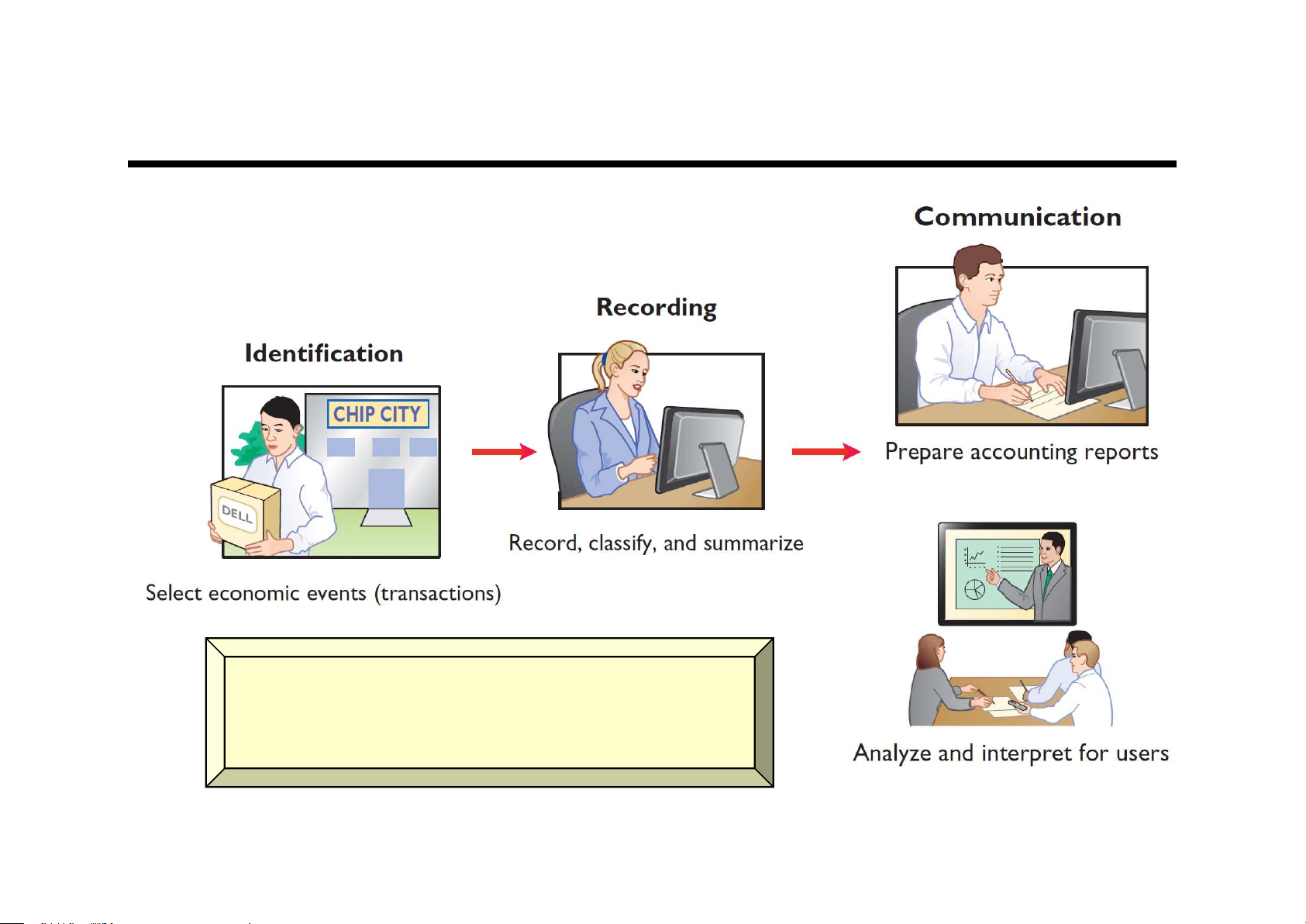
Accounting consists of three basic activities—it identifies, records, and communicates
the economic events of an organization to interested users. 1-4 LO 1 Three Activities
The accounting process includes the bookkeeping function. 1-5 LO 1 Transaction
Illustration: Are the following events recorded in the accounting records? Discuss product Purchase Event computer design with Pay rent potential customer Criterion
Is the financial position (assets, liabilities, or owner’s
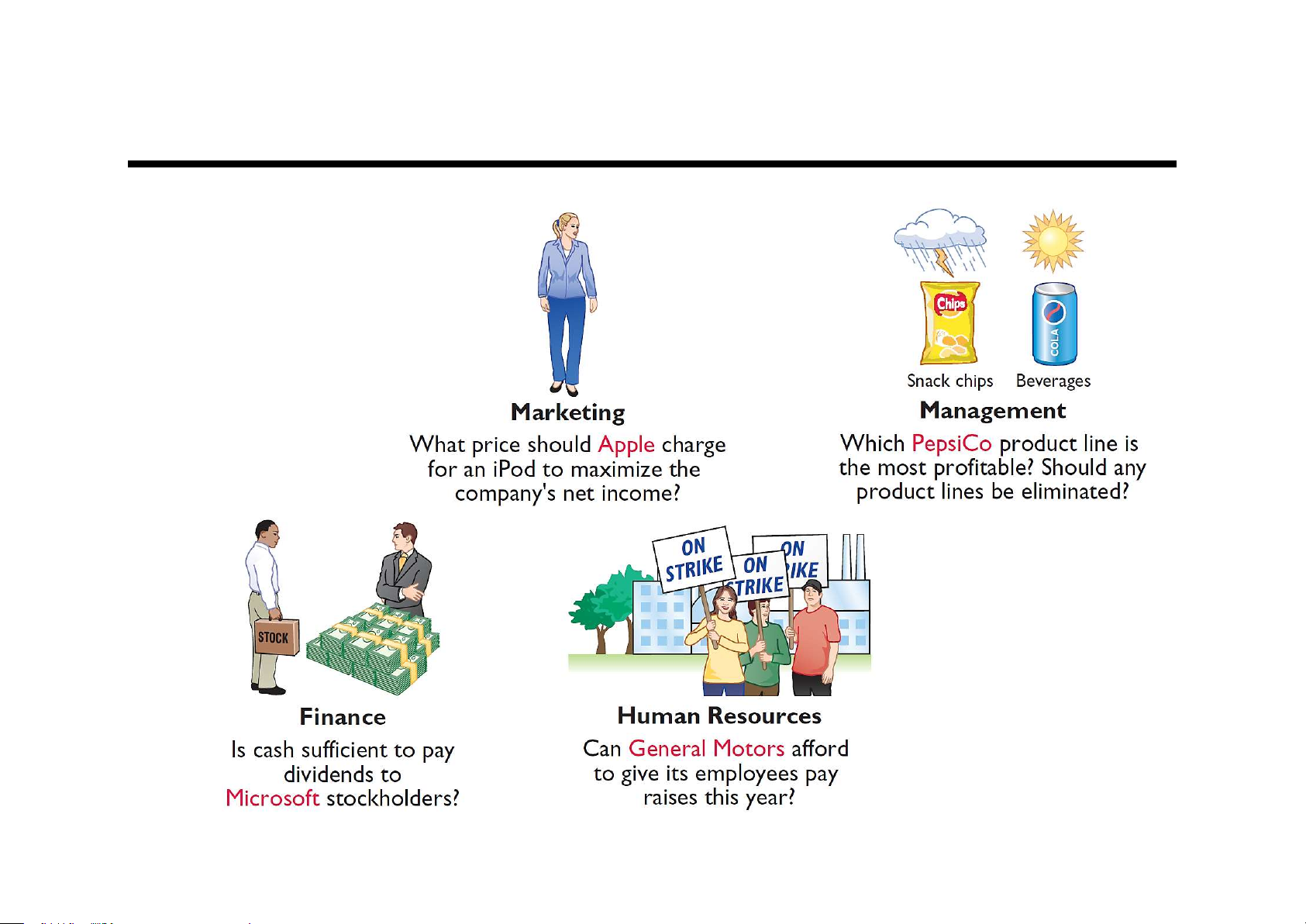
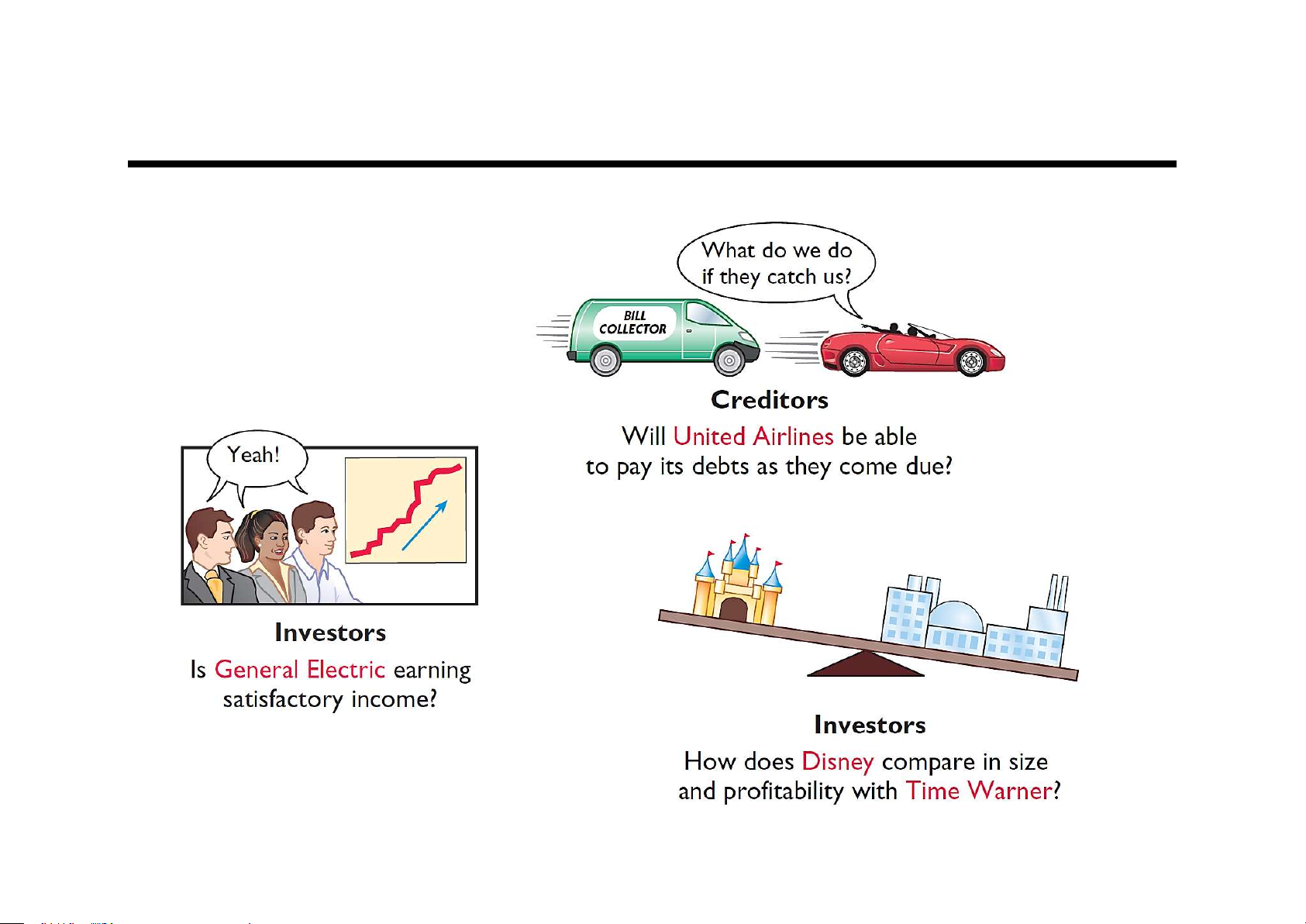
equity) of the company changed? Record/ Don’t Record 1-6 LO 4 Who Uses Accounting Data INTERNAL USERS 1-7 LO 1 Who Uses Accounting Data EXTERNAL USERS 1-8 LO 1 Aim of accounting:
To provide sufficient information for users to make informed business decisions: • Financial Accounting: External users Regulated • Management Accounting: Internal users Not regulated 1-9 LEARNING
Explain the building blocks of accounting: ethics, 2 OBJECTIVE principles, and assumptions. Ethics in Financial Reporting
Recent financial scandals include: Enron, WorldCom, HealthSouth, AIG, and other companies.
Regulators and lawmakers concerned that economy would suffer if
investors lost confidence in corporate accounting. In response, ►
Congress passed Sarbanes-Oxley Act (SOX).
Effective financial reporting depends on sound ethical behavior. 1-10 LO 2
Generally Accepted Accounting Principles Financial Statements Various users need Balance Sheet financial Income Statement information
Statement of Owner's Equity Statement of Cash Flows Note Disclosure The accounting profession has developed standards that are Generally Accepted generally accepted and Accounting Principles (GAAP) universally practiced. 1-11 LO 2
Generally Accepted Accounting Principles
Generally Accepted Accounting Principles (GAAP) – Standards that are
generally accepted and universally practiced. These standards indicate how to report economic events. Standard-setting bodies: ►
Financial Accounting Standards Board (FASB) ►
Securities and Exchange Commission (SEC) ►
International Accounting Standards Board (IASB) 1-12 LO 2 Measurement Principles
HISTORICAL COST PRINCIPLE (or cost principle) dictates that
companies record assets at their cost.
FAIR VALUE PRINCIPLE states that assets and liabilities should be
reported at fair value (the price received to sell an asset or settle a liability).
Selection of which principle to follow
generally relates to trade-offs between relevance and faithful representation. 1-13 LO 2 Assumptions
MONETARY UNIT ASSUMPTION requires that companies include in the
accounting records only transaction data that can be expressed in terms of money.
ECONOMIC ENTITY ASSUMPTION requires that activities of the entity
be kept separate and distinct from the activities of its owner and all other economic entities. Proprietorship Forms of Business Partnership Ownership Corporation 1-14 Forms of Business Ownership Proprietorship Partnership Corporation Owned by one person Owned by two or Ownership divided more persons into shares of Owner is often stock manager/operator Often retail and service-type Separate legal Owner receives any businesses entity organized profits, suffers any under state losses, and is Generally unlimited personally liable for personal liability corporation law all debts Limited liability Partnership agreement 1-15 LO 2 DO IT! 1 Basic Concepts
Indicate whether the following statements are true or false. 1.
The three steps in the accounting process are identification, recording, and communication.
2. Bookkeeping encompasses all steps in the accounting process.
3. Accountants prepare, but do not interpret, financial reports.
4. The two most common types of external users are investors and company officers.
5. Managerial accounting activities focus on reports for internal users. Solution: 1. 2. 3. 4. 5. 1-16 LO 1 Assumptions Question
Combining the activities of Kellogg and General Mills would violate the a. cost principle.
b. economic entity assumption. c. monetary unit assumption. d. ethics principle. 1-17 LO 2 Assumptions Question
A business organized as a separate legal entity under state law
having ownership divided into shares of stock is a a. proprietorship. b. partnership. c. corporation. d. sole proprietorship. 1-18 LO 2 DO IT! 2 Building Blocks of Accounting
Indicate whether each of the following statements presented below is true or false. 1.
Congress passed the Sarbanes-Oxley Act to reduce
unethical behavior and decrease the likelihood of future corporate scandals. 2.
The primary accounting standard-setting body in the
United States is the Financial Accounting Standards Board (FASB). 3.
The historical cost principle dictates that companies
record assets at their cost. In later periods, however,
the fair value of the asset must be used if fair value is higher than its cost. 1-19 LO 2 DO IT! 2 Building Blocks of Accounting
Indicate whether each of the following statements presented below is true or false.
4. A business owner’s personal expenses must be separated
from expenses of the business to comply with
accounting’s economic entity assumption. 1-20 LO 2