Ôn tập Ngữ pháp và Câu phức | Tiếng anh chuyên ngành 2 | Học viện Tài chính
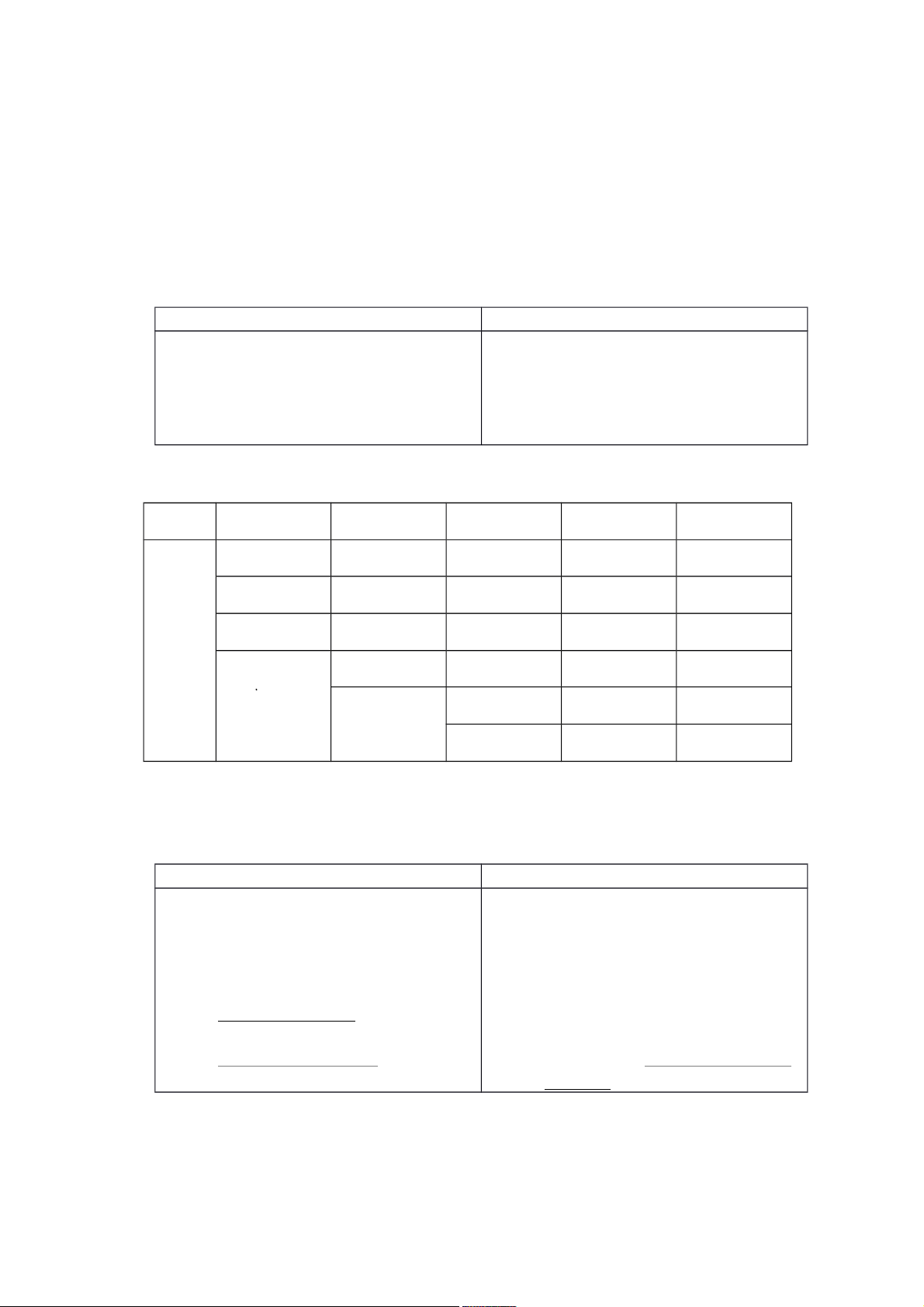
What are the post-modifiers of a complex noun phrase mainly realized by ? Post-modifier= of genitive The cover of the book The history of England Post-modifier=Adverbial The question below A car behind Post-modifier=Appositive noun phrase A new teacher, Mr Jones His friend , a doctor Post-modifier= Adj phrase The fruit common in Thailand Someone better than him Post-modifier= Prepositional phrase The girl from the poor village The food on the table Post-modifier= Finite clause The girl that I love The student who argue with the teacher Post-modifier= Non-finite clause The first contestant moving on to the next round My last attempt to apply for college. Tài liệu được sưu tầm và soạn thảo dưới dạng file PDF để gửi tới các bạn cùng tham khảo, ôn tập đầy đủ kiến thức, chuẩn bị cho các buổi học thật tốt. Mời bạn đọc đón xem!
Môn: Tiếng anh chuyên ngành 2 10 tài liệu
Trường: Học viện Tài chính 1.1 K tài liệu
Tác giả:















Preview text:
ĐỀ CƯƠNG NGỮ PHÁP
Lecture 1: Elements of grammar
1. Make a distinction between open-class items and closed-system items. Give examples. Open-class items Closed-system items
Cannot normally be extended Have the same grammatical by the creation of additional properties and structural members
possibilities as other members Reciprocally exclusive of the class Indefinitely extendable
E.g.: i, iii, and iv ('closed') and the number in ii and v (‘open’) i ii iii iv v (John) may sit by this fountain will state at that tree must read from window hurry along blackboard on girl path
2. Structurally, what is the difference between a finite and a non-finite clause? Give examples. Finite clause Non-finite clause
Its verbal element is a finite
Its verbal is a non-finite verb
verb, which show the tense and
form (to-V, Ved, Ving) , which the mood of the verb.
doesn’t show the tense and the Have subject of its own mood of the verb. E.g.:
The subject is normally that of
Although he tried, he couldn’t the whole sentence. pass the exam. E.g.:
While I was cooking, my mother
It is difficult to be there on time. came home.
Cooking is my favorite activity.
Lecture 2: Basic noun phrase
1. Name types of pronoun Pronoun Type
Members of the Subclass Example
Personal Subjective case
I, you, we, they, he, she, it I saw John yesterday.
Him, her, his, my, our, She should wait for Objective case your, its him. Possessive
mine, yours, his, hers, The white car is mine. ours, theirs
myself, yourself, himself, Reflexive
herself, itself, oneself, He injured himself ourselves, yourselves, playing football. themselves Reciprocal They really hate each each other, one another other. Relative
that, which, who, whose, The book that you gave whom, where, when me was really boring. Demonstrative
this, that, these, those This is a new car. Interrogative who, what, why, where, What did he say to you? when, whatever Indefinite anything, anybody, anyone, something, There's something in somebody, someone, no my shoe.
one,nothing, nobody, none
2. Structure of a basic noun phrase: Basic Noun Phrase Closed-system Pre-modifier(s) Head Noun(s) Pre-determiners Post-determiners Determiners
3. What are the syntactic function of a noun phrase ?
a) Common syntactic functions: S,O,C Subject (S) E.g.: My brother is a teacher. S Cs
Direct Object (Od) E.g.: They like football. S Od
Indirect Object (Oi)
E.g.: We gave our friend a book. S Oi Od
Subject complement (Cs) E.g.: My brother is a teacher. S Cs
Object complement (Co)
E.g.: They elected him their chairman. S Od Co
b) Minor functions:
Prepositional complement (Cprep.)
E.g.: On the way we look at it. Cprep Cprep
in the garden, on time, behind the chair Cprep Cprep Cprep
Note: Prepositional complement is also called object of preposition/ complement of preposition
Appositive (App.)
E.g.: My friend, a teacher, will come soon. App.
His boss, Mr. Andy, is very nice. App. Adverbial (A)
E.g.: Last week , we telephoned him. A (time) We met him yesterday. A (time)
Adjectival Complement (Cadj)
E.g.: The game isn't worth the candle. Cadj She is worth that prize. Cadj
Lecture 3: Complex noun phrase
1. Structure of a complex noun phrase ? Complex NPs Pre-modifiers Head N Post-modifiers Open-Class Closed-system Adj Verb Noun
2. What are the pre-modifiers of a complex noun phrase mainly realized by ?
Pre-modifiers=Adj phrase The pretty girl An exhausted worker
Pre-modifiers=Noun phrase The fashion show A lightning strike
Pre-modifier= ‘s genitive Susie’s car My brother’s house
Pre-modifier= sentence
Our we-won’t-give-up slogan
Her I-don’t-get-it answer
Pre-modifier= adverbial The then manager Her daily routine
Pre-modifier= Ing/ed participle A crying baby The stolen watch
Pre-modifier=Prepositional phrase The nearby store Before-the-scene videos
3. What are the post-modifiers of a complex noun phrase mainly realized by ?
Post-modifier= of genitive The cover of the book
The history of England
Post-modifier=Adverbial The question below A car behind
Post-modifier=Appositive noun phrase A new teacher, Mr Jones
His friend , a doctor
Post-modifier= Adj phrase
The fruit common in Thailand
Someone better than him
Post-modifier= Prepositional phrase
The girl from the poor village
The food on the table
Post-modifier= Finite clause The girl that I love
The student who argue with the teacher
Post-modifier= Non-finite clause
The first contestant moving on to the next round
My last attempt to apply for college
Lecture 4: Verbs & its complement
1. Name types of multi-word verb ?
There are 3 types of multi-word verbs: Phrasal , prepositional verbs and phrasal- prepositional verb. a) Phrasal verb
A phrasal verb consists of a verb and a particle, which is an adverb. Ex:
The chef threw down the knife The assistant chef took off.
The restaurant owner backed up the assistant chef.
b) Prepositional verb
A prepositional verb consists of a verb plus a particle, which is a preposition. Ex:
The chef relied on the assistant chef.
Visitors didn’t walk over the lawn.
c) Phrasal-prepositional verb
A phrasal-prepositional verb consists of a verb and 2 particles, adv followed by a preposition Ex:
My old friend makes up for lost time.
Lisa couldn’t catch up with her classmates.
2. Make distinction between a phrasal verb and a prepositional verb?
Movement: The prepositional verb accepts a relative pronoun after the preposition, thus we can have:
The minister on whom John relied.
The girl at whom he looked.
- Insertion of adjuncts: The prepositional verb allows an adverb to be placed between the verb and preposition.
John relied steadfastly on the minister.
He looked nervously at the girl.
- Reverse order of the adverb and the NP in the phrasal verb: The adverb in phrasal
verb can be placed before or after the direct object except when it is a pronoun while
the preposition in a prepositional verb always precedes the direct object.
John backed the Minister up.
Not: John relied the Minister on.
- Paraphrasing: Phrasal verbs can often (but not always) be replaced by a single word verb.
John hinted at the solution. ~ John suggested the solution.
3. What can complement in an intensive sentence (SVCs) be realized by ?
Cs = Noun phrases: a teacher of Russia, a good wife…… He has become a father. S V Cs Cs = Adjective phrases: John is fond of them. S V Cs
He is angry that they are late . S V Cs Cs = Nominal clause
The problem is that we have run out of money.
The question is whether he will come back in time for the game.
4. In an adjective phrase, what can adj be complemented by?/What can the adj
as subject complement (Cs) be complemented by ?
The adjective as Cs may be complemented by:
- A prepositional phrase:
She is very good at telling lies. Cadj
We were afraid of the dog.
- A to -infinitive clause:
I am glad to meet you again.
He was reluctant to agree with me.
- An ing-participle clause:
She was busy doing her homework.
This film is worth seeing twice. - A that clause:
+ With factual adjectives: certain, clear, great, likely, nice, obvious, possible, strange,
true, confident, aware, afraid…
I am afraid that you can’t come in.
I am confident that we will win.
+ With volitional adjectives: essential, imperative, necessary, vital, urgent…
It’s essential that you be on time
It’s important that he be present at the meeting.
- A wh-clause or whether/ If clause: after some negative factual adjectives
I am not sure where he went.
She was not aware who she was.
5. What can be object in a mono-transitive sentence? (SVOd)/What can function as direct object? Direct object can be: • Od = Noun phrase
He is a top marketing man. He lacks confidence.
• Od = A finite that clause
Everyone expected that Mary would marry John .
They agree that she is pretty. •
Od = A finite wh-clause
I believe what you told me.
I don’t knowhow he could get home.
He forgotwhy they complained.
• Od = A non-finite claus e He likes to talk. He likes talking.
6. What can be complement in a complex-transitive sentence? (SVOCo) Co=Noun phrase
He called me his precious gift.
They made him the team leader. Co=Adj phrase
His manner makes me disappointed.
Their declaration left her speechless.
Co=Infinitive clause
My manager is forcing me to work through the weekend Od Co
You shouldn’t let your family interfere with our plans. Od Co
Co =Participle/Particip le clause
I caught him climbing on your wall. Od Co
I found the watch stolen. Od Co
Lecture 5: Simple sentence
1. Name clause types/pattern: (1) SVA S Vintens Aplace Mary is in the house. (2) SVC S V intens Cs Mary is kind. a nurse (3) SVO S Vmonotrans Od Somebody caught the ball. (4) SVOA S Vcomplex trans Od A place I put the plate on the table.
(5) SVOC S Vcomplex trans Od Co We have proved him wrong. a fool. (6) SVOO S Vditrans Oi Od
She gives me expensive presents. (7) SV S Vintrans The child laughed.
2. What can function as adverbial ?/What can adverbial be realized by? A=Noun phrase
I forgot to lock the door this morning.
We had no idea what happened the day before. A=Finite clause
While I was watching videos in my room, my mother barged in.
Please leave a message whenever you go out. A=Non-finite clause
Being a top student, Emily can apply for as many colleges as she like.
She complimented her sister’s picture to make her happy. A=Verbless clause
Although disappointed with the result , she still remains a brief smile.
Whatever the excuse, I can’t tolerate your misbehavior.
Lecture 6: Complex sentence
1. Structural classification of dependent clauses in a complex sentence. Give examples Dependent clause
Connected to the independent clause
Begin with subordinating conjunctions/subordinators
E.g.: The police inform that a serial killer has escaped. Subordinate clause
Please check your answers carefully before submitting to the teacher.
Because she was frequently absent from school, her teacher decided to contact her parents.
2. Make a distinction between a complex sentence and a compound sentence. Give examples Complex sentence Compound sentence
Be made of an independent
Be made of 2 independent
clause and one or more
clauses (or complete sentences)
dependent clauses connected
connected to one another with a to it coordinating E.g.:
conjunction/coordinators While she was reading (FANBOYS) novels, she heard a loud E.g.: noise downstairs. The child is starving but She promised me that she her mother just ignore her would visit my house often and walk away. before leaving. I want to be independent so I decide to study abroad.
3. What function Nominal That-clause can have in sentences? Give examples Subject
That Emily enrolled in medical school was expected by her parents.
The fact that he discovered a new formula shocked everyone. Od
I noticed that she looked uncomfortable in that dress.
The teacher didn’t know that one of her students reported her to the principal. Cs
The problem is that we don’t have much time left.
The solution is that we convince Jamie to let go of his past. Appositive
My opinion, that no action need be taken yet, is shared by most of us here.
His answer, that he would leave her behind, moved her to tears.
Adjective complement
I’m sure that things will be better.
She is confident that she will get the first prize.
4. What function Nominal Wh-clause can have in sentences? Give examples Subject
What he said yesterday isn’t what his parents had expected.
How the criminal managed to escape is unknown . Od
I don’t know why he suddenly moves to New York.
My parents couldn’t understand what the foreigner was saying. Cs
Your misbehavior today is not what we taught you.
The problem is not who will sing, but who will hear. Appositive
The question, what the girl saw that night, hasn’t been answered.
The truth, how a kind-hearted man became a murderer, is still a mystery. Cadj
I’m not sure what Lina’s friends are planning for her birthday .
She’s ashamed of what she has done to her family. Cprep
I won’t contact with whoever acts suspiciously.
They never talk about who will be the first one to marry.
5. What function Nominal relative clause can have in sentences? Give examples Subject
What we shouldn’t bring to school is written on the school board.
Who will take the lead role has been announced this evening. Oi
The show will give whoever answer this question correctly a prize.
The girl makes whoever she likes delicious desserts. Cs
The problem is what we can do to help children with disabilities.
At that point, she became who she hated before. App
Tell me about your workplace, that is, where you work after graduation. Co
My mother called her son whatever nicknames she can think of. Cprep
This unit looks at how small companies thrive these days.
The police arrived at where the accident happens.
6. What function Nominal Yes/No-interrogative clause can have in sentences? Give examples Subject
Whether she comes back or not is unsure to us. Od
I ask if/whether you know the location of the new school.
She didn’t know if/whether she could transfer to her friend’s school. Co
He asked the doctor if/whether something was wrong with his mother. Cs
The point isn’t whether you like it or not. Cadj
I’m not sure if/whether you want to eat out today.
7. What function To-infinitive clause can have in sentences? Give examples Subject
For a well-behaved boy to act like that was clearly a surprise.
For a cognitively impaired child to study well would be a miracle. Od
She never wants to get involve in your problem.
I would like to invite some of our guests to the stage. Co
James asked me to be his girlfriend yesterday.
My mother told me to lock the door before leaving. Cs
My dream is to become a famous singer.
Our plan is to make her embarrassed in front of her guests. App
My aim, to have the highest score, impressed the teachers.
His strategy, to earn more money, is encouraged by his parents. Cadj
I’m glad to be with you at last. She is clearly not happy all days. to stuck in her room
8. What function Nominal Ing-infinitive clause can have in sentences? Give examples Subject
Having a baby at such a young age must be tough for you.
Taking care of your sister is the least I can do. Od
I love hanging out with my friends at weekends.
John didn’t even bother talking to me. Co
I saw her running away from a strange guy last night. Some people heard her in the middle of the night screaming for help . App
The boy, jumping with joy, is my younger brother
His family, living in Miami, visits him twice a week. Cadj I’m busy at school. working for a project Cprep
She isn’t interested in playing the piano.
We need to focus on writing the main parts. Exercise
1. Identify the syntactic function of the underlined parts
a. Can you call me a taxi or something ? Oi Od b. Call me anything you like. Od Co
c. It’s so cold. I can’t get warm. Cs Cs d. Keep quiet. Cs e. Keep these children quiet. Od Co
f. Can you give them [something to keep them quiet]. Oi Od
2. Identify sentence elements
a. John/carefully/searches/the room. S A V Od
b. The girl/is/now/a student/at a big university. S V A Cs A
c. His brother/grew/happy/gradually. S V Cs A d. It/rained/steadily/all days S V A A
e. He/had given/the girl/an apple. S V Oi Od
f. They/make/him/the chairman/every year. S V Od Co A
g. They/have made/him/their son-in-law/despite his objection. S V Od Co A
3. Identify an error in each sentence and correct it.
a. Bob wishes that his wife understands why he has not had time to write her lately. Error: her Correction: to her
b. Because of the accident, the judge forbade Joe and me from driving for six months. Error: for Correction: in
4. Underline and identify the syntactic function of dependent clauses in the following sentences.
a. I told him that he was absolutely wrong. Co
b. The problem is that our computers are out of order. Cs
5. Rearrange the order of the following complex NPs.
a. global/a/truly/amazing/company/multinational.
A truly amazing global multinational company.
b. manager/50-year-old/a/Japanese. A 50-year-old Japanese.
c. of/principle/pay-for-performance/the.
The principle of pay-for-performance.
d. American/aggressive,/director/inexperienced/well-educated,/but/an.
An aggressive inexperienced but well-educated American director.
e. sales/an/multinational/Italian/a/of/a/US/representative/company/in/subsidiary.
An Italian sales representative in a US subsidiary of a multinational company.
6. Combine each pair of sentences into a complex one. State the function of the subordinate clause.
a. Why didn’t he come? I do not know.
I do not know why he didn’t come . Od
b. He came late. This made us frustrated.
He came late, which made us frustrated. Od
OR: That he came late made us frustrated. S
7. Make one complex sentence from each group of sentences. You’ll make any
necessary changes in structure but not in meaning. Do not use coordinators but, and, or in your sentence The girl is Mary. She is pretty.
She was standing in the corner.
You waved to her when you entered. She became very angry.
Mary, the pretty girl standing in the corner, whom you waved to when you entered, became very angry.
Tài liệu liên quan:
-
Sample Exam Questions and Answers | Tiếng anh chuyên ngành 2 | Học viện Tài chính
98 49 -
Speaking Assignment: Brand Extension and Its Impact on Profitability | Tiếng anh chuyên ngành 2 | Học viện Tài chính
84 42 -
Câu bị động - Passive Voice Exercises & Practice Questions | Tiếng anh chuyên ngành 2 | Học viện Tài chính
69 35 -
Đề thi minh họa tiếng anh chuyên ngành | Tiếng anh chuyên ngành 2 | Học viện Tài chính
82 41 -
Marketing Mix & Quality Management Notes | Tiếng anh chuyên ngành 2 | Học viện Tài chính
64 32