Orbital Mechanics














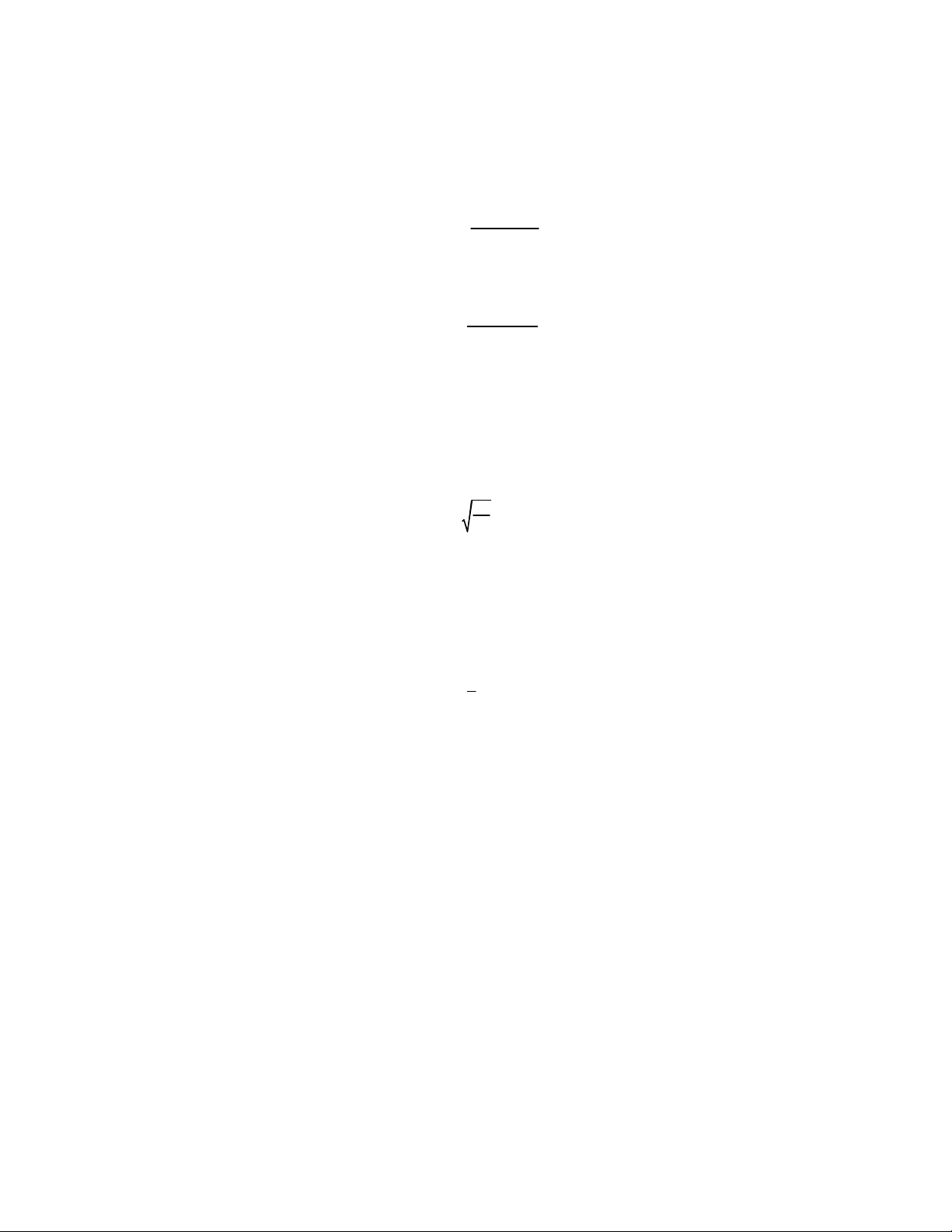
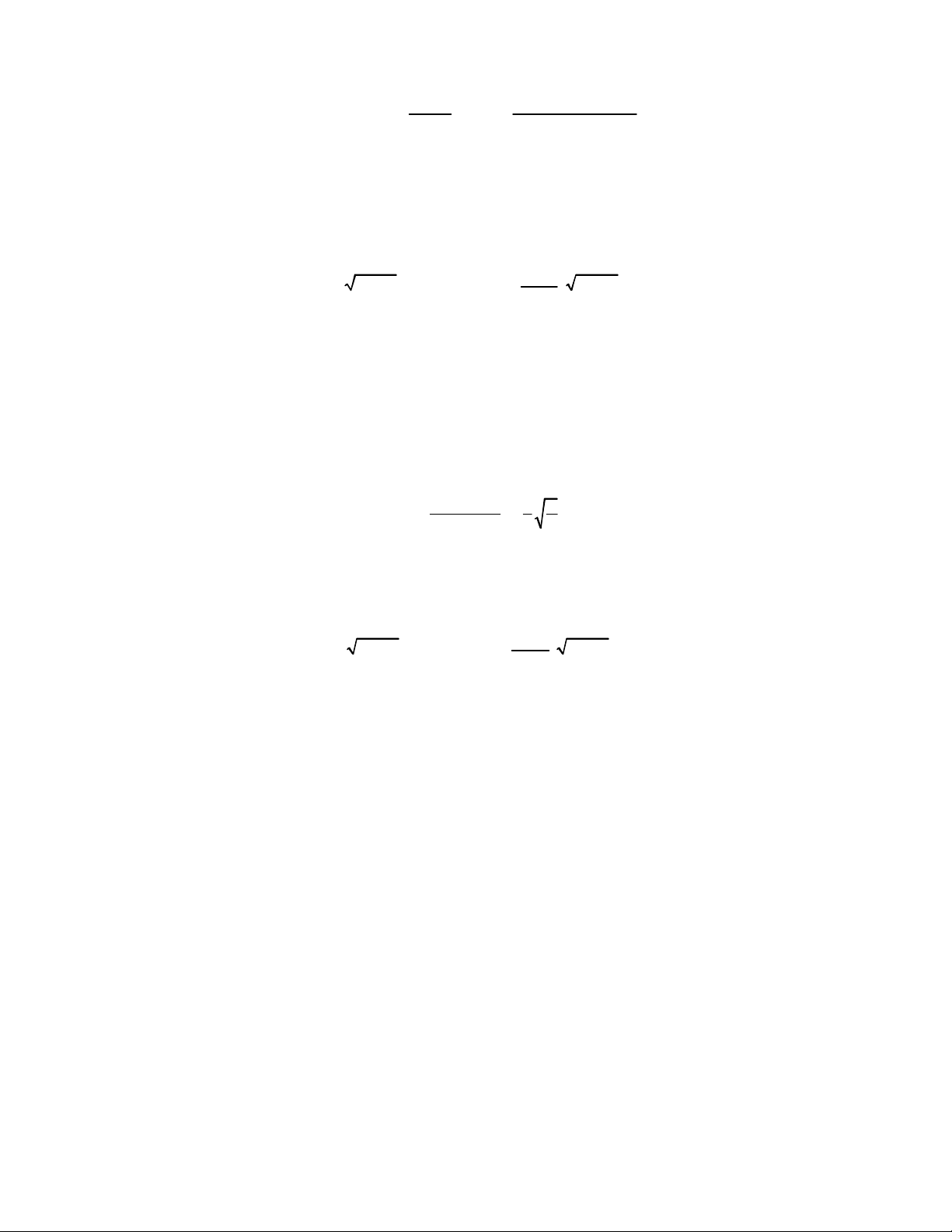
Preview text:
7 Chapter
Fundamentals of Orbital Mechanics
Celestial mechanics began as the study of the motions of natural celestial bodies,
such as the moon and planets. The field has been under study for more than 400
years and is documented in great detail. A major study of the Earth-Moon-Sun
system, for example, undertaken by Charles-Eugene Delaunay and published in
1860 and 1867 occupied two volumes of 900 pages each. There are textbooks
and journals that treat every imaginable aspect of the field in abundance.
Orbital mechanics is a more modern treatment of celestial mechanics to include
the study the motions of artificial satellites and other space vehicles moving un-
der the influences of gravity, motor thrusts, atmospheric drag, solar winds, and
any other effects that may be present. The engineering applications of this field
include launch ascent trajectories, reentry and landing, rendezvous computations,
orbital design, and lunar and planetary trajectories.
The basic principles are grounded in rather simple physical laws. The paths of
spacecraft and other objects in the solar system are essentially governed by New-
ton’s laws, but are perturbed by the effects of general relativity (GR). These per-
turbations may seem relatively small to the layman, but can have sizable effects
on metric predictions, such as the two-way round trip Doppler. The implementa-
tion of post-Newtonian theories of orbital mechanics is therefore required in or-
der to meet the accuracy specifications of MPG applications.
Because it had the need for very accurate trajectories of spacecraft, moon, and
planets, dating back to the 1950s, JPL organized an effort that soon became the
world leader in the field of orbital mechanics and space navigation. In doing so,
it developed the fundamental ephemerides of planets, moons, and asteroids now 1 2
Explanatory Supplement to Metric Prediction Generation
used by the International Astronomical Union (IAU) and appearing in the Astro- nomical Almanac.
The states of these and any other objects of interest in the solar system are tabu-
lated in ephemerides, generated either by JPL Navigation or by spacecraft pro-
jects, and put into standardized forms for ready usage by any applications to
which these ephemerides are made available. The standardization is made possi-
ble by software utilities provided by JPL’s Navigation Ancillary Instrumentation Facility (NAIF).
NAIF also provides utilities for easy access to and manipulation of ephemerides,
as well as tools for computation of characteristics of interest extracted from the
ephemerides. For example, the SPKEZ function returns states of any object pos-
sessing a NAIF identifier (NAIFID) as observed by any other NAIFID at a given
ephemeris time and specified aberration type, provided the needed underlying
ephemerides have been supplied. The NAIF toolkit has become the international
standard for ephemeris access and usage.
The reader should appreciate that, while the creation of ephemerides and the de-
velopment of NAIF tools for accessing them require intensive knowledge of the
principles of orbital mechanics, the users of these entities, such as the MPG de-
veloper, is spared much of this burden. The skills deemed necessary for MPG
development and maintenance include a familiarity with the basic terms and fun-
damentals of orbital mechanics, awareness of the range of utilities contained in
the SPICE toolkit, and appreciation of which SPICE functions may be effective in MPG applications.
The information contained in this chapter, of necessity, is therefore limited to an
overview of orbital mechanics. The level of detail has been narrowed to that be-
lieved sufficient to permit future MPG personnel to understand its algorithms and
to extend its capability. Those desiring fuller information are therefore directed
to SPICE required reading, the commentary contained in the source code of
NAIF utilities, any of a number of textbooks and journals in the field, and inter- net searches.
The reader is expected to have a basic familiarity with the concepts of time
measurement, coordinate systems, mechanics, vector algebra, and numeric meth- ods.
Fundamentals of Orbital Mechanics 3
7.1 Coordinate Systems and Frames
The subject of coordinate systems and frames is treated more fully in another
chapter of this work. This section provides a short summary as applicable to the needs of the current chapter.
In metric prediction generation, it is sometimes necessary to represent the states
(i.e., positions and velocities) of objects in a number of different coordinate sys-
tems according to the contexts in which these are to be used. Each coordinate
system corresponds to a way of expressing positions and velocities with respect
to a particular frame of reference, such as a set of rectangular axes.
In principle, it is possible to obtain a standard celestial coordinate frame that is
fixed in space by fixing the orientation of a chosen inertial coordinate frame at a
specified instant, called the standard epoch. In practice, the axes may not be di-
rectly observable at the standard epoch, but they may be inferred by adopting a
catalog of the positions and motions of a set of stars or other celestial objects that
act as reference points in the sky. The International Celestial Reference Frame
(ICFR) is commonly used in fundamental ephemerides of solar system objects.
In general, an object may be moving with respect to a coordinate system, and that
coordinate frame may be moving or rotating with respect to other frames. There-
fore, in order to be definite, it is necessary also to specify the time coordinate to
which spatial coordinate values refer.
The apparent state of a celestial object also depends on the state of the observer,
as well as the coordinate frame to which observation is referred. Such relative
motions are governed by theories of relativity, discussed in the chapter on Space-
time. Coordinates may also include the effects of other distortions or aberrations
that may require compensation.
The MPG standard epoch is J2000, defined by the positions of the Earth's equa-
tor and equinox on Julian Day 2451545.0, or January 1, 2000 at 12:00:00. Trans-
lation among other standard reference frames relies on standard models of pre-
cession and nutation to determine spatial coordinates at given epochs. 4
Explanatory Supplement to Metric Prediction Generation 7.2 Two-Body Motion
Johannes Kepler observed from a study of the positions of planets that their mo-
tions in the solar system appeared to exhibit three behaviors that we now call Ke-
pler’s laws, published in 1609.
K-1: The orbits of the planets are ellipses, with the Sun at one focus of the ellipse.
K-2: The line joining the planet to the Sun sweeps out equal areas in equal
times as the planet travels around the ellipse.
K-3: The ratio of the squares of the periods of revolution for two planets is
equal to the ratio of the cubes of their semimajor axes.
Kepler’s theory was later refined by Isaac Newton to account for the mutual per-
turbations among the bodies of the solar system. Newton published his three
laws of motion and law of universal gravitation in 1687.
N-1: Objects at rest remain at rest and objects in uniform motion remain in
uniform motion unless acted upon by an external net force.
N-2: An applied force on an object is equal to the time rate of change of momentum of that object.
N-3: For every action, there is an equal and opposite reaction.
N-UG: Every object in the universe attracts every other body in the uni-
verse with a force directed along the line of centers of the two objects
that is proportional to the product of their masses and inversely pro-
portional to the square of the distance between them, G m m 1 2 F = (7-1) 2 d
In this relation, G is the Newton gravitational constant, 1 m and 2 m are the
masses of the primary and secondary bodies, and d is the distance between them.
It is now understood that Kepler’s laws only apply to the so-called two-body
problem, where the number of objects interacting in space is limited to two. As
will be discussed later in the chapter, the extension of Newton’s laws to more
than two bodies bears no simple solution, and generally requires numeric meth-
ods for determining pos itions over time.
Fundamentals of Orbital Mechanics 5
Because the laws of Kepler and Newton agree in two-body theory, the orbits they
describe are often referred to as Keplerian, with Newtonian theory reserved to
describe multiple body interactions without relativistic effects applied.
There are a number of cases in which the effects of multiple bodies may be
treated as slight perturbations superimposed on two-body theory. Such is the
case, for example, in approximating positions of planets relative to the Sun, the
Moon relative to Earth, and spacecraft in solar and planetary orbits. 7.2.1
Keplerian Motion
Let it now be assumed here that there are only two bodies whose motions are to
be characterized. The more massive of these will be designated the primary, and
the other, the secondary. If 1r is the position vector of the primary with respect
to an arbitrary inertial origin, 2r is that of the secondary, r = 2r - 1r is the vector
from primary to secondary, and r |
= r | is its magnitude, then the equations of
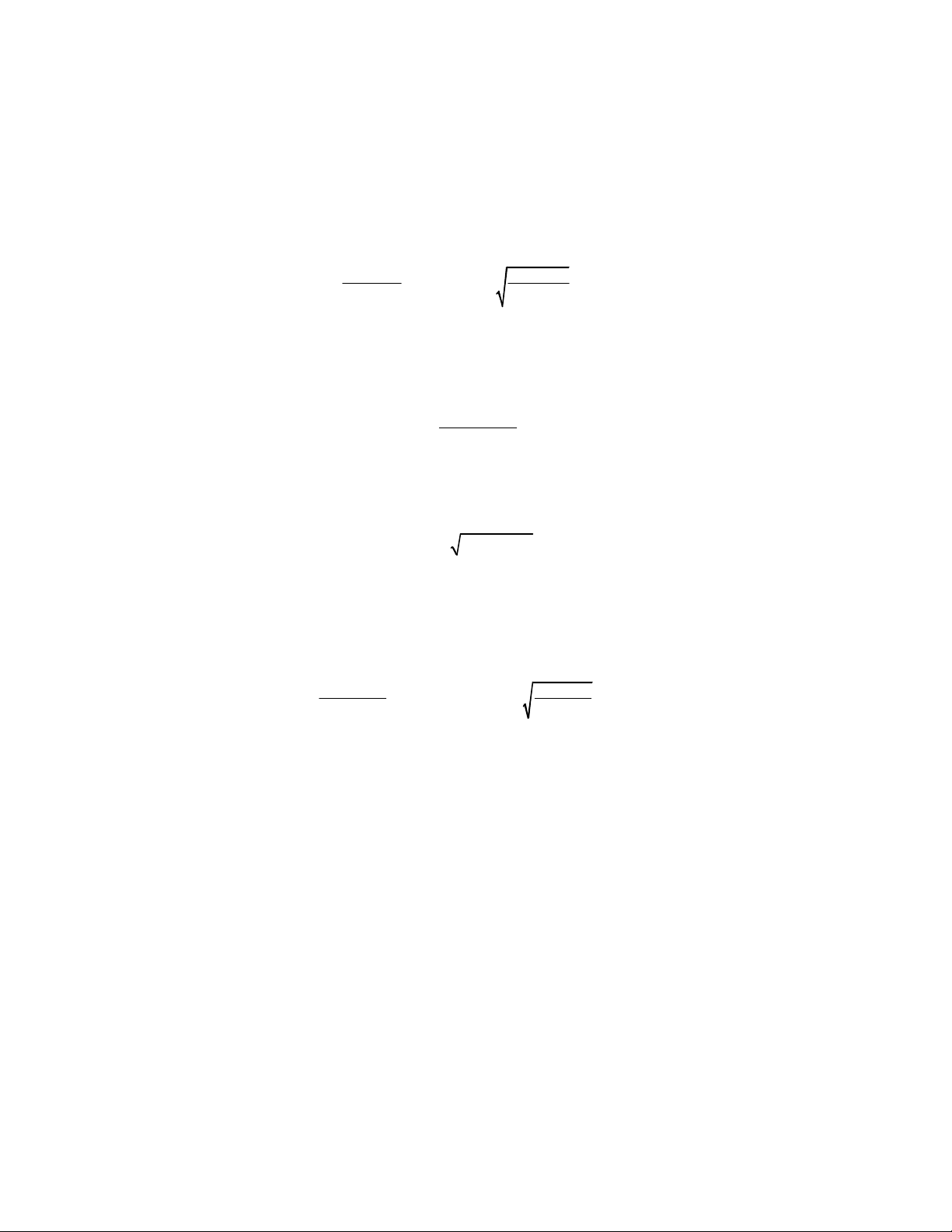
force at the two bodies, by Newton’s laws, are G 1 m m2 1 m 1r&& = 3 r r (7-2) G m1 m2
m2 2r&& = - 3 r r
The body mass on the left-hand side of each equation above divides out
with that on the right-hand side. Consequently, subtracting the two gives
G (m + m ) 1 2
r& = &2r& - 1r&& = - (7-3) 3 r r
Newton's law for a single body moving around a primary is therefore m r r&& = - (7-4) 3 r where m = ( G 1
m + m2). All three of Kepler’s laws follow from this expression.
Similarly, adding the two equations of Eq.(7-2) shows that the net force acting on
the pair as viewed in an inertial frame is zero, 1
m &1r& + 2
m 2r&& = 0 (7-5) 6
Explanatory Supplement to Metric Prediction Generation
Integration of this equation therefore gives the net momentum of the pair, which
is constant. A second integration gives the motion of the center of mass, or bary- center, which is located at 1 m 1r + 2 m 2 = r c = 0r + cv t (7-6) 1 m + 2 m
The barycenter is non-accelerating, and is therefore an inertial frame in which the
position and velocity of the bodies and center of mass can be determined at all
times from initial positions and velocities.
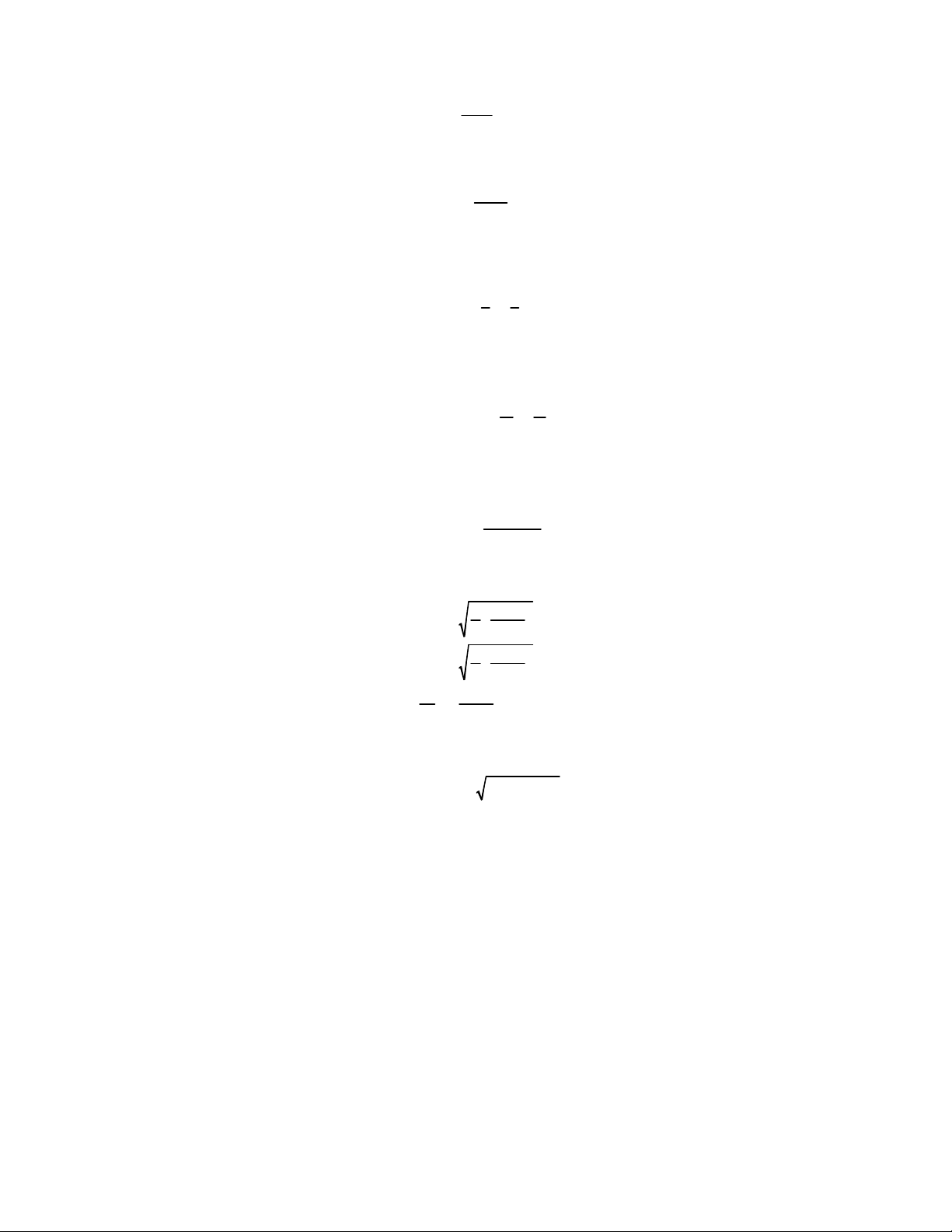
If the origin of the system is taken to be the barycenter, then m2 1 r = - 2 m r (7-7) 1
In this frame, the position vectors satisfy m2 + m2 r = - 1 r 2 m m (7-8) 1 + m2 = r2 m1
Substitution of Eq.(7-9) into Eq.(7-2) produces Newton’s law for each
body moving about the barycenter, 3 G m2 G 2 m 1 r&& = 3 r = - 2 3 1 r r
(m + m ) r 1 2 1 (7-9) 3 G m1 G 1 m 2 r&& = - r = - 2 3 2 3 r r
(m1 + m2) 2r
Further, Eqs. (7-4) and (7-9) appear to be the same when the proper associations
between radial vectors and gravitational constants are made. 3 m G 2 m 1 1 r&& = - 1 r 1 3 m = 2 r (m + m ) 1 1 2 (7-10) 3 G m 1 m 1 2
r&& = - 3 2r 2 m = 2 1 r ( 1 m + m2)
They may each be solved separately, as if the system were uncoupled. But, of
course, all three pertain to the same system, and orbit in synchrony.
Fundamentals of Orbital Mechanics 7
It suffices, then to concentrate on only one of the forms, and the one chosen here
is Eq.(7-4). The remainder of the treatment in this section focuses on characteris-
tics of the trajectory of the secondary with the primary at the origin. 7.2.2
Angular Momentum
The angular momentum per unit mass is the vector product of the position and velocity vectors, or
h = r ´ r& 2 h = r q& (7-1)
where q& denotes the angular rate of the secondary as viewed at the primary. If
the angular rate is negative, the motion is said to be retrograde in that reference frame.
In Newtonian two-body physics, the derivative of this vector is zero, m
h& = r ´ r& + r& ´r& = - (7-2)
3 r ´ r + 0 = 0 r
since the cross product of a vector with itself is the zero vector. Consequently,
the angular momentum is constant, and thus conserved along the trajectory1. The
trajectory is therefore planar, since the h vector is perpendicular to both position
and velocity and constant everywhere along the trajectory.
The magnitude of the momentum satisfies the relationship h |
= pr ´vp |= pr p v ,
which follows since the position and velocity vectors are perpendicular at this
point. The angular rate for a Keplerian trajectory satisfies the relation h q& = (7-3) 2 r
As a further consequence of constant momentum, if f is the angle between posi-
tion and velocity vectors, then at any two points along the orbit,
1 This characteristic is equivalent to Kepler’s second law, since the differential area of between two
arcs separated in time by dt and in angle by dq is equal to r × r dq /2 . The time rate of change
of area swept out by an arc is therefore h /2 , which is constant. 8
Explanatory Supplement to Metric Prediction Generation 1 r 1
v sin 1f = 2r 2v sin 2 f (7-4)
Alternately, j could be defined as the angle between the velocity vector and a
line perpendicular to the position vector oriented such that j = p/ 2 - f . This
angle, called the flight angle, satisfies 1 r 1 v cos 1 j = 2r 2 v cos 2 j (7-5)
Both the rv angle f and the flight angle j are commonly denoted by the Greek
letter phi, so it behooves the reader to determine from the context of usage which applies.
The total angular momentum about the center of gravity of the closed system is conserved, so 1 m 1 h + 2 m 2 h = m h (7-6)
where m is the equivalent mass in the primary-centered system and the ih are the
angular momentums per unit mass of each body. 2 & 2 & 2 & 1 m 1r q + 2
m 2r q = m r q (7-7)
Substituting the distances values implied in Eq.(7-8), dividing out the common
angular rate, and simplification produces the result m m 1 2 m = (7-8) m1 + m2
This is the so called reduced mass of the system. It is less than either of the two
masses comprising it, and is such that the motion of either body, with respect to
the other as origin, is the same as a body having this mass moving with respect to
the barycenter and acted upon by the same force. 7.2.3
Orbital Parameters
Although it is not done here, it is fairly straightforward2 to show that the integra-
tion of Eq.(7-4) yields a conic trajectory in space (circle, ellipse, parabola, or hy-
perbola), in which the position of the secondary body at any given time can be
2 See, for example, the solution of the Lagrange equations of motion given in [Irving &
Mullineux1959]. Later in this chapter, this claim is validated by showing that a conic trajectory satisfies Eq.(7-4).
Fundamentals of Orbital Mechanics 9
computed from m and a set of six orbital parameters. One such set is comprised
of the components of the position and velocity vectors at a given time. Another
is the set of osculating elements that specify the position of the body at a refer-
ence epoch and the size, shape, and orientation of the orbit in space. A typical
set of osculating elements is shown in Figure 7-1, and defined below: p r = pericenter distance
e = eccentricity of trajectory
i = inclination of trajectory plane to reference plane (7-9)
W = longitude of ascending node
w = argument of pericenter
tp = epoch of pericenter
The pericenter is the point in a trajectory that is nearest to the center of attraction,
and is synonymous with periapsis in this case. The distance from the primary to
the pericenter is called the perifocal distance. Eccentricity is a parameter that
specifies the shape of the conic section. Inclination is the angle between the ref-
erence plane and the orbital plane, positive when the pericenter is in the northern
hemisphere of the reference frame. The ascending node is that intersection of the
conic with the reference plane that carries the trajectory from the southern to
northern hemisphere, and the argument of pericenter is the angle from the node
to the pericenter, and is not defined for a circular orbit. The semi-major axis a
of the conic is often given rather than the pericenter distance pr , and the longi-
tude of pericenter v = W + w is sometimes given instead of w . The orbital pe-
riod (of elliptical orbits) and mean motion are often of interest, but are not usu-
ally cited as one of the six elements needed to define the orbit.
Anomaly is the term that astronomers use to denote an angle. The angle q meas-
ured at the primary body, from the pericenter to the orbiting body is called the
true anomaly. The mean anomaly is the angle M from pericenter to a hypotheti-
cal body moving with a constant angular velocity n that is equal to the orbiting
body's mean orbital motion. M = (t t - p )n (7-10)
The mean anomaly of a circle or ellipse is simply an angle that marches uni-
formly in time from 0 to 360 degrees during one revolution. It is defined to be 0 10
Explanatory Supplement to Metric Prediction Generation
degrees at periapsis, and therefore is 180 degrees at apoapsis. The mean motion
is the constant rate at which the angle accumulates over time.
The eccentric anomaly is another angle that has an easily understood and physi-
cal interpretation for elliptical orbits that simplifies the relationship between
mean and true anomalies, as described later in this chapter.
The concepts of mean and eccentric anomalies are also extended to parabolic and
hyperbolic orbits, as they are useful mathematical concepts for interrelating or-
bital time and position. However, they bear no (easily assimilated) geometric
significance otherwise in these cases.
The SPICE function OSCELT takes as its input the gravitational parameter m , a
time t , and the trajectory state vector (r,v) at this time; it returns a set of orbital
elements similar to those of Eq.(7-9) above, but in which tp is replaced the pa-
rameter M , the mean anomaly at this epoch. The remainder of this discussion
relates to the methods by which the elements are calculated from the given state.
In 1710, Jacob Hermann discovered a vector which has since been rediscovered
and refined many times since. Today it is referred to as the Laplace-Runge-Lenz
vector, which in a particular normalized form, is called the eccentricity vector. It is given by v ´ = h r e (7-11) m - r
Its direction is along the major axis of the conic toward pericenter, and its magni-
tude is the eccentricity, | e |= e . This expression makes it possible to determine
the eccentricity and the direction of pericenter from any given state vector (r,v) along the orbit.
If the eccentricity is not unity, the semimajor axis is related to the state via a rear-
rangement of the vis-viva equation (given later in Eq.(7-31)), as 1 2 - æ ö 2 v a ç ÷ = çç (7-12) èr - m ÷÷ø
The periapsis and apoapsis distances are then likewise determined by p
r = a (1 - e ) (7-13) r = a ( a 1 + e )
Fundamentals of Orbital Mechanics 11
The angular momentum is perpendicular to the plane of the new orbit. The incli-
nation is the angle this vector makes with the reference frame z-axis, commonly
denoted k . It can be found using the SPICE function
i = VSEP(h,k) (7-14)
The node vector n is perpendicular to both the reference plane and the angular
momentum vector, pointing toward the ascending node. It is given by
n = k ´ h (7-15)
If the inclination is zero (or p ) this vector is of zero length; the SPICE conven-
tion in this case is to set n (1,0,0)T = .
The longitude of the ascending node is the angle between the x-axis and this vec- tor, which may be computed by
W = arctan(nx , y n ) (7-16)
The arc tangent function used here computes the quadrant-corrected angle whose
first component is in the x-direction, and the second, in the y-direction.
The argument of pericenter is the angle between the node vector and the eccen-
tricity vector, positive if the pericenter lies in the direction of h ´ n , which lies in the orbital plane.
w = sgn(e gh ´ n)VSEP(e ,n) (7-17)
If negative, this angle is sometimes augmented by 2p in order to provide a posi-
tive result. This element is undefined for circular orbits, by SPICE convention it is set to zero.
The final element is the true anomaly at the epoch of the given state. The true
anomaly q is the angle measured from the pericenter to the given position, posi-
tive in the clockwise direction about h . In order to calculate this angle, two unit vectors are used: e ux = e h ´ e y u = (7-18) | h ´ e |
q = arctan(r gux ,r guy ) 12
Explanatory Supplement to Metric Prediction Generation
The relationships between true, eccentric, and mean anomalies are discussed a little later on.
An alternate method of calculation of the true anomaly of non-circular orbits is
by inverting the conic formula, appearing later, in Eq.(7-20), which gives
æ(1 + e)r - r ö -1 q = ±cos p ç ÷ ç ÷ ç (7-19) ç er ÷÷ è ø
The method given in Eq.(7-18), however, avoids this ambiguity.
The process of determining the state of a trajectory at any given time using the
gravitational parameter and orbital elements is called propagation of the conic.
The SPICE utility CONICS embodies this process; given the gravitational con-
stant, orbital elements, and time at which the state is to be computed, it returns
the state vector. The method of propagation is different for the different types of
conic sections, and is found in the discussions of each type. 7.2.4 Trajectories
As mentioned earlier, the motion of the secondary with respect to the primary
takes the form of a conic section. This claim will now be validated. The claim is
that, when viewed in the orbital plane with the primary at the origin and major
axis along the line from primary to pericenter, the motion in polar coordinates is
described by the familiar conic formula (1 +e)r p r = (7-20) 1 + e cosq
Typical plots of conic trajectories are illustrated in Figure 7-2. The numerator
(1 + e) pr of the polar equation is known as the semi-latus rectum of the conic
section; it is the distance from the primary to the trajectory in a direction perpen-
dicular to the major axis. When e = 0 , the orbit is circular; when 0 < e < 1, the
orbit is an ellipse; whene = 1 , the trajectory is a parabola; and when e > 1 , the trajectory is hyperbolic.
The Cartesian vector form of the conic trajectory is
Fundamentals of Orbital Mechanics 13 écosqù ê ú
r r ê sin qú = ê ú (7-21) ê ú ê 0 ú êë úû
The velocity vector is the derivative of this vector, which may be found using
elementary calculus and the relation for q& given by Eq.(7-3) to be é -sin q ù é -sin q ù ê ú ê ú h ê v êe cos ú m q ê ú = + ú = (7-22) 2 êe + cos (1 e) qú + p r ê ú (1 - e )a ê ú ê 0 ú ê 0 ú êë úû êë úû
Differentiation of the velocity and reapplication of Eq. q give the accelera- tion, é-cos qù 2 ê ú h ê ú
a = r&& = (7-23) 2 ê - sin q (1 e) ú + p r r ê ú ê 0 ú êë úû
Substitution of this result into Eq.(7-4) indicates that the angular momen- tum must satisfy
h = (1 + e) pr m (7-24)
Therefore, the secondary trajectory viewed by the primary is a conic sec-
tion whose angular momentum is given above.
The orbital position and velocity in Cartesian coordinates are then écosqù é -sinq ù ê ú ê ú p r (1 + ) e ê r ê sin ú m q ê ú v = êe + cos ú = (7-25) 1 e cos q q ú + ê ú p r (1 + e) ê ú ê 0 ú ê 0 ú êë úû êë úû 7.2.5 Euler Angles
The trajectory plane frame of reference may be transformed to the reference
frame of a given set of orbital elements by a rotation of coordinates. Leonard
Euler showed that any rotation in 3-space can be decomposed into the product of
three elemental rotations. Each rotation is quantified by an identified axis of the
frame and an angle of rotation about this axis. The set of axes and the corre- 14
Explanatory Supplement to Metric Prediction Generation
sponding angles are called the Euler angles of the transformation. Euler angles
provide a convenient means of representing the spatial orientation of any frame
of the space as a composition of rotations from a reference frame.
Multiplying vectors in the trajectory plane frame by the following rotation matrix
transforms them into vectors in the reference frame of the orbital elements.
R = [-W 3] ×[- ]i1 ×,[ w - 3] (7-26)
This formula may be found in the Explanatory Supplement to the Astronomical
Almanac [Seidelmann1992]. The notation [f]n above denotes a rotation about
the axis designated as n by an angle f . It is implemented in the SPICE function
ROTATE. The standard assignment of axes is x = 1, y = 2, z = 3. The combined
rotation matrix implementing a given set of Euler angles is returned by the EUL2M function. 7.2.6
Total Energy and Orbital Shape
The total energy of the secondary in this configuration is the sum of its kinetic and potential energies, or G m m mm 1 1 2 2 1 2 tot e = 2mv - = 2m v r - (7-27) r
Here, r and v denote, respectively, the distance from the secondary to the pri-
mary and the velocity of the secondary in the trajectory plane relative to the pr i-
mary. Note that the reduced mass m is used in computing the system kinetic energy.
By Newton’s law. this total energy is constant, and may be equated to its value
when the secondary is at pericenter. With substitution of h = p r p v , it is 2 e = ( p v m tot - )m 2 r p (7-28) 2 = ( h m 2 - )m 2 pr p r
The total energy vanishes for an orbit having the same pericenter but whose an-
gular momentum takes the value
Fundamentals of Orbital Mechanics 15 hpar = 2 m pr (7-29)
The trajectory with zero total energy is parabolic , with e = 1 . It represents the
case in which the secondary’s kinetic energy is just sufficient to escape the at-
traction of the primary. Escape velocity3 for an object at pericenter is defined as
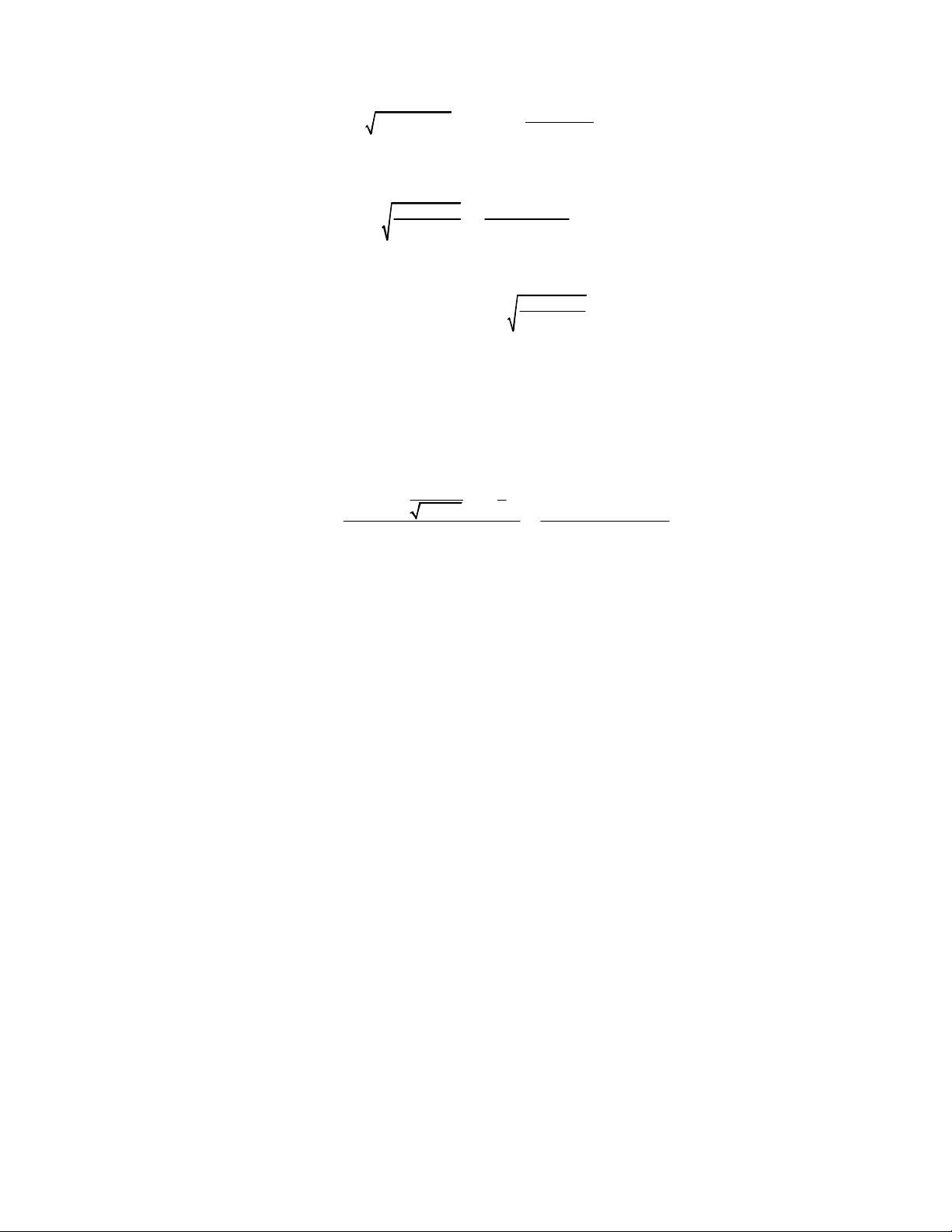
the tangential rate required to achieve this state, 2m esc v = (7-30) p r
The escape velocity of an object at rest on a body is found using the above ex-
pression, but with the perifocal distance set equal to the body radius.
When the total energy is negative, the trajectory is bound and the orbit is ellipti-
cal. When positive, the trajectory is unbound and the orbit is hyperbolic.
By equating the relationships in Eqs.(7-27) and (7-28), dividing out the secon-
dary mass, and rearranging terms, the following equation results: æ - ö 2 2 1 e v =mç ÷ çç (7-31) èr - ÷÷ p r ø
This equation, known as the vis-viva equation and also as the orbital energy con-
servation equation, relates the velocity v at any point of distance r along the
trajectory to the excess orbital momentum, which has been related to eccentricity by the relationship 2 2 æ ö = 2 h ç ÷ ç ÷ -1 h e = -1 ç (7-32) èh ÷ par ø m pr
This form is not obvious, but results when the magnitude of e , as given in
Eq.(7-11), is computed and then some vector algebra, the definition h = r ´ v ,
the vis-viva equation above, and Eq.(7-29) are applied. Eccentricity can also be written in the form
3 Since the quantity of reference is a scalar, the more proper term would be escape speed. The term
is retained, however, for historical reasons. Escape velocity is often misunderstood to be the speed
a powered vehicle (such as a rocket) must have in order to leave orbit. However, this is not the
case. It is the speed a bullet fired from the surface would have to travel (ignoring the effects of
drag) to leave orbit, but it is not the speed required for a rocket or other object in powered flight.
An object under power could leave the Earth's gravity at any speed, assuming it had enough fuel. 16
Explanatory Supplement to Metric Prediction Generation 2 v r p p e = - 1 (7-33) m
The semimajor axis a of the trajectory is related to the pericenter distance by p r a = (7-34) 1 -e
The semimajor axis is thus positive for ellipses and circles, infinite for the parab-
ola, and negative for the hyperbola. The vis-viva equation expressed using a is 2 = m(2 1 v - (7-35) r a )
The difference in squared velocity at any two points on the trajectory is thus given by 2 2 1 1 2 v - 1 v = 2 mæ ö ç - ÷ ç ÷ (7-36) è ÷ 2 r 1 r ø
In particular, the difference between squared velocities at periapsis and apoapsis of an elliptical orbit is 4e m 2 2 p v - av = (7-37) 2 a(1 -e )
Further, the velocities at periapsis and apoapsis are m +e
vp = a (11 -e ) m -e a v = (7-38) a (11 +e ) vp 1 + e = a v 1 - e
The semimajor axis and angular momentum are thus related by 2
h = pr vp = ma (1 - e ) (7-39) 7.2.7
Relationship Between Mean and True Anomaly The constant angular momentum 2
h = r q& may be equated to its value as given in Eq.(7-20) to give
Fundamentals of Orbital Mechanics 17 2 æ r + e ö 2 & ç p(1 )
h = (1 + e)m ÷ & p r = r q = ç ÷ ç (7-40) ç1 + e cos ÷ q q ÷ è ø
which, upon rearranging terms, is & m q (7-41) 3 3 = 2 (1 + e) pr (1 + e cos ) q
This relation may be integrated directly to yield a linearly growing left-hand side, n (t t m k
- p ) = (t - tp) (7-42) 3 3 (1 + e) pr
where the constant of integration is chosen to make the quantity zero at pericen-
ter. A constant parameter k has been introduced as the proportionality to the
mean motion, to be determined.
The integral of the right-hand side can also be calculated in closed form, by man-
ual means or by a software tool such as Mathematica, to yield 1 - æ (e - 1) 2tanh ç tan q ö÷ çè 2 ÷ e - (2 1 )ø e sinq k M = - - (7-43) 2 3/2 2 (e - 1)
(e - 1)(1 + ecosq)
No constant of integration of the right-hand side appears, as the expression is zero at pericenter.
This equation is the generalized Kepler equation that relates mean anomaly to
true anomaly. The reader will note, however, that, as it is expressed above, there
are imaginary terms when e < 1 and a possible singularity at e = 1 . For ellipti-
cal and parabolic orbits, then, further manipulations of Eq.(7-43) are required in
order to transform this result into real, nonsingular forms. Each case is consid-
ered separately in the paragraphs below.
It may also be noted that, while it may be simple enough in principle to deter-
mine the orbital time that corresponds to a given true anomaly, the reverse solu-
tion, for q given t , involves solving a transcendental equation. Kepler’s equa-
tion is therefore generally solved by iterative means. Fortunately there are meth-
ods for doing this that converge rather quickly. 18
Explanatory Supplement to Metric Prediction Generation 7.2.8
Elliptic Orbit Relationships
The form of Eq.(7-43) for elliptical orbits (e < 1) may be transformed by dint of
circular and hyperbolic trigonometric transformations into 1 (t -t m p ) 3 3 (1 + e) r p (7-44) 1 æ 1 - æ 1 = çç2tan - e çç
tan q ö÷÷-e 1 -e sinq ö÷ 2 3 / 2 (1 - e ) çè çè 1 + e (2) ÷ ÷ ÷ ø ø
(The author made this transformation using Mathematica, but laborious manual
methods produce the same result.) This equation is sufficient to relate mean and
true anomalies; however, some simplification can yet be made.
Motion in this case is periodic. As q traverses an orbit, the parenthesized term
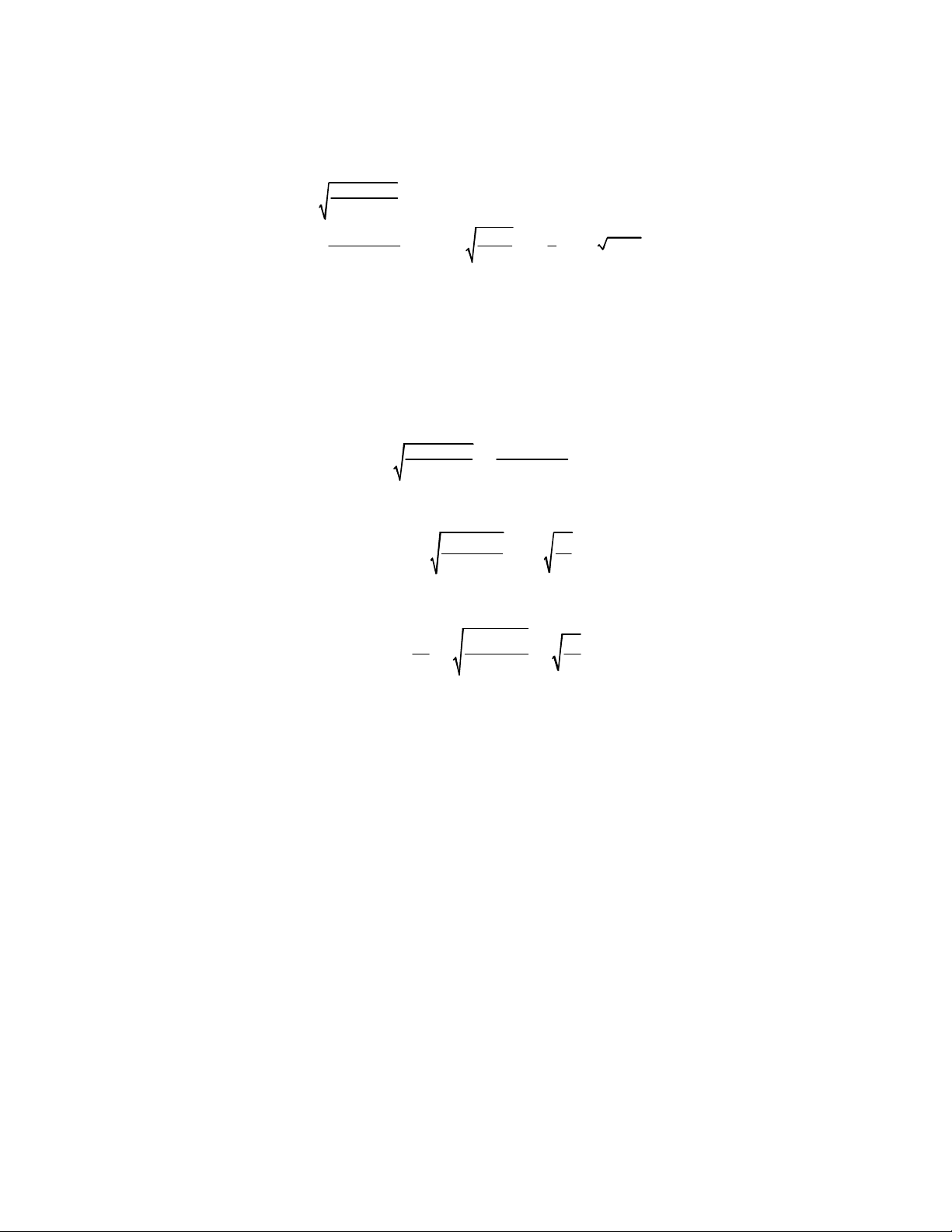
of the right-hand side above varies from 0 to 2p radians, so the period T satis- fies m 2 T p (7-45) 3 3 = 2 3 / 2 (1 + e) pr (1 - e ) or 3 3 = 2 rp a T p (7-46) 3 = 2p (1 - e) m m
The mean motion is thus equal to 3 (1 e) m m 2p - E n = = 3 = (7-47) 3 T p r a
The k parameter appearing in Eq.(7-43) for this case is 2 3/2 k (1 e )- = - .
For elliptical orbits, the eccentric anomaly is defined as the angle E , shown in
Figure 7-3, measured at the center of the ellipse, from the pericenter to the point
on the circumscribing auxiliary circle of radius a from which a perpendicular to
the major axis would intersect the orbiting body.
Since the ellipse pericenter is pr = ( a 1 - )
e , the distance from the ellipse center
to the focus is a e . The geometry is thus such that the eccentric and true anoma- lies are related by
Fundamentals of Orbital Mechanics 19
a cosE = a e + r cosq (7-48)
Substitution of Eq.(7-20) in the above and simplification produce the following
relationship between true and eccentric anomalies: e + cosq cosE = (7-49) 1 +e cosq
This may also be written in the inverted form cosE - e cosq = (7-50) 1 -e cosE
Substitution of q from Eq.(7-50) into Eq.(7-44), application of trigonometric
identities, and simplification yield the familiar form of Kepler’s equation for el- liptical orbits: M = E - sin e E
M = nE (t - pt ) (7-51) 1 m E n = 3 a
To determine the position at a given a time t , the mean anomaly M is computed,
from which the eccentric anomaly E must be found in order to determine the
true anomaly q via Eq.(7-50). Much effort has been expended over the last few
hundred years in attempts to invert the Kepler equation in a closed form expres-
sion. One such expression, credited to Friedrich Wilhelm Bessel in 1817, is ¥ 2
E = M + å Jk (ke)sin(k M) (7-52) k 1 = k
in which Jk(x) is the Bessel function of the first kind and order k. However, this
form converges so slowly at higher eccentricities that iterative root-finding meth- ods are more desirable.
Newton-Raphson iteration is an efficient method for solving for the eccentric
anomaly, as follows. Let f (E) = E - e sinE - M for given M and e be the
function whose root is desired. The iteration begins using the first two terms of Eq.(7-52), or 0
E = M + esinM , and subsequent estimates of the root are given by the recursion 20
Explanatory Supplement to Metric Prediction Generation E f E
k - e sin E - M ( ) k k Ek 1 + = Ek - = E - (7-53) f (¢ k E ) k 1 - cosEk
Convergence is quadratic, and thus achieves high accuracy after only a few steps.
The orbital position and velocity in Cartesian coordinates relative to the center of
the orbital ellipse, with x-axis in the direction of pericenter is then é cosE ù é -sinE ù ê ú 2 a n ê ú ê 2 ú E ê 2 ú E
r = a ê 1 -e sinE ú vE = ê 1 -e cosE (7-54) r ú ê ú ê ú ê 0 ú ê 0 ú êë úû êë úû
The position equation follows from the geometry shown in Figure 7-3. The polar
form of the position equation is
r = a (1 -e cosE) (7-55)
The velocity equation results upon differentiating the position equation and sub-
stituting E& found by differentiating Eq.(7-51) n & E 1 E m = (7-56) 1 e cosE = - r a
The position and velocity vectors in Cartesian coordinates relative to the primary
are easily related to Eq.(7-54), é cosE - e ù é -sinE ù ê ú 2 a n ê ú ê 2 ú E ê 2 r
a ê 1 e sinE ú v ê 1 - e cosE ú = - = (7-57) r ú ê ú ê ú ê 0 ú ê 0 ú êë úû êë úû 7.2.9
Parabolic Orbit Relationships
For a parabolic orbit (e = 1), the Kepler equation given in Eq.(7-43) is indeter-
minate. However, a tool such as Mathematica, or judicious application of
L’Hospital’s rule in taking the limit of this expression as e ® 1 , profuse use of
trigonometric identities, and algebraic simplification produce the reduced result