/
-./
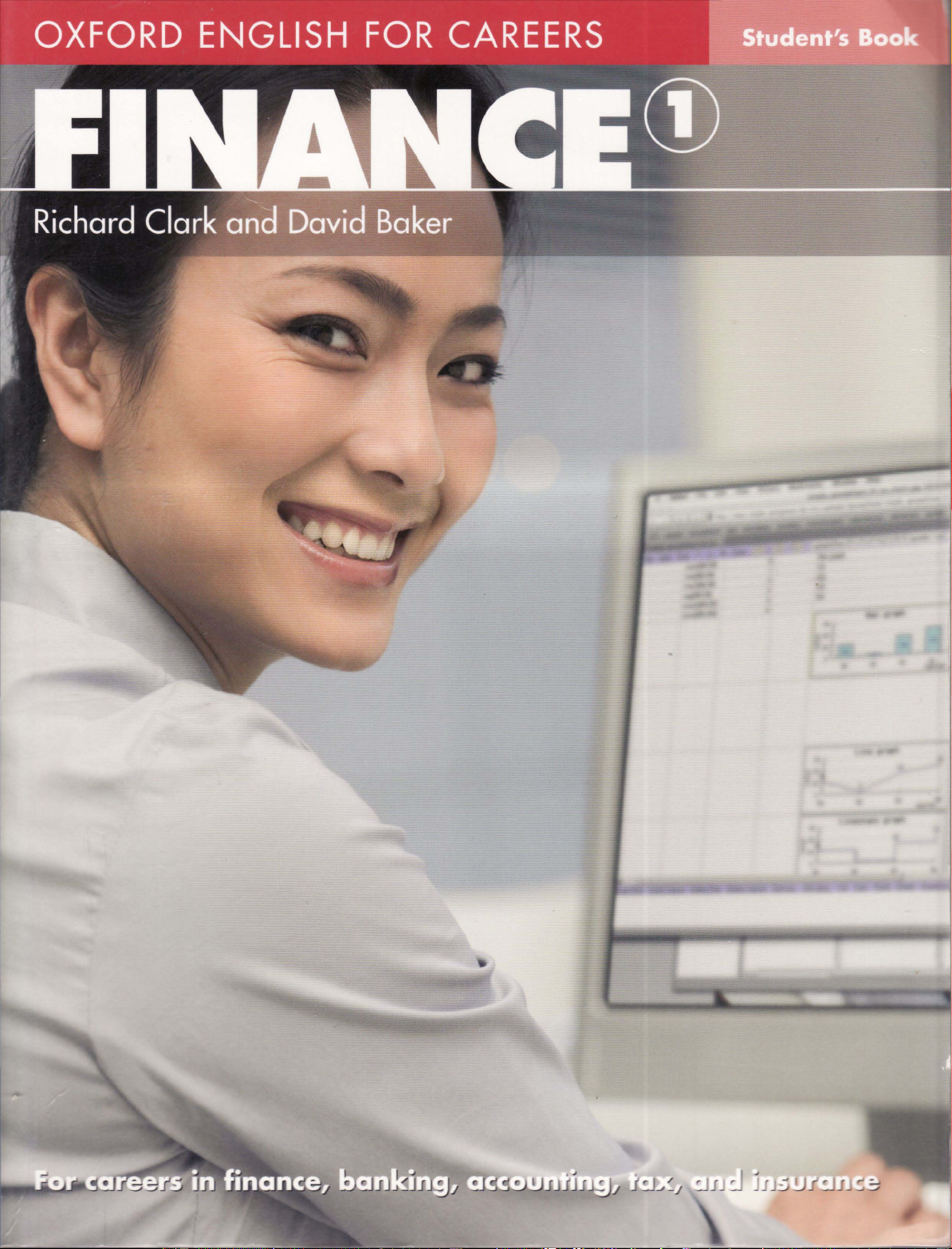
OXFORD
ENGLISH
FOR
CAREERS
)~-~.,'
..
f.:~
=-=-'t~
'-
-
,--=
-;:~-
~arc:f
(]~rk
~
·
nd
David
Baker
-
-::~\
- _ - 1
~.!J
, -
'.
--
~~_
.~_.
_.
__
~
_
-~
_
__
.-~
.cr
.!.lI.~._
.
?->
~
..,
.j~
.;';::J~~.
O".~
.
,=,~
. .
Student's
Book
OXFORD
UNIVERSITY
PRESS
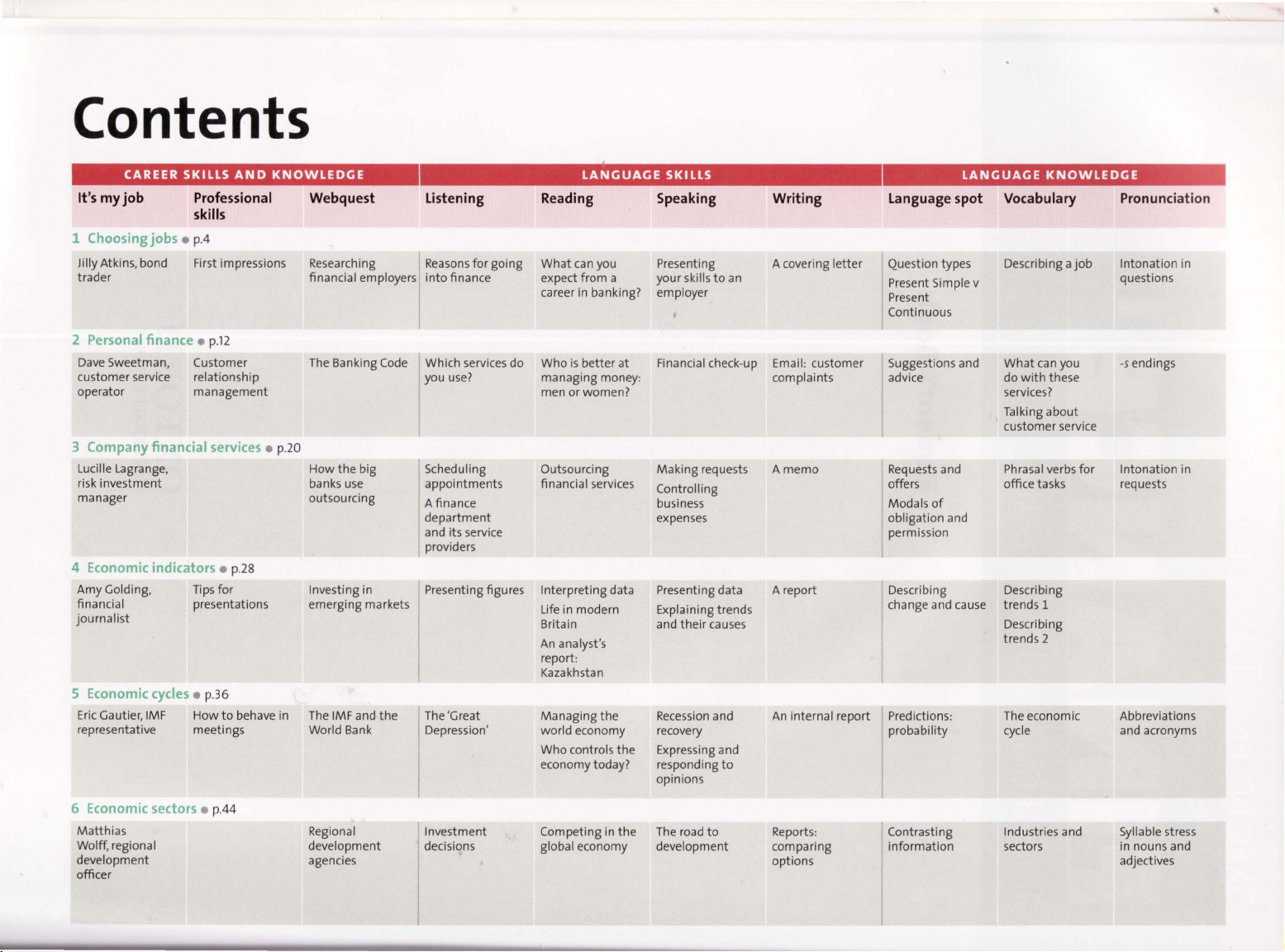
Contents
CAREER
SKILLS
AND
KNOWLEDGE
LANGUAGE
SKILLS
It's
my
job
Professional Webquest Listening
Reading Speaking
Wr
iting Language spot Vocabulary
Pro
nunciation
skills
1 Choosing jobs _ p.4
Jilly Atkins, bond First impressions
Researching
Reasons
for
going What can you Presenting A covering
letter
Ques
tion
types Describing a
job
Intonation in
trader
financial employers
into
finance expect
from
a
your
skills
to
an
Present Simple v
questions
career in banking?
employer
Present
Continuous
2 Personal finance _ p.
12
Dave Sweetman,
Customer
The
Banking
Code
Which services do Who is better at
Financial check-up Email: customer Suggestions and What can you -5 endings
customer service
relationship
you
use?
managing money: complaints advice
do
with
these
operator management
men or women? services?
, Talking about
customer service
3
Company financial services _ p.20
Lucille
Lagrange,
Howthe
big Scheduling Outsourcing
Making
requests
Amemo
Requests and
Phrasal verbs for Intonation in
risk investment banks
use
appointments financial services
Controlling
offers office tasks requests
manager outsourcing
A finance
business
Modals
of
department
expenses obligation and
and its service
permission
providers
4 Economic indicators _ p.
28
Amy Golding,
Tips
for
Investing
in
Presenting figures Interpreting data Presenting data A report Describing Describing
financial
presentations emerging markets
Life in modern
Explaining trends
change and cause trends 1
journalist
Britain and
their
causes Describing
An
analyst's
trends 2
report:
Kazakhstan
5 Economic
cycles
_ p.36
Eric
Gautier,lMF
How
to
behave
in
The
IMF and
the
The 'Great
Managing
the
Recession
and
An
internal report I Predictions: The economic Abbreviations
representative
meetings World Bank
Depression'
world economy recovery probability cycle and acronyms
Who
controls
the
Expressing and
economy today?
responding
to
opinions
6
Economic sectors _ p.44
Matthia
s
Regional Investment
Competing
in
the
The road
to
Reports: Contrasting Industries and Syllable stress
Wolff, regional
development
decisions
global economy development comparing information
sectors in nouns and
development
agencies options adjectives
officer
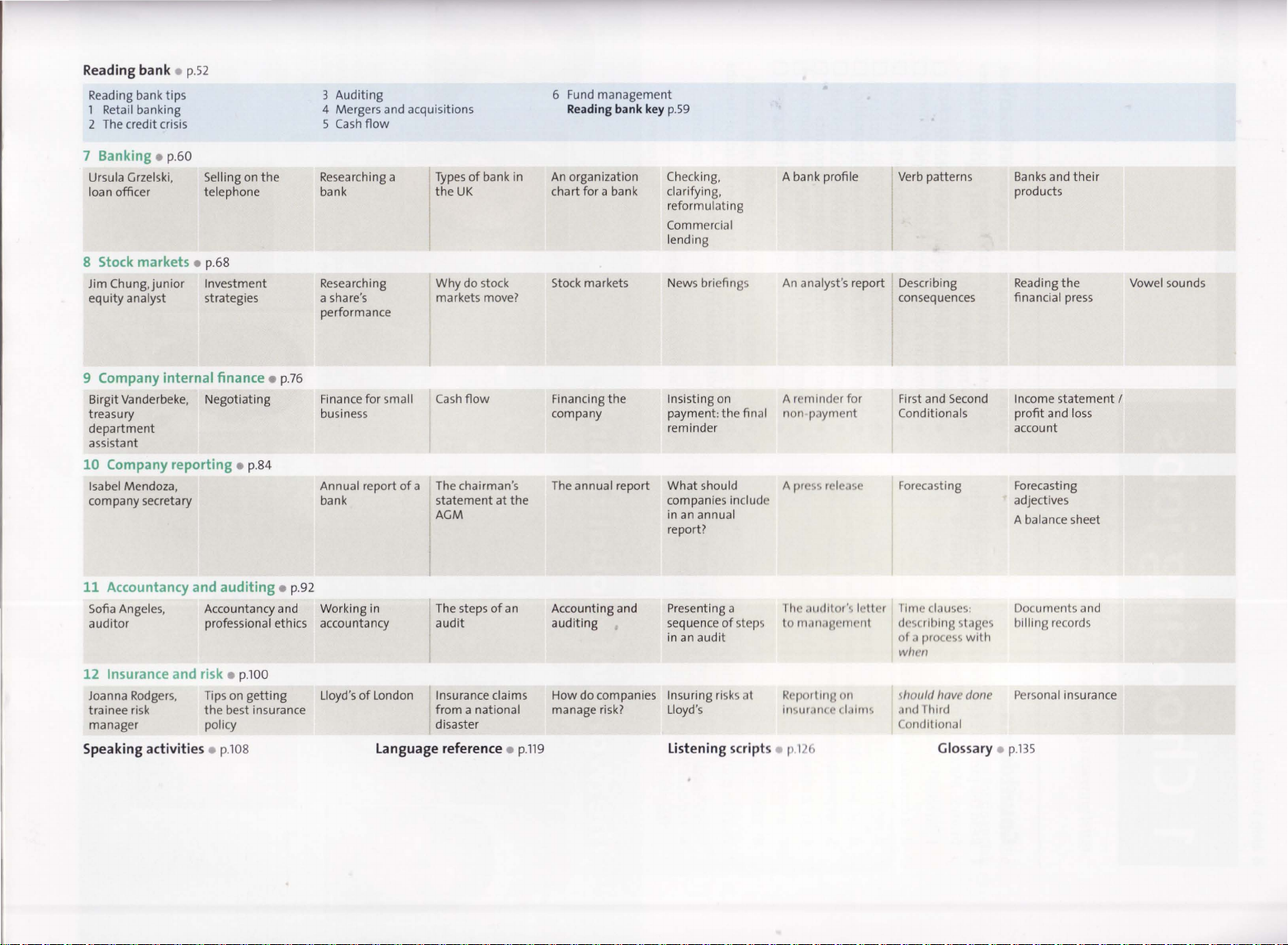
Reading bank .
p.52
Reading bank tips
1
Retail banking
2 The credit crisis
7 Banking . p.60
Ursula Grzelski,
loan
officer
Selling
on
the
telephone
8 Stock markets . p.68
Jim
Chung,
junior
Investment
equity
analyst strategies
9 Company internal finance .
p.76
Birgit Vanderbeke,
Negotiating
treasury
department
assistant
10
Company reporting . p
.8
4
Isabel Mendoza,
com
pa
ny secreta
ry
11
Accountancy and auditing . p.92
Sofia
Angeles, Accountancy and
auditor
professional ethics
12
Insurance and
risk
.
p.1OO
Joanna Rodgers, Tips on
getting
trainee risk
the
best insurance
manager
policy
Speaking activities . p.108
3
Auditing
4 Mergers and acquisitions
5
Cash
flow
Researching a
Types
of
bank in
bank
the
UK
Researching
Why
do stock
a share's markets move?
performance
Finance
for
small
Cash
flow
business
Annual report
of
a
Th
e chairman's
bank
statement
at
the
AGM
Working in The steps
of
a n
accountancy
audit
Lloyd's
of
London Insurance claims
from
a national
disaster
Language reference .
p.n9
6 Fund
management
Reading
bank
key
p.59
An
organization Checking,
chart
for
a bank clarifying,
reformul
ating
Commercial
lending
Stock markets News briefings
Financing
the
Insisting on
company payment:
the
final
reminder
The
annual report
What
should
companies include
in an
annual
report?
Accounting and
Presenting a
aud
iti
ng
se
quence
of
steps
in
an
audit
How
do companies Insuring risks at
manage risk? Lloyd
's
Listening scripts
A bank profile
An
analyst's report
A r('minder
for
non payment
A
pre~\
release
111
('
duclllol\'
I(,[L(
'r
to
1ll
,
1I1
,l
flP
IlH
'nL
ReportIng on
in'-llHtlll«(l
(
Idllll
\
p.126
Verb patterns Banks and
their
products
Describing Reading
the
Vowel sounds
consequences
financial press
First and Second
Income
statement
/
Conditionals
profit
and
loss
account
Forecasting Forecasting
adjectives
A
balance sheet
I ime clauses: Documents and
describing stages
billing
records
of
J
pro(c~~
wi
th
w/l('rl
\/lolild
have done Personal insurance
,
lilt!
1 hlrd
Condlllonal
Glossary
p.135
4
Unit
1
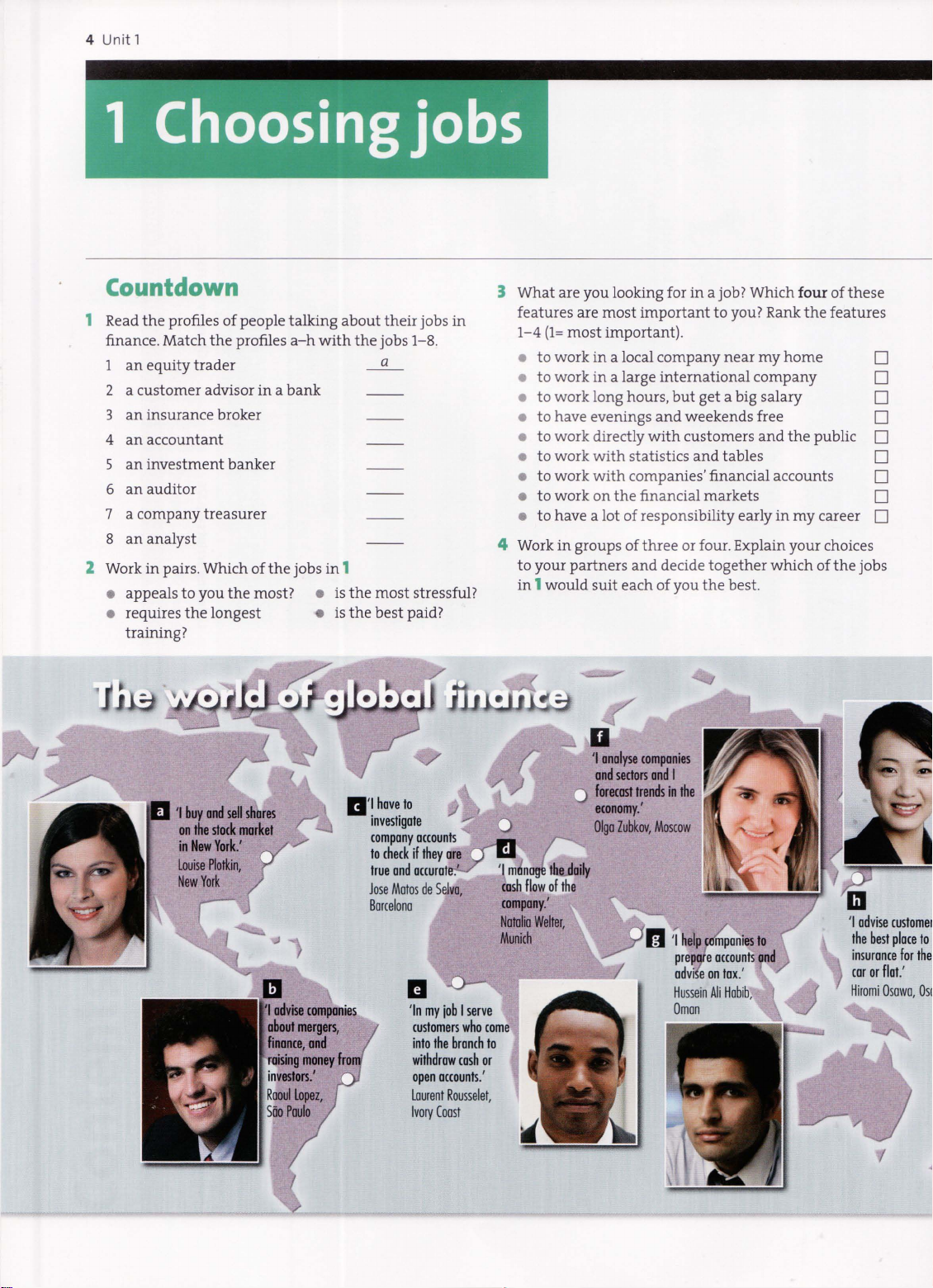
Countdown
1 Read
the
profiles of people talking about
their
jobs in
finance. Match
the
profiles
a-h
with
the
jobs
1-8.
1
an
equity trader a
2 a customer advisor
in
a
bank
3
an
insurance broker
4
an
accountant
5
an
investment banker
6
an
auditor
7 a company treasurer
8
an
analyst
Z Work
in
pairs. Which of
the
jobs in 1
appeals to you
the
most?
requires
the
longest
training?
is
the
most stressful?
is
the
best paid?
11
'1
have
to
investigate
company
accounts
to
check
if
they
ore
true
and
accurat
.'
Jose
Matos
de
Selva,
Barcelona
II
3 What are you looking for in a job? Which four of these
features are most important
to
you? Rank
the
features
1-4
(1=
most important).
to work in a local company near my home
to work in a large international company
to work long hours,
but
get a big salary
to have evenings
and
weekends free
to work directly
with
customers
and
the
public
D
D
D
D
D
D
to work
with
statistics
and
tables
to work
with
companies' financial accounts D
to work on
the
financial markets D
to have a lot of responsibility early in
my
career D
4 Work in groups of three or four. Explain your choices
to
your partners
and
decide together which of
the
jobs
in
1 would suit each of you
the
best.
D
'I
m n
the~oily
cosh
flow
of
the
company.'
Natalia
Welter
,
Munich
'I
analyse
companies
and
sectors
and
I
forecast
trends
in
the
economy.'
Olga
Zubkov,
Moscow
'I
advise
customer
the
best
place
to
insurance
for
the
cor
orflat
.'
advise
companies
about
mergers,
finance,
and
raising
money
investors.'
Raoul
Lopez,
Siio
Paulo
'In
my
job
I
serve
customers
who
come
into
the
branch
to
withdraw
cash
or
open
accounts.'
laurent
Rou
ss
elet
,
Ivory
(oo
st
6
Unit
1
If
you own shares
(UK)
or stocks (USA),you own
a part
of
a company and 'share' in its profits
when they
pay
dividends. Traders buy and
sell
shares on stock markets or equity markets like
Wall
Street.
If
you own bonds,you own a part
of
a government
or company's debt. Bonds
usually pay a fixed
interest,
the
yield,
for
example,
for
ten years.
Which investment
is
safer? Which do you
think
gives
the
best long-term return?
It's
my
job
1
Look
at
the
list of qualities
that
could be important
to work in financial markets. Mark
them
VI
(very
important),
01
(quite important), or
NI
(not important).
Then compare your answers in pairs.
1 having a lot of experience in business or
finance
__
0
2 being able to get on well
with
your clients
__
0
3 being good
at
working
in
a
team
-0
4 being good
at
socializing
-0
5 being good
at
listening to
and
remembering information
-0
6 being able to
think
quickly
-0
7
being good
at
taking risks
-0
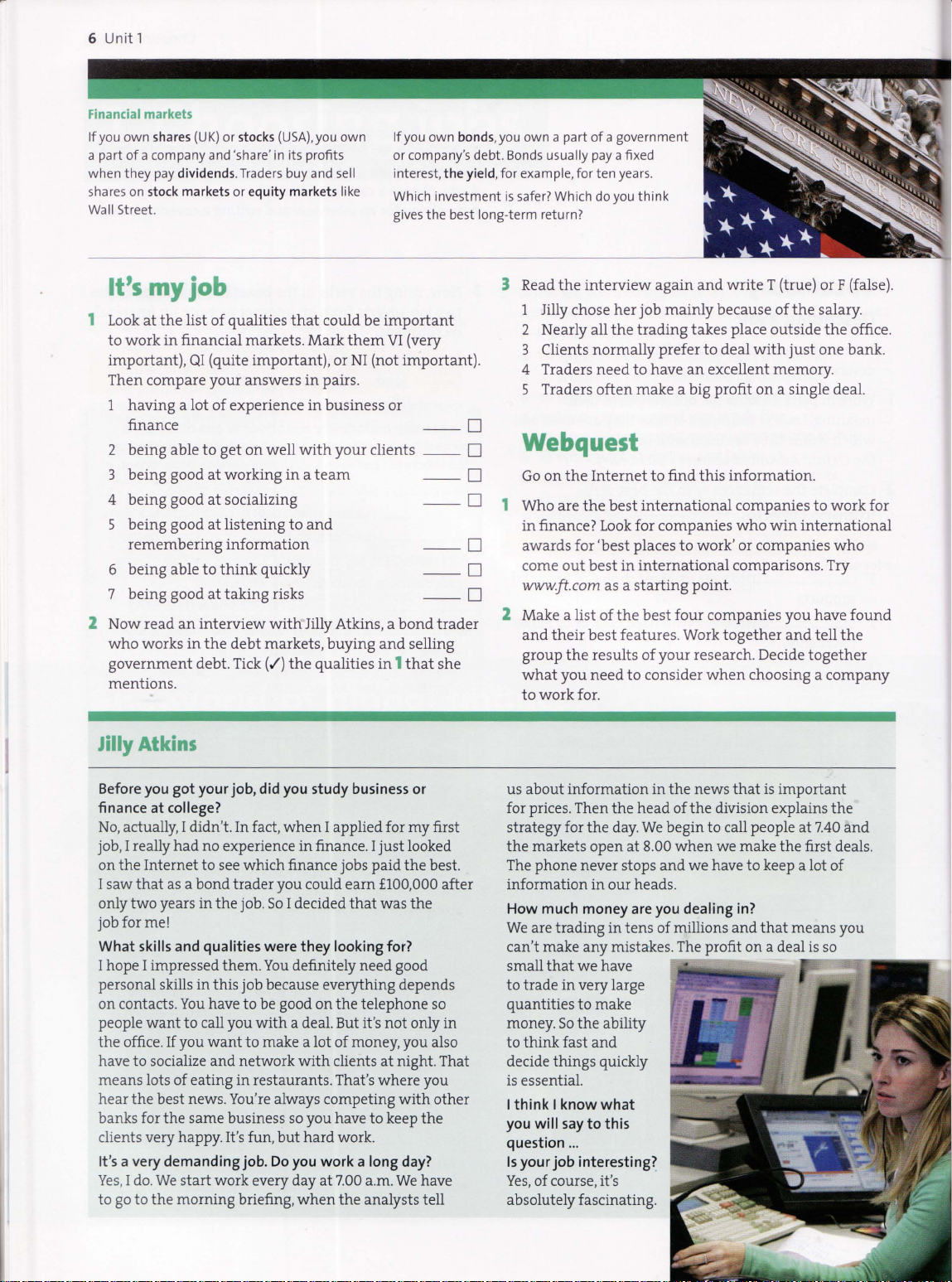
2 Now read
an
interview
with
lilly Atkins, a bond trader
who works
in
the
debt markets, buying
and
selling
government debt.
Tick
(.I)
the
qualities
in
1
that
she
mentions.
Jilly
Atkins
Before you
got
your j
ob
, did
you
study
business
or
finance
at
college?
No,
actually, I didn't. In fact, when I applied for my first
job, I really had no experience in finance. I just looked
on the Internet to see which finance jobs paid
the
best.
I saw
that
as
a bond trader you could earn £100,000 after
only two years in
the
job.
So
I decided that was the
job for
me!
What
skills and qualities
were
they
looking
for?
I hope I impressed them.
You
definitely need good
personal skills in this job because everything depends
on contacts.
You
have to be good on the telephone
so
people want to call you
with
a deal. But it's not only in
the
office.
If
you
want
to make a lot of money, you also
have to socialize and network
wi
th clients at night. That
means lots of eating in restaurant
s.
That's where you
hear
the
best news.
You're
always competing with other
banks for the same business
so
you have to keep the
clients very happy. It's fun, but hard work.
It's a very
demanding
job.
Do
you
work
a
long
day?
Yes
, I
do.
We
start work every day at 7.00 a.m.
We
have
to
go
to the morning briefing,
when
the analysts tell
3 Read
the
interview again
and
write
T (true) or F (false).
1 lilly chose her job mainly because of
the
salary.
2 Nearly all
the
trading takes place outside
the
office.
3
Clients normally prefer
to
deal
with
just
one
bank
.
4 Traders need to have
an
excellent memory.
5 Traders often make a big profit on a single deal.
Webquest
Go
on
the
Internet to find this information.
1 Who are
the
best international companies to work for
in finance?
Look
for companies
who
win
international
awards for 'best places to work' or companies who
come out best in international comparisons. Try
wwwjt.com as a starting point.
2 Make a list of
the
best four companies you have found
and
their best features. Work together
and
tell
the
group
the
results of your research. Decide together
what
you need to consider
when
choosing a company
to work for.
us about information in
the
news
that
is
important
for prices. Then the head of the division explains
the
strategy for the
day.
We
begin to call people at 7.40 and
the markets open at
8.00
when
we make the first deals.
The phone never stops and we have to keep a lot of
information in our heads.
How
much
money
are you
dealing
in?
We
are trading in tens of millions and
that
means you
can't make any mistakes. The profit on a deal
is
so
small that we have
to trade in very large
quantities to make
money.
So
the
ability
to think fast and
decide things quickly
is
essential.
I
think
I
know
what
you
will
say
to
this
question
..
.
Is
your
job
interesting
~
Yes,
of course, it's
absolutely fascinating.
Language spot
Question types
1
Look
at
these
questions
the
interviewer asks lilly.
Which ones
can
she
an
s
wer
yes or
no?
1 Before
you
got your job, did you s
tudy
bu
siness or
finance
at
college?
2
What
skills
and
qualities
we
re t
hey
looking
fo
r?
3
Do
you
work a long da
y?
4 How
much mone
y are
you
dealing in?
5
Is
your job
inter
esting?
How
are yes / no questions different from
information
questions?
»
Go
to
Language reference p.
ng
2 Make
these
statements
into
yes /
no
questions.
1
You
can
earn
a lot.
2 An
insurance
broker works
with
insurance
policies.
3 They work for Paribas.
4 She is
an
analy
st.
5 I have
to
socialize
with
clients.
6 The
share
price could rise conSiderably.
3 Ask
information
questions
to
get
the
answers
below.
Q:
---------------
-
A:
They sell a
range
of
insurance
products.
2 Q:
_________________
_
A:
She
earns
£50,
000
a year.
3 Q:
________________
__
A:
We
have
ten
branches
in
Spain.
4 Q :
___________
_
____
___
A:
It
takes
two
years
to
train
as a broker.
5 Q:
__
_
____________
___
A:
I decided
to
become
an
accountant
because I love
working
with
numbers
.
Choo
si
ng jobs 7
4 Work
in
pai
rs.
Student
A, choose a finance job,
bu
t don't tell your
partner
what
your job is. Answer your
par
tner
's
questions
with
only 'yes' or 'no'.
Student
B, guess
what
Sruden
P:s
job
is
by asking
them
yes /
no
questions.
-:-
his
means
you can only
ask
them
questions like 0
you
work
in a bank?
and
OT Vlhere tioyou
,~orle?
hen
you ha 'e
~
'
shed
, do 1
again
,
but
this
time
S
uden
A
has
0 guess \'ha S e 3's job
is.
The
person
who
guesses
their
partner
's job vith
the
fewest questions wins.
Pronunciation
Intonation in questions
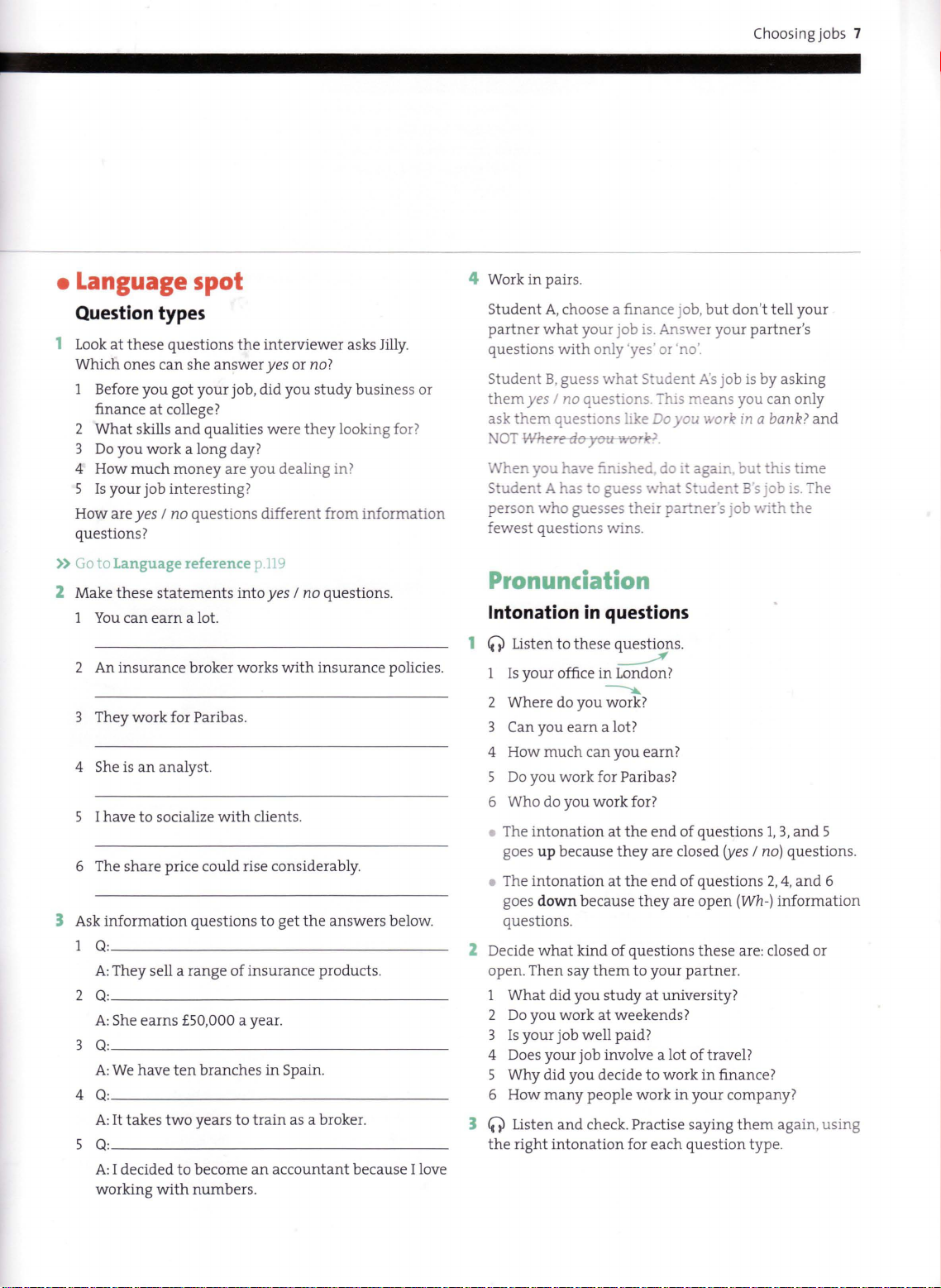
1
«,)
Listen
to
these
questions.
~
1
Is
your office
in
London?
~
2 Where do you work?
3 Can
you
earn
a lot?
4 H
ow
muc
h can you
earn
?
5
Do
you work for Paribas?
6 Who do you
work
for?
The
in
tonation
at
the
end
of questions 1,
3,
and
5
goes
up
because
they
are closed
(yes
/
no)
question
s.
The i
ntonation
at
the
end
of questions 2,4,
and
6
goes
down
because
they
are
open
(Wh-)
informati
on
ques
tions
.
2 Decide
what
kind of questions
these
are: closed or
o
pen
.
Then
say
them
to
your
partner
.
1
What
did
you
study
at
university?
2
Do
you work
at
weekends?
3
Is
your
job well
paid
?
4 Does your job involve a lot of travel?
5
Why
did you decide
to
work
in
finance?
6
How
many
people work
in
your compan
y?
3
«,)
Listen
and
check. Practise saying
them
again
,
using
the
right
intonation
for
each
question
type.
8
Unit
1
comparative analysis
(n)
a study
of
the
financial figures
of
a company in relation
to
similar companies in the same sector. Often
shortened
to
'a
comp' in investment banking.
merger
(n)
the act
of
joining
two
or more
businesses or organizations
into
one
loan application
(n)
a request
by
a company
to
borrow money from a bank
spreadsheet
(n)
a computer program
that
is
used,
for example, when doing financial
or project planning
Reading
What
can
you expect from a career
in banking?
You
are going
to
read two reports from a university
magazine on careers in banking. Helen works in
the
corporate finance department of
an
investment bank
and
Angus
is
a customer service advisor in a retail bank.
1 Discuss
these
questions
in
pairs.
1 What do you
think
each job involve
s?
2 What skills do you
think
each job needs?
2 Work in pairs
and
complete
the
questions below.
1
Who
w
ork
for
?
2
When
(start)
in
the
morning?
:3
What
sort
of
sk
ill
s
need?
4
What
tasks
in
the office?
5
What
ki
nd
of reports
?
6
How many customers each day?
7
H
ow
mu
ch
earn?
8
How often
meetings?
9
How many hours ina day?
10
How
l
ong
(t
a
ke)
get home?
3 Student
A,
go to p.l08
and
read
the
text about Angus.
Student
B, read
the
text about Helen opposite. Find
the
answers to
the
reporter's questions in 2.
4 Student A, you are
the
reporter. Interview Helen
and
ask her about her job.
Student
B,
you are Helen. Answer your
partner
's
questions
and
tell
them
about your job.
Now change roles: Student
A, you are Angus. Student
B,
you are
the
reporter.
5 Now work together
and
find
the
words in
the
two
texts to
match
the
definitions.
Someone
who
...
1 has finished university
is
a
____
_
2
is
starting in a company
is
____
_
3 works well
with
customers has
____
_
4 doesn't make mistakes
is
____
_
5 works well
with
other colleagues
is
a
____
_
6
is
enthusiastic about
their
job
is
____
_
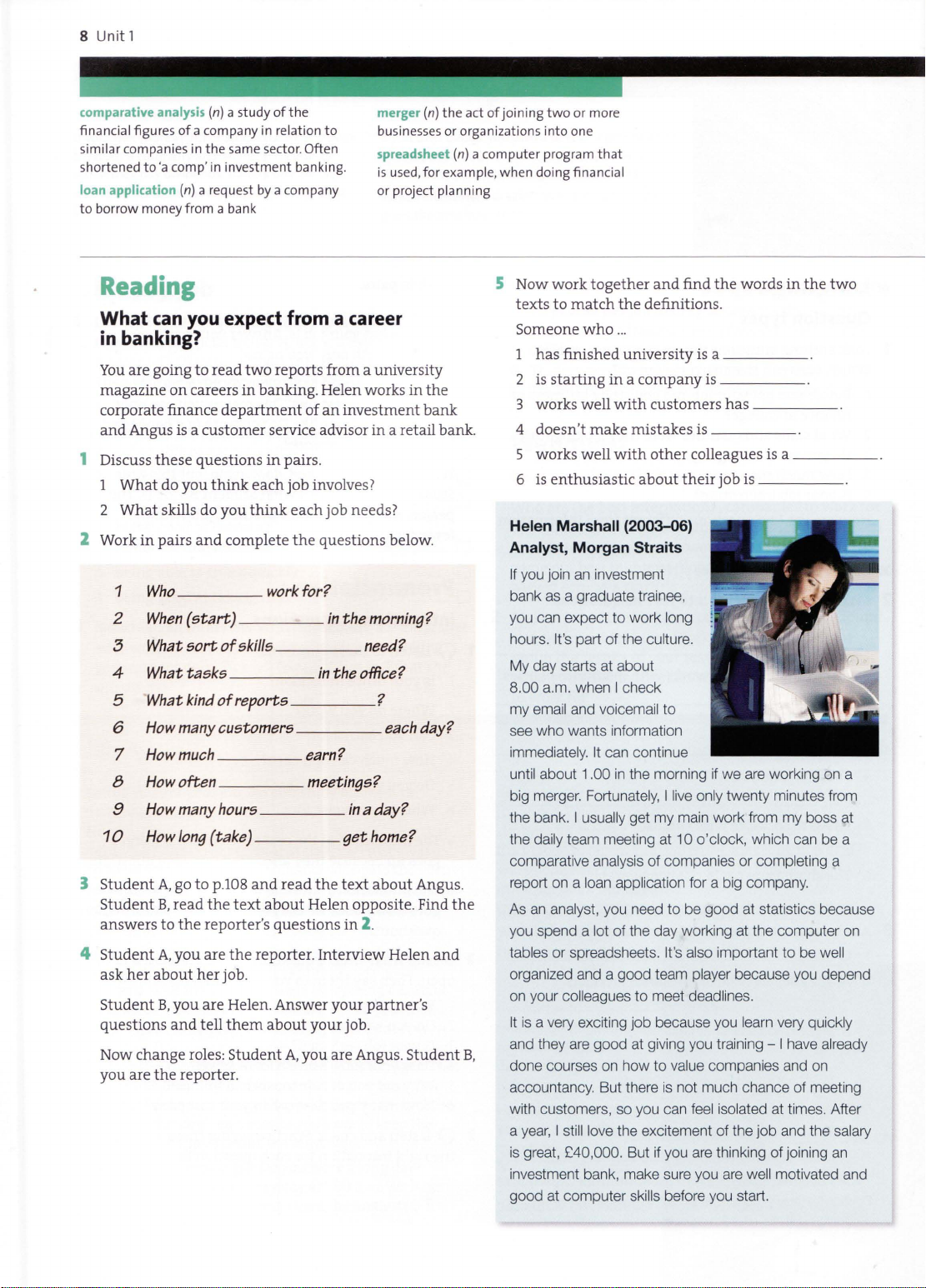
Helen Marshall (2003-06)
Analyst, Morgan Straits
If you join an investment
bank
as a graduate trainee,
you can
expect
to
work
l
ong
hours. It's part
of
the culture.
My
day starts
at
about
8.00 a.m.
when
I check
my
email and voicemail
to
see
who
wants
information
immediately. It can continue
until
about
1.00
in
the morning if
we
are working on a
big merger.
Fortunately, I live only
twenty
minutes from
the
bank
. I usually
get
my
main
work
from
my
boss
at
the
daily
team
meeting at 10
o'clock
,
which
can
be
a
comparative
analysis
of
companies
or
completing a
report on a
loan application for a big
compan
y.
As an
analyst, you need
to
be
good
at statistics
because
you
spend
a lot
of
the day working at the
computer
on
tables
or
spreadsheets. It's also
important
to
be
well
organized and a
good
team
player
because
you
depend
on your colleagues
to
meet
deadlines.
It
is a very exciting
job
because you learn very quickly
and they are
good
at giving you training - I have already
done
courses on
how
to
value companies and on
accountancy
. But there is
not
much
chance
of
meeting
with
customers
, so you can feel isolated at times. After
a year, I still love the excitement
of
the
job
and the salary
is great,
£:40,000.
But if you are thinking
of
joining an
investment bank, make sure you are
well motivated and
good
at
computer
skills before you start.
Listening
Reasons for going
into
finance
1
~
Listen to three people talk about
why
they
chose
to
go into finance. Match
the
people
with
their
jobs
1-3
and
their
main
motivations a-c.
Person
Toshi
Daniella
Abdullah
Job
1 investment
banker
2 accountant
Mo
ti
vat
i
on
a
to
help
their
country
b to work
mainly on
figures
3
bank
manager
c to be
independent
2
~
Listen again
and
write T (true) or F (false).
Toshi
1 became
an
accountant after he left university
2 didn't like his first job
3
is
motivated by
the
reaction of his clients
4 works from
home
rather
than
going
to
the
office.
Dan
iella
5 came to
UK
because she spoke good English
6
had
one interview
that
lasted
twenty
minutes
7 works long hours
so
she doesn't like
the
training
8
is
no longer stressed
by
giving presentations.
Abdullah
9 was a hard-working
student
at
university
10
was influenced to study finance by his friends
11
was frightened of going to
the
UK
to study
12
wants
to make money
by
starting a business.
J The three people describe
what
motivated
them
to
choose a career in finance. Work in pairs. Make a list of
other motivations people might have.
Choosing jobs 9
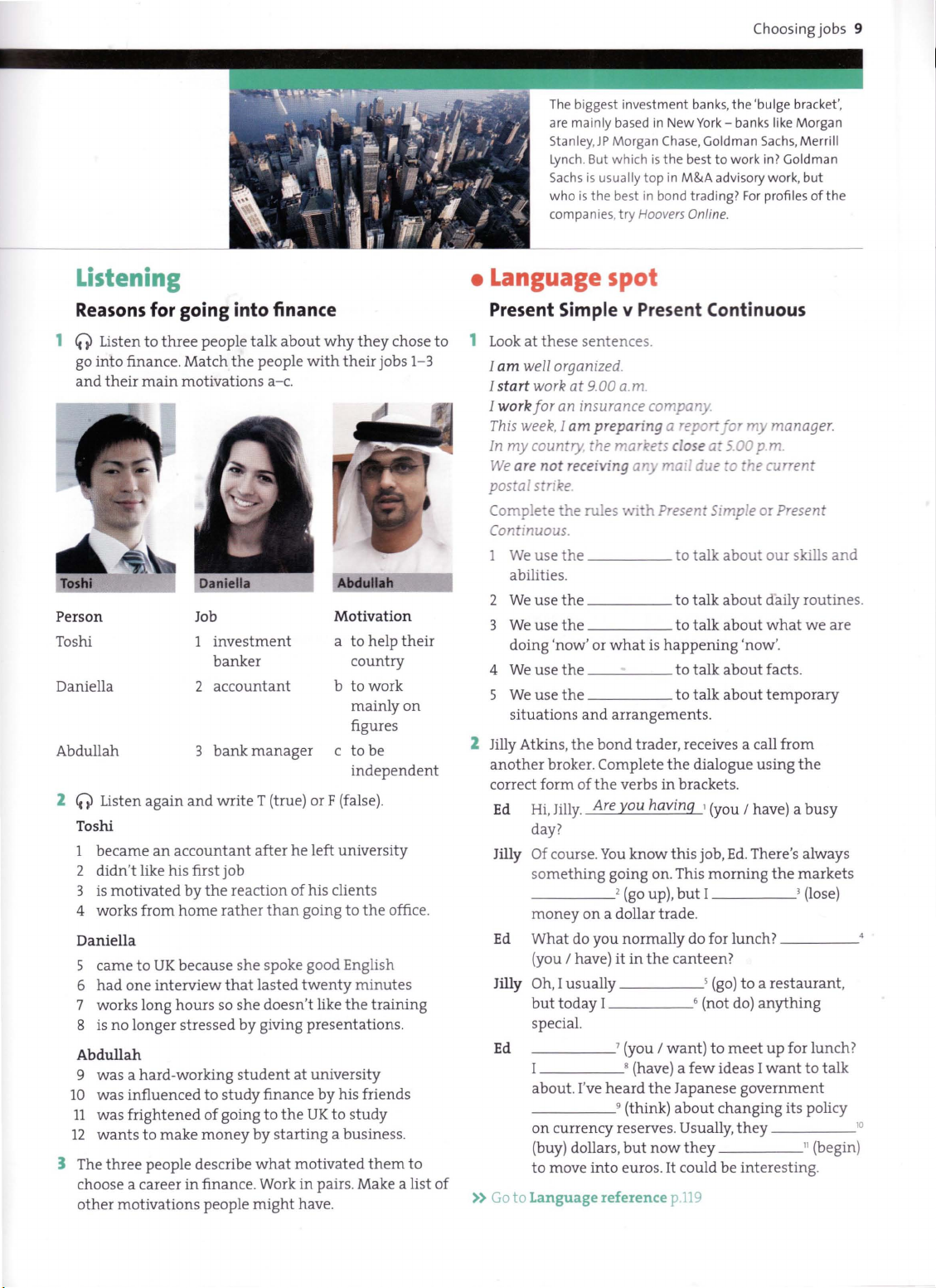
The biggest inve
stment
banks,
the
'bul
ge
bracket',
are
m
ai
nly based in
New
York
- banks like Morgan
Stan ley,
JP
Mor
ga
n Chase, Goldman
Sachs
, Merrill
Lyn
ch.
But which
is
the
best
to
work
in? Goldman
Sach
s
is
usually
top
in
M&A
advisory work,
but
wh
o is
th
e best in bond trading?
For
profiles
of
the
companies,
try
Haavers Online.
Language spot
Present Simple v
Pres
ent
Continuous
1
Look
at
the
se sentences.
I am well
or
ganized.
I start work at
9.00
a.m.
I work for
an
insurance company
This
week, I am preparing a
repa
0
my
manager.
In
my
country. he mar e-s close a- 5.00 p.
m.
We
are not receiving any
mQl
I due 0 he current
pos
al
s
rike
Comple e
the
rules
vi
Presen
Simple or Present
Continuous.
1
We
use
the
___
__
to talk about our skills and
abilities.
2
We
use
the
___
_ _ to talk about daily routines.
3
We
use
the
to
talk about
what
we are
doing
'now
' or
what
is
happening
'now
'.
4
We
use
the
to talk about facts.
5
We
use
the
to talk about temporary
situations
and
arrangements.
2 Jilly Atkins,
the
bond trader, receives a call from
another
broker. Complete
the
dialogue using
the
correct form of
the
verbs in brackets.
Ed Hi,
Jilly.
Are
you havinq 1 (you / have) a
busy
day?
lilly
Of
course.
You
know this job,
Ed
. There's always
so
mething
going on. This morning
the
markets
_
___
2
(go
up),
but
I 3 (lose)
money on a dollar trade.
Ed
What do you normally
do
for lunch?
___
_
(you / have) it in
the
canteen?
lilly
Oh,
I usually 5
(go)
to
a restaurant,
but
today I 6 (not
do)
anything
special.
Ed
7 (you / want)
to
meet
up
for lunch?
_____
8 (have) a few ideas I
want
to talk
about. I've heard
the
Japanese government
_____
9 (think) about changing its policy
on currency reserves.
Usually,
they
10
(buy) dollars,
but
now
they
11
(begin)
to
move into euros.
It
could be interesting.
»
Go
to
Language reference p.
119
10 Un it 1
-a
d da es often
fai
l an interview beca
us
e
~-eJ
a e
n'
t done their preparation.
So,
us
e a
d map to help
yo
u.
Think of
si
x questions they may ask
you
. Put
each
in
a circle around
the
interviewer.
n the centre of a
pi
e
ce
of paper, write
the
wo
rd
interviewe
r.
Draw a line from each circle a
nd
note down
how you
will
answer
the
question.
Drawa
box
under
the
notes and write one
example from your experience.
Writing
A covering letter
When
you
apply
for
a
job,
you normally
se
nd
a
CV
and
a
covering
letter
.
1
Complete
the
covering
letter
by
choosing
the
correct
verbs
. (Use
the
explanations
in
Language spot
on
p.g.)
Ms
MWilson
JBD
Bank
56
Cheapside
LONDON
EC4Y
2WD
23
June
20-
Dear
Ms
Wilson,
I write /
am
writing1
to
apply for
the
job
of
customer
advisor, as
advertised
on
your
website
on
13
June
(reference WRF/236).
I am I am being2 numerate, I have /
am
having'
good
personal skills,
and
I
am
very
interested
in
banking. I
like /
am
liking4
contact
with
customers
and
I
am
good
at
communicating
with people.
As
you can
see
from my
CV,
I
studied
economics
at
school
and
I
now
study / am
now
studying
S
for a diploma
in
business studies. I think /
am
thinking6 this gives
me
a
good
background
for
the
job.
I currently work /
am
currently working' part-time
in
a
bookshop, so
I have /
am
having
8
experience
of
dealing
with
customers
and
handling money. Every
day
I prepare /
am
preparing9
the
cash balance
when
we
close
the
shop.
Presently, during
the
holiday period, I also help /
am
also
helping
10
my uncle with his
accounts
on
the
computer
.
I would
be
very pleased
to
have
the
opportunity
to
discuss this application further.
You
can
contact
me
by
email
at:jsmith@meganet.com
.
I look forward
to
hearing from you.
Yours sincerely,
~
b..aJ,
James
Smith
Z
Choose
your
favourite
job
from
Webquest
or
the
unit
and
write
a
covering
letter
to
apply
for
it.
Professional skills
First
impressions
Read
t
he
ar
ticle
and
answer
the
questions
.
Would
yo
u
dress
differently
for
an
interview
with
a
bank
or
a
call
ce
ntre?
2
What
other
ways
ca
n
you
make
a
good
impression
in
the
first
minute?
3
What
is
the
most
interes
ti
ng
thing
you
like
people
to
kn
ow ab
out
you?
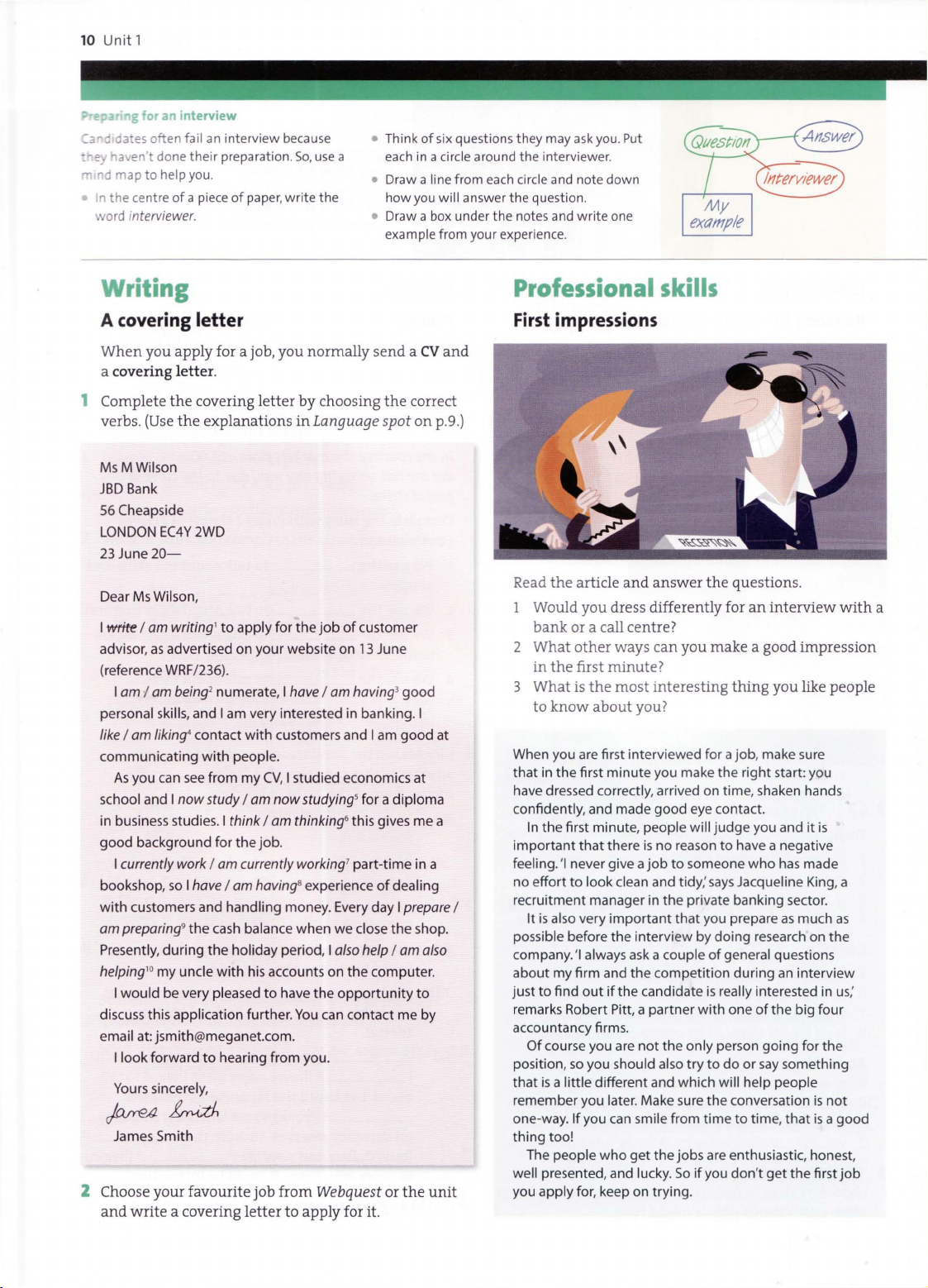
When you are first interviewed for a
job
, make sure
that
in
the
first minute you make
the
right start: you
have dressed correctly, arrived
on
time, shaken hands
confidently,
and
made
good
eye contact.
In
the
first minute,
people
will
judge
you
and
it
is
important
that
there
is no reason
to
have a negative
feeling.
'I never give a
job
to
someone
who
has
made
no
effort
to
look clean
and
tidy; says Jacqueline
King
, a
recruitment
manager
in
the
private banking sector.
It
is
also very
important
that
you
prepare
as much as
possible before
the
interview by doing research
on
the
company
.
'I
always ask a
couple
of general questions
about
my firm
and
the
competition during an interview
just
to
find
out
if
the
candidate
is
really interested
in
us;
remarks Robert
Pitt, a
partner
with
one
of
the
big four
accountancy
firms.
Of course you are
not
the
only person going for
the
position,
so
you should also try
to
do
or
say
something
that
is
a little different
and
which
will
help
people
remember
you later. Make sure
the
conversation
is
not
one
-way.
If
you can smile from
time
to
time,
that
is
a
good
thing too!
The
people
who
get
the
jobs
are enthusiastic, honest,
well presented,
and
lucky. So
if
you
don't
get
the
first
job
you apply
for,
keep
on
trying.
Speaking
Presenting
your
skills
to
an
employer
In a job interview, you have
to
explain
why
you
want
to
do a job
and
why
you would be good
at
it.
Work in groups of three or four.
1
Choose your favourite job from
the
unit. Prepare to
explain to
the
others
why
you
want
th
e job.
Us
e
the
Useful language below
to
help you think of ideas.
Te
ll
the
others
just
the
na
me of the job you have chosen.
2 Prepare
at
least six questions to ask
the
other
members of your group about
their
job choices.
Use
the
Useful topics below
and
different types of question
from
Language spot on p.7. Three questions
must
be
information / open
Wh- questions
and
three
must
be
yes /
no
questions.
3 One
student
presents
their
choice to
the
others,
explaining
why
they
want
the
job. The others are
the
interview panel
who
ask questions to see if
the
person
is
suitable. Take
turns
so
that
everyone presents.
Useful topics
your education
skills
experience (with example
s)
motivation
understanding of
the
job's needs
what
you can offer to
an
employer
Useful
language
I would like
to
be a
...
because I
want
to
.
..
In this job you need to
...
I like / enjoy /
am
good
at
analysing figures
and
data
selling things
working
on
computers
solving problems
working
with
people
in
a
team
.
At
the
moment
I
am
studying ...
For
me
,
the
most
important
thing
is
...
I
think
this job will help
me
to ...
I
think
a
...
needs to be
..
.
Checklist
Assess your progress
in
this unit.
Tick
(.f)
the
statements which are true.
I can talk about what a person does
in
their job
I can talk about where and how they work
I can ask a range of different questions
about jobs
in
finance
I can discuss what skills and qualities are
needed for jobs
in
finance
I can prepare for an interview and write a
covering
letter
Keywords
Adjectives
accurate
numerate
Nouns
candidate
career
covering
letter
deadline
equity trader
graduate
job application
motivation
skill
team player
training
trend
Verbs
advise
analyse
apply
(for)
borrow
deal with
forecast
investigate
lend
serve
Look
back through this unit.
Find
five
more
words or expressions
that
you
think are useful.
12
Unit 2
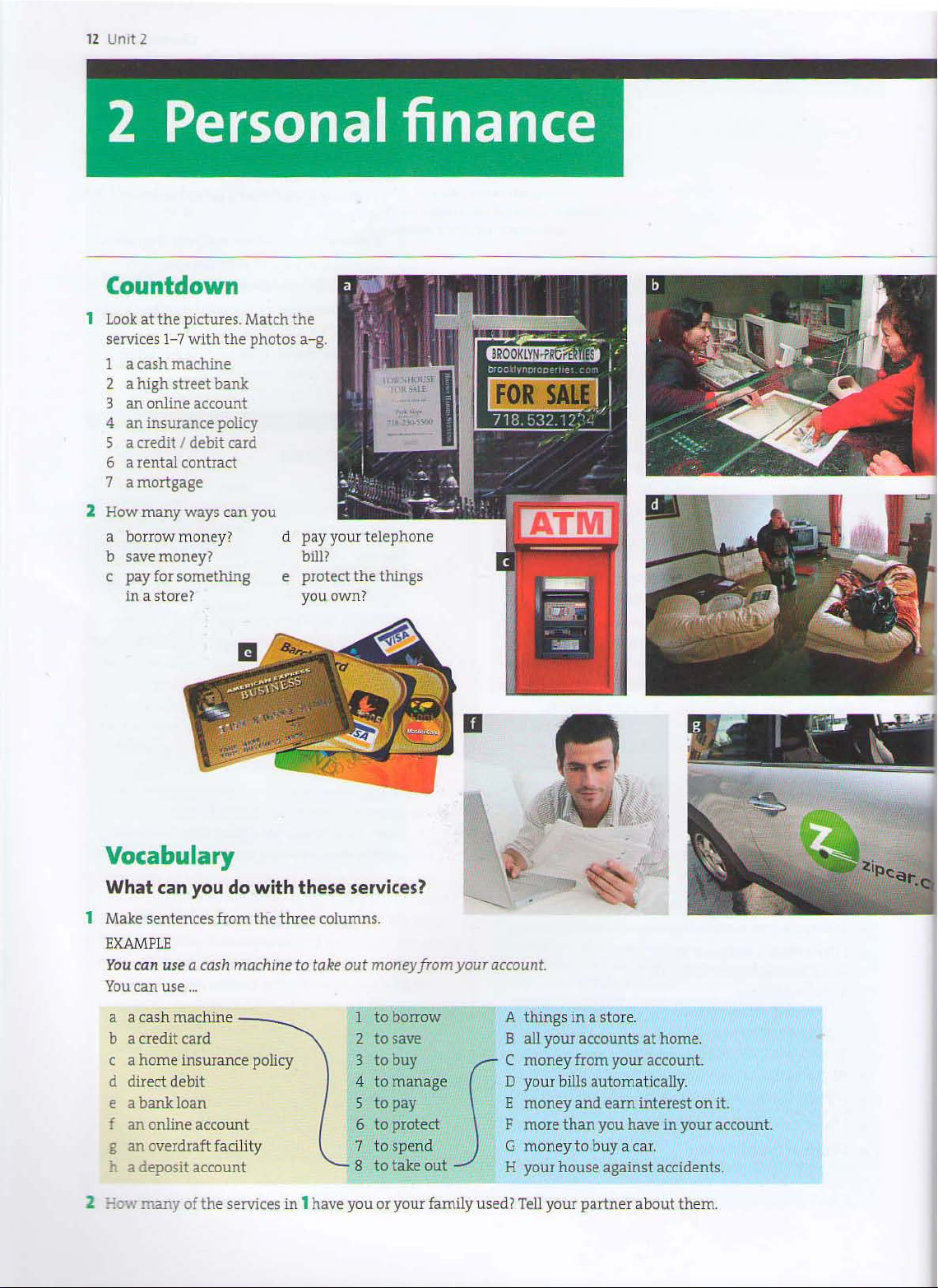
Countdown
1
Look
at the picture
s.
Match
the
selVices 1-7 with
the
photos a-g.
1 a cash machine
2 a high street bank
3 an online account
4 an insurance policy
5 a
cr
edit I debit card
6 a rental contract
7 a mortgage
Z How many ways can you
a bo
rr
ow money]
b save money?
c pay for something
in a store?
Vocabulary
d
e protect the things
you ow
n?
What can you do with
these
servi
ce
s?
1 Make sentences
fr
om
th
-e t hree columns.
EXAMP
LE
You
can use a cash machine to take
out
money
from
your
account.
You
can use
..
a a cash machine _ _
~
b a credit card
c a home insurance policy
d direct debit
e a bank loan
f an online account
g an overdraft fac
il
ity
h a deposit account
1
2
3
4
5
6
7
B
to borrow
to save
to buy
to
man
age
to pay
to protect
to spend
to take out
A things in a stor
e.
B all your accounts
at
home.
C money from your account.
D your bills automatically.
E money
and
earn interest on it.
F more than you have in your account.
G money to buy a car.
H your house against accidents.
Z How many of the services in 1 have you or your family used?
Tell
your
partn
er about
th
em.
i Read t
he
advertisement from
SBA
bank
abou
t their
services. Complete
the
text
with
the
prepositions from,
in.jor, on,
or into.
If
you
need to
borrow
money
_
__
_ _ 1 a bank, save
money
_ _ _ _ _ 1 a deposit account, or
even
i
nv
est
_ _ _ _ _ l shares,
why
not
try
SBA?
Our
accounts are si
mple
to
use
and
we a
re
easy
to f
ind
in
any
High
Street.
You
can
pay
money
_
____
.•
a
current account
or
wi
thdraw
money
~
your
account
simply
by
visiting a branch
or
even
on
l
ine
.
If
you
find
you
have spent
too
much
_____
shoppi
ng
or
you
owe too
much
7
your
credit
card,
you
can
always
apply
g an overdraft.
So
cali
into
your
loca
l branch
and
join
us
.
Dave Sweetman
Only a few years ago banks
dosed
every day at 3.30
and
there
were
no cash machines. In today's worl
d,
we
expect
to
access our banks 24 hours a day. But
who
are
t
he
people
who
make this possible? Our reporter visits
th
e
24
-
hour
call centre of a British
bank
and
talks to
Da
ve
Sweet
man
about
the
life
of
a night worker.
Why do you choose to work at night?
We
ll
, my wife
and
I have
just
had
our first child.
Bec
ause I work at night, I can see my son during
the
day. It's
much
better.
How
many people work
the
night shi
ft?
There are
twenty
of
us
at night. It's a huge office
and
a
lo
t of people work here during
the
day.
but
at night it's
a bit empty.
How
is
working at
ni
ght different from working
normal hours?
The volume of calls at night
is
far lower t
han
during
the
day. But because
the
team
is small. you have more
responsibility
and
people make friends
more
easily.
Plus, of course, you
earn
more
and
get a bigger bonus,
Persona l finance
13
In
this unit
using financial services
suggestions and advice
customer experience
handling customer complaints
It's
my
job
1 Discuss t
he
questions in pairs or small groups.
I
What
do
you
t
hink
are
the
advantages
and
disadvantages of
working
at
night?
Would you like
to do it?
2 What kind of
person do
you
think
would
want
to
work
at
nigh
t?
Why?
2:
Nowread
about
Dave
and
compare
what
he says wi
th
your
answers.
And
why do people
call
at
night?
We
take a lot of calls from overseas customers based in
different time zones, as well as from people
on
holiday
who
h~e
lost
their
credit cards or need
money
quickly.
What is
the
best pa rt of
the
job?
It
is
the
customers
that
make
the
job.
At
night,
some
how
people are more relaxed
and
there
is more
time
to develop a conversation. It's surprising
what
customers
start
talking
about
. The
lat
est football scores
or
the
news in UK if
they
are
on
holiday. Sometimes
they
forget
the
real reason for
the
call.
Fin
a
ll
y,
what's
the
most unusual problem you've had
to deal with?
Some of
the
stories are extraordinary. Last week, for
example.]
had
a call from a guy
who
had
just
got
married. He
had
bought drinks for all his guests all
evening
and
the
hotel
had
now
refused his credit card
so he couldn't pay.
He
was
really embarrassed. But
we
solved it
and
had
a l
augh
.
14 U
nit
2
T
he
UK
banking sector
co
n
tri
butes significantly
to
the
UK
a
nd
its economy.
Bank
ing
emp
loys about
half
a
million
people.
The
wider financial industry
emp
loys
ove
r
1.
1
million
and,
together
wi
t h related activit
ies
(accountancy, business,
computer and lega l
se
r
vices.
et
c.),
some 3 million
peop
le
rely on
the
financi
al
indus
try
for their jobs.
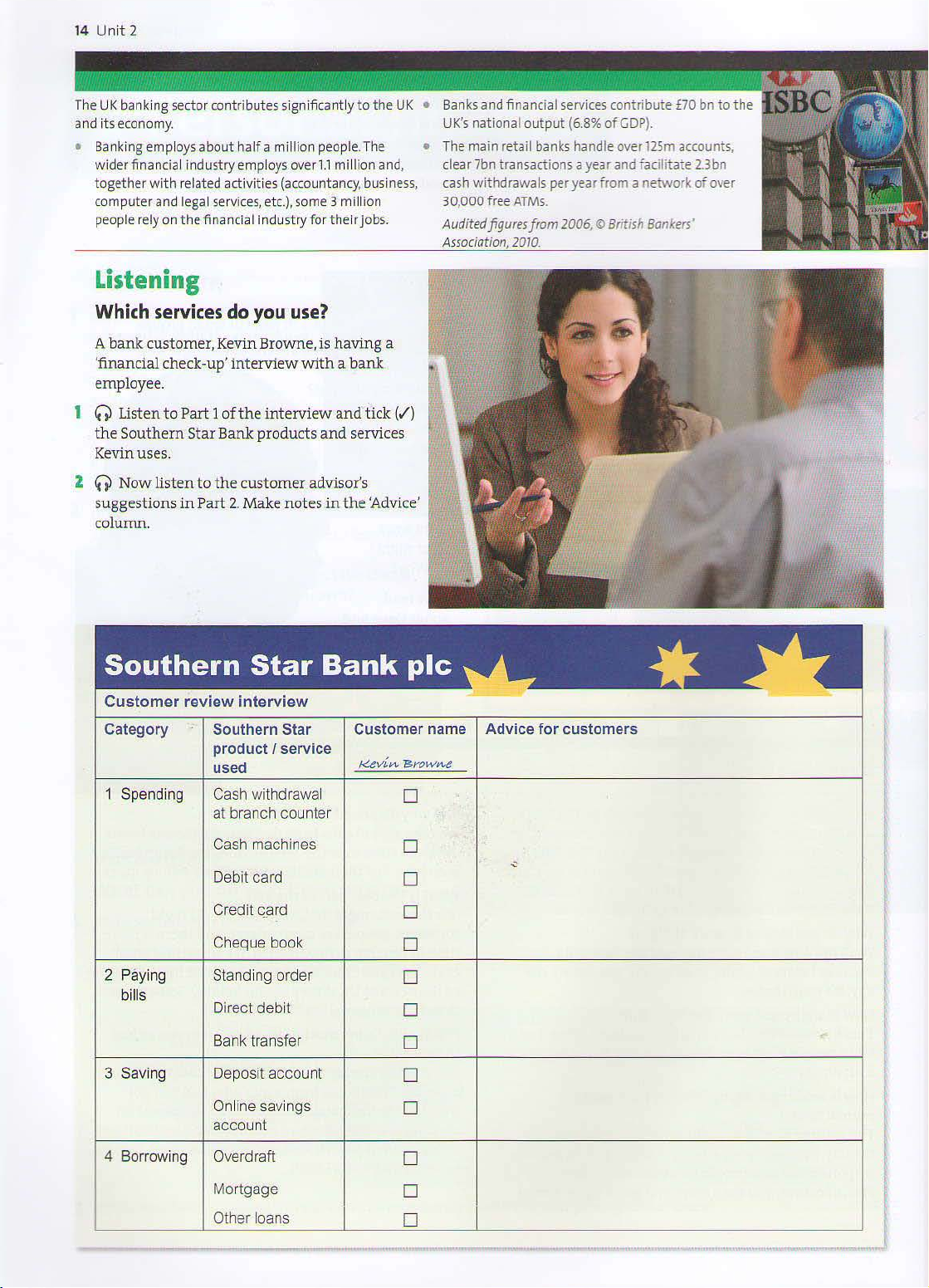
Listening
Which services do you use?
A
bank
customer,
Kevi
n Browne,
is
having a
'financial check-up' interview
with
a
bank
employee.
1
0
list
en to Part 1 of
th
e interview
and
tick (,I)
the Southern Star Bank products
and
services
Kevin uses.
2
0 Now listen to the customer advisor's
suggestions
in
Part
2.
Make notes in
the
'Advic
e'
column.
Customer
review
interview
Banks and financial services contribute
£70
bn to
the
UK's national
output
(6.8%
of
GOP).
The
main retail
ban~s
handle over
125m
accounts.
dear
7bn transactions a y
ea
r and facilitate
23bn
cash
withdrawal~
per year
from
a network
of
Oller
30,000 free
ATMs
.
Audited figures from 1006,
It'IBritish
Bankers'
Category
Southern Star
Customer
name Advice
for
customers
product
I service
used
f<,e
v;'""
grow'"'"<'!
1 Spending
Cas
h withdrawal
D
at branch counter
Cas
h machines
D
,
Debit card
D
Credit ca rd
D
Cheque book
D
2
Pay
i
ng
Standi
ng
order
D
bills
Direct debit
D
Bank transfer
D
3 Savi
ng
Deposit account
D
On
li
ne
sav
ings
D
account
4 Borrowi
ng
Overdraft
D
Mo
rtgage
D
Other loans
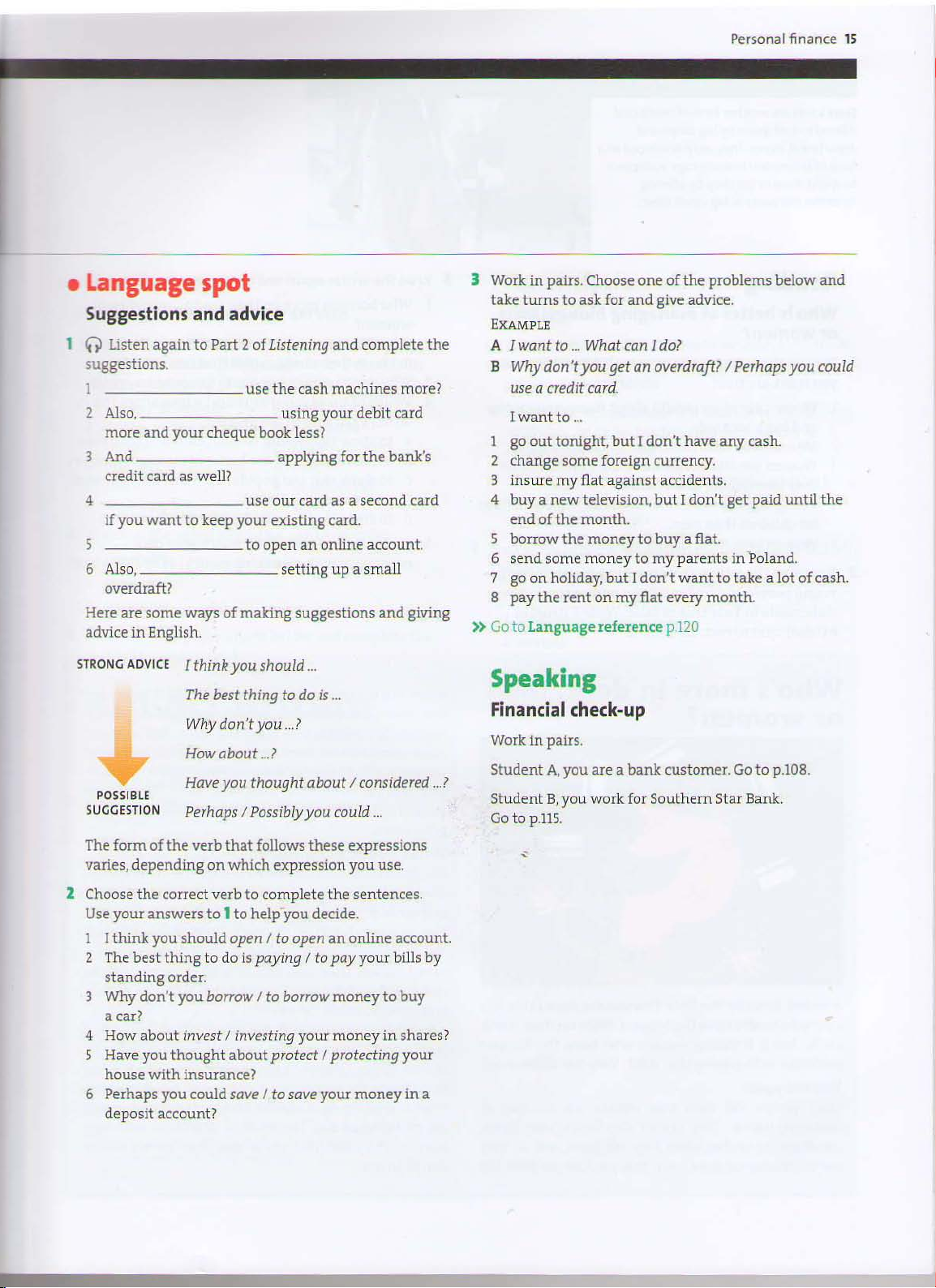
Language spot
Suggestions
and
advice
1 G
list
en
again
to Part 2
of
Listening
and
complete
the
suggestions.
1
________
use
the
cash
machines
mo
r
e?
2 Also,
using
your
debit
card
more
and
your
cheque
book
less?
3 And applying
fo
r
the
bank's
credit
ca
rd as well?
4
use
our
card as a second card
if
you
want
to keep
your
existing
card.
5
________
to
open
an
online
account.
6 Also, _
:-
_ _ _
___
setti
ngupa
small
overdraft?
Here
are
some
ways
of
making
suggestions
and
giving
advice
in
English.
STRONG
ADVICE
1
think
you
should
...
POSS
I
BL
E
SUGG
ES
TI
ON
The best thing to do
is
..
Why
don't
you
...
1
Howabout
...
?
Have
you
thought
about
/ considered
...
7
Perhaps!
Possibly
you
could
..
The
form
of
the
verb
that
follows
these
exp
ressions
varies, d
epe
nding
on
which
expression you use.
2 Choose t
he
correct
verb
to co
mp
lete
the
sentences.
Use
your
answers
to
1
to
help-
you
decide.
1 I
think
you
should
open I to open
an
online
account.
2 T
he
best
thing
to do
is
pay
ing I to
pay
your
bills
by
st
anding
order.
3
Why
don't
you borrow I to borrow
money
to
buy
a car?
4
How
about
invest I investing
your
mone
y
in
shar
es?
5 Have you
though
t
about
protect I protecting
your
house
with
insurance?
6 Perhaps you
could
save I to save
your
money
in
a
deposit account?
Personal finance
15
J Work
in
pairs. Choose
one
of
the
problems
below
and
take
turns
to
ask
for
and
give advice.
EXA
MPLE
A I
want
to
...
What
can I
do?
B
Why
don't
you
get
an
overdraft? / Perhaps
you
could
use a credit
ca
r
d.
I
want
to
..
go
out
tonight,
but
r
don't
have
any
cash.
2
change
some
foreign currency.
3 insure
my
flat
again
st
accidents.
4
buy
a
new
television,
but
I
don't
get
paid
until
the
end
of
the
month.
5
borrow
the
money
to buy a flat.
6 s
end
some
money
to
my
parent
s
in
Pola
nd
.
7 go
on
holiday,
but
I
don't
want
to
tak
e a lot
of
cash.
8 pay
the
rent
on
my
flat every
month.
»
Go
to
L
anguage
re
ference
p.l20
Speaking
Financial
check-up
Work
in
pairs.
Student
A,
you
are
a
bank
customer.
Go
to
p.108.
Stud
ent
B,
you work for Sout
hern
Star Bank.
Go to
p.m.
,
16
Unit
2:
offered
to
customers
by
big shops ilnd
department stores. They were developed
ilS
a
form
of
promotion
to
encourilge customers
to
spend more in the shop
by
offering
incentive discounts
or
big credit IimiU.
Reading
Who
is
better
at
managing money: men
or
women?
1 Discuss
these
comments
in
pairs. Which of
them
do
you
think are true?
1 Women are more careful about managing money
and
bank
accounts.
2 Men usually have more debt
than
women.
:J
Women use store cards more
than
men
because
they
love buying new clothes.
4 Young
women
have more financial responsibilities
for children
than
men.
S Women save more money
than
men.
Z Now read the article
about
a survey of debt among
young people
and
ftnd
out
if
the
author thinks the
statements
in
1 are true or false. Write T (true) or
F (false) next to each statement.
Who's
more
in
debt:
men
or
women?
A
re
ce
nt
study by the Debt Foundation shows that it
is
young men who have
the
biggest debts on the
ir
credit
ca
rd
s,
but
it
is
young women who ha
ve
the biggest
problems with pay
in
g
that
deb
t.
Why the difference?
Ste
r
eotypes!
Many
people
stili
think that women
are
just
bad at
managing money.
They
cannot stop buying new shoes,
handbags, or clothes when they
see
them, and
so
they
borrow money on store
ca
r
ds
that you can get
from
big
3 Read
the
article again
and
answer
the
questions.
1 Who borrows more on their credit
cards:
men
or
women?
2:
Why do
women
have more problems
with
paying
debts
on
their credit cards? Find
two
reasons.
:J
Why don't
women
use banks to borrow money?
4 Which of these comments best summarizes
the
writer's purpose
in
the article?
a to show
that
young women earn less
than
men
b to show
that
men
are better
at
managing money
c to show
that
our popular opinions about
women
and
money are wrong
d to show
that
men
and
women
are not equal
5
Do
the facts in the survey match your own
experience
with
managing mon
ey?
Why I Why not?
shops.
But
the resulu
of
the survey show this
is
simply not
tr
ue
.
Young
men,
it
seems,
use
store cards just
as
much
as
women. Sometimes, they are worse.
Also,
they save
less
money than women
from
their
salaries
. They open fewer
savings accounts than women and
take
bigger
risks
with
their finance, investing
in
things
like
shares.
Young
men
are
also
less
likely
to
have insurance on their homes and
possessions.
What
about
equ
a
li
ty
?
No,
the
real
reason women can't
pay
is
that women
usually
have
debu
on
basic
things
for
the home
like
rent
and services simply because they are poorer and often
have
to support children
or
older parents on
low
incomes.
The
study shows that today at the age
of
24 most women
earn
15%
less
than men and
have
more responsibilities
with
family
and children. These are the
real
causes
of
debt
problems.
So
much
for
equality!
But
the worst
news
from
the survey
is
t
hat,
because
of
their poverty, women
of
t
en
cannot go
to
big
banks
to
borrow money.
They
have
to
use
other service companies
that charge the highest
rates
of
interest.
So,
they suffer
more and
pay
more
in
interest because their
family
needs
are more desperate.
The
result
is
that there are more
women who have their gas or electricity turned
off
for
non payment.
Vocabulary
Talking
abo
ut
customer
service
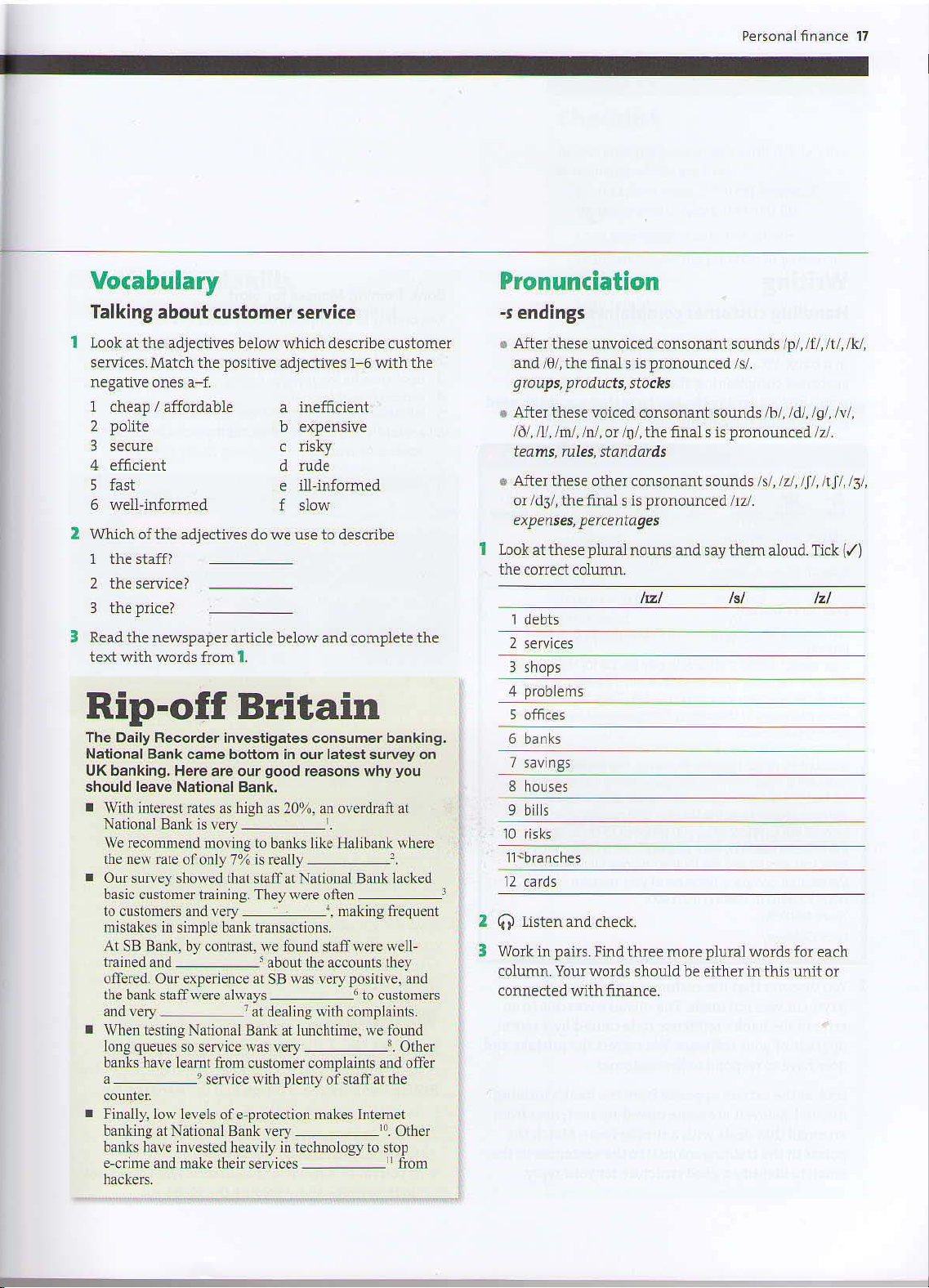
1 Look at
the
adjectives below which describe customer
services. Match the positive adjectives
1- 6 with the
negative ones a-f.
1 cheap / affordable
a inefficient
2 polite
b
expensive
3 secure
c
risky
4 efficient
d
rude
5 fast
e
ill
-informed
6 well-informed
f slow
Z Which of
the
adjectives do we use to describe
1
the
staff?
2
the
service?
3
the
price?
J
Read
the
newspaper article below and complete
the
text with words from
1.
Rip-off
Britain
The Daily
Recorder
investigates
consumer
bankin
g.
National Bank
came
bottom
in
our
latest
surv
ey on
UK
banking
. Here are
our
good
reasons
why
you
should
leave National Bank.
With interest rates as high as 20%, an overdraft at
National Bank
is
very I
We
recommend moving to banks like Halibank where
the new rate of only 7% is really
!
Our survey showed that staff at National Bank lacked
basic customer t
rai
ning. They were ofien
;c---:
__
_
to customers and very
.,
making frequent
mistakes in simple bank transactions.
At 5B Bank, by contrast,
we
fo
u
nd
staff were well-
trained and I about the accounts they
offered.
Our experience at 5B was very positive. and
the bank staff were always
6
to
customers
and very
7 at dealing with complaints.
Wh
en testing National Bank at
lu
nchtime, we found
long queues so service was very
~
.
Other
banks have learnt from customer complaints and
off
er
a 9 service with plenty
of
staff at the
counter.
Finally, low levels
ofe
-protection makes Internet
bank
in
g
at
Na
ti
onal Bank very
10.
Other
banks have invested heavily in technology to stop
e-crime and make their services
II
from
hackers.
Pronunciation
-5
endings
Pe
rsonal
fi
nance
17
After these
un
voiced consonant
so
unds Ipl,
If!
, It!, Ik
l,
and
19/,
the
final s
is
pronounced l
si.
group
s.
products, stocks
After these voiced consonant
so
unds
fb
i,
l
di
, Ig/, lv
i,
10/, 1
1!
.l
mJ,
In
l,
or I
IJ
/,
the
final s
is
pronounced Izl.
teams,
ru
les. standards
After these other consonant sounds
isi
.l
v,
I fl, i
tJ
/, 131,
or I
d3
/,
the
final s
is
pronounced li z).
expenses. percentages
1 L
ook
at these plural nouns and say
them
aloud.
Tic
k (.t)
the correct
co
lumn.
IIZ
I lsi I
zl
1 debts
2 services
3 shops
4 pr
ob
lems
5
offices
6 ban
ks
7
sa
vi
ngs
8 houses
9 bills
10
risks
1 1
~
branches
12
cards
Z «j) Listen
and
check.
J Work in pairs. Find three more
pl
ural words for each
column.
Your
words should be ei
th
er
in
th
is
un
it or
connected with finance.
18
Unit 2
Writing
Handling
customer complaints
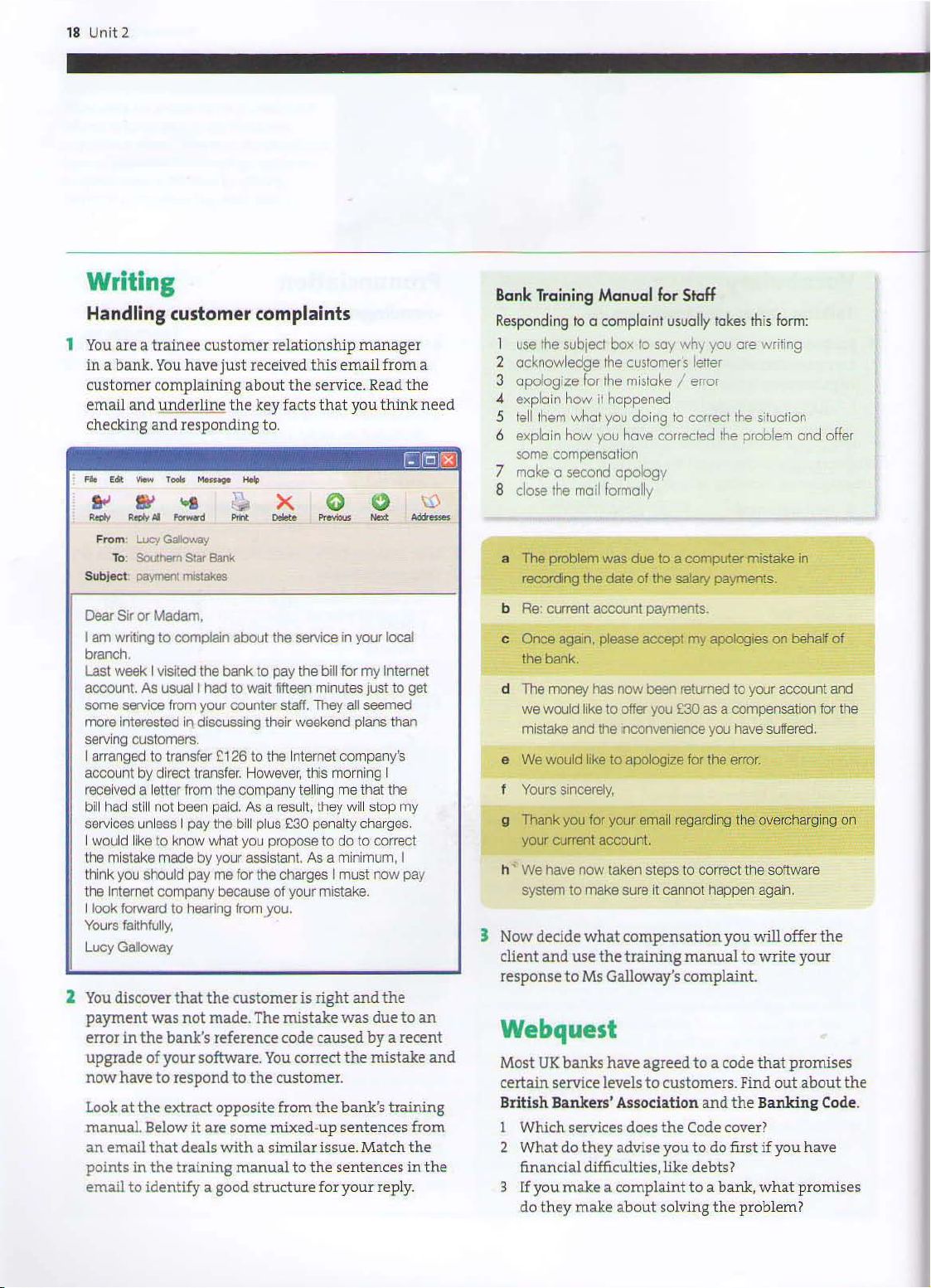
1
You
are
a
trainee
customer
re
lation
sh
ip
manager
in
a bank.
You
have
just
receiv
ed
th
is e
mail
from
a
customer
complaining
abou
t
the
service. Read
the
email
and
underline
the
key
facts t
hat
you
th
ink
need
checking
and
responding
t
o.
80'
Ill'
"I
rtodt
Reo/,
...
-..
From
Lucy
GaJcr.vay
To Southam Star Bank
Subject
payment
rTIIStakeS
Dear Sir or Madam.
I am
writing
to complain about the s
ervic
e
in
your
local
br
anch.
Las
t week I
visited
the bank to pay
the
bi
n f
or
ffi.J
Inte
rn
et
account.
As
usual I had to wa
it
fifteen min
ut
es
just
to
get
some
service from
yo
ur
co
un
ter
staff.
They a
ll
seemed
more
in
terested i
n.
di
scussing t
heir
weekend plans than
serving
customers.
I arranged to transfer £126 to the Internet company's
account
by
direct
transfer.
Howeve
r.
th
is
morning
I
received a letter
from
the company tel
li
ng me that the
bi
ll
had still
not
been
paid.
As
a result, they
wil
l slop
my
services
un
less I pay the
bi
ll
pl
us £30 penalty charges.
I
would
l
ike
to
know what
you
propose to do to correct
the mistake made
by
your
assistant.
As
a
min
i
mum
, I
t
hink
you
should pay me
fo
r the charges I must now pay
the
Internet company because
of
you
r
mi
stake.
1
i00i<
f
orw
a
rd
to
hea
rin
g
from
you.
Your
s
fa
it
hfu
ll
y.
lucy
G
al
low
ay
2
You
discover
that
the
customer
is
right
and
the
payment
was
not
made.
The
mistake
was
due
to
an
error
in
the
bank
's
reference
code
caused
by
a
recent
upgrade
of
your
software.
You
correct
th
e
mistake
and
now
have
to
respond
to
the
customer.
Look
at
the
extract
opposit
e
from
the
bank's
trai
ning
manual
Below
it
are
some
mix
e
d-up
sentences
from
an
email
that
deals
with
a
similar
issue
.
Match
the
p
ain
ts
in
the
training
manual
to
the
sentences
in
the
em ail
to
identify
a good
structure
for
yOU!
reply.
Bank
Training
Manual
for
Staff
Responding to a complaint usually takes this form:
1
use
the
subject box
to
soy
why
you
are
wri
ting
2
acknowledge
th
e
cus
tomer's letter
3 apologize for
the
mistake / error
.4
expla in how it h
ap
pe
n
ed
5 tell th
em
what
yo
u
do
ing to correct the situation
6 explain h
ow
you hove
COfrec
t
ed
the problem a
rl
d offer
some
comperlso
ti
on
7 make 0 secorld
apology
8 close
the
mail formally
8
The
problem was
due
to a computer mistake
in
recording the date
01
the salary payments.
b Ae: current account payments.
c Once again. please accept
my
apologies on behalf
of
the bank,
d
The
money
has
row
been
returned to
your
account and
we
wouJd
li
ke
to
offer
you
£30
as
a compensati
on
for the
mistake and the i
nconveni
ence you have suffered.
e
We
would
like
to
apologize
for
the error.
Y
ours
Sincerely.
9 Thank
you
for
you
r ema
il
regardi
ng
the
ov
ercharg
ing
on
your current account.
h'
We
ha
ve
no
w taken steps to corr
ec
t the software
system to make sure
it cannot happen again.
J
Now
decide
what
compensation
you
will offer
the
client
and
use
the
training
manual
to
writ
e
your
response
to
Ms Galloway's
complaint
Webquest
Most
UK
banks
have
agreed
to
a code
that
promises
certain
service levels
to
customers.
Find
out
about
the
Briti
sh
Banker
s' Ass
ociation
and
the
Banking
Code.
1
Which
services does
the
Code cover?
2
What
do
they
advise
you
to
do first
if
you
have
financial
difficulties, like de
bt
s?
3 If
you
make
a
complaint
to
a bank.
what
promises
do
they
make
about
solving
the
problem?
Professional skills
Customer relationship management
Read
the
text
below
and
then
discuss
the
questi
on
s.
1
Do
you
think
banks are
right
to
think
of
their
cu
stomers
as
'custom
ers for life?
2 What do you
think
are
the
'changing financial
needs of a
customer
through
their
life'? Make a list
in pairs or
small
groups,
then
discuss
as
a class.
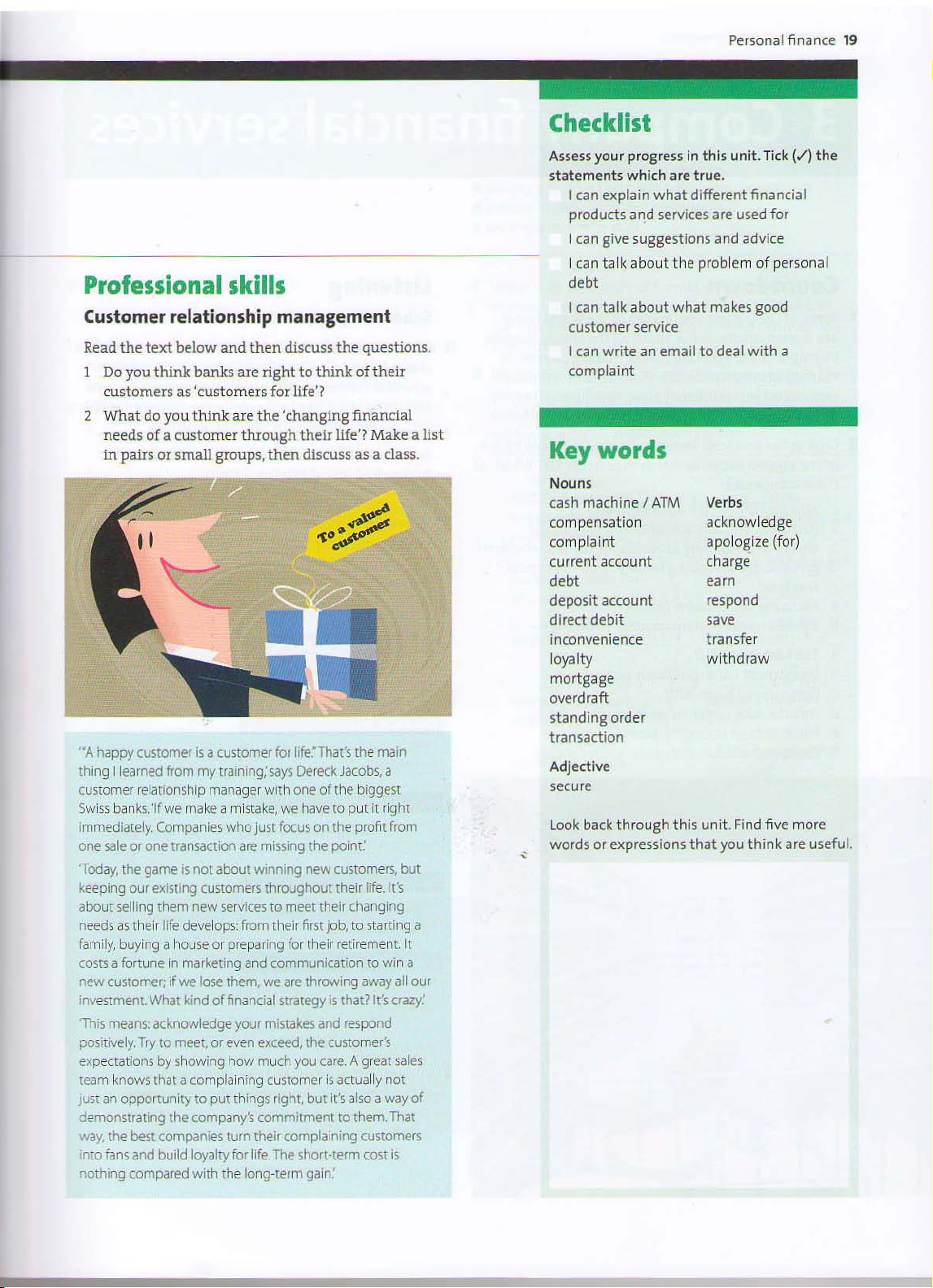
"A
happy customer
is
a customer
for
Iife."That's
the
main
thin
g I learned
from
my
trai
n
ing:
says
Dereck
Jacobs, a
cu
sto
me
r relat
ionshi
p
man
ag
er
wi
th one of t
he
biggest
Sw
iss bank
s.'lf
we make a mi
stak
e,
we have to put it r
ig
ht
immediately.
Companies
w
ho
just
focus
on
t
he
p
rofi
t
fr
om
one
sale
or
one transaction
are
missing
the point:
'Tooay,
the game
is
not
about
winning
new
customers, but
keeping
our
existing
customers throughout
th
e
ir
lif
e.
It's
about
selling
them
new
seNices tG meet
their
ch
ang
in
g
needs as their
life
develops: f
rom
their
firs
t job, to
star
tin
g a
fa
m
il
y,
buying a hou
se
or p
re
p
ar
ing
for their
ret
irement. It
costs
a
fort
un
e
in
ma
r
ketin
g a
nd
communicati
on
to w
in
a
new
customer;
if
we
lose
th
e
m,
we
are
throwing
away
all
our
investment.
What
kind
of
financial
strategy
is
that?
It's
crazy:
'This
means:
acknowledge
your
mistakes
and respond
posi
ti
ve
ly
. T
ry
to meet, or even exceed, the customer's
exp
ectat
ions
by
show
ing
h
ow
mu
ch
you
care
. A great
sales
team
kn
ow
s that a
com
plain
in
g customer is
ac
tua
ll
y
no
t
just
an
opportuni
ty
to put things
righ
t.
but i
t's
also
a
way
of
demonstrating the company's commitment to t
hem,
That
way,
the best companies
turn
t
heir
complaining customers
into
fans
and
build
loyalty
for
lif
e.
The
short-
term
cost
is
no
t
hing
compared
wit
h t
he
long·t
erm
ga
i
n:
Pe
rsonal finance
19
Checklist
Assess
yo
ur progress in th
is
un
it.
Tic
k (,I)
the
statements wh
ic
h are true.
I can explain
what
different financial
products and services are used for
I can give suggestions and advice
I can talk about the prob lem of personal
debt
I can talk about
what
makes good
customer service
I can write an email to deal with a
complaint
Keywords
Nouns
cash machine I
ATM
compensat
io
n
complaint
current account
debt
deposit account
di
rect debit
inconvenience
loyalty
mortgage
overdraft
standing order
transaction
Adjective
secure
Ve
r
bs
acknowledge
apologi
ze
(for)
charge'
earn
respond
save
transfer
wit
hd
raw
look back through th
is
unit.
Fi
nd
fi
ve more
words
or
expressions
that
you thi
nk
a
re
useful.