Phân tích chuỗi cung ứng của FORD | Môn Quản trị chuỗi cung ứng quốc tế - Đại học Kinh Tế Quốc Dân
Raw materials and parts are delivered from suppliers to warehouses. From there, they are sent to assembly centers for vehicle production. Once assembled, vehicles are distributed to dealers, who then sell them to customers. Tài liệu được sưu tầm gồm 15 trang, giúp bạn ôn tập tốt hơn. Mời các bạn đón xem.
Môn: Quản trị chuỗi cung ứng quốc tế 80 tài liệu
Trường: Trường Đại học Kinh Tế Quốc Dân 8.5 K tài liệu
Tác giả:







Preview text:
lOMoAR cPSD| 58950985
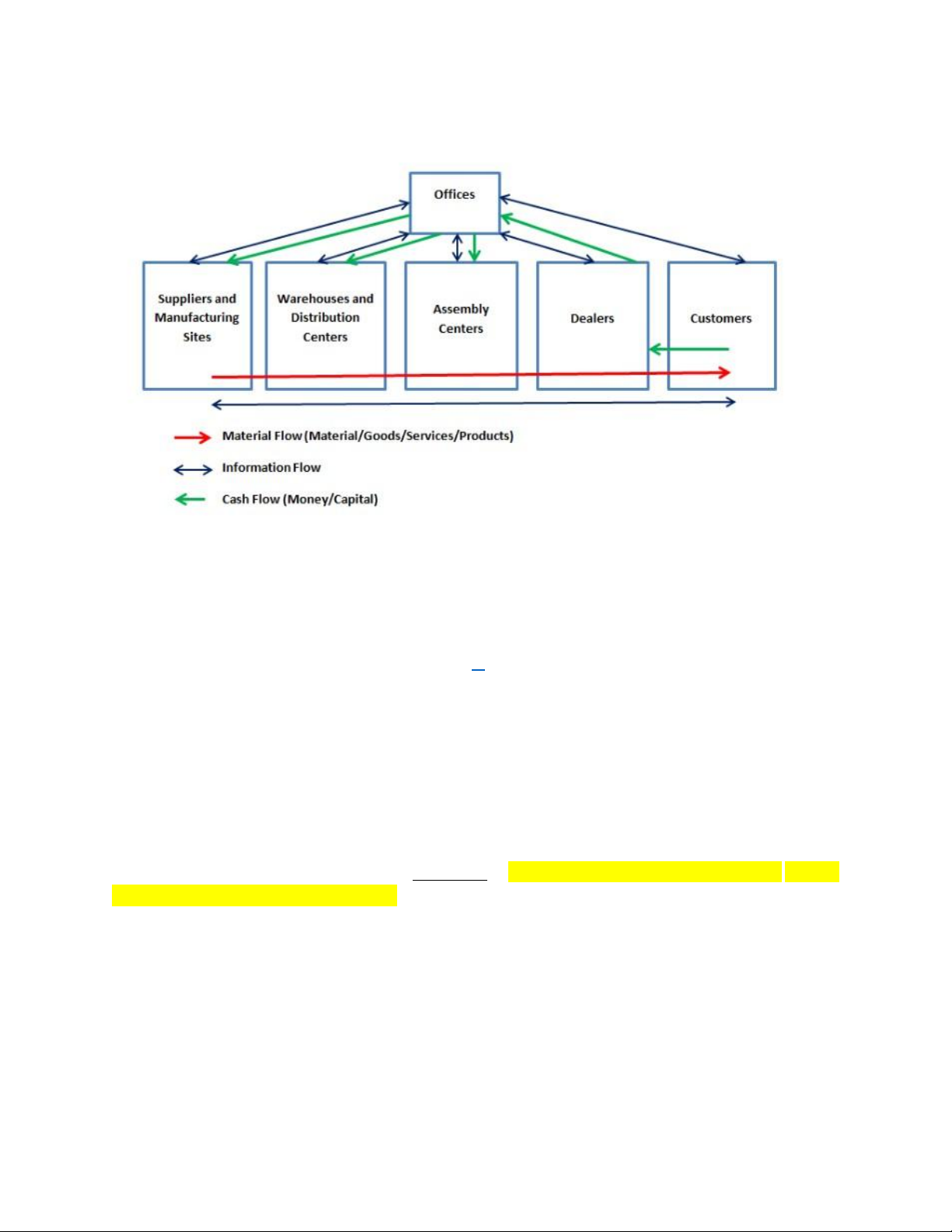
Mô hình tổng quan về ccu của FORD?
Raw materials and parts are delivered from suppliers to warehouses. From there, they are sent to
assembly centers for vehicle production. Once assembled, vehicles are distributed to dealers, who then sell them to customers.
Còn check lại 2022 (khả năng vẫn là thế này vì) 1. Planning Process
Ford’s supply chain planning is supported by advanced digital tools that enhance production flexibility.
Ford has announced a plan to invest a total of $29 billion globally in the stage of 5 years (2021 to 2025).
The goal of this investment is to strengthen Ford's competitiveness in the global electric and autonomous
vehicle market. Part of this strategy focused on expanding Ford's presence in China, establishing it as a key
market alongside EU and the United States.
The company utilizes tools like Teradata and Planisware to support collaborative planning between product
developers and manufacturing engineers. These software tools allow Ford to manage complex assembly
lines that can accommodate multiple vehicle models, improving flexibility and reducing costs. For instance,
Ford can quickly adapt its assembly lines to incorporate new production needs, such as adding a battery
insertion station for electric vehicle production. This capability is essential in maintaining production
efficiency as the company expands its lineup of electric vehicles.
R&D: Ford’s decentralized Research and Development (R&D) structure involves spreading R&D activities
across multiple locations, allowing various teams to innovate and collaborate based on regional and global
needs. Decentralized R&D allows Ford to tailor innovations to different regional markets. This flexibility lOMoAR cPSD| 58950985
is crucial because automotive needs can vary based on geography, consumer preferences, regulations, and
infrastructure. For instance, fuel efficiency technologies may be more prominent in Europe, while electric
vehicle (EV) development could be a priority in markets like North America and China.
The decentralized approach fosters collaboration across various teams with specialized knowledge.
Engineers and designers working on specific technologies can quickly exchange information and innovate
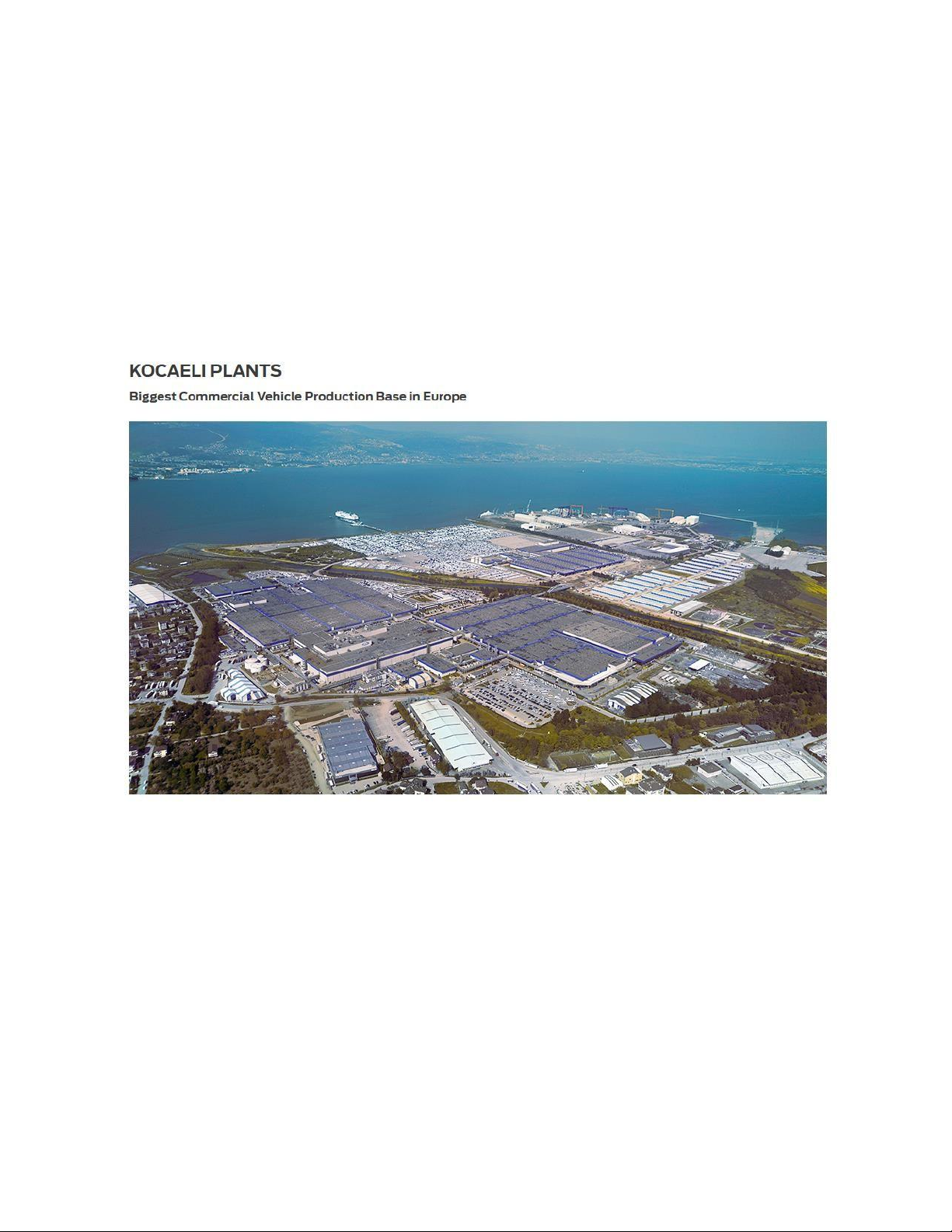
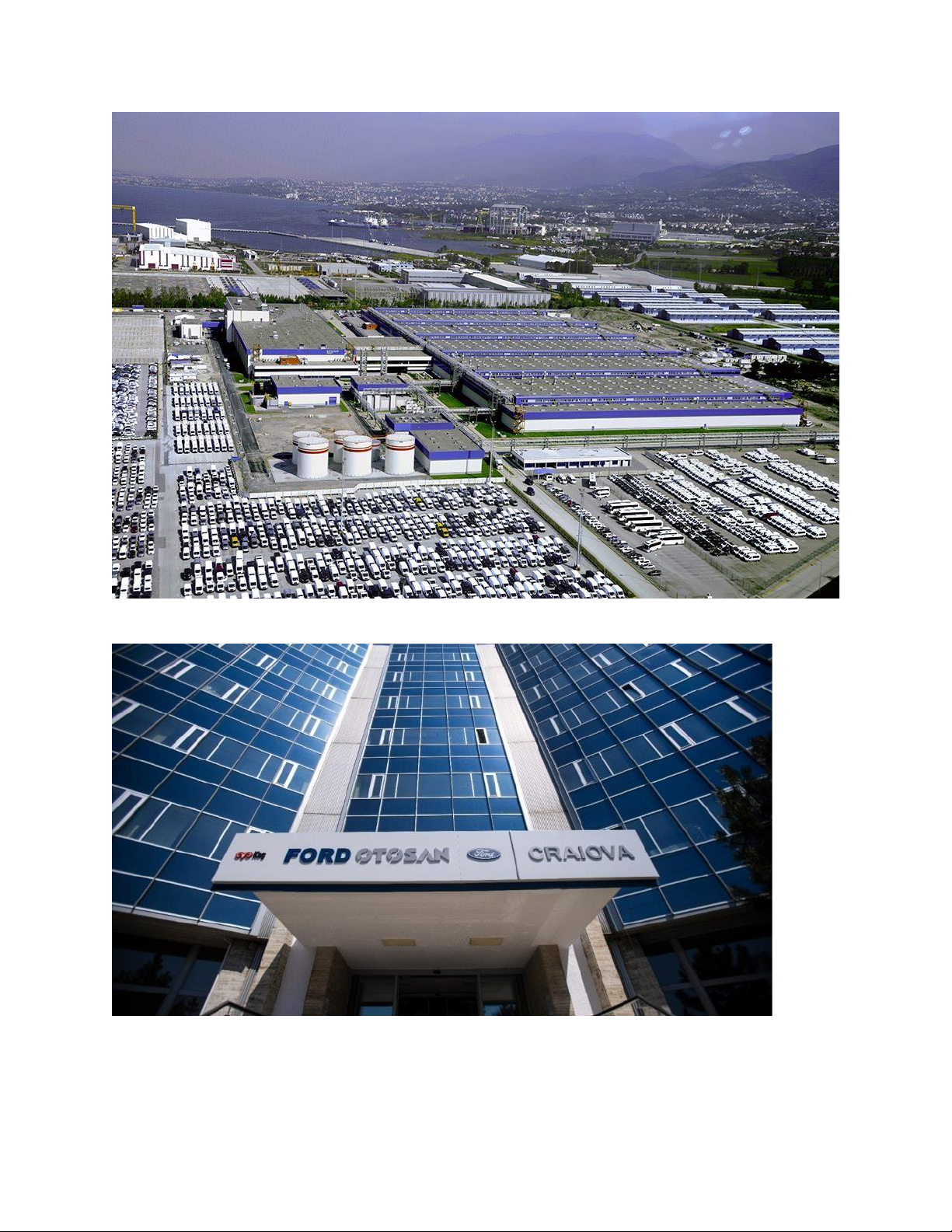
without being constrained by a centralized structure. Ford Otosan Golcuk Plant, Turkey lOMoAR cPSD| 58950985 CRAIOVA PLANT , Romania Atlanta R&D Center lOMoAR cPSD| 58950985
Ford's decentralized R&D model, the company uses a combination of both in-house teams and
outsourced partnerships.
- Ford’s in-house teams are instrumental in driving long-term innovations and creating
foundational technologies that support its global product lines. By centralizing some areas
of expertise, Ford ensures consistency and alignment with their strategic vision across the organization.
- While Ford relies on its internal teams for many R&D activities, it also outsources certain
functions and forms partnerships with external entities to access specialized skills, new
technologies, or faster innovation cycles. Examples include:
Tech companies and startups: Ford partners with technology firms, especially in the fields
of artificial intelligence (AI), machine learning, and advanced software. For instance, Ford
has collaborated with companies like Google for AI integration and Argo AI for
autonomous driving technology. 2. Purchasing lOMoAR cPSD| 58950985
Ford’s supply chain can be characterized as a multitier supplier network where thousands of suppliers
provide raw materials and parts of vehicles, as well as services and resources. Currently, Ford Motor
Company cooperates with about 1,500 Tier 1 suppliers that produce the most important vehicle parts.
These suppliers are located in more than 60 countries, where over 4,000 sites are involved in the
production processes (Ford Motor Company, 2017a; Ford Motor Company, 2017b). There are 10 tiers of
suppliers that provide vehicle components and raw materials.
Tier 1: direct suppliers to Ford and supply the major vehicle components such as engines, transmissions,
and advanced systems that are integral to vehicle assembly (close and strategic partnership with Ford,
often providing high-quality and complex parts that are essential to the finished product) using
frameworks like the Aligned Business Framework (ABF), which helps ensure that sustainability and
business conduct are aligned across the supply chain
Tier 2 Suppliers provide subcomponents or raw materials to the Tier 1 suppliers. For instance, if Tier 1 is
providing engine systems, Tier 2 might be responsible for providing components like sensors, fuel injectors,
or raw materials like steel or aluminum that are essential to building the final product.
Tier 3 Suppliers might be responsible for even more basic components or materials such as metals,
plastics, or electronics that are used by Tier 2 suppliers. In some cases, Tier 3 could be involved in providing
raw materials like specific types of plastic that are then molded into smaller components by Tier 2 suppliers.
Tier 4 and Below can be further down the supply chain, providing basic raw materials such as chemicals,
metals, or even energy, which are crucial for the manufacturing of products in higher tiers.
- => There is a flow of parts and materials between these tiers. Tier 1 suppliers receive their key
components from lower tiers (Tier 2, Tier 3, etc.), integrate them into larger, more complex
systems, and then deliver those systems to Ford.
Essentially, Tier 1 suppliers are integrators that take parts or materials from lower tiers and
assemble them into the final product that Ford uses in its vehicle production. lOMoAR cPSD| 58950985
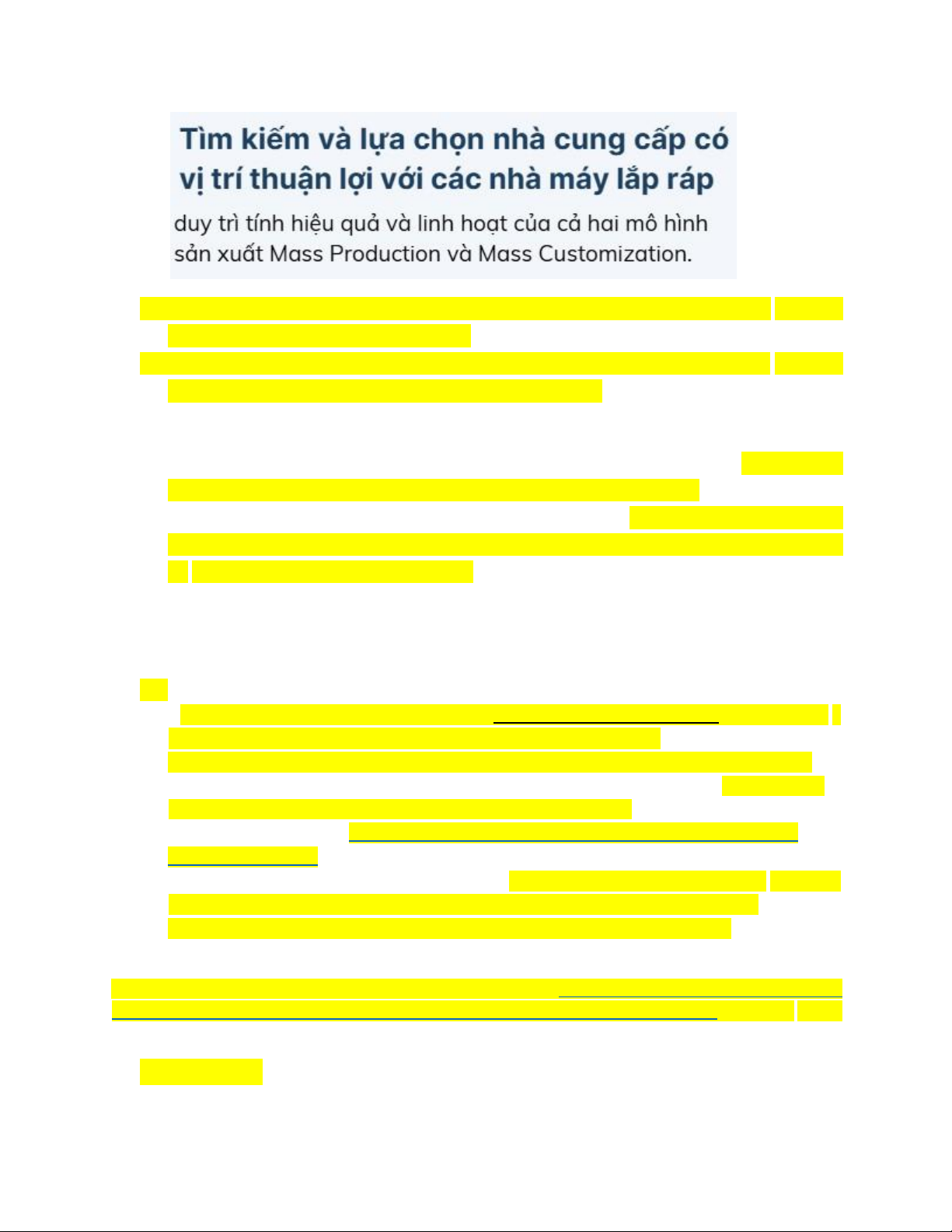
- Searching and selecting suppliers: It is important to find suppliers with strategic locations
that are convenient for assembly plants.
- Maintaining effectiveness and flexibility: Ensuring the balance of efficiency and flexibility
in both mass production and mass customization models.
Ford Vietnam has implemented a strategy of assembling the Ranger pickup truck at the
Hai Duong plant to optimize efficiency and flexibility in production, also established a
network of material and auto parts suppliers throughout the country to ensure product
and service quality. These suppliers are often located near assembly plants and
Fordauthorized dealerships, making it easier to provide and service vehicles. (Dana Ford –
Da Nang, Binh Duong Ford – Binh Duong
- Restraint criterias of choosing suppliers:
+ Quality Assurance: Suppliers must adhere to Ford's rigorous quality standards, demonstrating a
commitment to delivering products that meet or exceed specifications.
This includes compliance with recognized quality management systems such as ISO/TS 16949 +
Collaboration and Continuous Improvement: Ford seeks suppliers willing to collaborate on
product development and continuous improvement initiatives. Participation in industry
standards and guidelines, such as those provided by the Automotive Industry Action Group (AIAG), is encouraged
+ Besides, they evaluate suppliers based on their ability to manage risks, ensure timely deliveries,
and maintain financial and operational stability, which are followed by Ethical & Legal
Compliance, Environmental Responsibility, and Human Rights and Labor Practices
Programs and initiatives to identify and develop suppliers: Widening the Inclusion Network (WIN)
program (in 2020, focused on increasing Tier 2 suppliers), MentorWE( woman program), and some others 3. Operations lOMoAR cPSD| 58950985
Autonomous assembly line:
Ford uses technology from a startup called Symbio Robotics that looks at the past few hundred attempts
to determine which approaches and motions appeared to work best. A computer sitting just outside the
cage shows Symbio’s technology sensing and controlling the arms. Toyota and Nissan are using the same
tech to improve the efficiency of their production lines.
This technology allows this part of the assembly line to run 15 percent faster, a significant improvement in
automotive manufacturing where thin profit margins depend heavily on manufacturing efficiencies.
-> Improvement in Product Quality
Error Reduction in Manufacturing: The use of robots and AI systems helps reduce errors and
improve product quality. At Ford's Super Duty plant, the installation of vision-guided robots has
improved both quality and efficiency in handling large metal parts, reducing costs and increasing accuracy.
Labor Cost Savings and Increased Productivity: The implementation of autonomous
assembly lines has helped Ford reduce labor costs and increase productivity. Specifically,
the use of robots and automation systems has helped lower production costs and increase
efficiency, while reducing dependence on manual labor.
Ford’s Lean Manufacturing:
Concept: Lean manufacturing is a systematic, continuous improvement method focused
on adding value for customers while eliminating waste in the production process or service
delivery within an organization. This approach helps reduce costs (increase profits),
optimize resource usage, shorten production/service delivery times, and increase
flexibility in responding to the ever-changing, increasingly stringent customer requirements. lOMoAR cPSD| 58950985 Benefits:
Improves productivity and quality (Ford improved its assembly productivity by
36% since 1980 through the implementation of Lean Manufacturing principles. )
Shortens production times and service delivery cycles ( At Daman Products, the
adoption of Lean Manufacturing led to a 97% reduction in cycle times, a 50% reduction
in setup times, and a 90% reduction in flow distance.)
Minimizes both tangible and intangible waste due to inventory
Enhances the efficiency of equipment and facility utilization Increases responsiveness
Lean manufacturing brings efficiency to the supply chain by avoiding bottlenecks. The
principles of Lean aim to make the production process as efficient as possible. It focuses on
improving product quality and costs by removing waste from the production process and
the value chain. Ford learned this approach from Toyota. Flexibility:
Mass Production Features:
Mass production is characterized by the standardization of products, where items
are produced in large volumes with minimal customization. It emphasizes
efficiency through automation, reducing labor costs, increasing productivity and
cost reduction rather than personalized preferences.
Mass Customization Features:
Mass customization allows for a wide variety of personalized products, offering
customers the opportunity to tailor items to their preferences, which adapt
efficiently to diverse demands without compromising productivity. The approach
aims to keep costs similar to mass production by leveraging flexible manufacturing
systems. Additionally, customers are more involved in the design or selection
process, resulting in a product that better meets individual needs. lOMoAR cPSD| 58950985 4. Logistics Logistics: lOMoAR cPSD| 58950985 Xuôi:
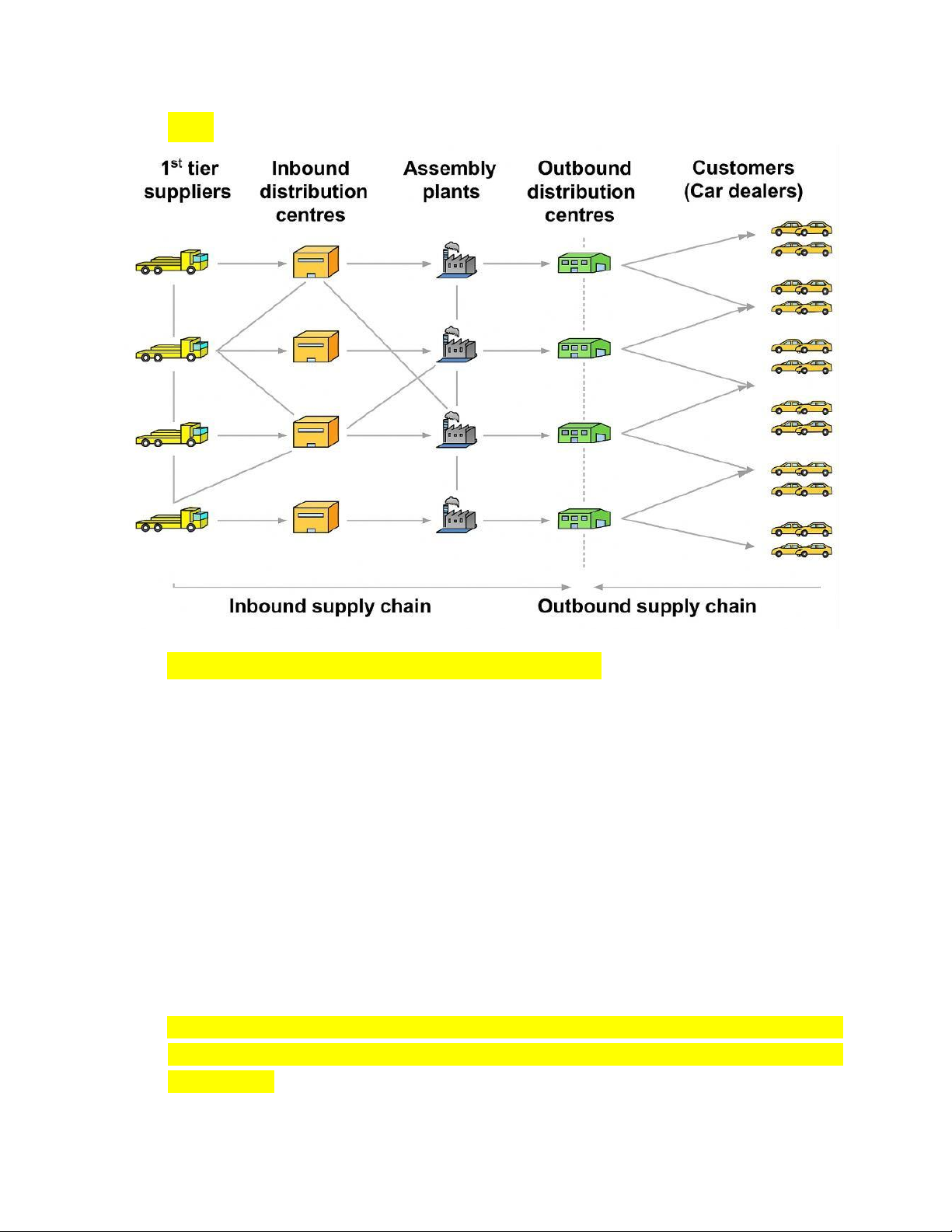
Inbound Supply Chain (Left side of the diagram):
1. 1st Tier Suppliers:
The process begins with the first-tier suppliers, who provide parts and materials
that are directly used in the production of vehicles.The materials and parts from
the suppliers are then delivered to the inbound distribution centers. These centers
serve as storage hubs before the parts are moved to the assembly plants. Then,
the parts from the distribution centers are sent to the assembly plants, where they
are used to manufacture the final products (vehicles). This stage involves the core
activity of assembling the components into finished vehicles.
The inbound supply chain focuses on the flow of raw materials and components, ensuring
that assembly plants are supplied with the right materials in a timely manner.
(first-tier supplier provide parts and materials -> delivered to the inbound distribution
centers (storage hubs) -> sent parts to assembly plants, where final products are manufactured lOMoAR cPSD| 58950985
* This stage involves the core activity of assembling the components into finished vehicles.
Outbound Supply Chain (Right side of the diagram):
1. Outbound Distribution Centres:
After assembly, finished vehicles are sent to the outbound distribution
centers. These centers act as holding areas for the cars before they are
shipped to dealers or directly to customers.
Finally, the vehicles are sent to car dealers, who serve as the point of
contact for the customers (buyers). Dealers sell the cars to customers,
completing the outbound supply chain.
The outbound supply chain focuses on the distribution of finished products from
assembly plants to the final customers, ensuring timely delivery to car dealers and, ultimately, to end consumers.
Finished vehicles -> outbound distribution centers (holding areas, wait to be shipped to
dealers or directly to customers) -> sent to car dealers (customers), completing the outbound supply chain Logistics management
Ford Motor Company is focusing on using warehouses that are the property of third-party providers
because of the necessity to utilize large spaces associated with warehousing facilities in more than 60
countries (Ford Motor Company, 2017a). Therefore, warehouses, which are used by the company for
storing its products, are usually leased under certain service contracts (Ford Motor Company, 2017a; Ford
Motor Company, 2017b). Still, it is also important to note that Ford’s plants and assembly centers that are
owned by the company have additional warehousing space to store the limited number of products and components.
RTLS: In its manufacturing facilities, Ford employs RTLS technology to enhance efficiency and precision. lOMoAR cPSD| 58950985
For example, Ford has implemented RFID-based Just-In-Time (JIT) delivery systems to streamline parts
delivery to its manufacturing plants. This system ensures that parts arrive within hours of being needed,
optimizing inventory management and production timelines.
WMS: Ford Motor Company utilizes Warehouse Management Systems (WMS) to enhance the efficiency
of its supply chain and distribution operations. These systems automate and optimize various warehouse
processes, including inventory management, order fulfillment, and parts distribution.
JIT: Ford often uses a “just-in-time” inventory system. This means they get parts from suppliers exactly
when they need them. It helps reduce storage costs and ensures fresh components for assembly. Ngược:
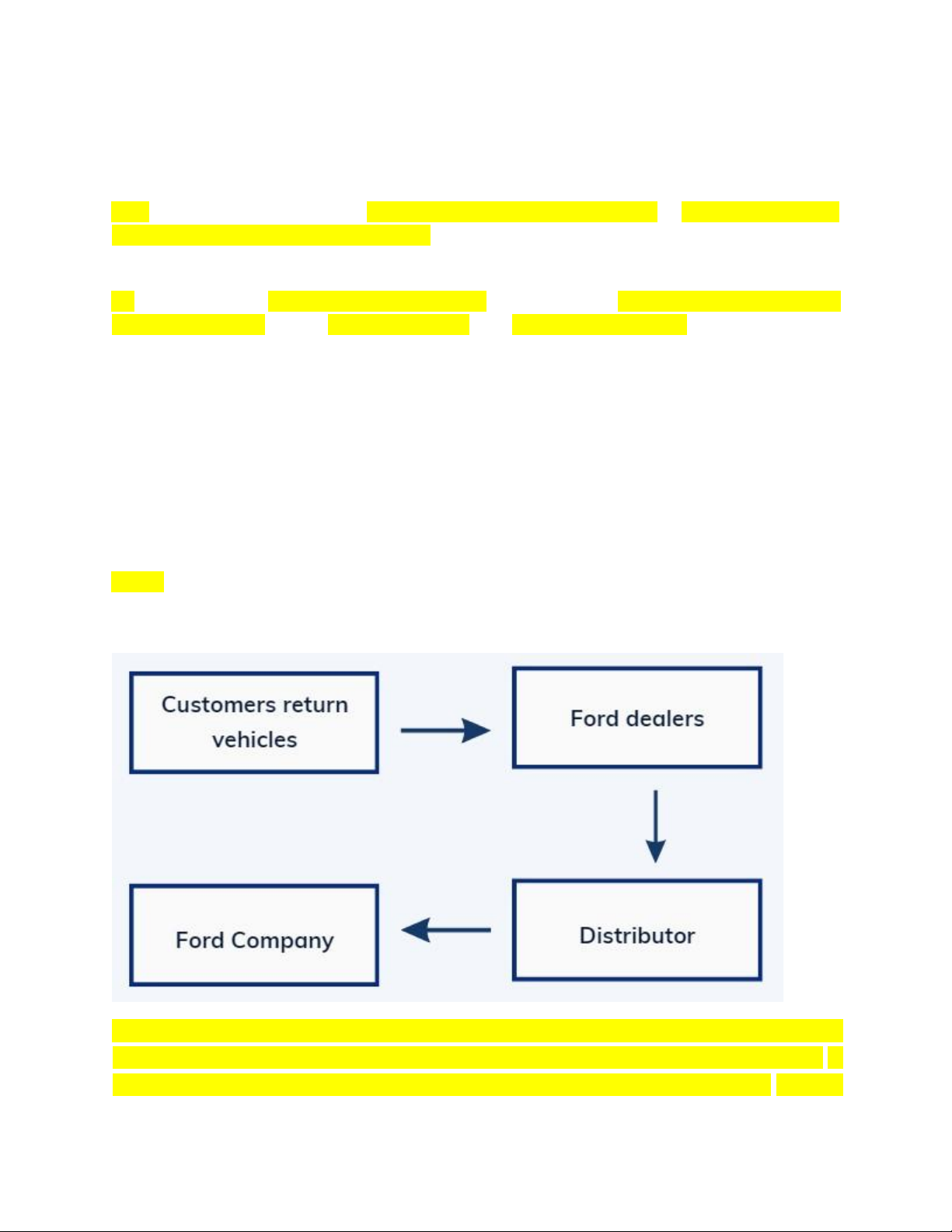
Ford's reverse logistics process begins when customers return vehicles due to defects,
dissatisfaction, or recalls. The returned cars are sent to Ford dealers, where they are inspected to
determine if they need repair, reselling, or recycling. Ford then evaluates the returned products lOMoAR cPSD| 58950985
and decides whether to repair, refurbish, or recycle them. If the vehicle is suitable for resale, it is
sent to a distribution center for further processing; if not, it may be dismantled or recycled. 5. Distribution -
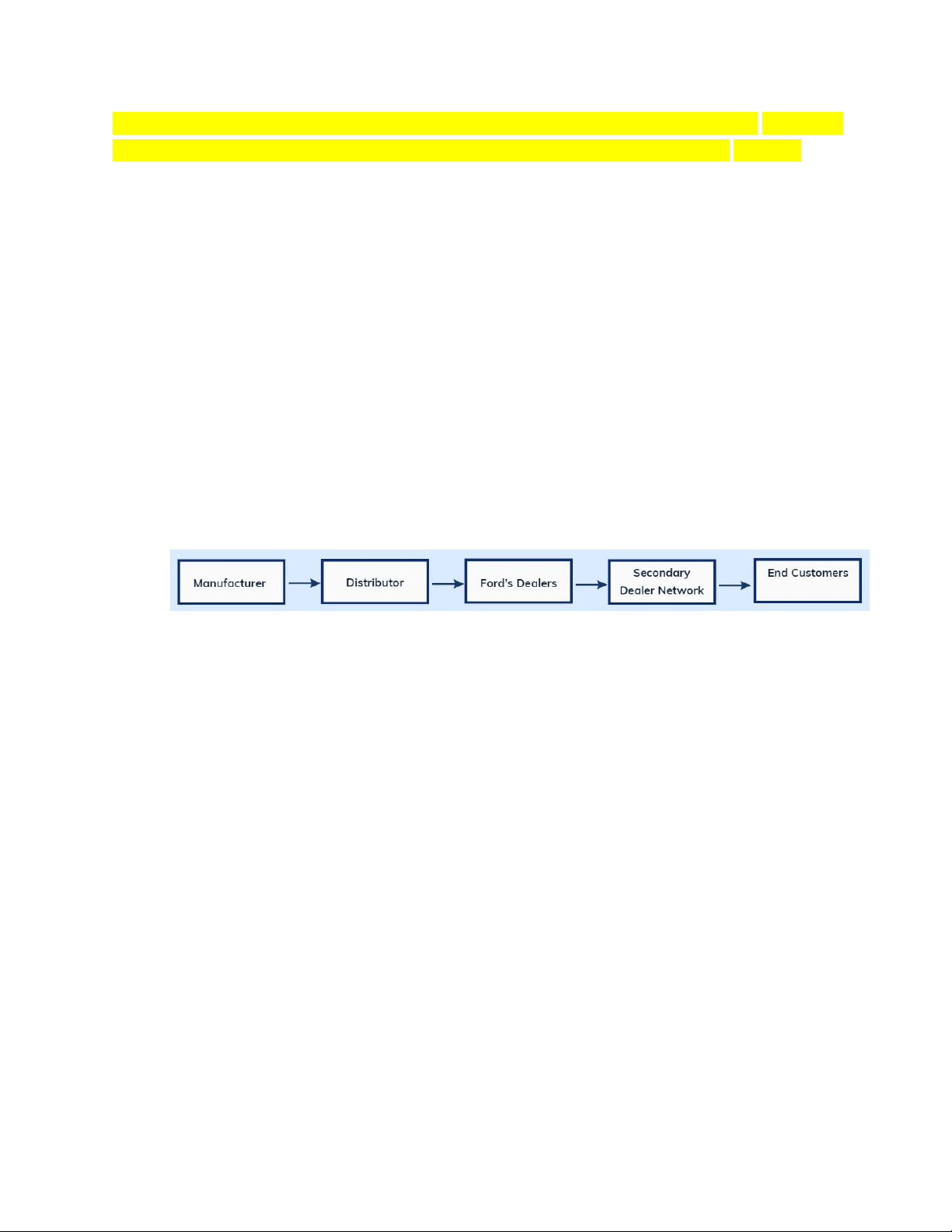
The Ford distribution process begins at the manufacturing plant, where vehicles are produced.
After production, the vehicles are sent to the distribution center, which acts as a hub for
distributing vehicles to various authorized dealers or regional distribution points - which serve as
the direct intermediary between Ford and the customers. These dealerships are responsible for
marketing the vehicles, managing customer relationships, and offering after-sales services. In
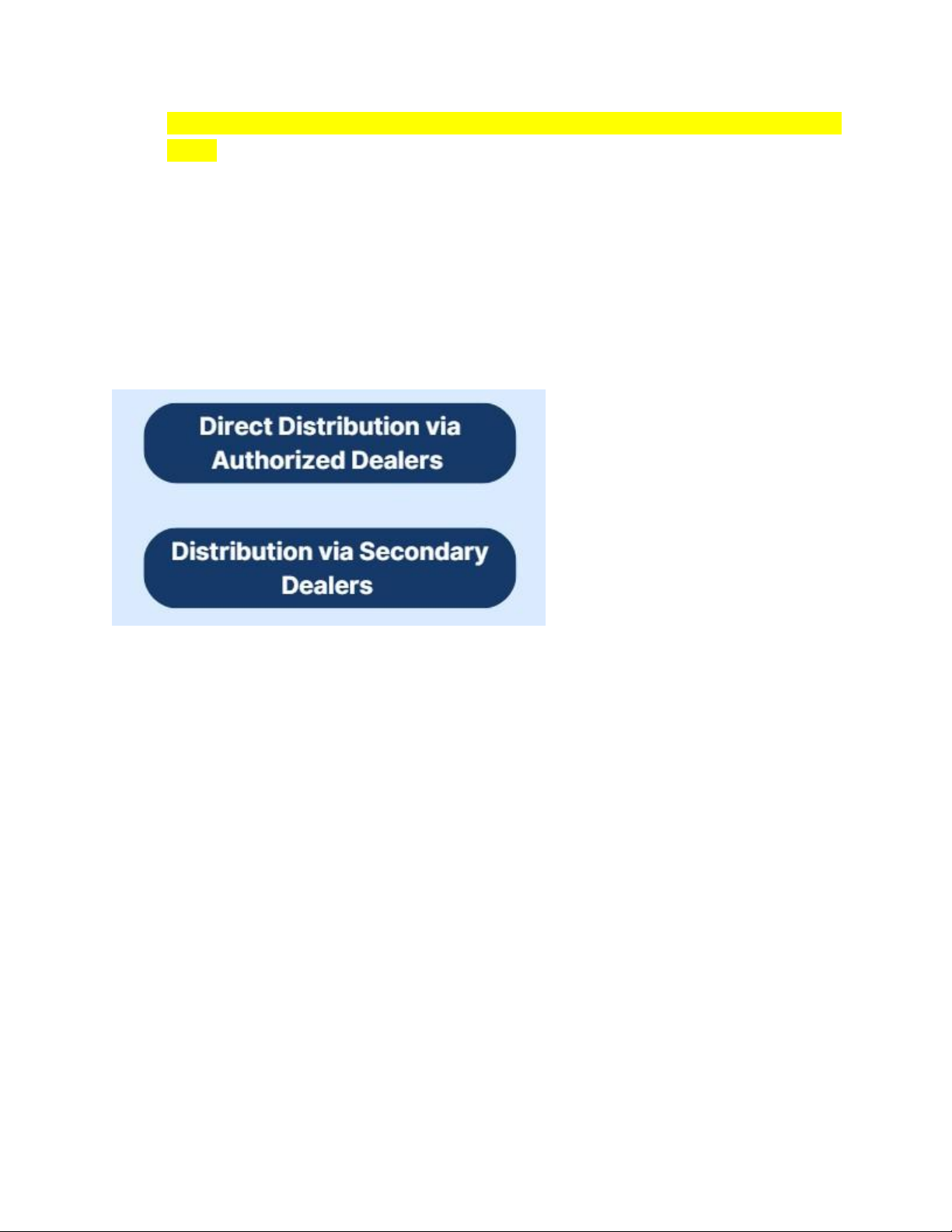
addition to the primary dealership network, Ford also relies on a secondary dealer network,
which includes smaller dealers or agents who have agreements to sell Ford products but are not
directly owned by the company. This secondary network helps expand Ford's reach, especially in
less accessible areas. Ultimately, the process culminates with end customers, who purchase the
vehicles through the dealership network, completing the distribution journey. lOMoAR cPSD| 58950985
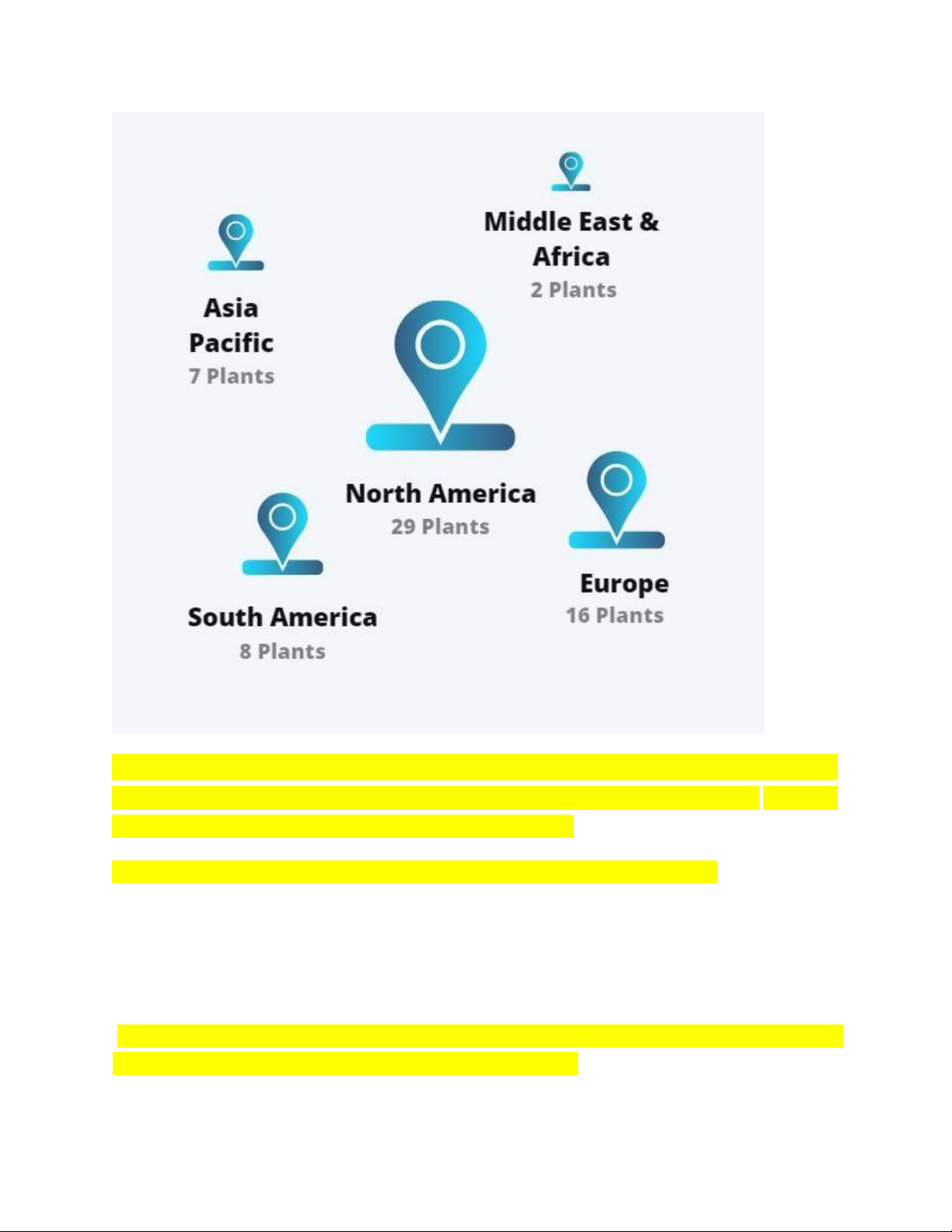
*Ford combines a strategy of globalization and localization, provides a wide range
of global products with a strong focus on regional adaptations to cater to specific consumer
preferences, regulatory requirements, and market conditions.
Ford operates in over 100 countries worldwide, making it a truly global brand. - Ford strives for
brand consistency across all its markets. This means that while product offerings might be
tailored, the brand message (e.g., “Built Ford Tough”) and core values of durability, reliability, and
innovation remain the same worldwide.
-> Optimizing transportation costs, reducing import taxes, leveraging local labor, cutting
operational costs, and quickly responding to market demands. lOMoAR cPSD| 58950985
- Each region focuses on producing different vehicle models to serve the local market's needs.
For example, Ford offers a broad lineup of vehicles that includes cars, trucks, SUVs, and
electric vehicles (EVs) across all global markets. While the overall product strategy is global, some
models are designed specifically for certain regions (e.g., the Ford F-150 for North America or the Ford Focus for Europe) TWO MAIN Channels:
Direct Distribution via Authorized Dealers
Distribution via Secondary Dealers
- Training, Marketing, and Financial Support: Ford provides training and marketing support
for dealers to ensure they can effectively sell Ford products and stay competitive. Financial
support programs can help dealers with working capital and loan facilitation.
- Flexible Pricing and Promotional Programs: Ford uses flexible pricing strategies and
promotions to attract customers and increase sales. These programs can include discounts,
limited-time offers, and financing options tailored to different customer needs.
Tài liệu liên quan:
-

Tài Liệu Học Tập Quản Trị Chuỗi Cung Ứng - GIÁO TRÌNH GQC1
24 12 -

Bài giảng Nghiên cứu doanh nghiệp Nike trong Phân tích chuỗi cung ứng | Trường Đại học Kinh Tế Quốc Dân
34 17 -
Bài Thuyết Trình Ngành Dệt May Trung Quốc - LOGT26CD
39 20 -
Đề cương ôn tập Quản trị chuỗi cung ứng
40 20 -

Phân tích Mô hình Kinh doanh và Quản lý Chuỗi cung ứng của Samsung | Môn Quản trị chuỗi cung ứng quốc tế - Đại học Kinh Tế Quốc Dân
75 38