Phonon drag thermoelectric phenomena in mesoscopic two-dimensional conductors: Current stripes, large Nernst effect, and influence of electron-electron interaction
Phonon drag thermoelectric phenomena in mesoscopic two-dimensional conductors: Current stripes, large Nernst effect, and influence of electron-electron interaction. Tài liệu được sưu tầm giúp bạn tham khảo, ôn tập và đạt kết quả cao. Mời bạn đọc đón xem.
Môn: Tài liệu Tổng hợp 3.6 K tài liệu
Trường: Tài liệu khác 3.9 K tài liệu
Tác giả:





Preview text:
See discussions, stats, and author profiles for this publication at: https://www.researchgate.net/publication/346762876
Phonon drag thermoelectric phenomena in mesoscopic two-dimensional
conductors: Current stripes, large Nernst effect, and influence of electron- electron interaction
Article · November 2020
DOI: 10.1103/PhysRevB.102.195301 CITATIONS READS 7 103 5 authors, including: Oleg Raichev Gennady Gusev
National Academy of Sciences of Ukraine University of São Paulo
142 PUBLICATIONS 1,717 CITATIONS
297 PUBLICATIONS 2,964 CITATIONS SEE PROFILE SEE PROFILE Alexander D Levin A. K. Bakarov University of São Paulo
Institute of Semiconductor Physics, Russian Academy of Sciences
99 PUBLICATIONS 1,411 CITATIONS
334 PUBLICATIONS 3,211 CITATIONS SEE PROFILE SEE PROFILE
All content following this page was uploaded by Alexander D Levin on 25 March 2021.
The user has requested enhancement of the downloaded file.
PHYSICAL REVIEW B 102, 195301 (2020)
Phonon drag thermoelectric phenomena in mesoscopic two-dimensional conductors: Current
stripes, large Nernst effect, and influence of electron-electron interaction
O. E. Raichev ,1,* G. M. Gusev ,2 F. G. G. Hernandez ,2 A. D. Levin,2 and A. K. Bakarov 3,4
1Institute of Semiconductor Physics, NAS of Ukraine, Prospekt Nauki 41, 03028 Kyiv, Ukraine
2Instituto de Física da Universidade de São Paulo, 135960-170, São Paulo, SP, Brazil
3Institute of Semiconductor Physics, Novosibirsk 630090, Russia
4Novosibirsk State University, Novosibirsk 630090, Russia
(Received 15 July 2020; revised 20 October 2020; accepted 22 October 2020; published 6 November 2020)
The interaction of electrons with a flux of ballistic phonons leads to excitation of many angular harmonics of
an electron distribution function. We show that this property dramatically modifies the magnetothermoelectric
phenomena in two-dimensional electron systems with boundaries. By considering classical magnetotransport of
electrons in a narrow channel with partly diffusive boundary scattering, we show that the phonon flux excites a
pattern of current stripes with alternating directions of propagation along the channel. The Nernst voltage due to
phonon drag appears already in the classical transport regime and can be comparable with the Seebeck voltage,
while the latter acquires a dependence on the magnetic field. The temperature dependence of these voltages
shows an unusual behavior determined by relaxation of higher-order harmonics of the distribution function
via electron-electron scattering. Our experimental studies of mesoscopic samples based on high-quality GaAs
quantum wells confirm the main properties of the thermoelectric response suggested by the theory.
DOI: 10.1103/PhysRevB.102.195301 I. INTRODUCTION
to both E∗ and magnetic field B) is equal to zero since there
is no current in the system. If the energy dependence of E∗ is
The physics of thermoelectric phenomena in solids is an
taken into account, the effective electric field acts differently
important field of study that has both fundamental and applied
on electrons with different energies, and there appears a
significance. In spite of a long research history, knowledge of
nonequilibrium distribution of electrons leading to a finite
the mechanisms of thermoelectricity is still not complete, and
Nernst effect [5]. However, the corresponding Nernst field is
some experimental facts remain unexplained. In particular,
proportional to a small factor (T /ε
one of the unsolved mysteries is an anomalously large
F )2, and it is much smaller
than the Nernst field actually observed in experiments [6,7].
Nernst effect due to phonon drag in two-dimensional (2D)
It was suggested [8] that the anisotropy of both the phonon
electron systems in the classical transport regime [1,2]. The
and the electron spectra can be responsible for the large
phonon drag mechanism implies that nonequilibrium acoustic
Nernst effect, but there is no direct proof of the relevance of
phonons, having a net momentum along the temperature
this mechanism to the observed behavior. It is worth noting
gradient ∇T , partly transfer this momentum to an electron
that the anomalously large Nernst effect due to phonon drag
system via their absorption and stimulated emission in the
has been observed only in 2D systems, while in 3D systems
process of electron-phonon interaction, which resembles
this effect is negligibly small [9], in accordance with the
friction between electron and phonon subsystems. Indeed,
theory. The properties described above correspond to the
in the regime of linear transport, this mechanism can be
classical transport regime. In the quantum regime, i.e., when
conveniently described [1,3] through a frictional force term,
Landau quantization becomes important, the theory suggests
which is added to the Lorentz force term in the classical
a significant phonon-drag Nernst effect in 2D systems.
Boltzmann equation. If phonon distribution is established as
Moreover, both Seebeck and Nernst coefficients show
a result of the linear response of a phonon system to a small
magnetophonon oscillations (see [10] and references therein).
temperature gradient, this distribution is weakly anisotropic
Whereas the experiments described above have been done
[1,3,4], and the frictional force term is expressed through
on macroscopic 2D samples, we have carried out mea-
the “effective electric field” E∗ε proportional to ∇T . The
typical conditions of thermoelectric experiments assume
surements of Seebeck and Nernst voltages in small-sized
that the total current through the sample is zero. Thus, if
(mesoscopic) bars, and we also observed an unexpectedly
the energy dependence of E∗
large classical Nernst effect, which we attribute to the phonon
ε is neglected, which is a good
approximation for degenerate electron gas with energy ε
drag mechanism. In this paper, we propose a theory that re-
replaced by the Fermi energy ε
lates the unusual classical phonon-drag Nernst effect to the
F , the kinetic equation has a
trivial solution describing the Seebeck field E
presence of boundaries, and thus it can be helpful for the S = −E∗. In
these conditions, the Nernst field E
explanation of experimental results. We describe the behav-
N (which is perpendicular
ior of magnetothermoelectric coefficients following from this
theory, and we compare the results of calculations with our
*Corresponding author: raichev@isp.kiev.ua experimental data.
2469-9950/2020/102(19)/195301(11) 195301-1
©2020 American Physical Society O. E. RAICHEV et al.
PHYSICAL REVIEW B 102, 195301 (2020)
First of all, we notice that the phonon drag in small-sized
2D samples can occur due to the interaction of electrons with
strongly nonequilibrium acoustic phonons coming directly
from the heater, which creates a temperature gradient in the
system. Indeed, at low temperatures, T ∼ 4.2 K, the acoustic
phonon mean free path lengths in crystals can be comparable
to or even larger than the sample size, so the interaction of
electrons with such ballistic phonons proves to be important
[11–15]. While the interaction with quasiequilibrium phonons
leads to a small momentum transfer to the electron system, of
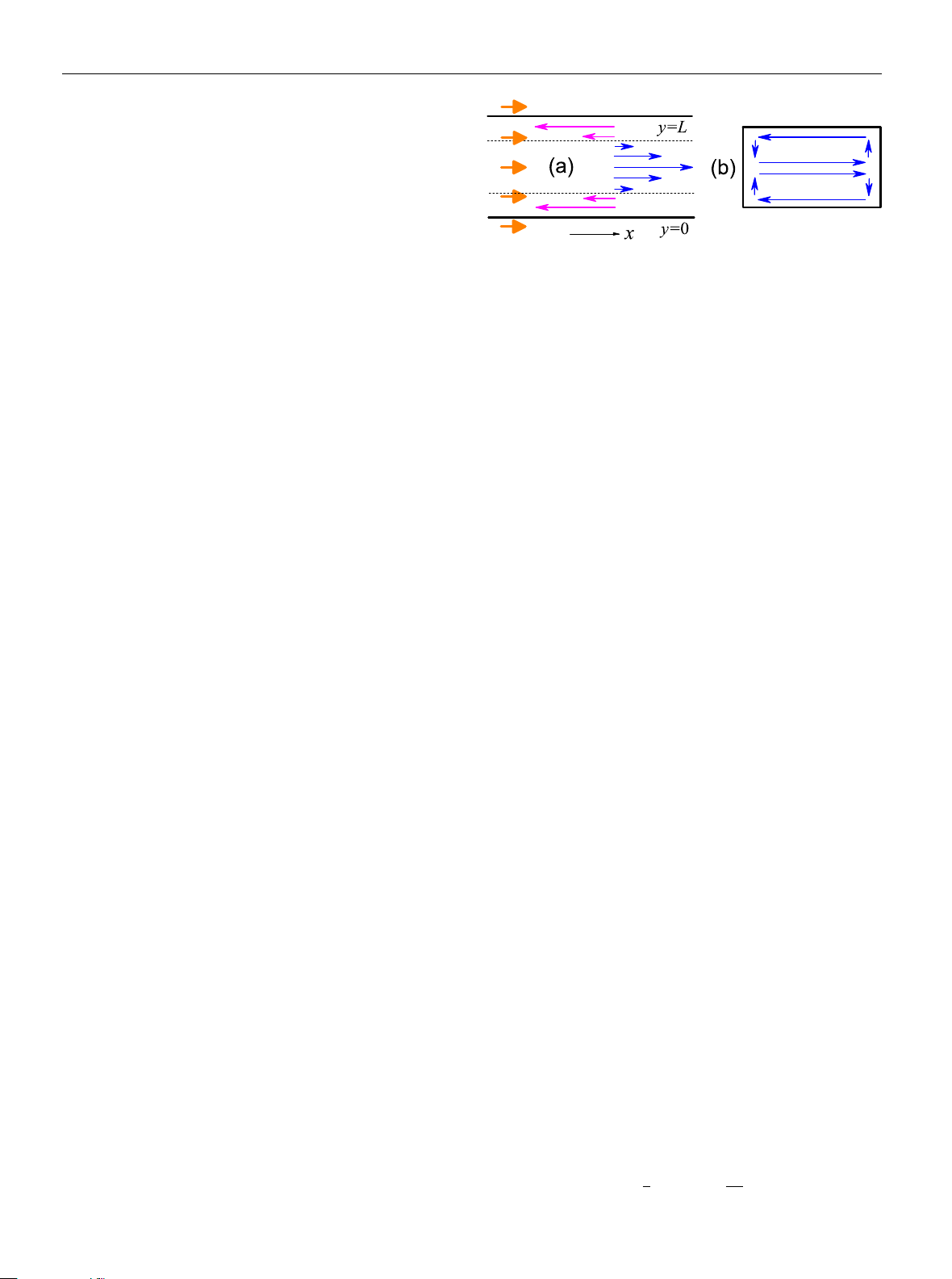
FIG. 1. Under excitation of electron system by a phonon flux
the order of drift momentum of a phonon per one collision,
(bold arrows) in a long channel, the electric current (thin arrows)
flows in stripes with alternating directions so that the total current
the electrons interacting with ballistic phonons gain much
through the channel is zero (a). In finite-sized samples, such an
larger momenta, of the order of Fermi momentum. That is
excitation is expected to create current whirlpools (b).
why the interaction of electrons with ballistic phonons often
provides the main contribution to the drag, even if electron
absorption of these phonons is relatively rare. Observation
phenomena, we consider 2D electrons confined in a straight
of large-amplitude magnetophonon oscillations of the drag-
channel (0 < y < L) in the presence of a transverse magnetic
induced Seebeck voltages under conditions when T is much
field B and a homogeneous unidirectional phonon flux, as
smaller than the Bloch-Grüneisen temperature also confirms
shown in Fig. 1. We describe the results of the numerical
the presence of strongly nonequilibrium high-energy (presum-
solution of the classical Boltzmann equation with boundary
ably ballistic) phonons in thermoelectric experiments [16,17].
conditions for partly diffusive boundary scattering. We find
The idea of our theory is based on the observation that the
that in this geometry, the current density is arranged in a
frictional force term describing the interaction of electrons
pattern of stripes with alternating directions of the current
with strongly nonequilibrium phonons is essentially differ-
along the channel so that the total current is zero. If the
ent from the electric field term eE · v entering the linearized
boundaries are equivalent, the current distribution is symmet-
kinetic equation, and it cannot be represented through an ef-
ric and contains an odd number of stripes. At zero B, there
fective electric field as described above. Whereas the electric
are three or five such stripes, while with increasing B their
field term depends on the cosine of the angle ϕ between the
number can increase. We calculate both the Seebeck field
electric field E and group velocity v of an electron, i.e., it con-
and Nernst voltage, and we find that a large Nernst effect
tains only the first angular harmonics (∝e±iϕ), the frictional
can be expected. The Nernst voltage VN is maximal for the
force term, in general, contains a set of different angular har-
case of fully specular boundary scattering. The Seebeck field
monics (∝e±ikϕ). Thus, the interaction of electrons with a flux
does not depend on B in this specific case, but it becomes
of ballistic phonons leads to excitation of many angular har-
B-dependent for diffusive boundary scattering. In mesoscopic
monics of electron distribution functions. In an ideal infinitely
channels, whose width L is smaller than the mean free path
large and homogeneous 2D system, this important fact has no
length, the drag-induced Nernst voltage can be comparable
immediate significance, because only the first (k = 1) angular
with the Seebeck one, which is never the case in macroscopic
harmonics contributes to the current, and the condition of zero
samples. The increase of temperature leads to the suppression
local current can be satisfied in the presence of electric field E,
of the nonequilibrium spatial distribution of currents, as the
which equilibrates the contribution from the first harmonics of
electron-electron interaction suppresses the higher angular
the frictional force and describes the Seebeck effect (ES = E)
harmonics of the distribution function excited by the phonon
while the Nernst effect is absent (EN = 0). However, if the
flux, and internal friction within the electron gas tends to
system is inhomogeneous, in particular when boundaries are
smoothen the current density distributions. As a result, the
present, there is a mixing of different angular harmonics of
Nernst voltage decreases with increasing temperature. Our
electron distribution, so the condition of zero local current
experimental data are in agreement with the main properties
cannot be satisfied. As a result, there should appear spatial
of thermoelectric response following from the theory.
distributions of electric current density and electrochemical
The paper is organized as follows. Section II describes the
potential, which depend on the system geometry and are sen-
theoretical model. The results of calculations are presented in
sitive to magnetic field. Such distributions are also sensitive
Sec. III. Section IV contains a description of measurements
to temperature T , mostly because an increase in T increases
and the experimental results, which are compared with the
the probability of electron-electron scattering. This scattering
theoretical ones. More discussion and concluding remarks are
is efficient in the relaxation of higher-order (k 2) harmonics given in the final section.
of the distribution function, and, for this reason, it is respon-
sible for viscosity effects in electron systems, which have
attracted a lot of attention [18] since the pioneering work of II. GENERAL FORMALISM
Gurzhi [19]. The current distribution implies the existence of
The distribution function of electrons moving in the elec-
both Seebeck and Nernst fields (and corresponding observable
tric field E(r) = −∇(r) and the transverse magnetic field B
Seebeck and Nernst voltages), which are expected to have a
obeys the classical kinetic equation
nontrivial dependence on magnetic field and temperature.
To illustrate the basic properties of the transport regime de- ∂
v · ∇ f
eE(r) + e [v × B] · f
scribed above and of its influence on magnetothermoelectric p (r) +
p (r) = Jp (r), (1) c ∂p 195301-2
PHONON DRAG THERMOELECTRIC PHENOMENA IN …
PHYSICAL REVIEW B 102, 195301 (2020)
where r = (x, y) is the 2D coordinate, v = p/m is the group
where 0 < ϕ < π, the functions r0ϕ and rLϕ characterize
velocity, m is the effective mass, and p is the 2D momentum
reflection of electrons at the lower (y = 0) and upper (y = L)
of an electron. The right-hand side contains the collision in-
boundaries, while the constants M0 and ML are given by
tegrals, including the one describing interaction of electrons π the following expressions: M0 = N −1 dϕ sin ϕ(1 − 0 0
with nonequilibrium phonons (Appendix A). Using energy π
r0ϕ )g2π−ϕ(0), ML = N −1
dϕ sin ϕ(1 − rL L
ϕ )gϕ (L), with
and angle variables according to p = m 0 v
ε (cos ϕ, sin ϕ), we N
π dϕ sin ϕ(1 − r0,L
write the distribution function as f 0,L = 0
ϕ ). Note that r0,L ϕ = 1 if ϕ = 0 or p ≡ fεϕ . ϕ = π.
Below, we consider the geometry of infinitely long 2D
Application of the method of characteristics together with
channels of width L (0 < y < L, −∞ < x < ∞), and we as-
the boundary conditions allows one to obtain two coupled
sume a homogeneous (coordinate-independent) distribution of
Fredholm equations (n = 0, 1) for the quantities g
phonons. Under these conditions, the distribution function f 0 (y) and εϕ g
does not depend on the x coordinate, the local currents along 1 (y):
the y axis are absent, and the electrostatic potential is rep- L
resentable in the form (r) = −Ex + (y), where E ≡ E g dyK x
n (y) = eE Ln (y) + n (y) + 1
n0 (y, y )g0 (y ) l
is a homogeneous electric field. To solve the linear-response 0
problem, it is convenient to write the distribution function as L + 1
dyKn1(y, y)g1(y). (7) ∂ l fε e 0
fεϕ (r) = fε − [g
∂ε εϕ(y) − e(y)], (2)
These quantities are related to local electrochemical potential where f
(voltage) V (y) and local current j
ε is the equilibrium Fermi distribution, and gεϕ
x (y) ≡ j (y) according to
describes a small nonequilibrium part of the distribution func-
V (y) = g0(y)/e and j(y) = emvg1(y)/2π ¯h2. The functions
tion. Substituting Eq. (2) into Eq. (1), one gets the following
Ln(y), n(y), and Knn(y, y) are specified in Appendix B.
linearized kinetic equation for g The terms εϕ:
n (y) are determined by Fϕ and are proportional
to the intensity of phonon flux. Without these terms, Eq. (7) ∂ ∂
reduces to the one applied previously [20] to the problem of sin ϕ g g
∂ εϕ(y) + R−1
εϕ (y) − eE cos ϕ − Fεϕ y ε ∂ϕ
magnetoresistance of narrow channels. In the next section, we ∂ J
consider the case of equivalent boundaries, when r0ϕ = rLϕ ≡ ×
fε + εϕ(y) = 0, (3)
rϕ, and we describe the thermoelectric response by applying ∂ε vε the following expressions:
where Rε is the classical cyclotron radius for an electron with
Fϕ = eEphsgn(cos ϕ), (a)
energy ε, and Jεϕ (y) = −(∂ fε/∂ε)[Jim εϕ + Jph εϕ + Jee εϕ] is the
linearized collision integral describing interaction of electrons
Fϕ = eEph cos2 ϕ sgn(cos ϕ), (b) (8)
with impurities, equilibrium phonons, and other electrons.
Next, Fεϕ is the frictional force due to the phonon drag (see
which correspond to interaction of electrons with either
Appendix A). In the vicinity of the Fermi level (the case of
piezoelectric (a) or deformation (b) potential generated by
degenerate electron gas is considered), we replace ε by the
unidirectional (along x) flux of acoustic phonons emitted by a Fermi energy ε
black body whose temperature exceeds the Bloch-Grüneisen
F , vε by the Fermi velocity vF , and we omit
the energy index hereafter. The collision integrals are written
temperature (Appendix A). These expressions are referred to
in the relaxation-time approximation, with introduction of
below as model [a] and model [b], respectively. If phonon
the characteristic mean free path lengths l
flux is directed at an angle φ with respect to x, one should 1 and le for mo-
mentum changing (electron-impurity and electron-phonon)
substitute ϕ − φ in place of ϕ in Eq. (8). If there is a symmet-
and momentum conserving (electron-electron) scattering, re-
ric deviation from unidirectional propagation, for example the
spectively (see [20] and references therein). Then Eq. (3) is
phonons are propagating within an angular interval −δ < ϕ <
reduced to a partial differential equation
δ (δ < π/2), then Fϕ is modified, but the results presented
below do not change qualitatively. ∂ ∂ sin ϕ + R−1 + 1 g ∂ ϕ (y) y ∂ϕ l III. RESULTS
= g0(y) + g1(y) cos ϕ + eE cos ϕ + Fϕ, (4)
Consider first the case of zero magnetic field. In the l le
absence of electron-electron interaction, 1/le → 0, there ex- 2π where l = (1/l
ists an analytical solution under condition Fϕ = F2π−ϕ, when
1 + 1/le )−1, g0 = dϕ g 0
ϕ/2π , and g1 = 2π
phonon flux is directed along the channel or symmetrically dϕ cos ϕg 0 ϕ/π .
distributed over the angles in an interval around ϕ = 0. For
The presence of the drag force Fϕ makes Eq. (4) different 0 < ϕ < π,
from those considered earlier for the same geometry [20–23].
The boundary conditions for g ϕ (y) are [20]
gϕ = l(eE cos ϕ + Fϕ ) 1 − (1 − rϕ )e−y/l sin ϕ , g 1 − r ϕ (0) = r0ϕg ϕλϕ
2π−ϕ (0) + 1 − r0 ϕ M0, (5) g g
1 − (1 − rϕ )λϕey/l sin ϕ , (9)
2π−ϕ (L) = rL
ϕ gϕ (L) + 1 − rLϕ ML, (6)
2π−ϕ = l (eE cos ϕ + Fϕ ) 1 − rϕλϕ 195301-3 O. E. RAICHEV et al.
PHYSICAL REVIEW B 102, 195301 (2020)
where λϕ = e−L/l sin ϕ. The symmetry property gϕ (y) =
−gπ−ϕ(y) (since Fϕ = −Fπ−ϕ) leads to M0 = ML = 0, and
gϕ (y) satisfies the Fuchs-like boundary conditions [24,25]
gϕ (0) = rϕg2π−ϕ (0) and g2π−ϕ (L) = rϕgϕ (L). The same sym-
metry makes g0(y) equal to zero. However, the local current π j(y) ∝ dϕ[g 0
ϕ (y) + g2π−ϕ (y)] cos ϕ is not zero. The re- L
quirement of zero total current I =
dy j(y) = 0 defines the 0
Seebeck field ES = E as π I F E F ϕ S = − IF , = dϕ cos ϕ eI I cos ϕ E E 0 ×
(1 − rϕ )(1 − λϕ ) 1 − l sin ϕ . (10) L 1 − rϕλϕ
If boundary reflection is specular, rϕ = 1, the factor in the
square brackets is equal to 1. Then ES is equal to its bulk
value, ES = Ebulk, which is determined by the first angular S harmonics of Fϕ:
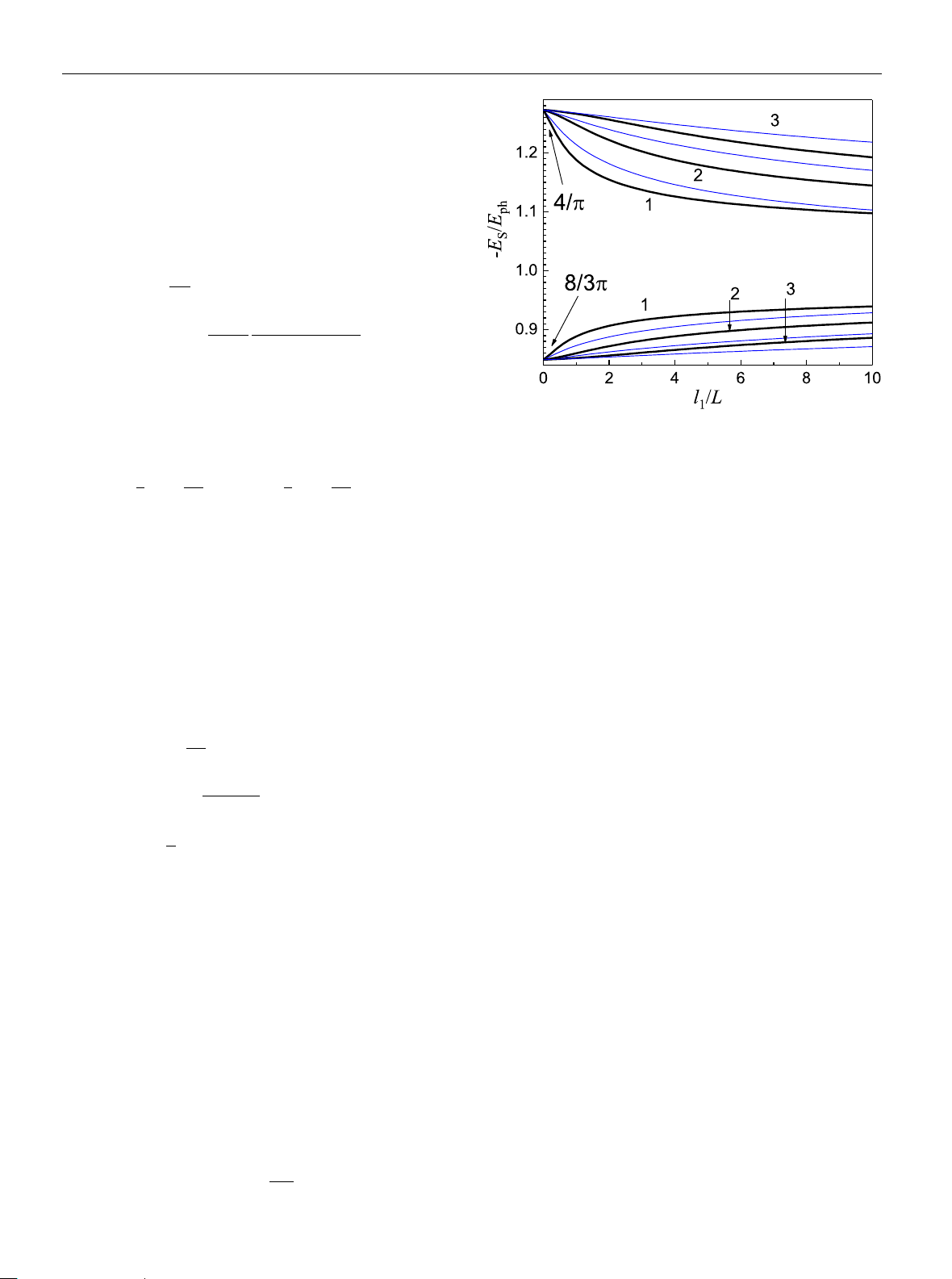
FIG. 2. Seebeck field in the absence of electron-electron scatter- ing, l
1/le = 0 (1), and for finite electron-electron scattering, l1/le = 3 2π dϕ 2π dϕ
(2) and l1/le = 10 (3). The bold lines show the case of fully diffusive E bulk = − 2 e±iϕF cos ϕF boundary scattering, r0 S ϕ = − 2 ϕ. (11)
ϕ = rLϕ = 0, while the thin (blue) lines cor- e 0 2π e 0 2π
respond to weakly diffusive boundaries, r0ϕ = rLϕ = exp(−α sin2 ϕ)
with α = 1. The upper and the lower groups of plots correspond to
In particular, E bulk = −(4/π )E
= −(8/3π )E S ph and E bulk S ph
the models [a] and [b], respectively.
for models [a] and [b], respectively. The solution ES = Ebulk S
for specular reflection is valid in the presence of electron-
electron interaction and even in the presence of a magnetic
where A is a numerical constant. Therefore, with increas-
field (see below). In the general case of partly diffusive bound-
ing T the absolute value of the Seebeck field approaches
ary scattering, ES depends on the ballisticity ratio b = l1/L
its bulk value by either increasing (model [a]) or decreasing and on rϕ.
(model [b]). This behavior is different from that expected
If electron-electron interaction is present, the local current
in the commonly used model of weakly anisotropic phonon
density distribution is determined by the integral equation
distribution [1,3], when the temperature dependence of the
following from Eq. (7) at n = 1,
Seebeck field is determined by the factor ph(τphT )−1, where π dϕ
ph is the phonon mean free path with respect to phonon- g1(y) = l
cos ϕ(eE cos ϕ + Fϕ )
phonon and phonon-impurity scattering, and τ −1 is the rate ph 0 π
of electron-phonon collisions. If electron gas is degenerate
and T exceeds the Bloch-Grüneisen temperature, one has
× 2 − 1 − rϕ (e−y/l sinϕ + e(y−L)/l sinϕ) 1 − r
τ−1 ∝ T , which means that the drag-induced Seebeck field ϕλϕ ph
in the weakly anisotropic phonon model should follow the L + 1 dy K
temperature dependence of ph and decrease with increas- 11 (y, y )| l
B=0g1 (y ), (12) e 0
ing T , which indeed is observed in GaAs-based 2D electron systems [27].
where K11(y, y) at B = 0 can be obtained from Eq. (B1) as
It is worth pointing out that the currents along the channel
described in Appendix B. Without the phonon drag contribu-
are absent, j(y) = 0 and E = 0, when phonon flux is per-
tion Fϕ, Eq. (12) coincides with the one from Ref. [26]. Once
pendicular to the channel. The Seebeck voltage in this case
Eq. (12) is solved numerically, the Seebeck field ES = E is
develops along the y axis, VS = [g0(L) − g0(0)]/e. The volt- L
found from the relation of zero total current, dy g
age distribution is determined by the integral equation g 0 1 (y) = 0. 0 (y) = The dependence of E L
S on the ballisticity ratio l1/L for differ- 0(y) + l−1 dyK 0
00 (y, y )|B=0g0 (y ), where 0 and K00 at
ent ratios l1/le is shown in Fig. 2. For wide channels, l1/L →
B = 0 can be found as described in Appendix B. If scat-
0, ES is equal to its bulk value, while for narrow channels,
tering is specular, 0(y) acquires a simple form 0(y) = E π
S is smaller (model [a]) or larger (model [b]) than its bulk lπ−1 dϕF 0
ϕ[e(y−L)/l sin ϕ − e−y/l sin ϕ]/(1 + λϕ ). In the fol-
value because of the influence of boundaries. An increase of
lowing, we do not consider this setup and always assume that
temperature T reduces the mean free path l1 because of the
phonon flux is parallel to the channel.
contribution of electron-phonon scattering and increases the
Consider now the case of nonzero magnetic field. For
ratio l1/le since le in a degenerate Fermi gas scales as T −2,
specular boundary scattering, rϕ = 1, the Seebeck field is a according to
B-independent constant given by Eq. (11), ES = Ebulk. To S
prove this equality, one may multiply Eq. (4) by 2 cos ϕ and ¯hεF l
then integrate both of its sides over y from 0 to L and over ϕ e = AvF , (13) T 2 L
from 0 to 2π. As a result, with the use of I ∝ dy g 0 1 (y) = 0, 195301-4
PHONON DRAG THERMOELECTRIC PHENOMENA IN …
PHYSICAL REVIEW B 102, 195301 (2020)
FIG. 4. Voltage (a) and current (b) distributions across the chan-
nel with specular boundary reflection for different magnetic fields:
R/L = 2 (1), 0.5 (2), and 0.15 (3), calculated for F
FIG. 3. Nernst voltage, as a function of magnetic field (expressed ϕ of Eq. (8) (model
[a]). There are nine current stripes at R/L = 0.15. The current den-
through L/R ∝ B), in the case of specular boundary scattering for
sity is expressed in units of j l
0 = σ Eph, where σ is the classical Drude
1/L = 3 and 1.5, calculated for Fϕ of Eq. (8). The bold lines are
conductivity at B = 0. The bold lines correspond to the absence of
plotted assuming no electron-electron scattering, l1/le = 0, and the
electron-electron scattering, l
thin lines show the case of finite electron-electron scattering, l
1/le = 0, and the thin lines correspond 1/le = to l 3. 1/le = 3. one obtains the identity
The electron-electron scattering leads to a decrease of the absolute value of V 2π
N and makes the magnetic-field de-
dϕ sin(2ϕ)[g pendence of V
ϕ (L) − gϕ (0)]
N smoother, in particular by suppressing its 0 2π
maximum. Indeed, the currents and electrochemical potentials 2π
(which are proportional to the first and zero angular harmonics = dϕ L eE + 2 cos ϕFϕ . (14)
of gϕ) appear in the channel because of the boundary-induced 0 2π
conversion of higher-order angular harmonics of gϕ excited by
The boundary conditions for specular reflection are gϕ (0) =
the phonon flux, whereas the electron-electron scattering sup-
g2π−ϕ (0) and gϕ (L) = g2π−ϕ (L) so that gϕ (L) − gϕ (0) is a
presses these higher-order harmonics, thereby eliminating the
symmetric function with respect to ϕ = π. Thus, the integral
source of the effect. If l1/le → ∞, VN goes to zero. Although
on the left-hand side of Eq. (14) is zero, and Eq. (14) is
we have not succeeded in obtaining an analytical description
reduced to Eq. (10) with rϕ = 1. However, even for specular
of the saturated Nernst voltage, our analysis of numerical
boundary reflection, g0(y) appears to be nonzero, because
results suggests that, with a very high accuracy, it is approxi-
the homogeneous (y-independent) solution of Eq. (4) cannot
mated by V sat = E N
phl1Csat/[1 + Cel1/le] with Ce = 2/3. Since
satisfy the boundary conditions in the presence of magnetic
the probability of electron-electron scattering is rapidly en-
field. Thus, a finite Nernst voltage VN = V (L) − V (0) devel-
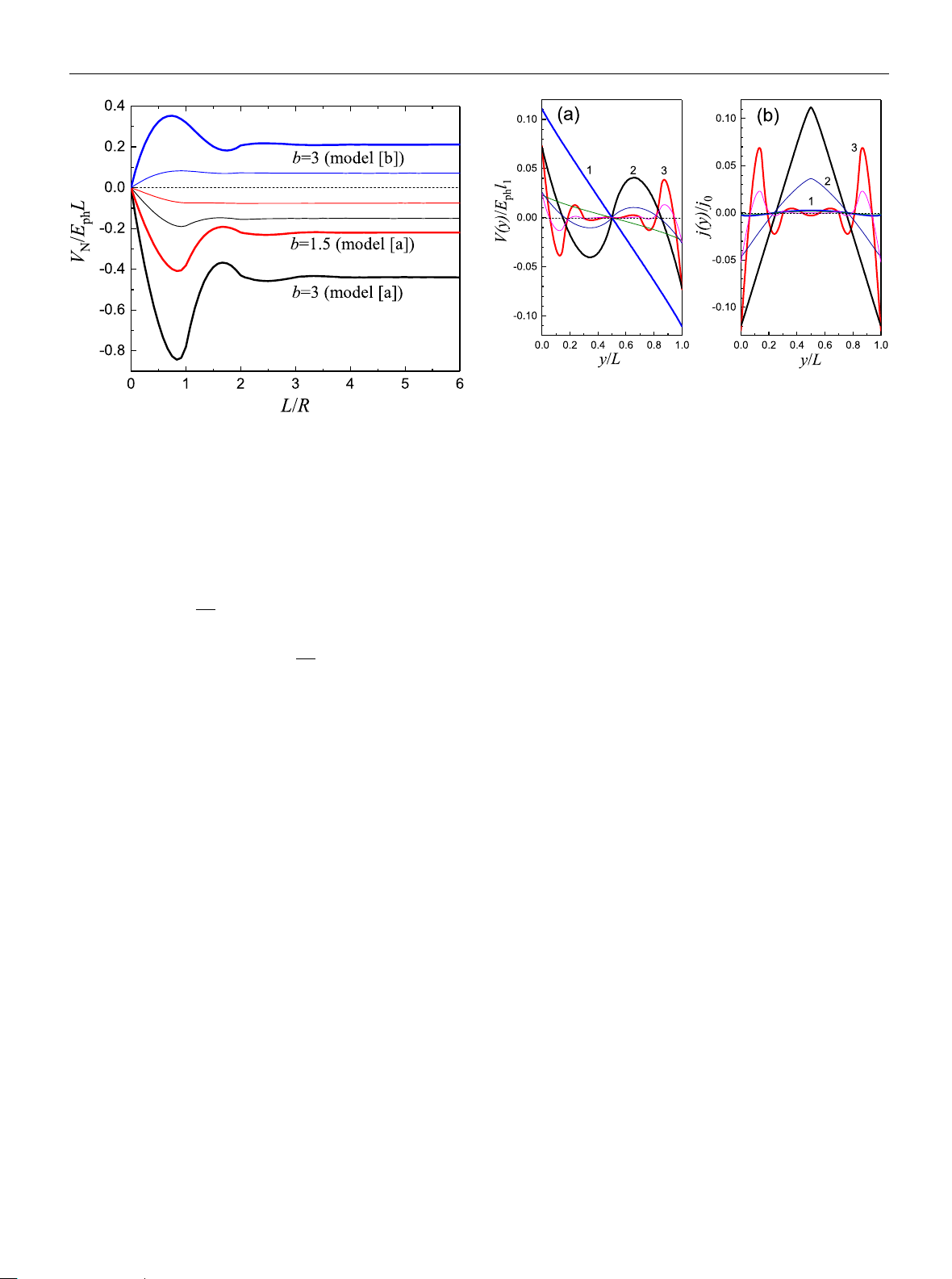
hanced with temperature, the Nernst voltage is suppressed by
ops. Figure 3 shows the dependence of VN on B for different
temperature. In contrast, in macroscopic samples the phonon
parameters b = l1/L and l1/le. The sign of the Nernst ef-
drag-induced Nernst voltage increases with temperature [5,6].
fect is sensitive to the function Fϕ describing excitation of
Figure 4 shows the distributions of local voltages and
the electron system and is different for the models [a] and
currents at different magnetic fields and demonstrates their
[b]. Nevertheless, for both models the plots demonstrate a
suppression by the electron-electron scattering. At small mag-
rapid increase of the absolute value of VN in the low-field
netic fields, the currents are small and the voltage distribution
region, followed by a maximum. At larger magnetic fields,
is almost linear. As B increases, the voltage distribution
L/R > 2, the field dependence of VN becomes very weak, so
becomes nonmonotonic. In stronger magnetic fields, when
one can address saturation behavior. A full saturation, with a
the cyclotron diameter 2R is smaller than L/2, there ex-
constant voltage VN = V sat, occurs at L/R > 4. The saturated
ists the region 2R < y < L − 2R where electrons do not feel N
Nernst voltage in the absence of electron-electron interaction
the boundaries if moving ballistically, and where both the
is given by V sat = C
voltages and the currents become small. In this regime, the N
satEphl1 with Csat = −0.148 (model [a])
and Csat = 0.07 (model [b]), so the effective Nernst field,
electrons near one boundary do not feel the other boundary,
defined as EN = VN /L, is proportional to the ballisticity ratio:
since an electron able to hit one of the boundaries cannot E sat = C
reach the other boundary even after a single scattering in N
satEphb. This means that in the samples of small size,
where the ballisticity ratio is larger than unity, the Nernst
the bulk, and the Nernst voltage loses its dependence on the
and Seebeck fields in the classical transport regime can be
channel width. The dependence on the magnetic field is lost
comparable to each other. In macroscopic samples, however,
as well, for the particular case of specular boundary scattering,
the Nernst field is much smaller than the Seebeck one [6].
which explains the saturation behavior shown in Fig. 3. When 195301-5 O. E. RAICHEV et al.
PHYSICAL REVIEW B 102, 195301 (2020)
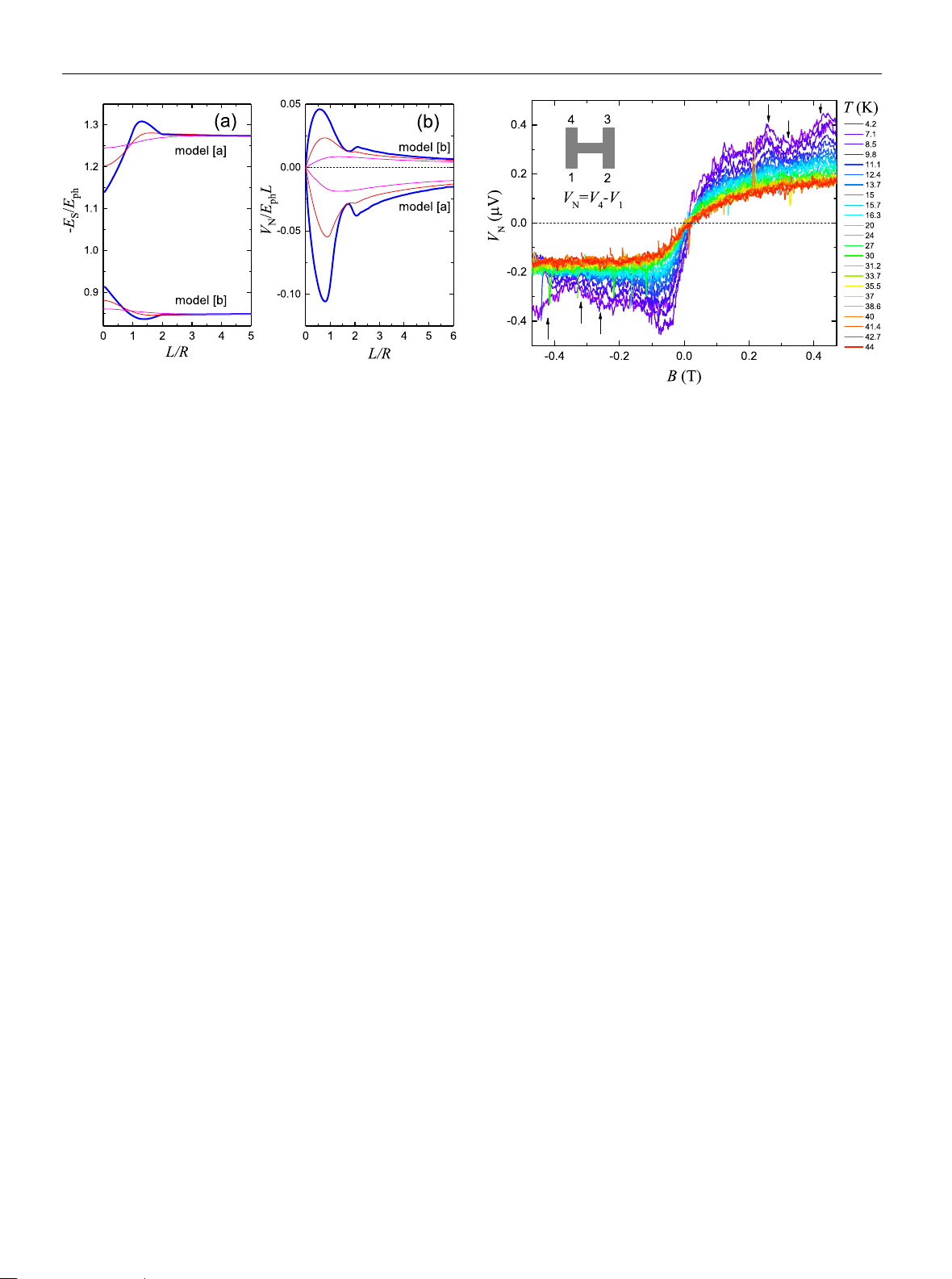
FIG. 5. Seebeck (a) and Nernst (b) voltages, as functions of the
magnetic field (expressed through L/R ∝ B), in the case of fully
FIG. 6. Magnetic-field dependence of the Nernst voltage V
diffusive boundary scattering (r N =
ϕ = 0) for l1/L = 3, calculated with V F
14 at different temperatures. The arrows indicate calculated posi-
ϕ of Eq. (8). The bold lines are plotted assuming no electron-
tions of the maxima and minima of the magnetophonon oscillations.
electron scattering, l1/le = 0, and the thin lines show the cases
of finite electron-electron scattering, l1/le = 3 (red) and l1/le = 10 (magenta).
both in the Seebeck and in the Nernst voltages, indicating the
importance of the phonon drag mechanism.
R L, the current and voltage distributions near the bound-
Below we concentrate on the Nernst effect measurements,
ary y = 0 are the same as in the semi-infinite plane y > 0.
since the influence of magnetic field and temperature on the
For partly diffusive boundary scattering, rϕ < 1, the
Seebeck effect expected from the theory is rather weak to be
magnetic-field dependence of the Nernst voltage V
resolved experimentally, regarding the level of noise present N does not
show a well-defined saturation. Instead, V
in our measurements. The plot of the Nernst voltage in a wide N slowly decreases
with B at 2R < L. Also, V
region of magnetic fields and temperatures at a fixed heater
N becomes gradually smaller when
the diffusivity of the scattering increases, because the current
power is shown in Fig. 6. The Nernst voltage rapidly increases
appearing in the system is reduced by the boundary scattering.
with B in the region B < 0.1 T, where the classical transport
As a consequence, the temperature-induced suppression of V
regime is expected, and it shows signs of saturation above N
becomes weaker with decreasing rϕ. The dependence of V
0.1 T. This voltage decreases considerably with increasing T N
on B is weakly sensitive to the form of reflection coefficient
in the whole range of the magnetic fields. In contrast, the See-
rϕ. With regard to the Seebeck field E
beck voltage (Fig. 7) does not show a significant temperature S , the diffusivity of
the boundary scattering leads to a qualitatively new feature,
dependence. Such a behavior is different from that expected a dependence of E
for the diffusion mechanism of thermoelectricity, which
S on B: the absolute value of ES tends to
reach the bulk value E bulk at L/R 1. Thus, in the case when
was studied earlier in mesoscopic systems [29–32]. This is S |E
expected, because in GaAs quantum wells the diffusion mech-
S | < |E bulk| at B = 0 (model [a]), |E S
S | increases with B,
while in the opposite case (model [b]), |E
anism is much weaker than the phonon drag mechanism in the S | decreases with
B. An example of the B-dependence of V
interval of temperatures that we study. However, the behavior
N and ES is shown in Fig. 5.
of thermoinduced voltages we observe is also different from
that caused by the phonon drag in macroscopic samples. The
most striking feature is the magnitude of the Nernst voltage,
IV. EXPERIMENT AND THEORY
VN , which is comparable to the Seebeck voltage, VS, measured
We have measured the thermoinduced voltages in the sam-
at the same heater power, Fig. 7. Another unusual feature is a
ples based on the high-quality GaAs quantum wells with elec-
strong suppression of VN when temperature T increases from
tron density ns 6.6 × 1011 cm−2 and low-temperature mo-
4.2 to 40 K. The transition from strong to weak (or saturated)
bility μ 2.1 × 106 cm2/V s. We have studied mesoscopic-
VN (B) dependence takes place between 0.05 and 0.1 T, which
size H-shaped four-terminal bars consisting of a central
correlates with the field B = 0.068 T corresponding to the
channel of length 10 μm and width L = 4 μm between sym-
condition 2R = L for this particular device. Therefore, taking
metrically placed 5-μm-wide legs (see the inset in Fig. 6). The
also into account that the mean free path l1 in our device is
temperature gradient is directed along the channel. The details
larger than L, one may attribute the observed unusual mag-
of the experimental setup and measurements are given in
netothermoelectric behavior to the size effect. The increase
the Supplemental Material [28]. The Seebeck and the Nernst
in temperature, apart from the general suppression of the
voltages were measured by a lock-in detector at a frequency
Nernst effect, causes a smoothing of the VN (B) dependence; in
of 2 f0 = 0.8-2.5 Hz. The thermoelectric measurements were
particular, it washes out the peak visible at small negative B.
performed in a variable temperature insert cryostat in the
The mechanism of magnetothermoelectric effects in meso-
temperature range from 4.2 to 40 K in magnetic fields up to
scopic samples proposed in the previous sections can explain
0.5 T. Above 0.2 T, we observe magnetophonon oscillations
the basic unusual features listed above. In Fig. 8, we have 195301-6
PHONON DRAG THERMOELECTRIC PHENOMENA IN …
PHYSICAL REVIEW B 102, 195301 (2020)
of the Seebeck voltage with magnetic field is expected to be
small, never exceeding 5% of the total effect, suggesting that
experimental discrimination between the models [a] and [b] is
a difficult task for nanovolt scale measurements. In addition,
in the region of weak magnetic fields, the Seebeck voltages
measured at the upper (V43) and at the lower (V12) pairs of
contacts are different and show a different dependence on
the magnetic field; see Fig. 7 and [28]. We do not have an
explanation of the asymmetry of V43 and V12 with respect
to the sign of B and of their strong difference in the region
of positive B. This may be related to contact imperfections,
leading to asymmetry of the contact resistances, combined
with contributions of skipping orbits to transport.
The calculations show that the absolute value of the
Seebeck field decreases slightly with magnetic field, it has a
weak local minimum at B ∼ 0.05 T, which is washed out by
temperature T , and it saturates at the bulk value at B > 0.1 T,
where it becomes independent of T . The Nernst voltage
VN first increases with B, goes through a sharp maximum
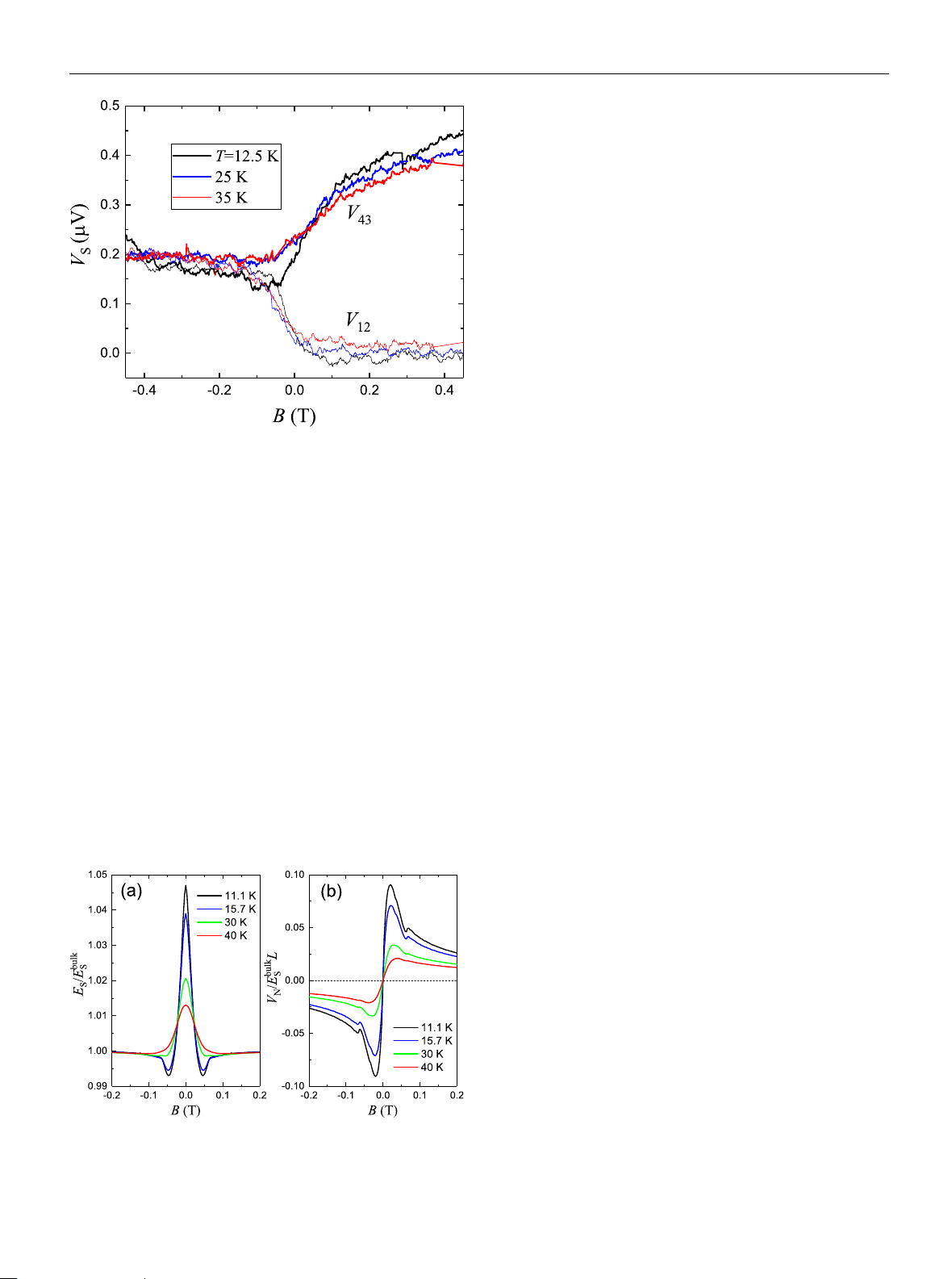
FIG. 7. Magnetic-field dependence of the Seebeck voltages mea-
at B 0.02 T, and slowly decreases at B > 0.07 T, where
sured between the upper and lower pairs of contacts for several
2R < L. When T increases from 11 to 40 K, VN at large
temperatures (indicated). The heater driving voltage is 2 V, the same
B decreases approximately twice, which agrees with our
as in the Nernst effect measurements shown in Fig. 6.
experimental data (Fig. 6). The smoothing of the VN (B)
dependence with increasing temperature is also in agreement
plotted both the Seebeck field (which is related to the Seebeck
with the experiment. According to the calculations, the ob-
voltage as −ES = VS/Lx, where Lx is the distance between the
served temperature-induced suppression of the Nernst effect
voltage probes along the channel) and the Nernst voltage VN ,
cannot be explained by a reduction of l
calculated for a channel of width L = 4 μm. We have used the 1 due to interaction of
electrons with equilibrium phonons; this suppression occurs
parameters of our sample such as the electron density and tem-
mostly because of the reduction of l
perature dependence of the resistivity in the pristine 2D layer
e, i.e., due to the increase
of electron-electron scattering probability. In spite of the
[28], which defines the temperature dependence of the mean
basic similarities between experimental and theoretical plots,
free path length l1. The length le was estimated according to
there are differences between them. The experiment does not
Eq. (13) with A = 5 determined from the temperature depen-
show a strong maximum of the Nernst voltage at B 0.02 T.
dence of magnetoresistance in similar Hall bar mesoscopic
Instead, a weaker maximum is seen between 0.05 and 0.1 T
devices [20]. To describe the boundary scattering, we use
and only in the region of negative B. The magnitude of the
rϕ = exp(−α sin2 ϕ) with α = 3. The function Fϕ has been
observed Nernst effect, as compared to the magnitude of the
taken from Eq. (A7) containing two terms. Parametrically, the
Seebeck effect, is considerably larger than that suggested by
first term in Eq. (A7) dominates in our samples, so the be-
the theory. We do not expect, however, a direct correlation
havior of thermoelectric effects is characteristic for the model
between theory and experiment because the theory uses a
[b]. This behavior is consistent with the sign of the observed
number of simplifying assumptions, in particular a simple
Nernst effect. In contrast to the Nernst effect, the evolution
device geometry and a model distribution of nonequilibrium
phonons that dictates the form of Fϕ. The actual distribution of
phonons over their energies and angles is unknown, and most
likely is different from the one used in the calculations. The
geometry of our experiment is more complicated compared to
the simple long channel geometry because the side arms 1–4
cannot be described merely as voltage probes; the distribution
of currents and potentials in these arms is also important
for developing the thermoelectric response. In particular, in
addition to the horizontal current stripes in the central section,
we expect vertical current stripes in the arms, and the overall
current distribution may even include whirlpool patterns
similar to those described in Ref. [33]. In magnetic field,
the distributions of currents and potentials in the upper (4,3)
and lower (1,2) side arms are expected to be different from
each other. The presence of the arms increases the absolute
FIG. 8. Magnetic-field dependence of Seebeck field (a) and
value of the Nernst voltage compared to that in the simple
Nernst voltage (b) calculated for the channel of width L = 4 μm,
long channel geometry, which is actually observed, because
based on the parameters of the device studied in the experiment, for
the effective vertical size (width) of the device becomes several temperatures.
considerably larger. Next, the sharp features at 2R = L 195301-7 O. E. RAICHEV et al.
PHYSICAL REVIEW B 102, 195301 (2020)
and the prominent peaks at smaller magnetic fields in the
increasing probability of electron-electron scattering, which is
theoretical plots of VN are a consequence of the single size
responsible for suppression of higher-order angular harmonics
scale, i.e., the channel width L, appearing in the theory. In
of the electron distribution function. Whereas the general for-
the real device, there is no such single size scale, and this
malism, based on the classical kinetic equation with boundary
can explain the absence of both the prominent peaks and the
conditions, is very similar to that used in the description of
sharp features in the observed magnetic-field dependence of
the magnetoresistance of mesoscopic channels (see [20] and
the Nernst voltage. Nevertheless, the observed suppression of
references therein), the thermoelectric problem considered in
the Nernst voltage by temperature is expected to be weakly
this paper is essentially different from the magnetoresistance
sensitive to either device geometry or phonon distribution,
problem. In the latter case, the higher-order angular harmonics
and our theory provides a reasonably good description of this
appear in the system near the boundaries due to the boundary unusual behavior.
scattering, while in our case they are created by the phonon-
induced excitation in the bulk of the channel. For this reason, a
hydrodynamic approach to the problem cannot be applied, and V. SUMMARY
the kinetic equation formalism is necessary for the description
Earlier experimental studies of magnetothermoelectric
of magnetothermoelectric phenomena. A good agreement be-
phenomena in small-sized (mesoscopic) 2D electron systems
tween experimental and theoretical suppression of the Nernst
were concentrated on the diffusive mechanism of thermoelec-
voltage by temperature is obtained when we use the parame-
tricity, as the temperature gradient in electron gas was created
ters [in particular, the constant A in Eq. (13)] extracted from
by heating of electrons by current, thereby avoiding nonequi-
a comparison of experimental and theoretical magnetoresis-
librium phonon fluxes across the samples [29–32]. In our
tance of narrow channels in mesoscopic Hall bars fabricated
work, we have used a more conventional experimental setup
from the same 2D layer structures as the H-shaped mesoscopic
by placing a heater near the mesoscopic system, and we have
bars used in our thermoelectric measurements [20].
obtained an unusual thermoelectric response attributed to the
On the other hand, there is a lack of full qualitative agree-
phonon drag mechanism, which is known to dominate over the
ment between experiment and theory, which we attribute to a
diffusive mechanism in GaAs-based samples in the interval
number of simplifying approximations used in the theoretical
of temperatures we study [1,2]. To explain the observation
description of the thermoelectric response. Among them are
of a large Nernst effect in the classical transport region, we
the neglect of classical memory effects [34], which are not
have proposed a theoretical model based on the assumption
accounted for by the Boltzmann equation but may become
that the phonon distribution function is considerably different
important in systems with boundaries in magnetic field; the
from the weakly nonequilibrium distribution usually applied
use of unified scattering lengths l1 and le for all harmonics
for a theoretical description of the phonon drag thermoelec-
of the distribution function, which is a crude approximation,
tricity. This is the case when the main contribution to the
especially because of the different sensitivity of even and
drag effect comes from the ballistic phonons arriving at the
odd angular harmonics to electron-electron scattering [35]; a
2D layer directly from the heater, which is relevant even in
simplified device geometry; and a model description of the
macroscopic samples [17]. Interaction of electrons with such
drag force term in the kinetic equation. In spite of this, we
phonons leads to excitation not only of the first angular har-
believe that the basic theoretical ideas described in this paper
monics of the electron distribution function, but also of the
have a potential for further development and can be helpful
higher-order harmonics. We have shown that in the presence
for a better understanding of electron response in the systems
of boundaries causing a mixing of different angular harmonics
with boundaries and, generally, in inhomogeneous systems of
due to the diffusivity of boundary scattering or even due to
interacting electrons under different types of excitation. We
specular boundary reflection in a magnetic field, the electron
also expect that the results described above will stimulate
system undergoes a transition to a peculiar state characterized
experimental studies of magnetothermoelectric phenomena in
by a nonhomogeneous current pattern in the form of stripes
mesoscopic 2D electron systems.
with alternating directions of propagation, leading to a Nernst
voltage that can be comparable to the Seebeck one. From this ACKNOWLEDGMENTS
prospective, our basic experimental findings can be viewed as
manifestations of the size effect in the thermoelectric prop-
The authors acknowledge financial support of this work by
erties. We note that there are other ways for excitation of
FAPESP and CNPq (Brazilian agencies).
higher-order harmonics, for example in the nonlinear (strong
current) regime and under time-dependent perturbation (irra-
APPENDIX A: PHONON DRAG FORCE
diation of the electron system by electromagnetic waves). In
these cases, nontrivial distributions of the current density and
In the classical transport regime, the absorption and stimu-
electrochemical potential in the presence of boundaries are
lated emission of three-dimensional phonons by 2D electrons expected as well.
is described by the phonon drag part of the collision integral:
Our study reveals an unusual temperature dependence ∞
of thermoelectric effects, in particular a suppression of the J dq dq D = 2π
z Iq CλQNλQ
Nernst voltage by temperature, which cannot be explained p ¯h (2π )2 2π z λ −∞
either within the diffusive mechanism or within the phonon × {[ f
drag caused by weakly nonequilibrium phonons. The theory
p− ¯hq − fp]δ(εp − εp− ¯hq − ¯ hωλQ)
we propose describes the effect of temperature in terms of
+ [ fp+¯hq − fp]δ(εp − εp+¯hq + ¯hωλQ)}, (A1) 195301-8
PHONON DRAG THERMOELECTRIC PHENOMENA IN …
PHYSICAL REVIEW B 102, 195301 (2020)
where CλQ is the squared matrix element of electron-phonon
δλl ¯hD2Q/2ρMsl, where D is the deformation potential con-
interaction in the bulk, ωλQ is the phonon frequency, Q =
stant and ρM is the material density. The other contribution
(q, qz ) is the phonon wave vector, λ is the phonon mode
comes from the interaction via piezoelectric potential and
index (one longitudinal acoustic mode, λ = l, and two trans-
depends on the direction of Q with respect to crystallographic
verse acoustic modes, λ = t1, t2, are considered), and NλQ
orientation. Assuming that the z axis coincides with one of the
is the nonequilibrium part of phonon distribution function.
main crystallographic axes, and one of the other main axes is
The squared overlap integral Iq = |0|eiqzz|0|2 depends on
at an angle χ with respect to the x axis, the total contribution z
the confinement potential defining the ground state of 2D is written as electrons, |0. If q
z → 0, one has Iq = 1. z ¯h 9q2q4
To find the effective force acting on electrons due to the ϕ C z q
λQ = δλl
D2Q2 + (eh14)2
drag effect in the linear transport regime, it is sufficient to sub- 2ρMsl Q 2Q6
stitute the equilibrium distribution functions f ε in Eq. (A1). In ¯h(eh 14 )2 q2q2
q4 q2 − 8q2 z z ϕq
the quasielastic approximation, the first and the second square + δλt + δ 2 + , 1 λt2 2ρ Q4 4Q6
brackets in Eq. (A1) are reduced to ∓ ¯hω M st Q
λQ(∂ fε/∂ε), respec-
tively, because small inelastic corrections can be neglected (A5)
in view of the smallness of phonon energies with respect where h = 1 −
to the Fermi energy. For the same reason, one may neglect 14
is the piezoelectric constant and ϕq cos(4ϕ the phonon energy ¯hω
q − 4χ ) is the orientational form-factor. If phonons are
λQ in the δ functions in Eq. (A1). The
propagating along the 2D plane, P (ζ , ϕ
phonon drag collision integral standing in the linearized ki-
q ) ∝ δ(ζ − π/2), so that q
netic equation is then written as J D
z = 0, this general expression simplifies to
εϕ −(∂ fε/∂ε)JD εϕ, where ¯hD2Q
¯h(eh14)2ϕ dq ∞ 2mω q λQ Cλ + δλ + δλ . (A6) JD Q = δλl t1 t2
εϕ ≡ Fεϕvε =
dqzIq CλQNλQ [δ( ¯hq 2ρ 8ρ (2π )2 z ¯hq M sl M st Q λ −∞
Assuming that the heater temperature T − ph exceeds the
2pε cos(ϕ − ϕq)) − δ( ¯hq + 2pε cos(ϕ − ϕq))],
Bloch-Grüneisen temperature so that Planck’s function in NλQ (A2)
of Eq. (A3) is approximately reduced to Tph/ ¯hωλQ, and also √
assuming that the phonon flux is unidirectional, P (ζ , ϕq) = pε =
2mε, and ϕq is the angle of q.
P0δ(ζ − π/2)δ(ϕq), one gets the “drag force” Fεϕ in Eq. (3)
The use of a standard weakly anisotropic form of NλQ ∝ in the following form:
Q · ∇T (see, for example, [3]) reduces the frictional force term JD m2T 4D2 p
εϕ to eE∗ε · v, where E∗ε ∝ ∇T is the effective electric phP0 ε Fεϕ =
cos2 ϕ + (eh14)2(1 − cos 4χ )
field. To take into account the interaction of electrons with bal-
(2π ¯h)2ρM sl ¯h2 2st pε
listic phonons, another form of NλQ is required, as described × sgn(cos ϕ), (A7) below.
If the ballistic phonons are described as blackbody radi-
and Fϕ in Eq. (4) is given by Eq. (A7) with pε replaced by
ation characterized by the heater temperature Tph, one may
the Fermi momentum pF . For comparison with experiment
write the distribution function as follows:
in Sec. IV, we use the form averaged over the angle χ. If P(ζ , ϕ
one considers either piezoelectric or deformation potential q ) NλQ = . (A3) interaction, F exp( ¯hω
ϕ is represented in the simple form of Eq. (8).
λQ/Tph) − 1
The energy distribution of these phonons is given by Planck’s
APPENDIX B: FUNCTIONS ENTERING EQ. (7)
function, while P (ζ , ϕq) specifies the angular distribution,
where ζ is the angle between Q and z axis. Below we assume
The formalism leading to Eq. (7) is based on the method of
a simple case when the flux is homogeneous (independent of
characteristics and is described in more detail in the Appendix
coordinate) and unidirectional in the 2D layer plane (like a
to Ref. [20]. Below we present a list of the expressions neces-
“phonon beam,” since only the phonons that can interact with
sary to obtain the functions entering Eq. (7). These functions
2D electrons are relevant), so one can choose the direction
have the following form (n = 0, 1, n = 0, 1):
of propagation as the x axis: ζ → π/2 and ϕ π q → 0. As a dϕ
result, P (ζ , ϕ K
(2 cos ϕ)n(cos ϕ)nQ+
q ) = P0δ(ζ − π/2)δ(ϕq ). This may correspond, nn (y, y ) = 2π ϕ (y, y )
for example, to a model of a remote heater, when the distance 0
from the heater to the 2D sample is much larger than the + μn(y)a (y)a ζ n(y) 0 00 + μn L L0 0
sizes of both the heater and the sample. The proportionality + μn(y)a (y)a ζ n(y), (B1) coefficient P 0 0L + μn L LL L
0 can be related to the energy density flux φph = dQ λ ¯hω π L (2π )3
λQsλ(qx/Q)NλQ, where the isotropic dispersion dϕ ω L
dy(2 cos ϕ)n cos ϕQ+ λ n (y) =
Q = sλQ is implied: ϕ (y, y ) 0 2π 0 π P L φ 0T 4 ph 1 ph = + 2 . (A4)
+ μn(y)a00 + μn (y)aL0 dyζ 1(y) 120 ¯h3 s2 s2 0 L 0 l t 0
Interaction of electrons with acoustic phonons via the de- L + μn(y)a (y)a
dyζ 1(y), (B2)
formation potential gives a contribution to C LL λ 0 0L + μn L L Q equal to 0 195301-9 O. E. RAICHEV et al.
PHYSICAL REVIEW B 102, 195301 (2020) π L Finally, dϕ n (y) =
dy(2 cos ϕ)n F s
ϕ Qsϕ (y, y ) π 0 2π 0 1 − r0 s=± μn ϕ (y) =
dϕ(2 cos ϕ)n 0 0 L 0 2πd + μn (y)a (y)a dyη 0 00 + μn L L0 0 (y )
× ep(ϕ0−ϕ) + rL ep(ϕ+ϕ0−2ϕL) , (B9) 0 ϕL L π + μn 1 − rL (y)a (y)a dyη ϕL 0 0L + μn L LL L (y ). (B3) μn (y) =
dϕ(2 cos ϕ)n L 0 0 2πd where F ±
ϕ = (Fϕ ± F × ,
2π−ϕ )/2. If phonon flux is parallel to the
r0ϕ ep(2ϕ0−ϕ−ϕL) + ep(ϕ−ϕL) (B10) 0 channel, F − ϕ = 0 and F + ϕ = Fϕ. π
sin ϕ(cos ϕ)n Here and below, ζ n(y) = dϕ 1 − r0 0 ϕ 0 d sin ϕ
ϕ = arccos [cos ϕ + (y − y)/R], (B4) (1 − d )
× ep(ϕ−ϕ) + ep(ϕ−ϕ) , (B11) r0 Q± ϕ y=0
ϕ (y, y ) = [θ (ϕ − ϕ) + (1 − d )/d]ep(ϕ−ϕ) π
sin ϕ(cos ϕ)n ± ζ n(y) = dϕ 1 − rL r0 L ϕ
ϕ ep(2ϕ0−ϕ−ϕ)/d + rL ep(ϕ+ϕ−2ϕL )/d d sin ϕ 0 ϕL 0 ± 1 (1 − d )
[θ (ϕ − ϕ) + (1 − d )/d]ep(ϕ−ϕ) ,
× ep(ϕ−ϕ) + ep(ϕ−ϕ) , (B12) sin ϕ rLϕ y=L (B5) π η sin ϕ 0 (y ) = dϕ 1 − r0ϕ
F2π−ϕep(ϕ−ϕ) d sin ϕ
where θ is the theta-function and p = R/l. The quantities ϕ 0 0, ϕ (1 − d )
L , and d are functions of y + R cos ϕ:
+ Fϕep(ϕ−ϕ) , (B13) r0 ϕ ϕ y=0
0 = arccos(min{1, cos ϕ + y/R}), π sin ϕ ϕ ηL(y) = dϕ 1 − rLϕ
Fϕep(ϕ−ϕ)
L = arccos(max{−1, cos ϕ + (y − L )/R}), (B6) 0 d sin ϕ and + (1 − d )
F2π−ϕep(ϕ−ϕ) . (B14) rLϕ y=L
d = 1 − r0ϕ rL e2p(ϕ0−ϕL). (B7) 0 ϕL
The quantities ζ n(y) and η i
i (y ) depend on y through ϕ. With
The scalar coefficients in Eqs. (B1)–(B3) are a00 = (NL −
the use of Eq. (B4), the integrals over y in Eqs. (B2) and (B3)
αL)/Z, aL0 = βL/Z, a0L = β0/Z, aLL = (N0 − α0)/Z, with
can be transformed into integrals over ϕ in the interval ϕ ∈
Z = (N0 − α0)(NL − αL ) − β0βL, where N0 and NL are de-
[ϕ0, ϕL] and calculated analytically (for fixed ϕ) if the form of fined in the main text, while
Fϕ is simple enough. The remaining integrals over ϕ have to π be calculated numerically. α dϕ 2
The limiting case of B = 0 is equivalent to R → ∞. It is 0 =
1 − r0ϕ rLϕ sin ϕe2p(ϕ−ϕL0), L0 0 d0 described by the substitutions π α dϕ 2
p(ϕ − ϕ) = (y − y)/l sin ϕ, L =
1 − rLϕ r0ϕ sin ϕe2p(ϕ0L−ϕ), 0L 0 dL π
p(ϕ − ϕ0) = y/l sin ϕ, β dϕ 0 =
1 − r0ϕ 1 − rLϕ sin ϕep(ϕ−ϕL0),
p(ϕ − ϕ L0
L ) = (y − L )/l sin ϕ, 0 d0 π
p(ϕ − ϕ0L ) = p(ϕL0 − ϕ) = L/l sin ϕ, (B15) β dϕ L =
1 − rLϕ 1 − r0ϕ
sin ϕep(ϕ0L−ϕ). (B8) 0L 0 dL
in the exponents of the above expressions and θ (ϕ − ϕ) →
θ(y − y). In all other places, it is sufficient to replace ϕ0 and
Here ϕL0 and d0 denote ϕL and d at y = 0, respectively, while ϕ ϕ
L by ϕ. In this way, one gets, for example, d = 1 − r0
ϕrLϕλ2ϕ,
0L and dL denote ϕ0 and d at y = L.
where λϕ = exp(−L/l sin ϕ).
[1] R. Fletcher, Semicond. Sci. Technol. 14, R1 (1999).
[4] D. G. Cantrell and P. N. Butcher, J. Phys. C 20, 1985 (1987);
[2] R. Fletcher, E. Zaremba, and U. Zeitler, Phonon drag ther- 20, 1993 (1987).
mopower of low dimensional systems, in Electron-Phonon
[5] X. Zianni, P. N. Butcher, and M. J. Kearney, Phys. Rev. B 49,
Interactions in Low-Dimensional Structures, edited by L. 7520 (1994).
Challis (Oxford University Press, Oxford, 2003), Chap. 5.
[6] R. Fletcher, J. J. Harris, C. T. Foxon, M. Tsaousidou,
[3] A. Miele, R. Fletcher, E. Zaremba, Y. Feng, C. T. Foxon, and and P. N. Butcher, Phys. Rev. B 50, 14991
J. J. Harris, Phys. Rev. B 58, 13181 (1998). (1994). 195301-10
PHONON DRAG THERMOELECTRIC PHENOMENA IN …
PHYSICAL REVIEW B 102, 195301 (2020)
[7] R. Fletcher, V. M. Pudalov, and S. Cao, Phys. Rev. B 57, 7174
[22] P. S. Alekseev and M. A. Semina, Phys. Rev. B 100, 125419 (1998). (2019).
[8] P. N. Butcher and M. Tsaousidou, Phys. Rev. Lett. 80, 1718
[23] T. Holder, R. Queiroz, T. Scaffidi, N. Silberstein, A. Rozen, (1998).
J. A. Sulpizio, L. Ella, S. Ilani, and A. Stern, Phys. Rev. B 100,
[9] B. Tieke, R. Fletcher, J. C. Maan, W. Dobrowolski, 245305 (2019).
A. Mycielski, and A. Wittlin, Phys. Rev. B 54, 10565
[24] K. Fuchs, Proc. Cambridge Philos. Soc. 34, 100 (1938). (1996).
[25] S. B. Soffer, J. Appl. Phys. 38, 1710 (1967).
[10] O. E. Raichev, Phys. Rev. B 91, 235307 (2015).
[26] M. J. M. de Jong and L. W. Molenkamp, Phys. Rev. B 51, 13389
[11] H. Karl, W. Dietsche, A. Fischer, and K. Ploog, Phys. Rev. Lett. (1995). 61, 2360 (1988).
[27] B. R. Cyca, R. Fletcher, and M. D’Iorio, J. Phys.: Condens.
[12] V. I. Fal’ko and S. V. Iordanskii, J. Phys.: Condens. Matter 4, Matter 4, 4491 (1992). 9201 (1992).
[28] See Supplemental Material at http://link.aps.org/supplemental/
[13] F. Dietzel, W. Dietsche, and K. Ploog, Phys. Rev. B 48, 4713
10.1103/PhysRevB.102.195301 for details of the experimental (1993). setup and measurements.
[14] W. M. Gancza, C. Jasiukiewicz, A. J. Kent, D. Lehmann, T.
[29] A. G. Pogosov, M. V. Budantsev, D. Uzur, A. Nogaret, A. E.
Paszkiewicz, K. R. Strickland, and R. E. Strickland, Semicond.
Plotnikov, A. K. Bakarov, and A. I. Toropov, Phys. Rev. B 66,
Sci. Technol. 11, 1030 (1996). 201303(R) (2002).
[15] E. D. Eidelman and A. Ya. Vul’, J. Phys.: Condens. Matter 19,
[30] S. Maximov, M. Gbordzoe, H. Buhmann, L. W. Molenkamp, 266210 (2007).
and D. Reuter, Phys. Rev. B 70, 121308(R) (2004).
[16] J. Zhang, S. K. Lyo, R. R. Du, J. A. Simmons, and J. L. Reno,
[31] S. Goswami, C. Siegert, M. Baenninger, M. Pepper, I. Farrer,
Phys. Rev. Lett. 92, 156802 (2004).
D. A. Ritchie, and A. Ghosh, Phys. Rev. Lett. 103, 026602
[17] A. D. Levin, Z. S. Momtaz, G. M. Gusev, O. E. (2009).
Raichev, and A. K. Bakarov, Phys. Rev. Lett. 115, 206801
[32] S. Goswami, C. Siegert, M. Pepper, I. Farrer, D. A. Ritchie, and (2015).
A. Ghosh, Phys. Rev. B 83, 073302 (2011).
[18] I. Mandal and A. Lucas, Phys. Rev. B 101, 045122 (2020), and
[33] A. D. Levin, G. M. Gusev, E. V. Levinson, Z. D. Kvon, and references therein.
A. K. Bakarov, Phys. Rev. B 97, 245308 (2018).
[19] R. N. Gurzhi, Sov. Phys. JETP 44, 771 (1963).
[34] V. V. Cheianov, A. P. Dmitriev, and V. Yu. Kachorovskii, Phys.
[20] O. E. Raichev, G. M. Gusev, A. D. Levin, and A. K. Bakarov,
Rev. B 70, 245307 (2004).
Phys. Rev. B 101, 235314 (2020).
[35] R. N. Gurzhi, A. N. Kalinenko, and A. I. Kopeliovich,
[21] T. Scaffidi, N. Nandi, B. Schmidt, A. P. Mackenzie, and J. E.
Phys. Rev. Lett. 74, 3872 (1995); Low Temp. Phys. 23, 44
Moore, Phys. Rev. Lett. 118, 226601 (2017). (1997). 195301-11 View publication stats
Tài liệu liên quan:
-

Ung dung game hoa trong cac chien dich MKT
27 14 -

Bao cao Chi so TMDT Viet Nam 2025
30 15 -
Thông tư quy định về việc phân quyền, phân cấp và phân định thẩm quyền quản lý nhà nước về giáo dục cho chính quyền địa phương
32 16 -
Nghị quyết về phát huy các giá trị di sản văn hóa gắn với phát triên du lịch bền vững tỉnh Khánh Hòa đến năm 2025, định hướng đến năm 2030
34 17 -
Quyết định phê duyệt Chiến lược phát triển du lịch Việt Nam đến năm 2030
21 11