REPORTTRAINING PROGRAM AT MARRIOT INTERNATIONAL - Tài liệu tham khảo | Đại học Hoa Sen
REPORTTRAINING PROGRAM AT MARRIOT INTERNATIONAL - Tài liệu tham khảo | Đại học Hoa Sen và thông tin bổ ích giúp sinh viên tham khảo, ôn luyện và phục vụ nhu cầu học tập của mình cụ thể là có định hướng, ôn tập, nắm vững kiến thức môn học và làm bài tốt trong những bài kiểm tra, bài tiểu luận, bài tập kết thúc học phần, từ đó học tập tốt và có kết quả
Môn: Marketing (MK191P1) 310 tài liệu
Trường: Trường Đại học Hoa Sen 5.3 K tài liệu
Tác giả:










Preview text:
REPORT TRAINING PROGRAM AT MARRIOT INTERNATIONAL Lecturer: Nguyen Quoc Si
Subject: Human Resource Management_1839_2133 Members: Bui Vu Ngoc Nhi Ngo Phuong Uyen Nguyen Thi Hong Anh Pham Hoang Quynh Nhu Do Thi Tuong Vy I. INTRODUCTION
1. Marriott International
Marriott is the world's largest hotel group, headquartered in the USA. The group owns the
top 30 prestigious hotel brands - most of which are luxury and ultra-luxury through the
merger of Starwood Hotels & Resort Group's hotel brands. The Marriott hotel chain has a
total of over 7000 hotels, with over 1.1 million rooms spread across continents, which is
also considered the most successful hotel group in the history of the United States. a) History:
Founded in 1927 by Alice S. and J. Willard Marriot. That spring, J. Willard and Alice
open a nine-stool AW Root Beer stand, which they later call The Hot Shoppe
1967 Corporate name is changed from Hot Shoppes, Inc., to Marriott Corporation
1987 Marriott acquired Residence Inn Company and enters the lower-moderate lodging segment with Fairfield Inn
1993 The company splits into Marriott International and Host Marriott Corporation.
1997 Marriott acquires the Renaissance Hotel Group and introduces Town Place Suites,
Fairfield Suites, and Marriott Executive Residences brands.
2002 Marriott celebrates its 75th anniversary. The company now has over 2,300
hotels, 156 Senior Living Services Communities, 200,000 associates, and
operations in 63 countries and territories with annual sales of 20 billion
Today it is run by J.W. Marriott, Jr., who is chairman of the board and chief
executive officer and William J. Shaw is president and chief operating officer b) Asset:
1. Operates and franchises more than 2600 hotels and resorts, totaling approximately
425,900 rooms and 6,300 vacation ownership villas worldwide. 2. 15 brands 3. Has hotels in 70 countries.
4. It is ranked as the lodging industry's most admired company and one of the best
places to work by Fortune magazine.
2. Marriot’s Vision Statement
Marriott International Organization has ensured continued success for close to a hundred
years on a global stage by following the vision of the founders of the company.
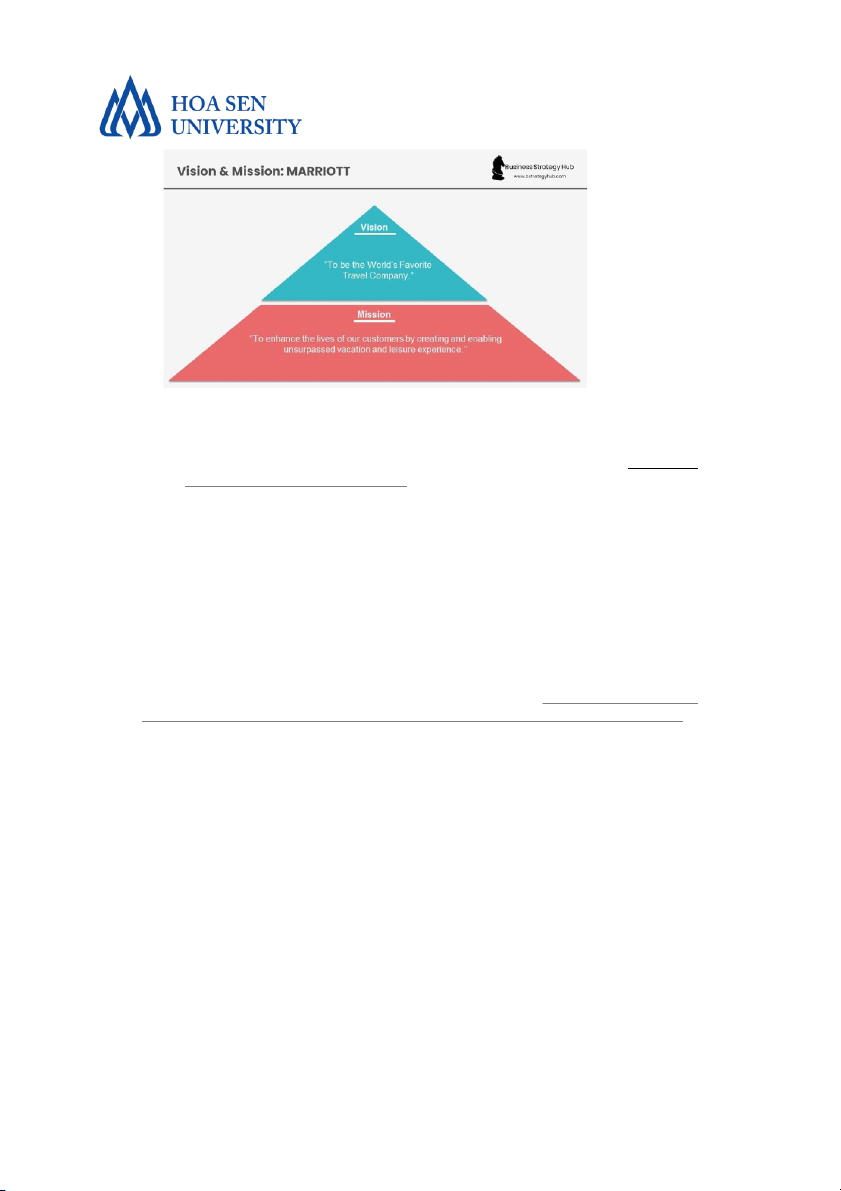
Marriott’s vision statement put forth by the company is as follows: “To be the
World’s Favorite Travel Company.”
To achieve the monumental success in the service industry on a global stage, the founders
of the Marriott International thought it was best to put forth a vision so simple that it was
not only easy to implement but also follow throughout the organization.
The goal of the company is very simple – to leave a legacy of excellence in the service
industry. Marriott International aims to be the favorite travel company for the masses
throughout the world. It was this vision in addition to the work ethic and company culture
that made it possible to achieve the success the company has staff size.
3. Marriot’s Mission Statement
The mission statement for Marriott International is as follows: “To enhance the lives of
our customers by creating and enabling unsurpassed vacation and leisure experience.”
An analysis of the mission statement has been done below: -
Enhance the lives of the customers: The key to the long-term success of any
service-providing company is to offer its customers services of that quality that the
customer is left with no other option other than choosing your brand.
Marriott International believes that by enhancing the lives of its customers and by
providing them with premium services, it can establish itself as a profitable company in
the long term. The company has pursued a wide range of strategies to make this mission a
reality. In 2020, Marriott International partnered with Quintessentially to provide its
customers with one-of-a-kind adventures and immersive experiences across the US and Europe. -
Creating and enabling unsurpassed vacation and leisure experiences: To retain
customers, Marriott International goes the extra mile to provide the customer with
a vacation experience that is their money’s worth. They do so by creating a
vacation experience and hotel experience full of comfort and enjoyment.
Right from the hotel room to the services provided by the Marriot International are of
premium quality. An example is the Ritz-Carlton Hotel, which is the go-to spot for all
high-profile people and celebrities. This shows that the company has been successful in
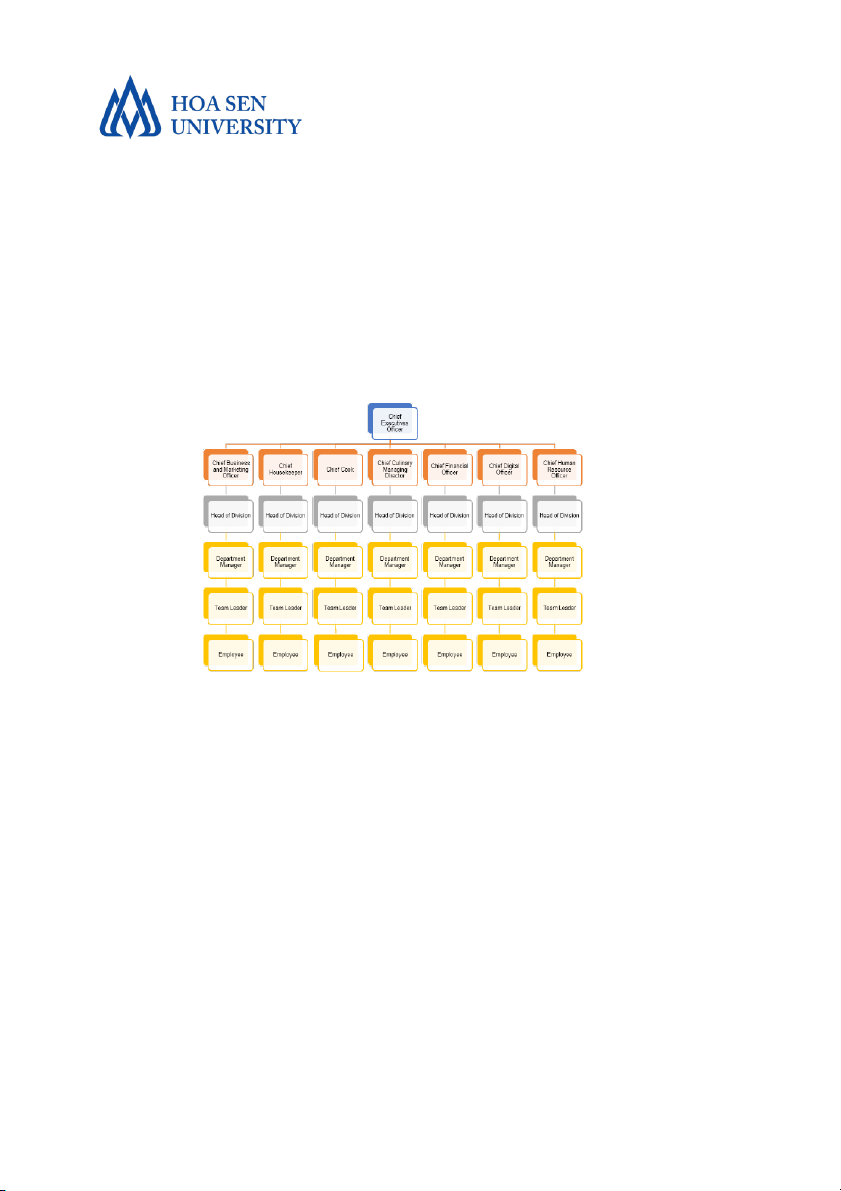
creating a credible brand Name for itself. 4. Staff size II. TRAINING PROGRAM: 1. Definition:
A training program is an activity or series of activities that include
taking one or more courses to improve performance, productivity,
skills, and knowledge. It's usually a low-cost endeavor with a flexible schedule.
2. Eight types of staff training programs available today: 1. Orientation training 2. Onboarding training 3. Technical skills training 4. Soft skills training 5. Product or service training 6. Compliance training 7. Franchise training
8. Managerial and leadership training
3. Training program in Marriot:
Marriott has 2 types of training:
Training new employees program: Marriott trains new employees to handle a wide
variety of positions and rotates them periodically to new jobs. This gives employees
opportunities to find the area in which they best like to work. The goal is to keep
employees interested in their work and keep them interested in working for Marriott.
Training development: Marriott has 2 types of training for current employees as
Managers - supervisory training and Leadership programs. Training and development
help companies gain and retain top talent, increase job satisfaction and morale, improve
productivity and earn more profit. Additionally, businesses that have actively interested
and dedicated employees see 41 percent lower absenteeism rates, and 17 percent higher productivity.
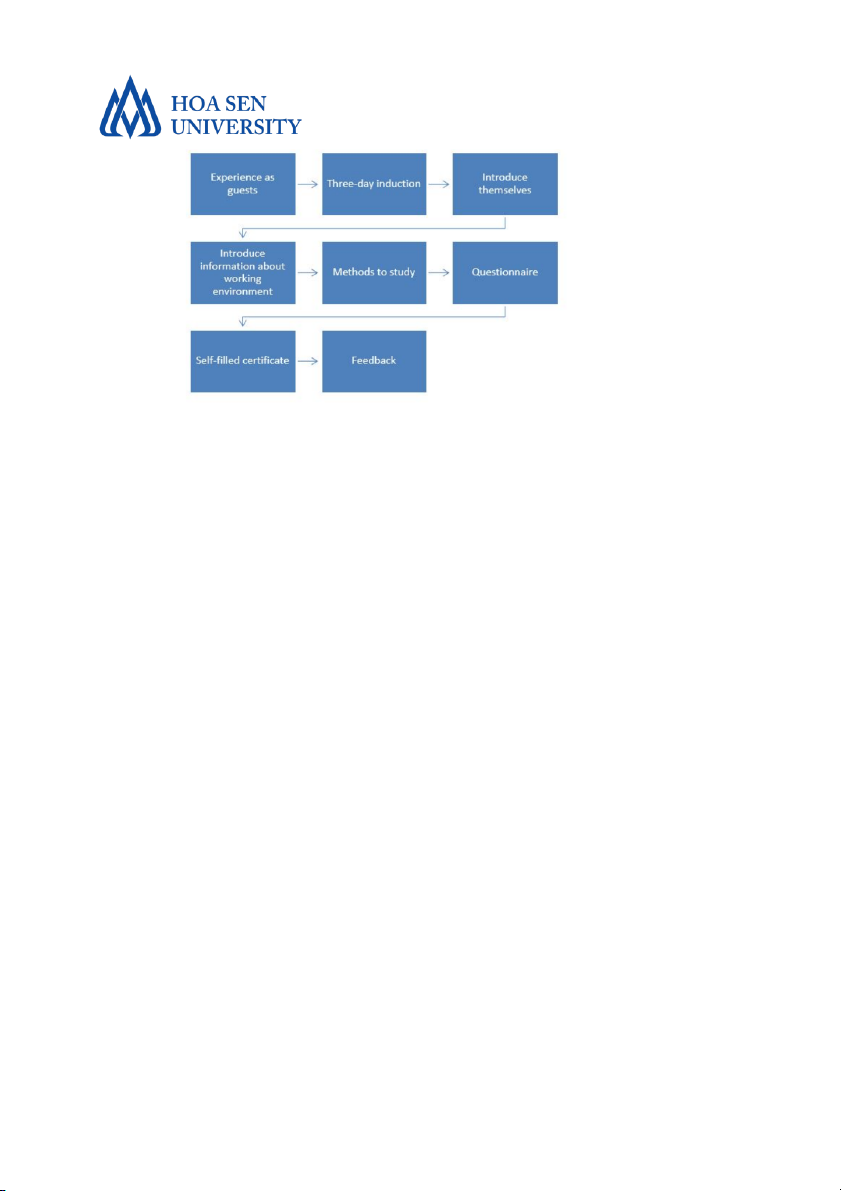
a) Training new employees program: - Training Design:
Step of training – In House Training - Training Need Analysis (TNA):
This method offers a wealth of knowledge and insight into the hotel and its amenities.
When a new employee checks into a hotel as a guest, they become familiar with the
amenities, policies, and technological resources available there.
New starters have opportunity to assess following key point while they stay at the hotel:
Efficiency and customer service of front desk.
Cleanness of the hotel, and to learn more about room appliances such as using air
controller system, safe and TV.
Learn more about restaurant and etc. - Induction Training:
Next three days, they attend to induction course. They will be given an employee
handbook at the outset, and the course book will contain general information. In the
Induction training, there are two different employee types:
1) Employees who have previously worked for the company and filled new openings are regarded as new hires.
2) New hire with no prior employment history with the company.
Additionally, previous employees completed this training in one day whereas a new
employee took three days to complete it. The following tasks are part of the induction training:
1) They will be verbally briefed on their plans for the upcoming three days.
2) After getting to know one another in the course, each participant introduces
themselves and provides a brief bio.
3) Presentation concerning the following: History of the company, who they were
yesterday, and mission and ideals of the company, what they need to accomplish.
4) What advantages they may receive and the policies of the company.
5) Basic hotel information, such as parking costs and Internet access options, should
be improved so that staff members are better prepared to respond to questions from guests.
6) Tours of the building provide an opportunity to learn more about its layout,
including where each department's offices are located in relation to restaurants,
fitness centers, public restrooms, rooms on various levels, and staff areas like the canteen and staff restrooms.
7) It also includes legal training requirements including introductory fire safety
instruction, workplace health and safety, and bomb awareness.
8) Trainings also help employees become more proficient in areas like customer
service, telephone etiquette, up-selling, food safety, and business brand standards
like picking up the phone after three rings, improving interactions with customers
as you approach them, among others. -
The methods described are used to complete all of these tasks: 1) Group conversation 2) Video clips 3) Presentation 4) Examples provided by guests
5) Through game learning methods
At the end of the training, the trainer evaluates the students using questionnaires. They
separate the trainees into different groups and allow them to compete to answer the
question. Then, after reviewing the entire induction training program, all learners are
asked for their opinion. The last step is to direct new hires to their supervisor for
additional training. The basic goal of induction training is to arm new hires with all the
knowledge and abilities they need to function as effectively within a company as their
coworkers do. It might include details like how to use the restrooms, how to enter and
exit the office, and how to use skills that are relevant to your employment. Additionally,
this training provides new hires with information of the firm, including its mission,
values, organizational structure, and policies and incentives. -
The following advantages of oriented training for an organization:
1) Effective job training for new hires, which improves the working environment for both coworkers and managers.
2) Reduces the expense of damages caused by an error made by a new employee. 3) Decreases employee turnover
Depending on how much knowledge you want to give the new employee, the length of
the training varies depending on the organization. Marriott is aware that most workers
don't want to continue working in entry-level positions like housekeeping. In order to
handle a wide range of tasks, Marriott trains its staff and regularly switches them out for
new ones. Employees are given the chance to discover the department in which they
enjoy working the most. They are prodded to prepare for advancement. The objective is
to maintain employees' enthusiasm in their work and in working for Marriott. Each
hourly employee at Marriott receives 15 minutes of training every day. The training
covers the fundamental information and skill areas that employees need to acquire in
order to perform their duties, such as buying, operating rooms, and cooking. - 5W
What: Steps of Training- In House Training
Where: Hotel in Marriott’s network
When: recruitment new employees Why:
Marriott trains employees to handle a wide variety of positions and rotates them periodically to new jobs.
This gives employees opportunities to find the area in which they best like to work.
The goal is to keep employees interested in their work and Marriott. Who: New employees
b) Training development (for current employees): -
Comparison between Training and Development TRAINING DEVELOPMENT FOCUS Current Future USE OF WORK Low High EXPERIENCE GOAL Preparation for current job Preparation for changes PARTICIPATION Required Voluntary
Development of Skills of Employees - Development helps in increasing the job
knowledge and skill of employees at each level employees to expand the horizons of
human intellect and the overall personality of the employees. -
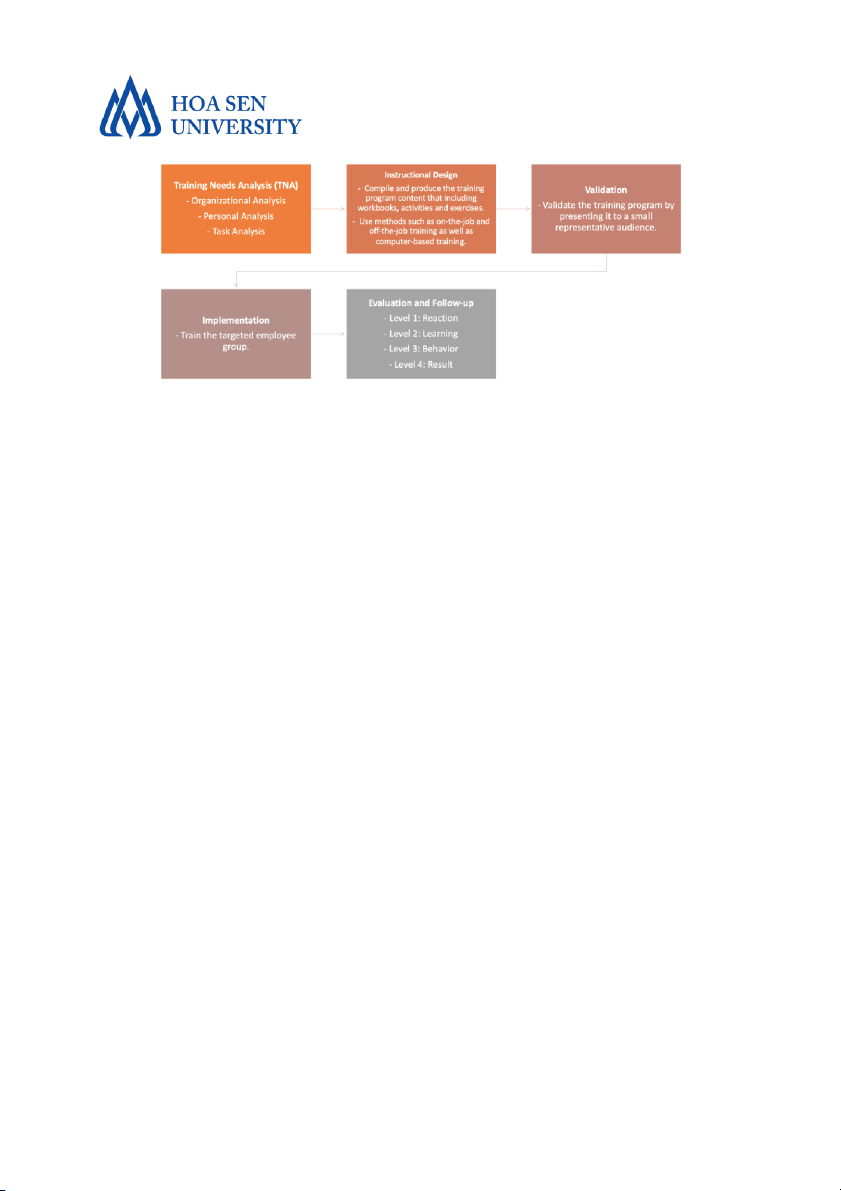
5 Step of Training Process for Training Development
Some significant training programs for employees held by Marriot:
MANAGERS AND SUPERVISORY TRAINING: 1) InMotion!
Uses practical experience to teach supervisors about various hotel departments and help
them gain a deeper understanding of the industry, which helps prepare them for managerial duties. 2) Get On Board
This training opportunity is intended to introduce new managers to International Lodging
who have been hired both within and externally. The manager "new to Marriott
International" experiences and learns Marriott's culture, regulations, and procedures for
International Lodging through a variety of channels while establishing the required connections. 3) IT
Training in Microsoft PowerPoint and Microsoft Excel is also being carried out. LEADERSHIP PROGRAMS 1) Facilitator Lead Programs
Marriott International's Core Competencies (Leadership, Managing Execution, Building
Relationships, Generating Talent and Organizational Capacity, Learning and Applying
Personal Expertise, and Business/Functional Results) are correlated with the three levels of the programs. 2) Property Strategic Planning
The hotel leadership team is the target audience for this two-day training, which is held
30 days before a new Marriott International hotel opens.
3) Courtyard by Marriott International University
General managers and assistant managers are able to enroll in this program, which is
exclusive to Courtyard hotels. It is intended to concentrate on understanding the brand's
positioning, product and service standards, pricing strategies and food and beverage.
4) Training On-Property Programs
For hotel managers providing Passports to Success, In the Beginning, or other on-
property training programs for hourly staff, a workshop is developed. 5) Effective Training Skills
Co-facilitation approaches, stages of experiential learning, measurement, and a greater
comprehension of learning styles are all key components of both the workshop and certification processes.
6) Virtual Leadership Training Program
The VLE was able to boost productivity and cost savings for Marriott as well as engage
managers in an experience that was "cutting edge". Managers could participate from the
hotel from which they worked by going to a ballroom and participating in a group with
their colleagues. Conversations gave participants the ability to network with people in a virtual environment. 7) Safety Training
A comprehensive safety training program that addresses accident prevention for
housekeeping and kitchen employees should include the proper use of food preparation
equipment, chemical use, and safe lifting techniques. Guests should be aware of where
emergency exits are located and where they should check in with employees after an evacuation. TRAINING EMPLOYEE DEVELOPMENT 1) Career Development
The goal of career development is to align an employee's personal objectives with the
demands of the firm. The HR department and the individual should jointly be responsible for career development. 2) Leadership Development
An individual's capacity to lead others is strengthened by leadership training. This kind of
initiative is not just for people in positions of authority. Giving teams in an organization
training in leadership skills can improve team performance. 3) Management Development
Management development improves the capacity of persons in management positions to
carry out the duties connected with organizing, planning, and executing organizational changes. 4) Supervisor Development
Supervisors must make the shift from performing work to overseeing the work of others
in a company's hierarchy. The task of developing programs to aid this transition falls to the HR department.
Training and Development Method Adopted by Courtyard Marriott hotel
Tài liệu liên quan:
-
Phân tích kỹ thuật Phân tích kỹ thuật không giống với phân tích cơ bản - Tài liệu tham khảo | Đại học Hoa Sen
270 135 -
Article 1 - Impact of social media in India - Tài liệu tham khảo | Đại học Hoa Sen
401 201 -
Nhượng quyền kinh doanh - báo cáo cuối kì - Tài liệu tham khảo | Đại học Hoa Sen
309 155 -
Article 1 - Impact of social media in India - Tài liệu tham khảo | Đại học Hoa Sen
348 174 -
On Lê Vũ for skylines - Exhibition introduction writing sample - Tài liệu tham khảo | Đại học Hoa Sen
297 149