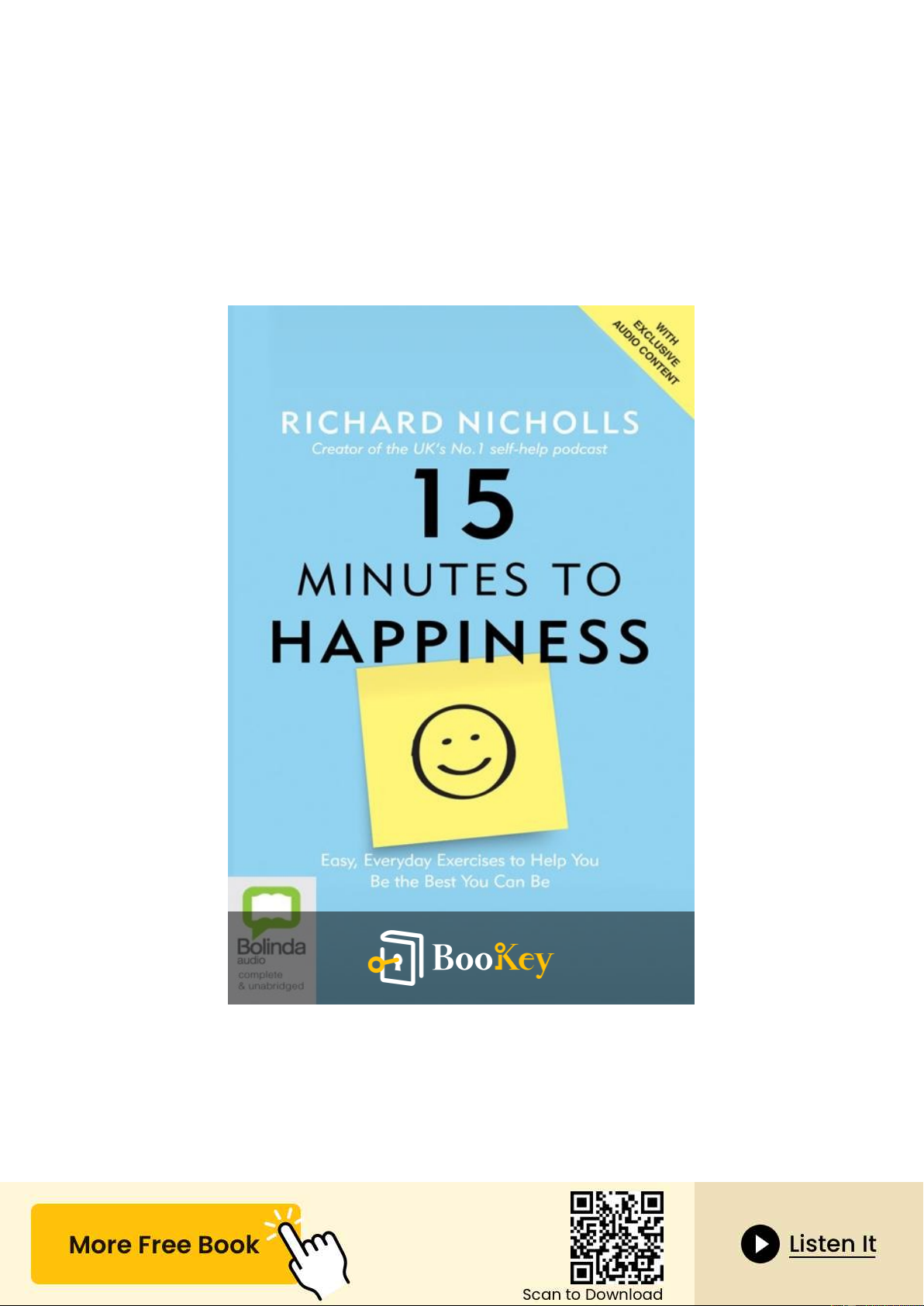
Sách "15 Minutes to Happiness" của tác giả Richard Nicholls
Sách "15 Minutes to Happiness" của tác giả Richard Nicholls. Tài liệu được sưu tầm giúp bạn tham khảo, ôn tập và đạt kết quả cao. Mời bạn đọc đón xem.
Môn: Tài liệu Tổng hợp 3.6 K tài liệu
Trường: Tài liệu khác 3.9 K tài liệu
Tác giả:



















Preview text:
15 Minutes to Happiness PDF Richard Nicholls 15 Minutes to Happiness
Simple Shifts for Lasting Joy in Just 15 Minutes a Day Written by Bookey
Check more about 15 Minutes to Happiness Summary
Listen 15 Minutes to Happiness Audiobook About the book
In "15 Minutes to Happiness," renowned psychotherapist
Richard Nicholls draws on insights from his acclaimed
podcast, Motivate Yourself, to debunk common self-help
myths and deliver practical solutions for real-life challenges.
This compelling guide explores the science of happiness,
revealing how small adjustments in our thoughts, emotions,
lifestyles, attitudes, self-esteem, health, and social connections
can lead to significant improvements in our overall well-being.
With simple 15-minute tasks designed for easy integration into
daily routines, Nicholls provides readers with effective tools to
enhance their happiness and enrich their lives. About the author
Richard Nicholls is a renowned author, speaker, and life coach
celebrated for his insightful approach to personal development
and well-being. With a background in psychology and a
passion for helping individuals unlock their potential, Nicholls
has dedicated his career to empowering people through
practical strategies and engaging techniques. His book "15
Minutes to Happiness" distills years of research and
experience into actionable steps that promote mental health
and emotional resilience. Through his writing and workshops,
Nicholls inspires readers and participants alike to cultivate
happiness and lead more fulfilling lives. Summary Content List
Chapter 1 : THINK HAPPY, BE HAPPY
Chapter 2 : CAN YOU BUY HAPPINESS?
Chapter 3 : ADOPT THE GRATITUDE ATTITUDE Chapter 4 : LOVING YOU IS EASY
Chapter 5 : BE OK ABOUT NOT BEING OK
Chapter 6 : HAPPY BODY, HAPPY MIND
Chapter 7 : GET YOURSELF CONNECTED Chapter 8 : HAPPY EVER AFTER
Chapter 1 Summary : THINK HAPPY, BE HAPPY Section Key Points About the
- 100 billion neurons create chemical responses influencing emotions.- Instincts vital for survival, while Brain
skills develop through repetition.- Unconscious abilities beneficial; bad habits can also form through repetition. Learning and
- Skills can fade without practice (e.g., skateboarding, guitar).- Brain pathways for skills become habitual Unlearning
with use.- Recognizing and altering pathways requires conscious effort. Defining
- Happiness is subjective, reflecting emotional experiences and life satisfaction.- Genetics account for ~50% Happiness
of happiness; actions and thoughts account for the rest.- Focus on changing behaviors/thoughts to alter happiness levels. Cognitive
- Thoughts shape emotions and behaviors; changing them can reform negative emotions.- A case study Behavioral
illustrates perspective change to alleviate anxiety.- Techniques like the ABC model help identify activating Therapy (CBT) events and reshape reactions. Controlling
- Techniques like thought stopping redirect negative obsessions.- Breathing techniques help regulate Thoughts and
emotions and manage stress/anxiety. Breathing Visualisation
- Positive visualisation promotes goal-setting with actionable steps.- Acknowledging setbacks cultivates and Optimism
resilience and enhances goal achievement. The Role of
- Emotions, including negative ones, are valuable for emotional literacy.- Journaling aids self-reflection, Emotions in
emotional clarity, and identifies negative patterns. Happiness Final Thoughts
- Happiness is a fluctuating process, not a constant state.- Acceptance of emotional ebb and flow is critical; on Happiness
sadness is part of the human experience.- Pursuing happiness may backfire, emphasizing the importance of emotional awareness.
Chapter One: Think Happy, Be Happy About the Brain
- The brain contains 100 billion neurons continuously
creating chemical responses influencing emotions and instincts.
- Instincts have been crucial for survival, while complex
skills develop through repetition, eventually becoming unconscious behaviors.
- Unconscious abilities can be beneficial while bad habits can develop through repetition. Learning and Unlearning
- Skills can fade if not practiced, as illustrated by personal
anecdotes about losing skateboard and guitar skills.
- The brain creates pathways for skills; frequently traveled pathways become habitual.
- Recognizing these pathways allows one to alter or unlearn
unhelpful habits, but requires conscious effort. Defining Happiness
- Happiness is a subjective measure of daily emotional
experiences and life satisfaction.
- Genetics influence about 50% of happiness levels, while
actions and thought processes account for the other 50%.
- To change happiness levels, one must focus on modifying
behaviors and thoughts, as only 10% of mood is affected by life experiences.
Cognitive Behavioral Therapy (CBT)
- CBT proposes that our thoughts shape our emotions and
behaviors; changing thought patterns can reform negative emotions.
- A case study illustrates how changing perspective can
alleviate anxiety and help navigate professional relationships.
- Techniques like the ABC model help individuals identify
activating events, beliefs, and consequences to reshape their reactions.
Controlling Thoughts and Breathing
- Techniques like thought stopping can help divert attention
from negative obsessions to positive alternatives.
- Effective breathing techniques regulate emotions by
ensuring proper oxygen flow to the brain, helping manage stress and anxiety.
Visualisation and Optimism
- Positive and process visualisation can promote goal-setting,
but only if one recognizes actionable steps rather than relying purely on imagining outcomes.
- Acknowledging and preparing for potential setbacks can
help cultivate resilience and increase the likelihood of achieving goals.
The Role of Emotions in Happiness
- Emotions, including negative ones, have value;
understanding and differentiating emotions can lead to greater emotional literacy.
- Journaling is a practical tool for self-reflection, aiding
emotional clarity and helping identify negative thought patterns.
Final Thoughts on Happiness
- Happiness is not a constant state but a fluctuating process
involving both positive and negative emotions.
- Individuals must accept the ebb and flow of emotions
without pressure to always feel happy, recognizing that
sadness is a part of the human experience.
- Understanding that the pursuit of happiness can sometimes
backfire emphasizes the importance of accepting one's
current emotional state and fostering overall emotional awareness. Example
Key Point:Recognize your ability to shape your own
happiness by changing thought patterns.
Example:Imagine waking up each day feeling a mix of
excitement and apprehension about the unknown ahead.
Instead of dwelling on potential failures, consciously
choose to focus on what you can learn from any
setbacks. As you navigate through your day, remind
yourself that your thoughts directly influence your
feelings; you'll notice moments of anxiety decrease
when you actively replace self-doubt with affirmations
of your capabilities. This shift in perspective enables
you to embrace challenges and approach life with a
positive, resilient outlook, ultimately paving your path toward sustained happiness.
Chapter 2 Summary : CAN YOU BUY HAPPINESS? Section Description Historical Context of Money
The evolution of money enabled easier transactions and led to the belief that increased
income correlates with happiness. Money as a Substitute for
Money replaces ancestral safety sources, negatively affecting social interactions and Safety
potentially leading to isolation. Wealth and Social Behavior
Wealth often reduces altruism; wealthier individuals tend to prioritize their own needs over helping others. Money's Influence on
While basic income can improve well-being, happiness plateaus after about £50,000 Happiness annually. Experiences vs. Material Goods
Spending on experiences yields greater happiness than material possessions due to lasting memories and connections. Optimism and Positivity
A positive outlook and engaging in charitable acts contribute to higher life satisfaction. Measuring Happiness
Readers should self-assess their happiness through a questionnaire to identify improvement areas. Social Comparisons and
Comparing oneself with others fosters dissatisfaction and materialism, affecting self-esteem Materialism negatively. Self-Esteem and Generosity
Low self-esteem links to materialism; generosity towards others enhances personal
happiness more than self-spending. Conclusion on Happiness and
Happiness derives from positive experiences and relationships rather than material wealth Materialism accumulation. Quick Happiness Boosting
1. Reflect on positive experiences through photos. 2. Spend on experiences, not things. 3. Ideas Donate to local causes.
Chapter Two: Can You Buy Happiness? The Psychology Of Money
Historical Context of Money
The concept of money evolved as societies grew beyond
basic bartering exchanges. Early forms were impractical and
led to the creation of coins, simplifying transactions and
fostering a desire for wealth. Despite understanding that
happiness comes from within, many equate increased income with happiness.
Money as a Substitute for Safety
In modern times, money replaces ancestral sources of safety,
impacting our instinct to be accepted within social groups.
Financial security can lead to a decline in social interactions,
potentially resulting in selfish behaviors and isolation.
Wealth and Social Behavior
Studies show that increased wealth correlates with reduced
altruism. Wealthy individuals are less likely to engage in
helping behaviors, as evidenced by experiments showing that
high-value car drivers prioritize their own needs over pedestrian safety.
Money's Influence on Happiness
While adequate income can enhance well-being, research
shows a diminishing return on happiness beyond a certain
income threshold—approximately £50,000 annually. Wealth
beyond this point yields only slight improvements in happiness.
Experiences vs. Material Goods
Money spent on experiences (travel, dining, etc.) contributes
more to happiness than material possessions. Experiences
foster memorable connections and positive emotions, unlike
fleeting satisfaction from consumer goods. Optimism and Positivity
Having a positive outlook is crucial for happiness. Regularly
engaging in positive experiences and charitable acts is linked
to increased life satisfaction. Measuring Happiness
Readers are encouraged to self-assess their happiness,
utilizing a questionnaire to gauge their satisfaction levels and
identify areas for improvement.
Social Comparisons and Materialism
The tendency to compare oneself to others, especially in the
social media age, often leads to dissatisfaction. This “keeping
up with the Joneses” mentality can perpetuate a cycle of
materialism, adversely impacting self-esteem.
Self-Esteem and Generosity
Low self-esteem is often linked to increased materialism.
Acts of kindness and generosity, particularly towards others,
can significantly boost one’s own happiness more than self-directed spending.
Conclusion on Happiness and Materialism
True happiness involves cultivating positive experiences and
relationships rather than accumulating material wealth.
Investing in moments and the well-being of others fosters
greater satisfaction and fulfillment.
Quick Happiness Boosting Ideas
1. Reflect on positive past experiences by looking through photos.
2. Spend strategically on experiences rather than material goods.
3. Donate to local causes, fostering a sense of community and purpose. Critical Thinking
Key Point:The Diminished Returns of Wealth on Happiness
Critical Interpretation:Nicholls argues that beyond a
certain income, money has a diminishing effect on
happiness, suggesting that wealth cannot guarantee
emotional satisfaction. While his perspective highlights
the importance of mindset over material possessions, it
could be contested by theories like the Easterlin
Paradox, which shows that income and happiness are
linked but only up to a point. Critics may argue that
Nicholls overlooks how socioeconomic factors like
financial stability may still be crucial to individual
happiness, as suggested by works like "The Spirit
Level" by Wilkinson and Pickett, which indicate that
income inequality affects overall societal well-being.
Chapter 3 Summary : ADOPT THE GRATITUDE ATTITUDE
Chapter Three: Adopt the Gratitude Attitude What Is Gratitude?
Gratitude plays a crucial role in personal happiness and life
satisfaction. Recognizing and appreciating kindness, even as
simple as a compliment, can significantly enhance our
overall contentment. Ingrained societal habits often lead to
ungratefulness, which undermines this appreciation. The act
of being thankful helps individuals focus on the positive
aspects of their lives, fostering a gratitude mindset that nurtures deeper happiness. Gratitude as a Skill
Gratitude isn’t merely a response; it's a skill that can be
developed through practice. Cultivating gratitude allows for
improved mental health, resilience to anxiety, and increased
willingness to give. Engaging in daily reflection on positive
experiences can encourage a mindset that seeks joy and
appreciation, enhancing overall well-being.
Affectionate Writing Exercise
Engaging in ‘affectionate writing’—expressing positive
reflections about people and experiences—has been shown to
improve both mental and physical health. Spending just 15
minutes writing about what you appreciate can create lasting
benefits, including reduced stress.
Perspective on Ingratitude
Ingratitude is often unnoticed, yet it affects countless lives.
To combat this, regularly ask yourself if you might be taking
something for granted. Simple reminders of daily life
comforts, like clean water or electricity, can shift our focus
toward appreciation and promote a more satisfying life.
The Importance of Mindfulness
Install Bookey App to Unlock Full Text and
Mindfulness, or the practice of being present in the moment, Audio
can help prevent the mind from wandering into negativity.
Tài liệu liên quan:
-
Ung dung game hoa trong cac chien dich MKT
27 14 -

Bao cao Chi so TMDT Viet Nam 2025
30 15 -

Thông tư quy định về việc phân quyền, phân cấp và phân định thẩm quyền quản lý nhà nước về giáo dục cho chính quyền địa phương
31 16 -
Nghị quyết về phát huy các giá trị di sản văn hóa gắn với phát triên du lịch bền vững tỉnh Khánh Hòa đến năm 2025, định hướng đến năm 2030
33 17 -

Quyết định phê duyệt Chiến lược phát triển du lịch Việt Nam đến năm 2030
19 10