+
six
tests
in
exam
format
+
introduction
to
each
task
+
extra
language
practice
+
model
interview
+
useful
language
for
Speaking
with
key
teaching
not
Just
testing
Preliminary
English Test
Includes
2004
exam
specifications
Louise
Hashemi
Barbara
Thomas
PEARSON
Longman
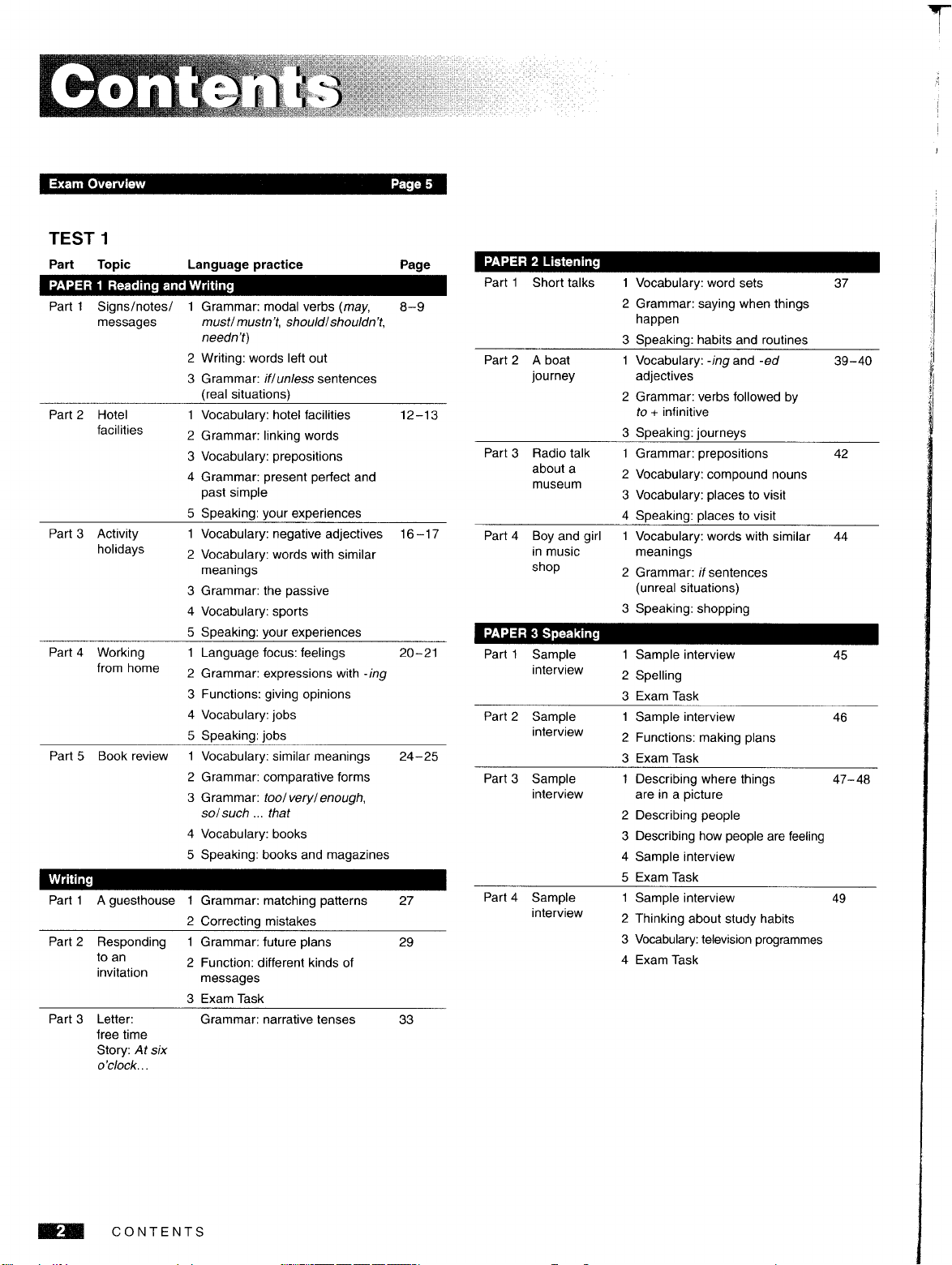
Exam Overview Page 5
TEST
1
T
Part Topic Language practice
Page
PAPER 2 Listening
PAPER 1 Reading and Writing
PAPER 3 Speaking
8-9
Part 2 A boat
journey
12-13
Part 3 Radio talk
about a
museum
16-17
Part 4 Boy and girl
in
music
shop
Part 1 Signs/notes/
messages
Part 2 Hotel
facilities
Part 3 Activity
holidays
Grammar: modal verbs (may,
must!mustn't, should/shouldn't,
needn't)
2 Writing: words left out
3 Grammar: if/unless sentences
(real situations)
1 Vocabulary: hotel facilities
2 Grammar: linking words
3 Vocabulary: prepositions
4 Grammar: present perfect and
past simple
5 Speaking: your experiences
1 Vocabulary: negative adjectives
2 Vocabulary: words with similar
meanings
3 Grammar: the passive
4 Vocabulary: sports
5 Speaking: your experiences
Part 1
Short talks 1 Vocabulary: word sets
37
2 Grammar: saying when things
happen
3 Speaking: habits and routines
1 Vocabulary: -ing and
-ed
39-40
adjectives
2 Grammar: verbs followed
by
to + infinitive
3 Speaking: journeys
1 Grammar: prepositions
42
2 Vocabulary: compound nouns
3 Vocabulary: places to visit
4 Speaking: places to visit
1 Vocabulary: words with similar 44
meanings
2 Grammar:
if
sentences
(unreal situations)
3 Speaking: shopping
Part 4 Working
from home
Part 5 Book review
Writing
1 Language focus: feelings
20-21
2 Grammar: expressions with -ing
3 Functions: giving opinions
4 Vocabulary: jobs
5 Speaking: jobs
1 Vocabulary: similar meanings
24-25
2 Grammar: comparative forms
3 Grammar: tool very/ enough,
sol
such
...
that
4 Vocabulary: books
5 Speaking: books and magazines
Part 1 Sample
interview
Part 2
Sample
interview
Part 3
Sample
interview
Sample interview
45
2 Spelling
3 Exam Task
1 Sample interview
46
2 Functions: making plans
3 Exam Task
1 Describing where things
47-48
are
in
a picture
2 Describing people
3 Describing how people are
feeling
4 Sample interview
5 Exam Task
Part 1
A guesthouse
1
Grammar: matching patterns 27
Part 4
Sample
2 Correcting mistakes
interview
Part 2
Responding 1 Grammar: future plans
29
to
an
2 Function: different kinds of
invitation
messages
3 Exam Task
Part 3 Letter:
Grammar: narrative tenses
33
free time
Story:
At
six
o'clock...
1 Sample interview
49
2 Thinking about study habits
3
Vocabulary:
television
programmes
4 Exam Task
..
CONTENTS
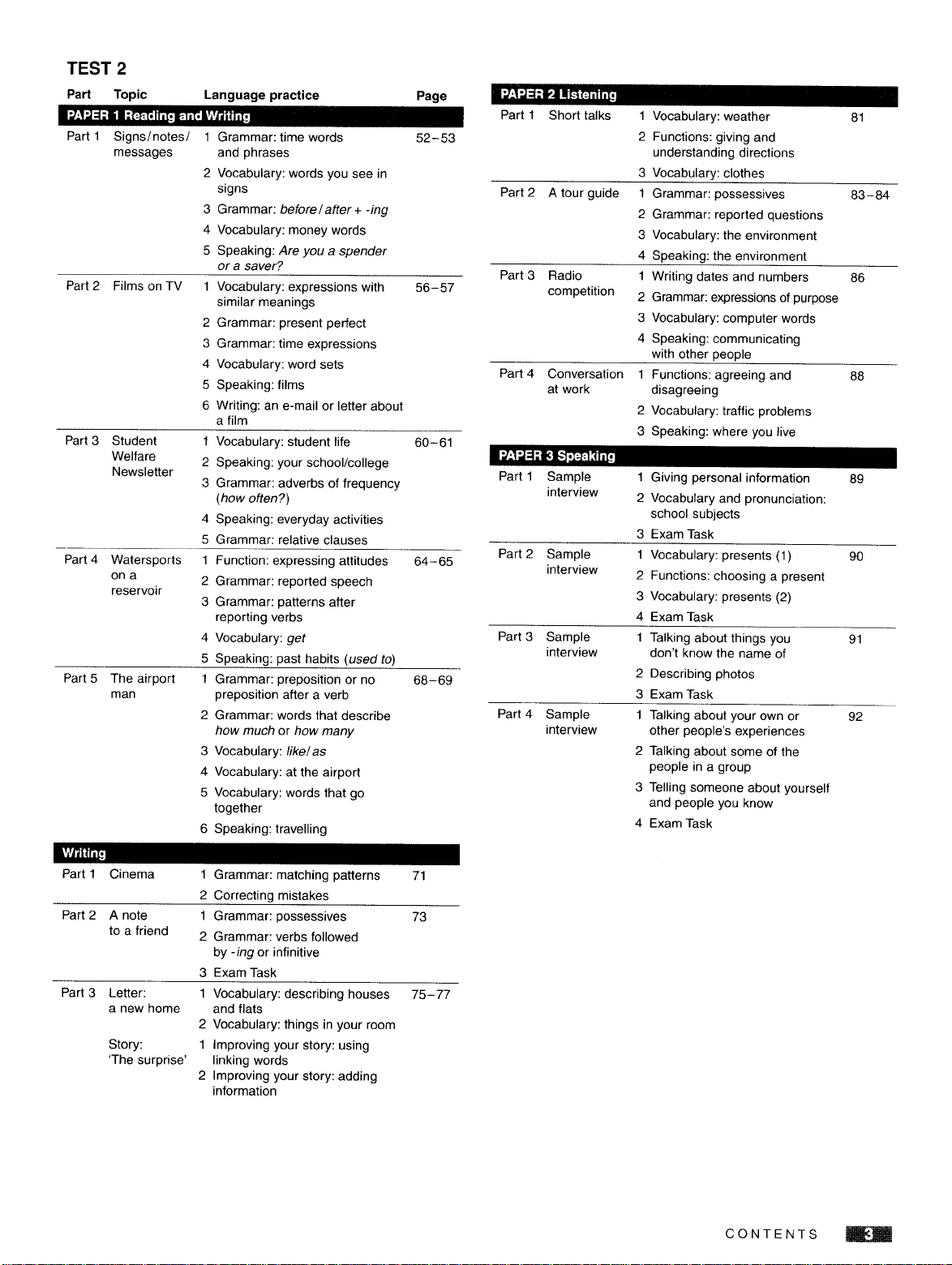
TEST 2
Part Topic
Language practice Page
PAPER 2 Listening
Part
1 Sample 1 Giving personal information
89
interview
2 Vocabulary and pronunciation:
school subjects
3 Exam Task
64-65
Part 2 Sample 1 Vocabulary: presents (1)
90
interview
2 Functions: choosing a present
3 Vocabulary: presents (2)
4
Exam Task
Part
3 Sample
1 Talking about things you
91
interview don't know the name of
68-69
2 Describing photos
3 Exam Task
Part
4 Sample 1 Talking about your own or
92
interview
other people's experiences
2 Talking about some of the
people
in
a group
3 Telling someone about yourself
and people you know
4 Exam Task
PAPER 1 Reading and Writing
Part
1
Signs/notes/
messages
Part
2 Films on TV
Part
3 Student
Welfare
Newsletter
Part
4 Watersports
on
a
reservoir
Part
5 The airport
man
Writing
Grammar: time words
52-53
and phrases
2 Vocabulary: words you see
in
signs
3 Grammar: before/ after + -ing
4 Vocabulary: money words
5 Speaking: Are you a spender
ora
saver?
Vocabulary: expressions with
56-57
similar meanings
2 Grammar: present perfect
3 Grammar: time expressions
4 Vocabulary: word sets
5 Speaking: films
6 Writing: an e-mail or letter about
afilm
1 Vocabulary: student life
60-61
2 Speaking: your school/college
3 Grammar: adverbs of frequency
(how often?)
4 Speaking: everyday activities
5 Grammar: relative clauses
1 Function: expressing attitudes
2 Grammar: reported speech
3 Grammar: patterns after
reporting verbs
4 Vocabulary: get
5 Speaking: past habits (used
to)
1 Grammar: preposition or no
preposition after a verb
2 Grammar: words that describe
how much or how many
3 Vocabulary: like/ as
4 Vocabulary: at the airport
5 Vocabulary: words that go
together
6 Speaking: travelling
Part 1 Short talks
Part
2 A tour guide
Part
3 Radio
competition
Part
4 Conversation
at work
PAPER 3 Speaking
1 Vocabulary: weather
81
2 Functions: giving and
understanding directions
3 Vocabulary: clothes
1 Grammar: possessives
83-84
2 Grammar: reported questions
3 Vocabulary: the environment
4 Speaking: the environment
1 Writing dates and numbers
86
2 Grammar: expressions of purpose
3 Vocabulary: computer words
4 Speaking: communicating
with other people
1 Functions: agreeing and
88
disagreeing
2 Vocabulary: traffic problems
3 Speaking: where you live
Part
1 Cinema 1 Grammar: matching patterns
71
2 Correcting mistakes
Part
2 A note 1 Grammar: possessives
73
to a friend
2 Grammar: verbs followed
by
-ing or infinitive
3
Exam Task
Part
3 Letter: 1 Vocabulary: describing houses
75-77
a new home
and flats
2 Vocabulary: things
in
your room
Story:
1 Improving your story: using
'The surprise'
linking words
2 Improving your story: adding
information
CONTENTS
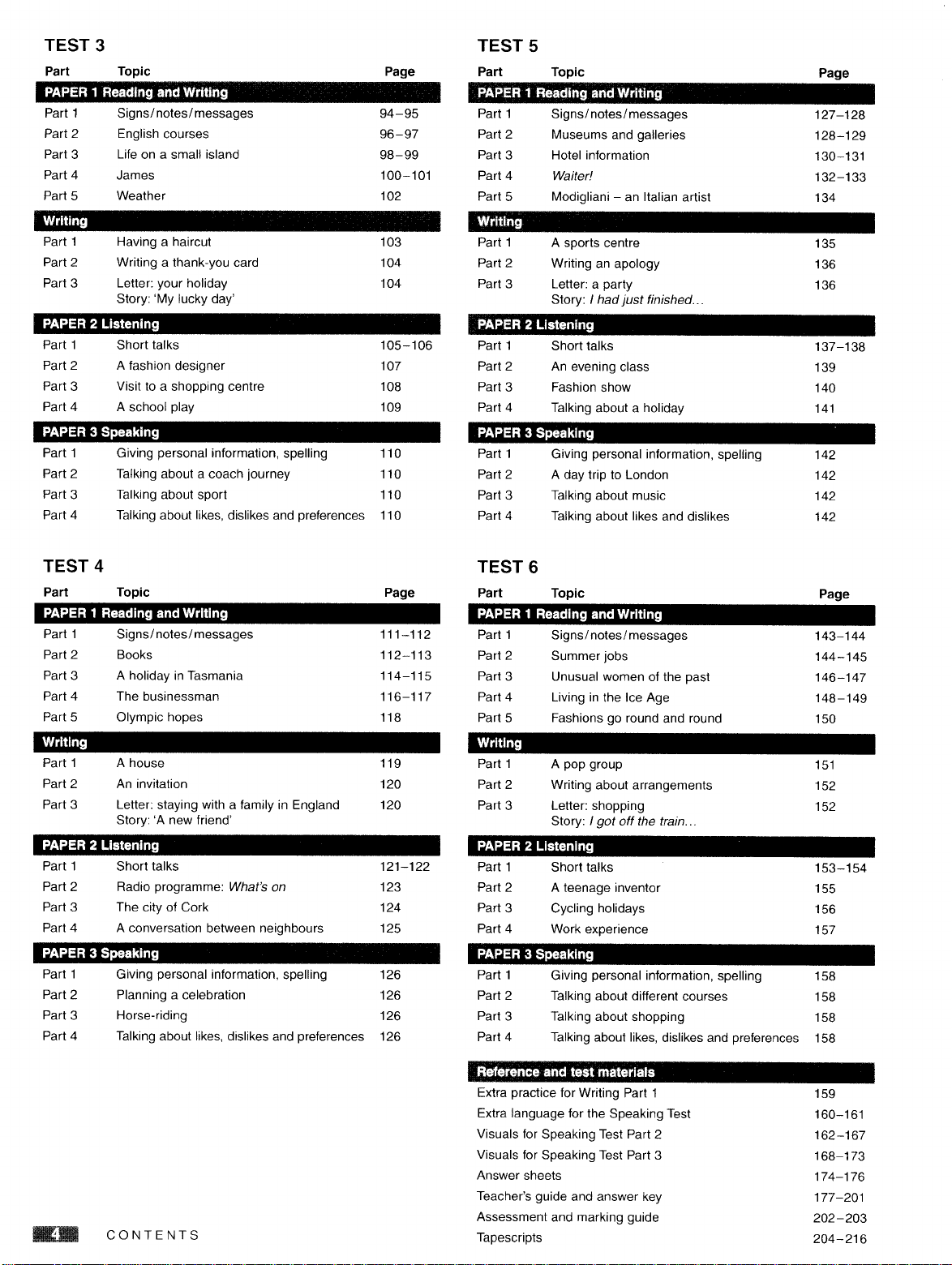
TEST 3
Part
Topic
Page
TEST 5
Part
Topic
Page
PAPER
1
Reading
and
Writing
PAPER
1
Reading
and
Writing
Part 1 Signs/notes/messages
94-95
Part 1
Signs/notes/ messages
127-128
Part 2 English courses
96-97
Part 2
Museums and galleries
128-129
Part 3 Life on a small island
98-99
Part 3 Hotel information
130-131
Part 4
James
100-101
Part 4
Waiter!
132-133
Part 5 Weather 102 Part 5 Modigliani - an Italian artist
134
Writing
Writing
Part 1 Having a haircut
103
Part 1 A sports centre
135
Part 2 Writing a thank-you card
104
Part 2
Writing
an
apology
136
Part 3 Letter: your holiday
104
Part 3
Letter: a party
136
Story: 'My lucky day' Story: I had just finished...
PAPER
2 listening
PAPER
2
Listening
Part 1 Short talks
105-106
Part 1 Short talks
137-138
Part 2 A fashion designer
107
Part 2
An
evening class
139
Part 3 Visit to a shopping centre 108 Part 3 Fashion show
140
Part 4 A school play 109 Part 4 Talking about a holiday
141
PAPER
3
Speaking
PAPER
3
Speaking
Part 1
Giving personal information, spelling
110
Part 1 Giving personal information, spelling
142
Part 2 Talking about a coach journey
110
Part 2 A day trip to London
142
Part 3 Talking about sport
110
Part 3 Talking about music
142
Part 4 Talking about likes, dislikes and preferences 110 Part 4
Talking about likes and dislikes
142
TEST 4 TEST 6
Part
Topic
Page
Part
Topic
Page
PAPER
1
Reading
and
Writing
PAPER
1
Reading
and
Writing
Part 1 Signs/notes/messages
111-112
Part 1
Signs/notes/ messages
143-144
Part 2 Books
112-113
Part 2
Summer jobs
144-145
Part 3 A holiday
in
Tasmania
114-115
Part 3
Unusual women of the past
146-147
Part 4 The businessman
116-117
Part 4
Living
in
the Ice Age
148-149
Part 5 Olympic hopes
118
Part 5 Fashions go round and round
150
Writing Writing
Part 1 A house
119
Part 1
A pop group 151
Part 2
An
invitation
120
Part 2
Writing about arrangements
152
Part 3 Letter: staying with a family
in
England
120
Part 3 Letter: shopping
152
Story: 'A new friend'
Story: I got off the train...
PAPER
2
Listening
PAPER
2
Listening
Part 1 Short talks
121-122
Part 1 Short talks
153-154
Part 2
Radio programme: What's on
123
Part 2 A teenage inventor
155
Part 3 The city of Cork
124
Part 3
Cycling holidays
156
Part 4
A conversation between neighbours
125
Part 4 Work experience
157
PAPER
3
Speaking
PAPER
3
Speaking
Part 1 Giving personal information, spelling
126
Part 1
Giving personal information, spelling
158
Part 2 Planning a celebration
126
Part 2 Talking about different courses
158
Part 3 Horse-riding
126
Part 3
Talking about shopping
158
Part 4 Talking about likes, dislikes and preferences
126
Part 4 Talking about likes, dislikes and preferences
158
Reference
and
test
materials
CONTENTS
Extra practice for Writing Part 1
Extra language for the Speaking Test
Visuals for Speaking Test Part 2
Visuals for Speaking Test Part 3
Answer sheets
Teacher's guide and answer key
Assessment and marking guide
Tapescripts
159
160-161
162-167
168-173
174-176
177-201
202-203
204-216
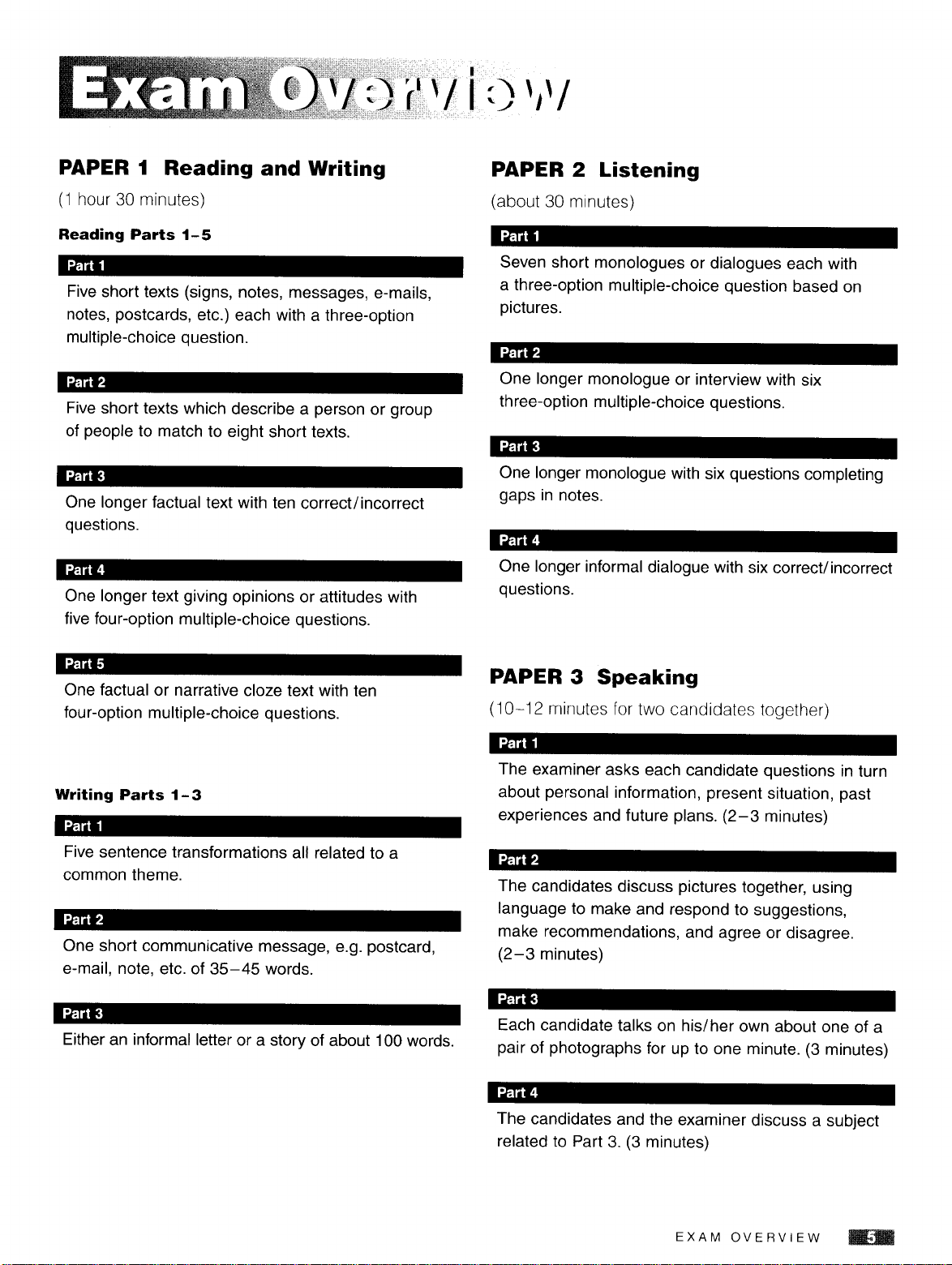
PAPER 1
Reading
and
Writing
(1
hour 30 minutes)
Reading
Parts
1-
5
Part 1
Five short texts (signs, notes, messages, e-mails,
notes, postcards, etc.) each with a three-option
multiple-choice question.
Part 2
Five short texts which describe a person or group
of
people to match to eight short texts.
Part 3
One longer factual text with ten correct/incorrect
questions.
Part 4
One longer text giving opinions or attitudes with
five four-option multiple-choice questions.
Part 5
One factual or narrative cloze text with ten
four-option multiple-choice questions.
Writing
Parts
1-
3
Part 1
Five sentence transformations all related to a
common theme.
Part 2
One short communicative message, e.g. postcard,
e-mail, note, etc. of
35-45
words.
Part 3
Either
an
informal letter or a story of about 100 words.
PAPER 2 Listening
(about 30 minutes)
Part 1
Seven short monologues or dialogues each with
a three-option multiple-choice question based on
pictures.
Part 2
One longer monologue or interview with six
three-option multiple-choice questions.
Part 3
One longer monologue with six questions completing
gaps
in
notes.
Part 4
One longer informal dialogue with six correct/incorrect
questions.
PAPER 3
Speaking
(10-12
minutes for two candidates together)
Part 1
The examiner asks each candidate questions
in
turn
about personal information, present situation, past
experiences and future plans.
(2-3
minutes)
Part 2
The candidates discuss pictures together, using
language to make and respond to suggestions,
make recommendations, and agree or disagree.
(2-3
minutes)
Part 3
Each candidate talks on his/her own about one of a
pair of photographs for up to one minute.
(3
minutes)
Part 4
The candidates and the examiner discuss a subject
related to Part
3.
(3
minutes)
EXAM
OVERVIEW
•••
IR
'I
R
••
lllnl
.nll.,ilinl
".sl
(1
hour
30
minutes)
•••
ding
••
'1
'I
~
Strategy
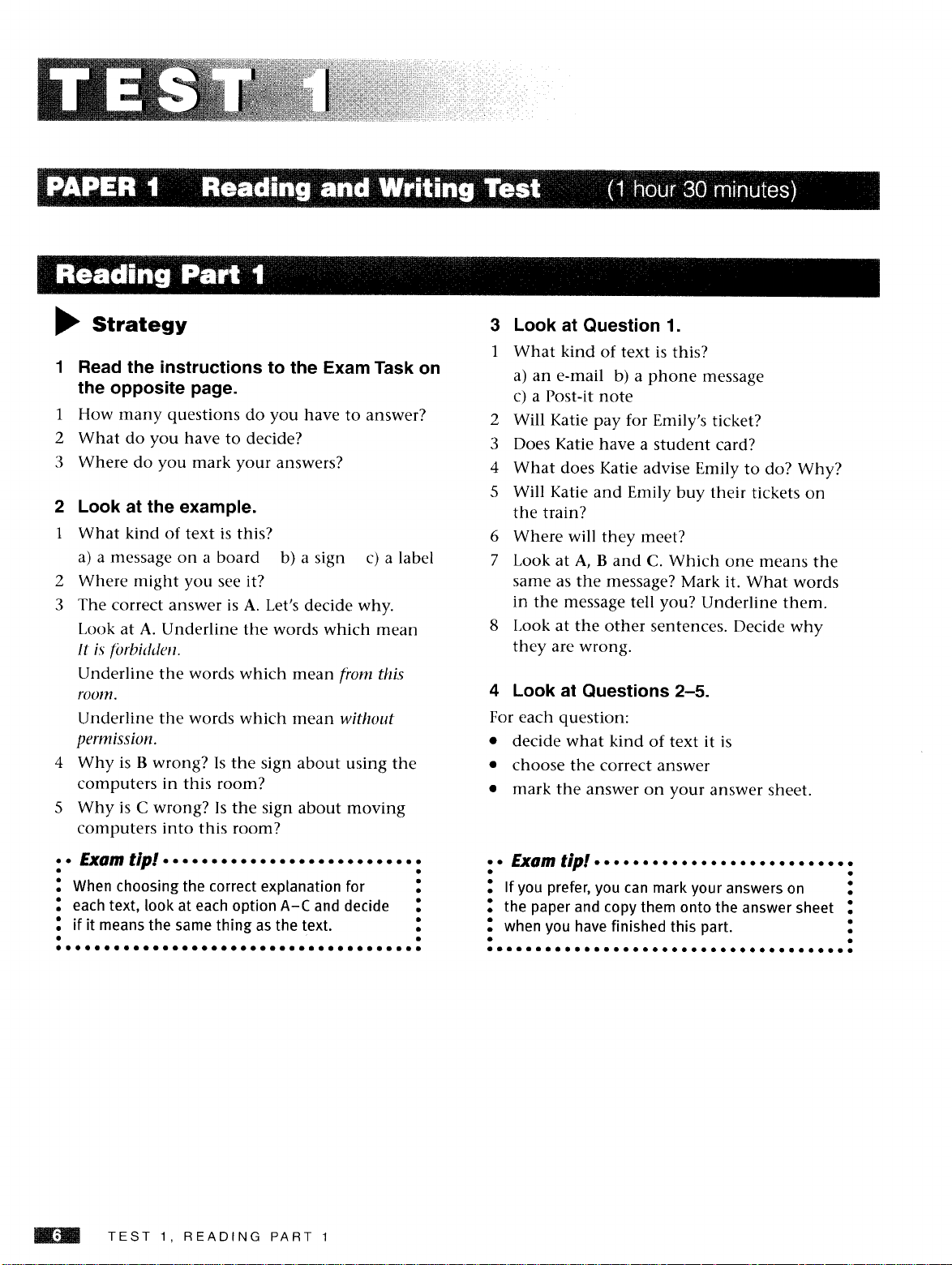
1 Read the instructions to the Exam Task
on
the opposite page.
1 How
many
questions
do
you
have
to
answer?
2
What
do
you
have
to
decide?
3
Where
do
you
mark
your
answers?
2 Look at the example.
1
What
kind
of
text
is
this?
a)
a message
on
a
board
b) a sign
c)
a label
2
Where
might
you
see it?
3
The
correct
answer
is
A.
Let's decide why.
Look
at
A.
Underline
the
words
which
mean
It
is
tbrbiddell.
Underline
the
words
which
mean
(rom this
room.
Underline
the
words
which
mean
without
permission.
4
Why
is B wrong?
Is
the
sign
about
using
the
computers
in
this
room?
5
Why
is
C
wrong?
Is
the
sign
about
moving
computers
into
this
room?
••
Exam
t/p1
••
••••
•••••••••••••
:
When
choosing
the
correct
explanation
for
:
:
each
text, look at
each
option
A-C
and
decide :
: if
it
means
the
same
thing
as
the
text. :
•••••••••••••••••••••••••••••••••••••
TEST
1,
READING
PART
1
3 Look at Question
1.
1
What
kind
of
text
is
this?
a)
an
e-mail b) a
phone
message
c)
a Post-it
note
2 Will Katie
pay
for Emily's ticket?
3 Does Katie
have
a
student
card?
4
What
does Katie advise Emily
to
do?
Why?
5 Will Katie
and
Emily
buy
their
tickets
on
the
train?
6
Where
will
they
meet?
7 Look
at
A,
Band
C.
Which
one
means
the
same
as
the
message? Mark it.
What
words
in
the
message tell you?
Underline
them.
8 Look
at
the
other
sentences. Decide
why
they
are wrong.
4 Look at Questions
2-5.
For
each
question:
decide
what
kind
of
text
it is
choose
the
correct
answer
mark
the
answer
on
your
answer
sheet.
••
Exam
tip!
•••••••••••••••••••••••••••
: If
you
prefer,
you
can
mark
your
answers
on
:
: the paper
and
copy them onto the answer sheet :
: when you have finished this part. :
•••••
••
•••••••••••••••••••••••••
••
Part
1
Questions
1-5
Look at the text
in
each question.
What does
it
say?
Mark the correct letter
A,
B or C on your answer sheet.
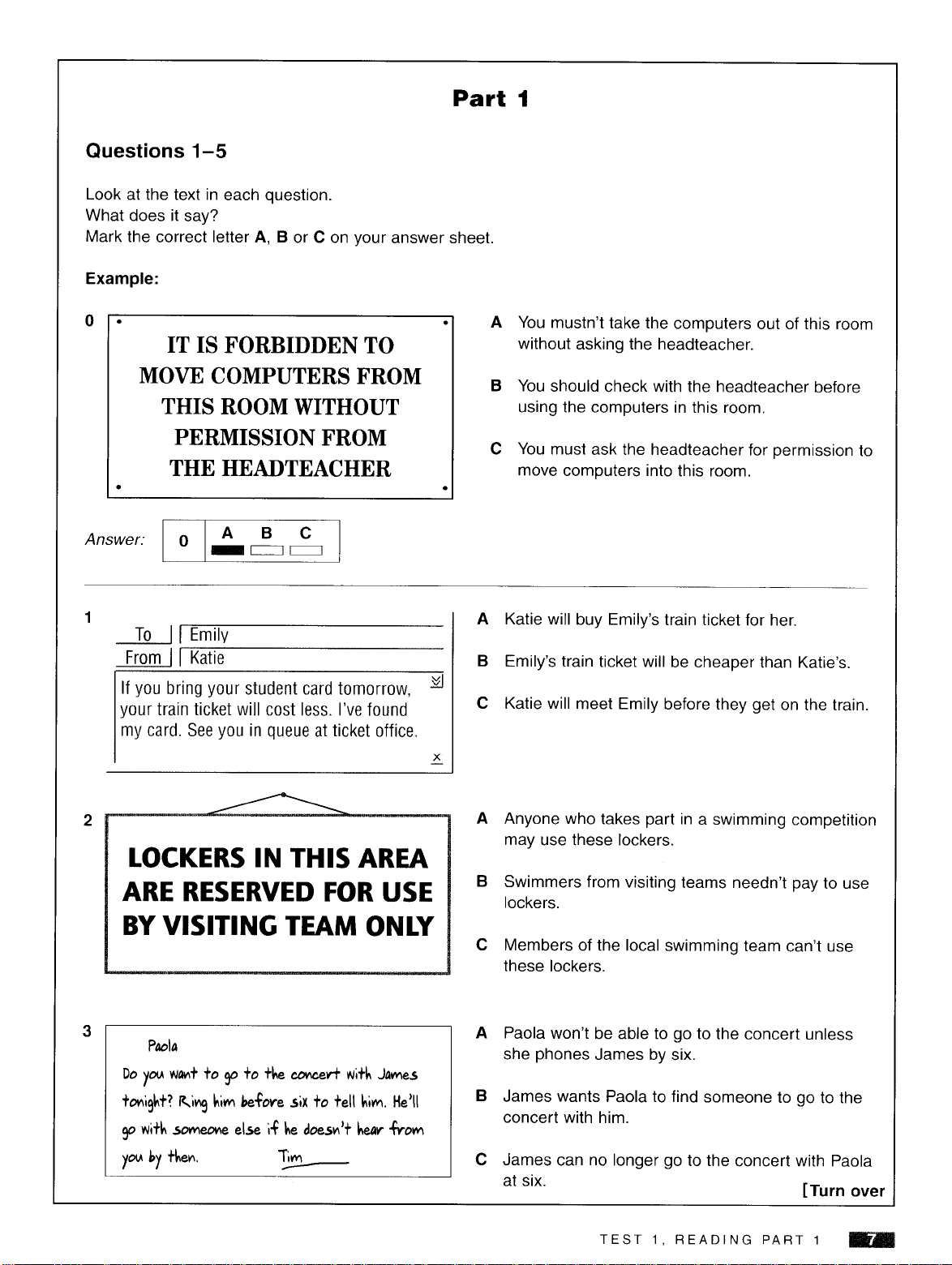
Example:
o
IT
IS
FORBIDDEN
TO
MOVE
COMPUTERS
FROM
THIS
ROOM
WITHOUT
PERMISSION
FROM
THE
HEADTEACHER
Answer: 0.:.
~
~
I
1
To
11
Emily
From
11
Katie
If
you
bring
your
student
card
tomorrow,
~
your
train
ticket
will
cost
less.
I've
found
my
card.
See
you
in
Queue
at
ticket
office.
2
LOCKERS
IN THIS
AREA
ARE
RESERVED
FOR
USE
BY
VISITING
TEAM
ONLY
3
PIlOIIl
Do
yov.
WllVIt
to
90
to
the
COV\C.en
with
JIlMes
tOVli9ht?
~iY19
hiM
kfoye
SIX
to
tell
hiM.
Helll
90
with
SOMeOVIe
else
if
he
doesYI't
hellY fV"OM
yov.
'py
theYl,
~
A
You
mustn't take the computers out of this room
without asking the headteacher.
B
You
should check with the headteacher before
using the computers
in
this room.
C
You
must ask the headteacher for permission to
move computers into this room.
A Katie will buy Emily's train ticket for her.
B Emily's train ticket will be cheaper than Katie's.
C Katie will meet Emily before they get on the train.
A Anyone who takes part
in
a swimming competition
may use these lockers.
B Swimmers from visiting teams needn't pay to use
lockers.
C Members of the local swimming team can't use
these lockers.
A Paola won't be able to go to the concert unless
she phones James by six.
B James wants Paola to find someone to go to the
concert with him.
C James can no longer go to the concert with Paola
at six.
[Turn over
TEST
1,
READING
PART
1
..
4
5
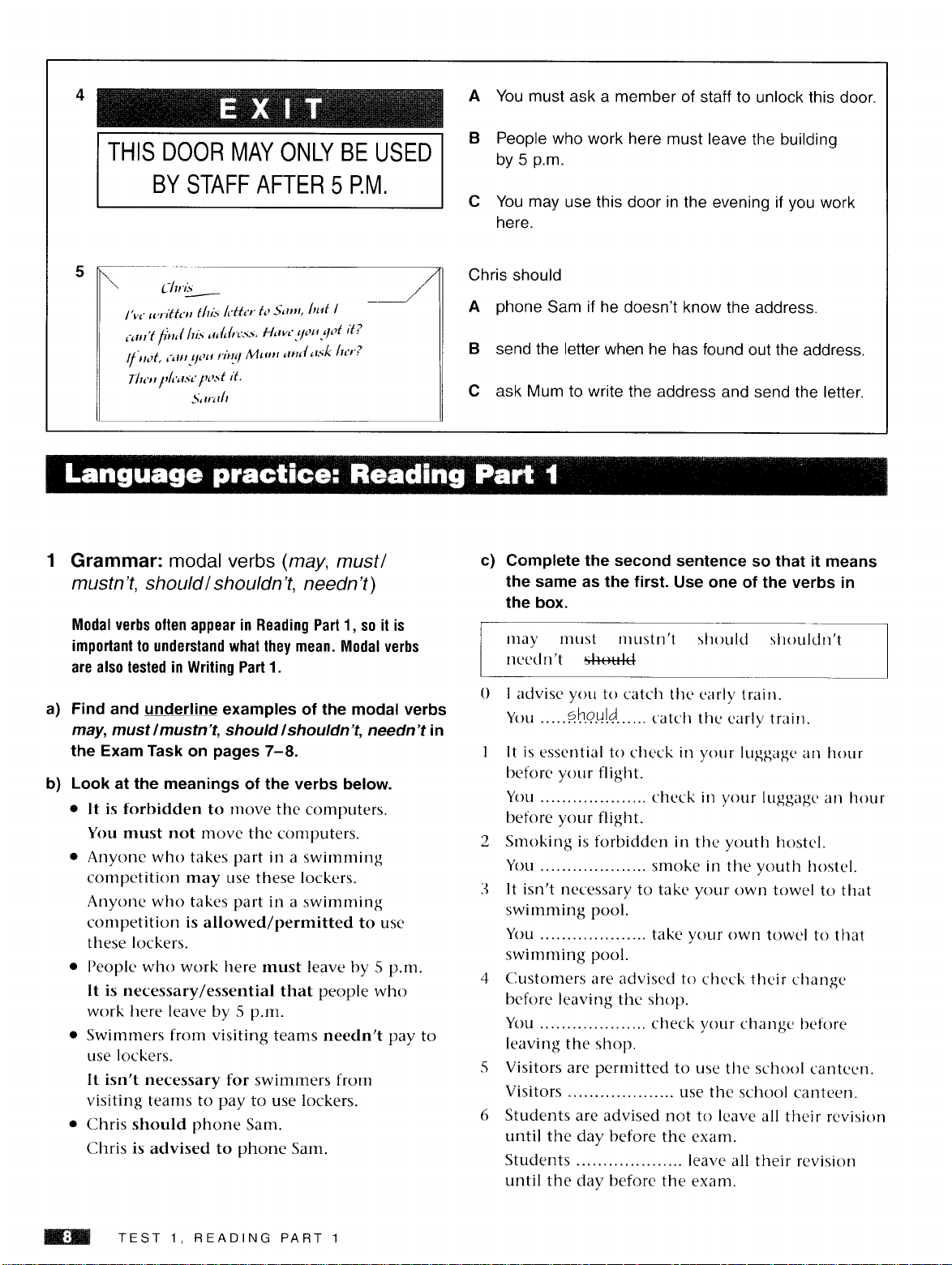
THIS
DOOR
MAY
ONLY
BE
USED
BY
STAFF
AFTER
5
PM.
Clm~'
-
I've writtclI
111I~'
Idler
I"
Sam, Iml I
,-all
'I
lilld
11I~'
'1IIdress. Havc!/ilt43ill it?
I/"ill, ,all.t/,'/t
rit~,!
M/tm
ami
ask
her?
ThclI
plcase
p,'sl
it.
SlImh
A
You
must ask a member of staff to unlock this door.
B People who work here must leave the building
by
5 p.m.
C
You
may use this door
in
the evening if you work
here.
Chris should
A phone Sam
if
he doesn't know the address.
B send the letter when he has found out the address.
C ask Mum to write the address and send the letter.
Language
practice:
Reacllng
Pari
..
1
Grammar:
modal verbs (may,
must!
mustn't, should/shouldn't, needn't)
c)
Complete
the
second
sentence
so
that
it
means
the
same
as
the
first.
Use
one
of
the
verbs
in
the
box.
Modal
verbs
often
appear
in
Reading
Part
1,
so
it
is
important
to
understand
what
they
mean.
Modal
verbs
are
also
tested
in
Writing
Part
1.
may
must
mustn't
should
needn't
should
a)
Find
and
underline
examples
of
the
modal
verbs
may,
must
I
mustn
't,
should
I
shouldn't,
needn't
in
the
Exam
Task
on
pages
7-8.
b)
Look
at
the
meanings
of
the
verbs
below.
It
is
forbidden
to
move
the
computers.
You
must
not
move
the
computers.
Anyone
who
takes
part
in a
swimming
competition
may
use
these
lockers.
Anyone
who
takes
part
in
a
swimming
competition
is
allowed/permitted
to
use
these
lockers.
People
who
work
here
must
leave
by
5
p.m.
It
is
necessary/essential
that
people
who
work here leave by 5 p.m.
Swimmers
from visiting
teams
needn't
pay
to
use lockers.
It
isn't
necessary
for
swimmers
from
visiting
teams
to
pay
to
use lockers.
Chris
should
phone
Sam.
Chris is
advised
to
phone
Sam.
TEST
1,
READING
PART
1
o I advise
you
to
catch
the
early
train.
You
.....
?b.Q.wl0
......
catch
the
early
train.
It
is
essential
to
check
in
your
luggage
an
hour
before
your
flight.
You
check
in
your
luggage
an
hour
before
your
flight.
2
Smoking
is
forbidden
in
the
youth
hostel.
You
smoke
in
the
youth
hostel.
:)
It
isn't
necessary
to
take
your
own
towel
to
that
swimming
pool.
you take
your
own
towel
to
that
swimming
pool.
4
Customers
are advised
to
check
their
change
before leaving
the
shop.
you
check
your
change
before
leaving
the
shop.
S Visitors are
permitted
to
use
the
school
canteen.
Visitors use
the
school
canteen.
6
Students
are advised
not
to
leave all
their
revision
until
the
day
before
the
exam.
Students
leave all
their
revision
until
the
day
before
the
exam.
2
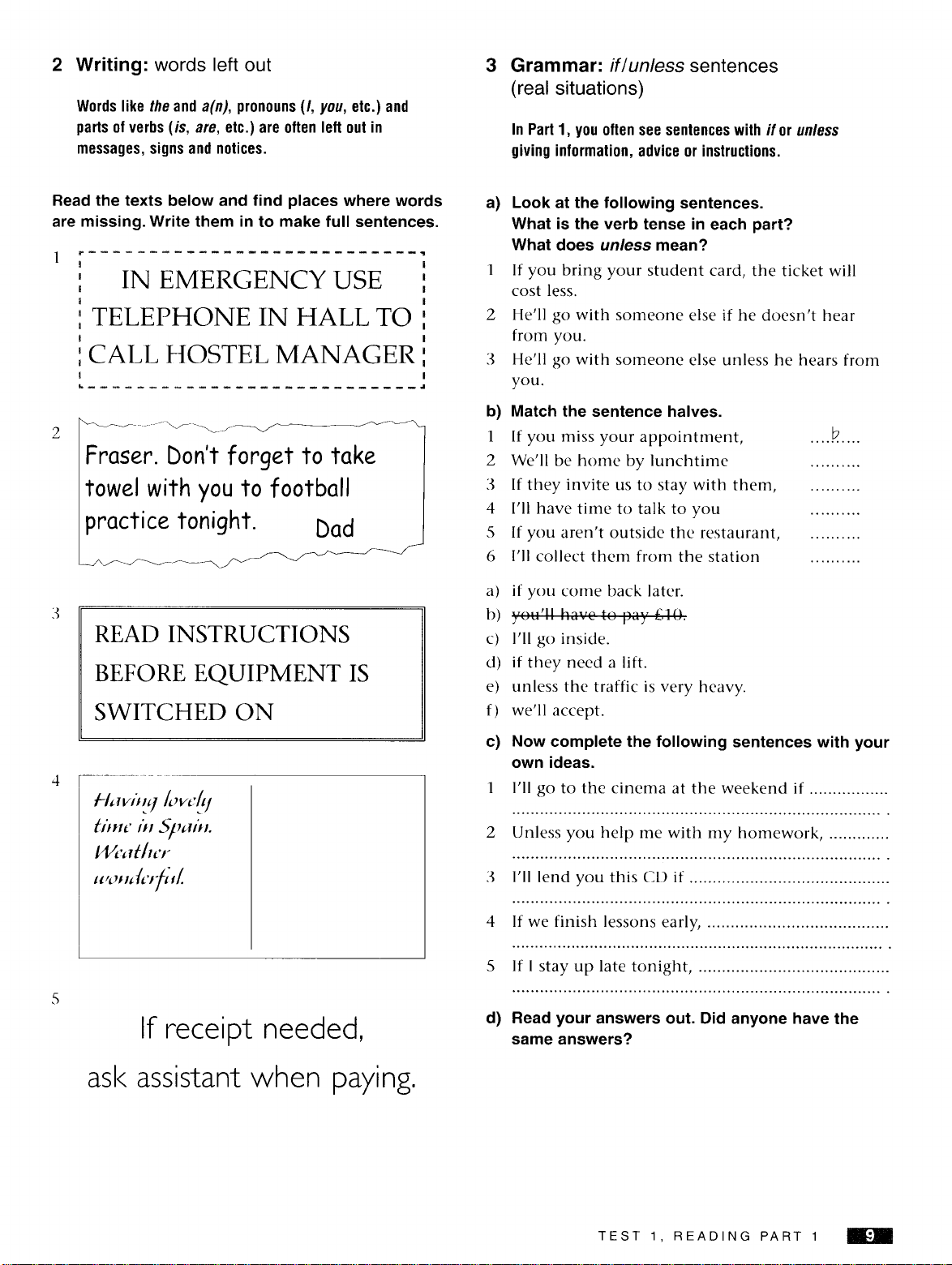
Writing:
words left out
Words
like
the
and
a(n),
pronouns
(I,
you,
etc.)
and
parts
of
verbs
(is,
are,
etc.)
are
often
left
out
in
messages,
signs
and
notices.
3 Grammar: if/unless sentences
(real situations)
In
Part
1,
you
often
see
sentences
with
if
or
unless
giving
information,
advice
or
instructions.
Read
the
texts
below
and
find
places
where
words
are
missing.
Write
them
in
to
make
full
sentences.
r---
-----------------------,
..
..
r.
....
a)
Look
at
the
following
sentences.
What
is
the
verb
tense
in each
part?
What
does
unless
mean?
1
If
you
bring
your
student
card,
the
ticket
will
cost
less.
2 He'll
go
with
someone
else if
he
doesn't
hear
from
you.
3 He'll
go
with
someone
else
unless
he
hears
from
you.
b) Match
the
sentence
halves.
1 If
you
miss
your
appointment,
2 We'll
be
home
by
lunchtime
3 If
they
invite
us
to
stay
with
them,
4 I'll
have
time
to
talk
to
you
5 If
you
aren't
outside
the
restaurant,
6 I'll
collect
them
from
the
station
IN EMERGENCY USE
Fraser.
Don't
forget
to
take
towel
with
you
to
football
practice tonight.
Dad
I
~--~------------------------~
I
I
I
I
TELEPHONE
IN
HALL TO :
I I
:CALL HOSTEL
MANAGER:
2
READ
INSTRUCTIONS
BEFORE EQUIPMENT
IS
SWITCHED
ON
4
Havillq lovellf
, ,
time
ill Spa;lI.
Weather
wO/ldo!;'/'
a) if
you
come
back
later.
b)
you'll
have
to
pay
£,10.
c)
I'll
go
inside.
d) if
they
need
a lift.
e)
unless
the
traffic
is
very
heavy.
f)
we'll
accept.
c)
Now
complete
the
following
sentences
with
your
own
ideas.
1 I'll
go
to
the
cinema
at
the
weekend
if .
2 Unless
you
help
me
with
my
homework,
.
3 I'll
lend
you
this
CD
if
..
4
If
we
finish
lessons early,
..
5 If I
stay
up
late
tonight,
..
5
If
receipt needed,
ask
assistant when paying.
d) Read
your
answers
out. Did anyone have
the
same
answers?
TEST
1,
READING
PART
1
..
" "
•••
illlIl
R
•••
Part
2
~
Strategy
1 Read
the
instructions
to
the
Exam Task
opposite.
1 How
many
questions
are there?
2
What
do
all
the
people
want?
:3
What
are
the
descriptions
about?
4 How
many
descriptions
are
there?
5
What
do
you
have
to
decide?
6
Where
do
you
mark
your
answers?
Questions
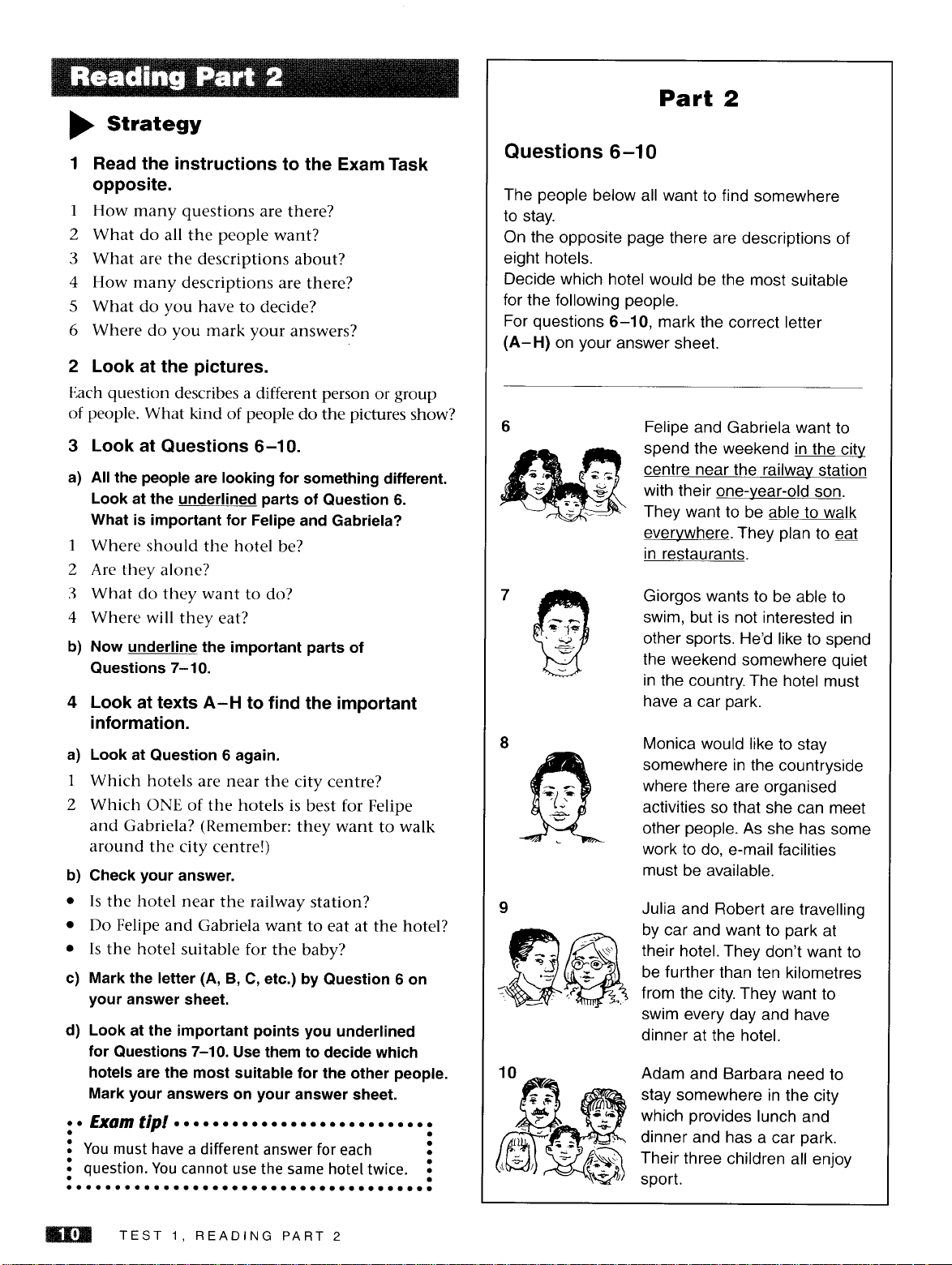
6-10
The people below all want to find somewhere
to stay.
On the opposite page there are descriptions of
eight hotels.
Decide which hotel would be the most suitable
for the following people.
For questions
6-10,
mark the correct letter
(A-H)
on your answer sheet.
Giorgos wants to be able to
swim, but is not interested
in
other sports. He'd like to spend
the weekend somewhere quiet
in
the country. The hotel must
have a car park.
Felipe and Gabriela want to
spend the weekend in the city
centre near the railway station
with their one-year-old son.
They want to be able to walk
everywhere. They plan to eat
in
restaurants.
Julia and Robert are travelling
by car and want to park at
their hotel. They don't want to
be further than ten kilometres
from the city. They want to
swim every day and have
dinner at the hotel.
Monica would like to stay
somewhere
in
the countryside
where there are organised
activities so that she can meet
other people. As she has some
work to do, e-mail facilities
must be available.
Adam and Barbara need to
stay somewhere
in
the city
which provides lunch and
dinner and has a car park.
Their three children all enjoy
sport.
6
7
9
8
2
Look
at
the
pictures.
Each question describes a different person
or
group
of people.
What
kind of people
do
the
pictures show?
3
Look
at
Questions
6-10.
4
Look
at texts
A-H
to
find
the
important
information.
a) All the people are looking
for
something different.
Look
at the underlined parts
of
Question
6.
What is
important
for
Felipe and Gabriela?
1
Where
should
the
hotel be?
2
Are
they
alone?
:3
What
do
they
want
to
do?
4
Where
will
they
eat?
b) Now underline the
important
parts
of
Questions
7-10.
a)
Look
at Question 6 again.
1
Which
hotels
are
near
the
city centre?
2
Which
ONE
of
the
hotels
is
best
for Felipe
and
Gabriela? (Remember:
they
want
to
walk
around
the
city centre!)
b) Check
your
answer.
Is
the
hotel
near
the
railway
station?
Do Felipe
and
Gabriela
want
to
eat
at
the
hotel?
Is
the
hotel
suitable for
the
baby?
c) Mark the letter (A, B,
C,
etc.) by Question 6
on
your
answer sheet.
d)
Look
at the
important
points
you underlined
for
Questions 7-10. Use them
to
decide which
hotels are the
most
suitable
for
the
other
people.
Mark
your
answers
on
your
answer sheet.
••
Exam
tipl
•••••••••••••••••••••••••••
:
You
must have a different answer for each :
: question.
You
cannot
use
the same hotel twice. :
•••••••••••••••••••••••••••••••••••••
IKI!II
TEST
1,
READING
PART
2
5 questions
Hotels
8 hotels
5
find somewhere to stay
Answer sheet
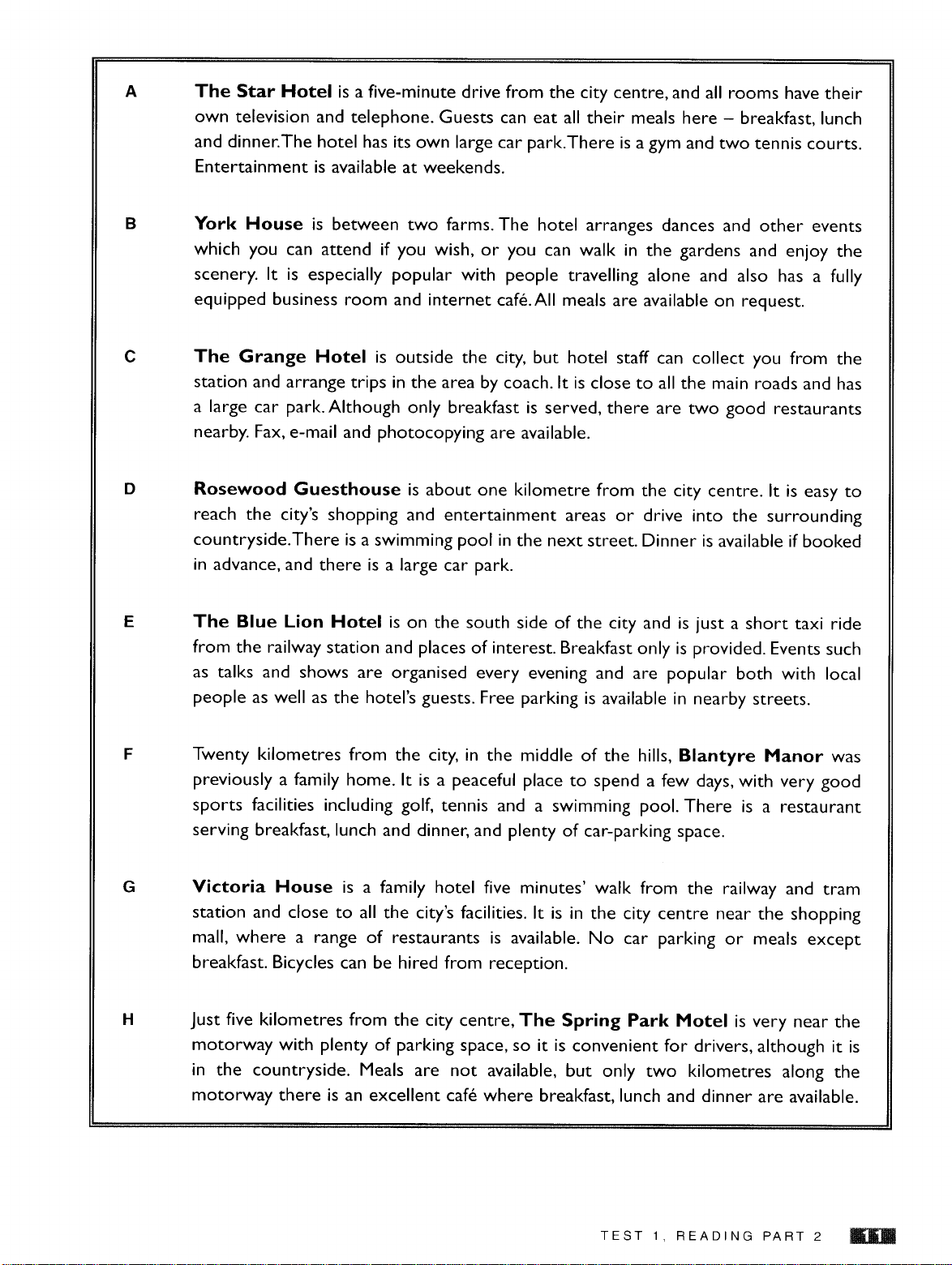
A
The
Star
Hotel
is
a five-minute drive from
the
city
centre,
and
all
rooms
have
their
own
television and
telephone.
Guests
can
eat
all
their
meals
here
- breakfast, lunch
and dinner.The hotel has its
own
large
car
park.There
is
a gym and
two
tennis
courts.
Entertainment
is
available
at
weekends.
B
York
House
is
between
two
farms.
The
hotel
arranges
dances and
other
events
which you can
attend
if
you wish,
or
you can walk
in
the
gardens
and enjoy
the
scenery.
It
is
especially
popular
with
people
travelling
alone
and also has a fully
equipped
business
room
and
internet
cafe.
All
meals
are
available
on
request.
C
The
Grange
Hotel
is
outside
the
city,
but
hotel
staff can collect you from
the
station
and
arrange
trips
in
the
area
by coach.
It
is
close
to
all
the
main
roads
and has
a large
car
park. Although only breakfast
is
served,
there
are
two
good
restaurants
nearby. Fax, e-mail and photocopying
are
available.
D
Rosewood
Guesthouse
is
about
one
kilometre
from
the
city
centre.
It
is
easy
to
reach
the
city's shopping and
entertainment
areas
or
drive
into
the
surrounding
countryside.
There
is
a swimming pool
in
the
next
street.
Dinner
is
available
if
booked
in
advance, and
there
is
a large
car
park.
E
The
Blue
Lion
Hotel
is
on
the
south
side
of
the
city and
is
just a
short
taxi ride
from
the
railway
station
and places
of
interest. Breakfast only
is
provided. Events such
as talks and
shows
are
organised
every
evening and
are
popular
both
with local
people
as well as
the
hotel's guests. Free parking
is
available
in
nearby
streets.
F Twenty
kilometres
from
the
city,
in
the
middle
of
the
hills,
Blantyre
Manor
was
previously a family
home.
It
is
a peaceful place
to
spend
a few days, with very
good
sports
facilities including golf, tennis and a swimming pool.
There
is
a
restaurant
serving breakfast, lunch and dinner, and plenty
of
car-parking space.
G
Victoria
House
is
a family hotel
five
minutes'
walk from
the
railway and
tram
station
and close
to
all
the
city's facilities.
It
is
in
the
city
centre
near
the
shopping
mall,
where
a range
of
restaurants
is
available.
No
car
parking
or
meals
except
breakfast. Bicycles can
be
hired from
reception.
H Just
five
kilometres
from
the
city
centre,
The
Spring
Park
Motel
is
very
near
the
motorway
with plenty
of
parking space,
so
it
is
convenient
for
drivers, although it
is
in
the
countryside.
Meals
are
not
available,
but
only
two
kilometres
along
the
motorway
there
is
an excellent cafe
where
breakfast, lunch and
dinner
are
available.
TEST
1,
READING
PART
2
l.anguage
pracllce:
Reading
Rarl
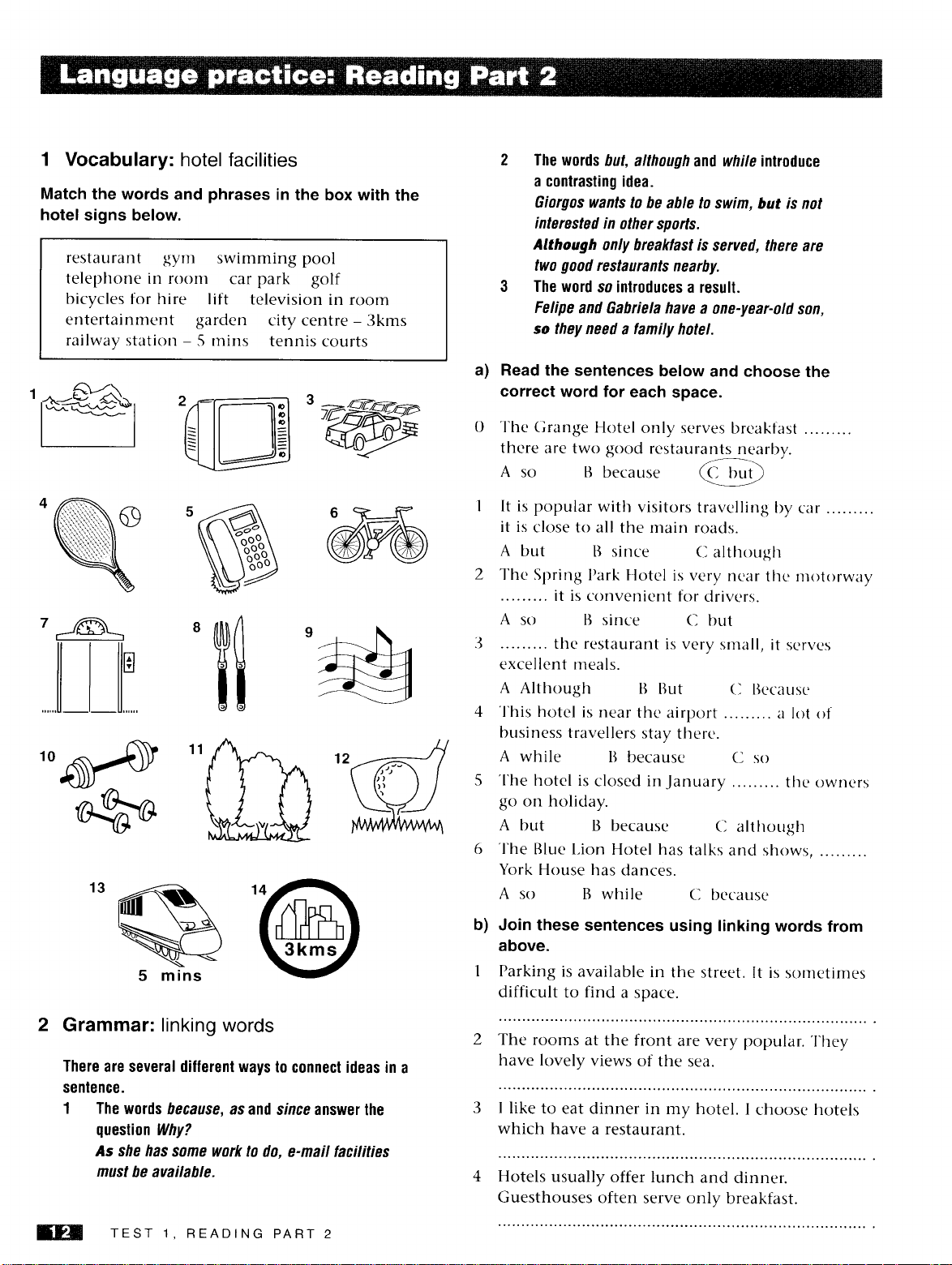
1 Vocabulary: hotel facilities
Match
the
words
and
phrases
in
the
box
with
the
hotel
signs
below.
restaurant
gym
swimming
pool
telephone
in
room
car
park
golf
bicycles for
hire
lift television
in
room
entertainment
garden
city
centre
-
3kms
railway
station
- 5
mins
tennis
courts
2
The
words
but,
although
and
while
introduce
a
contrasting
idea.
Giorgos
wants
to
be
able
to
swim,
but
is
not
interested
in
other
sports.
Although
only
breakfast
is
served,
there
are
two
good
restaurants
nearby.
3
The
word
so
introduces
a
result.
Felipe
and
Gabriela
have
a
one-year-old
son,
so
they
need
a family
hotel.
b)
Join
these
sentences
using
linking
words
from
above.
Parking
is
available
in
the
street. It
is
sometimes
difficult
to
find
a space.
a) Read
the
sentences
below
and
choose
the
correct
word
for
each space.
o
The
Grange
Hotel
only
serves breakfast .
there
are
two
good
restaurants
nearby.
A so
H because
~
It
is
popular
with
visitors
travelling
by car
.........
it
is
close
to
all
the
main
roads.
A
but
B since C
although
2
The
Spring Park Hotel
is
very
near
the
motorway
.........
it
is
convenient
for drivers.
A so
H since C
but
3
.........
the
restaurant
is
very small, it serves
excellent
meals.
A
Although
B But C Because
4 This
hotel
is
near
the
airport
.........
a lot
of
business travellers
stay
there.
A
while
B because C so
5
The
hotel
is
closed in
January
the
owners
go
on
holiday.
A
but
B because C
although
6
The
Blue Lion Hotel
has
talks
and
shows,
.........
York House has
dances.
A so B
while
C because
5
13~
5
mins
7~
J
__
~~.
10~
~
2 Grammar: linking words
There
are
several
different
ways
to
connect
ideas
in
a
sentence.
1
The
words
because,
as
and
since
answer
the
question
Why?
As
she
has
some
work
to
do,
e-mail facilities
must
be
available.
2
The
rooms
at
the
front
are
very
popular.
They
have
lovely views
of
the
sea.
3 I like
to
eat
dinner
in
my
hotel.
I
choose
hotels
which
have
a
restaurant.
4 Hotels
usually
offer
lunch
and
dinner.
Guesthouses
often
serve
only
breakfast.
.u
TEST
1,
READING
PART
2
Television
in room
Teleph o n e
in room
Tennis court
Văn bn
Bicycles
for hire
Gym
Entertainment
Liff
Lift
Restaurant
Golf
Although
Since
So
But
3 Vocabulary: prepositions
o My
house
is
.y.l.Q.~.!{.
to
the
shops,
so it's very
conven
ient.
b) Rewrite
the
sentences
in
your
notebook
so
they
are
true
for
you.
4
Grammar:
present perfect and past simple
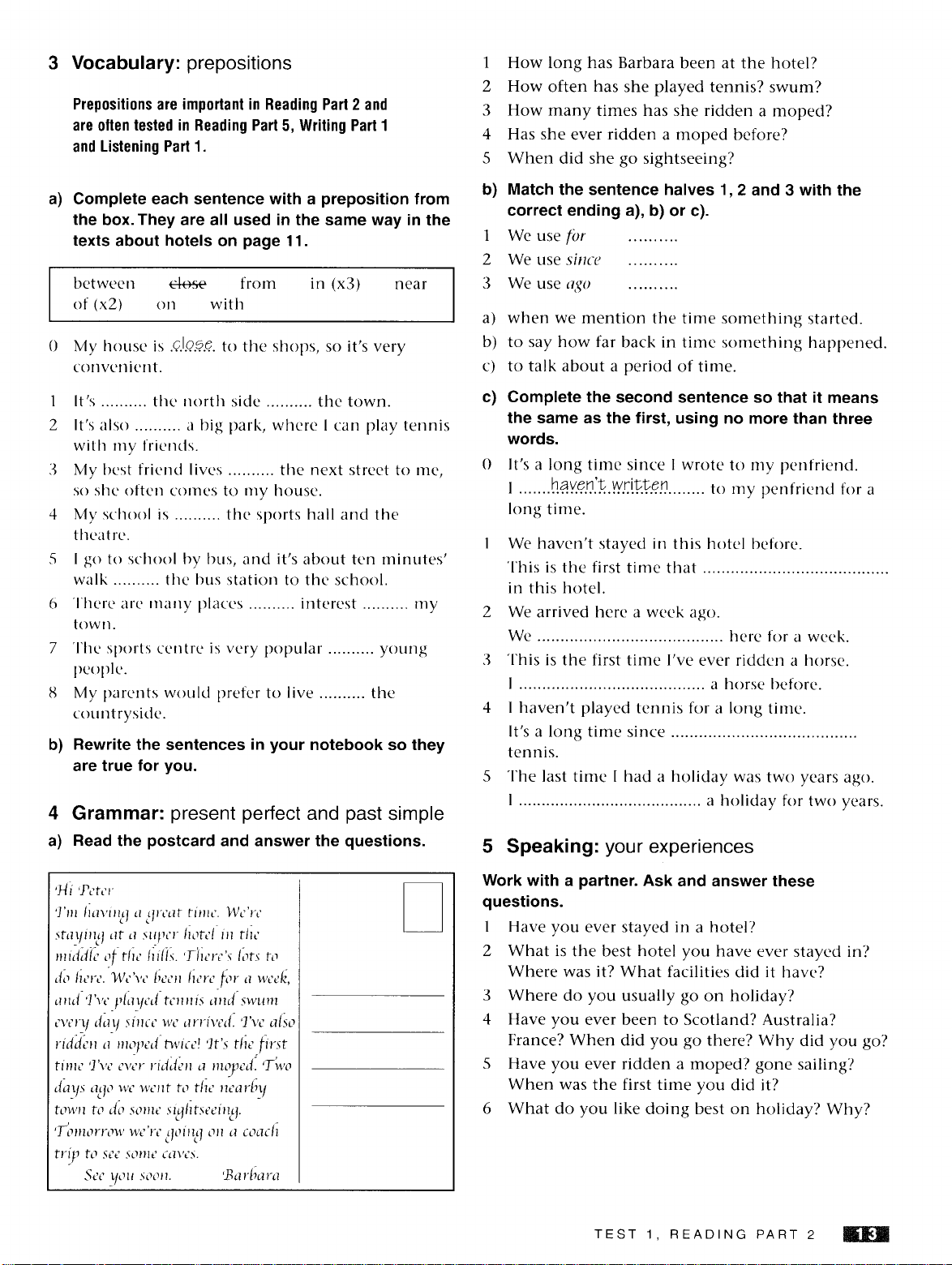
a)
Read
the
postcard
and
answer
the
questions.
We
haven't
stayed
in
this
hotel
before.
This
is
the
first
time
that
.
in
this
hotel.
2 We
arrived
here
a
week
ago.
We
here
for a week.
3
This
is
the
first
time
I've
ever
ridden
a
horse.
I a
horse
before.
4 I
haven't
played
tennis
for a
long
time.
It's a
long
time
since
..
tennis.
5
The
last
time
[
had
a
holiday
was
two
years ago.
I a
holiday
for
two
years.
a)
when
we
mention
the
time
something
started.
b)
to
say
how
far
back
in
time
something
happened.
c)
to
talk
about
a
period
of
time.
c)
Complete
the
second
sentence
so
that
it
means
the
same
as
the
first,
using
no
more
than
three
words.
o It's a
long
time
since
I
wrote
to
my
pen
friend.
I
haven't
written
t '
t'·
> d
t'
.
..
0
my
pen
f1cn
or
a
long
time.
5
Speaking:
your experiences
1
How
long
has
Barbara
been
at
the
hotel?
2
How
often
has
she
played
tennis?
swum?
3
How
many
times
has
she
ridden
a
moped?
4 Has
she
ever
ridden
a
moped
before?
5
When
did
she
go
sightseeing?
b) Match
the
sentence
halves
1,2
and 3
with
the
correct
ending
a), b)
or
c).
1 We
use
for
2 We use since
3 We use
ago
near
in
(x3)
Effis€'
from
on
with
between
of
(x2)
Prepositions
are
important
in
Reading
Part
2
and
are
often
tested
in
Reading
Part
5,
Writing
Part
1
and
listening
Part
1.
a)
Complete each
sentence
with
a
preposition
from
the
box. They are all used
in
the
same
way
in
the
texts
about
hotels
on
page 11.
1 It's
the
north
side
the
town.
2 It's also a big park,
where
I
can
play
tennis
with
my
friends.
3 My best
friend
lives
the
next
street
to
me,
so
she
often
comes
to
my
house.
4 My
school
is
the
sports
hall
and
the
theatre.
S I go
to
school
by bus,
and
it's
about
ten
minutes'
walk
the
bus
station
to
the
school.
6
There
are
many
places
interest
my
town.
7
The
sports
Cl'ntre
is
very
popular
young
peopiL'.
~
My
parents
would
prefer
to
live
the
countryside.
'Hi
'Fet'T
Tm
11(J\'"1fJ
(/
fP",'(/t tlml',
We're
sta.\}IJ1fJ
llt
a
Sly"T
Ill1tt'l1l1
till'
m
iddl~'
llf tile
II
ilk
'Tilae's
t;,ts
tl'
d;,
liere.
Wt"W
/i
eeJ1
IIac6
1
r a
week,
lHU{
']'w
yt;I\/ed" tell
J1
is
(/Ju{
SWWl1
eVtT'l:!
d;H/
siJ1ce
we
arriwl
']'w
also
ridd~'J1
(1
moped"
twice' 'It's tile
fint
time
']'w
eV~T
l'idd~J1
a
mopel'Two
Jays
af]"
we
weJ1t
tl' tlie llear{1y
tOWJ1
tt'
d"o
.\OJJle
.\lfJlitseeiJ1fJ.
'ToJJlormw
we're
f]oinfl,ll1
()
coacli
tr~p
to
.lee
.\Ome
caws.
St't'
\}l111
.\00/1.
'Ba
rl1a
ra
D
Work
with
a partner.
Ask
and
answer
these
questions.
1 Have
you
ever
stayed
in
a
hotel?
2
What
is
the
best
hotel
you
have
ever
stayed
in"!
Where
was
it?
What
facilities
did
it
have?
3
Where
do
you
usually
go
on
holiday?
4
Have
you
ever
been
to
Scotland?
Australia?
France?
When
did
you
go
there?
Why
did
you
go?
5
Have
you
ever
ridden
a
moped?
gone
sailing?
When
was
the
first
time
you
did
it?
6
What
do
you
like
doing
best
on
holiday"!
Why?
TEST
1,
READING
PART
2
Near
in
between
from
in
With
in
of
on
of
1 week
Every day
Twice
No she hasn’t
Two days ago
b
a
c
We’ve ever stayed
in this hotel
Have arrived
‘ve never ridden
I played
Have had
~
Strategy
1 Read
the
instructions
to
the
Exam Task
opposite.
1 How
many
sentences
are
there?
2
What
are
the
sentences
about?
3
What
do
you
have
to
read?
4
What
do
you
have
to
decide?
5
When
do
you
mark
A
on
your
answer
sheet?
6
When
do
you
mark
B
on
your
answer
sheet?
2 Read Sentences
11-
20
to
get
a
good
idea
what
the
text
is
about.
Match the sentences
to
the
following
topics.
a)
places
to
stay
17
b)
how
the
day
is
organised
c)
cancellations
d)
what
happens
if it rains
e)
what
you
need
to
take
f)
when
to
pay
g)
when
they
are
open
h) staff qualifications
i)
method
of
payment
j)
who
the
courses are suitable for
3 Read
the
text
to
find
the
information
you
need.
For each sentence (11-20),
mark
the part
of
the
text where you
think
the answer is.The
first
two
are
done
for
you.
4
Look
at
the
sentences again.
Compare
them
with
your
underlined
text.
Decide
whether
the
sentence
is
correct
or
incorrect.
Mark
your
answer
on
your
answer
sheet.
••
Exam
tip!
•••••
••••••••••
:
You
don't need to understand every word in the :
: text to answer the questions. Some parts
of
the :
: text aren't tested,
so
don't
worry about them. :
•••••
••
••••
••
••
••••••••
DB
TEST
1,
READING
PART
3
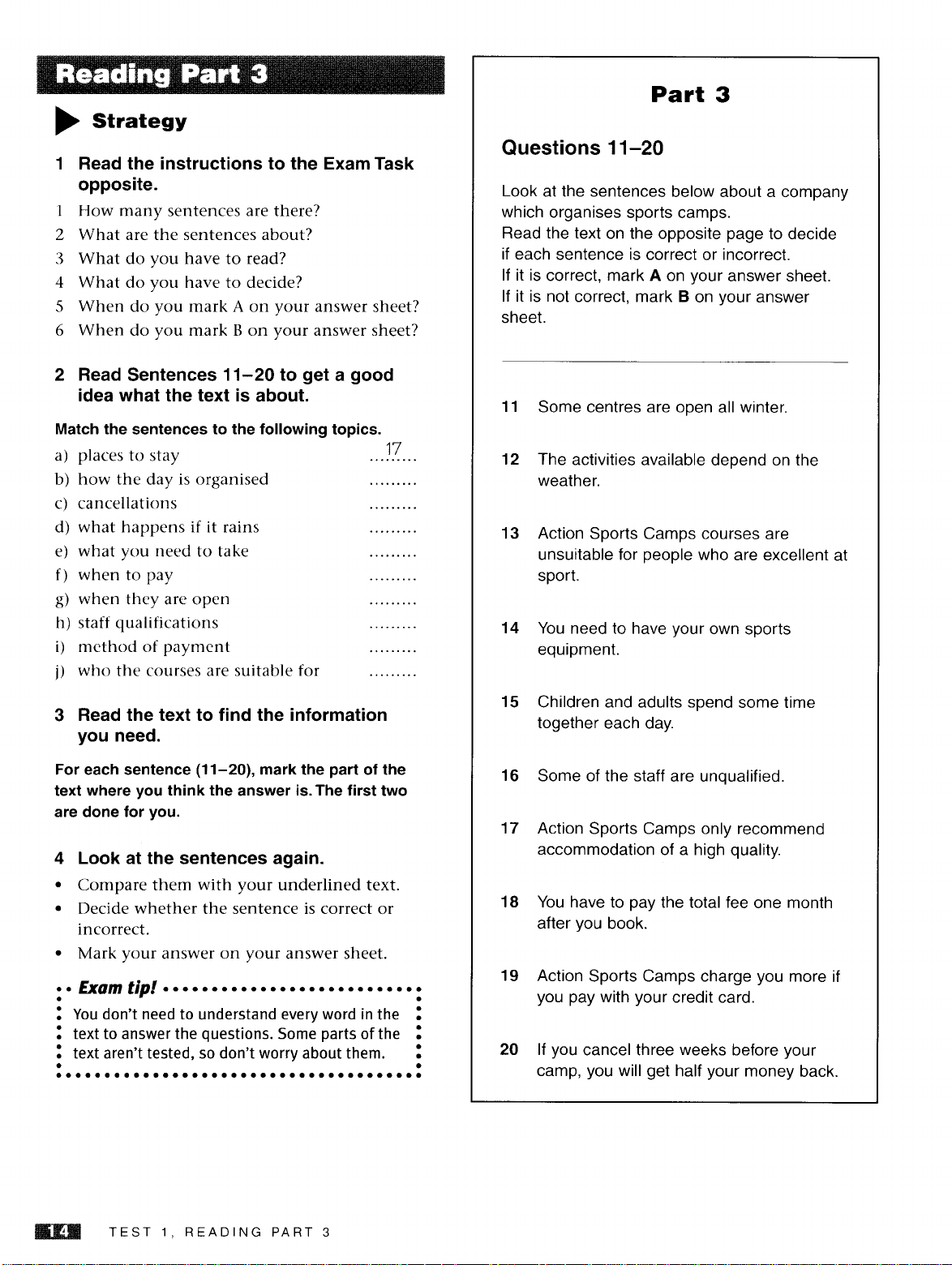
Part
3
Questions
11-20
Look at the sentences below about a company
which organises sports camps.
Read the text
on
the opposite page to decide
if each sentence
is
correct or incorrect.
If it
is
correct, mark A
on
your answer sheet.
If it
is
not correct, mark 8
on
your answer
sheet.
11
Some centres are open all winter.
12 The activities available depend
on
the
weather.
13 Action Sports Camps courses are
unsuitable for people who are excellent at
sport.
14
You
need to have your own sports
equipment.
15 Children and adults spend some time
together each
day.
16 Some of the staff are unqualified.
17
Action Sports Camps only recommend
accommodation of a high quality.
18
You
have to pay the total fee one month
after you book.
19
Action Sports Camps charge you more if
you pay with your credit card.
20 If you cancel three weeks before your
camp, you will get half your money back.
F
F
F
F
F
F
F
T
T
F
20
12
14
16
19
13
15
18
11
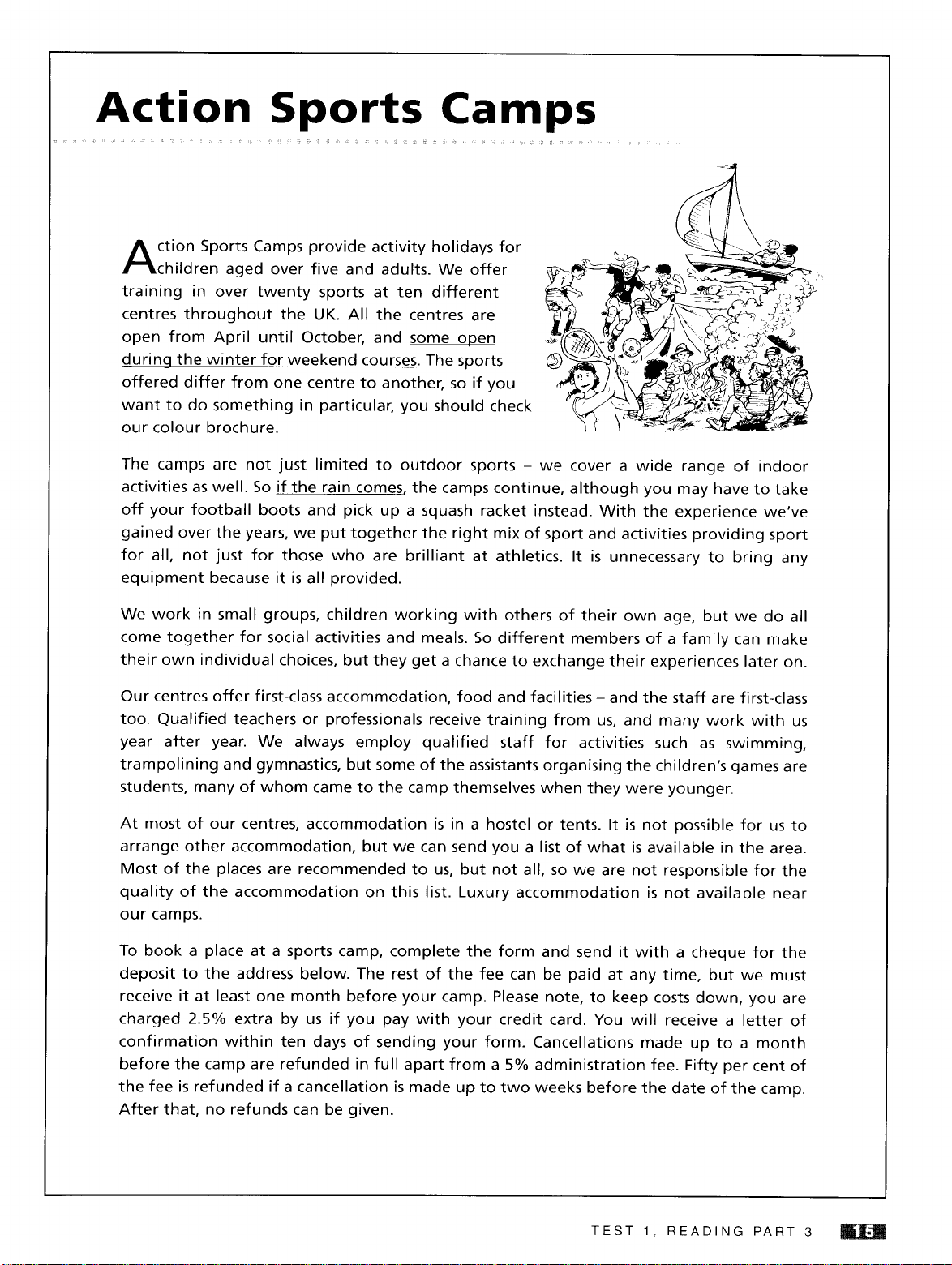
Action
Sports
Camps
A
ction
Sports Camps
provide
activity
holidays
for
children
aged
over
five
and
adults.
We
offer
training
in
over
twenty
sports
at
ten
different
centres
throughout
the
UK.
All
the
centres are
open
from
April
until
October,
and
some
open
during
the
winter
for
weekend
courses. The sports
offered
differ
from
one
centre
to
another,
so
if
you
want
to
do
something
in particular,
you
should
check
our
colour
brochure.
The camps are
not
just
limited
to
outdoor
sports -
we
cover a
wide
range
of
indoor
activities
as
well.
So
if
the
rain comes,
the
camps
continue,
although
you
may
have
to
take
off
your
football
boots
and
pick
up
a squash racket instead.
With
the
experience
we've
gained
over
the
years,
we
put
together
the
right
mix
of
sport
and
activities
providing
sport
for
all,
not
just
for
those
who
are
brilliant
at
athletics.
It
is
unnecessary
to
bring
any
equipment
because
it
is
all
provided.
We
work
in small groups,
children
working
with
others
of
their
own
age,
but
we
do
all
come
together
for
social activities
and
meals.
So
different
members
of
a
family
can
make
their
own
individual
choices,
but
they
get
a chance
to
exchange
their
experiences
later
on.
Our
centres
offer
first-class
accommodation,
food
and facilities - and
the
staff
are first-class
too.
Qualified
teachers
or
professionals receive
training
from
us,
and
many
work
with
us
year
after
year.
We
always
employ
qualified
staff
for
activities such
as
swimming,
trampolining
and
gymnastics,
but
some
of
the
assistants
organising
the
children's games are
students,
many
of
whom
came
to
the
camp themselves
when
they
were
younger.
At
most
of
our
centres,
accommodation
is
in a hostel
or
tents.
It
is
not
possible
for
us
to
arrange
other
accommodation,
but
we
can send
you
a list
of
what
is
available in
the
area.
Most
of
the
places are
recommended
to
us,
but
not
all,
so
we
are
not
responsible
for
the
quality
of
the
accommodation
on
this
list.
Luxury
accommodation
is
not
available
near
our
camps.
To
book
a place
at
a sports camp,
complete
the
form
and
send
it
with
a cheque
for
the
deposit
to
the
address
below.
The rest
of
the
fee
can be
paid
at
any
time,
but
we
must
receive
it
at
least
one
month
before
your
camp. Please
note,
to
keep
costs
down,
you
are
charged
2.5%
extra
by
us
if
you
pay
with
your
credit
card. You
will
receive a
letter
of
confirmation
within
ten
days
of
sending
your
form.
Cancellations
made
up
to
a
month
before
the
camp are
refunded
in
full
apart
from
a 5%
administration
fee.
Fifty
per
cent
of
the
fee
is
refunded
if
a
cancellation
is
made
up
to
two
weeks
before
the
date
of
the
camp.
After
that,
no
refunds
can be given.
TEST
1,
READING
PART
3
Language
praclice:
lIealling
I'ail
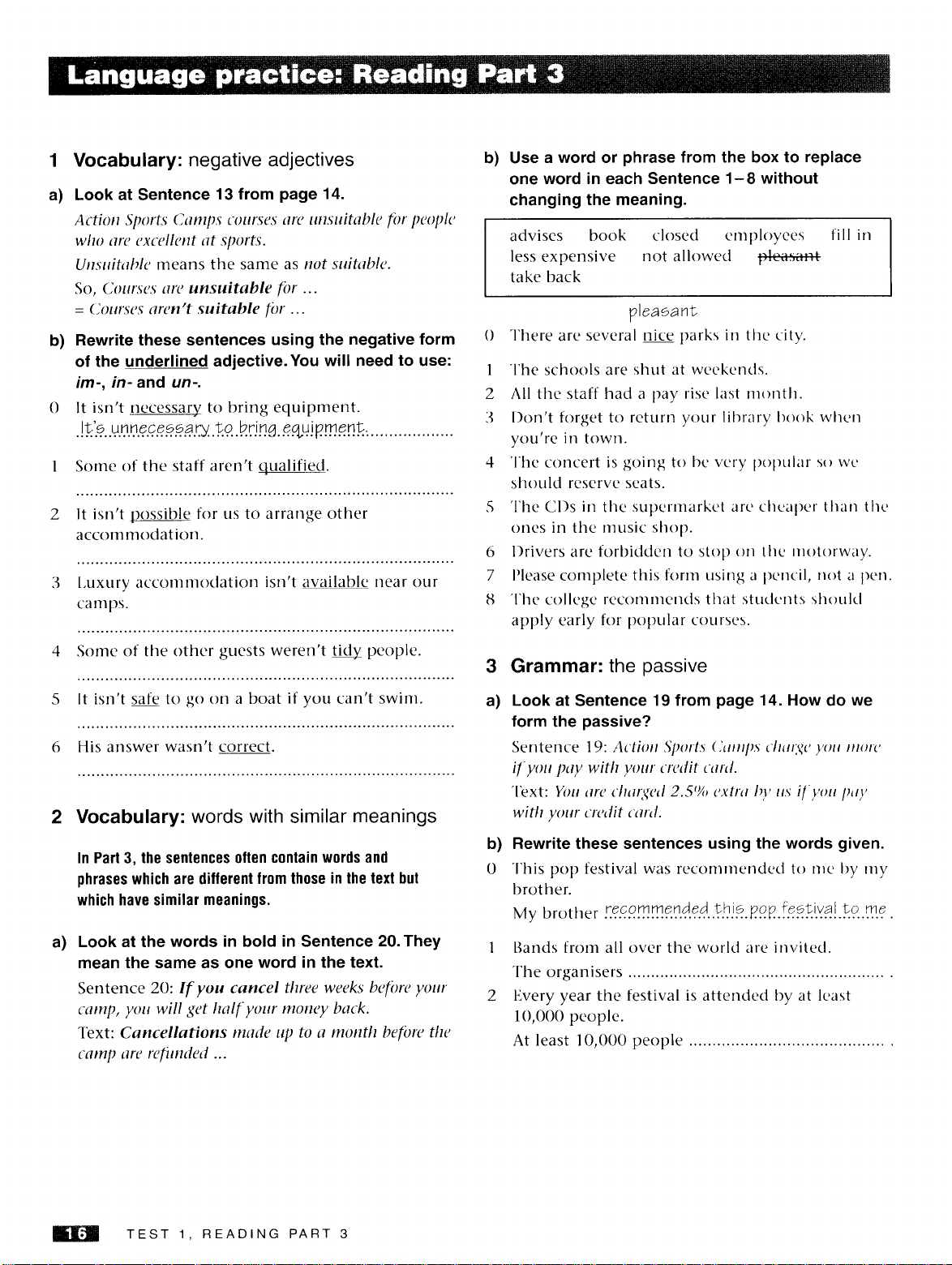
C
pleasant
o
There
are several nice parks in
the
city.
b) Use a
word
or
phrase
from
the
box
to
replace
one
word
in each Sentence
1-
8
without
changing
the
meaning.
1
The
schools
are
shut
at
weekends.
2
All
the
staff
had
a
pay
rise last 1110nth.
:3
Don't
forget
to
return
your
library
book
when
you're
in
town.
4
The
concert
is
going
to
be very popUlar so we
should
reserve seats.
5
The
eDs
in
the
supermarket
are
cheaper
than
the
ones
in
the
music
shop.
6 Drivers are
forbidden
to
stop
on
the
motorway.
7 Please
complete
this
form using a pencil,
not
a pl'n.
H
The
college
recommends
that
students
should
apply
early for
popular
courses.
1 Vocabulary: negative adjectives
a)
Look
at
Sentence 13
from
page 14.
Action Sports Camps courses are unsuitahle (or people
who are excellent
at
sports.
Unsuitahle
means
the
same
as
not
suitahle.
So, Courses are
unsuitable
t()r
.
=Courses
aren't
suitable
tor .
b) Rewrite
these
sentences
using
the
negative
form
of
the
underlined
adjective.
You
will
need
to
use:
im-, in- and un-.
o It
isn't
necessary
to
bring
equipment.
.
!t:'.~
..
1,l.1).1).~.c:.~~~0ry..t:Q..
r.r!
ng.
~q,
~
j
p.m
~mt:·
.
Some
of
the
staff
aren't
qualified.
2
It
isn't
possible for us
to
arrange
other
accommodation.
:3
Luxury
accommodation
isn't
available
near
our
camps.
advises
book
less
expensive
take
back
closed
employees
fill in
not
allowed
pleasant
4
Some
of
the
other
guests
weren't
tidy
people.
5 It
isn't
safe
to
go
on
a
boat
if
you
can't
swim.
6 His
answer
wasn't
correct.
2 Vocabulary: words with similar meanings
In
Part
3,
the
sentences
often
contain
words
and
phrases
which
are
different
from
those
in
the
text
but
which
have
similar
meanings.
a)
Look
at
the
words
in
bold
in Sentence 20. They
mean
the
same
as
one
word
in
the
text.
Sentence
20:
I(
you
cancel
three weeks
het(Jre
your
camp, you will get
hal(your
money
hack.
Text:
Cancellations
made
up to a
month
hetore the
camp
are
refil11ded
...
.u
TEST
1,
READING
PART
3
3
Grammar:
the passive
a)
Look
at Sentence 19
from
page 14.
How
do
we
form
the
passive?
Sentence
19: Action Sporls (.'all/ps chillse
yOIl
I//(J/"('
if
you
pay
with
YOllr
credit card.
Text:
You
are
charged
2.5(!1)
exlm
hy
liS
i!yolI
pay
with
YOllr
credit card.
b) Rewrite
these
sentences
using
the
words
given.
o This
pop
festival was
recommended
to
n1l'
by
my
brother.
My
brother
r.t:.c:~mm~~.0.~.0
..
~.~!:,:.p.~p..f~:':.t:iX~!
.
.t:?.~.t:.
Bands
from
all
over
the
world
are
invited.
The
organisers
.
2 Every
year
the
festival is
attended
by
at
!l'ast
10,000
people.
At least
10,000
people
.
not allowed
take back
book
less expensive
closed
fill in
advise
employees
invite Bands from all over the world
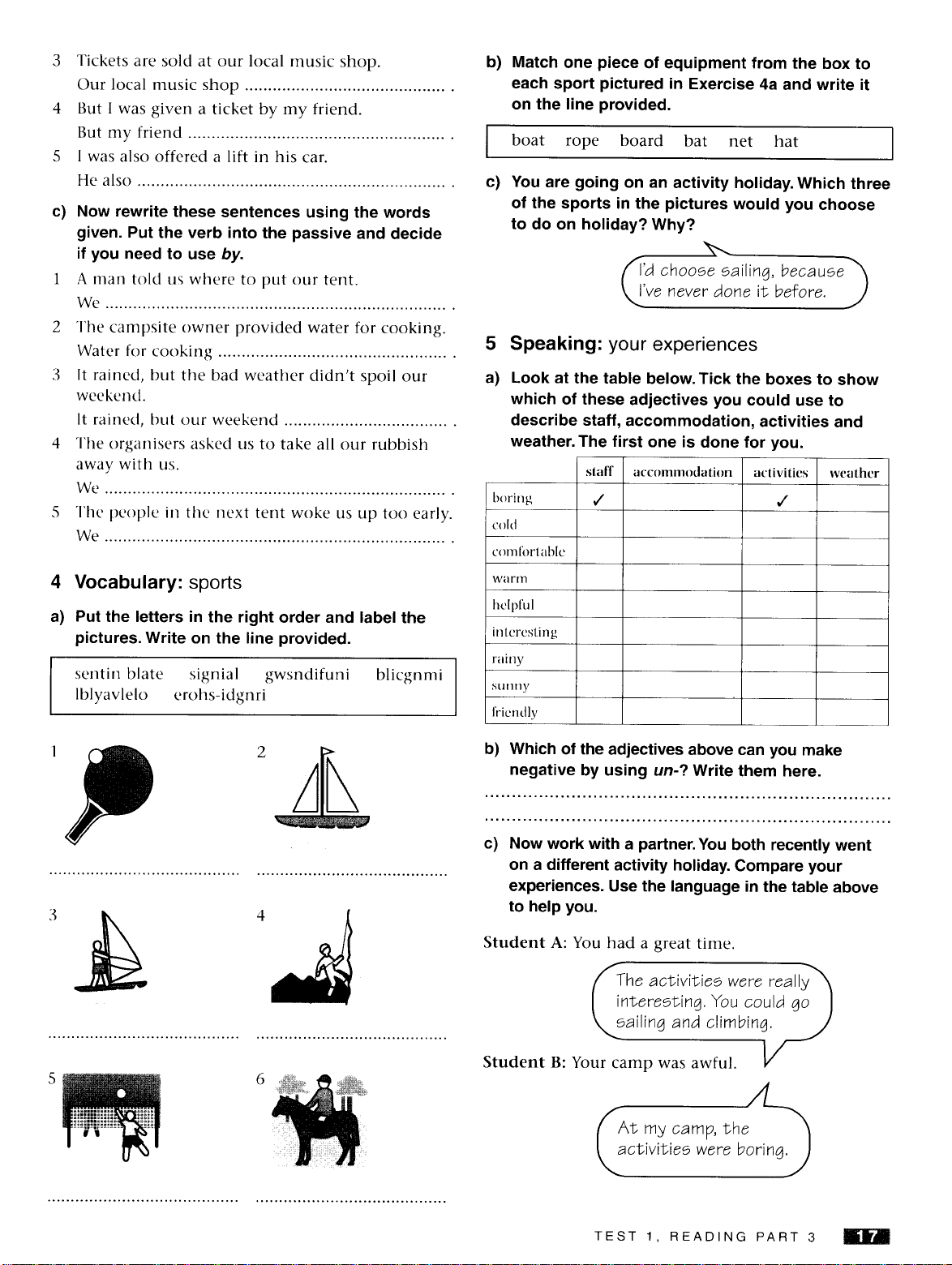
4 Vocabulary: sports
a)
Put the letters
in
the right order and label the
pictures. Write on the line provided.
3 Tickets
are
sold
at
our
local
music
shop.
Our
local
music
shop
.
4 But I was
given
a
ticket
by
my
friend.
But
my
friend
.
5 I was also
offered
a lift
in
his
car.
He also .
c)
Now rewrite these sentences using the words
given. Put the verb into the passive and decide
if
you need to use by.
1 A
man
told
us
where
to
put
our
tent.
We .
2
The
campsite
owner
provided
water
for
cooking.
Water for
cooking
.
3 [t
rained,
but
the
bad
weather
didn't
spoil
our
weekend.
[t
rained,
but
our
weekend
.
4
The
organisers
asked
us
to
take
all
our
rubbish
away
with
us.
We
.
5
The
people
in
the
next
tent
woke
us
up
too
early.
We
.
I'd
choose sailing, because
I've
never done
it
before.
boat
rope
board
bat
net
hat
staff
accommodation
activities
weather
boring
.I
.I
cold
cornlilrtable
warm
helpful
interesting
rainy
sunny
friendly
b) Match one piece of equipment from the box to
each sport pictured
in
Exercise 4a and write it
on the line provided.
5 Speaking:
your
experiences
a) Look at the table below. Tick the boxes to show
which of these adjectives you could use to
describe staff, accommodation, activities and
weather. The first one is done for you.
c)
You
are going on an activity holiday. Which three
of the sports
in
the pictures would you choose
to do on holiday? Why?
blicgnmi
signia[
gwsndifuni
erohs-idgnri
sentin
b[ate
Iblyavlelo
The
activities
were really
interesting.
You
could go
sailing and climbing.
At
my camp,
the
activities
were boring.
c) Now work with a partner.
You
both recently went
on
a different activity holiday. Compare your
experiences. Use the language
in
the table above
to
help you.
b)
Which of the adjectives above can
you
make
negative
by
using un-? Write them here.
Student
A:
You
had
a
great
time.
Student
B: Your
camp
was
awful.
65
3A
4~
TEST
1,
READING
PART
3
O Y 3 M O \ K Y 3 G 3 Z O I Q K Z 3 L U X 3 S K K
offers me a lift in his car
car
were told where to put our tent
w a s p r o v i d e d b y t h e c a m p s i t e o w n e r
Reading
Pari
..
~
Strategy
1
Read
the instructions to the Exam Task
opposite.
1
What
do
you
have
to
read?
2
What
do
you
have
to
do?
3
Where
do
you
mark
your
answers?
2 Read the text quickly to get a good
idea of what
it
is
about.
1
What
sort of work does
the
writer do?
2
Where
does
he
work?
3 Does
he
want
to
change
his life?
3 Read Questions
21-25.
It
is
important
to
understand
the
questions
before reading
the
text
in
more detail.
This exercise will help you
to
think
about
the
questions.
Underline the best word or phrase to complete
each sentence.
1 Question
21
asks
about
when/why/where
the
writer wrote
the
text. (This
is
always a
general question.)
2 Question 22 asks
about
the
writer's
feelings/plans/knowledge. (This
is
always a
question
about
detail
or
opinion.)
3
Question
23 asks
about
the
writer's
pictures!conversations/thoughts. (This
is
always
a
question
about
detail
or
opinion.)
4
Question
24 asks
about
what
the
writer
hopes
to
do/usually does/used
to
do.
(This
is
always a
question
about
detail
or
opinion.)
5
Question
25 asks
about
what
the
writer
will
do/might do/has
done.
(This
is
always a
general question.)
4 Read the text and answer Questions
21-25.
Read
the
text
again
more
carefully.
Choose
the
correct answer for
each
question.
Mark
your
answers
on
your
answer sheet.
••
Exam
tlpl
•••••••••••••••••••••••••••
: Questions
21
and
25
are always about the whole :
: text. Don't try to answer them by looking at the :
: beginning and
end
of
the text only! :
••••••••••••••••••••••••••••••••••••••
TEST
1,
READING
PART
4
Part
4
Questions
21-25
Read the text and questions below.
For each question, mark the correct letter
A,
B, C or D
on
your answer sheet.
The
Artist
People
think
being
an
artist
must
be
a
wonderful
way
to
earn
one's
living.
And
of
course,
there
are
lots
of
great
things
about
working
for
oneself, at
home
alone,
even
in
a
cold
studio
like
mine.
What
I really like is
that
nobody
tells
me
what
time
to
start
in
the
morning.
I like
to
paint
as
soon
as I
wake
up,
which
is always early,
but
isn't
the
same
time
every
day. And
nobody
tells
me
what
to
wear,
or
whether
I
can
take
the
afternoon
off
and
go
to
a f()otball
match.
But
then,
I
have
no
one
to
chat
with
when
I'm
bored,
no
one
to
discuss
last
night's
match
with
during
the
office
lunch
hour.
Sure, I
can
spend
the
afternoon
doing
something
I
enjoy
like
cycling
or
gardening
if
I
choose.
But
the
work
will still
be
there
when
I
do
finally
get
back
home.
Unfortunately,
working
at
home
means
that
people
can
always find
me,
whether
I'm
bored
or
not,
and
once
I've
answered
the
doorbell, it's
too
late -
my
thoughts
have
been
interrupted.
No
one
would
dream
of
calling
in
if I
worked
in
an
office,
but
I find
myself
listening
to
friends'
troubles.
As
they
talk,
my
ideas
disappear
and
I feel increasingly
stressed
thinking
of
my
work
waiting
to
be
done.
However,
when
I
hear
the
traffic
news
on
the
radio,
and
imagine
my
friends
sitting
miserably
in
their
cars
in
a jam, feeling
bored,
or
waiting
unhappily
for
an
overcrowded
tram
in
the
rain, I realise
that
I really
haven't
got
much
to
complain
about.
I
find
a CD
which
will
start
me
thinking,
turn
it
up
really
loudly
and
begin
another
picture
.
21
What
is
the writer trying to do
in
the text?
A encourage readers to work at home
B explain why he has changed his job
C describe his working life
D say how he would like to work
22 What does the writer like about his life?
A He has plenty of opportunities for sport.
B He
is
his own boss.
C He needn't work
in
the morning.
D He has a comfortable place to work.
23 What does the writer imagine he might do
with colleagues?
A have meals
in
restaurants
B go to the swimming pool
C spend time
in
the countryside
D talk about sport
24 The writer plays loud music because
A the traffic outside is noisy.
B it helps him to have ideas.
C it prevents him from feeling bored.
D he dislikes listening to the radio.
25 Which of these notices would be most
useful for the writer to put
on
his door?
A
I'm
working
-
please don't
disturb
B
please
call
at
m)'
offt'ce
fOY
an
affot'ntment
C
Please
knock
before
entering
D
Nf) VISI'rf)llS
l'I~I~f)"T)~)
)(JllINf,
f)I(I(lf;)~
Ilf)(JllS
TEST
1,
READING
PART
4
.:u

Preview text:

5 questions find somewhere to stay 8 hotels 5 Hotels Answer sheet Swimming pool Television Văn bản in room Bicycles Telephone Tennis court for hire in room Entertainment Lift Restaurant Gym Liff Golf Although Since So But 1 week Every day Twice No she hasn’t Two days ago c b a on of Near in between We’ve ever stayed from in this hotel of in With Have arrived in ‘ve never ridden I played Have had F F 15 20 12 F 14 18 11 16 F 19 13 F F F T T F closed employees take back book less expensive not allowed fill in advise
invite Bands from all over the world
O Y 3 M O \ K Y 3 G 3 Z O I Q K Z 3 L U X 3 S K K offers me a lift in his ca c r a
were told where to put our tent
w a s p r o v i d e d b y t h e c a m p s i t e o w n e r