Sách bài tập tiếng Anh lớp 11 nâng cao
Sách bài tập tiếng Anh lớp 11 nâng cao
Chủ đề: Sách bài tập Tiếng anh 11 13 tài liệu
Môn: Tiếng Anh 11 1 K tài liệu
Tác giả:


















Preview text:
Unit 1 GENERATION GAP A. PRONUNCIATION
1. Circle the word (A, B, C or D) that is stressed differently from the others. 1. A. nuclear B. pressure C. differ D. respect 2. A. extended B. elegant C. impossible D. financial 3. A. attitude B. privacy C. appearance D. difference 4. A. afford B. compare C. offer D. forbid 5. A. result B. viewpoint C. value D. prayer 6. A. disappointed B. fashionable C. open-minded D. interactive 7. A. childcare B. jungle C. hairstyle D. advice 8. A. comfortable B. conservative C. curricular D. responsible 9. A. skinny B. mature C. flashy D. casual 10. A. experience B. interact C. coordinate D. determine
2. Circle the word with an underlined letter (A, B, C or D) that is pronounced differently from the others. 1. A. footstep B. lessen C. upset D. respect 2. A. stuff B. judge C. mature D. junk 3. A. norm B. impose C. hole D. follow 4. A. multiple B. studious C. current D. upper 5. A. value B. taste C. table-manner D. ladder
3. Underline the stressed words in the following sentences and practice saying the sentences with a partner.
1. A: How often do you visit your grandparents?
B: Almost every weekend. Their house is not far from ours.
2. A: Who do you talk to when having a problem?
B. Well, usually my mom. She always gives me good advice. 3. A: Do you like soft drinks? B: Yes, I love them.
4. A: Do you like doing household chores?
B: No, not at all. But I have to help my mom, anyway.
5. A: These T-shirts look so cool. Why don't you try them on?
B: Sorry, I prefer those over there.
6. A: What should I bring to the party? B: Just bring yourself.
7. A: Look at these two photos. Can you guess where they were taken?
B: I guess this was in Hoi An and that in Hanoi.
8. A: Guess what? I've just met Jim, an ex-boyfriend of mine. B: What did you say to him?
9. A: Have you ever told a lie to your parents? B: Never, I dare not to. 10. A: Whose shoes are they?
B: I don't know. I've seen them there for two days. B. VOCABULARY & GRAMMAR
1. Fill in the missing words from the word bank. table manners generation gap junk food soft drinks household chores family values extended family nuclear family hairstyles homestay
1. ……………….. such as candy, bakery goods, ice cream and salty snacks is not healthy because they have plenty of salt and fats.
2. It is good to learn about ……………….. of the
country we are going to visit because different
cultures have different rules used while eating.
3. Children need to help their parents do ……………….. such as the washing up or laundry.
4. There is often a ……………….. between grandparents and grandchildren because their lifestyles are different.
5. The Coca-Cola company produces a wide variety of ……………….. which are attractive to young customers.
6. A(n) ……………….. including parents and children tends to be more popular in a modern society.
7. A(n) ……………….. is preferable to many people because children are brought up by both their
parents and their grandparents.
8. More and more tourists to Vietnam choose ……………….. service, in which they stay in a local
house of the city they are traveling to.
9. Everybody may try long, medium and short ……………….. to find the best look for your face and hair.
10. ……………….. such as moral standards or discipline are traditionally learned or reinforced within a family.
2. Complete the blanks with the correct form of the word in brackets by circling A, B, C or D.
1. It is hard to avoid ……………….. between parents and children because they have different interests. A. interactions B. disadvantages C. conflicts D. similarities
2. Many people spend a huge amount of money on expensive ……………….. clothes from Gucci or Polo Raph Lauren. A. brand name B. trend C. company D. material
3. Parents often advise their children not to break the ……………….. of Vietnam's society in choosing their clothes. A. principle B. norm C. ability D. form
4. It is inadvisable for parents to ……………….. their ideas on their children's choice of careers. A. impress B. insist C. concentrate D. impose
5. The more cheap cars are produced in Vietnam, the more Vietnamese people can ……………….. one. A. affect B. effort C. afford D. import
6. Nowadays, many women work in order to share the financial ……………….. with their husband. A. question B. impact C. behaviour D. burden
7. Growing up in a one-child family, Anna doesn't have any ……………….. to interact with. A. siblings B. friends C. neighbours D. parents
8. Parent-child ……………….. is likely to get worse if parents devote too much time to work and don't
spend time talking with their children. A. relative B. friendship C. relationship D. love
9. There is no doubt that many teenagers want to keep their personal information or stories in secret, or
their ……………….. needs respecting. A. private B. privacy C. personal D. description
10. Although Jack's parents said nothing about his plan of moving out, he realized their ……………….. through their eyes. A. discrimination B. disapproval C. familiarity D. protection
3. Complete the table below. Write N/A (not applicable) if the form does not exist. Verb Noun Adjective
1. ……n/a………. ……………….. responsibl e responsible responsibl e responsible 2. study ……………….. ……………….. respect 3. respect ……………….. ……………….. 4. ……………….. (dis)approval ……………….. 5. ……………….. emotion ……………….. 6. ……………….. ……………….. comfortable 7. ……………….. finance ……………….. 8. ……………….. relaxation ……………….. 9 private 9. ……………….. ……………….. privateprivate 10. conflict ……………….. conflicting conflicting confli cting conflicting
4. Use the words in the exercise 3 above to complete gaps in the following passage. Family in Vietnam
The majority of families in Vietnam are extended ones, where three or more generations live in the same
house and take care of each other. Extended families look similar to a mini society, in which the most
elderly have the strongest voice and are (1) ……………….. for most activities in their house. The
younger generation shows (2) ……………….. for
the older generation and vice versa, the old
generation tolerates the young. The children are expected to ask for their parents' (3) ……………….. on
their activities or plans. As a member of family, one person receives both (4) ……………….. and (5)
……………….. support from other members, particularly when he or she is in trouble. Vice versa, he or
she is expected to help other members in his or her family when they are in need. In general, families are
expected to be a source of (6) ……………….. , where every member may feel (7) ……………….. when getting together.
However, the findings from a recent (8) ……………….. show that these days, more newly-married
couples in Vietnam choose to live in a nuclear family. They would prefer to obtain (9) ……………….. in
their family life and to avoid possible (10) ……………….. when different generations live together.
(Text adapted from https://www.vietnamonline. com/culture/family.html/)
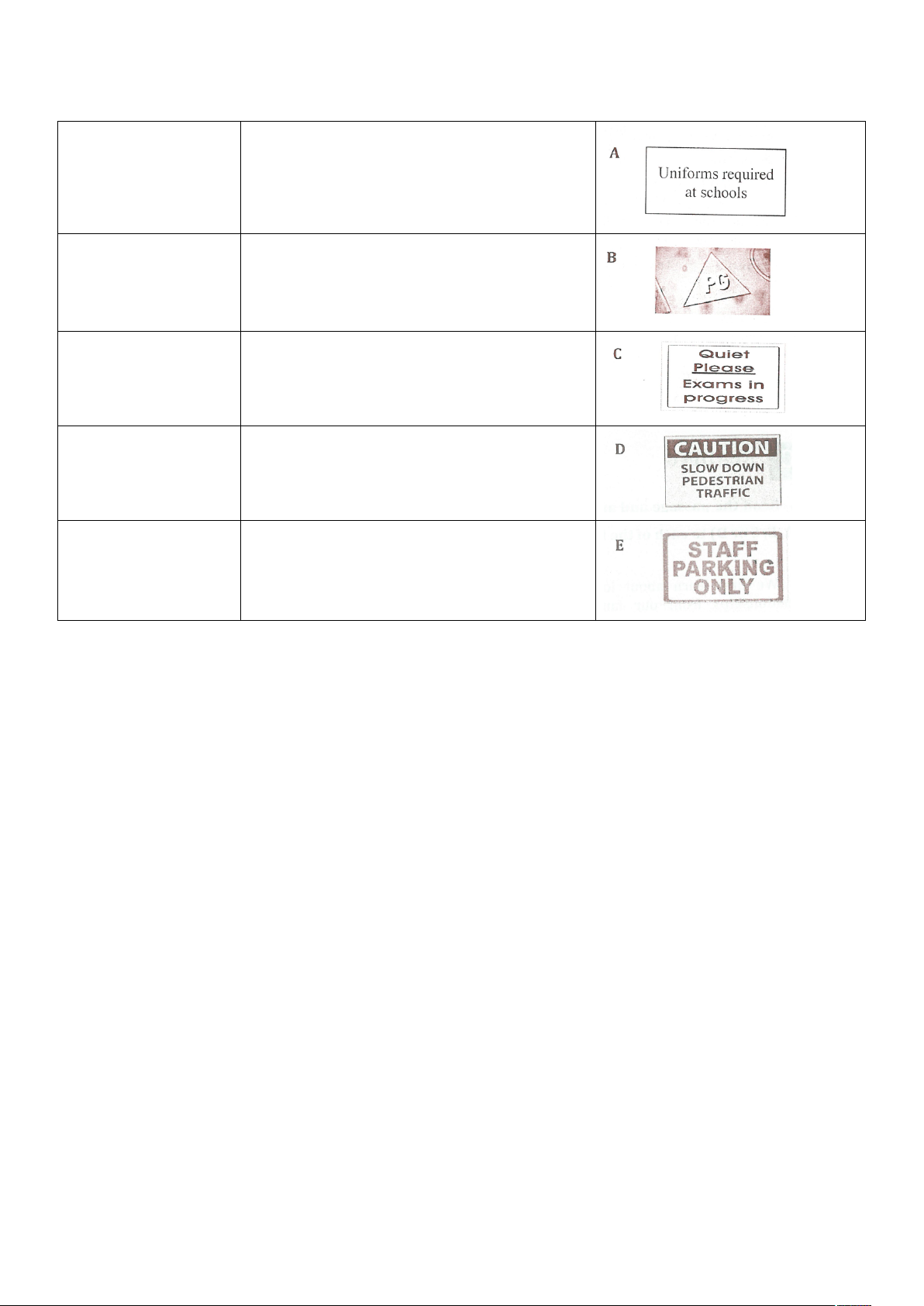
5. Match the sign with the sentences and complete with the correct form of should, ought to, have to or must ………………..
1. Drivers ……………….. reduce their
speed in the area people are walking. ………………..
2. Lucy's parents ……………….. check its
content before letting her watch the film. ………………..
3. Your car ……………….. be parked in this
area because you're are not working here. ………………..
4. Students ……………….. wear uniforms to school. ………………..
5. Everyone ……………….. keep silence
because the exams are going on.
6. Circle the best choice (A, B, C or D) to complete the following sentences.
1. She's not very well. Perhaps she ……………….. see a doctor. A. must B. ought to C. must not D. shouldn't
2. Jane's flight is at 6am tomorrow. She ……………….. leave home at 4am in order to do check-in. A. have to B. ought not to C. must D. shouldn't
3. You ……………….. do the back-up of all the documents in your computer just in case it breaks. A. must not B. ought to C. have to D. either B or C
4. Your aunt was very kind to me when I was in London. I think I ……………….. write her a thank you letter. A. must not B. should C. have to D. ought not to
5. I'm sorry to tell you that all the tables have been reserved. You ……………….. book next time. A. must B. shouldn't C. should D. ought not to
6. Mia told her son, James: “You'll be graduating from college soon. You ……………….. think about your future. " A. must B. must not C. would D. don't have to
7. The sign “Don't leave your belongings unattended” means that you ……………….. always take your personal items with you. A. should B. should not C. would D. don't have to
8. Tony ……………….. study too hard for his High School Graduation examinations, which are on
next Monday. Otherwise, he'll get sick. A. ought to B. should not C. must D. must not
9. Children ……………….. ask their parents for their advice on all their problems because their parents have more living experience. A. must not B. must C. should not D. should
10. I can't go out with my friends tonight. I ……………….. to do more work to catch up with the others. I'm so much behind. A. should B. ought C. must D. mustn't C. READING
1. Read the passage and answer the questions below. Choose the correct answer (A, B, C or D) to
each of the following questions. Family
We first learn about loving and caring relationships from our families. Family is defined as a
domestic group of people with some kinship - whether through blood, marriage, or adoption.
Ideally, each child is nurtured, respected, and grows up to care for others and develop strong and
healthy relationships. This does not mean that it is always easy to make and keep friends; it just means
that we share the goal of having strong relationships.
"Family" includes your parents and siblings, as well as relatives who you may not interact with
every day, such as your cousins, aunts, uncles, grand-parents, and stepparents. They are probably the
people you are closest to and with whom you spend the most time. Having healthy relationships with your
family members is both important and difficult.
It is never too late to begin the process of improving family relationships - even if they are already
of good quality. You can step back and assess the relationship, it is often hard to do this with your family.
Your family may constantly existing your life, so when an argument or issue arises, it may seem impossible to handle.
Remember that communication is key to resolving conflicts. While it may seem that your siblings
sometimes annoy you, they are also there to communicate. Use your family's presence to your advantage -
communicate with each other, develop your relationships, and build trust and respect.
(Text adapted from http://www. pamf.org/teen/abc/types/family.html)
1. According to the passage, what do we first learn from our family?
A. how to receive love from others
B. how to love and take care of others C. about our family members D. about marriage and family
2. According to the passage, what is the goal of a family? A. to nurture a healthy child B. to respect the parents
C. to build up good family relationships D. to make and keep friends.
3. The word ‘kinship’ in paragraph 1 refers to ________. A. social connection B. friendship C. childhood D. family relationship
4. According to the passage, who are regarded as family members? A. only parents and children
B. parents, children and relatives
C. those who you are closest to
D. relatives you often interact with
5. What is NOT TRUE about developing a healthy relationship among family members?
A. It's significant, but challenging. B. It can occur at any time.
C. It's never too late to start.
D. It's difficult and hopeless.
6. It's probably impossible for a person to deal with an argument or issue that arises in his family because ________.
A. his family always is by his side.
B. there is a lack of communication.
C. he himself needs to handle it. D. only his family may help.
7. The word ‘resolving’ in paragraph 5 could best be replaced by ________. A. supporting B. improving C. finding a solution to D. making a decision on
8. Why is communication significant in a family?
A. to solve arguments among family members
B. to strengthen relationships among family members
C. to build up trust and respect among family members D. all are correct
2. Read the passage and choose the correct answer (A, B, or C) to each of the following questions.
Generation gap is commonly used to refer to differences between generations that cause conflicts
and a frustrating lack of communication, creating a "gap."
However, from their position in the family, and with more life experience than younger family
members, grandparents are able to see that differences between generations can be positive for all concerned.
The areas of difference includes technology use, taste in music, work ethic, moral values, respect
for others, political views, attitudes toward different races, and religious beliefs. The top areas of
disagreement between the young and old, according to the Pew Research Centre Study, are use of
technology and taste in music. Grandparents are likely to have observed these differences in their
grandchildren who are tweens, teens, and young adults.
If large differences between the generations exist, why don't they lead to conflict? The answer is twofold.
First, the two largest areas of difference, technology and music, are less emotionally charged than
political issues. The older generation is likely to be proud of the younger generation's skills in technology
rather than to view it as a problem. As for the musical differences, each generation wants its own style of
music, and the older generation generally can relate to that desire.
Second, in other areas of difference, the younger generation tends to regard the older generation as
superior to their own generation - clearly a difference from the 1960s with a saying "Don't trust anyone
over thirty." According to the Pew Research Centre, all generations regard older Americans as superior in
moral values, work ethic and respect for others.
(Text adapted from https://www.thespruce.com/looking-at-the-generation-gap-1695859)
1. Match each word with its definition. i. generation gap a. of higher level or status ii. taste
b. a strong feeling of wanting to have something iii. twofold
c. a person's liking for something iv. desire
d. disagreement between different generations v. superior e. having two parts
2. What is generation gap usually perceived as?
A. the younger people's lack of communication
B. differences between generations leading to disagreements or conflicts
C. the older people's life experience
3. Which of the following is TRUE about how the elderly think about generation gap?
A. Being positive about the differences between generations.
B. Being concerned about all the differences.
C. Being frustrated in communicating with the younger members.
4. In which areas are the older and the younger people the most different? A. Technology and music. B. Work and politics. C. Music and religion.
5. What does the older generation think about their grandchildren's skills in technology?
A. They find their grandchildren's skills problematic.
B. They desire to improve their skills in technology.
C. They are proud of their grandchildren.
6. Why are the differences in music unlikely to cause conflicts between two generations?
A. Each generation likes to have their own taste.
B. Styles of music are various.
C. The older people have a stronger desire for music than the younger.
7. According to the Pew Research Centre, how do Americans consider the elderly?
A. The elderly think moral values of all generations are the same.
B. The elderly are better at moral values and work ethic.
C. All older Americans respect moral values and work ethic.
8. Which of the following could be the best title of the passage?
A. Generation Gap: Differences but Little Division
B. Generation Gap: Definition and History
C. Generation Gap: Areas of Differences.
3. Read an article about developing healthy relationships between parents and children
3.1. Choose a sentence (a-d) to complete each gap (1-4).
a. Follow each rule that they set b. Try to remain calm c. Spend time with your family
d. Talk about the rules ahead of time
‘I hate my parents’ rules’
Your relationship with your parents may be confusing right now. While you may feel ready to
make your own decisions about where and when you go, your parents will set limits. The reason your
parents do this is because they care about you and want to protect you from danger. You may find that
you are fighting with your parents more than you used to.
Here are some tips on how to avoid and handle arguments with your parents:
(1) ……………….. and not at the last minute. This way you will be able to tell what your parents will say
yes or no to before you make plans. Your parents can also explain to you why each rule is in place. Your
parents may be willing to listen to your ideas and use them when making rules that you both agree on.
(2) ……………….. and do not lose your temper when your parents say no to something. You will show
your parents that you are responsible and mature by talking instead of yelling and listening to what they have to say.
(3) ……………….. If your parents tell you to be home at a certain time, stick to it. They may begin to
worry about your safety if you are late. By being responsible and following rules, your parents may be
willing to negotiate a later time in the future.
Pick your battles. Try to figure out what is really bothering you. This will help you know if it is worth
arguing about. Some issues may be more important than others.
(4) ……………….. Communicate with each other and make some special family time so that you can
all enjoy the time you have at home. Suggest activities that your whole family will enjoy together
such as going for a hike, a bike ride, or going to the beach.
(Text adapted from http://youngwomenshealth.org/2011/06/02/healthy-relationships/)
3.2. Read the passage again and if decide the following statements are true or false. Write either T
(True) or F (False) in each gap. ……….
1. Your relationship with your parents is sometimes troubled. ……….
2. Your parents refuse your plan because they may see possible dangers. ……….
3. Parents have to accept your plan if you don't tell them until the last minute. ……….
4. It is useless to discuss a set of rules with your parents. ……….
5. Controlling yourself when being refused shows your responsibility and maturity. ……….
6. You need to follow your parents' rules, which can never be changed. ……….
7. It is not worth arguing with your parents. ……….
8. Make your time at home enjoyable to you and your parents. ……….
9. Outdoor activities such as hiking or riding a bicycle are not suggested for the whole family. ……….
10. Conflicts with your parents will never happen if you follow the suggested tips.
4. On a blog, five young moms with teenage kids have posted their parenting experience. Read their
posts and answer the questions below.
Nancy- “You sit ten women with teenage children in a circle, serve them a fizzy cocktail and some coffee
cake, and the talk soon turns competitive. Over what? Not school scores or college destinations, please
don't bother us. We fight about who is less appreciated at home.”
Kay- “Tweens or teens can easily start a message that they're stupid, fat, ugly, a loser - even when their
family and real-friends promote messaging that is completely counter to those thoughts. The world
around these kids with social media may make a fit kid feel fat and a smart kid feel stupid. It can make
almost anyone feel completely alone while sitting in a crowd.”
Dawn – “Every parent I know would agree that having children has given their lives meaning, a sense of
fulfillment, and a kind of joy previously unimagined. We love our children. We love caring for them. We
love watching them grow. Yet, at the same time, we realize that parenting has made us crazy.”
Jennifer - “Life in my house is never dull or boring. Or quiet, for that matter. There is always noise of
some kind, usually the result of bodily functions. You definitely have to have a good sense of humour when living with 3 guys.”
Jill- “I've found with my kids that I have ongoing conversations that develop as they get older, more
mature, and more computer literate. Best advice a friend gave to me many years ago was to always keep
the lines of communication open with your kids on ANY topic. Kids are very clever and usually one step ahead of mom and dad.”
(Text adapted from: https://www.aceable.com/blog/the-10-best-blogs-for-moms-of-teens/)
4.1. Decide which mom talks about the following topics. Some topics may be mentioned by none of
the five moms. Put a tick ( ) in the appropriate column. Topics Nancy Kay Dawn Jennifer Jill None 1. Children's school results
2. A negative feeling about being a mother 3. Their role in a family
4. An unhappy family relationship 5. Teenagers' misled thoughts 6. Children's growth
7. Enjoyable noise and humorous family members
8. Meaningfulness of having children
9. Effects of social media on teenagers' language
10. Communication with their kids
4.2. Match each word with its definition. 11. competitive
a. opposite to their current ideas or thoughts 12. counter b. uninteresting 13. unimagined
c. having a desire to be more successful 14. dull d. having knowledge of 15. literate
e. not as expected or predicted D. WRITING
1. Rewrite the following sentences by using the word given in the brackets.
1. Cell phones are not allowed on Tokyo subway. (must)
Passengers __________________________________________________________________________.
2. Doing physical activities is necessary for children (need)
Children ____________________________________________________________________________.
3. Jenny advised Timmy to leave his home at 12:30 pm to catch the 1:00 pm train, (should) Jenny said to Timmy:
“ __________________________________________________________________________________.”
4. It is good for parents to communicate with their children on any topic in order to improve their family relationship. (ought)
Parents _____________________________________________________________________________ .
5. I am required to be at the station 30 minutes before the coach to Vung Tau leaves. (must)
I __________________________________________________________________________________.
6. It is important for a mother to talk to her baby as soon as he or she is born. (should)
A mother ___________________________________________________________________________.
7. Besides studying, hanging out with friends is also helpful to teenagers. (should)
Teenagers __________________________________________________________________________.
8. It would be a good idea for Michelle to keep a journal on her daily activities. (ought)
Michelle __________________________________________________________________________.
9. Children under 12 are required to be accompanied by an adult to the entertainment centre. (must)
Children ___________________________________________________________________________.
10. I'd advise you to tell your parents your result before they ask you. (should)
You _______________________________________________________________________________.
2. Write complete sentences using the given words.
1. Mary / go / school / early / exam / this morning
Mary ______________________________________________________________________________.
2. My parents / not allow / me / go out / 9pm
My parents _________________________________________________________________________.
3. Tim / not / move out / even / conflicts / parents
Tim _______________________________________________________________________________.
4. Members / family / communicate / understand / each other
All members ________________________________________________________________________.
5. Elderly / learn / use /computers / from / younger
The elderly__________________________________________________________________________ .
6. It / necessary / children / tell / parents / issues / school
It is _______________________________________________________________________________.
7. Children / respect / elderly / though / argue / sometimes
Children ___________________________________________________________________________.
8. Teenagers / responsible / behaviours
Teenagers __________________________________________________________________________.
9. Parents / teach / children / housework
Parents _____________________________________________________________________________ .
10. It / necessary / kids / learn / swim / young
It _________________________________________________________________________________.
3. What does each sign mean? Write a sentence to describe each sign using OUGHT TO, SHOULD, HAVE TO, NEED TO, MUST
0. ________This door must be closed at all times________.
1. _____________________________________________
_____________________________________________
2. _____________________________________________
_____________________________________________
3. _____________________________________________
_____________________________________________
4. _____________________________________________
_____________________________________________
5. _____________________________________________
_____________________________________________ 4. A Letter of Advice
Imagine that you are a year 11 student at an American high school. You participated in a Vietnam-
America summer friendship program and stayed with a host family in Vietnam. Now that you have
returned home, a friend of yours is about to enroll in the same program.
Write a letter of advice (in about 150 words) to him/her about the experience of staying with a
Vietnamese family. Include your personal experiences as well as advices to help him/her to make the best out of this experience Dear_________________,
___________________________________________________________________________________
___________________________________________________________________________________
___________________________________________________________________________________
___________________________________________________________________________________
___________________________________________________________________________________
___________________________________________________________________________________
___________________________________________________________________________________
___________________________________________________________________________________ ANSWER KEY A. PRONUNCIATION 1. 1. D 2. B 3. C 4. C 5. A 6. B 7. D 8. A 9. B 10. B 2. 1. D 2. C 3. A 4. B 5. B 3
1. A: How often do you visit your grandparents?
B: Almost every weekend. Their house is not far from ours.
2. A: Who do you talk to when having a problem?
B. Well, usually my mom. She always gives me good advice. 3. A: Do you like soft drinks? B: Yes, I love them.
4. A: Do you like doing household chores?
B: No, not at all. But I have to help my mom, anyway.
5. A: These T-shirts look so cool. Why don’t you try them on?
B: Sorry, I prefer those over there.
6. A: What should I bring to the party? B: Just bring yourself.
7. A: Look at these two photos. Can you guess where they were taken?
B: I guess this was in Hoi An and that in Hanoi.
8. A: Guess what? I’ve just met Jim, an ex-boyfriend of mine.
B: LOL! What did you say to him?
9. A: Have you ever told a lie to your parents? B: Never, I dare not to. 10. A: Whose shoes are they?
B: I don’t know. I’ve seen them there for two days. B. VOCABULARY & GRAMMAR 1 1. junk foods 2. table manners 3. household chores 4. generation gap 5. soft drinks 6. nuclear family 7. extended family 8. homestay 9. hairstyles 10. family values 2 1. C 2. A 3. B 4. D 5. C 6. D 7. A 8. C 9. B 10. B 3. Verb Noun Adjective 1. ……….n/a……… responsibility responsible 2. study study studious 3. respect respect respectful 4. (dis)approve (dis)approval (dis)approving 5. n/a emotion emotional 6. comfort comfort comfortable 7. finance finance financial 8. relax relaxation relaxing / relaxed 9. n/a privacy private 10. conflict conflict conflicting 4 1. responsible 2. respect 3. approval 4. financial/emotional 5. emotional/financial 6. comfort 7. relaxed 8. study 9. privacy 10. Conflicts 5 1. D - must 2. B - should 3. E - mustn’t 4. A - must
5. C - have to / should / ought to C. READING 1 1. B 2. C 3. D 4. B 5. D 6. A 7. C 8. D 2 1.i.d ii. c iii. e iv. b v. a 2. B 3. A 4. A 5. C 6. A 7. B 8. A 3 3.1 1. d 2. b 3. a 4. c 3.2 1. T 2. T 3. F 4. F 5. T 6. F 7. F 8. T 9. F 10. T 4 4.1 1. None 2. Dawn 3. Nancy 4. None 5. Kay 6. Jill 7. Jennifer 8. Dawn 9. Kay 10. Jill 4.2 11c 12a 13e 14b 15d D. WRITING 1 Suggested sentences
1. Passengers mustn’t use cell phones on Tokyo subway.
2. Children need to do physical activities.
3. “You should leave your home at 12:30 pm to catch the 1:00 pm train.” / “Why don’t you leave your
home at 12:30pm to catch the 1:00 pm train.”
4. Parents ought to communicate with their children on any topic in order to improve their family relationship.
5. I must be at the station 30 minutes before the coach to Vung Tau leaves.
6. A mother should talk to her baby as soon as he or she is born.
7. Teenagers should hang out with friends besides studying.
8. Michelle ought to keep a journal on her daily activities.
9. Children under 12 must be accompanied by an adult to the entertainment center.
10. You should tell your parents your result before they ask you. 2 Suggested sentences
1. Mary have to go to school early for an exam this morning.
2. My parents do not allow me to go out after 9pm.
3. Tim should not move out even when he has had many conflicts with his parents.
4. All members of a family need to communicate in order to understand each other better.
5. The elderly have to / should / need to learn how to use computers from the young.
6. It is necessary for children to tell their parents all of their issues at school.
7. Children have to / should / need to respect the elderly even though they may argue sometimes.
8. Teenagers must be / have to be responsible for their behaviors.
9. Parents should /ought to teach their children to do housework.
10. It is necessary for kids to learn to swim when they are still young. 3 Suggested answer
1. Cell phones must be set up to be silent.
2. You should sit straight up while using computers.
3. People must wear safety equipment before entering this area.
4. Cameras or video equipment mustn’t be used in this area.
5. Workers should wear a helmet.
4 A sample letter of advice Dear Sally,
It’s Olivia, a former volunteer of the America-Vietnam Summer Friendship program! I’ve heard
that you will be participating in the 2018 program, and I would like to share with you my experience of
staying with my wonderful host family throughout my summer program.
To me, my host family were my best partners throughout the summer: they cooked the best
Vietnamese food, took me to beautiful places around the city, and were always willing to teach me some basic Vietnamese phrases.
To get the best experiences with your host family, here are some helpful tips. Although it might be
daunting at first, try to be open to spending time around everyone, instead of staying in your room or on
the phone. Remember to respect their house rules. Things may be strange to you, so ask questions whenever you are unsure!
I am sure you will have an amazing experience, and a second family that will be very difficult to
say goodbye to. Let me know if you have any questions! Best, Olivia. UNIT 2: RELATIONSHIPS
1. Circle the word (A, B, C, or D) that is stressed differently from the others. 1. A. relation B. argument C. attachment D. permission 2. A. popular B. beautiful C. romantic D. passionate 3. A. decision B. emotion C. dependence D. honesty 4. A. necessary B. sympathetic C. voluntary D. interesting 5. A. conflict (v) B. appear C. strengthen D. record (v) 6. A. potential B. confident C. possible D. personal 7. A. imaginable B. understandable C. argumentative D. economical 8. A. independence B. popularity C. conversation D. diversity 9. A. anger B. damage C. idea D. problem 10. A. cultural B. attached C. parental D. attractive
2. Circle the correct sound (A or B). 1. recipe A. / i / B. / e / 2. sympathy A. / ð / B./ θ / 3. date A. / eɪ / B./ a / 4. honesty A. / h / B. / / 5. suggest A. / g / B. / dʒ / 6. damage A. / a / B. / I / 7. opportunity A. / ju: / B. / ʌ / 8. psychology A. / p / B. / / 9. posting A. / əʊ / B. / ɒ / 10. counsellor A. / s / B. / z /
3. What are the possible contracted forms in each of the following exchanges? Write the contracted
forms if applicable, and N/A if not applicable as shown in the example (0). Then, practise the exchanges with a partner.
0. A: Le Modo Restaurant. How can I help you? ____ N/A ____
B: I would like to book a table for three people tonight at 7pm. ____ I'd____
1. A: I have watched the Shawn and Sheep three times. ________
B: Really? That is the most interesting cartoon I have ever seen. ________
2. A: Where have you been? ________
B: I have been upstairs to fix my computer. ________
3. A: Where did you meet your boyfriend for the first time? ________
B: I do not remember actually. ________
4. A: Finally we are home. ________
B: What a long flight! It took us almost two days. ________
5. A: Online dating is popular among youth these days. ________
B: Yeah, and I think they will no longer have face-to-face dating. ________
6. A: It is too hot here. Do you mind if I turn on the fan? ________
B: Not at all. Please do. ________
7. A: Excuse me. Can you please show me to the post office? ________
B: Sorry. I do not know. I am a tourist too. ________
8. A: What is your email address? I will send you a photo of my new house.
B: It is olivia.dan@gmail.com. Thanks a lot. ________
9. A: I am going to a talk show on teenagers' relationship tonight. ________
B: That sounds interesting. ________
10. A: You will be late for school if you do not leave home immediately. ________
B: I know. I am leaving now. ________ B. VOCABULARY & GRAMMAR
1. Complete each sentence with the correct form of the word provided.
1. I haven't got the ________ to sing at a wedding party. There are too many strangers. (CONFIDENT)
2. Lying to your parents or ________ is one of the worst habits that children should avoid. (HONEST)
3. Bringing your children to the orphanage to help the homeless
kids is a good way to teach them to
become more ________ towards the others. (SYMPATHY)
4. It would be better to talk to a ________ , who may give you helpful advice to improve your
relationship with your roommates. (COUNSEL)
5. Matt has such a great ________ that everyone must like him after the first meeting. (PERSON)
6. Despite being friends for more than three years, Jack and I usually have a lot of ________ when discussing an issue. (ARGUE)
7. Communication helps to form ________ between a baby and his or her mom. (ATTACH)
8. The ________ relationship between Romeo and Juliet seems to be endless. (ROMANCE)
9. Though Steve's accent was strange, his words were perfectly
________. He succeeded in passing
on his message of teenager love to the audience. (UNDERSTAND)
10. Current media put much ________ on developing face-to-face relationship with people around you. (EMPHASIZE)
11. Despite being the easiest means of communication, social media are likely to be ________ among
adolescents if they use them too much. (PROBLEM)
12. School children make a great ________ to charity by donating their unused stationery. (CONTRIBUTE)
13. Teenagers are advised to ask for their parents' ________ before enrolling in an online course. (PERMIT)
14. Mai's parents are ________. She is currently living with her mom and seldom meets her dad. (DIVORCE)
15. Leaving home after having a lot of arguments with her parents, Jane feels regretful and wants to be
________ with them and return home. (RECONCILE)
2 Complete each gap with a word/phrase to form collocations. success a child one's mind one's trust tension a contribution an ear a lie part in a community 1. achieve ______________________________ 2. make
______________________________ 3. change ______________________________ 4. raise ______________________________ 5. join ______________________________ 6. ease ______________________________ 7. take ______________________________ 8. betray ______________________________ 9. tell ______________________________ 10. lend ______________________________
3. Complete the following sentences with the phrases inthe Exercise 2. You may need to change the
forms of the words to fit the sentence.
1. In order to ________ in studying, students need to set up clear and realistic goals.
2. It is true that ________ frequently lets someone down and their relationship is likely to get worse. They
no longer believe in each other.
3. It may be hard for parents to ________ to become a caring and empathic person as he or she grows up.
4. Best friends sometimes ________ to each other because they understand that the truth may upset their friend.
5. High school students should ________ many
co-educational activities and community services in
order to develop their soft skills.
6. Anna always ________ or listens sympathetically and attentively to all the problems that her daughter shares with her.
7. Music is a wonderful therapeutic tool to help you get through difficult times or to ________.
8. Students of all ages should be encouraged to ________ to charity so that they learn how to care and share with others.
9. One of the most common motivators for a person to ________ is to interact with other people of a
shared passion or a specific hobby such as sport, dance, theatre or comedy.
10. At first, James decided to go on a date with Kate, but he ________ because they had always argued with each other.
4. Complete each sentence with a suitable word (A, B, C or D).
1. Jamie looked ________ in her new dress at her 20th birthday party. A. amazed B. amazing C. amaze D. amazingly
2. What's wrong with your mother? She sounded very ________ when I talked with her last Saturday at the supermarket. A. sad B. sadness C. sadly D. sadder
3. Ami has said goodbye to her boyfriend for many months, but it doesn't ________ she can forget their relationship. A. get B. grow C. seem D. stay
4. For the reason of personal safety, the informant wishes to ________ anonymous. A. seem B. look C. remain D. feel
5. We went to a five-star restaurant last night. All the dishes we ordered tasted as ________ as they look.