Sách giáo trình A Student's Dictionary of Psychology, 4th Edition môn Tâm lý học | Đại học Thái Nguyên
Sách giáo trình A Student's Dictionary of Psychology, 4th Edition môn Tâm lý học | Đại học Thái Nguyên. Tài liệu được sưu tầm giúp bạn tham khảo, ôn tập và đạt kết quả cao. Mời bạn đọc đón xem.
Môn: Tâm lý học 11 tài liệu
Trường: Đại học Thái Nguyên 386 tài liệu
Tác giả:



















Preview text:
A Student's Dictionary of Psychology, Fourth Edition Nicky Hayes Peter Stratton HODDER EDUCATION A STUDENT’S DICTIONARY of PSYCHOLOGY Nicky Hayes & FOURTH EDITION Peter Stratton
First published in Great Britain in 2003 by
Hodder Education, an Hachette UK Company,
338 Euston Road, London NW1 3BH www.hoddereducation.com
© 2003 Nicky Hayes and Peter Stratton
All rights reserved. No part of this publication may be reproduced or
transmitted in any form or by any means, electronically or mechanically,
including photocopying, recording or any information storage or retrieval
system, without either prior permission in writing from the publisher or a
licence permitting restricted copying. In the United Kingdom such licences
are issued by the Copyright Licensing Agency: Saffron House, 6–10 Kirby Street, London EC1N 8TS.
The advice and information in this book are believed to be true and
accurate at the date of going to press, but neither the author[s] nor the publisher
can accept any legal responsibility or liability for any errors or omissions.
British Library Cataloguing in Publication Data
A catalogue record for this book is available from the British Library
Library of Congress Cataloging-in-Publication Data
A catalog record for this book is available from the Library of Congress 978 0 340 87303 8 4 5 6 7 8 9 10
Typeset in 9pt New Baskerville by Tech-Set Ltd, Gateshead, Tyne and Wear. Printed and bound in India.
What do you think about this book? Or any other Hodder Education title?
Please send your comments to www.hoddereducation.com P R E F A C E
Producing a fourth edition of ‘A Student’s Dictionary of Psychology’ has allowed us to
bring all of our entries up to date. We have increased the number of terms in the dictionary
that relate to the ‘core’ areas of psychology: social psychology, cognitive psychology,
physiological psychology, developmental psychology, comparative psychology and
individual differences. We have also introduced a number of common terms to do with
carrying out psychological research and analysing it, using either quantitative or qualitative
analysis. We believe that this dictionary now represents a reasonably comprehensive
coverage of the terms that a student taking psychology is likely to encounter.
As ever, we have tried to make this an ‘explaining’ dictionary, which will tell you the
meaning of the term you have looked up, and a bit about how it is used in psychology.
Almost always, you will find that following up the cross-references will give you even more
explanation, by providing more detail about the topic and providing a clearer idea of how
the term and related terms are normally used.
Towards more accurate writing
There are several spelling and grammatical errors that seem to be particularly common in
psychology essays (and some journal articles). They matter because they can change the
whole meaning of a sentence as well as giving a bad impression. Here are some of the most important.
● Be consistent in singular and plural. Not ‘there is 23 of them’
● Latin words which end in ‘a’ tend to be plural e.g. data and media. Therefore, ‘data are reported’
● Apostrophes give endless trouble. Nearly always they indicate a possessive. ‘A student’s
opinion’. You can think of ’s as an abbreviation for his, hers or its. For example, ‘A student-his opinion’.
● You do not need an apostrophe to create a plural. ‘The department’s student’s…’
implies that they only have one student and you are about to be told about something that person possesses.
● Apostrophes come after the ‘s’ for plurals – if it belongs to several students, it is the
students’ opinion. In principle there should probably be a second ‘s’ but students’s
looks clumsy. If the word is already plural, like people, the apostrophe comes after the plural word: People’s party.
● Sometimes the spelling changes: plural of family is families. Possessive of family is
family’s. Possessive of many families is families’.
● Sometimes an apostrophe is used to indicate an abbreviation as in don’t for ‘do not’.
‘Its’ is already possessive. It gets an apostrophe only when functioning as an
abbreviation of ‘it is’, as in it’s a lovely day. 3
● ‘This finding highlights that value for money is an important issue for customers’. Do
not use ‘highlights’ – it is a cop-out to save you thinking of the word you should really
use. It makes this sentence ungrammatical, when it would have been simpler and more
informative to have used ‘shows’ or ‘suggests’. Or should it have been ‘proves’ or ‘emphasises’?
● ‘There’ is a place, ‘their’ refers to possessions. So do not write ‘we solved there problems’.
● Sentences in the form of a question should have a question mark at the end.
● Sentences that get long and complex should be split up.
● When a sentence or, worse, a paragraph, starts with ‘this’ it is often unclear what, in
the preceding material, it refers to. Think of it as a vague wave backwards to what you
have recently written. Make a rule to avoid using ‘This’ unless you say this what. This
(the first sentence of this paragraph) reminds me that it is important to minimise the
use of commas but even more important to use them correctly.
● ‘Effect’ and ‘affect’ cause problems for psychology students, especially because ‘affect’
has a technical meaning within psychology.
● Has an effect (noun). But also, though not so common, ‘effects a change’ means to bring about a change.
● Affects things (verb). But can be an affect (noun) meaning a feeling or emotion.
● ‘An increase in affect’ is an increase in emotion. An ‘affective state’ means you are affected by some emotion.
● A similar confusion between nouns and verbs occurs with practice (noun) ‘the
practice of psychotherapy’ and practise (verb) when you ‘practise your guitar solos’.
People do not usually get confused between ‘advice’ and ‘advise’ which follow the
same rule, so you may find you can remember practise in terms of advise.
● Finally, for some reason when writing about activating a response instead of writing
‘elicit’ people often write ‘illicit’, which is an adjective meaning that it is underhand or illegal.
Peter Stratton and Nicky Hayes 2003
A C K N O W L E D G E M E N T S
The existence of this dictionary owes much to the support and encouragement which
Helga Hands has so generously supplied throughout its preparation. Peter Stratton
would also like to thank Nicky Hayes for her unfailing wisdom and helpfulness, for years
of friendship and for being fun to work with throughout the history of this dictionary.
Thanks are also due to David Griggs, for his helpfulness and support in the preparation of this edition. 4 A ABBA design
An example of counterbalancing of experimental conditions. The first
condition (A) is followed by two trials of the second condition (B), then by one of
the first. The effect is to average out order effects if they are constant. However, if all
of the practice effects might take place during the first trial, it would be safer to run
half of the participants with a BAAB sequence. An alternative use of the term is to
refer to experimental designs in which one group of participants experiences
experimental conditions in the order A then B, while the other group experiences
them in the order B then A. The two uses can be distinguished by examining the
number of trials which the participant is obliged to undergo. aberrant
Behaviour (or in biology, an organism) that deviates from what is normal, expected or desirable. ability A capacity or skill. ability tests
Psychometric tests which are designed to measure what someone is already
able to do, as opposed to what they might be able to learn in the future. See also aptitude tests. ablation
The removal or destruction of part or parts of the brain by means of surgical
techniques, usually involving the cutting or burning away of the tissue concerned. abnormal
A term applied to behaviour or people who have been classed as not
normal. It is a potentially controversial label because of problems in defining
normality. Abnormality can be defined in several different ways:
(i) as behaviour which is different from the norm (i.e. unusual);
(ii) as behaviour which does not conform to social demands;
(iii) as statistically uncommon behaviour, based on the assumptions of the normal distribution;
(iv) as behaviour which is maladaptive or painful for the individual; or
(v) as the failure to achieve self-actualisation, the humanistic view.
These criteria bring their own problems because, for example, they lead to the
classification of highly regarded individuals like artists and social reformers as ‘abnormal’. abnormal psychology
The psychology of abnormal behaviour. This term has been
largely replaced by clinical psychology when referring to the professional practice of abnormal psychology. 5
STUDENT’S DICTIONARY OF PSYCHOLOGY abreaction
A process used in some forms of psychotherapy, especially
psychoanalytically oriented ones, which involves the re-living of deep emotional
experiences. During abreaction, repressed emotional disturbance is brought to
consciousness, allowing a recognition of its existence and the opportunity for the
client to develop new coping strategies. abscissa
The horizontal or x-axis of a graph. See also ordinate.
absolute refractory period
The period of a few milliseconds immediately after the
firing of a neurone. During the absolute refractory period the neurone will not
produce another electrical impulse, no matter how much stimulation it may receive.
See also relative refractory period. absolute threshold
The minimum amount of stimulation required for an event to be
detected. The absolute threshold of a particular form of stimulus is set at the point
where 50% of the signals with that physical value are detected. abstract thought
Thought which uses concepts which do not have an immediate
material correspondence, such as justice or freedom. In Piaget’ s theory of cognitive
development, the capacity for abstract thought is only acquired after the age of
about 12 years. It is an essential aspect of Piaget’s formal operational stage. abuse
(1) The use of substances inappropriately in a way that is damaging to the
individual, e.g. excessive alcohol consumption, sniffing glue. See addiction.
(2) Inappropriate and harmful treatment of another person. See also child abuse. accent
A distinctive pattern of pronouncing words and phrases which is shared by
members of a social or regional group. In some circumstances, accent is taken as an
important signifier of social status, and may thus determine the nature of social
interaction between individuals. This is particularly noticeable in highly stratified
societies such as that of the UK. See also dialect, psycholinguistics, speech registers. accommodation
(1) In biological terms, the process of adjusting shape to fit
incoming information, e.g. the process by which the lens of the eye adopts a
different shape when the eye is focused on distant objects to that when it is focused on nearby objects.
(2) In Piagetian theory, the process by which a schema, or cognitive structure, becomes
adjusted to new information by extending or changing its form, or even by subdividing
into a set of schemata with different applications. See also assimilation, equilibration. account analysis
A research method that involves analysing the accounts which
people give of their experience. Developed in answer to the need for psychological
research techniques which could deal with the subjective realities of human
experience (as opposed to measures of behaviour), account analysis takes as its
starting point the radical idea that what people say may have meaning. From there it
goes on to assert that a systematic approach to collecting people’s own versions of an
experience or event may be of value to psychologists seeking to understand human
experience. Account analysis can take many forms, but generally involves two stages: 6 A
(i) a systematic approach to the collection of accounts, generally through interviews; and
(ii) some reflective technique which allows the psychologist to extract ideas,
themes or implications from the data, such as discourse analysis, attributional
analysis, or thematic qualitative analysis.
Account analysis forms an important part of the ethogenic approach to the study of
social behaviour propounded by Rom Harré. accounts
The verbal descriptions that people give of their experiences. An
interpretivist approach treats the account as the object of study in its own right. For
example, if someone describes getting angry during an interaction, the account
might be taken as indicating something about their private emotional state.
Alternatively, researchers might study the description itself, as an example of the
form and features of accounts of emotional experiences. acetylcholine
A neurotransmitter which is found at the motor end plate and is
therefore involved in muscle action. Some military nerve gases exert their effect by
the destruction of the enzyme at the motor end plate which breaks down
acetylcholine, causing the latter to build up, producing uncontrollable muscle
spasm. Other drugs prevent the uptake of acetylcholine at the motor end plate by
themselves being picked up at the receptor sites, and so blocking the uptake of the
neurotransmitter. The paralysing poison curare operates in this way, and nicotine has a partial effect of this kind. achievement
The successful reaching of a goal. Used particularly to refer to real-life
successes and when evaluating a person’s life. achievement motivation
The motivation to accomplish valued goals and to avoid
failure. This concept became important in the 1960s as motivation theory became
less dominated by physiological drives, and was generally perceived as a need for achievement. achievement test
A test designed to measure what a person has already achieved, e.g.
a statistics examination. See also aptitude test. achromatic colours
A range of hues which is judged to be all of one colour (e.g.
yellows or blues). Their wavelengths occur within a narrow band, although they may
vary in intensity and saturation. ‘Achromatic’ usually means ‘all of one colour’. acoustic
Concerning sound and sound quality. acoustic store
The part of the working memory system which acts as a short-term
storage device for sounds and spoken words. acquired dyslexia
Dyslexia which has come about as a result of an accident, stroke or illness. acquisition
(1) A term used to indicate that a particular skill or ability has been
gained by an animal or human being. When applied to language, the term
‘acquisition’ is used to avoid drawing inferences about whether language has been 7
STUDENT’S DICTIONARY OF PSYCHOLOGY
learned or inherited. Stating that a skill has been acquired implies that the actual
process by which the skill was obtained is not the issue being discussed at that particular time.
(2) The phase during a conditioning procedure in which the response is learned or strengthened. acronym
An abbreviation of a title consisting of the initials of each word,
particularly common in discussions of psychological tests, e.g. BAS for British Ability
Scale. Working groups sometimes develop acronyms that outsiders do not
understand as a way of excluding non-members and producing a feeling of cohesion. acting out
The expressing of a wish, need or motivation, particularly when it is
unrecognised or unconscious, in overt behaviour. Often the behaviour is aggressive
and self-destructive and may be uncharacteristic of the person, who may have no
idea why he or she behaved in that way. action pattern
See fixed action pattern. action potential
The electrical impulse produced by a neurone when its stimulation
exceeds the threshold level, such that the neurone fires. See also evoked potential. action research
An approach to psychological enquiry which challenges the idealised
view of the psychologist as an ‘objective’ scientist, standing apart from the subject
matter and observing it dispassionately. Instead, action research takes as its starting
point the idea that the presence of other people will always affect behaviour, so it is
naive to assume that the activities of the researcher will not influence the behaviour
of the subject. Instead, an action researcher deliberately acts as a change agent
within a given situation, and incorporates the effects of these actions as an integral
part of the outcome of the research. Initially developed in an organisational context
by Lewin (e.g. Lewin, 1947), action research has continued to be popular in
organisational psychology. With the increased emphasis on ecological validity in
psychological research, action research is gradually gaining acceptance in several
other areas of psychological investigation. See also new paradigm research, participant observation. action research cycle
Action research is generally perceived as a cyclical activity,
proceeding from an initial diagnostic or evaluation stage to the development of a
change strategy, to an action and implementation stage, then back to another
evaluative stage, and so on through the cycle. action-specific energy
The energy which is used to perform fixed action patterns, or
innate behaviours. The idea is that the energy is generated purely as a result of an
instinctive drive to perform the activity, and will overspill into displacement activities if
it is not used in carrying out the particular action for which it has been generated. actor–observer effect
A finding in attribution theory that for unwanted events, people
tend to make dispositional attributions about other people’s behaviour (e.g. if you
drop a vase I conclude that you are clumsy) while attributing their own behaviour
primarily to the effects of external circumstances (if I drop the vase it must be 8 A
because it was slippery), a situational attribution. Research has found that depressed
people are more likely to make dispositional attributions about bad events that affect
them, while people in a good loving relationship extend the situational explanations
to their partner’s unwanted events. actualising tendency
A term coined by Rogers (1954) to describe the process by which
people seek to develop their various potentials and to maximise their personal
growth, once their need for positive regard from others has been satisfied. See also self-actualisation. acuity
The fineness of the discrimination that a sense organ can achieve. Most
commonly used with reference to vision, where visual acuity indicates the smallest
objects that can be distinguished. adaptation
The process of adjusting to an environment in such a way that maximal
benefit may be obtained from it, or at least in such a way that life may be continued
in a reasonably productive manner. The term has highly specific meanings in the following fields:
(i) physiology – the adjustment of bodily organs to particular environmental
demands, e.g. the adaptation of the heart to living at a high altitude;
(ii) evolutionary biology – how a species is matched to the environments in which it has developed; and
(iii) psychology – the process by which an individual achieves the best balance
feasible between conflicting demands. Piaget uses the term more specifically
for the processes by which cognitive structures are made to correspond to
reality. See accommodation, assimilation. addiction
A state of physiological or psychological dependence on some substance,
usually a drug, resulting in tolerance of that substance such that progressively larger
doses are required to obtain the same effect. Addictions are most clearly identified
by a failure to function adequately when the substance is withdrawn (see withdrawal
symptoms). The commonest addictions are to socially accepted drugs such as nicotine
and alcohol, although illegal drugs (e.g. heroin) and those initially taken as medical
treatment (e.g. tranquillisers) often cause more public concern. Treatments have
covered the full range of psychological and psychiatric techniques, but behavioural
and group methods are most widely used. In everyday use, the term has been
stretched to include needs which have become exaggerated to a degree that is
damaging to the individual, e.g. ‘addiction’ to television, violent exercise, or food. See also dependency. adipose
Fatty, or pertaining to fat. Adipose tissue in the body is tissue which stores
fat, and adipocytes are cells specifically adapted for that purpose. adjustment
Originally, adjustment was regarded as little more than the avoidance of
maladjustment, but it became a goal for therapy with the emergence of humanistic
approaches to psychotherapy. Modern therapists accept that many forms of
adjustment are possible, avoiding value judgements about life-style. Broadly 9
STUDENT’S DICTIONARY OF PSYCHOLOGY
speaking, adjustment refers to the individual’s achieving a harmonious balance with
the demands of both environment and cognitions. The development of behavioural
technologies to improve individual adjustment raises complex ethical
considerations, e.g. whether conditioning techniques to solve problems of sexual
adjustment can be adopted without consideration of values and morals. adolescence
The developmental period between childhood and adulthood. In
some cultures the transition is very brief and achieved through some form of rite of
passage, but in Western cultures it extends from the onset of puberty around 12
years of age, to about 17 or 18 years of age. Research on adolescence has tended to
emphasise the four developmental areas of competence, individuation, identity and self-esteem. adrenaline
A hormone and neurotransmitter produced by the adrenal glands, which
is particularly associated with emotional states. Adrenaline is involved in states of
arousal, initiated by the action of the sympathetic division of the autonomic nervous
system. It is released as a hormone by the adrenal gland, and serves to maintain an
activated state of the body such that a higher level of energy is produced by the
autonomic functions. It also acts within the brain as a neurotransmitter, and again is involved in emotional states. adrenergic pathway
A ‘pathway’ or familiar route in the brain that involves neurones
which release the neurotransmitter known as adrenaline. aesthetics
The study of the nature of beauty, or of pleasing perceptual experiences. aetiology
The study of causation. This term is particularly used to refer to the causes
of illnesses and mental disorders. affect
(1) A term used to mean emotion, but covering a very much wider spectrum
of feeling than the normal emotions. Affect includes pleasurable sensations,
friendliness and warmth, pensiveness, and mild dislike, etc., as well as the extreme
emotions such as joy, exhilaration, fear and hatred. Broadly speaking, affect refers to
any category of feeling, as distinct from cognition or behaviour.
(2) As a verb: to influence; to have an effect. Note that the verb ‘to affect’ means ‘to
cause’. ‘An effect’ is a result. See also effect. affect display
Overt signs such as posture, breathing, pupil dilation and raising of
fur, etc., which indicate the emotional state of the person or animal.
affectionless psychopathy
A term used by Bowlby to describe a syndrome in which an
individual does not demonstrate any emotion, whether positive or negative, towards
any other human being. Affectionless psychopaths, according to Bowlby, were
characterised by a lack of social conscience and a high level of delinquency. See also
psychopathic personality. affective disorder
A psychiatric term used to refer to syndromes in which the person
appears to be producing inappropriate emotional responses. Alternatively, it may
refer to a prolonged disturbance of mood or emotion, as in mania and depression. 10 A affective domain
The dimension or domain of the human psyche which is concerned
with feelings, emotions and moods. See also conative domain, cognitive domain, behavioural domain. afferent neurone
A nerve cell (neurone) which carries information in the form of
electrical impulses from the sense organs to the central nervous system. See also sensory neurone, efferent neurone. affiliation
The process of joining or the sense of belonging to a group. Nearly
everybody feels a desire to belong, so affiliation has been treated as a need or
motive. See also affiliative needs. affiliative needs
Needs which relate to a sense of belonging with, or friendship
towards, other people. This rests on the idea that the wish for affiliation is a kind of
drive, so that the strength of the need can be studied in the same kind of way that
physiological needs are studied. affordances
In J. J. Gibson’s ecological model of perception, affordances are the
possibilities for action which are offered by a particular visual stimulus, or image in the
visual field. The concept is becoming more widely used in other concepts, usually to
indicate the possibilities for action offered by the subject being referred to. afterimage
An image which remains in the visual field after the original stimulation
has ceased. Afterimages usually occur after particularly intense or prolonged
stimulation of the retina, e.g. after staring at an illuminated light bulb. See also negative aftereffects. agentic state
The state proposed by Milgram in which the individual surrenders
personal judgement and conscience to act as the agent of other people, and do what
they instruct. See autonomous state. age regression See regression. aggression
A term used in several ways, commonly to describe a deliberate attempt
to harm another being. There is no agreed definition, partly because the term is
applied sometimes to behaviour (hitting), sometimes to an emotional state (feeling
aggressive), and sometimes to an intention (wanting to harm). There are several
classifications of different kinds of aggression, the most useful distinction being
between instrumental aggression which is an aggressive act performed in order to
achieve some other objective, and hostile aggression, which is motivated by
antagonistic feelings and emotions. agnosia
A disorder of cognitive processing in which the person cannot create any
meaning out of their sensory inputs. agonist
A drug that causes a neurotransmitter to have an increased effect. For
example, it is suspected that cocaine is an agonist for the neurotransmitter dopamine
and that is why it produces pleasurable sensations. agoraphobia
The commonest form of phobia. Literally meaning a fear of open spaces,
it is usually associated with a fear of interacting with other people. Agoraphobia 11
STUDENT’S DICTIONARY OF PSYCHOLOGY
results in a severe restriction of the sufferer’s life, as he or she cannot enter any
crowded area and may become unable to leave the house. Often it is possible to
recognise some way that this makes it unnecessary for the person to have to tackle
some source of anxiety. Psychological treatments may attempt either to reduce the
symptoms of the phobia by techniques such as systematic desensitisation, or to resolve the underlying anxiety. Aha! experience
A sudden experience of enlightenment, in which the solution to a
problem is perceived very rapidly, with little prior feeling that progress is being
made towards the solution. An example of insight learning, used by Gestalt theorists
such as Kohler to argue against the reductionist approach to human learning put
forward by the behaviourist school. See also creativity. AI
See artificial intelligence. alarm reaction
A term used to describe the series of physiological responses brought
about by the activation of the sympathetic division of the autonomic nervous system.
Investigated systematically by W. Cannon, the alarm reaction involves, among other
changes, increased heart rate and blood pressure, producing an increased supply of
oxygen to the muscles, changes to the digestive system including rapid digestion of
sugars for increased energy, and alterations in the composition of the blood such
that clotting occurs more quickly. The effective result of these changes is that the
body is prepared for extended and demanding effort. alcoholic
A person who has become dependent on the drug alcohol. Many
problems dealt with by clinical psychologists are caused or aggravated by alcohol,
e.g. some 30% of cases of physical child abuse. Alcoholism is treated in a number of
different ways by different practitioners, including clinical psychologists, with
varying degrees of success. There is controversy over the question of whether total
abstinence is essential for anyone who has been an alcoholic. Alcoholism is
probably the most widespread and damaging addiction. See also antabuse, Korsakoff’s Syndrome. alexia
A condition in which written words cannot be recognised. It may be complete
or partial, and is also sometimes called ‘word blindness’. It is not a result of poor
vision, nor is it caused by failing to understand words, since they can still be understood when spoken. algorithm
A routine procedure which will produce a correct answer with enough
repetitions or applications. If an algorithm exists for a problem, you know it can be
solved by following the procedure. alienation
A state of feeling or perceiving oneself as separated from (1) one’s own feelings or (2) other people and society. alienist
An early title for psychiatrists, who treated ‘aliens’ (insane people). 12 A allele
One of a pair of genes. Most organisms have pairs of chromosomes, with
matching genes situated on each chromosome. If the two alleles are different in
form, one may be a dominant gene over the other (e.g. in eye colour, brown is
dominant over blue), or both may contribute to the eventual phenotype (e.g. as in
skin colour, where both alleles contribute to the final result). Partial dominance is also possible. all-or-none principle
The principle that a neurone either fires or it does not, with no
variation in the strength of the electrical impulse. It was originally thought that all
nerve cells operate according to the all-or-none principle – implying a necessity for
digital processing models of brain functioning, and fostering some computer
simulation approaches to understanding cognition. However, more recent evidence
has shown that all-or-none firing is uncommon within the brain itself, and that
cortical neurones may use variable coding. alpha
The first letter of the Greek alphabet, often used to indicate primacy or
importance, e.g. the dominant males in a baboon troop are sometimes referred to as alpha males. alpha level
Also known as the ‘alpha criterion’, this is the maximum probability of
making a Type I error, as a result of the statistical analysis of a set of data. In student
research the alpha level is usually set at p<.05, but it can be made more stringent by
choosing a different level of statistical significance. alpha male
A term used in ethology to describe a top-ranking or dominant male in a
social group, and also used loosely about men who display an extreme level of
stereotypical male characteristics. See also dominance hierarchy. alpha waves
Distinctive patterns of brain activity shown on EEG readings, consisting
of a wave pattern of between 8 and 12 Hz, characteristic of a state of wakeful
relaxation. See also beta waves, delta waves.
altered states of awareness
Also known as altered states of consciousness, this term
refers to the idea that there are qualitatively different mental states which will result
in various psychological processes such as attention and motivation functioning
differently. Sleep is an obvious example, but more subtle changes in the waking state
have also been studied, including hypnosis. alternate-forms method
A system for judging the reliability of a psychometric test,
which involves comparing the results produced by two different versions of the same
test, given to the same subjects. altruistic behaviour
Acting for the benefit of other people without regard to personal
cost or benefit. There is dispute about whether truly altruistic behaviour ever occurs.
See also reciprocal altruism. Alzheimer’s syndrome
A condition which resembles senile dementia but which can occur
much earlier in life, with some sufferers even being as young as 40 years of age. 13
STUDENT’S DICTIONARY OF PSYCHOLOGY ambiguous
Having more than one possible meaning. An ambiguous stimulus is one
which can be interpreted in more than one way (Fig. 1).
Figure 1 An ambiguous figure which may be seen as either a letter or a number ambivalence
The simultaneous existence of two opposed emotions, motivations or
attitudes, e.g. love–hate; approach-avoidance, etc. Each feeling has its own separate
origin, so the two cannot be reconciled and the person either alternates between the
two attitudes or represses one of them. ambivert
A person who has achieved a balance between extreme introversion and
extreme extraversion, as described by Eysenck. Ameslan
A standardised sign language used by deaf and/or dumb people in
America. A true language in its own right, several primate studies have involved the
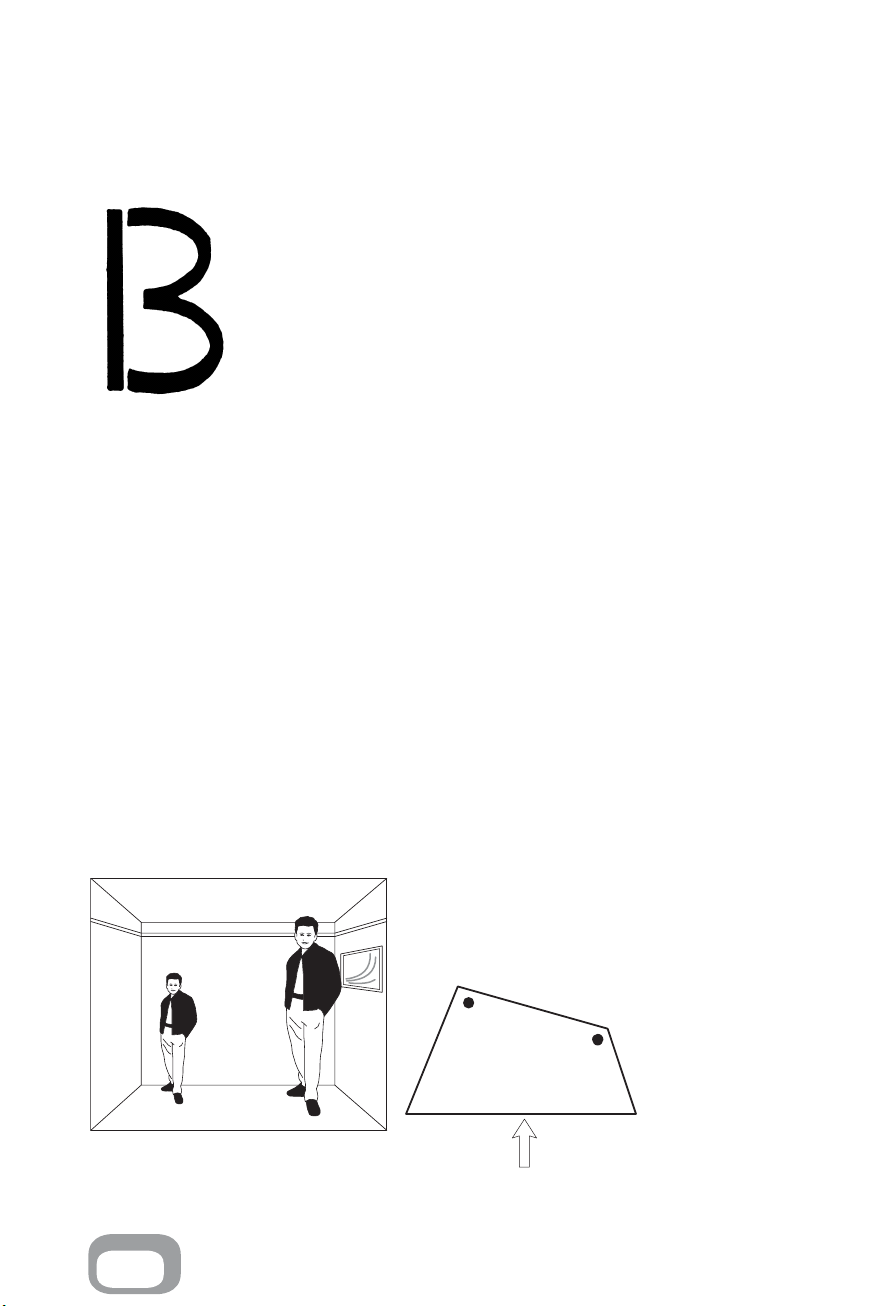
teaching of Ameslan to gorillas or chimpanzees, with a degree of success. Ames room
A well-known visual illusion in which a room is constructed which, when
viewed from a particular viewing point, appears to be normal, but actually has one
corner much farther away from the viewer. An appearance of equal distance is
achieved by carefully balancing the perspectives of the room and the levels of the
floor and ceiling. The effect is that people or objects of the same size appear to be of different sizes (Fig. 2). Floor layout Apparent view Viewing point
Figure 2 The Ames room illusion 14 A amnesia
Loss of memory, normally from physical causes. Retrograde amnesia refers to
loss of memory for events prior to the damaging event or disease; loss of memory of
the few minutes leading up to severe concussion is the most common example.
Anterograde amnesia refers to the loss of subsequent memory, e.g. impairment of the
ability to code new memories after brain surgery or, as found in Korsakoff’s syndrome,
through long-term alcoholism. amphetamine
A drug which stimulates the central nervous system. It is usually
prescribed in order to raise energy levels or to prevent sleep, and is abused (as
‘speed’, etc.) for the same purposes. Amphetamine is also used as an appetite
suppressant to help dieters and to control hyperactive children. amphetamine psychosis
A state of acute paranoia which develops as a result of taking
large amounts of amphetamine over a period of time. anaclitic depression
A depression caused in infants aged between 6 and 18 months by
prolonged separation from their mothers. The term was first used by Rene Spitz, and
was an important concept in early studies of maternal deprivation. anagram
A puzzle or problem which consists of words with their constituent letters
disarranged, such that all of the necessary letters are present but in the wrong order.
The letters may be randomly listed (GAANMRA) or rearranged to resemble other
words (A GRANMA). Anagrams are often used in laboratory problem-solving tasks. anal stage
The second of Freud’s psychosexual stages, in which libido focuses on the
anus. See also oral, phallic stage. analogue
An object or phenomenon which corresponds to, or resembles, another in
at least some respects. The term is used:
(i) in theories of memory referring to information stored in the brain from which
a representation or image of an object can be generated;
(ii) in biology for different characteristics of different species which have the same functions; and
(iii) in electronics for information stored through a continuously variable quantity,
such as, analogue (circular) clock faces as opposed to digital watches. analysand
That which is being, or has been, analysed. Used sometimes to refer to
student analysts undergoing psychoanalysis as part of their training. analysis
(1) Identifying the constituent parts or links of a whole so that it can be
better understood and interpreted, e.g. in statistical analysis.
(2) A shorthand term for psychoanalysis.
analysis-by-synthesis
A term used to describe a cognitive model in which the brain is
seen as combining separate pieces of information about an event in order to make
the best judgement about the nature of that event.
analysis of variance (ANOVA)
A statistical procedure used to test whether groups of
scores differ from each other. The principle is that if the scores are not being
influenced in different ways, the variation (variance) of scores within each group will 15
STUDENT’S DICTIONARY OF PSYCHOLOGY
allow us to predict how much variation there will be between the means of the
groups. If it turns out that the group means vary more than expected, we conclude
that the groups differ (and have therefore been influenced in different ways). Several
different sources of influence can be tested within a single ANOVA design, and the
complex relationships or interactions between them can be analysed. See F ratio. analytical psychology
The system of psychopathology and treatment devised by Carl
Jung after his split from the Freudian school. It introduces concepts such as the
archetype and the collective unconscious. anchoring
In social representation theory, the process of making the social
representation easier to grasp by setting it in a familiar context. In decision-making
theory, anchoring refers to the process of establishing a set reference point or
framework, from which a decision is evaluated. androgens
Hormones produced mainly by the testes. They are responsible for the
physical developments in the foetus which give rise to male characteristics, including
the external genitalia. Later in life they influence sexual activity and the expression
of genetically controlled characteristics, such as the growth of a beard. See testosterone. androgyny
The presence in one person (either male or female) of both male and
female characteristics. In humans, there are no sex differences which are present in
one gender and not the other – it is more a matter of the prevalence and strength of
each tendency. Therefore, everybody mixes male and female characteristics to some
extent, and the term androgyny is reserved for people who show both male and
female characteristics to a significant degree. Research indicates that individuals
who are psychologically androgynous tend to be mentally healthier than those who
conform tightly to orthodox gender stereotypes. anecdotal evidence
Information quoted in support of an idea or theory which has
been obtained purely from everyday experience or accounts, rather than from some
form of systematic or controlled study. anencephalic
Without a cerebrum. Anencephalic infants usually survive for only a few
days after birth, although some have been kept alive for up to 6 months.
Anencephalic infants are of interest to students of neonate functioning, as observable
differences between them and normal infants only seem to emerge after the first few
weeks, implying that cerebral cortex activity may not play an important part in early infant behaviour. angst
A mental disquiet or anguish considered by supporters of existentialism to be
the inevitable outcome of a full appreciation of the implications of personal
responsibility and personal choice. angular gyrus
That part of the cerebral cortex which is involved in the decoding of
visual symbols. The angular gyrus receives input from the visual cortex, and appears
to process that information into a form equivalent to information which has been
processed by the auditory cortex. The angular gyrus then passes messages on to the 16 A
area known as Wernicke’s area, where it is processed for comprehension. Accordingly,
the angular gyrus plays an important role in the process of reading, and it is thought
that damage to this area is the root cause of certain dyslexias. animism
The attribution of living qualities to inanimate objects or phenomena, and
frequently the attribution of conscious awareness. Animism is a powerful trend in
human thought processes, which has been studied mostly in the thinking of young
children. It is commonplace in everyday speech, e.g. referring to the family car as a
person, and occurs extensively in the belief systems of most cultures. anodyne
A pain-relieving treatment or agent. anomaly
A noticeable deviation from what is expected or predicted. anorexia nervosa
A disorder in which the person becomes unable to eat and may
starve to death. Anorexia is most common among teenage girls, and is often initiated
by excessive dieting. Anorexia has been thought of variously as arising from a
distorted body image, as a subconscious attempt to return to pre-pubertal physique
and, by implication, social role, and as an expression of rebellion against
domination by a mother figure. See also bulimia, eating disorders. ANOVA
See analysis of variance.
ANOVA interaction diagram
A diagram that illustrates the way that two variables may
interact with one another in the data. See fig 3.
Figure 3 ANOVA interaction diagram
ANOVA model of attributions See covariance. anoxia
A reduced supply of oxygen to the brain or other tissues. It is particularly
likely to happen to a baby around birth, and can result in brain damage. ANS
See autonomic nervous system. antabuse
The commercial name for the drug disulfiram, which produces an extreme
reaction when taken in conjunction with alcohol. Usually administered by a skin
implant which can last for a month or more, antabuse is used therapeutically in
aversion therapy for alcoholics. The association between extreme nausea and vomiting 17
STUDENT’S DICTIONARY OF PSYCHOLOGY
and alcohol can sometimes produce a lasting aversion to alcohol, enabling the
alcoholic to deal with the problem. antagonistic
Having an opposite effect, working against or competing with something
else. Antagonistic muscles work in opposite ways to one another, e.g. one set of muscles
in the iris contracts to dilate the pupil of the eye, while a different set constricts it. antecedent
Taking place before the relevant event. An antecedent may be the cause
of the event, but it cannot be assumed that it was. See also causation. antecedent variables
Factors in an experiment which precede (happen before) some
other event. Because of the time relationship, the antecedent variable cannot have been
caused by the subsequent event, and may even have been a cause of it. See causation. antenatal
To do with the period before birth. anterograde amnesia
A form of amnesia (i.e. loss of memory) in which the person
becomes unable to store new information, although memories which were laid down
before the amnesia-producing event remain intact and accessible. See also retrograde amnesia, amnesia. anthropology
The study of different human societies, involving a particular emphasis
on social structures and belief systems. An anthropologist is one who undertakes
such a study, often using non-participant observational techniques. anthropometric
To do with the measurement of parts of the human body, or of the human body as a whole. anthropomorphism
The attribution of human qualities, such as personality, emotions
and motives, to animals. See Lloyd Morgan’s canon. anticipation
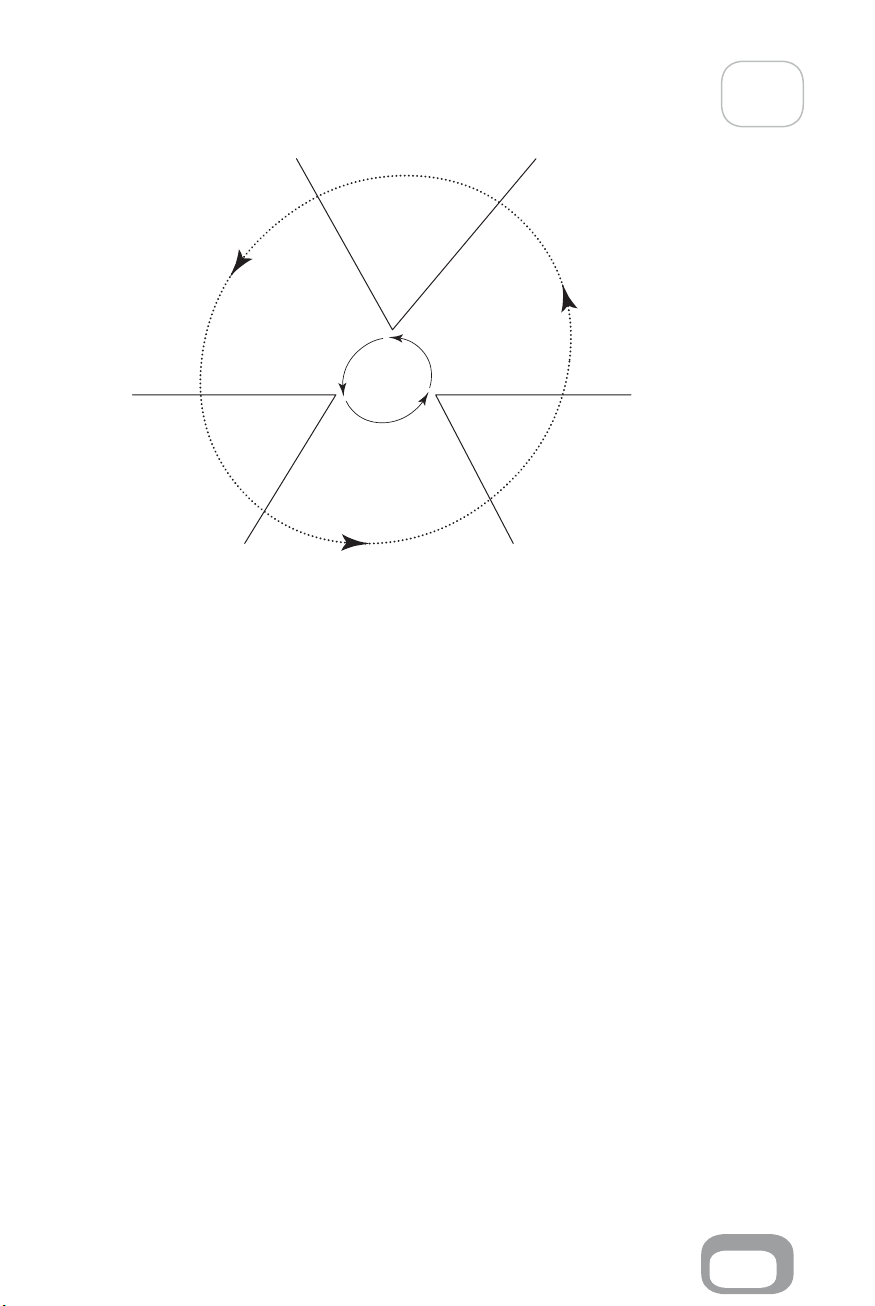
A mental state of readiness for a specific event. See also set. anticipatory schema
A concept put forward by Neisser, whereby an anticipatory
schema forms an essential cognitive component in the cyclic process of perception. An
anticipatory schema consists of a set of cognitions derived from the individual’s
beliefs and experiences, based on observations of the situation, and concerning the
most probable outcomes of action. This schema will be utilised in the selection of
appropriate behaviour and actions. These in turn will change or modify the
situation, producing a new sample of observations. These new observations then
modify the anticipatory schema. Neisser considered this continuous cyclic process to
be the key to an understanding of human cognition (Fig. 4). antidepressants
Drugs such as those known as ‘tricyclics’, which are used to treat severe depression. antilocution
Encouraging social prejudice by using verbal communication in a
particularly negative way, e.g. by using emotively loaded words and metaphors. anti-positivism
An approach to research which emphasises the human interpretation
of meanings and implications; introduced as a challenge to hard-line positivism. See
qualitative research, hermeneutics. 18 A Real world Present environment Modifies Samples Schema of Perceptual present exploration environment Directs Actions and Cognitive map of movements the world and its possibilities
Figure 4 The perceptual cycle anxiety
A stressful state resulting from the anticipation of danger. Anxiety has a
physiological component (the alarm reaction or fight-or-flight response), a cognitive
aspect, particularly in narrowing attention, and a subjective experience of
discomfort. Each of these components may help the person to deal effectively with
clearly recognised, real and immediate dangers, but can be damaging both
psychologically and physically when the anxiety persists, as in occupational stress or
unresolved unconscious conflicts. anxiety disorder
General term for psychological disorders in which chronic anxiety,
with debilitating consequences, is a prominent feature. Includes panic attacks and phobias. apathy
A mental state characterised by lack of interest in everyday or momentous
events, and involving a disinclination to exertion or effort in order to effect or
achieve results of any kind. The state is characteristic of depression. aphagia
A lack of eating, which can be induced experimentally by lesions in the
lateral hypothalamus. Animals with aphagia show no interest in solid food, to the
point of starvation. Aphagia is believed by some physiological psychologists
(although not all) to be a mechanism in anorexia nervosa. aphasia
A disorder of speaking, sometimes brought about by lesions in Broca’s area –
the area of the cortex involved in speech production. The affected individual has
serious problems in articulating words, although they have no difficulties in understanding language. apnoea (apnea)
Temporary stopping of breathing, common among premature
babies. It is present in some adults during sleep, and is believed to result in the 19
Tài liệu liên quan:
-
Câu hỏi ôn tập chương 2 Học phần: Tâm lý học (Bài giảng Elearning) | Đại học Thái Nguyên
28 14 -
Đề cương ôn tập môn Tâm lý học | Đại học Thái Nguyên
30 15 -

Exploring Psychology in Language Learning and Teaching Marion Williams Sarah Mercer Stephen Ryan Giáo trình tâm lý học | Đại học Thái Nguyên
28 14 -
Đề thi môn Tâm lý học | Đại học Thái Nguyên
32 16 -
Câu hỏi trắc nghiệm ôn tập môn Tâm lý học | Đại học Thái Nguyên
32 16