Sách The power of reading handbook
Sách The power of reading handbook. Tài liệu được sưu tầm giúp bạn tham khảo, ôn tập và đạt kết quả cao. Mời bạn đọc đón xem.
Môn: Tài liệu Tổng hợp 3.6 K tài liệu
Trường: Tài liệu khác 3.9 K tài liệu
Tác giả:















Preview text:
The Power of reading handbook british council 5 The Power English languagE TEachEr of reading DEvElopmEnT projEcT handbook the power oF reading handbook Picture by Gerry Fox
2 british The Power of council reading handbook Contents SecTionone
what is the Power of reading? 4 SecTionTwo
Planning a book flood project 6 SecTionThree Planning a book flood in your school 11
a. what to do with the books 12
b. assessing progress in reading 21 c. Planning and preparing reading environments 24
d. engagement and capacity building across the wider school 25 SecTionfoUr further reading, materials,
resources and references 27 Published in 2014 by british council Malaysia the british council 142c Jalan Ampang 50450 Kuala lumpur Malaysia
sections of this handbook are taken
from previous work by J.r.A. Williams Printed in Malaysia Acknowledgements:
Thanks to all the teachers and mentors who
took part in the ELTDP Power of Reading
pilot for their invaluable contributions to this handbook. The Power of british reading handbook council 3 SecTionONE What is the Power of reading? the Power of reading is a book-based approach that motivates children and provides them with good
English by ‘flooding’ their
classrooms with lots of attractive
books. For this reason, the method
has been called a ‘book Flood’. At
the same time, their teachers use
simple methods to make sure that
children interact regularly and pro- ductively with the books. the research done on this ap-
proach shows that it works well in
many different countries and cul-
tures. it accelerates all aspects of Picture by Gerry Fox
children’s language growth. it does
not require many hours of teacher
asked what they hoped the project
their children’s education.
training and it is not necessarily
would achieve for them and others,
• Parents and teachers coop- expensive.
the benefits of the Power of read-
erating to support children’s
the Power of reading pilot pro- ing were predicted to be: reading.
ject conducted by the british coun-
• Parents reading with their
cil in East Malaysia through the for pupils children at home.
british council English language • Improved English.
• Parent’s ability and inter- teacher Development Project • Improved literacy.
est in reading and in english
(EltDP) showed that ‘Every partici-
• Improved attitudes/motiva- increases
pating Por school reported that
tion towards english and
the project has benefited pupils, reading. for schools
particularly in regards to pupils’
• Improved academic results.
• Schools providing inviting
enjoyment of and positive attitudes
spaces and activities to en-
towards reading.’ in less than one for teachers courage reading. school year, the Por interven-
• Use of books to support
• Schools acting as a resource
tion nearly doubled the number of teaching and learning.
base and example for other
pupils who were able to read fiction
• Improvement in the teachers’ schools.
texts for information in English, and level of english.
• Schools achievements being
positive attitudes towards reading
• Increased teamwork between recognised.
grew by 50% after the arrival of the
teachers and with parents. Por books. When the results of the pilot
When head and senior teachers,
for parents and communities
project were examined by an ex-
teachers, parents and pupils were
• More parents involved in
ternal evaluator, he said that:
4 british The Power of council reading handbook
• [Teachers] have developed a
culture of sharing resources.
• Interest in using ‘running
records’ as a means of meas- uring students’ progress in reading
• A change in attitude towards
their students and a greater sense of their students’ po- tential. for parents
• There have been many exam-
ples of positive engagement and support from parents.
• Awareness raising amongst
parents about the benefits of reading/literacy and the ad- vantages of parental involve- ment with/support for their
children’s reading (even when
parents are themselves illiter- ate) for schools
• In many schools, the efforts to revamp and use librar- ies for Por activities have clearly had benefits for the whole school and have en- ticed other (non-project/non- english) teachers into using
the library for their teaching
spontaneous interactions and learning activities for pupils between students.
• The benefits of attractive, in-
• Many schools have reported
• Parents have noticed their
viting and comfortable library
that pupils often request
children displaying an in-
spaces (and spaces in which
the Por books and in some
creased desire to read with
interesting and creative
cases, pupils were reminding them.
teaching/learning activities
teachers of reading times
take place) extend beyond
and to allow them to read for teachers
the teachers and students to
silently, or engage in reading
• Teachers have developed/ex-
involve parents as well.
activities (such as storytell-
panded their teaching skills ing).
in response to the Por books this handbook will use the
• The POR works well for pupils and project activities.
experience of the Power of reading
as a spark and inspiration
• Teachers’ confidence and
pilot project, and the best scientific
towards future learning.
proficiency in English has in-
evidence from around the world to
• The POR has been noted in
creased as a result of involve-
show how schools, teachers and par-
some schools to encourage
ment with the project and
ents can organise their own Power
the development of deeper exposure to Por books. of reading programmes to gain
thinking and comprehension
• Many teachers have engaged these benefits for all their children. skills.
in active storytelling with Watch the Por video introduc-
• The POR has led to improve- their students.
ing the ideas behind the pilot at
ments in pupils reading and
• Teachers had increased their
www.youtube.com/user/ELT-
writing, sustained engage-
confidence and interest in
DPMalaysia – search for ‘EltDP
ment with Por books and lesson planning. Power of reading. The Power of british reading handbook council 5 SecTionTWO Planning a book flood project Funding opportunities
(EltDP). Part of the pilot was to
and others as possible to discuss:
look for other sources of funding SchOOlS
for taking the project to other and districts can find Present
schools. this included approaches
their own funding for a book flood.
• Availability and use of books.
to state foundations and large through school boards, Parent
• Co-operation among teachers. corporations.
teacher Associations, Members of
• Involvement of parents and
Parliament and other local contacts, families. Expressions of interest
schools can contact local founda-
tions, businesses and philanthro- Plans for
the Power of reading pilot was
pists who would be willing to be
• Storage and security of books.
keen to have schools volunteer for
party to such a successful enter-
• Responsibility and accountabil-
the project to make sure they had prise.
ity for keeping and using books.
the enthusiasm and capacity to Many companies have • Access to books.
make the best of the investment.
corporate social responsibility
• Capacity building so the books in the pilot, schools were
(csr) funds and are often on the
will be used effectively (pupils,
invited to submit ‘expressions of
lookout for straightforward and
parents and families, teachers). interest’ summarising:
good quality projects in which to
• Potential barriers and proposed
invest. search the internet under solutions.
• How the books might be used
’csr Malaysia’ for many examples • Others issues. and why. of such companies.
• Why this school should be cho- the books for the Power of sen.
School-level implementation
reading pilot were paid for by the plans
Ministry of Education through the
Every school starting on Power
british council English language
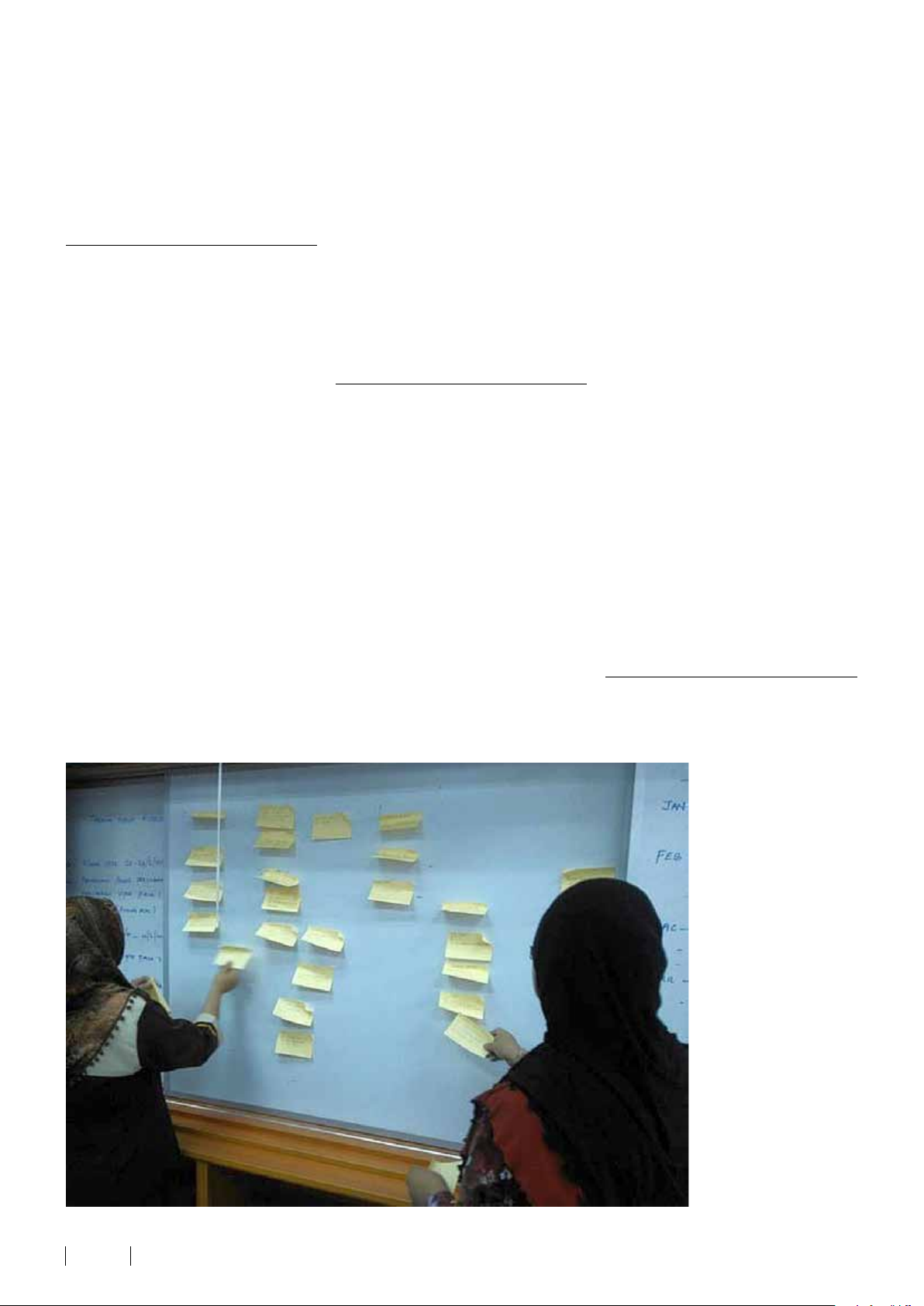
of reading should involve as many From these discussions, teacher Development Project teachers, management, parents schools can draw up plans. Power of Reading planning at SK Sembirai.
6 british The Power of council reading handbook SecTionTWO cASE STUDY >
school as our English committee
and the preschool teachers. it can
is planning to create an English
be used as a resource to help the
Example of a plan drawn up learning centre at our school in
preschool teachers to start early by teachers
the future. should we be given the reading especially for the English SK Bunga Raya
books, we will try our best to find language.
a place to put them, for example
establish a culture of children Supporting statements by placing them in one of the
taking home books to share
ThiS is a kampung school in an
classes for the time being. Anoth- with parents
isolated corner of our district.
er solution is to place them with if we have the chance to get teachers make full use of the
the school’s boarders and create
these books, we will make sure we
school library by taking children
an English library which can ac-
establish such a culture. this will
in groups to access books freely.
commodate the pupils’ need for
also help in the learning process there are a limited number of reading materials. at home and at the same time
titles in English mostly from old We strongly believe that a
will enforce the habits of reading reading schemes. these books thousand good quality English among family members.
are well cared for, but do not of-
books would have a great impact
fer children a variety of books to
on teaching and learning in our
establish a library for board-
capture their interest and imagi-
school and we see it as a long-
ers to be accessed outside of
nation. the library offers plenty
term investment and an on-going school hours of storage for more books and process. the teachers would it is one of the English com-
the library staff would give their
benefit from it as they can use the mittee’s plans to establish a
full support should this school be
books as a teaching resource in
library for boarders, to be ac- chosen. class.
cessed outside of school hours,
the English team at the school
so that boarders can spend their
work well together to organise Management time usefully and at the same
and plan English events for the Presently, the children and time can improve, enhance and
pupils. Following well-attended local community are dependent enrich their vocabulary and workshops, parents have begun
solely upon the school library grammar in the English lan-
to use songs, rhymes and games
since there are no libraries or guage.
with their children outside of
bookstores in the area or town. teachers have given consid-
school and are extremely keen to
the books at the schools, sadly,
eration to the logistics of how to
help their children in other ways.
are old and the insufficient for the receive and organise the books. the school is part boarding.
children’s needs. the headmas-
they plan to work with librarians
staff are responsible for the care
ter is fully supportive of the Por
with the books in the unused gov- of these children from Monday
Project and believes that reading ernment computer room and to
night through to thursday night. is the power of knowledge.
sort what they receive into books
currently, the children do their
they wish to use throughout the homework during this time and
Implementation consultation year to support the textbooks discussion comments:
are left to watch television each
and to be used for storytelling
evening. there is a captive audi-
replenish current outdated
in class, books to go straight
ence for books during the week
books in the school library
into the library and those which and the teachers plan to make it will help because most of
would be most enjoyed by those
a library of books available for
the books are outdated and not
children boarding. they have re- these children to enjoy each
suitable for young readers. Also,
quested that there be more sto- evening.
many of the books in the school
rybooks included with colourful are in bahasa Malaysia.
illustrations to attract the young- Project teachers
er readers. responsibility for the We think that our school
establish a reading corner in books would be shared jointly should have these books as it preschool between the head teacher (Gb)
will help us improve our pupils’ these books will help to
and the English panel. the school
English proficiency and cultivate establish a reading corner in
librarians have also agreed they
good reading habits. these books the preschool with cooperation
would lend their support to the
will be a great investment for our between the English committee project. The Power of british reading handbook council 7 SecTionTWO cASE STUDY > Example of a follow-up action plan drawn up by a group of teachers, PK and parents. SJK Bulat action plan: l big storybooks: teachers to read to pupils, to conduct shared reading and use as a base for follow up activities such as language arts activi- ties. TDP l
Multiple copies of books: to be used for guided reading, read- ing at home and self-access. there are not enough books for these activities so more books will be produced. esy of mentor in the EL l books would be made avail-
able to pupils in the classroom for self-access. Photo court l Four extra periods will be added to the level 1 timeta-
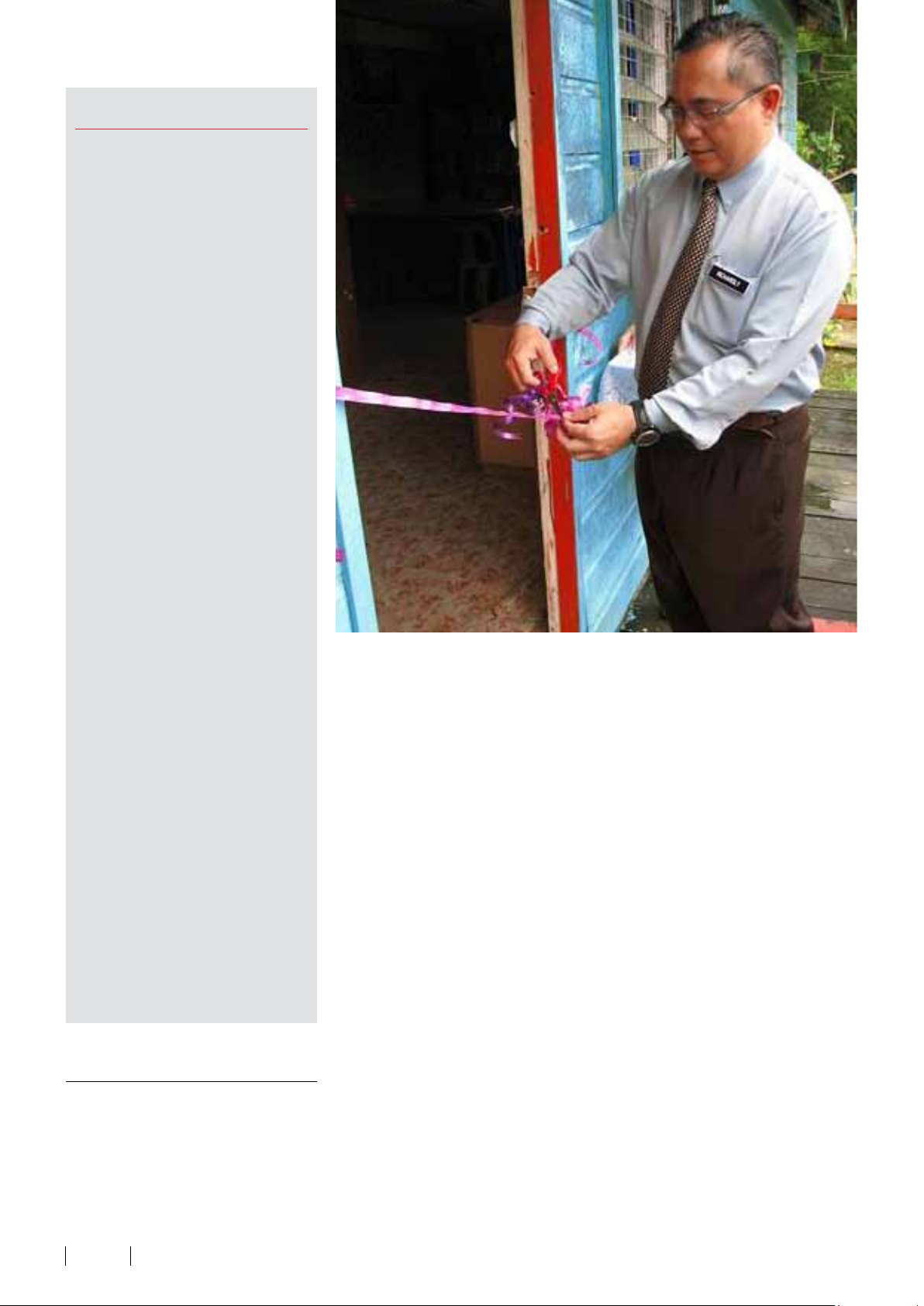
Ribbon-cutting by Language Officer at SK Nanga Lipus ble. l lessons using or based
attend all meetings and be part of
ing approach. Even though Power
around storybooks will take up
every activity, but it is very important
of reading fits perfectly with the around four periods a week.
that they are informed about what
requirements of the school cur- (the two extra periods and
is happening and have a chance to
riculum, they may feel that story- one double period. leaving offer their ideas.
telling or silent reading is not the
three periods for other English
sort of teaching that they expect. lessons.)
“Our school works together – that
therefore it is very useful if inspec- l storybook lesson plans and
means the GB, PK1 and myself, we
tors are informed from the outset
resources will be filed centrally
are all supporting this together.”
of plans for Power of reading, so and shared.
– Head of English Panel, SK Sentosa
when they visit classes they can l the library will be decorated.
appreciate the progress that pupils l level 1 classrooms will be are making. rearranged to allow for Por
Pejabat Pendidikan daerah activities. (Access to a mat
(PPD)/District Education Office
“When the inspector came into my for story time, group reading
the language officer responsible English class he was surprised that
activities and storage of books
for English in schools can be a big
the children can read and answer for self-access.)
help in designing and carrying out a questions. He asked me how this
Power of reading programme. Keep could be.” Informing and engaging
your PPD informed of what you are
– Teacher at SJK Chung Hua Authorities
doing, and invite your language
officer and school improvement
Local responsibilities and ac- gbs and other managers coaches to offer their input. countabilities Gbs and their deputies (PKs)
there are often resources sent
should be involved from the very inspectorate
to schools which do not get used
beginning in planning for Power of
sometimes the nazir or inspec- because nobody takes respon-
reading in the school. busy sched-
tor visiting a school may not be
sibility for them. there needs to
ules might mean that they cannot
aware that there is a Power of read-
be a plan for who will receive the
8 british The Power of council reading handbook SecTionTWO
books and look after them, and
tor asked for volunteers to become children home with books that are
who will make sure that they get
’Power of Reading Librarians’ and
at their reading level or just above. into the hands of pupils.
selected a total of eight: one boy
These books help solve the prob-
in one school, ‘Older students
and one girl from each of the year
lem of not having enough books.’
and parents along with teachers/
groups. The librarians were respon- – SJK Bulat
GB are responsible for the receipt, sible for keeping the shelves tidy,
covering and cataloguing of new
making a sign for the POR corner, You can find ideas for books,
books. Good activity to teach
making posters to put around the and download the books them-
students responsibility as well as
school, alerting the librarian to
selves from the internet. try search-
to engage a true community spirit, books that needed repair, and help-
ing ‘free books for children online’.
i.e. these books are for ‘all of us’.
ing promote the books in Power of
the best books are likely to be
it was agreed in another school Reading assemblies.
those that are produced for the
that ‘responsibility for the books
– SK Tanjung Aru
commercial market. these may be
would be shared jointly between
stocked in book shops in the big-
the GB and the English panel’.
Selecting and ordering books
ger cities. to see what is available in many towns, there are
it is best to use the internet. www. POR Library Room
cheaply produced books available mycen.com.my/malaysia/book.
in local stationary and book shops. html has a good list of Malaysian
First stage of the POR project
it is worth looking at these as
publishers and distributors. the
involved the transformation of an
they are the most easily available.
british council often uses www.
old store room into a bright colour-
Good books will have been writ- kinokuniya.com/my.
ful library. Teachers created a plan
ten for enjoyment. it might be best A shop which concentrates on
of ideal library and contents and
to avoid toy, tV and film tie-ins
affordable reading is www.leobook-
from that a list was drawn up of pos-
because these have usually been store.com/about.php.
sible items needed. A meeting was
produced to sell other products. the Power of reading brought
held with the GB and the PTA where
books designed for ‘learning’
all its books from overseas suppli-
the POR project was explained and
such as alphabet, dictionary and
ers. these were of the best quality
a book sample was shown. The PTA
vocabulary books lack the sort
in terms of production and con-
agreed to fund room renovation
of text which will draw children in
tent, and of course tend to be the
– the paint, floor covering, tables,
to the book and encourage read-
most expensive. to choose these,
chairs and book borrowing station.
ing fluency. Avoid ‘sticker books’
and get the best idea of the books
– SJK Chung Hua
because they lose much of their
published in the English speaking
point after the stickers are used.
world, visit www.amazon.com/chil- once the books are in the
the same shops might also sell
drens-books/ or www.thebookpeo- school and displayed then the
paper, card, pens and decorations
ple.co.uk/ which has many books idea that the books are every-
that can be used to make attrac- at discounted prices.
body’s responsibility seems to
tive books. teachers, parents and
When looking for books to buy,
be a good way of working. this
children can even recycle paper
use this list of headings to help
means that instead of just check-
and cardboard to make their own
you decide if the books are the
ing how the books are being kept
books. there are many ideas for best for Power of reading: and used, people can ask them-
how to make books on the inter- l
the subject matter (i.e. is it a selves whether they are doing
net, try searching ‘making books strong story? is the content
their best to make sure that the for children’. powerful and imaginative?)
Power of reading is having its l
the illustrations (i.e. Are they
effect. the best resource for this
‘We want to make more sets of interesting? Do they comple- can be the pupils.
small books. Either from the Read- ment the text?)
ing A-Z website (www.readinga-z. l
the style and complexity of the
Electing of ’Power of Reading
com/books/) or books teachers
language (i.e. is the language
Librarians’ from amongst exist-
make themselves. At the moment memorable? natural?) ing pupil librarians
there is no problem printing and l Anything else that you notice
photocopying as many of these as from your examination. (i.e.
The school has about 20 pupil
we can. These books are valuable humour? repetition?)
librarians selected from Years 3, 4,
because they give us an opportu-
there will be more about choos-
5, and 6. The librarian and the men-
nity to do guided reading and send ing books in the next chapter. The Power of british reading handbook council 9 SecTionTWO
Supporting teachers to develop
it is important that books for
read, and a storage area for some methods
the Power of reading are used and of the books. A successful Power of read-
continue to be used by pupils. in
ing is a school-wide project which
section 3, we will look at some of
‘Each of the classes discussed a
involves pupils, their families and
the ways that teachers and others
theme for their reading corner,
others from the community, Gbs,
can use books in their lessons. but and the class teacher was put in
PKs, staff from the PPD, inspectors, schools have found that making
charge of decorating, assisted by
and teachers of all subjects. but it
it easy for pupils to access the one other teacher.
is most important that the English
books is one of the best ways to
We prepared interactive lan-
teachers work together to make
make sure that the books are used guage games, such as puzzles and
sure that the pupils get the most most productively.
puppets, and hung them in plastic
out of the books in the school.
envelopes in the reading corners
to do this they need to develop Storing the books
to encourage pupils to learn more
methods and activities that will
if the books are to be kept in
vocabulary and to make use of
support and encourage pupils to
the library or a special room, then
the knowledge they gain from the
read and enjoy books in the class-
the children should be able to use books. room and outside. Among these the books before school.
The pupils really enjoy being
should be storytelling and reading set up a system so the pupils
there. In making the games and
to children, reading with children can borrow books for a week.
activities, teachers were able to and reading by children.
Encourage parents to come in to
learn more about how to engage some techniques for these can
the library to help children choose
children with reading and the
be found in section 3 (‘Planning
their books. schedule lessons in
importance of a language-rich en-
a book flood in your school’), but
the library. if possible, make the
vironment, and could adapt these
there will always be more. teach-
books available at the busiest
activities to different subjects.’
ers can help each other to look for place in the school. some schools – SK Poring
support from around and beyond
have set up a display of books in
the school, and especially use the school canteen. assessment processes
libraries (for instance, the teachers
the best place for the books is
the Power of reading pilot was
resource centres) and the internet
in the classroom with the children.
careful to measure the progress
to search for and share ideas.
try setting up a mini-library in
that pupils made when the books teachers can try out new meth- each classroom.
were introduced in their school.
ods in the classroom and think
often it is difficult to keep them
First of all there was the new about how they might improve
there because of damage by the
school-based assessment system
on them or adapt them to their
weather or animals, or because
(Pentaksiran berasaskan sekolah
particular situation. it is always
the classroom is used for other
or Pbs) which includes several
a good thing to talk about and subjects and different school
learning standards, instruments
discuss these thoughts with oth- shifts.
and evidence of pupils’ literacy
ers, so teachers can plan to meet if the books must be locked development.
regularly as part of the Power of
away overnight, use baskets to then a technique for record- reading approach.
carry them to and from the class-
ing reading level called “running rooms.
records” was introduced which
ensuring children interact
teacher’s used to make detailed
regularly and productively displaying the books
notes when listening to children with books
Wherever the books are stored, read. Many schools have resources
display them at a height that can Finally there was a measure
which are not used. these might
be easily seen by the smallest
to try and record the changes in
out of date from a previous cur-
children, and showing their covers
individual pupil’s reading profile in
riculum, they might be damaged
in an attractive way. Make sure that terms of their attitudes to reading
or not immediately usable, or they
any special displays of books are in English.
might be the product of an initia- changed regularly. the important thing about
tive which has now passed. some
any good assessment is that they storerooms contain books and reading corners
provide information that can be
other equipment still unopened in reading corners provide a
used by the teacher and pupils as their original packaging.
comfortable place for pupils to a guide to what to do next.
10 british The Power of council reading handbook SeCTionTHREE
Planning a book flood in your school Choosing the books
equivalence of the text, or have amusing rather than humorous no relationship to the text,
are also common, as are visual
THE Power of reading tried to
either of which might lead chil- jokes and asides which might
choose books which would be at-
dren to attend less to the print.
appeal to grown-ups as well as
tractive and interesting for pupils
in the best books, the illustra- children.
in Malaysian primary schools. the tions enhance and enrich the level of the language was
story, and often allow for paral- the best books are the books
considered in terms of the capaci-
lel stories to be constructed by that children choose for them-
ties of the relevant age group and the reader. selves.
it was found that books designed
• There is no attempt to simplify
for English as a first language for
the language as such. it is often
‘The students always see the books
children aged zero to seven were
repetitive, and referring to the
and love looking at them even if they the most appropriate. here and now rather than to
cannot read them – they still like to beyond that, language was not
abstract concepts. it is natural
look at them. The early finishers in
graded so that the full range of
rather than contrived, although
class always go and read the books’.
natural language was available. this often rhythmic and highly ex-
– Level 1 teacher, SK Sepagaya
fits with research showing that that pressive.
individuals will draw on the ele- • Most successful books for
‘My Year 1 pupils became addicted
ments of language input which are
children have a strong element
to the English story books. The Eng-
immediately meaningful and useful,
of humour. the fact that to be
lish story books have many colourful
and so it is not essential to under-
successful the books must also
pictures and cute animations which
stand every word in order to enjoy
appeal to adults, both as buyers can attract the pupils’ attention and a story and learn from it. and readers, might have a lot
get them interested in books.’
to do with this. themes that are
– Year 1 and 4 teacher, SK St John
in an attractive and high quality book:
• The storyline is strong, there is an attempt to engage the
reader in wanting to know what
happens next. subjects are cal-
culated to be of interest to the
age group, often featuring char-
acters of the target age. All the
elements of story are involved:
setting (character, location and
time); theme (an event and a
goal); plot (various episodes with goals and outcomes);
resolution (almost always a
twist, something unexpected, or jokes for the climax).
• The amount of text is limited on the page, sometimes one line,
rarely more than ten lines, and
the font size is set 18 point or
larger. the text often has poetic
qualities, being lively, rhythmical and rhyming. Picture by Gerry Fox
• Pictures are neither the direct
Storybooks have many colourful pictures which the attract pupils’ attention The Power of british reading handbook council 11 SeCTionTHREE (A) What to do with the books
THE following are descriptions
recognise structures of language,
Students generally want the teacher
of several widely used and effec-
construct their own understanding
to repeat stories – they have their
tive methods for the promotion of and express their thoughts.
favourite books. Teachers notice
reading in the classroom. it will be With good quality storybooks,
that even after repeated listening
seen that each has particular goals all teachers can become expert
students are still happy to hear the
in developing children’s reading
storytellers and take advantage of book.
strategies towards the ultimate these natural advantages. – SK Sembirai
aim of independent and continuing
reading. the principle behind each For teachers, the biggest success after the story
is that reading should be an enjoy-
is in attracting students to listen to
Encourage pupils’ response to
able and relevant experience al-
storybooks and remember language the story by for instance, retelling,
lowing for individual development.
from the story. Teachers feel that
summarising and analysing (per-
the methods also encourage the
by making storytelling fun, students
haps in their own language). Get
use of authentic and whole texts
will love to listen and are able to
them to generalise about stories
so that the full range of natural lan-
respond. From this, they understand
like this and to compare with other
guage is available, the belief being
and learn new words – it’s fun but
stories they know. Affirm, praise
that individuals will draw on the
at the same time, they learn. One
and accept the pupil’s ideas.
elements of input which are imme-
teacher noted that some students
children can respond by talking,
diately meaningful and useful.
are not just using words, but phras-
singing, role-playing the char- Further, although the goal is
es and sentences from the books.
acters, making and playing with
individual and independent read-
They even heard words that they
toys, masks and puppets, drawing
ing, the teacher has an important
think the students must have ac-
(charts, diagrams, maps, plans as
role in providing scaffolding and
quired themselves from the books.
well pictures) and writing (look at
support for children’s efforts in – SK Sembirai
some suggestions under ‘shared achieving this goal. taken to- Writing’ on Page 17).
gether, these techniques can be
Tips for great storytelling seen as the outcome of a bal- before the story
‘The books produce lots of storytell-
anced methodology which allows
look at the cover and pictures.
ers in class – the children like to
for individual, group and whole
Discuss the title. Encourage the
talk about the books – they talk with
class work, instruction and discov-
pupils to predict what the story
their friends, they talk about the
ery, challenge and consolidation,
might be about. talk about the pictures.
and ultimately the opening of an
subject matter, ask the pupils what – Teacher, SK Sentosa
avenue for every child succeed as
other stories they know that might a reader.
be similar. Ask about their expe-
remember to pass on these tips Reading to children
riences that might relate to the
to parents and families. they can
story. Encourage children to re-
use the books their children bring Storytelling
spond in bM or their first language
home ‘to significantly raise student stories have been shared in if they need to.
outcomes’ by ‘reading to their
every culture since before writ-
children on a daily basis.’ (Malaysia
ing was invented. storytelling is a reading to children
Education blueprint 2013-2025) means of entertainment, educa- tell the story with animation You can see teachers using
tion, and passing on cultural and and expression. use different
some of these techniques in the
moral values. in traditional class-
voices for different characters.
Por Videos at www.youtube.com/
rooms, story time was an important Vary your tone, intonation and user/eLTdPMalaysia
and much-loved part of the day
volume for dramatic effect. use
which encouraged children to ob-
gesture, body language and facial
• ELTDP Power of Reading, Read-
serve, listen, and participate in pre-
expression to get over the mean-
ing to children, before the story.
diction and problem-solving. in the
ing. Encourage the pupils to join in • ELTDP Power of Reading, Read-
language classroom, listeners can
with choruses and repetitions.
ing to children, After the story.
12 british The Power of council reading handbook SeCTionTHREE (A) Reading with children a meaningful way.
there may be other new words in
rather than using ‘big books’ for
the book which the children may Shared reading
shared reading, the Power of read-
be able to work out for themselves shared reading is a method in
ing collections provide a selection using context.
which teacher and pupils read a
of picture books that teachers can
text aloud. this is typically done by
share with the pupils. some teach-
When they realised that pupils could
having the children sit on the floor
ers and parents made their own big
look for clues such as illustrations
in front of the teacher who displays
books based on the Por stories:
to predict meaning, teachers were
the book. the procedure for shared
more relaxed about reading books
reading can vary, but it usually
Adapting a story and turning it into a which at face value seemed too
involves a series of sessions starting big book provides reusable teaching difficult. A classic example of such
with a prediction of the story from
aids for me in the future. I can even
a book is Room on the Broom. The
the title and any illustrations.
put the big book at the exhibition
structure of the text and the lan-
the teacher will then read the
corner in the library and encourage
guage is quite sophisticated but as
story allowing the children to follow
the children to read it during their
the story is enjoyable and the book
the text. sessions will gradually free hour.
written in rhyme with beautiful illus-
build with children joining in with the – SK Patau
trations, pupils always love listening
reading where they can. by the final
to it an d in this way get a feeling for
session, the children will have read
effective shared reading needs
the rhythm of the language.
the story aloud, some being able to
• enjoyable texts which are pre-
– SJK Chung Hua
‘read’ the text independently. sented with enthusiasm by the
shared reading provides enjoya- teacher; Pre-reading
ble activities where children can see
• to involve the children as before a shared reading ses-
how cues are used to make sense of
quickly as possible with repeat-
sion, set the scene by activating
what they want to read. the teacher
ed phrases and themes (‘i’ll huff
background knowledge. show the
models using phonics (how to iden-
and i’ll puff and i’ll blow your
children the cover of the book.
tify beginning and ending sounds,
house down’; ‘We can’t go over
Ask them about the picture on the
ends of words, rhyming words),
it we can’t go under it we’ll have cover. try to get them to tell you all
recognising spelling and grammar
to go through it’; ‘rumpeta,
they know about the main topic. tie
features in the text, and using pic- rumpeta, rumpeta’);
it to some topic they know about.
tures and other cues to get mean-
• drawing pupil’s attention to
ing. teachers can talk aloud about letters and sounds, meaning while reading
what they are doing and why as they making strategies, etc. children must be able to see
model it in different ways and in dif-
• to link shared reading to other
and follow text read. children read
ferent contexts. children are shown
reading activities, talk and writ-
with the teacher who can point to
and encouraged to apply both ‘top- ing.
the words. shared reading gives
down’ strategies like prediction and
the teacher opportunities to model
using context, as well as ‘bottom-up’
features of shared reading
the reading strategies (‘What
strategies like sounding out and syl-
(Note the contrast with storytelling
do you think the next word is?’,
labification, to their reading.
while using the same ways of bring- sounding out, etc.)
real learning involves taking risks ing the story to life with enthusiasm,
Give your pupils opportunities to
and making mistakes. the ability to
drama and participation)
become familiar with the sound and
make a good guess is essential to Decide which vocabulary items
look of language used in books. Ask
learning. in story sessions, pupils
the children need to know if they
questions which will encourage the
will be willing to take risks based on
are to understand the story. Pre-
children to predict what will happen
what they hear and see – pictures,
teach and check for understanding
next, e.g. ‘Where do you think the
illustrations, title, print cues. by ac-
of these words before you show
kitten will go next?’ ‘What do you
cepting their approximations and
the children the book. You can do
think will happen to baby hippo?’
through asking questions which help this by using real objects, pictures,
them to get meaning from the story,
mime, translation – or any other Post-reading
the teacher can facilitate pupils in way you can think of.
Ask questions to make sure the
learning to use good strategies. this You do not need to pre-teach
children understand the story:
way they are building the skills and
every new word – just those which
• Well, what happened at the end
confidence to understand a story in are crucial to comprehension. of the story? The Power of british reading handbook council 13 SeCTionTHREE (A)
• How was the problem solved? • What happened to ______?
(good character/ bad character)
• What would you have done if you were ________?
Ask questions that allow children
to use their imagination and show
their understanding of the story:
• How old is Jack? How tall is he? What colour hair or eyes does he have?
• Jack and his mother are poor. Draw a plan of their house? Describe it.
• What do you think they eat for
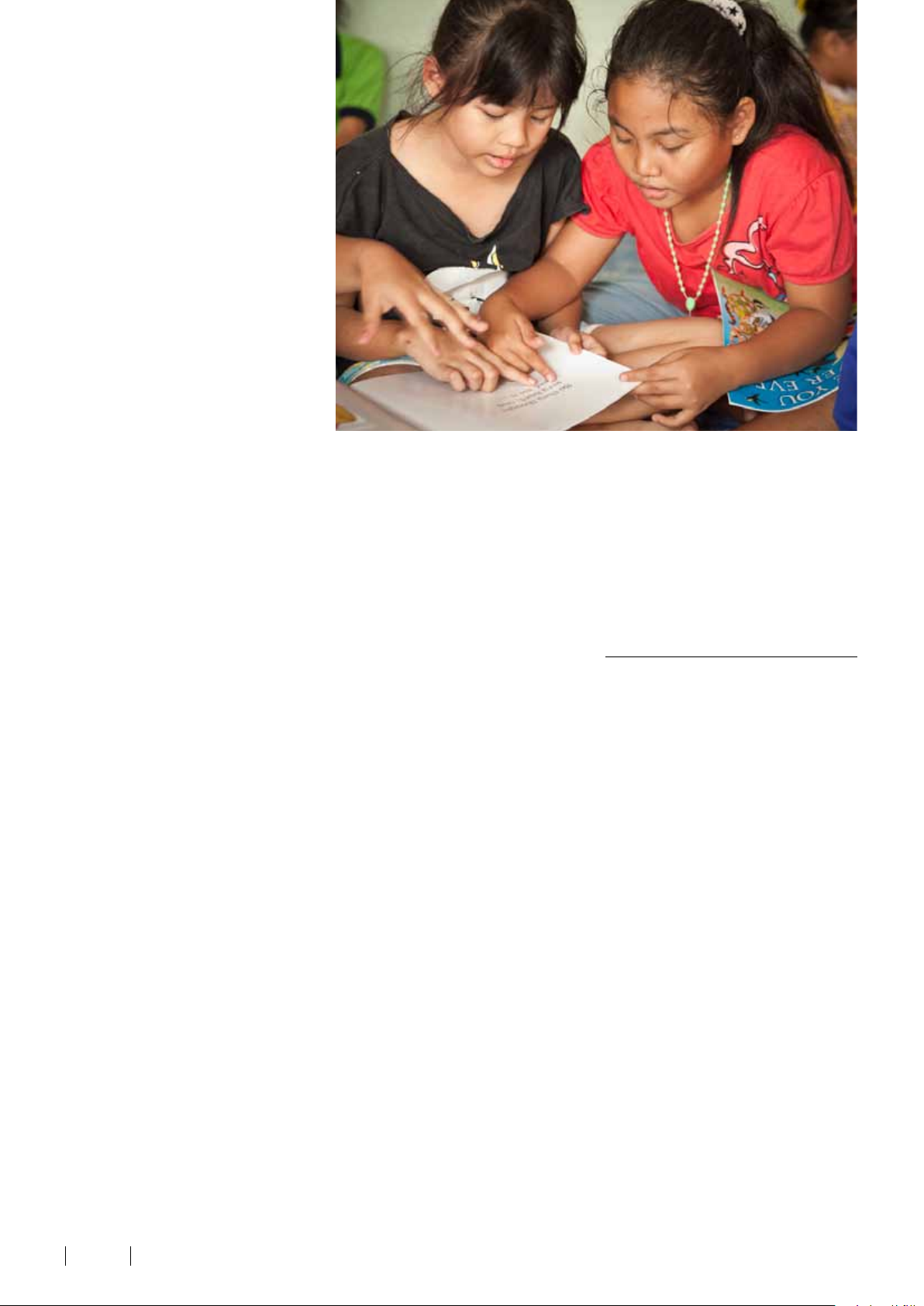
Children share a free reading session in SK Matu Baru breakfast?
• Who feeds the animals? What need? You can see teachers conduct- do Jack’s animals eat every
• reading – the Power of read-
ing shared reading and follow-up day? ing offers multiple copies of
work in the Por Video at www. the same book. can you think
youtube.com/user/eLTdPMa- As you and your pupils become of ways of using these books?
laysia. look for ‘EltDP Power of
more confident in responding to
• writing – What writing ac-
reading, reading with children,
stories read, encourage the inclu-
tivities could follow from the shared reading.’
sion of thinking skills questions: book? could the children make • Why do you think the their own books? Guided Reading character/s made that choice?
• grammar – What are the main
• How might the story be differ- grammatical structures in the While shared reading is usu- ent if…….? book? Are there any repeated
ally a whole class activity, guided
• What clues do the author/ illus-
phrases/sentences? how could reading is where the teacher works
trator give to show that ……? these be practised in other
with a small group. these pupils will
• What might (this character) be contexts?
be at about the same stage as each thinking when ….?
other, and be able to read texts of
• What do you think the author
‘Previously, I mainly used the text similar difficulty. wants readers to remember
book in class probably because of a A guided reading session will most in this story?
fear of a fine if I am not using it. Now often have the children and the
I am using other resources, for ex-
teacher seated round a table, with shared reading offers numer-
ample, story books, pictures, clip art, each having their own copy of the
ous opportunities to discuss syn-
activities, and games but within the
text. the procedure is usually that
tactic information (language pat-
skills required. From the story books, the teacher will introduce the text,
terns)and to recycle any repeated
I have been doing some activities,
the children will then ‘read’ individu-
sentences, e.g. ‘Who will help me for example:
ally at their own pace, and follow
to plant/pick/grind this corn?’ in
• Making zig-zag books
this with a discussion bringing out
other contexts, e.g. ‘Who will help
• Feeding my monster with vo-
any special points arising from the
me to give out/collect the books?’, cabulary (English)
text or from the processes that the
‘Who will help me to move the
• Making puppets based on a
children used to deal with it.
chairs/tidy the classroom?’, etc. story book
Guided reading can also include • Making a class book
the pupils taking turns to read the follow-up activities
• Making games based on a story
text out loud. the teacher’s role is
• drama/oral work – could book
again central: she selects the read- the story be acted out? What • Word games
ing, she chooses which children to would be the point of act- • Picture games
work with and identifies the useful ing out the story? What oral • Picture puzzles
and relevant points for discussion language would the children – SK Patau afterwards.
14 british The Power of council reading handbook SeCTionTHREE (A)
the strengths of guided reading
– Level 1 teacher, SK Seberang
• They even show that they
methods are in the social nature
understand the story by making
of the activities. they allow the
‘When doing guided reading activi-
a small vocabulary book of their
teacher time to work closely with
ties, I divide my students into three
own based on what they have
more children than would be pos-
groups based on their abilities. While read in the book.
sible listening to individuals read.
I am focusing on less able students,
• Now they show great interest in
Although the reading he is doing
using either shared or guided
reading English story books by
may be silent, the child is supported reading in the library area of the
borrowing the books after English
by both the teacher and his group.
classroom, the other groups may class.
he is able to call upon the teacher
be using worksheets, doing creative
– English teacher, SK Bunga Raya
for help if needed. he is encour-
writing activities, role-play or read-
aged to discuss and reflect on the
ing independently. Now I am able to
‘By doing guided reading I can get
text with fellow readers. While the
get much more closely involved with to know each pupil in reading and
goal is independent reading, guided my children’s learning, helping the
help them to develop/improve their
reading provides a framework for
weaker students and developing the weaknesses. I am able to guide
children to try out and compare
more capable students even more.’
pupils through stages according to
reading strategies, and also ben-
their weaknesses. I get to know the
efit from the shared experience of
- Stella Beduru, Year 1 and 3 teacher,
pupils and their interests, for ex-
deriving meaning and pleasure from SK St Christopher
ample, their favourite colours, their text.
‘reflecting on my phonics approach to
favourite books, etc. I also manage
reading and the opportunities afforded Another advantage of guided
to get to know their area of interest,
by the Power of reading Project.’ –
reading is that it increases the
for example, drawing, colouring etc
Narratives of Teacher Development
amount of time that children spend
and I use it to help them in improv-
actually reading. When it is silent,
guided reading reflections
ing their reading skills. I feel confi-
the reader will also concentrate Before
dent when I am teaching because
more on comprehension, and will
• Before guided reading was
I like what we do together (with
be allowed to get in to the ‘flow’
conducted in my school, most
the pupils). The stress level is good
of reading which characterises full
of the pupils had little interest in
because it makes me do things that
engagement with text. Many of us reading. I like.’
have found that forcing children to
• They do not know how to read in
– Teacher, SK Patau
read out loud so that we can listen English.
to them, even though they are well
• They were only looking at the the Por video on guided
into silent and internalised reading,
pictures and changed their book
reading shows teachers using this
does not give a real picture of the
in minutes without reading it.
technique in local schools. View it
strategies in use or a good idea of
• They did not show great interest
at www.youtube.com/user/eLTdP-
where support might be beneficial.
in reading the English books.
Malaysia – search for ‘EltDP Power
Guided reading techniques provide
of reading, reading with children, After
teachers with a way of extending Guided reading’
• After the guided reading session
their support for the reader at that
was carried out in our English
critical point between dependency Reading by children
class, most of the pupils started
and independence. Again, as with
to take English story books and
shared reading teachers can help
Listening to children read
read them for themselves.
children see how a variety of strate-
• They know how to read and
Another form of guided reading
gies are used in making sense of
pronounce words correctly.
is for teachers to hear their pupils
what want to read, as they read.
• They understand the meaning of
read out loud. this allows teach-
certain words by looking at the
ers to introduce personal learning
‘During group activities pupils can
pictures in the story book.
taking into account the individual
help one another to read correctly;
• Before guided reading was
experiences and development of
they can correct their friends’ mis-
carried out, the pupils spent
each pupil, and to enable fine-
takes. They can cooperate really
only one minute with each book,
tuned guidance. it gives an oppor-
well during shared reading sessions.
but not reading it. Now they
tunity for the teacher to engage
They are excited and eager to read
spend about 10 to 15 minutes
in meaningful talk with the pupil
in front of their friends in the class-
reading the book themselves and
about the text and their reading room.’
understanding what they read. development. The Power of british reading handbook council 15 SeCTionTHREE (A) traditionally, teachers were
individually or in pairs, sitting (or reading.
expected to hear each child once
lying down) with a book that they Por videos showing buddy
a day, which for those with large have chosen. some will be qui-
reading and silent reading are at
classes was a great burden. For
etly exchanging books in the class
www.youtube.com/user/eLTdP-
this reason, as well as classroom
library. the teacher will also be
Malaysia – search for ‘EltDP Power
noise and other distractions, this reading silently.
of reading, reading by children,
one-to-one activity has declined. Perhaps because this method buddy reading.’
to maintain the opportunity for
appears to be a free-for-all, with the
talking about reading, older or
teacher and pupils relaxing and not
access to a wide variety of texts
more experienced children, par-
‘doing’ anything, there has been a For beginner readers, the
ents, grandparents can be invited
great deal of research to support
teacher should provide a balance of
in to the class to hear pupils read.
the effectiveness of this use of class familiar texts that have been read
time. this has shown that students
to or shared with the children, and buddy reading Programme
using DEAr did as well or better in
other new, but easy, material. book Objectives:
reading comprehension tests than
boxes in a book corner can store
• To develop an interest in reading others taking skill-based reading
these texts, both fiction and non-fic- among children;
instruction, and that reading is also
tion. the books should be changed
• To improve reading comprehen-
effective for vocabulary develop- regularly. sion skills;
ment, grammar test performance,
• To promote and encourage peer writing and oral/aural development. Providing opportunities for chil-
support and cooperation among DEAr is sometimes called Free
dren to choose their own texts
Level 1 and Level 2 pupils. Voluntary reading, but to cre-
While teachers provide a selec-
ate the freedom and enthuse the
tion of texts, pupils should have the Implementation:
volunteers demands planning and
chance to choose which book they
Twenty Level 2 pupils (strong
organisation. For teachers, some
want to read or look at from the
Year 5 and Year 6 pupils) are paired
of the key elements of organising
very start. older or fluent readers
with 20 Level 1 pupils (average/ DEAr periods are: can be encouraged to seek out
weaker pupils). They take part in the
their own texts from the class or
programme once a week. Level 2 Selecting objectives
school library, and other sources
pupils use a picture book appropri-
objectives for free reading are
outside the school. As the reader’s
ate for Level 1 pupils and help them
as important as for any other class- independence develops, the
to read and understand the book. room activity. For example:
teacher’s role shifts from providing
All English teachers take turns to
• DEAR with or beginner readers:
texts to providing information as to
facilitate the reading activity follow-
to familiarise the youngest chil- where to find texts.
ing a pre-planned schedule.
dren with reading-like behaviour – SK Lutong
(like sitting with a book, turning
Providing time and space to
pages, making up a story to go read them in to maximise the pedagogic with the pictures etc.).
A well-lit, comfortable and ac-
benefits, teachers can use their • Regular DEAR sessions: To
cessible part of the room can be
limited opportunities to hear pupil’s foster sustained reading as a
set aside for silent reading. in whole
reading by using the tool of running habit in children who may not
class DEAr periods this and any
records. see the section on assess- have much opportunity to read
other place where the children are
ing progress in reading below. outside school.
comfortable and will not be dis-
• DEAR first thing in the morning
turbed can be used. Enough time
drop everything and read or after break times: to calm
should be set aside for children to (dear) and concentrate children on
get in to the flow of reading, to be
‘Children are reading indepen- second language or academic
absorbed in to the text. the term
dently Tuesday to Friday from 7 to work.
‘uninterrupted sustained silent
7.20, and they are supervised by
reading’ emphasises this need
prefects in each class.
these objectives will reflect the
for sufficient and dedicated time.
– Year 3 teacher, SK Pinawantai
strengths and needs of the learn-
Everybody is engaged in reading
ers and the organisation of the
or selecting reading material and A DEAr session will typically
classroom. underlying these is the
nothing else during these sessions.
feature all the children in the class
belief that reading is best learnt by
in some schools, the DEAr session
16 british The Power of council reading handbook SeCTionTHREE (A)
is at the same time for the whole
ties to discuss with pupils what was
tences. Children started to see the
school: children, teachers, admin-
read in DEAr. reading conferences
purpose in their writing and have
istrators support staff and visitors
between the teacher and each child become increasingly keener on tak-
together and at once doing noth-
can ascertain the pupils’ level of in-
ing control over their own learning.
ing but reading. the lesson being
terest, their understanding of what – SK Long Tuma
taught is that reading is something
they read and monitor the amount that is always worthwhile.
of reading they do. the teacher Shared writing
might also read book reports to shared writing is where the
giving children the chance to
provide sources for this data.
teacher and children construct
initiate reading themselves
a text together. A typical shared
opportunities for free reading,
The POR Team role played how a
writing session will see the teacher
or information gathering, outside
simple silent reading period could
ready to write on the blackboard
the DEAr period should also be pro-
take place. Teachers acted as
or a large sheet of paper, while
vided. children finishing set work
children to allow them the oppor-
the children make suggestions as
before others, waiting for teacher
tunity of working out any potential
to how the piece of writing should
attention or otherwise without a
problems. Once the teachers had proceed.
task can be encouraged to pick up
decided how best to carry out the
Writing does not have to be in
a book. When writing, or engaged
activity, they organised a meeting to
sentences and paragraphs. You can
in other work, children may get
share their plans with all the teach-
use stories from books to write:
involved in personal reading while ing staff. • signs, labels, adverts
looking for information. the key
This was important because the • lists, letters and notes
principle is that reading is never a
proposed weekly time for the activ- • titles for pictures
waste of time, and that teachers
ity was the start of the day when
• labels for maps, diagrams,
and others should take every op-
pupils were supervised by their class charts
portunity to encourage children to
teacher who was not necessarily an engage with books.
English teacher. The team encour-
For practising composition, en-
aged teachers to role play the activ-
courage children to draw pictures
breaking the silence and provid-
ity to prepare for the launch. Class
and describe what is happening
ing opportunities for purposeful teachers were given strict instruc-
in stories. listen to the children talk
tions to bring their own reading
retell stories and write them down
DEAr can provide opportunities material into class and to be a good
for them. As with shared reading,
to exploit the reading children do
reading role model for the pupils.
shared writing allows the teacher
through talk, and encourage talk
– SK Bunga Raya
to bring points of grammar, spelling
through the reading. the teacher
and punctuation to the attention of
can help children choose their own look at the Por video on the
the children within the context of an
texts by arousing interest in books
importance of choice at www.
immediate and real need to know. by introducing them, relating
youtube.com/user/eLTdPMalay-
the teacher is able to model writ-
them to a set purpose, or reading
sia – search for ‘EltDP Power of
ing strategies and techniques and extracts.
reading, reading by children, the
demonstrate the complexity of the similarly, children can be en- importance of choice.’ composing process.
couraged to promote books they one of the common failings of
have read to others. Written book
Reading, writing and talking
children’s writing is that they do not
reports can provide a useful record
think sufficiently about what they
of and source for this process. Using books for writing
are going to write. in shared writ-
often, book cards are used merely
Teachers began to love activities
ing, the teacher is able to ‘think out
to ‘check up’ on a pupil’s reading
that helped children to think about
loud’, and demonstrate what is usu-
or as a complementation for the
what they’ve read and the meaning
ally a hidden part of the act of writ- most number of books read. by
of the story. They started seeing a
ing. by participating in the writing,
using them as a form of review and
connection between reading and fun children can rehearse and review
recommendation for other readers,
cooperative, guided or independent
their present writing strategies, and
book report writing becomes mean-
writing. Writing started becoming
modify them where and when they
ingfully directed towards a real and
more about taking students through see the need. interested audience.
a creative process rather than ask- shared Writing is sometimes teachers can find opportuni-
ing them to write meaningless sen-
called ‘scribing’, especially when The Power of british reading handbook council 17 SeCTionTHREE (A)
it is used with very young writ-
book: ‘Teachers TV – guided
elements of reading such as un-
ers. this term well describes the
writing’ by Tag (Trinity acad-
derstanding the words, remember-
teacher’s role in the initial stages emy global).
ing the message, and transferring
of writing where the children’s information.
ability to compose a text far ex- Silent dictation
ceeds their ability to transcribe. it
this is a simple exercise that
Silent dictation: breaking the
is another example of where the
combines reading and writing and silence
teacher can provide scaffolding
that can exploit the books that
silent dictation as pair work: Al-
for children’s language develop-
children have been reading. the
low children to copy (for accuracy) ment.
teacher mimes to pupils that they
a text from a story book of their As with all writing, shared
should have a paper and pencil
choosing into their exercise book.
writing activities should have a
ready. she holds up strips that the
in pairs, child A closes book, child b
purpose and a potential audience. whole class can read with a familiar
opens her book and points to word
stories can be retold or adapted
text. she shows each for a short
or phrase counts to three (silently),
to different characters or set-
time (enough to read but not to
closes book. child A has to write
tings, for book making or wall copy), pupils to remember and
word/phrase on a scrap of paper.
display, letters of thanks or giving write the phrases.
the discussion that is involved in
information to send out to other
this exercise and the checking that
classes, teachers, visitors or par- ‘There was once
follows it is a great opportunity for
ents concerning reading events.
a very hungry little hen, purposeful talk.
in one class, the teacher sits and she ate and ate,
with the children grouped around and she grew and grew, Process writing a blank poster paper. and the more she ate, Process writing, sometimes
‘i have to write a letter to your the more she grew.’
called writer’s workshop, is a way
homes telling your parents that
(hungry hen by Richard Waring)
of organising composition which we have a meeting about the
serves the professional writer as
reading Week. how do you think i Although the teacher controls
much as the infant novice, the should start?’
the language, the activity is cogni-
process is very simple – the writer
the children’s suggestions are
tively very complex and includes
writes down his ideas and works
discussed, a consensus is formed and the teacher transcribes
the letter on to the poster. the
children may struggle to gain the
internal consistency of style and
form, but in doing so will recog-
nise many things about the dif-
ficulties of writing, and ways they could be resolved. A short Youtube video from
the united states of pupils writing
a story together by completing
sentences: ‘The dice game: a
Cooperative Story writing activ-
ity’ by The balanced Literacy diet. A longer Youtube video from
the uK shows collaboration with
young children to produce high
quality shared writing: ‘Year 1
non fiction Shared writing’ by rosie Johnson.
Guided writing is used in this
Youtube video to help Year 1 and
Year 2 children produce a guide-
Mini books on display at SK Kampung Enam
18 british The Power of council reading handbook SeCTionTHREE (A)
through versions of the work until
the ultimate stage of ‘publication’ is
achieved. A typical process writing
class in school will have children
working at various stages of their
writing, some on their own and oth-
ers with a partner. the teacher will
be conferring with children individu-
ally and in turn. the process writing
workshop is a model of interaction and purposeful talk. the writing process moves the
writer through successive stages:
1. ideas (that can be taken from or in reaction to a story or non- fiction book) 2. Writing a first draft
3. Proofreading (the writer checks their own work) 4. Writing second draft 5. Proofreading
6. conferring with a partner for proofreading and suggestions 7. Writing third draft 8. Proofreading
9. conferring with an ‘expert’ (i.e.
a teacher, another adult or an older pupil) 10. Final draft and checking 11. Publication
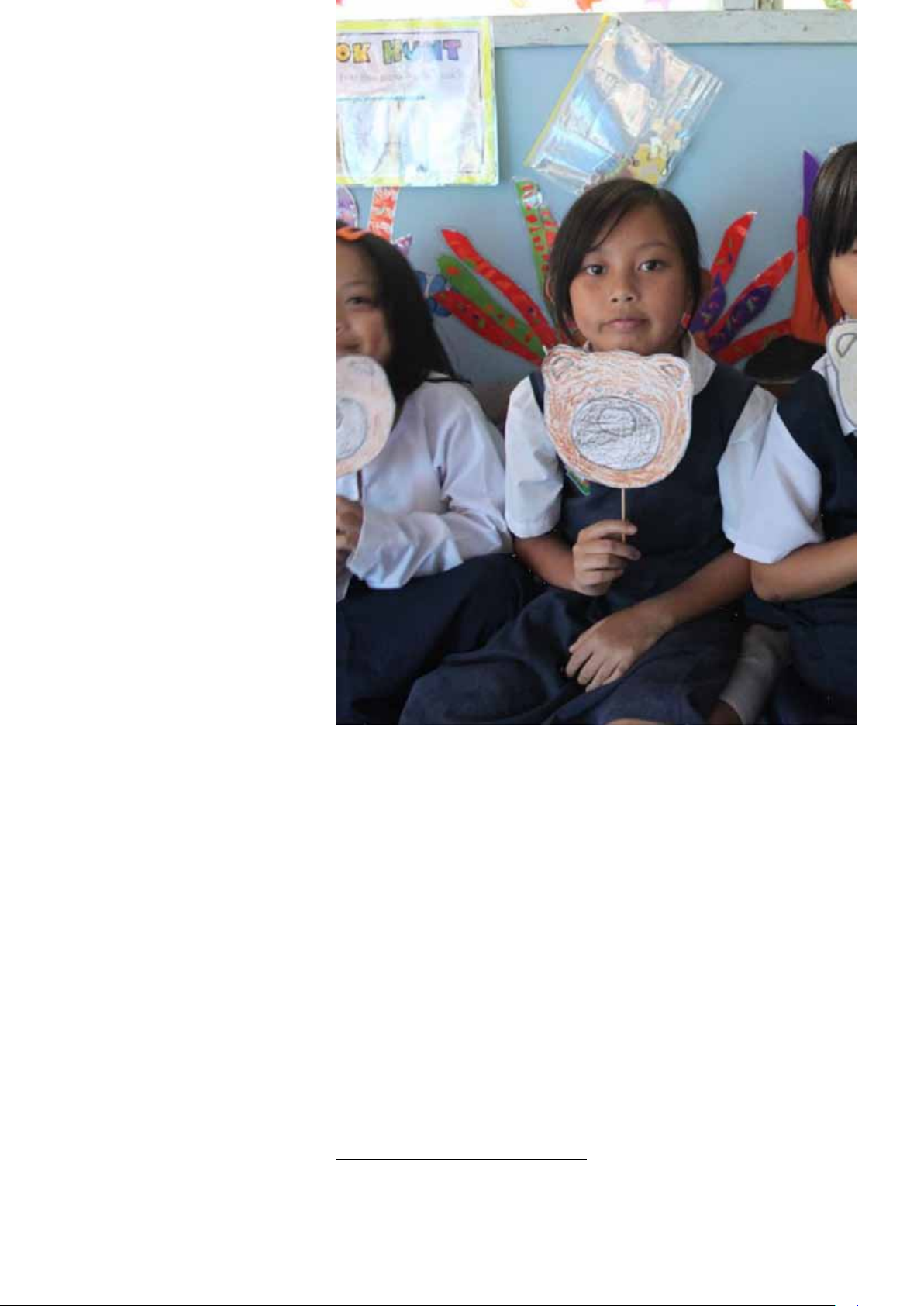
Pupils ready with their bear masks – at SK Poring these stages can be varied to
suit different purposes and condi-
the child reads the piece to the
the school. Mini book types cre-
tions. the basic idea is that the
class, or that it is displayed on the ated by children include:
writing will include drafting, cor-
wall or included in a class book or • Talking books rection and some involvement
self-made book. Publication provides • Pop up / Pull out
of another ‘reader’. in this role of
motivation and genuine reason for • Big books
reader, children engage in a differ-
the child to do best work (especially • Concertino books
ent set of literacy activities which
in presentation and handwriting), • Own story books
serve their own writing and reading
and also provides a sense of pur- • Flip-flap books development. the teacher does
pose and audience for the writing, • Puzzle books
not have to become involved in the
and another stimulus for talk and • Snake/stripe books
process until the writing has been discussion in the classroom. – SK Long Tuma
checked several times. this way
A teacher in the united states
For ‘there was an old lady, I
she can concentrate on helping the
uses a book that the pupils have
choose some simple resources like
writer at a higher level, for instance
been reading to start a writer’s
puppets and masks for the pupils
in making suggestions about style
workshop with very young children.
to create, and we all sing the song
and content, rather than having to
View the video on Youtube: ‘Writer’s together while I point to pictures
concentrate on spelling mistakes or Workshop’ by Mesquite isD.
in the book. The pupils understand grammatical errors.
much more when I use resources; some sequences might stop at
Projects and language arts
using these kinds of resources to
the final draft and checking stage,
support storytelling is new for me,
and remain in the child’s exercise creating mini books indepen-
but it really works.’
book or folder. Publication can mean dently plays a significant role at
– Level 1 teacher, SK Poring The Power of british reading handbook council 19
Tài liệu liên quan:
-

Ung dung game hoa trong cac chien dich MKT
18 9 -

Bao cao Chi so TMDT Viet Nam 2025
15 8 -

Thông tư quy định về việc phân quyền, phân cấp và phân định thẩm quyền quản lý nhà nước về giáo dục cho chính quyền địa phương
24 12 -
Nghị quyết về phát huy các giá trị di sản văn hóa gắn với phát triên du lịch bền vững tỉnh Khánh Hòa đến năm 2025, định hướng đến năm 2030
14 7 -

Quyết định phê duyệt Chiến lược phát triển du lịch Việt Nam đến năm 2030
13 7