Social Media Habits & Attitudes Survey Report | Tiếng Anh | Đại học Kinh tế - Đại học Đà Nẵng
PI hold a copy of this assignment if the original is lost or damaged. P I certify that no part of this assignment or product has been copied from any other student’s work or from any other source except where due acknowledgment is made in the assignment. PI affirms that no part of this assignment/product has been written/produced for me by any other person except where collaboration has been authorized by the teacher concerned. Tài liệu được sưu tầm và soạn thảo dưới dạng file PDF để gửi tới các bạn cùng tham khảo, ôn tập đầy đủ kiến thức, chuẩn bị cho các buổi học thật tốt. Mời bạn đọc đón xem!
Môn: Tiếng Anh (11) 10 tài liệu
Trường: Trường Đại học Kinh tế - Đại học Đà Nẵng 1.4 K tài liệu
Tác giả:




Preview text:
EAP 4 ASSIGNMENT COVER SHEET
Name:…Nguyễn Thị Loan Anh ………………………………………………. I.D……
22003250……………………..
Class: ……EAP4 -G2………… Assignment : Survey report
Assignment Question: (write out in full) social media
Due date: …7.…/…10.…/…2022………. Date submitted:…. 6…/.10…/2022
PI hold a copy of this assignment if the original is lost or damaged.
P I certify that no part of this assignment or product has been copied from any
other student’s work or from any other source except where due
acknowledgment is made in the assignment.
PI affirms that no part of this assignment/product has been written/produced for
me by any other person except where collaboration has been authorized by the teacher concerned.
PI am aware that this work may be reproduced and submitted to plagiarism
detection software programs for the purpose of detecting possible plagiarism
(which may retain a copy on its database for future plagiarism checking).
Note: An examiner or teacher has the right to NOT mark this assignment if the above
declaration has not been signed.
Student’s Signature: ……..……Anh…………… Date: …6.…/….10.…/…2022….
EXTENSION – To be approved BEFORE original submission date
Supporting evidence sighted: Yes / No
Extension approved / Extension not approved
If approved, new submission date ____/____/_____ Teacher’s Signature: ___________________ 1 SURVEY REPORT
Nguyen Thi Loan Anh – 22003250 EAP4-GP2 6/10/2022 Mr. Kenvin & Mrs. Lap Sang SOCIAL MEDIA 2 Contents Introduction 3 Methodology 4 Results 5
Figure 1: Favorite social media 6
Figure 2: First age started using social media 7
Figure 3: Time spent on social media per day 8
Figure 4: The Reason for using social media 9 Discussion 10 Reference list 11 Appendix 12 3 INTRODUCTION
These day, face-to-face communication is being replaced with online coversations using social
media apps, its use is expanding and has become a global phenomenon. Social media is one
versatile tool that permitted people to interact with others globally. Facebook, Instagram ,
Youtube, and Twitter are some of the most popular social networking sites. Especially for the
younger generation, who utilize social media to remain informed about news, learn more about
studies or professions, and stay in touch with friends, family, and coworkers.
According to Mark Zuckerberg, Facebook want to make communication and interaction
between people easier (Locke 2007). Besides, the Australian Bureau of Statistics (2011) shows
that individuals of all ages mostly access the Internet using networking equipment at home. In
addition, the report indicated that the percentage of internet users increased, from 26% in 2008 to 36% in 2009.
The purpose of the research was to investigate the social media habits and attitudes of students at ISB. 4 METHODOLOGY
The research on social media was conducted on the 29th of September 2022 at ISB
international school of business. The sample size was 50 responders who were Vietnamese
students studying Academic English courses in preparation. The sample was randomly
selected with equal gender representation. The majority of students were females from the south of Vietnam
The instrument was a questionnaire, it was formed by EAP4 students. The questionnaire
consisted of 13 questions, including only closed-ended only and demographic information was
elicited. The first of four questions collected demographic information, in particular, gender,
age , the first age started using, and the number of friends on social media. And the next
group's questions gathered information relating to the participants’ habits, the place, time, and
purpose of use. The last three questions concern the attitudes of respondents toward social media.
The questionnaire was answered online by EAP4 students at online Via Google Forms. The
subject took a link to complete. The researchers were available for support in case subjects had
difficulty understanding the questions. The whole took more than 12 hours to finish and each
participant took a few minutes to answer and submit their responses.
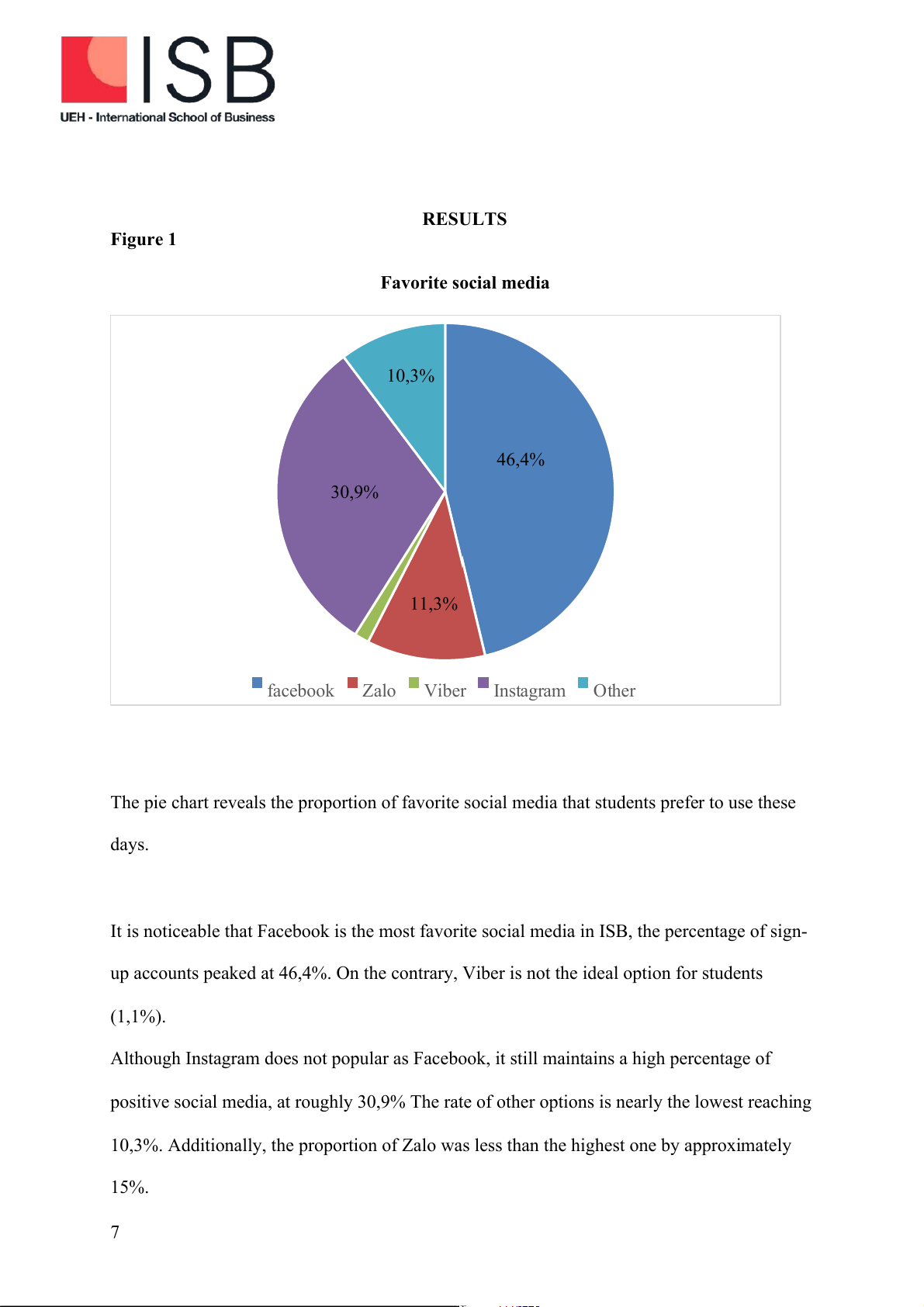
The data was then collated and covered into percentages in chart form for analysis. 5 6 RESULTS Figure 1 Favorite social media 10,3% 46,4% 30,9% 11,3% facebook Zalo Viber Instagram Other
The pie chart reveals the proportion of favorite social media that students prefer to use these days.
It is noticeable that Facebook is the most favorite social media in ISB, the percentage of sign-
up accounts peaked at 46,4%. On the contrary, Viber is not the ideal option for students (1,1%).
Although Instagram does not popular as Facebook, it still maintains a high percentage of
positive social media, at roughly 30,9% The rate of other options is nearly the lowest reaching
10,3%. Additionally, the proportion of Zalo was less than the highest one by approximately 15%. 7 Figure 2 :
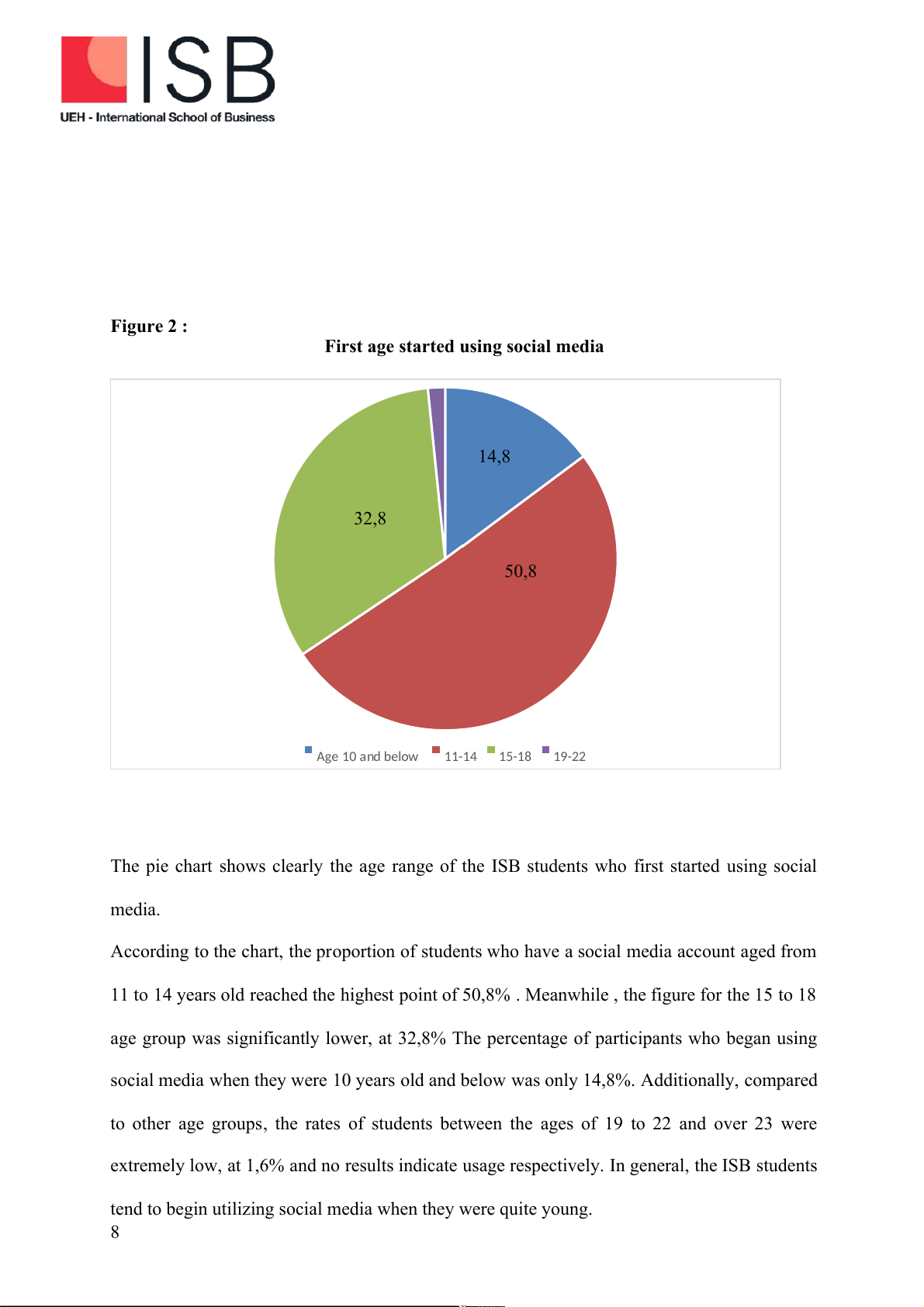
First age started using social media 14,8 32,8 50,8 Age 10 and below 11-14 15-18 19-22
The pie chart shows clearly the age range of the ISB students who first started using social media.
According to the chart, the proportion of students who have a social media account aged from
11 to 14 years old reached the highest point of 50,8% . Meanwhile , the figure for the 15 to 18
age group was significantly lower, at 32,8% The percentage of participants who began using
social media when they were 10 years old and below was only 14,8%. Additionally, compared
to other age groups, the rates of students between the ages of 19 to 22 and over 23 were
extremely low, at 1,6% and no results indicate usage respectively. In general, the ISB students
tend to begin utilizing social media when they were quite young. 8 Figure 3:
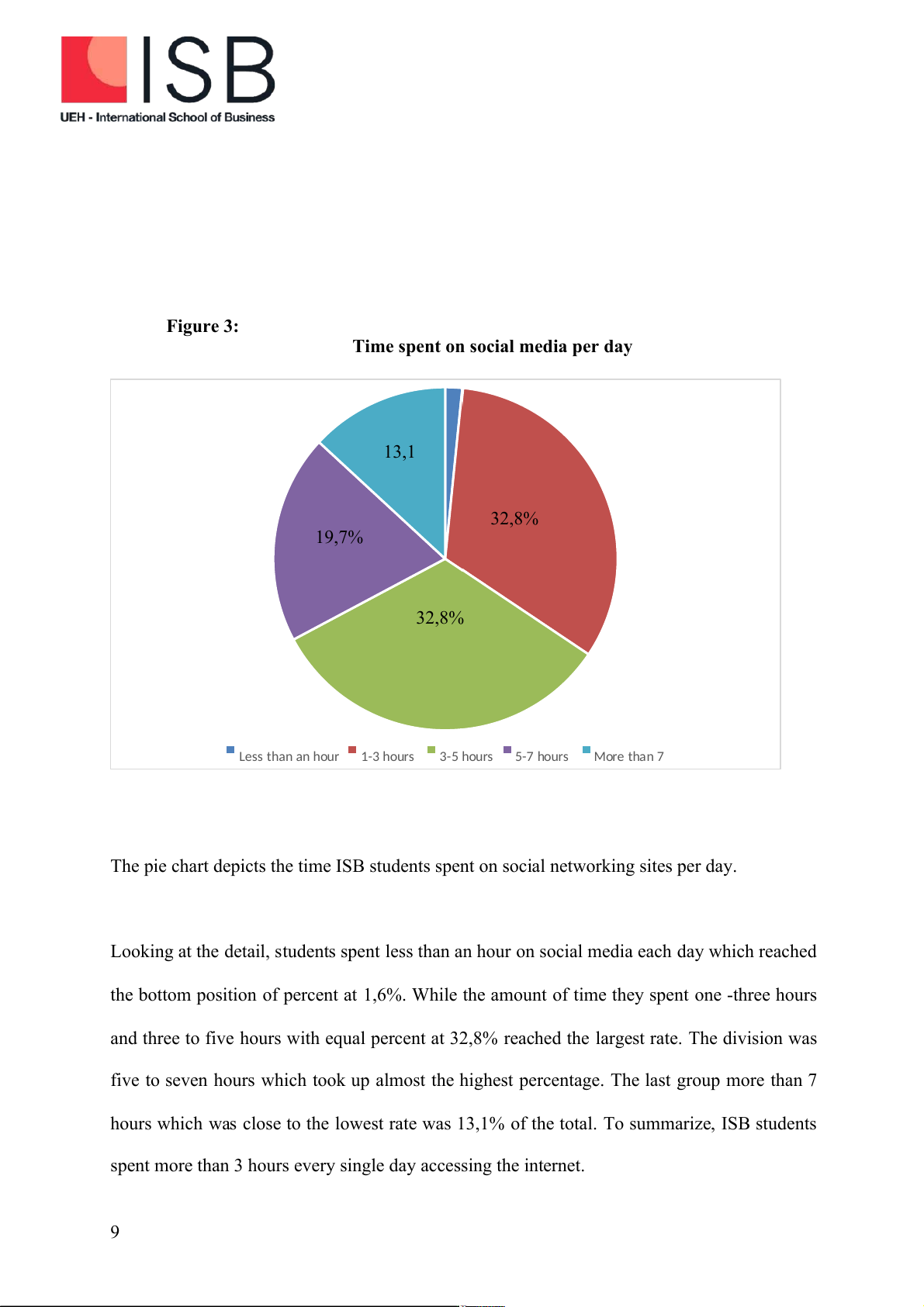
Time spent on social media per day 13,1 32,8% 19,7% 32,8% Less than an hour 1-3 hours 3-5 hours 5-7 hours More than 7
The pie chart depicts the time ISB students spent on social networking sites per day.
Looking at the detail, students spent less than an hour on social media each day which reached
the bottom position of percent at 1,6%. While the amount of time they spent one -three hours
and three to five hours with equal percent at 32,8% reached the largest rate. The division was
five to seven hours which took up almost the highest percentage. The last group more than 7
hours which was close to the lowest rate was 13,1% of the total. To summarize, ISB students
spent more than 3 hours every single day accessing the internet. 9 10 Figure 4:
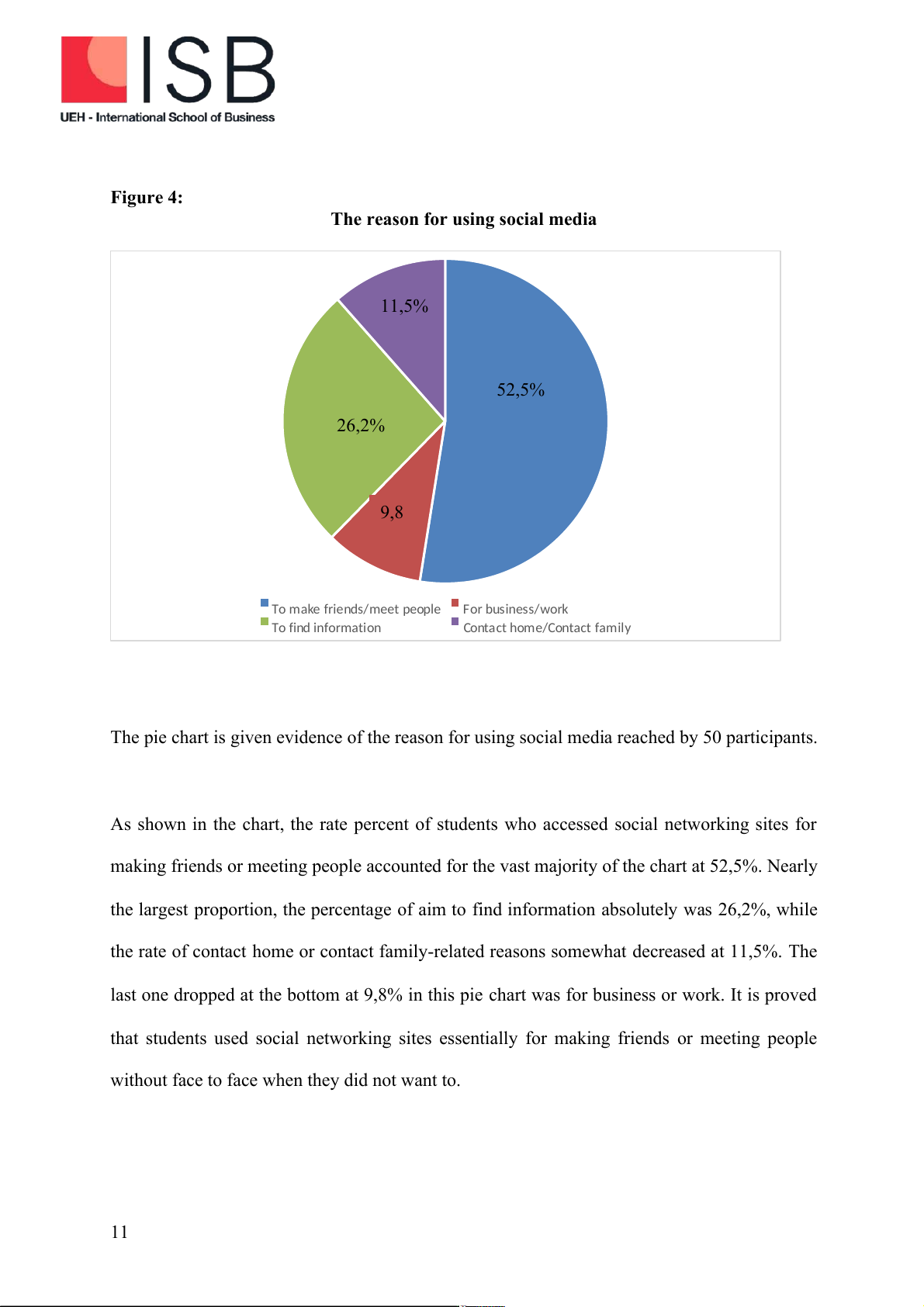
The reason for using social media 11,5% 52,5% 26,2% 9,8 To make friends/meet people For business/work To find information Contact home/Contact family
The pie chart is given evidence of the reason for using social media reached by 50 participants.
As shown in the chart, the rate percent of students who accessed social networking sites for
making friends or meeting people accounted for the vast majority of the chart at 52,5%. Nearly
the largest proportion, the percentage of aim to find information absolutely was 26,2%, while
the rate of contact home or contact family-related reasons somewhat decreased at 11,5%. The
last one dropped at the bottom at 9,8% in this pie chart was for business or work. It is proved
that students used social networking sites essentially for making friends or meeting people
without face to face when they did not want to. 11 DISCUSSION
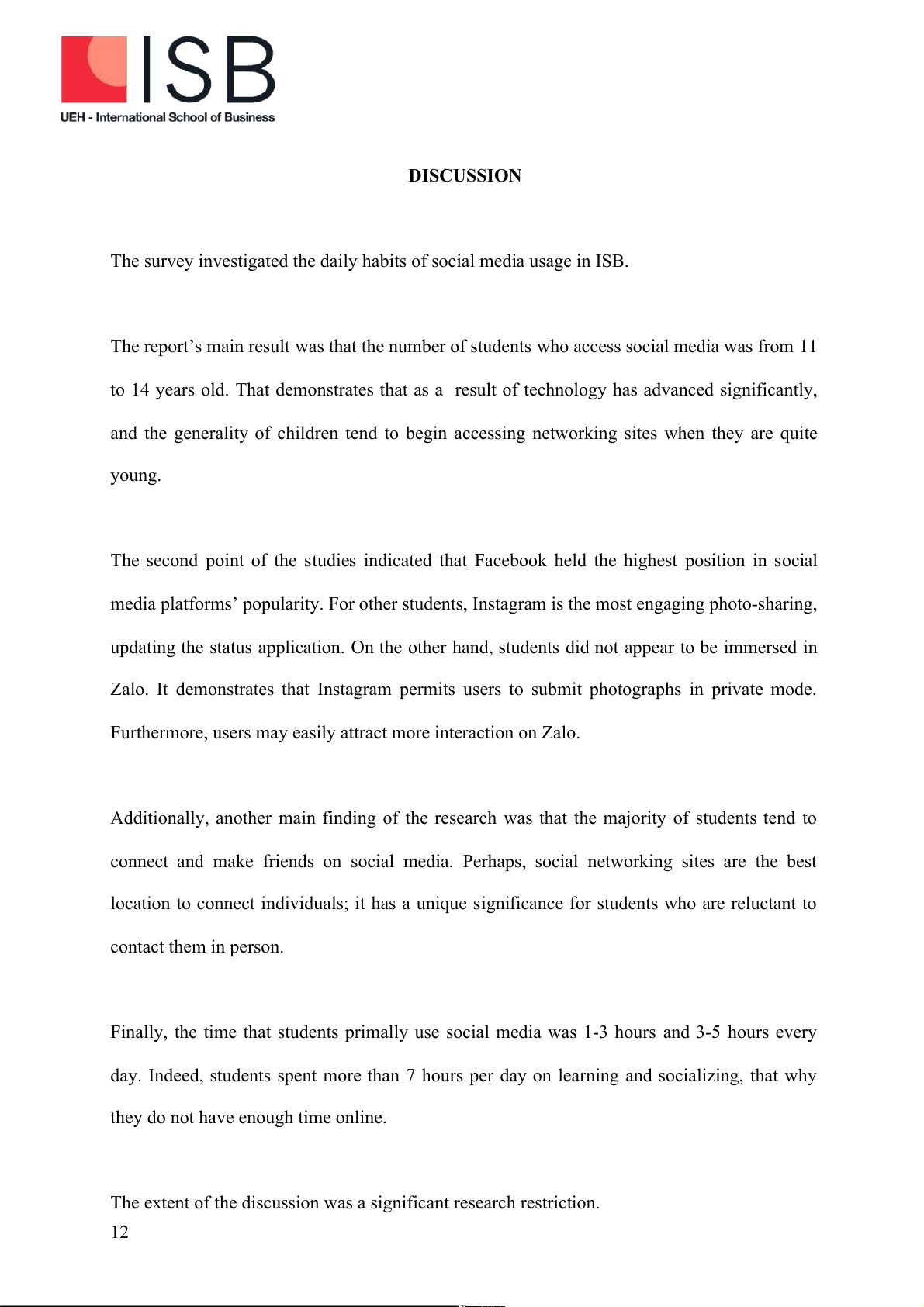
The survey investigated the daily habits of social media usage in ISB.
The report’s main result was that the number of students who access social media was from 11
to 14 years old. That demonstrates that as a result of technology has advanced significantly,
and the generality of children tend to begin accessing networking sites when they are quite young.
The second point of the studies indicated that Facebook held the highest position in social
media platforms’ popularity. For other students, Instagram is the most engaging photo-sharing,
updating the status application. On the other hand, students did not appear to be immersed in
Zalo. It demonstrates that Instagram permits users to submit photographs in private mode.
Furthermore, users may easily attract more interaction on Zalo.
Additionally, another main finding of the research was that the majority of students tend to
connect and make friends on social media. Perhaps, social networking sites are the best
location to connect individuals; it has a unique significance for students who are reluctant to contact them in person.
Finally, the time that students primally use social media was 1-3 hours and 3-5 hours every
day. Indeed, students spent more than 7 hours per day on learning and socializing, that why
they do not have enough time online.
The extent of the discussion was a significant research restriction. 12 REFERENCE LIST
The quotation by Mark Zuckerberg, CEO of Facebook, quoted in TIME, ‘the future of
Facebook’ by Laura Locke, July 17, 2007,
Australian Social Trends June 2011 Online @ home
Produced by the Australian Bureau of Statistics 13 APPENDIX
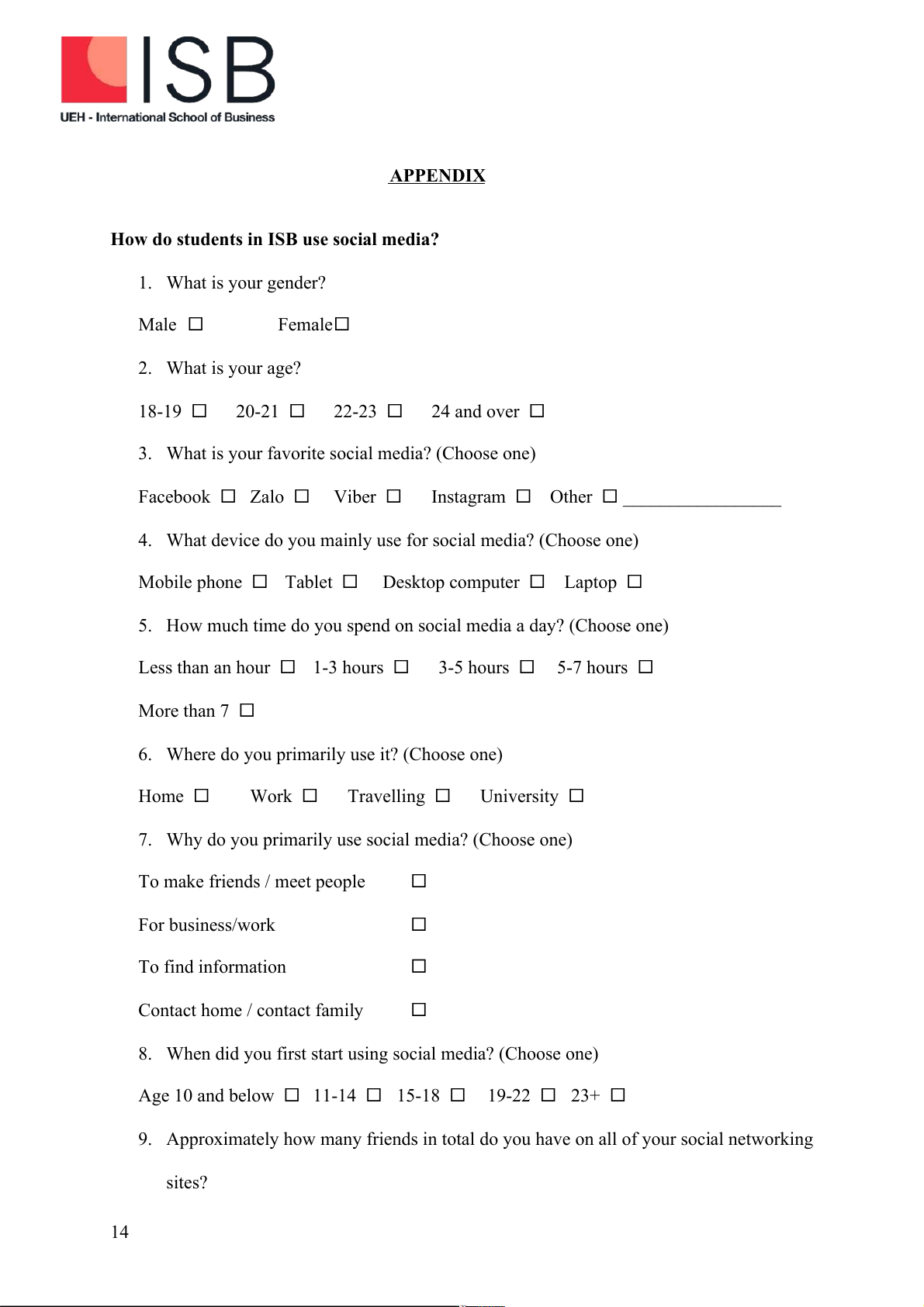
How do students in ISB use social media? 1. What is your gender? Male Female 2. What is your age? 18-19 20-21 22-23 24 and over
3. What is your favorite social media? (Choose one) Facebook Zalo Viber
Instagram Other _________________
4. What device do you mainly use for social media? (Choose one) Mobile phone Tablet
Desktop computer Laptop
5. How much time do you spend on social media a day? (Choose one)
Less than an hour 1-3 hours 3-5 hours 5-7 hours More than 7
6. Where do you primarily use it? (Choose one) Home Work Travelling University
7. Why do you primarily use social media? (Choose one) To make friends / meet people For business/work To find information Contact home / contact family
8. When did you first start using social media? (Choose one)
Age 10 and below 11-14 15-18 19-22 23+
9. Approximately how many friends in total do you have on all of your social networking sites? 14 0-10 11-25
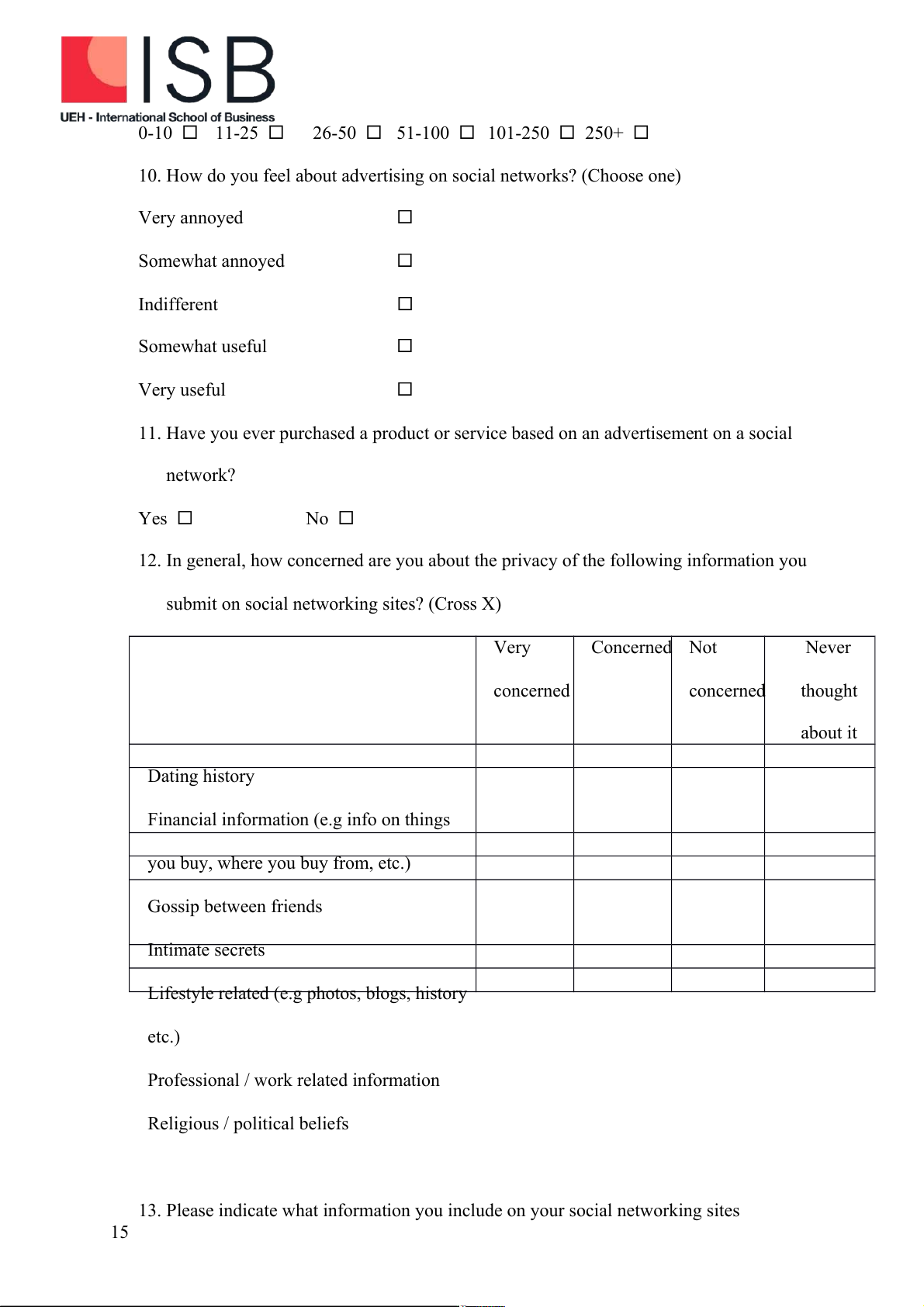
26-50 51-100 101-250 250+
10. How do you feel about advertising on social networks? (Choose one) Very annoyed Somewhat annoyed Indifferent Somewhat useful Very useful
11. Have you ever purchased a product or service based on an advertisement on a social network? Yes No
12. In general, how concerned are you about the privacy of the following information you
submit on social networking sites? (Cross X) Very Concerned Not Never concerned concerned thought about it Dating history
Financial information (e.g info on things
you buy, where you buy from, etc.) Gossip between friends Intimate secrets
Lifestyle related (e.g photos, blogs, history etc.)
Professional / work related information Religious / political beliefs
13. Please indicate what information you include on your social networking sites 15
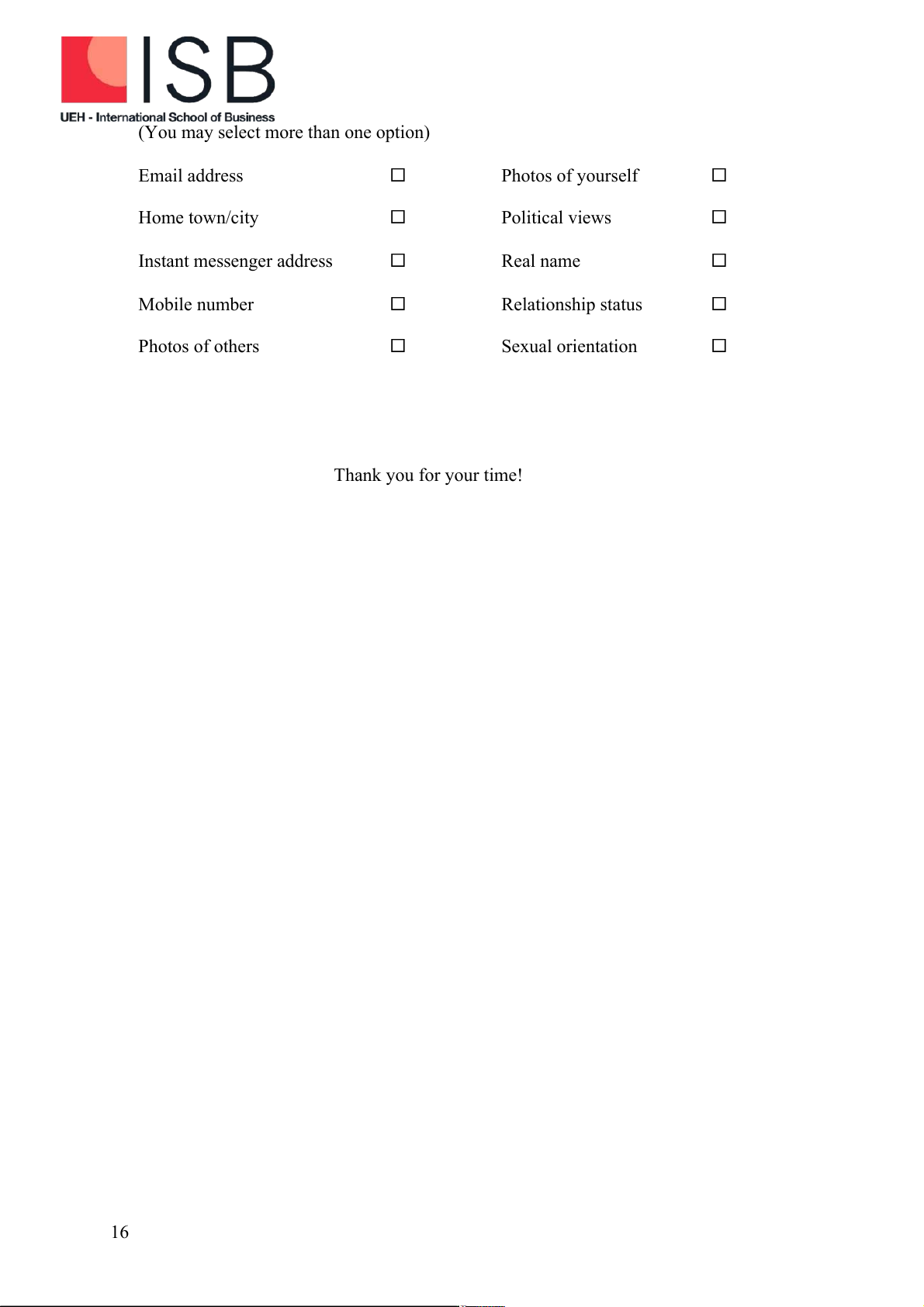
(You may select more than one option) Email address Photos of yourself Home town/city Political views Instant messenger address Real name Mobile number Relationship status Photos of others Sexual orientation Thank you for your time! 16
Tài liệu liên quan:
-
Bài Tập Nghe Đọc Viết: Jumbo Hostel và Thành Phố Tokyo | Tiếng Anh | Đại học Kinh tế - Đại học Đà Nẵng
32 16 -
Listening Skills Practice - ESL Test 1 & 2 Insights | Tiếng Anh | Đại học Kinh tế - Đại học Đà Nẵng
37 19 -
IELTS Speaking Tips: Common Phrases for Part 1 Responses | Tiếng Anh | Đại học Kinh tế - Đại học Đà Nẵng
35 18 -
Bài tập Reading Lần 2: Housing Needs and Property Options | Tiếng Anh | Đại học Kinh tế - Đại học Đà Nẵng
33 17