Tài liệu tham khảo - Chapter 2: Action, ethics, and research: How can I make a difference? | Trường Đại học Ngoại ngữ, Đại học Quốc gia Hà Nội
Tài liệu tham khảo - Chapter 2: Action, ethics, and research: How can I make a difference? | Trường Đại học Ngoại ngữ, Đại học Quốc gia Hà Nội. Tài liệu được sưu tầm giúp bạn tham khảo, ôn tập và đạt kết quả cao. Mời bạn đọc đón xem.
Môn: Chuyên Anh (ĐHNN) 55 tài liệu
Trường: Trường Đại học Ngoại ngữ, Đại học Quốc gia Hà Nội 646 tài liệu
Tác giả:



















Preview text:
Chapter 2
Action, ethics, and research: How can I make a difference? Chapter objectives
After this chapter, you should be able to:
Muslim veils in French schools: How can we
determine right from wrong in intercultural
➔ Define ethics and morality situations?
➔ Describe and evaluate universal
“Not in our town:” What is the role of
ethical approaches and ethical
intercultural communication in civic relativism engagement?
➔ Differentiate between civic and
How can we do responsible cultural
political engagement and relate research? them to culture
➔ Outline three approaches (paradigms) to cultural research in communication
➔ Distinguish between various
research focuses in intercultural communication
Intercultural Communication for Everyday Life, First Edition. John R. Baldwin, Robin R. Means Coleman, Alberto González, and Suchitra Shenoy-Packer.
© 2014 John R. Baldwin, Robin R. Means Coleman, Alberto González, and Suchitra Shenoy-Packer.
Published 2014 by John Wiley & Sons Ltd. 24
Chapter 2 Action, ethics, and research: How can I make a difference? 25
Every year more college students, secondary-school students, and working citizens
commit themselves to helping others. This help might take the form of “alternative”
breaks, in which college students go in groups to cities or regions of their country
that need more development or a special service boost, such as a clean-up after a
hurricane (Figure 2.1). According to Break Away, a website describing such opportunities,
alternative spring breaks began in the United States in the late 1980s and early 1990s
(Break Away, n.d.). They began “as part of an overall surge of interest in institutionalizing
community service on college campuses,” rather than the typical break in which university
students went to a “party” location. In 2010, more than 72,000 U.S. students participated
in such breaks. In 2011, 64 million U.S. Americans volunteered as part of some organiza-
tion (Federal Agency for Service and Volunteering, 27 Nov, 2012). Many Christians do
short-term group service projects within and outside of the United States, to address situ-
ations of poverty or disaster. The numbers doing such trips have increased from 120,000
in 1989 to 2,200,000 in 2006, with travelers spending a total of $1.6 billion U.S. dol ars (Corbett & Fikkert, 2009).
However, Steve Corbett and Brian Fikkert (2009) charge that, often, civic engage-
ment to help the poor does more harm than good. The best-intentioned effort at inject-
ing aid or bringing money into a community can increase dependence, reduce the
dignity of local individuals, and harm those who are giving. The givers can be paternal-
istic and can stereotype the poor. Such a charge raises difficult questions. When we are
interacting with people from other cultures within and outside of our nation, what
guidelines, if any, can direct our actions and communication? Should we, as citizens, be
involved in addressing needs in other cultures? What is our role in the politics or the
world around us? Some of us might want to get involved in or give to causes such as
Figure 2.1 Students often do service projects
as part of alternate spring breaks, mission trips,
or other group efforts. Many times, these works
provide wonderful service for communities, but
they can also have unforeseen ethical implications. Source: Edwin Remsberg/Alamy. 26 Part one Foundations
Habitat for Humanity, Save the Children, or Amnesty International. Others of us might
ask, “Is that really my responsibility?” or tell ourselves, “Maybe that’s something I’ll do
when I’m older.” If we want to do such service projects, how can we best understand
local communities and their needs? These questions lead us to three issues that we
will consider in this chapter: intercultural communication ethics; civic engagement; and cultural research.
Muslim veils in French schools: How can
we determine right from wrong in intercultural situations?
An issue that is dividing much of Europe, and especially France, at the time of writing
of this text, is the cultural and religious multiculturalism of Europe. One case study
from the cultural debate serves to introduce our discussion of ethics: whether the
French government should be able to outlaw religious imagery, such as large crosses,
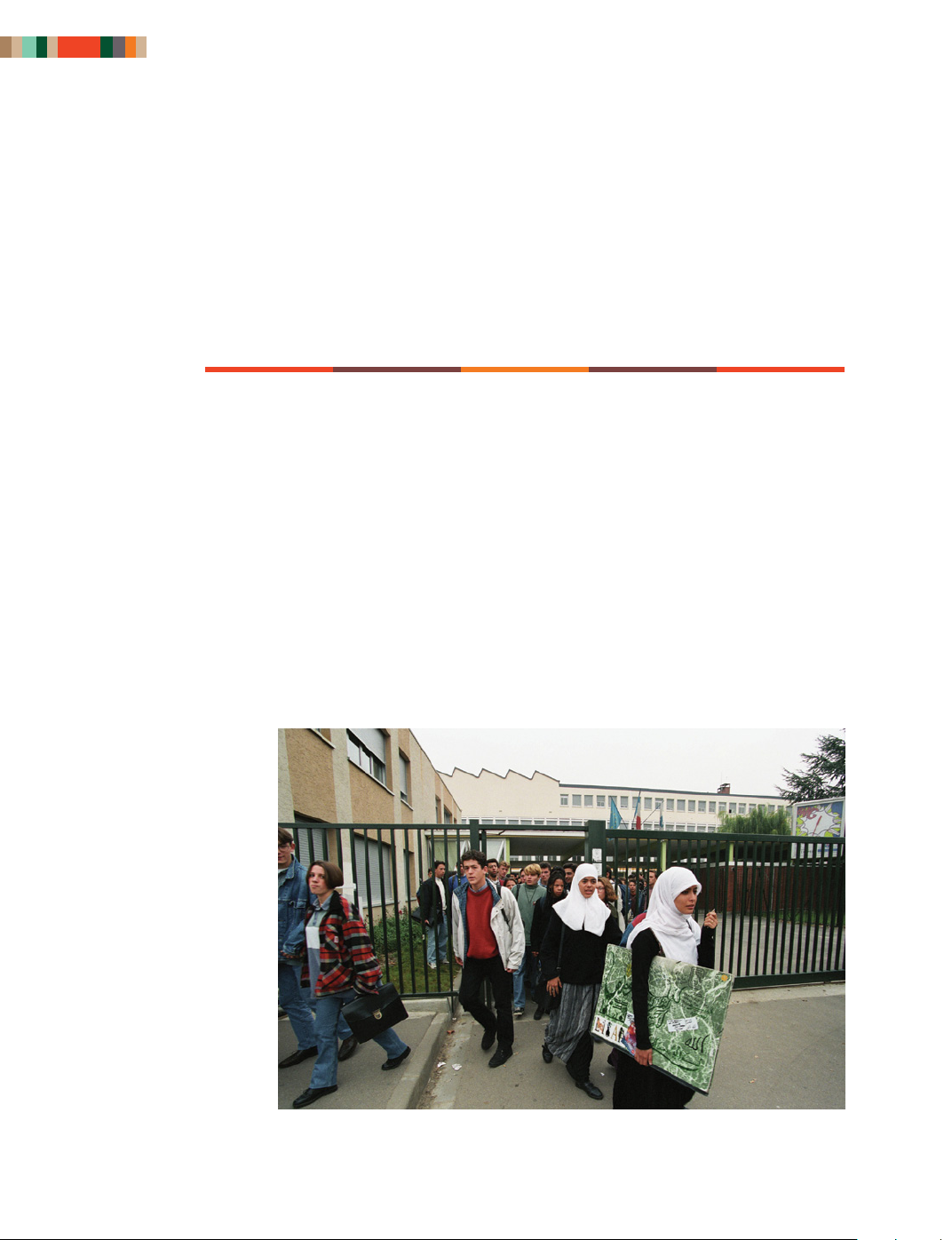
yarmulkes, or, perhaps the most controversial, veils for Muslim women (Figure 2.2).
On one side of the debate, the French government is concerned with religious division
and violence in the schools as well as traditional fears of loss of cultural prestige, as
Muslim culture exerts a stronger influence across Europe. On the other side are
notions of modesty and decorum held by Muslim women, many people feel that it is
against their religious practices not to cover their heads or portions of their faces. The
issue relates to similar questions: Does one nation have the right to tell another nation
how to handle its human rights? Should the global feminist movement seek to change Figure 2.2 The issue of wearing visual markers
of religion, such as the veil, has become a topic of hot political debate in France. In the mid-1990s, these students at Saint-Exupery Secondary School, in France, could still wear veils. Source: Jean-Pierre Rey/ Gamma Rapho/Getty Images.
Chapter 2 Action, ethics, and research: How can I make a difference? 27
the status of women in places where such changes grate against the grain of the cul-
ture? Should one offer a “bribe” to a public official to avoid a minor charge or to ensure
that some legal process happens in a timely manner? Or, within a specific culture, is it
ethical for a university or business to restrict freedom of speech by limiting “hate
speech?” If we remain silent when we see intolerance, such as someone telling a joke
that puts down a culture or group of people, is that silence wrong? All of these deal with the notion of ethics. Ethics and morality
Ethics and morality are linked to notions of right and wrong; while morality deals with
any behavior that might be considered right or wrong, ethics deals specifical y with the
rightness or wrongness of our interactions with others, that is, the application of moral
principles to behavior with others (Wines & Napier, 1992). In some cultures, taking drugs
might be considered immoral, but stealing or lying—as they involve others more directly—
are questions of ethics. It is often easier to determine what is moral y or ethical y accept-
able within a culture. It is more difficult to compare the systems of right and wrong
between two cultures or when people from two cultures are interacting, following differ- ent moral systems.
We all follow some form of guidelines as we interact with others. Let us imagine that
you wish to download your favorite reggae music, illegal y, from the Internet. Some com-
mon ethical approaches might lead you to different decisions. Utilitarianism, or deter-
mining the greatest benefit for the greatest number of people, would lead you to ask who
might be helped or hurt by illegal downloading of media content. The categorical
imperative, which uses logical questions like, “What if everyone did this?” would lead
you to think about what would happen, economical y, if everyone only downloaded music
illegal y. The golden mean, which involves avoiding extremes in decision-making, might
suggest that if the music is not obtainable for purchase or if you just want to try it out
before you buy, you might download, but not make a steady practice of it. Ethical egoism
refers to making choices based simply on what seems good or beneficial to us, without a
regard for others—you download the music because you want it and can get away with it (Griffin, 2009).
Ethical discussions in intercultural communication often lead to one of four
approaches. First, writers often skirt discussing ethics altogether. For example, one book
might spend 600 pages discussing how to spread new ideas, artifacts, or behaviors into
a culture (such as teaching people to have protected sex), but contain no reference to
ethical implications of cultural change; while another spends hundreds of pages talking
about how to blend international business styles, but mentions ethics only briefly, in a
one-page discussion of whether we should give bribes. A second approach is to present
practical checklists of ethical guidelines for intercultural communicators, such as learn-
ing from others or knowing ourselves. Such lists promote respectful intercultural com-
munication, but these may overlook deeper complexities of ethics or rely on a single
ethical system for their formulation. This leads to the last two approaches, which strug-
gle against each other in the field of intercultural communication: some seek a universal
or cross-cultural guideline for ethical behavior; and others argue that each culture
should determine its own set of ethics. 28 Part one Foundations
What do you think? In many nations, today, college students find the things they
need a major chain store. Imagine that you shop at such a store, because it is convenient,
and the prices are the lowest in town. But you find out that the organization engages in
unfair labor practices. It hires most employees part-time, to avoid paying for health insur-
ance. It discriminates against women or minority members by not giving them promo-
tions. Employees are underpaid and easily fired, but the CEOs and owners are very rich.
What are the ethical implications of you shopping or not shopping at such a store?
Determining a universal ethical stance
Many intercultural teachers and writers look for a meta-ethic, an overarching guideline of
behavior toward other people that either can or should be applied to people in all cultures.
But determining what that ethic should be is difficult. It would not be fair, for example, to
apply a Judeo-Christian ethic to people who do not follow that religious system. Utilitarian,
golden mean, and other ethical stances described earlier can inform intercultural commu-
nication (Hal , 2003), though each has limitations in actual application. Stel a Ting-Toomey
(1999) recommends a “derived” ethical universal approach: we look across cultures to see if
they hold ethical principles in common. Once we find ethical stances that overlap, we can
combine these for an approach that applies to interaction in any culture (Wines & Napier,
1992). For example, the United Nations Charter on Human Rights puts forth a series of
rights agreed upon by people of many nations, such as the “right to life, liberty, and security
of person” (United Nations, n.d.). The Charter advocates against all slavery or degrading
punishments, and for representation before the law.
Other writers offer universal ethical principles such as the humanistic principle, which
states that we should not harm others and should treat them well (Hatch, 1994). This is
similar to the peace principle, which centers the notion of human spirit as the basis for
universal ethics: “The guiding principle of any universal code of intercultural communica-
tion should be to protect the worth and dignity of the human spirit” (Kale, 2000, p. 452).
These principles state that we should not engage in any behavior that has a negative impact
on the welfare of others. With this in mind, racism, poverty, and creating human suffering
are unethical, and so is ignoring such injustices. This principle forms the first major com-
ponent of Judith Martin and Thomas Nakayama’s (2002) approach, which proposes that
any ethic that we apply across cultures, whether for everyday intercultural communication
or scholarly research into other cultures, should involve treating and representing others
with dignity and respect. With this in mind, it becomes ethical for college students or ON THE NET
Ethics matters: Find an ethical case study in the list of business ethics case studies at http://ethics.
sandiego.edu/resources. How might different cultures approach the same case differently? What
behavior might be appropriate if people in the case took some of the different universal ethical
approaches? How might the humanistic or peace principles be useful in the situation?
Chapter 2 Action, ethics, and research: How can I make a difference? 29
workers first to treat their colleagues with dignity, but also to be aware of and not ignore
larger social issues, such as human trafficking.
A second principle that Martin and Nakayama (2002) describe, the dialogic ethic,
states that as we determine ethics across cultures, we should discuss with the parties
involved what sorts of ethical guidelines should be in effect. It is sometimes hard to
determine what is right and wrong based on the humanistic principle, especially when
behaviors in question do not seem harmful, or when what is helpful to one party acts
against the wellbeing of another. This is in line with Mikhail Bakhtin’s (1981) idea of a
dialogic imperative, in which there is no monologue, but a comparison of competing
perspectives—or Jürgen Habermas’ (1998) notion of “communicative freedom” (p. 119),
which states that ethical discussion occurs when everyone has the ability to engage in
discussion, without coercion or constraint by others, such as through unequal power relations (Niemi, 2008).
For example, an ethical question that has influenced international politics is the degree
to which there should be a free flow of media between cultures. Allowing unrestricted
importation of international media often harms local artists, musicians, and media systems
in developing countries. But restricting its importation limits the advancement of media
systems in media-dominant nations, impacting jobs and economies in those nations. Most
ethical differences are not central to issues of dignity, and intercultural communicators can
overlook them (Hatch, 1994). But some differences are important enough to address—
questions of human rights, slavery, and genocide (United Nations, n.d.). Before either side
agrees to ethical guidelines, they should talk to each other to negotiate an ethical approach
that works for both parties. The dialogic ethic is based on building relationships with people
before we make ethical decisions about their behavior, and requires understanding, empa- thy, and caring. Ethical relativism
Other writers advocate cultural relativism, the idea that people in each culture create their
own accepted norms about what is right or wrong, with each ethical system being equal y
as acceptable as any other system. One possible issue with cultural relativism is that all
members of a culture could accept a practice that by most standards (e.g., the United
Nations Universal Declaration of Human Rights) would be harmful for some members. For
example, if most members of a culture believe in bride burning, slavery, torture, or human
sacrifice, cultural relativism dictates that those outside the culture should say nothing about
it. Ethical relativism has strong implications for human rights activists (e.g., Amnesty
International) and initiatives by some national governments to impose a view of human rights on others.
In sum, we see that ethics are an important part of intercultural communication. It
is important to be aware of our own ethical approach. But as we interact with people
from other cultures, there are often differences in how we are expected to treat others.
People offer a variety of universal ethical approaches (meta-ethics) to guide our
behavior, including the humanistic and dialogic principles, developed specifically for
intercultural communication. Others believe that we can only understand the ethics of
each culture uniquely. In most ethical, moral, and religious systems, however, consider-
ing the good of others—and working toward that good—seems to be a worthwhile ethical goal. 30 Part one Foundations
“Not in our town:” What is the role of intercultural
communication in civic engagement?
With a broader conception of culture—viewing culture as ever-negotiated and distinct
ways of life, rather than simply as national or ethnic groups—we can see that cultural
differences exist in many of the dilemmas that face us in the cities and towns where we
live and study. In a world of increasing diversity, we are faced with intolerance toward
those of other races, countries, or social class backgrounds. There are individuals in
our communities who may not have access to the same resources as others. There may
be a gap in levels of achievement our local schools, due in part to a chasm between the
culture of the children and the culture of the educational system (García & Guerra,
2006). People on many college campuses call our attention to social issues that often
have a cultural component, such as the status of refugees from different countries, or
political and religious division in places such as Northern Ireland. And agencies for
civil and human rights around the world organize activities that relate to awareness
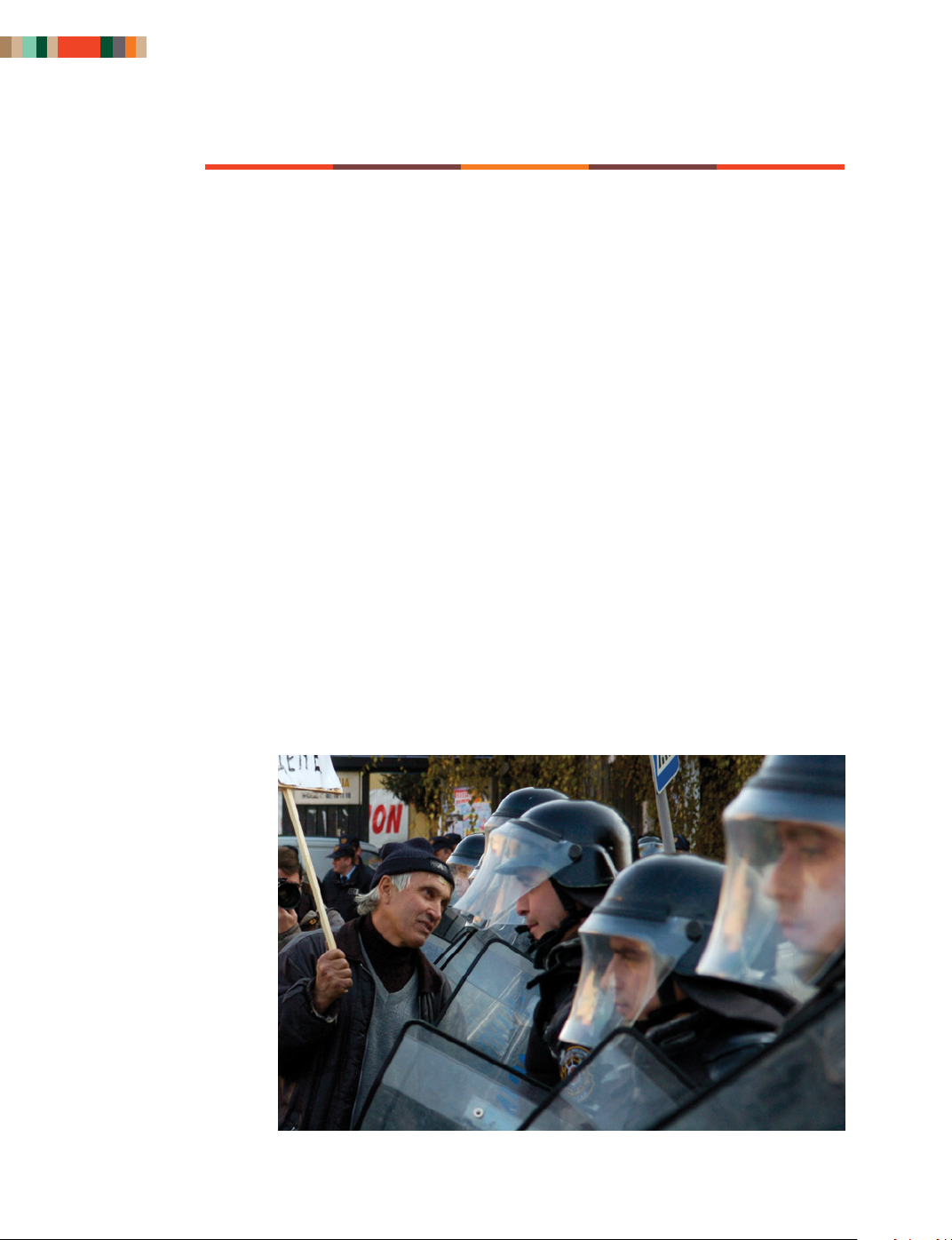
and tolerance. Around the world, citizens strive, often in protest, for human and civil rights (Figure 2.3).
As one example, the United States values altruism, the notion of doing good to some-
one, even a stranger and voluntarism, the idea of giving one’s own time, for no apparent
benefit to oneself (Althen et al., 2003). People in the United States give time or money to
help tsunami victims or AIDS orphans. They volunteer in organizations like Habitat for
Humanity or the American Cancer Foundation (even if they do not know someone with
cancer personally). Some sources say that as many as 26% of U.S. Americans volunteer
for some charitable organization each year (Bureau of Labor Statistics, 2008). They
give money and time for complete strangers, leading some Koreans to think that
U.S. Americans treat strangers like friends and friends like strangers (Kohls, 2001). Figure 2.3 Unemployed
citizens demand new workers’ rights in front of the Macedonian Parliament in Skopje, November 27, 2007. Source: Ognen Teofilovski/ Reuters.
Chapter 2 Action, ethics, and research: How can I make a difference? 31
Many U.S. Americans stand up to prejudice through efforts such as the “Not in Our Town”
campaigns that began after intolerance toward Jewish people in Billings, Montana (Not in
Our Town, n.d.). At the same time, in response to many efforts toward social change, we say
“Not in My Back Yard,” a statement so common people refer to it by the acronym NIMBY.
For example, many U.S. Americans who disagree with the detainment of Iraq refugees in
Guantanamo Bay during the Iraq War, might oppose a facility housing those same refugees in their own community.
Political and civic engagement
There are different ways to get involved in the community. Some involvement has a
political motive, and some does not. Involvement that includes participation in the
political system is referred to as political engagement. Political engagement includes
working on community problems, serving in organizations with a “stake in political
policies or outcomes,” supporting or talking to others about political causes, writing
letters or blogging about political or social issues, working on campaigns, signing peti-
tions, raising public awareness (e.g., through rallies, street theater, or boycotts), and
voting (Colby et al., 2007, pp. 30–31). Such efforts need not be connected to a specific
political party, but rather regard issues that involve public policy, spending, and
socio-political attention. For example, students in nations with a large foreign worker
population, such as Germany or Malaysia, might host a public debate on immigration
issues. Students might study and inform politicians or the public of the cultural needs,
perceptions, or conditions of the local homeless community. Efforts at political
engagement often cross cultural lines. For example, a discussion of Haitian workers
in the Dominican Republic requires knowledge about Haitian and Dominican cultural
differences, Dominican nationalization policy, prejudices between groups, and the
intersection of international politics and economies.
At the same time, many are less concerned about public policy than they are about the
everyday wel being of others, for example, people who need homes, children who need
mentoring, or immigrants and travelers who need to learn the host language. College
students might be involved in local children’s or history museums, efforts to renovate a
downtown or campus area, no-kill animal shelters, and so on. Involvement in the com-
munity, regardless of politics, is referred to as civic engagement. Civic engagement often
leads those involved to feel a sense of responsibility to their community, engaging in civil
society, and helping the common good, with activities including learning about diversity,
engaging in public problem solving, or assuming leadership roles in organizations (Jacoby,
2009). For example, a recent news report suggests that, although volunteering is a new
concept in Russia, 160,000 people have applied to volunteer time at the 2014 Sochi Olympics (Itasaka, 2013).
Once civic engagement turns to social issues, promoting local and global justice, or
taking an active role in the political process, it becomes political engagement. To distin-
guish civic from political engagement, for example, if a student group raises awareness
about the homeless or immigrants, it is political engagement; if the students simply donate
time working in a homeless culture or teaching immigrants the host language, it is civic engagement.
People and groups have long promoted voluntarism. One of the founding principles of
Harvard College in 1636 was preparing students to engage actively with community life. 32 Part one Foundations
Social leaders like educator and philosopher John Dewey and U.S. President Franklin
Roosevelt promoted connections between universities and the social problems of the day.
U.S. President George H. W. Bush passed the National and Community Service Act in 1990
(Jacoby, 2009). Now, many universities focus students’ attention on civic and political
engagement. Organizations such as the American Democracy Project and the American
Association of State Colleges and Universities (Jacoby, 2009), as well as specific institutions,
such as Georgetown University and University of Wisconsin-Madison, support programs
to get students involved with the community in some way (Welch, 2009).
Defending civic and political engagement among college students
In college, we might be political y involved or see the need to volunteer. However, there
are practical and ideological reasons why we may choose not to become engaged or even
avoid the discussion of civic or political engagement in the university setting. Practical
reasons—those most often in the forefront of students’ minds—include logistical issues:
“I barely have time to work and do my studies,” “I don’t know how to get involved,” “I’d
rather spend my spare time with friends.” There are several responses to these issues.
First, in a way, the patterns we establish in college often guide us as we enter the so-called
“real world” after college. We are busy with classes, exams, and jobs—but often no busier
than when we graduate and have full-time jobs, children, or other commitments. Second,
there is a need for someone to reach out and help others—if we do not, who will? Third,
there are personal benefits for helping others. If you are from a “collective” culture
(see chapter 4), you might find reward in contributing not only to your family or work-
group, but to the community at large, forging a new, broader sense of group identity. If
you are an “individualist,” you may find personal reward, a sense of feeling good about
yourself, from helping others (Bel ah et al., 1996). University life gives us many rewards—
friendship, career development, networking opportunities. But involvement in the lives
of others gives us a different reward. POP CUL
Consider the song, Solo le Pido a Dios, by Argentine singer, Leon Gieco. How might this song impact its
audience in its context? (You may have to do some Internet research to answer this.) What songs have
impacted your life as regards to helping others or thinking about your social world? TURE
Solo le Pido a Dios (Leon Gieco) I only ask of God I only ask of God
That I will not be indifferent to the pain
That I will not be indifferent to war
That the dry death will not find me
It is a great monster and steps mightily
Empty and alone, without having done enough
Upon all the poor innocence of the people I only ask of God [Trans. J. Baldwin]
That I will not be indifferent to the justice
That they will not strike my other cheek
After a talon has scratched my destiny
Chapter 2 Action, ethics, and research: How can I make a difference? 33
Some people have ideological reasons against teaching civic and political engagement
in the classroom. Some claim such teaching indoctrinates students with a specific
(supposedly liberal) ideology—it leads them to the left of politics. However, a detailed
study of more than 20 courses and programs incorporating Political Engagement
Projects (PEPs) at a variety of universities discovered that teaching exercises that created
civic and political engagement among students increased their likelihood of being
involved in their communities as adults, but did not change their political ideology.
If they were conservative going into the class, they became involved as conservatives.
If they were politically liberal, they engaged in the community in ways true to that polit-
ical approach (Colby et al., 2007). POP CUL
Some popular music groups, like Rage Against The Machine Gogol Bordello (a Gypsy punk band,
Figure 2.4), U2, or Green Day, make political activism a large part of their musical focus. What
popular artists do you know that include social themes in their music? What are some of the issues
and values they promote? What are some strengths and limitations of using popular music for social change? TURE Figure 2.4 Yuri Lemeshev, of Gogol Bordello, a Gypsy punk band from New York, U.S.A., performs in Moscow, Russia, July 23, 2010. Source: Will Ireland/ Metal Hammer Magazine/Rex Features.
Another concern critics raise is that the purpose of the college classroom is to teach skil s
and ideas that help one’s career, rather than instilling students with values of civic engage-
ment (Fish, 2008). People with this view often feel that the family should be the ones to
instill values of civic or political engagement in children. Colby et al. (2007) respond that
“reasonably well-informed, capable, engaged, and public-spirited citizens are essential if a
democracy is to flourish” (p. 26). Civic engagement, they argue, leads to citizen participa-
tion and to a more informed public, as those who become civical y engaged often see more
of the complexities of society and learn more about the social problems on which they
focus. While students have agency to be civic and political y engaged, there are often 34 Part one Foundations
constraints—political, economic, or cultural—that act upon their ability to be engaged. For
example, the political system in Myanmar prohibited the unregistered congregating of
more than five people, but allowed foreign non-governmental organizations (NGOs) to enter with humanitarian aid.
Final y, some people with a liberal perspective criticize political and civic engagement
efforts for not going far enough. In some cases, we might become engaged in a project, like
feeding hungry children, because we see ourselves as a cultural (or even racial) savior. Some
approaches to civic engagement could disempower those receiving the supposed help, lead-
ing to dependence on those providing the help. Such efforts could hide the unequal access
that some groups have to resources and power. John Eby (1998) suggests that most civic
engagement ignores larger structural issues, diverts attention from social policy to volunta-
rism, and leads students to a limited concept of real human needs and how to address them.
Colby et al. (2007) respond that civic engagement gives at least some sense of the choices that
are possible and may instill a sense of efficacy among people—that is, the sense that, with
their own work or combined with others, they can accomplish a task to which they set them-
selves. In this way, students will not wait for cultural or political elites to make decisions for
them, but will personal y influence the contexts and structures that impact their lives. Doing civic engagement
Getting involved matters. The humanitarian ethic noted earlier states that if people are suf-
fering and we do nothing, we are contributing to their suffering. At the same time, Martin
and Nakayama’s (2002) dialogic ethic suggests that as we become engaged we must partici-
pate with those influenced by our actions to determine the goals and the outcomes in a way
that empowers them and creates cultural y responsible engagement.
The question remains: what would this skeleton of civic engagement that we have
provided look like with “flesh and bones” on it? We present here three different cases of
civic engagement that pertain to culture in some way, based on real exercises used by instructors.
Case 1 One of the priorities of the National Organization of Women (NOW) is promot-
ing a national amendment to the U.S. Constitution that ensures the rights and safety of
women, including statements regarding women’s rights to abortion (National Organization
for Women (NOW), n.d.). An intercultural specialist or group of students could investigate
the organization and its objectives and how it relates to local cultures, politics, and civic
attitudes for and against the organization. People might investigate organizational or com-
munity members’ views of the organization’s mission and effectiveness, to promote local
strategies for more effective outreach to the community. Or they might do an experiment
on student groups on a college campus, seeing what effect different types of awareness mes-
sages from NOW have on students.
Case 2 In Israel, there is long-standing tension between Jewish and Palestinian Israelis.
Students and civic workers could investigate the roots of this tension, including historical
hatreds, social inequalities, and attitudes. They could study issues of prejudice and locate
points of similarity between the groups. Then they could develop an awareness campaign,
stage unity marches, or build programs that promote helpful contact (see chapter 6) between
children and adolescents of the two groups.
Chapter 2 Action, ethics, and research: How can I make a difference? 35 Break it down
Look in your local phonebook and newspaper, or on the Internet, or, if there is a volunteer
agency or network at your school, talk to that office. Make a list of the possible areas of civic
or political engagement in your community or at your school that might have some connection to culture.
Case 3 An instructor teaching how to give a persuasive speech to his students pointed out
that part of understanding persuasion is to understand the diversity of audiences. Some of
his students resisted, echoing a common stance that the standard public speaking class-
room is not a place to focus on race or class, and that in fact, many college classes simply
spend too much time on these “trite” topics. One student, “Henry,” held such an opinion,
until the instructor gave the students an assignment to interview someone of a different
racial, sexual, and social class background. Henry described “Sara,” a middle-aged African
American and her perception of her treatment in public places. Joseph Zompetti (2006,
para 32) summarizes Henry’s speech to the class:
As Henry told us the story of Sara, he became impassioned with empathy and concern. At
times, his eyes clouded up, but his voice remained stern and assertive. Henry sincerely
appeared to be moved by his interview with Sara. Given his earlier dislike for discussing
identity, the audience, too, was enwrapped in Henry’s speech. They seemed amazed at his
transformation and appreciated his sincerity. When he concluded his speech, Henry declared,
“I’ve learned that society does treat people differently, and that people have predispositions
toward other people . . . and I’ve learned it all from Sara.” At that moment in time, it seemed
as if everyone in the class, particularly Henry, understood the importance of identity and public speaking.
There is both benefit and need for us to look beyond our own desires and careers. We
live in a social world, and as such, must be concerned with the needs of the people around
us. We can get involved in the lives of others for the sake of making the world a better place;
or we can do so at a level that involves public policy and spending.
How can we do responsible cultural research?
Part of being cultural y ethical is providing accurate representations of others and of cul-
tural concepts. One way we may choose to be involved, especial y as we gain the skil s a
college education provides, is by doing research for civic groups. At a minimum, organi-
zations or groups might expect us to understand research. But how can we do or read
research effectively? The final section of the chapter introduces approaches to research,
and then closes with one last look at ethics as they relate to cultural, cross-cultural, and intercultural research. 36 Part one Foundations
Assumptions that guide cultural research
As we look at journal articles in the area of intercultural and cross-cultural communication, one
might be full of statistics; another, observational notes or example quotations from only a few
participants; another, an in-depth rhetorical analysis of a text (such as a Nelson Mandela speech
or a Norah Jones music video). People look at both culture and civic engagement differently.
One way to understand the variety of intercultural research is to explore the types of underlying
assumptions researchers might have. These assumptions tend to revolve around issues of what
is real (at least, what is the reality that we should be considering), what counts as knowledge, and
what the role of the researchers’ values should be in conducting research. These apply to how
scholars do research, but here we will apply them to our own understandings of the world.
Ontology refers to assumptions about the nature of reality. We often take our way of seeing
the social world as natural. But in fact, there are several ways to see reality, especial y social
reality (Miller, 2005, and Potter, 1996, outline some of these differences). For example, when we
think of how men and women communicate in a college setting, we might think of sex as some-
thing that leads men to communicate one way and women another, even if we recognize that
social upbringing, along with or instead of physical differences, is what influences behavior. That
is, we think of behavior in terms of external and internal causes and effects. If this is the case, then
if we can change causes in a social situation, the outcomes will change (like changing seating
in a classroom to influence the development of interracial friendships). Or we might believe
fundamental y that people have free wil . So, regardless of any cultural patterns, each woman or
man makes unique choices about how to behave. Or you might think that gender is always chang-
ing and that we “create” gender by the way we talk, the jokes we tel , and the images we make.
How we see the world is related to our epistemology, or assumptions about knowledge. If we
believe that each person has her or his own reality (e.g., “beauty is in the eye of the beholder”), we
will not make or believe in statements that describe how people are alike. If we do research, we
will want to talk to individuals to find their own perspectives of reality, or perhaps we might
describe the understandings of a single group of people. But if we believe in internal and external
causes for behavior, we will likely read and trust research that uses methods that filter out
researcher opinion, like experiments or closed-ended surveys, and we might prefer to make
claims only after we have done research on a large group of people, even using statistics.
In addition to our views of reality and knowledge, each of us has assumptions regard-
ing the role of our values as we do research on culture and communication, which is our
axiology. We might think that research can or should be value-free, especial y if we believe
in cultural relativism, noted before. Or we might think that we real y cannot see anything,
including research, apart from our own opinions and biases. We could even believe that in
a world with social inequalities, we would be wrong not to bring our values to our research,
doing research and taking action to address such inequalities.
Approaches to studying culture and communication
With these definitions in mind, we can better understand the notion of “paradigms” in the
communication field. The three paradigms—ways of seeing the (social or scientific)
world—most common in communication research are the scientific, humanistic, and critical
paradigms, though some consider postmodernism to be a fourth paradigm. Different
approaches to the world are often connected to preferred ways of doing research (Figure 2.5).
If you do scientific research, you will hold many of these assumptions: (1) Social behavior
Chapter 2 Action, ethics, and research: How can I make a difference? 37
Figure 2.5 Methods and examples of cultural, cross-cultural, and intercultural research Method Characteristics Example Experiment
There are typically two or more
Aubrey et al. (2009) found that women who viewed
conditions with different treatment
sexualized images (i.e., with high skin exposure)
(or a “control” group with no
rate their perceptions of their own bodies as more
treatment). Researchers observe
negative than those who see images with less
behavior or give a survey after the exposure.
treatment to see if the treatment led to any differences. Survey
Researchers give a list of items to
Kim et al. (2009) gave surveys measuring several (closed-ended)
which participants respond. The
cultural and individual variables among groups of
survey is often, but not always,
different ethnic backgrounds in the United States.
created from previous literature or
The more individuals saw themselves in terms of pre-existing measures.
their connection to others, the more they were
concerned with threats to self and other’s image in attempts to persuade. Survey Researchers give open-ended
Imahori & Cupach (1994) analyzed open-ended (open-ended)
questions to participants, either
questionnaires to determine differences in
in a list or as a diary. Then, the
communicative and emotional responses to
researchers group responses into
embarrassing predicaments between Japanese
themes, either interpreting them and U. S. Americans.
(themes with discussion) or turning
them into numbers to look for group differences. Interviews and
Researchers talk with participants,
Graham, Moeiai, & Shizuru (1985) used focus groups
following a strict interview format
standardized interviews and statistics to determine
(standardized), or a more flexible
differences in problems perceived by intercultural format (semi-structured).
and same-culture married couples. Cheong & Poon
Standardized interviews are more
(2009) used focus groups to uncover meanings and
easily turned into categories that
usages of Protestant Chinese immigrants to Canada,
can be analyzed with statistics.
providing quotations from participants.
Semi-structured interviews usually
lead to themes with quotations.
A focus group is an interview done with a group of people. (Continued) 38 Part one Foundations
Figure 2.5 (Continued ) Method Characteristics Example Observation
Researchers go into a culture and
Carbaugh et al. (2006) did fieldwork and observed
watch behavior. They can participate
interaction to discover (and interpret) Finnish
to different degrees and might also do
understandings of silence. Remland et al. (1995)
interviews, analyze documents, and so
used systematic observation to determine cultural
on. This can be either in the realm of
differences between several European countries
interpreting a behavior in context, or
regarding use of touch, distance, and body angle in
counting frequencies of the occurrence conversation. of a behavior. Language Researchers record naturally
Hei (2009) used discourse analysis and face analysis
occurring language and use either
management theory (see Ch. 7) to categorize, from previous theory and terms to
taped everyday conversation, ways Malaysians use
analyze the language, or look at the
direct and indirect ways to refuse requests or offers.
turn-taking and other features of
language to understand culture. Textual analysis
Researchers interpret a text, such as
Endres & Gould (2009) analyzed student essays from
a website or speech, often using the
an intercultural communication class to see how
approach of a particular theory as a
students “perpetuate White privilege” by confusing
lens through which to look at the text.
being White with the notion of Whiteness and by
seeing their whiteness as grounds for charity to other groups. Media content
Researchers develop a coding scheme
Glascock & Ruggiero (2004) analyzed six telenovelas analysis
to look at specific aspects of a text.
and one drama to find that women were portrayed
The analysis is often quantifiable and
as more domestic with lower status and more focus
can be submitted to statistics.
on attractiveness than men, and that lighter-skinned
Latinas/Latinos were more likely to have lead roles than those with darker skin. Media criticism
Researchers apply an interpretive lens
Stijn (2009) used concepts of group power and
from previous theory to understand a
hierarchy to examine how Western news media media text.
create a global (and Euro-centered) “center” in the
way they report about domestic and international
disasters, that is, making Western suffering more
understandable and substantively different than
suffering of global “Others.”
Note: This list is intended as a list of many of the methods used for research on culture and communication. It is not intended to be exhaustive.
Chapter 2 Action, ethics, and research: How can I make a difference? 39
is predictable because people act based on internal and external causes. (2) Researchers
should be systematic and remove personal biases, to understand the universal laws that gov-
ern communication behavior. (3) Research might be quantitative, using statistics, but
researchers could also use observation or other methods and still believe that they are
“uncovering” a world external to themselves. (4) Research is often done to test the relation-
ship between variables in a theory, with a goal to provide better predictions of communication
outcomes. We should note that scholars do not believe humans are total y predictable—just
similar enough in many ways to make “probable” predictions (Metts, 2004). As an example,
you might study whether international travel leads college students or business people to
have less ethnocentrism or reduced racism.
The second paradigm is often called humanistic or interpretive. “Humanistic” implies
that humans are unique from other aspects of nature, based on their ability to use symbols
or some other aspect of their human essence (Potter, 1996). Research is “interpretive” in
that you might try to understand (or interpret) individual texts or small groups of individu-
als or instances. As you research, you might admit your own values as influencing how
you see the reality of the people you study. Common assumptions of this view include:
(1) People are not (or are less) predictable because they make choices. (2) Researchers
should provide an interpretation of a group’s reality or of an isolated media text. (3) Research
should consider behavior or texts holistical y and within larger social contexts. (4) Research
should provide an explanation of a specific phenomenon in a culture from that culture’s
perspective, or an analysis of a speech or media text through application of a set of terms.
In this perspective, you might investigate how people on a soccer team create a sense of
belonging through joke telling and insults. Or you might investigate metaphors in a speech
by Kenyan environmental activist Wangari Maathai.
We can see a difference between social scientific and interpretive views of culture in a
common distinction some have made between approaches to understanding culture. On
one hand, in an etic approach, researchers develop some framework of terms or dimen-
sions, such as cultures where people focus more on the individual and those where people
focus more on the group, or those where people touch more and stand closer and those
where they touch less and stand further apart. Researchers then apply the framework or
theory to compare cultures in their behavior, according to terms the researcher has devel-
oped. Researchers using an emic approach will not want to impose their understandings
of meanings or behaviors on a culture, but will seek to set aside their own understandings.
Often using observation or talking to people, they try to discover the categories and mean-
ings people in their own cultures give to their behavior and social reality (Gudykunst & Nishida, 1989)
The third paradigm, critical research, seeks to address social injustice in the world or
explain how groups with different ideologies about the world struggle with each other to
make their views dominant. Unlike the first two paradigms, in critical research, authors
deliberately take their values into research. If you take this approach to doing research, you
might analyze music videos quantitatively to see if the portrayal of women gives them the
same choices and status as men. Or you might study how different groups within your cul-
ture or university struggle to make a particular definition of “education” dominant, exclud-
ing or putting down other views. Much of critical theory is about ideology and hegemony.
Ideology here refers to a set of assumptions that we use to interpret the world around us
(van Dijk, 1998)—it is different from a paradigm in that it often deals with social structures
and power. Hegemony is defined as some form or level of control over another group, such 40 Part one Foundations
as political, cultural, or economic power (Zompetti, 2012). Critical researchers, including
most feminists, would now look at gender differences in communication in terms of pos-
sible oppression or marginalization of women’s communicative styles (Kramarae, 1980),
either through media texts or in face-to-face communication, such as through interrup-
tions, topic choice, or slurs people use for men or women.
One new branch of critical theory involves postcolonialism—a field of study that looks
worldwide at problems created by colonization, seeking to bring awareness to these problems
and provide empowerment to those harmed by colonial relations (Shome & Hedge, 2002).
We can see the imposition of one cultural system from cases as distinct as European coloni-
zation of Africa and Asia to more modern forms of economic colonization, with one-way
media flows that lead strong media cultures to receive little outside influence, while influenc-
ing other cultures greatly. Key notions of postcolonialism include notions of diaspora, where
people from one culture spread out across many different cultures, and hybdridity, where
cultural elements blend within a culture (we will say more on these in chapter 3). The domi-
nant group represents diverse groups within its society in different, usual y unequal and
unfair ways, and there are impacts of postcolonial relations within a society on how subordi-
nate (and dominant) groups see their identity and agency, the choices one feels one
has. Often, people in subordinated groups, although still having agency, are constrained by
the power relations of the dominant group (Shome & Hedge, 2002). At the same time, some
writers argue that these power relations are more complicated than they seem at first: the
subordinate do have some agency, can represent the dominant group, and have their own
bases of power within hybrid relations (Garcia Canclini, 1995).
What do you think? Are there “real” differences between men and women and
the way they communicate (and what are they)? Or are these differences socially
constructed through communication? If they are socially constructed, are they done in a
way that disadvantages women and privileges men (give examples)? Or even in ways that
are inconsistent and contradictory?
From critical theory grew an approach called postmodernism. Postmodernism
involves not a single construction of some aspect of culture, but several. These social con-
structions place notions, such as “womanhood” or “manhood”, together with different con-
cepts. Men are told to be “sensitive new age guys”, to be good fathers or boyfriends, but are
also told they should be over-focused on women’s body parts and see women as something
to be “conquered.” That is, there are contradictory discourses, or presentations of ideas,
about things such as what it means to be a man or to be truly Japanese, or what counts as
success, constitutes “disease,” or merits “punishment” in a given culture (Foucault, 1995).
Postmodernism rejects much of what modernistic research, including humanistic research
stood for, such as linearity, reason, hierarchy of structure, and the search for given mean-
ings or single explanations. Postmodernists often feel that things such as modern specia-
lization, industrialization, urbanization, and rationalization (focus on reason) serve to
sustain systems of domination and control (Best & Kellner, 1991). Meaning, they suggest,
is not linear or rational; rather it jumps and leaps, the lines between disciplines (and even
between work and play, research and art) should be blurred, and we should bring what has
Chapter 2 Action, ethics, and research: How can I make a difference? 41
been left out—emotion, spirituality, rurality, and so on—back into academic thought
(Rosenau, 1992). The value of analyzing different discourses about things such as illness,
crime, masculinity, or democracy, is that it shows us how power works through and
between these discourses. If you take a postmodern view as you do research, you would be
less likely to make any claim about how a particular group, like Apache U.S. Indians,
Japanese burakumin, or Black Hondurans, are alike, but would expect there to be different
ways of living out each identity. Or you might study how different groups in your culture
seek to define notions like “family” or “success” in different ways that would provide power
or cultural prominence to one group or another.
Research can, but does not have to be linked to social action (political and civic engage-
ment). There is much research needed to make our communities and our world a better
place. But many people do research for practical means, such as to improve intercultural
business or education, or because of personal interest in some aspect of communication
(e.g., do people in southern France use nonverbal communication differently than those in the north of the country?).
But all research has ethical implications. Aside from standard research ethics of being
confidential, not manipulating our participants, and so on, in intercultural research, we
must be responsible in how we describe other cultures, making sure that our accounts are
true to how people in those cultures will see them. We should be careful not to look at other
cultures as strange, quaint, or folkloric (there are power relations involved even when we do
research). If we make a claim about a culture or about intercultural communication pro-
cesses, it should be based on sound research, and not just opinion. And we should consider
the consequences of anything we present from our research on those we research. As an
example, one researcher at a national conference presented a study on the values of Mexican
workers in maquildadoras—foreign-owned and -run factories in Mexico. The research was
funded by the company, with a report of Mexican values given to the foreign owners. In this
case, the owners could feasibly use the report to control the workers or get them to work for
cheaper wages. Research can have consequences, so it inherently involves ethics.
Differences of focus in culture-and-communication studies
Using the methods mentioned, we might look at different aspects of culture and communi-
cation. We often use “intercultural communication” as a broad name for all of these, but
there are different types of research and communication that involve culture:
Cultural communication research commonly refers to the study or practice of com-
munication in a single culture. Ethnographers in anthropology have taken such an approach
for many years. We might study how people in the context of a sports bar use banter with
strangers about the game. Cross-cultural communication is a term that never describes
interaction—only research, as it applies to studies that compare two or more cultures. We
might compare how members of different national cultural, ethnic, or age groups demon-
strate public displays of affection. That is, we would consider how Turks and Thais differ in
displays of affection, but not how they communicate with each other. This last idea more
appropriately describes what we can most precisely call intercultural communication—
defined in chapter 1 as communication between people of two different cultures, when the
culture impacts the communication enough to make a difference. For example, we might
consider interaction between Indian and Arab residents of Dubai in the hotel industry.
Co-cultural communication refers to communication between people of different groups 42 Part one Foundations
within a larger, dominant culture (what we used to call subcultures). There is a limitation in
the notion of co-culture, however, as often the differences between groups within a nation
(say, the Hmong community and White young professionals in the northwestern United
States) may be more different than differences between different nations (say, Australia and
New Zealand). Final y, we will use intergroup communication to refer to those instances
where group perception and processes (e.g., prejudices, stereotypes) impact communica-
tion, even if there are not real cultural differences (Baldwin & Hunt, 2002).
Some scholars look at culture as it relates to communication that is not exclusively face-
to-face, but also mediated. Developmental communication refers to communicative
efforts to bring more development (e.g., water, farming resources, family planning, eco-
nomic advancement) to communities (though some prefer to call this communication for
social change because of the condescending implications of the notion of “development”).
International communication is a vague term. Some use it interchangeably with intercul-
tural communication, though only when referring to cultures as nations. Others use it to
refer to national media systems, and final y, others use the term to refer to those situations
in which one is speaking for a nation, such as diplomats. In these cases, cultural and per-
sonal factors influence the communication process (see chapter 3), but so does the fact that
the person is representing the interests of a larger group. Summary
In this chapter, we looked at three separate but related issues. We considered ethics, looking
at the tension between ethical relativism and the idea of a meta-ethic, a single ethic used to
guide behavior regardless of cultures. While we framed our discussion in terms of interper-
sonal ethical choices, the field of international media entails similar ethical decisions. The
ethical stance people take will influence the way they do research. For example, someone
might believe that to do research that does not address or highlight social injustice is to be
unethical. Another researcher might believe that if one seeks to uncover the social reality of
a group, and that group does not believe that its gender relations are oppressive, then to
impose this view on the research is unethical.
Related to ethics, we introduced the notions of civic and political engagement. We saw
that individuals can be political y or civical y engaged regardless of political stance. There is
a growing need for colleges and universities, in the development of complete citizens, regard-
less of the country of the student, to promote civic action in a way appropriate to students’
culture, and, in some cases, to encourage both students and faculty to strive for cultural
change. But we also saw that even an open embracing in the college classroom of civic and
political engagement does not have to influence the student’s particular political world view.
Final y, we saw that both ethics and engagement relate to research. As intercultural
thinkers, we will gain knowledge and skil s that lead us to understand both our own culture
and the cultures of others around us better. This knowledge gives us agency and power,
within the constraints of our own cultural, political, and social situations. A growing knowl-
edge of culture may equip us more to make a positive influence on the world in a way that
is cultural y sensitive. And one way that many may choose to do this (or may be forced to, in
the context of an intercultural class) is through conducting cultural, cross-cultural, or inter-
cultural research. Hopeful y the ideas here will help us to be better local and global citizens, wherever we find ourselves.
Chapter 2 Action, ethics, and research: How can I make a difference? 43 KEY TERMS morality, 27 humanistic, 39 ethics, 27 interpretive, 39 utilitarianism, 27 etic approach, 39 categorical imperative, 27 emic approach, 39 golden mean, 27 critical, 39 ethical egoism, 27 ideology, 39 meta-ethic, 28 hegemony, 39 humanistic principle, 28 postcolonialism, 40 peace principle, 28 diaspora, 40 dialogic ethic, 29 hybridity, 40 cultural relativism, 29 agency, 40 altruism, 30 postmodernism, 40 voluntarism, 30 cultural communication, 41 political engagement, 31
cross-cultural communication, 41 civic engagement, 31
intercultural communication, 41 efficacy, 34 co-cultural communication, 41 ontology, 36 intergroup communication, 42 epistemology, 36
developmental communication, 42 axiology, 36
communication for social change, 42 paradigms, 36
international communication, 42 scientific, 36 Discussion questions
1 Some people grow discouraged realizing that there are multiple approaches to ethics and
morality and find it easier to give up, choosing simply not to think about it. What are
some problems with ignoring or giving up on understanding ethics?
2 Many modern media sources use parody and humor to highlight social problems and
issues (from parody newspapers (The Onion, http://www.theonion.com) to faux-news
shows (The Daily Show with John Stewart, The Colbert Report) to movies (Wag the Dog).
What do you think are the strengths and limitations of using parody and humor to address social issues?
3 Writers have tried to make a distinction between civic and political engagement. To what
degree do you feel these two can be treated separately? What are the implications,
strengths, and limitations of university classes that include a civic or political engage- ment focus?
4 Imagine a topic for a specific cultural, cross-cultural, or intercultural communication
study. What would you want to know? Which method might you choose, and why would
it be appropriate for your topic and study goals?
5 Read through the United Nations Universal Declaration of Human Rights (http://www.
un.org/en/documents/udhr/). What are the challenges for creating such a document? In what
ways do the rights proclaimed reflect or contradict practices in your culture?