Tài liệu tiếng anh sưu tầm. Fundamentals_of_Aerodynamics_5e_Anderson
Tài liệu tiếng anh sưu tầm. Fundamentals _ of _ Aerodynamics_5e_Anderson. Tài liệu sưu tầm được tổng hợp. Mời các bạn tham khảo
Môn: Kết cấu hàng không 1 8 tài liệu
Trường: Học viện Hàng Không Việt Nam 639 tài liệu
Tác giả:




















Preview text:
Anderson-98101 and98101˙fm December 23, 2009 17:34
Fundamentals of Aerodynamics Fifth Edition John D. Anderson, Jr. Anderson-98101 and98101˙fm December 23, 2009 17:34
McGraw-Hill Series in Aeronautical and Aerospace Engineering
John D. Anderson, Jr., University of Maryland, Consulting Editor Anderson Humble
Aircraft Performance and Design
Space Propulation Analysis and Design Anderson Hyer
Computational Fluid Dynamics
Stress Analysis of Fiber-Reinforced Composite Materials Anderson
Fundamentals of Aerodynamics Kane, Likins and Levinson Spacecraft Dynamics Anderson
Hypersonic and High Temperature Gas Kelly Dynamics
Fundamentals of Mechanical Vibrations Anderson Meirovitch Introduction to Flight
Fundamentals of Vibration Anderson Nelson
Modern Compressible Flow
Flight Stability and Automatic Control Borman Oosthuizen Combustion Engineering Compressible Fluid Flow Baruh Shames Analytical Dynamics Mechanics of Fluids Budynas Turns
Advanced Strength and Applied Stress
An Introduction to Combustion Analysis Ugural C ¸ engel and Cimbala
Stresses in Plates and Shells Fluid Mechanics White Curtis Viscous Fluid Flow
Fundamentals of Aircraft Structural White Analysis Fluid Mechanics Driels Wiesel
Linear Control Systems Engineering Spaceflight Dynamics Anderson-98101 and98101˙fm December 23, 2009 17:34
McGRAW-HILL SERIES IN AERONAUTICAL AND AEROSPACE ENGINEERING
TheWrightbrothersinventedthefirstpracticalairplaneinthefirstdecade
of the twentieth century. Along with this came the rise of aeronautical
engineering as an exciting, new, distinct discipline. College courses in
aeronautical engineering were offered as early as 1914 at the University of
Michigan and at MIT. Michigan was the first university to establish an aero-
nautics department with a four-year degree-granting program in 1916; by 1926 it
had graduated over one hundred students. The need for substantive textbooks in
various areas of aeronautical engineering became critical. Rising to this demand,
McGraw-Hill became one of the first publishers of aeronautical engineering text-
books, starting with Airplane Design and Construction by Ottorino Pomilio in
1919, and the classic and definitive text Airplane Design: Aerodynamics by the
iconic Edward P. Warner in 1927. Warner’s book was a watershed in aeronautical engineering textbooks.
Since then, McGraw-Hill has become the time-honored publisher of books in
aeronautical engineering. With the advent of high-speed flight after World War II
and the space program in 1957, aeronautical and aerospace engineering grew
to new heights. There was, however, a hiatus that occurred in the 1970s when
aerospace engineering went through a transition, and virtually no new books in
the field were published for almost a decade by anybody. McGraw-Hill broke
this hiatus with the foresight of its Chief Engineering Editor, B.J. Clark, who
was instrumental in the publication of Introduction to Flight by John Anderson.
First published in 1978, Introduction to Flight is now in its 6th edition. Clark’s
bold decision was followed by McGraw-Hill riding the crest of a new wave of
students and activity in aerospace engineering, and it opened the flood-gates for new textbooks in the field.
In 1988, McGraw-Hill initiated its formal series in Aeronautical and
Aerospace Engineering, gathering together under one roof all its existing texts
in the field, and soliciting new manuscripts. This author is proud to have been
made the consulting editor for this series, and to have contributed some of the
titles. Starting with eight books in 1988, the series now embraces 24 books cov-
ering a broad range of discipline in the field. With this, McGraw-Hill continues
its tradition, started in 1919, as the premier publisher of important textbooks in
aeronautical and aerospace engineering. John D. Anderson, Jr. Anderson-98101 and98101˙fm December 23, 2009 17:34 Anderson-98101 and98101˙fm January 5, 2010 17:21
Fundamentals of Aerodynamics Fifth Edition John D. Anderson, Jr. Curator of Aerodynamics National Air and Space Museum Smithsonian Institution and Professor Emeritus University of Maryland Anderson-98101 and98101˙fm December 23, 2009 17:34
FUNDAMENTALS OF AERODYNAMICS, FIFTH EDITION
Published by McGraw-Hill, a business unit of The McGraw-Hill Companies, Inc., 1221 Avenue of the
Americas, New York, NY 10020. Copyright © 2011 by The McGraw-Hill Companies, Inc. All rights
reserved. Previous editions © 2007, 2001, 1991 and 1984. No part of this publication may be reproduced
or distributed in any form or by any means, or stored in a database or retrieval system, without the prior
written consent of The McGraw-Hill Companies, Inc., including, but not limited to, in any network or
other electronic storage or transmission, or broadcast for distance learning.
Some ancillaries, including electronic and print components, may not be available to customers outside the United States.
This book is printed on acid-free paper.
1 2 3 4 5 6 7 8 9 0 DOC/DOC 1 0 9 8 7 6 5 4 3 2 1 0 ISBN 978-0-07-339810-5 MHID 0-07-339810-1
Global Publisher: Raghothaman Srinivasan
Senior Sponsoring Editor: Bill Stenquist
Director of Development: Kristine Tibbetts
Developmental Editor: Lorraine K. Buczek
Senior Marketing Manager: Curt Reynolds
Senior Project Manager: Jane Mohr
Production Supervisor: Susan K. Culberston
Design Coordinator: Brenda A. Rolwes
Cover Designer: Studio Montage, St. Louis, Missouri
(USE) Cover Image: © U.S. Navy photo
Lead Photo Research Coordinator: Carrie K. Burger
Compositor: Aptara, Inc.
Typeface: 10.5/12 Times Roman
Printer: R. R. Donnelley
All credits appearing on page or at the end of the book are considered to be an extension of the copyright page.
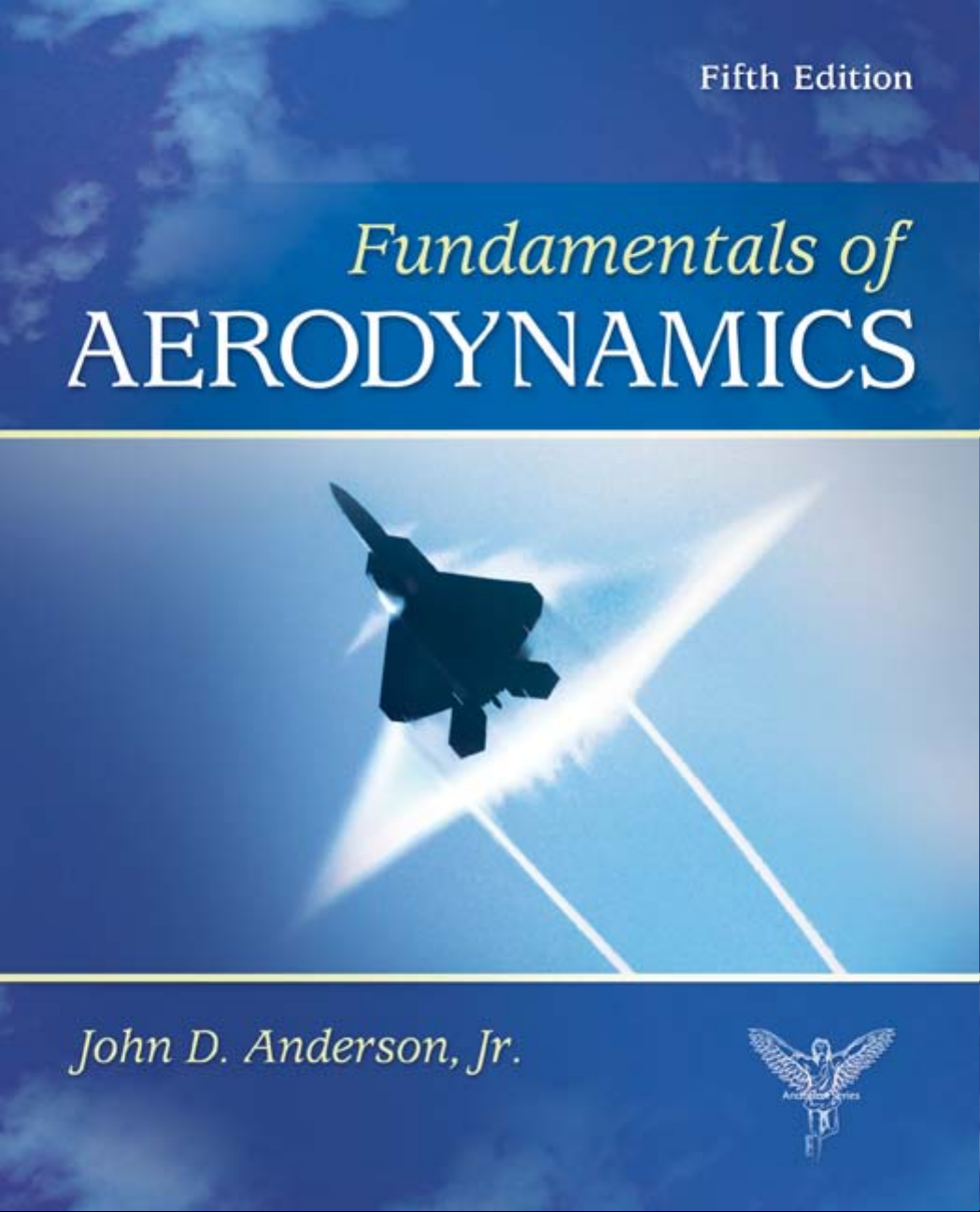
The white cloud that you see in the flow over the top of the F-22 on the cover of this book is due to water
vapor condensation occurring through the supersonic expansion waves on the top of the airplane. This
white cloud is abruptly terminated when the flow subsequently passes through the trailing-edge shock
waves behind the airplane. A detailed physical explanation of this flow can be found in Problem 9.21 at the end of Chapter 9.
Library of Congress Cataloging-in-Publication Data Anderson, John David.
Fundamentals of aerodynamics / John D. Anderson, Jr. — 5th ed.
p. cm. — (McGraw-Hill series in aeronautical and aerospace engineering)
Includes bibliographical references and index. ISBN-13: 978-0-07-339810-5 ISBN-10: 0-07-339810-1 1. Aerodynamics. I. Title. TL570.A677 2010 629.1323—dc22 2009048907 www.mhhe.com Anderson-98101 and98101˙fm December 23, 2009 17:34 ABOUT THE AUTHOR
John D. Anderson, Jr., was born in Lancaster, Pennsylvania, on October 1, 1937.
He attended the University of Florida, graduating in 1959 with high honors and
a bachelor of aeronautical engineering degree. From 1959 to 1962, he was a
lieutenant and task scientist at the Aerospace Research Laboratory at Wright-
Patterson Air Force Base. From 1962 to 1966, he attended the Ohio State Univer-
sity under the National Science Foundation and NASA Fellowships, graduating
with a Ph.D. in aeronautical and astronautical engineering. In 1966, he joined the
U.S. Naval Ordnance Laboratory as Chief of the Hypersonics Group. In 1973,
he became Chairman of the Department of Aerospace Engineering at the Uni-
versity of Maryland, and since 1980 has been professor of Aerospace Engineer-
ing at the University of Maryland. In 1982, he was designated a Distinguished
Scholar/Teacher by the University. During 1986–1987, while on sabbatical from
the University, Dr. Anderson occupied the Charles Lindbergh Chair at the Na-
tional Air and Space Museum of the Smithsonian Institution. He continued with
the Air and Space Museum one day each week as their Special Assistant for Aero-
dynamics, doing research and writing on the history of aerodynamics. In addition
to his position as professor of aerospace engineering, in 1993, he was made a
full faculty member of the Committee for the History and Philosophy of Science
and in 1996 an affiliate member of the History Department at the University of
Maryland. In 1996, he became the Glenn L. Martin Distinguished Professor for
Education in Aerospace Engineering. In 1999, he retired from the University of
Maryland and was appointed Professor Emeritus. He is currently the Curator for
Aerodynamics at the National Air and Space Museum, Smithsonian Institution.
Dr. Anderson has published 10 books: Gasdynamic Lasers: An Introduction,
Academic Press (1976), and under McGraw-Hill, Introduction to Flight (1978,
1984, 1989, 2000, 2005, 2008), Modern Compressible Flow (1982, 1990, 2003),
Fundamentals of Aerodynamics (1984, 1991, 2001, 2007), Hypersonic and High
Temperature Gas Dynamics (1989), Computational Fluid Dynamics: The Basics
with Applications (1995), Aircraft Performance and Design (1999), A History of
Aerodynamics and Its Impact on Flying Machines, Cambridge University Press
(1997 hardback, 1998 paperback), The Airplane: A History of Its Technology,
American Institute of Aeronautics and Astronautics (2003), and Inventing Flight,
Johns Hopkins University Press (2004). He is the author of over 120 papers on
radiative gasdynamics, reentry aerothermodynamics, gasdynamic and chemical
lasers, computational fluid dynamics, applied aerodynamics, hypersonic flow,
and the history of aeronautics. Dr. Anderson is in Who’s Who in America. He is
an Honorary Fellow of the American Institute of Aeronautics and Astronautics
(AIAA). He is also a fellow of the Royal Aeronautical Society, London. He is a
member of Tau Beta Pi, Sigma Tau, Phi Kappa Phi, Phi Eta Sigma, The American vii Anderson-98101 and98101˙fm December 23, 2009 17:34 viii About the Author
Society for Engineering Education, the History of Science Society, and the Soci-
ety for the History of Technology. In 1988, he was elected as Vice President of the
AIAA for Education. In 1989, he was awarded the John Leland Atwood Award
jointly by the American Society for Engineering Education and the American
Institute of Aeronautics and Astronautics “for the lasting influence of his recent
contributions to aerospace engineering education.” In 1995, he was awarded the
AIAA Pendray Aerospace Literature Award “for writing undergraduate and grad-
uate textbooks in aerospace engineering which have received worldwide acclaim
for their readability and clarity of presentation, including historical content.” In
1996, he was elected Vice President of the AIAA for Publications. He has recently
been honored by the AIAA with its 2000 von Karman Lectureship in Astronautics.
From 1987 to the present, Dr. Anderson has been the senior consulting editor
on the McGraw-Hill Series in Aeronautical and Astronautical Engineering. Anderson-98101 and98101˙fm December 23, 2009 17:34 Dedicated to My Family
Sarah-Allen, Katherine, Elizabeth, Keegan, and Tierney Anderson-98101 and98101˙fm December 23, 2009 17:34 Anderson-98101 and98101˙fm December 23, 2009 17:34 CONTENTS Preface to the Fifth Edition xix
1.12 Applied Aerodynamics: The Aerodynamic
Coefficients—Their Magnitudes and Variations 75 1
1.13 Historical Note: The Illusive Center P A R T of Pressure 89 Fundamental Principles 1
1.14 Historical Note: Aerodynamic Coefficients 93 Chapter 1 1.15 Summary 97
Aerodynamics: Some Introductory 1.16 Problems 98 Thoughts 3 1.1
Importance of Aerodynamics: Historical Chapter 2 Examples 5
Aerodynamics: Some Fundamental Principles 1.2
Aerodynamics: Classification and Practical and Equations 103 Objectives 11 2.1 Introduction and Road Map 104 1.3 Road Map for This Chapter 15 2.2 Review of Vector Relations 105 1.4 Some Fundamental Aerodynamic Variables 15
2.2.1 Some Vector Algebra 106 1.4.1 Units 18
2.2.2 Typical Orthogonal Coordinate Systems 107 1.5 Aerodynamic Forces and Moments 19
2.2.3 Scalar and Vector Fields 110 1.6 Center of Pressure 32
2.2.4 Scalar and Vector Products 110 1.7
Dimensional Analysis: The Buckingham
2.2.5 Gradient of a Scalar Field 111 Pi Theorem 34
2.2.6 Divergence of a Vector Field 113 1.8 Flow Similarity 41
2.2.7 Curl of a Vector Field 114 1.9 Fluid Statics: Buoyancy Force 52
2.2.8 Line Integrals 114 1.10 Types of Flow 62
2.2.9 Surface Integrals 115
1.10.1 Continuum Versus Free Molecule Flow 62
2.2.10 Volume Integrals 116
1.10.2 Inviscid Versus Viscous Flow 62
2.2.11 Relations Between Line, Surface,
and Volume Integrals 117
1.10.3 Incompressible Versus Compressible Flows 64 2.2.12 Summary 117
1.10.4 Mach Number Regimes 64 2.3
Models of the Fluid: Control Volumes and
1.11 Viscous Flow: Introduction to Boundary Fluid Elements 117 Layers 68
2.3.1 Finite Control Volume Approach 118 xi Anderson-98101 and98101˙fm December 23, 2009 17:34 xii Contents
2.3.2 Infinitesimal Fluid Element 3.2 Bernoulli’s Equation 207 Approach 119 3.3
Incompressible Flow in a Duct: The Venturi
2.3.3 Molecular Approach 119 and Low-Speed Wind Tunnel 211
2.3.4 Physical Meaning of the Divergence 3.4 Pitot Tube: Measurement of of Velocity 120 Airspeed 224
2.3.5 Specification of the Flow Field 121 3.5 Pressure Coefficient 233 2.4 Continuity Equation 125 3.6
Condition on Velocity for Incompressible 2.5 Momentum Equation 130 Flow 235 2.6
An Application of the Momentum Equation: 3.7
Governing Equation for Irrotational, Drag of a Two-Dimensional Body 135
Incompressible Flow: Laplace’s 2.6.1 Comment 144 Equation 236 2.7 Energy Equation 144
3.7.1 Infinity Boundary Conditions 239 2.8 Interim Summary 149
3.7.2 Wall Boundary Conditions 239 2.9 Substantial Derivative 150 3.8 Interim Summary 240
2.10 Fundamental Equations in Terms 3.9
Uniform Flow: Our First Elementary of the Substantial Derivative 156 Flow 241
2.11 Pathlines, Streamlines, and Streaklines
3.10 Source Flow: Our Second Elementary of a Flow 158 Flow 243
2.12 Angular Velocity, Vorticity, and Strain 163
3.11 Combination of a Uniform Flow with a 2.13 Circulation 174 Source and Sink 247 2.14 Stream Function 177
3.12 Doublet Flow: Our Third Elementary Flow 251 2.15 Velocity Potential 181
3.13 Nonlifting Flow over a Circular
2.16 Relationship Between the Stream Function Cylinder 253 and Velocity Potential 184
3.14 Vortex Flow: Our Fourth Elementary
2.17 How Do We Solve the Equations? 185 Flow 262
2.17.1 Theoretical (Analytical) Solutions 185
3.15 Lifting Flow over a Cylinder 266
2.17.2 Numerical Solutions—Computational
3.16 The Kutta-Joukowski Theorem and the
Fluid Dynamics (CFD) 187 Generation of Lift 280
2.17.3 The Bigger Picture 194
3.17 Nonlifting Flows over Arbitrary Bodies: 2.18 Summary 194 The Numerical Source Panel 2.19 Problems 198 Method 282
3.18 Applied Aerodynamics: The Flow over a 2
Circular Cylinder—The Real Case 292 P A R T
3.19 Historical Note: Bernoulli and Euler—The
Inviscid, Incompressible Flow 201 Origins of Theoretical Fluid Dynamics 300 Chapter 3
3.20 Historical Note: d’Alembert and His
Fundamentals of Inviscid, Incompressible Paradox 305 Flow 203 3.21 Summary 306 3.1 Introduction and Road Map 204 3.22 Problems 309 Anderson-98101 and98101˙fm December 23, 2009 17:34 Contents xiii Chapter 4 Chapter 5
Incompressible Flow over Airfoils 313
Incompressible Flow over Finite Wings 411 4.1 Introduction 315 5.1
Introduction: Downwash and Induced 4.2 Airfoil Nomenclature 318 Drag 415 4.3 Airfoil Characteristics 320 5.2
The Vortex Filament, the Biot-Savart Law, 4.4
Philosophy of Theoretical Solutions and Helmholtz’s Theorems 420
for Low-Speed Flow over Airfoils: The 5.3
Prandtl’s Classical Lifting-Line Vortex Sheet 325 Theory 424 4.5 The Kutta Condition 330
5.3.1 Elliptical Lift Distribution 430
4.5.1 Without Friction Could We Have
5.3.2 General Lift Distribution 435 Lift? 334
5.3.3 Effect of Aspect Ratio 438 4.6
Kelvin’s Circulation Theorem and the
5.3.4 Physical Significance 444 Starting Vortex 334 5.4
A Numerical Nonlinear Lifting-Line 4.7
Classical Thin Airfoil Theory: The Method 453 Symmetric Airfoil 338 5.5
The Lifting-Surface Theory and the Vortex 4.8 The Cambered Airfoil 348 Lattice Numerical Method 457 4.9
The Aerodynamic Center: Additional 5.6
Applied Aerodynamics: The Delta Considerations 357 Wing 464
4.10 Lifting Flows over Arbitrary 5.7
Historical Note: Lanchester and Bodies: The Vortex Panel
Prandtl—The Early Development of Numerical Method 361 Finite-Wing Theory 476
4.11 Modern Low-Speed Airfoils 367 5.8 Historical Note: Prandtl—The
4.12 Viscous Flow: Airfoil Drag 371 Man 480
4.12.1 Estimating Skin-Friction Drag: 5.9 Summary 483 Laminar Flow 372 5.10 Problems 484
4.12.2 Estimating Skin-Friction Drag: Turbulent Flow 374 Chapter 6 4.12.3 Transition 376
Three-Dimensional Incompressible
4.12.4 Flow Separation 381 Flow 487 4.12.5 Comment 386 6.1 Introduction 487
4.13 Applied Aerodynamics: The Flow over an Airfoil—The Real Case 387 6.2 Three-Dimensional Source 488
4.14 Historical Note: Early Airplane 6.3 Three-Dimensional Doublet 490 Design and the Role of Airfoil 6.4 Flow over A Sphere 492 Thickness 398
6.4.1 Comment on the Three-Dimensional
4.15 Historical Note: Kutta, Joukowski, Relieving Effect 494 and the Circulation Theory 6.5
General Three-Dimensional Flows: Panel of Lift 403 Techniques 495 4.16 Summary 405 6.6
Applied Aerodynamics: The Flow over a 4.17 Problems 407 Sphere—The Real Case 497 Anderson-98101 and98101˙fm December 23, 2009 17:34 xiv Contents 6.7
Applied Aerodynamics: Airplane Lift 8.3 Speed of Sound 555 and Drag 500 8.3.1 Comments 563 6.7.1 Airplane Lift 500 8.4 Special Forms of the Energy 6.7.2 Airplane Drag 502 Equation 564
6.7.3 Application of Computational Fluid 8.5 When Is A Flow Compressible? 572
Dynamics for the Calculation of Lift and 8.6
Calculation of Normal Shock-Wave Drag 507 Properties 575 6.8 Summary 511
8.6.1 Comment on the Use of Tables to Solve 6.9 Problems 512
Compressible Flow Problems 590 8.7
Measurement of Velocity in a Compressible Flow 591 3 P A R T
8.7.1 Subsonic Compressible Flow 591
Inviscid, Compressible Flow 513
8.7.2 Supersonic Flow 592 8.8 Summary 596 8.9 Problems 599 Chapter 7
Compressible Flow: Some Preliminary Aspects 515 Chapter 9 7.1 Introduction 516
Oblique Shock and Expansion Waves 601 7.2
A Brief Review of Thermodynamics 518 9.1 Introduction 602 7.2.1 Perfect Gas 518 9.2 Oblique Shock Relations 608
7.2.2 Internal Energy and Enthalpy 518 9.3 Supersonic Flow over Wedges
7.2.3 First Law of Thermodynamics 523 and Cones 622
7.2.4 Entropy and the Second Law of
9.3.1 A Comment on Supersonic Lift and Drag Thermodynamics 524 Coefficients 625
7.2.5 Isentropic Relations 526 9.4
Shock Interactions and Reflections 626 7.3 Definition of Compressibility 530 9.5
Detached Shock Wave in Front of a Blunt 7.4
Governing Equations for Inviscid, Body 632 Compressible Flow 531
9.5.1 Comment on the Flow Field behind a 7.5
Definition of Total (Stagnation)
Curved Shock Wave: Entropy Gradients Conditions 533 and Vorticity 636 7.6
Some Aspects of Supersonic Flow: Shock 9.6 Prandtl-Meyer Expansion Waves 636 Waves 540 9.7
Shock-Expansion Theory: Applications to 7.7 Summary 544 Supersonic Airfoils 648 7.8 Problems 546 9.8 A Comment on Lift and Drag Coefficients 652 9.9 The X-15 and Its Wedge Tail 652 Chapter 8
9.10 Viscous Flow: Shock-Wave/
Normal Shock Waves and Related Topics 549 Boundary-Layer Interaction 657 8.1 Introduction 550
9.11 Historical Note: Ernst Mach—A 8.2
The Basic Normal Shock Equations 551 Biographical Sketch 659 Anderson-98101 and98101˙fm December 23, 2009 17:34 Contents xv 9.12 Summary 662
11.11 Applied Aerodynamics: The Blended 9.13 Problems 663 Wing Body 754
11.12 Historical Note: High-Speed Airfoils—Early Research and Chapter 10 Development 760
Compressible Flow through Nozzles, Diffusers,
11.13 Historical Note: The Origin of The and Wind Tunnels 669 Swept-Wing Concept 764 10.1 Introduction 670
11.14 Historical Note: Richard T.
10.2 Governing Equations for
Whitcomb—Architect of the Area Rule Quasi-One-Dimensional Flow 672 and the Supercritical Wing 773 10.3 Nozzle Flows 681 11.15 Summary 774
10.3.1 More on Mass Flow 695 11.16 Problems 776 10.4 Diffusers 696
10.5 Supersonic Wind Tunnels 698 Chapter 12
10.6 Viscous Flow: Shock-Wave/
Linearized Supersonic Flow 779
Boundary-Layer Interaction inside nozzles 704 12.1 Introduction 780 10.7 Summary 706
12.2 Derivation of the Linearized Supersonic 10.8 Problems 707 Pressure Coefficient Formula 780
12.3 Application to Supersonic Airfoils 784 Chapter 11
12.4 Viscous Flow: Supersonic Airfoil
Subsonic Compressible Flow over Airfoils: Drag 790 Linear Theory 711 12.5 Summary 793 11.1 Introduction 712 12.6 Problems 794 11.2
The Velocity Potential Equation 714 11.3
The Linearized Velocity Potential Chapter 13 Equation 717
Introduction to Numerical Techniques 11.4
Prandtl-Glauert Compressibility
for Nonlinear Supersonic Flow 797 Correction 722 11.5 Improved Compressibility
13.1 Introduction: Philosophy of Computational Corrections 727 Fluid Dynamics 798 11.6 Critical Mach Number 728
13.2 Elements of the Method of Characteristics 800
11.6.1 A Comment on the Location of Minimum
Pressure (Maximum Velocity) 737
13.2.1 Internal Points 806 11.7
Drag-Divergence Mach Number: The 13.2.2 Wall Points 807 Sound Barrier 737
13.3 Supersonic Nozzle Design 808 11.8 The Area Rule 745
13.4 Elements of Finite-Difference 11.9 The Supercritical Airfoil 747 Methods 811
11.10 CFD Applications: Transonic Airfoils
13.4.1 Predictor Step 817 and Wings 749
13.4.2 Corrector Step 817 Anderson-98101 and98101˙fm December 23, 2009 17:34 xvi Contents
13.5 The Time-Dependent Technique: 14.9
Applied Hypersonic Aerodynamics:
Application to Supersonic Blunt Hypersonic Waveriders 876 Bodies 818
14.9.1 Viscous-Optimized Waveriders 882
13.5.1 Predictor Step 822 14.10 Summary 890
13.5.2 Corrector Step 822 14.11 Problems 890 13.6 Flow over Cones 826
13.6.1 Physical Aspects of Conical Flow 827
13.6.2 Quantitative Formulation 828 4 P A R T
13.6.3 Numerical Procedure 833 Viscous Flow 891
13.6.4 Physical Aspects of Supersonic Flow Over Cones 834 13.7 Chapter 15 Summary 837 13.8 Problem 838
Introduction to the Fundamental Principles
and Equations of Viscous Flow 893 15.1 Introduction 894 Chapter 14
15.2 Qualitative Aspects of Viscous
Elements of Hypersonic Flow 839 Flow 895 14.1 Introduction 840
15.3 Viscosity and Thermal Conduction 903 14.2
Qualitative Aspects of Hypersonic
15.4 The Navier-Stokes Equations 908 Flow 841
15.5 The Viscous Flow Energy Equation 912 14.3 Newtonian Theory 845
15.6 Similarity Parameters 916 14.4
The Lift and Drag of Wings at Hypersonic
15.7 Solutions of Viscous Flows: A Preliminary
Speeds: Newtonian Results for a Flat Plate Discussion 920 at Angle of Attack 849 15.8 Summary 923
14.4.1 Accuracy Considerations 856 15.9 Problems 925 14.5
Hypersonic Shock-Wave Relations and Another Look at Newtonian Theory 860 Chapter 16 14.6 Mach Number Independence 864
A Special Case: Couette Flow 927 14.7
Hypersonics and Computational Fluid Dynamics 866 16.1 Introduction 927 14.8
Hypersonic Viscous Flow: Aerodynamic
16.2 Couette Flow: General Discussion 928 Heating 869
16.3 Incompressible (Constant Property)
14.8.1 Aerodynamic Heating and Hypersonic Couette Flow 932
Flow—the Connection 869
16.3.1 Negligible Viscous Dissipation 938
14.8.2 Blunt versus Slender Bodies in
16.3.2 Equal Wall Temperatures 939 Hypersonic Flow 871
16.3.3 Adiabatic Wall Conditions (Adiabatic
14.8.3 Aerodynamic Heating to a Wall Temperature) 941 Blunt Body 874
16.3.4 Recovery Factor 944 Anderson-98101 and98101˙fm December 23, 2009 17:34 Contents xvii
16.3.5 Reynolds Analogy 945 Chapter 19
16.3.6 Interim Summary 946
Turbulent Boundary Layers 1019
16.4 Compressible Couette Flow 948 19.1 Introduction 1020
16.4.1 Shooting Method 950
19.2 Results for Turbulent Boundary Layers
16.4.2 Time-Dependent Finite-Difference on a Flat Plate 1020 Method 952
19.2.1 Reference Temperature Method
16.4.3 Results for Compressible Couette for Turbulent Flow 1022 Flow 956
19.2.2 The Meador-Smart Reference
16.4.4 Some Analytical Considerations 958
Temperature Method for Turbulent 16.5 Summary 963 Flow 1024
19.2.3 Prediction of Airfoil Drag 1025 Chapter 17
19.3 Turbulence Modeling 1025
Introduction to Boundary Layers 965
19.3.1 The Baldwin-Lomax Model 1026 19.4 Final Comments 1028 17.1 Introduction 966 19.5 Summary 1029
17.2 Boundary-Layer Properties 968 19.6 Problems 1030
17.3 The Boundary-Layer Equations 974
17.4 How Do We Solve the Boundary-Layer Equations? 977 Chapter 20 17.5 Summary 979
Navier-Stokes Solutions: Some Examples 1031 Chapter 18 20.1 Introduction 1032 Laminar Boundary Layers 981 20.2 The Approach 1032
20.3 Examples of Some Solutions 1033 18.1 Introduction 981
20.3.1 Flow over a Rearward-Facing Step 1033
18.2 Incompressible Flow over a Flat Plate: The Blasius Solution 982
20.3.2 Flow over an Airfoil 1033
18.3 Compressible Flow over a Flat Plate 989
20.3.3 Flow over a Complete Airplane 1036
20.3.4 Shock-Wave/Boundary-Layer Interaction
18.3.1 A Comment on Drag Variation 1037 with Velocity 1000
18.4 The Reference Temperature Method 1001
20.3.5 Flow over an Airfoil with a Protuberance 1038
18.4.1 Recent Advances: The Meador-Smart
20.4 The Issue of Accuracy for the Prediction
Reference Temperature Method 1004 of Skin Friction Drag 1040
18.5 Stagnation Point Aerodynamic 20.5 Summary 1045 Heating 1005
18.6 Boundary Layers over Arbitrary Bodies: Finite-Difference Solution 1011 Appendix A
18.6.1 Finite-Difference Method 1012
Isentropic Flow Properties 1047 18.7 Summary 1017 Appendix B 18.8 Problems 1018 Normal Shock Properties 1053 Anderson-98101 and98101˙fm December 23, 2009 17:34 xviii Contents Appendix C Appendix E
Prandtl-Meyer Function and Mach
Standard Atmosphere, English Engineering Angle 1057 Units 1071 Appendix D Bibliography 1079 Standard Atmosphere, Index 1085 SI Units 1061 Anderson-98101 and98101˙fm December 23, 2009 17:34
PREFACE TO THE FIFTH EDITION
Thisbookisforstudents—toberead,understood,andenjoyed.Itiscon-
sciously written in a clear, informal, and direct style to talk to the reader
and gain his or her immediate interest in the challenging and yet beautiful
discipline of aerodynamics. The explanation of each topic is carefully constructed
to make sense to the reader. Moreover, the structure of each chapter is tightly or-
ganized in order to keep the reader aware of where we are, where we were, and
where we are going. Too frequently the student of aerodynamics loses sight of
what is trying to be accomplished; to avoid this, I attempt to keep the reader
informed of my intent at all times. For example, preview boxes are introduced at
the beginning of each chapter. These short sections, literally set in boxes, are to
inform the reader in plain language what to expect from each chapter, and why
the material is important and exciting. They are primarily motivational; they help
to encourage the reader to actually enjoy reading the chapter, therefore enhancing
the educational process. In addition, each chapter contains a road map—a block
diagram designed to keep the reader well aware of the proper flow of ideas and
concepts. The use of preview boxes and chapter road maps are unique features of
this book. Also, to help organize the reader’s thoughts, there are special summary
sections at the end of most chapters.
The material in this book is at the level of college juniors and seniors in
aerospace or mechanical engineering. It assumes no prior knowledge of fluid
dynamics in general, or aerodynamics in particular. It does assume a familiarity
with differential and integral calculus, as well as the usual physics background
common to most students of science and engineering. Also, the language of
vector analysis is used liberally; a compact review of the necessary elements of
vector algebra and vector calculus is given in Chapter 2 in such a fashion that
it can either educate or refresh the reader, whatever may be the case for each individual.
This book is designed for a 1-year course in aerodynamics. Chapters 1 to 6
constitute a solid semester emphasizing inviscid, incompressible flow. Chapters 7
to 14 occupy a second semester dealing with inviscid, compressible flow. Finally,
Chapters 15 to 20 introduce some basic elements of viscous flow, mainly to serve
as a contrast to and comparison with the inviscid flows treated throughout the bulk
of the text. Specific sections on viscous flow, however, have been added much
earlier in the book in order to give the reader some idea of how the inviscid results
are tempered by the influence of friction. This is done by adding self-contained
viscous flow sections at the end of various chapters, written and placed in such a
way that they do not interfere with the flow of the inviscid flow discussion, but
are there to complement the discussion. For example, at the end of Chapter 4 on
incompressible inviscid flow over airfoils, there is a viscous flow section that deals xix