University Students' Perceptions of AI Application in Writing Skills in Vietnam: A Systematic Review - Tạp chí Giáo dục
University Students' Perceptions of AI Application in Writing Skills in Vietnam: A Systematic Review - Tạp chí Giáo dục. Tài liệu được sưu tầm giúp bạn tham khảo, ôn tập và đạt kết quả cao. Mời bạn đọc đón xem.
Môn: Tài liệu Tổng hợp 3.6 K tài liệu
Trường: Tài liệu khác 3.9 K tài liệu
Tác giả:










Preview text:
VIETNAM JOURNAL OF EDUCATION, 2025
Volume 9, Issue 2, 325-334
ht ps:/ doi.org/10.52296/vje.2025.533 ORIGINAL ARTICLE
University Students’ Perceptions of AI Application in Writing Skills in Vietnam: A Systematic Review Linh Thuy Cung+, Uyen Phuong Thi Hoang, Hanoi University, Vietnam Anh Ngoc Dinh,
+Corresponding author ● Email: cunglinh2705@gmail.com Thu Ha Bui Article history ABSTRACT Received: 29 December, 2024
Despite the growing integration of Artificial Intelligence in global education, Accepted: 05 May, 2025
AI tools fail to be broadly applied in Vietnamese contexts. This study aims to Published: 30 June, 2025
systematically review students’ perceptions regarding the application of AI
tools in writing education in Vietnamese contexts to proffer some suggestions Keywords
for effective AI use to support writing skills. The content analysis method was Writing skills, higher
employed in a thorough analysis of three selected articles. The study education, students’
concludes that Vietnamese university students’ perceptions have increasingly perception, AI tools,
garnered attention from scholars in recent years, with mixed methods being Vietnam, EFL context
identified as the predominant research approach in relevant investigations.
The findings reveal that AI applications offer significant advantages to
students, including enhancements in writing quality, increased writing
productivity, and improvements in active learning engagement, as well as
positive psychological effects. Nevertheless, the study also underscores
challenges that participants face, particularly concerning the accuracy of AI-
generated content and the tendency of over-dependence on these
technologies, which could affect their overall writing skills development and
critical thinking skills. The study recommends that universities in Vietnam
invest in digital literacy, improve technological infrastructure, and establish
clear ethical guidelines for AI integration in academic writing. 1. INTRODUCTION
The rapid development of technology and digital applications is changing the way we live, work and learn. In
this context, Artificial Intelligence (AI) is one of the most revolutionary and transformative technologies. Thanks to
its ability to mimic human intelligence and decision-making processes, AI has opened up an era where robots are
partaking in problem-solving, invention, and decision-making. AI development has gained traction thanks to
advances in machine learning, deep learning, neural networks, and natural language processing (Vinothkumar &
Karunamurthy, 2023). As a result, AI has been extensively adopted across multiple fields all over the world, including education (Yang, 2023).
Specifically, AI has become an intriguing approach used in language teaching and learning to improve learning
outcomes (Haristiani, 2019; Pedro et al., 2019). With its capacity to handle massive amounts of data, identify
complicated patterns, and provide customized insights, AI presents new opportunities to improve educational
practices and student results (Roll & Wylie, 2016). For instance, ChatGPT, an AI-powered language learning tool,
has the potential to improve learners’ language skills and subskills. These AI-powered tools are known for creating
captivating and immersive learning environments that facilitate students to complete language learning assignments
This is an open access article distributed under the terms of the Creative Commons Attribution License (https://creativecommons.org/licenses/by/4.0/),
which permits unrestricted use, distribution, and reproduction in any medium, provided the original work is properly cited.
Copyrighted © 2025 Vietnam Journal of Education 325
VIETNAM JOURNAL OF EDUCATION
and enhance their overall level of proficiency (Divekar et al., 2022). According to Feng Teng (2024), the significance
of AI and its technologies is indisputable in this scientifically advanced era, since they are making notable
advancements in a variety of language learning areas, including writing proficiency.
However, while international research confirms the transformative impact of AI in language education, there
remains a notable gap in the Vietnamese context. Although Vietnam has witnessed rapid technological adoption in
education, which was particularly accelerated during Covid-19 pandemic, Vietnam-based literature indicates that
both educators and students are still hesitant to fully embrace AI tools, often perceiving them as too new, overly
sophisticated, or difficult to control. Despite growing governmental and institutional investments in educational
technology and AI-driven tools, research specifically examining how Vietnamese university students perceive and
engage with AI applications in writing instruction is still limited (Tran, 2024; Nguyen & Phan, 2024). Therefore, this
study aims to pinpoint the gap by systematically reviewing Vietnamese university students’ perceptions of AI
applications in writing skills. This systematic review intends to investigate the research trends and findings related to
students’ perspectives towards applying AI tools to improve writing skill, point out the possible benefits and
challenges in the Vietnamese context, and make suggestions for practitioners, future research; and eventually provide
new insights for policymakers, curriculum designers, teachers as well as researchers who are planning to utilize AI
tools soon. The present study was designed to answer the following research questions: (1) What are the trends in
applying AI tools in writing skills in ESL/EFL learning in Vietnam?; (2) What are the main findings from the
available literature (benefits/ challenges)? 2. LITERATURE REVIEW
2.1. Overview of AI
The word Artificial Intelligence (AI) was first coined in 1956, when the two computer scientists at Stanford,
Marvin Minsky and John McCarthy hosted a Research Project on the subject at Dartmouth College in New
Hampshire (Haenlein & Kaplan, 2019). From then on, there have been numerous ways of defining AI. According to
Rahman (2009, p.343), the use of AI is to create software that filters information and performs other autonomous
tasks such as computing or searching for users. Russell and Norvig (2016) also claim that “AI is the only field to
attempt to build machines that will function autonomously in complex, changing environments.” Furthermore,
researchers reviewed AI based on its abilities to not only create other machines but also imitate humans. In 2009,
Whitby stated that artificial intelligence is a complicated term, including logic, self-awareness, learning, emotional
knowledge, planning, conscience, creativity, and so on. This definition aligns with many other researchers, proving
that the purpose of artificial intelligence is to build systems that display human characteristics (Campesato, 2020;
Aldosari, 2020), including the abilities to think humanly, to think rationally, to act humanly, and to act rationally (Russell & Norvig, 2016).
2.2. AI tools in language teaching and learning
AI tools are increasingly integrated into language education, benefiting both students and teachers in various
ways. Students use AI tools to improve the four main language skills. Tools like Listenwise and Speechling offer
interactive exercises and real-time feedback that help enhance listening comprehension. Tokac et al. (2019) claim
that through active practice of listening comprehension, users can converse with virtual chatbots in real-time.
Learners are likely to be exposed to a wealth of accents, lexical resources, and speech patterns through the chatbot’s
responses, allowing them to get more acquainted with the way English language is used naturally. Concerning
speaking, platforms such as Rosetta Stone and Google Assistant integrate AI to provide pronunciation practice and
simulate conversations. Duong and Suppasetseree (2024) note that students could listen to the AI voice chatbot’s
speaking voice, which sounds like a native speaker multiple times and practice pronunciation by trying to correct
pronunciation mistakes so that they could speak with better pronunciation. As highlighted by Hidayat (2024), AI
tools like Scribe and Rewordify provide tailored recommendations for reading materials based on students’ interests
and levels. Noticeably, the platform also supplies personalised reading comprehension exercises which align with
students’ levels and adjust the difficulty level as students progress. Moreover, AI tools like ChatGPT give users
immediate feedback on grammar, vocabulary use, sentence structure, coherence, and organisation. The AI model
with a large amount of language data recognises mistakes, gives recommendations, and offers contextualised
suggestions, intending to promote users’ writing skills (Song & Song, 2023). Furthermore, teachers leverage AI tools
to streamline their instructional tasks. When designing exercises and assessments, AI tools like Kahoot use data to 326
VIETNAM JOURNAL OF EDUCATION
create personalised quizzes, promoting more targeted practice, as seen in studies by Licorish et al. (2018). In terms
of grading, Al-based automated grading systems can significantly reduce grading time while maintaining high
accuracy and fairness in assessments (Dimari et al., 2024).
2.3. Students’ perspectives on using AI tools to improve writing skills
The integration of AI tools in the writing process has yielded both benefits and challenges. 2.3.1. Benefits
AI tools have been found in numerous studies to offer a wide range of advantages. AI tools, with their user-
friendliness, boast their ease of use (Lee et al., 2024) and facilitate the process of paraphrasing and determining
grammar correction. By making it easy to paraphrase a sentence and suggest new vocabulary that has never been
used, AI tools contribute to the production of high-quality work (Ginting et al., 2023). In addition, with the assistance
of AI writing tools, students can improve various aspects of writing as well as enhance their creativity and correct
their mistakes (Safitri & Fithriani, 2024). This is because AI tools can enhance vocabulary, provide translations and
recommend rich expressions. They also give feedback, detect and correct errors (Lee et al., 2024). Likewise, Selim
(2024) discovered that common problems including spelling, grammar, and punctuation can be fixed by AI tools. AI
tools’ suggestions provide EFL students with crucial instructions to increase the quality of their academic work, save
time, boost clarity, and avoid unintentional plagiarism. The student participants in this study mentioned that they
used AI-powered tools to meet deadlines and seek advice and comments from valuable AI tools. 2.3.2. Challenges
Despite the benefits of AI tools in enhancing students’ writing skills, there still exist challenges for consideration.
Students express concerns regarding inaccurate translations and unnatural expressions or grammatical structures (Lee
et al., 2024), and concerns over security related to hacking and password protection (Ginting et al., 2023). They are
also concerned about becoming overly dependent on AI-based tools and need instructions from teachers to cultivate
their English writing skills. Safitri and Fithriani (2024) add that depending on AI Writing tools can also hinder creativity in writing.
2.4. Previous systematic studies in the world
Feng Teng (2024) conducted a systematic review of 20 studies to examine ChatGPT’s effectiveness in EFL
writing. These articles, published between 2023 and 2024, were primarily based in Asian nations (China, Japan, etc.).
The results indicate that ChatGPT can be used as a collaborative tool to offer writing suggestions, customize search
results, give individualized feedback, and improve the overall quality of writing. Furthermore, it can identify complex
grammar and syntax errors, suggest writing structure, and promote prompt coherence (Mizumoto et al., 2024).
ChatGPT also excels in text generation, first draft creation, idea generation, and literature summarization. These
features can help writers generate and organize their ideas more easily in the phases of the writing process (Boudouaia
et al., 2024). Consequently, ChatGPT facilitates specific writing phases and aspects, which boosts productivity and
allows better time management. Notwithstanding its benefits, ChatGPT presents serious problems with regard to
academic integrity and ethical use. An excessive dependence on AI-generated content raises the risk of undermining
the growth of writing and critical thinking abilities (Barrot, 2023). To preserve the integrity of academic and
professional writing, it is imperative that AI tools be used sensibly and morally. Although ChatGPT can help with a
variety of writing assignments, it cannot completely replace a human writer’s sophisticated abilities and knowledge.
This is because AI lacks the ability to understand context thoroughly, interpret complex emotions, and generate truly
original ideas, which are important factors of high-quality writing. In addition, using ChatGPT to generate content
could lead to misuse, creating misleading or plagiarized content, and false citations (Day, 2023).
3. MATERIALS AND METHODS
Systematic reviews, as their name suggests, refer to a detailed and comprehensive plan to identify all the evidence
topics to reduce bias in the review results (Uman, 2011). Systematic reviews differ from literature reviews in terms
of their methodology. While traditional literature reviews are generally a less systematic review with only a small
number of databases (Robinson & Lowe, 2015), systematic reviews are conducted in a meticulously organised
process that digs deep into “the body of evidence” (Nordenbo, 2009, p. 22).
In August of 2024, the systematic research was carried out on databases including Web of Science, ERIC, Google
Scholar and ResearchGate. These databases were selected since they provide numerous accessible education-related 327
VIETNAM JOURNAL OF EDUCATION
studies. The selected articles are written in English and the Vietnamese language, published between 2016 and
2024. The review period of 2016 to 2024 was chosen because this era marks significant advancements in AI
technologies, particularly in education, with rapid development and adoption of AI-powered tools for academic
writing in Vietnam (Nguyen & Hoang, 2024; Tran, 2023). This timeframe also captures the effects of the Covid-19
pandemic, which accelerated digital transformation and the integration of AI in Vietnamese higher education (Tran,
2023). Reviewing literature from these years ensures the inclusion of the most relevant trends, challenges, and
opportunities in AI applications into academic writing in the Vietnamese context. The searched articles were selected
based on the research areas, document types, language used and publication years. Only research studies were taken
into consideration in the research results. After reading these articles, a systematic review is conducted, following
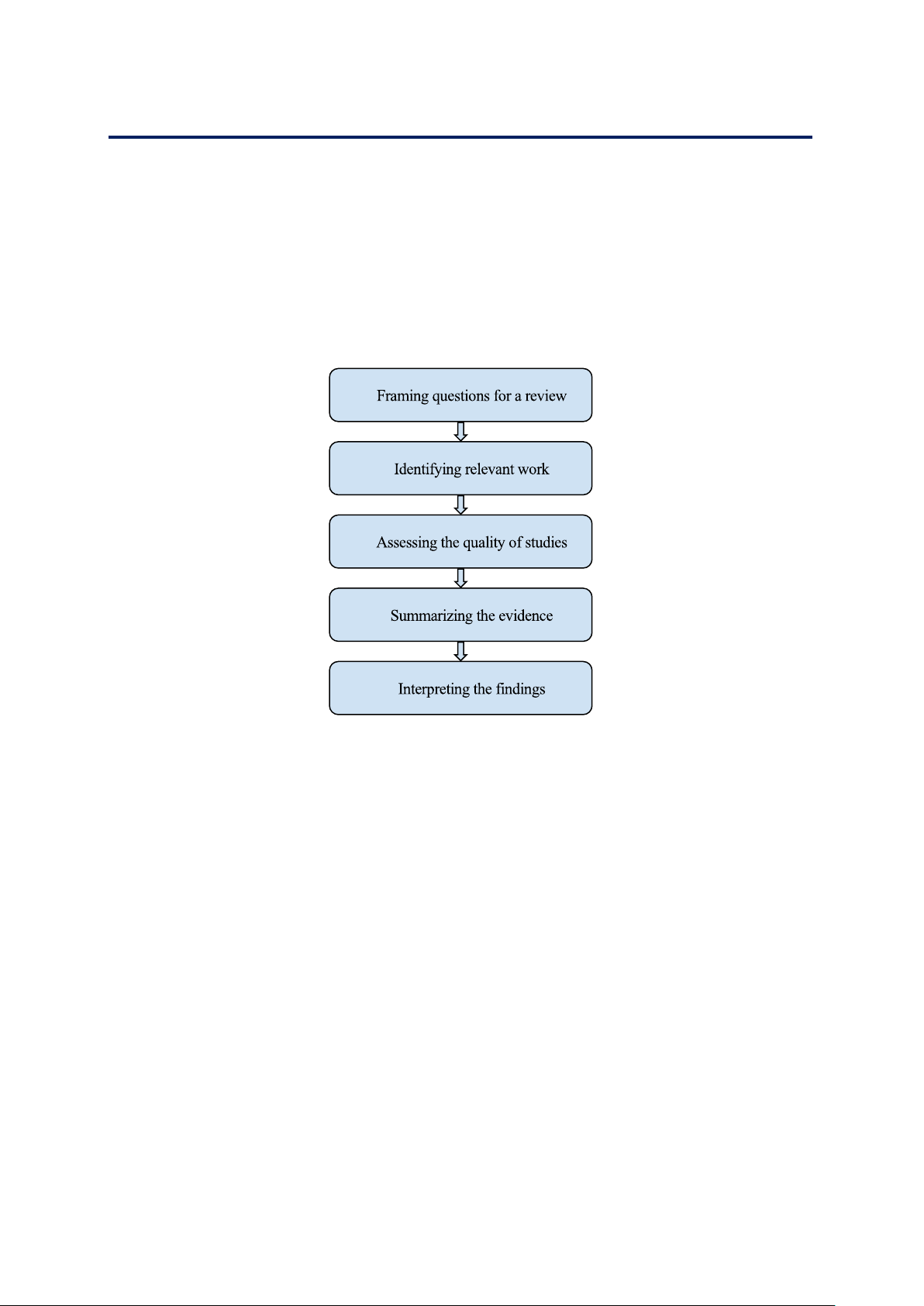
the five phases suggested by Khan et al. (2003). Figure 1 shows five phases of the Systematic Literature Review
proposed by Khan et al. (2003).
Figure 1. Five phases of Systematic Literature Review proposed by Khan et al. (2003)
Phase 1. Framing Questions for a review: With the robust development of technology, a variety of AI tools are
being introduced in the Education Industry. Many of them are beneficial for users’ language learning, especially
writing skills; thus, AI tools are widely used by students in support of their writing skills. Therefore, this review aims
to explore the trend in applying AI tools in writing skills in ESL/EFL studies in Vietnam, as well as analyse students’
perceptions of AI tools application in writing skills.
Phase 2. Identifying Relevant Work: The next phase in performing a systematic literature review is to identify
relevant articles. There are two steps in this phase. First, collect all the related articles on previous studies. Next,
select appropriate studies based on the aforementioned categories. The search is carried out with databases including
Web of Science, ERIC, Google Scholar and ResearchGate, published from 2016 to 2024. The research terms used
included “AI applications in Vietnamese education”, “AI’s impacts on Vietnamese education”, “AI tools and writing
skills”, and “AI and Vietnamese education”.
Phase 3. Assessing the Quality of Studies: The next phase in the systematic literature review is assessing the
quality of studies. The inclusion criteria was clarified to determine whether the articles would be included or excluded
from this review. Only articles that satisfy the inclusion criteria of the study would be chosen for further phases.
Hence, irrelevant studies can be avoided. After assessing, only three out of 101 articles have met the inclusion criteria.
Inclusion criteria in the study: (1) Published between 2016-2024; (2) Written in the English language;
(3) Implementation of AI tools in writing skills; (4) Learning that involves the English language (ESL and EFL);
(5) Participants or respondents from higher education; (6) Students’ perceptions of AI application.
Phase 4. Summarising the Evidence: The search was carried out using databases such as Web of Science, ERIC,
Google Scholar, and ResearchGate. The search using keywords “Implementation of AI tools in EFL/ESL in 328
VIETNAM JOURNAL OF EDUCATION
Vietnam” and “Application of AI tools in EFL/ESL in Vietnam” resulted in a total of 40 articles published from 2016
to 2024 in Google Scholar and ResearchGate databases. After reviewing article titles, abstracts, keywords, results
and conclusion, 40 articles were chosen. After assessing the articles, excluding those that did not meet the inclusion
criteria, only three articles are appropriate for this review.
Phase 5. Interpreting the Findings: In the final phase, three selected articles are examined by analysing the content.
This phase reveals the trend in applying AI tools in writing skills in ESL/EFL research studies in Vietnam, as well
as highlights students’ perceptions of AI tools application in writing skills. 4. RESULTS AND DISCUSSION 4.1. Results
Table 1. Trends in AI utilisation in the academic writing process in Vietnamese higher education Categories Phi and Nguyen (2024) Le et al. (2023) Phan (2023) Year 2024 2023 2023 Methods mixed methods qualitative method mixed methods 46 third-year students 20 Vietnamese EFL students 100 students from four majoring in English from two higher education General English classes at Participants Language Teaching in Da institutions: Can Tho Vietnam National University Nang University University + Nam Can Tho (VNU) University
For the purpose of answering Q1, the studies’ distribution by subcategories including publication years, research
methodology used, and the participants’ education level was examined by the researchers.
The distribution of reviewed research related to the utilisation of AI tools in the academic writing process in
Vietnam by publication years is clearly explained as follows. The studies in this field were mostly published in 2023
(n=2). The following year witnessed only one research study. The most commonly used research methods were
mixed methods (n=2), while only one research study used qualitative methods. In terms of sampling, Phi and Nguyen
(2024) examined 46 third-year students majoring in English Language Teaching Da Nang university; Le, Hua, Pham
(2023) investigated 20 Vietnamese EFL students from Can Tho University and South Can Tho University and Phan,
(2023) studied 100 students from four General English classes at Vietnam National University (VNU).
The key findings regarding AI application in the academic writing process in Vietnamese higher education
In response to RQ2, the subcategories were examined by the researchers as follows: benefits, challenges and
recommendations related to applying AI in the academic writing process in Vietnamese higher education.
All three reviewed studies show students’ positive perceptions towards the use of AI in their academic writing
projects. The most common perceived benefits include improved students’ vocabulary (n=3), grammar (n=3) through
immediate feedback and suggestions (n=3), making learners more engaged (n=2), increasing their motivation (n=2)
and eventually enhancing their writing productivity (n=2).
Table 2. Benefits of applying AI tools in writing skills in ESL/EFL studies in Vietnam Categories Sub-categories n Articles
Le, Hua and Pham (2023); Phan (2023); Improving vocab 3 Phi and Nguyen (2024) Quality of writing
Le, Hua and Pham (2023); Phan (2023); Improving grammar 3 Phi and Nguyen (2024) Improving structure 2
Le, Hua and Pham (2023); Phan (2023)
Summarising and translating the topic 1 Phi and Nguyen (2024) Productivity of Generating ideas 1 Phi and Nguyen (2024) writing Paraphrasing their work 1 Phi and Nguyen (2024) 329
VIETNAM JOURNAL OF EDUCATION Giving immediate feedback and
Le, Hua and Pham (2023); Phan (2023); 3 suggestions Phi and Nguyen (2024)
Making learners more engaged in Active learning 2
Le, Hua and Pham (2023); Phan (2023) learning
Increasing students’ motivation 2
Le, Hua and Pham (2023); Phan (2023) Psychology
Increasing students’ interest 2
Le, Hua and Pham (2023); Phan (2023)
Exposure to the diversity of different Others
styles, dialects, and cultural nuances 1 Le, Hua and Pham (2023) of the English language
Though acknowledging the benefits of using AI in academic writing, the reviewed articles also present some
disadvantages in the application. The most visible shortcoming is the increased overdependence of students on these
tools (n=2), leading to the degradation of creativity (n=2). Besides, inaccuracy (in paraphrasing, translating, and
suggestion processes), ethical consideration and related digital problems (n=1) are also pointed out.
Table 3. Disadvantages of applying AI tools to writing skills in ESL/EFL studies in Vietnam Categories Sub-categories n Articles Inaccurate paraphrases 1 Phan (2023) Accuracy Inaccurate translations 1 Phan (2023) Inaccurate suggestions 2
Phan (2023); Le, Hua and Pham (2023)
Ethical Consideration Unauthorized access 1 Le, Hua and Pham (2023) Overdependence 2
Le, Hua and Pham (2023); Phan (2023)
Repetitive and uninteresting inputs 1 Phan (2023) Others Creativity limitation 2
Le, Hua and Pham (2023); Phan (2023) Language knowledge hindrance 1 Phan (2023)
4.2. Discussions
The trends in applying AI tools in writing skills in ESL/EFL studies in Vietnam
The current systematic review explores EFL/ESL university students’ perceptions on the utilisation of AI tools
in the academic writing process in Vietnam by reviewing and analysing three studies in 2023 and 2024.
Firstly, the studies on the utilisation of AI in language learning, particularly in Vietnam, have gained growing
interest since 2023. This is driven by advancements in AI technology that offer individualised interactive learning
experiences and transform the approach to language learning (Rane et al., 2023). In Vietnam, educational institutions
are increasingly adopting AI tools to facilitate remote learning, provide tailored educational resources, and support
teachers in their instructional methods (Tran & Nguyen, 2024).
Secondly, the methodology of the three reviewed studies is analysed to find out the most widely-used research
design. The analysis reveals that the most favoured research method is mixed-methods design, followed by the
qualitative method. With mixed methods, researchers can generalize findings from the qualitative interviews with a
broader sample and investigate students’ different perspectives about the utilisation of AI in the academic writing
process (Vigoda-Gadot & Vashdi, 2020).
Thirdly, in terms of sampling, the number of participants of Phan (2023) study is the largest, followed by Phi and
Nguyen (2024). Le et al. (2023) has the smallest number of participants. Therefore, future research could expand to
a broader sample range to seek better insights into EFL/ESL university students’ perceptions on the utilisation of AI
tools in the academic writing process in Vietnam.
The main findings from the available literature
There are indeed limited Vietnamese research studies on AI utilization in academic writing, though all reviewed
studies focus on students’ perceptions of this trend. 330
VIETNAM JOURNAL OF EDUCATION
Firstly, all three studies report that AI enhances students’ writing quality. In the study by Phi and Nguyen (2024),
the students claimed that they can learn formal language, advanced vocabulary, and correct grammar to apply to their
essays writing thanks to appropriate suggestions and thorough explanations of ChatGPT. Similarly, Phan (2023) also
concluded that students can improve their vocabulary and grammar through error detection, hence fostering their
writing quality. These recognitions are in line with Ginting et al. (2023), asserting that AI tools appropriately
determine vocabulary and grammatical correctness, resulting in high-quality work. AI tools also greatly enrich
students’ vocabulary by providing synonyms and recommending more advanced word choices (Marzuki et al.,
2023). Moreover, Le et al. (2023) pointed out that students’ sentence structures have improved because AI tools
assist students in correcting their own errors and suggest better ways to structure their ideas. Phan (2023) also reported
that students used the Paraphrasing Tool application to diversify their structures. Besides, Selim (2024) pointed out
that AI tools resolve students’ common issues like spelling and punctuation errors. These improvements improve the
overall quality of students’ work.
Secondly, AI enhances students’ productivity during the writing process. According to Phi and Nguyen (2024), AI
simplifies writing challenges and makes writing tasks easier to complete by summarising and translating the topic. As
a result, AI could create the initial engagement between students and the writing process, assisting students in generating
ideas for writing tasks. AI tools, particularly ChatGPT, contributed to idea generation for writing assignments by
proposing topics, themes, and perspectives that students might not have come up with otherwise (Taecharungroj, 2023).
Once students have done their writing, they use ChatGPT for revision. This finding has strengthened Ginting et al.
(2023), revealing that students utilised Quillbot and Grammarly to paraphrase sentences to complete the final project.
All three studies agree that students got this significant support through instant feedback from AI tools. This agreement
aligns with Selim (2024), in which students found valuable suggestions and feedback given by AI tools. This study,
moreover, pointed to new points in AI boosting students’ writing productivity, expressing that students can save time in
proofreading and editing phrases. Also, AI tools act as students’ deadline reminders.
Thirdly, AI tools engage students in the writing-learning process. Le et al. (2023) prove that students not only
receive one-way responses from AI tools, but they can also be actively involved in the learning process by using
ChatGPT more extensively in their writing exercises, leading to the enhancement of their understanding of the English
language. The examined students in the study of Phan (2023) also expressed joy when gaining new experiences
provided by AI tools, resulting in boosted learning engagement. This claim is presented in the findings of Amyatun
and Kholis (2023), showcasing students’ attentiveness in the learning process and eagerness when seeking clarification
on their writing-related problems. Similarly, the participants in the study by Song and Song (2023) also reported that
incorporating AI technology into writing learning significantly enhanced their motivation and engagement. They noted
that the interactive features of ChatGPT and the instant feedback it provided encouraged them to participate more
actively in writing activities and boosted their motivation to practice and develop their writing skills.
Fourthly, AI tools increase students’ motivation and interest in the writing-learning process. This is because Le
et al. (2023) reported that the AI tools’ interface is easy to use and adaptable to their learning styles, motivating
students to take more responsibility for their learning outcomes. Phan (2023) also found that AI users felt more
imaginative and self-assured after receiving immediate and enthusiastic support from AI tools. Due to this significant
benefit, Amyatun and Kholis (2023) made a comparison between traditional teacher-centred techniques and AI tools
utilisation in the classroom, commenting that students in traditional classrooms may lack motivation and interest in
writing activities compared to those in the latter ones.
Besides, Le et al. (2023) spotted a new benefit when students use AI in the writing learning process. They reported
that students were interested in insights that AI tools provide, such as different styles, dialects, and cultural nuances
of the English language. Thus, AI tools could create an engaging learning environment that offers students various
linguistic expressions, developing a deep understanding of the language.
From the obtained findings, students are found to have positive perceptions of the role of AI tools in their writing
learning process, which brings them undeniable benefits in terms of quality, productivity in writing, active learning
and so on. However, students complain about challenges that they encountered while using these tools during their writing learning periods.
Firstly, Phan (2023) reported students’ doubts about the inaccuracy in the paraphrasing and translating process
of AI tools. Regarding paraphrases, examined students are concerned that the Grammarly website might not provide 331
VIETNAM JOURNAL OF EDUCATION
flexible language used due to its single input, leading to monotonous assistance. Moreover, students worried that this
tool could even fail to paraphrase lengthy passages accurately. When it comes to translation, students expressed that
Google Translate could provide inappropriate language translation, specifically long sentences or specialised
terminologies, because it is culturally insensitive. Le et al. (2023) also included this problem in their findings,
questioning the appropriateness of AI-provided content, which might lead to misconceptions or misunderstandings
and potentially prevent the development of language knowledge in students. These findings resonate with Lee et al.
(2024), in which students are concerned about inaccurate translations and unnatural expressions or grammatical
structures. As a result, students questioned the efficacy of AI tools in fostering their English writing skills.
In terms of ethical considerations, the students in Le et al. (2023) raised another concern about users’ privacy,
whether their data and interactions with AI tools were being handled and stored without any authorisation. They
worried that other people could get access to their writing samples and feedback that they have received from AI
tools. Similarly, Ginting et al. (2023) claim that students might be exposed to potential cybersecurity vulnerabilities,
posing a significant threat to each individual. Consequently, students are reluctant to use AI tools due to concerns
over privacy issues (Malik et al., 2023).
Overdependence is another major concern when students use AI in their learning (Phan, 2023). This study points
out the fact that students nowadays invest less time and effort in writing to search for ideas or to look up relevant
references to deal with their current problems, such as a difficult word or an idiom. Instead, they rely on AI tools for
immediate answers, which could eventually diminish their critical thinking and problem-solving, as they only use
information fed by AI tools. This recognition is further presented in Lee et al. (2024), finding that students, especially
those who are beginners and lack the English skills to judge their work themselves, are likely to accept feedback from
AI without any further judgment. Even though many AI tools, according to Phan (2023), could only be fed with
repetitive and uninteresting inputs, leading to monotonous suggestions. As time goes by, this overdependent behaviour
could lead to diminishing creativity and overall writing capabilities (Le et al., 2023; Phan, 2023). Therefore, relying
solely on AI tools could curb students’ creativity and hinder their application of language knowledge in writing. 5. CONCLUSION
This study is undertaken to investigate the trends of AI application in the academic writing process as well as the
benefits and challenges in the process in Vietnamese higher education. The key results of this systematic review
indicate: (1) there has been a growing interest in AI application in the academic writing process in higher education
in Vietnam recently; (2) the most preferred method is mixed-method; (3) findings in reviewed studies are both in
favour of and concerned about the utilisation of AI tools.
While the reviewed studies highlight both positive outcomes, such as improved writing performance and
personalised feedback, and concerns related to over-reliance and ethical issues, the limited number of available
studies (only three) restricts the generalizability of these conclusions. To address this gap, future research should
broaden its scope by including diverse student populations and employing longitudinal designs to better understand
the evolving impact of AI on writing skills over time. Additionally, universities in Vietnam should invest in digital
literacy training, improve technological infrastructure, and develop clear guidelines to promote the ethical and
effective use of AI in academic writing. Such efforts will help maximise the benefits of AI while mitigating potential
challenges, ultimately enhancing the quality and equity of higher education in Vietnam.
Conflict of Interest: No potential conflict of interest relevant to this article was reported. REFERENCES
Aldosari, S. A. M. (2020). The future of higher education in the light of artificial intelligence transformations.
International Journal of Higher Education, 9(3), 145-151. https://doi.org/10.5430/ijhe.v9n3p145
Amyatun, R. L., & Kholis, A. (2023). Can Artificial Intelligence (AI) like QuillBot AI Assist Students’ Writing
Skills? Assisting Learning to Write Texts using AI. ELE Reviews: English Language Education Reviews, 3(2),
135-154. https://doi.org/10.22515/elereviews.v3i2.7533
Barrot, J. S. (2023). Using ChatGPT for Second language writing: Pitfalls and potentials. Assessing Writing, 57,
100745. https://doi.org/10.1016/j.asw.2023.100745 332
VIETNAM JOURNAL OF EDUCATION
Boudouaia, A., Mouas, S., & Kouider, B. (2024). A study on CHATGPT-4 as an innovative approach to enhancing
English as a foreign language writing learning. Journal of Educational Computing Research, 62(6), 1509-1537.
https://doi.org/10.1177/07356331241247465
Campesato, O. (2020). Artificial intelligence, machine learning, and deep learning. Stylus Publishing, LLC.
Day, T. (2023). A preliminary investigation of fake peer-reviewed citations and references generated by ChatGPT.
The Professional Geographer, 75(6), 1024-1027. https://doi.org/10.1080/00330124.2023.2190373
Dimari, A., Tyagi, N., Davanageri, M., Kukreti, R., Yadav, R., & Dimari, H. (2024). AI-based automated grading
systems for Open book examination system: Implications for assessment in Higher Education. 2024 International
Conference on Knowledge Engineering and Communication Systems (ICKECS), 1-7. https://doi.org/10.1109/ ickecs61492.2024.10616490
Divekar, R. R., Drozdal, J., Chabot, S., Zhou, Y., Su, H., Chen, Y., Zhu, H., Hendler, J. A., & Braasch, J. (2021).
Foreign language acquisition via artificial intelligence and extended reality: design and evaluation. Computer
Assisted Language Learning, 35(9), 2332-2360. https://doi.org/10.1080/09588221.2021.1879162
Duong, T., & Suppasetseree, S. (2024). The effects of an artificial intelligence voice chatbot on improving
Vietnamese undergraduate students’ English speaking skills. International Journal of Learning, Teaching and
Educational Research, 23(3), 293-321. https://doi.org/10.26803/ijlter.23.3.15
Feng Teng, M. (2024). A Systematic Review of ChatGPT for English as a Foreign Language Writing: Opportunities,
Challenges, and Recommendations. International Journal of TESOL Studies, 6(3). https://doi.org/10.58304/ ijts.20240304
Ginting, P., Batubara, H. M., & Hasnah, Y. (2023). Artificial intelligence-powered writing tools as adaptable aids for
academic writing: Insight from EFL college learners in writing final project. International Journal of
Multidisciplinary Research and Analysis, 6(10), 4640-4650. https://doi.org/10.47191/ijmra/v6-i10-15
Haenlein, M., & Kaplan, A. (2019). A brief history of artificial intelligence: On the past, present, and future of
artificial intelligence. California Management Review, 61(4), 5-14.
Haristiani, N. (2019). Artificial Intelligence (AI) chatbot as Language learning medium: An inquiry. Journal of
Physics: Conference Series, 1387(1), 012020. https://doi.org/10.1088/1742-6596/1387/1/012020
Hidayat, M. T. (2024). Effectiveness of AI-based personalised reading platforms in enhancing reading
comprehension. Journal of Learning for Development, 11(1), 115-125. https://doi.org/10.56059/jl4d.v11i1.955
Khan, K. S., Kunz, R., Kleijnen, J., & Antes, G. (2003). Five steps to conducting a systematic review. Journal of the
Royal Society of Medicine, 96(3), 118-121. https://doi.org/10.1258/jrsm.96.3.118
Kot, S. O., & Nykyporets, S. S. (2024). Utilization of artificial intelligence in enhancing English language proficiency
in tertiary education. Science and Education in the Third Millennium: Information Technology, Education, Law,
Psychology, Social Sphere, Management. Chap. 10: 250-274.
Le, T. T., Hua, H. H., & Pham, T. T. (2023). Exploring the impacts of ChatGPT in EFL writing: Student perceptions
of opportunities and challenges in Vietnamese higher education. Kognisi: Jurnal Ilmu Keguruan, 1(2), 107-124.
Lee, Y.J., Davis, R. O., & Lee, S. O. (2024). University students’ perceptions of artificial intelligence-based tools for
English writing courses. Online Journal of Communication and Media Technologies, 14(1). https://doi.org/ 10.30935/ojcmt/14195
Licorish, S. A., Owen, H. E., Daniel, B., & George, J. L. (2018). Students’ perception of Kahoot!’s influence on
teaching and learning. Research and Practice in Technology Enhanced Learning, 13(1). https://doi.org/10.1186/ s41039-018-0078-8
Malik, A. R., Pratiwi, Y., Andajani, K., Numertayasa, I. W., Suharti, S., & Darwis, A. (2023). Exploring artificial
intelligence in academic essay: higher education student’s perspective. International Journal of Educational
Research Open, 5, 100296.
Marzuki, , Widiati, U., Rusdin, D., Darwin, & Indrawati, I. (2023). The impact of AI writing tools on the content and
organization of students’ writing: EFL teachers’ perspective. Cogent Education, 10(2). https://doi.org/ 10.1080/2331186X.2023.2236469 333
VIETNAM JOURNAL OF EDUCATION
Mizumoto, A., Shintani, N., Sasaki, M., & Teng, M. F. (2024). Testing the viability of ChatGPT as a companion in
L2 writing accuracy assessment. Research Methods in Applied Linguistics, 3(2), 100116. https://doi.org/ 10.1016/j.rmal.2024.100116
Nguyen, G. T., & Hoang, T. T. D. (2024). Artificial intelligence in Vietnamese higher education: Challenges and opportunities.
https://tapchicongthuong.vn/artificial-intelligence-in-vietnamese-higher-education-challenges-
and-opportunities-124436.htm
Nguyen, P. H., & Dieu, N. B. (2024). An investigation into third-year ELT students’ perceptions of using ChatGPT
as an AI writing-assistant tool: a case study in Vietnam. International Journal of Arts Humanities and Social
Sciences Studies, 9(5), 41-55.
Nordenbo, S. E. (2010). Evidence and synthesis: a new paradigm in educational research. In The Research Council
of Norway (Ed.), Rigour and relevance in educational research (pp. 21-27).
Pedro, F., Subosa, M., Rivas, A., & Valverde, P. (2019). Artificial intelligence in education: Challenges and
opportunities for sustainable development. UNESCO. https://unesdoc.unesco.org/ark:/48223/pf0000366994
Phan, T. N. L (2023). Students’ perceptions of the AI technology application in English writing classes. In
Proceedings of the AsiaCALL International Conference, 4, 45-62.
Rahman, S., Mahbubur. (2009). Methods and Applications for Advancing Distance Education Technologies
International Issues and Solutions International Issues and Solutions. IGI Global.
Rane, N., Choudhary, S., & Rane, J. (2023). Education 4.0 and 5.0: Integrating artificial intelligence (AI) for
personalized and adaptive learning. SSRN. https://doi.org/10.2139/ssrn.4638365
Robinson, P., and Lowe, J. (2015). Literature reviews vs systematic reviews Australian and New Zealand. Journal
of Public Health, 39(2), 103. https://doi.org/10.1111/1753-6405.12393
Roll, I., & Wylie, R. (2016). Evolution and revolution in artificial intelligence in education. International Journal of
Artificial Intelligence in Education, 26, 582-599. https://doi.org/10.1007/s40593-016-0110-3
Russell, S. J., & Norvig, P. (2016). Artificial intelligence: A modern approach (3rd ed.). Pearson Education Limited.
Safitri, M., & Fithriani, R. (2024). Exploring higher education EFL students’ perception of AI writing tools in the
5.0 ERA. Cetta: Jurnal Ilmu Pendidikan, 7(1), 267-276. https://doi.org/10.37329/cetta.v7i1.3158
Selim, A. S. (2024). The transformative impact of AI-powered tools on academic writing: Perspectives of EFL
University students. International Journal of English Linguistics, 14(1), 14. https://doi.org/10.5539/ijel.v14n1p14
Song, C., & Song, Y. (2023). Enhancing academic writing skills and motivation: assessing the efficacy of ChatGPT
in AI-assisted language learning for EFL students. Frontiers in Psychology, 14, 1260843.
Taecharungroj, V. (2023). “What can ChatGPT do?” Analyzing early reactions to the innovative AI chatbot on
Twitter. Big Data and Cognitive Computing, 7(1), 35. https://doi.org/10.3390/bdcc7010035
Tokac, U., Novak, E., & Thompson, C. G. (2019). Chatbots for language learning: Opportunities and challenges.
Turkish Online Journal of Distance Education, 20(4), 202-212.
Tran, P. T., & Nguyen, D. T. (2024). Behavioral Intention to Adopt Artificial Intelligence for Teaching in Higher
Education: A Case Study in Vietnam. Journal of Computer Science and Technology Studies, 6(2).
Tran, T. T. H. (2023). AI tools in teaching and learning English academic writing skills. Proceedings of the AsiaCALL
International Conference, 4, 170-187. https://doi.org/10.54855/paic.23413
Uman, L. S. (2011). Systematic reviews and meta-analyses. Journal of the Canadian Academy of Child and
Adolescent Psychiatry, 20(1), 57-59. https://www.ncbi.nlm.nih.gov/pmc/articles/PMC3024725/
Vigoda-Gadot, E., & Vashdi, D. R. (Eds.). (2020). Handbook of research methods in public administration,
management and policy (pp. 30-31). Edward Elgar Publishing.
Vinothkumar, J., & Karunamurthy, A. (2023). Recent advancements in artificial intelligence technology: Trends and
implications. Quing: International Journal of Multidisciplinary Scientific Research and Development, 2(1), 1-
11. https://doi.org/10.54368/qijmsrd.2.1.0003
Whitby, B. (2009). Artificial Intelligence. The Rosen Publishing Group, Inc.
Yang, L. M. (2023). Application and research on foreign language teaching in the context of digital transformation.
SHS Web of Conferences, 159, 01011. https://doi.org/10.1051/shsconf/202315901011 334
Tài liệu liên quan:
-

Ung dung game hoa trong cac chien dich MKT
18 9 -
Bao cao Chi so TMDT Viet Nam 2025
15 8 -
Thông tư quy định về việc phân quyền, phân cấp và phân định thẩm quyền quản lý nhà nước về giáo dục cho chính quyền địa phương
24 12 -
Nghị quyết về phát huy các giá trị di sản văn hóa gắn với phát triên du lịch bền vững tỉnh Khánh Hòa đến năm 2025, định hướng đến năm 2030
14 7 -
Quyết định phê duyệt Chiến lược phát triển du lịch Việt Nam đến năm 2030
13 7