VĂN HÓA ANH MỸ: Khái Quát và Những Đặc Điểm Chính
VĂN HÓA ANH MỸ: Khái Quát và Những Đặc Điểm Chính
Môn: Maketing 21 tài liệu
Trường: Trường Đại học Kinh Tế - Tài Chính Thành phố Hồ Chí Minh 0.9 K tài liệu
Tác giả:


















Preview text:
VĂN HOÁ ANH MỸ PART I. ENGLISH CULTURE CHAPTER 1. OVERVIEW
READING 1. COUNTRY AND PEOPLE
- Britain _ geographically speaking = England + Wales + Scotland + Northern Ireland
- England (nước Anh)- quốc gia độc lập- thủ đô là London
- Great Britain = England + Wales + Scotland
- The United Kingdom (the UK) _ political entity (thực thể chính trị) = Great Britain +
Northern Ireland = England + Wales + Scotland + Northern Ireland
- British Isles = Great Britain + Ireland = England + Wales + Scotland + Ireland
The British Isles refer to a group of islands off the northwestern coast of continental Europe, and
they consist of two main islands: Great Britain + Ireland
(Quần đảo Anh đề cập đến một nhóm các hòn đảo ngoài khơi bờ biển phía tây bắc của lục địa châu
Âu và chúng bao gồm hai hòn đảo chính: Vương quốc Anh + toàn bộ Ireland)
Có 2 cách phân chia quần đảo Anh
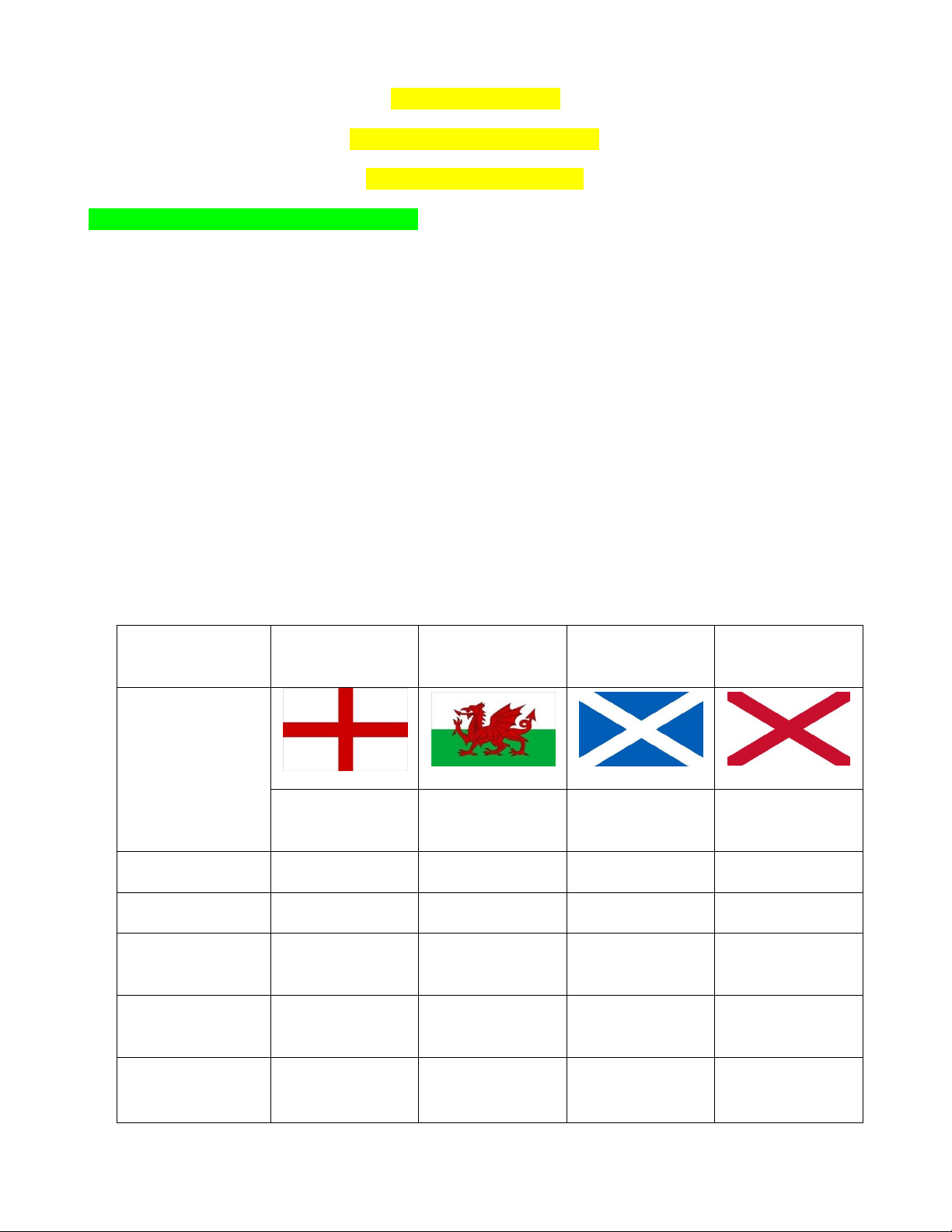
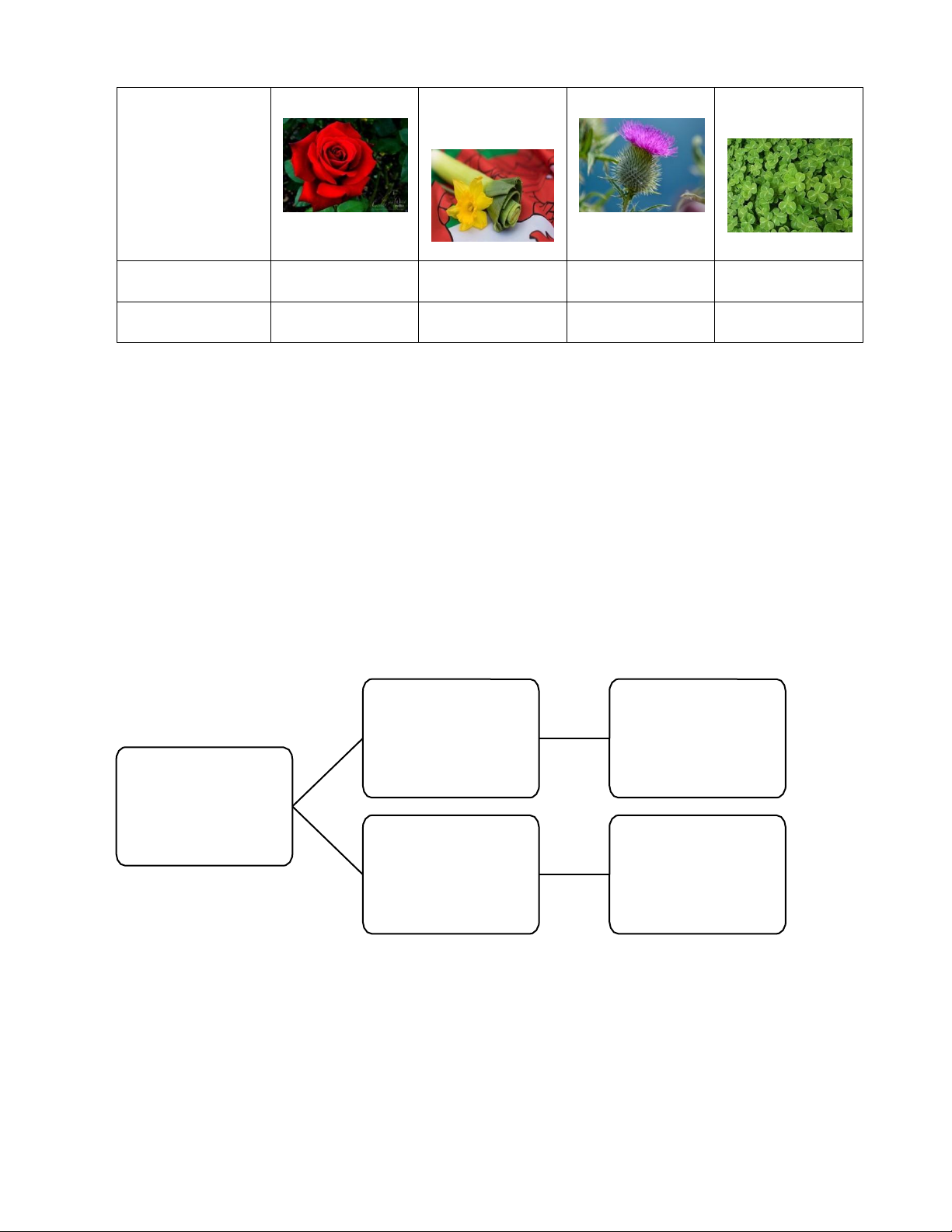
1. Geographically speaking: British Isles = Great Britain + Ireland 1.1. Great Britain The Welsh dragon Countries England Wales Scotland Northern Ireland Currency Pound Sterling Pound Sterling Pound Sterling Pound Sterling Capital London Cardiff Edinburgh Belfast The people The English The Welsh The Scots The Irish or Ulster Men Language English English and English, Scots English and Irish Welsh and Scots Gaelic Gaelic National symbol The red rose The leek and The thistle (Hoa The Shamrock yellow daffodil kế) and the Harp (Cỏ ba lá và cây đàn (Tỏi tây, hoa thuỷ tiên vàng) hạc) National color White Red Blue Green Patron Saint St. George St. David St. Andrew St. Patrick 1.2. Ireland
Ireland = Republic of Ireland + Northern Ireland 2. Political y
In the British Isles there are two states An independent country The Reupblic of Ireland and a sovereign state (Eire/ Ireland/ the Repubic) Not part of the United Kingdom. The British Isles The United Kingdom of Great Britain and Has the authorities over Northern Ireland (The UK/ the rest of the British Isles Britain)
II. The national anthem (Quốc ca): “God save the Queen”
Ý nghĩa: To show the respect/ loyalty to the Queen
III. The union Jack (The Union flag/ The Royal banner)
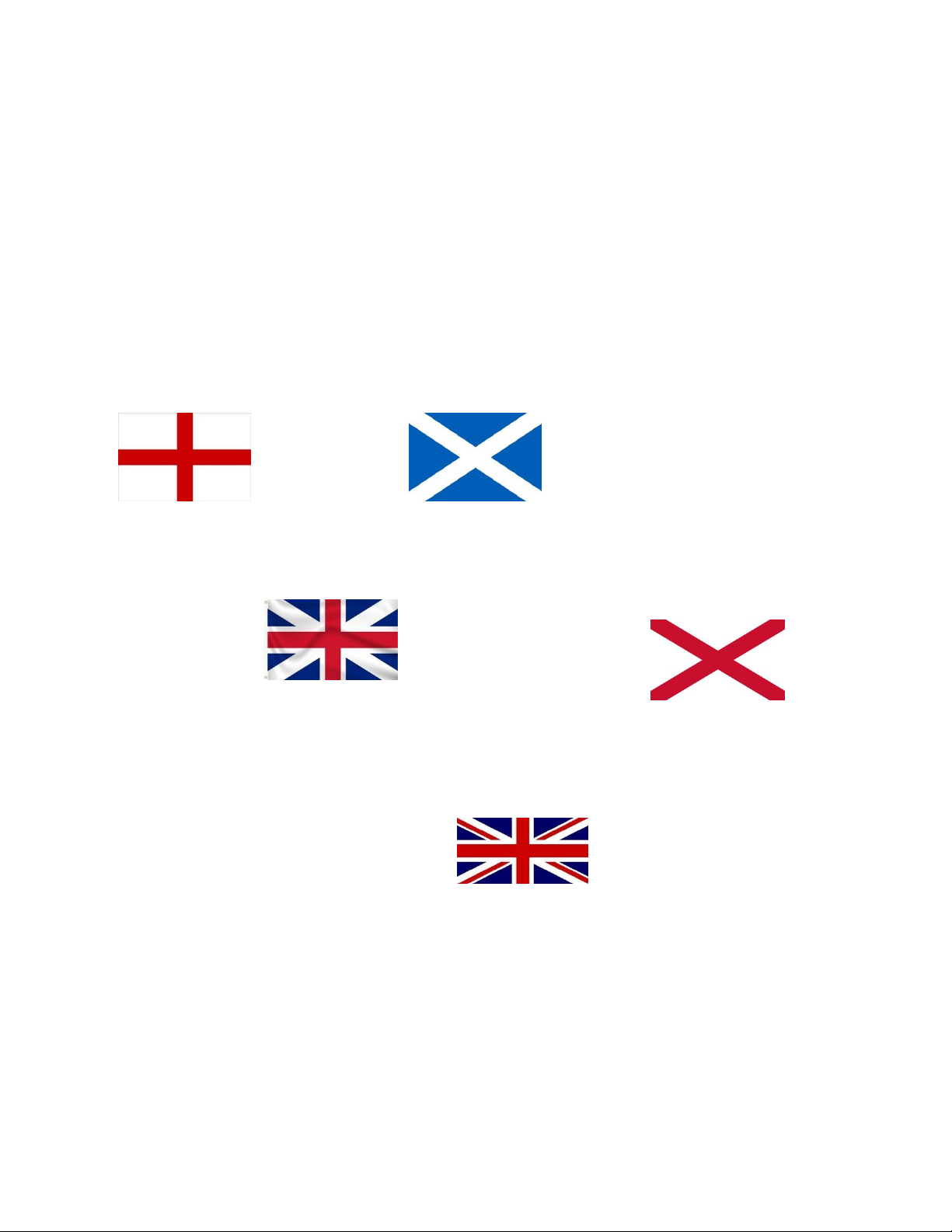
- A flag contains 3 other flags: England, Scotland and Ireland
Why doesn’t the Welsh dragon appear on the Union Jack?
Because when the first Union Flag was created in 1606, Wales was already united with England from the 13th century (1535)
Wales was a Pricipality (Xứ) of a kingdom, not a separate nation.
• The first Union Flag (1606)
Combined the flags of England and Scotland: the cross of St. George was placed on top of the cross of St. Andrew
to symbolize the political union between England and Scotland
White border around the red cross: for the rules of heraldry demanded that 2 colors must never touch each other • 1/1/1801
Ireland was united with Great Britain. The cross of St. Patrick was combined with the Union flag of St.
George & St. Andrew, to create the Union flag that has been flown ever since + England Scotland = + Union Jack 1606 Ireland (Flag of Great Britain) = Union Jack 1801 (Union flag of United Kingdom)
The union Jack: respect for individuality within a closely knit community True or False
1. England can refer to Great Britain but it should never be used to mean the United Kingdom F: cannot/ and
2. Britain is a short form of the full name of the United Kingdom of Great Britain and Northern Ireland F: the UK
3. It is proper to use Britain to mean the United Kingdom T
4. The official name of the UK is the United Kingdom of Great Britain and Ireland F: Northern Ireland
5. People from Scotland are Britons/ British T
6. The design of the Union Jack is symmetrical (đối xứng) F: unsymmetrical
7. The union Jack is a symbol of unity T
8. Flying the flag upside down indicates a situation of danger T
9. The colors of the flag include red, white and green F: blue
10. The Union flag is a flag containing 3 other flags of England, Scotland and Wales F: Northern Ireland
11. Wales is represented by the England flag instead of the Welsh dragon T
12. Another name for the Union Jack is Royal Banker F: Banner
• People often refer to Britain by another name “England”
Not strictly correct, and it can make some people angry. Why?
England is only one of the 4 nations of the British Isles (England, Scotland, Wales and Northern Ireland)
• The people from the 4 nations are all British/ Britons
• Why to confuse Britain with England can cause grave offence?
because it overlooks the distinct identities and contributions of the other countries within the
United Kingdom, namely Scotland, Wales, and Northern Ireland. Each of these countries has
its own unique history, culture, and national identity.
Using "England" as a synonym for the entire United Kingdom can also perpetuate a perception
of England as the dominant within the UK, leading to feelings of marginalization (gạt ra
ngoài lề) or exclusion among individuals from other parts of the UK.
• Why is England sometimes mistaken for Britain abroad?
- Historical prominence: England has played a significant role in the history of the British Isles
and the establishment of the British Empire
The dominance of English culture can
sometimes overshadow the cultural nuances and diversity of the other countries
- Demographic dominance: England is the largest and most populous country within the United
Kingdom, accounting for over 80% of the total population
- Common language: English is the primary language spoken in all countries of the United
Kingdom, including England, Scotland, Wales, and Northern Ireland.
- Limited perception: People from outside the UK may not be fully aware of the political,
cultural, and historical differences between England, Scotland, Wales, and Northern Ireland
HOWEVER, the 4 nations were different from each other in almost every aspect of life:
Racial difference, Economic system, Legal system, Social system
1. Racial difference (khác biệt về chủng tộc, sắc tộc)
There are two main races in the British Isles: Celtic race and Germanic race
• The people in Ireland, Wales and highland Scotland belonged to the Celtic race; those in
England and lowland Scotland were mainly of Germanic origin
• This difference was reflected in the languages they spoke
- People in the Celtic areas spoke Celtic languages: Irish Gaelic, Scottish Gaelic and Welsh
- People in Germanic areas spoke Germanic dialects (phương ngữ Đức) (including the one which
has developed into modern English)
Today, these differences have become blurred, but Welsh, Scottish and Irish people feel their identity very strongly
THE DOMINANCE OF ENGLAND 2. Economic system
The supply of money in Britain is controlled by the Bank of England 3. Legal system
The system of politics is of English origin 4. Social system
- English is the main language of all 4 nations
- Many aspects of life are organized according to English custom and practice
- People from Britain would like to be called British
- The queen of the country is known as “Elizabeth the Second”
- Some people who live in England all their lives decribes them as Scottish, Welsh or Irish
These people support the country of their parents rather than English in sporting contests
CHAPTER 2. TRADITIONAL BELIFES AND VALUE I.
Stereotypes and changes (Những định kiến và thay đổi)
Stereotypes (n) A fixed idea or image that many people have of a particular type of person or
thing, but which is often not true in reality (Những tư tưởng, hình ảnh đã ăn sâu vào trong tư
tưởng của chúng ta nhưng nó không đúng trong thực tế) British stereotypes:
- Strangers usually dont talk to each other on trains
- It is polite to queue for everything: buses, theatre tickets, shops, etc. Britain are very patient
- People say “thank you” when they give money to a shop assitant
- People open presents in front of people they receive them
- British people believe that Britain is “a land of tradition”
- The stereotyped image of the London “city gent” includes the wearing of a bowler hat Stereotypes Changes
This is the popular belief that Britain is a ‘land of tradition’
At the level of public life (Xét chung cho
As individual (Xét từng cá nhân), the British
toàn xã hội Anh) this is undoubtedly true
are probably less inclined to fol ow tradition
than the people of most other countries are.
• Annual ceremony of the state opening
of Parliament (carefully follows
• The country has fewer local parades or centuriesold customs)
processions with genuine folk roots
• The military ceremony of “trooping the
than most other countries have (The UK coulor”
có ít các cuộc diễu hành ở địa phương
• The changing of the guard outside the
có nguồn gốc từ dân gian)
Buckingham Palace never changes
• The English language has fewer sayings (ca dao) in common everyday The
British are too individualistic (có rất ít
các ca dao, tục ngữ, thành ngữ dân ca hơn các nước khác)
Breakfast: a large ‘fry-up’ preceded by cereal
Cut out the fry-up in breakfast
with milk and followed by toast, butter and
marmalade, all washed down with lots of tea Smaller and simpler breakfast
Big breakfast/ Continental breakfast
Afternoon tea: Biscuits, scones, sandwiches or
Use more coffee; tradition afternoon tea is cake
minority activity to retired people and the leisured upper-middle class
The British is patient people (They love
The British hate having to wait and have less
queuing whenever they are waiting for
patience than people in many other countries something)
(They line up but don't enjoy it) II.
Muticulturalism (Chủ nghĩa đa văn hoá)
• Britain is a multicultural society
- There was a large scale immigration to Britain from places outside the British Isles in the 20th
century. The UK now has itself long adopted a policy of multiculturalism in relation to
immigrants (CP Anh đã áp dụng chính sách đối với người nhập cư)
It means that the UK allows people from different cultures to live in the UK while continuing to
practice their own cultural traditions rather than expecting them to adapt to (Chính sách này cho
phép những người nhập cư từ các nền VH khác nhau sinh sống ở Anh trong khi vẫn tiếp tục duy trì văn hoá của họ)
Ex: In London, the shop were full of black bread, pickled cucumbers and vodka
- The divergence from indigenous British attitudes in new British communities is constantly
narrowing (Sự khác biệt về thái độ giữa người Anh bản địa với cộng đồng người Anh mới đến đã thu hẹp hơn)
British characteristics: the new British have made their own contribution to British life and attitudes:
* They made indigenous British care more about their child’s education
* They have probably helped to make people more informal: The English cafe is a small,
inexpensive eating place; Traditional cafes have declined with the rise of fast-foods chains
* They have changed the nature of the corner shop
* They have great contribution on the appearance of the well-attended festival in the whole
Britain: the annual Notting Hill Carnival III.
Conservatism (Chủ nghĩa bảo thủ)
The British have few living folk traditions and are too individualistic to have the same everyday habits as each other
- They may NOT BEHAVE in traditional ways HOWEVER They LIKE symbols of tradition
and stability (không cư xử theo cách truyền thống nhưng lại thích những giá trị truyền thống)
Ex: The decline of nuclear family (gia đình hạt nhân không tồn tại nhiều như XH cũ) HOWEVER
Politicians cited enthusiasm for traditional family values as a way of winning support (Các chính trị gia
vẫn thể hiện sự ủng hộ đối với các giá trị gia đình hạt nhân truyền thống
Để giành được phiếu bầu)
- In general, the British value continuity over modernity for its own sake. They do not consider it
especially smart to live in a new house (thích ở trong những ngôi nhà cổ, mang tính chất kế thừa
hơn là hiện đại; họ không coi việc ở trong những ngôi nhà hiện đại là thông minh)
- They have a general sentimental attachment to older, supposedly safer times (Họ có một tình
cảm gắn bó chung với những thời đại cũ hơn, được cho là an toàn hơn)
- Their Christmas card usually depict scenes from past centuries
- A look at children’s reading habits suggests that this attitude is not going to change; They
contain no references to other races or classes and mention nothing more modern than a
radio (Những cuốn sách giáo khoa không thay đổi mà vẫn kiểu dáng cũ, nội dung cũ, từ các tác
giả cũ,…; cuộc sống của họ chỉ cần một cái đài thôi là đủ)
- They were reluctant to change their system of currency (không muốn thay đổi hệ thống tiền tệ)
- They like their pubs to look old (Thích các quán rượu kiểu cũ) IV. Being different
- Being different is one aspect of conservatism
- The British can be particularly and stubbornly conservative about anything which is perceived
as a token of Britishness (Người Anh bảo thủ một cách cứng nhắc về những gì được coi là đặc trưng của người Anh)
- They are rather proud of being different
- Why should they change just to be like everyone else
- Not being like everyone else is a good reason not to change.
Ex: very difficult to imagine that they will ever agree to change from driving on the left-hand
side of the road to driving on the right.
- Developments at European Union (EU) level
cause a change in some everyday aspect of
British life are usually greeted with suspicion and hostility.
Ex: + The case of double-decker buses (The British public is always ready to listen to such predictions of doom) + Systems of measurement: o Distance: Miles, Yards o Weights: Stones, Pounds, o Tallnesses: Feet, Inches
ounces, pints, gallons (A pint = a glass of beer) o Financial year: beginning of April V. The love of nature
• The love of nature is another aspect of conservatism.
• The British has an idealized vision of the countryside
Some countryside = poor facilities + lack of educational opportunities + unemployment + poverty
To British, the countryside = peace + quiet + beauty + good health + no crime
Ex: the building of the Channel tunnel between France and Britain
+ England: Nobody wanted the rail link near them
+ France: Communities battled with each other to get the new line built through their towns
• YHA (Youth Hostels Association): a charity whose aim is to help many young people of
limited means to a greater knowledge, love and care of the countryside
• The hobby of garderning: They grow plants. Gardening is one of the most popular hobbies in the country VI. The love of animals
- The love of animals is one aspect of the love of nature It also represent conservatism
- The British tend to have a sentimental attitude to animals
- Nearly half of the households in Britain keep at least one domestic pet.
Ex: Rossendale Pet Cemetery in Lancashire (Nghĩa trang thú cưng Rossendale ở Lancashire)
- 5 freedoms of pets (Ở Anh có bản tuyên ngôn nhân quyền dành cho động vật)
+ Freedom from hunger and thirst + Freedom from discomfort
+ Freedom from pain, injury or disease
+ Freedom to express normal behaviour
+ Freedom from fear and distress
VII. Formality and informality
“the British are rather formal in their general behaviour” False
• Formality in public role
- When people are ‘on duty’, they have to obey some quite rigid rules
• Informality in private role
- When people are not playing a public role-when they are just being themselves- there seem to be no rules at all.
- The British are probably more tolerant of ‘strange’ clothing than people in most other countries
• Dress down on Sundays (Người Anh thích ăn mặc giản dị vào ngày Chủ nhật)
• Friendly = Informality
- Being friendly in Britain often involves showing that you are not bothering with the formalities
+ Not addressing title (Mr, Mrs,…)
+ Not dressing smartly when entertaining guests
+ Not shaking hands when meeting
+ Not saying “please” when making offers or requests
- Before: British people are more reserved (dè dặt hơn), Not convention to kiss when meeting a friend - Now: “help yourself”
you are completely accepted and just like ‘one of the family’. Buffet-type meals
Kiss when meeting each other (women and women, and men and women, but still never men and men!)
VIII. Public spiritedness and amateurism (Tinh thần chung vì cộng đồng và chủ nghĩa nghiệp dư)
• Amateurism (Khi mà có bất cứ một vấn đề gì, thay vì kêu gọi sự trợ giúp của chính phủ hay
bất cứ tổ chức nào thì những cá nhân nghiệp dư trong XH sẽ tự tìm cách để giải quyết vấn đề đó)
The whole countrywide networks have been set up without any government help at all (self-help)
• Public spritedness = “Chipping in”: a lot of people giving a little bit of their free time to
help in a variety of ways (Nhiều người bỏ một chút thời gian của họ ra để chung tay giúp đỡ XH)
In public life Britain has traditionally followed what might be called “the cult of the talented
amateur” (sự sùng bái những cá nhân nghiệp dư tài năng)
Society is best served by everybody ‘chipping in’, rather than one person that is highly
professional (Người Anh thường đánh giá rất cao chủ nghĩa nghiệp dư)
‘Only doing your job’ has never been accepted as a justification for actions (Những người chỉ
làm công việc của họ sẽ bị chỉ trích và không thể bao biện cho hành động của mình bởi mọi
người phải chung tay giúp đỡ XH trở nên tốt đẹo hơn)
Tens of thousands of ‘amateurs’ are still actively involved in charity work IX. Privacy and sex
• Respect for privacy underlies many aspects of British life (own home, individual’s right)
• Britain often keep their information private
We shouldn’t ask personal questions about their money, family life or sex
It is seen as rude to ask people what are called ‘personal’ questions
• Conventional formula on being introduced to someone in Britain: ‘How do you do?’
• The British do not allow their politicians a private life (For ex when he/ she had not kept
their private lives and public roles separate enough)
• Modern Britons have a positive and open attitude to sex (Sex may no longer be ‘bad’, but it
is still embarrassing; It is an absolutely private matter) • Sex education in schools
- In the past: Little or no teaching sex education at schools (embarrassing)
- Now: Sex education is taught at many schools as a vital part of teaching • Prostitution
- It is legal to be a prostitude
- It is illegal to behave like one in public (Against the law ‘Solicit’) True/ False
1. The image of the British as a nation of tea - drinkers is another stereotype which is somewhat out of date . T
2. British have more patience than people in many other countries . F: do not have/ have less
3. The annual Notting Hill Carnival in London is of Caribbean inspiration and origin T 4. British people like change F
5. To British people , the countryside means beauty , no crime and poverty F
6. British wanted the Channel tunnel near them because it would be good for local business F
7. The love of countryside is another aspect of British conservatism T
8. It is legal to run over a dog in your car and then keep on driving in Britain F
9. British are rather formal in their general behavior F: informal
10. Modern Britons have a negative and open attitude to sex F
CHAPTER 3. BRITISH POLITICAL SYSTEM
READING 1. POLITICAL LIFE I. The Party system
• Britain is normally described as having a ‘two-party system’: Labour party and Conservative
party; Single-party Government
• The parties choose candidates in elections (independent candidates are rarly elected- chỉ những
ứng viên thuộc các đảng lớn mới đc bỏ phiếu bầu)
- The party that wins the majority of seat (Đảng cầm quyền)
forms the Government and its leaders
+ Leaders =Member of Parliment (MPs) thành viên của Nghị viện Anh = Nghị sĩ
+ Member of Government = Ministers (Bộ trưởng)
- The largest minority party = opposition (Đảng đối lập)
criticize the party running the country
- Without agreement between the political parties, the British parliamentary system would break
down (nếu không có sự đồng thuận giữa các đảng phái chính trị thì hệ thống nghị viện Anh sẽ sụp đổ) II.
The public attitude to politics
• Politicians in Britain do not have a good reputation
- Lack of trustworthiness (Thiếu niềm tin)
+ They do not expect them to be corrupt (Họ nghĩ rằng các chính trị gia luôn thiếu trung thực)
+ They do not expect them to use their position to amass personal wealth (Họ nghĩ rằng các chính trị gia luôn tham nhũng)
People are not really shocked when the government is caught lying, they would be very
shocked indeed if it was discovered that the government was doing anything actually illegal.
- Lack of enthusiasm (Thiếu nhiệt huyết)
+ The British do not know the name of their local Member of Parliament (MP)
+ They do not even know the names of the important government ministers or leaders of the major political parties.
1st rule in politics: NEVER BELIEVE ANYTHING UNTIL IT’S BEEN OFFICIALLU DENIED
• The british are not always unenthusiatic
- To British people, nobody regards politics as a ‘dangerous’ topic of conversation not avoid
talking about; it just a boring topic of conversation
- Three-quarters (75%) of the adult population are interested enough in politics to vote at national
elections, even though voting is not compulsory
- In Britain, it is generally accepted that politics is a dirty business, a necessary evil. III.
The style of democracy (Loại hình dân chủ ở Anh)
• People choose who is to govern the country and let them get on with it
• The British are said to have a high respect for the law
- There is little systematic law-breaking by large sections of the population
- Tax evasion is not the national pastime that it is said to be in some countries (không trốn thuế)
• the British are comparatively unenthusiastic about making new laws
- while you have to have laws sometimes, wherever possible it is best to do without them (tốt nhất là không có luật)
- In many aspects of life the country has comparatively few rules and regulations
Relationship between individual and the State: Both should leave each other alone Individual Government Responsibilitie
- Not breaking the law and paying s taxes Rights - Not being obliged to vote at - Having less participation by elections
ordinary citizens in governing and law
- Not having to register their change making No concept of “By the of address when moving house
people” (Ít bị can thiệp bởi người dân
thường vào việc quản lý đất nước
Ở Anh khong có định nghĩa “CP do dân”)
- Not having to ask the people for change in law
- Not having to have a special vote in
Parliament with a high proportion of
MPs in favour (CP không phải tiến
hành bỏ phiếu trước ở nghị viện để có
được tỷ lệ dồng thuận cao trước khi đưa ra 1 luật) IV.
The constitution (Hiến pháp Anh)
Britain doesn’t have a constitution at al
• Britain is a constitutional monarchy (Quân chủ lập hiến)
- A country governed by a king or a queen who accepts the advice of a parliament (Đất nước
được cai trị bởi vua/ nữ hoàng, người sẽ tham vấn lời khuyên của nghị viện trước khi đưa ra 1 quyết định gì)
• It is also a Parliamentary democracy (Dân chủ nghị viện) >< Việt Nam, Mỹ:
Representative democracy (Dân chủ đại diện)
- Government controlled by Parliament
Đảng cầm quyền chiếm được Parliament (The house of commons)
Các MPs sẽ thành lập nên Government
Government được kiểm soát bởi The house of commons Government bỏ
phiếu bầu ra Prime Minister
- Official head of state has little real power (Người đứng đầu cả nước (Queen/ King) không có quyền lực thực tế)
• No written law (không có luật thành văn)
- There is no written law in Britain that says anything about who can be the Prime Minister/ MPs or what the powers of they are
- There is no single written document which asserts people’s rights V.
The style of politics (Loại hình chính trị ở Anh)
• Political life in Britain is still influenced by the traditional British respect for privacy
and love of secrecy (đời sống chính trị ở Anh vẫn bị ảnh hưởng bởi truyền thống tôn trọng
quyền riêng tư và thích bí mật của người Anh)
• It is also comparatively informal
- important decisions are taken at lunch, or over drinks, or in chance encounters in the corridors
of power, not at official public meetings, or even at pre-arranged private meetings
- MPs have a habit of co-operation among politicians of different parties, even they hate each
other, they normally see the practical advantage of co-operation - Politicians are good friends
very little time is wasted fighting about how political business is
to be conducted fairly (không cần phải lãng phí thời gian để đấu đá nhau để làm thế nào để làm
chính tri 1 cách công bằng) READING 2. THE MONARCHY I. THE APPEARANCE
• In written law, the Queen has absolute power to: - Choose the Prime Minister
- Dismiss ministers and Governments (Bãi bỏ hoặc cách chức các bộ trưởng)
- Dissolve Parliament (Giải tán nghị viện)
- Refuse to agree to legislation passed by Parliamnet (Phủ quyết ý kiến của nghị viện anh trong
việc đưa ra 1 luật mới)
- Dismiss the governments of other countries of which she is monarch (Bãi bỏ chính phủ của các
quốc gia bà ta là nữ hoàng)
- Embody the law in the courts (Là đại diện của luật pháp)
- Can do nothing that is legally wrong (không thể làm gì trái pháp luật) II. THE REALITY The reality is very different
• The Queen cannot choose anyone she likes to be Prime Minister
• Can’t decide the other government ministers but the PM (không có quyền chọn các bộ
trưởng ngoại trừ Thủ tướng)
• Can’t refuse PM’s requests of a dissolution of government (không có quyền bác bỏ yêu cầu
của thủ tướng trong việc giải tán chính phủ)
• Can’t stop the Government going ahead ưith any of its politics (Không có quyền yêu cầu
chính phủ dừng thực thi các chính sách)
The Queen has almost no power at al
When she opens Parliament each year, the speech she makes has been written for her
- She makes no secret of the fact - She reads word for word
- She might ask the Government Ministers to change the words III.
THE ROLE OF THE MONARCH (Vai trò của nữ hoàng)
• Personal embodiment of the Government (Đại diện của chính phủ)
- Actual Gov (The minister wwho are also MPs)
- people can be as critical as they like about the real government, and can argue that it should
be thrown out, without being accused of being unpatriotic (người dân có thẻ chỉ trích các
ministers mà không bị buộc tội là không yêu nước
bởi họ không xúc phạm đến nữ hoàng)
• A final check on a Government
- If the government ever managed to pass a bill through parliament which was obviously
terribly bad and very unpopular, the monarch could refuse the royal assent and the bill
would not become law (nữ hoàng có thể bác bỏ 1 dự luật, thậm chí là khi nó đã được thông qua)
- Refuse PM’s request and dismiss him (nữ hoàng có thể từ chối yêu cầu và bãi nhiệm Thủ tướng)
- Delay the bill to become a law (Nữ hoàng có thể trì hoãn một dự thảo luật trở thành luật real power) • Plays practical role
- being a figurehead and representing the country (Nữ hoàng đóng vai trò là bù nhìn và đại
diện quốc gia khi tiếp đón các đoàn ngoại giao nước ngoài)
the real government has more time to get on with the actual job of running the country IV.
THE VALUE OF THE MONARCH
• The British monarch is probably more important to the economy of the country than it is
to the system of government (thu hút du khách thúc đẩy du lịch thúc đẩy kinh tế)
• the monarchy is very popular with the majority of the British people. The monarchy: a
symbol of continuity; the expression of national pride
• make up for the lack of colour and ceremony in most people’s daily lives
• the glamorous lives of ‘the royals’ provide a source of entertainment V.
THE FUTURE OF THE MONARCH
• the British monarchy as an institution has only rarely been a burning political issue (chế độ
quân chủ Anh với tư cách là một thể chế hiếm khi là một vấn đề chính trị nóng bỏng Ít
có sự tranh luận về sự tồn tại của chế độ này)
• The Queen herself remains popular.
• But the various marital problems in her family have lowered the prestige of royalty in many
people’s eyes (Những vấn đề hôn nhân đã làm giảm uy tín của hoàng gia trong mắt nhiều người)
Future of royal style: A little less grand, A little less distant (Bớt xa hoa, bớt xa cách)
READING 3. THE GOVERNMENT I.
THE GOVERNMENT STRUCTURE The Government include:
• The Prime Minister: Head of government most powerful • MPs:
- All ministers come from the ranks of Parliament, most of them from the House of
Commons and belong to the same political party “Single- party government”
- Head of the Government Departments (Minister of…) VD: Minister of Finance
- Appointed by the Monarch (On the advice of the PM)
- Take on various responsibilities of managing Parliament but have COLLECTIVE RESPONSIBILITY II.
COLLECTIVE RESPONSIBILITY (Trách nhiệm chung)
• Collective responsibility: Every member of the government, however junior, shares the
responsibility for every policy made by the government
- No member of the government can criticize government policy in public; if so they must
resign (không thành viên nào của chính phủ có thể chỉ trích chính sách của chính phủ một
cách công khai, không thì phải từ chức)
- Of course, individual government members may hold different opinions, but they are
expected to keep these private. III.
THE CABINET (Nội các Anh)
• Which committee is the cabinet?
The Cabinet: The committee at the centre of the British political system and is the supreme
decision- making body in government ( là Ủy ban trung tâm của hệ thống chính trị Anh và là cơ
quan ra quyết định cao nhất trong chính phủ) • Who are the members?
The leading politicians in the governing party usually become members of the cabinet • Where it located? 10 Downing Street • When meeting? Once a week, every Thursday
• What does its activities include?
- Take decisions about new policies
- Implement existing policies and the running of the various government departments • How do it do?
- The PM chairs the meeting (Thủ tướng làm chủ toạ các buổi họp)
- What and who says is kept secret
- Reports are made and circulated to Government departments (Các báo cáo được viết và gửi
ngược lại các phòng ban của chính phủ)
- Government departments summarizes the topic dicussed and decisions taken IV. THE PRIME MINISTER
• The leader of his party in the House of Commons
• Has a great deal of power in reality
- Appoints the cabinet and change his cabinet (power of patronage: quyền đỡ đầu) (có quyền bổ
nhiệm nội các và thay đổi thành viên trong nội các)
- Makes the final decisions on major issues (chọn chủ đề thảo luận của cuộc họp và đưa ra các quyết định cuối cùng)
- Decides the agenda for cabinet meetings which he also chairs
• Has the power of public image (quyền xuất hiện trước công chúng)
• Has the power to make decision without prior discussion with the cabinet (đưa ra quyết định
cuối cùng mà không cần thảo luận trước với nội các) V.
THE CIVIL SERVICE (DỊCH VỤ CÔNG)
• Helps rung the Government day-to-day and implement policies
• Remains thought Government come and go (Những thành viên trong mảng dịch vụ công vẫn
tồn tại mặc dù chính phủ của họ thay đổi liên tục)
Most senior civil servant (công chức) has the title of “Permanent Secretary”
• Knows the secrets of previous Gov which the present minister is unaware of very important
• Is reputed for absolute impartiality (Họ nổi tiếng về sự công bằng tuyệt đối)
• Top civil servants (have > 20 years of experience) exercise quite a lot of control over their
ministers (Các công chức hàng đầu có quyền kiểm soát đối với các bộ trưởng của họ vì họ biết
nhiều bí mất về các bộ trưởng đời trước)
• Unknown to the large public • Is a career that:
- Get a high salary (more than their minister)
- Have absolut job security (công việc ổn định)
- Stand for a good chance of being awarded an official honour
• British people never question about the loyalty of civil service but its efficiency:
- Most cival servant in civil service is still largely made up of people from the same narrow
section of society (Hầu hết các công chức đến từ một phần rất nhỏ của XH, thường thuộc tầng lớp quý tộc)
+ Have been to a public school and then Oxford and Cambrige
+ Studied History and classical languages
- Lives too much in its own closed world, cut off from the concerns of most people in society
Does not have enough expertise in matters such as economics or technology Solutions:
- appointing experts from outside the civil service to work own various projects (Bộ trưởng sẽ bổ
nhiệm các chuyên gia bên ngoài mảng dịch vụ công để làm việc trong nhiều dự án)
- Minister have their own political advisers working alongside (or, some would say, in
competition with) their civil servants (cử các cố vấn chính trị của riêng họ làm việc cùng với
(hoặc để cạnh tranh với) các công chức của họ) VI.
CENTRAL AND LOCAL GOVERNMENT
• Local government authorities (generally known as ‘councils’) only have powers because the
central government has given them powers
British governments have the authorities to
reorganize local government, abolishing some local councils and bringing new ones into existence
• Most people have far more direct dealings with local government (Người dân chỉ làm việc
trực tiếp với chính quyền địa phương)
- Local councils traditionally manage nearly all public services (local council xử lý hầu hết các
công việc trong mảng dịch vụ công)
- They employ three times as many people as the national government does (số lượng nhân viên
nhiều gấp 3 lần so với central government)
- Local councils have traditionally been fairly free from constant central interference in their day
to day work. (khá thoái mái và tự do, ít bị trung ương can thiệp liên tục vào công việc hàng ngày của họ)
NOW: There is greater and greater control by central government
• Local government has similar system of national government (central government): Local Government Central Government
All members of the local government and the central government are representatives elected by the people through elections.
Councilors (Uỷ viên hội đồng)
Members of Parliament (MPs) (Nghị sĩ)
Meet in council chamber in the Town Hall or
Làm việc ở Parliament (Nghị viện)
County Hall (làm việc tại phòng hội đồng ở
Tòa thị chính hoặc địa hạt)
Make policy implemented by local government Make policy implemented by civil servants
officers (đều đưa ra những chính sách ở mức
độ trung ương/ địa phương)
Những người thực hiện chính sách này: local government officers
Collect one kind of tax (tax based on property) Collect all kinds of taxes
READING 4. THE PARLIAMENT I. HOUSE OF COMMONS
• Activities – Like parliament in other western democracies - Make new laws
- Give authorities for the government to raise and spend money (trao quyền cho chính phủ để thu thuế và chi tiêu)
- Keep a close eye on government activities and discuss these activities (giám sát nghiêm ngặt
các hoạt động của chính phủ)
• Place of working officers: Palace of Westminster
• House of commons:
- 2 side of benches facing each other 2 parties
+ Either For or Against (No opportunity for a reflection of all various shades of political opinions)
(Chỉ được For or Against, không có quan điểm trung lập)
+ Encourage confrontation between Government and opposition (khuyến khích sự đối đầu giữa
đảng cầm quyền và đảng đối lập)
+ Reinforce the reality of the British two-party system (Việc thiết lập hàng ghế 2 bên: Củng cố
thực tế về 2 đảng đối lập ở Anh)
- Speaker chairs the debate between 2 parties - Other features:
+ Has no front (không có bảng tên) + Has no desk for MPs + Is small
thể hiện sự informal trong việc làm chính trị ở Anh II.
THE ATMOSPHERE OF PARLIAMENT
• Creates fairly informal asmosphere:
- MPs are encouraged to co- operate
- MPs speak in a conventional tone and don’t normally speak for long
- MPs are forbidden to address one another directly or use personal names (Các nghị sĩ bị cấm
xưng hô trực tiếp với nhau hoặc sử dụng tên riêng)
+ All remarks and questions must go “through the chair” (Mọi nhận xét, thắc mắc đều phải
được thông qua bởi chủ toạ)
+ Use “the hounourable member of Winchester” or “my right honourable friend”
Take the “heat” out of debate and decrease the possibility that violence may break down III. MP’S LIFE ◆ In the past:
• British politics was influenced by public spiritedness and amateurism
• Traditionally, MPs were not supposed to be specialist politicians (nghị sĩ không được coi là
chính trị gia chuyên nghiệp)
- They were supposed to be ordinary people
- Ideally came from all walks of life
• MPs were not even paid until the early 20th century
- Why? They were supposed to be doing a pubic service, not making a career for themselves (bởi
vì họ đi làm công chứ không phải gây dựng sự nghiệp)
- Only rich people could afford to be MPs
• They have incredibly poor facilities: have to share an office and a secretary with two or more other MPs ◆ Now:
• Politics in Britain in the last forty years has become professional (40 năm trở lại đây, việc làm
chính trị ở Anh đã trở nên chuyên nghiệp hơn)
đã được trả lương hơn là public spiritedness
như trước kia (even now MPs do not get paid very much)
- Most MPs are full-time politicians and they can do another job if they can (only part-time)
- In fact, the average modern MPs spend more time at work than any other professional in the
country (các nghị sĩ phải dành nhiều thời gian làm việc hơn các ngành nghề khác)
• MPs have s busy life:
- Morning are taken up with committee work, research, preparing speeches and dealing with the
problems of constituents (cử tri)
- Afternoon = meetings in the house - Weekends are not free:
+ Visit their constituencies (thăm các khu vực bỏ phiếu)
+ Listen to the problems of anybody who wants to see them
They are so busy that they have little time for pursuing another career; and little time for families (higher rate of divorce) IV. PARLISMENTARY BUSINESS
1. Debate on a particular proposal (tham gia thảo luận về 1 đề xuất cụ thể)
They have to vote for or against by walking through one of 2 corridors at the side of the house - Ayes: Agree - Noes: Disagree
2. Some committees are appointed to examine particular proposal for laws (Kiểm tra những đề xuất luật cụ thể)
3. There are also permanent committees whose job is to investigate the activities of government
in particular field (uỷ ban thường trực: kiểm tra hoạt động của chính phủ)
- Permanent committees include 40 members
- Have power to call certain people such as civil servants to come and answer their questions
The committees are becoming a more and more important part of the business of the Commons V.
MP’S WAY OF WORKING (Cách làm việc của các nghị sĩ)
• MPs nearly vote the way that their party tells them to do (Các nghị sĩ không có quyền bỏ
phiếu theo quan điểm của họ mà phải vote theo chỉ thị của đảng) Independent candidates are rarely elected • The WHIPs:
- The people who make sure that MPs do what the party tell them to do (powerful people)
The WHIPs are considered as the ears of the party leaders
- Each of the two major parties has several MPs who perform this role
+ Inform all MPs in their party how they should vote
+ Act as intermediaries between the backbenchers and the front benches (giữ vai trò như
trung gian giữa những người không ủng hộ và người đồng thuận)
+ Keep the party leadership informed about backbench opinion (thông báo cho các lãnh đạo
trong đảng về những ý kiến trái chiều của thành viên trong đảng) VI.
THE HOUSE OF LORDS (thượng nghị viện)
• Working place: Parliament’s second chamber
• A unique feature of the British parliamentary system is its hereditary element (yếu tố cha truyền con nối)
• Members of the House of Lords is called Peers
are not elected but inherited (không được
bầu bởi nhân dân mà kế thừa từ đời trước
chỉ dành cho tầng lớp quý tộc)
• Its main job is to “double check” new laws
• Does not have the power to stop a new law that the Commons wants, but it can delay it
• Is a forum for public discussion TRUE OR FALSE
1. Politicians in Britain do not have a good reputation. T 2. People hate the politicians F
3. The first rule of politics is ' Never Believe Anything until It's Been Officially Denied ' T
4. Three - quarters of the adult population are interested enough in politics to vote at national
elections , even though voting is not compulsory T
5. In Britain it is not accepted that politics is dirty business , a necessary evil F
6. The Speaker are considered as the ears of the party leaders F: The WHIPS
7. Britain is one of the very few European countries whose citizens do not have identity cards T
8. Britain is a country whose government is controlled by a parliament which has been elected by the people T
9. Britain is a constitutional monarchy T
10. There is a rule that forbids MPs to address one another directly or use personal names T
11. The British are comparatively enthusiastic about making new laws F
12. Britain is almost alone among modern states that it does not have ' a constitution at all T
13. The British government is the government of people for the people by the people F
14. In Britain people are legally described as ' subjects ' - subjects of Her Majesty the Queen T
15. As far as the law is concerned , there are some restrictions on whom the Queen chooses to run the government for her
F: no (theo luật thì nữ hoàng có quyền chọn người đứng đầu CP)
16. The Whips act as intermediaries between the backbenchers and the frontbench of a party T
17. Britain normally has two - party government F: single - party government
18. Member of the government can criticize government policy in public F: No member
19. In fact , the Queen has to choose someone who has the support of the majority of MPs in the House of Commons
T: Nữ hoàng anh phải chọn người được sự đồng ý của nghị sĩ chứ k đc tự chọn
20. In reality the Queen has almost no power at all T
21. The future royal style is a little more grand , but little less distant F: less
22 Only members of the Lords are normally known as MPs (Members of Parliament) F: Commons
23 The Speaker controls the debates in the House of Commons T
24 All of MPs in the House of Commons have their fixed seats in the meeting room F
25. MPs always vote the way that their part tells them to T FILL IN THE BLANKS
1. PM has the power of patronage (the power to appoint the cabinet and change the cabinet)
2. Civil servants, even of the highest rank, are unknown to the large public
3. The British civil service has a (largely) deserved reputation for absolute political impartiality
(công bằng, công tư tuyệt đối)
4. Local councils traditionally manage nearly all public service
5. The monarch is the personal embodiment of the government of the country
6. Queen Elizabeth II can perform the ceremonial duties which heads of state often have to spend their time on
7. The mornachy gives British people a symbol of continuity, and a harmless outlet for the expression of national pride
8. The habit of Single- party government has help to establish the tradition known as collective responsibility READING 5. ELECTIONS I. THE SYSTEM
• The electoral system used in Britain doesn’t seem to add up (hệ thống bầu cử ở Anh dường như không thay đổi)
• Principal: “The first-past-the-post” system (The one who come first- have the most vote will
be the winner) Ai dành đc nhiều phiếu thì thắng
• Exception: In Northern Ireland, the principal of elecion is “Vote early, vote often” (bỏ phiếu
càng sớm càng tốt, bỏ phiếu bao nhiêu lần cũng được)
• Nearly everybody votes for a candidate on the basis of the party he/she represents, not on the
qualities or political opinions of the candidate
thực tế là bỏ phiếu chọn đảng chứ k phải chọn ứng viên II. VOTERS
• Voters can choose only one candidate, otherwise, the ballot paper is “spoiled” and not counted
(cử tri chỉ được chọn 1 ứng viên duy nhất, nếu k thì lá phiếu sẽ k đc tính)
• Voters must 18 years olf and on the electoral register (cử tri phải từ 18 tuổi trở lên và thuộc khu vực bỏ phiếu)
• Nobody is obliged to vote (bỏ phiếu là không bắt buộc) III. TIME FOR NEW ELECTION
• It is the government which decides when to hold an election (chính phủ quyết định khi nào tổ chức bầu cử)
• An election has to take place at least every 5 years (but it usually shorter, every 4 years)
• Usually take place on Thursday IV. THE CAMPAIGN
• Elections at Britain are comparatively quite affairs (Các cuộc bầu cử ở Anh khá là công bằng)
- Local newspapers give coverage to the candidates (mỗi địa phương cung cấp cho ứng viên 1 trang bìa)
- Candidates hold meetings (Các ứng viên tổ chức các cuộc họp để vận động bầu cử)
- Party supporters stick up posters in their windows (Những người ủng hộ các ứng viên của đảng
mình bằng cách dán áp phích lên cửa sổ của họ)
- Local party workers spend their time canvassing (Các đảng viên địa phương dành thời gian đi diễu hành)
No large rallies or parades like in USA
• Strict regulations on the campaign - Limited amount of money
Have to submit detailed accounts for their expenses for inspection (Phải nộp bản kê khai chi tiết
các khoản chi để kiểm tra)
- Any attempt to influence voters improperly is outlawed (Bất kỳ nỗ lực nào nhằm gây ảnh hưởng
tới cử tri một cách không đúng đắn đều bị coi là trái pháp luật) • The real campaign
- Take place at a national level (diễn ra ở quy mô toàn quốc chứ k chỉ 1 địa phương)
- The parties spend millions of pounds advertising on hoardings and newspapers
- They don’t buy time on TV like USA but are given a number of strictly timed “party election broadcasts”
- Each party also holds a daily televised news conference
Emphasis is on the national party personalities rather than local candidates (Trọng tâm của
bầu cử là chọn đảng cầm quyền chứ không lựa chọn ứng viên) V. PROCESS OF ELECTION
• The country is divided into a number of areas of roughly equal population = constituencies
(chia thành nhiều khu vực với dân số sêm nhau- gọi là khu vực bỏ phiếu)
• Anyone wishing to become an MP must declare himself belonging to one of these
constituencies (after depositing 500 pounds with the Returning Officer) (Bất kỳ ai muốn trở
thành nghị sĩ phải tuyên bố anh ta thuộc đảng nào, khu vực bầu cử nào; sau khi đã nộp 500 pao
cho cơ quan phụ trách việc bỏ phiếu
Nếu nhận đc ít nhất 5% phiếu bầu thì sẽ được hoàn lại)
• The date of general election (Polling day) is fixed: - Always on Thursday
Tài liệu liên quan:
-
Phân Tích Chiến Lược Marketing Của Apple (Điểm Nổi Bật & Thách Thức)
21 11 -
Bài tập Cạnh tranh Hoàn Hảo - C03 - Phân Tích Chi Phí và Lợi Nhuận
30 15 -
Đề cương môn Maketing căn bản - trường đại học kinh tế- tài chính thành phố Hồ chí minh.
46 23 -
Đề cương môn Maketing căn bản - trường đại học kinh tế- tài chính thành phố Hồ chí minh..
52 26