Web3 Technologies: Challenges and Opportunities
Tài liệu cung cấp cái nhìn tổng quát về các công nghệ mới và cách chúng được ứng dụng trong thực tế. Nội dung được trình bày rõ ràng, có hệ thống, giúp người đọc dễ dàng tiếp cận và hiểu các khái niệm cơ bản. Tài liệu phù hợp để tham khảo, học tập và nghiên cứu ở mức tổng quan.
Môn: Tài liệu Tổng hợp 3.6 K tài liệu
Trường: Tài liệu khác 3.9 K tài liệu
Tác giả:






Preview text:
This article has been accepted for publication in IEEE Network. This is the author's version which has not been fully edited and
content may change prior to final publication. Citation information: DOI 10.1109/MNET.2023.3321546 1
Web3 Technologies: Challenges and Opportunities
Weikang Liu, Bin Cao*, and Mugen Peng
Abstract—Different from “read” based Web1 and “read-write”
opaque in this model, data operations cannot be regulated, and
based Web2, “read-write-own” based Web3 is proposed as a
data security cannot be guaranteed, which may cause adverse
typical user-centric Internet to open the new generation of the
social influence. For example, the data breach of Facebook is
World Wide Web. Web3 is the internet religious fundamentalism
believed to have influenced the 2016 U.S. presidential election.
for data rights owned by users based on identity, data, network,
and service, which requires the support of full-process data
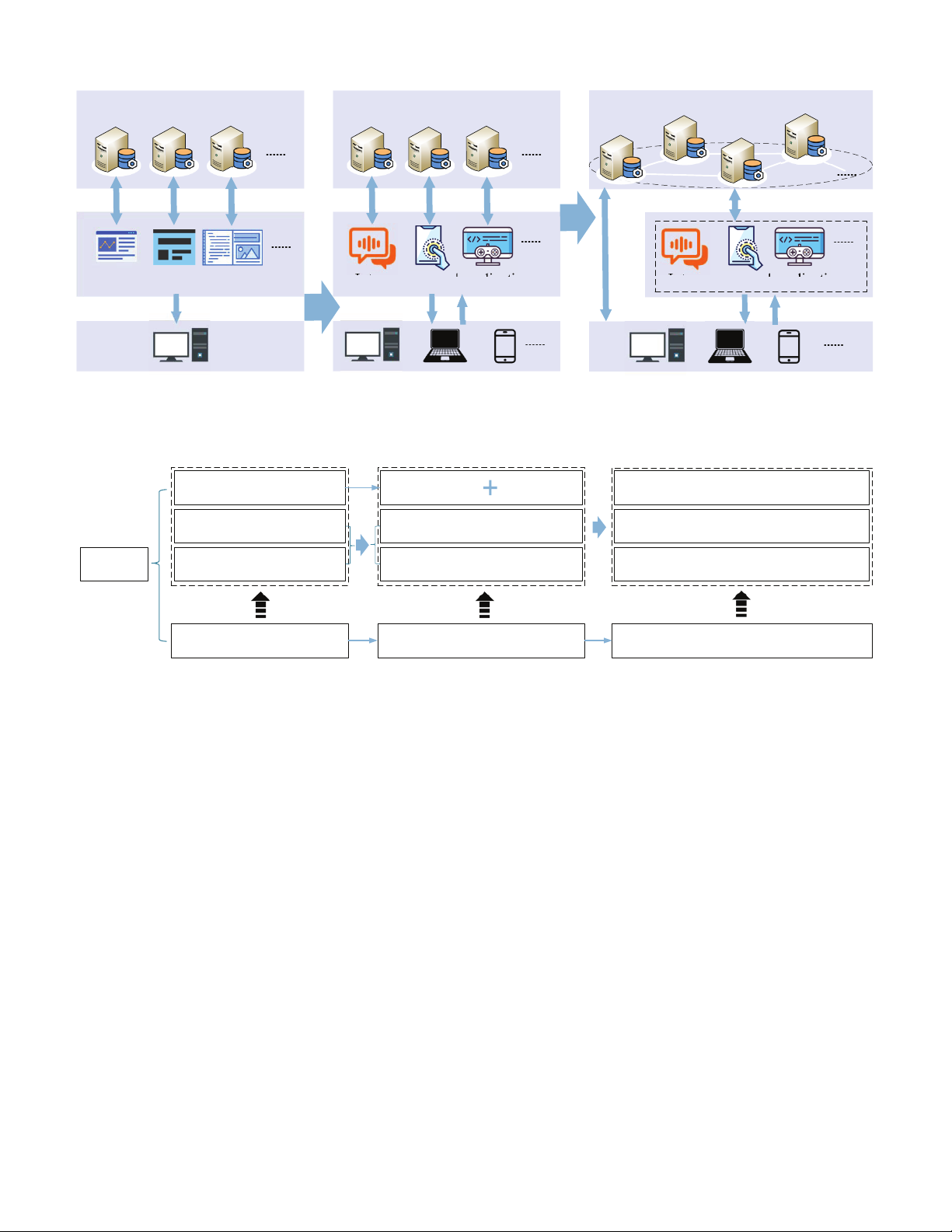
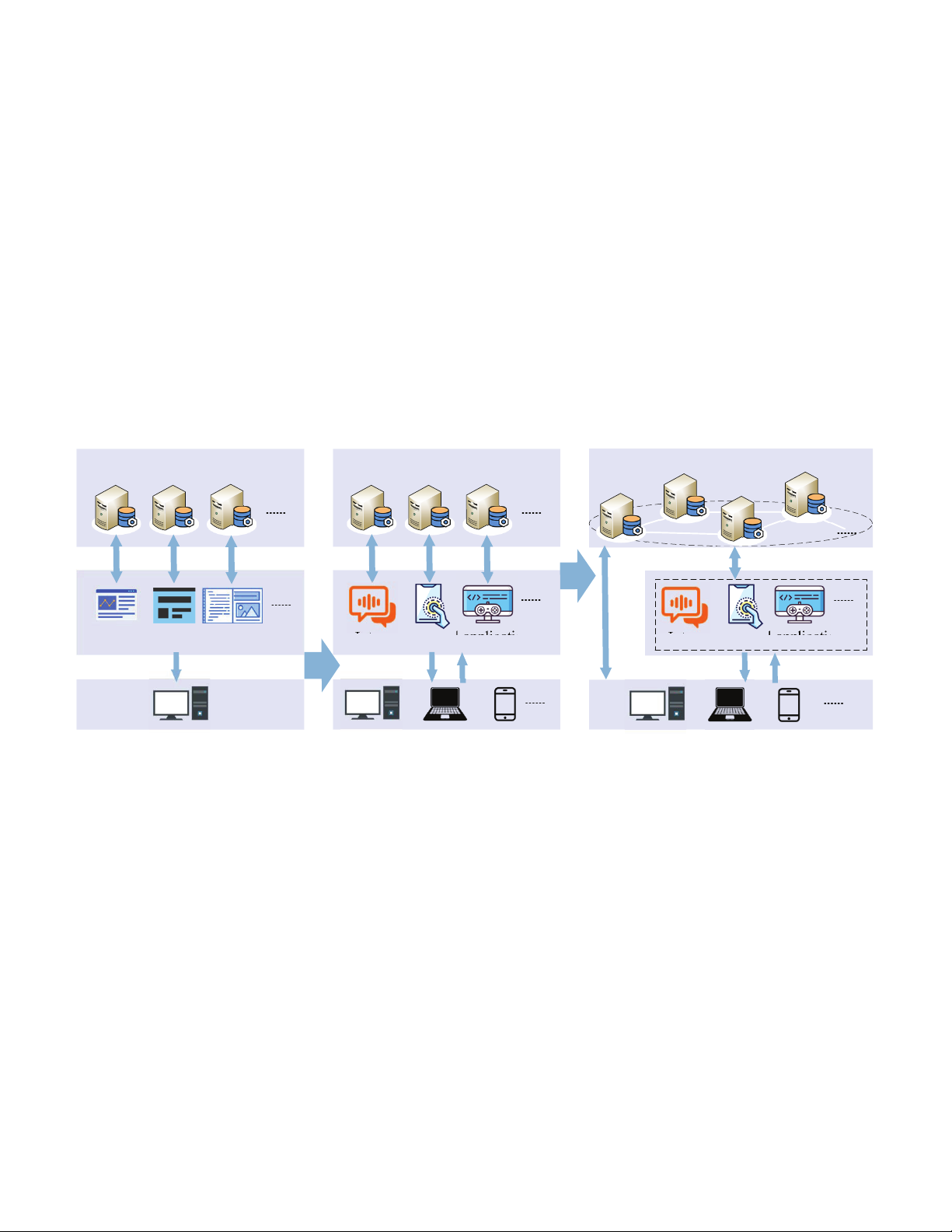
Fig. 1 illustrates the evolution of Web1, Web2, and Web3.
protection provided by a zero-trust and zero-touch environment.
Different from “read” based Web1 and “read-write” based
However, as to the traditional layered architecture like TCP/IP,
Web2, which is content-centric, “read-write-own” based Web3
data protection is an overlaid function, which is far away from
is user-centric, where data does not rest with platforms. How-
the full-process data protection requirements. To this end, in
ever, it makes no sense to consider data owned by users apart
order to build a zero-trust and zero-touch environment, a Web3
architecture is presented in this article as a promising paradigm.
from multi-party collaborative environments. Therefore, as
Meanwhile, the key principles for Web3 architecture designing
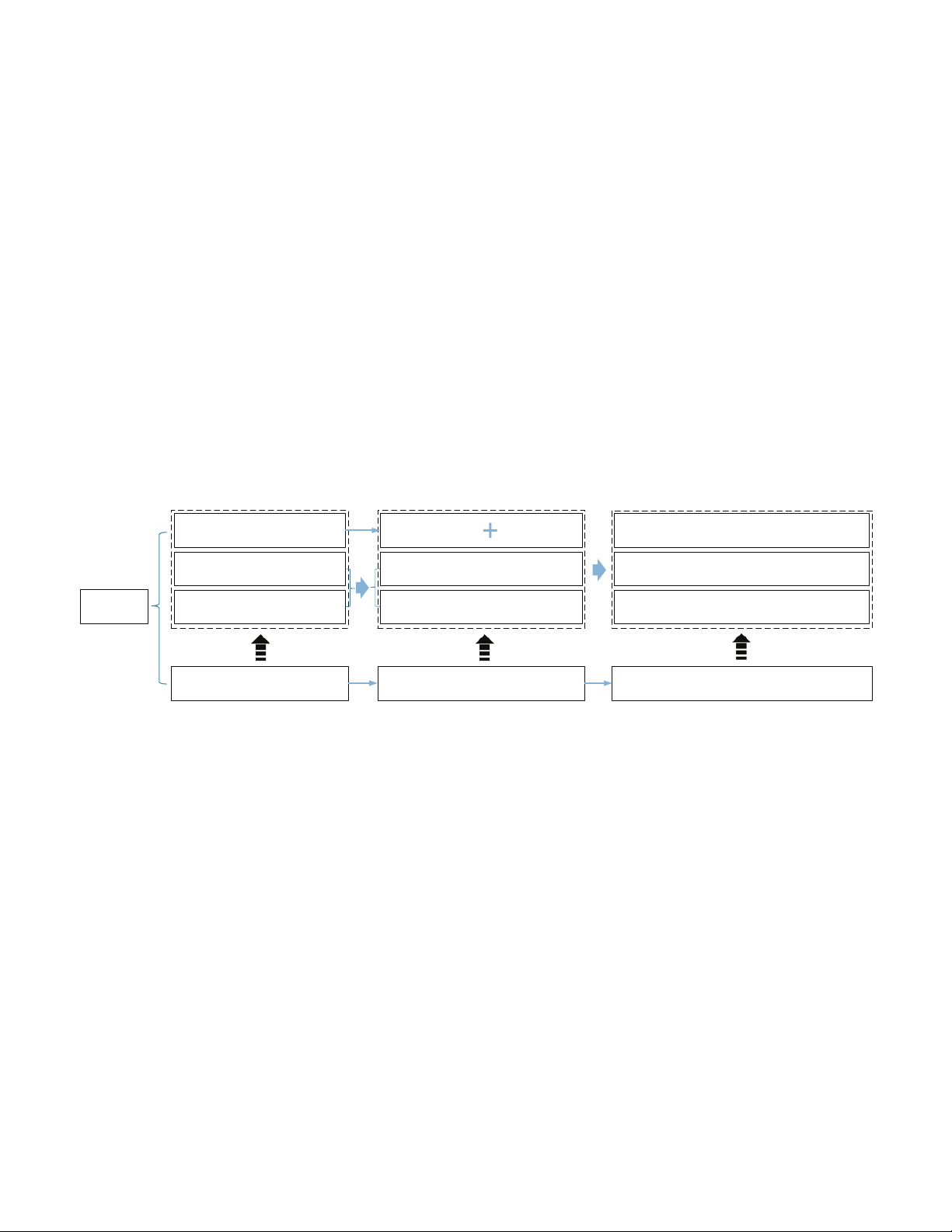
shown in Fig. 2, when considering whether the user owns the
are discussed, covering interoperability and interpretability of
data, the following three factors should be considered: explicit
data, trustworthiness throughout network lifecycle, incentive
sovereignty, well-defined responsibilities, and an environment
for collaboration and sharing, and human-centric experience.
that stimulates multi-party participation. The first relies on the
Moreover, in order to achieve these principles, four aspects of
enabling technologies are presented, including semantic, incen-
combination of trust data and identities, while the second and
tive, decentralized, and spatial technologies. Finally, some main
third require the support of trust networks and services. Trust
challenges and open issues are also identified as a future direction
identities are generated and managed locally by users, and it for further work.
can be used across various applications. It is the basis of data
Index Terms—Web3, Zero-trust, Zero-touch, Data rights, User-
owned by the user. Trust data can be transferred to different centric, Decentralization.
applications with the user’s permission, thus breaking down
the problem of data island. In trust networks and services, I. INTRODUCTION
malicious programs can be prevented from being set up I
to cause unreasonable data usage and value allocation. The
ncluding the portal websites of early Sina, MySpace, and
construction of these four trust elements needs the support
LiveJournal, the first generation of web technology, Web1,
of a zero-trust and zero-touch environment. By adopting the
allows users to browse the static pages of text and images
concept of zero trust, no identity, data, network, or service will
passively. In order to overcome the read-only limitation, the
be pre-assigned static and coarse-grained privileges, thereby
current generation, Web2, has enabled users to create and
increasing the cost and reducing the temptation to do evil
share their content for interactivity. In recent years, as mobile
[1]. Zero-touch network and service management enables self-
wireless technology advances, interactivity based on Web2
monitoring, self-healing, and self-optimization without human
has become ubiquitous, leading to an explosive amount of
intervention [2]. It can help the zero-trust concept to achieve
user-generated data and spawning many successful platforms,
continuous and automatic inspecting of all network behaviors,
such as Youtube, Facebook, Google, etc. While facilitating
thus providing indicators for timely and dynamic adjustment
interaction with the entire world anytime, anywhere, and in of privileges.
any form, Web2 has also brought about a worrying status
Recently, much attention has been paid to Web3-based
quo, where various platforms fully control the identities and
applications, including decentralized applications (Dapps),
data of users. Meanwhile, the independent identity and data
decentralized autonomous organizations (DAOs), and other
management in different platforms also contributes to the
related activities. In [3], a Dapp for crowdsourcing named
problem of data island. Notably, these mentioned problems
CrowdBC has been conceptualized and implemented on the
are rooted in the centralized model where Web2 platforms are
Ethereum network. The concept of DAO is introduced, and
third-party intermediaries for the exchange of information. In
the main software platforms, as well as visualization tools
other words, with the development of Web2, internet religious
for DAOs activity, are reviewed in [4]. To the best of our
fundamentalism, “it is for everyone,” claimed by Tim Berners-
knowledge, no published work has been done to detail how
Lee, has been far away from the root. As a result, platforms are
to build a zero-trust and zero-touch environment for Web3.
This work was supported in part by National Key (R&D) Program of
In addition, most of the current so-called Web3 activities rely
China under Grant 2021YFB1714100, in part by the National Natural Science
on centralized platforms or entities like OpenSea, Coinbase,
Foundation of China under Grant No. U22B2006, and in part by Zhejiang Lab under Grant 2021KF0AB03.
Binance, and so on, making it inherit the limitations of Web2.
Weikang Liu, Bin Cao (corresponding author) and Mugen Peng are with
For example, digital assets of the Russian DAO users still can
State Key Laboratory of Networking and Switching Technology, Beijing
be violated. Then, to construct Web3 formally, we are inspired
University of Posts and Telecommunications, Beijing, 100876, China. Bin Cao
is also with Zhejiang Lab, HangZhou, 311121, China. E-mail:{Weikang Liu,
to provide a comprehensive discussion on its architecture and caobin, pmg}@bupt.edu.cn
enabling technologies in this article.
Authorized licensed use limited to: Badan Riset Dan Inovasi Nasional. Downloaded on October 09,2023 at 05:32:44 UTC from IEEE Xplore. Restrictions apply.
© 2023 IEEE. Personal use is permitted, but republication/redistribution requires IEEE permission.See https://www.ieee.org/publications/rights/index.html for more information.
This article has been accepted for publication in IEEE Network. This is the author's version which has not been fully edited and
content may change prior to final publication. Citation information: DOI 10.1109/MNET.2023.3321546 2 ,QGHSHQGHQWDQGFHQWUDOL]HG ,QGHSHQGHQWDQGFHQWUDOL]HG 2SHQDQGGHFHQWUDOL]HG 2ZQ 2ZQ 3HUPLVVLRQ 6WDWLFSDJHVRIWH[WDQGLPDJH ,QWHUDFWLYHVRFLDODSSOLFDWLRQV ,QWHUDFWLYHVRFLDODSSOLFDWLRQV 5HDG 5HDG :ULWH 2ZQ 5HDG :ULWH :HE :HE :HE
Fig. 1: Evolution of Web1, Web2, Web3 6RYHUHLJQW\ 7UXVWLGHQWLW\ 7UXVWGDWD
:HEDUFKLWHFWXUHLQWHJUDWHGPXOWLSODQH 5HVSRQVLELOLW\ 7UXVWQHWZRUN )RXUNH\GHVLJQSULQFLSOHV 瀡2ZQ瀢 0XOWLSDUW\SDUWLFLSDWLRQ 7UXVWVHUYLFH )RXUDVSHFWVRI:HEWHFKQRORJLHV 7KUHHFRQVLGHUHGIDFWRUV )RXUWUXVWHOHPHQWV
$]HURWUXVWDQG]HURWRXFKHQYLURQPHQW Fig. 2: Road Map for Web3
The remainder of this article is organized as follows. In
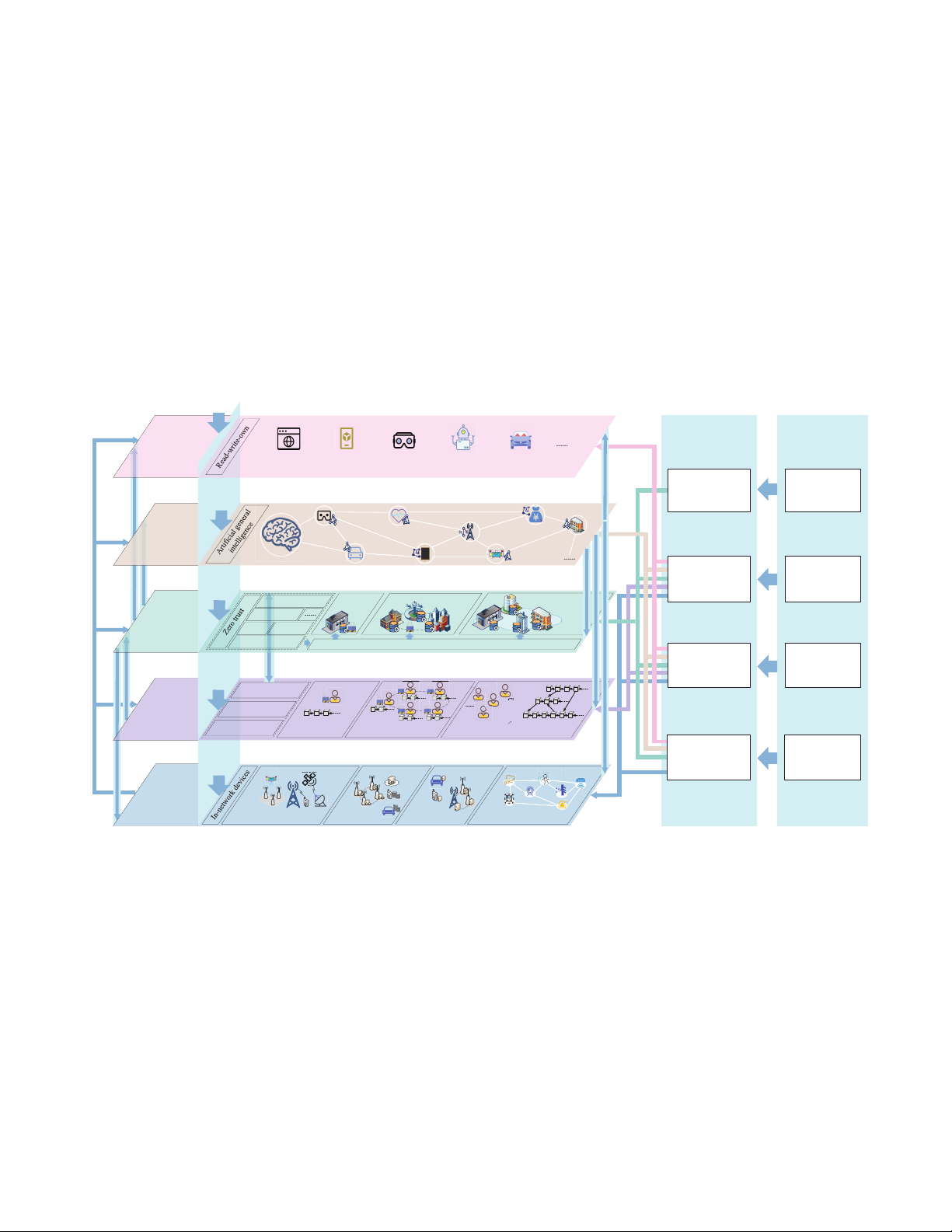
interdependent planes: Application-as-a-Service (AaaS) plane,
Section II, the proposed Web3 architecture is introduced in
Artificial-Intelligence-as-a-Service (AIaaS) plane, Data-as-a-
terms of its composed five planes. Section III provides the key
Service (DaaS) plane, Blockchain-as-a-Service (BaaS) plane,
principles to consider when designing this architecture. The
and Infrastructure-as-a-Service (IaaS) plane. The design of
enabling technologies to support these principles are discussed
these five layers adheres to four key principles, and making
following that. Future challenges and open issues are presented
this architecture align with them relies on four aspects of
in Section V. Finally, Section VI concludes this work and enabling technologies. discusses future trends. A. AaaS Plane II. WEB3 ARCHITECTURE
It is the top plane and provides users with applications
A zero-trust and zero-touch environment can provide real-
and services in the form of web pages, mobile applications,
time data protection throughout the entire network process,
etc. To avoid centralized dominance and facilitate censorship,
thereby supporting the construction of the four trust elements,
they are deployed and managed in a decentralized manner.
which are crucial for data rights to be owned by users. Full-
For example, front-end codes can be stored in decentralized
process data protection requires the deployment of cross-layer
storage systems on the DaaS plane, such as Inter Planetary
functionalities. However, the traditional layered architecture
File System, SWARM, and so forth. Through the front-end
like 5-layer TCP/IP is not conducive to deploying cross-layer
interfaces, users can invoke the back-end program to create
functionalities, leaving data protection as its overlay [1]. To
and manage Self-sovereign Identity (SSI), conduct decentral-
build a zero-trust and zero-touch environment for Web3, it is
ized transactions, earn profits, and write data into different
necessary to reorganize the architecture to provide hierarchical
storage systems as needed. It is worth emphasizing that SSI
extensibility from top to down. Therefore, we are motivated
is completely controlled by the user, independent of specific
to propose a Web3 architecture, which integrated multi-plane.
applications and services [5]. Once created, it can be reused
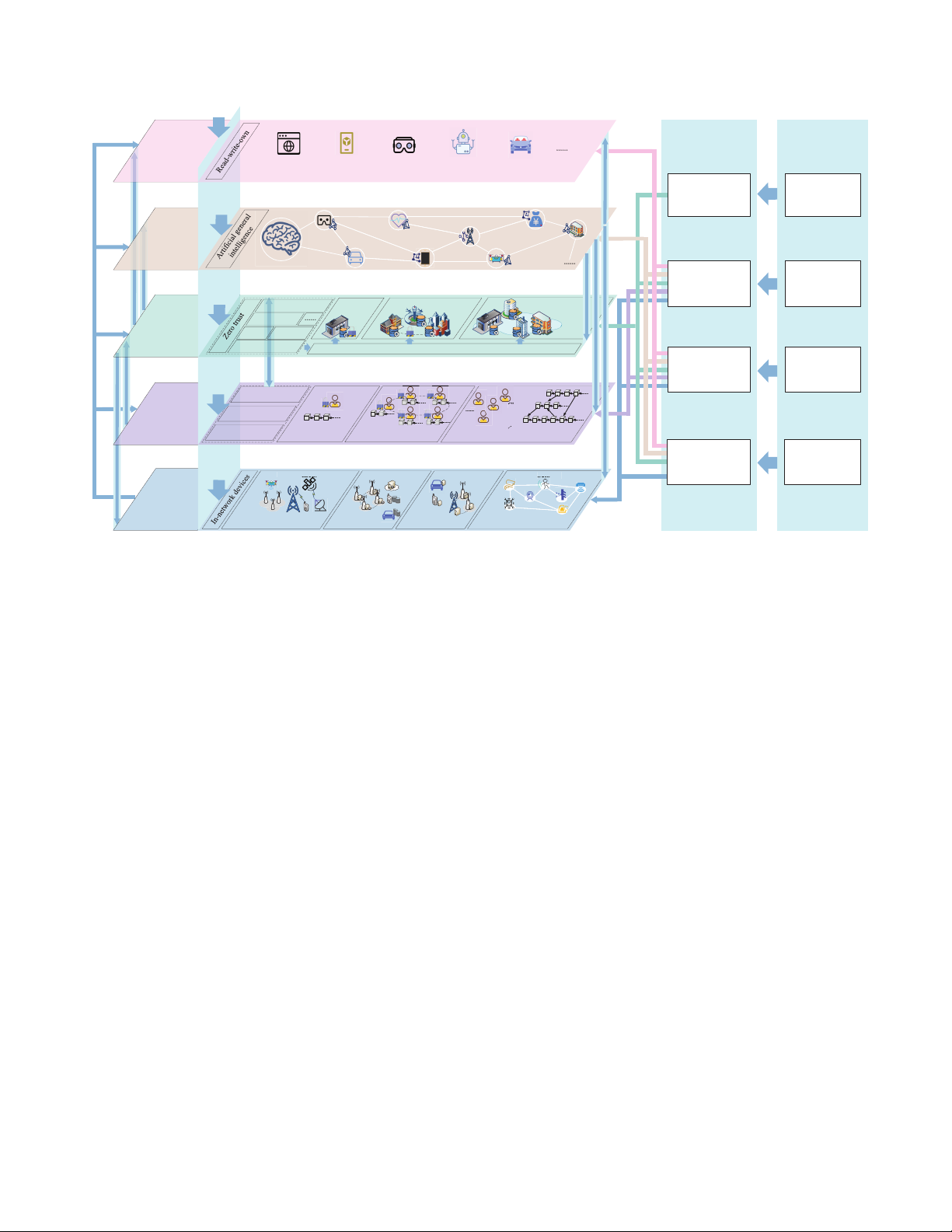
Illustrated in Fig. 3, the proposed architecture consists of five
in any application or service on all five planes. Meanwhile,
Authorized licensed use limited to: Badan Riset Dan Inovasi Nasional. Downloaded on October 09,2023 at 05:32:44 UTC from IEEE Xplore. Restrictions apply.
© 2023 IEEE. Personal use is permitted, but republication/redistribution requires IEEE permission.See https://www.ieee.org/publications/rights/index.html for more information.
This article has been accepted for publication in IEEE Network. This is the author's version which has not been fully edited and
content may change prior to final publication. Citation information: DOI 10.1109/MNET.2023.3321546 3 Self-sovereign Identity Enabling AaaS Key principles technologies plane Desktop Mobile VR/AR Robot Car browser terminal terminal Interoperability Data Intelligence Semantic and Interpretability governance support Technologies of Data Connected I intelligence nte AIaaS gr a plane te d de AGI Trustworthiness si Data Intelligence Decentralized gn through Network governance support Technologies a Lifecycle nd Private Consortium environment Public Service provisioning p environment environment hysi DaaS Access control Storage Processing c plane al Data collection r Slicing esour Incentives for Trustworthiness The bridge between Intelligence Incentive Collaboration and c enhancement
real-world data and blockchains support Technologies e Sharing su Chain 1 Off-chain pp Cross Chain 2 or BaaS chain On-chain t plane Chain 3 Private blockchain Consortium blockchain Cross-chain for private slices for consortium slices
Public blockchain for public slices Data Intelligence Towards Spatial governa r nce nc support Human-Centric Technologies Communication Storage Computing Sensing Experience IaaS I plane Full-earth ubiquitous coverage Sufficient Sufficient Networked sensor Extreme connectivity storage resources computing resources Timely, high-precision sensing Fig. 3: Web3 Architecture
data tied to it can also be used in any authorized application
(FL), swarm learning, and split learning, many distributed
and service. Till now, many related standards have been
learning architectures have been proposed and are believed
specified for implementing SSI and public key infrastructure
to be better developed in Web3 for privacy protection.
in a decentralized manner, such as Decentralized Identifiers
and Verifiable Credentials by the World Wide Web Consor- C. DaaS Plane
tium, Decentralized Key Management System by OASIS and
This plane determines the zero-trust characteristic of Web3.
Hyperledger, and so on. However, their deployment is still in
While providing zero-trust data governance for the AaaS, the prototype stage.
AIaaS and IaaS planes, it also relies on the functional support
of other planes, such as the intelligence support of the AIaaS B. AIaaS Plane
plane, the trustworthiness enhancement of the BaaS plane, and
This plane determines the zero-touch characteristic of Web3.
the physical resource support of the IaaS plane. In Web3, data
Based on the resource support of the DaaS and IaaS planes,
sinking from cloud to edge and owned by users would expose
its primary responsibility is to provide guidance for user
data to shifting perimeters, thereby reducing the importance
configuration and operation, and to act as an engine for various
of network perimeters in the security posture. To protect data
zero-touch services on different planes. Aiming to achieve data
regardless of location, this plane should be open, scalable, and
ownership by users in multi-party collaborative environments,
independent of a particular platform, enabling the creation of
Web3 can finally break down the problem of data island.
slices for private, consortium, and public environments. This
Then, it would be more conducive to data collection and
open environment makes it difficult for traditional perimeter-
sharing than Web2, which is essential to provide strong support
based security model to provide protection for Web3, and
for AI. In Web2, AI is confined to various domains and
integrate support for various data regulations like the General
can only make decisions in a specific domain or task set.
Data Protection Regulation, etc. In response to this problem,
For example, AI for joint source and channel coding cannot
[6] has proposed the Zero Trust Model (ZTM) that focuses on
be applied to resource allocation. However, in Web3, AI
users, assets, and resources rather than static perimeters. Its
can break down domain boundaries based on easier access
core principle is “verify and never trust,” and it is expected to
to data from different domains, thus making it possible to
be used in Web3 to provide security for the entire data life-
evolve toward artificial general intelligence (AGI). Meanwhile,
cycle, covering data collection, data processing, data storage,
data sinking from cloud to edge will facilitate the evolution
data access, data service provisioning, and so on. Specifically,
of AI from centralized in-cloud learning to distributed on-
Web3 participants will assume no implicit trust, and will
device learning, which will be of great importance for building
continuously analyze network traffic, inspect visitor behaviors,
connected intelligence in 6G. Including federated learning
evaluate potential risks, and enact timely protections.
Authorized licensed use limited to: Badan Riset Dan Inovasi Nasional. Downloaded on October 09,2023 at 05:32:44 UTC from IEEE Xplore. Restrictions apply.
© 2023 IEEE. Personal use is permitted, but republication/redistribution requires IEEE permission.See https://www.ieee.org/publications/rights/index.html for more information.
This article has been accepted for publication in IEEE Network. This is the author's version which has not been fully edited and
content may change prior to final publication. Citation information: DOI 10.1109/MNET.2023.3321546 4 D. BaaS Plane
it is necessary to model data in a standard format for data
Blockchain offers a conceptual framework and approaches
interoperability and machine interpretability in Web3.
to establish distributed trust and address the free rider problem
• Trustworthiness throughout network lifecycle: Though
and Sybil attacks. Integrating various blockchain technologies,
blockchain lays a feasible technological foundation for
this plane aims to enhance the security and trustworthiness of
solving the centralization problem and enabling transac-
data across and within slices in the DaaS plane. According
tions in trustless environments, it is not rigorous to sim-
to different read and write permissions required by slices,
ply assume that blockchain-based architectures can fully
different blockchains can be used, such as private, consortium,
inherit the characteristics of blockchain. For example,
and public blockchains. Private blockchains can be used in the
OpenSea still retains the ability to remove user-uploaded
slices created by a single organization or entity to improve data
non-fungible tokens (NFTs) from its homepage without
security, consortium blockchains can facilitate data sharing and
requiring the user’s permission. Therefore, it is necessary
value circulation in the slices created by an alliance, and public
to consider an effective way to incorporate the design
blockchains can provide data consistency and trustworthiness
principles of blockchain into the proposed architecture for
for the slices that are open to the public. Furthermore, many
trustworthiness throughout the whole network lifecycle.
on-chain technologies are available to improve the blockchain
• Incentives for collaboration and sharing: Spontaneity
running on slices, to accommodate their differentiated needs
is indispensable to the booming development of the
in scalability, security, and decentralization. Meanwhile, many
Internet, where service providers and network operators
cross-chain technologies have been proposed for blockchain
voluntarily optimize their performance [8]. Similarly,
interoperability, and can be used to enable value and data
for Web3’s sustainable development, we also expect
transfer between different slices. To bridge the trust gap
all the participants to voluntarily collaborate and share
between blockchains and the external world, many off-chain
resources. However, without satisfactory compensation,
technologies have been proposed and can be used to con-
participants will not interested in participating in the
sistently bind other storage systems in the DaaS plane to
construction. Therefore, it is necessary to establish incen- blockchains.
tive mechanisms and corresponding business models to
construct reasonable, stable and long-term collaboration and sharing. E. IaaS Plane
• Towards human-centric experience: Creating a more
As the foundation of the above four planes, IaaS is made
free and borderless environment to release the value of
up of a collection of physical facilities to provide the com-
data and resources is the development goal of Internet.
munication, computing, and storage resources needed for the
Following this goal, the ultimate vision of Web3 is
other four planes in Web3. In Web2, services are deployed
to eliminate the barriers between virtuality and reality,
on the network in an over-the-top (OTT) manner, and then the
achieving unimpeded flow of data, while providing ex-
heterogeneous data needs to be aggregated to service providers
tremely immersive and precise human-centric experience.
for analysis and decision-making. This out-of-network frame-
To support the seamless reality-virtuality interaction, it
work makes the response occur above the network, and thus
is necessary to develop high-performance infrastructure
cannot deal with network dynamics in real time [7]. However,
capabilities and unified state description of objects in
in order to support the reliable operations of Web3, real- Web3.
time decision-making is indispensable, such as the real-time
network traffic inspection and evaluation mentioned in DaaS. IV. WEB3 TECHNOLOGIES
Fortunately, the development of in-network devices provides a
In order to support the summarized key design principles,
way to optimize the infrastructure to implement functionalities
this section focuses on the technologies from the following
within the network for real-time in-network decisions. With
four aspects, which can help in-depth understand the features
the help of in-network devices, AaaS, AIaaS, DaaS, BaaS, and of Web3.
IaaS planes can be integrated on demand to support native AI,
native data protection, and native trustworthiness, which 6G A. Semantic Technologies also advocates.
Semantic Web was first envisioned by Tim Berners-Lee and
is considered the earliest definition of Web3 [9]. However, III. KEY DESIGN PRINCIPLES
it is not regarded as equivalent to Web3 in this article, but
In this section, we summarize the key principles to consider
a series of technologies that can support the key principle
when designing five planes, which are
Interoperability and interpretability of data. It can mainly
• Interoperability and interpretability of data: Due
be used in the DaaS plane. Specifically, it allows data to be
to the heterogeneity of data, diversity of data sources,
processed, shared and reused across application, entity and
and data machine-unprocessable, it would be challenging
organization boundaries by providing a common framework,
to meet the requirements of Web3 for automated and
which includes the data model, taxonomies, ontologies, rules
intelligent services, such as the connected intelligence and query languages.
mentioned in AIaaS, and the real-time network traffic
As the common data model used in Semantic Web, Re-
inspection and evaluation mentioned in DaaS. Therefore,
source Description Framework (RDF) has standardized a
Authorized licensed use limited to: Badan Riset Dan Inovasi Nasional. Downloaded on October 09,2023 at 05:32:44 UTC from IEEE Xplore. Restrictions apply.
© 2023 IEEE. Personal use is permitted, but republication/redistribution requires IEEE permission.See https://www.ieee.org/publications/rights/index.html for more information.
This article has been accepted for publication in IEEE Network. This is the author's version which has not been fully edited and
content may change prior to final publication. Citation information: DOI 10.1109/MNET.2023.3321546 5
triplet representation to describe resources. With the help of
physical worlds [11]. Based on such large and redundant
RDF triples, webs of information about related things can be
data, the influence of malicious data can be eliminated by
formed. Furthermore, for information machine-processable, it
comparison and analysis, thus laying the foundation for data
is essential to provide a common understanding of information
veracity. (ii) Communication: user-centric networks (UCNs)
between machines and humans. For this purpose, Semantic
have been proposed to facilitate the transition from “network”
Web has specified taxonomies (such as RDF schema) and
to “my network”, which is user-definable, user-configurable,
ontologies (such as Web Ontology Language OWL) to extend
and user-controllable [11]. Decentralized and interconnected
RDF vocabulary, where the defined semantics can be used
UCNs will enable users to own their generated data and
for reasoning about the described knowledge. Meanwhile, rule
control how it is used and spread in digital worlds, thereby
languages have been standardized to supplement their knowl-
eliminating the potential for data misuse by centralized service
edge representation, such as the Rule Interchange Format and
providers. (iii) Computing: decentralized Software-Defined-
the Semantic Web Rule Language. Finally, to access RDF data,
Network paradigm can be used to abstract the shared under-
a query language has been specified in the Simple Protocol
lying infrastructure and programmatically create cost-efficient
and RDF Query Language for data retrieval and manipulation,
slices for users on demand [12]. Open source software, as well
relationship searching and discovery.
as AGI in the AIaaS plane can guide and help users manipulate
Enabling semantic ability on Web3 can eliminate the barrier
and manage their slices. Many privacy-preserving technologies
of machines to automatically process massive Internet infor-
can be used to protect data from being compromised, when
mation at the data level, which lays the foundation for the
they needs to be aggregated or interacted to realize data util-
scalability of the DaaS plane and the powerful AGI of the
ity. Related technologies are cryptographic techniques (such
AIaaS plane. Moreover, in combination with the AIaaS plane,
as homomorphic encryption, secure multi-party computation,
Web3 can be endowed with the ability of self-configuration,
zero-knowledge proof), perturbative technologies (such as
self-organization and self-adaptation, thus supporting various
differential privacy), and anonymization technologies [13]. (iv)
zero-touch services to automatically handle real-time situa-
Storage: according to differentiated requirements, centralized tions [10].
and distributed storage systems of the DaaS plane, as well as
different types of blockchains of the BaaS plane, can be used to support the slices. B. Decentralized Technologies
Based on the synergy of these decentralized technologies,
The unprecedented success of Bitcoin shows us the ability
Web3 will be an open, decentralized, and user-centric web
of blockchain to build trust in a trustless and decentralized
that is invulnerable to DDoS attacks and single points of
environment. The core of blockchain is following a certain
failure. Meanwhile, participants in Web3 can overcome the
rule while distrusting any user, device or traffic, which is con-
natural boundary between systems to share information and
sistent with the “verify and never trust” of ZTM. Traditional
collaborate freely and trustingly.
centralized model put too much trust in the central authority
to follow this principle, and cannot meet the requirement of
Web3. Fortunately, many decentralized technologies have been C. Incentive Technologies
proposed to ensure the security, privacy and ownership of
As to decentralized Web3, incentive mechanisms will go far
personal data, which can be used in Web3 to support the
beyond user attraction and value creation. Besides stimulating
key principle Trustworthiness throughout network lifecycle.
contributions of knowledge, such as open source softwares
The following will introduce these technologies from the
and high-fidelity AI models, it can also promote the sharing
perspective of identity and data.
and coordination of decentralized infrastructure resources, thus
First, true control of identities is the prerequisite for users
affecting the performance and security of Web3, like the
to own their data. To return its control to users, SSI has been
operation of slices in the DaaS plane. However, self-interested
proposed to enable users to create, verify and manage their
and independent participants tend to behave for their own
identifiers in a decentralized manner without trusting third
interests, which may be incompatible with the global interest.
parties. Furthermore, in the proposed Web3 architecture, SSI
Faced with this dilemma, many application methods have
is expected to become globally unique identities throughout
been proposed for incentive mechanisms to regulate participant
the communication network from access, transport, storage to
behaviors. They can be applied in all planes of Web3 to
computing. Such a design is essential for Web3 to evaluate
support the key principle Incentives for collaboration and
the comprehensive trust degree of users, but is challenging to sharing.
implement due to the reliance on cross-industry and cross-
To ensure the sustainable operation of Web3, a well-
domain collaboration, as well as the dependency on still
designed incentive mechanism should first have the following
evolving decentralized technologies like blockchain.
properties according to [14]. (i) At the side of individual
Next, the following will introduce the decentralized tech-
interest, the benefits should be non-negative (i.e., Individual
nologies related to data from four aspects: sensing, commu-
Rationality) and the allocation should be fair (i.e., Incen-
nication, computing, and storage. (i) Sensing: communica-
tive Fairness). Meanwhile, privacy of participants should be
tion systems with wireless sensing capabilities, as well as
protected (i.e., Incentive Privacy). (ii) At the side of global
a wide variety of large-scale deployed sensing devices, will
interests, the individual interest should be compatible with the
provide high-volume multi-dimensional sensing data about
interest of Web3 (i.e., Incentive Compatibility and Incentive
Authorized licensed use limited to: Badan Riset Dan Inovasi Nasional. Downloaded on October 09,2023 at 05:32:44 UTC from IEEE Xplore. Restrictions apply.
© 2023 IEEE. Personal use is permitted, but republication/redistribution requires IEEE permission.See https://www.ieee.org/publications/rights/index.html for more information.
This article has been accepted for publication in IEEE Network. This is the author's version which has not been fully edited and
content may change prior to final publication. Citation information: DOI 10.1109/MNET.2023.3321546 6
Truthfulness). Meanwhile, social welfare maximization should
Besides the ultimate infrastructure capabilities and diverse
be satisfied for greater attraction to participation (i.e., Social
presentation forms, the unified state description of real objects
Welfare Maximization). (iii) At the side of operations, the
and corresponding virtual objects is crucial for the reality-
incentive mechanism should be decentralized and automated
virtuality interaction as well. Currently, NFTs not only thrive
to match Web3 (i.e., Incentive Automation). Meanwhile, in
in virtuality for digital collectibles, game assets, etc., but
the absence of powerful centralized entities, the incentive
also begin to be associated with more and more physical
mechanism should be lightweight, with acceptable physical
objects, such as cars, wines, and so on, providing Web3 with resource consumption.
attempts to describe states of virtual and real objects. With
Secondly, based on these considerations, many economic
these attempts, NFTs are expected to act as a link between
theoretic approaches can be used to design incentive mecha-
reality and virtuality for Web3, facilitating the circulation of
nisms for Web3, such as game theory, auction, contract and
both tangible and intangible assets.
matching theory [15]. In a decentralized manner, they can
Finally, based on all the four design principles discussed
be applied to facilitating the sharing and collaboration of
above, an intelligent, trust, and sustainable cyber-physical
physical, data and intelligence resources, regardless of vari-
space with an inclusive open ecosystem will be constructed,
ous human and geographic constraints. Apparently, traditional
which also signals the arrival of a full-fledged Metaverse.
centralized business models are no longer applicable to the
enforcement of incentive mechanisms and the management V. CHALLENGES AND OPEN ISSUES
of related resources in decentralized Web3. Without a top-
down hierarchy, DAO provides a feasible reference for Web3
In the development of Web3, there are many issues and
to establish corresponding business models. In these business
challenges worthy of attention and discussion, which can be
models, the rules and procedures will be fully transparent to
divided into two categories, on-going and potential ones.
all involved participants, and the executions will be automatic without human intervention.
A. On-going Challenges and Open Issues
Last but not least, thoughtful design requirements, ap-
propriate design approaches and matching business models
In the current transition phase of Web2 to Web3, there are
are expected to help maximize the sustainable and scalable
a series of on-gonging issues and challenges summarized as
operation of Web3 while minimizing the incentive cost. follows:
• Backward and forward compatibility: In order not D. Spatial Technologies
to affect the operations of current applications and ser-
Spatial Web, proposed by Peter Diamandis, is the latest
vices, it is necessary for Web3 to be strongly backward
vision of Web3 and has two main goals. One is to provide
compatible with Web2. Meanwhile, in order to meet
secure, trustworthy and privacy-preserving interactions and
the increasing security requirements and application sce-
transactions for humans, machines and virtual economies, that
narios, Web3 also needs to be forward compatible, so
can be achieved by the three aspects of enabling technologies
as to support online upgrade and sustainable evolution.
introduced above. The other is the deep integration of physical,
However, endowing Web3 with backward and forward
digital, and biological domains to eliminate the boundaries be-
compatibility requires reasonable and comprehensive de-
tween reality and virtuality. Focusing on the reality-virtuality
sign on its protocols, mechanisms and functions, which
interaction, this subsection explains how it supports the key remains an open issue.
principle Towards human-centric experience.
• Unified and lightweight design: As an open web, Web3
The reality-virtuality interaction is realized by reality map-
will face large-scale access and dynamically changing
ping to virtuality and virtuality reacting back to reality [8].
services, and then its complexity will increase expo-
In the IaaS plane, 6G-enabled full-earth ubiquitous coverage,
nentially. For a low-complexity Web3, unified standards
extreme connectivity, and networked sensing can provide
and basic protocols are required, thereby decreasing the
comprehensive, real-time and high-resolution sensing, local-
numbers of functionalities and realizing a lightweight
ization and imaging capabilities. They can be used to acquire
architecture. However, unified standards and architectural
sufficient information and knowledge about the physical and
solutions cannot be achieved without global consensus,
biological world, which are critical to forward map to virtual which remains challenging.
models aided by connected intelligence in the AIaaS plane.
• Flexible deployment, management, and services: The
These high-fidelity virtual models of physical and biological
shift from content-centric to user-centric makes the archi-
objects can be used in digital twins to simulate the operations
tecture and operations that underpin Web3 different from
of real objects, capture the corresponding rules and help to
Web2. As a result, the value of traditional theoretical
put into practice in reality [8]. Meanwhile, with the help
models for guiding the deployment, management, and
of immersive technologies such as extended reality video,
services of Web3 is greatly diminished. Therefore, a
haptic and multi-sensory information, and 3D holographic
series of precise theoretical models for Web3 are urgently
images, they can provide humans with immersive experiences
needed. Meanwhile, based on these theoretical models,
regardless of the physical distance. Then, remote services like
how to achieve flexible and low-cost deployment without
remote operations, haptic telemedicine, etc. will not be far
sacrificing security and decentralization remains chal- away.
lenging. Moreover, how to provide flexible services for
Authorized licensed use limited to: Badan Riset Dan Inovasi Nasional. Downloaded on October 09,2023 at 05:32:44 UTC from IEEE Xplore. Restrictions apply.
© 2023 IEEE. Personal use is permitted, but republication/redistribution requires IEEE permission.See https://www.ieee.org/publications/rights/index.html for more information.
This article has been accepted for publication in IEEE Network. This is the author's version which has not been fully edited and
content may change prior to final publication. Citation information: DOI 10.1109/MNET.2023.3321546 7
applications through their flexible management is other
[5] Kalman C. Toth and Alan Anderson-Priddy. Self-sovereign digital open issue.
identity: A paradigm shift for identity. IEEE Secur. Privacy, 17(3):17– 27, 2019.
• Professional supervision and inspection: Currently, [6] John Kindervag.
No more chewy centers: The zero trust model of
Web3 in baby stage is lack of unified standards, this
information security. Forrester Research, Inc., dated Mar, 23, 2016.
makes the data cannot be freely circulated between
[7] Mingrui Cao, Long Zhang, and Bin Cao. Toward on-device federated
learning: A direct acyclic graph-based blockchain approach. IEEE Trans.
authorized services and applications, and the globally
Neural Netw. Learn. Syst., pages 1–15, 2021.
unique SSI is not implemented to support the trust-
[8] Qinqin Tang, F. Richard Yu, Renchao Xie, Azzedine Boukerche, Tao
worthiness throughout the network lifecycle. Therefore, Huang, and Yunjie Liu.
Internet of intelligence: A survey on the
enabling technologies, applications, and challenges. IEEE Commun.
professional supervision is needed to inspect whether the
Surv. Tutorials, pages 1–1, 2022.
whole project code is safe, whether the permissions are
[9] Dieter Fensel and Mark A Musen. The semantic web: a brain for
reasonable, and whether the traffic is compliant.
humankind. IEEE Intell. Syst., 16(2):24–25, 2001.
[10] Chafika Benzaid and Tarik Taleb. Ai-driven zero touch network
and service management in 5g and beyond: Challenges and research
B. Potential Challenges and Open Issues
directions. IEEE Network, 34(2):186–194, 2020.
[11] Wen Tong and Peiying Zhu. 6G, the Next Horizon: From Connected
In Web2, the enabling technology discussed in this paper
People and Things to Connected Intelligence. Cambridge University Press, 2021.
still has some unsolved problems, such as the interpretability
[12] David Espinel Sarmiento, Adrien Lebre, Lucas Nussbaum, and Abdel-
issue of AI, the trilemma issue of blockchain and so on. In the
hadi Chari. Decentralized sdn control plane for a distributed cloud-edge
transition to Web3, these technologies are highly integrated,
infrastructure: A survey. IEEE Communications Surveys & Tutorials, 23(1):256–281, 2021.
interpenetrated and intersected, thus making it possible for
[13] Xuefei Yin, Yanming Zhu, and Jiankun Hu. A comprehensive survey of
Web3 to break the inherent limitations of a single technology,
privacy-preserving federated learning: A taxonomy, review, and future
and obtain technical breakthroughs that are difficult to achieve
directions. ACM Computing Surveys (CSUR), 54(6):1–36, 2021.
[14] Bin Cao, Zixin Wang, Long Zhang, Daquan Feng, Mugen Peng, Lei
in Web2. However, in Web3, it is still necessary to further
Zhang, and Zhu Han. Blockchain systems, technologies and applica-
study which issues left over by Web2 can be solved, which
tions: A methodology perspective. IEEE Commun. Surv. Tutor., pages
issues still exist, and what new issues will be generated. 1–1, 2022.
[15] Xuezhen Tu, Kun Zhu, Nguyen Cong Luong, Dusit Niyato, Yang
Meanwhile, it is unknown what basic theoretical problems
Zhang, and Juan Li. Incentive mechanisms for federated learning: From
Web3 will face, how to define them, and how to solve them.
economic and game theoretic perspective. IEEE Trans. Cognit. Commun. Networking, 2022. VI. CONCLUSIONS
This article has proposed a Web3 architecture, which
integrates five distinct planes, namely AaaS plane, AIaaS
plane, DaaS plane, BaaS plane and IaaS plane. Supporting
the deployment of cross-layer functionalities, this architecture
aims to build a zero-trust and zero-touch environment, thus
Weikang Liu received the B.E degree in information and communication
helping ensure data protection throughout the whole process.
engineering from Beijing University of Posts and Telecommunications, in
Meanwhile, for its sustainable development, this article has
2017. He is currently pursuing his Ph.D. degree in the State Key Laboratory
of Networking and Switching Technology, Beijing University of Posts and
summarized four key principles, covering interoperability and
Telecommunications. His research interests include blockchain, and Web3.
interpretability of data, trustworthiness throughout network
lifecycle, incentive for collaboration and sharing, and human-
centric experience. With the goal of understanding further in-
tricacies, this article has divided the technologies that underpin
these key principles into four aspects: semantic, decentralized,
incentive, and spatial technologies. Generally, this article can
be seen as a pioneer work on Web3 architecture designing,
Bin Cao is a Full Professor with the School of Information and Communi-
which is expected to facilitate the implementation of Web3,
cation Engineering, Beijing University of Posts and Telecommunications. He
is/was an Associate/Guest Editor of IEEE Transactions on Mobile Computing,
although multiple issues and challenges are still there at this
IEEE Internet of Things Journal, IEEE Communications Magazine, IEEE infancy stage.
Transactions on Industrial Informatics, etc. His research is blockchain. REFERENCES
[1] John Kindervag et al. Build security into your network’s dna: The zero
trust network architecture. Forrester Research Inc, 27, 2010. [2] GSZSM ETSI.
Zero-touch network and service management (zsm);
reference architecture. Group Specification (GS) ETSI GS ZSM, 2, 2019.
[3] Ming Li, Jian Weng, Anjia Yang, Wei Lu, Yue Zhang, Lin Hou, Jia-
Mugen Peng (IEEE Fellow) is a Full Professor with the School of Information
Nan Liu, Yang Xiang, and Robert H Deng. Crowdbc: A blockchain-
and Communication Engineering, Beijing University of Posts and Telecommu-
based decentralized framework for crowdsourcing. IEEE Trans. Parallel
nications. He was a recipient of the 2018 Heinrich Hertz Prize Paper Award,
Distrib. Syst., 30(6):1251–1266, 2018.
the 2014 IEEE ComSoc AP Outstanding Young Researcher Award, etc.
[4] Youssef El Faqir, Javier Arroyo, and Samer Hassan. An overview
of decentralized autonomous organizations on the blockchain. In
Proceedings of the 16th international symposium on open collaboration, pages 1–8, 2020.
Authorized licensed use limited to: Badan Riset Dan Inovasi Nasional. Downloaded on October 09,2023 at 05:32:44 UTC from IEEE Xplore. Restrictions apply.
© 2023 IEEE. Personal use is permitted, but republication/redistribution requires IEEE permission.See https://www.ieee.org/publications/rights/index.html for more information.
This article has been accepted for publication in IEEE Network. This is the author's version which has not been fully edited and
content may change prior to final publication. Citation information: DOI 10.1109/MNET.2023.3321546 8 ,QGHSHQGHQWDQGFHQWUDOL]HG ,QGHSHQGHQWDQGFHQWUDOL]HG 2SHQDQGGHFHQWUDOL]HG 2ZQ 2ZQ 3HUPLVVLRQ 6WDWLFSDJHVRIWH[WDQGLPDJH ,QWHUDFWLYHVRFLDODSSOLFDWLRQV ,QWHUDFWLYHVRFLDODSSOLFDWLRQV 5HDG 5HDG :ULWH 2ZQ 5HDG :ULWH :HE :HE :HE
Fig. 4: Evolution of Web1, Web2, Web3
Authorized licensed use limited to: Badan Riset Dan Inovasi Nasional. Downloaded on October 09,2023 at 05:32:44 UTC from IEEE Xplore. Restrictions apply.
© 2023 IEEE. Personal use is permitted, but republication/redistribution requires IEEE permission.See https://www.ieee.org/publications/rights/index.html for more information.
This article has been accepted for publication in IEEE Network. This is the author's version which has not been fully edited and
content may change prior to final publication. Citation information: DOI 10.1109/MNET.2023.3321546 9 6RYHUHLJQW\ 7UXVWLGHQWLW\ 7UXVWGDWD
:HEDUFKLWHFWXUHLQWHJUDWHGPXOWLSODQH 5HVSRQVLELOLW\ 7UXVWQHWZRUN )RXUNH\GHVLJQSULQFLSOHV 瀡2ZQ瀢 0XOWLSDUW\SDUWLFLSDWLRQ 7UXVWVHUYLFH )RXUDVSHFWVRI:HEWHFKQRORJLHV 7KUHHFRQVLGHUHGIDFWRUV )RXUWUXVWHOHPHQWV
$]HURWUXVWDQG]HURWRXFKHQYLURQPHQW Fig. 5: Road Map for Web3
Authorized licensed use limited to: Badan Riset Dan Inovasi Nasional. Downloaded on October 09,2023 at 05:32:44 UTC from IEEE Xplore. Restrictions apply.
© 2023 IEEE. Personal use is permitted, but republication/redistribution requires IEEE permission.See https://www.ieee.org/publications/rights/index.html for more information.
This article has been accepted for publication in IEEE Network. This is the author's version which has not been fully edited and
content may change prior to final publication. Citation information: DOI 10.1109/MNET.2023.3321546 10 Self-sovereign Identity Enabling AaaS Key principles technologies plane Desktop Mobile VR/AR Robot Car browser terminal terminal Interoperability Data Intelligence Semantic and Interpretability governance support Technologies of Data Connected I intelligence nte AIaaS gr a plane te d de AGI Trustworthiness si Data Intelligence Decentralized gn through Network governance support Technologies a Lifecycle nd Private Consortium environment Public Service provisioning p environment environment hysi DaaS Access control Storage Processing c plane al Data collection r Slicing esour Incentives for Trustworthiness The bridge between Intelligence Incentive Collaboration and c enhancement
real-world data and blockchains support Technologies e Sharing su Chain 1 Off-chain pp Cross Chain 2 or BaaS chain On-chain t plane Chain 3 Private blockchain Consortium blockchain Cross-chain for private slices for consortium slices
Public blockchain for public slices Data Intelligence Towards Spatial governa r nce nc support Human-Centric Technologies Communication Storage Computing Sensing Experience IaaS I plane Full-earth ubiquitous coverage Sufficient Sufficient Networked sensor Extreme connectivity storage resources computing resources Timely, high-precision sensing Fig. 6: Web3 Architecture
Authorized licensed use limited to: Badan Riset Dan Inovasi Nasional. Downloaded on October 09,2023 at 05:32:44 UTC from IEEE Xplore. Restrictions apply.
© 2023 IEEE. Personal use is permitted, but republication/redistribution requires IEEE permission.See https://www.ieee.org/publications/rights/index.html for more information.
Tài liệu liên quan:
-

Ung dung game hoa trong cac chien dich MKT
22 11 -

Bao cao Chi so TMDT Viet Nam 2025
26 13 -

Thông tư quy định về việc phân quyền, phân cấp và phân định thẩm quyền quản lý nhà nước về giáo dục cho chính quyền địa phương
30 15 -
Nghị quyết về phát huy các giá trị di sản văn hóa gắn với phát triên du lịch bền vững tỉnh Khánh Hòa đến năm 2025, định hướng đến năm 2030
25 13 -

Quyết định phê duyệt Chiến lược phát triển du lịch Việt Nam đến năm 2030
16 8