webologyhihihihihihihihihihihihih
wwwwwww
Môn: Quản trị tài chính doanh nghiệp 288 tài liệu
Trường: Trường Đại học Kinh Tế Quốc Dân 8.7 K tài liệu
Tác giả:














Preview text:
See discussions, stats, and author profiles for this publication at: https://www.researchgate.net/publication/359939257
The Impact Of User-Generated Content (Ugc) On Destination Image
Formation And Behavior Intentions Article · January 2022 CITATION READS 1 1,667 6 authors, including: Javeria Ashfaq Asfandyar Khan 12
Khyber Pakhtunkhwa Tourism Integrated Development Project (KITE)
PUBLICATIONS 29 CITATIONS
9 PUBLICATIONS 18 CITATIONS SEE PROFILE SEE PROFILE Muhammad Bilal Fazaila Shad University of Peshawar Islamia College University
2 PUBLICATIONS 6 CITATIONS
26 PUBLICATIONS 160 CITATIONS SEE PROFILE SEE PROFILE
All content following this page was uploaded by Fazaila Shad on 14 April 2022.
The user has requested enhancement of the downloaded file. Webology (ISSN: 1735-188X) Volume 19, Number 2, 2022
The Impact Of User-Generated Content (Ugc) On Destination
Image Formation And Behavior Intentions
Javeria Ashfaq1 , Asfandyar Khan2* , Muhammad Bilal3 , Muhammad Salman4 , Fazaila Shad5
1 Lecturer at Department of Mass Communication, National University of Modern
Languages (NUML Rawalpindi), Khadim Hussain Rd, Lalazar, Rawalpindi, Punjab 46000, Pakistan.
2 *Ph.D Scholar at Azman Hashim International Business School (AHIBS), Universiti
Teknologi Malaysia (UTM), Sultan Ibrahim Chancellery Building, Jalan Iman, 81310 Skudai, Johor, Malaysia.
3Lecturer at Institute of Management Studies (IMS), University of Peshawar, Peshawar, Pakistan.
4 Lecturer at Institute of Business Studies, Kohat University of Science and Technology, Pakistan.
5 Ph.D Scholar at Islamia college, University of Peshawar, Pakistan.
__________________________________________________________________________ Abstract
The importance “of the Internet on the image formation “process has been widely “recognised
by both academic and practitioners. Despite the increasing use of user-generated electronic
content as an information source for tourists, its influence on destination image formation is
not yet fully understood. In order to bridge this knowledge gap in tourism management, we
conducted an empirical study to identify the impact of online user generated reviews on the
two dimensions of destination image: affective and cognitive and bahavior intention and
mediating role of destination image and UGC. The results of this study showed that UGC has
positive effect on cognitive image and non-significate with affective image and behavior
intentions. The findings also showed cognitive image mediate the relationship between UGC
and BI and affective does not mediate the relationship between UGC and BI. This findings of
this will helps researchers, marketers and even governments to understand concepts such as
UGC, cognitive and affective dimension of the image and behavior intentions.” 7892 http://www.webology.org Webology (ISSN: 1735-188X) Volume 19, Number 2, 2022
Keywords: “User-generated content, destination image, cognitive image, affective image,
tourist destination, behavior Intention.” 1. Introduction
Tourism is one of the sectors that provides the largest contribution to the economic
development of countries. It contributes to income and employment generation in society and
to the enrichment of many related industries. Tourism is an economic activity that already
accounts for 5% of the world’s GDP (UNWTO, 2012) where competence is more and more
intense. Destinations largely compete based on their perceived images relative to competitors
in the marketplace (Baloglu & Mangaloglu, 2001). Therefore, it is necessary to develop a
positive image of the destination in target markets to achieve a real competitive advantage
(Gartner, 1993; Baloglu & McCleary, 1999b).”
“Tourists now have online resources that enable them to search for possible
destinations, transportation, accommodation and leisure activities, in addition to the purchase
of these services (Akehurst, 2009). The importance of the Internet in the image formation
process has been recently recognised by both academic and practitioners. Previous research
has shown online browsing influences on both the cognitive and the affective dimensions of
image, although most previous research has focused purely on the cognitive component
(Echtner & Ritchie, 1991; Walmsley & Young, 1998; Chen & Uysal, 2002). This lack of
research is especially visible in the tourism sector where the industry has witnessed
fundamental changes in the last years (Buhalis & Law, 2008; Minghetti & Buhalis, 2010). In
addition, the Internet has changed tourist behaviour dramatically (Mills & Law, 2004).
Prospective travellers have direct access to a much greater wealth of information and can
make online purchases themselves, instead of relying on travel agencies (Morrison et al.,
2001). The influence of the Internet on destination image is yet to be fully revealed as the
virtual environment is broad and boasts different platforms, such as blogs and web forums,
that might have differential effects on the image held by tourists (Jani & Hwang, 2011).”
“In this context, online user-generated reviews about travel destinations, hotels, and
tourism services have become important sources of information for travellers (Pan,
MacLaurin & Crotts, 2007). Each year hundreds of millions of potential visitors consult online
reviews (Tripadvisor, 2012). Academic research is also interested in studying this behaviour.
Goldenberg et al. (2001) observed that consumer decision-making processes are strongly
influenced by word-of-mouth (WOM) from other consumers. In addition, Gretzel and Yoo
(2007) further found that reviews provided by other travellers are often perceived by readers
to be more up-to-date, enjoyable, and reliable than information provided by travel service providers.”
“Destination and travel marketers are interested in influencing tourists’ behaviour to
encourage them to favour and purchase their products and services – including destinations.
With the upsurge in use of user-generated content (hereafter UGC) as it occurs in blogs and
web forums, the influence of tourism marketers on potential tourists seems to be diminishing 7893 http://www.webology.org Webology (ISSN: 1735-188X) Volume 19, Number 2, 2022
(Pan, MacLaurin, & Crotts, 2007). UGC includes online information sources that are created,
initiated, circulated and used by consumers who intend to educate each other and share
information about products, brands, services, personalities and other issues (Blackshaw & Nazzaro, 2004).”
“Recent research on destination image (Echtner & Ritchie, 2003; Tasci & Gartner,
2007; Tasci, Gartner & Cavusgil, 2007) and on the use of electronic platforms by tourists
(Schmallegger & Carson, 2008; Wenger, 2008) has flourished. However, despite the crucial
role they play in the modern tourism industry, little work has been done on how web forums
and blogs are used to measure and build a destination image (Wenger, 2008), particularly
those capturing destination image in a holistic manner (Echtner & Ritchie, 2003; Carson,
2008). In this study we first analyse to what extent access to UGC influences two dimensions
of the destination image: cognitive and affective. Second, we analyse the mediating role of
the cognitive and affective dimensions of image on the relationship between access to UGC
and behavioural intentions. According to these objectives, we first review the literature and
propose a set of hypotheses, then describe the methodology and present the results. We end
with conclusions and implications derived from this research.”
2. Literature review and hypotheses development
2.1 User-generated content (UGC) in tourism and destination image
“Consumers are using electronic word-of-mouth (e WOM) more and more to share
opinions and experiences about products and services (Rezabakhsh et al., 2006; Mendes, Tan
& Mills, 2012). We can find a great deal of content on the Internet about entertainment and
providing reviews on products and services such as books, restaurants, and hotels (George & Scerri, 2007).”
“UGC is an electronic communication phenomenon enabled by Web 2.0, the second
generation of web-based services, which allows people to collaborate and share information
online (Cox et al., 2009). Because of the experiential nature of tourism products for which
previous quality cannot be ascertained, WOM and, more recently, e WOM are much relied on
by potential tourists in forming images (Gretzel, Hyan-Yoo & Purifoy, 2007; Pan et al., 2007;
Cox et al., 2009). Consequently, UGC serves as an information source for potential tourists (Ye et al., 2009).”
“Destination image can be viewed as a set of beliefs, ideas, and impressions that people
have of attributes and/or activities available at a destination (Richardson & Crompton, 1988;
Dadgostar & Isostalo, 1992; Kotler, Haider & Rein, 1993). As destination image is developed
through a complex process of learning and information sharing (Wenger, 2008), it is of
interest to focus on the shared information available on platforms through which tourists
communicate with each other: communication spaces such as forums, public internet
discussion boards, blogs, social networking sites (such as Facebook and My Space) and also
private web sites (Jani & Hwang, 2011). Destination image can be categorised on a temporal 7894 http://www.webology.org Webology (ISSN: 1735-188X) Volume 19, Number 2, 2022
basis as pre- or post-travel image (Sussman & Unel, 1999; Beerli & Martin, 2004; Frías et al.,
2008; Yilmaz et al., 2009); on an attribute basis as functional and/or psychological image
(Echtner & Ritchie, 1993, 2003; Tasci et al., 2007; Bigné, Sánchez & Sanz, 2009); and on the
basis of tourist response as cognitive and/or affective image (Baloglu & McCleary, 1999b).
This last perspective is the one used in this study because much research has focused purely
on the cognitive dimension and many researchers have asked for the inclusion of the affective
dimension (Kim & Richardson, 2003; Li et al., 2009).”
“An increasing number of researchers have directed their attention to identifying what
constitutes destination image (Lawson & Band-Bovy, 1977; Dichter, 1985). Much empirical
research supports the premise that destination image is composed of two dimensions:
cognitive and affective (Crompton, 1979). The cognitive component refers to the beliefs or
knowledge a person has about the characteristics or attributes of a tourist destination (Baloglu
& McCleary, 1999; Pike & Ryan, 2004), while the affective dimension is represented by the
individual’s feelings towards the tourist destination (Chen & Uysal, 2002; Kim & Richardson, 2003).”
“With some exceptions (Baloglu & McCleary, 1999; Mackay & Fesenmaier, 2000;
Uysal, Chen & Williams, 2000), most destination image studies focus exclusively on the
cognitive dimension of destination image and overlook the affective dimension. The cognitive
dimension has been extensively examined in tourism literature (Fakeye & Crompton, 1991;
Court & Lupton, 1997; Chen & Kerstetter, 1999; Leisen, 2001). However, Kim and
Richardson (2003) posit that in tourism contexts, evaluation of affective qualities of places
might become even more important than objective or perceptible properties of places. Only
recently, several studies (San Martín & Rodríguez del Bosque, 2008; Li et al., 2009; Wang &
Hsu, 2010; Moreno, Molina & Moreno, 2013) have proposed the cognitive-affective nature
of destination image. This concept is integrated not only through the individual’s cognitive
evaluations but also through their affective evaluations of a tourist destination (Kim &
Richardson, 2003; Pike & Ryan, 2004). According to the literature, the coexistence of both
components may better explain the image a tourist has of a destination (Baloglu & Brinberg, 1997).”
“Moreover, there is a higher perceived credibility of opinions expressed in UGC as
compared to traditional tourism information sources (Sarks 2007). The explanation of this
evidence probably lies in the necessity of consuming tourism products before an evaluation
can take place (Senecal & Nantal 2004; Rabanser & Ricci 2005). As a result, online reviews
and WOM recommendations are a growing and important information source because of the
perceived independence of the message source (Gitelson & Kerstetter 1995; Crotts 1999;
Dellarocas 2003; Johnson & Kayne 2003; Hennig-Thurau et al. 2004; Pan et al. 2007; Litvin
et al. 2008). A recent UK survey found consumers put more trust in sites with reviews than in
professional guides and travel agencies (eMarketer, 2007). Similarly, Oellrich and Auhuber
(2007) showed online customer ratings have high credibility among consumers in Germany
and Austria. Furthermore, a study undertaken on Tripadvisor users found that looking at other 7895 http://www.webology.org Webology (ISSN: 1735-188X) Volume 19, Number 2, 2022
tourists’ comments and travel blogs was the most popular online activity (Gretzel et al., 2007).”
“According to Brand Signal Theory (Erdem & Swait, 1998), when tourists trust
destination sources, the information provided is likely to exert a persuasive effect on their
opinions about destination image. Since UGC is very credible, it can help tourists and
travellers to form the image of a destination. Consumer access to information related to
attributes, experiences and emotions shared by other tourists may then affect their perceived
image of the destination. Therefore, based on the idea that destination image has two
dimensions – cognitive and affective – we propose:”
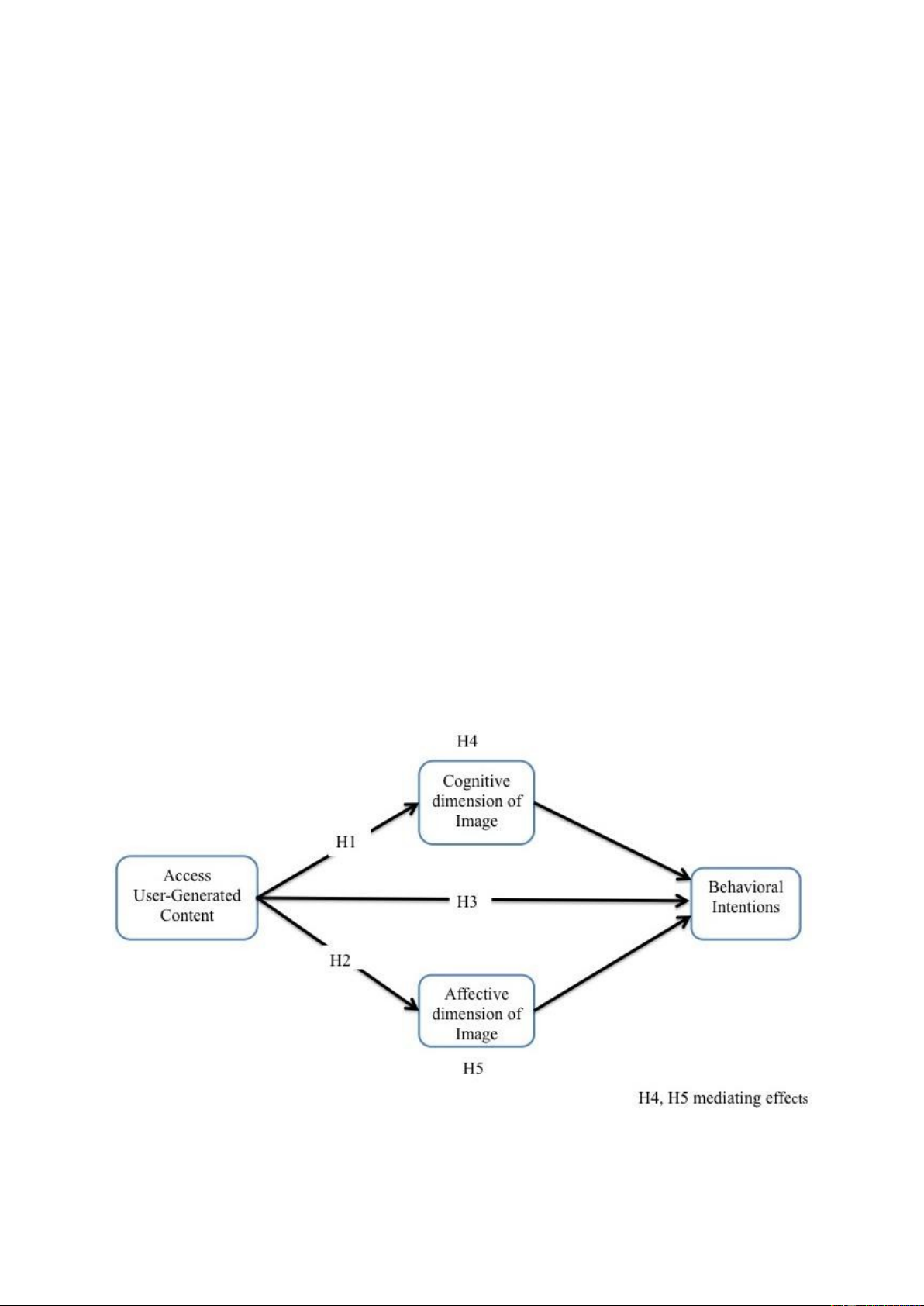
H1: “Access to UGC positively influences the cognitive dimension of image destination”
H2: “Access to UGC positively influences the affective dimension of image destination”
“As the tourism industry provides so much potential for destinations, it is imperative
that marketers understand the reasoning behind the intention to visit. Intention to recommend
the destination has been also considered a good indicator of behaviour in this context because
most tourist decisions are based on WOM (Kneesel et al., 2010).”
“How to attract tourists to visit a place and/or how to encourage them to recommend
the destination to others is crucial for the success of destination tourism development (Chen
& Tsai, 2007). Ye et al. (2011) assessed the impact of UGC on business performance using
data from a major Chinese travel agency. The findings indicated that tourists’ purchase
decisions are strongly influenced by online travel reviews. Casaló et al. (2011) investigated
some of the antecedents of the travellers’ intention to follow the advice obtained from UGC
in the online travel community. Perceived usefulness of the advice, trust in the online travel
community, and attitude toward the advice were found to be relevant to Spanish speaking
members of several online travel communities in determining their intention to follow the
advice obtained in these communities. Additional studies have also shown that online travel
reviews may influence the decisions of travellers. Vermeulen and Seegers (2009) conducted
an experimental study with 168 participants to determine the impact of online reviews on the
attitudes of travellers to hotels which revealed that exposure to online reviews enhanced hotel
awareness and that positive reviews improved the attitudes of travellers towards hotels. Based
on survey data with 1480 respondents, Gretzel and Yoo (2008) examined the role of travel
reviews in trip planning processes and demonstrated the importance of online consumer
reviews at an individual level. The importance of UGC goes far beyond the tourism sector. In
a more general study, access to UGC was also found to increase consumers’ intention to
purchase and the likelihood of buying a recommended product (Senecal & Nantel, 2004).
Thus, we expect that when a person accesses UGC for a particular destination, s/he will be
more likely to visit the destination and recommend it to others, which, in turn, will positively
influence her/his future behaviour. We thus propose:”
H3: “Access to UGC positively influences behavioural intentions” 7896 http://www.webology.org Webology (ISSN: 1735-188X) Volume 19, Number 2, 2022
2.2 Destination image as a mediating variable
Destination image has a critical influence on travellers’ destination choice processes (Cai,
2002), and it is a crucial method of differentiating destinations among competitors. When
potential travellers have a limited knowledge of a destination, perceived image fulfils an
important function. Strong, positive, distinct and recognizable images increase the probability
of a destination being chosen by travellers. Destination marketing therefore often focuses on
promoting a favourable destination image, which can provide travellers with vicarious
experiences before an actual visit (Hyun & O'Keefe, 2012). The importance of developing a
favourable destination image motivates research on the formation of destination image through
different types of information. We posit that access to UGC may enhance tourist perceptions
of destination image, which, in turn, may positively impact behavioural intentions. Based on
this rationale and on the cognitive and affective dimensions of destination image, the following hypotheses are proposed:”
H4: “The cognitive dimension of image destination mediates the relationship between access
to UGC and behavioural intentions”
H5: “The affective dimension of image destination mediates the relationship between access
to UGC and behavioural intentions”
“The conceptual model proposed is presented in Figure 1. As we can see in the model, access
to UGC both directly and indirectly (through image dimensions) affect behavioural intentions.
Therefore, this conceptual model highlights the role of UGC in explaining the behaviours of tourists.”
Figure 1 Conceptual model 7897 http://www.webology.org Webology (ISSN: 1735-188X) Volume 19, Number 2, 2022 3. Methodology
Data were collected in December 2021. Participants were recruited through advertisements in
return for a small gift. The survey population consisted of individuals over the age of 18 who
had not previously visited the destination and who did not belong to that area. We collected
194 valid questionnaires. The sample average age was 22 years (ranging from 18 to 28) and
53.1% of the participants were women.”
“On arrival at the computer laboratory, subjects were informed about the procedure. A
pre-test was run to ensure the statements were understood. Participants freely visited for a few
minutes the website of a rural destination as if they were looking for a weekend trip (5 to 10
minutes). After website exposure, individuals responded to the questionnaire which contained
the variables of the proposed model.”
“In order to ensure content validity, selected items for the constructs were primarily
revised from prior studies in the tourism context. All the constructs, except for image,
behavioural intention and demographic variables, were measured on 10-point Likert scales.
Image scales were based on 10-point semantic differential scales. Affective image was
measured by Russel’s (1980) four bipolar affective items:” “pleasant/ unpleasant,”
“relaxing/distressing,” “arousing/sleepy,” and “exciting/gloomy”. “The use of these scales in
destination studies has been also reported by other authors (Baloglu & Brinberg, 1997;
Walmsley & Young, 1998; Baloglu & McCleary, 1999a, b; Baloglu & Mangaloglu, 2001).
For the cognitive image dimension, items were borrowed from Ong and Horbunluekit (1997).
We used the most applicable items as some of these included adjectives that were not truly
bipolar, and some were not really representative of the cognitive image dimension (Ekinci &
Hosany, 2006; Li, et al., 2009). The final set of bipolar adjectives retained in this study to
capture the cognitive image includes” “isolated/accessible”, “unfriendly/ friendly”, “dirty/
clean”, “quiet/ noisy” and “unsafe/ safe”. “The respondents were also asked to rate their
overall impression of this destination by selecting a value on a 10-point Likert scale from 1
(very negative) to 10 (very positive) (Baloglu & McCleary, 1999a). Behavioural intentions
were measured by asking the respondents whether they would recommend the rural
destination to their family and friends and whether they would consider visiting the
destination. This measurement was based on Kneesel, Baloglu and Millar (2010), with an
anchor of 1 being not recommend at all, and 10 being definitely recommend, and with 1 being
definitely not consider visiting, and 10 being definitely will, respectively. We included a
question in which, we asked participants whether they had accessed the web opinions
generated by other users or not. This was a yes/no question. Moreover, in order to control for
possible confounding effects, we measured general attitude to WOM with items borrowed
from Park et al. (2007). At the end of the questionnaire, individuals provided some
demographic information, gender, age and city of residence.”” 4. Results 7898 http://www.webology.org Webology (ISSN: 1735-188X) Volume 19, Number 2, 2022
“We used the bootstrap method of Preacher and Hayes (2008) to estimate the direct
and indirect effects and the bias-corrected 95% confidence interval (CI) for each individual
mediator (Table 1). Recent reviews indicate that researchers often use causal-steps strategy,
particularly Baron and Kenny’s (1986) approach and the product-of-coefficient approach
(e.g., the Sobel test), to test mediation effects (Mathieu, De Shon & Bergh, 2008). However,
the latter approaches were not adequate for the present study for two reasons. First, Baron and
Kenny’s (1986) method were proposed to test models with a single mediator instead of
multiple mediator models (Preacher & Hayes, 2008). Second, the bootstrap method solves the
problem of a non-normal sampling distribution produced from the indirect effect being a
product of two parameters a and b (Preacher & Hayes, 2004; Zhao et al., 2010) by generating
an empirical sampling distribution of a x b.”
Table 1 Regression results for the mediating effects of the cognitive and affective dimensions
of destination image on the relationship between access to UGC and behavioural intentions.” Model Estimate SE p “H1: UGC → C.I (a1)” “0.3677” “0.1545” “0.0183” “H2: UGC → A.I (a2)” “0.0401” “0.1571” “0.2553” “C.I → B.I (b1)” “0.4860” “0.1239” “0.0001” “A.I → B.I (b2)” “0.6331” “0.1218” “0.0000” “H3: UGC → B.I (c´)” “-0.3977” “0.2244” “0.0780”
“H4: Indirect effect (a1 x b1)” ‘0.1787” - -
“H5: Indirect effect (a2 x b2)” “0.0254” - -
“Note: UGC (access to User-Generated Content) is the independent variable (X), C.I
(cognitive dimension of image destination) is the mediator (M1), A.I (affective dimension
of image destination) is the mediator (M2), B.I (behavioural intentions) is the outcome (Y).”
“Results show, first, a positive and significant relationship between access to UGC and
the cognitive dimension of image destination (β=0.3677; p<0.05), but not between access to
UGC and the affective dimension (β=0.0401; p>0.05). Thus, H1 is supported but H2 is not.
The direct effect between access to UGC and behavioural intentions (c´) is only marginally
significant (p=0.0780). Thus, H3 is not fully supported. However, the indirect effect through
the cognitive dimension of image is positive and significant (a1xb1) with 95% confidence
interval excluding zero (0.0383 to 0.4270). Thus, H4 is supported. The next indirect effect
flows from the access to UGC to behavioural intentions through the affective dimension of
image destination (a2xb2). In this case, the confidence interval includes zero (-0.1655 to 0.22
46). Therefore, results do not support H5.”
“In summary, only the cognitive image, as a dimension of destination image, mediates
the relationship between access to UGC and behavioural intentions. A new literature revision
gave us an explanation of this result. A common agreement among researchers appears to
point out that affective evaluation depends on cognitive assessment while affective responses
are formed as a function of cognitive responses (Gartner, 1993; Stern & Krakover, 1993; Vogt
& Andereck, 2003; Ryan & Cave, 2005). This perspective suggests that although a distinction 7899 http://www.webology.org Webology (ISSN: 1735-188X) Volume 19, Number 2, 2022
is made between the two dimensions, they are also interrelated. The direction of the
relationship between perceptual/cognitive and affective components has been discussed in
various consumer and tourism decision-making models (Mayo & Jarvis, 1981; Woodside &
Lysonski, 1989; Crompton & Ankomah, 1993). Mayo and Jarvis (1981) conceptualised a
model of the tourism decision-making process with special emphasis on attitudes or images
toward destinations. In this model, tourists form their feelings as a function of beliefs and
opinions. When relating image formation to the destination selection process, Gartner (1993)
proposed that the cognitive component (defined as the sum of beliefs and knowledge of
attributes of the object or product), and the affective component (defined as the individual’s
feeling towards the tourist destination) are hierarchically related. These findings along with
the results obtained in the proposed model led us to propose a new conceptual model.”
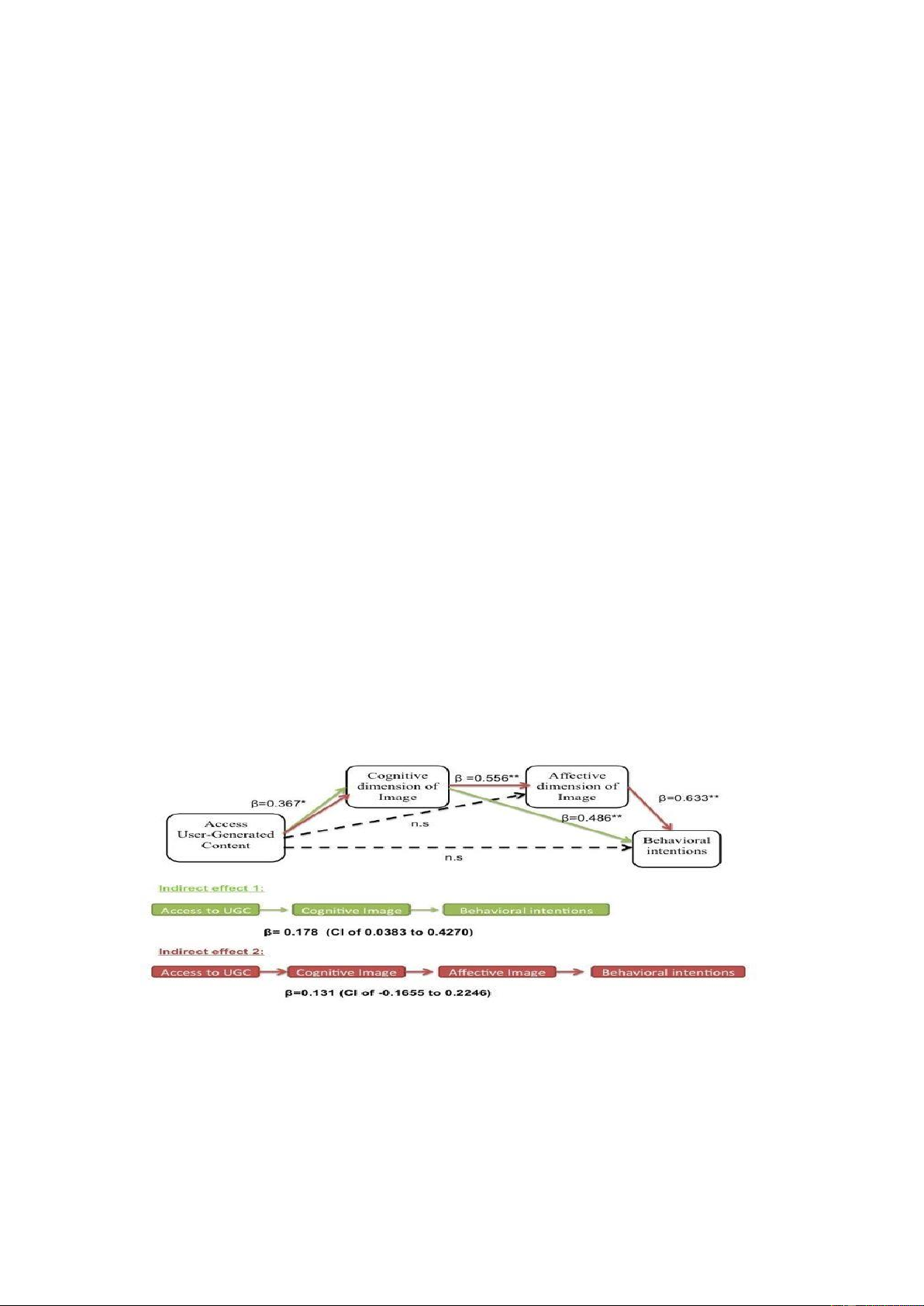
“Figure 2 depicts a renewed version of the previously proposed model. A new
inspection of the data seems to confirm that the new model better explains behavioural
intentions and confirms previous findings in destination image research. As Baloglu and
McCleary (1999), Beerli and Martin (2004) show, the formation of a cognitive image
influences the formation of an affective image (β=0.556), which, in turn, affects what is called
behavioural intentions (β=0.633). The direct influence of access to UGC on behavioural
intentions is not significant in this model. However, the results suggest a direct relationship
between access to UGC and cognitive image, and an indirect relationship between access to
UGC on behavioural intention through the cognitive and affective dimensions of image
destination. Therefore, the cognitive dimension of image is the first variable to be affected by
access to UGC. This result implies that the individual is able to compose a cognitive image
of the destination based on the reviews and opinions he/she has read.”
Figure 2 New version of the conceptual model” 5. Conclusions
The increased use of web 2.0 applications has generated much UGC. The intangible nature of
tourism products impedes evaluation before consumption, while it has long been recognised
that interpersonal communications are an important information source among tourists (Litvin 7900 http://www.webology.org Webology (ISSN: 1735-188X) Volume 19, Number 2, 2022
et al., 2008). With the spread of Internet use, virtual interactions among consumers have
become commonplace, which has led some tourism researchers to point out that online WOM
plays an important role in the acquisition and retention of consumers in an e-commerce era
(Litvin et al., 2008; Vermeulen & Seegers, 2009; Ye et al., 2011). Results of this study extend
previous works on the online context by demonstrating how UGC affects the image of a tourist
destination. This study has observed that rather than considering the web as merely an
information source (Frías et al., 2008; Li et al., 2009), it should be considered a channel
through which to create and promote a positive image of the destination.”
“For potential tourists, UGC is an important information source in forming an image
towards a particular destination. Tourism destinations need to disseminate favourable
experiences to tourists, and these experiences include advice and comments from other
travellers. This study contributes to the literature on tourism by revealing the influence of
access to UGC on behavioural intentions through destination image. The results suggest that
access to UGC have a significant impact on the cognitive dimension of image and finally on
future behaviour of tourists. Moreover, as Gartner (1993), Vogt and Andereck (2003), and
Ryan and Cave (2005) suggest, the cognitive dimension of image has a significant impact on the affective dimension.”
Limitations of the study
There are some limitations in this study. First, we analysed how UGC from the official
destination site influences the image of a tourist destination, but further research should be
conducted to find out what results are produced by other sites or platforms. It would be then
interesting to address other platforms different from the official destination site. For example,
social networks such as Facebook or Twitter may also contribute to image creation and their
impact on behavioural intentions should be addressed in future research.”
“Our results may help both public administrations and tourism marketing managers to
understand the image formation process and to design more efficient marketing strategies for
tourist destination sites. Marketers should provide more functional or cognitive information
to tourists involved in trip preparation, while also providing appropriate services during the
vacation to satisfy these tourists. They will then acquire a good image of the destination and
will therefore visit the destination and spread a positive image by WOM to other potential travellers.” References
Akehurst, G. (2009). User generated content: the use of blogs for tourism organizations and
tourism consumers. Service Business, 3(1), 51-61.
Baloglu, S., & Brinberg, D. (1997). Affective images of tourism destination. Journal of travel research, 35(4), 11-15.
Baloglu, S., & Mangaloglu, M. (2001). Tourism destinations images of Turkey, Egypt, Greece
and Italy: As perceived by us. Based tour operators and travel agents. Tourism Management, 22(1), 1–9. 7901 http://www.webology.org Webology (ISSN: 1735-188X) Volume 19, Number 2, 2022
Baloglu, S., & McCleary, K. (1999a). A model of destination image formation. Annals of
Tourism Research, 26(4), 868-97.
Baloglu, S., & McCleary, K. (1999b). U.S. international pleasure travelers’ image of four
mediterranean destinations: A comparison of visitors and non-visitors. Journal of
Travel Research, 38(2), 144-52.
Baron, R. M., & Kenny, D. A. (1986). The moderator-mediator variable distinction in social
psychological research: Conceptual, strategic, and statistical considerations. Journal
of personality and Social Psychology, 51(6), 1173–1182.
Beerli, A., & Martin, D. J. (2004). Factors influencing destination image. Annals of Tourism Research, 31(3), 657–681.
Bigné, A. E., Sánchez, G. I., & Sanz, B. S. (2009). The functional-psychological continuum
in the cognitive image of a destination: A confirmatory analysis. Tourism Management, 30(5), 715-723.
Blackshaw, P. & Nazzaro, M. (2004). Consumer generated media (CGM) 101: Word-of-
mouth in the age of web fortified consumer. Retrieved July 25, 2008, from
http://www.nielsenbuzzmetrics.com/whitepapers
Buhalis, D., & Law, R. (2008). Progress in information technology and tourism management:
20 years on and 10 years after the Internet-The state of eTourism research. Tourism Management, 29, 609-623.
Cai, L. A. (2002). Cooperative branding for rural destinations. Ann Tourism Res, 29(3), 720– 742.
Carson, D. (2008). The blogosphere as a market research tool for tourism destinations: A case
study of Australia’s northern territory. Journal of Vacation Marketing, 14(2), 111– 119.
Casaló, L.V.; Flavián, C., & Guinalíu, M. (2011). Understanding the intention to follow the
advice obtained in an online travel community. Computers in Human Behavior, 27(2), 622-633.
Chen, C. F., & Tsai, D. (2007). How destination image and evaluative factors affect
behavioral intentions?. Tourism Management, 28, 1115–1122.
Chen, J., & Uysal, M. (2002). Market positioning analysis: A hybrid approach. Annals of
Tourism Research, 29(4), 987-1003.
Chen, P., & Kerstetter, D. (1999). International student’s image of rural Pennsylvania as a
travel destination. Journal of Travel Research, 37, 256-266.
Court, B. C., & Lupton, R. A. (1997). Customer portfolio development: modelling destination
adopters, inactives, and rejecters. Journal of Travel Research, 36(1), 35-43.
Cox, C., Burgess, S., Sellitto, C., & Buutlejens, J. (2009). Consumer generated web based
marketing. Australia: CRC for Sustainable Tourism Pty Ltd.
Crompton, J. L. (1979). An assessment of the image of Mexico as a vacation destination and
the influence of geographical location upon that image. Journal of Travel Research, 17(4), 18–23.
Crompton, J. L., & Ankomah, P.K (1993). Choice Set Propositions in Destination Decisions.
Annals of Tourism Research, 20, 461-476. 7902 http://www.webology.org Webology (ISSN: 1735-188X) Volume 19, Number 2, 2022
Crotts, J. (1999). Consumer Decision Making and Pre-Purchase Information Search. In Y.
Mansfield, & A. Pizam (Ed.), Consumer Behavior in Travel and Tourism (pp. 149– 68). New York: Haworth Press.
Dadgostar, B., & Isostalo, R. M. (1992). Factors affecting time spent by near-home tourists
in city destinations. Journal of Travel Research, 31(2), 34–39.
Dellarocas, C. (2003). The digitization of word of mouth: promise and challenges of online
feedback mechanisms. Management Science, 49(10), 1407-24.
Dichter, E. (1985). What is an image?. Journal of Consumer Research, 13, 455-472.
Echtner, C. M., & Ritchie, J.R.B. (1991). The meaning and measurement of destination image.
The Journal of Tourism Studies, 2(2), 2-12.
Echtner, C. M., & Ritchie, J.R.B. (2003). The meaning and measurement of destination image.
The Journal of Tourism Studies, 14(1), 37–48.
Ekinci, Y., & Hosany, S. (2006). Destination personality: An application of brand personality
to tourism destinations. Journal of Travel Research, 45(2), 127-139.
E MARKETER (2007, June 25). UK Online Travel: Travelers are Sharing Experiences.
eMarketer. Retrieved from http://www.emarketer.com/Article.aspx?id=1005067andsr c=article2_newsltr
Erdem, T., & Swait, J. (1998). Brand equity as a signaling phenomenon. Journal of Consumer Psychology, 7(2), 131-157.
Fakeye, P., & Crompton, J. (1991). Image Differences between Prospective, First-Time, and
Repeat Visitors to the Lower Rio Grande Valley. Journal of Travel Research, 30(2), 10-16.
Frías D. A., Rodríguez, M. A., & Castañeda, J. A. (2008). Internet vs. travel agencies on pre-
visit destination image formation: An information processing view. Tourism Management, 29, 163–179.
Gartner, W. C. (1993). Image Formation Process. Journal of Travel and Tourism Marketing, 2(2/3), 191-215
George, C., & Scerri, J. (2007). Web 2.0 and User-Generated Content: legal challenges in the
new frontier. Journal of Information, Law and Technology, 12(2), 1-22.
Gitelson, R., & Kerstetter, D. (1995). The influence of friends and relatives in travel decision-
making. Journal of Travel & Tourism Marketing, 3(3), 59-68.
Goldenberg, J., Libai, B., & Muller, E. (2001). Talk of the network: A complex systems look
at the underlying process of word-of-mouth. Marketing letters, 12(3), 211-223.
Gretzel, U., & Yoo, K. H. (2008). Use and impact of online travel reviews. In P. O’Connor,
W. Höpken, & U. Gretzel (Eds.), Information and communication technologies in
tourism 2008 (pp. 35–46). New York: Springer Verlag.
Gretzel, U., Yoo, K. H., & Purifoy, M. (2007). Online travel review study: role and impact of
online travel reviews. Texas: A&M University.
Hennig-Thurau, T., Gwinner, K. P., Walsh, G., & Gremler, D. D. (2004). Electronic word-of-
mouth via consumer-opinion platforms: What motives consumers to articulate
themselves on the Internet?. Journal of Interactive Marketing, 18(1), 38–52.
Hyun, M. Y., & O 'keefe, R. M. (2012). Virtual destination image: Testing a telepresence
model. Journal of Business Research, 65(1), 29-35. 7903 http://www.webology.org Webology (ISSN: 1735-188X) Volume 19, Number 2, 2022
Jani, D., & Hwang, Y. (2011). User-generated Destination Image through Weblogs: A
Comparison of Pre- and Post-visit Images. Asia Pacific Journal of Tourism Research, 16(3), 339-356.
Johnson, T., & Kayne, B. (2003). Wag the blog: how reliance on traditional media and the
Internet influence credibility perceptions of weblogs among blog users. Journalism
and Mass Communications Quarterly, 11(3), 622–642.
Kim, H., & Richardson, S. L. (2003). Motion Picture Impacts on Destination Images. Annals
of Tourism Research, 30(1), 216-237.
Kneesel, E., Baloglu, S., & Millar, M. (2010). Gaming Destination Images: Implications for
Branding. Journal of Travel Research, 49(1), 68 – 78.
Kotler, P., Haider, D. H., & Rein, Y. (1993). Marketing places: Attracting investment,
industry and tourism to cities, states and nations. New York: The Free Press.
Lawson, F. & Band-Bovy, M. (1977). Tourism and recreational development. London: Architectural Press.
Leisen, B. (2001). Image segmentation: the case of a tourism destination. Journal of Services Marketing, 15(1), 49 – 66.
Li, X.; Pan, B.; Zhang L. & Smith, W.W. (2009). The Effect of Online Information Search on
Image Development: Insights from a Mixed-Methods Study. Journal of Travel Research, 48(1), 45-57.
Litvin, S.W.; Goldsmith, R.E. & Pan, B. (2008). Electronic word-of-mouth in hospitality and
tourism management. Tourism Management, 29(3), 458–468.
Mackay, K. J. & Fesenmaier, D. (2000). An exploration of cross-cultural destination image
assessment. Journal of Travel Research, 38(4), 417–423.
Mathieu, J. E., Deshon, R. P., & Bergh, D. D. (2008). Mediational inferences in organizational
research: Then, now, and beyond. Organizational Research Methods, 11(2), 203–223.
Mayo, E. J., & Jarvis, L. P. (1981). The Psychology of Leisure Travel. Boston: CBI.
Mendes Filho, L. A. M., Tan, F. B., & Mills, A. (2012). User-generated content and travel
planning: An application of the theory of planned behavior. Revista Brasileira de
Pesquisa em Turismo, 6(3), 280-289.
Mills, J., & Law, R. (2004). Handbook of consumer behavior, tourism and the Internet.
Journal of travel & Tourism Marketing, 17(2/3), 101—117.
Minghetti, V., & Buhalis, D. (2010). Digital divide in tourism. Journal of Travel Research, 49(3), 267-281.
Moreno, M. R., Molina, C. M., & Moreno, R. R. (2013). Satisfacción, lealtad y colectivismo
en destinos culturales: Satisfaction, loyalty and collectivism in cultural destinations.
Tourism & Management Studies, 9(2), 44-49.
Morrison, A. M., Jing, S., O’leary, J. T., & Lipping, A. C. (2001). Predicting usage of the
Internet for travel bookings: An exploratory study. Information Technology and Tourism, 4(1), 15–30.
Oellrich, J., & Bauhuber, F. (2007). Inside of a blog: background and thoughts from the
touristic blog Tourismus-zukunft.de. Blogs in tourism conference, Kitzbühel, Vol. 12.
Ong, B. S., & Horbunluekit S. (1997). The Impact of a Thai Cultural Show on Thailand’s
Destination Image. American Business Review, 15(2), 97-103. 7904 http://www.webology.org Webology (ISSN: 1735-188X) Volume 19, Number 2, 2022
Pan, B., Maclaurin, T., & Crotts, J. C. (2007). Travel blogs and its implications for destination
marketing. Journal of Travel Research, 46, 35–45.
Park, D. H., Lee, J., & Han, I. (2007). The Effect of On-Line Consumer Reviews on Consumer
Purchasing Intention: The Moderating Role of Involvement. International Journal of
Electronic Commerce, 11(4), 125–148.
Pike, S., & Ryan, C. (2004). Destination positioning analysis through a comparison of
cognitive, affective, and cognitive perceptions. Journal of Travel Research, 42(4), 333–342.
Preacher, K. J., & Hayes, A. F. (2004). SPSS and SAS Procedures for Estimating Indirect
Effects in Simple Mediation Models. Behavior Research Methods, Instruments, and Computers, 36(4), 717–731.
Preacher, K. J. & Hayes, A. F. (2008). Asymptotic and resampling strategies for assessing
and comparing indirect effects in multiple mediator models. Behavior research methods, 40(3), 879-891.
Rabanser, U., & Ricci, F. (2005). Recommendation systems: Do they have a viable business
model in e-Tourism. In A. Frew (Ed.), Information and communication technologies
in tourism 2005. ENTER 2005 proceedings (pp. 160–171). New York: Springer Wien.
Rezabakhsh, B., Bornemann, D., Hansen, U., & Schrader, U. (2006). Consumer power: a
comparison of the old economy and the Internet economy. Journal of Consumer Policy, 29(3), 3-36.
Richardson, S. L., & Crompton, J. L. (1988). Cultural variations in perceptions of vacation
attributes. Tourism Management, 9(2), 128–136.
Russel, J. A. (1980). A Circumplex Model of Affect. Journal of Personality and Social Psychology, 39, 1161-1178.
Ryan, C., & Cave, J. (2005). Structuring destination image: A qualitative approach. Journal
of Travel Research, 44, 143–150.
San Martín, H., & Rodríguez del Bosque, I. A. (2008). Exploring the cognitive–affective
nature of destination image and the role of psychological factors in its formation.
Tourism Management, 29(2), 263-277.
Sarks, G. (2007). Consumer generated content in travel: a roadmap for bringing consumers
into the conversation. Web-seminar presentation, 16 April, Compete, Inc.
Schmallegger, D., & Carson, D. (2008). Blogs in tourism: Changing approaches to
information exchange. Journal of Vacation Marketing, 14(2), 99–110.
Senecal, S., & Nantel, A. (2004). The influence of online product recommendations on
consumers’ online choices. Journal of Retailing, 80, 159-169.
Stern, E, & Krakover, S. (1993). The formation of a composite urban image. Geographical Analysis, 25(2), 130-146.
Sussmann, S., & Unel, A. (1999). Destination image and its modification after travel: An
empirical study on Turkey. In A. Pizam, & Y. Mansfield (Eds.), Consumer behavior
in travel and tourism. New York: Haworth Hospitality.
Tasci, A. D. A., & Gartner, W. C. (2007). Destination image and its functional relationship.
Journal of Travel Research, 45(4), 413–425 7905 http://www.webology.org Webology (ISSN: 1735-188X) Volume 19, Number 2, 2022
Tasci, A. D. A., Gartner, W. C., & Cavusgil, S. T. (2007). Conceptualization and
operationalization of destination image. Journal of Hospitality and Tourism Research, 31(2), 194–223.
Tripadvisor. (2012). TripAdvisor unveils 2011 travelers’ choice destinations awards.
Retrieved May, 05, 2012, from http://www.tripadvisor.com/PressCenter-i4665-c1- Press_Releases.html
UNWTO World tourism organization. (2012). Statistical Annex. UNWTO World Tourism
Barometer, Vol.12. Madrid: UNWTO.
Uysal, M., Chen, J. S., & Williams, D. R. (2000). Increasing state market share through a
regional positioning. Tourism Management, 21(1), 89-96.
Vermeulen, I. E., & Seegers, D. (2009). Tried and tested: The impact of online hotel reviews
on consumer consideration. Tourism Management, 30(1), 123-127.
Vogt, C. A., & Andereck, K. L. (2003). Destination perceptions across a vacation. Journal of
Travel Research, 41, 348–354.
Walmsley, D., & Young, M. (1998). Evaluative images and tourism: The use of personal
constructs to describe the structure of destination Images. Journal of Travel Research, 36, 65–69.
Wang, C. Y., & Hsu, M. K. (2010). The relationships of destination image, satisfaction, and
behavioral intentions: An integrated model. Journal of Travel & Tourism Marketing, 27(8), 829-843.
Wenger, A. (2008). Analysis of travel bloggers’ characteristics and their communication
about Austria as a tourism destination. Journal of Vacation Marketing, 14(2), 169– 176.
Woodside, A. G., & Lysonski, S. (1989). A General Model of Traveler Destination Choice.
Journal of Travel Research, 27(4), 8-14.
Ye, Q., Law, R., Gu, B., & Chen, W. (2011). The influence of user-generated content on
traveler behavior: An empirical investigation on the effects of e-word-of-mouth to
hotel online bookings. Computers in Human Behaviour, 27, 634–639.
Ye, Q., Zhang, Z., & Law, R. (2009). Sentiments classification of online reviews to travel
destinations by supervised machine learning approaches. Expert System with
Applications, 36(6), 527–535.
Yilmaz, Y., Yilmaz, Y., Icigen, E.T., Ekin, Y. & Utku, D. B. (2009). Destination image: A
comparative study on pre and post trip image variations. Journal of Hospitality
Marketing and Management, 18(5), 461–479.
Zhao, X., Lynch, J. G., & Chen, Q. (2010). Reconsidering Baron and Kenny: Myths and truths about 7906 http://www.webology.org View publication stats