2_English_Vocabulary_In_Use_Pre-Intermediate_Cambridge_-_Fourth_Edition











Preview text:
University Printing House, Cambridge cb2 8bs, United Kingdom
One Liberty Plaza, 20th Floor, New York, NY 10006, USA
477 Williamstown Road, Port Melbourne, VIC 3207, Australia
4843/24, 2nd Floor, Ansari Road, Daryaganj, Delhi –110002, India
79 Anson Road, #06–04/06, Singapore 079906
Cambridge University Press is part of the University of Cambridge.
It furthers the University’s mission by disseminating knowledge in the pursuit of
education, learning and research at the highest international levels of excellence. www.cambridge.org
Information on this title: www.cambridge.org/elt
© Cambridge University Press 2017
This publication is in copyright. Subject to statutory exception
and to the provisions of relevant collective licensing agreements,
no reproduction of any part may take place without the written
permission of Cambridge University Press. First published 1997 Fourth edition
A catalogue record for this publication is available from the British Library
ISBN 978-131662831-7 Edition with answers and ebook
ISBN 978-131663171-3 Edition with answers ISBN 978-131663172-0 ebook
Cambridge University Press has no responsibility for the persistence or accuracy
of URLs for external or third-party internet websites referred to in this publication,
and does not guarantee that any content on such websites is, or will remain,
accurate or appropriate. Information regarding prices, travel timetables, and other
factual information given in this work is correct at the time of first printing but
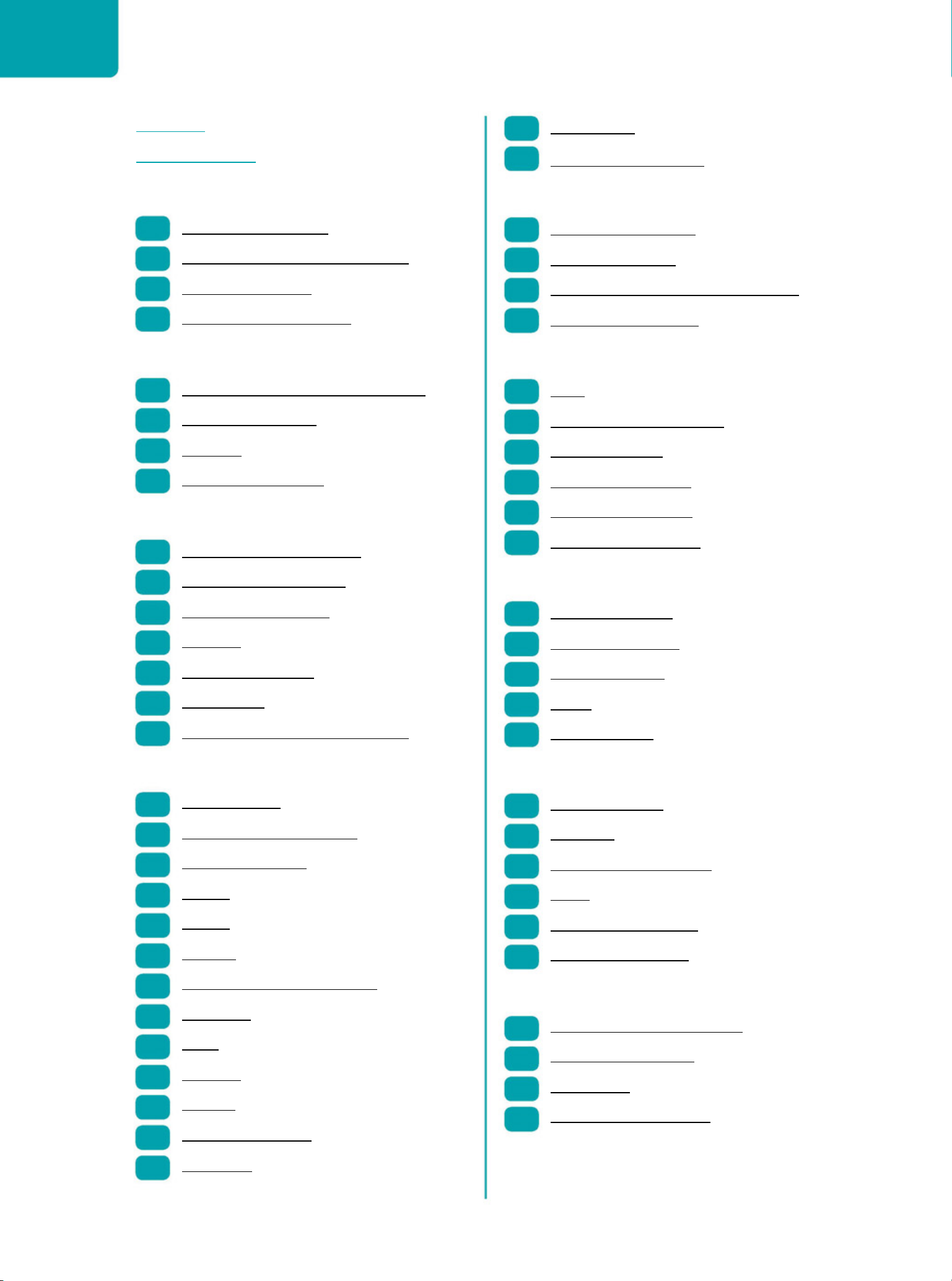
Cambridge University Press does not guarantee the accuracy of such information thereafter. Contents Thanks 29 On the road Introduction 30 Notices and warnings Learning Education and study 1 Learning vocabulary 31 Classroom language
2 Keeping a vocabulary notebook 32 School education 3 Using a dictionary
33 Studying English and taking exams
4 English language words 34 University education The world around us Work and business
5 Country, nationality and language 35 Jobs 6 The physical world
36 Talking about your work 7 Weather 37 Making a career 8 Animals and insects 38 Working in an office People 39 Running a company 9 The body and movement 40 Business and finance
10 Describing appearance
Leisure and entertainment 11 Describing character 41 Sport and leisure 12 Feelings 42 Competitive sport 13 Family and friends 43 Books and films 14 Growing up 44 Music
15 Romance, marriage and divorce 45 Special events Daily life Tourism 16 Daily routines 46 Travel bookings
17 The place where you live 47 Air travel 18 Around the home
48 Hotels and restaurants 19 Money 49 Cafés 20 Health 50 Sightseeing holidays 21 Clothes 51 Holidays by the sea
22 Fashion and buying clothes
Communication and technology 23 Shopping
52 Newspapers and television 24 Food 53 Phoning and texting 25 Cooking 54 Computers 26 City life
55 Email and the Internet 27 Life in the country 28 Transport
English Vocabulary in Use Pre-intermediate and Intermediate 3 Social issues Key verbs 56 Crime
81 Make, do and take: 57 Politics uses and phrases 58 Climate change
82 Key verbs: give, keep and miss 59 War and violence
83 Get: uses, phrases and phrasal verbs Concepts
84 Go: meanings and expressions 60 Time 85 The senses 61 Numbers Words and grammar
62 Distance, dimensions and size 86 Uncountable nouns
63 Objects, materials, shapes and colour 87 Verb constructions 1
64 Containers and quantities 88 Verb constructions 2 89 Adjectives Functional language
90 Prepositions: place and movement
65 Apologies, excuses and thanks 91 Adverbs 66 Requests, permission and suggestions Connecting and linking 67 Opinions, agreeing 92 Time and sequence and disagreeing
93 Addition and contrast
68 Likes, dislikes, attitudes
94 Reason, purpose, result, condition and preferences
69 Greetings, farewells and special Style and register expressions
95 Formal and informal English Word formation
96 Completing forms and CVs
70 Prefixes: changing meaning 97 Writing an essay
71 Suffixes: forming nouns
98 Formal letters and emails
72 Suffixes: forming adjectives
99 Informal emails and messages 73 Compound nouns 100 Abbreviations Phrase building Answer key 74 Word partners Phonemic symbols 75 Fixed phrases
76 Fixed phrases in conversation Index
77 Verb or adjective + preposition Acknowledgements
78 Prepositional phrases How to use the ebook ██████████
79 Phrasal verbs 1: form and meaning
80 Phrasal verbs 2: grammar and style 4
English Vocabulary in Use Pre-intermediate and Intermediate Thanks
Sabina Ostrowska wrote two new units for the Fourth Edition: Unit 46, Travel Bookings and
Unit 49, Cafés. The publishers would like to thank Sabina for her contribution to this edition.
English Vocabulary in Use Pre-intermediate and Intermediate 5 Introduction To the student
This book will help you learn more than 2,000 words and phrases, and you can use it
without a teacher. There are 100 units in the book. You can study them in any order, but
the first four units have information about vocabulary that will help you with your learning.
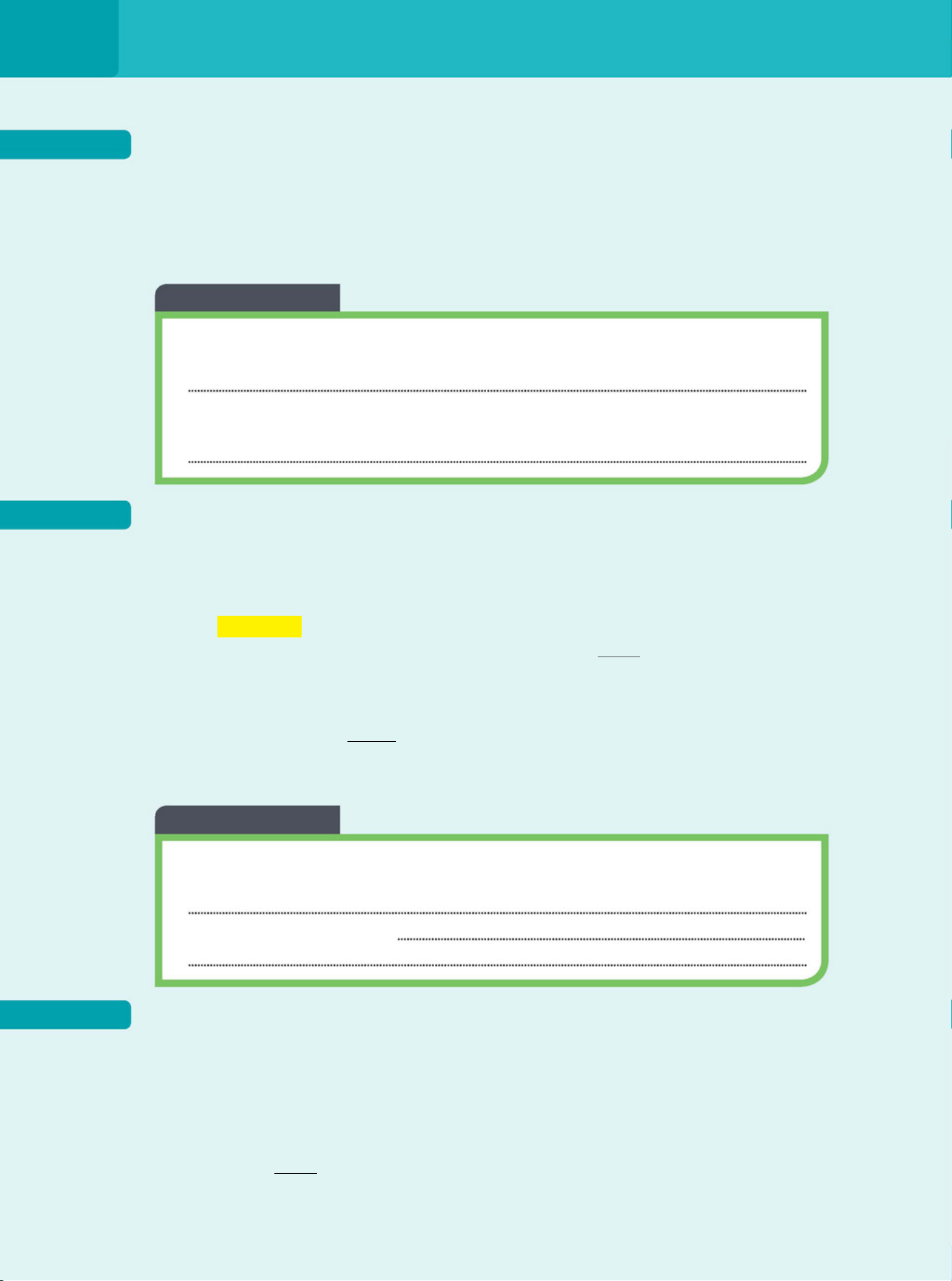
Here is what the pages look like: The left-hand page presents Pictures and the new vocabulary. diagrams show the meaning of some words.
New vocabulary is in bold. Example sentences help you to understand new words. The right-hand There is space for you page practises the to write your answers. new vocabulary. There is an example in each exercise to help you. Over to you is a chance for you to use the new words to write about yourself, your life and your country.
After you do the exercises, you can check your answers in the Answer key at the back of the
book. You will also find possible answers for most of the Over to you exercises.
The Index at the back of the book has all the new words and phrases from the units, with
a phonemic transcription to help you with pronunciation. If you have the edition with the
ebook, you can listen to the pronunciation of all the new vocabulary, and there are more
practice exercises as well. see p262 for more information about the ebook.
It is a good idea to have a dictionary when you use the book. sometimes you may want a
bilingual dictionary, so you can find a translation; sometimes the book asks you to use an
English dictionary for an exercise. You also need a notebook when you are studying. The study
units 1–4 in this book will give you ideas and information to help you to use your notebook
and become a better learner. I hope you enjoy using this book. 6
English Vocabulary in Use Pre-intermediate and Intermediate To the teacher
This book can be used in class or for self-study. It is intended for learners at the upper A2 level
and B1 level on the Council of Europe scale, and teaches more than 2,000 words and phrases.
The vocabulary is organised around common everyday topics, but also contains units on
different aspects of language such as phrasal verbs, uncountable nouns and link words and
phrases. These units provide key information about lexis, but also help to ensure that learners
are exposed to the most important vocabulary for their level. The first four units are dedicated
to aspects of vocabulary learning such as record keeping and dictionary use. The book has
been written so that units can be studied in any order, but I recommend you look at these four
study units first, as they provide learners with important advice about vocabulary learning in general.
Throughout the book, vocabulary items have been chosen for their usefulness in a wide
range of everyday situations, and this task has been made easier by having access to the
English Profile (EP). Forming part of a large research programme sponsored by the Council of
Europe, the EP helps teachers and students identify the words or phrases that a learner can be
expected to know at each level of the Common European Framework. The words and phrases
have mainly been selected using the Cambridge Learner Corpus, examination wordlists and
classroom materials, and in this book the main focus is on words and phrases at the upper
end of the A2 level and across the B1 level.
Much of the new vocabulary (on average about 25 items per unit) is presented through
different types of text, and then explained immediately after the item appears, or in a separate
glossary below the text; some words are presented in tables or lists, and contextualised in
sentence examples; some of the new vocabulary is presented in pictures and diagrams.
The new vocabulary is then practised on the right-hand pages through a wide range of
exercise types. These pages generally progress from easier to more difficult exercises, with
items often tested receptively first, e.g. through a matching or grouping exercise, before
moving on to more challenging productive exercises such as gap-fill texts or sentence
transformations. In many units, the final exercise is called Over to you. This indicates
a personalised exercise, in which learners have an opportunity to use some of the new
vocabulary to talk about themselves, their lives and their country, and sometimes to express
their own personal opinions. These make ideal classroom speaking activities for pairs or
groups, but many of the exercises on the right-hand page can be adapted for speaking
practice. For example, where there are short question and answer dialogues, students can first
read the dialogues out loud, then one student can ask the questions, and their partner has
to respond appropriately using target vocabulary from the unit, but without referring to the book.
There is a comprehensive Answer key at the back of the book, as well as an Index of all the
vocabulary taught with a phonemic pronunciation guide and a unit reference to where each item appears.
Find more resources for teachers at www.cambridge.org/elt/inuse
We hope you enjoy using this new edition.
English Vocabulary in Use Pre-intermediate and Intermediate 7 Study unit 1 Learning vocabulary A Using this book
It’s a good idea to have a routine when you use this book. [something you do often and usually in the same way] For example:
• a weekly routine when you study a new unit for at least [not less than] 30–45 minutes;
• a daily routine when you revise that unit. [study it again] You may only need to revise for five or ten minutes each time. 1.1 Over to you Write your answers.
1 How often can you spend at least half an hour or forty- five minutes on a unit?
2 How often can you revise? How much time can you spend when you revise? Where will you do it? B Studying a new unit
When you are studying a unit for the first time, you need to be active when you are learning.
• With a new word or phrase, say it aloud [speak it so you can hear it], and repeat it to yourself
silently [in your head, not speaking]. If you have the eBook that goes with the book, use it to check the pronunciation.
• Use a highlighter pen to mark words you think are important or difficult.
• Write down new words and phrases in your notebook. (See Unit 2 for more information.)
• Always try to write an example sentence for new words. You can choose an example
from this book or a dictionary, but an example from your own life will often help you to
remember a word, e.g. I shared a flat with an Australian girl when I was in London last year.
• Do exercises in pencil, then you can rub them out (using a rubber) and do them again later.
This is a good way to revise vocabulary. 1.2 Over to you Write your answers.
1 Which of these things do you do now when you are learning vocabulary?
2 What will you do in the future? C Revising a unit
When you are revising a unit one or two days later, it is also important to be as active as possible.
• Test yourself, e.g. look at a word and cover the meaning. Can you remember what the
meaning is? If you can’t, check the meaning, then come back to the word in five minutes’ time and test yourself again.
• Look at what you wrote in your notebook when you first studied the unit. Is there any new
information you want to add, e.g. something about the pronunciation, or a common word partner? (See Unit 2.)
• Diagrams may help you to organise some of the vocabulary differently, and help you to remember it. 8
English Vocabulary in Use Pre-intermediate and intermediate 1Studyunit Who took Let’s take a 1.3 Over to you my pen? break now. Write your answers. take
1 Do you revise vocabulary that you study? If so, how often? I took notes What size shoes during the lecture. do you take?
2 Will you try to revise more often in the future?
If so, will you use some of the ideas above? D Expanding* your vocabulary
• When you learn a word, e.g. dirty, think of synonyms (syn) [words with a similar meaning] or
opposites (opp) in your language. Look them up in a bilingual dictionary to find the English
words, then look up the English words in an English dictionary to check the meaning. From
this, you will find that the opposite of dirty is clean, and you may also find filthy [very dirty]. * making something bigger
1.4 Using this method, find opposites for the words in bold.
1 My room is very clean. opp dirty
2 It’s a permanent job. opp
3 He was kind to all of his animals. opp
4 Babies have very soft, smooth skin. opp
5 Where’s the entrance? opp
6 Was the bird dead? opp
7 Did they accept the invitation? opp
• Building word families (see Units 70–72) will also help to expand your vocabulary. From a
noun, verb or adjective, you can often find related words in the dictionary with a similar
meaning. So, you can often learn two or three words, and not just one, e.g. argue v = have
an angry discussion; n = argument.
1.5 Use a dictionary to find the related parts of speech for the words in bold.
1 She gave me some advice. verb advise
2 We mustn’t argue. noun
3 I will have to revise this unit. noun
4 Is there a choice? verb
5 I want to expand my vocabulary. noun
6 The two boys are very different. noun verb
7 They need to communicate more. noun adj
• Try to read and listen to English as much as possible. The more you read and listen, the
more you will learn. When you read, try to:
– Highlight or underline interesting new words.
– Highlight words if they are familiar but you can’t remember the meaning.
• There is a lot of spoken English on the Internet which you can play again and again.
Try to make a note of interesting words and look up the meaning. 1.6 Over to you
Now choose a unit that interests you. Study the left-hand page, then do the exercises in
pencil. Wait for at least 24 hours, revise the unit, then answer these questions.
1 How many answers did you get right the first time?
2 How many answers did you get right the second time?
English Vocabulary in Use Pre-intermediate and intermediate 9 Study unit 2
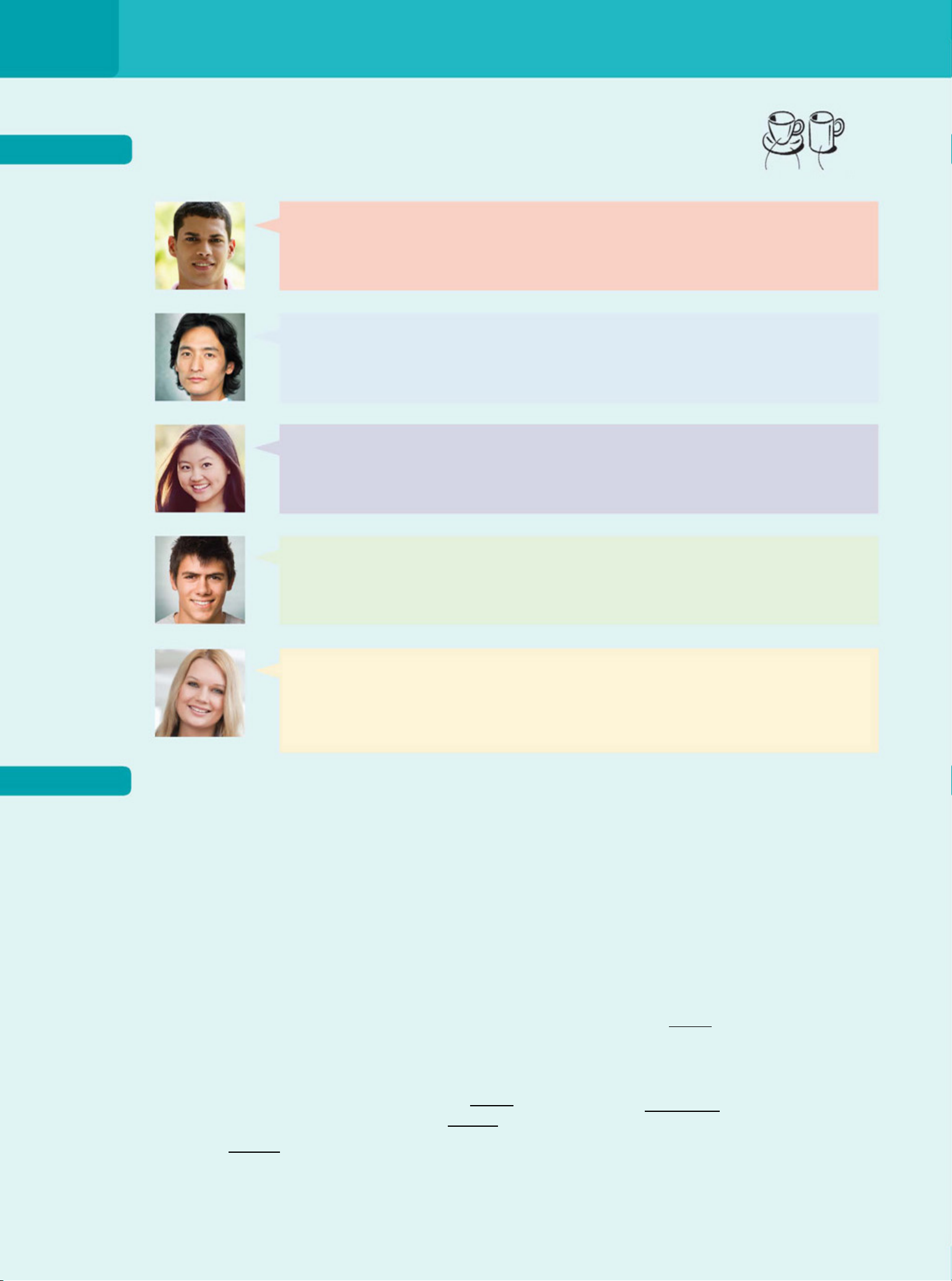
Keeping a vocabulary notebook A What do you do? This is what some students do. cup saucer mug
RAFAEL I write down new English words and phrases in my notebook, and
next to each one I write a Spanish translation. I usually write down if
a word is a noun, verb, adjective, and so on. KAZUO
I sometimes write a word in phonemics because English pronunciation
is very difficult for me. But my notebook is a mess [nothing is in a good
order; syn untidy]. I like to draw pictures. EUN
I sometimes make a note of new words in my notebook, but I often
forget [don’t remember]. I usually write a translation, and sometimes I
write example sentences as well.
ANDREY I’ve got a notebook. I don’t use it much but when I do, I try and list words
by topic, so I put all the animals together, and all the clothes words
together, and so on. I find it’s easier to remember the words this way.
DONATA I note down new words and phrases. Sometimes I translate them
into Polish, and sometimes I write an explanation [a description of what
something means] in English if it is not difficult. For example: kitten – a very young cat B Tips for your notebook
A tip is a piece of advice to help you. Here are some tips for your notebook.
• Put words from one topic in the same place, e.g. food in one place, clothes in another, etc. Don’t
mix them up [put them together with no order]. You can also have grammar topics, e.g. ‘uncountable
nouns’, or a page for words that all have a connection, e.g. words and phrases that were all in a
story you read in English. Some words and phrases will go in more than one topic.
• If you can’t find a topic for a new word or phrase, e.g. useful or in particular, put them in a different place
in your notebook, e.g. a page for each day or each week, or perhaps one page for every English lesson
you have. Write the date clearly at the top, e.g. Monday 14th May.
• When you write down new vocabulary, write a translation if it is necessary [you need it; opp
unnecessary], but also write the meaning in English if it is possible, or draw pictures.
• If possible, add synonyms, opposites, other parts of speech, etc. (See Unit 1.)
awful adj = terrible (syn dreadful)
enjoy v = like something and get pleasure from it n = enjoyment adj = enjoyable
• Example sentences help you with the grammar of a word, or with word partners (collocations).
I enjoy living in a big city. (NOT I enjoy to live in a big city.) (See Units 87–8.)
I spent two weeks in Rome. (NOT I passed two weeks in Rome. You spend time in a place.) (See Unit 74.)
• Remember, words often have more than one meaning that you need to know, e.g. a tip is also
money that you give, for example, to a waiter for serving you in a restaurant. 10
English Vocabulary in Use Pre-intermediate and intermediate Exercises 2Study unit
2.1 Organise the words into the topics below. One word can go in two different topics.
Use a dictionary to help you. diet branch lay the table count v dig v ground flour add up raw leaf minus butcher thousand frozen zero butterfly food garden numbers diet
2.2 Explain these words in English, or draw a picture, or if you think an explanation is too
difficult and a drawing is not possible, write a translation instead. 1 raw not cooked 2 dig 3 butcher 4 leaf 5 flour 6 lay the table 7 add up 8 minus
2.3 What information could you include with these words? The answers are all on the opposite page.
1 forget opposite – remember 2 awful 3 necessary 4 translate 5 tip 6 enjoy 2.4 Over to you
Answer the questions. If possible, compare your answers with someone else.
1 Look again at what the students said on the opposite page. What are the good things that they do? Underline them.
2 Do you do all of these things?
3 Is there anything you don’t do now, but will do in the future?
4 At the moment, which person’s notebook is most like your notebook?
5 What are the most useful tips on the opposite page for you?
English Vocabulary in Use Pre-intermediate and intermediate 11 Study unit 3 Using a dictionary A
What dictionaries do I need?
A bilingual dictionary [using two languages] is easy for you to understand, and quick and
easy to use. A dictionary in English will give you reading practice in English and many more
examples of how words are used. If possible, use both. These are good dictionaries in English
for your level, and most of them are available online:
Cambridge Learner’s Dictionary
Oxford Wordpower Dictionary
Longman Active Study Dictionary
Macmillan Essential Dictionary B
Information in dictionaries
If you look up a word [find a word in a dictionary] using the Cambridge Learner’s Dictionary, the
information is shown like this: pronunciation part of speech using (= noun) phonemic symbols (see fun1 /fʌn/ noun [u] [U] tells you that fun page 247) is uncountable (see
1 enjoyment or pleasure, or something 2 for fun/for the fun of it Unit 86) a definition
that gives you enjoyment or pleasure
for pleasure and not for any other reason fixed phrases using explains the
She’s great fun to be with. 3 make fun of sb/sth the word are shown meaning
Have fun! (= enjoy yourself)
to make a joke about someone or in bold (see Units bold italics
It’s no fun having to work late every something in an unkind way. 75–6) show common night.
The other children at school used to examples are in word partners make fun of his hair. italics (see Unit 74)
3.1 Correct the spelling mistakes. Use a dictionary to check your answers. 1 allways always 6 confortable 2 realy 7 accomodation 3 unfortunatly 8 beautifull 4 expecially 9 unbeleivable 5 cloths 10 neccesary
3.2 In the word island /ˈaɪlənd/, the letter ‘s’ is silent (not pronounced). Use your dictionary to
find the silent letters in these words. 1 knee 2 comb 3 castle 4 salmon 5 receipt C Defining words
‘Defining words’ are words that dictionaries use when they define [explain] the words in the
dictionary. Some of these are quite common.
emphasise [give something more attention and importance], e.g. My teacher has always
emphasised the importance of writing down new words in a notebook.
relating to or connected to/with [having a relationship with someone or something],
e.g. musical is connected with / related to music
amount [how much there is of something], e.g. £5 million is a large amount of money.
official [done by the government or someone in authority], e.g. A passport is an official document.
behave [do or say things in a particular way], e.g. People can behave strangely when they’re nervous. 12
English Vocabulary in Use Pre-intermediate and intermediate Exercises 3Study unit
3.3 Complete the dictionary definitions using words from the box.
connected with emphasise relating to behave official amount
1 industrial / ɪnˈdʌstriəl/ 1 adjective connected with industry
2 sum /sʌm/ noun [C] an of money
3 pretend /prɪˈtend/ verb [I,T] to
as if something is true when it is not
4 certificate /səˈtɪfɪkət/ noun [C] an
document that gives details to show something is true
5 not at all /nɒt ət ɔːl/ used instead of ‘no’ or ‘not’ to what you are saying:
I’m not at all happy about it
6 legal /ˈliːgəl/ adjective the law D Using a dictionary
• When you use a dictionary to check the meaning of a word, put a tick (✓) next to it. Each
time you return to a page with a tick, see [find out] if you remember the word.
• When you meet a new word or phrase in a text, first try to guess the meaning [try to think of
the meaning when you don’t know it]. Then, use a dictionary to see if your guess was correct.
• Don’t just read the dictionary definition. Example phrases and sentences show you how a
word or phrase is used, and they help you to understand the meaning more clearly.
• If you look up a word in a bilingual dictionary and get two or three different translations,
check these words in an English dictionary to see which translation is the best one for the situation.
• Remember that many words have more than one meaning. The first meaning in the
dictionary is not always the one you want. You may need to read through the different meanings.
3.4 Answer the questions, and use an English dictionary to check the answers. 1 What does puppy mean? It’s a very young dog.
2 Is the correct spelling organize or organise?
3 What part of speech is extremely?
4 What kind of noun is advice?
5 What preposition follows the verb rely?
6 Look up friend, and then the words in bold that are often used with it. Can you complete these phrases? She’s an friend; he’s my friend; you friends with people.
3.5 Match the sentences on the right with the different meanings of post on the left. post1 /pəʊst/ noun 1 He’s applied for a post overseas.
1 System [no plural] UK (US mail) 3 Job [c] formal 2 Did you send the
the system for sending letters, a job cheque by post? parcels, etc A part-time post. 3 I tied the flag
Your letter is in the post. A teaching post. to a post.
I’m sending the documents by post. 4 We haven’t 4 Pole [c] had any post yet.
2 Letters [u] UK (US mail)
a long, vertical piece of wood or
letters, parcels, etc that you send metal fixed into the ground at or receive one end.
Has the post arrived/come yet?
I found the dog tied to a post.
English Vocabulary in Use Pre-intermediate and intermediate 13 Study unit 4 English language words A Parts of speech
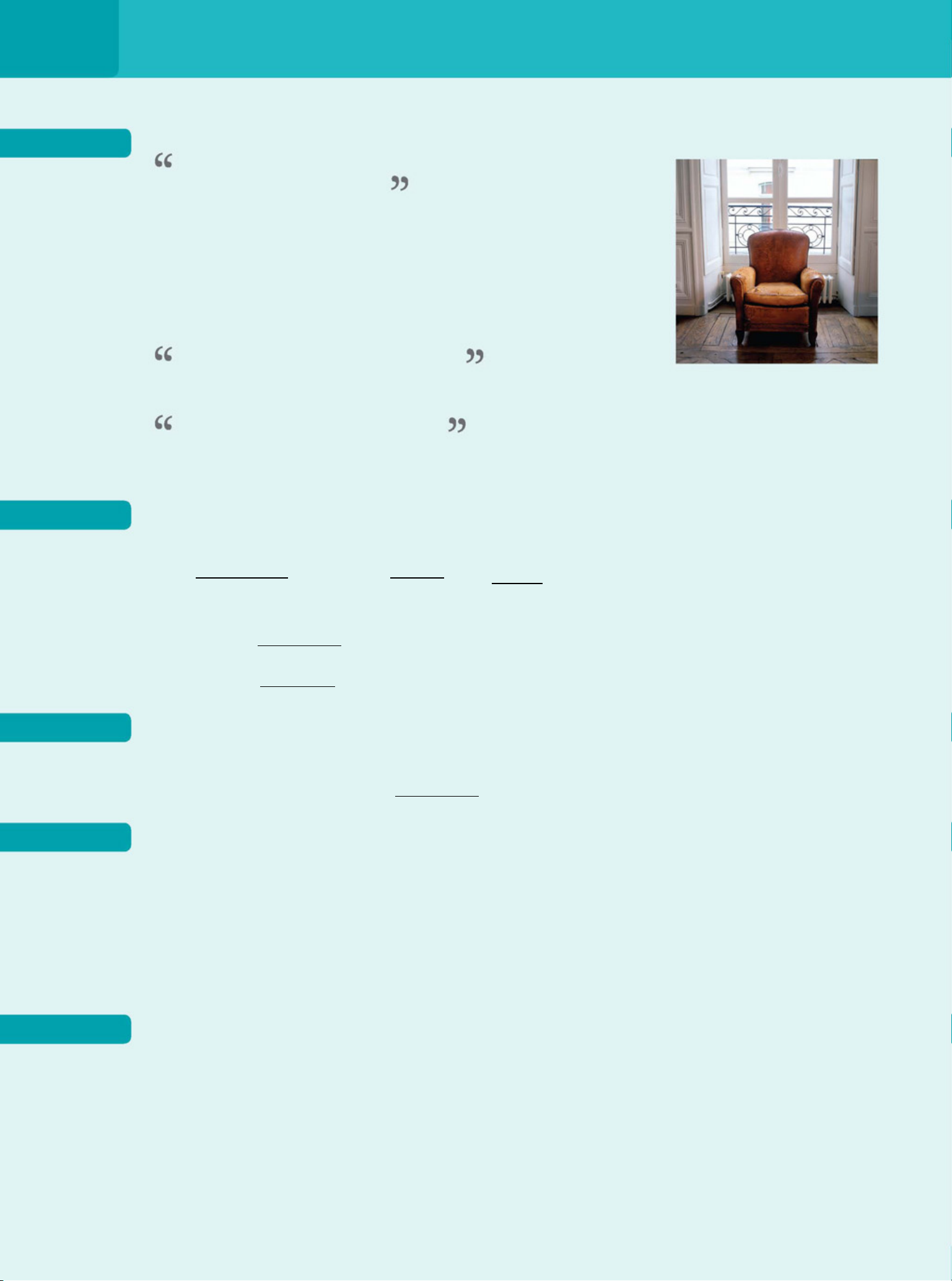
I have a brown leather chair by the window, and I often sit there
in the morning to listen to music.
In the sentence above, I is a pronoun; chair, window, morning
and music are all nouns; have, sit and listen are verbs; brown
and leather are adjectives; often is an adverb; by and to are
prepositions; the is a definite article; a is an indefinite article;
and is a conjunction or link word. Here are two more examples:
We saw an elephant at the zoo yesterday.
Elephant and zoo are nouns; saw is a verb; at is a preposition;
an is an indefinite article; the is a definite article.
It was a cold night, so I walked quickly.
Was and walked are verbs; cold is an adjective; night is a noun; quickly is an adverb; so is a link word. B Grammar
When you are learning vocabulary, you need to know certain things about different words; for
example, if nouns are countable, e.g. books, apples, chairs; or uncountable, e.g. information
(NOT informations), advice (NOT advices). (See Unit 86.)
With verbs, you need to know if they are regular, e.g. work, live, etc; or irregular, e.g. go/went,
take/took. You will also need to learn the grammar of phrasal verbs, e.g. take something off,
wake up. (See Units 79–80.)
You also need to learn certain groups of words as phrases, e.g. at the moment, never mind, see
you later. (See Units 75–6.) C Word building
In the word uncomfortable, un- is a prefix, and -able is a suffix. Other common prefixes
include in- and dis-, e.g. incorrect and dislike. Common suffixes include -ment and -ive, e.g.
improvement and attractive. (See Units 70–72.) D Pronunciation
Dictionaries show the pronunciation of a word using phonemic symbols, e.g. book /bʊk/, before
/bɪˈfɔː/, cinema /ˈsɪnəmə/.
Every word has one or more syllables, e.g. book has one syllable, before has two syllables,
cinema has three syllables.
It is important to know which syllable to stress, e.g. on before it is the second syllable
(be'fore), on cinema it is the first syllable ('cinema). The vertical mark ' shows where the stressed syllable begins. E Punctuation
Every sentence must begin with a capital letter and end with a full stop. Some sentences
have a comma, which often shows a pause [when you stop reading or speaking for a short time] in
a long sentence. Did you also know that a question must end with a question mark? 14
English Vocabulary in Use Pre-intermediate and intermediate Exercises 4Study unit
4.1 Put the words into the correct columns. noun comma phonemic symbol adverb stress question mark syllable preposition full stop adjective parts of speech punctuation pronunciation noun
4.2 There is one word missing in each line of the text. Where does the missing word go?
What could it be? What part of speech is it?
Last year I went to for my holiday. I spent the first 1 Spain (noun)
week Seville staying with a couple of friends, and 2
then I a train to Barcelona, where I spent another 3
ten days. It is beautiful city and I had a marvellous 4
time. I stayed in a very hotel right in the centre, but 5
I didn’t mind spending a lot money because it was a 6
wonderful and it was very convenient. My brother was 7
the person who recommended it; he goes Spain a lot 8
and he stays anywhere else. I may go back next year 9 if have enough time. 10
4.3 Answer the questions.
1 What type of verb is break? an irregular verb
2 What does a sentence begin with?
3 What do you put at the end of every sentence? 4 What’s missing here.
5 What shows you there is a pause in the middle of a long sentence?
6 What type of noun is butter?
7 What type of verbs are pick somebody up and grow up?
8 What are full stop and comma examples of?
9 How do dictionaries show the pronunciation of a word?
10 Is the ‘a’ in phrase pronounced the same as can, can’t or late?
4.4 Mark the stress on each word. How many syllables are there? ' English 2 informal opposite syllable decide adjective education pronunciation
4.5 Look at these words and answer the questions. cheap dangerous kind lucky
1 What part of speech are these words? adjectives
2 Can you change the first two words into adverbs?
3 Is the pronunciation of kind like wind (noun) or find (verb)?
4 What prefix do you need to form the opposite of the last two words?
5 What suffix makes a noun from kind?
English Vocabulary in Use Pre-intermediate and intermediate 15
5 Country, nationality and language A Who speaks what where? country nationality language Australia Australian English Brazil Brazilian Portuguese China Chinese Mandarin (and Cantonese) Egypt Egyptian Arabic France French French Germany German German Greece Greek Greek Israel Israeli Hebrew Italy Italian Italian Japan Japanese Japanese (South) Korea Korean Korean Poland Polish Polish Russia Russian Russian Saudi Arabia Saudi Arabian Arabic Spain Spanish Spanish Switzerland Swiss Swiss-German, French, Italian Thailand Thai Thai Turkey Turkish Turkish the UK (United Kingdom)* British English
the USA (United States of America) American English
*the UK (England, Scotland, Wales and Northern Ireland)
I come from Argentina, so I’m Argentinian and my first language is Spanish. The capital is
Buenos Aires, which has a population of more than 10 million people. Common mistakes
He’s English. (NOT He’s english.); We ate French food. (NOT We ate France food.)
I went to the USA. (NOT I went to USA.) I also visited the UK. (NOT I also visited UK.) B Parts of the world
The continents in the world are Europe, Africa, Asia, North America, South America,
Australia [Australia and New Zealand] and Antarctica.
We also use these terms for different parts of the world:
the Middle East (e.g. United Arab Emirates, Saudi Arabia), the Far East (e.g. Thailand, Japan), the
Caribbean (e.g. Jamaica, Barbados), Scandinavia (Sweden, Norway, Denmark, Finland). C The people
When we are talking about people from a particular country, we add ‘s’ to nationalities ending
in ‘-i’ or ‘-(i)an’, but we need the definite article (the) for most others. Brazilians/Russians are … The British / The French are … Thais/Israelis The Swiss / The Japanese
With both groups we can also use the word ‘people’, e.g. Brazilian people, British people, etc. 16
English Vocabulary in Use Pre-intermediate and intermediate . Exercises
5.1 Answer the questions.
1 What nationality are people from Poland? Polish
2 What nationality are people from Thailand?
3 What language is spoken in Spain?
4 Where do people speak Hebrew?
5 Where do people speak Mandarin?
6 What language is spoken in Brazil?
7 What language is spoken in Egypt?
8 What nationality are people from Germany?
9 Write down three countries whose first language is English.
10 Write down three languages spoken in Switzerland.
5.2 What parts of the world are these countries in? Write the continent, e.g. Europe, or the area, e.g. the Far East. 1 Germany Europe 4 Italy 2 Japan 5 Jamaica 3 Saudi Arabia 6 Argentina
5.3 Underline the main stress in the words in the box, and practise saying them. Use the
pronunciation in the index to help you. Brazilian Japan Egyptian Arabic Scandinavia Chinese Portuguese Australia Saudi Arabia 5.4 Write the answers.
1 Bangkok is the capital of Thailand . 4 Moscow is the capital of . 2. Ankara is the capital of .
5 Buenos Aires is the capital of . 3 Seoul is the capital of . 6 Athens is the capital of .
5.5 Complete the sentences with the name of the people from the country on the right.
1 I’ve worked a lot with the French . FRANCE 2 I know lots of . GERMANY 3 We do a lot of business with . JAPAN 4 I used to know a lot of . ISRAEL 5 I have always found very friendly. BRAZIL 6 People often say that are very reserved. BRITAIN 7 are very organised. SWITZERLAND 8 I met a lot of on my trip to Moscow. RUSSIA 5.6 Over to you
Answer the questions for you, then ask a friend – if possible, someone from a different
country – and write their answers.
1 What’s your nationality?
2 What’s the capital city and population of your country?
3 What’s your first language?
4 What other languages do you speak?
5 Which countries have you visited?
6 Which countries would you like to visit?
English Vocabulary in Use Pre-intermediate and intermediate 17 6 The physical world A Facts DID YOU KNOW...? The Krubera- Voronja Cave
Two thirds of the surface1 of the The Beijing–Hangzhou Grand
Earth2, is covered in, water.
Canal is the longest canal in the
world. It is 1,794 kilometres long.
El Azizia in Libya is the hottest place
in the world, where temperatures
The highest waterfall in the world Beijing-Hangshou
of over3 57 °C (57 degrees Celsius)
is the Angel Falls in Venezuela. It Grand Canal have been recorded. is 979 metres high.
The coldest place on earth is probably The Amazon Rainforest is the
Vostok in Antarctica, which reached a
largest rainforest in the world,
temperature of minus 89 °C.
covering 40% of the South American continent.
The Krubera-Voronja Cave near the
Black Sea coast in Georgia, is the
The Pacifi c is the largest ocean
deepest cave in the world. It is over
in the world, and is nearly twice the The Angel Falls 2000 metres deep. size of the Atlantic Ocean. 1 the top or outside part 2 the planet we live on 3 more than Language help
Cover can mean that something is over something else, e.g. The surface was covered in water; The
ground was covered with snow. Cover can also refer to the size of something, e.g. The Amazon rainforest
covers 40% of South America, or the distance you travel, e.g. We covered ten miles in one day. B Geography
Switzerland consists of [is made or formed from] three main geographical regions [areas in
a country or the world]: The Swiss Plateau, The Jura, and The Alps. Switzerland is a land of
contrasts [big differences], with completely different landscapes [the appearance of an area
of land]. The climate [weather conditions] can also change within a very short distance. For
example, Ascona in the south has an almost Mediterranean climate, but the Dufour Peak in
Valais has a very cold climate. The distance between the two is just 70 kilometres. Lake Constance Basel St Gallen Zurich north north-west north-east Bern west east Lake Geneva south-west south-east Geneva south Locarno 18
English Vocabulary in Use Pre-intermediate and intermediate Exercises
6.1 Look at the map of Switzerland and complete the sentences. 1 Zurich is in the north . 2 The Jura mountains are . 3 Geneva is . 4 St Gallen is . 5 Basel is . 6 Lake Constance is . 7 Locarno is .
6.2 Test your knowledge. Can you complete these sentences without looking at the opposite page?
1 Two thirds of the surface
of the Earth is covered in water. 2 Vostok in Antarctica is the . 3 El Azizia in Libya is the . 4 The Krubera-Voronja is the deepest in the world. 5 The Beijing–Hangzhou Grand is the longest in the world.
6 At 979 metres the Angel Falls is the highest in the world. 7 The Amazon is the largest . 8 The largest in the world is the Pacific. 9 The
we live on is called the Earth.
6.3 Complete the sentences.
1 Mount Everest is the highest mountain in the world . 2 In the autumn, the ground is
in leaves that have fallen off the trees.
3 You find this animal in the semi-desert of Australia. 4 Brazil is a country of
: large empty areas inland, and cities near the coast. 5 The Amazon rainforest
40% of the South American continent.
6 Mountains and lakes are typical of the in Switzerland. 7 It was a freezing night. The was well below zero. 8 Switzerland
of three main geographical regions.
9 It takes the moon just under 28 days to go round the .
10 People say Cape Town in South Africa has a wonderful : sunny for much of the
year, and never too hot or very cold. 11 The
from London to Paris is 340 kilometres; that’s less than the from London to Edinburgh.
12 When the temperature fell to 10
Celsius, all the schools in the town closed. 6.4 Over to you
Answer the questions about your country and your region.
1 What are the highest and lowest temperatures?
2 Do you like the climate?
3 Are there any regions which have a very different landscape from the rest of the country?
4 Do you have any long canals, or famous caves or waterfalls?
5 How would you describe the landscape in the region where you live?
6 What’s the distance from the place where you live to the next big town?
English Vocabulary in Use Pre-intermediate and intermediate 19