81 Relationship Supply Chain & CRM: Optimizing B2B Processes | Logistics | Trường Đại học Kinh tế, Đại học Quốc gia Hà Nội
Tài liệu được sưu tầm và soạn thảo dưới dạng file PDF với mục đích hỗ trợ học tập và tham khảo. Nội dung tài liệu được trình bày rõ ràng, dễ tiếp cận, phù hợp cho việc ôn tập và củng cố kiến thức trong quá trình học đại học. Đây sẽ là nguồn tư liệu hữu ích giúp các bạn sinh viên chuẩn bị tốt hơn cho các buổi học, đồng thời mở rộng thêm hiểu biết về môn học. Hy vọng tài liệu này sẽ mang lại nhiều giá trị và hỗ trợ các bạn trong hành trình học tập. Mời bạn đọc cùng tham khảo!
Môn: Logistics 61 tài liệu
Trường: Trường Đại học Kinh tế, Đại học Quốc gia Hà Nội 491 tài liệu
Tác giả:




Preview text:
5TIJKI$WUKUUQ
$WUKUU4CKQUJKRUKC
8 5WRRJCKCFWUQOT
4CKQUJKR/CCIO TGG
6JKuEJCRvGTGvGPFuvJGRTKTFKuEWuuKPTGICTFKPIJy
EoRCPKGu CTG FGRn[KPI GPvGTRTKuGyKFG KPHToCvKP
u[uvGouvdWKnFCPFuvTGPIvJGP TICPK\CvKPCnRCTvPGT 9COCT
uJKRuPvGTRTKuGu[uvGouJGnRKPvGITCvGCTKWudWuKPGuu
CEvKKvKGuuvTGConKPGCPFdGvvGToCPCIGKPvGTCEvKPuyKvJ
EWuvoGTuCPFdGvvGTETFKPCvGyKvJuWRRnKGTuKPTFGT
UJQTFoUCTIUTCKT9COCTKUMQHQT
KUTUURWTUWKQHQTKIEQUUCFRCUUKI
JQUUCKIUQQUJQRRTUQWFTEWEQORK
v oGGv EJCPIKPI EWuvoGT FGoCPFu oTG GHHKEKGPvn[
QTUoRTKEU/WEJQHJEQORCoUUWEEUUJCUKF
CPFGHHGEvKGn[+PvJKuEJCRvGTvyCFFKvKPCnRyGTHWn
CTKWFQKUHHEKWUQHEJQQIQUWRRQTKU
UWRREJCK6JTQWIJCEQOKCKQQHFKUTKWKQRTCE
u[uvGouCTGKPvTFWEGFuWRRn[EJCKPoCPCIGoGPv5%/
KEUTWEM HOCCIOCFEJQQIKECKQC
u[uvGou uWRRTvKPI dWuKPGuuvdWuKPGuu $$ vTCPuCE
KQU9COCTECOCOQFQHUWRREJCKHHKEKE
vKPu CPF EWuvoGT TGnCvKPuJKR oCPCIGoGPv %4/
$KI J CTIU TCKT CF RTKCUEQT ORQT K
u[uvGouHTRTovKPICPFuGnnKPIRTFWEvuCPFdWKnFKPI
JQTF9COCTORQUOQTJCOKKQRQR
CPFPWTKuJKPInPIvGToEWuvoGTTGnCvKPuJKRu9JGP
QTFKFOKKQKJ7KF5CUCFK
CFFGFvGPvGTRTKuGTGuWTEGRnCPPKPI42u[uvGoudvJ
JCFCQWUQTUKEQWTKU
HvJGuGu[uvGouvKGvJGEWuvoGTvvJGuWRRn[EJCKPvJCv
1 QH 9COCToU HCOQWU UWRR EJCK KQCKQU KU
FQTOCCIFKQTJT OCWHCEWTTUCT T
KPEnWFGuvJGoCPWHCEvWTGTCPFuWRRnKGTuCnnvJGyC[dCEM
URQUKHQTOQKQTKIKQTUQHJKTRTQFWEU
vvJGTCyoCvGTKCnuvJCvWnvKoCvGn[dGEoGvJGRTFWEv
K 9COCToU CTJQWUU JRKI 9COCTCEJK EQU
PoCvvGTyJGTGKPvJGyTnFvJG[TKIKPCvG
QRTEQTFTHWHKOQOTEJCFKUCFUU
/TG CPF oTG EoRCPKGu HKPF vJCv vJG[ PGGF
KCKOKCKIJQUUQHUCUFWQQWQHUQEMKOU
u[uvGou vJCv uRCP vJGKT GPvKTG TICPK\CvKP v vKG
9COCTHWTJT UTCOKF KUUWRR EJCK ETCKI
GGT[vJKPI vIGvJGT u C TGuWnv CP WPFGTuvCPFKPI H
EQOOWKECKQQTMUKJUWRRKTUQKORTQRTQF
uWRRn[ EJCKP oCPCIGoGPv CPF EWuvoGT TGnCvKPuJKR
WE HQ CF TFWE KQTKU 6J QTM QH IQC
oCPCIGoGPvKuETKvKECnvuWEEGGFKPvFC[uEoRGvKvKG
UWRRKTUCTJQWUUCFTCKUQTUJCUFUETKF
CUJCKICOQUKMCUKIHKTO9COCTCUQF
CPFGGTEJCPIKPIFKIKvCnyTnF
QRFJEQERQHpETQUUFQEMKItFKTETCUHTUHTQO
KQWFQQWQWFTWEMTCKTUKJQWTCUQTCI
U(KIWT6JEQORCoUTWEMUEQKWQWUFKT
IQQFUQFKUTKWKQJTJCTUQTFTRCEMCIF
CFFKUTKWFKJQWUKKIKKQT After reading
1. Describe supply chain management systems and how they help to improve business- this chapter, to-business processes. you will be
2. Describe customer relationship management systems and how they help to improve
the activities involved in promoting and selling products to customers as well as able to do the
providing customer service and nourishing long-term relationships. following:
9COCToU KUOU K EJQQI Q UWRRQT KU
UWRREJCKJCCUQTUWFKRQTHWEWUQOTT
CKQUJKROCCIOECRCKKKU9COCToUKHQTOC
KQUUOUTEQTFTRWTEJCUKTUQTCTQWF
JQTFCQIKJCJQUQHQJTKHQTOCKQQEC
KQKOQHFCQJTKOURWTEJCUFKJUCOQTFT
EUFCCCTJQWUEQCKKICJUFCCKUQ
QHJCTIUKJQTFUCTUW9COCTECUQEM
OQTQHJOQURQRWCTRTQFWEUCFEWUTKOUJC
RQRFQWCJUCOKOU9COCToUQK
WUKUUEQKWUQITQKKUECTHWTHKKIKUUWR
REJCKQQRKOKQJTCFKKQCCFQKUCU
6JUCFQJTKQCKQUJCHWFCFOCKCKF 74
9COCToUKORTUUKITQJCFOCTMUJCT9COCT
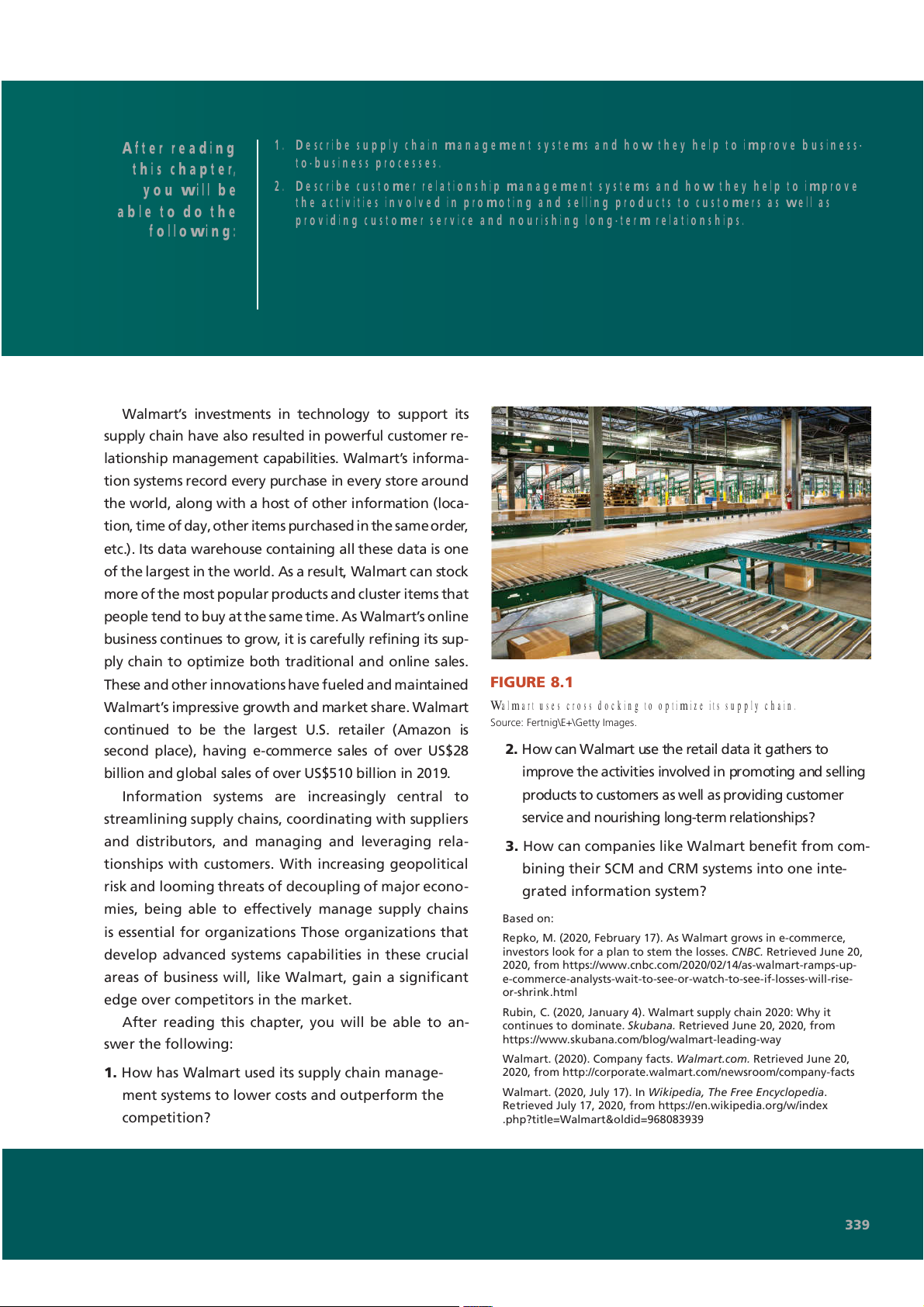
Walmart uses cross docking to optimize its supply chain.
EQKWF Q J CTIU 75 TCKT OCQ KU
5WTEG(GTvPKI)Gvv[+oCIGu
UEQF RCEJCKI EQOOTE UCU QH QT 75
QEC9COCTWUJTCKFCCKICJTUQ
KKQCFIQCUCUQHQT75KKQK
KORTQJCEKKKUKQFKRTQOQKICFUKI
HQTOCKQ UUOU CT KETCUKI ETC Q
RTQFWEUQEWUQOTUCU CURTQKFKIEWUQOT
UTCOKKIUWRREJCKUEQQTFKCKIKJUWRRKTU
UTKECFQWTKUJKIQITOTCKQUJKRU
CF FKUTKWQTU CF OCCIKI CF TCIKI TC
QECEQORCKUKM9COCTHKHTQOEQO
KQUJKRUKJEWUQOTU9KJKETCUKIIQRQKKEC
KKIJKT5/CF4/UUOUKQQK
TKUMCFQQOKIJTCUQHFEQWRKIQHOCQTEQQ
ITCFKHQTOCKQUUO
OKU KI C Q HHEK OCCI UWRR EJCKU $CUFQ
KUUUKCHQTQTICKCKQU6JQUQTICKCKQUJC
4RMQ/(TWCTU9COCTITQUKEQOOTE
FQRCFCEFUUOU ECRCKKKUK JUETWEKC
KUQTUQQMHQTCRCQUOJQUUU4TKF,W
HTQOJRUEEEQOCUCOCTTCORUWR
CTCUQHWUKUUK KM9COCTICKCUKIKHKEC
EQOOTECCUUCKQUQTCEJQUKHQUUUKTKU QTUJTKMJO
FIQTEQORKQTUKJOCTM
4WK,CWCT9COCTUWRREJCK9JK
HT TCFKI JKU EJCRT QW K C Q C
EQKWUQFQOKCWCC4TKF,WHTQO
UTJHQQKI
JRUUMWCCEQOQICOCTCFKIC
9COCTQORCHCEUCNCTE4TKF,W
QJCU9COCTWUFKUUWRREJCKOCCI
HTQOJREQTRQTCCOCTEQOUTQQOEQORCHCEU
OUUOUQQTEQUUCFQWRTHQTOJ
9COCT,WFCTEENFC
4TKF,WHTQOJRUKMKRFKCQTIKF EQORKKQ
RJRK9COCTQFKF
%264 r 5640)60+0)$75+05561$75+0554.6+105+258+5722.;%+00&%7561/44.6+105+2/0)/06
WRRNJCKPCPCIGOGPV
In the previous chapter, we discussed the need to share internal data in order to streamline business
processes, improving coordination within the organization to improve efficiency and effective-
ness. Let’s now turn our attention to collaborating with partners along the supply chain. Obtain-
ing the raw materials and components that a company uses in its daily operations is an important
key to business success. When deliveries from suppliers are accurate and timely, companies can
convert them to finished products more efficiently. Coordinating this effort with suppliers has
become a central part of many companies’ overall business strategy, as it can help them reduce
costs associated with inventory levels and get new products to market more quickly. Ultimately,
this helps companies drive profitability and improve their customer service because they can
react to changing market conditions swiftly. Collaborating or sharing information with suppliers
has become a strategic necessity for business success. In other words, by developing and main-
taining stronger, more integrated relationships with suppliers, companies can more effectively
compete in their markets through cost reductions and responsiveness to market demands.
9CVUC5WRRNCP
The term supply chain is commonly used to refer to a collection of companies and processes
involved in everything from extracting raw materials to moving a product from the suppliers
of raw materials to the suppliers of intermediate components, then to final production, and,
ultimately, to the customer. Companies often procure specific raw materials and components
from many different “upstream” suppliers. These suppliers, in turn, work with their own
suppliers to obtain raw materials and components; their suppliers work with additional sup-
pliers, and so forth. The further out in the supply chain one looks, the more suppliers are
involved. As a result, the term “chain” becomes somewhat of a misnomer since it implies
one-to-one relationships facilitating a chain of events flowing from the first supplier to the
second to the third and so on. Similarly, on the “downstream” side, the products move to
many different customers. The flow of materials from suppliers to customers can thus be
more accurately described as a supply network because of the various interrelated parties
involved in moving raw materials, intermediate components, and, finally, the end product
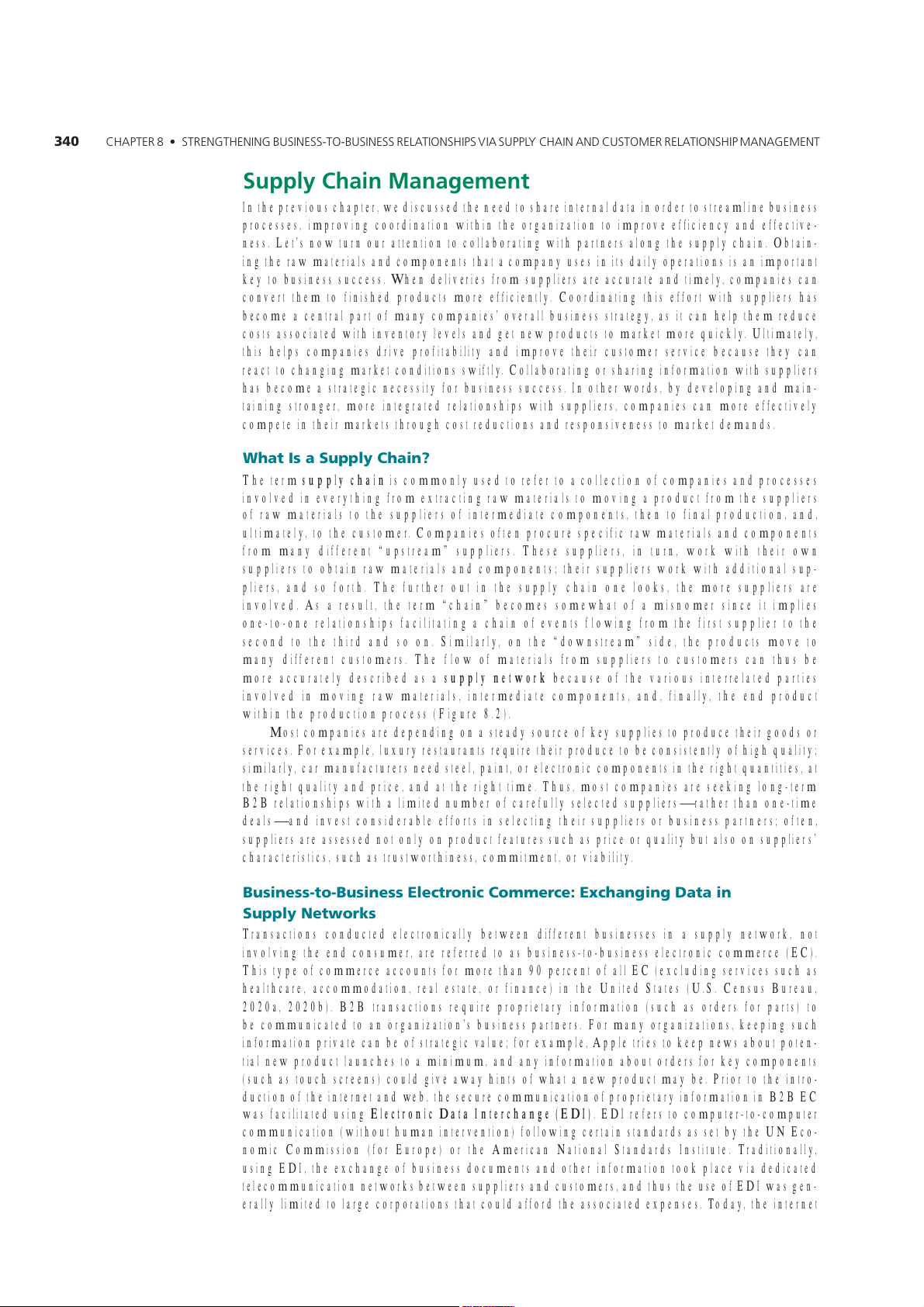
within the production process (Figure 8.2).
Most companies are depending on a steady source of key supplies to produce their goods or
services. For example, luxury restaurants require their produce to be consistently of high quality;
similarly, car manufacturers need steel, paint, or electronic components in the right quantities, at
the right quality and price, and at the right time. Thus, most companies are seeking long-term
B2B relationships with a limited number of carefully selected suppliers—rather than one-time
deals—and invest considerable efforts in selecting their suppliers or business partners; often,
suppliers are assessed not only on product features such as price or quality but also on suppliers’
characteristics, such as trustworthiness, commitment, or viability.
WUPGUUVWUPGUUNGEVTPEOOGTEGECPIPICVCP 5WRRN0GVTMU
Transactions conducted electronically between different businesses in a supply network, not
involving the end consumer, are referred to as business-to-business electronic commerce (EC).
This type of commerce accounts for more than 90 percent of all EC (excluding services such as
healthcare, accommodation, real estate, or finance) in the United States (U.S. Census Bureau,
2020a, 2020b). B2B transactions require proprietary information (such as orders for parts) to
be communicated to an organization’s business partners. For many organizations, keeping such
information private can be of strategic value; for example, Apple tries to keep news about poten-
tial new product launches to a minimum, and any information about orders for key components
(such as touch screens) could give away hints of what a new product may be. Prior to the intro-
duction of the internet and web, the secure communication of proprietary information in B2B EC
was facilitated using Electronic Data Interchange (EDI). EDI refers to computer-to-computer
communication (without human intervention) following certain standards as set by the UN Eco-
nomic Commission (for Europe) or the American National Standards Institute. Traditionally,
using EDI, the exchange of business documents and other information took place via dedicated
telecommunication networks between suppliers and customers, and thus the use of EDI was gen-
erally limited to large corporations that could afford the associated expenses. Today, the internet
%264 r 5640)60+0)$75+05561$75+0554.6+105+258+5722.;%+00&%7561/44.6+105+2/0)/06 74 A typical supply network. Supplier Supplier Supplier Supplier Supplier Supplier Supplier Supplier Supplier Supplier Company Supplier Supplier Supplier Supplier
has become an economical medium over which this business-related information can be trans-
mitted, enabling even small to mid-sized enterprises to use EDI; many large companies (such as
the retail giant Walmart) require their suppliers to transmit information such as advance shipping
notices using web-based EDI protocols. Further, companies have devised a number of innovative
ways to facilitate B2B transactions using web-based technologies. Specifically, organizations
increasingly use extranets (see Chapter 3, “Managing the Information Systems Infrastructure
and Services”) for exchanging data and handling transactions with their suppliers or organiza-
tional customers. Commonly, portals are used to interact with the business partners; these are discussed next.
21. Portals, in the context of B2B supply chain management, can be defined as access
points (or front doors) through which a business partner accesses secured, proprietary information
that may be dispersed throughout an organization (typically using extranets). By allowing direct
access to critical information needed to conduct business, portals can thus provide substantial
productivity gains and cost savings for B2B transactions.
In contrast to business-to-consumer (B2C) EC, where anyone can set up a customer account
with a retailer, the suppliers or customers in B2B transactions are typically prescreened by the
business, and access to the company’s extranet will be given depending on the business relation-
ship (typically, after a review of the supplier’s or buyer’s application). To support different types
of business relationships, portals come in two basic forms: supplier portals and customer portals.
Supplier portals are owned or managed by a “downstream” company and automate the business
processes involved in purchasing or procuring products from multiple suppliers; they connect a
single buyer and multiple suppliers. On the other end of the spectrum, customer portals are
owned or managed by an “upstream” company and automate the business processes involved in
selling or distributing products to multiple buyers; they connect a single supplier und multiple
buyers. B2B marketplaces are typically run by separate entities and connect multiple buyers and
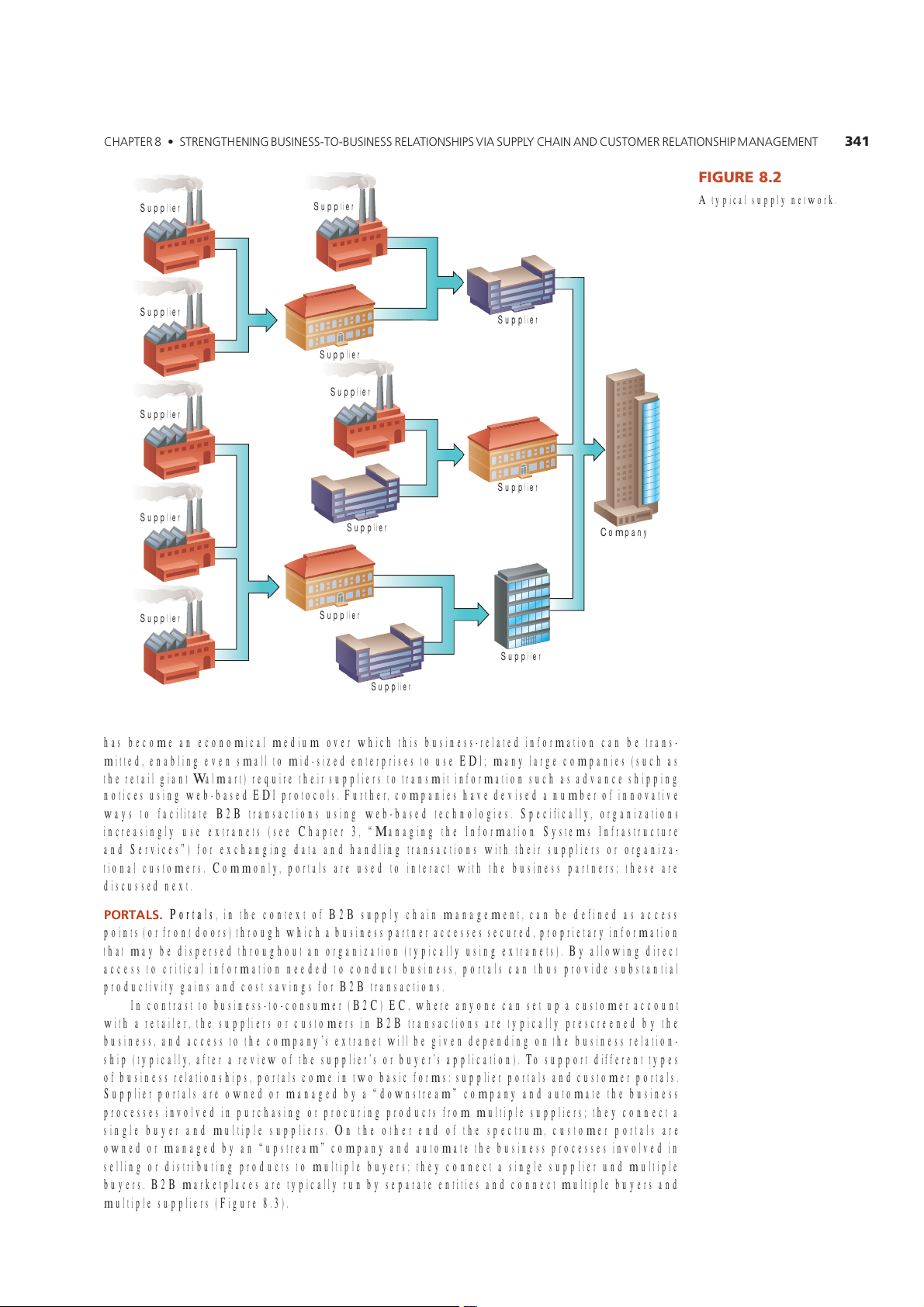
multiple suppliers (Figure 8.3).
%264 r 5640)60+0)$75+05561$75+0554.6+105+258+5722.;%+00&%7561/44.6+105+2/0)/06 74 Suppliers Customers Supplier portals, B2B marketplaces, and customer portals. Supplier B2B Customer Portals Marketplaces Portals
RRT2TC Many companies that are dealing with large numbers of suppliers (e.g., The
Boeing Company, Lilly, P&G, and Hewlett-Packard [HP]) set up supplier portals (sometimes
referred to as sourcing portals or procurement portals). A supplier portal is a subset of an
organization’s extranet designed to automate the business processes that occur before, during,
and after sales transactions between the organization (i.e., a single buyer) and its multiple
suppliers. For example, on the HP Supplier Portal, companies can register their interest in
becoming a supplier for HP; access terms and conditions or guidelines (such as guidelines
related to labeling, shipment, or packaging); and, once a business relationship is established with
HP, manage interorganizational business processes associated with ordering and payment.
T2TC Customer portals are designed to automate the business processes that
occur before, during, and after sales transactions between a supplier and multiple customers.
In other words, customer portals provide efficient tools for business customers to manage all
phases of the purchasing cycle, including reviewing product information, order entry, and
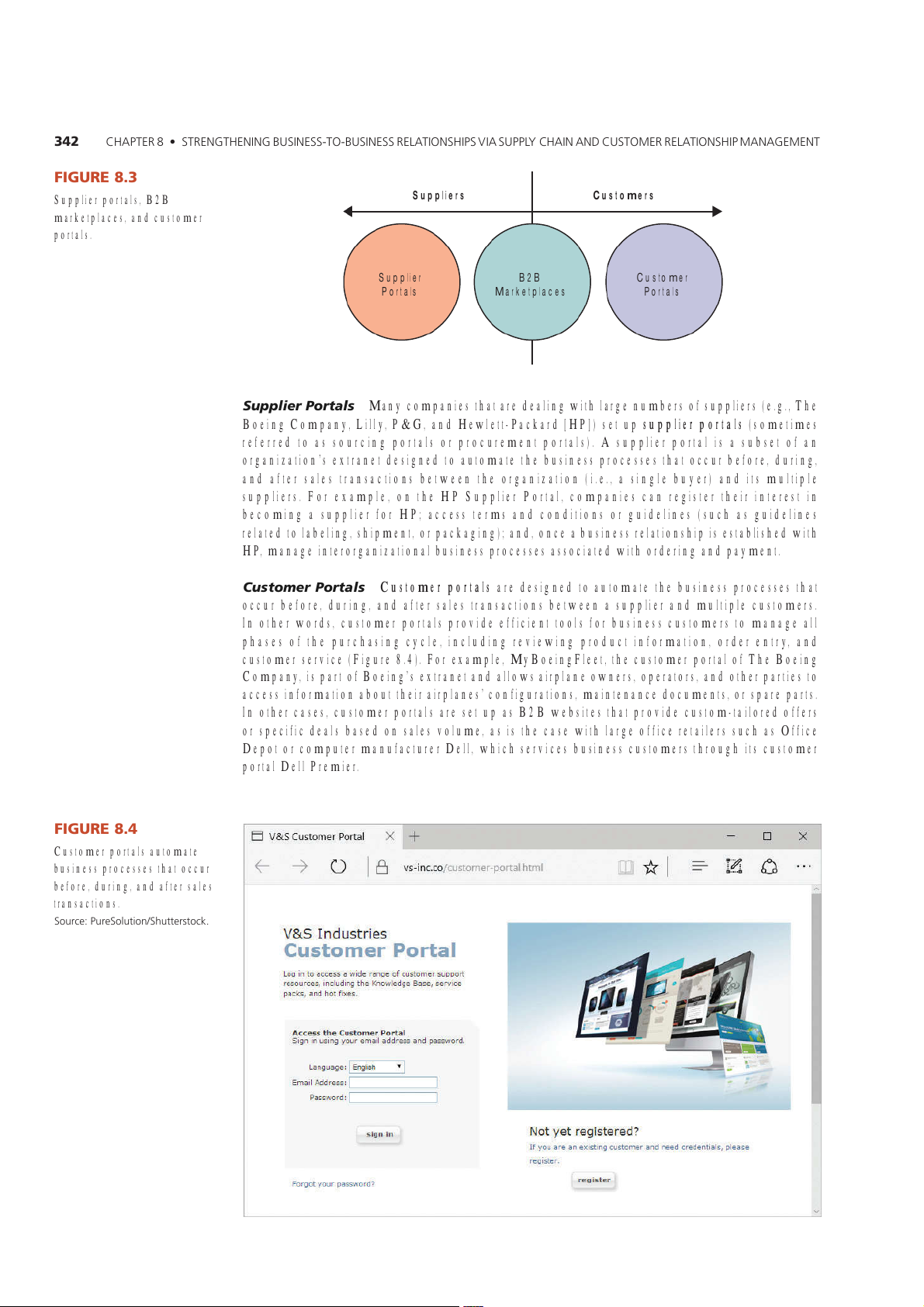
customer service (Figure 8.4). For example, MyBoeingFleet, the customer portal of The Boeing
Company, is part of Boeing’s extranet and allows airplane owners, operators, and other parties to
access information about their airplanes’ configurations, maintenance documents, or spare parts.
In other cases, customer portals are set up as B2B websites that provide custom-tailored offers
or specific deals based on sales volume, as is the case with large office retailers such as Office
Depot or computer manufacturer Dell, which services business customers through its customer portal Dell Premier. 74 Customer portals automate business processes that occur
before, during, and after sales transactions.
5WTEG2WTG5nWvKP5JWvvGTuvEM
%264 r 5640)60+0)$75+05561$75+0554.6+105+258+5722.;%+00&%7561/44.6+105+2/0)/06
-2. The purpose of supplier portals and customer portals is to enable
interaction between a single company and its many suppliers or customers. Being owned/
operated by a single organization, these portals can be considered a subset of the organization’s
extranet. However, setting up such portals tends to be beyond the reach of small to midsized
businesses because of the costs involved in designing, developing, and maintaining this type
of system. Many of these firms do not have the necessary monetary resources or skilled
personnel to implement such portals on their own, and the transaction volume does not justify
the expenses. To service this market, a number of business-to-business marketplaces have
sprung up. B2B marketplaces are operated by third-party vendors, meaning they are built and
maintained by a separate entity rather than being associated with a particular buyer or supplier.
These marketplaces generate revenue by taking a small commission for each transaction that
occurs, by charging usage fees, by charging association fees, and/or by generating advertising
revenues. Unlike customer and supplier portals, B2B marketplaces allow many buyers and many
sellers to come together, offering firms access to real-time trading with other companies in their
vertical markets (i.e., markets composed of firms operating within a certain industry sector).
Such B2B marketplaces can create tremendous efficiencies for companies because they bring
together numerous participants along the supply network. Some popular B2B marketplaces
include https://www.metals1.com (metals), https://www.paperindex.com (paper), and https://
www.fibre2fashion.com (textile and fashion supplies).
In contrast to B2B marketplaces serving vertical markets, other B2B marketplaces are not
focused on any particular industry. One of the most successful examples is the Chinese market-
place Alibaba.com. Alibaba.com brings together buyers and suppliers from around the globe,
from almost every industry, selling almost any product, ranging from fresh ginger to manufac-
turing machinery. Alibaba.com offers various services, such as posting item leads, displaying
products, and contacting buyers or sellers but also features such as trading tips or price watch for
raw materials. Offering various trading tools including online storefronts, virtual factory tours,
and real-time chat, such B2B marketplaces have enabled many small or little-known suppliers to
engage in trade on a global basis.
CPCIPIORNG5WRRN0GVTMU
A prime example of a company having to manage extremely complex supply networks is Apple
and its extremely successful mobile devices, such as the iPhone and iPad. Typically, Apple sells
millions of these devices within the first few days following the product launch. How does Apple
manage to produce such an incredible number of these products? If you take a close look at
the devices, you will find a statement saying “Designed by Apple in California Assembled in
China.” Every time a new Apple device is launched, industry observers disassemble these devices
to get a sneak peek into Apple’s supply chain. The iPhone, like other Apple devices, is by no
means manufactured by Apple. The components of the iPhone are sourced from dozens of com-
panies located in various countries. For example, according to market research firm IHS iSuppli,
a recent iPhone’s flash memory and central processing unit were produced by Korean Sam-
sung; the display was sourced from Korean LG; the phone chips were made by German Infineon
(manufactured in Germany or Southeast Asia); the Wi-Fi and global positioning system (GPS)
chips were produced by U.S.-based Broadcom (but possibly assembled in China, Korea, Singa-
pore, or Taiwan); the touchscreen controller was made by Texas Instruments; many other parts,
such as the camera, were possibly made in Taiwan; and so on (depending on the requirements,
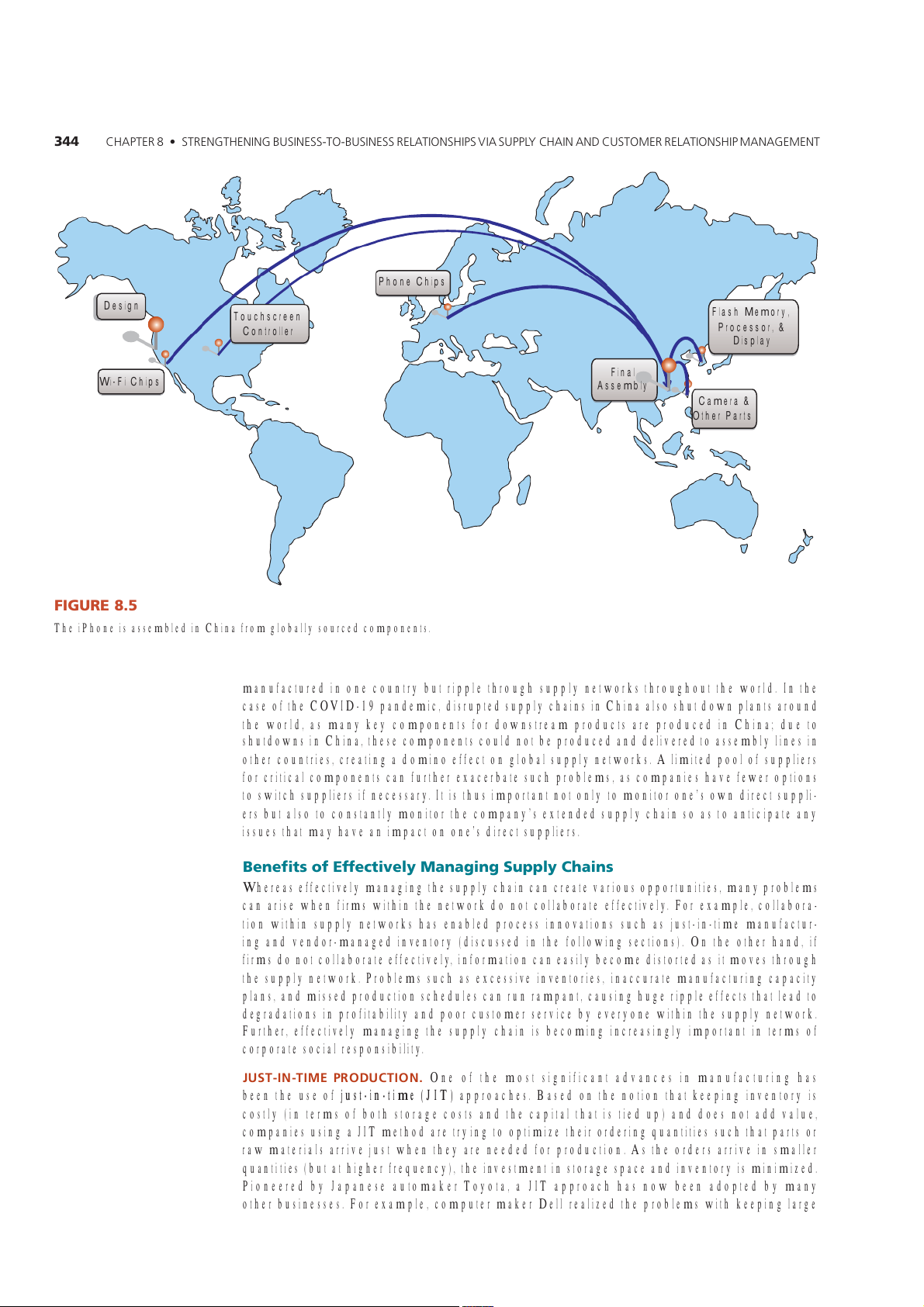
companies such as Apple use various suppliers for different product models). The final products
are assembled in a factory owned by Taiwanese electronics giant Foxconn, located in Shenzhen,
China (a city of more than 10 million people located just north of Hong Kong), from where
the finished iPhones are shipped by air to the different countries where the iPhone is for sale
(Figure 8.5). Although many have never heard of Foxconn, it is the largest electronics manufac-
turer in the world, producing components, cell phones, gaming consoles, and so on, for various
other companies, including Dell, HP, and Sony.
Coordinating such an extensive supply network requires considerable expertise, especially
when facing unexpected events such as shortages in touchscreen panels or other issues at suppli-
ers’ factories; likewise, global crises, such as the COVID-19 pandemic in early 2020, can cause
disruptions in supply chains, resulting in work stoppages and delayed orders. For example, com-
panies using a “just in time” inventory philosophy (discussed below) faced shutdowns and
delays. It is important to note that the impacts of such events are often not limited to the products
%264 r 5640)60+0)$75+05561$75+0554.6+105+258+5722.;%+00&%7561/44.6+105+2/0)/06 Phone Chips Design Touchscreen Flash Memory, Controller Processor, & Display Final Wi-Fi Chips Assembly Camera & Other Parts 74
The iPhone is assembled in China from globally sourced components.
manufactured in one country but ripple through supply networks throughout the world. In the
case of the COVID-19 pandemic, disrupted supply chains in China also shut down plants around
the world, as many key components for downstream products are produced in China; due to
shutdowns in China, these components could not be produced and delivered to assembly lines in
other countries, creating a domino effect on global supply networks. A limited pool of suppliers
for critical components can further exacerbate such problems, as companies have fewer options
to switch suppliers if necessary. It is thus important not only to monitor one’s own direct suppli-
ers but also to constantly monitor the company’s extended supply chain so as to anticipate any
issues that may have an impact on one’s direct suppliers.
GPGVUGEVGNCPCIPI5WRRNCPU
Whereas effectively managing the supply chain can create various opportunities, many problems
can arise when firms within the network do not collaborate effectively. For example, collabora-
tion within supply networks has enabled process innovations such as just-in-time manufactur-
ing and vendor-managed inventory (discussed in the following sections). On the other hand, if
firms do not collaborate effectively, information can easily become distorted as it moves through
the supply network. Problems such as excessive inventories, inaccurate manufacturing capacity
plans, and missed production schedules can run rampant, causing huge ripple effects that lead to
degradations in profitability and poor customer service by everyone within the supply network.
Further, effectively managing the supply chain is becoming increasingly important in terms of
corporate social responsibility.
211 One of the most significant advances in manufacturing has
been the use of just-in-time (JIT) approaches. Based on the notion that keeping inventory is
costly (in terms of both storage costs and the capital that is tied up) and does not add value,
companies using a JIT method are trying to optimize their ordering quantities such that parts or
raw materials arrive just when they are needed for production. As the orders arrive in smaller
quantities (but at higher frequency), the investment in storage space and inventory is minimized.
Pioneered by Japanese automaker Toyota, a JIT approach has now been adopted by many
other businesses. For example, computer maker Dell realized the problems with keeping large
%264 r 5640)60+0)$75+05561$75+0554.6+105+258+5722.;%+00&%7561/44.6+105+2/0)/06
inventories, especially because of the fast rate of obsolescence of electronics components. To
illustrate, recall our discussion of Moore’s Law, which suggests that processor technology is
doubling in performance approximately every 24 months. Because of this, successful computer
manufacturers have learned that holding inventory that can quickly become obsolete or devalued
is a poor strategy for success. In fact, Dell now only keeps about 2 hours of inventory in its
factories. Obviously, using a JIT method is heavily dependent on tight cooperation between all
partners in the supply network, not only suppliers but also other partners, such as shipping and logistics companies.
11 Under a traditional inventory model, the manufacturer or
retailer would manage its own inventories, sending out requests for additional items as needed. In
contrast, vendor-managed inventory (VMI) is an approach to inventory management in which
the suppliers to a manufacturer (or retailer) manage the manufacturer’s (or retailer’s) inventory
based on negotiated service levels. To make VMI possible, the manufacturer (or retailer) allows
the supplier to monitor stock levels and ongoing sales data. Such arrangements can help to
optimize the manufacturer’s (or retailer’s) inventory, both saving costs and minimizing stockout
situations (thus enhancing customer satisfaction); the supplier, in turn, benefits from the intense
data sharing, which helps produce more accurate forecasts, reduces ordering errors, and helps
prioritize the shipment of goods.
..2 One major problem affecting supply chains are ripple effects
referred to as the bullwhip effect. Each business forecasting demand typically includes a safety
buffer to prevent possible stockouts. However, forecast errors and safety stocks multiply when
moving up the supply chain, such that a small fluctuation in demand for a product can lead
to tremendous fluctuation in demand for parts or raw materials farther up the supply chain.
Like someone cracking a bullwhip, a tiny “flick of the wrist” will create a big movement at the
other end of the whip. Likewise, a small forecasting error at the end of the supply chain can
cause massive forecasting errors farther up the supply chain. Implementing integrated business
processes allows a company to better coordinate the entire supply network and reduce the impact of the bullwhip.
1211.21. Effectively managing the supply chain has also become
tremendously important for aspects related to corporate social responsibility. Specifically,
transparency and accountability within the supply chain can help organizations save costs and/
or create a good image. Two related issues are product recalls and sustainable business practices; both are discussed next.
2TFEEC Given that a typical supply network comprises tens, hundreds, or sometimes
thousands of players, many of which are dispersed across the globe, there are myriad possibilities
where shortcuts are being taken or quality standards are not being met. Often, such issues are
caught somewhere along the supply chain, but sometimes such incidents go unnoticed until
the product reaches the end consumer. These problems can be exacerbated if companies are
sourcing their products or raw materials globally, as more potential points of failure are added
due to differences in quality or product safety regulations in the originating countries.
Hence, it is extremely important to have the necessary information to trace back the move-
ment of products through the supply chain to be able to quickly identify the problematic link.
Being able to single out the source of a problem can help a company to perform an appropriate
response, helping to save goodwill and limiting the costs of a recall. Further, in many cases, only
some batches of a product may be problematic (such as when certain raw materials or compo-
nents are sourced from different suppliers). If a company is not able to clearly identify the
affected batches, the recall will have to be much broader, costing the company much more (in
both goodwill and money) than just having to recall the affected batches. Hence, companies
need to have a clear picture of their supply chain and need to store these data in case of problems at a later point in time.
CPCP2TCEE Another aspect related to corporate social responsibility
is a growing emphasis on sustainable business practices. Particularly, organizations have come
under increasing scrutiny for issues such as ethical treatment of workers (especially overseas) or
environmental practices. For instance, because of Apple’s vast success in marketing its products
%264 r 5640)60+0)$75+05561$75+0554.6+105+258+5722.;%+00&%7561/44.6+105+2/0)/06
around the world, the tech giant has also received an abundance of negative press related to the
poor conditions for many workers who assemble the world’s favorite phone. A typical worker
in such plants endures a 12-hour work shift 6 days a week. These workers typically live next
to the assembly plant in crowded dorms that are often infested with bedbugs, and many have
no working toilets. Over the past several years, there were also reports of numerous workers
committing suicide due to the stress and poor conditions. While Apple is certainly aware of
the negative effects that a supplier’s action can have on a company’s reputation, it also faces
a conundrum, as few (if any) companies have sufficient production capacity, especially when
offering such low wages, to meet the demand for hugely popular products such as the iPhone.
Other companies are trying to portray a “green” image and attempt to minimize their carbon
footprint. For example, HP takes a proactive approach, being the first major information tech-
nology company to publish its aggregate supply chain greenhouse gas emissions, restrict the use
of hazardous materials, implement environmentally friendly packaging policies, and so on. To
do that and to provide sound, convincing numbers to back a “green” image, a company such as
HP needs to have a clear view of its entire supply chain. Similarly, U.S. regulations require
95 percent of computers purchased by the U.S. federal government to carry the EPEAT eco-
label. To achieve this certification, a manufacturer must possess and produce extensive evidence
that the products meet EPEAT’s strict requirements.
1RVOPIVG5WRRNCP6TWI5WRRNCPCPCIGOGPV
Information systems focusing on improving supply chains have two main objectives: to acceler-
ate product development and innovation and to reduce costs. These systems, called supply chain
management (SCM) systems, improve the coordination of suppliers, product or service produc-
tion, and distribution. When implemented successfully, SCM systems help in not only reducing
inventory costs but also enhancing revenue through improved customer service. SCM systems
are often integrated with ERP systems to leverage internal and external information to better col-
laborate with suppliers. Like ERP and customer relationship management systems, SCM systems
are delivered in the form of modules (Table 8.1) that companies select and implement according
to their differing business requirements.
As discussed previously, ERP systems are primarily used to optimize business processes
within the organization, whereas SCM systems are used to improve business processes that span
organizational boundaries. Whereas some standalone SCM systems only automate the logistics
aspects of the supply chain, organizations can reap the greatest benefits when the SCM system is
tightly integrated with ERP and customer relationship management systems modules; this way,
SCM systems can use data about customer orders or sales forecasts (from the customer relation-
ship management system), data about payments (from the ERP system), and so on. Given its
scope, SCM is adopted primarily by large organizations with a large and/or complex supplier
network. At the same time, many smaller suppliers are interacting with the systems of large
companies. To obtain the greatest benefits from the SCM processes and systems, organizations
need to extend the system to include all trading partners regardless of size, providing a central
location for information integration and common processes so that all partners benefit.
For an effective SCM strategy, several challenges have to be overcome. First and foremost, as
with any information system, an SCM system is only as good as the data entered into it. This
means that to benefit most from an SCM system, the organization’s employees have to actually use
the system and move away from traditional ways of managing the supply chain, as an order placed
by fax or telephone will most likely not find its way into the system. Another challenge to over-
come is distrust among partners in the supply chain; for many companies, sales and supply chain
data are strategic assets, and no one wants to show his or her cards to other members in the supply
chain. Further, many organizations (such as Apple) tend to be very clandestine about their suppli-
ers, as such information could reveal their pricing strategies or give clues about new product devel-
opment. In addition, more and more organizations are reluctant to share data along the supply
chain because of an increase in intellectual property theft, especially in China, a major source of
supplies for many companies. A final challenge is to get all partners within the supply chain to
adopt an SCM system. Several years ago, the retail giant Walmart began mandating its suppliers to
use its RetailLink supply chain system and refused to engage in a business relationship with any
supplier that was not willing to use the system. Whereas large companies can force their suppliers
or partners to use a system, smaller companies typically do not have this power.
%264 r 5640)60+0)$75+05561$75+0554.6+105+258+5722.;%+00&%7561/44.6+105+2/0)/06 WHEN THINGS GO WRONG
The Chicken Sandwich War of 2019
2RG[Gu.WKuKCPC-KvEJGPKuCHCuv HFTGuvCWTCPvEJCKP
JCFPvCEEWPvGFHTCPKPGPvT[uCHGv[PGvCPFvJGKTuWR
JGCFSWCTvGTGFKPvJG7PKvGF5vCvGuvJCvuRGEKCnK\GuKPt[W
Rn[EJCKPHCKnGFCuCTGuWnv
IWGuuGFKvtEJKEMGP+PWIWuv2RG[GunCWPEJGFC
6JGSWGuvKPTGoCKPu&KF2RG[GuCTvKHKEKCnn[ETGCvGvJG
PGy EJKEMGPuCPFyKEJv EoRGvGyKvJ %JKEM(KnCPF
dW\\MPyKPIvJGKTuWRRn[EJCKPyWnFPvdGCdnGvMGGR
vJGTHCuvHFTGuvCWTCPvu2RG[GunGGTCIGFvJGKTuEKCn
WR!EETFKPIvvJGKT%1PvJCvyCuPvvJGECuG6JG[
oGFKCTGCEJFWTKPI vJGnCWPEJ CPFGRGTKGPEGFoCuuKG
lWuvFKFPvCEEWPvHTvJGKTCnGHHGEvuHuEKCnoGFKCCPF
KPETGCuGuKPEWuvoGTvTCHHKEGuvKoCvGFCvyGnnGTRGT
vJGCRRCTGPvFGnKEKWuPGuuHvJGKTEJKEMGPuCPFyKEJ
EGPv6JGKTEJKEMGPuCPFyKEJnCWPEJyCuuKoWnvCPGWun[C $CuGFP
oCuuKGuWEEGuuCPFCHCKnWTGCu2RG[GuuWRRn[EJCKPyCu
WPCdnGvMGGRRCEGyKvJFGoCPF
CKIJ/&GEGodGT9J[%JKEMHKn2RG[GuCPF/E&P
CnFunCWPEJGFCEJKEMGPuCPFyKEJyCTKP4GvTKGGF,Wn[
6JGuCPFyKEJyCuHHKEKCnn[CPPWPEGFPWIWuv
HToJvvRuyyyEPdEEoyJ[EJKEMHKnC
CPFunFWvoTGvJCPoPvJuHKPITGFKGPvuyKvJKP
RRG[GuoEFPCnFunCWPEJGFCEJKEMGPuCPFyKEJyCTJvon
vJGHKTuvyGGMuCHvGTnCWPEJ&WTKPIvJGnCWPEJ2RG[Gu
/E0Wnv[/1EvdGT9J[KvuvCMKPIoPvJuHT2R
yGPv v yCT yKvJ %JKEM(Kn PuEKCnoGFKCv FGdCvG
G[GuvdTKPIdCEMKvuEJKEMGPuCPFyKEJZWPG4GvTKGGF
yJuGHCuvHFEJKEMGPuCPFyKEJyCudGvvGT6JGFGdCvG
,Wn[ HTo J vvRuyyyHdWuKP GuuEo nKHGuv[nG
uvCTvGF yJGP%JKEM(KnuGPvCvyGGvvJCvEnCKoGF vJGKT
RRG[GuEJKEMGPuCPFyKEJdCEMuWRRn[EJCKP
uCPFyKEJyCuvJGTKIKPCnnGFEJKEMGPuCPFyKEJ2RG[Gu
2Ku\E\T5GRvGodGT2RG[GuuRKE[EJKEMGPuCPF
TGuRPFGFyKvJvJGvyyTFvyGGvp[CnnIF!qCPFvJG
yKEJ5WRRn[EJCKPoKuJCRToCTMGvKPIvCEvKE!VTCVGEWTEGTT
TGuvKuJKuvT[%nGCTn[vJGFGdCvGyCu uWEEGuuHWnCuuoG
4GvTKGGF ,Wn[ HTo JvvRuyyyuvTCvGIKEuWTEGTT
EoRRG[GuuRKE[EJKEMGPuCPFyKEJuWRRn[Jvon
GuvKoCvGvJCv2RG[GuICKPGFoTGvJCP75oKnnKPKP
oGFKCCnWGdGECWuGHvJGTGCEJCPFGHHGEvHvJGKTuEKCn
2RG[Gu ,Wn[ +PMRGFC G TGG PEENRGFC
4GvTKGGF ,Wn[ HToJvvRuGPyKMKRGFKCTIyKPFG
oGFKC oCTMGvKPI GHHTvu7PHTvWPCvGn[HT 2RG[GuCPF
RJR!vKvnG2RG[GunFKF
vJGKTEWuvoGTuKvvCMGuPGCTn[oPvJuHTCEJKEMGPvdG
6%%TGCvKGu5GRvGodGTyvJG2RG[GuEJKEMGPuCPFyKEJ
TCKuGFCPFJCTGuvGF6JWuvJGWPEPvTnnGFuRKMGKPFGoCPF
vGCEJGuvJGCnWGHKPGPvT[oCPCIGoGPvTGCVG4GvTKGGF
WRuGvvJGGPvKTGuWRRn[EJCKPCuKvKuKoRuuKdnGvFGETGCuG
,Wn[HToJvvRuvEETGCvKGuEoJyvJGRRG[GuEJKEMGP
vJGvKoGHTCoGHTRTFWEKPIEJKEMGP2RG[GunGCFGTuJKR
uCPFyKEJvGCEJGuvJGCnWGHKPGPvT[oCPCIGoGPv
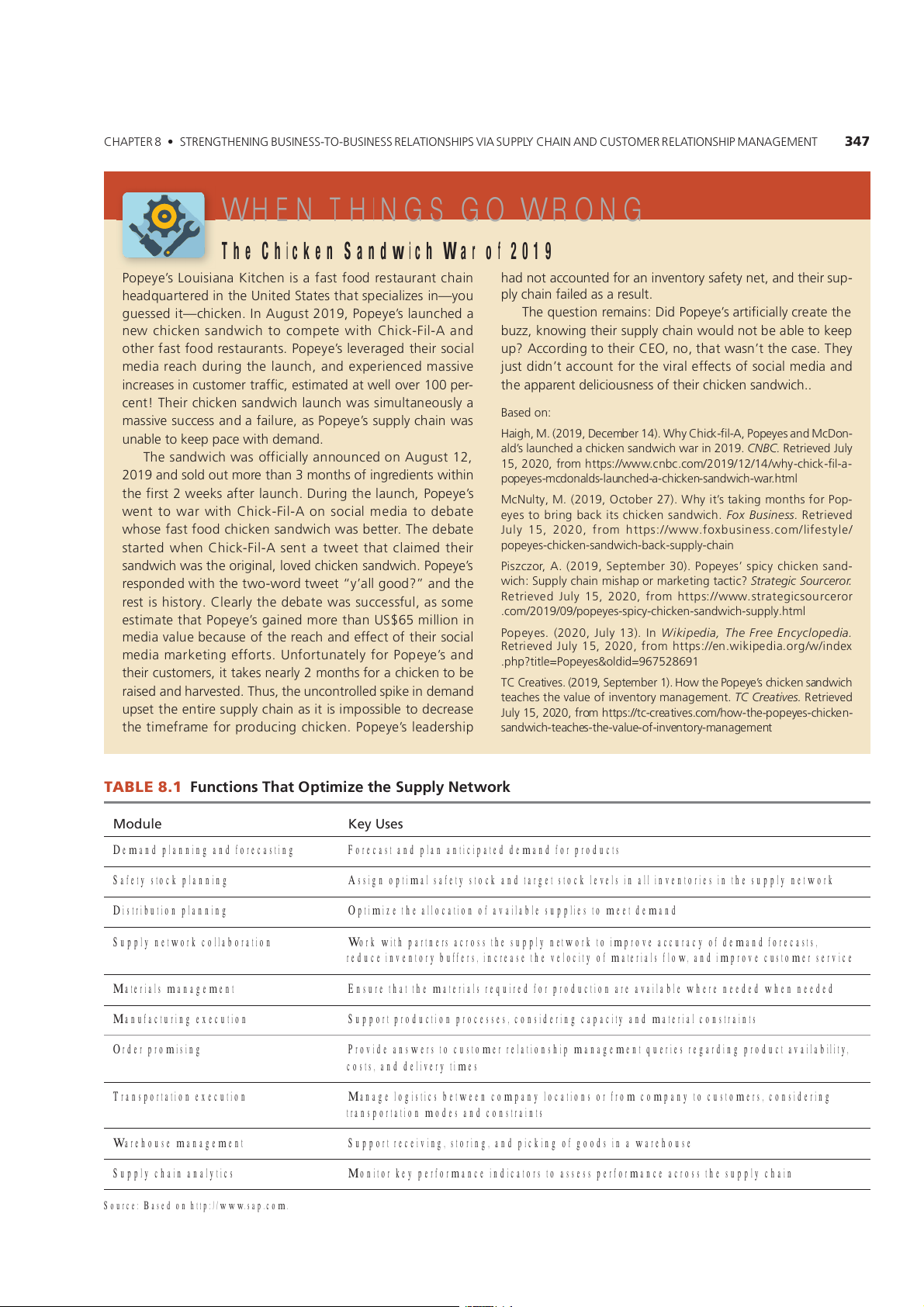
6. WPEVKQPUJCV1RVKOKGVJGWRRNGVYQTM /QFW -7UU
Demand planning and forecasting
Forecast and plan anticipated demand for products Safety stock planning
Assign optimal safety stock and target stock levels in all inventories in the supply network Distribution planning
Optimize the allocation of available supplies to meet demand Supply network collaboration
Work with partners across the supply network to improve accuracy of demand forecasts,
reduce inventory buffers, increase the velocity of materials flow, and improve customer service Materials management
Ensure that the materials required for production are available where needed when needed Manufacturing execution
Support production processes, considering capacity and material constraints Order promising
Provide answers to customer relationship management queries regarding product availability, costs, and delivery times Transportation execution
Manage logistics between company locations or from company to customers, considering
transportation modes and constraints Warehouse management
Support receiving, storing, and picking of goods in a warehouse Supply chain analytics
Monitor key performance indicators to assess performance across the supply chain
Source: Based on http://www.sap.com .
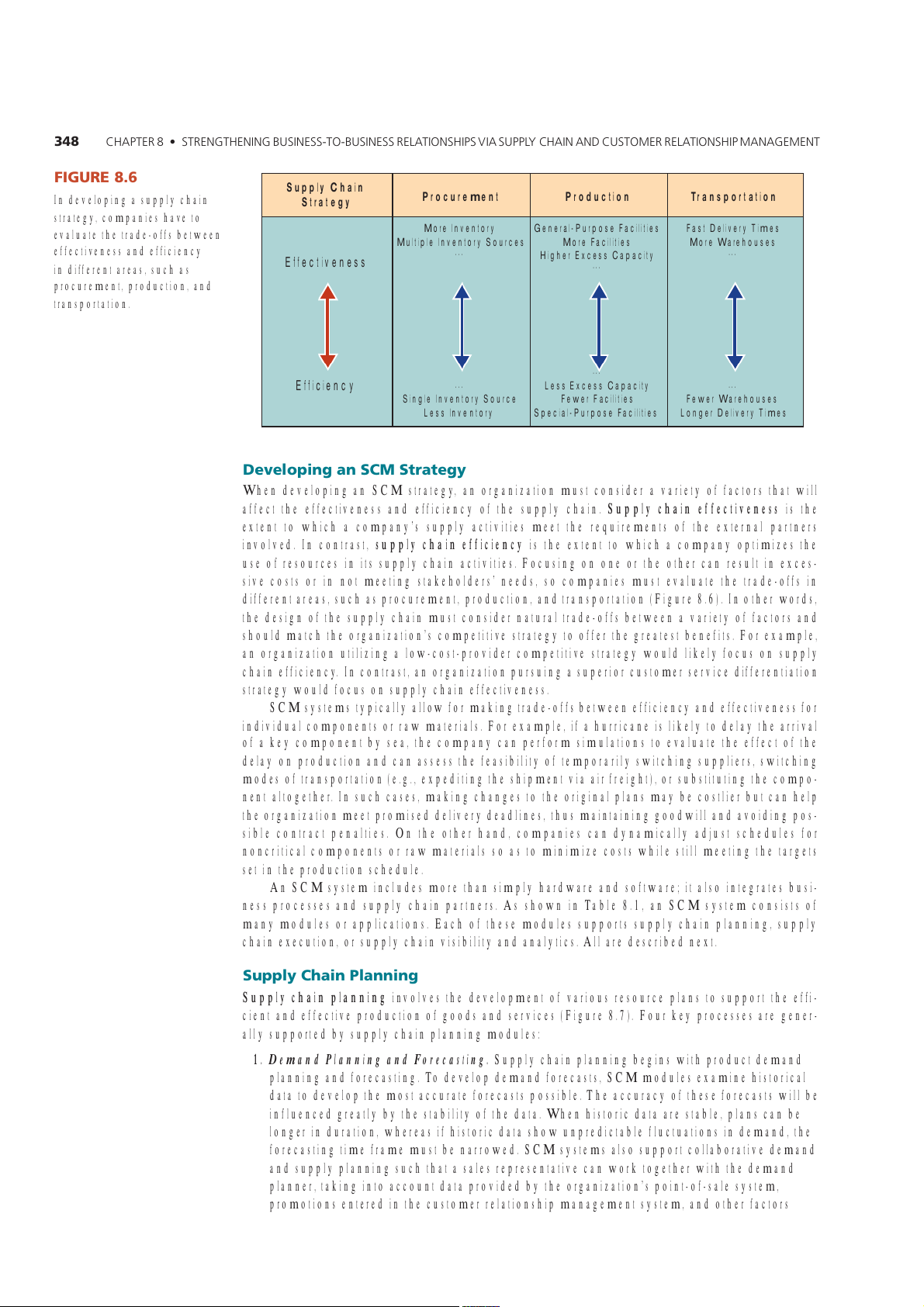
%264 r 5640)60+0)$75+05561$75+0554.6+105+258+5722.;%+00&%7561/44.6+105+2/0)/06 74 Supply Chain In developing a supply chain Strategy Procurement Production Transportation strategy, companies have to More Inventory General-Purpose Facilities Fast Delivery Times
evaluate the trade-offs between Multiple Inventory Sources More Facilities More Warehouses effectiveness and efficiency ... ... Effectiveness Higher Excess Capacity ... in different areas, such as procurement, production, and transportation. ... Efficiency ... Less Excess Capacity ... Single Inventory Source Fewer Facilities Fewer Warehouses Less Inventory Special-Purpose Facilities Longer Delivery Times
GGNRPICP55VTCVGI
When developing an SCM strategy, an organization must consider a variety of factors that will
affect the effectiveness and efficiency of the supply chain. Supply chain effectiveness is the
extent to which a company’s supply activities meet the requirements of the external partners
involved. In contrast, supply chain efficiency is the extent to which a company optimizes the
use of resources in its supply chain activities. Focusing on one or the other can result in exces-
sive costs or in not meeting stakeholders’ needs, so companies must evaluate the trade-offs in
different areas, such as procurement, production, and transportation (Figure 8.6). In other words,
the design of the supply chain must consider natural trade-offs between a variety of factors and
should match the organization’s competitive strategy to offer the greatest benefits. For example,
an organization utilizing a low-cost-provider competitive strategy would likely focus on supply
chain efficiency. In contrast, an organization pursuing a superior customer service differentiation
strategy would focus on supply chain effectiveness.
SCM systems typically allow for making trade-offs between efficiency and effectiveness for
individual components or raw materials. For example, if a hurricane is likely to delay the arrival
of a key component by sea, the company can perform simulations to evaluate the effect of the
delay on production and can assess the feasibility of temporarily switching suppliers, switching
modes of transportation (e.g., expediting the shipment via air freight), or substituting the compo-
nent altogether. In such cases, making changes to the original plans may be costlier but can help
the organization meet promised delivery deadlines, thus maintaining goodwill and avoiding pos-
sible contract penalties. On the other hand, companies can dynamically adjust schedules for
noncritical components or raw materials so as to minimize costs while still meeting the targets
set in the production schedule.
An SCM system includes more than simply hardware and software; it also integrates busi-
ness processes and supply chain partners. As shown in Table 8.1, an SCM system consists of
many modules or applications. Each of these modules supports supply chain planning, supply
chain execution, or supply chain visibility and analytics. All are described next.
5WRRNCP2NCPPPI
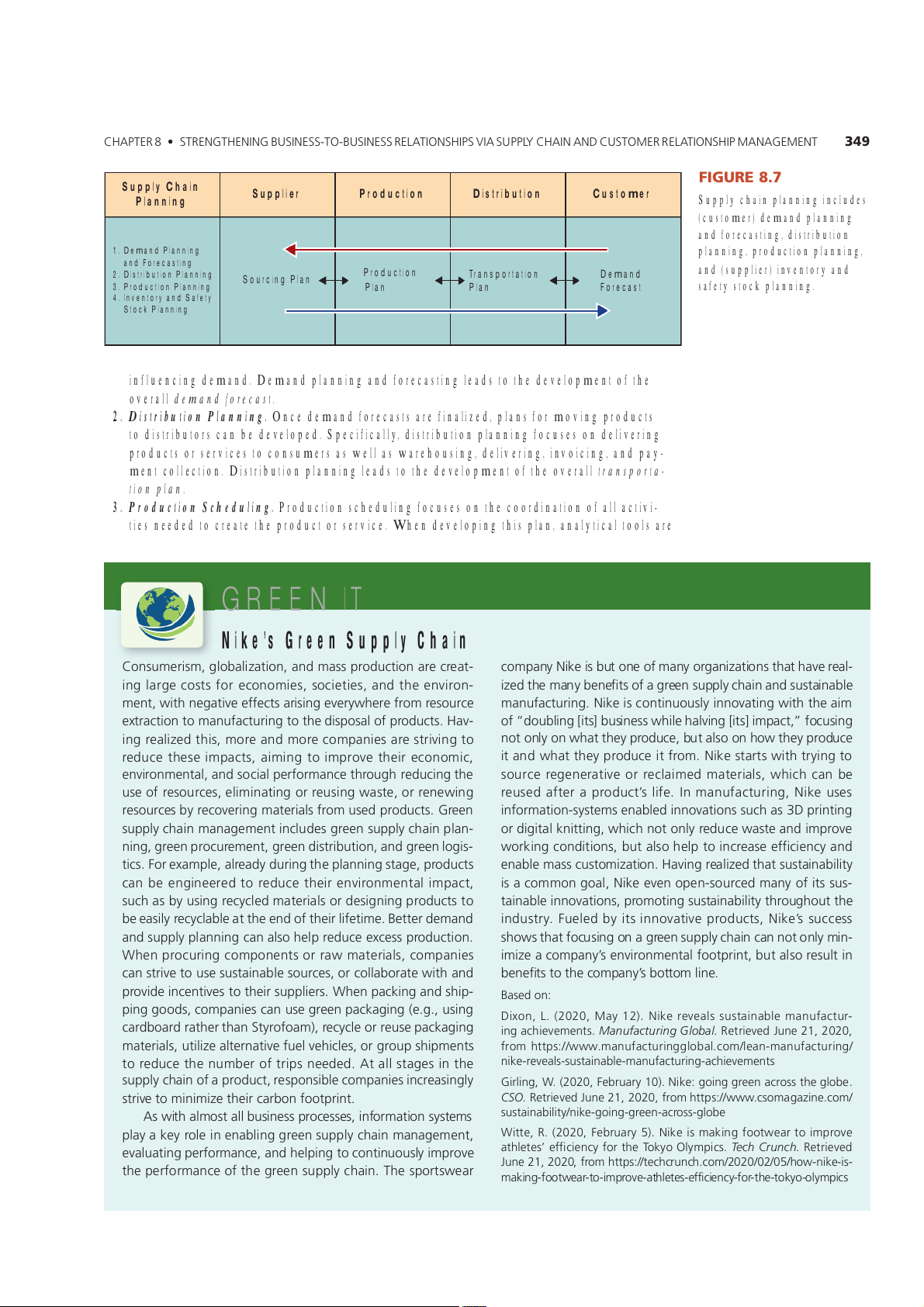
Supply chain planning involves the development of various resource plans to support the effi-
cient and effective production of goods and services (Figure 8.7). Four key processes are gener-
ally supported by supply chain planning modules:
1. Demand Planning and Forecasting. Supply chain planning begins with product demand
planning and forecasting. To develop demand forecasts, SCM modules examine historical
data to develop the most accurate forecasts possible. The accuracy of these forecasts will be
influenced greatly by the stability of the data. When historic data are stable, plans can be
longer in duration, whereas if historic data show unpredictable fluctuations in demand, the
forecasting time frame must be narrowed. SCM systems also support collaborative demand
and supply planning such that a sales representative can work together with the demand
planner, taking into account data provided by the organization’s point-of-sale system,
promotions entered in the customer relationship management system, and other factors
%264 r 5640)60+0)$75+05561$75+0554.6+105+258+5722.;%+00&%7561/44.6+105+2/0)/06
74 Supply Chain Supplier Production Distribution Customer Planning
Supply chain planning includes (customer) demand planning and forecasting, distribution 1. Demand Planning
planning, production planning, and Forecasting and (supplier) inventory and 2. Distribution Planning Production Transportation Demand Sourcing Plan 3. Production Planning Plan Plan Forecast safety stock planning. 4. Inventory and Safety Stock Planning
influencing demand. Demand planning and forecasting leads to the development of the overall demand forecast .
2. Distribution Planning. Once demand forecasts are finalized, plans for moving products
to distributors can be developed. Specifically, distribution planning focuses on delivering
products or services to consumers as well as warehousing, delivering, invoicing, and pay-
ment collection. Distribution planning leads to the development of the overall transporta- tion plan .
3. Production Scheduling. Production scheduling focuses on the coordination of all activi-
ties needed to create the product or service. When developing this plan, analytical tools are GREEN IT Nike’s Green Supply Chain
%PuWoGTKuoIndCnK\CvKPCPFoCuuRTFWEvKPCTGETGCv
EoRCP[0KMGKudWvPGHoCP[TICPK\CvKPuvJCvJCGTGCn
KPInCTIGEuvuHTGEPoKGu uEKGvKGuCPFvJGGPKTP
K\GFvJGoCP[dGPGHKvuHCITGGPuWRRn[EJCKPCPFuWuvCKPCdnG
oGPvyKvJPGICvKGGHHGEvuCTKuKPIGGT[yJGTGHToTGuWTEG
oCPWHCEvWTKPI0KMGKuEPvKPWWun[KPPCvKPIyKvJvJGCKo
GvTCEvKPvoCPWHCEvWTKPIvvJGFKuRuCnHRTFWEvuC
HpFWdnKPI=Kvu?dWuKPGuuyJKnGJCnKPI=Kvu?KoRCEvqHEWuKPI
KPITGCnK\GFvJKuoTGCPFoTGEoRCPKGuCTGuvTKKPIv
PvPn[PyJCvvJG[RTFWEGdWvCnuPJyvJG[RTFWEG
TGFWEG vJGuGKoRCEvuCKoKPIvKoRTGvJGKT GEPoKE
KvCPFyJCvvJG[RTFWEGKvHTo0KMGuvCTvuyKvJvT[KPIv
GPKTPoGPvCnCPFuEKCnRGTHToCPEGvJTWIJTGFWEKPIvJG
uWTEG TGIGPGTCvKGTTGEnCKoGFoCvGTKCnuyJKEJECP dG
WuGHTGuWTEGuGnKoKPCvKPITTGWuKPIyCuvGTTGPGyKPI
TGWuGF CHvGT CRTFWEvunKHG +PoCPWHCEvWTKPI 0KMG WuGu
TGuWTEGud[TGEGTKPIoCvGTKCnuHToWuGFRTFWEvu)TGGP
KPHToCvKPu[uvGouGPCdnGFKPPCvKPuuWEJCu&RTKPvKPI
uWRRn[EJCKPoCPCIGoGPvKPEnWFGuITGGPuWRRn[EJCKPRnCP
TFKIKvCnMPKvvKPIyJKEJPvPn[TGFWEGyCuvGCPFKoRTG
PKPIITGGPRTEWTGoGPvITGGPFKuvTKdWvKPCPFITGGPnIKu
yTMKPIEPFKvKPudWvCnuJGnRvKPETGCuGGHHKEKGPE[CPF
vKEu(TGCoRnGCnTGCF[FWTKPIvJGRnCPPKPIuvCIGRTFWEvu
GPCdnGoCuuEWuvoK\CvKPCKPITGCnK\GFvJCvuWuvCKPCdKnKv[
ECPdGGPIKPGGTGFvTGFWEG vJGKTGPKTPoGPvCnKoRCEv
KuCEooPICn0KMGGGPRGPuWTEGFoCP[HKvuuWu
uWEJCud[WuKPITGE[EnGFoCvGTKCnuTFGuKIPKPIRTFWEvuv
vCKPCdnGKPPCvKPuRTovKPIuWuvCKPCdKnKv[vJTWIJWvvJG
dGGCuKn[TGE[EnCdnGCvvJGGPFHvJGKTnKHGvKoG$GvvGTFGoCPF
KPFWuvT[(WGnGFd[ KvuKPPCvKGRTFWEvu 0KMGu uWEEGuu
CPFuWRRn[RnCPPKPIECPCnuJGnRTGFWEGGEGuuRTFWEvKP
uJyuvJCvHEWuKPIPCITGGPuWRRn[EJCKPECPPvPn[oKP
9JGPRTEWTKPIEoRPGPvuTTCyoCvGTKCnuEoRCPKGu
KoK\GCEoRCP[uGPKTPoGPvCnHvRTKPvdWvCnuTGuWnvKP
ECPuvTKGvWuGuWuvCKPCdnGuWTEGuTEnnCdTCvGyKvJCPF
dGPGHKvuvvJGEoRCP[udvvonKPG
RTKFGKPEGPvKGuvvJGKTuWRRnKGTu9JGPRCEMKPICPFuJKR $CuGFP
RKPIIFuEoRCPKGuECPWuGITGGPRCEMCIKPIGIWuKPI
&KP . /C[0KMGTGGCnu uWuvCKPCdnGoCPWHCEvWT
ECTFdCTFTCvJGTvJCP5v[THCoTGE[EnGTTGWuGRCEMCIKPI
KPICEJKGGoGPvuCPWCEVWTPNDCN4GvTKGGF,WPG
oCvGTKCnuWvKnK\GCnvGTPCvKGHWGnGJKEnGuTITWRuJKRoGPvu
HToJvvRuyyyoCPWHCEvWTKPIIndCnEonGCPoCPWHCEvWTKPI
vTGFWEGvJGPWodGTHvTKRuPGGFGFvCnnuvCIGuKPvJG
PKMGTGGCnuuWuvCKPCdnGoCPWHCEvWTKPICEJKGGoGPvu
uWRRn[EJCKPHCRTFWEvTGuRPuKdnGEoRCPKGuKPETGCuKPIn[
)KTnKPI9(GdTWCT[0KMGIKPIITGGPCETuuvJGIndG
uvTKGvoKPKoK\GvJGKTECTdPHvRTKPv
4GvTKGGF,WPGHToJvvRuyyyEuoCIC\KPGEo
uyKvJCnouvCnndWuKPGuuRTEGuuGuKPHToCvKPu[uvGou
uWuvCKPCdKnKv[PKMGIKPIITGGPCETuuIndG
RnC[CMG[TnGKPGPCdnKPIITGGPuWRRn[EJCKPoCPCIGoGPv
9KvvG4(GdTWCT[ 0KMGKuoCMKPIHvyGCTvKoRTG
GCnWCvKPIRGTHToCPEGCPFJGnRKPIvEPvKPWWun[KoRTG
CvJnGvGuGHHKEKGPE[HTvJG 6M[1n[oRKEuGETWPE4GvTKGGF
,WPGHToJvvRuvGEJETWPEJEoJyPKMGKu
vJGRGTHToCPEGHvJGITGGPuWRRn[EJCKP6JGuRTvuyGCT
oCMKPIHvyGCTvKoRTGCvJnGvGuGHHKEKGPE[HTvJGvM[n[oRKEu
%264 r 5640)60+0)$75+05561$75+0554.6+105+258+5722.;%+00&%7561/44.6+105+2/0)/06
used to optimally utilize materials, equipment, and labor. Production also involves product
testing, packaging, and delivery preparation. Production scheduling leads to the develop- ment of the production plan.
4. Inventory and Safety Stock Planning. Inventory and safety stock planning focuses on
the development of inventory estimates. Using inventory simulations and other analytical
techniques, organizations can balance inventory costs and desired customer service levels
to determine optimal inventory levels. Once inventory levels are estimated, suppliers are
chosen who contractually agree to preestablished delivery and pricing terms. Inventory and
safety stock planning leads to the development of a sourcing plan.
As suggested, various types of analytical tools—such as statistical analysis, simulation, and
optimization—are used to forecast and visualize demand levels, distribution and warehouse
locations, resource sequencing, and so on. Once these plans are developed, they are used to
guide supply chain execution. Additionally, it is important to note that SCM planning is an
ongoing process—as new data are obtained, plans are updated. For example, if shortages in the
capacity for manufacturing touchscreen displays suddenly become evident, Apple has to
dynamically adjust its plans so as to obtain the needed quantities to meet customer demand.
5WRRNCPGEWVP
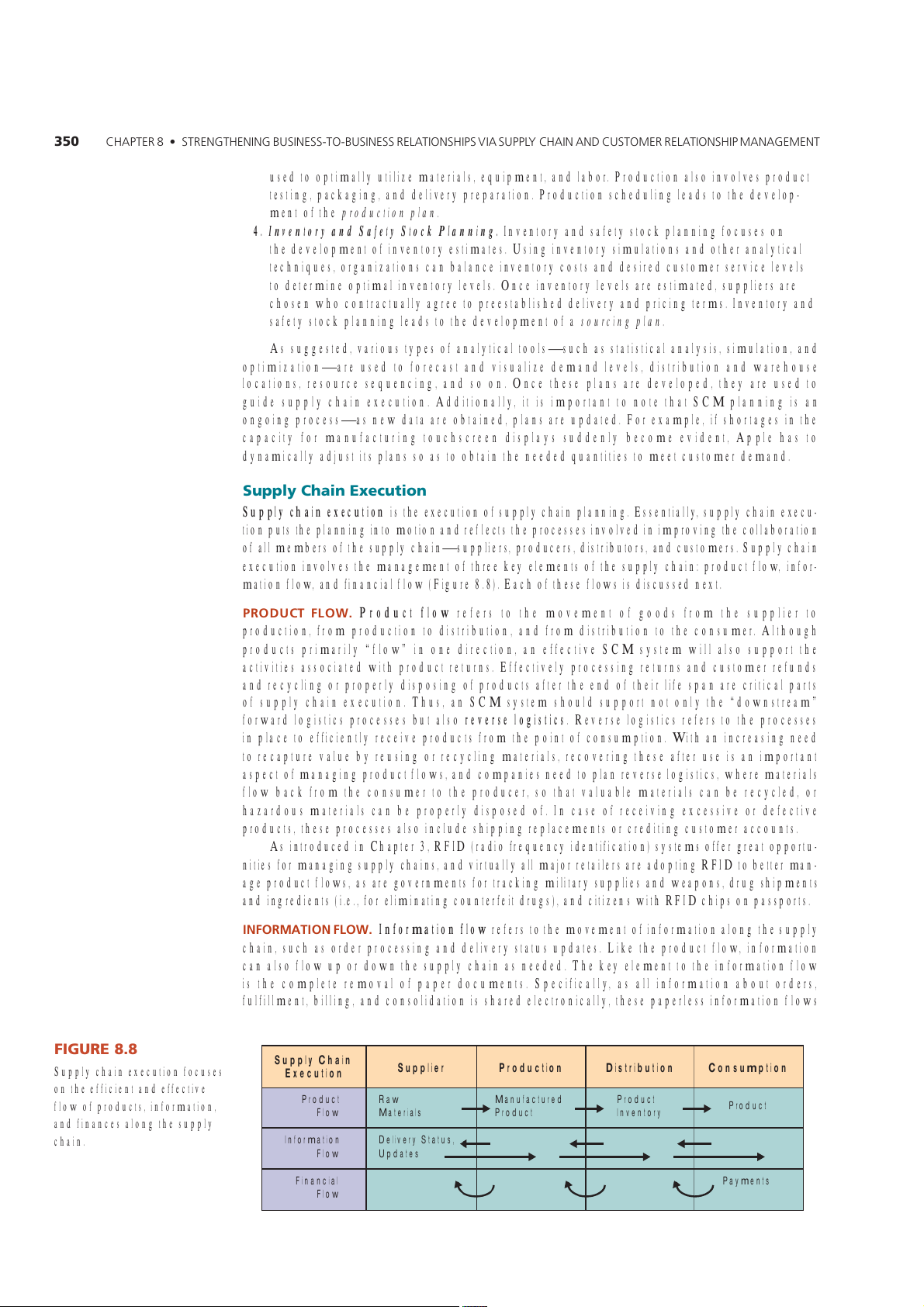
Supply chain execution is the execution of supply chain planning. Essentially, supply chain execu-
tion puts the planning into motion and reflects the processes involved in improving the collaboration
of all members of the supply chain—suppliers, producers, distributors, and customers. Supply chain
execution involves the management of three key elements of the supply chain: product flow, infor-
mation flow, and financial flow (Figure 8.8). Each of these flows is discussed next.
21 .1 Product flow refers to the movement of goods from the supplier to
production, from production to distribution, and from distribution to the consumer. Although
products primarily “flow” in one direction, an effective SCM system will also support the
activities associated with product returns. Effectively processing returns and customer refunds
and recycling or properly disposing of products after the end of their life span are critical parts
of supply chain execution. Thus, an SCM system should support not only the “downstream”
forward logistics processes but also reverse logistics. Reverse logistics refers to the processes
in place to efficiently receive products from the point of consumption. With an increasing need
to recapture value by reusing or recycling materials, recovering these after use is an important
aspect of managing product flows, and companies need to plan reverse logistics, where materials
flow back from the consumer to the producer, so that valuable materials can be recycled, or
hazardous materials can be properly disposed of. In case of receiving excessive or defective
products, these processes also include shipping replacements or crediting customer accounts.
As introduced in Chapter 3, RFID (radio frequency identification) systems offer great opportu-
nities for managing supply chains, and virtually all major retailers are adopting RFID to better man-
age product flows, as are governments for tracking military supplies and weapons, drug shipments
and ingredients (i.e., for eliminating counterfeit drugs), and citizens with RFID chips on passports.
11.1 Information flow refers to the movement of information along the supply
chain, such as order processing and delivery status updates. Like the product flow, information
can also flow up or down the supply chain as needed. The key element to the information flow
is the complete removal of paper documents. Specifically, as all information about orders,
fulfillment, billing, and consolidation is shared electronically, these paperless information flows 74 Supply Chain
Supply chain execution focuses Execution Supplier Production Distribution Consumption
on the efficient and effective Product Raw Manufactured Product
flow of products, information, Product Flow Materials Product Inventory and finances along the supply Information Delivery Status, chain. Flow Updates Financial Payments Flow
%264 r 5640)60+0)$75+05561$75+0554.6+105+258+5722.;%+00&%7561/44.6+105+2/0)/06
save not only paperwork but also time and money. Additionally, because SCM systems use a
central database to store data, all supply chain partners must continuously have access to the
most current data necessary for scheduling production, shipping orders, and so on.
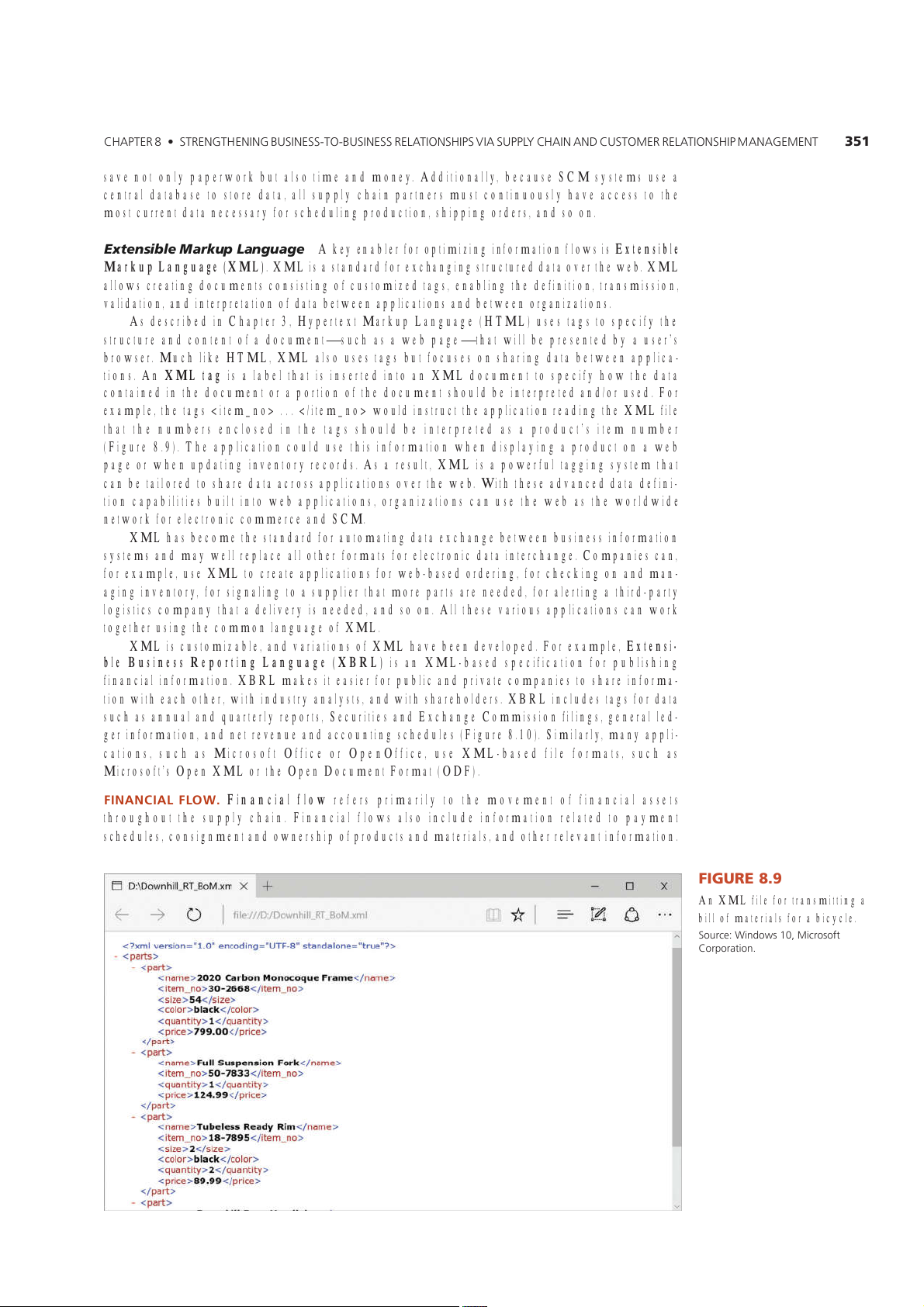
PCTMRCPC A key enabler for optimizing information flows is Extensible
Markup Language (XML). XML is a standard for exchanging structured data over the web. XML
allows creating documents consisting of customized tags, enabling the definition, transmission,
validation, and interpretation of data between applications and between organizations.
As described in Chapter 3, Hypertext Markup Language (HTML) uses tags to specify the
structure and content of a document—such as a web page—that will be presented by a user’s
browser. Much like HTML, XML also uses tags but focuses on sharing data between applica-
tions. An XML tag is a label that is inserted into an XML document to specify how the data
contained in the document or a portion of the document should be interpreted and/or used. For
example, the tags . . . would instruct the application reading the XML file
that the numbers enclosed in the tags should be interpreted as a product’s item number
(Figure 8.9). The application could use this information when displaying a product on a web
page or when updating inventory records. As a result, XML is a powerful tagging system that
can be tailored to share data across applications over the web. With these advanced data defini-
tion capabilities built into web applications, organizations can use the web as the worldwide
network for electronic commerce and SCM.
XML has become the standard for automating data exchange between business information
systems and may well replace all other formats for electronic data interchange. Companies can,
for example, use XML to create applications for web-based ordering, for checking on and man-
aging inventory, for signaling to a supplier that more parts are needed, for alerting a third-party
logistics company that a delivery is needed, and so on. All these various applications can work
together using the common language of XML.
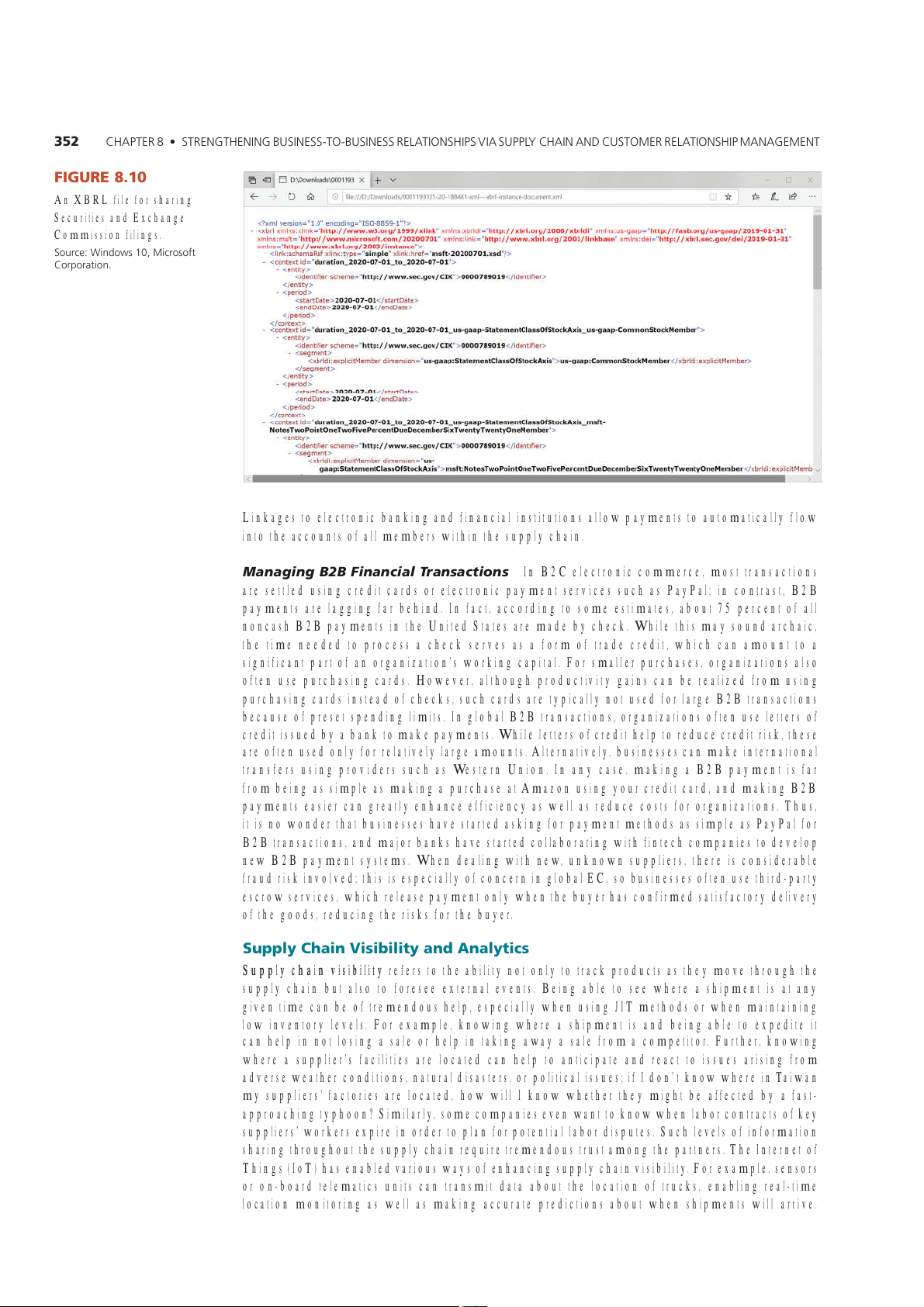
XML is customizable, and variations of XML have been developed. For example, Extensi-
ble Business Reporting Language (XBRL) is an XML-based specification for publishing
financial information. XBRL makes it easier for public and private companies to share informa-
tion with each other, with industry analysts, and with shareholders. XBRL includes tags for data
such as annual and quarterly reports, Securities and Exchange Commission filings, general led-
ger information, and net revenue and accounting schedules (Figure 8.10). Similarly, many appli-
cations, such as Microsoft Office or OpenOffice, use XML-based file formats, such as
Microsoft’s Open XML or the Open Document Format (ODF).
. .1 Financial flow refers primarily to the movement of financial assets
throughout the supply chain. Financial flows also include information related to payment
schedules, consignment and ownership of products and materials, and other relevant information. 74
An XML file for transmitting a
bill of materials for a bicycle.
5WTEG9KPFyu/KETuHv %TRTCvKP
%264 r 5640)60+0)$75+05561$75+0554.6+105+258+5722.;%+00&%7561/44.6+105+2/0)/06 74 An XBRL file for sharing Securities and Exchange Commission filings.
5WTEG9KPFyu/KETuHv %TRTCvKP
Linkages to electronic banking and financial institutions allow payments to automatically flow
into the accounts of all members within the supply chain.
CPCPPCPECTCPCEP In B2C electronic commerce, most transactions
are settled using credit cards or electronic payment services such as PayPal; in contrast, B2B
payments are lagging far behind. In fact, according to some estimates, about 75 percent of all
noncash B2B payments in the United States are made by check. While this may sound archaic,
the time needed to process a check serves as a form of trade credit, which can amount to a
significant part of an organization’s working capital. For smaller purchases, organizations also
often use purchasing cards. However, although productivity gains can be realized from using
purchasing cards instead of checks, such cards are typically not used for large B2B transactions
because of preset spending limits. In global B2B transactions, organizations often use letters of
credit issued by a bank to make payments. While letters of credit help to reduce credit risk, these
are often used only for relatively large amounts. Alternatively, businesses can make international
transfers using providers such as Western Union. In any case, making a B2B payment is far
from being as simple as making a purchase at Amazon using your credit card, and making B2B
payments easier can greatly enhance efficiency as well as reduce costs for organizations. Thus,
it is no wonder that businesses have started asking for payment methods as simple as PayPal for
B2B transactions, and major banks have started collaborating with fintech companies to develop
new B2B payment systems. When dealing with new, unknown suppliers, there is considerable
fraud risk involved; this is especially of concern in global EC, so businesses often use third-party
escrow services, which release payment only when the buyer has confirmed satisfactory delivery
of the goods, reducing the risks for the buyer.
5WRRNCP8UDNVCPFPCNVEU
Supply chain visibility refers to the ability not only to track products as they move through the
supply chain but also to foresee external events. Being able to see where a shipment is at any
given time can be of tremendous help, especially when using JIT methods or when maintaining
low inventory levels. For example, knowing where a shipment is and being able to expedite it
can help in not losing a sale or help in taking away a sale from a competitor. Further, knowing
where a supplier’s facilities are located can help to anticipate and react to issues arising from
adverse weather conditions, natural disasters, or political issues; if I don’t know where in Taiwan
my suppliers’ factories are located, how will I know whether they might be affected by a fast-
approaching typhoon? Similarly, some companies even want to know when labor contracts of key
suppliers’ workers expire in order to plan for potential labor disputes. Such levels of information
sharing throughout the supply chain require tremendous trust among the partners. The Internet of
Things (IoT) has enabled various ways of enhancing supply chain visibility. For example, sensors
or on-board telematics units can transmit data about the location of trucks, enabling real-time
location monitoring as well as making accurate predictions about when shipments will arrive.
%264 r 5640)60+0)$75+05561$75+0554.6+105+258+5722.;%+00&%7561/44.6+105+2/0)/06
Further, various sensors can provide valuable information about the condition of shipments
throughout all phases of the journey; temperature or humidity sensors can provide information
about whether sensitive goods have been kept within the correct temperature or humidity range,
or sensors or cameras can be used to send alerts if a shipment has been tampered with.
Supply chain analytics refers to the use of key performance indicators to monitor perfor-
mance of the entire supply chain, including sourcing, planning, production, and distribution. For
example, a purchasing manager can identify the suppliers that are frequently unable to meet
promised delivery dates. Being able to access key performance metrics can help to identify and
remove bottlenecks, such as by switching suppliers, spreading orders over multiple suppliers,
expediting shipping for critical goods, and so on. With the increase in available data from a vari-
ety of sources, ranging from IoT sensors used in logistics to Industrial Internet of Things (IIoT)
sensors used in manufacturing to news reports about global events, Big Data analytics plays an
increasingly important role in optimizing supply chains.
CPCIPI5WRRNCPU7UPINEMECP6GEPNI
Among the biggest challenges of managing complex supply chains are lack of transparency,
difficulties in connecting different vendors and suppliers, and difficulties in investigating suppli-
ers’ legal or ethical issues. One development that has been touted as revolutionizing information
flows in supply chains is blockchain technology. As discussed in Chapter 4, “Enabling Business-
to-Consumer Electronic Commerce,” a blockchain is a distributed public ledger, on which all
transactions are recorded as blocks; Bitcoin is the most well-known example of a cryptocurrency
based on blockchain technology. As each block is linked to the previous and the following block,
and as the ledger is distributed across numerous computers, blockchains are highly resilient
against tampering. In addition, there is no need for central authorities coordinating or ensuring
the veracity of transactions, and the elimination of the need for trusted middlemen allows for
transactions to be triggered and executed automatically.
Given these benefits, blockchains are often regarded as being highly secure and helping
increase efficiency and transparency, and many organizations are actively exploring ways in
which blockchain technology can be used for improving supply chains. A primary application is
smart contracts, where transactions and funds transfers are executed automatically if a certain
condition is met. Another promising application is tracing products from the source. For exam-
ple, De Beers, the world’s largest producer of diamonds, uses blockchain technology to track the
movement of diamonds from the point of mining to the store. This allows tracing the origins of
the diamonds, assuring customers that the diamonds are genuine, and helping the company avoid
purchasing or selling diamonds of questionable origin (e.g., “blood diamonds”). Likewise, large
food and retail companies (such as Walmart) experiment with the use of blockchains to trace the
origins of the produce from farm to store, in an attempt to minimize issues related to food safety
or to guarantee the origins of organic foods.
Yet critics of blockchain technology point out that blockchains cannot solve some of the
underlying problems in supply chains. Whereas blockchains are often lauded for their potential
to eliminate the need for trust, this need for trust does not actually disappear; rather than trusting
others, we will have to trust software, which is even more difficult to understand than other
humans. Likewise, except when data is automatically entered (e.g., using IoT sensors), we still
have to trust that someone entered the data correctly; if a producer of organic mangoes uses for-
bidden pesticides, using a blockchain will not resolve this issue (and tracking items that are not
physically unique will not be magically made possible by using blockchain). Even if data are
automatically captured and entered, we still must trust the manufacturer of the sensor, the soft-
ware vendor, and so on (and by now, we know that virtually no software is without bugs). As
usual, the old adage applies, “garbage in, garbage out.” Bad data quality cannot be overcome
merely by using blockchain technology. Another drawback that directly results from one of
blockchain’s biggest benefits is the irreversibility of transactions. Once a transaction is executed,
there is no way to reverse it, and without a trusted middleman, organizations have no recourse in
case something goes wrong (intentionally or unintentionally). Finally, while smart contracts do
not take the form of lengthy unintelligible legal documents, smart contracts still need to be
audited, and software code is much more difficult to audit than contract policies written in Eng-
lish. In sum, blockchain technology offers much potential (and is greatly hyped up by consulting
companies jumping on the blockchain bandwagon), but only time will tell if it will indeed revo-
lutionize supply chain management.
%264 r 5640)60+0)$75+05561$75+0554.6+105+258+5722.;%+00&%7561/44.6+105+2/0)/06
WUVQOGTGNCVKQPUJKRCPCIGOGPV
With the changes introduced by the web, in most industries a company’s competition is simply a
mouse click away. It is increasingly important for companies not only to generate new business
but also to attract repeat business from existing customers. This means that, to remain competi-
tive, companies must keep their customers satisfied. In today’s highly competitive markets, cus-
tomers hold the balance of power; if customers become dissatisfied with the levels of customer
service they are receiving, they have many alternatives readily available.
It is important to note that customers are not just the end consumer but also other businesses
in B2B transactions. As mentioned earlier, B2B e-commerce is many times larger than business-
to-consumer (B2C) e-commerce. So, any rules or best practices for keeping customers happy
apply to not only retailers but also any company within a supply chain. In the past, companies
would try to establish long-term relationships with business customers, and establishing rela-
tionships with end customers was virtually impossible, especially for large companies. Today,
the emphasis has shifted from conducting business transactions to managing relationships even
when dealing with individual customers. If a company successfully manages its relationships
with customers—satisfying them and solving their problems—then customers are less price sen-
sitive. Hence, leveraging and managing customer relationships is equally as important as prod-
uct development. Indeed, customer relationship management systems often collect data that can
be mined to discover the next product line extension that customers covet.
The increasing digital density and the rise in the use of social media, Big Data, cloud com-
puting, and IoT have tremendously changed the way organizations need to interact with their
customers. Some researchers argue that we have moved from the internet age to the age of the
customer. The age of the customer is characterized by customers being part of social circles and
being increasingly empowered by social media (Figure 8.11). For example, customers have
much more access to information from various sources; at the same time, customers’ word of
mouth can be spread anywhere, anytime using mobile devices and has a much wider reach
through social media such as blogs, Twitter, or Facebook. This can pose tremendous challenges
for organizations trying to present and maintain a positive public image, as unmonitored conver-
sations can have huge negative impacts, and monitoring and participating in ongoing conversa-
tions can be an important part of shaping public opinion. In addition, companies face significant
changes in the competitive landscape. For example, the internet has freed customers from having
to purchase goods locally and has thus lowered the barriers to entry for potential rivals. Simi-
larly, many products have been replaced or marginalized by digital substitutes. The power of
buyers has increased, as people can quickly and easily find information, reviews, or prices at a
competitor’s store. At the same time, employees, an important source of supply, have more
mobility and thus have higher power. Last but not least, not only one’s customers but also one’s
competitors have tremendous amounts of information about one’s products (and their strengths
and weaknesses) available at their fingertips and can more easily predict one’s next strategic
move. Thus, businesses must rethink their interactions with customers; rather than seeing cus-
tomers as a passive audience, organizations must engage in conversations with their customers.
In their attempts to engage with customers and build long-lasting relationships, organizations are 74 Blogs Today’s empowered custom- ers have many ways to obtain and spread information and Online Product Video-Sharing Reviews Sites opinions about companies. Search Engines Social Networks Price Comparison Microblogs Sites Customers
%264 r 5640)60+0)$75+05561$75+0554.6+105+258+5722.;%+00&%7561/44.6+105+2/0)/06 COMING ATTRACTIONS
Augmenting Supply Chain Success
+PvJGHKnoPTVGRTV6o%TWKuGWuGFIGuvWTGu
JGCFuWRFKuRnC[PJyvouvGHHKEKGPvn[CTTCPIGECTI
CPFPCvWTCnnCPIWCIGvKPvGTCEvyKvJCHWvWTKuvKEEoRWvGT
IKGPvJGuK\GFKoGPuKPCPFyGKIJvHvJGKvGou9JGP
vJCv FKuRnC[GF KPHToCvKP P oCuuKG uETGGPu vJCv uWT
FGnKGTKPIKvGou4ECPRTKFGoTGvJCPyKFGn[WuGF)25
TWPFGFJKo6FC[uWEJKPvGTCEvKPKuPnPIGTuEKGPEGHKE
PCKICvKPd[RTKFKPICJGCFuWRyKPFuJKGnFFKuRnC[yKvJ
vKP dWv uEKGPEG HCEv WIoGPvGF TGCnKv[ 4 TGHGTu v
TGCnvKoGvTCHHKECPCn[uKuuTGTWvKPIECPEEWTPvJG Hn[
KPvGTCEvKPuKPCnKGFKTGEvTKPFKTGEvKGyHCRJ[uKECnTGCn
yKvJWvCP[KPvGTCEvKPuvJCvoKIJvFKuvTCEvvJGFTKGTFFK
yTnFGPKTPoGPvvJCvKuCWOGPVGFTuWRRnGoGPvGFd[
vKPCnKPHToCvKPCdWvvJGECTIECPCnudGRTKFGFKH
EoRWvGTIGPGTCvGFuGPuT[ KPRWvuWEJ Cu uWPF KFG
PGGFGFGIvGoRGTCvWTGuGPuKvKGKvGouPFvJGdGuvRCTv
ITCRJKEuT)25FCvC8KuWCnKPHToCvKPHTGCoRnGECP
HvJKuKuvJCvyTMGTuWuKPI4uWRRTv yKnn HGGnnKMG 6o
dGRTGuGPvGFPRvKECnRTlGEvKPu[uvGouoPKvTuJCPF
%TWKuGKPPTVGRTV
JGnFFGKEGuCPFuP5WEJKPHToCvKPECPdGRTKFGFP $CuGFP
CJGCFuWRFKuRnC[WuKPICJGCFuGvTG[GInCuuGuTdGRT
CTvu2WIWuv4GFGHKPKPIvJGuWRRn[EJCKP+PPCvKG4
lGEvGFPvnCTIGuETGGPuTGGPCGJKEnGuyKPFuJKGnF
84CRRTCEJGuCPCPEWGFDNVTWPG4GvTKGGF,WPG
/CP[ dGnKGG vJCv 4 Ku IKPI v vTCPuHTo CTKWu
HToJvvRuyyyTWIIGFodKnKv[HTdWuKPGuuEo
CuRGEvuHuWRRn[EJCKPoCPCIGoGPv(TGCoRnGCPKoRT
TGFGHKPKPIvJGuWRRn[EJCKPKPPCvKGCTTCRRTCEJGu
vCPvRCTvHCuuGodnKPITRCEMKPITFGTuKuvJGRKEMKPIRT
WIoGPvGFTGCnKv[,Wn[+PMRGFCGTGGPEENRG
EGuu yJGTG C JWoCP pRKEMuq EoRPGPvuT EoRnGvGF
FC4GvTKGGF,Wn[HToJvvRuGPyKMKRGFKCTIyKPFG
KvGouHTCuuGodn[TFGnKGT[4ECPCnnyGCEJRKEMGTv
RJR!vKvnGWIoGPvGFATGCnKv[nFKF
uGGCpFKIKvCnRCEMKPInKuvqPCJGCFuWRFKuRnC[9JGPCP
KIIKPu / &GEGodGT 5WRRn[ EJCKP 4 vGEJPnI[
KvGoKuuGnGEvGFKPC yCTGJWuGvJGJGCFuWRFKuRnC[ ECP
KuJGTG CPFKvuGEKvKPI TDG4GvTKGGF,WPGHTo
vJGPuJyvJGouvGHHKEKGPvRCvJvvJGPGvKvGovRKEM
JvvRuyyyHTdGuEouKvGuHTdGuvGEJEWPEKn
uWRRn[EJCKPCTvGEJPnI[KuJGTGCPFKvuGEKvKPI
IWKFKPIvJGRGTuPRGTHGEvn[vvJGPGvuvGRKPvJGRTEGuu
8KTvWCnn[PoKuvCMGuToKuuvGRuCTGoCFG1PEGRTFWEvu
5GyCTF4 /C[WIoGPvGFTGCnKv[ 4KuvJG HWvWTG
H vJG uWRRn[ EJCKP WRRN CP COG CPGT 4GvTKGGF
CTGEnnGEvGFvdGuJKRRGF4ECPCnuCKFKPnCFKPIEP
,W PG HT o Jvv Ru uWRRn[EJCKPI CoGEJCPIGTE o
vCKPGTuCPFvTWEMud[RTKFKPIuvGRd[uvGRKPuvTWEvKPuPC
CWIoGPvGFTGCnKv[CTHWvWTGuWRRn[EJCKP
increasingly utilizing cloud-based systems and Big Data to better understand their customers
and predict their needs and desires. Likewise, the IoT serves as a source for additional data not
only about customers but also about their usage of products and can offer various opportunities
to offer customers better value.
Many of the world’s most successful corporations have realized the importance of develop-
ing and nurturing relationships with their customers. For example, Starbucks Coffee uses a vari-
ety of means to engage with its customers. Like many other businesses, Starbucks uses a loyalty
card to entice people to return to its stores; further, Starbucks actively solicits feedback and new
product ideas from its customers, not only within the stores but also via its open innovation plat-
form https://ideas.starbucks.com , and it has one of the most successful fan pages on Facebook.
Computer manufacturer Dell, in contrast, has different needs when interacting with its custom-
ers. For instance, when Dell sales representatives are dealing with large corporate clients that
routinely make large computer purchases, issues of quantity pricing and delivery are likely to be
paramount, whereas when dealing with less-computer-savvy individuals ordering a new note-
book for personal use, questions about compatibility with an older printer or the ability to run a
specific program may be asked. No matter the customer, Dell attempts to provide all customers
with a positive experience during both the presale and the ongoing support phases. Large banks
and insurance companies are trying to widen and deepen relationships with customers in order
to sell more financial services and products, maximizing the lifetime value of each individual
customer. Chase Card Services, for example, has more than 4,000 agents handling 200 million
customer calls a year. Being able to increase first-call resolution (sometimes referred to as first-
contact resolution), that is, addressing the customers’ issues during the first contact, can help to
save costs tremendously while increasing customer satisfaction.
Marketing researchers have found that the cost of trying to win back customers who have
gone elsewhere can be up to 50 to 100 times as much as keeping a current one satisfied. Thus,
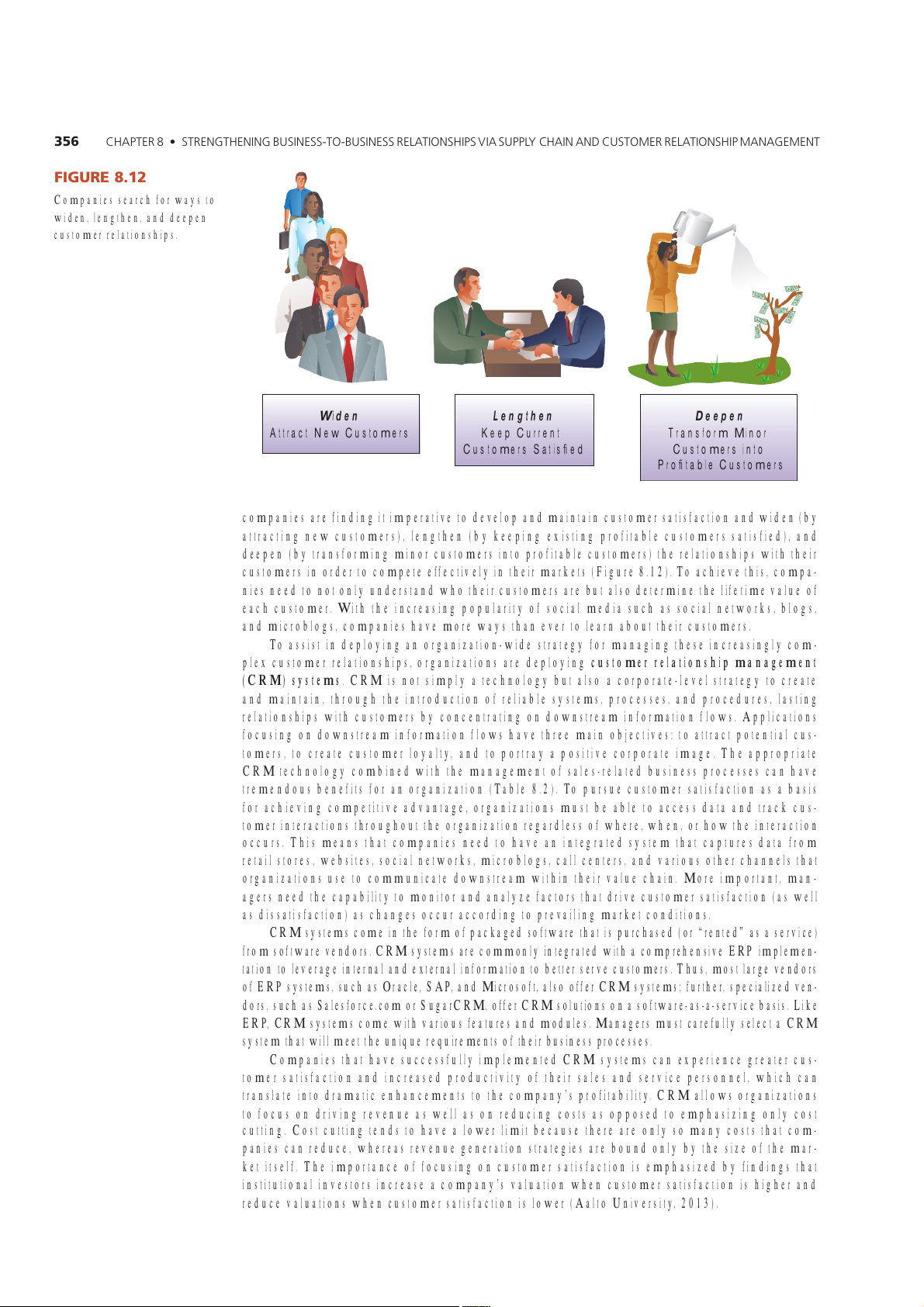
%264 r 5640)60+0)$75+05561$75+0554.6+105+258+5722.;%+00&%7561/44.6+105+2/0)/06 74 Companies search for ways to widen, lengthen, and deepen customer relationships. Widen Lengthen Deepen Attract New Customers Keep Current Transform Minor Customers Satisfied Customers into Profitable Customers
companies are finding it imperative to develop and maintain customer satisfaction and widen (by
attracting new customers), lengthen (by keeping existing profitable customers satisfied), and
deepen (by transforming minor customers into profitable customers) the relationships with their
customers in order to compete effectively in their markets (Figure 8.12). To achieve this, compa-
nies need to not only understand who their customers are but also determine the lifetime value of
each customer. With the increasing popularity of social media such as social networks, blogs,
and microblogs, companies have more ways than ever to learn about their customers.
To assist in deploying an organization-wide strategy for managing these increasingly com-
plex customer relationships, organizations are deploying customer relationship management
(CRM) systems. CRM is not simply a technology but also a corporate-level strategy to create
and maintain, through the introduction of reliable systems, processes, and procedures, lasting
relationships with customers by concentrating on downstream information flows. Applications
focusing on downstream information flows have three main objectives: to attract potential cus-
tomers, to create customer loyalty, and to portray a positive corporate image. The appropriate
CRM technology combined with the management of sales-related business processes can have
tremendous benefits for an organization (Table 8.2). To pursue customer satisfaction as a basis
for achieving competitive advantage, organizations must be able to access data and track cus-
tomer interactions throughout the organization regardless of where, when, or how the interaction
occurs. This means that companies need to have an integrated system that captures data from
retail stores, websites, social networks, microblogs, call centers, and various other channels that
organizations use to communicate downstream within their value chain. More important, man-
agers need the capability to monitor and analyze factors that drive customer satisfaction (as well
as dissatisfaction) as changes occur according to prevailing market conditions.
CRM systems come in the form of packaged software that is purchased (or “rented” as a service)
from software vendors. CRM systems are commonly integrated with a comprehensive ERP implemen-
tation to leverage internal and external information to better serve customers. Thus, most large vendors
of ERP systems, such as Oracle, SAP, and Microsoft, also offer CRM systems; further, specialized ven-
dors, such as Salesforce.com or SugarCRM, offer CRM solutions on a software-as-a-service basis. Like
ERP, CRM systems come with various features and modules. Managers must carefully select a CRM
system that will meet the unique requirements of their business processes.
Companies that have successfully implemented CRM systems can experience greater cus-
tomer satisfaction and increased productivity of their sales and service personnel, which can
translate into dramatic enhancements to the company’s profitability. CRM allows organizations
to focus on driving revenue as well as on reducing costs as opposed to emphasizing only cost
cutting. Cost cutting tends to have a lower limit because there are only so many costs that com-
panies can reduce, whereas revenue generation strategies are bound only by the size of the mar-
ket itself. The importance of focusing on customer satisfaction is emphasized by findings that
institutional investors increase a company’s valuation when customer satisfaction is higher and
reduce valuations when customer satisfaction is lower (Aalto University, 2013).
%264 r 5640)60+0)$75+05561$75+0554.6+105+258+5722.;%+00&%7561/44.6+105+2/0)/06
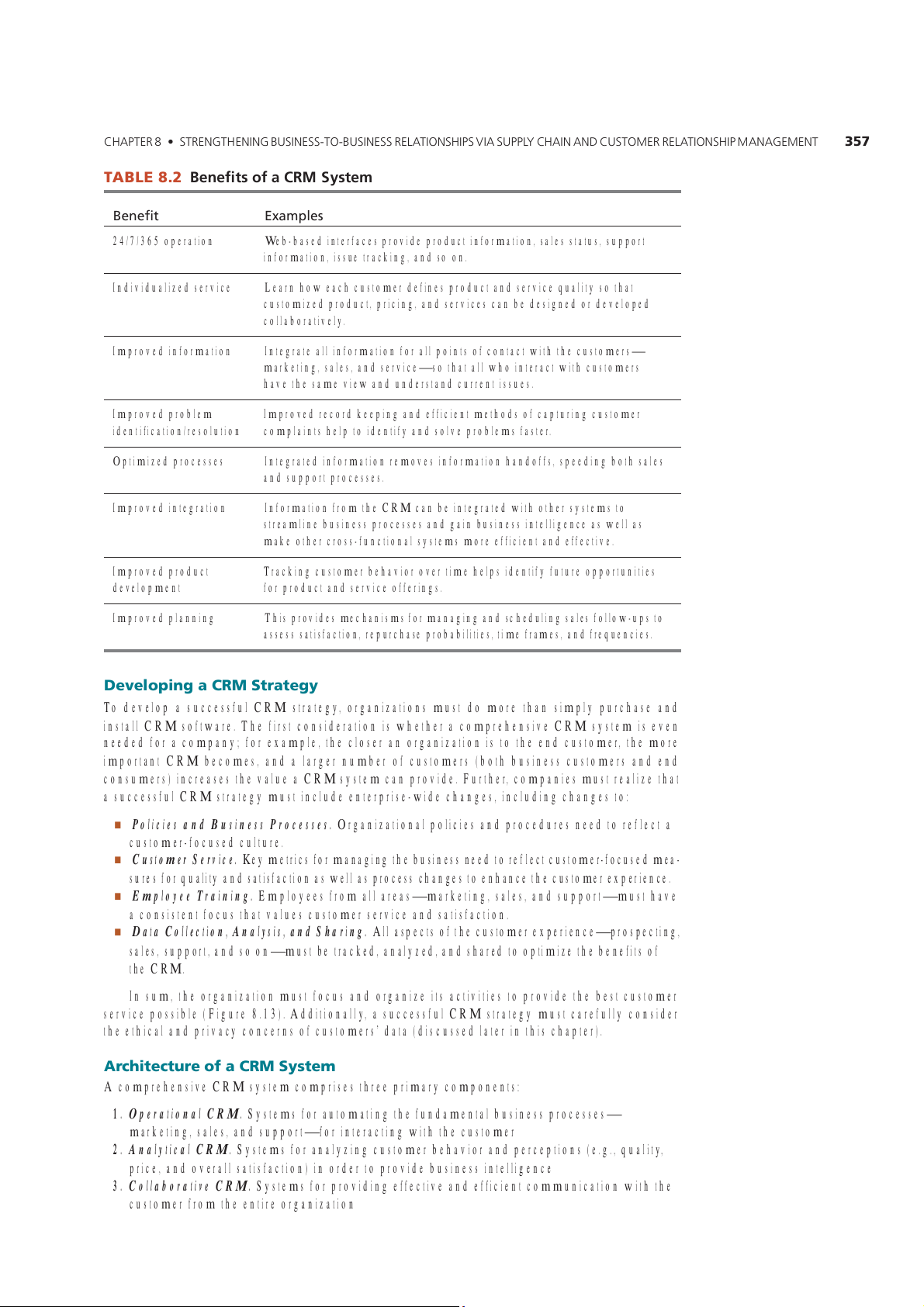
6. GPGHKVUQHCUVGO $HK CORU 24/7/365 operation
Web-based interfaces provide product information, sales status, support
information, issue tracking, and so on. Individualized service
Learn how each customer defines product and service quality so that
customized product, pricing, and services can be designed or developed collaboratively. Improved information
Integrate all information for all points of contact with the customers—
marketing, sales, and service—so that all who interact with customers
have the same view and understand current issues. Improved problem
Improved record keeping and efficient methods of capturing customer identification/resolution
complaints help to identify and solve problems faster. Optimized processes
Integrated information removes information handoffs, speeding both sales and support processes. Improved integration
Information from the CRM can be integrated with other systems to
streamline business processes and gain business intelligence as well as
make other cross-functional systems more efficient and effective. Improved product
Tracking customer behavior over time helps identify future opportunities development
for product and service offerings. Improved planning
This provides mechanisms for managing and scheduling sales follow-ups to
assess satisfaction, repurchase probabilities, time frames, and frequencies.
GGNRPIC45VTCVGI
To develop a successful CRM strategy, organizations must do more than simply purchase and
install CRM software. The first consideration is whether a comprehensive CRM system is even
needed for a company; for example, the closer an organization is to the end customer, the more
important CRM becomes, and a larger number of customers (both business customers and end
consumers) increases the value a CRM system can provide. Further, companies must realize that
a successful CRM strategy must include enterprise-wide changes, including changes to:
■ Policies and Business Processes. Organizational policies and procedures need to reflect a customer-focused culture.
■ Customer Service. Key metrics for managing the business need to reflect customer-focused mea-
sures for quality and satisfaction as well as process changes to enhance the customer experience.
■ Employee Training. Employees from all areas—marketing, sales, and support—must have
a consistent focus that values customer service and satisfaction.
■ Data Collection, Analysis, and Sharing. All aspects of the customer experience—prospecting,
sales, support, and so on—must be tracked, analyzed, and shared to optimize the benefits of the CRM.
In sum, the organization must focus and organize its activities to provide the best customer
service possible (Figure 8.13). Additionally, a successful CRM strategy must carefully consider
the ethical and privacy concerns of customers’ data (discussed later in this chapter).
TEVGEVWTGC45UVGO
A comprehensive CRM system comprises three primary components:
1. Operational CRM. Systems for automating the fundamental business processes—
marketing, sales, and support—for interacting with the customer
2. Analytical CRM. Systems for analyzing customer behavior and perceptions (e.g., quality,
price, and overall satisfaction) in order to provide business intelligence
3. Collaborative CRM. Systems for providing effective and efficient communication with the
customer from the entire organization
Tài liệu liên quan:
-
Giáo trình logistic về quản trị logistics
7 4 -

Chương 3 Đóng gói và vân chuyển - Mối quan hệ giữa đóng gói và vận chuyển trong logistics môn Logistics | Trường Đại học Kinh tế, Đại học Quốc gia Hà Nội
31 16 -
Yếu Tố: Các Quy Định Mà Tổ Chức Tuân Thủ môn logistics | Trường Đại học Kinh tế, Đại học Quốc gia Hà Nội
27 14 -
Mối liên hệ giữa Logistics và Vận tải đa phương thức môn Logistics | Trường Đại học Kinh tế, Đại học Quốc gia Hà Nội
38 19 -
E-Business & E-Commerce: Managing eCustomer Relationships | Logistics | Trường Đại học Kinh tế, Đại học Quốc gia Hà Nội
38 19