907636235-JTE-Template-Eng-06-2025
Jte template
Môn: Công nghệ kỹ thuật điện 11 tài liệu
Trường: Trường Đại học Sư phạm Kỹ thuật Thành phố Hồ Chí Minh 4.3 K tài liệu
Tác giả:




Preview text:
JOURNAL OF TECHNICAL EDUCATION SCIENCE
Ho Chi Minh City University of Technology and Education Website: https://jte.edu.vn Email: jte@hcmute.edu.vn ISSN: 2615-9740
Title of the Paper in English, Be Concise, Specific and Relevant, Bold, Times New Roman, Size 13
Full name (in English Order: EO; for example: Van Teo Tran NOT Tran Van Teo) of first author1* ,
Full name (in EO) of second author2, Full name (in EO) of third author1
1Affiliation for first author (just write the name of the university and the country, for example: Ho Chi Minh City University
of Technology and Education, Vietnam)
2 Affiliation for second author (more detailed information such as department, faculty, or the university's address should not
be provided here, but in the authors’ biography section)
* Corresponding author. Email: abc@xyz.com ARTICLE INFO ABSTRACT Received:
The abstract must include from 150 to 250 words, NOT include formatted
equations. The abstract should be a single paragraph, without Revised:
abbreviations, comments and references (If references are required, enter Accepted:
the authors name and year in brackets single). It should follow the style of
structured abstracts, but without headings and numberings, including the Published:
following aspects: 1) Questions and purpose of the study 2) Research KEYWORDS
methods: Describe the way/method to solve the problem(s), such as
develop theory/ methods of data collection, data processing... 3) Results: Keyword 1;
Summarize the articles main findings, including data that may be taken as Keyword 2;
essential remarks of the study. The results must be presented in the way
that answers the research questions proposed. 4) Conclusion: One or two Keyword 3;
sentences to conclude the research results and their possible applications. Keyword 4;
The abstract must provide information briefly but include data to illustrate Keyword 5.
and get straight to the point. Keywords: immediately after the abstract;
provide a minimum of 5 keywords; avoiding general and plural terms and
multiple concepts (avoid, for example, 'and', 'of'); be sparing with
abbreviations (only abbreviations firmly established in the field may be
eligible). These keywords will be used for indexing purposes, separated by a semicolon, end by a dot.
Doi: https://doi.org/10.54644/jte.2025.1777
Copyright © JTE. This is an open access article distributed under the terms and conditions of the Creative Commons Attribution-NonCommercial 4.0
International License which permits unrestricted use, distribution, and reproduction in any medium for non-commercial purpose, provided the original work is properly cited. 1. Introduction
This article template let you quickly format your article and help with the placement of specific
elements, such as title, author list, abstract, keywords and the paper structure. It would be noted that all
manuscripts must contain the essential elements needed to convey your manuscript, including Abstract,
Keywords, Introduction, Materials and Methods, Results and Discussions, Conclusions, and References.
The follow specific requirements of layout format are as below:
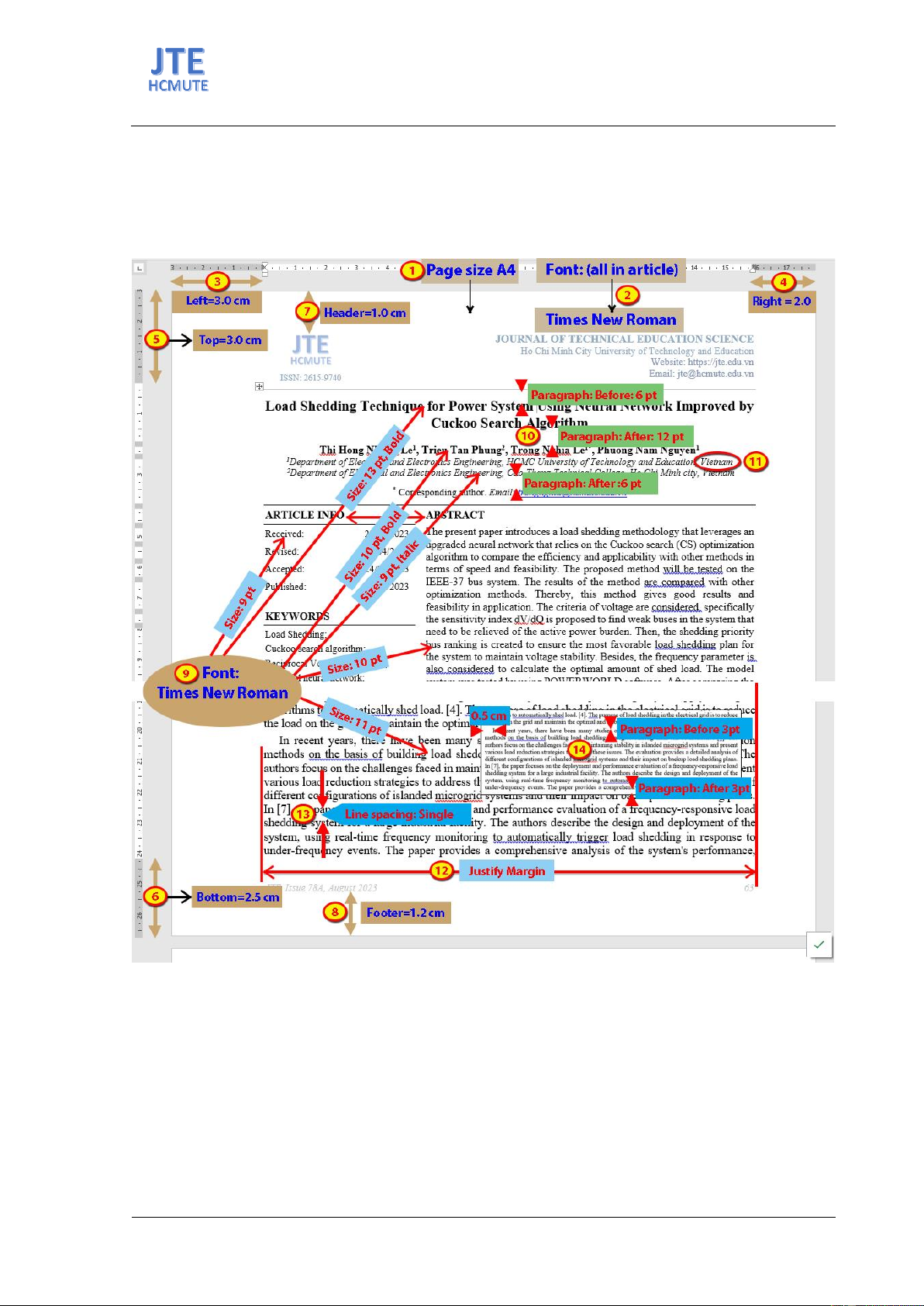
- The layout must be set in A4 size, portrait layout, with specific Page Setup parameters as follows:
Top: 3.0 cm, Bottom: 2.5 cm, Left: 3.0 cm, Right: 2.0 cm, Header from Top: 1.0 cm, Footer from
Bottom: 1.2 cm. Article content is set in 11-point Times New Roman, no larger or smaller in size; line
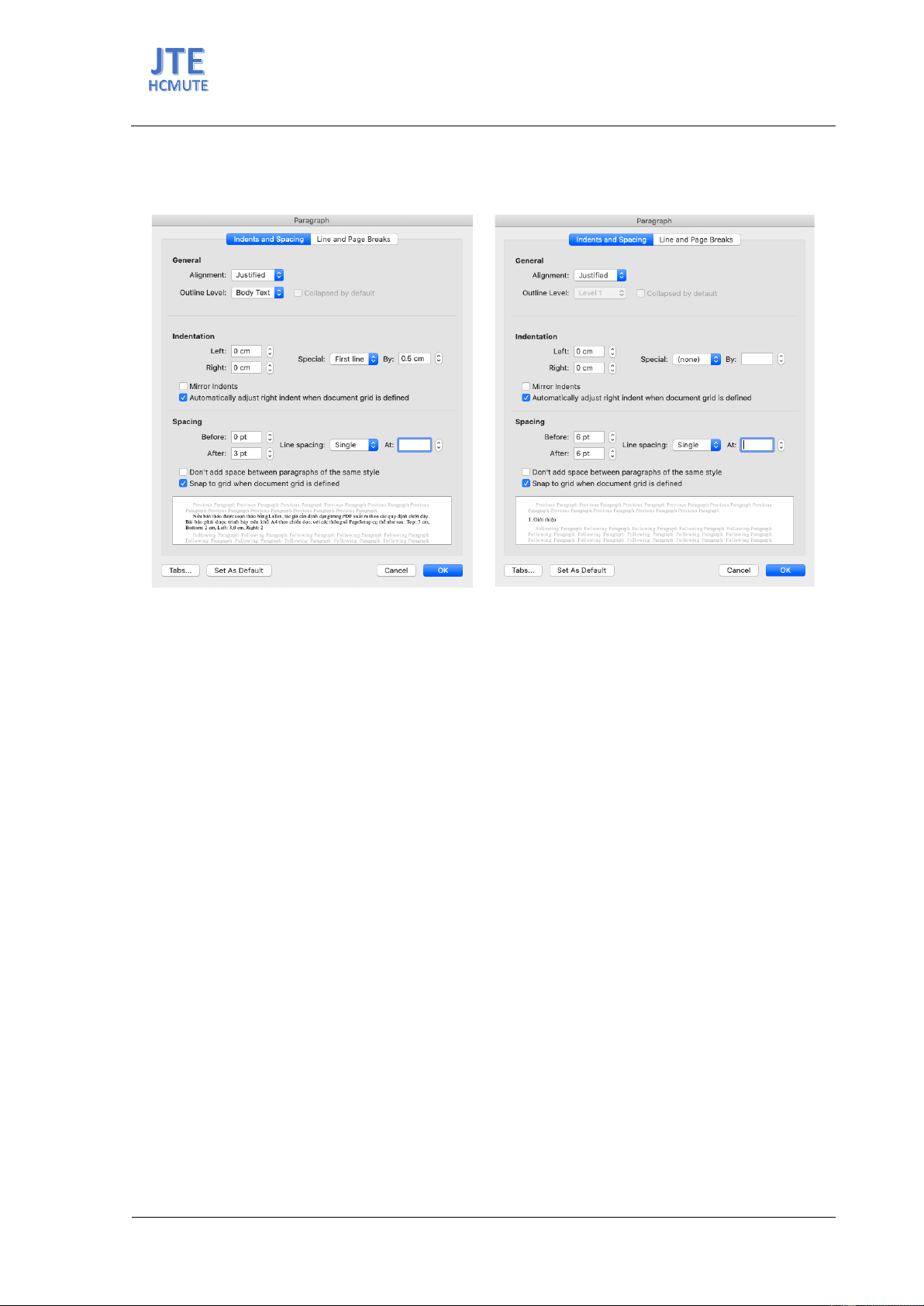
spacing: single, before 0; after 3; justified margin. The Headings of any sections must set the line
spacing: single, before 6; after 6. See Figure 1, 2 for reference.
All manuscripts must satisfy the requirements as below. The capacity of each article must not
exceed ten (10) pages (exclude the authors biography).
The article must be written in the IMRAD structure (Introduction – Methods/Materials – Results –
And Discussion). IMRAD structure is a unique, standard structure in international scientific community.
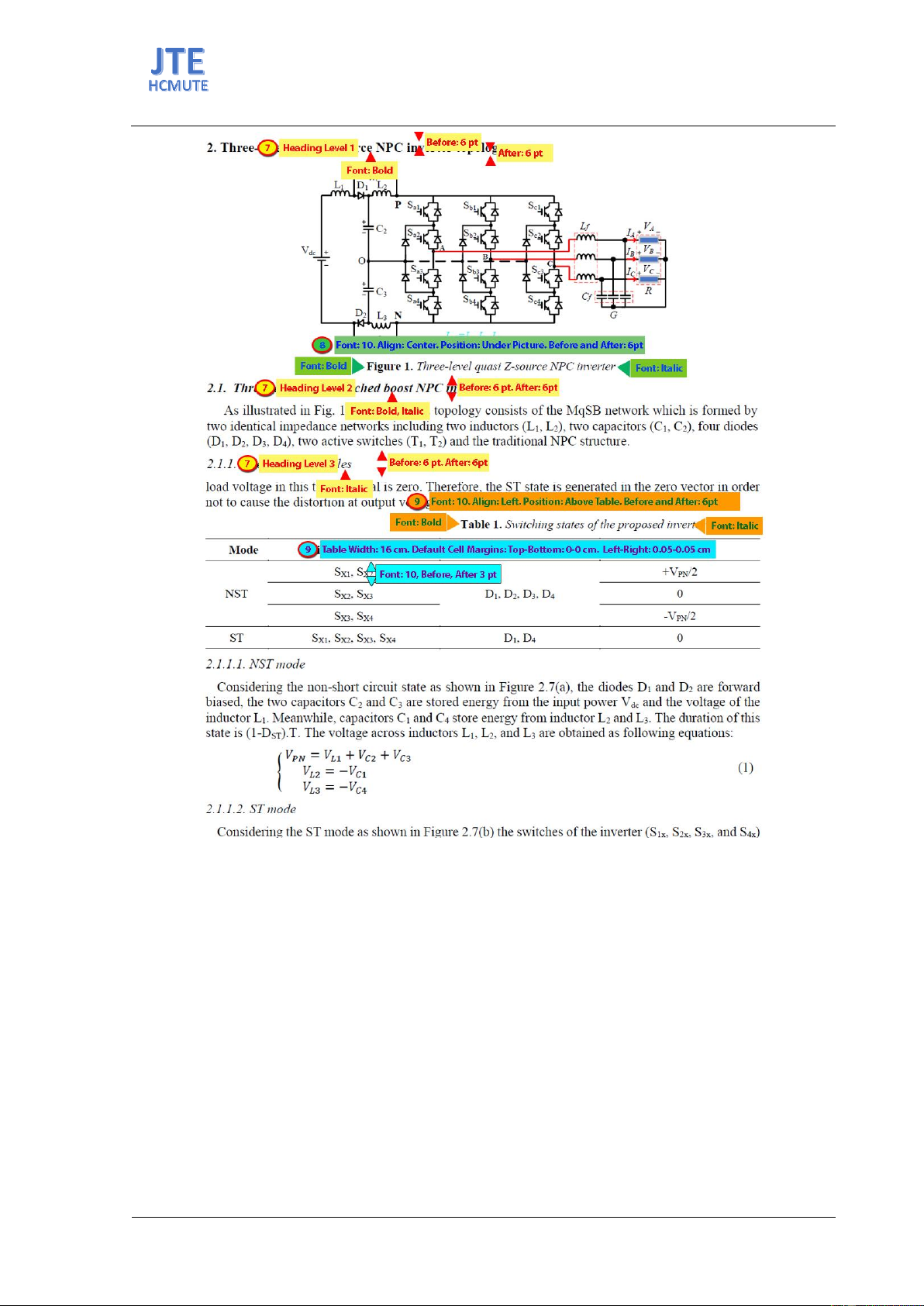
Heading of major sections (Heading level 1) is in Bold; Heading level 2 is in Bold, Italic; Heading level
3 is in Italic. All of them have the font size of 11 pts.
Note: Do not use the automatic numbering. The number of heading levels should not exceed three.
JTE, Volume xx, (Special) Issue xx, mm/20xx 1
JOURNAL OF TECHNICAL EDUCATION SCIENCE
Ho Chi Minh City University of Technology and Education Website: https://jte.edu.vn Email: jte@hcmute.edu.vn ISSN: 2615-9740
The “Introduction” section should briefly place the study in a broad context and highlight why it is
important. It should define the purpose of the work and its significance, including specific hypotheses
being tested. The current state of the research field should be reviewed carefully and key publications
cited. Finally, briefly mention the main aim of the work and highlight the main conclusions. The
structure of the Introduction part should be arranged as follows.
Figure 1. Guidelines of page set up, font name and size, of paragraph margin and spacing.
Initially, it should briefly place the study in a broad context. If necessary, use 1-2 sentences to
summarize the basic knowledge related to research problem. Point out research problem in a specific,
concise manner. Next, through briefly summarizing the most recently published related studies,
highlight knowledge gap needed to be added to complete solution for the research problem. Published
related studies which are introduced must include citations and references. Citations should not be
very few. Limited in number of citations could be understood that either the problem is not important
so little people are interest in, or the author refuses to find out how the problem has been addressed and
what knowledge gaps are. Many scientists recommend that the minimum number of citations should
equal to the number of pages in a scientific report. The Journal of Technical Education Science
JTE, Volume xx, (Special) Issue xx, mm/20xx 2
JOURNAL OF TECHNICAL EDUCATION SCIENCE
Ho Chi Minh City University of Technology and Education Website: https://jte.edu.vn Email: jte@hcmute.edu.vn ISSN: 2615-9740
encourages authors to prioritize citations from articles published in the Journal and articles published in
international reputable journals such as WoS, Scopus, etc. Citing from textbooks should be limited. It is
acceptable only when the authors have to use basic knowledge/ formulas in textbooks to develop theory
or apply to calculate in research. (a) (b)
Figure 2. Paragraph setup for (a): Content text and (b) Heading of any section
Thirdly, briefly describe the ways and outcomes to address the stated problem. Also, it would be
good to briefly describe structure of the article.
2. Materials and Methods
This part should be described in detail the ways or methods, materials, devices necessary to solve the
research problems. They should be described with sufficient detail so that other researchers can replicate
and build on published results. New methods and protocols should be described in detail while well-
established methods can be briefly described and appropriately cited. The approach might be by
theoretical developing, empirical researching, surveying, etc. Applied approach should be explained the
advantages and, if possible, be compared with previous studies. In the case of theoretical developing
research, it should be present theoretical bases to find out solution to research problems.
3. Results and Discussion
This section shows the results obtained from doing research. Images or tables could be used to
illustrate the results and support for discussions. Authors should discuss the results and how they can be
interpreted in perspective of previous studies and of the working hypotheses. The findings and their
implications should be discussed in the broadest context possible and limitations of the work
highlighted. Future research directions may also be mentioned.
If necessary, one part of the article might be divided into several sections. It is possible to provide
information introducing small parts between the main heading of the section and the subheading.
Subheadings (Heading level 2) are in size 11, Bold and Italic as following.
3.1. Abbreviation
Long and frequently used terms could be abbreviated. These terms must be fully displayed at the first
time they appear in the article, accompanied by notation put in parentheses and used consistently
thereafter. For example, “Science and technology development orientations (S&T) have played a role
...". Please do not use abbreviations in the title and abstract, unless they are unavoidable.
JTE, Volume xx, (Special) Issue xx, mm/20xx 3
JOURNAL OF TECHNICAL EDUCATION SCIENCE
Ho Chi Minh City University of Technology and Education Website: https://jte.edu.vn Email: jte@hcmute.edu.vn ISSN: 2615-9740
Figure 3. Guidelines of figures, of tables, of section heading and subheading.
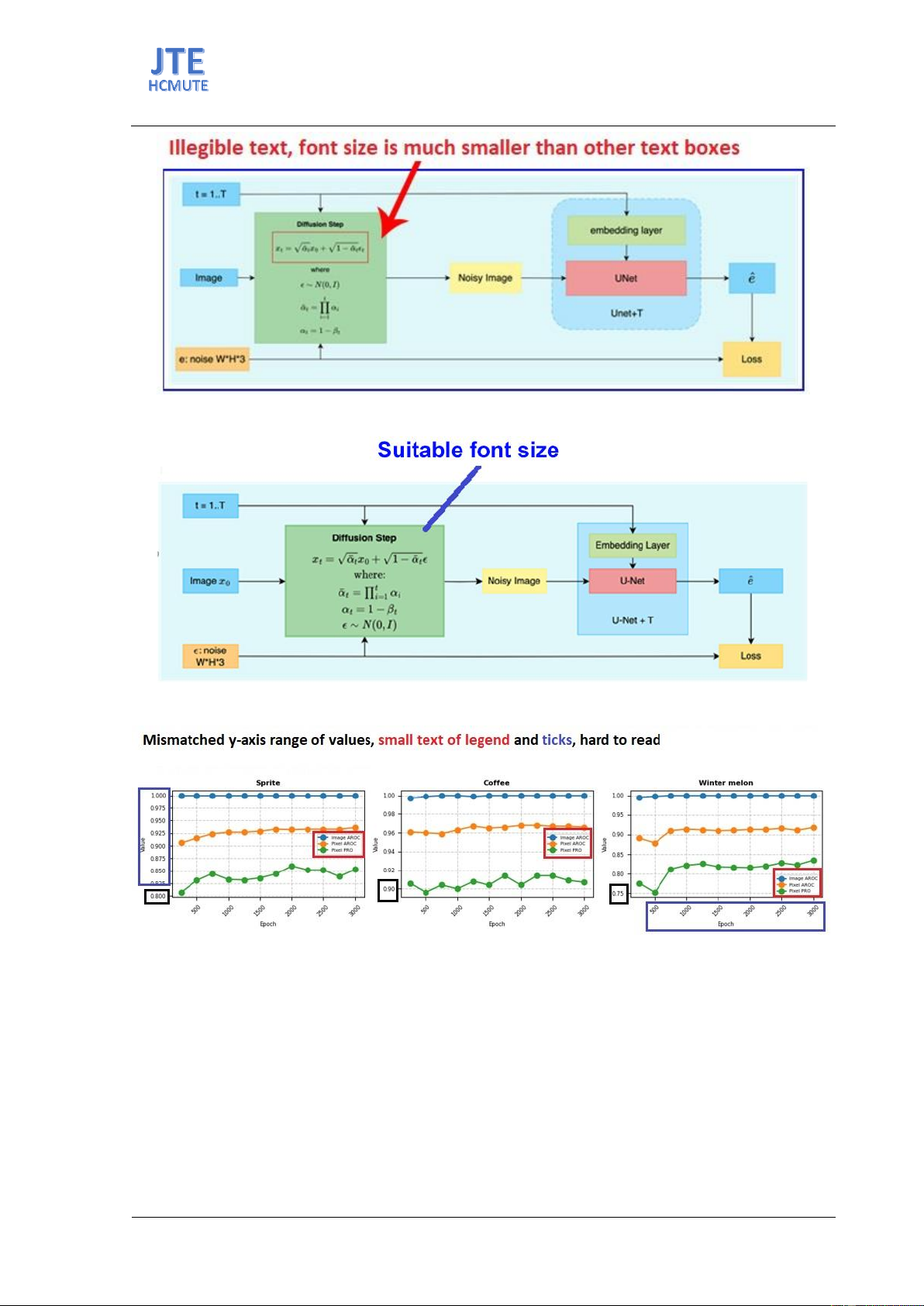
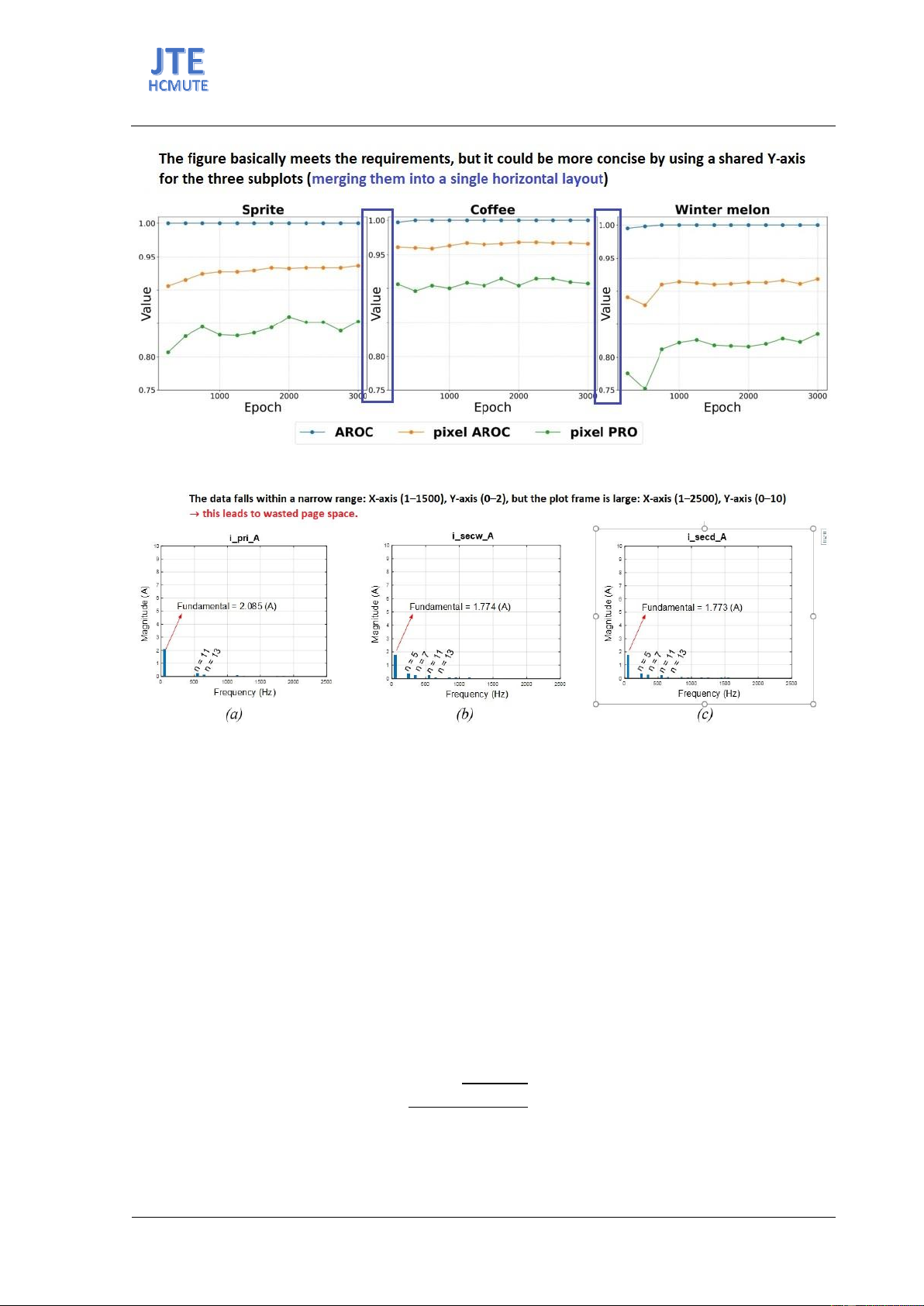
Fourthly, according to ethical standard A.2, the information in the article must be presented
concisely, clearly, and succinctly. Figures in the article should not contain areas without information or
with unnecessary details. Any text (if present) within the figures must have a readable font size that is
proportional to the font size of the article (unless the author intends to emphasize a specific point).
Composite images (for comparison purposes) should have consistent reference frames. The examples
below illustrate figures that meet and do not meet these criteria.
JTE, Volume xx, (Special) Issue xx, mm/20xx 4
JOURNAL OF TECHNICAL EDUCATION SCIENCE
Ho Chi Minh City University of Technology and Education Website: https://jte.edu.vn Email: jte@hcmute.edu.vn ISSN: 2615-9740 (a) (b) (c)
JTE, Volume xx, (Special) Issue xx, mm/20xx 5
JOURNAL OF TECHNICAL EDUCATION SCIENCE
Ho Chi Minh City University of Technology and Education Website: https://jte.edu.vn Email: jte@hcmute.edu.vn ISSN: 2615-9740 (d) (e)
Figure 4. Illustrative images based on ethical standard A.2
(a), (c), and (e): unacceptable images.
(b) and (d): acceptable images.
3.2. Format and presentation notes 3.2.1. Unit and number
It must be consistently used International System of Units (SI Units) for the data in the article. Other
kinds of unit should be converted to SI units whenever possible. Italic format is applied for symbols of
calculated quantities. Decimals presented in Vietnamese articles by "," and by "." in English articles. 3.2.2. Equations
Equations should be numbered consecutively throughout the text and enclosed in parentheses ad
below. Please note that the function symbols and variables are italicized; Matrix symbols and vector
symbols are in bold. The author should use either the Microsoft Equation Editor or the MathType plugin to create Equations.
−𝑏 ± √𝑏2 − 4𝑎𝑐 𝑥 = (1) 2𝑎
JTE, Volume xx, (Special) Issue xx, mm/20xx 6
JOURNAL OF TECHNICAL EDUCATION SCIENCE
Ho Chi Minh City University of Technology and Education Website: https://jte.edu.vn Email: jte@hcmute.edu.vn ISSN: 2615-9740
3.2.3. Figures and Tables
Figures (including diagrams, maps, pictures, photos...) and Tables must be given sequential
ascending numbers and titles, for example Figure 1, Figure 2; Table 1, Table 2, etc. The Figure caption
must be placed under the figure (Center alignment). Caption of a table must locate above the table (Right
alignment). The captions of figure and table must set in 10-point Times New Roman, bold their number
and italic tittle, the line spacing: single, before 6; after 6. The labels of figures and tables must be
referenced (introduce and discuss) in the text. (See Fig. 3) It is required that the author do not use an
introduction for table or of figure like: "... illustrated in the following figure:", or “or "Statistics as in the
following table:". It should be referenced to number of figures and tables, such as "... illustrated in Figure
1", or "The results are shown in Table 2".
Data in tables must be accurate. Please submit tables as editable text and not as images. All figures
must be at a sufficiently high resolution (at least 300 dpi). The width of the table and the figure is equal
to the width of the column or the page’s height. If the table or the figure is too large, it could be displayed on a landscape page.
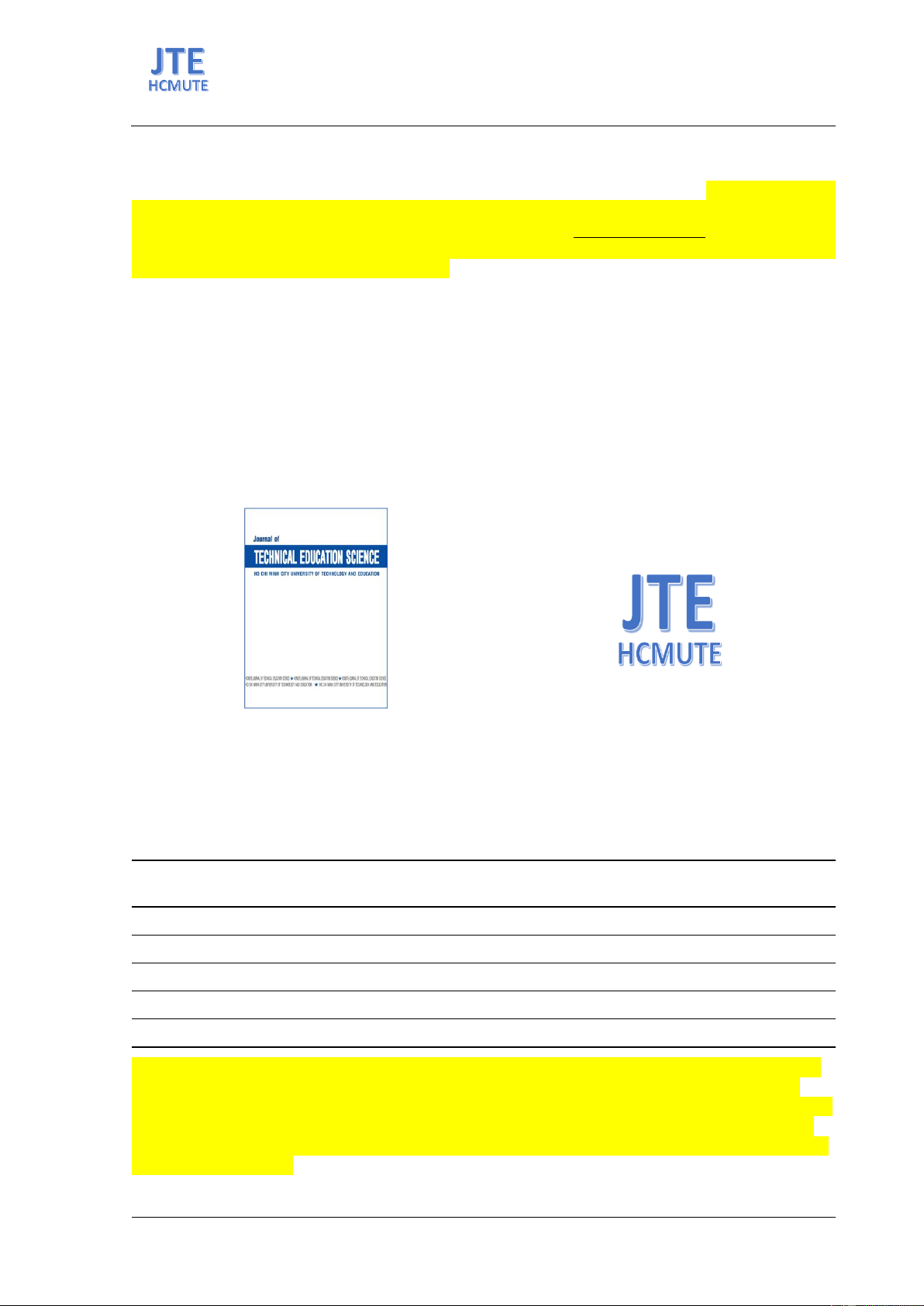
All tables and figures should be near with the text that references to them. If a figure consists of many
small images, symbolize such images by letters as a), b), etc., and explain the image’s contents right in its title. (a) (b)
Figure 5. Brand identity of JTE: (a) Cover page of JTE; (b) Logo of JTE
Figure 5 illustrates the heading format of an image inserted in the article. The format of the
components of the table is shown in Table 1.
Table 1. 10 most densely populated countries (with population above 5 million) Area Density Rank Country Population (km2) (Pop/km2) 1 Singapore 5,704,000 710 8,033 2 Bangladesh 171,730,000 143,998 1,193 3 Lebanon 5,266,785 6,020 847 4 Taiwan 6,856,000 10,452 656 5 Korea 23,604,000 36,193 652
Note: components of a table must be in editable text, not in the form of screenshots. Table Properties
have Table tab with Preferred Width = 16 cm, Table options with Top = 0 Bottom = 0 Left = 0,05
Right = 0,05 cm, Row tab with Not check Specify height. Font size of text inside table = 10, Layout of
Table with Spacing Before = 3pt After = 3pt, Line Spacing: Single. No borders for the left and right
edges of the table; the first row of the table (which is the title of each column) should not be left blank or missing information.
JTE, Volume xx, (Special) Issue xx, mm/20xx 7
JOURNAL OF TECHNICAL EDUCATION SCIENCE
Ho Chi Minh City University of Technology and Education Website: https://jte.edu.vn Email: jte@hcmute.edu.vn ISSN: 2615-9740 4. Conclusions
This section summarizes important outcomes drawn form the section 3: Results and Discussion.
Note to avoid duplicating Abstract. It could be orientations of researching, developing and applying research results. Acknowledgments
All of contributing individuals and organizations of the study should be disclosed. The sponsors of
the research are shown here. For example, authors can write: “This work belongs to the project in 2022
funded by the Ho Chi Minh City University of Technology and Education, Vietnam” Conflict of Interest
Authors must confirm “no conflict of interest”, write down as “The authors declare no conflict of interest.”
Data Availability Statement
If the article exceeds ten pages, the excess part will be written as supporting information. You can
display your supporting information on your own or institutional website. The authors describe the way
to provide the readers supporting information here. Authors can write: “The data that support the
findings of this study are available from the corresponding author upon reasonable request.” REFERENCES
Please ensure that every reference cited in the text is also present in the reference list (and vice versa).
Any references cited in the abstract must be given in full. References must be numbered in order of
appearance in the text and listed individually at the end of the manuscript. We recommend preparing the
references with a bibliography software package, such as EndNote, Mendely, or Zotero... or use “Insert
Citation” in MS Word to avoid typing mistakes and duplicated references.
Citations in the text should follow the referencing style of IEEE (see detail the reference guide at
https://ieeeauthorcenter.ieee.org/wp-content/uploads/IEEE-Reference-Guide.pdf). Some important notes are given below.
In the text, reference numbers should be placed in square brackets [], and placed before the
punctuation; for example [1], [1–3] or [1, 3]. For embedded citations in the text with pagination, use
both parentheses and brackets to indicate the reference number and page numbers; for example [5] (p.
10). or [6] (pp. 101–105). References must be numbered in order of appearance in the article. The
order of references should be manual typed, not used numbered list of Word, have Paragraph properties
with Indentation Left = 0, Special = Hangling By = 0,75 cm. References have font size 8, Justify
Alignment, Spacing Before and After = 0
All references must be presented in Romantic characters, i.e. in English.
Some common examples of references in IEEE format are demonstrated as below: [1] for article
without DOI ([2] is equivalent example), [3] for article with DOI (([4] is equivalent example)), [5] for
article with ID ([6] is equivalent example), [7] for article in other Language ([8] is equivalent example),
[9] for article with url (for example), [10] for unpublished paper (for example), [11] for article in
conference proceedings without DOI ([12] is equivalent example), [13] for article in conference
proceedings with DOI ([14] is equivalent example), [15] for Paper Presented at a Conference ([16] is
equivalent example), [17] for book, [18] for book with chapter title ([19] is equivalent example), [20 for
patent], [21] for dissertations (for example), [22] for standards (for example): [1]
J. K. Author, “Name of paper,” Abbrev. Title of Periodical, vol. x, no. x, pp. xxx-xxx, Abbrev. Month, year. [2]
T. T. C. Duong, C. C. Nguyen, and T. D. Tran, "Synchronization Sliding Mode Control of Closed-Kinematic Chain Robot Manipulators
with Time-Delay Estimation," Appl. Sci., vol. 12, no. 11, p. 5527, 2022. [3]
J. K. Author “Name of paper,” Abbrev. Tite of Periodical, vol. x, no. x, pp. xxx-xxx, Abbrev. Month, year, doi: xxx [4]
G. R. Sheu et al., “Distribution of atmospheric mercury in northern Southeast Asia and South China Sea during Dongsha Experiment,”
Atmos. Environ., vol. 78, pp. 174–183, Oct. 2013, doi: 10.1016/J.ATMOSENV.2012.07.002. [5]
J. K. Author, “Name of paper,” Abbrev. Title of Periodical, vol. x, no. x, Abbrev. month, year, Art. no. xxx. [6]
J. Zhang and N. Tansu, “Optical gain and laser characteristics of InGaN quantum wells on ternary InGaN substrates,” IEEE Photon. J.,
vol. 5, no. 2, Apr. 2013, Art no. 2600111. [7]
J. K. Author, “Name of paper,” (in Language), Abbrev. Title of Periodical, vol. x, no. x, Abbrev. month, year, Art. no. xxx
JTE, Volume xx, (Special) Issue xx, mm/20xx 8
JOURNAL OF TECHNICAL EDUCATION SCIENCE
Ho Chi Minh City University of Technology and Education Website: https://jte.edu.vn Email: jte@hcmute.edu.vn ISSN: 2615-9740 [8]
E. P. Wigner, “On a modification of the Rayleigh–Schrodinger perturbation theory,” (in German), Math. Naturwiss. Anz. Ungar. Akad.
Wiss., vol. 53, p. 475, 1935. [9]
J. K. Author, “Name of paper,” Abbrev. Title of Periodical, vol. x, no. x, pp. xxx–xxx, Abbrev. Month, year. Accessed: Month, Day,
Year, doi: 10.1109.XXX.123456. [Online]. Available: site/path/file
(for example: [9] W. P. Risk, G. S. Kino, and H. J. Shaw, “Fiber-optic frequency shifter using a surface acoustic wave incident at an
oblique angle,” Opt. Lett., vol. 11, no. 2, pp. 115–117, Feb. 1986. [Online]. Available: https://opg.optica.org/ol/abstract.cfm?uri=ol-11- 2-115)
[10] J. K. Author, “Title of paper,” unpublished.
(for example: [10] B. Smith, “An approach to graphs of linear forms,” unpublished.)
[11] J. K. Author, “Title of paper,” in Abbreviated Name of Conf., (location of conference is optional), (Month and day(s) if provided) year, pp. xxx-xxx.
[12] T. V. Do, T. L. P. Nguyen, T. T. T. Nguyen, L. T. H. Lam, P. S. Thanh, and T. D. Nguyen, “Ankle joint rehabilitation system-the
preliminary results,” in Proceedings of the Sixth International Conference on Research in Intelligent and Computing, 2021, pp. 33–37.
[13] J. K. Author, “Title of paper,” in Abbreviated Name of Conf., (location of conference is optional), year, pp. xxx–xxx, doi: xxx.
[14] G. Veruggio, “The EURON roboethics roadmap,” in Proc. Humanoids ’06: 6th IEEE-RAS Int. Conf. Humanoid Robots, 2006, pp. 612–
617, doi: 10.1109/ICHR.2006.321337.
[15] J. K. Author, “Title of paper,” presented at the Abbreviated Name of Conf., City of Conf., Abbrev. State, Country, Month and day(s), year, Paper number.
[16] K. C. Dinh, N. S. Dao, H. D. Le, H. L. Le, T. D. T. Cam, and D. T. Tran, "Kinematics and Dynamics for a 4-DOF Parallel Robot,"
presented at the 2021 International Conference on System Science and Engineering (ICSSE), 2021.
[17] B. Klaus and P. Horn, Robot Vision. Cambridge, MA, USA: MIT Press, 1986.
[18] J. K. Author, “Title of chapter in the book,” in Title of Published Book, X. Editor, Ed., City of Publisher, State (only U.S.), Country:
Abbrev. of Publisher, year, ch. x, sec. x, pp. xxx–xxx
[19] T. Ogura, “Electronic government and surveillance-oriented society,” in Theorizing Surveillance: The Panopticon and Beyond.,
Cullompton, U.K.: Willan, 2006, ch. 13, pp. 270–295.
[20] J. K. Author, “Title of patent,” Country Patent xxx, Abbrev. Month, day, year.
[21] J. K. Author, “Title of dissertation,” Ph.D. dissertation, Abbrev. Dept., Abbrev. Univ., City of Univ., Abbrev. State, year.
(for example: [21] J. O. Williams, “Narrow-band analyzer”, Ph.D. dissertation, Dept. Elect. Eng., Harvard Univ., Cambridge, MA, USA, 1993.)
[22] Title of Standard, Standard number, date.
(for example: [22] IEEE Criteria for Class IE Electric Systems, IEEE Standard 308, 1969.)
[23] A. Harrison, private communication, May 1995.
First Author Full Name (in original order, for example: Tran Van Teo). The first paragraph may contain author’s educational background
is listed. The degrees should be listed with type of degree in what field, which institution, city, state, and country, and year the degree was earned.
The second paragraph lists work experience (including being awarded prizes, honors,…), the previous job and the current job must have year
and location (Lab, Department, Faculty, University, Country).
The third paragraph lists all research interests as detailed as possible (keywords).
The last paragraph is author’s contact (at least, including email address) Email: abcd@hcmute.edu.vn. ORCID:
https://orcid.org/0000-000X-XXXX-XXXX. Tel (of CoAuthor): 090XXXXXXX
Second Author: Authors’ Biography was included in a table with one columns as this demonstration. The Table Properties with Preferred
Width = 16 cm, Table Option Top = 0, Bottom = 0, Left = 0,05 cm Right = 0,05 cm, No Border. All authors must verify their authorship of
the article using their ORCID, so the ORCID of each author must be provided here.
Email: abcd@hcmute.edu.vn. ORCID:
https://orcid.org/0000-000X-XXXX-XXXX
Note: To easily look up the scientific identities, authors should fill the ORCID number in the “user
details” section when submitting the manuscript. For details regarding the author's ORCID number,
please refer to: https://info.orcid.org/what-is-orcid/, if the author does not have one yet, please register
at: https://orcid.org/register. In the manuscript, change the ORCID link of the icon right after the contact
author in the template (author1*) to your ORCID link and include the ORCID number immediately after
the email in the biography section.
JTE, Volume xx, (Special) Issue xx, mm/20xx 9
Tài liệu liên quan:
-
Chapter 6: Inverter & VFD (Variable frequency drive) | Bài giảng môn công nghệ kỹ thuật điện Trường đại học sư phạm kỹ thuật TP. Hồ Chí Minh
322 161 -
Công nghệ pin cải tiến trên Lucid Air Pure RWD 2023 | Báo cáo cá nhân môn Công nghệ kĩ thuật điện Trường đại học sư phạm kỹ thuật TP. Hồ Chí Minh
240 120 -
Tính toán lựa chọn công suất hệ thống điện mặt trời phù hợp dựa vào tải tiêu thụ của nhà máy Quảng Việt | Tài liệu môn công nghệ kĩ thuật điện
283 142 -
Chương 2: Multisim 6.20 và ứng dụng vào mô phỏng mạch điện | tài liệu môn Công nghệ kỹ thuật điện Trường đại học sư phạm kĩ thuật TP. Hồ Chí Minh
553 277