AI Engine Architecture & Applications in 5G | Thực tập cơ bản | Trường Đại học Bách khoa Hà Nội
For compute-intensive applications like 5G cellular and machine learning DNN/CNN, our new vector processor AI Engines are an array of VLIW SIMD high-performance processors that deliver up to 8X silicon compute density at 50% the power consumption of traditional programmable logic solutions. Tài liệu được sưu tầm và soạn thảo dưới dạng file PDF để gửi tới các bạn cùng tham khảo, ôn tập đầy đủ kiến thức, chuẩn bị cho các buổi học thật tốt. Mời bạn đọc đón xem!
Môn: Thực tập cơ bản 331 tài liệu
Trường: Đại học Bách Khoa Hà Nội 5.6 K tài liệu
Tác giả:



Preview text:
WP506 (v1.2) AI Engines and Their Applications
For compute-intensive applications like 5G cellular and
machine learning DNN/CNN, our new vector processor AI
Engines are an array of VLIW SIMD high-performance
processors that deliver up to 8X silicon compute density at
50% the power consumption of traditional programmable logic solutions. ABSTRACT
This white paper explores the architecture, applications, and benefits of using
our new AI Engine for compute intensive applications like 5G cellular and machine learning DNN/CNN.
5G requires between five to 10 times higher compute density when compared
with prior generations; AI Engines have been optimized for DSP, meeting both
the throughput and compute requirements to deliver the high bandwidth and
accelerated speed required for wireless connectivity.
The emergence of machine learning in many products, often as DNN/CNN
networks, dramatically increases the compute-density requirements.
AI Engines, which are optimized for linear algebra, provide the compute-
density to meet these demands—while also reducing the power consumption
by as much as 50% when compared to similar functions being performed in programmable logic.
AI Engines are programmed using a C/C++ paradigm familiar to many
programmers. AI Engines are integrated with the Adaptable and Scalar
Engines to provide a highly flexibly and capable overall solution.
Xilinx is creating an environment where employees, customers, and partners feel welcome and included. To that end, we’re removing noninclusive language from our
products and related collateral. We’ve launched an internal initiative to remove language that could exclude people or reinforce historical biases, including terms
embedded in our software and IPs. You may still find examples of non-inclusive language in our older products as we work to make these changes and align with evolving
industry standards. Follow this link for more information. WP506 (v1.2) www.xilinx.com 1
AI Engines and Their Applications
Technology Advancements Driving Compute Density
Advancements in multiple technologies are driving the need for non-linear higher compute
density. Data converters with sampling rates of gigahertz per second enable direct sampling of
RF signals, simplifying the analog system but requiring a corresponding order of magnitude higher
DSP compute density. Direct RF sampling is coupled with using multiple antennas, such as
advanced radar systems with their tens of thousands of antennas.
The hype surrounding 5G wireless has been brewing for years, and the technology promises to
change people’s lives by connecting everything in the environment to a network that is one
hundred times faster than a cellular connection and ten times faster than the speediest home
broadband service. Millimeter waves, massive MIMO, full duplex, beam-forming, and small cells are
just a few of the technologies that enable ultrafast 5G networks. Speed and low latency are two
major benefits of 5G that promise many new applications, from autonomous vehicles to virtual
reality. These technologies drive compute density and memory requirements to an order of magnitude greater than 4G.
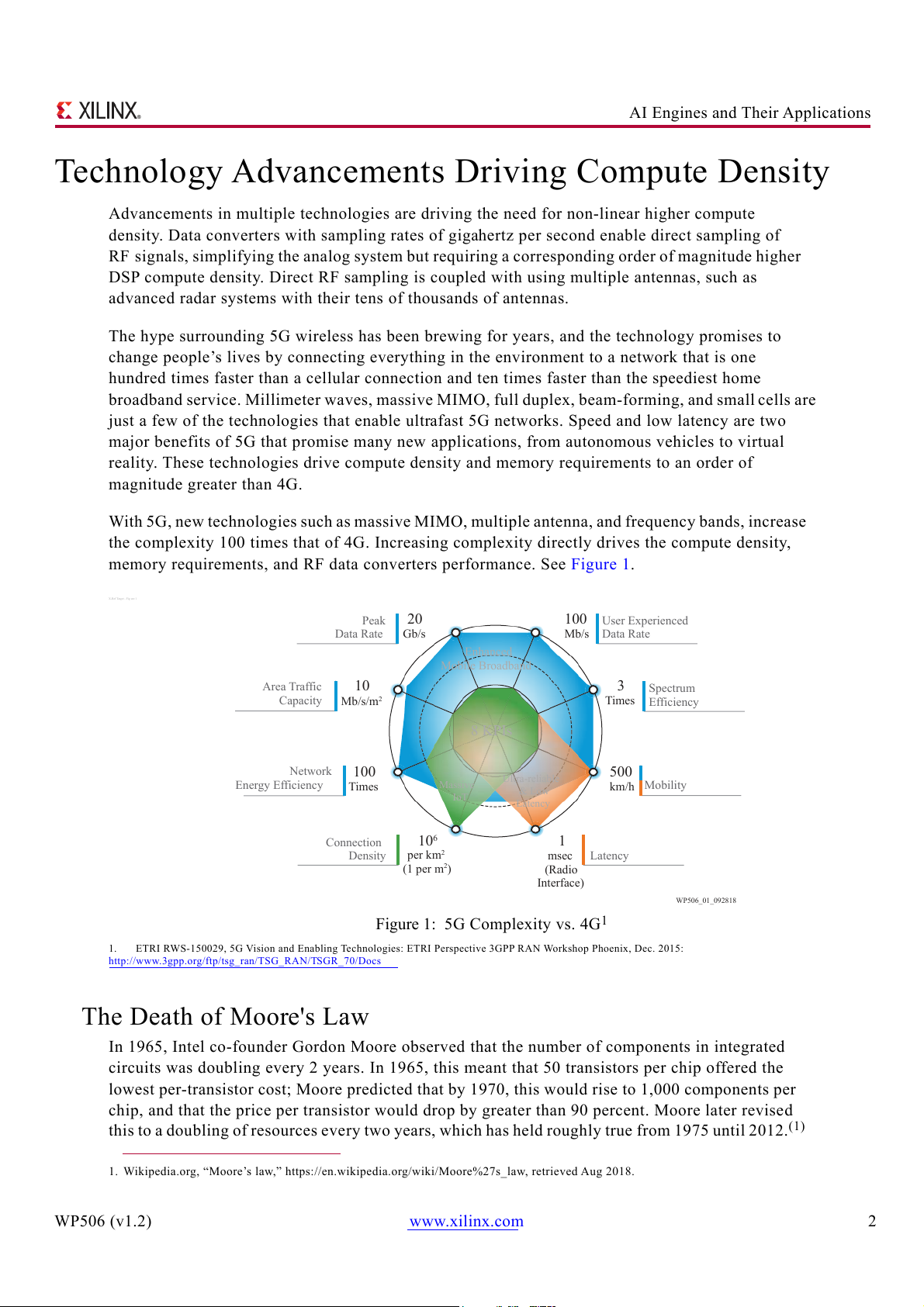
With 5G, new technologies such as massive MIMO, multiple antenna, and frequency bands, increase
the complexity 100 times that of 4G. Increasing complexity directly drives the compute density,
memory requirements, and RF data converters performance. See Figure 1. X-Ref Target - Fig ure 1 Peak 20 100 User Experienced Data Rate Gb/s Mb/s Data Rate Enhanced Mobile Broadband Area Traffic 10 3 Spectrum Capacity Mb/s/m2 Times Efficiency 8 KPIs Network 100 500 Energy Efficiency Ultra-reliable Times Massive km/h Mobility & Low IoT Latency Connection 106 1 Density per km2 msec Latency (1 per m2) (Radio Interface) WP506_01_092818
Figure 1: 5G Complexity vs. 4G1 1.
ETRI RWS-150029, 5G Vision and Enabling Technologies: ETRI Perspective 3GPP RAN Workshop Phoenix, Dec. 2015:
http://www.3gpp.org/ftp/tsg_ran/TSG_RAN/TSGR_70/Docs The Death of Moore's Law
In 1965, Intel co-founder Gordon Moore observed that the number of components in integrated
circuits was doubling every 2 years. In 1965, this meant that 50 transistors per chip offered the
lowest per-transistor cost; Moore predicted that by 1970, this would rise to 1,000 components per
chip, and that the price per transistor would drop by greater than 90 percent. Moore later revised
this to a doubling of resources every two years, which has held roughly true from 1975 until 2012.(1)
1. Wikipedia.org, “Moore’s law,” https://en.wikipedia.org/wiki/Moore%27s_law, retrieved Aug 2018. WP506 (v1.2) www.xilinx.com 2
AI Engines and Their Applications
Moore's Law projected that each next smaller process node would provide greater density,
performance, and lower power, all at a lower cost. The observation was named “Moore's Law” and
held true for roughly 50 years. The Moore's Law principle was a driving enabler for increasing IC
density, performance, and affordability—a principle we used to deliver devices that are increasingly capable at lower cost.
As IC process nodes reached 28nm and below, Moore's Law “broke”; devices built on smaller
process nodes no longer provided a free ride for power, cost, and performance. A gap developed
between the compute demand of 5G cellular systems and programmable logic compute density.
The cost, power, and performance required by 5th-generation cellular were outstripping the
programmable logic's ability to meet system-level goals. Enter the AI Engine
Responding to the non-linear increase in demand by next-generation wireless and Machine
Learning applications for higher compute density and lower power requirements, we began
investigating innovative architecture, leading to the development of the AI Engine. The AI Engine
along with Adaptable Engines (programmable logic) and Scalar Engines (processor subsystem)
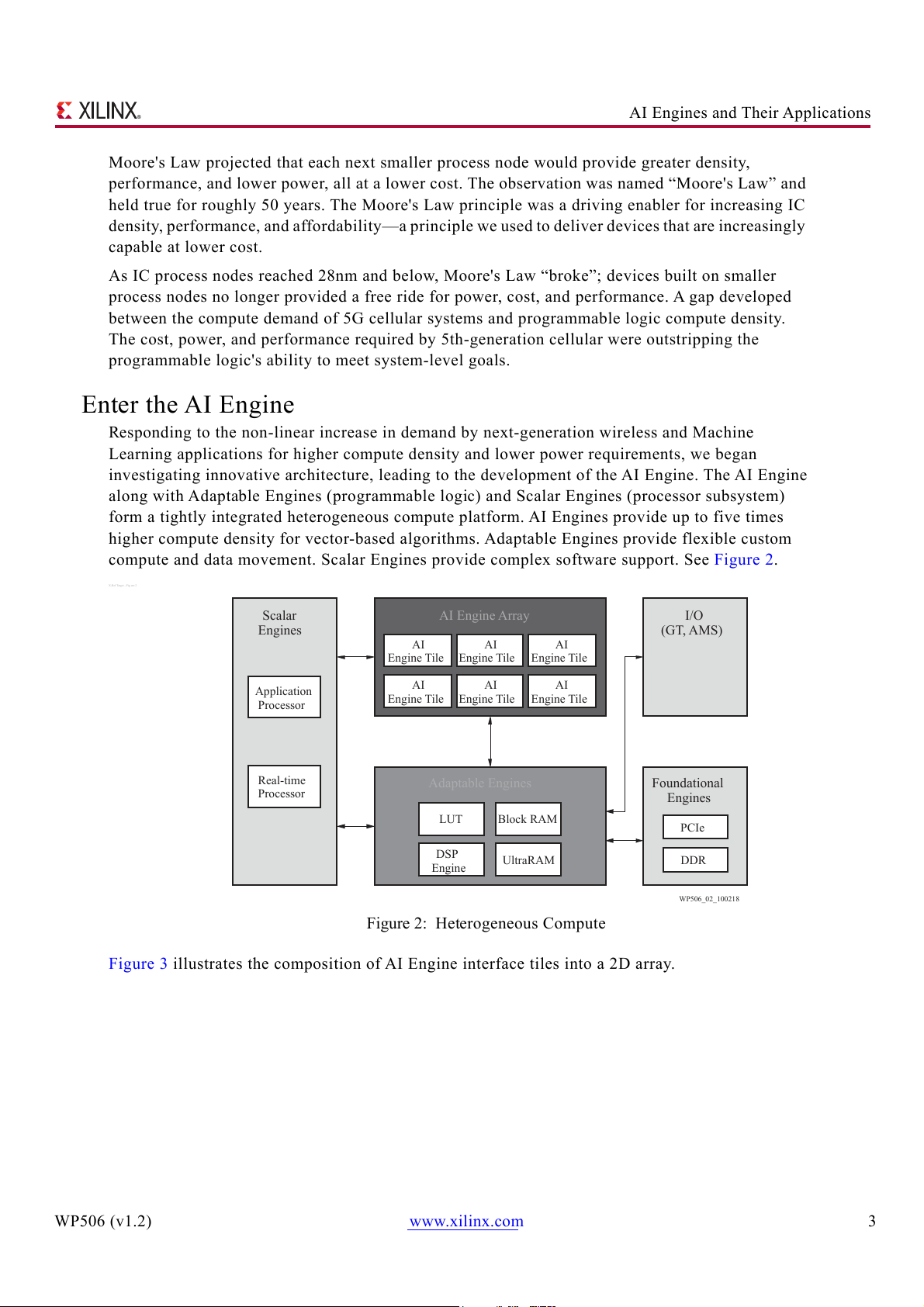
form a tightly integrated heterogeneous compute platform. AI Engines provide up to five times
higher compute density for vector-based algorithms. Adaptable Engines provide flexible custom
compute and data movement. Scalar Engines provide complex software support. See Figure 2. X-Ref Target - Fig ure 2 Scalar AI Engine Array I/O Engines (GT, AMS) AI AI AI Engine Tile Engine Tile Engine Tile Application AI AI AI Processor Engine Tile Engine Tile Engine Tile Real-time Adaptable Engines Foundational Processor Engines LUT Block RAM PCIe DSP UltraRAM DDR Engine WP506_02_100218
Figure 2: Heterogeneous Compute
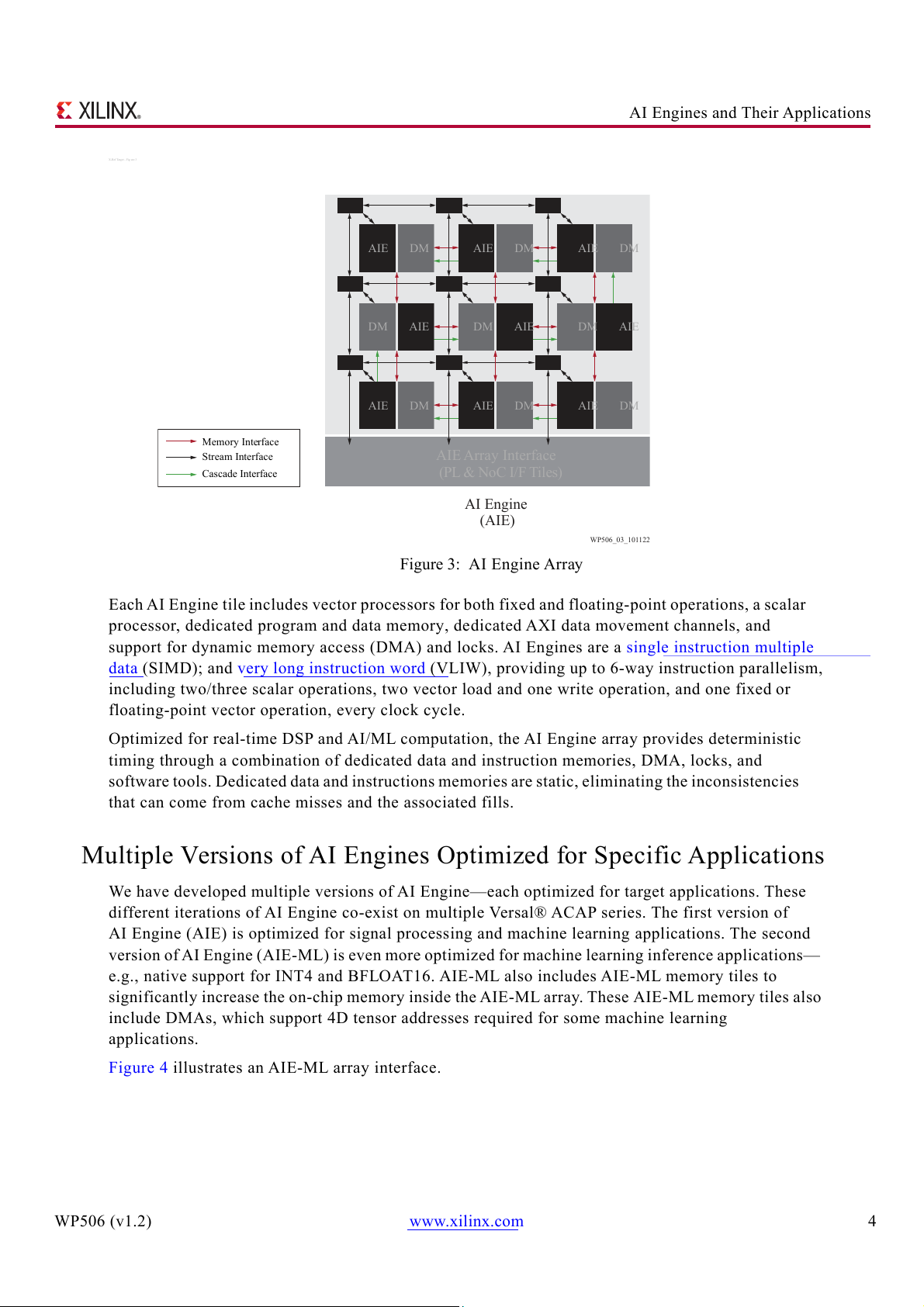
Figure 3 illustrates the composition of AI Engine interface tiles into a 2D array. WP506 (v1.2) www.xilinx.com 3
AI Engines and Their Applications X-Ref Target - Fig ure 3 AIE DM AIE DM AIE DM DM AIE DM AIE DM AIE AIE DM AIE DM AIE DM Memory Interface Stream Interface AIE Array Interface Cascade Interface (PL & NoC I/F Tiles) AI Engine (AIE) WP506_03_101122 Figure 3: AI Engine Array
Each AI Engine tile includes vector processors for both fixed and floating-point operations, a scalar
processor, dedicated program and data memory, dedicated AXI data movement channels, and
support for dynamic memory access (DMA) and locks. AI Engines are a single instruction multiple
data (SIMD); and very long instruction word (VLIW), providing up to 6-way instruction parallelism,
including two/three scalar operations, two vector load and one write operation, and one fixed or
floating-point vector operation, every clock cycle.
Optimized for real-time DSP and AI/ML computation, the AI Engine array provides deterministic
timing through a combination of dedicated data and instruction memories, DMA, locks, and
software tools. Dedicated data and instructions memories are static, eliminating the inconsistencies
that can come from cache misses and the associated fills.
Multiple Versions of AI Engines Optimized for Specific Applications
We have developed multiple versions of AI Engine—each optimized for target applications. These
different iterations of AI Engine co-exist on multiple Versal® ACAP series. The first version of
AI Engine (AIE) is optimized for signal processing and machine learning applications. The second
version of AI Engine (AIE-ML) is even more optimized for machine learning inference applications—
e.g., native support for INT4 and BFLOAT16. AIE-ML also includes AIE-ML memory tiles to
significantly increase the on-chip memory inside the AIE-ML array. These AIE-ML memory tiles also
include DMAs, which support 4D tensor addresses required for some machine learning applications.
Figure 4 illustrates an AIE-ML array interface. WP506 (v1.2) www.xilinx.com 4
AI Engines and Their Applications X-Ref Target - Fig ure 4 AIE-ML DM AIE-ML DM AIE-ML DM AIE-ML DM AIE-ML DM AIE-ML DM AIE-ML DM AIE-ML DM AIE-ML DM Memory Memory Memory Tile Tile Tile Memory Interface Stream Interface AIE-ML Array Interface Cascade Interface (PL & NoC I/F Tiles) AI Engine-ML (AIE-ML) WP506_04_101122
Figure 4: AIE-ML Array Interface
A Comparison of AI Engine VLIW SIMD Architecture vs. GPUs
GPUs are software programmable and can handle various type of workloads. However, data flow in
a GPU is predominantly defined by software and is governed by the GPU's rigid and complex
memory hierarchy. If the compute and efficiency potential of the GPU is to be realized, a workload's
data flow must map precisely to the GPU memory hierarchy. Because of this data flow constraint
and memory hierarchy, the GPU cannot deliver deterministic throughput and latency at the same
time. Also, because of the memory hierarchy and the different level of caches, GPUs are not the
most efficient when it comes to device and power utilization.
As GPUs, the AI Engines are software programmable. But they are also hardware adaptable—
meaning they can handle wide ranges of workloads because the workload dataflows can be directly
remapped on the device. Also, Versal ACAP devices including the AI Engine have local memory
placed close to the compute cores, which enables high energy efficiency and no cache misses as
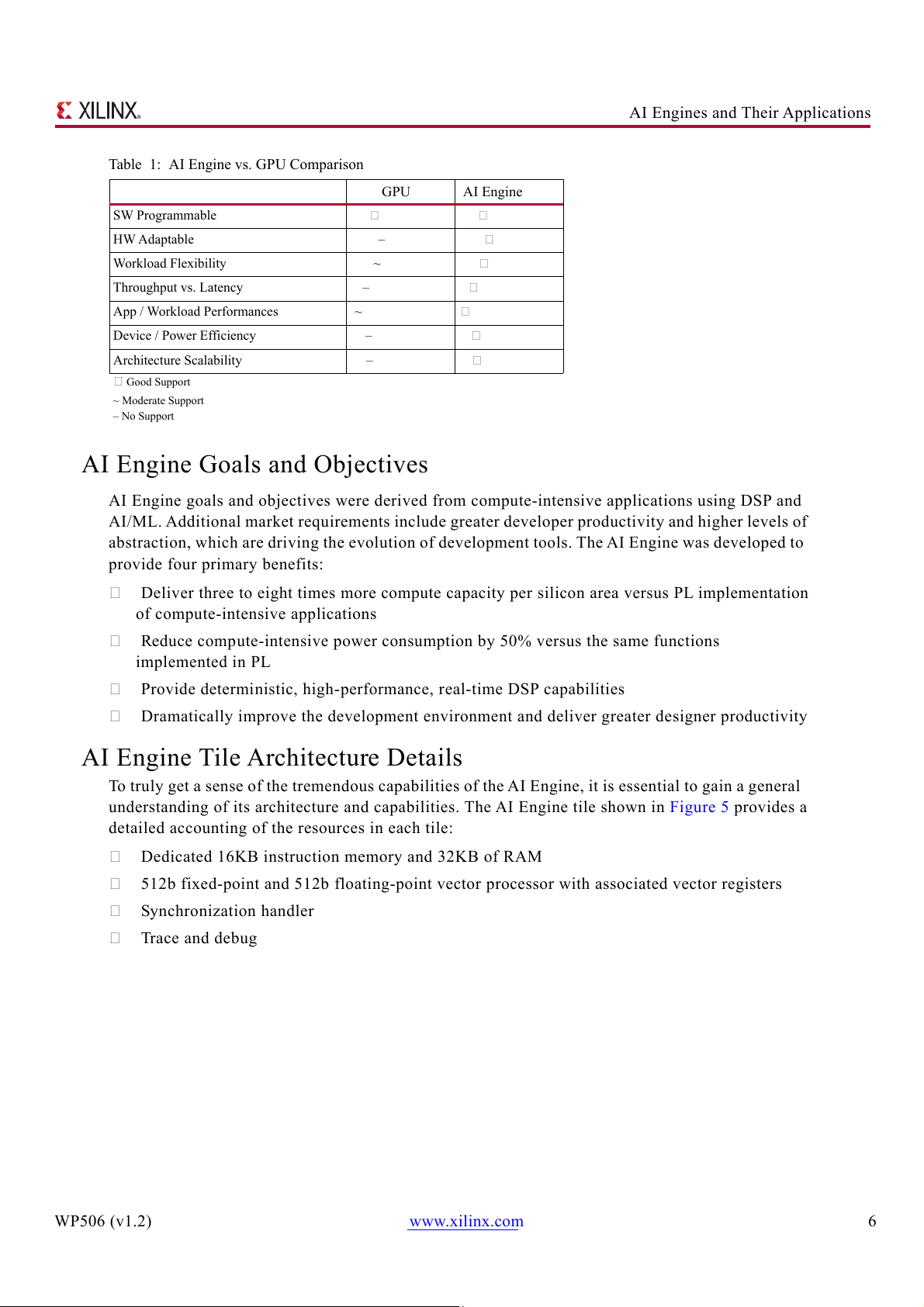
GPUs. Also because the hardware can be adapted to the workload, AI Engines can deliver
deterministic low latency and high throughput while achieving great power and device efficiency compared to GPUs. See Table 1. WP506 (v1.2) www.xilinx.com 5
AI Engines and Their Applications
Table 1: AI Engine vs. GPU Comparison GPU AI Engine SW Programmable HW Adaptable – Workload Flexibility ~ Throughput vs. Latency – App / Workload Performances ~ Device / Power Efficiency – Architecture Scalability – Good Support ~ Moderate Support – No Support AI Engine Goals and Objectives
AI Engine goals and objectives were derived from compute-intensive applications using DSP and
AI/ML. Additional market requirements include greater developer productivity and higher levels of
abstraction, which are driving the evolution of development tools. The AI Engine was developed to provide four primary benefits:
Deliver three to eight times more compute capacity per silicon area versus PL implementation
of compute-intensive applications
Reduce compute-intensive power consumption by 50% versus the same functions implemented in PL
Provide deterministic, high-performance, real-time DSP capabilities
Dramatically improve the development environment and deliver greater designer productivity
AI Engine Tile Architecture Details
To truly get a sense of the tremendous capabilities of the AI Engine, it is essential to gain a general
understanding of its architecture and capabilities. The AI Engine tile shown in Figure 5 provides a
detailed accounting of the resources in each tile:
Dedicated 16KB instruction memory and 32KB of RAM
512b fixed-point and 512b floating-point vector processor with associated vector registers Synchronization handler Trace and debug WP506 (v1.2) www.xilinx.com 6
AI Engines and Their Applications X-Ref Target - Fig ure 5 AXI MM AI Engine Interface AXI Stream Cascade Stream AXIS West AXIS East Instruction Load & Store Program orth Fetch & Address MM2S Mem S2MM Memory N Code Generation DMA I/F DMA (16MB) itch IS Unit Unit w X S A IM X 32b Scalar Fixed Point Floating Point A RISC Unit 512b SIMD 512b SIMD Data Vector Unit Vector Unit I/F I/F Memory em em M (32KB) M Scalar Vector Register Files Register Files outh S Control, Stall Accumulator IS Debug Handler Stream FIFO X & Trace A Mem I/F WP506_20_101022
Figure 5: Detail of AI Engine Tile
An AI Engine with dedicated instruction and data memory is interconnected with other AI Engine
tiles, using a combination of dedicated AXI bus routing and direct connection to neighboring AI
Engine tiles. For data movement, dedicated DMA engines and locks connect directly to dedicated
AXI bus connectivity, data movement, and synchronization. AIE Operand Precision Support
The vector processors are composed of both integer and floating-point units. Operands of 8-bit,
16-bit, 32-bit, and single-precision floating point (SPFP) are supported natively in AIE. For different
operands, the operands-per-clock cycle changes, as detailed in Table 2.
Table 2: AI Engine Vector Precision Support Operand A Operand B Output Number of MACs/Clock 8b real 8b real 16b real 128 16b real 8b real 48b real 64 16b real 16b real 48b real 32 16b real 16b complex 48b complex 16 16b complex 16b complex 48b complex 8 16b real 32b real 48/80 real 16 16b real 32b complex 48/80 complex 8 16b complex 32b real 48/80 complex 8 16b complex 32b complex 48/80 complex 4 32b real 16b real 48/80 complex 16 32b real 16b complex 48/80 complex 8 32b complex 16b real 48/80 complex 8 32b complex 16b complex 48/80 complex 4 WP506 (v1.2) www.xilinx.com 7
AI Engines and Their Applications
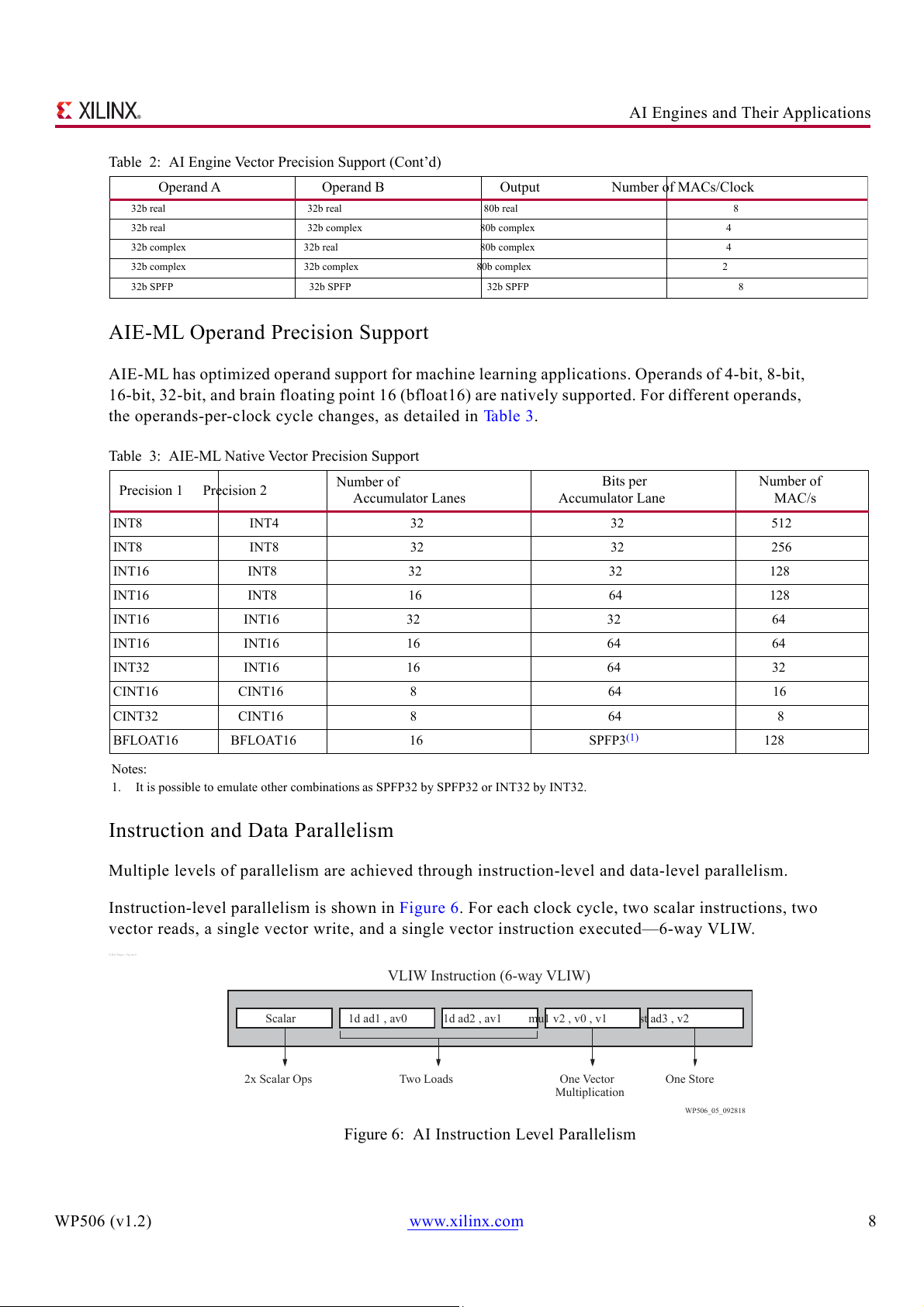
Table 2: AI Engine Vector Precision Support (Cont’d) Operand A Operand B Output Number of MACs/Clock 32b real 32b real 80b real 8 32b real 32b complex 80b complex 4 32b complex 32b real 80b complex 4 32b complex 32b complex 80b complex 2 32b SPFP 32b SPFP 32b SPFP 8
AIE-ML Operand Precision Support
AIE-ML has optimized operand support for machine learning applications. Operands of 4-bit, 8-bit,
16-bit, 32-bit, and brain floating point 16 (bfloat16) are natively supported. For different operands,
the operands-per-clock cycle changes, as detailed in Table 3.
Table 3: AIE-ML Native Vector Precision Support Number of Bits per Number of Precision 1 Precision 2 Accumulator Lanes Accumulator Lane MAC/s INT8 INT4 32 32 512 INT8 INT8 32 32 256 INT16 INT8 32 32 128 INT16 INT8 16 64 128 INT16 INT16 32 32 64 INT16 INT16 16 64 64 INT32 INT16 16 64 32 CINT16 CINT16 8 64 16 CINT32 CINT16 8 64 8 BFLOAT16 BFLOAT16 16 SPFP3(1) 128 Notes: 1.
It is possible to emulate other combinations as SPFP32 by SPFP32 or INT32 by INT32.
Instruction and Data Parallelism
Multiple levels of parallelism are achieved through instruction-level and data-level parallelism.
Instruction-level parallelism is shown in Figure 6. For each clock cycle, two scalar instructions, two
vector reads, a single vector write, and a single vector instruction executed—6-way VLIW. X-Ref Target - Fig ure 6 VLIW Instruction (6-way VLIW) Scalar 1d ad1 , av0 1d ad2 , av1 mu1 v2 , v0 , v1 st ad3 , v2 2x Scalar Ops Two Loads One Vector One Store Multiplication WP506_05_092818
Figure 6: AI Instruction Level Parallelism WP506 (v1.2) www.xilinx.com 8
AI Engines and Their Applications
Data level parallelism is achieved via vector-level operations where multiple sets of data can be
operated on a per-clock-cycle basis, as shown in Table 2.
Deterministic Performance and Connectivity
The AI Engine architecture was developed for real-time processing applications, which require
deterministic performance. Two key architectural features ensure deterministic timing:
Dedicated instruction and data memories
Dedicated connectivity paired with DMA engines for scheduled data movement using
connectivity between AI Engine tiles
Direct memory (DM) interfaces provide direct access between the AI Engine tile and its nearest
neighbors, AI Engine tile data memory to the north, south, and west. This is typically used to move
results to/from the vector processors while the overall processing chain produces and/or consumes
data. Data memory is implemented to enable a “ping-pong” buffering scheme, which minimizes
memory contention impacts on performance.
AXI-Stream and AXI-Memory Mapped Connectivity between AI Engine Tiles
The simplest form of AI Engine to AI Engine data movement is via the shared memory between
direct neighboring AI Engine Tiles. However, when the tiles are further away, then the AI Engine tile
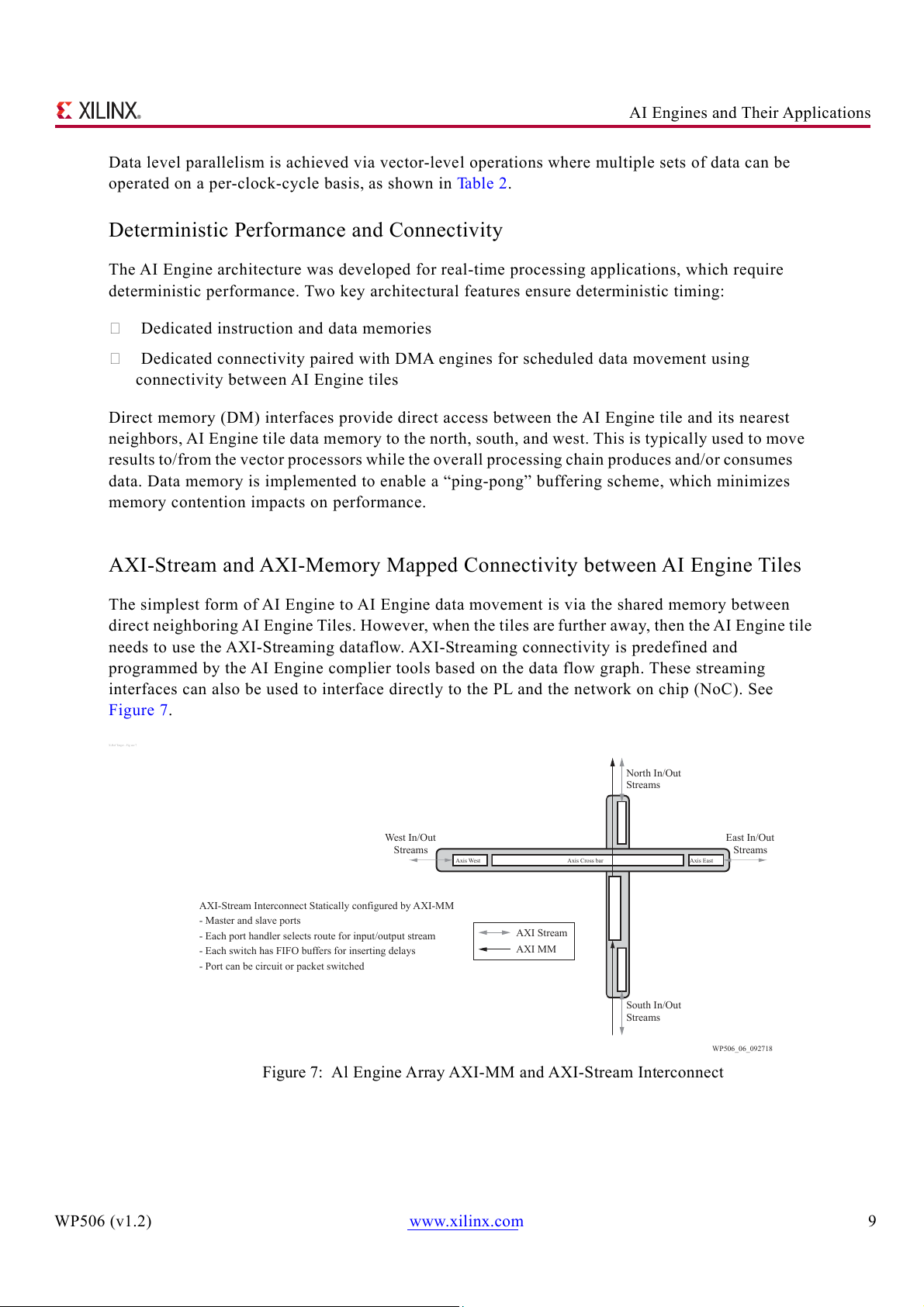
needs to use the AXI-Streaming dataflow. AXI-Streaming connectivity is predefined and
programmed by the AI Engine complier tools based on the data flow graph. These streaming
interfaces can also be used to interface directly to the PL and the network on chip (NoC). See Figure 7. X-Ref Target - Fig ure 7 North In/Out Streams West In/Out Axis North East In/Out Streams Streams Axis West Axis Cross bar Axis East
AXI-Stream Interconnect Statically configured by AXI-MM - Master and slave ports AXI Stream
- Each port handler selects route for input/output stream AXI-MM Switch
- Each switch has FIFO buffers for inserting delays AXI MM
- Port can be circuit or packet switched Axis South South In/Out Streams WP506_06_092718
Figure 7: Al Engine Array AXI-MM and AXI-Stream Interconnect WP506 (v1.2) www.xilinx.com 9
AI Engines and Their Applications
AIE-ML Memory Tile Architecture Details
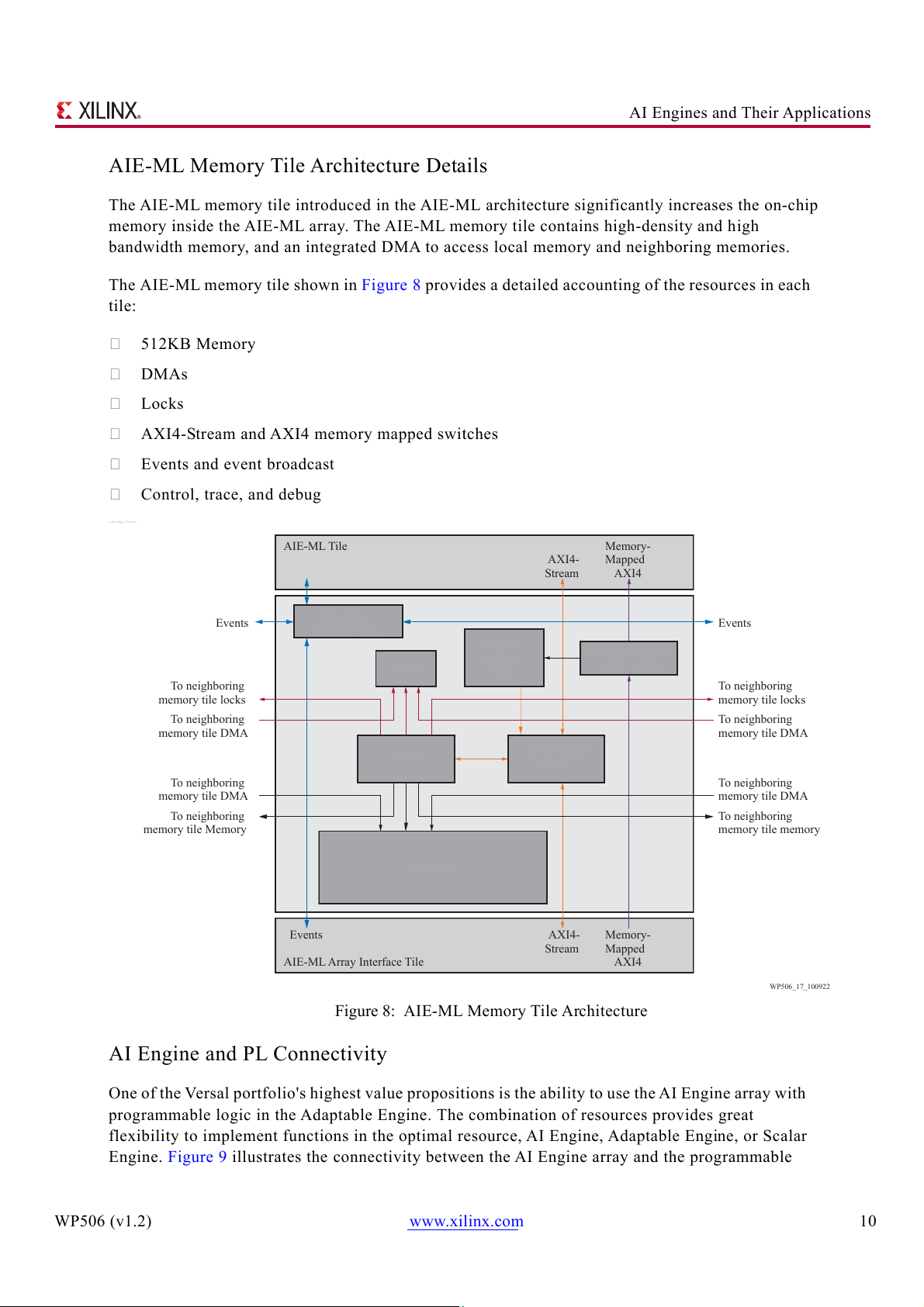
The AIE-ML memory tile introduced in the AIE-ML architecture significantly increases the on-chip
memory inside the AIE-ML array. The AIE-ML memory tile contains high-density and high
bandwidth memory, and an integrated DMA to access local memory and neighboring memories.
The AIE-ML memory tile shown in Figure 8 provides a detailed accounting of the resources in each tile: 512KB Memory DMAs Locks
AXI4-Stream and AXI4 memory mapped switches Events and event broadcast Control, trace, and debug X-Ref Target - Fig ure 8 AIE-ML Tile Memory- AXI4- Mapped Stream AXI4 Broadcast Events Events Event Switch Control, Memory-Mapped Debug, AXI4 Switch Locks Trace To neighboring To neighboring memory tile locks memory tile locks To neighboring To neighboring memory tile DMA memory tile DMA AXI4-Stream DMA Switch To neighboring To neighboring memory tile DMA memory tile DMA To neighboring To neighboring memory tile Memory memory tile memory Memory Events AXI4- Memory- Stream Mapped AIE-ML Array Interface Tile AXI4 WP506_17_100922
Figure 8: AIE-ML Memory Tile Architecture AI Engine and PL Connectivity
One of the Versal portfolio's highest value propositions is the ability to use the AI Engine array with
programmable logic in the Adaptable Engine. The combination of resources provides great
flexibility to implement functions in the optimal resource, AI Engine, Adaptable Engine, or Scalar
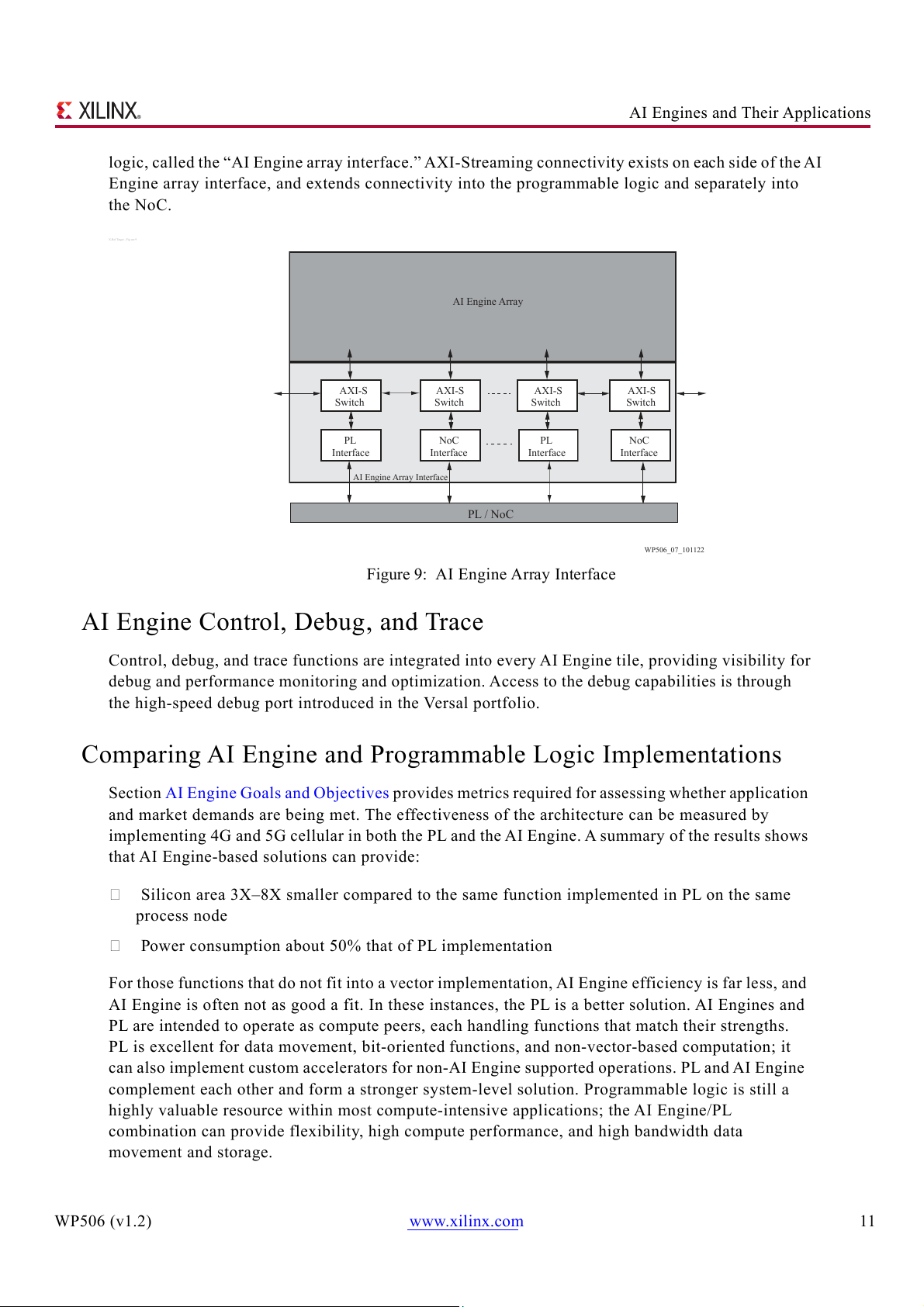
Engine. Figure 9 illustrates the connectivity between the AI Engine array and the programmable WP506 (v1.2) www.xilinx.com 10
AI Engines and Their Applications
logic, called the “AI Engine array interface.” AXI-Streaming connectivity exists on each side of the AI
Engine array interface, and extends connectivity into the programmable logic and separately into the NoC. X-Ref Target - Fig ure 9 AI Engine Array AXI-S AXI-S AXI-S AXI-S Switch Switch Switch Switch PL NoC PL NoC Interface Interface Interface Interface AI Engine Array Interface PL / NoC WP506_07_101122
Figure 9: AI Engine Array Interface
AI Engine Control, Debug, and Trace
Control, debug, and trace functions are integrated into every AI Engine tile, providing visibility for
debug and performance monitoring and optimization. Access to the debug capabilities is through
the high-speed debug port introduced in the Versal portfolio.
Comparing AI Engine and Programmable Logic Implementations
Section AI Engine Goals and Objectives provides metrics required for assessing whether application
and market demands are being met. The effectiveness of the architecture can be measured by
implementing 4G and 5G cellular in both the PL and the AI Engine. A summary of the results shows
that AI Engine-based solutions can provide:
Silicon area 3X–8X smaller compared to the same function implemented in PL on the same process node
Power consumption about 50% that of PL implementation
For those functions that do not fit into a vector implementation, AI Engine efficiency is far less, and
AI Engine is often not as good a fit. In these instances, the PL is a better solution. AI Engines and
PL are intended to operate as compute peers, each handling functions that match their strengths.
PL is excellent for data movement, bit-oriented functions, and non-vector-based computation; it
can also implement custom accelerators for non-AI Engine supported operations. PL and AI Engine
complement each other and form a stronger system-level solution. Programmable logic is still a
highly valuable resource within most compute-intensive applications; the AI Engine/PL
combination can provide flexibility, high compute performance, and high bandwidth data movement and storage. WP506 (v1.2) www.xilinx.com 11
AI Engines and Their Applications
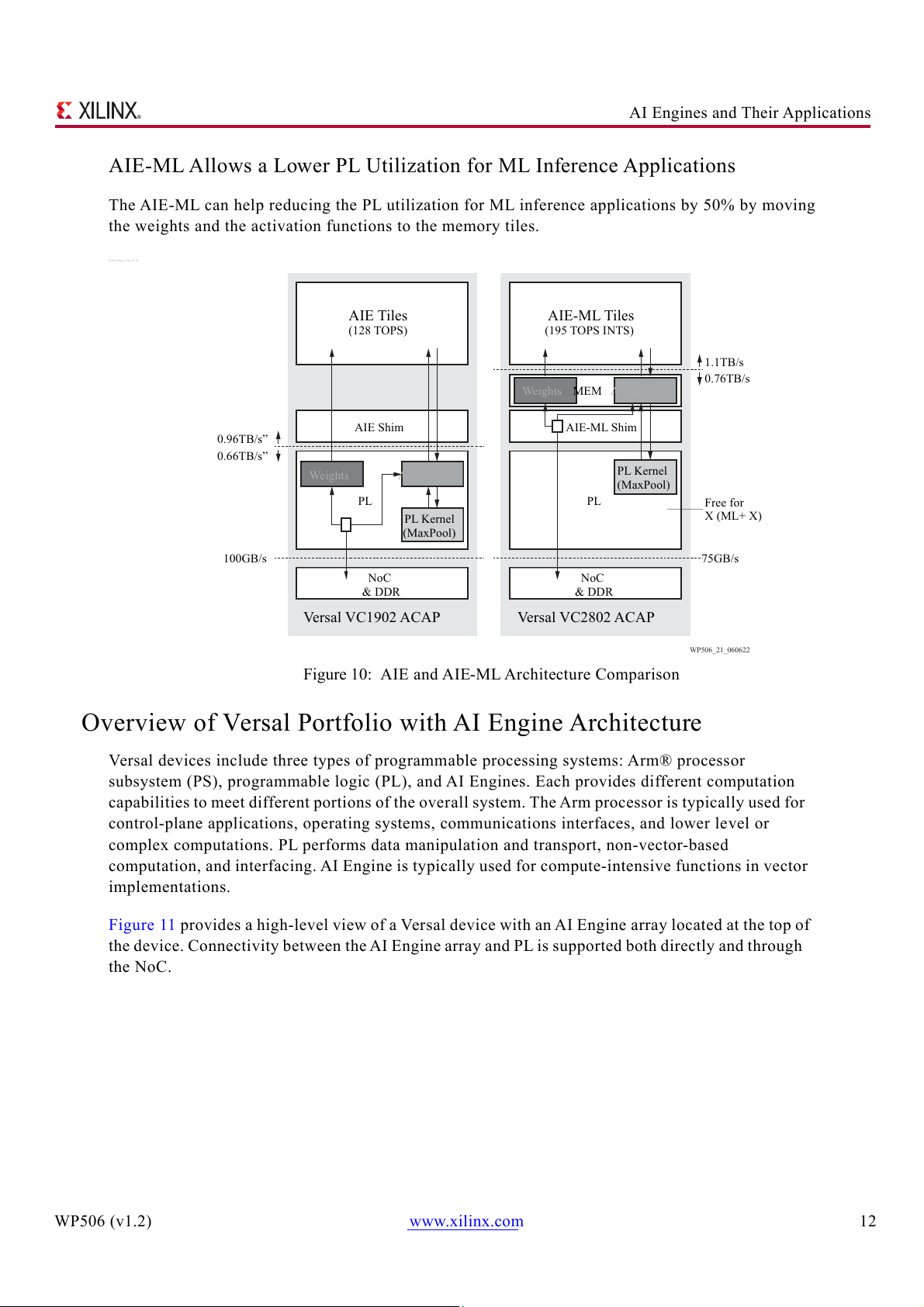
AIE-ML Allows a Lower PL Utilization for ML Inference Applications
The AIE-ML can help reducing the PL utilization for ML inference applications by 50% by moving
the weights and the activation functions to the memory tiles. X-Ref Target - Fig ure 10 AIE Tiles AIE-ML Tiles (128 TOPS) (195 TOPS INTS) 1.1TB/s 0.76TB/s Weights MEM Activations AIE Shim AIE-ML Shim 0.96TB/s” 0.66TB/s” Weights Activations PL Kernel (MaxPool) PL PL Free for X (ML+ X) PL Kernel (MaxPool) 100GB/s 75GB/s NoC NoC & DDR & DDR Versal VC1902 ACAP Versal VC2802 ACAP WP506_21_060622
Figure 10: AIE and AIE-ML Architecture Comparison
Overview of Versal Portfolio with AI Engine Architecture
Versal devices include three types of programmable processing systems: Arm® processor
subsystem (PS), programmable logic (PL), and AI Engines. Each provides different computation
capabilities to meet different portions of the overall system. The Arm processor is typically used for
control-plane applications, operating systems, communications interfaces, and lower level or
complex computations. PL performs data manipulation and transport, non-vector-based
computation, and interfacing. AI Engine is typically used for compute-intensive functions in vector implementations.
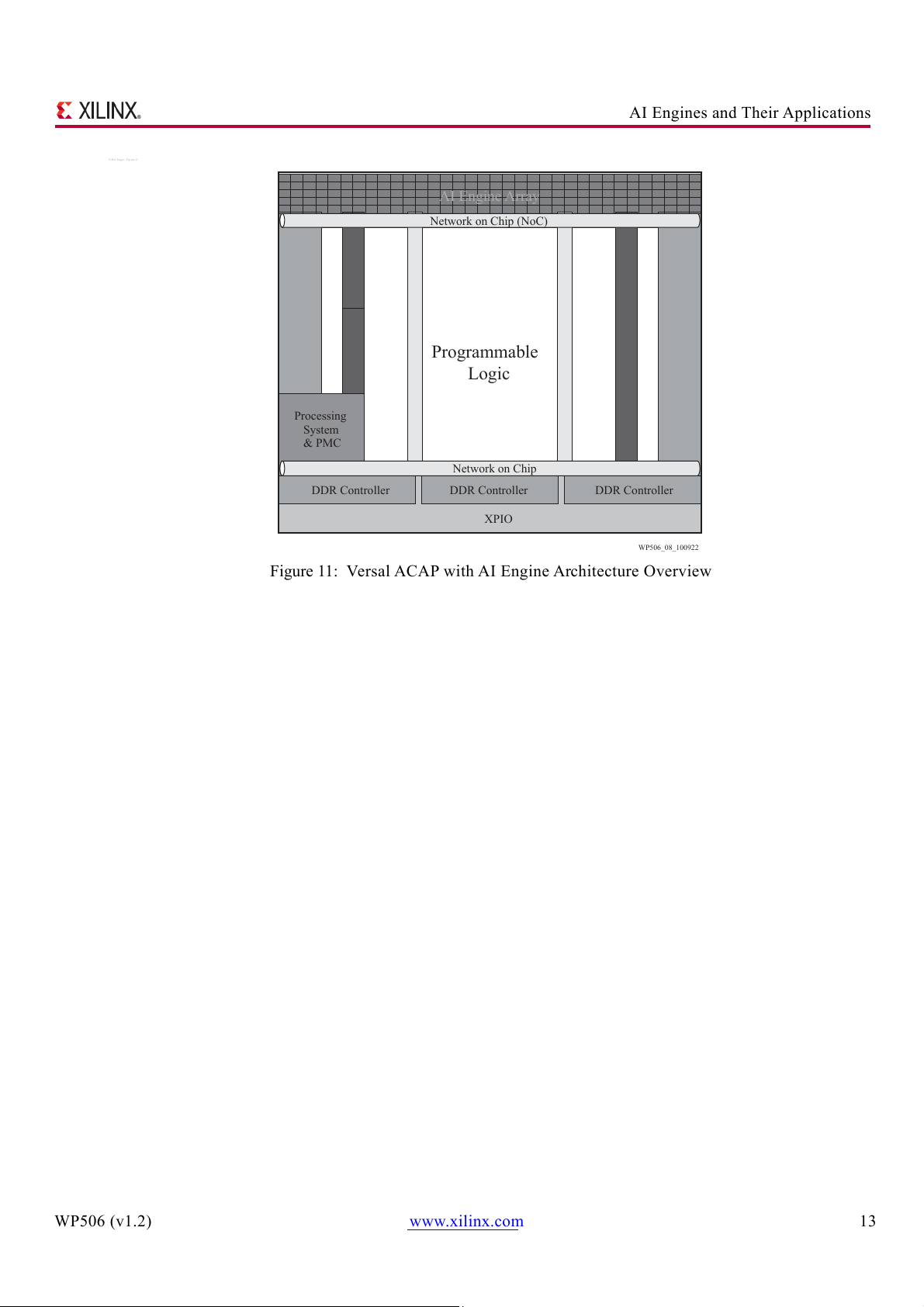
Figure 11 provides a high-level view of a Versal device with an AI Engine array located at the top of
the device. Connectivity between the AI Engine array and PL is supported both directly and through the NoC. WP506 (v1.2) www.xilinx.com 12
AI Engines and Their Applications X-Ref Target - Fig ure 11 AI Engine Array Network on Chip (NoC) Integrated IP ransceivers T Programmable ransceivers PCIe & CCIX Logic Integrated IP AMS/T Processing System & PMC Network on Chip DDR Controller DDR Controller DDR Controller XPIO WP506_08_100922
Figure 11: Versal ACAP with AI Engine Architecture Overview WP506 (v1.2) www.xilinx.com 13
AI Engines and Their Applications
AI Engine Development Environment
We have placed a great deal of emphasis on the use of high-level languages (HLL) to help raise the
level of abstraction for developing with our devices. The Versal architecture has three
fundamentally different programmable elements: PL, PS, and AI Engine. All three can be
programmed using C/C++ or by using a single environment tool, the Vitis™ Unified Software Platform.
With the Vitis core development kit, users can run a fast functional AI Engine simulation using an
x86-based simulation environment or a cycle approximate simulation using a System-C model. For
system-level simulation, a System-C virtual platform is available that supports all three processing domains.
Signal Processing designers can also use the Vitis Model Composer, a high-level graphical entry
environment based on MATLAB® and Simulink® for simulation and code generation of designs
that include both the PL and AI Engine domains.
A key element in the development environment are the AI Engine libraries that support DSP and
wireless functions, ML and AI, linear algebra, and matrix math. These libraries are optimized for
efficiency and performance, enabling the developer to take full advantage of AI Engine capabilities.
The AIE API - A Single API Interface for AI Engine
The AIE and AIE-ML each have its own set of intrinsics that enable very efficient implementations
of many types of primitives. However, because these intrinsics are very low level, each modification
of the code, e.g., a change of datatype, requires a rewrite of the source code. Also because of the
architectural changes required for higher efficiency and smaller silicon area between each iteration,
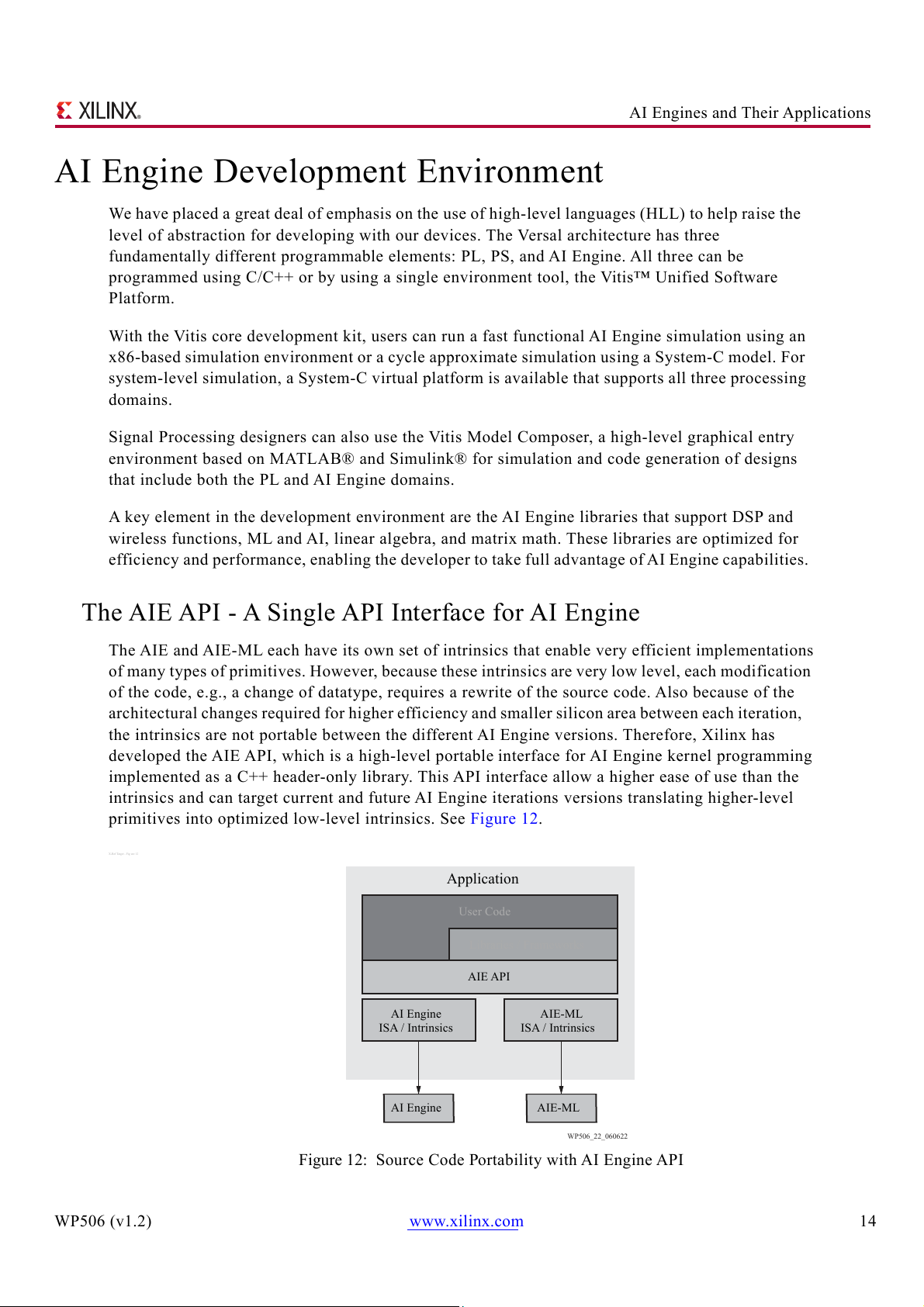
the intrinsics are not portable between the different AI Engine versions. Therefore, Xilinx has
developed the AIE API, which is a high-level portable interface for AI Engine kernel programming
implemented as a C++ header-only library. This API interface allow a higher ease of use than the
intrinsics and can target current and future AI Engine iterations versions translating higher-level
primitives into optimized low-level intrinsics. See Figure 12. X-Ref Target - Fig ure 12 Application User Code Libraries / Frameworks AIE API AI Engine AIE-ML ISA / Intrinsics ISA / Intrinsics AI Engine AIE-ML WP506_22_060622
Figure 12: Source Code Portability with AI Engine API WP506 (v1.2) www.xilinx.com 14
AI Engines and Their Applications AI Engine Applications
AI Engines have been optimized for compute-intensive applications, specifically digital signal
processing (DSP) and some artificial intelligence (AI) technology such as machine learning (ML) and 5G Wireless applications.
Digital Signal Processing Using AI Engines
Radio Solutions Validation Suite
Real-time DSP is used extensively in wireless communications. We compared implementations of
classic narrow-band and wide-band radio design principles, massive MIMO, and baseband and
digital front-end concepts, validating the AI Engine architecture as being well-suited to building radio solutions.
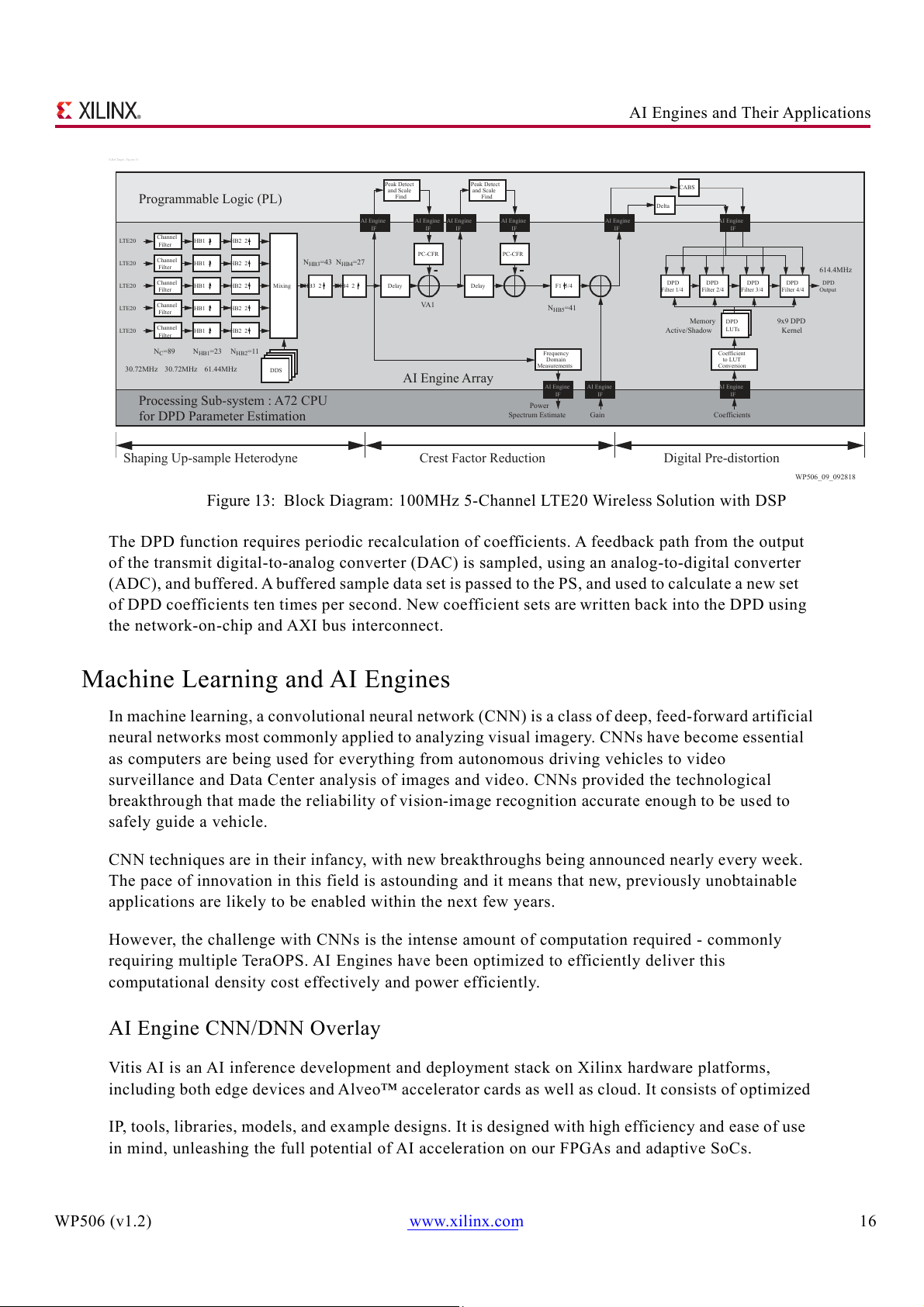
Example: 100MHz 5-Channel LTE20 Wireless Solution
A 100MHz 5-channel LTE20 wireless was implemented in a portion of a Versal device. Five channels
of 16b input data are streamed in at 30.72MSPS and processed in an 89-tap channel filter. The
signals are then up-sampled by four using two stages of half-band filters (23 and 11 taps), resulting
in a sample rate of 122.88MSPS.
The up-sampled stream is then mixed with a direct-digital synthesized (DDS) sine / cosine wave
function and summed. Two additional half-band filters (47 and 27 taps) up-sample by a total of four
to produce a 491.52MSPS input stream to a crest-factor reduction (CFR) function. A fractional rate
change, five-up / four-down provided by a 41-tap filter, results in a 614.4MSPS input sample rate to
a digital pre-distortion function (DPD).
A peak detector / scale find (PD / SF) circuit is implemented in PL; the output of the 491.52MSPS
DUC and mixer stage comprises one of its inputs, while the CFR second stage provides its second
input. The PD / SF circuit, implemented in PL, is resource-efficient; conversely, it is resource-
inefficient if implemented in an AI Engine. This is a good illustration of an architectural decision
taken to utilize the best resource for different functional blocks of the design. See Figure 13. WP506 (v1.2) www.xilinx.com 15
AI Engines and Their Applications X-Ref Target - Fig ure 13 Peak Detect Peak Detect CABS and Scale and Scale Programmable Logic (PL) Find Find Delta AI Engine AI Engine AI Engine AI Engine AI Engine AI Engine IF IF IF IF IF IF Channel LTE20 HB1 2 HB2 2 Filter PC-CFR PC-CFR Channel LTE20 HB1 2 HB2 2 N Filter HB3=43 NHB4=27 614.4MHz Channel DPD DPD DPD DPD DPD LTE20 HB1 2 HB2 2 Mixing HB3 2 HB4 2 Delay Delay F1 5/4 Filter 614.4MHz Filter 1/4 Filter 2/4 Filter 3/4 Filter 4/4 Output Channel VA1 LTE20 HB1 2 HB2 2 N Filter HB5=41 Memory DPD 9x9 DPD Channel LTE20 HB1 2 HB2 2 Active/Shadow LUTs Kernel Filter 122.88MHz 491.52MHz NC=89 NHB1=23 NHB2=11 Frequency Coefficient Domain to LUT 30.72MHz 30.72MHz 61.44MHz Measurements Conversion DDS AI Engine Array AI Engine AI Engine AI Engine
Processing Sub-system : A72 CPU IF IF IF Power for DPD Parameter Estimation Spectrum Estimate Gain Coefficients Shaping Up-sample Heterodyne Crest Factor Reduction Digital Pre-distortion WP506_09_092818
Figure 13: Block Diagram: 100MHz 5-Channel LTE20 Wireless Solution with DSP
The DPD function requires periodic recalculation of coefficients. A feedback path from the output
of the transmit digital-to-analog converter (DAC) is sampled, using an analog-to-digital converter
(ADC), and buffered. A buffered sample data set is passed to the PS, and used to calculate a new set
of DPD coefficients ten times per second. New coefficient sets are written back into the DPD using
the network-on-chip and AXI bus interconnect.
Machine Learning and AI Engines
In machine learning, a convolutional neural network (CNN) is a class of deep, feed-forward artificial
neural networks most commonly applied to analyzing visual imagery. CNNs have become essential
as computers are being used for everything from autonomous driving vehicles to video
surveillance and Data Center analysis of images and video. CNNs provided the technological
breakthrough that made the reliability of vision-image recognition accurate enough to be used to safely guide a vehicle.
CNN techniques are in their infancy, with new breakthroughs being announced nearly every week.
The pace of innovation in this field is astounding and it means that new, previously unobtainable
applications are likely to be enabled within the next few years.
However, the challenge with CNNs is the intense amount of computation required - commonly
requiring multiple TeraOPS. AI Engines have been optimized to efficiently deliver this
computational density cost effectively and power efficiently. AI Engine CNN/DNN Overlay
Vitis AI is an AI inference development and deployment stack on Xilinx hardware platforms,
including both edge devices and Alveo™ accelerator cards as well as cloud. It consists of optimized
IP, tools, libraries, models, and example designs. It is designed with high efficiency and ease of use
in mind, unleashing the full potential of AI acceleration on our FPGAs and adaptive SoCs. WP506 (v1.2) www.xilinx.com 16
AI Engines and Their Applications
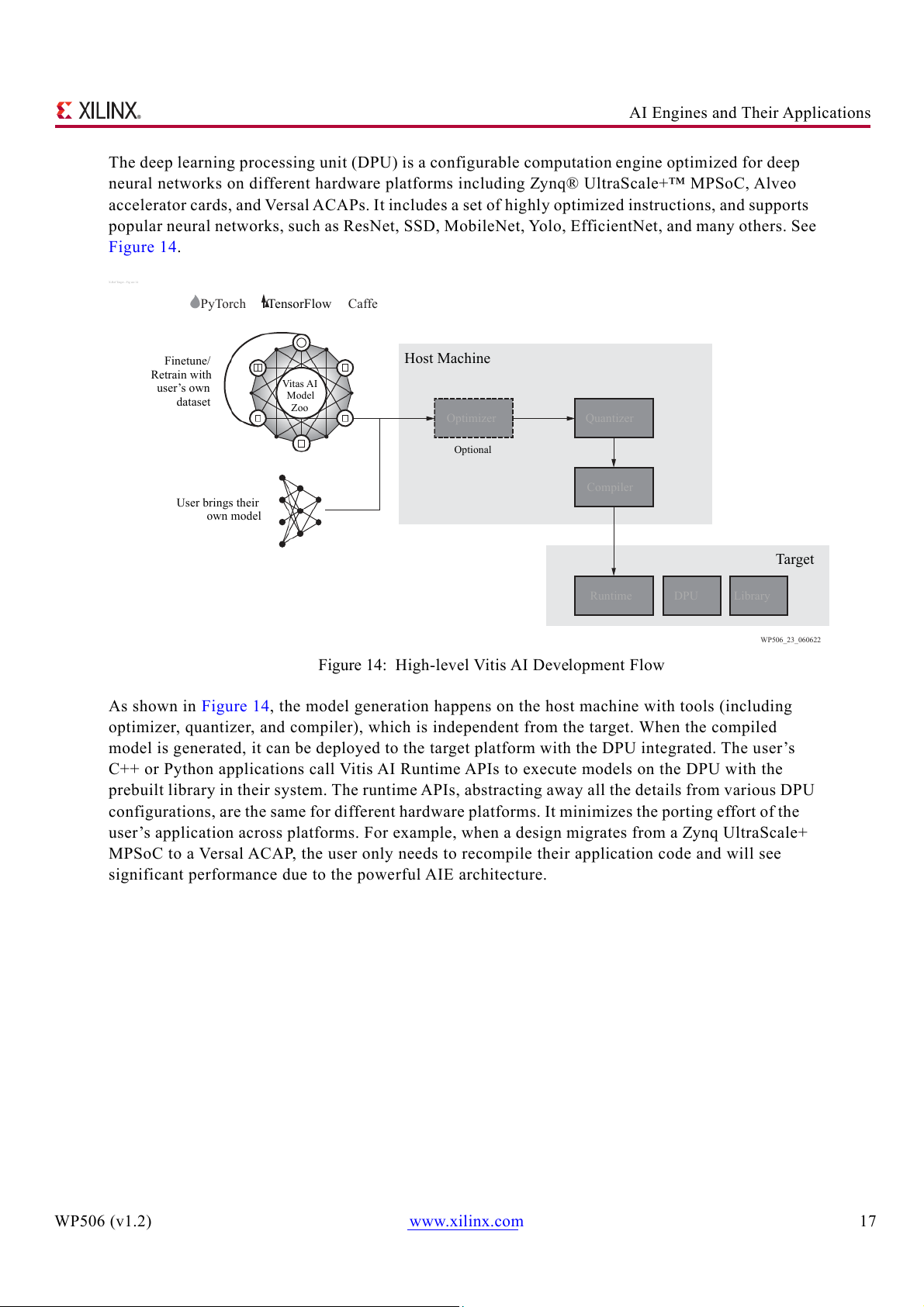
The deep learning processing unit (DPU) is a configurable computation engine optimized for deep
neural networks on different hardware platforms including Zynq® UltraScale+™ MPSoC, Alveo
accelerator cards, and Versal ACAPs. It includes a set of highly optimized instructions, and supports
popular neural networks, such as ResNet, SSD, MobileNet, Yolo, EfficientNet, and many others. See Figure 14. X-Ref Target - Fig ure 14 PyTorch TensorFlow Caffe Finetune/ Host Machine Retrain with user’s own Vitas AI dataset Model Zoo Optimizer Quantizer Optional Compiler User brings their own model Target Runtime DPU Library WP506_23_060622
Figure 14: High-level Vitis AI Development Flow
As shown in Figure 14, the model generation happens on the host machine with tools (including
optimizer, quantizer, and compiler), which is independent from the target. When the compiled
model is generated, it can be deployed to the target platform with the DPU integrated. The user’s
C++ or Python applications call Vitis AI Runtime APIs to execute models on the DPU with the
prebuilt library in their system. The runtime APIs, abstracting away all the details from various DPU
configurations, are the same for different hardware platforms. It minimizes the porting effort of the
user’s application across platforms. For example, when a design migrates from a Zynq UltraScale+
MPSoC to a Versal ACAP, the user only needs to recompile their application code and will see
significant performance due to the powerful AIE architecture. WP506 (v1.2) www.xilinx.com 17
AI Engines and Their Applications Summary
AI Engines represent a new class of high-performance compute. Integrated within a Versal-class
device, the AI Engine can be optimally combined with PL and PS to implement high-complexity
systems in a single Xilinx ACAP. Real-time systems require deterministic behavior, which the
AI Engine delivers through a combination of architecture features such as dedicated data and
programming memories, DMA and Locks, and compiler tools.
AI Engines deliver three to eight times better silicon area compute density when compared with
traditional programmable logic DSP and ML implementations, while reducing power consumption
by nominally 50%. A C/C++ programming paradigm raises the level of abstraction and promises to
significantly increase the developer's productivity.
System performance scalability is provided through a family of devices, ranging from small devices
with 30 AI Engines and 80K LUTs to devices with 400 AI Engines and nearly a million LUTs. Package
footprint compatibility between these devices enables migration within the product family to meet
varying performance and price targets. For more information, go to:
WP505, Versal: The First Adaptive Compute Acceleration Platform (ACAP)
WP504, Accelerating DNNs with Xilinx Alveo™ Accelerator Cards WP506 (v1.2) www.xilinx.com 18
AI Engines and Their Applications Revision History
The following table shows the revision history for this document: Date Version Description of Revisions 12/16/2022 1.2
Added AIE-ML and Vitis AI software environment information throughout document. 07/10/2020 1.1 Updated Figure 5. 10/03/2018 1.0.2 Editorial updates only. 10/02/2018 1.0.1 Editorial updates only. 10/02/2018 1.0 Initial Xilinx release. Disclaimer
The information disclosed to you hereunder (the “Materials”) is provided solely for the selection and use of Xilinx
products. To the maximum extent permitted by applicable law: (1) Materials are made available “AS IS” and with all faults,
Xilinx hereby DISCLAIMS ALL WARRANTIES AND CONDITIONS, EXPRESS, IMPLIED, OR STATUTORY, INCLUDING BUT NOT
LIMITED TO WARRANTIES OF MERCHANTABILITY, NON-INFRINGEMENT, OR FITNESS FOR ANY PARTICULAR PURPOSE;
and (2) Xilinx shall not be liable (whether in contract or tort, including negligence, or under any other theory of liability)
for any loss or damage of any kind or nature related to, arising under, or in connection with, the Materials (including your
use of the Materials), including for any direct, indirect, special, incidental, or consequential loss or damage (including loss
of data, profits, goodwill, or any type of loss or damage suffered as a result of any action brought by a third party) even
if such damage or loss was reasonably foreseeable or Xilinx had been advised of the possibility of the same. Xilinx
assumes no obligation to correct any errors contained in the Materials or to notify you of updates to the Materials or to
product specifications. You may not reproduce, modify, distribute, or publicly display the Materials without prior written
consent. Certain products are subject to the terms and conditions of Xilinx’s limited warranty, please refer to Xilinx’s
Terms of Sale which can be viewed at http://www.xilinx.com/legal.htm#tos; IP cores may be subject to warranty and
support terms contained in a license issued to you by Xilinx. Xilinx products are not designed or intended to be fail-safe
or for use in any application requiring fail-safe performance; you assume sole risk and liability for use of Xilinx products
in such critical applications, please refer to Xilinx’s Terms of Sale which can be viewed at http://www.xilinx.com/ legal.htm#tos.
Automotive Applications Disclaimer
AUTOMOTIVE PRODUCTS (IDENTIFIED AS “XA” IN THE PART NUMBER) ARE NOT WARRANTED FOR USE IN THE
DEPLOYMENT OF AIRBAGS OR FOR USE IN APPLICATIONS THAT AFFECT CONTROL OF A VEHICLE (“SAFETY
APPLICATION”) UNLESS THERE IS A SAFETY CONCEPT OR REDUNDANCY FEATURE CONSISTENT WITH THE ISO 26262
AUTOMOTIVE SAFETY STANDARD (“SAFETY DESIGN”). CUSTOMER SHALL, PRIOR TO USING OR DISTRIBUTING ANY
SYSTEMS THAT INCORPORATE PRODUCTS, THOROUGHLY TEST SUCH SYSTEMS FOR SAFETY PURPOSES. USE OF
PRODUCTS IN A SAFETY APPLICATION WITHOUT A SAFETY DESIGN IS FULLY AT THE RISK OF CUSTOMER, SUBJECT ONLY
TO APPLICABLE LAWS AND REGULATIONS GOVERNING LIMITATIONS ON PRODUCT LIABILITY.
© 2018–2022 Advanced Micro Devices, Inc. All rights reserved. AMD, the AMD Arrow logo, Xilinx, the Xilinx logo, Alveo,
Artix, Kintex, Kria, Spartan, Versal, Vitis, Virtex, Vivado, Zynq, and combinations thereof are trademarks of Advanced
Micro Devices, Inc. Other product names used in this publication are for identification purposes only and may be
trademarks of their respective owners. AMBA, AMBA Designer, Arm, ARM1176JZ-S, CoreSight, Cortex, PrimeCell, Mali,
and MPCore are trademarks of Arm Limited in the EU and other countries. PCI, PCIe and PCI Express are trademarks of
PCI-SIG and used under license. MATLAB and Simulink are registered trademarks of The MathWorks, Inc. WP506 (v1.2) www.xilinx.com 19
Tài liệu liên quan:
-
Báo cáo Thực Tập Cơ Bản: Linh Kiện và IC Trong Mạch Điện | Thực tập cơ bản | Trường Đại học Bách khoa Hà Nội
41 21 -
Báo cáo Thực Tập Cơ Bản: Thiết Kế Mạch Điện Tử | Thực tập cơ bản | Trường Đại học Bách khoa Hà Nội
34 17 -
Báo cáo về Chủ nghĩa Xã hội Khoa học và Vai trò của C. Mác - Ph. Ăngghen | Thực tập cơ bản | Trường Đại học Bách khoa Hà Nội
40 20 -
Báo cáo Thực Tập Cơ Bản: Thiết Kế Mạch Đếm Thuận 0-9 Bằng Altium | Thực tập cơ bản | Trường Đại học Bách khoa Hà Nội
34 17 -
Báo cáo thực tập Mạch khuếch đại âm tần - Điện tử | Thực tập cơ bản | Trường Đại học Bách khoa Hà Nội
35 18